

SIST EN 18071:2026
(Main)Inland navigation vessels - Methanol bunkering
General Information
- Abstract
This document specifies requirements for methanol bunkering transfer systems to and from inland navigation vessels. The various scenarios for the bunker facility operator concern land, truck and vessel (barge). It concerns design, dimensions and technical requirements for the transfer of methanol, including the nozzle, connection, inner and outer flanges and failsafe features.
This document also specifies the process and procedures for the bunkering operations, as well as responsibilities and risk assessment scope, taking into consideration the specific hazards in handling and bunkering methanol fuel. Next to this, the requirement for the methanol provider to provide a bunker delivery note and training and qualification of personnel involved.
This document is not applicable to cargo operations.
- Status
- Published
- Public Enquiry End Date
- 22-Oct-2024
- Publication Date
- 17-Nov-2025
- Technical Committee
- I13 - Imaginarni 13
- Current Stage
- 6060 - National Implementation/Publication (Adopted Project)
- Start Date
- 14-Nov-2025
- Due Date
- 19-Jan-2026
- Completion Date
- 18-Nov-2025

Overview
EN 18071:2025 (CEN) - "Inland navigation vessels - Methanol bunkering" specifies safety, design and operational requirements for methanol bunkering of inland navigation vessels. It covers methanol transfer systems between land, truck and bunker vessels (barge) and the receiving vessel manifold. The standard addresses transfer equipment (nozzles, couplings, inner/outer flanges), failsafe features, emergency shutdown (ESD) links, procedural controls, risk assessment and personnel training. EN 18071:2025 is intended to harmonize bunkering practices across Europe and supports regulatory frameworks such as ES-TRIN.
Key Topics
- Transfer system design and technical requirements: design, dimensions and materials for nozzles, flanges, couplings and transfer arms or hoses; identification and maintenance requirements for methanol transfer systems.
- Failsafe features and emergency systems: requirements for Emergency Shut Down (ESD) systems and safety dry break‑away couplings (SBC) to limit spillage and mechanical loads during disconnection or pull‑away events.
- Operational procedures and controlled zones: defined procedures for safe bunkering operations, mooring, vapour management and establishment of safety and controlled zones during transfer.
- Risk assessment and safety management: scope and methodology for assessing methanol‑specific hazards, acceptable operational parameters and vessel safety assessments prior to bunkering.
- Documentation and traceability: requirement for a Bunker Delivery Note (BDN) specifying quantity and quality, procedures manuals and maintenance documentation.
- Personnel training and qualifications: training and record requirements for vessel crews, bunker facility personnel, hose/watch and manifold/watch roles in line with ES-QIN and safety management systems.
- Maintenance and inspection: maintenance manuals and inspection criteria to ensure ongoing compliance and safe operation of transfer systems.
Applications
EN 18071 is practical for:
- Vessel owners/operators converting or operating inland navigation vessels on methanol fuel.
- Bunker facility operators (fixed terminals, truck, train or barge suppliers) designing transfer interfaces and operational procedures.
- Port authorities, inspection bodies and classification societies enforcing compliance and conducting inspections.
- Designers and equipment manufacturers producing methanol‑compatible nozzles, flanges, hoses, couplings and ESD interfaces.
- Training organizations developing qualification programs and records for bunkering personnel.
Use cases include designing compliant bunkering manifolds, defining site procedures and checklists, conducting risk assessments, and producing compliant BDNs for methanol fuel deliveries.
Related Standards (if applicable)
- EN ISO 20519 - bunkering of LNG-fuelled vessels (reference model)
- EN 13765, EN 12115 - hose and hose assembly specifications
- EN 1092-1 - flanges and joints
- EN 14420-6 - tank truck couplings
- EN IEC 60309-1 - industrial plugs/sockets
- ASTM F1122-22 - quick disconnect couplings
- ES-TRIN, ES-QIN - inland navigation technical requirements and qualifications
Keywords: EN 18071, methanol bunkering, inland navigation vessels, bunkering transfer systems, Bunker Delivery Note, ESD, safety dry break‑away coupling, risk assessment, personnel training.
Relations
- Effective Date
- 09-Feb-2026
- Effective Date
- 28-Jan-2026
- Effective Date
- 28-Jan-2026
- Effective Date
- 28-Jan-2026
- Effective Date
- 28-Jan-2026
Get Certified
Connect with accredited certification bodies for this standard

DNV
DNV is an independent assurance and risk management provider.

Lloyd's Register
Lloyd's Register is a global professional services organisation specialising in engineering and technology.

Element Materials Technology
Materials testing and product certification.
Sponsored listings
Frequently Asked Questions
SIST EN 18071:2026 is a standard published by the Slovenian Institute for Standardization (SIST). Its full title is "Inland navigation vessels - Methanol bunkering". This standard covers: This document specifies requirements for methanol bunkering transfer systems to and from inland navigation vessels. The various scenarios for the bunker facility operator concern land, truck and vessel (barge). It concerns design, dimensions and technical requirements for the transfer of methanol, including the nozzle, connection, inner and outer flanges and failsafe features. This document also specifies the process and procedures for the bunkering operations, as well as responsibilities and risk assessment scope, taking into consideration the specific hazards in handling and bunkering methanol fuel. Next to this, the requirement for the methanol provider to provide a bunker delivery note and training and qualification of personnel involved. This document is not applicable to cargo operations.
This document specifies requirements for methanol bunkering transfer systems to and from inland navigation vessels. The various scenarios for the bunker facility operator concern land, truck and vessel (barge). It concerns design, dimensions and technical requirements for the transfer of methanol, including the nozzle, connection, inner and outer flanges and failsafe features. This document also specifies the process and procedures for the bunkering operations, as well as responsibilities and risk assessment scope, taking into consideration the specific hazards in handling and bunkering methanol fuel. Next to this, the requirement for the methanol provider to provide a bunker delivery note and training and qualification of personnel involved. This document is not applicable to cargo operations.
SIST EN 18071:2026 is classified under the following ICS (International Classification for Standards) categories: 47.020.30 - Piping systems; 47.020.85 - Cargo spaces; 47.060 - Inland navigation vessels; 75.200 - Petroleum products and natural gas handling equipment. The ICS classification helps identify the subject area and facilitates finding related standards.
SIST EN 18071:2026 has the following relationships with other standards: It is inter standard links to SIST EN IEC 60309-1:2022, SIST EN 14420-6:2013, SIST EN 1092-1:2018, SIST EN 13765:2018, SIST EN 12115:2021. Understanding these relationships helps ensure you are using the most current and applicable version of the standard.
SIST EN 18071:2026 is associated with the following European legislation: EU Directives/Regulations: 2014/94/EU, 2023/1804, 2023/1804-1; Standardization Mandates: M/581. When a standard is cited in the Official Journal of the European Union, products manufactured in conformity with it benefit from a presumption of conformity with the essential requirements of the corresponding EU directive or regulation.
SIST EN 18071:2026 is available in PDF format for immediate download after purchase. The document can be added to your cart and obtained through the secure checkout process. Digital delivery ensures instant access to the complete standard document.
Standards Content (Sample)
SLOVENSKI STANDARD
01-januar-2026
Plovila za celinske vode - Oskrba z metanolom
Inland navigation vessels - Methanol bunkering
Fahrzeuge der Binnenschifffahrt - Bunkerung von Methanol
Bateaux de navigation intérieure - Avitaillement en méthanol
Ta slovenski standard je istoveten z: EN 18071:2025
ICS:
47.060 Jezerska in rečna plovila Inland navigation vessels
75.200 Oprema za skladiščenje Petroleum products and
nafte, naftnih proizvodov in natural gas handling
zemeljskega plina equipment
2003-01.Slovenski inštitut za standardizacijo. Razmnoževanje celote ali delov tega standarda ni dovoljeno.
EN 18071
EUROPEAN STANDARD
NORME EUROPÉENNE
November 2025
EUROPÄISCHE NORM
ICS 47.020.30; 47.060 Supersedes CWA 17540:2020
English Version
Inland navigation vessels - Methanol bunkering
Bateaux de navigation intérieure - Avitaillement en Fahrzeuge der Binnenschifffahrt - Bunkerung von
méthanol Methanol
This European Standard was approved by CEN on 8 September 2025.
CEN members are bound to comply with the CEN/CENELEC Internal Regulations which stipulate the conditions for giving this
European Standard the status of a national standard without any alteration. Up-to-date lists and bibliographical references
concerning such national standards may be obtained on application to the CEN-CENELEC Management Centre or to any CEN
member.
This European Standard exists in three official versions (English, French, German). A version in any other language made by
translation under the responsibility of a CEN member into its own language and notified to the CEN-CENELEC Management
Centre has the same status as the official versions.
CEN members are the national standards bodies of Austria, Belgium, Bulgaria, Croatia, Cyprus, Czech Republic, Denmark, Estonia,
Finland, France, Germany, Greece, Hungary, Iceland, Ireland, Italy, Latvia, Lithuania, Luxembourg, Malta, Netherlands, Norway,
Poland, Portugal, Republic of North Macedonia, Romania, Serbia, Slovakia, Slovenia, Spain, Sweden, Switzerland, Türkiye and
United Kingdom.
EUROPEAN COMMITTEE FOR STANDARDIZATION
COMITÉ EUROPÉEN DE NORMALISATION
EUROPÄISCHES KOMITEE FÜR NORMUNG
CEN-CENELEC Management Centre: Rue de la Science 23, B-1040 Brussels
© 2025 CEN All rights of exploitation in any form and by any means reserved Ref. No. EN 18071:2025 E
worldwide for CEN national Members.
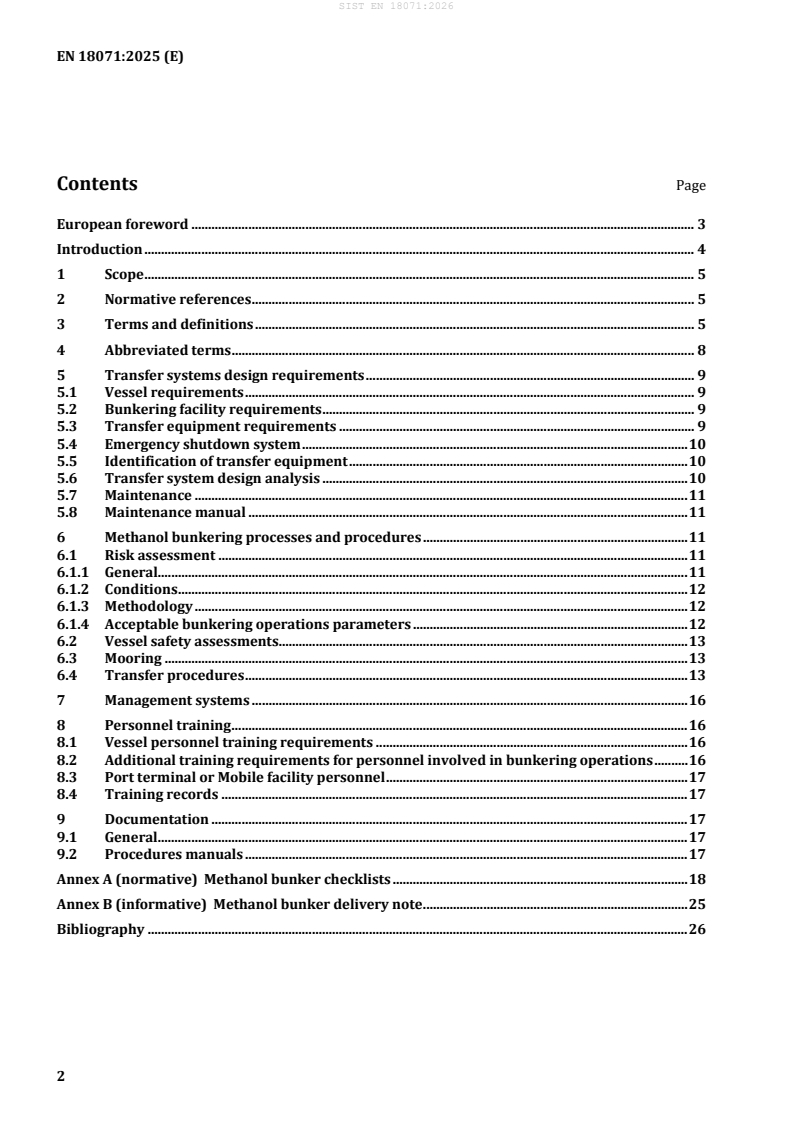
Contents Page
European foreword . 3
Introduction . 4
1 Scope . 5
2 Normative references . 5
3 Terms and definitions . 5
4 Abbreviated terms . 8
5 Transfer systems design requirements . 9
5.1 Vessel requirements . 9
5.2 Bunkering facility requirements . 9
5.3 Transfer equipment requirements . 9
5.4 Emergency shutdown system . 10
5.5 Identification of transfer equipment . 10
5.6 Transfer system design analysis . 10
5.7 Maintenance . 11
5.8 Maintenance manual . 11
6 Methanol bunkering processes and procedures . 11
6.1 Risk assessment . 11
6.1.1 General. 11
6.1.2 Conditions . 12
6.1.3 Methodology . 12
6.1.4 Acceptable bunkering operations parameters . 12
6.2 Vessel safety assessments. 13
6.3 Mooring . 13
6.4 Transfer procedures . 13
7 Management systems . 16
8 Personnel training . 16
8.1 Vessel personnel training requirements . 16
8.2 Additional training requirements for personnel involved in bunkering operations . 16
8.3 Port terminal or Mobile facility personnel . 17
8.4 Training records . 17
9 Documentation . 17
9.1 General. 17
9.2 Procedures manuals . 17
Annex A (normative) Methanol bunker checklists . 18
Annex B (informative) Methanol bunker delivery note . 25
Bibliography . 26
European foreword
This document (EN 18071:2025) has been prepared by Technical Committee CEN/TC 15 “Inland
navigation vessels”, the secretariat of which is held by DIN.
This European Standard shall be given the status of a national standard, either by publication of an
identical text or by endorsement, at the latest by May 2026, and conflicting national standards shall be
withdrawn at the latest by May 2026.
Attention is drawn to the possibility that some of the elements of this document may be the subject of
patent rights. CEN shall not be held responsible for identifying any or all such patent rights.
This document supersedes CWA 17540:2020.
This document has been prepared under a standardization request M/581 addressed to CEN by the
European Commission. The Standing Committee of the EFTA States subsequently approves these
requests for its Member States.
Any feedback and questions on this document should be directed to the users’ national standards body.
A complete listing of these bodies can be found on the CEN website.
According to the CEN-CENELEC Internal Regulations, the national standards organisations of the
following countries are bound to implement this European Standard: Austria, Belgium, Bulgaria, Croatia,
Cyprus, Czech Republic, Denmark, Estonia, Finland, France, Germany, Greece, Hungary, Iceland, Ireland,
Italy, Latvia, Lithuania, Luxembourg, Malta, Netherlands, Norway, Poland, Portugal, Republic of North
Macedonia, Romania, Serbia, Slovakia, Slovenia, Spain, Sweden, Switzerland, Türkiye and the United
Kingdom.
Introduction
Methanol also known as methyl alcohol is a polar covalent hydrocarbon fuel that can be made from non-
fossil sources and is very clean burning when compared to conventional marine fuels. Therefore
methanol is increasingly being used as sustainable fuel for vessels for environmental reasons. Its usage
is expected to expand significantly in the future. Therefore, there is a need to standardize the bunkering
requirements for inland navigation vessels to a reasonable degree, so that vessel operators have the tools
to select vessel fuel providers that meet set safety and fuel quality standards, in order to conduct
methanol bunkering operations safely.
This European Standard specifies safety requirements for methanol bunkering within the meaning of
European Parliament and Council Directive (EU) 2016/1629 of 14 September 2016 laying down technical
requirements for inland waterway vessels.
This document on the bunkering of methanol is based on research outcome of the Workshop CEN/WS
106 ‘Specification for bunkering of methanol’ in which was developed the CWA 17540 ‘Ships and marine
technology – Specification for bunkering of methanol fuelled vessels’. Next to this as a reference is used
the existing standard EN ISO 20519 ‘Ships and marine technology – Specification for bunkering of
liquefied natural gas fuelled vessels’.
1 Scope
This document specifies requirements for methanol bunkering transfer systems to and from inland
navigation vessels. The various scenarios for the bunker facility operator concern land, truck and vessel
(barge). It concerns design, dimensions and technical requirements for the transfer of methanol,
including the nozzle, connection, inner and outer flanges and failsafe features.
This document also specifies the process and procedures for the bunkering operations, as well as
responsibilities and risk assessment scope, taking into consideration the specific hazards in handling and
bunkering methanol fuel. Next to this, the requirement for the methanol provider to provide a bunker
delivery note and training and qualification of personnel involved.
This document is not applicable to cargo operations.
2 Normative references
The following documents are referred to in the text in such a way that some or all of their content
constitutes requirements of this document. For dated references, only the edition cited applies. For
undated references, the latest edition of the referenced document (including any amendments) applies.
EN 13765:2018, Thermoplastic multi-layer (non-vulcanized) hoses and hose assemblies for the transfer of
hydrocarbons, solvents and chemicals - Specification
EN 12115:2021, Rubber and thermoplastics hoses and hose assemblies for liquid or gaseous chemicals -
Specification
EN 1092-1:2018, Flanges and their joints - Circular flanges for pipes, valves, fittings and accessories, PN
designated - Part 1: Steel flanges
ASTM F1122-22, Standard specification for Quick Disconnect Couplings (6 in. NPS and smaller)
EN 14420-6:2013, Hose fittings with clamp units - Part 6: TW tank truck couplings
EN IEC 60309-1, Plugs, fixed or portable socket-outlets and appliance inlets for industrial purposes - Part 1:
General requirements
ES-TRIN:2025, European Standard for laying down Technical Requirements for Inland Navigation vessels
ES-QIN, European Standard for Qualifications in Inland Navigation
3 Terms and definitions
For the purposes of this document, the following terms and definitions apply.
ISO and IEC maintain terminology databases for use in standardization at the following addresses:
— ISO Online browsing platform: available at https://www.iso.org/obp/
— IEC Electropedia: available at https://www.electropedia.org/
3.1
bunker
vessel fuel primarily used to produce power for propulsion, heating and generating electricity through
combustion in machinery and equipment onboard
3.2
bunkering
transfer of bunker from land-based or floating facilities into a vessel’s permanent tanks or connection of
portable tanks to the vessel’s fuel supply system
3.3
bunkering agreement
contractual agreement applying to a bunker transfer
3.4
bunker delivery note
BDN
official document from the bunker facility operator providing information on the quantity, quality and
type of the fuel delivered to the vessel
3.5
bunkering operation supervisor
qualified person from the receiving vessel and at the methanol supplying facility (truck, train, bunker
vessel or bunker terminal) assigned with overall responsibility for bunkering operations
3.6
manifold watch
qualified person from the receiving vessel tasked with monitoring the transfer system
3.7
hose watch
qualified persons nominated by the bunker facility operator (truck, train, bunker vessel or bunker
terminal) to maintain a watch on the fuel supply side of the transfer system
3.8
bunker vessel
barge or tanker used for the delivery of fuel to the receiving vessel
3.9
bunker terminal
fixed facility on or near shore which can deliver fuel to the receiving vessel
3.10
truck
road tanker used for the delivery of fuel to the receiving vessel
3.11
train
rail vehicle used for the delivery of fuel to the receiving vessel
3.12
inspection
process in which the design and the condition of a vessel is evaluated to determine its compliance with
rules and standards
3.13
inspection body
competent authority assisting in the uniform and effective implementation of inland vessel navigation
codes and regulations, in charge to determine the compliance of the vessel with the requirements
3.14
controlled zone
area extending from the bunker manifold on the receiving vessel to the supply source (road tanker,
bunker vessel or bunker terminal) during the bunker operation which can have restrictions in place
3.15
safety dry break-away coupling
SBC
coupling that provides a safe release and isolation between the receiving vessel and the delivering vessel
or facility with a minimum of spill so as to protect the bunker equipment from advertent excessive loads
(pull away accidents)
3.16
facility
infrastructure used for storage and/or transfer of methanol
3.17
emergency shut down system
ESD
system that safely and effectively stops the transfer of fuel between the receiving vessel and the
delivering vessel or shore-based facility
3.18
safety management system
SMS
set of procedures an organisation needs to follow in order to meet its safety objectives
3.19
safety data sheet
SDS
detailed information bulletins prepared by the manufacturer or importer of a chemical that describes the
physical and chemical properties, physical and health hazards, routes of exposure, precautions for safe
handling and use, emergency and first-aid procedures, and control measures
3.20
methanol transfer system
equipment between the delivering facility and the bunker manifold on the receiving vessel
Note 1 to entry: Such equipment can include vessel to vessel transfer hoses, transfer arms, safety dry break-away
coupling (SBC), flanges, couplings. In addition, this includes the ESD vessel/shore or vessel/vessel link used to
connect the receiving and supplying ESD systems.
3.21
technical standard
standard that prescribe requirements for one or more of the following: operations, equipment
design/fabrications or testing methodology
3.22
transfer arm
bunker system of rigid pipe sections connected by swivelling joints, often combined with flexible hose
sections that together comprise an articulated system for transferring fuel to a vessel being bunkered
3.23
static electricity
electricity produced by movement between dissimilar materials through physical contact and separation
3.24
safety zone
area around the bunkering facility where only dedicated and essential personnel and activities are
allowed during bunkering
3.25
vapour management
treatment process of methanol vapour
Note 1 to entry: The treatment process is vapour recovery – inerting with nitrogen – vent.
4 Abbreviated terms
For the purpose of this document, the following abbreviated terms apply:
Term Description Explanation
CCNR Central Commission for the The Central Commission for the Navigation of the Rhine
navigation of the Rhine (CCNR) is an international organization (Belgium, France,
Germany, Switzerland and The Netherlands) that exercises an
essential regulatory role in the navigation of the Rhine. It is
active in the technical, legal, economic and environmental
fields. In all its areas of action, its work is guided by the
efficiency of transport on the Rhine, safety, social
considerations, and respect for the environment.
ES-TRIN European Standard laying Technical standards adopted by the European Committee
down Technical for drawing up standards in the field of inland navigation
Requirements for Inland (CESNI) in various areas, in particular standards for
Navigation vessels technical requirements for vessels, professional
qualifications, and information technologies. A vessel
operating on EU waterways or Rhine shall carry either a
Union inland navigation certificate or a Rhine vessel
inspection certificate. Both certificates are issued by the
competent national authorities (inspection bodies) and
confirm the full compliance of the vessel with the technical
requirements (ES-TRIN). ES-TRIN is binding in accordance
with Directive (EU) 2016/1629 and CCNR’s Rhine vessel
inspection regulations.
ES-QIN European standard for A set of standards, the so-called ‘Prague Standards’, adopted
qualification in inland in 2019 and divided into 5 main parts as follows: (1)
navigation standards for competences, (2) standards for practical
examinations, (3) standards for the approval of simulators,
(4) standards for medical fitness and (5) standards for
models of crew-related documents.
Term Description Explanation
IMO International Maritime A specialized agency of the United Nations whose purpose is
Organization “to provide machinery for cooperation among governments
in the field of governmental regulation and practices
relating to technical matters of all kinds affecting shipping
engaged in international trade; to encourage and facilitate
the general adoption of the highest practicable standards in
matters concerning efficiency of navigation, and prevention
and control of marine pollution from ships.”
5 Transfer systems design requirements
5.1 Vessel requirements
5.1.1 In order to be compliant with this document, vessels involved in methanol bunkering operations
shall meet the requirements in 5.1.2. These requirements apply to vessels of all sizes, in domestic as well
as international service.
5.1.2 Bunkering vessels and receiving vessels shall conform with this document and be approved by its
Inspection Body or competent authority complying with the applicable uniform interpretations and
requirements according to ES-TRIN.
NOTE In case of a receiving sea-going ship, it can meet at that end ISO standards (ISO/DIS 22120 ‘Specification
for bunkering methanol fuelled vessels’ under development), and therefore as a minimum, the applicable
requirements of the IGF Code (IMO) and IMO Interim Guidelines for the safety of ships using methyl/ethyl as fuel
(see bibliography [10] and [8]).
5.2 Bunkering facility requirements
5.2.1 Mobile facilities such as road tankers, rail tank cars and portable tanks, piping, hoses, pumps and
valves shall be fabricated and conform to meet applicable standard recognized by national standard
bodies, for handling methanol.
NOTE For more information about requirements, see ES-TRIN.
5.2.2 The bunker vessels shall conform to local codes for handling methanol.
5.2.3 The bunker terminal shall conform to local codes for handling methanol.
5.3 Transfer equipment requirements
5.3.1 All components of the methanol transfer system shall be fabricated to meet or exceed
requirements as specified in ES-TRIN, including methanol vapour management. Transfer hoses shall
meet the requirements of EN 13765:2018 or EN 12115:2021 with a minimum working pressure of 14
bar and shall be used for methanol transfer only. In addition to marking as specified in European
standards EN 13765:2018 and EN 12115:2021 methanol transfer hoses shall be permanently and legible
marked “FOR METHANOL TRANSFER ONLY”. For transfer hoses according EN 12115:2021 Grade Ω/T is
recommended.
NOTE In case of a receiving sea-going ship at that end it can meet or exceed IGF Code (IMO) and IBC Code (IMO)
Chapter 5 (see bibliography [10] and [9]).
5.3.2 The application of the methanol transfer system/hose with an ESD and a safety dry break-away
coupling (SBC) shall be considered in a risk assessment as described in Clause 6 of this document,
including methanol vapour management.
5.4 Emergency shutdown system
5.4.1 The methanol transfer system shall be connected to an emergency shut down system (ESD). The
delivering facility and the receiving vessel ESD system shall be interconnected with a vessel/shore or a
vessel/vessel ESD link to ensure the coordinated operation of both the delivering and the receiving
systems.
5.4.2 The ESD shall be designed to be activated by operator-initiated signal as well as sensor input. The
ESD shall stop the methanol transfer pumps and close the ESD valves.
At least the signal of the high-high level sensor shall be transmitted to the bunkering station by means of
a watertight connection plug meeting the requirements of EN IEC 60309-1.
NOTE As an example the ESD could be activated upon input in the event of: leakage detection (either leakage
in liquid form or as vapor), overfilling of the receiving methanol tank indicated by the high high-level alarm, vessel
drifting out of position, transfer arm (if any) being overstressed, fire detection and any other situations or alarms
which can endanger the bunkering operation.
5.5 Identification of transfer equipment
The methanol provider shall supply a list of equipment for use during bunkering operations, including
pertinent operating parameters. The list shall comprise:
a) connection types and sizes to which connection is possible;
All flanges used in the transfer system shall be in accordance with EN 1092-1:2018 and the coupling
of the bunkering system shall be in accordance with EN 14420-6:2013, if dry disconnect couplings of
up to and including 6 inches are used, the dimensions and tolerances shall be in accordance with
ASTM F1122-22 to meet compatibility requirements;
NOTE The coupling can be of the type safety dry break-away (SBC) as an outcome of the risk assessment in
Clause 6 in accordance with ES-TRIN.
b) ESD system or systems to be used;
c) maximum and minimum flow rates by pumps;
d) maximum and minimum working pressure of the transfer arm/hose;
e) maximum expected pressure the transfer system could experience during the bunkering operation
or in the event an emergency break-away release system is triggered, or ESD is activated.
5.6 Transfer system design analysis
Any fuel transfer system intended for bunkering methanol shall be analysed by qualified personnel or
other competent organization. Confirmation that the following critical design criteria can be met and also
sufficiently documented by a qualified engineer shall be given:
— that individual components are manufactured to appropriate industry standards;
— that any components used in assemblies are compatible in terms of construction materials and
functionality;
— the transfer system will operate within its design parameters;
— that controls have been made to ensure the transferring system will not be subjected to loads in
excess of acceptable design limits;
— that a full list of components listed along with information specified in 6.4.8 has been provided;
— that all sensors, manometers etc. should be possible to isolate;
— a procedure for vapour management shall have been determined or specified by the competent
parties.
5.7 Maintenance
Equipment shall be maintained and inspected according to the recommendations of the manufacturers.
The recommendations are stated in either the manufacturer manual or the operation manual. Equipment
certified by competent authorities shall be inspected and maintained according to these bodies' rules.
5.8 Maintenance manual
A maintenance manual shall be kept regarding the transferring system. The manual shall contain a listing
of each piece of equipment in the transferring system. The manual shall contain a list of the maintenance
procedures and inspections as specified by the competent personal or authority. A record of all
maintenance and inspections at least over the last 36 months shall be maintained.
6 Methanol bunkering processes and procedures
6.1 Risk assessment
6.1.1 General
The decision to allow a designated methanol bunkering area remains within the discretion of the port
and/or the competent authority. However, there is a need to determine if the proposed bunkering
location is acceptable from safety aspects.
A risk assessment shall be conducted and documented before bunkering operations can be allowed at a
specific location. The risk assessment shall be carried out by the competent authority having jurisdiction
over safety and security at the bunkering site. The assessment will remain valid as long as conditions and
presumptions remain unchanged. Upon changes the assessment shall be revised or performed again. Risk
assessments shall always be approved by the competent administration under whose jurisdiction the
bunkering operation is taking place.
When performing the risk assessment for methanol bunkering operations, physical and chemical
characteristics of methanol should be considered, including but not limited to:
— invisible burning behaviour of methanol flames in daylighting conditions;
NOTE In some daylight conditions with overcast skies there can be weak blue flames visible.
— barely visible behaviour of flames in indoor conditions;
— propensity to form flammable and explosive vapour cloud that can create overpressures in confined
spaces;
— corrosiveness which could lead to damage and reduction of material strength if incompatible
materials are selected for components for use, storage and transport systems;
— possibility of ‘running’ fires that result from spillage and improper containment of the spillage in case
of fire.
6.1.2 Conditions
As a minimum the risk assessment shall consider the following:
— proximity of the bunkering location to areas where personnel or other individuals and/or public can
be expected;
— measures for monitoring marine traffic that could impact bunkering operations are suitable and the
mechanism for passing traffic information to bunkering supervisors is robust and effective;
— measu
...