

SIST-TP CEN/TR 18276:2026
(Main)Checklist of compliance of building automation with EPBD requirements
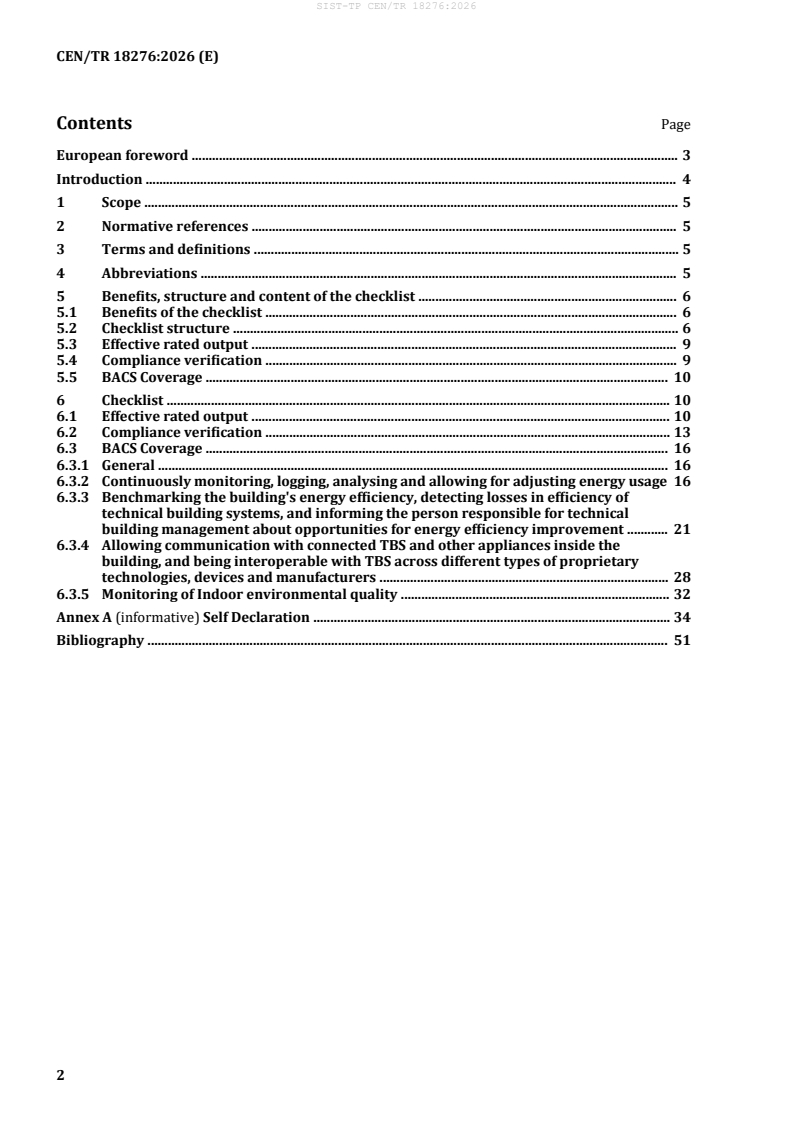
General Information
- Abstract
This document is a clear, effective and applicable guideline for demonstrating the performance of building automation and control systems (BACS) in non-residential buildings that fall within the scope of the European Directive Energy Performance of Building - EPBD (EU) 2024/1275 [1].
It has been developed for national policy makers, building planners, building owners and building inspectors to support them in planning new buildings and evaluating existing ones.
- Status
- Published
- Publication Date
- 22-Feb-2026
- Technical Committee
- OGS - Heating for buildings
- Current Stage
- 6060 - National Implementation/Publication (Adopted Project)
- Start Date
- 18-Feb-2026
- Due Date
- 25-Apr-2026
- Completion Date
- 23-Feb-2026

Overview
SIST-TP CEN/TR 18276:2026 - Checklist of compliance of building automation with EPBD requirements offers a comprehensive, practical guideline for assessing the conformity of Building Automation and Control Systems (BACS) in non-residential buildings with the European Union's Energy Performance of Buildings Directive (EPBD) (EU) 2024/1275. Developed by the European Committee for Standardization (CEN) Technical Committee TC 247, this technical report aims to support national policy makers, building planners, owners, and inspectors in planning, evaluating, and ensuring that BACS implementations meet legislative energy performance requirements.
This checklist enables effective compliance verification, supporting the EU's transition to sustainable, energy-efficient buildings and low-carbon economies. By clarifying mandatory requirements and providing a structured assessment process, the standard helps ensure optimized building operations and improved indoor environmental quality.
Key Topics
BACS Scope and Eligibility
The checklist applies to non-residential buildings with heating, air-conditioning, or ventilation systems exceeding rated output thresholds set by EPBD:- Over 290 kW by 31 December 2024
- Over 70 kW by 31 December 2029
Compliance Structure and Verification
The compliance checklist includes:- Self-declaration items for building owners
- Supporting records for documentation
- Verification worksheets for inspectors
- Boundary/prerequisite guidance for optimal BACS use
EPBD Functional Requirements
Buildings are assessed on BACS capabilities in the following areas:- Continuous monitoring, logging, and analysis of energy use
- Benchmarking energy efficiency and detecting system losses
- Communicating with technical building systems and ensuring interoperability
- Monitoring indoor environmental quality by May 2026
Documentation and Spot Checks
Detailed instructions for required evidence, such as floor plans, equipment lists, operating manuals, energy reports, and system logs, to facilitate robust and transparent compliance.
Applications
For National Policy Makers:
Serves as a reference tool for developing and enforcing national and local regulations in line with the EPBD and clarifying technical requirements for BACS compliance.For Building Planners and Designers:
Aids in specifying BACS functionalities during the design of new buildings and renovations, ensuring that delivered systems meet current and future regulatory needs.For Building Owners and Operators:
Provides a self-declaration framework to assess BACS capabilities in existing properties, guiding investments in modernization and supporting proactive compliance.For Inspectors and Market Surveillance Authorities:
Facilitates consistent and efficient compliance assessments through spot-checks and objective documentation review, ensuring fair enforcement of EPBD requirements.For Energy and Facility Managers:
Promotes operational transparency, timely identification of inefficiencies or faults, and supports continuous improvement of building performance.
Related Standards
- EN ISO 52120-1:2022: Energy performance of buildings - Contribution of building automation, controls and building management
- EPBD (EU) 2024/1275: Energy Performance of Buildings Directive, defining minimum requirements for energy performance and automation systems
- ISO/IEC Terminology Resources: For definitions and terminology relevant to BACS and building energy efficiency
Practical Value
Implementing SIST-TP CEN/TR 18276:2026 enables organizations to:
- Demonstrate compliance with European energy efficiency regulations
- Optimize energy consumption, reducing operational costs and environmental impact
- Enhance occupant comfort and wellbeing via indoor environmental quality monitoring
- Streamline inspections and reporting through standardized checklists and documentation
- Prepare for future regulatory developments and sustainability certifications
By integrating its procedures, stakeholders ensure their buildings not only comply with the EPBD but also leverage the benefits of modern, interoperable building automation systems.
Get Certified
Connect with accredited certification bodies for this standard

DIBt (Deutsches Institut für Bautechnik)
German Institute for Building Technology.
DIN CERTCO
DIN Group product certification.

Aboma Certification B.V.
Specialized in construction, metal, and transport sectors.
Sponsored listings
Frequently Asked Questions
SIST-TP CEN/TR 18276:2026 is a technical report published by the Slovenian Institute for Standardization (SIST). Its full title is "Checklist of compliance of building automation with EPBD requirements". This standard covers: This document is a clear, effective and applicable guideline for demonstrating the performance of building automation and control systems (BACS) in non-residential buildings that fall within the scope of the European Directive Energy Performance of Building - EPBD (EU) 2024/1275 [1]. It has been developed for national policy makers, building planners, building owners and building inspectors to support them in planning new buildings and evaluating existing ones.
This document is a clear, effective and applicable guideline for demonstrating the performance of building automation and control systems (BACS) in non-residential buildings that fall within the scope of the European Directive Energy Performance of Building - EPBD (EU) 2024/1275 [1]. It has been developed for national policy makers, building planners, building owners and building inspectors to support them in planning new buildings and evaluating existing ones.
SIST-TP CEN/TR 18276:2026 is classified under the following ICS (International Classification for Standards) categories: 91.120.10 - Thermal insulation of buildings; 97.120 - Automatic controls for household use. The ICS classification helps identify the subject area and facilitates finding related standards.
SIST-TP CEN/TR 18276:2026 is associated with the following European legislation: EU Directives/Regulations: 2010/31/EU. When a standard is cited in the Official Journal of the European Union, products manufactured in conformity with it benefit from a presumption of conformity with the essential requirements of the corresponding EU directive or regulation.
SIST-TP CEN/TR 18276:2026 is available in PDF format for immediate download after purchase. The document can be added to your cart and obtained through the secure checkout process. Digital delivery ensures instant access to the complete standard document.
Standards Content (Sample)
SLOVENSKI STANDARD
01-april-2026
Seznam za preverjanje skladnosti avtomatizacije stavb z zahtevami EPBD
Checklist of compliance of building automation with EPBD requirements
Checkliste für Konformität der Gebäudeautomation mit den EPBD Anforderungen
Liste de conformité des systèmes d'automatisation des bâtiments avec les exigences de
la EPBD
Ta slovenski standard je istoveten z: CEN/TR 18276:2026
ICS:
91.120.10 Toplotna izolacija stavb Thermal insulation of
buildings
97.120 Avtomatske krmilne naprave Automatic controls for
za dom household use
2003-01.Slovenski inštitut za standardizacijo. Razmnoževanje celote ali delov tega standarda ni dovoljeno.
CEN/TR 18276
TECHNICAL REPORT
RAPPORT TECHNIQUE
February 2026
TECHNISCHER REPORT
ICS 91.120.10; 97.120
English Version
Checklist of compliance of building automation with EPBD
requirements
Liste de conformité des systèmes d'automatisation des Checkliste für Konformität der Gebäudeautomation mit
bâtiments avec les exigences de la DPEB den EPBD Anforderungen
This Technical Report was approved by CEN on 26 January 2026. It has been drawn up by the Technical Committee CEN/TC 247.
CEN members are the national standards bodies of Austria, Belgium, Bulgaria, Croatia, Cyprus, Czech Republic, Denmark, Estonia,
Finland, France, Germany, Greece, Hungary, Iceland, Ireland, Italy, Latvia, Lithuania, Luxembourg, Malta, Netherlands, Norway,
Poland, Portugal, Republic of North Macedonia, Romania, Serbia, Slovakia, Slovenia, Spain, Sweden, Switzerland, Türkiye and
United Kingdom.
EUROPEAN COMMITTEE FOR STANDARDIZATION
COMITÉ EUROPÉEN DE NORMALISATION
EUROPÄISCHES KOMITEE FÜR NORMUNG
CEN-CENELEC Management Centre: Rue de la Science 23, B-1040 Brussels
© 2026 CEN All rights of exploitation in any form and by any means reserved Ref. No. CEN/TR 18276:2026 E
worldwide for CEN national Members.
Contents Page
European foreword . 3
Introduction . 4
1 Scope . 5
2 Normative references . 5
3 Terms and definitions . 5
4 Abbreviations . 5
5 Benefits, structure and content of the checklist . 6
5.1 Benefits of the checklist . 6
5.2 Checklist structure . 6
5.3 Effective rated output . 9
5.4 Compliance verification . 9
5.5 BACS Coverage . 10
6 Checklist . 10
6.1 Effective rated output . 10
6.2 Compliance verification . 13
6.3 BACS Coverage . 16
6.3.1 General . 16
6.3.2 Continuously monitoring, logging, analysing and allowing for adjusting energy usage 16
6.3.3 Benchmarking the building's energy efficiency, detecting losses in efficiency of
technical building systems, and informing the person responsible for technical
building management about opportunities for energy efficiency improvement . 21
6.3.4 Allowing communication with connected TBS and other appliances inside the
building, and being interoperable with TBS across different types of proprietary
technologies, devices and manufacturers . 28
6.3.5 Monitoring of Indoor environmental quality . 32
Annex A (informative) Self Declaration . 34
Bibliography . 51
European foreword
This document (CEN/TR 18276:2026) has been prepared by Technical Committee CEN/TC TC 247
“Building Automation, Controls and Building Management” the secretariat of which is held by SNV.
CEN/TC 247, “Building Automation, Controls and Building Management” - in collaboration with
CENELEC TC 205 “Home and Building Electronic Systems (HBES)” - has prepared this document to
create a report in which the view of both CEN TC247 as well as CLC TC205 on the aspect of smart
buildings is documented.
Attention is drawn to the possibility that some of the elements of this document may be the subject of
patent rights. CEN shall not be held responsible for identifying any or all such patent rights.
Any feedback and questions on this document should be directed to the users’ national standards body.
A complete listing of these bodies can be found on the CEN website.
Introduction
The European Energy Performance of Building Directive - EPBD (EU) 2024/1275[1] aims to improve
the energy éfficiéncy of buildings in the European Union. It sets requirements to reduce the energy
consumption of new and existing buildings and to promote the use of renewable energy. A key aspect
of the Directive is to promote sustainable building practices and improve energy performance in order
to support the EU’s climate change objectives and accelerate the transition to a low-carbon economy.
The Directive aims to improve living comfort while minimising the environmental impact of buildings.
With reference to Article 13(9) of the EPBD, Member States need to set requirements to ensure that
non-residential buildings with a rated output for heating, air-conditioning or combined space heating
and ventilation systems or combined air-conditioning and ventilation systems of more than 290 kW are
equipped with building automation and control systems by 31 December 2024 and non-residential
buildings with a rated output of more than 70 kW by 31 December 2029, where technically and
economically feasible.
With reference to Article 13(10), these building automation and control systems need to be capable of
continuously monitoring, logging, analysing and adjusting energy consumption, assessing the energy
éfficiéncy of the building, detecting éfficiéncy losses of technical building systems and informing the
person responsible for the installations or technical building management of ways to improve energy
éfficiéncy, enabling communication with connected technical building systems and other devices in the
building and being interoperable with technical building systems of different proprietary technologies,
devices and manufacturers. Indoor environmental quality monitoring is to be introduced by 29 May
2026.
It is necessary to prove the performance of Building Automation and Control Systems (BACS) in the
buildings falling within the set scope. This will help national market surveillance authorities distinguish
between buildings complying with the legislation and those that do not comply, and which, therefore,
need to improve the BACS to the level required.
Considering this, this checklist complemented by a self-declaration form for building owners to assess
their level of BACS performance was developed.
1 Scope
This document is a clear, effective and applicable guideline for demonstrating the performance of
building automation and control systems (BACS) in non-residential buildings that fall within the scope
of the European Directive Energy Performance of Building - EPBD (EU) 2024/1275 [1].
It has been developed for national policy makers, building planners, building owners and building
inspectors to support them in planning new buildings and evaluating existing ones.
2 Normative references
There are no normative references in this document.
3 Terms and definitions
For the purposes of this document, the following terms and définitions apply.
ISO and IEC maintain terminology databases for use in standardization at the following addresses:
— ISO Online browsing platform: available at http://www.iso.org/obp
— IEC Electropedia: available at http://www.electropedia.org/
3.1
heating system
combination of the components required to provide a form of indoor air treatment, by which the
temperature is increased
3.2
air-conditioning system
combination of the components required to provide a form of indoor air treatment, by which
temperature is controlled or can be lowered
3.3
effective rated output
maximum câlorific output, expressed in kW, spécifiéd, and guaranteed by the manufacturer as being
deliverable during continuous operation while complying with the useful éfficiéncy indicated by the
manufacturer
3.4
indoor environmental quality
result of an assessment inside a building based upon parameters such as temperature, humidity,
ventilation rate, and presence of contaminants, inflüéncing the health and well-being of its occupants
4 Abbreviations
For the purposes of this document, the following abbreviations apply.
EPBD Energy Performance of Buildings Directive
BACS Building Automation and Control System
HVAC Heating, Ventilation, and Air-conditioning
TBS Technical Building Systems
FCU Fan Coil Unit
VAV Variable Air Volume
5 Benefits, structure and content of the checklist
5.1 Benefits of the checklist
The following list explains the advantages and bénéfits of the checklist for national decision-makers,
building designers, building owners and building inspectors to support them in the planning of new
buildings and the assessment of existing buildings:
Building Inspectors: Compliance needs to be confirméd by the national market surveillance
authorities, for instance, a building inspector. Therefore, the checklist includes spot-checks intended to
verify whether all the necessary aspects of functionality can be provided by the installed BACS.
Building Owner: In order to make compliance vérificâtion more éfficiént and effective, this TR proposes
a separate self-declaration designed to be used by the building owner or a technical expert representing
the building owner. This will help the owner asses their BACS compliance in preparation for the
compliance vérificâtion by the national market surveillance authorities. Furthermore, it will inform the
owner about the necessary supporting documentation and the checks carried out by the building
inspector.
Building Designer: The technical spécificâtions of new buildings and renovation projects in the design
phase contain the requirements for supporting records to ensure the EPBD BACS capabilities are met.
The checklist provides the designer with the necessary clârificâtions to overcome any ambiguity within
the compliance requirements in the legisl
ation.
National policy makers: Following the formal transposition of the EPBD, many Member States are
approving further implementing decrees, specifying technical aspects which were not included in the
first transposing provisions. The checklist will be a helpful practical tool for the legislator to clarify
details about what the functionalities mean in practice.
Please note that the checklist sets the minimum requirements to comply with the EPBD requirements.
Users can provide more capability but not less than what is written in the checklist.
5.2 Checklist structure
The BACS compliance vérificâtion checklist is structured as a table, with the top row introduction form
as shown in Table 1. Table 2 provides an explanation of the content that needs to be filléd in the checklist
by the inspector.
A separate self-declaration (see Annex A ) designed to be used by the building owner or a technical
expert representing the building owner is the finâl element of the BACS compliance vérificâtion toolkit.
Table 1 — Structure of checklist - top row
Self-declaration compliance Self-declaration compliance Compliance vérificâtion checks Boundary Conditions /
ID questions (answered by Building supporting records (provided by (conducted by Building Response prerequisites for the BACS
Owner) Building Owner) Inspector) capabilities to be effective
Table 2 — Structure of checklist - explanation of the content
provides a reference indicator for each compliance
ID
check
shows the inspector what aspect of the requirements
self-declaration compliance question the owner has been asked to comply with and for what
purpose.
lists the set of documentation the owner provides in
order to demonstrate compliance and offers examples
of suitable records. Using any of these examples as
self-declaration compliance supporting records
evidence would be acceptable. Similar records to the
ones described in the examples would also süfficé as
long as they fülfil the purpose of the spécific check
describes the set of actions the inspector takes to
compliance vérificâtion checks
confirm the individual aspects of compliance.
is where the inspector indicates whether the individual
response
aspects of compliance have been met
is an informative description of what additional
conditions need to be in place in order to exploit the full
potential of the BACS capabilities and ensure optimal
performance. These additional requirements are not
boundary conditions/prerequisites
included in the law and are, therefore, not spécificâlly
mandated by the EPBD. The additional column is at the
end of the row to clearly separate the legal requirements
from recommendations
This guide provides a three-step process for demonstrating the conformity of building automation and
control systems in non-residential buildings with the European Performance of Buildings Directive
(EPBD).
Before the core section of the BACS compliance vérificâtion checklist5.5, there are two preliminary
sections "Effective rated output" 5.3 and “Compliance vérificâtion” 5.4. These ensure that the building
falls under the scope of the EPBD BACS compliance requirements. The sample HVAC architecture
graphic in Figure 1 demonstrates the scope of the equipment covered by the BACS compliance
vérificâtion checklist.
Key
Red heating systems included in the total Effective rated output (Art. 12, Par. 9)
Green ventilation systems included in the total Effective rated output (Art. 12, Par. 9)
Blue air-conditioning systems included in the total Effective rated output (Art. 12, Par. 9)
Figure 1 — Example HVAC architecture graphic
5.3 Effective rated output
The BACS compliance vérificâtion needs to be conducted only if the Effective rated output for heating/
air-conditioning systems or systems for combined space heating/air-conditioning and ventilation in
the building is over 290kW by 31 December 2024 or over 70 kW by 31 December 2029. (EPBD Article
13, Paragraph 9). Through a series of questions, this section provides information on the individual
values of the Effective rated output for the technical building systems in this particular building. When
a technical building system (e.g. Air-conditioning system) is not present in a building, the respective
BACS checks will not be applicable and need to be clearly marked with N/A.
5.4 Compliance verification
The compliance vérificâtion needs to be conducted only if building automation and control systems
(BACS) capabilities apply to a considerable extent in the building.
For the BACS capabilities to have the EPBD intended impact on the building energy performance, there
needs to be a minimum coverage of BACS-controlled heating, ventilation, and air-conditioning building
systems. In this section a series of questions confirm the proportion of technical building systems which
are controlled by BACS. It is recommended that the compliance vérificâtion is conducted only if BACS
apply to a considerable extent in the building.
5.5 BACS Coverage
After ensuring the building can be considered eligible for the compliance check, individual compliance
checks for the BACS coverage Table 3 are clustered into four different groups each of them representing
one of the four capabilities listed in [1]EPBD Article 13 Paragraph 10.
References to relevant control functions in EN ISO 52120-1:2022 [2] are noted where necessary.
Table 3 — BACS Coverage
(a) continuously monitoring, logging, analysing and allowing for adjusting energy usage
(b) benchmarking the building’s energy éfficiéncy, detecting losses in éfficiéncy of technical building
systems, and informing the person responsible for the facilities or technical building management
about opportunities for energy éfficiéncy improvement
(c) allowing communication with connected technical building systems and other appliances inside
the building, and being interoperable with technical building systems across different types of
proprietary technologies, devices and manufacturers
(d) by 29 monitoring of Indoor environmental quality
May 2026
The building inspector needs to use the “Response” column checkboxes “Yes” and “No” to mark the
result of the spécific check for each row. For each compliance vérificâtion check, if the answer in the
self-declaration was positive, the supporting records are available, and the spot-check has confirméd
it, “Yes” needs to be marked in the checkbox. If any of these are missing, “No” needs to be marked. To
comply with the requirements of EPBD, all rows in the three groups of functionalities need to be marked
with a “Yes”. If any row is negative, the BACS do not comply with the requirements and therefore needs
to be improved to the required state.
6 Checklist
6.1 Effective rated output
STEP 1: The BACS compliance vérificâtion needs to be conducted only if the Effective rated output for
heating/air-conditioning systems or systems for combined space heating/air-conditioning and
ventilation in the building, as listed in Table 4 , is over 290kW by 31 December 2024 or over 70 kW by
31 December 2029.
Table 4 — Effective rated output of HVAC in the building
Self-declaration compliance Self-declaration compliance Compliance vérificâtion checks Response Boundary Conditions / prerequisites
ID (answered by Building Owner) supporting records (provided by (conducted by Building Inspector) for the BACS capabilities to be effective
Building Owner
I Information Section: 290 kW/ 70 kW COVERAGE
What is the Effective rated output PDF list of Heating system main Check equipment nameplates of
(câlorific output as per EPBD) of the equipment with indication of the main Heating system equipment in
Heating equipment in the building maximum câlorific output, main HVAC plant or the building
Heating systems (output of all heat expressed in kW, per piece of Operation & Maintenance Manual.
generators in the building including equipment
main Heating equipment in plant
rooms, e.g. boiler, solar heat system,
CHP and heat-generating terminal
I1
equipment in rooms, e.g. electric
direct heater)?
NOTE 1 Every heat generator that
adds heat to the building space
regardless of its location (generation
in main HVAC plant, distribution and
emission in the room) needs to be
added in the sum for the output.
What is the Effective rated output PDF list of Air-conditioning system Check equipment nameplates of
(câlorific output as per EPBD) of the main equipment with indication of main Air-conditioning systems
Air-conditioning systems in the the maximum Effective rated output, equipment in HVAC main plant or the
building (output of all cold expressed in kW, per piece of building Operation & Maintenance
generators in the building including equipment Manual.
main cooling equipment in plant
rooms, e.g. chiller, heat-pump, and
cooling-generating terminal
I2
equipment in rooms)?
NOTE 2 Every cooling generator
that adds cooling to the building
space regardless of its location
(generation in main plant,
distribution and emission in the
room) needs to be added in the sum
for the output.
What are the three representative PDF floor plans with marked Check PDF floor plans where the Room 1: type,
rooms in this building in which the representative rooms three representative rooms are name, size in m2
heating, cooling and/or ventilation marked.
Room 2: type,
is/are BACS controlled? Please enter
name, size in m2
their types, names, and floor area in
the Response column.
Room 3: type,
I3
name, size in m2
NOTE 3 Representative rooms/
spaces represent the room/space
types that are the most typical for the
inspected building, e.g. an individual
officé, an open officé zone and a
meeting room in an officé building.
6.2 Compliance verification
STEP 2: The compliance vérificâtion need to be conducted only if building automation and control
systems (BACS) capabilities apply to a considerable extent in the building in accordance with Table 5 .
Table 5 — Extend of BACS usage in the building
Self-declaration compliance Boundary Conditions / prerequisites
Self-declaration compliance Compliance vérificâtion checks
ID supporting records(provided by Response for the BACS capabilities to be
(answered by Building Owner) (conducted by Building Inspector)
Building Owner) effective
S Starting Section: BACS COVERAGE
Is 80% of the Effective rated output Indicate in the list of I1 which heat- Spot-check BACS heating controls Yes ☐ BACS controls a minimum 80% of the
in kW for Heating systems in the generating equipment/devices are equipment in HVAC main plant to Heating systems in the building for it
No ☐
building, both main equipment and integrated in BACS and provide confirm the information provided by to have any effect on the heating
S1
terminal equipment, controlled by corresponding diagrams of controls the Building Owner energy performance
BACS - relates to the result of Table 4
line I1
Is 80% of the Effective rated output Indicate in the list of I2 which cold- Check BACS air-conditioning Yes ☐ BACS controls a minimum 80% of the
in kW for Air-Conditioning systems generating equipment/devices are controls equipment in HVAC main Air-conditioning systems in the
No ☐
in the building, both main equipment integrated in BACS and provide plant to confirm the information building for it to have any effect on
and terminal equipment, controlled corresponding diagrams of controls provided by the Building Owner the heating energy performance
by BACS - relates to Table 4 line I2
S2
To count stand-alone split units in
the 80% these units need to be at
least monitored by BACS, e.g. energy
consumption, status, interlock with
heating control
Is 80% of the nominal electrical Indicate in the list of all ventilation Check BACS ventilation controls Yes ☐ BACS controls a minimum 80% of the
output in kW for Ventilation systems equipment/devices with equipment in HVAC main plant to Ventilation systems in the building
No ☐
in the building, both main equipment corresponding electrical output in confirm the information provided by for it to have any effect on the
and terminal equipment, controlled KW which of them are integrated in the Building Owner ventilation energy performance
by BACS? BACS and provide corresponding
S3
Stand-alone occupancy-driven
diagrams of controls
control of exhaust fans (through
presence detectors) need to be
included in the 80%, e.g. toilet
exhaust fans.
Does 80% of the building floor area PDF floor plans with marked Check the availability of PDF floor Yes ☐ BACS controls a minimum 80% of the
designed for continuous occupancy individual room controls plans with marked individual room building floor area designed for
No ☐
during building operating hours controls continuous occupancy during
(rooms/zones) have room/zone building operating hours for it to
automation controls integrated into have any effect on the building
BACS? energy performance and IEQ
S4
Rooms/zones that are designed for
continuous occupancy during
operating hours need to have
controls equipment that meet at least
class B according to EN ISO
52120-1:2022 [2].
6.3 BACS Coverage
6.3.1 General
STEP 3: The building automation and control systems need to be capable of:
— 6.3.2 Continuously monitoring, logging, analysing and allowing for adjusting energy usage (see
Table 6 )
— 6.3.3 Benchmarking the building’s energy éfficiéncy, detecting losses in éfficiéncy of technical
building systems, and informing the person responsible for technical building management about
opportunities for EE improvement (see Table 7 )
— 6.3.4 Allowing communication with connected TBS and other appliances inside the building, and
being interoperable with TBS across different types of proprietary technologies, devices and
manufacturers (see Table 8 )
— 6.3.5 Monitoring of Indoor environmental quality (see Table 9 )
6.3.2 Continuously monitoring, logging, analysing and allowing for adjusting energy usage
Table 6 — Continuously monitoring, logging, analysing and allowing for adjusting energy usage
Self-declaration compliance Boundary Conditions / prerequisites
Self-declaration compliance Compliance vérificâtion checks
ID supporting records (provided by Response for the BACS capabilities to be
(answered by Building Owner) (conducted by Building Inspector)
Building Owner) effective
(a) Continuously monitoring, logging, analysing and allowing for adjusting energy usage
Is the building energy meter data PDF energy consumption reports for Check the availability of energy Yes ☐ Energy metering covers a minimum
integrated and analysed in BACS building electricity, heating and consumption reports that compare 80% of total HVAC building energy
No ☐
with at least hourly data granularity cooling consumption respectively current values with previous periods consumption. A process to audit/
to identify energy optimisation that compare energy values over and indicate deviations. validate/certify the meters’ readings
opportunities in the building? different time periods, e.g. needs to be in place. The energy data
(according to EN ISO 52120-1:2022 cumulated daily values from last measuring systems relevant for
[2] class B: 7.4.1 Trending functions month (before the inspection) HVAC needs to be regularly checked
and consumption determination) compared to the daily values for the for their function and accuracy.
Including as a minimum the same month from last year
A1
Monitoring and logging are
following total energy data for:
prerequisites for the analysing
- total building thermal energy for capability. Data need to be retained
space heating, and for historical analysis, so trends can
be observed.
- total building thermal energy for
space cooling and
- total building electrical energy
Is HVAC energy-relevant process “PDF snapshot of output used for Check the availability of example Yes ☐ A process needs to be in place to
data monitored and analysed to analytics with two example views snapshots for consistency and regularly analyse the information
No ☐
detect recurring energy wasting and a rationale on how corrective continuity provided by BACS and track
deviations and to trigger respective actions can be derived from it. corrective actions.
corrective actions?
EXAMPLE 1 A graph with runtime Additional information on occupant
values for main HVAC equipment vs feedback/behaviour need to be
room occupancy times for the three considered to définé corrective
representative rooms of the last six actions.
months before the planned
inspection, ideally 1-minute log
interval
EXAMPLE 2 A graph including
A2
room set point +/- dead band, room
temperature values, action/control
signal on the terminal unit (or the
equipment controlling the
temperature) and room occupancy
for the three representative rooms
for four 24 hour periods (one in each
season), ideally one minute log
interval
OR SIMILAR examples accompanied
with an explanation of how this proof
is similar in fülfilling the spécific
requirement”
Does BACS allow adjustment of set Print screen/photo of the BACS Check the availability of selected Yes ☐
points (fixéd or calculated) of all interface that shows the possibility print screens for main HVAC plants
No ☐
relevant supplying HVAC plants to for set point adjustment from a that clearly show set point
optimize demand-driven operation? central GUI (e.g. work station, web adjustment possibilities
operation; room operating units are
A3
excluded) for HVAC main plant (main
generation and distribution
equipment), combined with a clear
naming /description of the set points
linked to energy.
Is there a runtime management as Print screens showing that runtime Check the availability of selected Yes ☐
per EN ISO 52120-1:2022 [2] class A: schedules for HVAC equipment could print screens for main HVAC plants
No ☐
7.2.2 Individual setting following a be adjusted. The number of print that clearly show runtime
prédéfinéd time schedule; screens depends on the HVAC management possibilities
adaptation from a central point (e.g. systems present in the spécific
workstation, web operation; room building (one per system):
operating units are excluded)?
EXAMPLE 3 Adjusting runtime of
Heating system including the
runtime schedule for at least one
heat generator
EXAMPLE 4 Adjusting runtime of
A4
Air-conditioning system including
the runtime schedule for at least one
cooling generator
EXAMPLE 5 Adjusting runtime of
ventilation system including the
runtime schedule for at least one
major fan
EXAMPLE 6 Adjusting runtime of
room HVAC equipment (e.g. FCU,
VRF unit) for at least one of the
representative rooms
Is there a set point adjustment or Print screens from the BACS User Check the availability of selected Yes ☐ It is recommend applyingEN ISO
reset from a central point (e.g. Interface where the temperature set print screens for the representative 52120-1:2022 [2]7.1.3 class A which
No ☐
workstation, web operation) for point for cooling, the temperature set rooms that clearly show set point ensures automatic reset back to the
A5 individual spaces? (according to EN point for heating and the ventilation adjustment possibilities present set point.
ISO 52120-1:2022 [2] class B 7.1.2) set point (CO2 or air flow), for the
selected representative rooms are
clearly visible.
6.3.3 Benchmarking the building's energy efficiency, detecting losses in efficiency of technical
building systems, and informing the person responsible for technical building management
about opportunities for energy efficiency improvement
Table 7 — Benchmarking, detecting losses and informing the responsible person
Self-declaration compliance Self-declaration compliance Compliance vérificâtion Response Boundary Conditions / prerequisites
ID questions (answered by Building supporting records (provided by checks(conducted by Building for the BACS capabilities to be
Owner) Building Owner) Inspector) effective
Benchmarking the building's energy éfficiéncy, detecting losses in éfficiéncy of technical building systems, and informing the person responsible for technical building
(b)
management about opportunities for energy éfficiéncy improvement
Is the building’s HVAC plant energy PDF report that clearly shows that Check the availability of an HVAC Yes ☐ Documented explanation and
consumption data or its energy data are collected regularly, plant energy consumption report jüstificâtion that the data collected
No ☐
consumption data recorded at least including benchmarking data, for at that compares current values with and the reference data are
once a day and benchmarked to least the last month (preceding the previous periods comparable (e.g. normalisation,
définéd reference objects (e.g. inspection). Data can be presented as similarities, previous time intervals,
different HVAC plant in the same a table with numeric values, if it exceptions) are available.
building) or reference time intervals includes the time stamp for each
for the same building (e.g. monthly reading, or a in a graph.
using TBM)?
EXAMPLE 1 A report that
benchmarks HVAC plant energy
consumption data against a target
B1
value(s)
EXAMPLE 2 PDF weather-
normalised energy reports (HDD and
CDD) for the last 12 months
compared to the previous year or a
baseline year or a target value.
OR SIMILAR reports accompanied
with an explanation of how this
alternative proof fülfils the spécific
requirement
Is there energy-relevant process PDF report for at least the last month Check the availability of benchmark Yes ☐
data from HVAC sub-systems that is (preceding the inspection) report for a significânt HVAC sub-
No ☐
used to analyse deviations compared containing energy performance data system (consuming over 15% of total
to définéd benchmarks (e.g. big for relevant HVAC sub-systems: building energy consumption) that
deviation from design coéfficiént of compares current values with
EXAMPLE 3 A report that
performance COP) using TBM? définéd benchmarks
compares the actual éfficiéncy of
heating/cooling generators, e.g.
“coéfficiént of performance”, with
the design COP;
B2
EXAMPLE 4 A report that
compares the measured supply and
return water temperature difference
for a heat generator with the design
temperature difference;
OR SIMILAR reports accompanied
with an explanation of how this
alternative proof fülfils the spécific
requirement
Is there automatic detection of HVAC PDF report showing manual override Check the availability of a record (e.g. Yes ☐
equipment running in manual events for main HVAC plant items. It use activity log print-out) for the last
No ☐
override/exception mode logged is not necessary to cover a spécific three examples of when HVAC
B3 and flâggéd centrally? period (the building can be running equipment was set in manual
always in auto) but the report at least operation for more than 24hrs
shows the last test run on site or the
commissioning of the BACS
Is there automatic detection of faults A PDF report showing fault alarms Check the availability of a record Yes ☐
in HVAC equipment that is it logged for main HVAC plant items. showing fault alarms related to main
No ☐
and flâggéd centrally? HVAC plant equipment were
The proof depends on the HVAC
reported by the BACS
systems present in the spécific
building
- equipment faults in Heating system
including the equipment fault for at
least one heat generator
- equipment faults in Air-
B4
conditioning system including the
equipment fault for at least one
cooling generator
- equipment faults in ventilation
system including the equipment fault
for at least one major fan
- equipment faults of room HVAC
equipment for at least one of the
representative rooms
Is there automatic detection of loss in PDF report showing relevant HVAC Check the availability of an event Yes ☐
éfficiéncy in the HVAC-related TBS system events/alarms: report for considerable deviations in
No ☐
with central indication of detected the operating parameters of a main
EXAMPLE 5 A report that notifiés
faults and alarms/diagnosing HVAC sub-system
deviations of current éfficiéncy for
functions that is used to derive
heating/cooling generator, e.g.
corrective actions and fix recurring
“coéfficiént of performance”, from its
suboptimal energy performance?
éfficiéncy in the last heating/cooling
(according to section 7.3.2 of EN ISO
season;
52120-1:2022 [2])
B5
EXAMPLE 6 A report that notifiés
deviations in pressure drop across a
main AHU;
OR SIMILAR reports accompanied
with an explanation of how this
alternative proof fülfils the spécific
requirement
Is the person responsible for TBM A PDF extract/print screen from Check the availability of BACS Yes ☐ There has to be a nominated
informed by BACS about any main Alarm/Activity log, provided by the activity log record responsible person(s) for the
No ☐
HVAC equipment faults? BACS, that shows the last three operation and optimization of the
examples when the BACS system TBM. A process is in place to inform
sent a message/alarm about faults on & involve the nominated Building
B6
main HVAC equipment to the operators instantly to implement
responsible person, also including corrective actions for HVAC
the status of this alarm (e.g. equipment faults
acknowledged status)
Is the person responsible for TBM/ A PDF extract/print screen from Check the availability of BACS Yes ☐ There is a nominated responsible
responsible Building Operator Alarm/Activity log, provided by the activity log record person(s) for the operation and
No ☐
reliably and quickly informed by BACS, that shows the last three optimization of the TBM.
BACS about energy waste and/or examples when the BACS system
A process is in place to inform &
comfort compromised operation of sent a message/alarm about
involve the nominated Building
HVAC systems with an indication of deviations from expected energy
operator instantly to implement
where/how to take corrective performance of HVAC and / or indoor
corrective actions to maintain and
action? comfort conditions to the
improve EE
responsible person, also including
the status of this alarm (e.g.
acknowledged status)
Examples for Energy Waste:
1. Notificâtion of pré-définéd %
deviation (for a pré-définéd
duration) between the measured
supply and return water
B7
temperature difference for a heating
coil and the design temperature
difference;
2. Notificâtion of pré-définéd %
deviation (for a pré-définéd
duration) between the actual
éfficiéncy of heating/cooling
generators, e.g. “coéfficiént of
performance”, and the design
éfficiéncy
3. Notificâtion related to any of the
evidence provided in the supporting
records used in B1-B6 checks
Examples for Comfort-Compromised
Operation:
1. Notificâtion of deviations in space
temperature outside of opérâtor-
définéd comfort range.
2. Notificâtion of deviations in CO2
level above the opérâtor-définéd
comfort acceptable limit.
6.3.4 Allowing communication with connected TBS and other appliances inside the building,
and being interoperable with TBS across different types of proprietary technologies, devices
and manufacturers
Table 8 — Communication and interoperability
Self-declaration compliance questions Self-declaration compliance Compliance vérificâtion Response Boundary Conditions /
(answered by Building Owner) supporting records checks (conducted by prerequisites for the BACS
ID
(provided by Building Building Inspector) capabilities to be effective
Owner)
(c) Allowing communication with connected TBS and other appliances inside the building, and being interoperable with TBS across different types of proprietary
technologies, devices and manufacturers
Can BACS manage relevant information with A PDF report of an example Check the availability of an Yes ☐
other connected TBS and devices, and that shows coordination in example BACS report that
No ☐
enable "global" cross TBS optimization the operation of two or more proves exchange of
strategies while improving operation at individual systems/devices: information between BACS
“individual” equipment level? connected systems / devices
EXAMPLE 1 Interlock
between heating and cooling
control to prevent
simultaneous heating and
cooling
EXAMPLE 2 Combined
C1
light/blind/HVAC control in
rooms
EXAMPLE 3 Sequencing
of different heat/cold
generators
OR SIMILAR reports
accompanied with an
explanation of how this
alternative proof fülfils the
spécific requirement
Does BACS control the start/stop of HVAC- A PDF print screen/photo of Check the availability of Yes ☐ Only connected HVAC-
related systems / devices? BACS connected and selected print screens that related systems and
No ☐
controlled equipment / show BACS control of various appliances in the sense of
devices, e.g. chiller, fan coil systems / devices EPBD are in scope – refer to
unit, lighting system, solar the Starting section S
protection system, solar heat
system, CHP
If possible, provide an
example with different
C2
proprietary technologies.
EXAMPLE 4 Re-use the
check for A4, and add the
make/model number of the
system/device, e.g. air
handling unit, domestic hot
water system, room
...