

oSIST prEN 16723:2026
(Main)Biomethane and other renewable and low-carbon methane rich gases - Specifications for injection in the natural gas network and for mixtures with natural gas as automotive fuel
- Abstract
This document specifies for
- renewable and low-carbon methane rich gases for injection in the gas network
- natural gas, renewable and low-carbon methane rich gases and mixtures thereof as fuel for engines
This documents also specifies necessary related methods for sampling, analysis, and testing.
This document applies to the previously mentioned gases irrespective of the storage state (compressed or liquefied). To check compliance with some requirements set by the standard, LNG or liquefied biomethane should be re-gasified prior to testing.
- Status
- Not Published
- Public Enquiry End Date
- 02-Aug-2026
- Technical Committee
- DPL - Gas supply
- Current Stage
- 4020 - Public enquire (PE) (Adopted Project)
- Start Date
- 05-Jun-2026
- Due Date
- 23-Oct-2026
- Completion Date
- 08-Oct-2026

oSIST prEN 16723:2026 is a draft European Standard published by SIST for biomethane and other renewable and low-carbon methane rich gases. It specifies gas quality requirements for injection into the natural gas network and for natural gas, renewable and low-carbon methane rich gases, and mixtures of these gases as fuel for engines. It also sets out the related sampling, analysis, testing, marking and packaging provisions used to check compliance, and it applies to gases in compressed or liquefied state.
What does oSIST prEN 16723:2026 specify?
oSIST prEN 16723:2026 covers two main uses: entry into the gas network and use as engine fuel. It brings these uses into one document and links them to common reference conditions, sampling rules and test methods.
The document applies to renewable and low-carbon methane rich gases for network injection, and to natural gas and methane-rich gas mixtures used as fuel for engines, including automotive use. It also states that LNG and liquefied biomethane may need to be regasified before testing for some requirements, which matters when compliance is checked on-site or in a laboratory.
| Annex | What it covers |
|---|---|
| Annex A | Parameter notes and when specific contaminants are relevant |
| Annex B | Odorization and sulfur |
| Annex C | Examples of different compliance schemes |
| Annex D | A-deviations |
The main body is organized into scope, normative references, terms and definitions, parameters and test methods, sampling, and marking, labelling and packaging. Clause 4 is the technical core because it sets the parameter sets for network injection and for automotive fuels.
What are the key requirements of oSIST prEN 16723:2026?
oSIST prEN 16723:2026 separates requirements for network injection from requirements for engine fuels. In practice, that means the same gas may need to satisfy one set of limits for grid entry and a different, usually tighter, set for vehicle use.
Network injection requirements
Clause 4.3 links renewable and low-carbon methane rich gases for injection to the common gas quality requirements of EN 16726:2025, plus additional parameters specific to these gases. Table 1 covers contaminants such as total volatile silicon, compressor oil, dust impurities, chlorinated and fluorinated compounds, carbon monoxide, ammonia and amines. For operators, this means the gas must be checked not only for energy content and composition, but also for trace contaminants that can damage equipment or create health and safety issues.
Clause 4.3 also points readers to national assessment of contaminants and limits where health criteria depend on feedstock and upgrading process. In practice, the document expects the parties and the competent authority to set local control rules where the standard gives room for national decisions.
Automotive fuel requirements
Clause 4.3 and Table 2 define two grades for automotive use: a standard grade and a dedicated grade. The dedicated grade has stricter limits and additional parameters, which matters for advanced engines and applications that target higher efficiency or tighter emission-related needs.
Table 2 covers, among other things, hydrogen, hydrocarbon dew point, carbon dioxide, oxygen, nitrogen, sulfur compounds, total sulfur, ammonia, amines, Wobbe Index, net calorific value, methane number, compressor oil, solid particulates and water dew point. For fuel suppliers and station operators, this means the gas has to be suitable not just for combustion, but also for engine durability, fuel-system cleanliness and stable operation across different climates.
Reference conditions and test basis
Clause 4.2 sets the standard reference conditions used for volumes, calorific values and Wobbe index. It also says that if gas properties are available at other reference conditions, conversion to the standard basis is done using EN ISO 13443. This matters because compliance comparisons must be made on the same metering basis.
Equivalent methods and validation
The document names test methods as normative, but it allows equivalent methods if they are validated and produce similar measurement uncertainty. This gives laboratories some flexibility, while still keeping results comparable between sites and countries.
Climate-dependent water dew point
Clause 4.4 introduces three climate classes, A, B and C, for water dew point requirements at 20 000 kPa. Each country states in a national annex which grade or grades it adopts. In practice, this lets colder markets set tougher low-temperature behaviour requirements for vehicle fuel.
Sampling and contamination control
Clause 5 requires sampling according to EN ISO 10715. It also stresses contamination control from sampling to analysis and says that, if analysis is not done on site, the delay should be minimized for reactive components. That is important for trace contaminants such as silicon compounds and other species that can change after sampling.
Marking and consumer identification
Clause 6 requires the information on dispensing pumps and nozzles for automotive NG and renewable and low-carbon methane rich gases to follow EN 16942. This supports consistent vehicle-fuel identification at the point of refuelling.
What terms does oSIST prEN 16723:2026 define?
- Biogas - gas mainly made of methane and carbon dioxide from anaerobic digestion of biomass.
- Biomethane - methane-rich gas made by upgrading biogas or by methanation of biogas and syngas.
- e-methane - synthetic renewable methane, typically produced from renewable hydrogen and CO₂ or by electrochemical processes.
- Liquefied natural gas (LNG) - natural gas liquefied after processing for storage or transport.
- Liquefied biomethane (LBM) - biomethane liquefied after processing for storage or transport.
- Methane number (MN) - a rating that indicates knock resistance of a gaseous fuel in a reciprocating engine.
- Wobbe index - a measure used to compare the interchangeable use of gaseous fuels in combustion equipment.
- Natural gas network - the transmission network or local distribution system used to move gas.
Who uses oSIST prEN 16723:2026?
oSIST prEN 16723:2026 is used by biomethane producers, gas network operators, gas quality laboratories, fuel suppliers and refuelling station operators. It is also relevant to engine manufacturers, vehicle and equipment operators, and competent authorities that approve local limits or monitoring regimes.
In practice, producers use it to design upgrading and purification steps, laboratories use it to select sampling and analysis methods, and grid operators use it to define entry specifications and monitoring plans. For automotive fuel, it helps station operators and fleet users check whether a gas is suitable for engine performance and fuel-system protection.
What changed in oSIST prEN 16723:2026 from the previous edition?
oSIST prEN 16723:2026 will supersede EN 16723-1:2016 and EN 16723-2:2017. The foreword states these technical changes:
- EN 16723-1 and EN 16723-2 have been merged.
- The scope has been extended to pyrogasification, hydrothermal gasification and power to methane.
- Analysis methods from ISO/TC 193/SC1 have been added.
- Calculation methods for methane number from ISO/TC 193 have been added.
Which standards are used with oSIST prEN 16723:2026?
| Standard | What it contributes |
|---|---|
| EN 16726:2025 | Base gas quality framework for Group H gas and several common limits |
| EN ISO 10715 | Gas sampling |
| EN ISO 13443 | Conversion to ISO standard reference conditions |
| EN ISO 6976 | Calculation of calorific values, density, relative density and Wobbe indices |
| EN ISO 6974 (all parts) | Gas composition analysis by gas chromatography |
| EN ISO 2613-1 / EN ISO 2613-2 | Total silicon and siloxane determination |
| EN ISO 2615 | Compressor oil determination |
| EN ISO 2612 | Ammonia determination |
| CEN ISO/TS 2610 | Amines determination |
| EN ISO 17507-1 / EN ISO 17507-2 | Methane number calculation methods |
| EN ISO 19739:2005 | Sulfur compounds by gas chromatography |
| EN 16942 | Graphical vehicle compatibility information at pumps and nozzles |
The document also refers to EN ISO 2611-1, EN ISO 2620, EN ISO 6327, EN ISO 6974-3, EN ISO 6974-6, EN ISO 6975, ISO/TR 11150, ISO/TR 12148, ISO/DIS 24895-1 and EN ISO 23874 for specific analysis and dew-point related tasks.
What does the oSIST prEN 16723:2026 document contain?
The document contains the technical tables that define common network-entry requirements, automotive fuel requirements and climate-dependent water dew point classes. It also contains sampling instructions, marking and labelling rules, and a set of informative annexes that explain why particular contaminants matter and how compliance can be organized in practice.
Annex A gives background on contaminants such as silicon compounds, halogenated compounds, amines, terpenes, hydrogen, compressor oil, dust, heavy metals and dew point control. Annex B explains the sulfur and odorization approach, Annex C gives example compliance schemes and monitoring phases, and Annex D lists A-deviations for national cases.
Relations
- Effective Date
- 01-Jul-2026
- Effective Date
- 01-Jul-2026
Get Certified
Connect with accredited certification bodies for this standard

DNV
DNV is an independent assurance and risk management provider.

Lloyd's Register
Lloyd's Register is a global professional services organisation specialising in engineering and technology.
DNV Energy Systems
Energy and renewable energy certification.
Sponsored listings
Frequently Asked Questions
oSIST prEN 16723:2026 is a draft published by the Slovenian Institute for Standardization (SIST). Its full title is "Biomethane and other renewable and low-carbon methane rich gases - Specifications for injection in the natural gas network and for mixtures with natural gas as automotive fuel". This standard covers: This document specifies for - renewable and low-carbon methane rich gases for injection in the gas network - natural gas, renewable and low-carbon methane rich gases and mixtures thereof as fuel for engines This documents also specifies necessary related methods for sampling, analysis, and testing. This document applies to the previously mentioned gases irrespective of the storage state (compressed or liquefied). To check compliance with some requirements set by the standard, LNG or liquefied biomethane should be re-gasified prior to testing.
This document specifies for - renewable and low-carbon methane rich gases for injection in the gas network - natural gas, renewable and low-carbon methane rich gases and mixtures thereof as fuel for engines This documents also specifies necessary related methods for sampling, analysis, and testing. This document applies to the previously mentioned gases irrespective of the storage state (compressed or liquefied). To check compliance with some requirements set by the standard, LNG or liquefied biomethane should be re-gasified prior to testing.
oSIST prEN 16723:2026 is classified under the following ICS (International Classification for Standards) categories: 27.190 - Biological sources and alternative sources of energy; 75.060 - Natural gas; 75.160.30 - Gaseous fuels. The ICS classification helps identify the subject area and facilitates finding related standards.
oSIST prEN 16723:2026 has the following relationships with other standards: It is inter standard links to SIST EN 16723-2:2017, SIST EN 16723-1:2017. Understanding these relationships helps ensure you are using the most current and applicable version of the standard.
oSIST prEN 16723:2026 is available in PDF format for immediate download after purchase. The document can be added to your cart and obtained through the secure checkout process. Digital delivery ensures instant access to the complete standard document.
Standards Content (Sample)
SLOVENSKI STANDARD
01-julij-2026
Biometan ter drugi obnovljivi in nizkoogljični plini, bogati z metanom -
Specifikacije za dodajanje v omrežje zemeljskega plina in za zmesi z zemeljskim
plinom kot gorivom za vozila
Biomethane and other renewable and low-carbon methane rich gases - Specifications for
injection in the natural gas network and for mixtures with natural gas as automotive fuel
Biomethan und andere erneuerbare und kohlenstoffarme methanreiche Gase -
Spezifikationen für die Einspeisung in das Erdgasnetz und für Gemische mit Erdgas als
Kraftstoff für Kraftfahrzeuge
Biométhane et autres gaz renouvelables et à faible teneur en carbone riches en
méthane - Spécifications pour l'injection dans le réseau de gaz naturel et pour les
mélanges avec le gaz naturel comme carburant automobile
Ta slovenski standard je istoveten z: prEN 16723
ICS:
27.190 Biološki viri in drugi Biological sources and
alternativni viri energije alternative sources of energy
75.060 Zemeljski plin Natural gas
75.160.30 Plinska goriva Gaseous fuels
2003-01.Slovenski inštitut za standardizacijo. Razmnoževanje celote ali delov tega standarda ni dovoljeno.
DRAFT
EUROPEAN STANDARD
NORME EUROPÉENNE
EUROPÄISCHE NORM
July 2026
ICS Will supersede EN 16723-1:2016, EN 16723-2:2017
English Version
Biomethane and other renewable and low-carbon methane
rich gases - Specifications for injection in the natural gas
network and for mixtures with natural gas as automotive
fuel
Biométhane et autres gaz renouvelables et à faible Biomethan und andere erneuerbare und
teneur en carbone riches en méthane - Spécifications kohlenstoffarme methanreiche Gase ¿ Spezifikationen
pour l'injection dans le réseau de gaz naturel et pour für die Einspeisung in das Erdgasnetz und für
les mélanges avec le gaz naturel comme carburant Gemische mit Erdgas als Kraftstoff für Kraftfahrzeuge
automobile
This draft European Standard is submitted to CEN members for enquiry. It has been drawn up by the Technical Committee
CEN/TC 408.
If this draft becomes a European Standard, CEN members are bound to comply with the CEN/CENELEC Internal Regulations
which stipulate the conditions for giving this European Standard the status of a national standard without any alteration.
This draft European Standard was established by CEN in three official versions (English, French, German). A version in any other
language made by translation under the responsibility of a CEN member into its own language and notified to the CEN-CENELEC
Management Centre has the same status as the official versions.
CEN members are the national standards bodies of Austria, Belgium, Bulgaria, Croatia, Cyprus, Czech Republic, Denmark, Estonia,
Finland, France, Germany, Greece, Hungary, Iceland, Ireland, Italy, Latvia, Lithuania, Luxembourg, Malta, Netherlands, Norway,
Poland, Portugal, Republic of North Macedonia, Romania, Serbia, Slovakia, Slovenia, Spain, Sweden, Switzerland, Türkiye and
United Kingdom.
Recipients of this draft are invited to submit, with their comments, notification of any relevant patent rights of which they are
aware and to provide supporting documentation.
Warning : This document is not a European Standard. It is distributed for review and comments. It is subject to change without
notice and shall not be referred to as a European Standard.
EUROPEAN COMMITTEE FOR STANDARDIZATION
COMITÉ EUROPÉEN DE NORMALISATION
EUROPÄISCHES KOMITEE FÜR NORMUNG
CEN-CENELEC Management Centre: Rue de la Science 23, B-1040 Brussels
© 2026 CEN All rights of exploitation in any form and by any means reserved Ref. No. prEN 16723:2026 E
worldwide for CEN national Members.
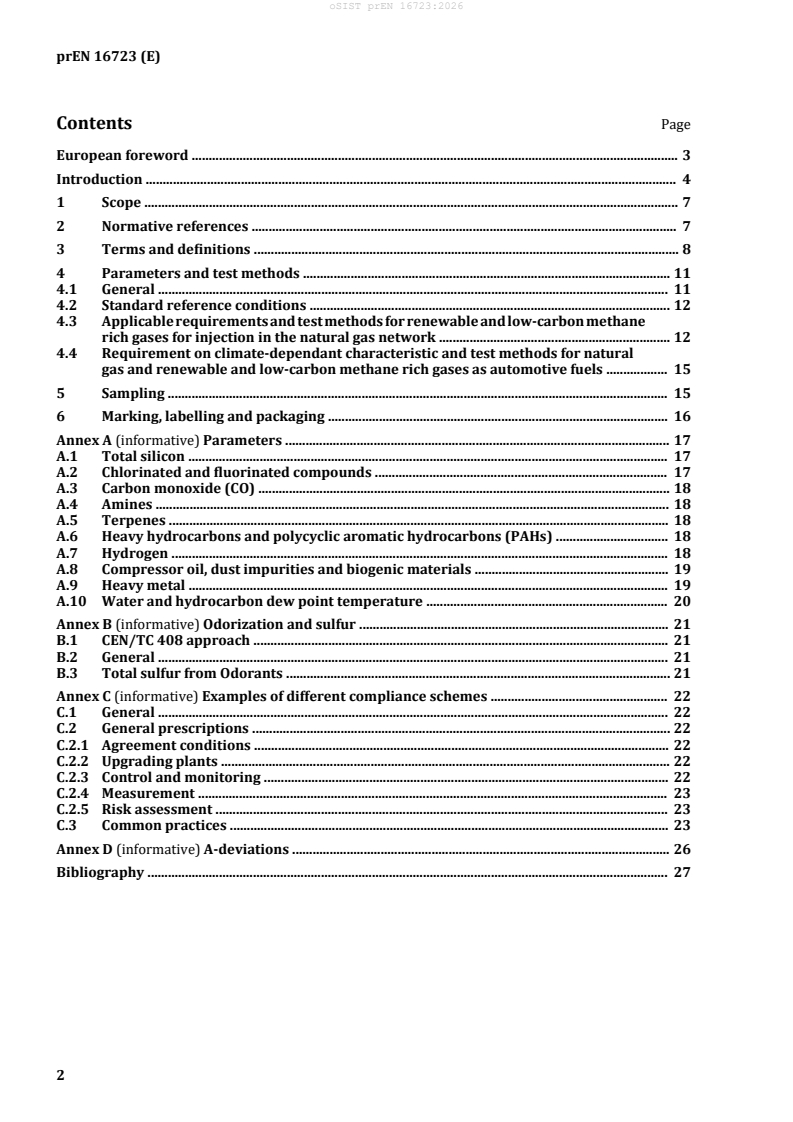
Contents Page
European foreword . 3
Introduction . 4
1 Scope . 7
2 Normative references . 7
3 Terms and definitions . 8
4 Parameters and test methods . 11
4.1 General . 11
4.2 Standard reference conditions . 12
4.3 Applicable requirements and test methods for renewable and low-carbon methane
rich gases for injection in the natural gas network . 12
4.4 Requirement on climate-dependant characteristic and test methods for natural
gas and renewable and low-carbon methane rich gases as automotive fuels . 15
5 Sampling . 15
6 Marking, labelling and packaging . 16
Annex A (informative) Parameters . 17
A.1 Total silicon . 17
A.2 Chlorinated and fluorinated compounds . 17
A.3 Carbon monoxide (CO) . 18
A.4 Amines . 18
A.5 Terpenes . 18
A.6 Heavy hydrocarbons and polycyclic aromatic hydrocarbons (PAHs) . 18
A.7 Hydrogen . 18
A.8 Compressor oil, dust impurities and biogenic materials . 19
A.9 Heavy metal . 19
A.10 Water and hydrocarbon dew point temperature . 20
Annex B (informative) Odorization and sulfur . 21
B.1 CEN/TC 408 approach . 21
B.2 General . 21
B.3 Total sulfur from Odorants . 21
Annex C (informative) Examples of different compliance schemes . 22
C.1 General . 22
C.2 General prescriptions . 22
C.2.1 Agreement conditions . 22
C.2.2 Upgrading plants . 22
C.2.3 Control and monitoring . 22
C.2.4 Measurement . 23
C.2.5 Risk assessment . 23
C.3 Common practices . 23
Annex D (informative) A-deviations . 26
Bibliography . 27
European foreword
This document (prEN 16723:2026) has been prepared by Technical Committee CEN/TC 408, the
secretariat of which is held by AFNOR.
This document is currently submitted to the CEN Enquiry.
This document will supersede EN 16723-1:2016 and EN 16723-2:2017.
In comparison with the previous edition, the following technical modifications have been made:
— EN 16723-1 and EN 16723-2 have been merged.
— Extension to pyrogasification, hydrothermal gasification, power to methane.
— Addition of analysis methods from ISO/TC 193/SC1.
— Addition of calculation methods for methane number from ISO/TC 193.
Introduction
To support the implementation of Directive 2009/28/EC on the promotion of the use of energy from
renewable sources, the European Commission launched in 2010 a standardization mandate M/
475[1] . This mandate was asking for the development of a set of quality spécifications for biomethane
to be used as a fuel for vehicle engines and to be injected in natural gas pipelines (network). Biomethane
in this context can be produced from biological (fermentation, digestion,etc.) and thermochemical
processing of biomass and is appropriate to be used as a blending component to natural gas.
CEN/TC 408 was created to answer this mandate and developed:
— EN 16723-1:2016, Natural gas and biomethane for use in transport and biomethane for injection in
the natural gas network - Part 1: Specifications for biomethane for injection in the natural gas network
— EN 16723-2:2017, Natural gas and biomethane for use in transport and biomethane for injection in
the natural gas network - Part 2: Automotive fuels specification
Some technical aspects were still discussed, and the European Commission proposed to financé pre-
normative research to remove technical barriers to the development of biomethane. This research was
conducted in 3 phases by GERG, the Gas Research European Group, under the supervision of CEN/TC
408:
— SA/CEN/RESEARCH/475/2017-07 (2018-2019, Phase 2a) - experimental work on siloxanes on
passenger cars and gas firéd home appliances, and a literature study on impacts of sulphur, impacts
of oxygen, particularly related to underground storage and corrosion, and health impacts.
— SA/CEN/RESEARCH/475/2019-09 (2020-2022, Phase 2b) – continued experimental work on
siloxanes for heavy duty engines and industrial boilers, commencement of experimental campaign
on sulphur, and on oxygen impacts. Improving spécific knowledge on biomethane at the European
level, particularly in relation to impact of feedstocks,
— BioStar2C (2022-2024, Phase 2c) - Completion of the experimental and literature campaigns begun
in Phase 2b to support the delivery by CEN TC 408 and update of the standards.
Standardized analysis methods spécific for biomethane were also missing such as amine, halogen,
siloxane, compressor oil. ISO/TC 193/SC1, Analysis of natural gas, launched a dedicated WG25,
Biomethane, to develop these methods. They were developed under the Vienna Agreement with
CEN/TC 408.
Since the publication of the standards, the production of biomethane has progressed in Europe. New
ways of producing other renewable and low-carbon gases also started: pyro-gasification, hydrothermal
gasification, methanation, power-to-gas, etc. The title and scope of CEN/TC 408 were extended to these
new production processes and intrants besides biomass: “Biomethane and other renewable and low-
carbon methane rich gases”. There has also been a wider introduction of heavy-duty vehicles using
natural gas and biomethane. Several different engine technologies are used on the market, including
spark ignited engines and engines with diesel-like combustion (High Pressure Direct Injection).
To take into account the experience gained since the publication of EN 16723-1 and EN 16723-2, the
results of the pre-normative research conducted by GERG and the publication of analysis methods by
ISO/TC 193/SC1, CEN/TC 408 decided to revise the standards and merge the two parts into one.
The intention is also to consider the different production processes and sources of the renewable and
low-carbon methane rich gases production to indicate what component should be measured or not.
In the automotive sector, the use of natural gas requires additional quality définitions to maintain full
engine durability and performance over lifetime. Considering the technological possibilities of the grid,
the standard natural gas grade meets the requirements of most conventional engines. As some EU
member countries have tighter legal requirements on emission relevant fuel parameters such as sulfur,
a second dedicated grade is définéd.
Key
1 biogas from digestion or thermo- chemical process
2 upgrading
3 injection into the gas grid
4 natural gas grid
5 conditioning
6 refuelling station
7 non-grid sourced natural gas
8 local dedicated infrastructure
9 automotive use
10 domestic and industrial use
11 grid spécification
12 automotive spécification
Figure 1 — Representation of some flows and uses of biomethane and natural gas
1 Scope
This document spécifiés for
— renewable and low-carbon methane rich gases for injection in the gas network,
— natural gas, renewable and low-carbon methane rich gases and mixtures thereof as fuel for engines.
This documents also spécifiés necessary related methods for sampling, analysis, and testing.
This document applies to the previously mentioned gases irrespective of the storage state (compressed
or liquéfiéd). To check compliance with some requirements set by the standard, LNG or liquéfiéd
biomethane are ré-gasifiéd prior to testing.
2 Normative references
The following documents are referred to in the text in such a way that some or all of their content
constitutes requirements of this document. For dated references, only the edition cited applies. For
undated references, the latest edition of the referenced document (including any amendments) applies.
ISO/TR 11150, Natural gas - Hydrocarbon dew point and hydrocarbon content
ISO/TR 12148, Natural gas — Calibration of chilled mirror type instruments for hydrocarbon dewpoint
(liquid formation)
ISO/DIS 24895-1, Analysis of natural gas — Determination of particulate matter — Part 1: Determination
of particles content by gravimetric method
CEN ISO/TS 2610, Analysis of natural gas - Biomethane - Determination of amines content (ISO/TS
2610:2022)
EN ISO 2611-1, Analysis of natural gas - Halogen content of biomethane - Part 1: HCl and HF content by
ion chromatography (ISO 2611-1:2024)
EN ISO 2612, Analysis of natural gas - Biomethane - Determination of ammonia content by Tuneable Diode
Laser Absorption Spectroscopy (ISO 2612:2023)
EN ISO 2613-1, Analysis of natural gas - Silicon content of biomethane - Part 1: Determination of total
silicon by atomic emission spectroscopy (AES) (ISO 2613-1:2023)
EN ISO 2613-2, Analysis of natural gas - Silicon content of biomethane - Part 2: Determination of siloxane
content by gas chromatography with ion mobility spectrometry (ISO 2613-2:2023)
EN ISO 2615, Analysis of natural gas - Biomethane - Determination of the content of compressor oil (ISO
2615:2024)
EN ISO 2620, Analysis of natural gas - Biomethane - Determination of VOCs by thermal desorption gas
chromatography with flame ionization and/or mass spectrometry detectors (ISO 2620:2024)
EN ISO 6327, Gas analysis - Determination of the water dew point of natural gas - Cooled surface
condensation hygrometers (ISO 6327:1981)
EN ISO 6974-3, Natural gas - Determination of composition and associated uncertainty by gas
chromatography - Part 3: Precision and bias (ISO 6974-3:2018)
EN ISO 6974-6, Natural gas - Determination of composition with defined uncertainty by gas
chromatography - Part 6: Determination of hydrogen, helium, oxygen, nitrogen, carbon dioxide and C1 to
C8 hydrocarbons using three capillary columns (ISO 6974-6:2002)
EN ISO 6975, Natural gas - Extended analysis - Gas-chromatographic method (ISO 6975:1997)
EN ISO 6976, Natural gas - Calculation of calorific values, density, relative density and Wobbe indices from
composition (ISO 6976:2016)
EN ISO 10715, Natural gas - Gas sampling (ISO 10715:2022)
EN ISO 13443, Natural gas - Standard reference conditions (ISO 13443:1996 including Corrigendum
1:1997)
EN 16726:2025, Gas infrastructure - Quality of gas - Group H
EN 16942, Fuels - Identification of vehicle compatibility - Graphical expression for consumer information
EN ISO 17507-1, Natural gas - Calculation of methane number of gaseous fuels for reciprocating internal
combustion engines - Part 1: MNc method (ISO 17507-1:2025)
EN ISO 17507-2, Natural gas - Calculation of methane number of gaseous fuels for reciprocating internal
combustion engines - Part 2: PKI method (ISO 17507-2:2025)
EN ISO 19739:2005, Natural gas - Determination of sulfur compounds using gas chromatography (ISO
19739:2004)
EN ISO 23874, Natural gas - Gas chromatographic requirements for hydrocarbon dewpoint calculation
(ISO 23874:2006)
EN ISO 6974 (all parts), Natural gas - Determination of composition and associated uncertainty by gas
chromatography (ISO 6974, all parts)
3 Terms and definitions
For the purposes of this document, the following terms and définitions apply.
— ISO Online browsing platform: available athttp://www.iso.org/obp
— IEC Electropedia: available athttp://www.electropedia.org/
3.1
biogas
gas, comprising principally methane and carbon dioxide, obtained from the anaerobic digestion of
biomass
3.2
biomass
biological material from living, or recently living organisms, typically this may be plants or plant-
derived materials
3.3
biomethane
gas comprising principally methane, obtained from either upgrading of biogas or methanation of biogas
and syngas
3.4
bio-syngas
gas, comprising principally carbon monoxide and hydrogen, obtained from gasification of biomass
3.5
compressed natural gas (CNG)
natural gas used as a fuel for automotive vehicles, typically compressed up to 20 000 kPa in the
gaseous state
3.6
compressed biomethane
biomethane used as a fuel for automotive vehicles, typically compressed up to 20 000 kPa in the
gaseous state
3.7
density
quotient of the mass of a gas and its volume
3.8
e-methane
synthetic renewable methane
Note 1 to entry: It can be produced with hydrogen derived from renewable electricity and CO₂ or electrochemical
processes.
3.9
gas infrastructure
pipeline systems including pipework, underground gas storages and their associated stations or plants
for the transmission and distribution of gas
3.10
gross calorific value / superior calorific value / higher heating value
calorific value when the combustion products being in the gaseous state, except for water, which is
condensed to the liquid state
3.11
hydrocarbon dew point temperature
temperature at which an infinitésimal amount of liquid hydrocarbons is in equilibrium with a bulk
vapour for a spécifiéd pressure
[SOURCE: EN ISO 14532:2017 [2]]
3.12
liquefied natural gas (LNG)
natural gas which has been liquéfiéd, after processing, for storage or transportation purposes
3.13
liquefied biomethane (LBM)
biomethane which has been liquéfiéd, after processing, for storage or transportation purposes
3.14
low-carbon gases
gases produced by low-carbon yet non-renewable electricity (e.g. nuclear), thermochemical conversion
of low-carbon feedstock or from processes relying on natural gas and carbon capture
Note 1 to entry: To qualify as low-carbon, a gas needs to meet a GHG emissions reduction threshold (e.g. 70 % in
RED III).
3.15
methanation
chemical process in which hydrogen (H₂) reacts with carbon monoxide (CO) or carbon dioxide (CO₂)
to produce methane (CH₄) and water (H₂O)
Note 1 to entry: This process is typically used to convert syngas (a mixture of CO and H₂) or CO₂ into methane.
Note 2 to entry: It can be used to produce a renewable or low-carbon fuel.
Note 3 to entry: E-methane is produced by methanation.
3.16
methane number (MN)
rating indicating the knocking characteristics of a gaseous fuel
Note 1 to entry: MN has a similar use as the octane number for petrol.
Note 2 to entry: MN expresses the volume percentage of methane in a methane/hydrogen mixture which, in a test
engine under standard conditions, has the same tendency to knock as the gaseous fuel to be examined.
3.17
methane rich gas
gas produced by anaerobic digestion, pyrolysis, gasification, methanation and upgraded to natural gas
spécification
3.18
natural gas (NG)
naturally occurring mixture of hydrocarbon and non-hydrocarbon gases found in porous geological
formations (reservoirs) beneath the earth’s surface
Note 1 to entry: Natural gas contains primarily methane, but generally includes ethane, propane and higher
hydrocarbons, and some non-combustible gases such as nitrogen and carbon dioxide. Natural gas can also contain
components such as sulfur compounds and/or other chemical species.
[SOURCE: EN ISO 14532:2017 [2]]
3.19
natural gas network
either transmission network or local distribution system
3.20
net calorific value / inferior calorific value / lower heating value
calorific value when the combustion products are in the gaseous state
[SOURCE: EN ISO 14532:2017 [2]]
3.21
non-grid sourced natural gas
natural gas not coming from the natural gas network
3.22
odorization
addition of odorants to allow the recognition of gas leaks by smell at very low concentration (before a
build up to a dangerous gas in air concentration can occur)
[SOURCE: EN ISO 14532:2017 [2]]
3.23
power to gas
process to generate gas from electrical power
3.24
relative density
quotient of the density of a gas and the density of dry air of standard composition at the same spécifiéd
conditions of pressure and temperature
[SOURCE: EN ISO 14532:2017 [2]]
3.25
renewable gases
gases from renewable feedstocks
EXAMPLE biogas, biomethane, renewable hydrogen, e-methane (renewable synthetic methane), and
renewable ammonia
3.26
syngas
gas, comprising principally of carbon monoxide and hydrogen, obtained from gasification of fossil fuel
3.27
upgrading of biogas or syngas
removal of carbon dioxide and contaminants from biogas or syngas
3.28
water dew temperature / water dew point
temperature at which an infinitésimal amount of liquid water is in equilibrium with a bulk vapour for
a spécifiéd pressure
[SOURCE: EN ISO 14532:2017 [2]]
3.29
Wobbe index
quotient of the calorific value on a volumetric basis at spécifiéd reference conditions and the square
root of the relative density at the same spécifiéd metering reference conditions
Note 1 to entry: The Wobbe Index is said to be gross or net according to whether the calorific value used is the
gross or net calorific value.
[SOURCE: EN ISO 14532:2017 [2]]
3.30
methanation
chemical process in which hydrogen (H₂) reacts with carbon monoxide (CO) or carbon dioxide (CO₂)
to produce methane (CH₄) and water (H₂O)
Note 1 to entry: This process is typically used to convert syngas (a mixture of CO and H₂) or CO₂ into methane.
Note 2 to entry: It can be used to produce a renewable or low-carbon fuel.
Note 3 to entry: E-methane is produced by methanation.
4 Parameters and test methods
4.1 General
This clause describes applicable requirements and test methods for biomethane and other renewable
and low-carbon methane rich gases, natural gas and mixtures thereof.
Table 1 refers to European grid quality as définéd in EN 16726:2025 [3] and spécifiés additional
requirements for biomethane and other renewable and low-carbon methane-rich gases at the point of
entry into H gas and L gas networks.
Table 2 spécifiés parameters and limit values required for biomethane and other renewable and low-
carbon methane rich gases, natural gas and mixtures thereof if used as a fuel in engines for mobile and
stationary applications.
Two grades for automotive use are définéd: The standard grade and an optional dedicated grade. The
dedicated grade has stricter limit values and spécifiés additional parameters. The dedicated grade is
frequently met by LNG, biomethane and other renewable and low-carbon methane-rich gases. It is
intended for advanced engines and use cases where higher engine éfficiéncy is targeted. Gas complying
with the higher quality grade can be offered by both a separate infrastructure and the gas grid.
Both grades for automotive use in Table 2 can be offered independently from each other, with no
obligation to provide the other quality if only one grade is offered.
Natural gas, biomethane and other renewable and low-carbon methane rich gases and blends of those
shall be free from any constituents or impurities other than the ones described in this standard, to the
extent that it cannot be injected into natural gas networks without quality adjustment or treatment or
that renders the fuel unacceptable for use as an automotive fuel. In the case of such other constituents
and/or impurities, it may be necessary to obtain an approval from the competent and legitimate
authority to définé the acceptable risk in the territory of the injection point.
4.2 Standard reference conditions
Unless stated otherwise, all volumes are for the real dry gas at ISO Standard Reference conditions of 15
°C and 101,325 kPa.
Unless stated otherwise, all calorific values and Wobbe index are for the real dry gas at ISO Standard
Reference conditions of:
— 15 °C (combustion);
— and 15 °C and 101,325 kPa (metering).
In assessing compliance with this European Standard, parameters should be determined directly at ISO
standard reference conditions. If the properties are only available at other reference conditions and the
actual gas composition is not known, then conversion to ISO standard reference conditions shall be
carried out using the procedure described in EN ISO 13443.
To check compliance with some requirements set by the standard, LNG or liquéfiéd biomethane should
be ré-gasifiéd prior to testing.
4.3 Applicable requirements and test methods for renewable and low-carbon methane
rich gases for injection in the natural gas network
Renewable and low-carbon methane rich gases shall meet the requirements of EN 16726:2025 for
common parameters and Table 1 or Table 2 respectively, only for parameters spécific to renewable and
low-carbon methane rich gases. Health criteria assessment for renewable and low-carbon methane rich
gases is complex and dependent upon the biogas feedstock and upgrading and purification process. As
a result, it is recommended that contaminants to be spécifiéd and limits to be applied are assessed at
national level using an appropriate methodology. An example of such a methodology is provided in
CEN/TR 17238 [4], Proposed limit values for contaminants in biomethane based on health assessment
criteria.
Table 1 provides common requirements for injection into H and L gas systems and Table 2 provides the
standard grade limit values and an optional dedicated grade for automotive use spécifiéd with stricter
limit values and additional parameters.
For injection into L gas systems, national requirements for Wobbe index, relative density, and CO shall
be applied when appropriate.
Information on Wobbe index and calorific value can be found in Annex D.
The reported test methods are normative but equivalent methods can be used if those methods have
been validated and give rise to similar measurement uncertainties compared to the normative methods.
EXAMPLE: EN ISO 2620 [5] is also a method that has been validated for siloxanes and terpenes.
Table 1 — Applicable common requirements and test methods for renewable and low-carbon
methane rich gases at the point of entry into H gas and L gas networks
a
Limit values
Test method
Parameter Unit
(normative)
Min Max
EN ISO 2613-1
Total volatile
3 b
EN ISO 2613-2
mg/m 0,3 to 1
silicon (as Si)
EN ISO 2620
d
Compressor oil EN ISO 2615
c, d
Dust impurities ISO/DIS 24895-1
Chlorinated
e, f
- EN ISO 2611-1
compounds
Fluorinated
e
EN ISO 2611-1
compounds
EN ISO 6974 (all
g
CO % mol _ 0,1
parts)
NH3 mg/m - 10 EN ISO 2612
Amine - 10 CEN ISO/TS 2610
mg/m
a
Limit values are absolute, the number of the decimal places is not linked to the accuracy of the test methods.
b
A range of limit values for siloxanes is proposed for this standard. Studies have demonstrated that continuous
exposure to 100 % renewable and low-carbon methane rich gases for 15 years should require a spécification as
low as 0,1 mg Si/m . However, a limit set at this level would present difficulty in terms of analytical measurement
3 3
(current quantification limits are at best 0,10 mg Si/m , which would imply setting a limit of 0,30 mg Si/m ).
Moreover, this would not recognize the mitigating effects of dilution of injected biomethane by natural gas. It is
therefore suggested that the limit value to be applied [in a Network Entry Agreement] should be agreed between
renewable and low-carbon methane rich gases producer a
...