

prEN 16723
(Main)Biomethane and other renewable and low-carbon methane rich gases - Specifications for injection in the natural gas system and for mixtures with natural gas as automotive fuel
- Abstract
This document specifies for
- renewable and low-carbon methane rich gases for injection in the gas network
- natural gas, renewable and low-carbon methane rich gases and mixtures thereof as fuel for engines
This documents also specifies necessary related methods for sampling, analysis, and testing.
This document applies to the previously mentioned gases irrespective of the storage state (compressed or liquefied). To check compliance with some requirements set by the standard, LNG or liquefied biomethane should be re-gasified prior to testing.
- Status
- Not Published
- Publication Date
- 10-Apr-2028
- Drafting Committee
- CEN/TC 408/WG 1 - Injection and fuel specification
- Current Stage
- 4060 - Closure of enquiry - Enquiry
- Start Date
- 15-Oct-2026
- Due Date
- 23-Mar-2027
- Completion Date
- 23-Mar-2027

prEN 16723 is a CEN draft European Standard from CEN/TC 408 on biomethane and other renewable and low-carbon methane rich gases. It specifies requirements for injecting these gases into the natural gas network and for using natural gas, biomethane and mixtures as automotive fuel, together with the sampling, analysis and testing methods needed to check conformity.
What does prEN 16723 specify?
prEN 16723 covers two main uses: gas for injection into the natural gas network, and gas used as fuel for engines. It applies to the gases whether they are compressed or liquefied, and it points to re-gasifying LNG or liquefied biomethane before testing when that is needed to check compliance.
The document is organized into six clauses and four informative annexes.
| Annex | What it covers |
|---|---|
| Annex A | Parameters to consider for monitoring, such as silicon, halogenated compounds, CO, amines, terpenes, heavy hydrocarbons, hydrogen, compressor oil, dust, heavy metals, and dew point topics |
| Annex B | Odorization and sulfur |
| Annex C | Examples of compliance schemes, monitoring, measurement and risk assessment |
| Annex D | A-deviations |
What are the key requirements of prEN 16723?
prEN 16723 separates the requirements for network injection from the requirements for automotive fuel. In practice, that means a producer, grid operator, or fuel supplier has to use the right table and the right test method for the intended use.
Network injection requirements
Clause 4.3 links network injection to the common gas quality rules in EN 16726:2025 and adds extra parameters for renewable and low-carbon methane rich gases. The main additions in Table 1 focus on contaminants and materials that can damage equipment, affect gas quality, or create health and handling concerns.
For network entry, the document covers total volatile silicon, compressor oil, dust impurities, chlorinated and fluorinated compounds, CO, ammonia, and amines. The practical message is that operators need to know which impurities are relevant for their feedstock and upgrading process, then monitor those parameters with the named methods or validated equivalent methods.
Clause 4.3 also points out that some limit values are to be handled through national requirements or local agreement, especially where the gas quality depends on feedstock, upgrading, or local network conditions. Annex C supports this with example compliance schemes, monitoring regimes, and risk-based agreements.
Automotive fuel requirements
Clause 4.3 and Table 2 define two automotive fuel grades: a standard grade and a dedicated grade. The dedicated grade has stricter limits and extra parameters, so it is the better fit for demanding engines and use cases where durability and performance over time matter most.
The automotive table covers hydrogen, hydrocarbon dew point, oxygen-related composition, sulfur species and total sulfur, ammonia, amines, Wobbe Index, net calorific value, methane number, compressor oil, solid particulates, and water dew point. In practice, this means fuel suppliers and station operators need to match the gas to the engine technology and to the local fuel quality expectations.
prEN 16723 also notes that the standard and dedicated grades can be offered independently. A supplier does not have to offer both grades if only one grade is provided.
Climate-dependent water dew point classes
Clause 4.4 gives three climate-dependent classes for water dew point at 20 000 kPa: classes A, B, and C. National annexes choose which grade(s) apply in a country.
This matters because refuelling systems in colder climates need tighter control of water condensation and icing risk. The class selection therefore affects station design, monitoring, and operational control.
Reference conditions and test basis
Clause 4.2 sets the reference basis for volume, calorific value, and Wobbe Index. Where data are available only at other conditions, the standard points to EN ISO 13443 for conversion.
This matters in practice because laboratories and network operators need a common basis before comparing test results or deciding compliance.
Sampling, contamination control, and marking
Clause 5 requires sampling in line with EN ISO 10715 and stresses contamination control from sampling through to analysis. It also notes that some parameters, such as total volatile silicon, need special care in the sampling method.
Clause 6 requires marking and labeling of dispensing pumps and nozzles in line with EN 16942. For operators, this means the fuel point has to communicate vehicle compatibility in the form expected by the standard.
What terms does prEN 16723 define?
- biomethane - Gas mainly made of methane, obtained by upgrading biogas or by methanation of biogas and syngas.
- methane rich gas - Gas produced by anaerobic digestion, pyrolysis, gasification, or methanation and upgraded to natural gas specification.
- low-carbon gases - Gases made from low-carbon but non-renewable electricity, low-carbon feedstock, or processes that use natural gas with carbon capture.
- compressed natural gas (CNG) - Natural gas used as an automotive fuel in compressed gaseous form.
- liquefied natural gas (LNG) - Natural gas liquefied after processing for storage or transport.
- liquefied biomethane (LBM) - Biomethane liquefied after processing for storage or transport.
- methane number (MN) - A rating that describes the knocking tendency of a gaseous fuel in a reciprocating engine.
- Wobbe index - A measure that combines calorific value and relative density to indicate interchangeability of gaseous fuels.
Who uses prEN 16723?
prEN 16723 is used by biomethane producers, upgrading plant operators, gas network operators, refuelling station operators, fuel suppliers, laboratories, and inspection bodies. It is also relevant to engine makers, vehicle and fleet operators, and authorities that set or approve local gas-quality conditions.
In practice, these users rely on the document to set entry agreements, choose sampling and analytical methods, verify fuel quality, decide on monitoring plans, and label automotive dispensing equipment.
What changed in prEN 16723 from the previous edition?
prEN 16723 will supersede EN 16723-1:2016 and EN 16723-2:2017. The foreword states that the main technical changes are:
- EN 16723-1 and EN 16723-2 have been merged into one document.
- The scope has been extended to pyrogasification, hydrothermal gasification, and power to methane.
- Analysis methods from ISO/TC 193/SC1 have been added.
- Methane number calculation methods from ISO/TC 193 have been added.
Which standards are used with prEN 16723?
prEN 16723 relies on several referenced standards and companion methods to measure composition, calculate gas properties, and identify vehicle fuel compatibility.
- EN 16726:2025 - Sets the common gas-quality framework for Group H gas and supplies the broader quality context.
- EN ISO 10715 - Provides gas sampling rules.
- EN ISO 13443 - Gives the conversion procedure to ISO standard reference conditions.
- EN ISO 6976 - Used to calculate calorific value, density, relative density, and Wobbe index from composition.
- EN ISO 17507-1 and EN ISO 17507-2 - Provide methane number calculation methods.
- EN ISO 2613-1, EN ISO 2613-2, EN ISO 2611-1, EN ISO 2612, EN ISO 2615, and EN ISO 2620 - Cover analysis of silicon, halogens, ammonia, compressor oil, and VOCs in biomethane.
- EN ISO 6974 series, EN ISO 23874, EN ISO 6327, ISO/TR 11150, and ISO/TR 12148 - Support composition analysis, dew point work, and instrument calibration.
- EN 16942 - Provides the vehicle-compatibility marking used at dispensing points.
- CEN/TR 17238 - Gives guidance on contaminant limits based on health assessment criteria.
What does the prEN 16723 document contain?
The document contains the main requirement tables for network injection and automotive fuel, plus a climate-dependent dew point table for vehicle fuel use. It also includes the sampling clause, marking and labelling requirements, and a short set of common reference conditions for comparing results.
The annexes add practical context rather than new mandatory requirements. Annex A explains why certain contaminants matter for different feedstocks and production routes, Annex B discusses sulfur and odorization, and Annex C gives example compliance schemes, including monitoring and risk assessment. Figure 1 shows the main flows from production and upgrading to grid injection, refuelling, and end use.
Relations
- Effective Date
- 09-Feb-2026
- Effective Date
- 09-Feb-2026
Get Certified
Connect with accredited certification bodies for this standard

DNV
DNV is an independent assurance and risk management provider.

Lloyd's Register
Lloyd's Register is a global professional services organisation specialising in engineering and technology.
DNV Energy Systems
Energy and renewable energy certification.
Sponsored listings
Frequently Asked Questions
prEN 16723 is a draft published by the European Committee for Standardization (CEN). Its full title is "Biomethane and other renewable and low-carbon methane rich gases - Specifications for injection in the natural gas system and for mixtures with natural gas as automotive fuel". This standard covers: This document specifies for - renewable and low-carbon methane rich gases for injection in the gas network - natural gas, renewable and low-carbon methane rich gases and mixtures thereof as fuel for engines This documents also specifies necessary related methods for sampling, analysis, and testing. This document applies to the previously mentioned gases irrespective of the storage state (compressed or liquefied). To check compliance with some requirements set by the standard, LNG or liquefied biomethane should be re-gasified prior to testing.
This document specifies for - renewable and low-carbon methane rich gases for injection in the gas network - natural gas, renewable and low-carbon methane rich gases and mixtures thereof as fuel for engines This documents also specifies necessary related methods for sampling, analysis, and testing. This document applies to the previously mentioned gases irrespective of the storage state (compressed or liquefied). To check compliance with some requirements set by the standard, LNG or liquefied biomethane should be re-gasified prior to testing.
prEN 16723 is classified under the following ICS (International Classification for Standards) categories: 27.190 - Biological sources and alternative sources of energy; 75.160.30 - Gaseous fuels. The ICS classification helps identify the subject area and facilitates finding related standards.
prEN 16723 has the following relationships with other standards: It is inter standard links to EN 16723-1:2016, EN 16723-2:2017. Understanding these relationships helps ensure you are using the most current and applicable version of the standard.
prEN 16723 is available in PDF format for immediate download after purchase. The document can be added to your cart and obtained through the secure checkout process. Digital delivery ensures instant access to the complete standard document.
Standards Content (Sample)
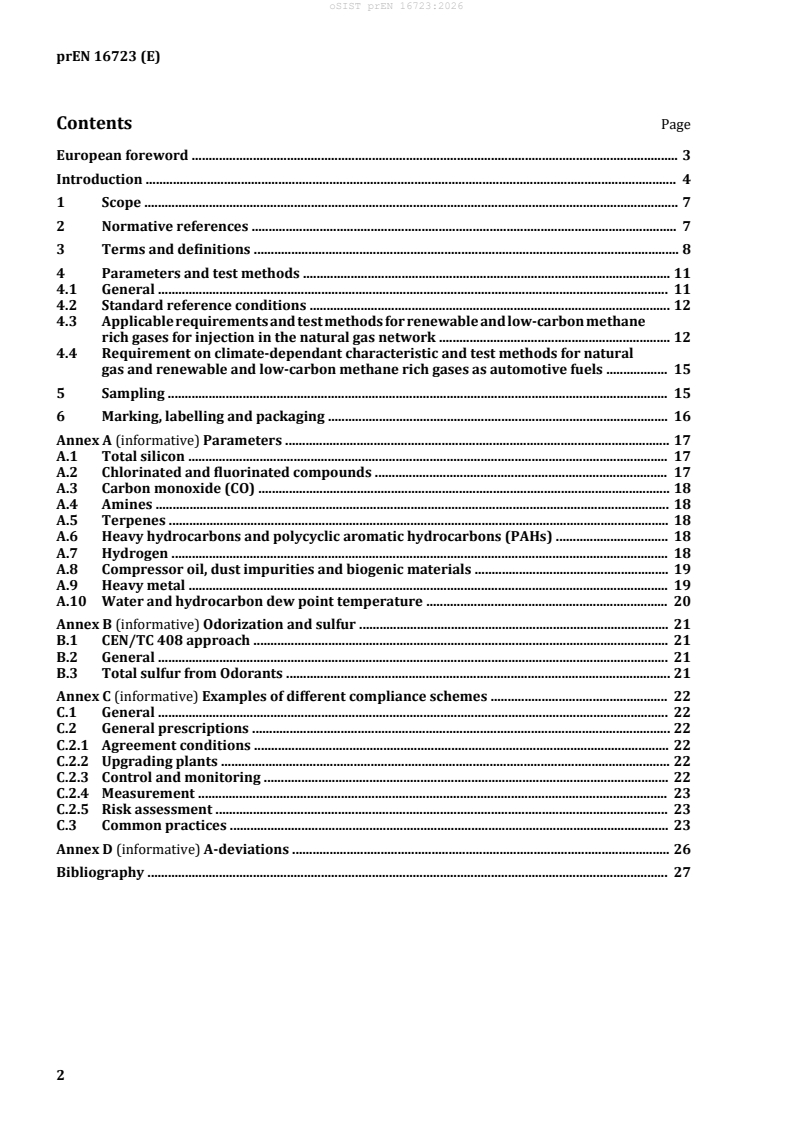
Contents
- Introduction
- 1 Scope
- 2 Normative references
- 3 Terms and definitions
- 3.1 biogas
- 3.2 biomass
- 3.3 biomethane
- 3.4 bio-syngas
- 3.5 compressed natural gas (CNG)
- 3.6 compressed biomethane
- 3.7 density
- 3.8 e-methane
- 3.9 gas infrastructure
- 3.10 gross calorific value / superior calorific value / higher heating value
- 3.11 hydrocarbon dew point temperature
- 3.12 liquefied natural gas (LNG)
- 3.13 liquefied biomethane (LBM)
- 3.14 low-carbon gases
- 3.15 methanation
- 3.16 methane number (MN)
- 3.17 methane rich gas
- 3.18 natural gas (NG)
- 3.19 natural gas network
- 3.20 net calorific value / inferior calorific value / lower heating value
- 3.21 non-grid sourced natural gas
- 3.22 odorization
- 3.23 power to gas
- 3.24 relative density
- 3.25 renewable gases
- 3.26 syngas
- 3.27 upgrading of biogas or syngas
- 3.28 water dew temperature / water dew point
- 3.29 Wobbe index
- 3.30 methanation
- 4 Parameters and test methods
- 4.1 General
- 4.2 Standard reference conditions
- 4.3 Applicable requirements and test methods for renewable and low-carbon methane
- 4.4 Requirement on climate-dependant characteristic and test methods for natural gas
- 5 Sampling
- 6 Marking, labelling and packaging
- Annex A
- Annex B
- Annex C
- Annex D
- 4.3 Dutch Deviation
- 4.3 Danish Deviation
- Bibliography
Introduction
To support the implementation of Directive 2009/28/EC on the promotion of the use of energy from renewable sources, the European Commission launched in 2010 a standardization mandate M/ 475[1] . This mandate was asking for the development of a set of quality spécifications for biomethane to be used as a fuel for vehicle engines and to be injected in natural gas pipelines (network). Biomethane in this context can be produced from biological (fermentation, digestion,etc.) and thermochemical processing of biomass and is appropriate to be used as a blending component to natural gas. CEN/TC 408 was created to answer this mandate and developed:
- EN 16723-1:2016, Natural gas and biomethane for use in transport and biomethane for injection in the natural gas network - Part 1: Specifications for biomethane for injection in the natural gas network
- EN 16723-2:2017, Natural gas and biomethane for use in transport and biomethane for injection in the natural gas network - Part 2: Automotive fuels specification Some technical aspects were still discussed, and the European Commission proposed to financé prenormative research to remove technical barriers to the development of biomethane. This research was conducted in 3 phases by GERG, the Gas Research European Group, under the supervision of CEN/TC 408:
- SA/CEN/RESEARCH/475/2017-07 (2018-2019, Phase 2a) - experimental work on siloxanes on passenger cars and gas firéd home appliances, and a literature study on impacts of sulphur, impacts of oxygen, particularly related to underground storage and corrosion, and health impacts.
- SA/CEN/RESEARCH/475/2019-09 (2020-2022, Phase 2b) – continued experimental work on siloxanes for heavy duty engines and industrial boilers, commencement of experimental campaign on sulphur, and on oxygen impacts. Improving spécific knowledge on biomethane at the European level, particularly in relation to impact of feedstocks,
- BioStar2C (2022-2024, Phase 2c) - Completion of the experimental and literature campaigns begun in Phase 2b to support the delivery by CEN TC 408 and update of the standards. Standardized analysis methods spécific for biomethane were also missing such as amine, halogen, siloxane, compressor oil... ISO/TC 193/SC1, Analysis of natural gas, launched a dedicated WG25, Biomethane, to develop these methods. They were developed under the Vienna Agreement with CEN/TC 408.
Since the publication of the standards, the production of biomethane has progressed in Europe. New ways of producing other renewable and low-carbon gases also started: pyro-gasification, hydrothermal gasification, methanation, power-to-gas, etc. The title and scope of CEN/TC 408 were extended to these new production processes and intrants besides biomass: “Biomethane and other renewable and lowcarbon methane rich gases”. There has also been a wider introduction of heavy-duty vehicles using natural gas and biomethane. Several different engine technologies are used on the market, including spark ignited engines and engines with diesel-like combustion (High Pressure Direct Injection). To take into account the experience gained since the publication of EN 16723-1 and EN 16723-2, the results of the pre-normative research conducted by GERG and the publication of analysis methods by ISO/TC 193/SC1, CEN/TC 408 decided to revise the standards and merge the two parts into one. The intention is also to consider the different production processes and sources of the renewable and low-carbon methane rich gases production to indicate what component should be measured or not. In the automotive sector, the use of natural gas requires additional quality définitions to maintain full engine durability and performance over lifetime. Considering the technological possibilities of the grid, the standard natural gas grade meets the requirements of most conventional engines. As some EU member countries have tighter legal requirements on emission relevant fuel parameters such as sulfur, a second dedicated grade is définéd.
oSIST prEN 16723:2026 prEN 16723 (E) Key 1 biogas from digestion or thermo- chemical process 2 upgrading 3 injection into the gas grid 4 natural gas grid 5 conditioning 6 refuelling station 7 non-grid sourced natural gas 8 local dedicated infrastructure 9 automotive use 10 domestic and industrial use 11 grid spécification
oSIST prEN 16723:2026 prEN 16723 (E) 12 automotive spécification Figure 1 — Representation of some flows and uses of biomethane and natural gas
oSIST prEN 16723:2026 prEN 16723 (E)
1 Scope
This document spécifiés for - renewable and low-carbon methane rich gases for injection in the gas network, - natural gas, renewable and low-carbon methane rich gases and mixtures thereof as fuel for engines. This documents also spécifiés necessary related methods for sampling, analysis, and testing. This document applies to the previously mentioned gases irrespective of the storage state (compressed or liquéfiéd). To check compliance with some requirements set by the standard, LNG or liquéfiéd biomethane are ré-gasifiéd prior to testing.
2 Normative references
The following documents are referred to in the text in such a way that some or all of their content constitutes requirements of this document. For dated references, only the edition cited applies. For undated references, the latest edition of the referenced document (including any amendments) applies. ISO/TR 11150, Natural gas - Hydrocarbon dew point and hydrocarbon content ISO/TR 12148, Natural gas — Calibration of chilled mirror type instruments for hydrocarbon dewpoint (liquid formation) ISO/DIS 24895-1, Analysis of natural gas — Determination of particulate matter — Part 1: Determination of particles content by gravimetric method CEN ISO/TS 2610, Analysis of natural gas - Biomethane - Determination of amines content (ISO/TS 2610:2022) EN ISO 2611-1, Analysis of natural gas - Halogen content of biomethane - Part 1: HCl and HF content by ion chromatography (ISO 2611-1:2024) EN ISO 2612, Analysis of natural gas - Biomethane - Determination of ammonia content by Tuneable Diode Laser Absorption Spectroscopy (ISO 2612:2023) EN ISO 2613-1, Analysis of natural gas - Silicon content of biomethane - Part 1: Determination of total silicon by atomic emission spectroscopy (AES) (ISO 2613-1:2023) EN ISO 2613-2, Analysis of natural gas - Silicon content of biomethane - Part 2: Determination of siloxane content by gas chromatography with ion mobility spectrometry (ISO 2613-2:2023) EN ISO 2615, Analysis of natural gas - Biomethane - Determination of the content of compressor oil (ISO 2615:2024) EN ISO 2620, Analysis of natural gas - Biomethane - Determination of VOCs by thermal desorption gas chromatography with flame ionization and/or mass spectrometry detectors (ISO 2620:2024) EN ISO 6327, Gas analysis - Determination of the water dew point of natural gas - Cooled surface condensation hygrometers (ISO 6327:1981) EN ISO 6974-3, Natural gas - Determination of composition and associated uncertainty by gas chromatography - Part 3: Precision and bias (ISO 6974-3:2018) EN ISO 6974-6, Natural gas - Determination of composition with defined uncertainty by gas chromatography - Part 6: Determination of hydrogen, helium, oxygen, nitrogen, carbon dioxide and C1 to C8 hydrocarbons using three capillary columns (ISO 6974-6:2002) EN ISO 6975, Natural gas - Extended analysis - Gas-chromatographic method (ISO 6975:1997)
oSIST prEN 16723:2026 prEN 16723 (E) EN ISO 6976, Natural gas - Calculation of calorific values, density, relative density and Wobbe indices from composition (ISO 6976:2016) EN ISO 10715, Natural gas - Gas sampling (ISO 10715:2022) EN ISO 13443, Natural gas - Standard reference conditions (ISO 13443:1996 including Corrigendum 1:1997) EN 16726:2025, Gas infrastructure - Quality of gas - Group H EN 16942, Fuels - Identification of vehicle compatibility - Graphical expression for consumer information EN ISO 17507-1, Natural gas - Calculation of methane number of gaseous fuels for reciprocating internal combustion engines - Part 1: MNc method (ISO 17507-1:2025) EN ISO 17507-2, Natural gas - Calculation of methane number of gaseous fuels for reciprocating internal combustion engines - Part 2: PKI method (ISO 17507-2:2025) EN ISO 19739:2005, Natural gas - Determination of sulfur compounds using gas chromatography (ISO 19739:2004) EN ISO 23874, Natural gas - Gas chromatographic requirements for hydrocarbon dewpoint calculation (ISO 23874:2006) EN ISO 6974 (all parts), Natural gas - Determination of composition and associated uncertainty by gas chromatography (ISO 6974, all parts)
3 Terms and definitions
For the purposes of this document, the following terms and définitions apply. - ISO Online browsing platform: available athttp://www.iso.org/obp - IEC Electropedia: available athttp://www.electropedia.org/
3.1 biogas
gas, comprising principally methane and carbon dioxide, obtained from the anaerobic digestion of biomass
3.2 biomass
biological material from living, or recently living organisms, typically this may be plants or plantderived materials
3.3 biomethane
gas comprising principally methane, obtained from either upgrading of biogas or methanation of biogas and syngas
3.4 bio-syngas
gas, comprising principally carbon monoxide and hydrogen, obtained from gasification of biomass
3.5 compressed natural gas (CNG)
natural gas used as a fuel for automotive vehicles, typically compressed up to 20 000 kPa in the gaseous state
oSIST prEN 16723:2026 prEN 16723 (E)
3.6 compressed biomethane
biomethane used as a fuel for automotive vehicles, typically compressed up to 20 000 kPa in the gaseous state
3.7 density
quotient of the mass of a gas and its volume
3.8 e-methane
synthetic renewable methane Note 1 to entry: It can be produced with hydrogen derived from renewable electricity and CO₂ or electrochemical processes.
3.9 gas infrastructure
pipeline systems including pipework, underground gas storages and their associated stations or plants for the transmission and distribution of gas
3.10 gross calorific value / superior calorific value / higher heating value
calorific value when the combustion products being in the gaseous state, except for water, which is condensed to the liquid state
3.11 hydrocarbon dew point temperature
temperature at which an infinitésimal amount of liquid hydrocarbons is in equilibrium with a bulk vapour for a spécifiéd pressure [SOURCE: EN ISO 14532:2017 [2]]
3.12 liquefied natural gas (LNG)
natural gas which has been liquéfiéd, after processing, for storage or transportation purposes
3.13 liquefied biomethane (LBM)
biomethane which has been liquéfiéd, after processing, for storage or transportation purposes
3.14 low-carbon gases
gases produced by low-carbon yet non-renewable electricity (e.g. nuclear), thermochemical conversion of low-carbon feedstock or from processes relying on natural gas and carbon capture Note 1 to entry: To qualify as low-carbon, a gas needs to meet a GHG emissions reduction threshold (e.g. 70 % in RED III).
3.15 methanation
chemical process in which hydrogen (H₂) reacts with carbon monoxide (CO) or carbon dioxide (CO₂) to produce methane (CH₄) and water (H₂O) Note 1 to entry: This process is typically used to convert syngas (a mixture of CO and H₂) or CO₂ into methane. Note 2 to entry: It can be used to produce a renewable or low-carbon fuel. Note 3 to entry: E-methane is produced by methanation.
oSIST prEN 16723:2026 prEN 16723 (E)
3.16 methane number (MN)
rating indicating the knocking characteristics of a gaseous fuel Note 1 to entry: MN has a similar use as the octane number for petrol. Note 2 to entry: MN expresses the volume percentage of methane in a methane/hydrogen mixture which, in a test engine under standard conditions, has the same tendency to knock as the gaseous fuel to be examined.
3.17 methane rich gas
gas produced by anaerobic digestion, pyrolysis, gasification, methanation and upgraded to natural gas spécification
3.18 natural gas (NG)
naturally occurring mixture of hydrocarbon and non-hydrocarbon gases found in porous geological formations (reservoirs) beneath the earth’s surface Note 1 to entry: Natural gas contains primarily methane, but generally includes ethane, propane and higher hydrocarbons, and some non-combustible gases such as nitrogen and carbon dioxide. Natural gas can also contain components such as sulfur compounds and/or other chemical species. [SOURCE: EN ISO 14532:2017 [2]]
3.19 natural gas network
either transmission network or local distribution system
3.20 net calorific value / inferior calorific value / lower heating value
calorific value when the combustion products are in the gaseous state [SOURCE: EN ISO 14532:2017 [2]]
3.21 non-grid sourced natural gas
natural gas not coming from the natural gas network
3.22 odorization
addition of odorants to allow the recognition of gas leaks by smell at very low concentration (before a build up to a dangerous gas in air concentration can occur) [SOURCE: EN ISO 14532:2017 [2]]
3.23 power to gas
process to generate gas from electrical power
3.24 relative density
quotient of the density of a gas and the density of dry air of standard composition at the same spécifiéd conditions of pressure and temperature [SOURCE: EN ISO 14532:2017 [2]]
oSIST prEN 16723:2026 prEN 16723 (E)
3.25 renewable gases
gases from renewable feedstocks EXAMPLE biogas, biomethane, renewable hydrogen, e-methane (renewable synthetic methane), and renewable ammonia
3.26 syngas
gas, comprising principally of carbon monoxide and hydrogen, obtained from gasification of fossil fuel
3.27 upgrading of biogas or syngas
removal of carbon dioxide and contaminants from biogas or syngas
3.28 water dew temperature / water dew point
temperature at which an infinitésimal amount of liquid water is in equilibrium with a bulk vapour for a spécifiéd pressure [SOURCE: EN ISO 14532:2017 [2]]
3.29 Wobbe index
quotient of the calorific value on a volumetric basis at spécifiéd reference conditions and the square root of the relative density at the same spécifiéd metering reference conditions Note 1 to entry: The Wobbe Index is said to be gross or net according to whether the calorific value used is the gross or net calorific value.
[SOURCE: EN ISO 14532:2017 [2]]
3.30 methanation
chemical process in which hydrogen (H₂) reacts with carbon monoxide (CO) or carbon dioxide (CO₂) to produce methane (CH₄) and water (H₂O) Note 1 to entry: This process is typically used to convert syngas (a mixture of CO and H₂) or CO₂ into methane. Note 2 to entry: It can be used to produce a renewable or low-carbon fuel. Note 3 to entry: E-methane is produced by methanation.
4 Parameters and test methods
4.1 General
This clause describes applicable requirements and test methods for biomethane and other renewable and low-carbon methane rich gases, natural gas and mixtures thereof. Table 1 refers to European grid quality as définéd in EN 16726:2025 [3] and spécifiés additional requirements for biomethane and other renewable and low-carbon methane-rich gases at the point of entry into H gas and L gas networks.
Table 2 spécifiés parameters and limit values required for biomethane and other renewable and lowcarbon methane rich gases, natural gas and mixtures thereof if used as a fuel in engines for mobile and stationary applications.
Two grades for automotive use are définéd: The standard grade and an optional dedicated grade. The dedicated grade has stricter limit values and spécifiés additional parameters. The dedicated grade is frequently met by LNG, biomethane and other renewable and low-carbon methane-rich gases. It is
oSIST prEN 16723:2026 prEN 16723 (E) intended for advanced engines and use cases where higher engine éfficiéncy is targeted. Gas complying with the higher quality grade can be offered by both a separate infrastructure and the gas grid. Both grades for automotive use in Table 2 can be offered independently from each other, with no obligation to provide the other quality if only one grade is offered. Natural gas, biomethane and other renewable and low-carbon methane rich gases and blends of those shall be free from any constituents or impurities other than the ones described in this standard, to the extent that it cannot be injected into natural gas networks without quality adjustment or treatment or that renders the fuel unacceptable for use as an automotive fuel. In the case of such other constituents and/or impurities, it may be necessary to obtain an approval from the competent and legitimate authority to définé the acceptable risk in the territory of the injection point.
4.2 Standard reference conditions
Unless stated otherwise, all volumes are for the real dry gas at ISO Standard Reference conditions of 15 °C and 101,325 kPa.
Unless stated otherwise, all calorific values and Wobbe index are for the real dry gas at ISO Standard Reference conditions of:
- 15 °C (combustion);
- and 15 °C and 101,325 kPa (metering).
In assessing compliance with this European Standard, parameters should be determined directly at ISO standard reference conditions. If the properties are only available at other reference conditions and the actual gas composition is not known, then conversion to ISO standard reference conditions shall be carried out using the procedure described in EN ISO 13443.
To check compliance with some requirements set by the standard, LNG or liquéfiéd biomethane should be ré-gasifiéd prior to testing.
...