

SIST EN 18136:2026
(Main)Ground limestone for use in concrete, mortar and grout - Definition, specifications and conformity criteria
General Information
- Abstract
This document specifies requirements for the chemical and physical properties as well as quality control procedures for ground limestone for use as an addition in concrete.
This document is also applicable to ground limestone to be used in mortars and grouts.
This document does not specify provisions for the use of ground limestone in the production of concrete.
- Status
- Published
- Public Enquiry End Date
- 27-Mar-2025
- Publication Date
- 17-Jun-2026
- Technical Committee
- BBB - Concrete, reinforced concrete and prestressed concrete
- Current Stage
- 6060 - National Implementation/Publication (Adopted Project)
- Start Date
- 10-Jun-2026
- Due Date
- 15-Aug-2026
- Completion Date
- 18-Jun-2026

Overview
SIST EN 18136:2026 is a comprehensive European standard that defines the requirements for ground limestone used as an addition in concrete, mortar, and grout. Developed by SIST (Slovenian Institute for Standardization), this standard outlines the chemical and physical properties, as well as the necessary quality control and conformity assessment procedures for ground limestone. The document provides essential guidance for manufacturers and users to ensure consistent product quality and reliability in building materials, aligning with broader European cement and concrete standards.
Keywords: ground limestone, standardization, concrete addition, SIST EN 18136, chemical properties, physical properties, quality control, conformity criteria, mortar, grout.
Key Topics
Definition of Ground Limestone
The standard defines ground limestone as fine particles produced from carbonate rocks, including limestone, chalk, marble, or dolostone, obtained by grinding and/or selection.Chemical and Physical Requirements
SIST EN 18136 specifies key properties such as:- Calcium carbonate (CaCO₃) content
- Clay and moisture content
- Total organic carbon and alkali content
- Blaine surface area and particle fineness
- Soundness and setting times when combined with reference cements
Quality Control Procedures
Rigorous sampling and testing protocols ensure ground limestone meets conformity standards. This includes:- Factory production control
- Autocontrol sampling and testing
- Continuous surveillance and assessment
- Statistical conformity assessment based on characteristic values
Labelling and Packaging
Clear identification of ground limestone, including its category, moisture content, and organic carbon levels, is required for packaging and documentation, supporting traceability and product differentiation.Conformity Assessment
Procedures for demonstrating compliance with SIST EN 18136 involve both internal factory controls and third-party certification. Requirements are set for ongoing monitoring, sample testing, and corrective actions in case of non-conformity.
Applications
The requirements set out in SIST EN 18136:2026 enable industry professionals to:
Enhance the Quality of Concrete, Mortar, and Grout
By adhering to the specified chemical and physical properties, manufacturers ensure their ground limestone is suitable for use as an addition, leading to more durable and consistent end-products.Streamline Quality Control Across Europe
The standard offers harmonized criteria for production control and product testing, supporting consistent material performance in diverse construction environments.Facilitate Regulatory Compliance
Implementing SIST EN 18136 helps suppliers meet the expectations of clients and regulatory bodies, reducing the risks associated with non-compliant materials.Support Sustainable Construction Practices
Ground limestone is frequently used to improve the sustainability profile of cement-based products. By following this standard, producers can reliably incorporate alternative materials without compromising quality.
Related Standards
For comprehensive compliance and integration, companies should also consider the following standards referenced within or relevant to SIST EN 18136:
- EN 206 – Concrete – Specification, performance, production, and conformity
- EN 197-1 – Cement – Composition, specifications, and conformity criteria for common cements
- EN 196-series – Various aspects of cement testing (e.g., determination of strength, chemical analysis, fineness, setting times)
- EN 933-9/EN 933-10 – Assessment of fines and grading of filler aggregates
- EN 1097-series – Testing mechanical and physical properties of aggregates
- EN 1744-1 – Determination of chemical properties of aggregates
- EN 13639 – Determination of total organic carbon in limestone
These related standards form a robust basis for product assessment, quality management, and regulatory acceptance within the European construction materials sector. By integrating SIST EN 18136:2026 with associated standards, organizations promote higher quality, safety, and sustainability in their concrete, mortar, and grout products.
Relations
- Effective Date
- 12-Aug-2026
- Effective Date
- 12-Aug-2026
- Effective Date
- 12-Aug-2026
- Effective Date
- 12-Aug-2026
- Effective Date
- 12-Aug-2026
- Effective Date
- 12-Aug-2026
- Effective Date
- 12-Aug-2026
- Effective Date
- 12-Aug-2026
- Effective Date
- 12-Aug-2026
- Effective Date
- 12-Aug-2026
- Effective Date
- 12-Aug-2026
- Effective Date
- 03-Jun-2026
- Effective Date
- 01-Apr-2026
Get Certified
Connect with accredited certification bodies for this standard

DIBt (Deutsches Institut für Bautechnik)
German Institute for Building Technology.
DIN CERTCO
DIN Group product certification.

Aboma Certification B.V.
Specialized in construction, metal, and transport sectors.
Sponsored listings
Frequently Asked Questions
SIST EN 18136:2026 is a standard published by the Slovenian Institute for Standardization (SIST). Its full title is "Ground limestone for use in concrete, mortar and grout - Definition, specifications and conformity criteria". This standard covers: This document specifies requirements for the chemical and physical properties as well as quality control procedures for ground limestone for use as an addition in concrete. This document is also applicable to ground limestone to be used in mortars and grouts. This document does not specify provisions for the use of ground limestone in the production of concrete.
This document specifies requirements for the chemical and physical properties as well as quality control procedures for ground limestone for use as an addition in concrete. This document is also applicable to ground limestone to be used in mortars and grouts. This document does not specify provisions for the use of ground limestone in the production of concrete.
SIST EN 18136:2026 is classified under the following ICS (International Classification for Standards) categories: 01.040.91 - Construction materials and building (Vocabularies); 91.100.10 - Cement. Gypsum. Lime. Mortar; 91.100.15 - Mineral materials and products; 91.100.30 - Concrete and concrete products. The ICS classification helps identify the subject area and facilitates finding related standards.
SIST EN 18136:2026 has the following relationships with other standards: It is inter standard links to SIST EN 1097-7:2023, SIST EN 196-3:2017, SIST EN 1097-5:2008, SIST EN 196-7:2008, SIST EN 196-1:2016, SIST EN 933-9:2022, SIST EN 13639:2017, SIST EN 196-6:2019, SIST EN 196-2:2026, SIST EN 1744-1:2010+A1:2013, SIST EN 197-1:2011, SIST EN 933-10:2009, SIST EN 206-1:2026. Understanding these relationships helps ensure you are using the most current and applicable version of the standard.
SIST EN 18136:2026 is associated with the following European legislation: EU Directives/Regulations: 305/2011; Standardization Mandates: M/128. When a standard is cited in the Official Journal of the European Union, products manufactured in conformity with it benefit from a presumption of conformity with the essential requirements of the corresponding EU directive or regulation.
SIST EN 18136:2026 is available in PDF format for immediate download after purchase. The document can be added to your cart and obtained through the secure checkout process. Digital delivery ensures instant access to the complete standard document.
Standards Content (Sample)
SLOVENSKI STANDARD
01-julij-2026
Mleti apnenec za beton, malto in injekcijsko maso - Definicija, specifikacije in
merila skladnosti
Ground limestone for use in concrete, mortar and grout - Definition, specifications and
conformity criteria
Gemahlener Kalkstein für die Nutzung in Beton, Mörtel und Fugenmörtel - Definition,
Anforderungen und Konformitätskriterien
Additions calcaires pour utilisation dans le béton, le mortier et le coulis - Définition,
spécifications et critères de conformité
Ta slovenski standard je istoveten z: EN 18136:2026
ICS:
01.040.91 Gradbeni materiali in gradnja Construction materials and
(Slovarji) building (Vocabularies)
91.100.10 Cement. Mavec. Apno. Malta Cement. Gypsum. Lime.
Mortar
91.100.30 Beton in betonski izdelki Concrete and concrete
products
2003-01.Slovenski inštitut za standardizacijo. Razmnoževanje celote ali delov tega standarda ni dovoljeno.
EN 18136
EUROPEAN STANDARD
NORME EUROPÉENNE
May 2026
EUROPÄISCHE NORM
ICS 91.100.30
English Version
Ground limestone for use in concrete, mortar and grout -
Definition, specifications and conformity criteria
Calcaire moulu pour utilisation dans le béton, le Gemahlener Kalkstein für die Nutzung in Beton, Mörtel
mortier et le coulis - Définition, spécifications et und Fugenmörtel - Definition, Anforderungen und
critères de conformité Konformitätskriterien
This European Standard was approved by CEN on 9 February 2026.
CEN members are bound to comply with the CEN/CENELEC Internal Regulations which stipulate the conditions for giving this
European Standard the status of a national standard without any alteration. Up-to-date lists and bibliographical references
concerning such national standards may be obtained on application to the CEN-CENELEC Management Centre or to any CEN
member.
This European Standard exists in three official versions (English, French, German). A version in any other language made by
translation under the responsibility of a CEN member into its own language and notified to the CEN-CENELEC Management
Centre has the same status as the official versions.
CEN members are the national standards bodies of Austria, Belgium, Bulgaria, Croatia, Cyprus, Czech Republic, Denmark, Estonia,
Finland, France, Germany, Greece, Hungary, Iceland, Ireland, Italy, Latvia, Lithuania, Luxembourg, Malta, Netherlands, Norway,
Poland, Portugal, Republic of North Macedonia, Romania, Serbia, Slovakia, Slovenia, Spain, Sweden, Switzerland, Türkiye and
United Kingdom.
EUROPEAN COMMITTEE FOR STANDARDIZATION
COMITÉ EUROPÉEN DE NORMALISATION
EUROPÄISCHES KOMITEE FÜR NORMUNG
CEN-CENELEC Management Centre: Rue de la Science 23, B-1040 Brussels
© 2026 CEN All rights of exploitation in any form and by any means reserved Ref. No. EN 18136:2026 E
worldwide for CEN national Members.
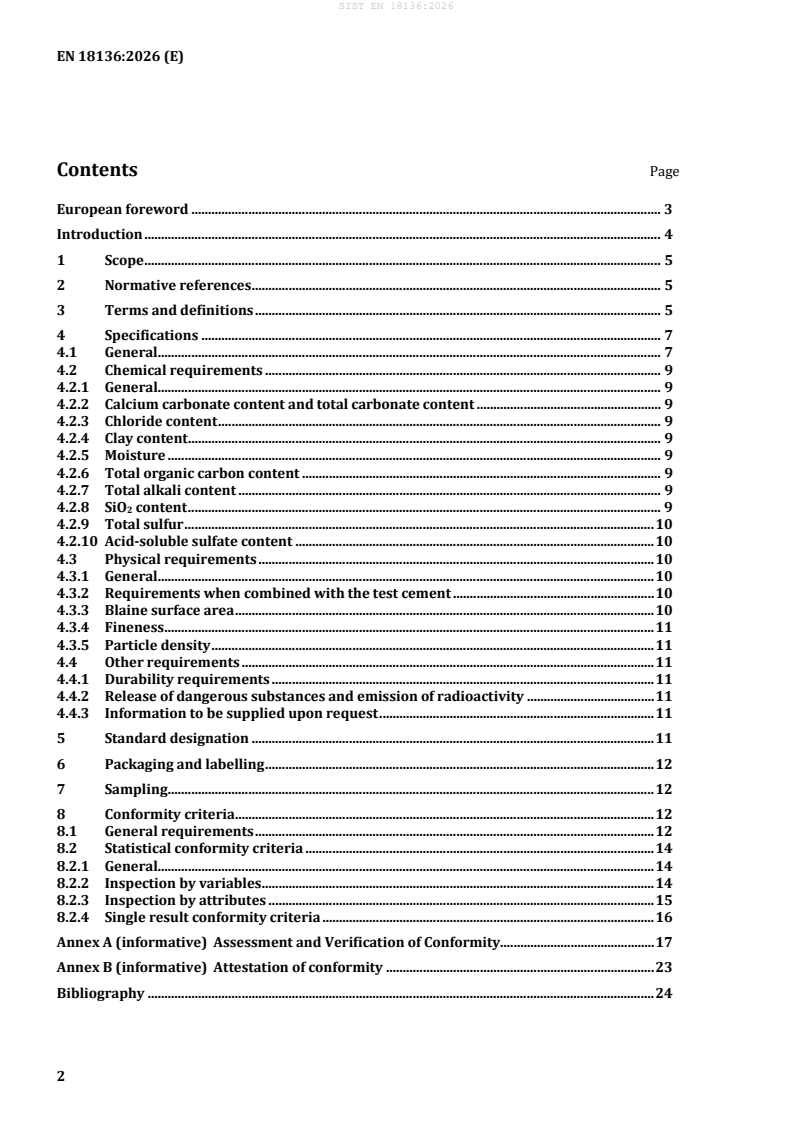
Contents Page
European foreword . 3
Introduction . 4
1 Scope . 5
2 Normative references . 5
3 Terms and definitions . 5
4 Specifications . 7
4.1 General. 7
4.2 Chemical requirements . 9
4.2.1 General. 9
4.2.2 Calcium carbonate content and total carbonate content . 9
4.2.3 Chloride content . 9
4.2.4 Clay content . 9
4.2.5 Moisture . 9
4.2.6 Total organic carbon content . 9
4.2.7 Total alkali content . 9
4.2.8 SiO content . 9
4.2.9 Total sulfur . 10
4.2.10 Acid-soluble sulfate content . 10
4.3 Physical requirements . 10
4.3.1 General. 10
4.3.2 Requirements when combined with the test cement . 10
4.3.3 Blaine surface area . 10
4.3.4 Fineness . 11
4.3.5 Particle density . 11
4.4 Other requirements . 11
4.4.1 Durability requirements . 11
4.4.2 Release of dangerous substances and emission of radioactivity . 11
4.4.3 Information to be supplied upon request . 11
5 Standard designation . 11
6 Packaging and labelling . 12
7 Sampling . 12
8 Conformity criteria . 12
8.1 General requirements . 12
8.2 Statistical conformity criteria . 14
8.2.1 General. 14
8.2.2 Inspection by variables . 14
8.2.3 Inspection by attributes . 15
8.2.4 Single result conformity criteria . 16
Annex A (informative) Assessment and Verification of Conformity. 17
Annex B (informative) Attestation of conformity . 23
Bibliography . 24
European foreword
This document (EN 18136:2026) has been prepared by Technical Committee CEN/TC 104 “Concrete and
related products”, the secretariat of which is held by SN.
This European Standard shall be given the status of a national standard, either by publication of an
identical text or by endorsement, at the latest by September 2026, and conflicting national standards shall
be withdrawn at the latest by May 2029.
Attention is drawn to the possibility that some of the elements of this document may be the subject of
patent rights. CEN shall not be held responsible for identifying any or all such patent rights.
Any feedback and questions on this document should be directed to the users’ national standards body.
A complete listing of these bodies can be found on the CEN website.
According to the CEN-CENELEC Internal Regulations, the national standards organisations of the
following countries are bound to implement this European Standard: Austria, Belgium, Bulgaria, Croatia,
Cyprus, Czech Republic, Denmark, Estonia, Finland, France, Germany, Greece, Hungary, Iceland, Ireland,
Italy, Latvia, Lithuania, Luxembourg, Malta, Netherlands, Norway, Poland, Portugal, Republic of North
Macedonia, Romania, Serbia, Slovakia, Slovenia, Spain, Sweden, Switzerland, Türkiye and the United
Kingdom.
Introduction
This document sets out specifications for ground limestone for use in concrete, mortar and grout. It is
based on a survey that has been carried out in European countries already using ground limestone in
concrete, which has enabled the identification of the common core group of characteristics and common
values.
The ground limestone referred to in this document is originated from the exploitation of carbonate rock-
forming minerals (limestone, chalk, marble, dolostone). Ground limestone is used in concrete production
in some European countries, based on national experience and tradition.
When using ground limestone conforming to this document, consider that certain properties of fresh and
hardened concrete can be influenced. Where relevant, such effects need to be considered in concrete mix
design.
1 Scope
This document specifies requirements for the chemical and physical properties as well as quality control
procedures for ground limestone for use as an addition in concrete.
This document is also applicable to ground limestone to be used in mortars and grouts.
This document does not specify provisions for the use of ground limestone in the production of concrete.
2 Normative references
The following documents are referred to in the text in such a way that some or all of their content
constitutes requirements of this document. For dated references, only the edition cited applies. For
undated references, the latest edition of the referenced document (including any amendments) applies.
EN 196-1, Methods of testing cement - Part 1: Determination of strength
EN 196-2, Methods of testing cement - Part 2: Chemical analysis of cement
EN 196-3, Methods of testing cement - Part 3: Determination of setting times and soundness
EN 196-6, Methods of testing cement - Part 6: Determination of fineness
EN 196-7, Methods of testing cement - Part 7: Methods of taking and preparing samples of cement
EN 197-1, Cement - Part 1: Composition, specifications and conformity criteria for common cements
EN 933-9, Tests for geometrical properties of aggregates - Part 9: Assessment of fines - Methylene blue test
EN 933-10, Tests for geometrical properties of aggregates - Part 10: Assessment of fines - Grading of filler
aggregates (air jet sieving)
EN 1097-5, Tests for mechanical and physical properties of aggregates - Part 5: Determination of the water
content by drying in a ventilated oven
EN 1097-7, Tests for mechanical and physical properties of aggregates - Part 7: Determination of the
particle density of filler - Pyknometer method
EN 1744-1, Tests for chemical properties of aggregates — Part 1: Chemical analysis
EN 13639, Determination of total organic carbon in limestone
3 Terms and definitions
For the purposes of this document, the following terms and definitions apply.
ISO and IEC maintain terminology databases for use in standardization at the following addresses:
— ISO Online browsing platform: available at https://www.iso.org/obp/
— IEC Electropedia: available at https://www.electropedia.org/
3.1
ground limestone
fine particles obtained by grinding and/or selection, dry or in aqueous suspension, from carbonate rocks
Note 1 to entry: E.g. limestone, chalk, marble, dolostone.
3.2
addition
finely divided inorganic material used in concrete in order to improve certain properties or to achieve
special properties
3.3
test cement
selected source of Portland cement used for carrying out the tests needed to evaluate conformity to the
requirements of 4.3.2.2, 4.3.2.3 and 4.3.2.4
3.4
activity index
percentage of the compressive strength of standard mortar bars, prepared with 75 % test
cement plus 25 % ground limestone by mass, to the compressive strength of standard mortar bars
prepared with 100 % test cement, when tested at the same age
3.5
autocontrol
continuous statistical quality control of the ground limestone based on the testing of samples taken by
the producer or their agent at point(s) of release from the ground limestone producing facility
3.6
control period
period of production and/or dispatch identified for the evaluation of the autocontrol test results
3.7
characteristic value
value of the required property outside of which lies a specified percentage, the percentile Pk, of all the
values of the population
3.8
single result limit value
limit value of a chemical or physical property which – for any single test result – in the case of an upper
limit is not to be exceeded or in the case of a lower limit is, as a minimum, to be reached
3.9
allowable probability of acceptance CR
for a given sampling plan, the allowed probability of acceptance of ground limestone with a characteristic
value outside the specified minimum or maximum values
3.10
sampling plan
specific plan which states the (statistical) sample size(s) to be used, the percentile Pk, and the allowable
probability of acceptance CR
3.11
spot sample
sample taken at the same time and from one and the same place, relating to the intended tests which can
be obtained by combining one or more immediately consecutive increments
Note 1 to entry: See EN 196-7.
3.12
certificate of conformity of the factory production control
document issued under the rules of the scheme for the Assessment and Verification of Conformity
indicating that adequate confidence is provided that factory production control is in conformity with the
relevant product specification standard
3.13
existing factory
factory for which the conformity of the factory production control has already been certified using this
document
3.14
factory production control
documented, permanent and internal control of production in a factory
3.15
factory
facility used by a manufacturer for the production of ground limestone using equipment which is suitable
for continuous mass production of ground limestone, in particular, equipment for adequate grinding
and/or selection and the necessary silo capacity for the storage and dispatch of each ground limestone
produced
Note 1 to entry: This equipment and the production control applied allow the control of production with
sufficient accuracy to ensure that the requirements of this document are met.
3.16
initial period
immediate period starting after the first issuing of the certificate of conformity of the factory production
control for a ground limestone and at the latest from the first dispatching of ground limestone
3.17
new factory
factory for which the conformity of the factory production control has not been certified using this
document
3.18
certification body
third-party conformity assessment body operating certification schemes
3.19
works’ quality documentation
documentation that provides information on the factory production control which is applied by a
manufacturer at a particular factory to ensure constancy of performance of the ground limestone
4 Specifications
4.1 General
The chemical and physical requirements in 4.2 and 4.3 are specified as characteristic or declared values.
Conformity to a characteristic or declared value is assessed by means of a statistical quality control
procedure as described in Clause 8. The test methods prescribed in this document are reference methods.
Other test methods may be used provided they give results equivalent to those obtained with the
reference method. In case of a dispute, only the reference method shall be used.
Ground limestone shall be in accordance with one of the three categories given in Table 1 for the chemical
and physical requirements. The producer shall declare the conformity of the ground limestone to one of
the three categories.
Table 1 — Chemical and physical requirements given as characteristic or declared values
a
Property Test Requirements
reference
Category 1 Category 2 Category 3
CaCO (%) EN 196-2 ≥ 95 ≥ 75 ≥ 40
CaCO3 + MgCO3 (%) EN 196-2 To declare as a ≥ 75
j
minimum value
Chloride content (%) EN 196-2 ≤ 0,10 ≤ 0,10 ≤ 0,10
Clay content (g/kg) EN 933-9 ≤ 3,0 ≤ 12,0 ≤ 12,0
b b b
Moisture (%) EN 1097-5 ≤ 1 ≤ 1 ≤ 1
Total organic carbon content EN 13639 ≤ 0,20 ≤ 0,20 ≤ 0,20
c
(%) c or ≤ 0,50
or ≤ 0,50
Total alkali content (%) EN 196-2 To declare as a To declare as a To declare as a
maximum maximum value maximum
value value
i
SiO content (%) EN 196-2 To declare as a To declare as a To declare as a
maximum maximum value maximum
value value
g h h h
Total sulfur (%) EN 1744-1 ≤ 0,4 ≤ 0,4 ≤ 0,4
k k k
Acid-soluble sulfate content EN 1744-1 ≤ 0,15 ≤ 0,15 ≤ 0,15
g
(%)
f
Initial setting time (min) EN 196-3 ≤ twice of the control mix
f
Soundness (mm) EN 196-3 ≤ 10 ≤ 10 ≤ 10
Activity index EN 196-1 ≥ 0,71 ≥ 0,71 ≥ 0,71
2 d
Blaine surface area (m /kg) EN 196-6 ≥ 280 ≥ 220 ≥ 220
e
Fineness % < 63µm EN 933-10 > 70 > 70 > 70
e
Fineness % < 125µm EN 933-10 > 85 > 85 > 85
e
Fineness % < 2mm EN 933-10 100 100 100
Particle density EN 1097-7 To declare as To declare as an To declare as
an average average value an average
value value
a
Requirements expressed in % are given by mass of the ground limestone.
b
To be declared if greater than 1 %.
c
The producer shall declare which limit (0,20 or 0,50) applies for category 2 and category 3.
d
When fineness is determined according to 4.3.4 Fineness and the corresponding requirements of this table,
it is not mandatory to determine Blaine surface area according 4.3.3.
e
When fineness is determined according to 4.3.3 Blaine surface area and the corresponding requirements of
this table, it is not mandatory to determine fineness according to 4.3.4.
a
Property Test Requirements
reference
f
When soundness and initial setting time are determined according to 4.3.2.3 and 4.3.2.2 and the
corresponding requirements of this table, it is not mandatory to determine sulphur and sulfate content.
g
When total sulfur and acid-soluble sulfate content are determined according to 4.2.9 and 4.2.10 and the
corresponding requirements of this table, it is not mandatory to determine initial setting time and soundness.
h
To be declared if greater than 0,4 %.
i
SiO2 content shall be declared where specified
j
Declaration of CaCO + MgCO (%) content is optional.
3 3
k
To be declared as a maximum value if greater than 0,15 %.
4.2 Chemical requirements
4.2.1 General
The chemical properties of the ground limestone shall conform to the requirement in Table 1.
4.2.2 Calcium carbonate content and total carbonate content
The calcium carbonate content expressed as CaCO and total carbonate content (CaCO +MgCO ), shall be
3 3 3
determined in accordance with EN 196-2.
4.2.3 Chloride content
–
The chloride content expressed as Cl , shall be determined in accordance with EN 196-2.
4.2.4 Clay content
The clay content shall be determined by the methylene blue test in accordance with EN 933-9 and
expressed in g/kg.
4.2.5 Moisture
The moisture shall be determined in accordance with EN 1097-5 and expressed in % by mass.
Ground limestone moisture shall be declared if greater than 1 %.
In the case ground limestone is supplied in suspension, the dry mass content of the suspension shall not
deviate from the value declared by the supplier by more than ± 2 % by mass of the material when
determined by drying a representative sample of at least 5 g of suspension in a well ventilated oven
at (105 ± 5) °C to constant mass. Constant mass is considered to be reached when successive weighings
at least 1 h apart during drying at (105 ± 5) °C do not differ by more than 0,2 %.
4.2.6 Total organic carbon content
The total organic carbon content (TOC) shall be determined in accordance with EN 13639 and expressed
in % by mass. The producer shall declare which limit (0,20 or 0,50) applies for category 2 and category 3.
4.2.7 Total alkali content
The total alkali content shall be determined in accordance with EN 196-2 and declared as Na O .
2 eq
The result is expressed in % by mass.
content
4.2.8 SiO2
The total content of SiO shall be determined in accordance with EN 196-2 and expressed in % by mass.
4.2.9 Total sulfur
The sulfur content shall be determined in accordance with EN 1744-1 and expressed in % by mass.
4.2.10 Acid-soluble sulfate content
The acid-soluble sulfate content shall be determined in accordance with EN 1744-1 and expressed in %
by mass.
4.3 Physical requirements
4.3.1 General
The physical properties of the ground limestone shall conform to the requirement in Table 1.
4.3.2 Requirements when combined with the test cement
4.3.2.1 Test cement
The test cement according to EN 197-1 shall have the following requirements:
— Type CEM I;
— Strength class 42,5 or higher;
— Fineness (Blaine) not less than 300-460 m /kg;
— Tricalcium aluminate: 6 % by mass to 12 % by mass;
— Total alkalis (Na O ): 0,5 % by mass to 1,2 % by mass.
2 eq
4.3.2.2 Initial Setting time
The initial setting time of a combination (by mass) of 25 % of ground limestone with 75 % of test cement
shall be determined in accordance with EN 196-3 and shall not be greater than twice as long as the initial
setting time of the reference cement.
4.3.2.3 Soundness
The soundness shall be determined on 25 % ground limestone plus 75 % test cement (both by mass) in
accordance with EN 196-3.
4.3.2.4 Activity index
The activity index shall be expressed as the ratio (in percent) of the compressive strength of the
combination (by mass) of 25 % of ground limestone with 75 % of test cement, to the compressive
strength of the test cement on its own. The compressive strengths shall be determined in accordance
with EN 196-1 and the “water: (cement + ground limestone)” ratio and the “water: cement” ratio shall
both be 0,50. The activity index is evaluated at 28 days.
NOTE The activity index gives no direct information on the strength contribution of ground limestone in
concrete, nor is the use of the ground limestone limited to the mixing ratio used in the activity index test.
4.3.3 Blaine surface area
The specific Blaine surface shall be determined in accordance with the air permeability method specified
in EN 196-6. The result is expressed in m /kg.
2 2
NOTE 1 m /kg = 10 cm /g.
4.3.4 Fineness
The fineness at 63 µm, 125 µm and 2 mm may be determined by air jet sieving in accordance
with EN 933-10 or Laser diffraction methods in accordance with ISO 13320 [5]. In case of dispute, the air
jet sieving method according to EN 933-10 shall be used as the reference method.
Other sieves may be provided on request.
4.3.5 Particle density
The particle density shall be determined in accordance with EN 1097-7 and shall not deviate by more
than 200 kg/m from the value declared by the producer.
4.4 Other requirements
4.4.1 Durability requirements
Ground limestone conforming to this document is deemed to satisfy the durability requirements for
concrete.
NOTE Requirements for concrete durability can be found in the concrete standard series EN 206 and national
regulations.
4.4.2 Release of dangerous substances and emission of radioactivity
Additional information for the release of dangerous substances and emission of radioactivity may be
supplied upon request where specified.
NOTE Requirements can be found in transposed European legislation and national laws, regulations and
administrative provisions.
4.4.3 Information to be supplied upon request
Additional information may be supplied upon request where specified.
5 Standard designation
Ground limestone covered by this document shall be designated by its category as specified in Table 1.
Additional information shall be provided:
— the moisture value if the moisture is greater than 1 %;
— the dry mass content in the case the ground limestone is supplied in suspension;
— the total organic carbon content limit (0,20 % or 0,50 %) in case of category 2 and 3;
When in the same factory, the manufacturer produces different ground
...