

SIST EN 438-9:2026
(Main)High-pressure decorative laminates (HPL) - Sheets based on thermosetting resins (usually called laminates) - Part 9: Classification and specifications for alternative core laminates
General Information
- Abstract
This document specifies performance requirements for alternative core laminates intended for interior use, the core layer compositions of which are not covered by EN 438-3 [1], EN 438-4 [2], EN 438-5 [3], EN 438-6 [4] and EN 438-8 [5]. The core layer types (coloured core layer and metal reinforced core layer) are specified in this part of the EN 438 series.
NOTE Regarding the test methods relevant to this document, see EN 438-2.
- Status
- Published
- Public Enquiry End Date
- 30-Jul-2025
- Publication Date
- 17-Jun-2026
- Technical Committee
- IPMA - Polimer materials and products
- Current Stage
- 6060 - National Implementation/Publication (Adopted Project)
- Start Date
- 11-Jun-2026
- Due Date
- 16-Aug-2026
- Completion Date
- 18-Jun-2026

Overview
SIST EN 438-9:2026 establishes the classification and specification requirements for high-pressure decorative laminates (HPL) with alternative core layers based on thermosetting resins, intended mainly for interior use. This standard specifically covers laminate core compositions not included in earlier parts of the EN 438 series, such as coloured core layers and metal reinforced core layers. It outlines dimensional tolerances, performance criteria, and inspection requirements aimed at supporting quality, safety, and performance in diverse architectural and furnishing applications.
Key Topics
Alternative Core Laminates
Laminates included under SIST EN 438-9:2026 feature core layer compositions not described in EN 438-3, EN 438-4, EN 438-5, EN 438-6, or EN 438-8. The key types are:- Coloured core laminates: Developed for enhanced aesthetic consistency throughout the laminate thickness.
- Metal reinforced core laminates: Incorporate metal layers or meshes to improve mechanical properties, fire resistance, or permeability.
Classification System
- Laminates are classified with a three-letter code based on core type, thickness (compact or thin), and grade (standard or flame-retardant).
- This standard includes both standard and flame-retardant grades for coloured core and metal reinforced laminates.
Performance and Inspection Requirements
- Specifies criteria for surface quality, colour, pattern, and finish through visual and physical inspections.
- Outlines dimensional tolerances for thickness, flatness, length, width, and edge quality.
- Sets requirements for resistance to wear, immersion, humid or wet conditions, heat, as well as flexural strength and density.
- References the relevant test methods (primarily EN 438-2) for determining properties including reaction to fire.
Fire Performance
- Notes that fire reaction properties depend on composition and construction.
- Advises that fire testing for construction applications should refer to EN 13823, EN ISO 11925-2, and EN 13501-1, while performance in non-construction uses may vary by country.
Applications
High-pressure decorative alternative core laminates are valued for their durability, versatility, and design flexibility. Their typical areas of use include:
- Interior wall panels and partitions: Where a solid colour or metal aesthetic is desired throughout the panel thickness.
- Furniture manufacturing: For surfaces that require enhanced strength, edge durability, and aesthetic appeal-especially where exposed edges are visible.
- Public and commercial spaces: Such as retail, hospitality, or healthcare environments requiring high-impact, robust surfaces.
- Specialty environments: Metal reinforced core laminates are suited to settings with heightened mechanical or fire performance needs, such as transport, public buildings, or laboratories.
- Magnetic and functional panel uses: Metal reinforcements can enable magnetic or adhesive functionalities for display systems or technical applications.
Related Standards
For a comprehensive approach to HPL performance, design, and testing, the following standards are closely related to SIST EN 438-9:2026:
- EN 438-1: Introduction and general information on high-pressure decorative laminates.
- EN 438-2: Test methods and determination of properties for HPL sheets.
- EN 438-3: Classification and specification for laminates under 2 mm for bonding to substrates.
- EN 438-4: Specification for compact laminates (≥2 mm thick).
- EN 438-5: Flooring-grade HPL specification (<2 mm thick).
- EN 438-6: Exterior grade compact laminates (≥2 mm thick).
- EN 438-8: Specification for design laminates.
- EN 13823, EN ISO 11925-2, and EN 13501-1: Fire reaction testing and classification for construction-related uses.
By adhering to SIST EN 438-9:2026, manufacturers and specifiers can ensure alternative core HPL delivers the needed performance, safety, and visual quality for advanced interior applications. The standard supports consistent, high-quality outcomes across architectural, furniture, and specialty projects employing coloured core or metal reinforced laminates.
Relations
- Effective Date
- 10-Jun-2026
- Effective Date
- 10-Jun-2026
- Effective Date
- 10-Jun-2026
- Effective Date
- 10-Jun-2026
- Effective Date
- 10-Jun-2026
- Effective Date
- 10-Jun-2026
- Effective Date
- 10-Jun-2026
- Effective Date
- 10-Jun-2026
- Effective Date
- 10-Jun-2026
- Effective Date
- 19-Jun-2024
Get Certified
Connect with accredited certification bodies for this standard

DIN CERTCO
DIN Group product certification.

Smithers Quality Assessments
US management systems and product certification.
Sponsored listings
Frequently Asked Questions
SIST EN 438-9:2026 is a standard published by the Slovenian Institute for Standardization (SIST). Its full title is "High-pressure decorative laminates (HPL) - Sheets based on thermosetting resins (usually called laminates) - Part 9: Classification and specifications for alternative core laminates". This standard covers: This document specifies performance requirements for alternative core laminates intended for interior use, the core layer compositions of which are not covered by EN 438-3 [1], EN 438-4 [2], EN 438-5 [3], EN 438-6 [4] and EN 438-8 [5]. The core layer types (coloured core layer and metal reinforced core layer) are specified in this part of the EN 438 series. NOTE Regarding the test methods relevant to this document, see EN 438-2.
This document specifies performance requirements for alternative core laminates intended for interior use, the core layer compositions of which are not covered by EN 438-3 [1], EN 438-4 [2], EN 438-5 [3], EN 438-6 [4] and EN 438-8 [5]. The core layer types (coloured core layer and metal reinforced core layer) are specified in this part of the EN 438 series. NOTE Regarding the test methods relevant to this document, see EN 438-2.
SIST EN 438-9:2026 is classified under the following ICS (International Classification for Standards) categories: 83.140.20 - Laminated sheets. The ICS classification helps identify the subject area and facilitates finding related standards.
SIST EN 438-9:2026 has the following relationships with other standards: It is inter standard links to SIST EN 15468:2016+A1:2021, SIST EN 14978:2016, SIST EN 13329:2016+A1:2017, SIST EN 14978:2016+A1:2021, SIST EN 13329:2016, SIST EN 13329:2006+A1:2009, SIST EN 15468:2016, SIST EN 13329:2016+A2:2021, SIST EN 438-1:2016, SIST EN 438-9:2018. Understanding these relationships helps ensure you are using the most current and applicable version of the standard.
SIST EN 438-9:2026 is available in PDF format for immediate download after purchase. The document can be added to your cart and obtained through the secure checkout process. Digital delivery ensures instant access to the complete standard document.
Standards Content (Sample)
SLOVENSKI STANDARD
01-julij-2026
Dekorativni visokotlačni laminati (HPL) - Plošče na osnovi duromernih smol
(splošno laminati) - 9. del: Razvrstitev in specifikacije za laminate z alternativno
strukturo jedra
High-pressure decorative laminates (HPL) - Sheets based on thermosetting resins
(usually called laminates) - Part 9: Classification and specifications for alternative core
laminates
Dekorative Hochdruck-Schichtpressstoffplatten (HPL) - Platten auf Basis härtbarer Harze
(Schichtpressstoffe) - Teil 9: Klassifizierung und Spezifikationen für Schichtpressstoffe
mit alternativem Kernaufbau
Stratifiés décoratifs haute pression (HPL) - Plaques à base de résines
thermodurcissables (communément appelées stratifiés) - Partie 9 : Classification et
spécifications relatives aux stratifiés avec autres types d'âmes
Ta slovenski standard je istoveten z: EN 438-9:2026
ICS:
83.140.20 Laminatne plošče Laminated sheets
2003-01.Slovenski inštitut za standardizacijo. Razmnoževanje celote ali delov tega standarda ni dovoljeno.
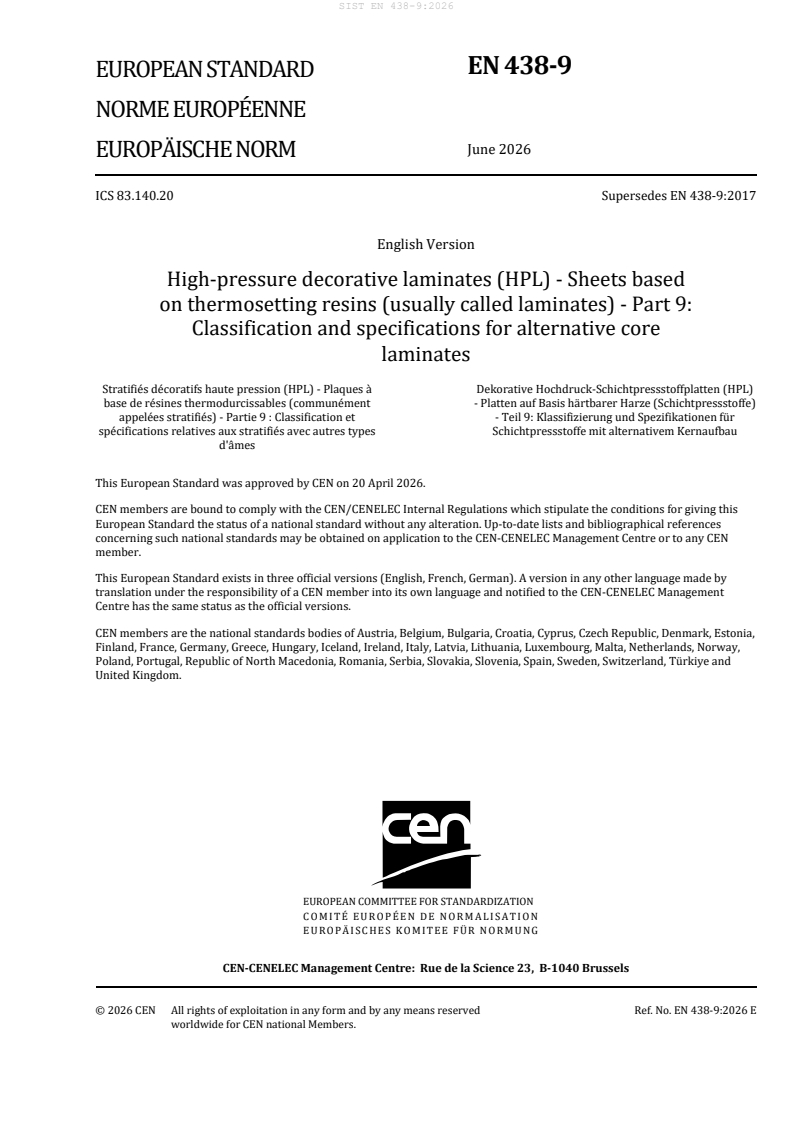
EN 438-9
EUROPEAN STANDARD
NORME EUROPÉENNE
June 2026
EUROPÄISCHE NORM
ICS 83.140.20 Supersedes EN 438-9:2017
English Version
High-pressure decorative laminates (HPL) - Sheets based
on thermosetting resins (usually called laminates) - Part 9:
Classification and specifications for alternative core
laminates
Stratifiés décoratifs haute pression (HPL) - Plaques à Dekorative Hochdruck-Schichtpressstoffplatten (HPL)
base de résines thermodurcissables (communément - Platten auf Basis härtbarer Harze (Schichtpressstoffe)
appelées stratifiés) - Partie 9 : Classification et - Teil 9: Klassifizierung und Spezifikationen für
spécifications relatives aux stratifiés avec autres types Schichtpressstoffe mit alternativem Kernaufbau
d'âmes
This European Standard was approved by CEN on 20 April 2026.
CEN members are bound to comply with the CEN/CENELEC Internal Regulations which stipulate the conditions for giving this
European Standard the status of a national standard without any alteration. Up-to-date lists and bibliographical references
concerning such national standards may be obtained on application to the CEN-CENELEC Management Centre or to any CEN
member.
This European Standard exists in three official versions (English, French, German). A version in any other language made by
translation under the responsibility of a CEN member into its own language and notified to the CEN-CENELEC Management
Centre has the same status as the official versions.
CEN members are the national standards bodies of Austria, Belgium, Bulgaria, Croatia, Cyprus, Czech Republic, Denmark, Estonia,
Finland, France, Germany, Greece, Hungary, Iceland, Ireland, Italy, Latvia, Lithuania, Luxembourg, Malta, Netherlands, Norway,
Poland, Portugal, Republic of North Macedonia, Romania, Serbia, Slovakia, Slovenia, Spain, Sweden, Switzerland, Türkiye and
United Kingdom.
EUROPEAN COMMITTEE FOR STANDARDIZATION
COMITÉ EUROPÉEN DE NORMALISATION
EUROPÄISCHES KOMITEE FÜR NORMUNG
CEN-CENELEC Management Centre: Rue de la Science 23, B-1040 Brussels
© 2026 CEN All rights of exploitation in any form and by any means reserved Ref. No. EN 438-9:2026 E
worldwide for CEN national Members.
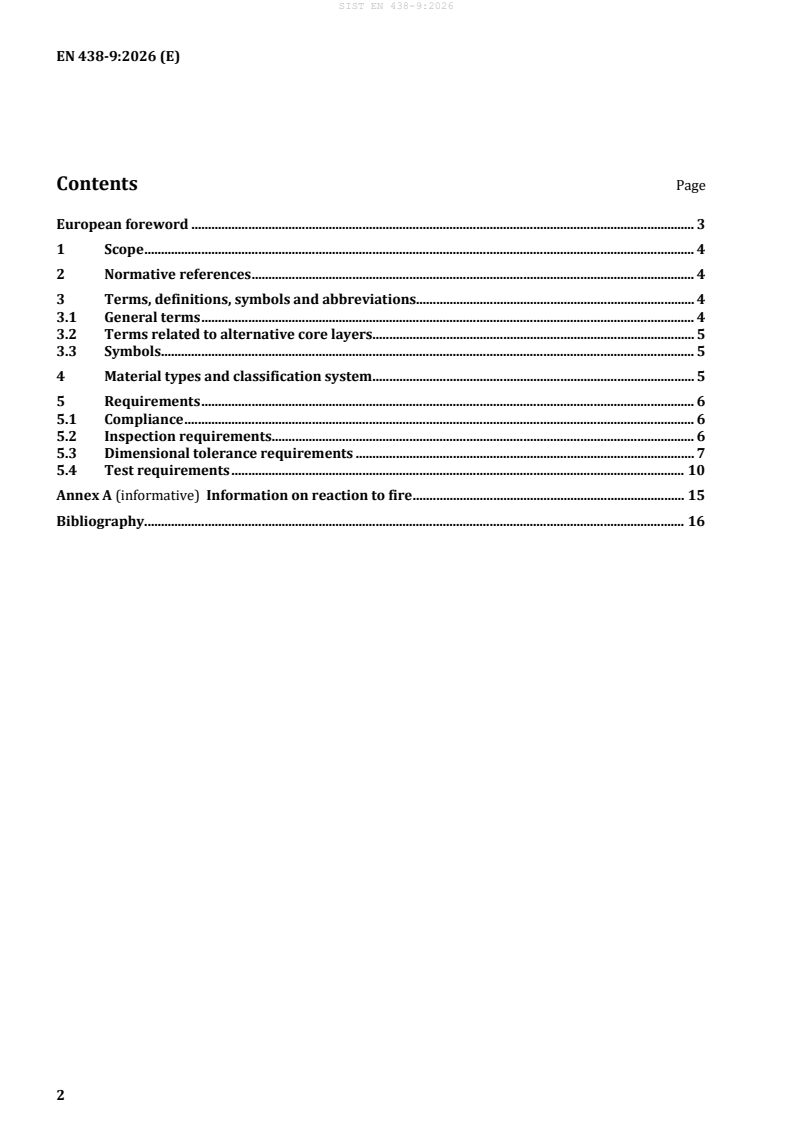
Contents Page
European foreword . 3
1 Scope . 4
2 Normative references . 4
3 Terms, definitions, symbols and abbreviations. 4
3.1 General terms . 4
3.2 Terms related to alternative core layers . 5
3.3 Symbols. 5
4 Material types and classification system . 5
5 Requirements . 6
5.1 Compliance . 6
5.2 Inspection requirements. 6
5.3 Dimensional tolerance requirements . 7
5.4 Test requirements . 10
Annex A (informative) Information on reaction to fire . 15
Bibliography. 16
European foreword
This document (EN 438-9:2026) has been prepared by Technical Committee CEN/TC 249 “Plastics”, the
secretariat of which is held by SIS.
This European Standard shall be given the status of a national standard, either by publication of an
identical text or by endorsement, at the latest by December 2026, and conflicting national standards shall
be withdrawn at the latest by December 2026.
Attention is drawn to the possibility that some of the elements of this document may be the subject of
patent rights. CEN shall not be held responsible for identifying any or all such patent rights.
This document supersedes EN 438-9:2017.
— change of the density requirements on coloured core HPL;
— alignment of the requirements with other parts in the EN 438 series.
The EN 438 series, under the general title High-pressure decorative laminates (HPL) — Sheets based on
thermosetting resins (usually called laminates), consists of the following parts:
— Part 1: Introduction and general information
— Part 2: Determination of properties
— Part 3: Classification and specifications for laminates less than 2 mm thick intended for bonding to
supporting substrates
— Part 4: Classification and specifications for compact laminates of thickness 2 mm and greater
— Part 5: Classification and specifications for flooring grade laminates less than 2 mm thick intended for
bonding to supporting substrates
— Part 6: Classification and specifications for exterior-grade Compact laminates of thickness 2 mm and
greater
— Part 7: Compact laminate and HPL composite panels for internal and external wall and ceiling finishes
— Part 8: Classification and specifications for design laminates
— Part 9: Classification and specifications for alternative core laminates
Any feedback and questions on this document should be directed to the users’ national standards body.
A complete listing of these bodies can be found on the CEN website.
According to the CEN-CENELEC Internal Regulations, the national standards organisations of the
following countries are bound to implement this European Standard: Austria, Belgium, Bulgaria, Croatia,
Cyprus, Czech Republic, Denmark, Estonia, Finland, France, Germany, Greece, Hungary, Iceland, Ireland,
Italy, Latvia, Lithuania, Luxembourg, Malta, Netherlands, Norway, Poland, Portugal, Republic of North
Macedonia, Romania, Serbia, Slovakia, Slovenia, Spain, Sweden, Switzerland, Türkiye and the United
Kingdom.
1 Scope
This document specifies performance requirements for alternative core laminates intended for interior
use, the core layer compositions of which are not covered by EN 438-3 [1], EN 438-4 [2], EN 438-5 [3],
EN 438-6 [4] and EN 438-8 [5]. The core layer types (coloured core layer and metal reinforced core layer)
are specified in this part of the EN 438 series.
NOTE Regarding the test methods relevant to this document, see EN 438-2.
2 Normative references
The following documents, in whole or in part, are normatively referenced in this document and are
indispensable for its application. For dated references, only the edition cited applies. For undated
references, the latest edition of the referenced document (including any amendments) applies.
EN 438-2:2016+A1:2018, High-pressure decorative laminates (HPL) — Sheets based on thermosetting
resins (usually called laminates) — Part 2: Determination of properties
EN ISO 178, Plastics — Determination of flexural properties (ISO 178)
EN ISO 1183-1, Plastics — Methods for determining the density of non-cellular plastics — Part 1: Immersion
method, liquid pycnometer method and titration method (ISO 1183-1)
EN ISO 12572, Hygrothermal performance of building materials and products — Determination of water
vapour transmission properties — Cup method (ISO 12572)
3 Terms, definitions, symbols and abbreviations
For the purposes of this document, the following terms and definitions apply.
ISO and IEC maintain terminology databases for use in standardization at the following addresses:
— ISO Online browsing platform: available at https://www.iso.org/obp/
— IEC Electropedia: available at https://www.electropedia.org/
3.1 General terms
3.1.1
high-pressure decorative alternative core laminate
alternative core laminate
HPL
sheet(s) consisting of decorative surface layer(s) and alternative core layers bonded together by an high
pressure process
Note 1 to entry: Typical values for the high pressure process are a temperature of ≥ 120 °C and a pressure
of ≥ 5 MPa.
3.1.2
surface layer
upper decorative layer consisting in one or more sheets of fibrous material (usually paper) impregnated
with aminoplastic thermosetting resins (usually melamine based resins)
Note 1 to entry: The surface layers appear on one or both side(s) of the laminate(s). In case of one-sided laminates,
the back of the sheet(s) can be made suitable for adhesive bonding to a substrate.
3.2 Terms related to alternative core layers
3.1.3.1
coloured core layer
coloured fibrous materials (usually paper) impregnated with aminoplastic thermosetting resins (usually
melamine based resins) or fibrous materials (usually paper) impregnated with coloured aminoplastic
thermosetting resins (usually melamine based resins)
Note 1 to entry: A translucent laminate is achieved by using clear resins and bleached fibres.
Note 2 to entry: The surface layer and the coloured core layers can have the same colour producing a uniformly
coloured laminate or be different colours to achieve a succession of coloured layers.
3.1.3.2
metal reinforced core layer
metal layer(s) or mesh(es) and cellulosic fibrous layers (usually paper) impregnated with phenolic
thermosetting resins or aminoplastic thermosetting resins (usually melamine based resins)
Note 1 to entry: The purpose of including the metal layers is to improve the mechanical, fire or permeability
performances of the laminate. Additionally, the metal layers can give aesthetic improvements to edge and can also
act as magnetically adhesive layer.
3.3 Symbols
For the purposes of this document, the following symbols apply:
t nominal thickness of the alternative core laminate
4 Material types and classification system
Alternative core laminates are specified using a three-letter classification system as shown in Table 1.
Table 1 — Alternative core laminate classification system
First letter Second letter Third letter
B (Coloured core layer laminate) C (Compact) S (Standard grade)
R (Metal reinforced core layer laminate) T (Thin laminate < 2 mm) F (Flame retardant grade)
Type S – Standard grade high-pressure decorative alternative core laminates.
Type F – High-pressure decorative alternative core laminates with improved fire retardance, similar to
type S but also complying with special requirements of specified tests which may vary according to the
application (e.g. construction, marine, transport) and the country of use (see 5.4.3).
NOTE These types of laminate are normally not postformable.
In addition to the abbreviation “HPL” and the number of this document, materials are specified by the
alphabetical classification system.
EXAMPLE “Coloured core, standard grade, thin, high-pressure decorative laminate” is designated as
HPL/EN 438-9 BTS.
5 Requirements
5.1 Compliance
Alternative core layer laminates classified in Table 1 shall comply with all appropriate requirements
specified in 5.2, 5.3 and 5.4. This applies to both full-size sheets and cut-to-size panels.
5.2 Inspection requirements
5.2.1 General
Inspection shall be carried out in accordance with EN 438-2:2016+A1:2018, Clause 4, at a distance
between 750 mm and 1 500 mm.
5.2.2 Colour and pattern
When inspected in daylight or D65 standard illuminant, as specified in EN ISO/CIE 11664-2 [9], and also
under tungsten-filament lightning illuminant A as specified in EN ISO/CIE 11664-2 [9], a slight difference
between the corresponding colour reference sample held by the supplier and the specimen under test is
acceptable.
When colour and surface finish are critical, sheets should be checked for colour and surface-finish
compatibility without protective film before fabrication or installation.
5.2.3 Surface finish
When inspected at different viewing angles, there shall be no significant difference between the
corresponding surface-finish reference sample held by the supplier and the specimen under test.
When colour and surface finish are critical, it is recommended that sheets are checked for colour and
surface-finish compatibility without protective film before fabrication or installation.
5.2.4 Reverse side
The reverse side of single-sided sheets shall be suitable for adhesive bonding (e.g. sanded). In the case of
sanded backs, slight chatter marks are permissible.
...