


IEC 60747-5-5:2007
(Main)Semiconductor devices - Discrete devices - Part 5-5: Optoelectronic devices - Photocouplers
General Information
- Abstract
This part of IEC 60747 gives the terminology, essential ratings, characteristics, safety test as well as the measuring method for photocouplers (or optocouplers). NOTE The word "optocoupler" can also be used instead of "photocoupler". This standard replaces the clauses for photocouplers (or optocouplers) described in IEC 60747-5-1, IEC 60747-5-2 and IEC 60747-5-3, including their amendments. The contents for phototransistors and photothyristors in IEC 60747-5-1, IEC 60747-5-2 and IEC 60747-5-3, including their amendments, will be considered obsolete as of the effective date of publication of this standard. NOTE Photocouplers that are certified to the previous version of the photocoupler standard, namely IEC 60747-5-1/2/3, are to be considered in compliance with the requirements and provisions of IEC 60747-5-5.
- Status
- Published
- Publication Date
- 12-May-2013
- Technical Committee
- SC 47E - Discrete semiconductor devices
- Drafting Committee
- WG 4 - TC 47/SC 47E/WG 4
- Current Stage
- DELPUB - Deleted Publication
- Start Date
- 20-Jul-2020
- Completion Date
- 28-Aug-2026
Buy Documents
IEC 60747-5-5:2007+AMD1:2013 CSV - Semiconductor devices - Discrete devices - Part 5-5: Optoelectronic devices - Photocouplers Released:5/13/2013

IEC 60747-5-5:2007 - Semiconductor devices - Discrete devices - Part 5-5: Optoelectronic devices - Photocouplers Released:9/26/2007
Overview
IEC 60747-5-5:2007 is an international standard published by the International Electrotechnical Commission (IEC) that focuses on semiconductor discrete optoelectronic devices known as photocouplers, also called optocouplers. This standard defines the terminology, essential ratings, characteristics, safety tests, and measurement methods for photocouplers. It updates and replaces previous relevant clauses found in IEC 60747-5-1, IEC 60747-5-2, and IEC 60747-5-3, consolidating the requirements into a single comprehensive document.
Photocouplers are crucial components used to provide electrical isolation and signal transfer between different parts of electronic systems, particularly where noise reduction and protection against high voltages are essential. IEC 60747-5-5 standardizes key aspects of photocoupler design, testing, and manufacturing to ensure interoperability, safety, and performance.
Key Topics
Terminology and Definitions: Clear definitions related to photocouplers including types such as phototransistor, photothyristor, phototriac, photodarlington, IC photocoupler, FET photocoupler, and solid-state opto relay.
Essential Ratings: Specifications for safe operating conditions and electrical ratings including current transfer ratio (CTR), cut-off frequency, isolation voltage, isolation resistance, and input/output capacitance.
Safety Requirements: Requirements specific to photocouplers providing reinforced isolation for electrical shock protection, including partial discharge testing, isolation voltage testing, and related safety certifications.
Electrical Characteristics: Parameters describing device performance such as collector-emitter saturation voltage, switching times, maximum power dissipation, and holding current.
Measuring and Testing Methods: Standardized procedures to measure critical parameters such as CTR, isolation resistance, switching times, partial discharges, and transient immunity (CMTI).
Types of Photocouplers: Coverage of DC and AC input photocouplers with outputs including phototransistor, phototriac, and solid state opto relays ensuring adaptability across applications.
Applications
IEC 60747-5-5 certified photocouplers are widely used in various industrial and consumer electronic applications to provide safe and reliable electrical isolation and signal transmission. Key application areas include:
Industrial Automation: Ensuring noise-free control signal transfer and user safety in programmable logic controllers (PLCs), motor drives, and sensor interfaces.
Power Electronics: Isolation in switching power supplies, inverters, and motor controllers where high voltage isolation and transient immunity are mandatory.
Communication Systems: Protecting sensitive circuitry in data communication devices by isolating signal grounds and reducing electromagnetic interference.
Medical Equipment: Providing reinforced isolation to safeguard patients and operators from electrical shock in diagnostic and therapeutic devices.
Consumer Electronics: Enhancing safety and reliability in devices such as power adapters, televisions, and audio equipment where signal and power sections need isolation.
The standard ensures that devices meet strict electrical safety and performance criteria, facilitating their use in critical applications requiring high reliability and protection.
Related Standards
IEC 60747 Series: Covers a broad spectrum of semiconductor devices including discrete and integrated components beyond photocouplers.
IEC 60065: Safety standard applicable to audio, video, and similar electronic apparatus which may incorporate photocouplers for isolation.
IEC 61010 Series: Safety requirements for electrical equipment for measurement, control, and laboratory use, relevant when photocouplers are used for isolation.
ISO/IEC 62368: Safety standard for audio/video and information technology, guiding the use of isolation components like photocouplers.
UL1577: U.S. safety standard specifically related to optocouplers, which often references or harmonizes with IEC photocoupler standards.
By adhering to IEC 60747-5-5:2007, manufacturers and users of photocouplers can ensure device quality, safety, and interoperability across global electronic applications, making it a critical standard in the semiconductor optoelectronics domain. For detailed measurement procedures, safety requirements, and device characteristics, referencing the official IEC publication is recommended.
Relations
- Effective Date
- 05-Sep-2023
- Effective Date
- 05-Sep-2023
- Effective Date
- 05-Sep-2023
- Effective Date
- 05-Sep-2023
- Effective Date
- 05-Sep-2023
- Effective Date
- 05-Sep-2023
- Effective Date
- 05-Sep-2023
- Effective Date
- 25-Aug-2026
- Effective Date
- 25-Aug-2026
- Effective Date
- 05-Sep-2023
- Revised
IEC 60747-5-5:2020 - Semiconductor devices - Part 5-5: Optoelectronic devices - Photocouplers - Effective Date
- 05-Sep-2023
Buy Documents
IEC 60747-5-5:2007+AMD1:2013 CSV - Semiconductor devices - Discrete devices - Part 5-5: Optoelectronic devices - Photocouplers Released:5/13/2013
IEC 60747-5-5:2007 - Semiconductor devices - Discrete devices - Part 5-5: Optoelectronic devices - Photocouplers Released:9/26/2007
Frequently Asked Questions
IEC 60747-5-5:2007 is a standard published by the International Electrotechnical Commission (IEC). Its full title is "Semiconductor devices - Discrete devices - Part 5-5: Optoelectronic devices - Photocouplers". This standard covers: This part of IEC 60747 gives the terminology, essential ratings, characteristics, safety test as well as the measuring method for photocouplers (or optocouplers). NOTE The word "optocoupler" can also be used instead of "photocoupler". This standard replaces the clauses for photocouplers (or optocouplers) described in IEC 60747-5-1, IEC 60747-5-2 and IEC 60747-5-3, including their amendments. The contents for phototransistors and photothyristors in IEC 60747-5-1, IEC 60747-5-2 and IEC 60747-5-3, including their amendments, will be considered obsolete as of the effective date of publication of this standard. NOTE Photocouplers that are certified to the previous version of the photocoupler standard, namely IEC 60747-5-1/2/3, are to be considered in compliance with the requirements and provisions of IEC 60747-5-5.
This part of IEC 60747 gives the terminology, essential ratings, characteristics, safety test as well as the measuring method for photocouplers (or optocouplers). NOTE The word "optocoupler" can also be used instead of "photocoupler". This standard replaces the clauses for photocouplers (or optocouplers) described in IEC 60747-5-1, IEC 60747-5-2 and IEC 60747-5-3, including their amendments. The contents for phototransistors and photothyristors in IEC 60747-5-1, IEC 60747-5-2 and IEC 60747-5-3, including their amendments, will be considered obsolete as of the effective date of publication of this standard. NOTE Photocouplers that are certified to the previous version of the photocoupler standard, namely IEC 60747-5-1/2/3, are to be considered in compliance with the requirements and provisions of IEC 60747-5-5.
IEC 60747-5-5:2007 is classified under the following ICS (International Classification for Standards) categories: 01 - GENERALITIES. TERMINOLOGY. STANDARDIZATION. DOCUMENTATION; 31.080.01 - Semiconductor devices in general; 31.260 - Optoelectronics. Laser equipment. The ICS classification helps identify the subject area and facilitates finding related standards.
IEC 60747-5-5:2007 has the following relationships with other standards: It is inter standard links to IEC 60747-5-1:1997, IEC 60747-5-3:1997/AMD1:2002, IEC 60747-5-1:1997/AMD2:2002, IEC 60747-5-3:1997, IEC 60747-5-2:1997, IEC 60747-5-2:1997/AMD1:2002, IEC 60747-5-1:1997/AMD1:2001, EN 115-1:2008+A1:2010, EN 81-3:2000+A1:2008, IEC 60747-5-5:2007/AMD1:2013, IEC 60747-5-5:2020. Understanding these relationships helps ensure you are using the most current and applicable version of the standard.
IEC 60747-5-5:2007 is available in PDF format for immediate download after purchase. The document can be added to your cart and obtained through the secure checkout process. Digital delivery ensures instant access to the complete standard document.
Standards Content (Sample)
IEC 60747-5-5 ®
Edition 1.1 2013-05
INTERNATIONAL
STANDARD
NORME
INTERNATIONALE
colour
inside
Semiconductor devices – Discrete devices –
Part 5-5: Optoelectronic devices – Photocouplers
Dispositifs à semiconducteurs – Dispositifs discrets –
Partie 5-5: Dispositifs optoélectroniques – Photocoupleurs
All rights reserved. Unless otherwise specified, no part of this publication may be reproduced or utilized in any form
or by any means, electronic or mechanical, including photocopying and microfilm, without permission in writing from
either IEC or IEC's member National Committee in the country of the requester.
If you have any questions about IEC copyright or have an enquiry about obtaining additional rights to this publication,
please contact the address below or your local IEC member National Committee for further information.
Droits de reproduction réservés. Sauf indication contraire, aucune partie de cette publication ne peut être reproduite ni
utilisée sous quelque forme que ce soit et par aucun procédé, électronique ou mécanique, y compris la photocopie et les
microfilms, sans l'accord écrit de la CEI ou du Comité national de la CEI du pays du demandeur.
Si vous avez des questions sur le copyright de la CEI ou si vous désirez obtenir des droits supplémentaires sur cette
publication, utilisez les coordonnées ci-après ou contactez le Comité national de la CEI de votre pays de résidence.
IEC Central Office Tel.: +41 22 919 02 11
3, rue de Varembé Fax: +41 22 919 03 00
CH-1211 Geneva 20 info@iec.ch
Switzerland www.iec.ch
About the IEC
The International Electrotechnical Commission (IEC) is the leading global organization that prepares and publishes
International Standards for all electrical, electronic and related technologies.
About IEC publications
The technical content of IEC publications is kept under constant review by the IEC. Please make sure that you have the
latest edition, a corrigenda or an amendment might have been published.
Useful links:
IEC publications search - www.iec.ch/searchpub Electropedia - www.electropedia.org
The advanced search enables you to find IEC publications The world's leading online dictionary of electronic and
by a variety of criteria (reference number, text, technical electrical terms containing more than 30 000 terms and
committee,…). definitions in English and French, with equivalent terms in
It also gives information on projects, replaced and additional languages. Also known as the International
withdrawn publications. Electrotechnical Vocabulary (IEV) on-line.
IEC Just Published - webstore.iec.ch/justpublished Customer Service Centre - webstore.iec.ch/csc
Stay up to date on all new IEC publications. Just Published If you wish to give us your feedback on this publication
details all new publications released. Available on-line and or need further assistance, please contact the
also once a month by email. Customer Service Centre: csc@iec.ch.
A propos de la CEI
La Commission Electrotechnique Internationale (CEI) est la première organisation mondiale qui élabore et publie des
Normes internationales pour tout ce qui a trait à l'électricité, à l'électronique et aux technologies apparentées.
A propos des publications CEI
Le contenu technique des publications de la CEI est constamment revu. Veuillez vous assurer que vous possédez
l’édition la plus récente, un corrigendum ou amendement peut avoir été publié.
Liens utiles:
Recherche de publications CEI - www.iec.ch/searchpub Electropedia - www.electropedia.org
La recherche avancée vous permet de trouver des Le premier dictionnaire en ligne au monde de termes
publications CEI en utilisant différents critères (numéro de électroniques et électriques. Il contient plus de 30 000
référence, texte, comité d’études,…). termes et définitions en anglais et en français, ainsi que
Elle donne aussi des informations sur les projets et les les termes équivalents dans les langues additionnelles.
publications remplacées ou retirées. Egalement appelé Vocabulaire Electrotechnique
International (VEI) en ligne.
Just Published CEI - webstore.iec.ch/justpublished
Service Clients - webstore.iec.ch/csc
Restez informé sur les nouvelles publications de la CEI.
Just Published détaille les nouvelles publications parues. Si vous désirez nous donner des commentaires sur
Disponible en ligne et aussi une fois par mois par email. cette publication ou si vous avez des questions
contactez-nous: csc@iec.ch.
IEC 60747-5-5 ®
Edition 1.1 2013-05
INTERNATIONAL
STANDARD
NORME
INTERNATIONALE
colour
inside
Semiconductor devices – Discrete devices –
Part 5-5: Optoelectronic devices – Photocouplers
Dispositifs à semiconducteurs – Dispositifs discrets –
Partie 5-5: Dispositifs optoélectroniques – Photocoupleurs
INTERNATIONAL
ELECTROTECHNICAL
COMMISSION
COMMISSION
ELECTROTECHNIQUE
INTERNATIONALE
ICS 31.080.01; 31.260 ISBN 978-2-8322-0814-4
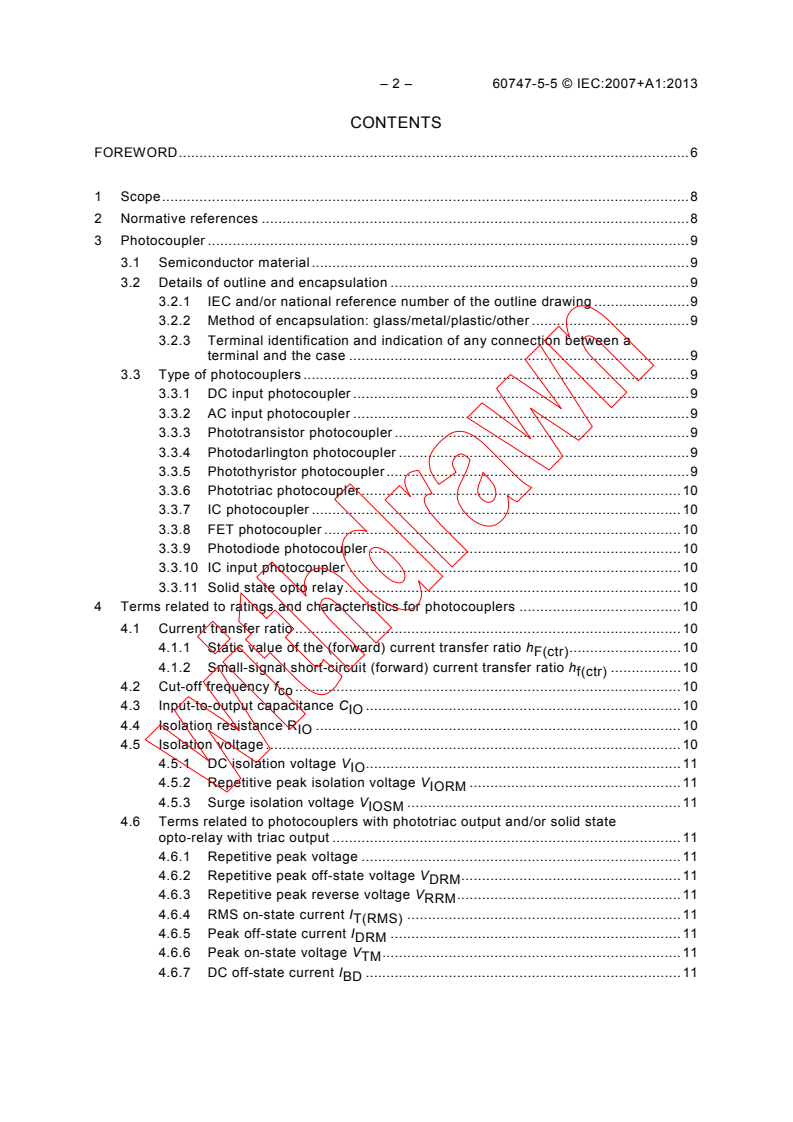
– 2 – 60747-5-5 © IEC:2007+A1:2013
CONTENTS
FOREWORD . 6
1 Scope . 8
2 Normative references . 8
3 Photocoupler . 9
3.1 Semiconductor material . 9
3.2 Details of outline and encapsulation . 9
3.2.1 IEC and/or national reference number of the outline drawing . 9
3.2.2 Method of encapsulation: glass/metal/plastic/other . 9
3.2.3 Terminal identification and indication of any connection between a
terminal and the case . 9
3.3 Type of photocouplers . 9
3.3.1 DC input photocoupler . 9
3.3.2 AC input photocoupler . 9
3.3.3 Phototransistor photocoupler . 9
3.3.4 Photodarlington photocoupler . 9
3.3.5 Photothyristor photocoupler . 9
3.3.6 Phototriac photocoupler . 10
3.3.7 IC photocoupler . 10
3.3.8 FET photocoupler . 10
3.3.9 Photodiode photocoupler . 10
3.3.10 IC input photocoupler . 10
3.3.11 Solid state opto relay . 10
4 Terms related to ratings and characteristics for photocouplers . 10
4.1 Current transfer ratio . 10
4.1.1 Static value of the (forward) current transfer ratio h . 10
F(ctr)
4.1.2 Small-signal short-circuit (forward) current transfer ratio h . 10
f(ctr)
4.2 Cut-off frequency f . 10
co
4.3 Input-to-output capacitance C . 10
IO
4.4 Isolation resistance R . 10
IO
4.5 Isolation voltage . 10
4.5.1 DC isolation voltage V . 11
IO
4.5.2 Repetitive peak isolation voltage V . 11
IORM
4.5.3 Surge isolation voltage V . 11
IOSM
4.6 Terms related to photocouplers with phototriac output and/or solid state
opto-relay with triac output . 11
4.6.1 Repetitive peak voltage . 11
4.6.2 Repetitive peak off-state voltage V . 11
DRM
4.6.3 Repetitive peak reverse voltage V . 11
RRM
4.6.4 RMS on-state current I . 11
T(RMS)
4.6.5 Peak off-state current I . 11
DRM
4.6.6 Peak on-state voltage V . 11
TM
4.6.7 DC off-state current I . 11
BD
60747-5-5 © IEC:2007+A1:2013 – 3 –
4.6.8 DC on-state voltage V . 11
T
4.6.9 Holding current I . 11
H
4.6.10 Critical rate of rise of off-state voltage dV/dt . 11
4.6.11 Trigger input current I . 12
FT
4.7 Common mode transient immunity CMTI . 12
5 Terms for photocoupler providing protection against electrical shock . 12
5.1 Safety ratings of a photocoupler for reinforced isolation . 12
5.2 Electrical safety requirements of a photocoupler for reinforced isolation . 12
5.2.1 Partial discharge p . 12
d
5.2.2 Apparent charge q , q . 12
pd
5.2.3 Threshold apparent charge q , q . 12
pd(TH) TH
5.2.4 Test voltages for the partial-discharge test of a photocoupler . 12
5.2.5 Test voltage V , V . 12
pd(t) t
5.2.6 Partial discharge test voltage V . 13
pd(t)
5.2.7 Initial test voltage V , V . 13
pd(ini) ini
5.2.8 Apparent charge measuring voltage V , V . 13
pd(m) m
5.2.9 Partial-discharge inception voltage V , V . 13
pd(i) i
5.2.10 Partial-discharge extinction voltage V , V . 13
pd(e) e
5.2.11 Time intervals of the test voltage . 13
5.3 Isolation voltages and isolation test voltages for photocouplers providing
protection against electrical shock . 16
5.3.1 Rated isolation voltage . 16
5.4 Limiting values (absolute maximum system) over the operating temperature
range, unless otherwise stated . 16
5.4.1 Minimum and maximum storage temperatures T . 16
stg
5.4.2 Minimum and maximum ambient or reference-point operating
temperatures T or T . 16
amb ref
5.4.3 Maximum soldering temperature T . 16
sld
5.4.4 Maximum continuous (direct) reverse input voltage V . 16
R
5.4.5 Maximum collector-emitter voltage, with the base open-circuited
V . 16
CEO
5.4.6 Maximum collector-base voltage, where an external base connection is
present, with the emitter open-circuited V . 16
CBO
5.4.7 Maximum emitter-base voltage, where an external base connection is
present, with the collector open-circuited V . 16
EBO
5.4.8 Maximum emitter-collector voltage, where no external base connection
is present V . 16
ECO
5.4.9 Maximum continuous (direct) or repetitive peak isolation voltage V
IO
or V . 16
IORM
5.4.10 Where appropriate, maximum surge isolation voltage V . 16
IOSM
5.4.11 Maximum continuous collector current I . 17
C
5.4.12 Maximum continuous forward input current I at an ambient or
F
reference-point temperature of 25 °C and derating curve or derating
factor . 17
5.4.13 Maximum peak forward input current I at an ambient or
FM
reference-point temperature of 25 °C and under specified pulse
conditions . 17
– 4 – 60747-5-5 © IEC:2007+A1:2013
5.4.14 Maximum power dissipation P of the output transistor at an ambient
trn
or reference-point temperature of 25 °C and a derating curve or
derating factor . 17
5.4.15 Maximum total power dissipation of the package P at an ambient or
tot
reference-point temperature of 25 °C and derating curve or derating
factor . 17
6 Electrical characteristics . 17
6.1 Phototransistor output photocoupler . 17
6.2 Phototriac output photocoupler or solid state opto-relay . 19
7 Photocouplers providing protection against electrical shock. 19
7.1 Type . 19
7.2 Ratings (have to be mentioned in a special section in the manufacturer’s data
sheet) . 19
7.2.1 Safety ratings . 19
7.2.2 Functional ratings . 19
7.2.3 Rated isolation voltages . 19
7.3 Electrical safety requirements . 20
7.4 Electrical, environmental and/or endurance test information (supplementary
information) . 20
8 Measuring methods for photocouplers . 27
8.1 Current transfer ratio h . 27
F(ctr)
8.2 Input-to-output capacitance C . 28
IO
8.3 Isolation resistance between input and output R . 29
IO
8.4 Isolation test. 30
8.5 Partial discharges of photocouplers . 31
8.6 Collector-emitter saturation voltage V of a photocoupler . 34
CE(sat)
8.6.1 Collector-emitter saturation voltage (d.c. method) . 34
8.6.2 Collector-emitter saturation voltage (pulse method) . 35
8.7 Switching times t t of a photocoupler . 36
on, off
8.8 Peak off-state current I . 37
DRM
8.9 Peak on-state voltage V . 39
TM
8.10 DC off-state current I . 41
BD
8.11 DC on-state voltage V . 42
T
8.12 Holding current I . 43
H
8.13 Critical rate of rise of off-state voltage dV/dt . 43
8.14 Trigger input current I . 46
FT
8.15 Measuring methods of common mode transient immunity (CMTI) for
photocoupler . 47
9 Testing methods of electrical rating for phototriac coupler . 49
9.1 Repetitive peak off-state voltage V . 49
DRM
9.2 DC off-state voltage V . 50
BD
Annex A (normative) Input/output safety test . 51
Bibliography . 52
60747-5-5 © IEC:2007+A1:2013 – 5 –
Figure 1a – Time intervals for method a) . 14
Figure 1b – Time intervals for method b) . 15
Figure 1 – Time intervals of the test voltage . 15
Figure 2 – Test voltage . 17
Figure 3 – Measurement circuit . 27
Figure 4 – Measurement circuit for input to output capacitance . 29
Figure 5 – Measurement circuit for isolation resistance . 29
Figure 6 – Test circuit for withstanding isolation voltage . 30
Figure 7 – Partial discharge test circuit . 31
Figure 8 – Complete test arrangement connections for calibration . 32
Figure 9 – DC measurement circuit . 34
Figure 10 – Pulse measurement circuit . 35
Figure 11 – Switching time measurement circuit . 36
Figure 12 – Switching times . 37
Figure 13 – Measurement circuit for peak off-state current . 38
Figure 14 – Waveforms of the peak off-state voltage and current . 39
Figure 15 – Measurement circuit for peak on-state voltage . 40
Figure 16 – Waveforms of the peak on-state voltage and current . 41
Figure 17 – Measurement circuit for d.c. off-state current . 41
Figure 18 – Measurement circuit for d.c. on-state voltage . 42
Figure 19 – Measurement circuit for holding current . 43
Figure 20 – Measurement circuit for critical rate of rise of off-state voltage . 44
Figure 21 – Exponential waveform of the off-voltage (V ) . 45
D
Figure 22 –Linear pulse form of the off-voltage (V ) . 45
D
Figure 23 – Measurement circuit for the trigger input current . 46
Figure 24 – Output terminal voltage versus input forward current . 46
Figure 25 – Common mode transient immunity (CMTI) measurement circuit for
photocoupler . 47
Figure 26 – Typical waveforms of the common mode pulse (V ) and optocoupler
CM
output (V ) . 49
O
Figure A.1 – Circuit diagram . 51
Table 1 – Datasheet characteristics . 20
Table 2 – Tests and test sequence for photocoupler providing protection against
electrical shock . 26
Table 3 – Test conditions . 27
– 6 – 60747-5-5 © IEC:2007+A1:2013
INTERNATIONAL ELECTROTECHNICAL COMMISSION
______________
SEMICONDUCTOR DEVICES –
DISCRETE DEVICES –
Part 5-5: Optoelectronic devices –
Photocouplers
FOREWORD
1) The International Electrotechnical Commission (IEC) is a worldwide organization for standardization comprising
all national electrotechnical committees (IEC National Committees). The object of IEC is to promote international
co-operation on all questions concerning standardization in the electrical and electronic fields. To this end and in
addition to other activities, IEC publishes International Standards, Technical Specifications, Technical Reports,
Publicly Available Specifications (PAS) and Guides (hereafter referred to as “IEC Publication(s)”). Their
preparation is entrusted to technical committees; any IEC National Committee interested in the subject dealt with
may participate in this preparatory work. International, governmental and non-governmental organizations liaising
with the IEC also participate in this preparation. IEC collaborates closely with the International Organization for
Standardization (ISO) in accordance with conditions determined by agreement between the two organizations.
2) The formal decisions or agreements of IEC on technical matters express, as nearly as possible, an international
consensus of opinion on the relevant subjects since each technical committee has representation from all
interested IEC National Committees.
3) IEC Publications have the form of recommendations for international use and are accepted by IEC National
Committees in that sense. While all reasonable efforts are made to ensure that the technical content of IEC
Publications is accurate, IEC cannot be held responsible for the way in which they are used or for any
misinterpretation by any end user.
4) In order to promote international uniformity, IEC National Committees undertake to apply IEC Publications
transparently to the maximum extent possible in their national and regional publications. Any divergence between
any IEC Publication and the corresponding national or regional publication shall be clearly indicated in the latter.
5) IEC provides no marking procedure to indicate its approval and cannot be rendered responsible for any equipment
declared to be in conformity with an IEC Publication.
6) All users should ensure that they have the latest edition of this publication.
7) No liability shall attach to IEC or its directors, employees, servants or agents including individual experts and
members of its technical committees and IEC National Committees for any personal injury, property damage or
other damage of any nature whatsoever, whether direct or indirect, or for costs (including legal fees) and expenses
arising out of the publication, use of, or reliance upon, this IEC Publication or any other IEC Publications.
8) Attention is drawn to the Normative references cited in this publication. Use of the referenced publications is
indispensable for the correct application of this publication.
9) Attention is drawn to the possibility that some of the elements of this IEC Publication may be the subject of patent
rights. IEC shall not be held responsible for identifying any or all such patent rights.
This consolidated version of IEC 60747-5-5 consists of the first edition (2007) [documents
47E/332/FDIS and 47E/340/RVD] and its amendment 1 (2013) [documents 47E/437/CDV
and 47E/451/RVC]. It bears the edition number 1.1.
The technical content is therefore identical to the base edition and its amendment and
has been prepared for user convenience. A vertical line in the margin shows where the
base publication has been modified by amendment 1. Additions and deletions are
displayed in red, with deletions being struck through.
60747-5-5 © IEC:2007+A1:2013 – 7 –
International Standard IEC 60747-5-5 has been prepared by subcommittee 47E: Discrete
semiconductor devices, of IEC technical committee 47: Semiconductor devices.
This standard replaces the clauses for photocouplers (or optocouplers) described in
IEC 60747-5-1, IEC 60747-5-2 and IEC 60747-5-3, including their amendments.
The contents for phototransistors and photothyristors in IEC 60747-5-1, IEC 60747-5-2 and
IEC 60747-5-3, including their amendments, will be considered obsolete as of the effective date
of publication of this standard.
NOTE Photocouplers that are certified to the previous version of the photocoupler standard, namely
IEC 60747-5-1/2/3, are to be considered in compliance with the requirements and provisions of IEC 60747-5-5.
This publication has been drafted in accordance with the ISO/IEC Directives, Part 2.
A list of the parts in the IEC 60747 series, under the general title Semiconductor devices –
Discrete devices, can be found on the IEC website.
The committee has decided that the contents of the base publication and its amendment will
remain unchanged until the maintenance result date indicated on the IEC web site under
"http://webstore.iec.ch" in the data related to the specific publication. At this date, the
publication will be
• reconfirmed,
• withdrawn,
• replaced by a revised edition, or
• amended.
IMPORTANT – The “colour inside” logo on the cover page of this publication indicates
that it contains colours which are considered to be useful for the correct understanding
of its contents. Users should therefore print this publication using a colour printer.
– 8 – 60747-5-5 © IEC:2007+A1:2013
SEMICONDUCTOR DEVICES –
DISCRETE DEVICES –
Part 5-5: Optoelectronic devices –
Photocouplers
1 Scope
This part of IEC 60747 gives the terminology, essential ratings, characteristics, safety tests as
well as the measuring methods for photocouplers (or optocouplers).
NOTE The word “optocoupler” can also be used instead of “photocoupler”.
2 Normative references
The following referenced documents are indispensable for the application of this document. For
dated references, only the edition cited applies. For undated references, the latest edition of the
referenced document (including any amendments) applies.
IEC 60065:2001, Audio, video and similar electronic apparatus – Safety requirements
IEC 60068-1:1988, Environmental testing – Part 1: General and guidance
IEC 60068-2-1:2007, Environmental testing – Part 2: Tests – Tests A: Cold
IEC 60068-2-2:2007, Environmental testing – Part 2: Tests – Tests B: Dry heat
IEC 60068-2-78:2001, Environmental testing – Part 2-78: Tests – Test Cab: Damp heat, steady
state
IEC 60068-2-6:, Environmental testing – Part 2: Tests – Test Fc: Vibration (sinusoidal)
IEC 60068-2-14:1984, Environmental testing – Part 2: Tests – Test N: Change of temperature
IEC 60068-2-17:1994, Basic environmental testing procedures – Part 2: Tests – Test Q: Sealing
IEC 60068-2-27:, Environmental testing – Part 2-27: Tests – Test Ea and guidance: Shock
and bump
IEC 60068-2-30:2005, Environmental testing – Part 2-30: Tests – Test Db: Damp heat, cyclic
(12 h + 12 h cycle)
IEC 60068-2-58:2005, Environmental testing – Part 2-58: Tests – Test Td: Test methods for
solderability, resistance to dissolution of metallization and to soldering heat of surface mounting
devices (SMD)
IEC 60112:2003, Method for the determination of the proof and the comparative tracking indices
of solid insulating materials
___________
To be published (replacing the sixth edition)
To be published (replacing the third edition)
60747-5-5 © IEC:2007+A1:2013 – 9 –
IEC 60216-1:2001, Electrical insulating materials – Properties of thermal endurance – Part 1:
Ageing procedures and evaluation of test results
IEC 60216-2:2005, Electrical insulating materials – Thermal endurance properties – Part 2:
Determination of thermal endurance properties of electrical insulating materials – Choice of test
criteria
IEC 60664-1:2007, Insulation coordination for equipment within low-voltage systems – Part 1:
Principles, requirements and tests
IEC 60672-2:1999, Ceramic and glass insulating materials – Part 2: Methods of test
IEC 60695-11-5:2004, Fire hazard testing – Part 11-5: Test flames – Needle-flame test method
– Apparatus, confirmatory test arrangement and guidance
3 Photocoupler
Optoelectronic device designed for the transfer of the electrical signals by utilizing optical
radiation to provide coupling with electrical isolation between the input and the output
NOTE Different types of photocouplers include ambient-rated or case-rated photocouplers, for signal-isolation
applications.
3.1 Semiconductor material
– Input diode: Gallium Arsenide, Gallium Aluminium Arsenide, etc.
– Output: Silicon, etc.
3.2 Details of outline and encapsulation
3.2.1 IEC and/or national reference number of the outline drawing
3.2.2 Method of encapsulation: glass/metal/plastic/other
3.2.3 Terminal identification and indication of any connection between a terminal and
the case
3.3 Type of photocouplers
3.3.1 DC input photocoupler
Photocoupler consisting at the input of a photoemitter to which d.c. current is applied
3.3.2 AC input photocoupler
Photocoupler consisting at the input of antiparallel photoemitters to which a.c. current is applied
3.3.3 Phototransistor photocoupler
Photocoupler whose photo sensitive element is a phototransister
NOTE Phototransistor is a transistor in which the current produced by the photoelectric effect in the neighbourhood of
the emitter-base junction acts as base current, which is amplified.
3.3.4 Photodarlington photocoupler
Photocoupler whose photo sensitive element is a Darlington phototransistor
NOTE A base terminal may or may not be provided.
3.3.5 Photothyristor photocoupler
Photocoupler whose photo sensitive element is a photothyristor
NOTE 1 Photothyrister is a thyrister that is designed to be triggered by optical radiation.
NOTE 2 Gate terminal may or may not be provided.
– 10 – 60747-5-5 © IEC:2007+A1:2013
3.3.6 Phototriac photocoupler
Photocoupler whose photo sensitive element is a phototriac.
NOTE A phototriac is a triac that is designed to be triggered by optical radiation.
3.3.7 IC photocoupler
Photocoupler whose photo-sensitive element is a photodiode/phototransistor and an integrated
circuit
3.3.8 FET photocoupler
Photocoupler with one or more field-effect transistors (FETs) in the output stage
NOTE A FET is activated by photo emitter by direct optical radiation.
3.3.9 Photodiode photocoupler
Photocoupler whose photosensitive element is a photodiode
3.3.10 IC input photocoupler
Photocoupler whose input element consists of an integrated circuit and an photoemitter.
3.3.11 Solid state opto relay
Photocoupler whose photo sensitive element is phototriac and output is triac.
4 Terms related to ratings and characteristics for photocouplers
4.1 Current transfer ratio
4.1.1 Static value of the (forward) current transfer ratio h
F(ctr)
The ratio of the d.c. output current to the d.c. input current, the output voltage being held
constant.
NOTE The abbreviation CTR (d.c.) is sometimes used instead of a symbol.
4.1.2 Small-signal short-circuit (forward) current transfer ratio h
f(ctr)
The ratio of the a.c. output current to the a.c. input current, the output being short-circuited to
a.c.
NOTE The abbreviation CTR (a.c.) is sometimes used instead of a symbol.
4.2 Cut-off frequency f
co
The frequency at which the modulus of the small-signal current transfer ratio has decreased to
1 2 of its low-frequency value.
4.3 Input-to-output capacitance C
IO
The total capacitance between all input terminals connected together and all output terminals
connected together.
4.4 Isolation resistance R
IO
The resistance between all input terminals connected together and all output terminals
connected together.
4.5 Isolation voltage
The voltage between any specified input terminal and any specified output terminal.
60747-5-5 © IEC:2007+A1:2013 – 11 –
4.5.1 DC isolation voltage V
IO
The value of the constant isolation voltage
4.5.2 Repetitive peak isolation voltage V
IORM
The highest instantaneous value of the isolation voltage including all repetitive transient
voltages, but excluding all non-repetitive transient voltages.
NOTE A repetitive transient voltage is usually a function of the circuit. A non-repetitive transient voltage is usually due
to an external cause and it is assumed that its effect has completely disappeared before the next non-repetitive
voltage transient arrives.
4.5.3 Surge isolation voltage V
IOSM
The highest instantaneous value of an isolation voltage pulse of specified wave shape with short
time duration
4.6 Terms related to photocouplers with phototriac output and/or solid state opto-relay
with triac output
4.6.1 Repetitive peak voltage
4.6.2 Repetitive peak off-state voltage V
DRM
Maximum applicable repetitive peak forward voltage between anode and cathode in off-state
under specified gate conditions.
NOTE The repetitive voltage has a slew rate of less than the specified critical rate of rise of off-state voltage (dv/dt).
4.6.3 Repetitive peak reverse voltage V
RRM
Maximum applicable repetitive peak reverse voltage between anode and cathode in off-state
under specified gate conditions.
4.6.4 RMS on-state current I
T(RMS)
Maximum applicable root-mean-square forward current between anode and cathode in on-state
under specified gate conditions.
4.6.5 Peak off-state current I
DRM
Forward leakage current between the off-state output terminals under specified conditions
4.6.6 Peak on-state voltage V
TM
Peak forward voltage between on-state output terminals under specified conditions
4.6.7 DC off-state current I
BD
Forward leakage current between off-state output terminals under specified conditions
4.6.8 DC on-state voltage V
T
The d.c. forward voltage between on-state output terminals under specified conditions, when the
specified forward current is applied between on-state output terminals
4.6.9 Holding current I
H
The minimum on-state current in output to maintain the on-state under specified conditions
4.6.10 Critical rate of rise of off-state voltage dV/dt
The rate of rise of off-state voltage just before the transition from off-state to on-state under the
specified operating conditions
– 12 – 60747-5-5 © IEC:2007+A1:2013
4.6.11 Trigger input current I
FT
The minimum input forward current to switch from off-state to on-state in output under specified
conditions
4.7 Common mode transient immunity CMTI
The common mode transient immunity (CMTI), also sometimes referred to as the common mode
rejection (CMR) or the common mode rejection ratio (CMRR), is the maximum tolerable
rate-of-rise (or fall) of a common mode voltage (V ). The CMTI specification or the CMR or
CM
CMRR specification should include the amplitude of the common mode pulse (V ). This
CM
common mode pulse (V ) that is applied across the two grounds across the optocoupler should
CM
not exceed the maximum rated transient isolation voltage specification of the photocoupler as
defined by the V .
IOTM
5 Terms for photocoupler providing protection against electrical shock
This clause covers terms for a photocoupler after it has been subjected to operating conditions
(safety ratings) that exceed the specified ratings (limiting values) for normal operation.
5.1 Safety ratings of a photocoupler for reinforced isolation
Electrical, thermal, and mechanical operating conditions that exceed the specified ratings
(limiting values) for normal operation, and to which the specified safety requirements refer.
5.2 Electrical safety requirements of a photocoupler for reinforced isolation
Electrical requirements that have to be met and maintained after the photocoupler has been
subjected to specified safety ratings, to ensure protection against electrical shock.
NOTE The photocoupler may become permanently inoperative when safety ratings are applied.
5.2.1 Partial discharge p
d
Localized electrical discharge which occurs in the insulation between input and output terminals
of the photocoupler
5.2.2 Apparent charge q , q
pd
Electrical charge caused by a partial discharge in the photocoupler
5.2.3 Threshold apparent charge q , q
pd(TH) TH
A specified value of apparent charge that is as small as technically feasible and to which
measured values of the partial-discharge inception voltage or extinction voltage, respectively,
refer.
NOTE 1 A threshold apparent charge of 5 pC was found to be a practicable criterion for photocouplers. Otherwise it
should be defined on each individual device design. Smaller values are desirable but are not viable at this time.
NOTE 2 In actual tests, this criterion applies to the apparent charge pulse with the maximum value.
NOTE 3 The term specified discharge magnitude" (see 3.18.2 of IEC 60664-1) is synonymous with threshold
apparent charge.
5.2.4 Test voltages for the partial-discharge test of a photocoupler
See Figure 1a and Figure 1b. All voltages used are a.c. peak voltages.
5.2.5 Test voltage V , V
pd(t) t
The voltage applied during the test period between the input terminals (connected together) and
the output terminals (connected together) of the photocoupler under test
60747-5-5 © IEC:2007+A1:2013 – 13 –
5.2.6 Partial discharge test voltage V
pd(t)
The isolation voltage applied during the partial discharge test period.
NOTE 1 Specified values of this voltage may be expressed as multiple of the specified value of the maximum working
isolation voltage or maximum repetitive peak isolation voltage: V = F x V if V ≥ V
.
pd(t) IOWM IOWM IORM
(V = F x V or V = F x V , whichever is higher. Refer to 5.2.8 for V .)
IOWM pd(m) IORM
pd(m) pd(m)
Refer 5.2.7 item c) multiplying factor.
NOTE 2 Test voltage, where the apparent charge has to be equal or less than the specified value.
5.2.7 Initial test voltage V , V
pd(ini) ini
The test voltage applied during the initial test time t .
ini
a) Initial voltage: V ,a; V ,a (see Table F.1 of IEC 60664-1 for minimum voltages,
pd(ini) ini
interpolation is also possible.)
The value of the voltage applied at the beginning of the measurement, for a specified time t ,
ini
which is intended to simulate the occurrence of a transient overvoltage.
b) Initial test voltage: V ,b; V ,b
pd(ini) ini
The isolation test voltage applied between the short-circuited input and the short-circuited
output terminals at routine test (method b). A withstand voltage equal to the manufacturer’s
rating with a maximum of V
IOTM
NOTE 1 The initial test voltage is higher than or equal to the test voltage in the second part of the test period in
which partial discharge characteristics are measured, see Subclause 5.2.10.
NOTE 2 For method a), the specified value for the initial test voltage is equal to the specified value of the
maximum transient isolation voltage V .
IOTM
NOTE 3 For method b), the specified value for the initial test voltage (isolation voltage) is equal to or lower than
the specified value of the maximum transient isolation voltage V .
IOTM
NOTE 4 The equivalent r.m.s. value of an a.c. test voltage may also be used.
c) Multiplying factor: F
At routine test stage: F = 1,875
At sample test stage and after life tests, subgroup 1: F = 1,6
After endurance tests, subgroups 2 and 3: F = 1,2
NOTE When the test result using the above F factors is certainly affected by testability on, for example, the device
package size, package leads or the test system, the following F factors can be chosen instead by manufacturer's
decision; F = 1,6, F = 1,2 and F = 1,0 respectively.
5.2.8 Apparent charge measuring voltage V , V
pd(m) m
The test voltage at which apparent charge is mea
...
IEC 60747-5-5
Edition 1.0 2007-09
INTERNATIONAL
STANDARD
NORME
INTERNATIONALE
Semiconductor devices – Discrete devices –
Part 5-5: Optoelectronic devices – Photocouplers
Dispositifs à semiconducteurs – Dispositifs discrets –
Partie 5-5: Dispositifs optoélectroniques – Photocoupleurs
All rights reserved. Unless otherwise specified, no part of this publication may be reproduced or utilized in any form or by
any means, electronic or mechanical, including photocopying and microfilm, without permission in writing from either IEC or
IEC's member National Committee in the country of the requester.
If you have any questions about IEC copyright or have an enquiry about obtaining additional rights to this publication,
please contact the address below or your local IEC member National Committee for further information.
Droits de reproduction réservés. Sauf indication contraire, aucune partie de cette publication ne peut être reproduite
ni utilisée sous quelque forme que ce soit et par aucun procédé, électronique ou mécanique, y compris la photocopie
et les microfilms, sans l'accord écrit de la CEI ou du Comité national de la CEI du pays du demandeur.
Si vous avez des questions sur le copyright de la CEI ou si vous désirez obtenir des droits supplémentaires sur cette
publication, utilisez les coordonnées ci-après ou contactez le Comité national de la CEI de votre pays de résidence.
IEC Central Office
3, rue de Varembé
CH-1211 Geneva 20
Switzerland
Email: inmail@iec.ch
Web: www.iec.ch
About the IEC
The International Electrotechnical Commission (IEC) is the leading global organization that prepares and publishes
International Standards for all electrical, electronic and related technologies.
About IEC publications
The technical content of IEC publications is kept under constant review by the IEC. Please make sure that you have the
latest edition, a corrigenda or an amendment might have been published.
ƒ Catalogue of IEC publications: www.iec.ch/searchpub
The IEC on-line Catalogue enables you to search by a variety of criteria (reference number, text, technical committee,…).
It also gives information on projects, withdrawn and replaced publications.
ƒ IEC Just Published: www.iec.ch/online_news/justpub
Stay up to date on all new IEC publications. Just Published details twice a month all new publications released. Available
on-line and also by email.
ƒ Electropedia: www.electropedia.org
The world's leading online dictionary of electronic and electrical terms containing more than 20 000 terms and definitions
in English and French, with equivalent terms in additional languages. Also known as the International Electrotechnical
Vocabulary online.
ƒ Customer Service Centre: www.iec.ch/webstore/custserv
If you wish to give us your feedback on this publication or need further assistance, please visit the Customer Service
Centre FAQ or contact us:
Email: csc@iec.ch
Tel.: +41 22 919 02 11
Fax: +41 22 919 03 00
A propos de la CEI
La Commission Electrotechnique Internationale (CEI) est la première organisation mondiale qui élabore et publie des
normes internationales pour tout ce qui a trait à l'électricité, à l'électronique et aux technologies apparentées.
A propos des publications CEI
Le contenu technique des publications de la CEI est constamment revu. Veuillez vous assurer que vous possédez
l’édition la plus récente, un corrigendum ou amendement peut avoir été publié.
ƒ Catalogue des publications de la CEI: www.iec.ch/searchpub/cur_fut-f.htm
Le Catalogue en-ligne de la CEI vous permet d’effectuer des recherches en utilisant différents critères (numéro de référence,
texte, comité d’études,…). Il donne aussi des informations sur les projets et les publications retirées ou remplacées.
ƒ Just Published CEI: www.iec.ch/online_news/justpub
Restez informé sur les nouvelles publications de la CEI. Just Published détaille deux fois par mois les nouvelles
publications parues. Disponible en-ligne et aussi par email.
ƒ Electropedia: www.electropedia.org
Le premier dictionnaire en ligne au monde de termes électroniques et électriques. Il contient plus de 20 000 termes et
définitions en anglais et en français, ainsi que les termes équivalents dans les langues additionnelles. Egalement appelé
Vocabulaire Electrotechnique International en ligne.
ƒ Service Clients: www.iec.ch/webstore/custserv/custserv_entry-f.htm
Si vous désirez nous donner des commentaires sur cette publication ou si vous avez des questions, visitez le FAQ du
Service clients ou contactez-nous:
Email: csc@iec.ch
Tél.: +41 22 919 02 11
Fax: +41 22 919 03 00
IEC 60747-5-5
Edition 1.0 2007-09
INTERNATIONAL
STANDARD
NORME
INTERNATIONALE
Semiconductor devices – Discrete devices –
Part 5-5: Optoelectronic devices – Photocouplers
Dispositifs à semiconducteurs – Dispositifs discrets –
Partie 5-5: Dispositifs optoélectroniques – Photocoupleurs
INTERNATIONAL
ELECTROTECHNICAL
COMMISSION
COMMISSION
ELECTROTECHNIQUE
PRICE CODE
INTERNATIONALE
XA
CODE PRIX
ICS 31.080.01; 31.260 ISBN 2-8318-8643-0
– 2 – 60747-5-5 © IEC:2007
CONTENTS
FOREWORD.6
1 Scope.8
2 Normative references .8
3 Photocoupler .9
3.1 Semiconductor material.9
3.2 Details of outline and encapsulation .9
3.2.1 IEC and/or national reference number of the outline drawing .9
3.2.2 Method of encapsulation: glass/metal/plastic/other .9
3.2.3 Terminal identification and indication of any connection between a
terminal and the case .9
3.3 Type of photocouplers .9
3.3.1 DC input photocoupler .9
3.3.2 AC input photocoupler .9
3.3.3 Phototransistor photocoupler .9
3.3.4 Photodarlington photocoupler .9
3.3.5 Photothyristor photocoupler.9
3.3.6 Phototriac photocoupler.10
3.3.7 IC photocoupler .10
3.3.8 FET photocoupler .10
3.3.9 Photodiode photocoupler .10
3.3.10 IC input photocoupler .10
3.3.11 Solid state opto relay.10
4 Terms related to ratings and characteristics for photocouplers .10
4.1 Current transfer ratio .10
4.1.1 Static value of the (forward) current transfer ratio h .10
F(ctr)
4.1.2 Small-signal short-circuit (forward) current transfer ratio h .10
f(ctr)
4.2 Cut-off frequency f .10
co
4.3 Input-to-output capacitance C .10
IO
4.4 Isolation resistance R .10
IO
4.5 Isolation voltage .10
4.5.1 DC isolation voltage V .11
IO
4.5.2 Repetitive peak isolation voltage V .11
IORM
4.5.3 Surge isolation voltage V .11
IOSM
4.6 Terms related to photocouplers with phototriac output and/or solid state
opto-relay with triac output .11
4.6.1 Repetitive peak voltage .11
4.6.2 Repetitive peak off-state voltage V .11
DRM
4.6.3 Repetitive peak reverse voltage V .11
RRM
4.6.4 RMS on-state current I .11
T(RMS)
4.6.5 Peak off-state current I .11
DRM
4.6.6 Peak on-state voltage V .11
TM
4.6.7 DC off-state current I .11
BD
4.6.8 DC on-state voltage V .11
T
4.6.9 Holding current I .11
H
4.6.10 Critical rate of rise of off-state voltage dV/dt .11
60747-5-5 © IEC:2007 – 3 –
4.6.11 Trigger input current I .12
FT
4.7 Common mode transient immunity CMTI .12
5 Terms for photocoupler providing protection against electrical shock.12
5.1 Safety ratings of a photocoupler for reinforced isolation .12
5.2 Electrical safety requirements of a photocoupler for reinforced isolation.12
5.2.1 Partial discharge p .12
d
5.2.2 Apparent charge q , q .12
pd
5.2.3 Threshold apparent charge q , q .12
pd(TH) TH
5.2.4 Test voltages for the partial-discharge test of a photocoupler .12
5.2.5 Test voltage V , V .12
pd(t) t
5.2.6 Partial discharge test voltage V .13
pd(t)
5.2.7 Initial test voltage V , V .13
pd(ini) ini
5.2.8 Apparent charge measuring voltage V , V .13
pd(m) m
5.2.9 Partial-discharge inception voltage V , V .13
pd(i) i
5.2.10 Partial-discharge extinction voltage V , V .13
pd(e) e
5.2.11 Time intervals of the test voltage .13
5.3 Isolation voltages and isolation test voltages for photocouplers providing
protection against electrical shock.16
5.3.1 Rated isolation voltage .16
5.4 Limiting values (absolute maximum system) over the operating temperature
range, unless otherwise stated .16
5.4.1 Minimum and maximum storage temperatures T .16
stg
5.4.2 Minimum and maximum ambient or reference-point operating
temperatures T or T .16
amb ref
5.4.3 Maximum soldering temperature T .16
sld
5.4.4 Maximum continuous (direct) reverse input voltage V .16
R
5.4.5 Maximum collector-emitter voltage, with the base open-circuited
V .16
CEO
5.4.6 Maximum collector-base voltage, where an external base connection is
present, with the emitter open-circuited V .16
CBO
5.4.7 Maximum emitter-base voltage, where an external base connection is
present, with the collector open-circuited V .16
EBO
5.4.8 Maximum emitter-collector voltage, where no external base connection
is present V .16
ECO
5.4.9 Maximum continuous (direct) or repetitive peak isolation voltage V
IO
or V .16
IORM
5.4.10 Where appropriate, maximum surge isolation voltage V .16
IOSM
5.4.11 Maximum continuous collector current I .17
C
5.4.12 Maximum continuous forward input current I at an ambient or
F
reference-point temperature of 25 °C and derating curve or derating
factor.17
5.4.13 Maximum peak forward input current I at an ambient or
FM
reference-point temperature of 25 °C and under specified pulse
conditions.17
5.4.14 Maximum power dissipation P of the output transistor at an ambient
trn
or reference-point temperature of 25 °C and a derating curve or
derating factor .17
5.4.15 Maximum total power dissipation of the package P at an ambient or
tot
reference-point temperature of 25 °C and derating curve or derating
factor.17
– 4 – 60747-5-5 © IEC:2007
6 Electrical characteristics.17
6.1 Phototransistor output photocoupler .17
6.2 Phototriac output photocoupler or solid state opto-relay .19
7 Photocouplers providing protection against electrical shock.19
7.1 Type.19
7.2 Ratings (have to be mentioned in a special section in the manufacturer’s data
sheet).19
7.2.1 Safety ratings .19
7.2.2 Functional ratings.19
7.2.3 Rated isolation voltages .19
7.3 Electrical safety requirements .20
7.4 Electrical, environmental and/or endurance test information (supplementary
information) .20
8 Measuring methods for photocouplers .27
8.1 Current transfer ratio h .27
F(ctr)
8.2 Input-to-output capacitance C .28
IO
8.3 Isolation resistance between input and output R .29
IO
8.4 Isolation test.30
8.5 Partial discharges of photocouplers.31
8.6 Collector-emitter saturation voltage V of a photocoupler .34
CE(sat)
8.6.1 Collector-emitter saturation voltage (d.c. method).34
8.6.2 Collector-emitter saturation voltage (pulse method) .35
8.7 Switching times t t of a photocoupler .36
on, off
8.8 Peak off-state current I .37
DRM
8.9 Peak on-state voltage V .39
TM
8.10 DC off-state current I .41
BD
8.11 DC on-state voltage V .42
T
8.12 Holding current I .43
H
8.13 Critical rate of rise of off-state voltage dV/dt.43
8.14 Trigger input current I .46
FT
8.15 Measuring methods of common mode transient immunity (CMTI) for
photocoupler .47
9 Testing methods of electrical rating for phototriac coupler .49
9.1 Repetitive peak off-state voltage V .49
DRM
9.2 DC off-state voltage V .50
BD
Annex A (normative) Input/output safety test .51
Bibliography.52
Figure 1a – Time intervals for method a).14
Figure 1b – Time intervals for method b).15
Figure 1 – Time intervals of the test voltage.15
Figure 2 – Test voltage .17
Figure 3 – Measurement circuit.27
Figure 4 – Measurement circuit for input to output capacitance.29
Figure 5 – Measurement circuit for isolation resistance.29
60747-5-5 © IEC:2007 – 5 –
Figure 6 – Test circuit for withstanding isolation voltage .30
Figure 7 – Partial discharge test circuit .31
Figure 8 – Complete test arrangement connections for calibration .32
Figure 9 – DC measurement circuit.34
Figure 10 – Pulse measurement circuit .35
Figure 11 – Switching time measurement circuit .36
Figure 12 – Switching times .37
Figure 13 – Measurement circuit for peak off-state current.38
Figure 14 – Waveforms of the peak off-state voltage and current.39
Figure 15 – Measurement circuit for peak on-state voltage .40
Figure 16 – Waveforms of the peak on-state voltage and current .41
Figure 17 – Measurement circuit for d.c. off-state current .41
Figure 18 – Measurement circuit for d.c. on-state voltage .42
Figure 19 – Measurement circuit for holding current.43
Figure 20 – Measurement circuit for critical rate of rise of off-state voltage .44
Figure 21 – Exponential waveform of the off-voltage (V ).45
D
Figure 22 –Linear pulse form of the off-voltage (V ) .45
D
Figure 23 – Measurement circuit for the trigger input current .46
Figure 24 – Output terminal voltage versus input forward current.46
Figure 25 – Common mode transient immunity (CMTI) measurement circuit for
photocoupler.47
Figure 26 – Typical waveforms of the common mode pulse (V ) and optocoupler
CM
output (V ).49
O
Figure A.1 – Circuit diagram .51
Table 1 – Datasheet characteristics .20
Table 2 – Tests and test sequence for photocoupler providing protection against
electrical shock.26
Table 3 – Test conditions.27
– 6 – 60747-5-5 © IEC:2007
INTERNATIONAL ELECTROTECHNICAL COMMISSION
______________
SEMICONDUCTOR DEVICES –
DISCRETE DEVICES –
Part 5-5: Optoelectronic devices –
Photocouplers
FOREWORD
1) The International Electrotechnical Commission (IEC) is a worldwide organization for standardization comprising
all national electrotechnical committees (IEC National Committees). The object of IEC is to promote international
co-operation on all questions concerning standardization in the electrical and electronic fields. To this end and in
addition to other activities, IEC publishes International Standards, Technical Specifications, Technical Reports,
Publicly Available Specifications (PAS) and Guides (hereafter referred to as “IEC Publication(s)”). Their
preparation is entrusted to technical committees; any IEC National Committee interested in the subject dealt with
may participate in this preparatory work. International, governmental and non-governmental organizations liaising
with the IEC also participate in this preparation. IEC collaborates closely with the International Organization for
Standardization (ISO) in accordance with conditions determined by agreement between the two organizations.
2) The formal decisions or agreements of IEC on technical matters express, as nearly as possible, an international
consensus of opinion on the relevant subjects since each technical committee has representation from all
interested IEC National Committees.
3) IEC Publications have the form of recommendations for international use and are accepted by IEC National
Committees in that sense. While all reasonable efforts are made to ensure that the technical content of IEC
Publications is accurate, IEC cannot be held responsible for the way in which they are used or for any
misinterpretation by any end user.
4) In order to promote international uniformity, IEC National Committees undertake to apply IEC Publications
transparently to the maximum extent possible in their national and regional publications. Any divergence between
any IEC Publication and the corresponding national or regional publication shall be clearly indicated in the latter.
5) IEC provides no marking procedure to indicate its approval and cannot be rendered responsible for any equipment
declared to be in conformity with an IEC Publication.
6) All users should ensure that they have the latest edition of this publication.
7) No liability shall attach to IEC or its directors, employees, servants or agents including individual experts and
members of its technical committees and IEC National Committees for any personal injury, property damage or
other damage of any nature whatsoever, whether direct or indirect, or for costs (including legal fees) and expenses
arising out of the publication, use of, or reliance upon, this IEC Publication or any other IEC Publications.
8) Attention is drawn to the Normative references cited in this publication. Use of the referenced publications is
indispensable for the correct application of this publication.
9) Attention is drawn to the possibility that some of the elements of this IEC Publication may be the subject of patent
rights. IEC shall not be held responsible for identifying any or all such patent rights.
International Standard IEC 60747-5-5 has been prepared by subcommittee 47E: Discrete
semiconductor devices, of IEC technical committee 47: Semiconductor devices.
This standard replaces the clauses for photocouplers (or optocouplers) described in
IEC 60747-5-1, IEC 60747-5-2 and IEC 60747-5-3, including their amendments.
The contents for phototransistors and photothyristors in IEC 60747-5-1, IEC 60747-5-2 and
IEC 60747-5-3, including their amendments, will be considered obsolete as of the effective date
of publication of this standard.
NOTE Photocouplers that are certified to the previous version of the photocoupler standard, namely
IEC 60747-5-1/2/3, are to be considered in compliance with the requirements and provisions of IEC 60747-5-5.
60747-5-5 © IEC:2007 – 7 –
The text of this standard is based on the following documents:
FDIS Report on voting
47E/332/FDIS 47E/340/RVD
Full information on the voting for the approval of this standard can be found in the report on
voting indicated in the above table.
This publication has been drafted in accordance with the ISO/IEC Directives, Part 2.
A list of the parts in the IEC 60747 series, under the general title Semiconductor devices –
Discrete devices, can be found on the IEC website.
The committee has decided that the contents of this publication will remain unchanged until the
maintenance result date indicated on the IEC web site under "http://webstore.iec.ch" in the data
related to the specific publication. At this date, the publication will be
• reconfirmed,
• withdrawn,
• replaced by a revised edition, or
• amended.
– 8 – 60747-5-5 © IEC:2007
SEMICONDUCTOR DEVICES –
DISCRETE DEVICES –
Part 5-5: Optoelectronic devices –
Photocouplers
1 Scope
This part of IEC 60747 gives the terminology, essential ratings, characteristics, safety tests as
well as the measuring methods for photocouplers (or optocouplers).
NOTE The word “optocoupler” can also be used instead of “photocoupler”.
2 Normative references
The following referenced documents are indispensable for the application of this document. For
dated references, only the edition cited applies. For undated references, the latest edition of the
referenced document (including any amendments) applies.
IEC 60065:2001, Audio, video and similar electronic apparatus – Safety requirements
IEC 60068-1:1988, Environmental testing – Part 1: General and guidance
IEC 60068-2-1:2007, Environmental testing – Part 2: Tests – Tests A: Cold
IEC 60068-2-2:2007, Environmental testing – Part 2: Tests – Tests B: Dry heat
IEC 60068-2-78:2001, Environmental testing – Part 2-78: Tests – Test Cab: Damp heat, steady
state
IEC 60068-2-6:⎯, Environmental testing – Part 2: Tests – Test Fc: Vibration (sinusoidal)
IEC 60068-2-14:1984, Environmental testing – Part 2: Tests – Test N: Change of temperature
IEC 60068-2-17:1994, Basic environmental testing procedures – Part 2: Tests – Test Q: Sealing
IEC 60068-2-27:⎯, Environmental testing – Part 2-27: Tests – Test Ea and guidance: Shock
and bump
IEC 60068-2-30:2005, Environmental testing – Part 2-30: Tests – Test Db: Damp heat, cyclic
(12 h + 12 h cycle)
IEC 60068-2-58:2005, Environmental testing – Part 2-58: Tests – Test Td: Test methods for
solderability, resistance to dissolution of metallization and to soldering heat of surface mounting
devices (SMD)
IEC 60112:2003, Method for the determination of the proof and the comparative tracking indices
of solid insulating materials
___________
To be published (replacing the sixth edition)
To be published (replacing the third edition)
60747-5-5 © IEC:2007 – 9 –
IEC 60216-1:2001, Electrical insulating materials – Properties of thermal endurance – Part 1:
Ageing procedures and evaluation of test results
IEC 60216-2:2005, Electrical insulating materials – Thermal endurance properties – Part 2:
Determination of thermal endurance properties of electrical insulating materials – Choice of test
criteria
IEC 60664-1:2007, Insulation coordination for equipment within low-voltage systems – Part 1:
Principles, requirements and tests
IEC 60672-2:1999, Ceramic and glass insulating materials – Part 2: Methods of test
IEC 60695-11-5:2004, Fire hazard testing – Part 11-5: Test flames – Needle-flame test method
– Apparatus, confirmatory test arrangement and guidance
3 Photocoupler
Optoelectronic device designed for the transfer of the electrical signals by utilizing optical
radiation to provide coupling with electrical isolation between the input and the output
NOTE Different types of photocouplers include ambient-rated or case-rated photocouplers, for signal-isolation
applications.
3.1 Semiconductor material
– Input diode: Gallium Arsenide, Gallium Aluminium Arsenide, etc.
– Output: Silicon, etc.
3.2 Details of outline and encapsulation
3.2.1 IEC and/or national reference number of the outline drawing
3.2.2 Method of encapsulation: glass/metal/plastic/other
3.2.3 Terminal identification and indication of any connection between a terminal and
the case
3.3 Type of photocouplers
3.3.1 DC input photocoupler
Photocoupler consisting at the input of a photoemitter to which d.c. current is applied
3.3.2 AC input photocoupler
Photocoupler consisting at the input of antiparallel photoemitters to which a.c. current is applied
3.3.3 Phototransistor photocoupler
Photocoupler whose photo sensitive element is a phototransister
NOTE Phototransistor is a transistor in which the current produced by the photoelectric effect in the neighbourhood of
the emitter-base junction acts as base current, which is amplified.
3.3.4 Photodarlington photocoupler
Photocoupler whose photo sensitive element is a Darlington phototransistor
NOTE A base terminal may or may not be provided.
3.3.5 Photothyristor photocoupler
Photocoupler whose photo sensitive element is a photothyristor
NOTE 1 Photothyrister is a thyrister that is designed to be triggered by optical radiation.
NOTE 2 Gate terminal may or may not be provided.
– 10 – 60747-5-5 © IEC:2007
3.3.6 Phototriac photocoupler
Photocoupler whose photo sensitive element is a phototriac.
NOTE A phototriac is a triac that is designed to be triggered by optical radiation.
3.3.7 IC photocoupler
Photocoupler whose photo-sensitive element is a photodiode/phototransistor and an integrated
circuit
3.3.8 FET photocoupler
Photocoupler with one or more field-effect transistors (FETs) in the output stage
NOTE A FET is activated by photo emitter by direct optical radiation.
3.3.9 Photodiode photocoupler
Photocoupler whose photosensitive element is a photodiode
3.3.10 IC input photocoupler
Photocoupler whose input element consists of an integrated circuit and an photoemitter.
3.3.11 Solid state opto relay
Photocoupler whose photo sensitive element is phototriac and output is triac.
4 Terms related to ratings and characteristics for photocouplers
4.1 Current transfer ratio
4.1.1 Static value of the (forward) current transfer ratio h
F(ctr)
The ratio of the d.c. output current to the d.c. input current, the output voltage being held
constant.
NOTE The abbreviation CTR (d.c.) is sometimes used instead of a symbol.
4.1.2 Small-signal short-circuit (forward) current transfer ratio h
f(ctr)
The ratio of the a.c. output current to the a.c. input current, the output being short-circuited to
a.c.
NOTE The abbreviation CTR (a.c.) is sometimes used instead of a symbol.
4.2 Cut-off frequency f
co
The frequency at which the modulus of the small-signal current transfer ratio has decreased to
1 2 of its low-frequency value.
4.3 Input-to-output capacitance C
IO
The total capacitance between all input terminals connected together and all output terminals
connected together.
4.4 Isolation resistance R
IO
The resistance between all input terminals connected together and all output terminals
connected together.
4.5 Isolation voltage
The voltage between any specified input terminal and any specified output terminal.
60747-5-5 © IEC:2007 – 11 –
4.5.1 DC isolation voltage V
IO
The value of the constant isolation voltage
4.5.2 Repetitive peak isolation voltage V
IORM
The highest instantaneous value of the isolation voltage including all repetitive transient
voltages, but excluding all non-repetitive transient voltages.
NOTE A repetitive transient voltage is usually a function of the circuit. A non-repetitive transient voltage is usually due
to an external cause and it is assumed that its effect has completely disappeared before the next non-repetitive
voltage transient arrives.
4.5.3 Surge isolation voltage V
IOSM
The highest instantaneous value of an isolation voltage pulse of specified wave shape with short
time duration
4.6 Terms related to photocouplers with phototriac output and/or solid state opto-relay
with triac output
4.6.1 Repetitive peak voltage
4.6.2 Repetitive peak off-state voltage V
DRM
Maximum applicable repetitive peak forward voltage between anode and cathode in off-state
under specified gate conditions.
NOTE The repetitive voltage has a slew rate of less than the specified critical rate of rise of off-state voltage (dv/dt).
4.6.3 Repetitive peak reverse voltage V
RRM
Maximum applicable repetitive peak reverse voltage between anode and cathode in off-state
under specified gate conditions.
4.6.4 RMS on-state current I
T(RMS)
Maximum applicable root-mean-square forward current between anode and cathode in on-state
under specified gate conditions.
4.6.5 Peak off-state current I
DRM
Forward leakage current between the off-state output terminals under specified conditions
4.6.6 Peak on-state voltage V
TM
Peak forward voltage between on-state output terminals under specified conditions
4.6.7 DC off-state current I
BD
Forward leakage current between off-state output terminals under specified conditions
4.6.8 DC on-state voltage V
T
The d.c. forward voltage between on-state output terminals under specified conditions, when the
specified forward current is applied between on-state output terminals
4.6.9 Holding current I
H
The minimum on-state current in output to maintain the on-state under specified conditions
4.6.10 Critical rate of rise of off-state voltage dV/dt
The rate of rise of off-state voltage just before the transition from off-state to on-state under the
specified operating conditions
– 12 – 60747-5-5 © IEC:2007
4.6.11 Trigger input current I
FT
The minimum input forward current to switch from off-state to on-state in output under specified
conditions
4.7 Common mode transient immunity CMTI
The common mode transient immunity (CMTI), also sometimes referred to as the common mode
rejection (CMR) or the common mode rejection ratio (CMRR), is the maximum tolerable
rate-of-rise (or fall) of a common mode voltage (V ). The CMTI specification or the CMR or
CM
CMRR specification should include the amplitude of the common mode pulse (V ). This
CM
common mode pulse (V ) that is applied across the two grounds across the optocoupler should
CM
not exceed the maximum rated transient isolation voltage specification of the photocoupler as
defined by the V .
IOTM
5 Terms for photocoupler providing protection against electrical shock
This clause covers terms for a photocoupler after it has been subjected to operating conditions
(safety ratings) that exceed the specified ratings (limiting values) for normal operation.
5.1 Safety ratings of a photocoupler for reinforced isolation
Electrical, thermal, and mechanical operating conditions that exceed the specified ratings
(limiting values) for normal operation, and to which the specified safety requirements refer.
5.2 Electrical safety requirements of a photocoupler for reinforced isolation
Electrical requirements that have to be met and maintained after the photocoupler has been
subjected to specified safety ratings, to ensure protection against electrical shock.
NOTE The photocoupler may become permanently inoperative when safety ratings are applied.
5.2.1 Partial discharge p
d
Localized electrical discharge which occurs in the insulation between input and output terminals
of the photocoupler
5.2.2 Apparent charge q , q
pd
Electrical charge caused by a partial discharge in the photocoupler
5.2.3 Threshold apparent charge q , q
pd(TH) TH
A specified value of apparent charge that is as small as technically feasible and to which
measured values of the partial-discharge inception voltage or extinction voltage, respectively,
refer.
NOTE 1 A threshold apparent charge of 5 pC was found to be a practicable criterion for photocouplers. Otherwise it
should be defined on each individual device design. Smaller values are desirable but are not viable at this time.
NOTE 2 In actual tests, this criterion applies to the apparent charge pulse with the maximum value.
NOTE 3 The term specified discharge magnitude" (see 3.18.2 of IEC 60664-1) is synonymous with threshold
apparent charge.
5.2.4 Test voltages for the partial-discharge test of a photocoupler
See Figure 1a and Figure 1b. All voltages used are a.c. peak voltages.
5.2.5 Test voltage V , V
pd(t) t
The voltage applied during the test period between the input terminals (connected together) and
the output terminals (connected together) of the photocoupler under test
60747-5-5 © IEC:2007 – 13 –
5.2.6 Partial discharge test voltage V
pd(t)
The isolation voltage applied during the partial discharge test period.
NOTE 1 Specified values of this voltage may be expressed as multiple of the specified value of the maximum working
isolation voltage or maximum repetitive peak isolation voltage: V = F x V if V ≥ V
.
pd(t) IOWM IOWM IORM
(V = F x V or V = F x V , whichever is higher. Refer to 5.2.8 for V .)
IOWM pd(m) IORM
pd(m) pd(m)
Refer 5.2.7 item c) multiplying factor.
NOTE 2 Test voltage, where the apparent charge has to be equal or less than the specified value.
5.2.7 Initial test voltage V , V
pd(ini) ini
The test voltage applied during the initial test time t .
ini
a) Initial voltage: V ,a; V ,a (see Table F.1 of IEC 60664-1 for minimum voltages,
pd(ini) ini
interpolation is also possible.)
The value of the voltage applied at the beginning of the measurement, for a specified time t ,
ini
which is intended to simulate the occurrence of a transient overvoltage.
b) Initial test voltage: V ,b; V ,b
pd(ini) ini
The isolation test voltage applied between the short-circuited input and the short-circuited
output terminals at routine test (method b). A withstand voltage equal to the manufacturer’s
rating with a maximum of V
IOTM
NOTE 1 The initial test voltage is higher than or equal to the test voltage in the second part of the test period in
which partial discharge characteristics are measured, see Subclause 5.2.10.
NOTE 2 For method a), the specified value for the initial test voltage is equal to the specified value of the
maximum transient isolation voltage V .
IOTM
NOTE 3 For method b), the specified value for the initial test voltage (isolation voltage) is equal to or lower than
the specified value of the maximum transient isolation voltage V .
IOTM
NOTE 4 The equivalent r.m.s. value of an a.c. test voltage may also be used.
c) Multiplying factor: F
At routine test stage: F = 1,875
At sample test stage and after life tests, subgroup 1: F = 1,6
After endurance tests, subgroups 2 and 3: F = 1,2
NOTE When the test result using the above F factors is certainly affected by testability on, for example, the device
package size, package leads or the test system, the following F factors can be chosen instead by manufacturer's
decision; F = 1,6, F = 1,2 and F = 1,0 respectively.
5.2.8 Apparent charge measuring voltage V , V
pd(m) m
The test voltage at which apparent charge is measured
5.2.9 Partial-discharge inception voltage V , V
pd(i) i
The lowest peak value of an a.c. test voltage at which the apparent charge is greater than the
specified threshold apparent charge, if the test voltage is increased from a lower value where no
partial discharge occurs.
NOTE The equivalent r.m.s. value of an a.c. test voltage may also be used.
5.2.10 Partial-discharge extinction voltage V , V
pd(e) e
The lowest peak value of an a.c. test voltage at which the apparent charge is smaller than the
specified threshold apparent charge, if the test voltage is reduced from a higher value where
such discharge occurs.
NOTE The equivalent r.m.s. value of an a.c. test voltage may also be used.
5.2.11 Time intervals of the test voltage
See the terms and letter symbols indicated in Figure 1a and 1b.
– 14 – 60747-5-5 © IEC:2007
V
t
V
ini,a
V
m
V
IORM
t
st
t
t t t t t t
1 ini 2 3 4
m
IEC 1823/07
t initial time (method a) only)
ini
t (partial-discharge) stress time
st
t (partial-discharge) measuring time
m
t , t , t , t settling times
1 2 3 4
Figure 1a – Time intervals for method a)
60747-5-5 © IEC:2007 – 15 –
V
t
Isolation test
V
ini,b
Partial discharge test
V
m
V
IORM
t
t t t t t
1 st1 2 3 st2 4
t
t t
ini,b m
IEC 1824/07
Method b1)
V Isolation test
t
V
ini,b
Partial discharge test
V
m
V
IORM
t
t t t t t
2 st2
1 st1 3 4
t
t
ini,b t
m
IEC 1825/07
Method b2)
V
t Isolation test, partial discharge test
V
...