

IEC TS 61851-27:2026
(Main)Electric vehicle conductive charging system - Part 27: EV supply equipment with automatic docking of a vehicle coupler according to IEC 62196-2, IEC 62196-3 or IEC TS 62196-3-1
General Information
- Abstract
IEC TS 61851-27:2026, in combination with IEC 61851-1 or IEC 61851-23, gives the requirements for EV supply equipment with automatic docking and undocking functions (aEVSE) of a vehicle coupler according to IEC 62196-2, IEC 62196-3 or IEC TS 62196-3-1 for power transfer with electrically propelled road vehicles according to ISO TS 5474-5.
Use of aEVSE with the megawatt charging system is under consideration.
This document provides requirements for aEVSE with a single vehicle connector.
Requirements for aEVSE with more than one vehicle connector are under consideration.
This document only applies to aEVSE with automatic couplers of category 1: using vehicle couplers defined by IEC 62196-2, IEC 62196-3 or IEC TS 62196-3-1.
This document only specifies automatic conductive energy transfer using a vehicle connector and a vehicle inlet; it does not specify automatic conductive power transfer using a plug and a socket-outlet.
This document does not apply to aEVSE with automatic couplers of category 2: using an electro-mechanical interface defined by EN 50696.
This document does not apply to aEVSE with automatic coupler of category 3 (see IEC TS 61851-26).
EMC requirements for EV supply equipment are defined in IEC 61851-21-2.
Interoperable communication for docking and undocking between an aEVSE and an EV, extending the communication between an EV supply equipment and an EV as specified in IEC 61851-1, IEC 61851-23, IEC 61851-24 and the ISO 15118 series, is under consideration.
This document does not cover all safety aspects related to maintenance
- Status
- Published
- Publication Date
- 03-Feb-2026
- Technical Committee
- TC 69 - Electrical power/energy transfer systems for electrically propelled road vehicles and industrial trucks
- Drafting Committee
- WG 14 - TC 69/WG 14
- Current Stage
- PPUB - Publication issued
- Start Date
- 04-Feb-2026
- Completion Date
- 27-Feb-2026
Buy Documents
IEC TS 61851-27:2026 - Electric vehicle conductive charging system - Part 27: EV supply equipment with automatic docking of a vehicle coupler according to IEC 62196-2, IEC 62196-3 or IEC TS 62196-3-1 Released:2/4/2026
Overview
IEC TS 61851-27:2026 specifies technical requirements for electric vehicle (EV) supply equipment with automatic docking and undocking functions (aEVSE), utilizing a vehicle coupler according to IEC 62196-2, IEC 62196-3, or IEC TS 62196-3-1. This technical specification, developed by the International Electrotechnical Commission (IEC), aims to facilitate reliable and safe automatic conductive energy transfer between EV supply equipment and electrically propelled road vehicles, in accordance with ISO TS 5474-5.
By addressing automatic docking processes, the standard supports the next generation of EV charging systems, enhancing usability for autonomous vehicles, increasing convenience for users, and enabling greater accessibility for people with disabilities. The document also lays foundational requirements for single-connector aEVSE systems, anticipating future expansion for multi-connector and higher power (megawatt charging) solutions.
Key Topics
Scope and Applicability
- Covers single-connector aEVSE for conductive charging, using couplers defined in IEC 62196-2, -3, or TS 62196-3-1.
- Does not apply to aEVSE using electro-mechanical interfaces under EN 50696 or those defined in IEC TS 61851-26.
- Focuses exclusively on automatic conductive energy transfer via vehicle connectors, not plug and socket-outlet systems.
System Architecture
- Specifies the requirements for the interaction between an aEVSE and an electrically propelled road vehicle.
- Outlines necessary safety, control, and communication architectures (with further interoperable communication standardization under consideration).
Classification and Requirements
- Classifies aEVSE by coupler type, service environment (indoor/outdoor), installation (restricted/unrestricted access), and communication method (proprietary, interoperable).
- Includes mechanical, thermal, and electrical protection measures for reliable and safe operation.
- Details requirements for marking, user and installation manuals, test, and measurement methods.
Space and Operation
- Defines essential spatial concepts: obstacle-free space, home space, and mating space for manipulators.
- Addresses limits on force, pressure, and movement speed to prevent injury or equipment damage.
- Provides guidelines for emergency stop features and safety during docking/undocking procedures.
Applications
IEC TS 61851-27:2026 is crucial for manufacturers, integrators, and operators of EV charging infrastructure, especially those developing:
- Automated EV charging stations in public or private environments
- Charging systems for autonomous and driverless vehicles
- High-volume fleet charging solutions where automatic, hands-free operation is essential
- Accessible charging solutions for users with mobility challenges
- Scalable charging infrastructure supporting future multi-connector and high-power (e.g., megawatt charging) deployments
This standard enables the deployment of aEVSEs that streamline EV charging, improve operational safety, and facilitate smart grid integration. Its use is integral to forward-looking EV infrastructure projects seeking compliance with global EV charging standards.
Related Standards
For comprehensive EV charging system conformity, refer to these related standards:
- IEC 61851-1: General requirements for electric vehicle conductive charging systems
- IEC 61851-23: DC EV supply equipment requirements
- IEC 62196 Series: Specifications for plugs, socket-outlets, vehicle connectors, and inlets
- IEC TS 61851-28: Under consideration – interoperable communication for aEVSE
- IEC 61851-21-2: EMC requirements for EV supply equipment
- ISO TS 5474-5: Functional and safety requirements for automatic conductive power transfer
- ISO 12100 / ISO 10218-1 / ISO TS 15066: Safety principles covering risk assessment, robots, and collaborative operation
Adopting IEC TS 61851-27:2026 supports interoperability, safety, and future-proofing in the rapidly evolving field of EV charging technology.
Buy Documents
IEC TS 61851-27:2026 - Electric vehicle conductive charging system - Part 27: EV supply equipment with automatic docking of a vehicle coupler according to IEC 62196-2, IEC 62196-3 or IEC TS 62196-3-1 Released:2/4/2026
Get Certified
Connect with accredited certification bodies for this standard

TÜV Rheinland
TÜV Rheinland is a leading international provider of technical services.

TÜV SÜD
TÜV SÜD is a trusted partner of choice for safety, security and sustainability solutions.

DEKRA Certification Inc.
DEKRA US certification services.
Sponsored listings
Frequently Asked Questions
IEC TS 61851-27:2026 is a technical specification published by the International Electrotechnical Commission (IEC). Its full title is "Electric vehicle conductive charging system - Part 27: EV supply equipment with automatic docking of a vehicle coupler according to IEC 62196-2, IEC 62196-3 or IEC TS 62196-3-1". This standard covers: IEC TS 61851-27:2026, in combination with IEC 61851-1 or IEC 61851-23, gives the requirements for EV supply equipment with automatic docking and undocking functions (aEVSE) of a vehicle coupler according to IEC 62196-2, IEC 62196-3 or IEC TS 62196-3-1 for power transfer with electrically propelled road vehicles according to ISO TS 5474-5. Use of aEVSE with the megawatt charging system is under consideration. This document provides requirements for aEVSE with a single vehicle connector. Requirements for aEVSE with more than one vehicle connector are under consideration. This document only applies to aEVSE with automatic couplers of category 1: using vehicle couplers defined by IEC 62196-2, IEC 62196-3 or IEC TS 62196-3-1. This document only specifies automatic conductive energy transfer using a vehicle connector and a vehicle inlet; it does not specify automatic conductive power transfer using a plug and a socket-outlet. This document does not apply to aEVSE with automatic couplers of category 2: using an electro-mechanical interface defined by EN 50696. This document does not apply to aEVSE with automatic coupler of category 3 (see IEC TS 61851-26). EMC requirements for EV supply equipment are defined in IEC 61851-21-2. Interoperable communication for docking and undocking between an aEVSE and an EV, extending the communication between an EV supply equipment and an EV as specified in IEC 61851-1, IEC 61851-23, IEC 61851-24 and the ISO 15118 series, is under consideration. This document does not cover all safety aspects related to maintenance
IEC TS 61851-27:2026, in combination with IEC 61851-1 or IEC 61851-23, gives the requirements for EV supply equipment with automatic docking and undocking functions (aEVSE) of a vehicle coupler according to IEC 62196-2, IEC 62196-3 or IEC TS 62196-3-1 for power transfer with electrically propelled road vehicles according to ISO TS 5474-5. Use of aEVSE with the megawatt charging system is under consideration. This document provides requirements for aEVSE with a single vehicle connector. Requirements for aEVSE with more than one vehicle connector are under consideration. This document only applies to aEVSE with automatic couplers of category 1: using vehicle couplers defined by IEC 62196-2, IEC 62196-3 or IEC TS 62196-3-1. This document only specifies automatic conductive energy transfer using a vehicle connector and a vehicle inlet; it does not specify automatic conductive power transfer using a plug and a socket-outlet. This document does not apply to aEVSE with automatic couplers of category 2: using an electro-mechanical interface defined by EN 50696. This document does not apply to aEVSE with automatic coupler of category 3 (see IEC TS 61851-26). EMC requirements for EV supply equipment are defined in IEC 61851-21-2. Interoperable communication for docking and undocking between an aEVSE and an EV, extending the communication between an EV supply equipment and an EV as specified in IEC 61851-1, IEC 61851-23, IEC 61851-24 and the ISO 15118 series, is under consideration. This document does not cover all safety aspects related to maintenance
IEC TS 61851-27:2026 is classified under the following ICS (International Classification for Standards) categories: 43.120 - Electric road vehicles. The ICS classification helps identify the subject area and facilitates finding related standards.
IEC TS 61851-27:2026 is available in PDF format for immediate download after purchase. The document can be added to your cart and obtained through the secure checkout process. Digital delivery ensures instant access to the complete standard document.
Standards Content (Sample)
IEC TS 61851-27 ®
Edition 1.0 2026-02
TECHNICAL
SPECIFICATION
Electric vehicle conductive charging system -
Part 27: EV supply equipment with automatic docking of a vehicle coupler
according to IEC 62196-2, IEC 62196-3 or IEC TS 62196-3-1
ICS 43.120 ISBN 978-2-8327-1029-6
All rights reserved. Unless otherwise specified, no part of this publication may be reproduced or utilized in any form or
by any means, electronic or mechanical, including photocopying and microfilm, without permission in writing from either
IEC or IEC's member National Committee in the country of the requester. If you have any questions about IEC copyright
or have an enquiry about obtaining additional rights to this publication, please contact the address below or your local
IEC member National Committee for further information.
IEC Secretariat Tel.: +41 22 919 02 11
3, rue de Varembé info@iec.ch
CH-1211 Geneva 20 www.iec.ch
Switzerland
About the IEC
The International Electrotechnical Commission (IEC) is the leading global organization that prepares and publishes
International Standards for all electrical, electronic and related technologies.
About IEC publications
The technical content of IEC publications is kept under constant review by the IEC. Please make sure that you have the
latest edition, a corrigendum or an amendment might have been published.
IEC publications search - IEC Products & Services Portal - products.iec.ch
webstore.iec.ch/advsearchform Discover our powerful search engine and read freely all the
The advanced search enables to find IEC publications by a
publications previews, graphical symbols and the glossary.
variety of criteria (reference number, text, technical With a subscription you will always have access to up to date
committee, …). It also gives information on projects, content tailored to your needs.
replaced and withdrawn publications.
Electropedia - www.electropedia.org
IEC Just Published - webstore.iec.ch/justpublished The world's leading online dictionary on electrotechnology,
Stay up to date on all new IEC publications. Just Published containing more than 22 500 terminological entries in English
details all new publications released. Available online and and French, with equivalent terms in 25 additional languages.
once a month by email. Also known as the International Electrotechnical Vocabulary
(IEV) online.
IEC Customer Service Centre - webstore.iec.ch/csc
If you wish to give us your feedback on this publication or
need further assistance, please contact the Customer
Service Centre: sales@iec.ch.
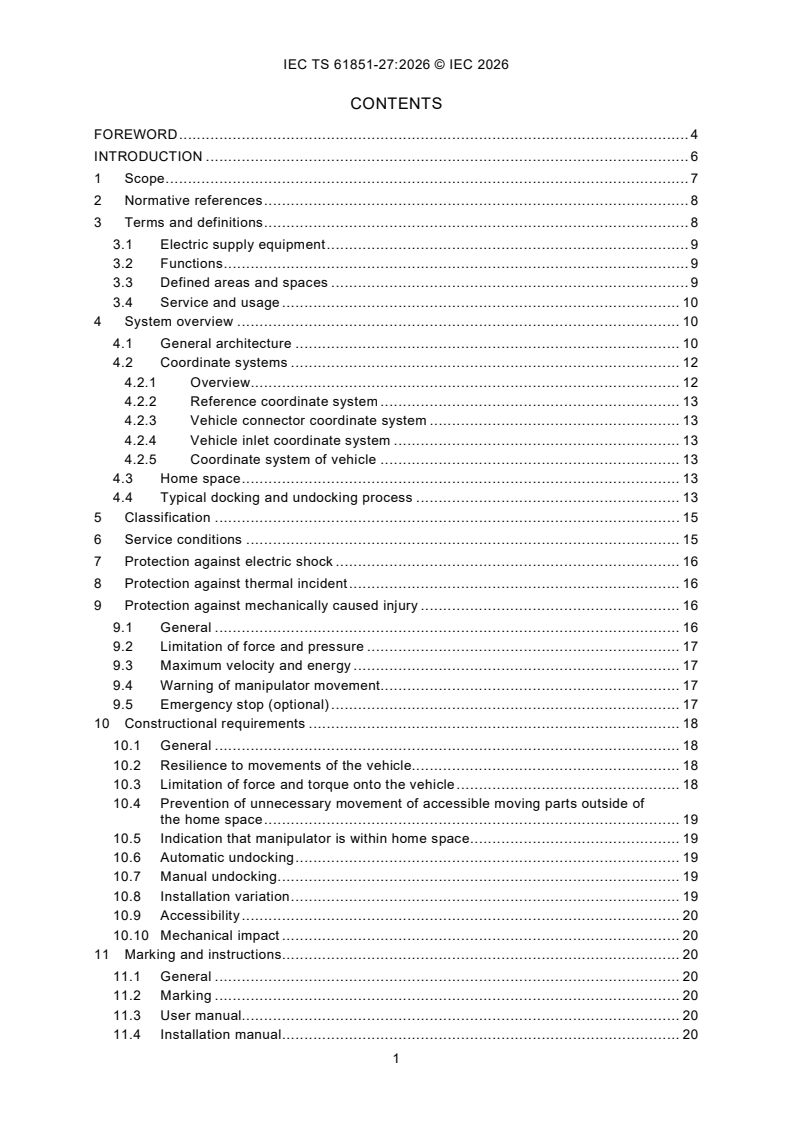
CONTENTS
FOREWORD . 4
INTRODUCTION . 6
1 Scope . 7
2 Normative references . 8
3 Terms and definitions . 8
3.1 Electric supply equipment . 9
3.2 Functions . 9
3.3 Defined areas and spaces . 9
3.4 Service and usage . 10
4 System overview . 10
4.1 General architecture . 10
4.2 Coordinate systems . 12
4.2.1 Overview . 12
4.2.2 Reference coordinate system . 13
4.2.3 Vehicle connector coordinate system . 13
4.2.4 Vehicle inlet coordinate system . 13
4.2.5 Coordinate system of vehicle . 13
4.3 Home space . 13
4.4 Typical docking and undocking process . 13
5 Classification . 15
6 Service conditions . 15
7 Protection against electric shock . 16
8 Protection against thermal incident . 16
9 Protection against mechanically caused injury . 16
9.1 General . 16
9.2 Limitation of force and pressure . 17
9.3 Maximum velocity and energy . 17
9.4 Warning of manipulator movement. 17
9.5 Emergency stop (optional) . 17
10 Constructional requirements . 18
10.1 General . 18
10.2 Resilience to movements of the vehicle. 18
10.3 Limitation of force and torque onto the vehicle . 18
10.4 Prevention of unnecessary movement of accessible moving parts outside of
the home space . 19
10.5 Indication that manipulator is within home space . 19
10.6 Automatic undocking . 19
10.7 Manual undocking . 19
10.8 Installation variation . 19
10.9 Accessibility . 20
10.10 Mechanical impact . 20
11 Marking and instructions. 20
11.1 General . 20
11.2 Marking . 20
11.3 User manual. 20
11.4 Installation manual . 20
12 Measurement and test methods . 21
12.1 General . 21
12.2 Interoperability test . 21
Annex A (informative) Examples of topologies of charging sites with aEVSE . 22
A.1 General . 22
A.2 Examples . 22
Annex B (informative) General considerations for specification of an obstacle-free
space for automatic docking and undocking . 26
B.1 General . 26
B.2 Obstacle-free space for proprietary applications . 26
B.3 Example of interoperable obstacle-free space. 27
B.3.1 General. 27
B.3.2 Vehicle movement . 27
B.3.3 Collision avoidance and detection . 27
B.3.4 Robustness of intruding vehicle parts . 27
B.3.5 Dimension of the interoperable obstacle-free space . 28
Annex C (normative) Specification of mating space and coordinate systems . 29
C.1 Mating space. 29
C.2 Mating space format . 29
C.3 Mating space definitions . 30
C.3.1 General. 30
C.3.2 Predefined mating space . 30
C.3.3 Custom mating space . 37
C.4 Installation tolerances . 38
Annex D (informative) Manually triggered operation of automatic docking and
undocking function. 39
D.1 General . 39
D.2 User interface . 40
D.3 Indication/user feedback. 40
D.4 User manual/installation instructions . 41
Annex E (informative) Interoperability test for aEVSE . 42
E.1 Principle . 42
E.2 Test bench . 42
E.3 Preparation of DUT . 43
E.4 Procedure . 43
E.5 Expression of results. 44
E.6 Test report . 44
Annex F (informative) Alphabetically sorted list of terms . 45
Bibliography . 46
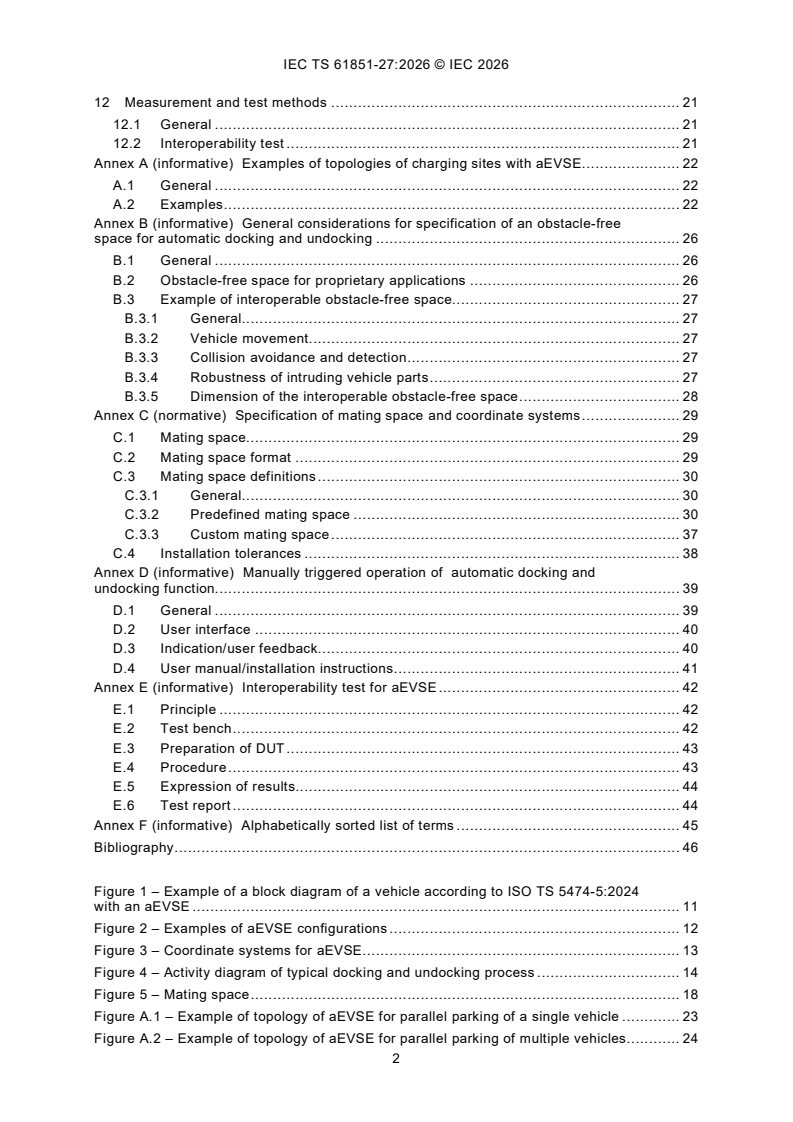
Figure 1 – Example of a block diagram of a vehicle according to ISO TS 5474-5:2024
with an aEVSE . 11
Figure 2 – Examples of aEVSE configurations . 12
Figure 3 – Coordinate systems for aEVSE . 13
Figure 4 – Activity diagram of typical docking and undocking process . 14
Figure 5 – Mating space . 18
Figure A.1 – Example of topology of aEVSE for parallel parking of a single vehicle . 23
Figure A.2 – Example of topology of aEVSE for parallel parking of multiple vehicles . 24
Figure A.3 – Example of topology of aEVSE with perpendicular parking . 24
Figure A.4 – Example of topology of aEVSE with flexible parking of a single vehicle . 25
Figure B.1 – Example of an interoperable obstacle-free space . 28
Figure C.1 – Example of installed aEVSE with predefined mating space "small" . 32
Figure C.2 – Example of installed aEVSE with predefined mating space "medium low" . 34
Figure C.3 – Illustration of predefined mating space "medium high" . 34
Figure C.4 – Illustration of predefined mating space "large low" . 35
Figure C.5 – Illustration of predefined mating space "large high" . 36
Figure C.6 – Illustration of predefined mating space "extra large" . 37
Figure C.7 – Illustration of example of custom mating space . 38
Figure D.1 – Typical activity diagram of manually triggered docking and undocking
process without communication . 40
Figure E.1 – Example of a mating space in a reference coordinate system . 43
Figure E.2 – Example of inlet displacement and rotation during boarding and alighting
of a passenger . 44
Table C.1 – Mating space format . 29
Table C.2 – Parameters of mating space "small" . 31
Table C.3 – Parameters of mating space "medium low" . 33
Table C.4 – Parameters of mating space "medium high" . 34
Table C.5 – Parameters of mating space "large low" . 35
Table C.6 – Parameters of mating space "large high" . 35
Table C.7 – Parameters of mating space "extra large" . 36
Table C.8 – Parameters of custom mating space . 37
Table C.9 – Example of installation tolerances with mating space "medium low" . 38
Table E.1 – Example of parameters of a mating space . 43
Table F.1 – Alphabetically sorted list of terms . 45
INTERNATIONAL ELECTROTECHNICAL COMMISSION
____________
Electric vehicle conductive charging system -
Part 27: EV supply equipment with automatic docking of a vehicle coupler
according to IEC 62196-2, IEC 62196-3 or IEC TS 62196-3-1
FOREWORD
1) The International Electrotechnical Commission (IEC) is a worldwide organization for standardization comprising
all national electrotechnical committees (IEC National Committees). The object of IEC is to promote international
co-operation on all questions concerning standardization in the electrical and electronic fields. To this end and
in addition to other activities, IEC publishes International Standards, Technical Specifications, Technical Reports,
Publicly Available Specifications (PAS) and Guides (hereafter referred to as “IEC Publication(s)”). Their
preparation is entrusted to technical committees; any IEC National Committee interested in the subject dealt with
may participate in this preparatory work. International, governmental and non-governmental organizations liaising
with the IEC also participate in this preparation. IEC collaborates closely with the International Organization for
Standardization (ISO) in accordance with conditions determined by agreement between the two organizations.
2) The formal decisions or agreements of IEC on technical matters express, as nearly as possible, an international
consensus of opinion on the relevant subjects since each technical committee has representation from all
interested IEC National Committees.
3) IEC Publications have the form of recommendations for international use and are accepted by IEC National
Committees in that sense. While all reasonable efforts are made to ensure that the technical content of IEC
Publications is accurate, IEC cannot be held responsible for the way in which they are used or for any
misinterpretation by any end user.
4) In order to promote international uniformity, IEC National Committees undertake to apply IEC Publications
transparently to the maximum extent possible in their national and regional publications. Any divergence between
any IEC Publication and the corresponding national or regional publication shall be clearly indicated in the latter.
5) IEC itself does not provide any attestation of conformity. Independent certification bodies provide conformity
assessment services and, in some areas, access to IEC marks of conformity. IEC is not responsible for any
services carried out by independent certification bodies.
6) All users should ensure that they have the latest edition of this publication.
7) No liability shall attach to IEC or its directors, employees, servants or agents including individual experts and
members of its technical committees and IEC National Committees for any personal injury, property damage or
other damage of any nature whatsoever, whether direct or indirect, or for costs (including legal fees) and
expenses arising out of the publication, use of, or reliance upon, this IEC Publication or any other IEC
Publications.
8) Attention is drawn to the Normative references cited in this publication. Use of the referenced publications is
indispensable for the correct application of this publication.
9) IEC draws attention to the possibility that the implementation of this document may involve the use of (a)
patent(s). IEC takes no position concerning the evidence, validity or applicability of any claimed patent rights in
respect thereof. As of the date of publication of this document, IEC had not received notice of (a) patent(s), which
may be required to implement this document. However, implementers are cautioned that this may not represent
the latest information, which may be obtained from the patent database available at https://patents.iec.ch. IEC
shall not be held responsible for identifying any or all such patent rights.
IEC TS 61851-27 has been prepared by IEC technical committee 69: Electrical power/energy
transfer systems for electrically propelled road vehicles and industrial trucks. It is a Technical
Specification.
The text of this Technical Specification is based on the following documents:
Draft Report on voting
69/1109/DTS 69/1126/RVDTS
Full information on the voting for its approval can be found in the report on voting indicated in
the above table.
The language used for the development of this Technical Specification is English.
This document was drafted in accordance with ISO/IEC Directives, Part 2, and developed in
accordance with ISO/IEC Directives, Part 1 and ISO/IEC Directives, IEC Supplement, available
at www.iec.ch/members_experts/refdocs. The main document types developed by IEC are
described in greater detail at www.iec.ch/publications.
In this document, the following print type is used: test specifications: in italic type.
A list of all parts in the IEC 61851 series, published under the general title Electric vehicle
conductive charging system, can be found on the IEC website.
The committee has decided that the contents of this document will remain unchanged until the
stability date indicated on the IEC website under webstore.iec.ch in the data related to the
specific document. At this date, the document will be
– reconfirmed,
– withdrawn, or
– revised.
INTRODUCTION
This part of the IEC 61851 series provides requirements for EV supply equipment with
automatic docking for the transfer of electric energy between EV supply equipment and electric
road vehicles. The vehicle and the EV supply equipment make up a complete system that is
covered by a number of IEC and ISO Standards.
Automatic docking is indispensable for autonomous vehicles, and it is also helpful for disabled
users of electric vehicles and for all users of electric vehicles seeking additional comfort. In the
case of public electric vehicle supply equipment, automatic docking can also provide a
convenient solution for queued vehicles, through automatic electric vehicle supply equipment
that is either fully mobile or movable on rails. Automatic docking can increase the number of
electric vehicles that are available to the grid to provide grid services.
Within the IEC 61851 series, the following documents cover different aspects of automatic
docking:
– IEC 61851-23-1 : DC electric vehicle charging station with an automated connection device;
– IEC TS 61851-26: EV supply equipment with automatic docking of a vehicle coupler located
at the underbody of an electric vehicle;
– IEC TS 61851-28 : Communication between EV supply equipment with automatic docking
and vehicles.
Automatic docking enables conductive energy transfer at the complete range of voltage and
current as specified in the following documents:
– IEC 61851-1: General requirements, which is a system standard that serves as a basis for
all the subsequent standards in the series; it is the product standard for mode 3 EV supply
equipment;
– IEC 61851-23: DC electric vehicle supply equipment;
– IEC 61851-23-3 : DC electric vehicle supply equipment for megawatt charging systems.
At the time of publication of this document, automatic conductive energy transfer is still in an
early development stage. The intention of this document is to guide further development of the
technology. As a Technical Specification, it is possible that this document does not yet contain
the full specification for interoperability as needed especially for public applications.
___________
Under preparation. Stage at the time of publication: IEC/CCDV 61851-23-1:2025.
Under preparation. Stage at the time of publication: IEC TS/ACD 61851-28:2024.
Under preparation. Stage at the time of publication: IEC/CCDV 61851-23-3:2025.
1 Scope
This document, in combination with IEC 61851-1 or IEC 61851-23, gives the requirements for
EV supply equipment with automatic docking and undocking functions (aEVSE) of a vehicle
coupler according to IEC 62196-2, IEC 62196-3 or IEC TS 62196-3-1 for power transfer with
electrically propelled road vehicles according to ISO TS 5474-5.
Use of aEVSE with the megawatt charging system is under consideration.
NOTE 1 Where this document refers to IEC 61851-23 and IEC 62196-3 or IEC TS 62196-3-1, it is intended to
.
alternatively use IEC 61851-23-3 and IEC TS 63379
This document provides requirements for aEVSE with a single vehicle connector.
Requirements for aEVSE with more than one vehicle connector are under consideration.
This document only applies to aEVSE with automatic couplers of category 1, which use a vehicle
coupler defined by IEC 62196-2, IEC 62196-3 or IEC TS 62196-3-1.
NOTE 2 Category 1 is planned to also include the use of an electro-mechanical interface defined by IEC TS 63379.
This document only specifies automatic conductive energy transfer using a vehicle connector
and a vehicle inlet; it does not specify automatic conductive power transfer using a plug and a
socket-outlet.
This document does not apply to aEVSE with automatic couplers of category 2, which use an
electro-mechanical interface defined by EN 50696.
NOTE 3 Category 2 is planned to also include the use of an electro-mechanical interface defined by IEC 63407 .
This document does not apply to aEVSE with automatic coupler of category 3 (see
IEC TS 61851-26).
NOTE 4 Category 3 is planned to use the electro-mechanical interface for AC up to 22 kW defined by IEC TS
63644 . Another document that extends category 3 and defines an electro-mechanical interface for combined AC/DC
power transfer is under consideration.
EMC requirements for EV supply equipment are defined in IEC 61851-21-2.
Interoperable communication for docking and undocking between an aEVSE and an EV,
extending the communication between an EV supply equipment and an EV as specified in
IEC 61851-1, IEC 61851-23, IEC 61851-24 and the ISO 15118 series, is under consideration.
NOTE 5 Where this document refers to "interoperable communication for docking and undocking", it is intended to
use communication according to IEC TS 61851-28. However, at the time of publication of this document,
IEC TS 61851-28 has not yet reached sufficient maturity to be normatively referenced.
This document does not cover all safety aspects related to maintenance.
___________
Under preparation. Stage at the time of publication: IEC TS/CDTS 63379:2025.
Under preparation. Stage at the time of publication: IEC/CCDV 63407:2024.
Under preparation. Stage at time of publication: IEC TS/ACD 63644:2025.
2 Normative references
The following documents are referred to in the text in such a way that some or all of their content
constitutes requirements of this document. For dated references, only the edition cited applies.
For undated references, the latest edition of the referenced document (including any
amendments) applies.
IEC 60364-7-722, Low-voltage electrical installations - Part 7-722: Requirements for special
installations or locations - Supplies for electric vehicles
IEC 61851-1, Electric vehicle conductive charging system - Part 1: General requirements
IEC 61851-23:2023, Electric vehicle conductive charging system - Part 23: DC electric vehicle
supply equipment
IEC 62196-2, Plugs, socket-outlets, vehicle connectors and vehicle inlets - Conductive charging
of electric vehicles - Part 2: Dimensional compatibility requirements for AC pin and contact-tube
accessories
IEC 62196-3, Plugs, socket-outlets, vehicle connectors and vehicle inlets - Conductive charging
of electric vehicles - Part 3: Dimensional compatibility requirements for DC and AC/DC pin and
contact-tube vehicle couplers
IEC TS 62196-3-1, Plugs, socket-outlets, vehicle connectors and vehicle inlets - Conductive
charging of electric vehicles - Part 3-1: Vehicle connector, vehicle inlet and cable assembly for
DC charging intended to be used with a thermal management system
ISO TS 5474-5:2024, Electrically propelled road vehicles - Functional requirements and safety
requirements for power transfer between vehicle and external electric circuit - Part 5: Automatic
conductive power transfer
ISO 10218-1, Robots and robotic devices - Safety requirements for industrial robots - Part 1:
Robots
ISO 12100:2010, Safety of machinery - General principles for design - Risk assessment and
risk reduction
ISO TS 15066:2016, Robots and robotic devices - Collaborative robots
3 Terms and definitions
For the purposes of this document, the terms and definitions given in IEC 61851-1,
IEC 61851-23 and the following apply.
ISO and IEC maintain terminology databases for use in standardization at the following
addresses:
– IEC Electropedia: available at https://www.electropedia.org/
– ISO Online browsing platform: available at https://www.iso.org/obp
NOTE Informative Annex F gives an alphabetical list of defined terms of this document.
3.1 Electric supply equipment
3.1.1
automatic EV supply equipment
aEVSE
EV supply equipment with automatic docking and undocking functions
3.1.2
ACD onboard system
system with automatic docking and undocking functions installed in a vehicle and used in
combination with an automatic EV supply equipment
[SOURCE: ISO TS 5474-5:2024, 3.1]
3.1.3
manipulator
machine, the mechanism of which usually consists of a series of segments jointed or sliding
relative to one another, for the purpose of grasping and/or moving objects (pieces or tools)
usually in several degrees of freedom
[SOURCE: ISO TR 11065:1992; modified – Second sentence deleted.]
3.2 Functions
3.2.1
docking
process in which a manipulator performs a controlled motion and mates either a plug to a
socket-outlet or a vehicle connector to a vehicle inlet
Note 1 to entry: This document only specifies docking of a vehicle connector and a vehicle inlet.
Note 2 to entry: Other actuators in addition to the manipulator can be used, for example for opening the inlet cover
or for drawing the vehicle connector into the vehicle inlet.
3.2.2
undocking
process in which a manipulator performs a controlled motion and unmates either a plug from a
socket-outlet or a vehicle connector from a vehicle inlet
Note 1 to entry: This document only specifies undocking of a vehicle connector and a vehicle inlet.
Note 2 to entry: Other actuators in addition to the manipulator can be used, for example for closing the inlet cover
or for ejecting the vehicle connector from the vehicle inlet.
3.3 Defined areas and spaces
3.3.1
obstacle-free space
space around the vehicle inlet or socket-outlet where no obstacles are allowed
Note 1 to entry: This document uses the term “obstacle-free space” only for the space around the vehicle inlet.
Note 2 to entry: ISO TS 5474-5:2024, 3.11, uses the term "package space" instead of "obstacle-free space".
3.3.2
home space
space used by moving parts of the manipulator to prepare for docking and to return for
undocking
Note 1 to entry: A home space is expected to be free of obstacles.
3.3.3
mating space
spatial envelope of points with specified range of orientations where mating of the vehicle
coupler or plug and socket-outlet is possible
Note 1 to entry: This document uses the term “mating space” only for mating of a vehicle coupler.
3.3.4
parking bay
parking space, US
parking stall, US
parking spot, US
area intended, and usually designated and marked, for the parking of a vehicle
[SOURCE: ISO 6707-1:2020, 3.1.3.59]
3.4 Service and usage
3.4.1
restricted access area
area accessible only to persons with the proper authorization
Note 1 to entry: Typically, authorisation is only provided to persons who are electrically and mechanical skilled or
instructed to perceive risks and to avoid hazards that an aEVSE can create.
[SOURCE: IEC 60050-195:2021, 195-04-04, modified – Replaced “electrically skilled persons
and electrically instructed persons” with “persons”, Note 1 to entry added.]
3.4.2
unrestricted access area
area where access is not restricted
Note 1 to entry: All people including the public can have access to the area.
4 System overview
4.1 General architecture
Figure 1 shows an example of a block diagram of a vehicle according to ISO TS 5474-5:2024
with an aEVSE.
Key
thin arrows = control
continuous arrows = power
dashed arrows = communication
continuous lines = grouping of components
10 aEVSE 20 EV
11 manipulator
12 supply equipment P2PS controller 22 EV P2PS controller
13 supply equipment communication controller (SECC) 23 EV communication controller (EVCC)
13.1 SECC docking/undocking communication function 23.1 EVCC docking/undocking communication
function
13.2 SECC energy transfer communication function 23.2 EVCC energy transfer communication function
14 vehicle connector 24 vehicle inlet
25 ACD onboard system
100 supply network 200 vehicle power supply circuit
1000 infrastructure backend 2000 vehicle backend
1001 supply equipment control function 2001 EV control function
A energy flow C communication for docking and undocking
B communication for energy transfer D P2PS signaling
Figure 1 – Example of a block diagram of a vehicle
according to ISO TS 5474-5:2024 with an aEVSE
The following configurations can exist (see Figure 2):
– integrated solution (automatic docking/undocking function and conductive power transfer
function);
– separate manipulator (automatic docking/undocking function) and conventional EVSE
(conductive power transfer function).
Key
A integrated solution
B separate manipulator
Figure 2 – Examples of aEVSE configurations
4.2 Coordinate systems
4.2.1 Overview
Several coordinate systems shall be used to describe the relative position and orientation of
the relevant objects for automatic conductive power transfer, see 4.2.2 to 4.2.5.
A similar set of coordinate systems is described in ISO 14539:2000.
See Figure 3.
Key
A reference coordinate system
B vehicle inlet coordinate system
NOTE The origins and orientations of the coordinate systems shown in the figure are just examples. See 4.2.2 and
4.2.4 for details.
Figure 3 – Coordinate systems for aEVSE
4.2.2 Reference coordinate system
The reference coordinate system is used for the definition of the mating space. See Annex C.
4.2.3 Vehicle connector coordinate system
See IEC 62196-2 and IEC 62196-3. The vehicle connector coordinate system is used internally
by the aEVSE to properly orient the vehicle connector relative to the vehicle inlet.
4.2.4 Vehicle inlet coordinate system
See IEC 62196-2 and IEC 62196-3. The vehicle inlet coordinate system is used to determine
the position and orientation of the vehicle inlet in a reference coordinate system.
4.2.5 Coordinate system of vehicle
See 10.2, 10.3 and ISO TS 5474-5.
4.3 Home space
See 10.4, 10.5, 10.6, 11.4 and Annex A.
4.4 Typical docking and undocking process
The activity diagram in Figure 4 shows a typical docking and undocking process. This diagram
does not show alternate flows such as cancellation of the ongoing docking process by the
vehicle or error handling.
The activity diagram in Figure 4 includes activities that are outside of the scope of this document
but are part of the docking and undocking process and are provided for information only. The
activities are as follows:
– establish communication (for example interoperable communication for docking and
undocking);
– vehicle positioning (for example as per ISO 12768-1 );
– terminate communication (for example interoperable communication for docking and
undocking).
If the inlet cover is opened by the vehicle itself, this takes place during the activity "Prepare for
docking".
NOTE The inlet cover can consist out of several moveable parts that are moved to make the inlet accessible for the
manipulator.
Energy transfer can take place in the activity "Latched", while the vehicle connector is latched
to the vehicle inlet.
If the inlet cover is closed by the vehicle, this takes place during the activity "Prepare for
leaving".
Figure 4 – Activity diagram of typical docking and undocking process
___________
Under preparation. Stage at the time of publication: ISO/CD 12768-1:2025.
5 Classification
The following classification for an aEVSE is applicable:
– according to the vehicle coupler used:
• type 1 in accordance with IEC 62196-2;
• type 2 in accordance with IEC 62196-2;
• type 3 in accordance with IEC 62196-2 (under consideration);
• type 4 in accordance with IEC 62196-2 (under consideration);
• configuration AA in accordance with IEC 62196-3;
• configuration BB in accordance with IEC 62196-3 (under consideration);
• configuration EE in accordance with IEC 62196-3 (under consideration);
• configuration FF in accordance with IEC 62196-3;
• configuration GG in accordance with IEC 62196-3:— (under consideration);
– according to the supported obstacle-free space, see Annex B;
– according to the supported mating space, see Annex C.
It is possible for an aEVSE to support multiple mating spaces:
– according to the installation:
• in restricted access area;
• in unrestricted access area;
– according to supported service conditions:
• normal service conditions, indoor use;
• normal service conditions, outdoor use;
• special service conditions;
– according to the communication for docking and undocking between the aEVSE and the
vehicle:
• no communication, see Annex D;
• proprietary communication for docking and undocking;
• interoperable communication for docking and undocking;
– according to the level of interoperability:
• proprietary, with a list of compatible vehicles given in the manual;
• interoperable (under consideration).
Additionally, the classification according to the applicable part of IEC 61851 applies, in case of
an integrated solution (automatic docking/undocking and conductive power transfer function)
according to 4.1.
6 Service conditions
The service conditions of IEC 61851-1 apply.
NOTE In IEC 61851-1:2017, the service conditions are given in 5.2 and 5.3.
___________
Configuration GG is added in IEC 62196-3 ed. 3, which is under preparation. Stage at time of publication:
IEC/AFDIS 62196-3:2025.
7 Protection against electric shock
For an aEVSE that provides AC energy transfer, the requirements of IEC 61851-1 for protection
against electric shock apply.
NOTE 1 See IEC 61851-1:2017, Clause 8, Clause 9, 12.6 and Clause 15.
NOTE 2 In IEC 61851-23:2023, see Clause 8, Clause 9 and 12.6.
For an aEVSE that provides DC energy transfer, the requirements of IEC 61851-23 for
protection against electric shock apply.
8 Protection against thermal incident
The aEVSE shall not produce temperatures, arcs or radiation which would cause a danger.
For an aEVSE that provides AC energy transfer, the requirements of IEC 61851-1 for protection
against thermal incident apply.
NOTE 1 See IEC 61851-1:2017, 6.3.2, Clause 9, Clause 13 and Clause 14.
For aEVSE that provides DC energy transfer, the requirements of IEC 61851-23 for protection
against thermal incident apply.
The aEVSE shall provide thermal protection for electrical drives.
If the vehicle connector is equipped with a latching device or retaining means, for example
according to IEC 62196-2 configuration type 1, IEC 62196-3 configuration AA or configuration
EE, then the latching device or retaining means of the vehicle connector may be designed such
that it can be engaged and disengaged electronically, for example by an internal servomotor
controlled from the aEVSE.
NOTE 2 The latching device or retaining means is part of the interlock function, which prevents disconnection under
load and thus prevents a thermal incident.
9 Protection against mechanically caused injury
9.1 General
The requirements in Clause 9 intend prevention of hazards to persons, domestic animals or
property caused by active movements of accessible moving parts of the aEVSE, for example
the manipulator, in any operation mode.
However, the safety features required on the accessible moving parts are dependent on the
installation. When the aEVSE is installed in an automated valet driving system (AVDS)
environment with no public access, except for unmanned "private-owned" vehicles driven by
the AVDS, several safety features to make the system inherently safe are already installed in
the AVDS and total infrastructure.
Safety of the full installation shall be assured by following the risk reduction method according
to ISO 12100:2010, Clause 6.
When safety-related control systems are used, they shall be assessed in accordance with
ISO TS 15066 and the requirements for safety functions of ISO 10218-1.
NOTE 1 In ISO 10218-1:2011, these requirements are given in 5.4; this document has been withdrawn but it is still
referenced in some regulations.
NOTE 2 In ISO 10218-1:2025, these requirements are given in 5.3.
The safety of the accessible moving parts shall be assessed as part of the entire installation.
In a highly secured and controlled environment such as an AVDS environment, the installation
can cover some safety features and does not require duplication on the accessible moving
parts. Such features can include, but are not limited to, the following:
– installation in a restricted access area;
– foreign object detection;
– living object detection.
9.2 Limitation of force and pressure
If safety is provided by limitation of force, the force and pressure created by active movement
of accessible moving parts shall be limited to values that are considered non-hazardous. These
values shall be maintained both under normal conditions and under conditions of single failure.
The maximum permissible force shall be according to the values provided in
ISO TS 15066:2016, Annex A.
Conformance shall be shown by calculation or by test.
9.3 Maximum velocity and energy
If safety is solely provided by limitation of velocity and energy, the maximum velocity of
accessible moving parts shall not exceed the values provided in ISO TS 15066:2016, Annex A.
A higher velocity is allowed if the kinetic energy does not exceed the values stated in
ISO TS 15066:2016, Annex A.
9.4 Warning of manipulator movement
If the aEVSE uses a visual or audible warning signal for warning persons as a safety feature,
for example indicator light or beep, to warn of active movement of accessible moving parts, an
appropriate indicator shall be used.
NOTE For Europe, see EN 842:1997 and EN 842:1997/AMD1:2008, 4.3.2. IEC 60204-1 can also be used.
This does not apply to warning signals shown by data display units.
A warning is not required if the docked manipulator follows the movement of the docked vehicle.
9.5 Emergency stop (optional)
An emergency stop, if any, triggers the following safe states:
a) stop active movement and reduce mechanical forces of all accessible parts to less than
25 N, see 9.2;
b) optionally, emergency switching or disconnect in accordance with IEC 61851-1; the relevant
components are allowed to be supplied with power until a safe le
...