

IEC 62840-1:2025
(Main)Electric vehicle battery swap system - Part 1: General and guidance
General Information
- Abstract
IEC 62840-1:2025 gives the general overview for battery swap systems, for the purposes of swapping batteries of electric road vehicles when the vehicle powertrain is turned off and when the battery swap system is connected to the supply network at standard supply voltages according to IEC 60038 with a rated voltage up to 1 000 V AC and up to 1 500 V DC.
This document is applicable for battery swap systems for EV equipped with one or more
– swappable battery systems (SBS), or
– handheld-swappable battery systems (HBS).
This document provides guidance for interoperability.
This document applies to
• battery swap systems supplied from on-site storage systems (for example buffer batteries etc),
• manual, mechanically assisted and automatic systems,
• battery swap systems intended to supply SBS/HBS having communication allowing to identify the battery system characteristics, and
• battery swap systems intended to be installed at an altitude of up to 2 000 m.
This document is not applicable to
• aspects related to maintenance and service of the battery swap station (BSS),
• trolley buses, rail vehicles and vehicles designed primarily for use off-road,
• maintenance and service of EVs,
• safety requirements for mechanical equipment covered by the ISO 10218 series,
• locking compartments systems providing AC socket-outlets for the use of manufacturer specific voltage converter units and manufacturer specific battery systems,
• electrical devices and components, which are covered by their specific product standards,
• any fix-installed equipment of EV, which is covered by ISO, and
• EMC requirements for on-board equipment of EV while connected to the BSS.
This first edition cancels and replaces the first edition of IEC TS 61280-1 published in 2016.
This edition includes the following significant technical changes with respect to IEC TS 61280-1:2016:
a) expanded scope to include handheld-swappable battery systems (HBS) and guidance on interoperability;
b) added definitions for "handheld-swappable battery system" (HBS) and expanded related terms such as "SBS/HBS coupler," "SBS/HBS charger," etc;
c) added classifications based on supply network characteristics, connection method, access and type of BSS;
d) added support for HBS, detailing the different compositions and workflows for type A (SBS) and type B (HBS) battery swap stations;
e) added requirements for functional interoperability, interface interoperability, data interoperability, operational interoperability, compatibility with legacy systems, and scalability;
f) added requirements for communication, protection against electric shock, specific requirements for accessories), cable assembly requirements, BSS constructional requirements, overload and short circuit protection, EMC, emergency switching or disconnect, marking and instructions;
g) expanded annex content, adding solutions for manual swapping stations for motorcycles with HBS and updating use cases.
- Status
- Published
- Publication Date
- 29-Apr-2025
- Technical Committee
- TC 69 - Electrical power/energy transfer systems for electrically propelled road vehicles and industrial trucks
- Drafting Committee
- WG 13 - TC 69/WG 13
- Current Stage
- PPUB - Publication issued
- Start Date
- 30-Apr-2025
- Completion Date
- 09-May-2025
Overview
IEC 62840-1:2025 is an international standard issued by the International Electrotechnical Commission (IEC) that outlines the general requirements and guidance for electric vehicle (EV) battery swap systems. This standard applies to battery swapping infrastructure designed to facilitate the replacement of batteries in electric road vehicles when the vehicle powertrain is off, ensuring safe connection to supply networks with standard supply voltages up to 1000 V AC and 1500 V DC.
The document addresses both swappable battery systems (SBS) and handheld-swappable battery systems (HBS), expanding the scope to include advanced interoperability and communication features, automating battery exchange procedures, and supporting various battery swap station typologies. The 2025 edition significantly updates and replaces the 2016 IEC TS 61280-1, reflecting technological advancements and broader EV deployment.
Key Topics
Scope and Application
- Covers battery swap systems connected to supply networks at rated voltages ≤ 1000 V AC / 1500 V DC
- Includes manual, mechanically assisted, and fully automatic swap systems
- Supports both on-site energy storage integration and complex control systems
- Applies to EVs equipped with SBS and HBS, covering passenger cars and motorcycles
System Classification
- Based on supply network characteristics and connection methods
- Categorizes automation levels and mounting methods
- Defines EV categories and battery swap station (BSS) types
- Defines swapping directions and access control specifics
Composition and Zones
- Detailed architecture of battery swap stations including lanes, battery handling, storage, and charging systems
- Supervisory and control systems specifications for efficient operation
- Clear zoning for vehicle lane, battery swap, storage, charging, and customer service to optimize workflow and safety
Interoperability Requirements
- Functional interoperability ensures compatibility between different EV and BSS hardware
- Interface and data interoperability to support communication protocols and data exchange
- Operational interoperability for workflow consistency
- Backwards compatibility with legacy systems and scalability for future upgrades
Safety and Protection
- Electrical shock protection measures
- Cable assembly, overload, and short circuit protection requirements
- Electromagnetic compatibility (EMC) considerations
- Optional emergency switching or disconnect mechanisms for enhanced safety
Communication Systems
- Safety relevant communication protocols for secure operations
- Optional communication links to telecommunication networks for monitoring and control
Marking and Instructions
- Standardized labeling and user instructions for effective operation and maintenance
Applications
IEC 62840-1:2025 facilitates the development and deployment of battery swap systems that provide fast, efficient alternatives to traditional EV charging. Key practical applications include:
EV Battery Replacement Stations
Battery swap stations built according to this standard ensure safe, interoperable swapping of EV batteries – critical for passenger cars, commercial vehicles, and motorcycles.Fast Turnaround for Electric Fleets
Deployments in delivery services, taxis, and public transportation where quick battery swaps reduce downtime and maximize vehicle utilization.Infrastructure for Compact EVs and Two-Wheelers
Guidance on handheld-swappable battery systems (HBS) supports the expansion of battery swapping to smaller EV segments such as motorcycles, increasing adoption in urban environments.Energy Storage Integration
Battery swap systems can integrate with onsite buffer storage systems, optimizing energy management and reducing demand on the electric grid during peak times.Interoperable Ecosystems
Supports a standardized approach to battery swapping technology, enabling EV manufacturers, battery producers, and infrastructure providers to work towards a seamless and scalable user experience.
Related Standards
- IEC 60038 – Defines standard supply voltages applicable to the battery swap system’s electrical infrastructure.
- ISO 10218 Series – Addresses safety requirements for robotic and mechanical equipment that could intersect with automated battery handling systems.
- IEC EMC Standards – Electromagnetic compatibility standards ensuring minimal interference with surrounding electrical systems.
- ISO Standards on EVs and Components – Cover fixed onboard equipment and general vehicle maintenance, complementary to the swapping system specifications.
Conclusion
IEC 62840-1:2025 establishes a comprehensive framework for the design, implementation, and operation of electric vehicle battery swap systems, promoting interoperability, safety, and efficiency. This standard is essential for stakeholders involved in the deployment of next-generation fast battery replacement infrastructures - driving the transition toward sustainable and user-friendly electric mobility worldwide.
Keywords: electric vehicle battery swap system, battery swap station, SBS, HBS, electric vehicle batteries, battery swapping infrastructure, interoperability, EV battery safety, battery swap communication, EV charging alternatives, IEC standards electric vehicles.
Relations
- Effective Date
- 05-Sep-2023
Get Certified
Connect with accredited certification bodies for this standard

TÜV Rheinland
TÜV Rheinland is a leading international provider of technical services.

TÜV SÜD
TÜV SÜD is a trusted partner of choice for safety, security and sustainability solutions.

DEKRA Certification Inc.
DEKRA US certification services.
Sponsored listings
Frequently Asked Questions
IEC 62840-1:2025 is a standard published by the International Electrotechnical Commission (IEC). Its full title is "Electric vehicle battery swap system - Part 1: General and guidance". This standard covers: IEC 62840-1:2025 gives the general overview for battery swap systems, for the purposes of swapping batteries of electric road vehicles when the vehicle powertrain is turned off and when the battery swap system is connected to the supply network at standard supply voltages according to IEC 60038 with a rated voltage up to 1 000 V AC and up to 1 500 V DC. This document is applicable for battery swap systems for EV equipped with one or more – swappable battery systems (SBS), or – handheld-swappable battery systems (HBS). This document provides guidance for interoperability. This document applies to • battery swap systems supplied from on-site storage systems (for example buffer batteries etc), • manual, mechanically assisted and automatic systems, • battery swap systems intended to supply SBS/HBS having communication allowing to identify the battery system characteristics, and • battery swap systems intended to be installed at an altitude of up to 2 000 m. This document is not applicable to • aspects related to maintenance and service of the battery swap station (BSS), • trolley buses, rail vehicles and vehicles designed primarily for use off-road, • maintenance and service of EVs, • safety requirements for mechanical equipment covered by the ISO 10218 series, • locking compartments systems providing AC socket-outlets for the use of manufacturer specific voltage converter units and manufacturer specific battery systems, • electrical devices and components, which are covered by their specific product standards, • any fix-installed equipment of EV, which is covered by ISO, and • EMC requirements for on-board equipment of EV while connected to the BSS. This first edition cancels and replaces the first edition of IEC TS 61280-1 published in 2016. This edition includes the following significant technical changes with respect to IEC TS 61280-1:2016: a) expanded scope to include handheld-swappable battery systems (HBS) and guidance on interoperability; b) added definitions for "handheld-swappable battery system" (HBS) and expanded related terms such as "SBS/HBS coupler," "SBS/HBS charger," etc; c) added classifications based on supply network characteristics, connection method, access and type of BSS; d) added support for HBS, detailing the different compositions and workflows for type A (SBS) and type B (HBS) battery swap stations; e) added requirements for functional interoperability, interface interoperability, data interoperability, operational interoperability, compatibility with legacy systems, and scalability; f) added requirements for communication, protection against electric shock, specific requirements for accessories), cable assembly requirements, BSS constructional requirements, overload and short circuit protection, EMC, emergency switching or disconnect, marking and instructions; g) expanded annex content, adding solutions for manual swapping stations for motorcycles with HBS and updating use cases.
IEC 62840-1:2025 gives the general overview for battery swap systems, for the purposes of swapping batteries of electric road vehicles when the vehicle powertrain is turned off and when the battery swap system is connected to the supply network at standard supply voltages according to IEC 60038 with a rated voltage up to 1 000 V AC and up to 1 500 V DC. This document is applicable for battery swap systems for EV equipped with one or more – swappable battery systems (SBS), or – handheld-swappable battery systems (HBS). This document provides guidance for interoperability. This document applies to • battery swap systems supplied from on-site storage systems (for example buffer batteries etc), • manual, mechanically assisted and automatic systems, • battery swap systems intended to supply SBS/HBS having communication allowing to identify the battery system characteristics, and • battery swap systems intended to be installed at an altitude of up to 2 000 m. This document is not applicable to • aspects related to maintenance and service of the battery swap station (BSS), • trolley buses, rail vehicles and vehicles designed primarily for use off-road, • maintenance and service of EVs, • safety requirements for mechanical equipment covered by the ISO 10218 series, • locking compartments systems providing AC socket-outlets for the use of manufacturer specific voltage converter units and manufacturer specific battery systems, • electrical devices and components, which are covered by their specific product standards, • any fix-installed equipment of EV, which is covered by ISO, and • EMC requirements for on-board equipment of EV while connected to the BSS. This first edition cancels and replaces the first edition of IEC TS 61280-1 published in 2016. This edition includes the following significant technical changes with respect to IEC TS 61280-1:2016: a) expanded scope to include handheld-swappable battery systems (HBS) and guidance on interoperability; b) added definitions for "handheld-swappable battery system" (HBS) and expanded related terms such as "SBS/HBS coupler," "SBS/HBS charger," etc; c) added classifications based on supply network characteristics, connection method, access and type of BSS; d) added support for HBS, detailing the different compositions and workflows for type A (SBS) and type B (HBS) battery swap stations; e) added requirements for functional interoperability, interface interoperability, data interoperability, operational interoperability, compatibility with legacy systems, and scalability; f) added requirements for communication, protection against electric shock, specific requirements for accessories), cable assembly requirements, BSS constructional requirements, overload and short circuit protection, EMC, emergency switching or disconnect, marking and instructions; g) expanded annex content, adding solutions for manual swapping stations for motorcycles with HBS and updating use cases.
IEC 62840-1:2025 is classified under the following ICS (International Classification for Standards) categories: 43.120 - Electric road vehicles. The ICS classification helps identify the subject area and facilitates finding related standards.
IEC 62840-1:2025 has the following relationships with other standards: It is inter standard links to IEC TS 62840-1:2016. Understanding these relationships helps ensure you are using the most current and applicable version of the standard.
IEC 62840-1:2025 is available in PDF format for immediate download after purchase. The document can be added to your cart and obtained through the secure checkout process. Digital delivery ensures instant access to the complete standard document.
Standards Content (Sample)
IEC 62840-1 ®
Edition 1.0 2025-04
INTERNATIONAL
STANDARD
NORME
INTERNATIONALE
Electric vehicle battery swap system –
Part 1: General and guidance
Système d’échange de batterie de véhicule électrique –
Partie 1: Généralités et recommandations
All rights reserved. Unless otherwise specified, no part of this publication may be reproduced or utilized in any form
or by any means, electronic or mechanical, including photocopying and microfilm, without permission in writing from
either IEC or IEC's member National Committee in the country of the requester. If you have any questions about IEC
copyright or have an enquiry about obtaining additional rights to this publication, please contact the address below or
your local IEC member National Committee for further information.
Droits de reproduction réservés. Sauf indication contraire, aucune partie de cette publication ne peut être reproduite ni
utilisée sous quelque forme que ce soit et par aucun procédé, électronique ou mécanique, y compris la photocopie et
les microfilms, sans l'accord écrit de l'IEC ou du Comité national de l'IEC du pays du demandeur. Si vous avez des
questions sur le copyright de l'IEC ou si vous désirez obtenir des droits supplémentaires sur cette publication, utilisez
les coordonnées ci-après ou contactez le Comité national de l'IEC de votre pays de résidence.
IEC Secretariat Tel.: +41 22 919 02 11
3, rue de Varembé info@iec.ch
CH-1211 Geneva 20 www.iec.ch
Switzerland
About the IEC
The International Electrotechnical Commission (IEC) is the leading global organization that prepares and publishes
International Standards for all electrical, electronic and related technologies.
About IEC publications
The technical content of IEC publications is kept under constant review by the IEC. Please make sure that you have the
latest edition, a corrigendum or an amendment might have been published.
IEC publications search - webstore.iec.ch/advsearchform
IEC Products & Services Portal - products.iec.ch
The advanced search enables to find IEC publications by a Discover our powerful search engine and read freely all the
variety of criteria (reference number, text, technical publications previews, graphical symbols and the glossary.
committee, …). It also gives information on projects, replaced With a subscription you will always have access to up to date
and withdrawn publications. content tailored to your needs.
IEC Just Published - webstore.iec.ch/justpublished
Electropedia - www.electropedia.org
Stay up to date on all new IEC publications. Just Published
The world's leading online dictionary on electrotechnology,
details all new publications released. Available online and once
containing more than 22 500 terminological entries in English
a month by email.
and French, with equivalent terms in 25 additional languages.
Also known as the International Electrotechnical Vocabulary
IEC Customer Service Centre - webstore.iec.ch/csc
(IEV) online.
If you wish to give us your feedback on this publication or need
further assistance, please contact the Customer Service
Centre: sales@iec.ch.
A propos de l'IEC
La Commission Electrotechnique Internationale (IEC) est la première organisation mondiale qui élabore et publie des
Normes internationales pour tout ce qui a trait à l'électricité, à l'électronique et aux technologies apparentées.
A propos des publications IEC
Le contenu technique des publications IEC est constamment revu. Veuillez vous assurer que vous possédez l’édition la
plus récente, un corrigendum ou amendement peut avoir été publié.
Recherche de publications IEC - IEC Products & Services Portal - products.iec.ch
webstore.iec.ch/advsearchform Découvrez notre puissant moteur de recherche et consultez
La recherche avancée permet de trouver des publications IEC gratuitement tous les aperçus des publications, symboles
en utilisant différents critères (numéro de référence, texte, graphiques et le glossaire. Avec un abonnement, vous aurez
comité d’études, …). Elle donne aussi des informations sur les toujours accès à un contenu à jour adapté à vos besoins.
projets et les publications remplacées ou retirées.
Electropedia - www.electropedia.org
IEC Just Published - webstore.iec.ch/justpublished
Le premier dictionnaire d'électrotechnologie en ligne au monde,
Restez informé sur les nouvelles publications IEC. Just
avec plus de 22 500 articles terminologiques en anglais et en
Published détaille les nouvelles publications parues.
français, ainsi que les termes équivalents dans 25 langues
Disponible en ligne et une fois par mois par email.
additionnelles. Egalement appelé Vocabulaire
Electrotechnique International (IEV) en ligne.
Service Clients - webstore.iec.ch/csc
Si vous désirez nous donner des commentaires sur cette
publication ou si vous avez des questions contactez-nous:
sales@iec.ch.
IEC 62840-1 ®
Edition 1.0 2025-04
INTERNATIONAL
STANDARD
NORME
INTERNATIONALE
Electric vehicle battery swap system –
Part 1: General and guidance
Système d’échange de batterie de véhicule électrique –
Partie 1: Généralités et recommandations
INTERNATIONAL
ELECTROTECHNICAL
COMMISSION
COMMISSION
ELECTROTECHNIQUE
INTERNATIONALE
ICS 43.120 ISBN 978-2-8327-0375-5
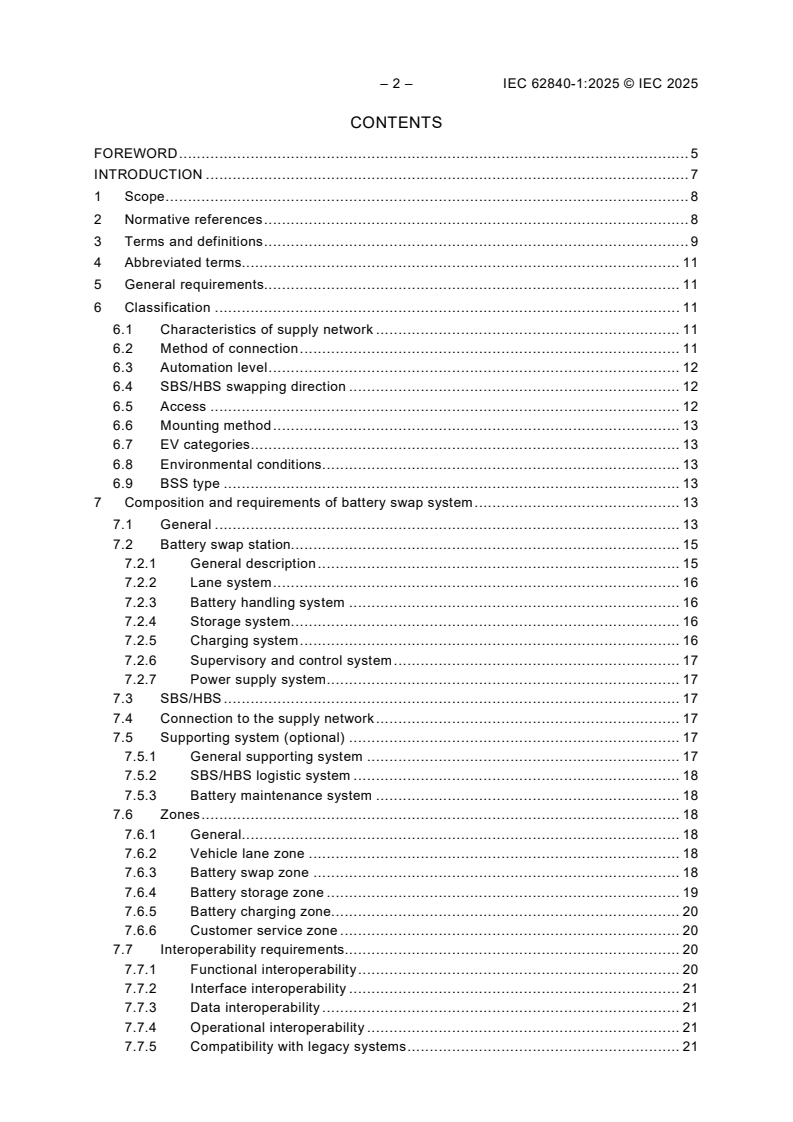
– 2 – IEC 62840-1:2025 © IEC 2025
CONTENTS
FOREWORD . 5
INTRODUCTION . 7
1 Scope . 8
2 Normative references . 8
3 Terms and definitions . 9
4 Abbreviated terms. 11
5 General requirements. 11
6 Classification . 11
6.1 Characteristics of supply network . 11
6.2 Method of connection . 11
6.3 Automation level . 12
6.4 SBS/HBS swapping direction . 12
6.5 Access . 12
6.6 Mounting method . 13
6.7 EV categories . 13
6.8 Environmental conditions . 13
6.9 BSS type . 13
7 Composition and requirements of battery swap system . 13
7.1 General . 13
7.2 Battery swap station. 15
7.2.1 General description . 15
7.2.2 Lane system . 16
7.2.3 Battery handling system . 16
7.2.4 Storage system . 16
7.2.5 Charging system . 16
7.2.6 Supervisory and control system . 17
7.2.7 Power supply system . 17
7.3 SBS/HBS . 17
7.4 Connection to the supply network . 17
7.5 Supporting system (optional) . 17
7.5.1 General supporting system . 17
7.5.2 SBS/HBS logistic system . 18
7.5.3 Battery maintenance system . 18
7.6 Zones . 18
7.6.1 General. 18
7.6.2 Vehicle lane zone . 18
7.6.3 Battery swap zone . 18
7.6.4 Battery storage zone . 19
7.6.5 Battery charging zone. 20
7.6.6 Customer service zone . 20
7.7 Interoperability requirements. 20
7.7.1 Functional interoperability . 20
7.7.2 Interface interoperability . 21
7.7.3 Data interoperability . 21
7.7.4 Operational interoperability . 21
7.7.5 Compatibility with legacy systems . 21
7.7.6 Scalability . 21
8 Communication . 21
8.1 Safety relevant communication. 21
8.2 Optional communication . 21
8.3 Communication circuit from the BSS to the telecommunication networks . 21
9 Protection against electric shock . 21
10 Specific requirements for accessories . 22
11 Cable assembly requirements . 22
12 BSS constructional requirements . 22
13 Overload and short circuit protection . 22
14 EMC . 22
15 Emergency switching or disconnect (optional). 22
16 Marking and instructions. 22
Annex A (informative) Sub-systems in different types of BSS . 23
A.1 General description of BSS . 23
A.2 Commercial vehicles battery swap station . 25
A.2.1 Automatic side-swapping station . 25
A.2.2 Automatic top-swapping station . 25
A.3 Passenger cars battery swap station. 26
A.3.1 Semi-automatic rear-swapping station . 26
A.3.2 Automatic bottom-swapping station . 27
A.3.3 Automatic side-swapping station . 28
A.4 Battery swap station for HBS – Motorcycles manual swapping station . 29
Annex B (informative) Use cases . 31
B.1 General . 31
B.2 Use case description . 31
B.2.1 Use case for positioning vehicle . 31
B.2.2 Use case for swapping battery pack . 32
B.2.3 Use case for charging SBS/HBS . 32
B.2.4 Use case for maintaining SBS/HBS . 33
B.2.5 Use case for emergency charging vehicle . 33
Bibliography . 34
Figure 1 – EV battery swap system (type A) . 14
Figure 2 – EV battery swap system (type B) . 15
Figure A.1 – Automatic side-swapping station layout . 25
Figure A.2 – Automatic top-swapping station layout . 26
Figure A.3 – Semi-automatic rear-swapping station layout . 27
Figure A.4 – Automatic bottom-swapping station layout . 28
Figure A.5 – Automatic side-swapping station layout . 29
Figure A.6 – Manual swapping station layout . 29
Table 1 – Accessibility of vehicle lane zone . 18
Table 2 – Accessibility of battery swap zone. 19
Table 3 – Accessibility of battery storage zone for type A BSS . 19
Table 4 – Accessibility of battery storage zone for type B BSS . 19
– 4 – IEC 62840-1:2025 © IEC 2025
Table 5 – Accessibility of battery charging zone for type A BSS . 20
Table 6 – Accessibility of battery charging zone for type B BSS . 20
Table A.1 – Composition and workflow in different types of battery swap stations . 23
Table B.1 – Use case for positioning vehicle . 31
Table B.2 – Use case for swapping battery pack . 32
Table B.3 – Use case for charging SBS/HBS . 32
Table B.4 – Use case for maintaining SBS/HBS . 33
Table B.5 – Use case for emergency charging vehicle . 33
INTERNATIONAL ELECTROTECHNICAL COMMISSION
____________
ELECTRIC VEHICLE BATTERY SWAP SYSTEM –
Part 1: General and guidance
FOREWORD
1) The International Electrotechnical Commission (IEC) is a worldwide organization for standardization comprising
all national electrotechnical committees (IEC National Committees). The object of IEC is to promote international
co-operation on all questions concerning standardization in the electrical and electronic fields. To this end and
in addition to other activities, IEC publishes International Standards, Technical Specifications, Technical Reports,
Publicly Available Specifications (PAS) and Guides (hereafter referred to as "IEC Publication(s)"). Their
preparation is entrusted to technical committees; any IEC National Committee interested in the subject dealt with
may participate in this preparatory work. International, governmental and non-governmental organizations liaising
with the IEC also participate in this preparation. IEC collaborates closely with the International Organization for
Standardization (ISO) in accordance with conditions determined by agreement between the two organizations.
2) The formal decisions or agreements of IEC on technical matters express, as nearly as possible, an international
consensus of opinion on the relevant subjects since each technical committee has representation from all
interested IEC National Committees.
3) IEC Publications have the form of recommendations for international use and are accepted by IEC National
Committees in that sense. While all reasonable efforts are made to ensure that the technical content of IEC
Publications is accurate, IEC cannot be held responsible for the way in which they are used or for any
misinterpretation by any end user.
4) In order to promote international uniformity, IEC National Committees undertake to apply IEC Publications
transparently to the maximum extent possible in their national and regional publications. Any divergence between
any IEC Publication and the corresponding national or regional publication shall be clearly indicated in the latter.
5) IEC itself does not provide any attestation of conformity. Independent certification bodies provide conformity
assessment services and, in some areas, access to IEC marks of conformity. IEC is not responsible for any
services carried out by independent certification bodies.
6) All users should ensure that they have the latest edition of this publication.
7) No liability shall attach to IEC or its directors, employees, servants or agents including individual experts and
members of its technical committees and IEC National Committees for any personal injury, property damage or
other damage of any nature whatsoever, whether direct or indirect, or for costs (including legal fees) and
expenses arising out of the publication, use of, or reliance upon, this IEC Publication or any other IEC
Publications.
8) Attention is drawn to the Normative references cited in this publication. Use of the referenced publications is
indispensable for the correct application of this publication.
9) IEC draws attention to the possibility that the implementation of this document may involve the use of (a)
patent(s). IEC takes no position concerning the evidence, validity or applicability of any claimed patent rights in
respect thereof. As of the date of publication of this document, IEC had not received notice of (a) patent(s), which
may be required to implement this document. However, implementers are cautioned that this may not represent
the latest information, which may be obtained from the patent database available at https://patents.iec.ch. IEC
shall not be held responsible for identifying any or all such patent rights.
IEC 62840-1 has been prepared by IEC technical committee 69: Electrical power/energy
transfer systems for electrically propelled road vehicles and industrial trucks. It is an
International Standard.
This first edition cancels and replaces the first edition of IEC TS 62840-1 published in 2016.
This edition includes the following significant technical changes with respect to
IEC TS 62840-1:2016:
a) expanded scope to include handheld-swappable battery systems (HBS) and guidance on
interoperability;
b) added definitions for "handheld-swappable battery system" (HBS) and expanded related
terms such as "SBS/HBS coupler," "SBS/HBS charger," etc;
c) added classifications based on supply network characteristics, connection method, access
and type of BSS;
– 6 – IEC 62840-1:2025 © IEC 2025
d) added support for HBS, detailing the different compositions and workflows for type A (SBS)
and type B (HBS) battery swap stations;
e) added requirements for functional interoperability, interface interoperability, data
interoperability, operational interoperability, compatibility with legacy systems, and
scalability;
f) added requirements for communication, protection against electric shock, specific
requirements for accessories), cable assembly requirements, BSS constructional
requirements, overload and short circuit protection, EMC, emergency switching or
disconnect, marking and instructions;
g) expanded annex content, adding solutions for manual swapping stations for motorcycles
with HBS and updating use cases.
The text of this International Standard is based on the following documents:
Draft Report on voting
69/1035/FDIS 69/1047/RVD
Full information on the voting for its approval can be found in the report on voting indicated in
the above table.
The language used for the development of this International Standard is English.
This document was drafted in accordance with ISO/IEC Directives, Part 2, and developed in
accordance with ISO/IEC Directives, Part 1 and ISO/IEC Directives, IEC Supplement, available
at www.iec.ch/members_experts/refdocs. The main document types developed by IEC are
described in greater detail at www.iec.ch/publications.
A list of all parts in the IEC 62840 series, published under the general title Electric vehicle
battery swap system, can be found on the IEC website.
The committee has decided that the contents of this document will remain unchanged until the
stability date indicated on the IEC website under webstore.iec.ch in the data related to the
specific document. At this date, the document will be
• reconfirmed,
• withdrawn, or
• revised.
INTRODUCTION
The purpose of the battery swap system is to provide energy partly or in total to electric road
vehicles (EV) through fast replacement of their swappable battery system (SBS) or handheld-
swappable battery system (HBS). The battery swap system aims to provide energy to electric
road vehicles by quickly replacing their swappable battery system or handheld-swappable
battery system. This can help alleviate range anxiety and make longer distance travel more
convenient.
As there is a possibility to charge the batteries after their removal from the vehicle in various
ways, the impact of this process on the critical infrastructure of the electrical grid is minimized.
Battery swap stations mainly include one or more of the following functions:
• swap of EV SBS or HBS;
• storage of EV SBS or HBS;
• charging and cooling of EV SBS or HBS;
• testing, maintenance and safety management of EV SBS or HBS.
This document serves as generic requirements for battery swap systems for EVs, e-motor
vehicles.
This document is published in separate parts according to the following structure:
– IEC 62840-1: General and guidance;
– IEC 62840-2: Safety requirements;
– IEC TS 62840-3: Specific requirements for battery swap system operating with handheld-
swappable battery systems .
___________
Under preparation. Stage at the time of publication: IEC TS/ACD 62840-3.2024.
– 8 – IEC 62840-1:2025 © IEC 2025
ELECTRIC VEHICLE BATTERY SWAP SYSTEM –
Part 1: General and guidance
1 Scope
This part of IEC 62840 gives the general overview of battery swap systems, for the purposes of
swapping batteries of electric road vehicles when the vehicle powertrain is turned off and when
the battery swap system is connected to the supply network at standard supply voltages
according to IEC 60038 with a rated voltage up to 1 000 V AC and up to 1 500 V DC.
This document is applicable to battery swap systems for EV equipped with one or more of the
following:
– swappable battery systems (SBS);
– handheld-swappable battery systems (HBS).
This document provides guidance for interoperability.
This document applies to
• battery swap systems supplied from on-site storage systems (for example buffer batteries
etc),
• manual, mechanically assisted and automatic systems,
• battery swap systems intended to supply SBS/HBS having communication allowing to
identify the battery system characteristics, and
• battery swap systems intended to be installed at an altitude of up to 2 000 m.
This document is not applicable to
• aspects related to maintenance and service of the battery swap station (BSS),
• trolley buses, rail vehicles and vehicles designed primarily for use off-road,
• maintenance and service of EVs,
• safety requirements for mechanical equipment covered by the ISO 10218 series,
• locking compartments systems providing AC socket-outlets for the use of manufacturer
specific voltage converter units and manufacturer specific battery systems,
• electrical devices and components, which are covered by their specific product standards,
• any fix-installed equipment of EV, which is covered by ISO, and
• EMC requirements for on-board equipment of EV while connected to the BSS.
2 Normative references
The following documents are referred to in the text in such a way that some or all of their content
constitutes requirements of this document. For dated references, only the edition cited applies.
For undated references, the latest edition of the referenced document (including any
amendments) applies.
IEC 60038, IEC standard voltages
IEC 61439-7:2022, Low-voltage switchgear and controlgear assemblies – Part 7: Assemblies
for specific applications such as marinas, camping sites, market squares, electric vehicle
charging stations
IEC 62368-1, Audio/video, information and communication technology equipment – Part 1:
Safety requirements
3 Terms and definitions
For the purposes of this document, the following terms and definitions apply.
ISO and IEC maintain terminology databases for use in standardization at the following
addresses:
• IEC Electropedia: available at https://www.electropedia.org/
• ISO Online browsing platform: available at https://www.iso.org/obp
3.1
electric vehicle
EV
electric road vehicle
vehicle propelled by an electric motor drawing current from a rechargeable storage battery or
from other portable energy storage devices (rechargeable, using energy from a source off the
vehicle, such as residential or public electric service), which is manufactured primarily for use
on public streets, roads or highways
[SOURCE: ISO 17409:2020, 3.19, modified – Some precisions have been added.]
3.2
battery swap system
battery swap station and supporting system
3.3
supporting system
system which serves the battery swap station
3.4
battery swap station
BSS
infrastructure or equipment that provides EVs with a swappable battery system (SBS) or
handheld-swappable battery system (HBS)
3.5
battery pack
energy storage device that includes cells or cell assemblies normally connected with cell
electronics, overcurrent shut-off device, including electrical interconnections, and interfaces for
external systems
Note 1 to entry: For further explanation, see ISO 12405-4:2018, Clause A.2.
Note 2 to entry: Examples of external systems are cooling, voltage class B, auxiliary voltage class A and
communication.
[SOURCE: ISO 12405-4:2018, 3.2, modified – The words "power supply circuits" have been
deleted from the definition.]
– 10 – IEC 62840-1:2025 © IEC 2025
3.6
battery system
energy storage device that includes cells or cell assemblies or battery pack(s) as well as
electrical circuits and electronics
Note 1 to entry: See ISO 12405-4:2018, A.3.2 and A.3.3, for further explanations. Battery system components
can also be distributed in different devices within the vehicle.
Note 2 to entry: Examples of electronics are the BCU and contactors.
[SOURCE: ISO 12405-4:2018, 3.3]
3.7
swappable battery system
SBS
battery system that can be moved/removed from an EV by handling system of BSS
3.8
handheld-swappable battery system
HBS
battery system that can be moved/removed from an EV by hand or with the assistance of an
installation/device
3.9
swappable battery system/handheld-swappable battery system coupler
SBS/HBS coupler
dedicated coupler for connecting an SBS/HBS to an electric vehicle (EV) or to a charging rack
3.10
swappable battery system/handheld-swappable battery system charger
SBS/HBS charger
device installed outside the EV to supply DC power to an SBS/HBS or a series of SBS/HBS
3.11
charging rack
equipment used for carrying an SBS/HBS and connecting an SBS/HBS to a charger to
accomplish the charge process
3.12
storage rack
equipment used to store an SBS/HBS
3.13
transferring equipment
equipment used for transferring an SBS inside a battery swap station (BSS)
3.14
battery swap equipment
swap equipment
equipment used for mounting/unmounting SBS/HBS to/from electric vehicles (EVs)
Note 1 to entry: The battery transferring function can be integrated in the battery swap equipment.
3.15
human machine interface
HMI
interface between operating staff and the instrumentation and computer systems connected to
the plant
Note 1 to entry: In this case, the plant refers to BSS.
[SOURCE: IEC 60050-395:2014, 395-07-48, modified – The abbreviated term "HMI" has been
added, and the note to entry has been replaced by a new note.]
4 Abbreviated terms
BCU battery control unit
BSS battery swap station
HBS handheld-swappable battery system
HMI human machine interface
SBS swappable battery system
SOC state of charge
SOH state of health
5 General requirements
The battery swap system for SBS/HBS described in this document allows simultaneous
connection of SBS/HBS to the BSS independent of their SOC, SOH, chemistry and performance.
The BSS shall be rated for one or a range of standard nominal voltages as given in IEC 60038.
For extreme environment or other special service conditions, IEC 61439-7:2022 applies.
Unless otherwise specified, the tests shall be carried out in a draught-free location and at an
ambient temperature of 20 °C ± 5 °C.
6 Classification
6.1 Characteristics of supply network
The BSS shall be classified according to the supply network that it is intended to be connected
to:
• AC supply network;
• DC supply network.
6.2 Method of connection
The BSS shall be classified according to the electric connection method:
• plug and cable connected;
• permanently connected.
– 12 – IEC 62840-1:2025 © IEC 2025
6.3 Automation level
Automation levels are classified as follows:
• full-automatic;
• semi-automatic;
• manual.
The full automatic battery swap processes include the following:
• positioning the vehicle;
• swapping the SBS from/to the vehicle;
• transferring the SBS from/to the storage system;
• storing the SBS;
• charging the SBS.
The full automatic battery swap process is operated by the automatic electrical/mechanical
systems, without any human labour.
The semi-automatic battery swap process includes the following:
• positioning the vehicle;
• swapping the SBS/HBS from/to the EV;
• transferring the SBS/HBS from/to the storage system;
• storing the SBS/HBS;
• charging the SBS/HBS.
The semi-automatic battery swap process is initiated and controlled by human operator while
assisted by the electrical/mechanical systems equipped with sensors or other automatic devices.
The manual battery swap process for SBS/HBS is initiated, operated and controlled by human
operators. In some cases, the operators may use electromechanical devices to assist.
6.4 SBS/HBS swapping direction
The physical direction of SBS/HBS swapping is classified as follows:
• side-swapping;
• bottom-swapping;
• top-swapping;
• front-swapping;
• rear-swapping;
• multiple direction.
Annex A and Annex B contain examples of specific designs and technologies used in the
different types of battery swap patterns.
6.5 Access
The BSS shall be classified according to the access it is intended for:
• BSS for locations with non-restricted access;
• BSS for locations with restricted access.
6.6 Mounting method
The BSS shall be classified according to the type of mounting:
a) stationary equipment
– mounted on walls, poles or equivalent positions;
– flush-mounted;
– surface-mounted;
– pole/column/pipe-mounted;
– floor-mounted;
– ground-mounted;
b) non-stationary equipment
– portable equipment;
– mobile equipment.
NOTE 1 More than one classification can apply.
NOTE 2 Subclause 6.6 is derived from IEC 61851-1:2017, 5.5.
6.7 EV categories
EV categories according to the type of vehicles. Include but not limited to the following types:
motorcycles/passenger cars/commercial vehicle.
NOTE The definition of motorcycles/passenger cars/commercial vehicle refers to UNECE Consolidated resolution
on the construction of vehicles (R.E.3).
6.8 Environmental conditions
The battery swap system can be classified according to its suitability for use in severe
environmental conditions other than those specified in this document, if declared so by the
manufacturer.
Where any special service conditions specified by the client exist, a special agreement
regarding testing shall be made between the battery swap system manufacturer and the client.
6.9 BSS type
The BSS shall be classified according to its type:
• type A BSS: battery swap station for the vehicle equipped with SBS;
• type B BSS: battery swap station for the vehicle equipped with HBS.
7 Composition and requirements of battery swap system
7.1 General
Battery swap stations (BSS) are used to replace SBS or HBS in motor vehicles or motorcycles,
mainly by mechanical or manual means.
EV battery swap system consists of
• a BSS,
• supporting system (optional),
• an SBS or HBS, and
• a power supply system.
– 14 – IEC 62840-1:2025 © IEC 2025
Figure 1 and Figure 2 show the composition of the EV battery swap system and the
relationships between the various systems, for type A BSS and type B BSS respectively.
Key
1 battery swap system 7 supply network
2 BSS, battery swap station (type A) 8 power supply system
3 SBS, swappable battery system 9 supervisory and control system
3a mechanical, electrical and communication interfaces 10 EV, electric vehicle
4 lane system (optional) 11 supporting system (optional)
5 handling system (optional) 11a SBS logistic system
6 storage system 11b battery maintenance system
6a charging system, included in storage system
Figure 1 – EV battery swap system (type A)
Key
1 battery swap system 8 power supply system
2 BSS, battery swap station (type B) 9 supervisory and control system
3 HBS, handheld-swappable battery system 10 EV, electric vehicle
3a mechanical, electrical, and communication interfaces 11 supporting system (optional)
5 handling system (optional) 11a HBS logistic system
6 storage system 11b battery maintenance system
6a charging system, included in storage system
7 supply network
Figure 2 – EV battery swap system (type B)
NOTE Charging and storage system can be physically within one installation.
7.2 Battery swap station
7.2.1 General description
Battery swap station type A consists of systems, which provide battery mounting/unmounting,
battery transfer, battery storage, battery charging and other functions. It shall support
swappable battery systems. A type A BSS may include
• a lane system,
• a battery handling system,
• a storage system,
• a charging system,
• a supervisory and control system, and
• a power supply system.
– 16 – IEC 62840-1:2025 © IEC 2025
Battery swap station type B is a compact system that installs the required systems in one
enclosure. It shall support handheld-swappable battery systems. Type B BSS may include
• a battery handling system,
• a storage system,
• a charging system,
• a supervisory and control system, and
• a power supply system.
7.2.2 Lane system
The lane system is used to transfer and/or position the EV to the designated location to get
ready for battery handling. EVs leave safely through the lane system after SBS are exchanged.
The lane system may provide functions such as
• EV verification,
• EV validation,
• EV cleaning,
• EV positioning, and
• EV locking and unlocking.
The lane may include a cleaning station for the purposes of cleaning EV/battery parts before
the swap process starts.
7.2.3 Battery handling system
The battery handling system consists of swap equipment and transferring equipment.
The system may provide functions such as
• locking/unlocking,
• mounting/un-mounting, and
• transferring.
7.2.4 Storage system
The storage system is used to store the SBS/HBS safely. It shall monitor the status of the
SBS/HBS and the ambient circumstances during storage.
The system consists of
• a storage rack,
• thermal units (thermal sensing), and
• equipment to communicate with supervisory and control system.
Local regulations can apply regarding a fire control/extinguishing system equipment.
7.2.5 Charging system
The charging system is used to charge the SBS/HBS safely. It shall carry the SBS/HBS in the
charging rack, communicate with the battery control unit (BCU) during the charging procedure,
and control the charging procedure and its safe operation.
The system consists of
• one or several SBS/HBS chargers,
• charging racks, and
• equipment to communicate with supervisory and control system.
7.2.6 Supervisory and control system
The supervisory and control system contains
• communication units,
• a data process module,
• data acquisition units,
• a data storage module,
• a remote control module, and
• a human machine interface (HMI).
The supervisory and control system monitors and controls all battery swap system processes.
This system may have communication with the power grid as well.
7.2.7 Power supply system
The power supply system controls power transfer between supply network and subsystems of
BSS as described in 7.2 and the supporting system as described in 7.5.
Power supply system depends on the implementation and the design of the manufacturer.
Reverse power flow implementation is under consideration.
7.3 SBS/HBS
The SBS/HBS is the object of a battery swap system. A battery swappable vehicle has one or
more SBS/HBS, which can be mounted or unmounted separately by the battery handling system.
7.4 Connection to the supply network
The connection of the BSS to the supply network is not in the scope of this document.
Depending on the criteria of different regions, local requirements for the connection to the grid
can apply.
A battery swap system/BSS can be connected to AC or DC supply network. Depending on the
purpose, the connection can be to the low voltage (LV) supply system. Specific requirements
for the connection of the battery swap system/BSS to the supply network are covered by the
system specific parts of the IEC 62840 series.
7.5 Supporting system (optional)
7.5.1 General supporting system
A supporting system consists of equipment which assists in completing the battery swap
process.
– 18 – IEC 62840-1:2025 © IEC 2025
A supporting system may include
• an SBS/HBS logistic system, and
• a battery maintenance system.
7.5.2 SBS/HBS logistic system
An SBS/HBS logistic system shall exchange and transport SBS/HBS between BSS and external
facilities or EVs. It provides service and communication between BSS and external facilities or
EVs in order to support the transportation of SBS/HBS.
7.5.3 Battery maintenance system
A battery maintenance system provides online or offline inspection and maintenance on
SBS/HBS in order to ensure safety, reliability and to extend the lifetime of SBS/HBS.
7.6 Zones
7.6.1 General
The battery swap station may be divided into the following zones, each with different
accessibility patterns:
• vehicle lane zone (only applies to type A BSS);
• battery swap zone;
• battery storage zone;
• battery charging zone;
• customer service zone.
7.6.2 Vehicle lane zone
The vehicle lane zone provides access for the EV to the BSS and the battery swap zone. Table 1
shows accessibility of vehicle lane zone, which can be different according to local regulations
or system requirements.
Table 1 – Accessibility of vehicle lane zone
Vehicle lane zone
Role Action
Accessibility
Access Fully authorized
EV driver Operate Partly authorized
Maintenance Forbidden
Access Fully authorized
Station operating personnel Operate Fully authorized
Maintenance Forbidden
Access Fully authorized
Station maintenance personnel Operate Partly authorized
Maintenance Fully authorized
7.6.3 Battery swap zone
The battery swap zone defines where automatic/semi-automatic devices are
mounting/unmounting SBS to and from the electric vehicles. Table 2 shows accessibility of
battery swap zone, which can be different according to local regulations or system requirements.
Table 2 – Accessibility of battery swap zone
Battery swap zone
Role Action
Accessibility
Access Partly authorized
EV driver Operate Partly authorized
Maintenance Forbidden
Access Forbidden
Station operating personnel Operate Fully authorized
Maintenance Forbidden
Access Fully authorized
Station maintenance personnel Operate Partly authorized
Maintenance Fully authorized
7.6.4 Battery storage zone
The battery storage zone defines where SBS/HBS are stored and manipulated by
automatic/semi-automatic devices. Table 3 and Table 4 show accessibility of battery storage
zone for SBS and HBS respectively, which can be different according to local regulations or
system requirements.
Table 3 – Accessibility of battery storage zone for type A BSS
Battery storage zone
Role Action
Accessibility
Access Forbidden
EV driver Operate /
Maintenance Forbidden
Access Forbidden
Station operating personnel
...