

IEC 63380-3:2025
(Main)Standard interface for connecting charging stations to local energy management systems - Part 3 Communication protocol and cybersecurity specific aspects
General Information
- Abstract
IEC 63380-3:2025 defines the secure information exchange between local energy management systems and electric vehicle charging stations. The local energy management systems communicate to the charging station controllers via the resource manager.
This document specifies the application of relevant transport protocols; in this case, SPINE (smart premises interoperable neutral-message exchange), SHIP (smart home IP), and ECHONET Lite. Other communication protocols can be defined in future editions
- Status
- Published
- Publication Date
- 07-Jul-2025
- Technical Committee
- TC 69 - Electrical power/energy transfer systems for electrically propelled road vehicles and industrial trucks
- Drafting Committee
- PT 63380 - TC 69/PT 63380
- Current Stage
- PPUB - Publication issued
- Start Date
- 08-Jul-2025
- Completion Date
- 18-Jul-2025
Buy Documents


IEC 63380-3:2025 - Standard interface for connecting charging stations to local energy management systems - Part 3 Communication protocol and cybersecurity specific aspects Released:7/8/2025

IEC 63380-3:2025 - Interface normale pour la connexion de bornes de charge aux systemes locaux de gestion de l’énergie - Partie 3: Protocole de communication et aspects spécifiques liés a la cybersécurité Released:7/8/2025
IEC 63380-3:2025 - Standard interface for connecting charging stations to local energy management systems - Part 3 Communication protocol and cybersecurity specific aspects Released:7/8/2025
Overview
IEC 63380-3:2025 defines a standard interface for secure information exchange between electric vehicle (EV) charging stations and local energy management systems (LEMS). Focusing on communication protocol and cybersecurity specific aspects, this part of the IEC 63380 series standardizes how LEMS communicate to charging station controllers via the resource manager, and prescribes the application of transport and messaging protocols such as SPINE, SHIP, and ECHONET Lite. The standard addresses secure commissioning, message formats, discovery, and key management to enable interoperable, secure EV charging integration.
Key Topics and Requirements
- Protocol stack and message architecture
- SPINE datagram structure, header and payload models, communication modes (simple/enhanced), and functional commissioning flows (discovery, binding, subscription).
- SHIP transport and session management including TCP, WebSocket, JSON message representation and TLS-based security.
- ECHONET Lite framing for device-level interoperability.
- Cybersecurity and key management
- Certificate handling, symmetric key lifecycle, node-specific public keys and verification procedures.
- Mutual authentication, TLS handshakes, session resumption strategies, and guidance for constrained devices.
- Secure commissioning options including QR-code based provisioning and PIN verification workflows.
- Interoperability and data mapping
- JSON ↔ XML transformations, common data types, addressing schemes (device/entity/feature), and selector usage for targeted messaging.
- Operational procedures
- Discovery/re-discovery, destination lists, binding and subscription management, reconnection and retransmission behavior, and recommendations for commissioning and troubleshooting.
Applications and Who Uses It
IEC 63380-3 is intended for stakeholders implementing secure EV charging integration with building and local energy management:
- Charging station manufacturers - ensure compliant controllers and network stacks.
- LEMS and building energy system vendors - integrate charging control and demand-response with standardized interfaces.
- System integrators and software developers - implement SPINE/SHIP/ECHONET Lite clients and servers for interoperability.
- Utilities and fleet operators - manage distributed charging loads securely within local grids and microgrids.
- Cybersecurity engineers and test labs - validate TLS, key management, commissioning flows, and protocol conformance.
- Regulators and procurement teams - reference for technical requirements in tenders and compliance frameworks.
Related Standards
- Other parts of the IEC 63380 series addressing physical and functional interfaces.
- International protocols and specifications referenced in the document (TLS, WebSocket, JSON/XML mappings, and ECHONET Lite).
- Complementary EV charging and energy-management standards used by manufacturers and operators.
Keywords: IEC 63380-3:2025, EV charging, local energy management systems, SPINE, SHIP, ECHONET Lite, cybersecurity, communication protocol, resource manager, commissioning, key management.
Buy Documents
IEC 63380-3:2025 - Standard interface for connecting charging stations to local energy management systems - Part 3 Communication protocol and cybersecurity specific aspects Released:7/8/2025
IEC 63380-3:2025 - Interface normale pour la connexion de bornes de charge aux systemes locaux de gestion de l’énergie - Partie 3: Protocole de communication et aspects spécifiques liés a la cybersécurité Released:7/8/2025
IEC 63380-3:2025 - Standard interface for connecting charging stations to local energy management systems - Part 3 Communication protocol and cybersecurity specific aspects Released:7/8/2025
Get Certified
Connect with accredited certification bodies for this standard

TÜV Rheinland
TÜV Rheinland is a leading international provider of technical services.

TÜV SÜD
TÜV SÜD is a trusted partner of choice for safety, security and sustainability solutions.

DEKRA Certification Inc.
DEKRA US certification services.
Sponsored listings
Frequently Asked Questions
IEC 63380-3:2025 is a standard published by the International Electrotechnical Commission (IEC). Its full title is "Standard interface for connecting charging stations to local energy management systems - Part 3 Communication protocol and cybersecurity specific aspects". This standard covers: IEC 63380-3:2025 defines the secure information exchange between local energy management systems and electric vehicle charging stations. The local energy management systems communicate to the charging station controllers via the resource manager. This document specifies the application of relevant transport protocols; in this case, SPINE (smart premises interoperable neutral-message exchange), SHIP (smart home IP), and ECHONET Lite. Other communication protocols can be defined in future editions
IEC 63380-3:2025 defines the secure information exchange between local energy management systems and electric vehicle charging stations. The local energy management systems communicate to the charging station controllers via the resource manager. This document specifies the application of relevant transport protocols; in this case, SPINE (smart premises interoperable neutral-message exchange), SHIP (smart home IP), and ECHONET Lite. Other communication protocols can be defined in future editions
IEC 63380-3:2025 is classified under the following ICS (International Classification for Standards) categories: 29.240.99 - Other equipment related to power transmission and distribution networks; 43.120 - Electric road vehicles. The ICS classification helps identify the subject area and facilitates finding related standards.
IEC 63380-3:2025 is available in PDF format for immediate download after purchase. The document can be added to your cart and obtained through the secure checkout process. Digital delivery ensures instant access to the complete standard document.
Standards Content (Sample)
IEC 63380-3 ®
Edition 1.0 2025-07
INTERNATIONAL
STANDARD
Standard interface for connecting charging stations to local energy management
systems –
Part 3: Communication protocol and cybersecurity specific aspects
ICS 29.240.99; 43.120 ISBN 978-2-8327-0508-7
All rights reserved. Unless otherwise specified, no part of this publication may be reproduced or utilized in any form or
by any means, electronic or mechanical, including photocopying and microfilm, without permission in writing from either
IEC or IEC's member National Committee in the country of the requester. If you have any questions about IEC copyright
or have an enquiry about obtaining additional rights to this publication, please contact the address below or your local
IEC member National Committee for further information.
IEC Secretariat Tel.: +41 22 919 02 11
3, rue de Varembé info@iec.ch
CH-1211 Geneva 20 www.iec.ch
Switzerland
About the IEC
The International Electrotechnical Commission (IEC) is the leading global organization that prepares and publishes
International Standards for all electrical, electronic and related technologies.
About IEC publications
The technical content of IEC publications is kept under constant review by the IEC. Please make sure that you have the
latest edition, a corrigendum or an amendment might have been published.
IEC publications search - IEC Products & Services Portal - products.iec.ch
webstore.iec.ch/advsearchform Discover our powerful search engine and read freely all the
publications previews, graphical symbols and the glossary.
The advanced search enables to find IEC publications by a
variety of criteria (reference number, text, technical With a subscription you will always have access to up to date
committee, …). It also gives information on projects, content tailored to your needs.
replaced and withdrawn publications.
Electropedia - www.electropedia.org
The world's leading online dictionary on electrotechnology,
IEC Just Published - webstore.iec.ch/justpublished
Stay up to date on all new IEC publications. Just Published containing more than 22 500 terminological entries in English
details all new publications released. Available online and and French, with equivalent terms in 25 additional languages.
once a month by email. Also known as the International Electrotechnical Vocabulary
(IEV) online.
IEC Customer Service Centre - webstore.iec.ch/csc
If you wish to give us your feedback on this publication or
need further assistance, please contact the Customer
Service Centre: sales@iec.ch.
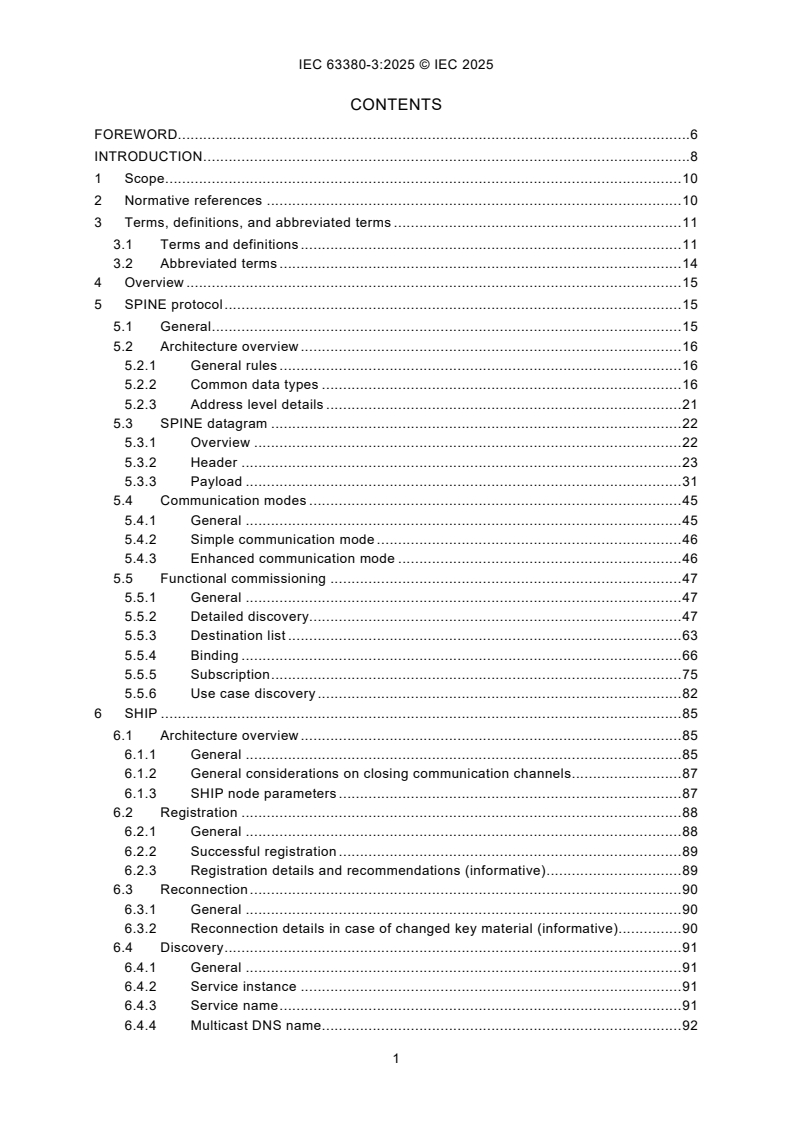
CONTENTS
FOREWORD. 6
INTRODUCTION . 8
1 Scope . 10
2 Normative references . 10
3 Terms, definitions, and abbreviated terms . 11
3.1 Terms and definitions . 11
3.2 Abbreviated terms . 14
4 Overview . 15
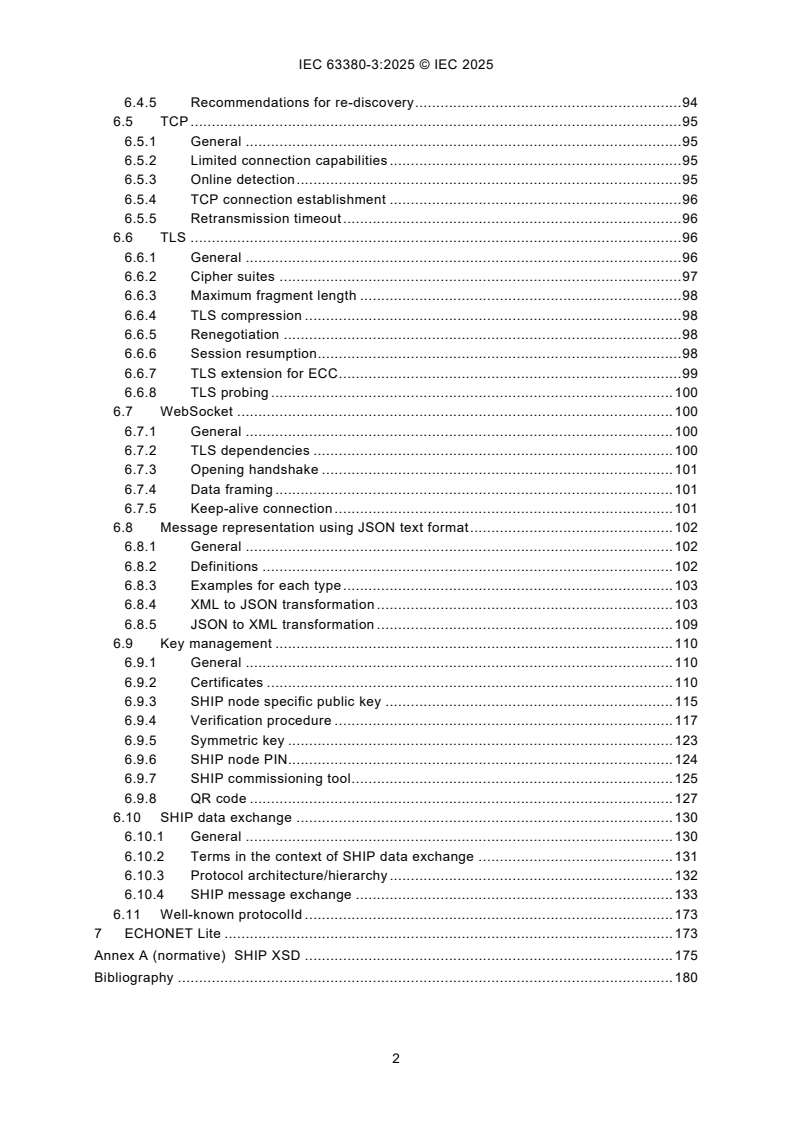
5 SPINE protocol . 15
5.1 General . 15
5.2 Architecture overview . 16
5.2.1 General rules . 16
5.2.2 Common data types . 16
5.2.3 Address level details . 21
5.3 SPINE datagram . 22
5.3.1 Overview . 22
5.3.2 Header . 23
5.3.3 Payload . 31
5.4 Communication modes . 45
5.4.1 General . 45
5.4.2 Simple communication mode . 46
5.4.3 Enhanced communication mode . 46
5.5 Functional commissioning . 47
5.5.1 General . 47
5.5.2 Detailed discovery. 47
5.5.3 Destination list . 63
5.5.4 Binding . 66
5.5.5 Subscription . 75
5.5.6 Use case discovery . 82
6 SHIP . 85
6.1 Architecture overview . 85
6.1.1 General . 85
6.1.2 General considerations on closing communication channels . 87
6.1.3 SHIP node parameters . 87
6.2 Registration . 88
6.2.1 General . 88
6.2.2 Successful registration . 89
6.2.3 Registration details and recommendations (informative) . 89
6.3 Reconnection . 90
6.3.1 General . 90
6.3.2 Reconnection details in case of changed key material (informative) . 90
6.4 Discovery . 91
6.4.1 General . 91
6.4.2 Service instance . 91
6.4.3 Service name . 91
6.4.4 Multicast DNS name . 92
6.4.5 Recommendations for re-discovery . 94
6.5 TCP . 95
6.5.1 General . 95
6.5.2 Limited connection capabilities . 95
6.5.3 Online detection . 95
6.5.4 TCP connection establishment . 96
6.5.5 Retransmission timeout . 96
6.6 TLS . 96
6.6.1 General . 96
6.6.2 Cipher suites . 97
6.6.3 Maximum fragment length . 98
6.6.4 TLS compression . 98
6.6.5 Renegotiation . 98
6.6.6 Session resumption . 98
6.6.7 TLS extension for ECC . 99
6.6.8 TLS probing . 100
6.7 WebSocket . 100
6.7.1 General . 100
6.7.2 TLS dependencies . 100
6.7.3 Opening handshake . 101
6.7.4 Data framing . 101
6.7.5 Keep-alive connection . 101
6.8 Message representation using JSON text format . 102
6.8.1 General . 102
6.8.2 Definitions . 102
6.8.3 Examples for each type . 103
6.8.4 XML to JSON transformation . 103
6.8.5 JSON to XML transformation . 109
6.9 Key management . 110
6.9.1 General . 110
6.9.2 Certificates . 110
6.9.3 SHIP node specific public key . 115
6.9.4 Verification procedure . 117
6.9.5 Symmetric key . 123
6.9.6 SHIP node PIN. 124
6.9.7 SHIP commissioning tool . 125
6.9.8 QR code . 127
6.10 SHIP data exchange . 130
6.10.1 General . 130
6.10.2 Terms in the context of SHIP data exchange . 131
6.10.3 Protocol architecture/hierarchy . 132
6.10.4 SHIP message exchange . 133
6.11 Well-known protocolId . 173
7 ECHONET Lite . 173
Annex A (normative) SHIP XSD . 175
Bibliography . 180
Figure 1 – Overview of communication protocols within IEC 63380-3 . 15
Figure 2 – PossibleOperationsType . 19
Figure 3 – DeviceAddressType . 20
Figure 4 – EntityAddressType . 20
Figure 5 – FeatureAddressType . 20
Figure 6 – SPINE datagram . 23
Figure 7 – SPINE header . 24
Figure 8 – SPINE payload . 32
Figure 9 – Example of selectors part (extract) with entity address part . 44
Figure 10 – Communication modes of SPINE devices A, B and C . 45
Figure 11 – Discovery example . 47
Figure 12 – Hierarchy types . 48
Figure 13 – Function Discovery Example over Feature Description . 49
Figure 14 – nodeManagementDetailedDiscoveryData function overview, part 1 . 52
Figure 15 – nodeManagementDetailedDiscoveryData function overview, part 2:
deviceInformation.description . 53
Figure 16 – nodeManagementDetailedDiscoveryData function overview, part 3:
entityInformation.description . 53
Figure 17 – nodeManagementDetailedDiscoveryData function overview, part 4:
featureInformation.description . 54
Figure 18 – nodeManagementDestinationListData function overview, part 1 . 65
Figure 19 – nodeManagementDestinationListData function overview, part 2 . 65
Figure 20 – Binding request . 68
Figure 21 – nodeManagementBindingRequestCall function overview . 68
Figure 22 – nodeManagementBindingData function overview . 70
Figure 23 – nodeManagementBindingDeleteCall function overview . 72
Figure 24 – Subscription request . 76
Figure 25 – nodeManagementSubscriptionRequestCall function overview . 76
Figure 26 – nodeManagementSubscriptionData function overview . 78
Figure 27 – nodeManagementSubscriptionDeleteCall function overview . 80
Figure 28 – nodeManagementUseCaseData function . 83
Figure 29 – Physical connections in the overall system . 86
Figure 30 – SHIP stack overview . 86
Figure 31 – Full TLS 1.2 handshake with mutual authentication . 97
Figure 32 – Quick TLS Handshake with Session Resumption . 99
Figure 33 – Easy mutual authentication with QR codes and smart phone . 124
Figure 34 – QR code model 2, "low" error correction code level, 0,33mm/module, with
SKI and PIN . 129
Figure 35 – QR code model 2, "low" error correction code level, 0,33 mm/module, with
all values . 130
Figure 36 – QR code model 2, "low" error correction code level, 0,33 mm/module, with
brainpoolP256r1 SKI and brainpoolP384r1 SKI . 130
Figure 37 – Protocol architecture and hierarchy . 132
Figure 38 – CMI Message sequence example . 136
Figure 39 – Connection state "hello" sequence example without prolongation request:
"A" and "B" already trust each other; "B" is slower/delayed . 143
Figure 40 – Connection state "hello" sequence example with prolongation request . 144
Figure 41 – Connection State "Protocol Handshake" message sequence example . 149
Figure 42 – Connection state "PIN verification" message sequence example (begin) . 158
Figure 43 – ECHONET Lite frame format . 174
Table 1 – Structure of the SPINE datagram . 23
Table 2 – cmdClassifier values and kind of messages for a message "M" and scope of
related acknowledgement messages . 27
Table 3 – Structure of the SPINE header . 30
Table 4 – Elements of the SPINE payload . 32
Table 5 – Example table (template) . 36
Table 6 – Considered cmdOptions combinations for classifier "write" . 37
Table 7 – Considered cmdOptions combinations for classifier "notify" . 38
Table 8 – Considered cmdOptions combinations for classifier "read" . 39
Table 9 – Considered cmdOptions combinations for classifier "reply" . 39
Table 10 – Address path examples . 43
Table 11 – Notify/response list of entities and their corresponding features with
nodeManagementDetailedDiscoveryData . 54
Table 12 – nodeManagementDetailedDiscoveryDataSelectors . 61
Table 13 – Notify/response of DestinationList information with
nodeManagementDestinationListData . 66
Table 14 – Binding request with nodeManagementBindingRequestCall . 68
Table 15 – nodeManagementBindingData holds list of binding entries . 71
Table 16 – Remove binding with nodeManagementBindingDeleteCall . 73
Table 17 – Subscription request with nodeManagementSubscriptionRequestCall . 77
Table 18 – nodeManagementSubscriptionData holds list of subscription entries . 79
Table 19 – Remove subscription with nodeManagementSubscriptionDeleteCall . 81
Table 20 – nodeManagementUseCaseData . 84
Table 21 – SHIP parameters default values . 87
Table 22 – Mandatory parameters in the TXT record. 93
Table 23 – Optional parameters in the TXT record . 93
Table 24 – Mapping from the XSD types to JSON types . 103
Table 25 – Transformation of a simple type . 104
Table 26 – Mapping from the XSD compositors to JSON types . 104
Table 27 – Examples for XML and JSON representations . 106
Table 28 – Example transformation of several combined XSD item types . 108
Table 29 – Example for JSON to XML transformation . 110
Table 30 – Trust levels . 123
Table 31 – MessageType values . 134
Table 32 – Structure of SmeHelloValue of SME "hello" message . 137
Table 33 – Structure of SmeProtocolHandshakeValue of SME "Protocol Handshake"
message . 145
Table 34 – Structure of SmeProtocolHandshakeErrorValue of SME "Protocol
Handshake Error" message . 146
Table 35 – Values of Sub-element "error" of messageProtocolHandshakeError . 148
Table 36 – Structure of SmeConnectionPinStateValue of SME "PIN state" message. 150
Table 37 – Structure of SmeConnectionPinInputValue of SME "pin input" message . 151
Table 38 – Structure of SmeConnectionPinErrorValue of SME "Pin error" message . 151
Table 39 – Values of Sub-element "error" of connectionPinError . 157
Table 40 – Structure of MessageValue of "data" message . 159
Table 41 – Structure of SmeConnectionAccessMethodsRequestValue of SME "Access
methods request" message . 162
Table 42 – Structure of SmeConnectionAccessMethodsValue of SME "Access
methods" message . 162
Table 43 – Structure of SmeConnectionCommissioningRequestValue of SME
"commissioning request" message . 164
Table 44 – Structure of SmeConnectionCommissioningResponseValue of SME
"commissioning response" message . 165
Table 45 – Structure of SmeConnectionKeyMaterialRequestValue of SME "key
material request" message . 165
Table 46 – Structure of SmeConnectionKeyMaterialValue of SME "key material"
message . 166
Table 47 – Structure of SmeConnectionKeyMaterialResponseValue of SME "key
material response" message . 167
Table 48 – Structure of SmeConnectionKeyMaterialDeleteValue of SME "key material
delete" message . 168
Table 49 – Structure of SmeConnectionKeyMaterialDeleteResponseValue of SME "key
material delete response" message . 169
Table 50 – Structure of SmeConnectionKeyMaterialStateValue of SME "key material
state" message . 170
Table 51 – Structure of SmeConnectionKeyMaterialStateResponseValue of SME "key
material state response" message . 170
Table 52 – Structure of SmeConnectionKeyMaterialStateRequestValue of SME "key
material state request" message . 171
Table 53 – Structure of SmeCloseValue of SME "close" message . 172
Table 54 – Well-known values for the element "protocolId" . 173
INTERNATIONAL ELECTROTECHNICAL COMMISSION
____________
Standard interface for connecting charging
stations to local energy management systems -
Part 3: Communication protocol and cybersecurity specific aspects
FOREWORD
1) The International Electrotechnical Commission (IEC) is a worldwide organization for standardization comprising
all national electrotechnical committees (IEC National Committees). The object of IEC is to promote international
co-operation on all questions concerning standardization in the electrical and electronic fields. To this end and
in addition to other activities, IEC publishes International Standards, Technical Specifications, Technical Reports,
Publicly Available Specifications (PAS) and Guides (hereafter referred to as "IEC Publication(s)"). Their
preparation is entrusted to technical committees; any IEC National Committee interested in the subject dealt with
may participate in this preparatory work. International, governmental and non-governmental organizations liaising
with the IEC also participate in this preparation. IEC collaborates closely with the International Organization for
Standardization (ISO) in accordance with conditions determined by agreement between the two organizations.
2) The formal decisions or agreements of IEC on technical matters express, as nearly as possible, an international
consensus of opinion on the relevant subjects since each technical committee has representation from all
interested IEC National Committees.
3) IEC Publications have the form of recommendations for international use and are accepted by IEC National
Committees in that sense. While all reasonable efforts are made to ensure that the technical content of IEC
Publications is accurate, IEC cannot be held responsible for the way in which they are used or for any
misinterpretation by any end user.
4) In order to promote international uniformity, IEC National Committees undertake to apply IEC Publications
transparently to the maximum extent possible in their national and regional publications. Any divergence between
any IEC Publication and the corresponding national or regional publication shall be clearly indicated in the latter.
5) IEC itself does not provide any attestation of conformity. Independent certification bodies provide conformity
assessment services and, in some areas, access to IEC marks of conformity. IEC is not responsible for any
services carried out by independent certification bodies.
6) All users should ensure that they have the latest edition of this publication.
7) No liability shall attach to IEC or its directors, employees, servants or agents including individual experts and
members of its technical committees and IEC National Committees for any personal injury, property damage or
other damage of any nature whatsoever, whether direct or indirect, or for costs (including legal fees) and
expenses arising out of the publication, use of, or reliance upon, this IEC Publication or any other IEC
Publications.
8) Attention is drawn to the Normative references cited in this publication. Use of the referenced publications is
indispensable for the correct application of this publication.
9) IEC draws attention to the possibility that the implementation of this document may involve the use of (a)
patent(s). IEC takes no position concerning the evidence, validity or applicability of any claimed patent rights in
respect thereof. As of the date of publication of this document, IEC had not received notice of (a) patent(s), which
may be required to implement this document. However, implementers are cautioned that this may not represent
the latest information, which may be obtained from the patent database available at https://patents.iec.ch. IEC
shall not be held responsible for identifying any or all such patent rights.
IEC 63380-3 has been prepared by IEC technical committee 69: Electrical power/energy
transfer systems for electrically propelled road vehicles and industrial trucks. It is an
International Standard.
The text of this International Standard is based on the following documents:
Draft Report on voting
69/1051/FDIS 69/1060/RVD
Full information on the voting for its approval can be found in the report on voting indicated in
the above table.
The language used for the development of this International Standard is English.
This document was drafted in accordance with ISO/IEC Directives, Part 2, and developed in
accordance with ISO/IEC Directives, Part 1 and ISO/IEC Directives, IEC Supplement, available
at www.iec.ch/members_experts/refdocs. The main document types developed by IEC are
described in greater detail at www.iec.ch/publications.
In this document, all text record fields are written in lowercase Courier font, since they belong
to protocol information/binary data exchange.
A list of all parts in the IEC 63380 series, published under the general title Standard interface
for connecting charging stations to local energy management systems, can be found on the IEC
website.
The committee has decided that the contents of this document will remain unchanged until the
stability date indicated on the IEC website under webstore.iec.ch in the data related to the
specific document. At this date, the document will be
• reconfirmed,
• withdrawn, or
• revised.
INTRODUCTION
The expansion of renewable energy and the simultaneous reduction in conventional generation
of electricity result in new power flows and loads on the equipment in the grid and at the house
connection point. At the same time, electrical consumers with high power consumption are
increasingly being installed in low-voltage systems in private customer systems. These include
charging systems for electric vehicles and heat pumps. These two developments can
temporarily lead to peak loads and bottlenecks in the network. An expansion of the distribution
grids for the comparatively few hours of high simultaneous power consumption is not considered
economically sensible. The legislator of energy efficiency has therefore introduced the concept
of "network-friendly control of controllable consumer devices".
It is crucial to define a standardized interface for the connected consumers and generating
facilities, which also includes the charging infrastructure for electric vehicles. When developing
a local, standardized interface, it is important to make a fundamental distinction between the
terms "power management" and "energy management".
In order to avoid an overload and the associated emergency shutdown due to specified power
limits in the property while all consumers are drawing electricity at the same time – especially
heating and air conditioning technology as well as charging infrastructure –, power management
is of great urgency. The maximum load at the grid connection point can therefore be reduced.
Accordingly, it is important to give priority to local power management over, for example,
optimization of operations and tariffs or desired charging plans.
Furthermore, the tariff-optimized operation can be pursued within the limits specified by the grid
infrastructure – controlled by the energy management system. As a consequence, a charging
infrastructure will be able to transmit information about procurement and tariff-optimized
operation from the local energy management of the property to the electric vehicle so that it
can coordinate its charging plan according to local demands. Effective coordination becomes
essential if generating systems are used within the property in order to achieve the highest
possible self-consumption of electricity.
The long-term goal is to buffer power and energy bottlenecks within a property using the energy
stored in the vehicle, which also brings the topic of energy recovery into focus; this aspect
needs to be considered during the development of a standardized interface for local power and
energy management.
The aim of the IEC 63380 series is to define a standard interface for connecting charging
stations to local energy management systems and the information exchange.
The IEC 63380 series specifies use cases, the sequences of information exchange, the data
models as well as the communication protocols to be used and includes all aspects of local
energy management of charging stations.
The IEC 63380 series covers scenarios where the charging infrastructure is managed by the
entity that operates the private electrical network, and local energy management systems are
used for local load management.
The IEC 63380 series addresses the energy management in installations with forward and
bidirectional charging whereby the overall energy management is ensured by the customer
energy manager.
The IEC 63380 series does not cover the secure information exchange between the charging
station and the IT backend system(s), such as the management of energy transfer of the charge
session, contractual and billing data, provided by the IT backend.
The IEC 63380 series consists of the following structure, describing the interface between
charging stations and local energy management systems;
• IEC 63380-1 : General requirements, use cases and abstract messages;
• IEC 63380-2: Specific data model mapping;
• IEC 63380-3: Communication protocol and cybersecurity specific aspects;
• IEC 63380-4 : Test specifications.
___________
1 Under preparation: Stage at the time of publication: IEC/CFDIS 63380-1:2025.
2 Under preparation. Stage at the time of publication: IEC/ACD 63380-4:2021.
1 Scope
This part of IEC 63380 defines the secure information exchange between local energy
management systems and electric vehicle charging stations. The local energy management
systems communicate to the charging station controllers via the resource manager.
This document specifies the application of relevant transport protocols; in this case, SPINE
(smart premises interoperable neutral-message exchange), SHIP (smart home IP), and
ECHONET Lite. Other communication protocols can be defined in future editions.
2 Normative references
The following documents are referred to in the text in such a way that some or all of their content
constitutes requirements of this document. For dated references, only the edition cited applies.
For undated references, the latest edition of the referenced document (including any
amendments) applies.
IEC 62394, Service diagnostic interface for consumer electronics products and networks –
Implementation for ECHONET
IEC 63380-2, Standard interface for connecting charging stations to local energy management
systems – Part 2: Specific data model mapping
ISO/IEC 14543-4-3:2015, Information technology, Home Electronic Systems (HES) architecture
– Part 4-3: Application layer interface to lower communications layers for network enhanced
control devices of HES Class 1
IETF RFC 793:1981, Transmission Control Protocol
IETF RFC 3280:2002, Internet X.509 Public Key Infrastructure Certificate and Certificate
Revocation List (CRL) Profile
IETF RFC 6455:2011, The WebSocket Protocol
IETF RFC 6763, DNS-Based Service Discovery
IETF RFC 5246, The Transport Layer Security (TLS) Protocol Version 1.2
IETF RFC 5289, TLS Elliptic Curve Cipher Suites with SHA-256/384 and AES Galois Counter
Mode (GCM)
IETF RFC 8422, Elliptic Curve Cryptography (ECC) Cipher Suites for Transport Layer Security
(TLS) Versions 1.2 and earlier
3 Terms, definitions, and abbreviated terms
For the purposes of this document, the following terms and definitions apply.
ISO and IEC maintain terminology databases for use in standardization at the following
addresses:
• IEC Electropedia: available at https://www.electropedia.org/
• ISO Online browsing platform: available at https://www.iso.org/obp
3.1 Terms and definitions
3.1.1
CA
certificate authority
certification authority
entity which can provide a digital signature for certificates
Note 1 to entry: Other SHIP nodes can check this digital signature with the certificate from the CA itself,
the "CA-certificate".
3.1.2
commissioning tool
instrument to establish the trust between different devices in the smart home
installation, for example distribute trustworthy credentials from some SHIP nodes to other SHIP
nodes
Note 1 to entry: For example, a smart phone, a Web server or a dedicated device can embody the role of a
commissioning tool. So far, the SHIP specification does not specify a commissioning tool; an interoperable protocol
for commissioning can be used on the layer above SHIP.
Note 2 to entry: Manufacturer can also use their own solutions.
3.1.3
DNS host name
fully qualified domain name used within DNS as host name to get the IP address of the
corresponding internet host
3.1.4
factory default
setting that allows the user to reset the SHIP node to the as-new condition
Note 1 to entry: All data that has been provided and stored by the SHIP node during its operation time shall be
deleted.
3.1.5
mDNS
multicast DNS host name
fully qualified domain name used within mDNS as host name to get the IP address of the
corresponding local SHIP node
3.1.6
M/O/NV/C
abbreviations which refer to
1) M = mandatory,
2) O = optional,
3) NV = not valid, and
4) C = choice, i.e., a presence or support depends also on the selection from multiple
possibilities,
and which are primarily used within specific definition tables describing certain specialized data
model definitions
3.1.7
PIN
personal identification number
secret number used for SHIP specific verification procedures
3.1.8
push button
switching mechanism to control some aspect of a machine or a process
Note 1 to entry: A push button event does not necessarily mean that a real physical button is used to trigger this
event. A push button event can also be generated by other means, for example, via a smart phone application or a
Web-interface (secure connection to SHIP node required). A push button shall provide a simple mechanism for a
user to bring the device to a certain state or start a certain process.
3.1.9
TM
QR code
quick response code
code used for efficient encoding of data into a small graphic
Note 1 to entry: Among other standards, ISO/IEC 18004:2024 specifies the encoding of QR code symbols.
Note 2 to entry: QR code is the trademark of a product supplied by Denso Wave incorporated. This information is
given for the convenience of users of this document and does not constitute an endorsement by IEC of the product
named. Equivalent products can be used if they can be shown to lead to the same results.
3.1.10
SHIP ID
identification which is used to uniquely identify a SHIP node, for example, in its service
discovery, and which is present in the mDNS or DNS-SD local service discovery
Note 1 to entry: Each SHIP node has a globally unique SHIP ID.
Note 2 to entry: See 6.4.
3.1.11
SHIP client
role which is assigned to the SHIP node that also embodies the TCP client role for a specific
peer-to-peer connection
3.1.12
SHIP commissioning
SHIP term which denotes the distribution of trustworthy SKIs from certain SHIP nodes to other
SHIP nodes
Note 1 to entry: The distribution of the trustworthy SKIs is handled by a so-called SHIP commissioning tool.
3.1.13
SHIP commissioning tool
instrument which is used to distribute trustworthy SKIs from certain SHIP nodes to other SHIP
nodes, and which allows a user to handle the trust relationships in the whole SHIP installation
(if each node in the installation supports commissioning) over one simple user interface
3.1.14
SHIP node
logical device which communicates via the described SHIP protocol and can be integrated into
a Web server or physical device
Note 1 to entry: One physical device can have more than one logical SHIP node. In this case, each SHIP node shall
use distinct ports (e.g. a physical device provides 3 open ports with 3 different SHIP services).
3.1.15
SHIP server
role which shall be assigned to the SHIP node that also embodies the TCP server role for a
specific peer-to-peer connection
3.1.16
SKI
subject key identifier
identifying certificate that contains a specific public key and is used as a cryptographically
backed identification and authentication criterion
Note 1 to entry: Each SHIP node has a specific public key.
3.1.17
trusted SHIP node
node which has a trusting relationship to another ship node
Note 1 to entry: If SHIP node A has a communication partner and a trusted relationship to SHIP node B, SHIP node
B is called a trusted SHIP node from SHIP node A's point of view; a trusted relationship can be established in different
ways.
3.1.18
UTF
UCS transformation format
computing industry standard for the consistent encoding, representation, and handling of text
expressed in most of the world's writing systems
3.1.19
Web server-based SHIP node
SHIP node that is hosted by a W
...
IEC 63380-3 ®
Edition 1.0 2025-07
NORME
INTERNATIONALE
Interface normale pour la connexion de bornes de charge aux systèmes locaux
de gestion de l’énergie -
Partie 3: Protocole de communication et aspects spécifiques liés à la
cybersécurité
ICS 29.240.99; 43.120 ISBN 978-2-8327-0508-7
Droits de reproduction réservés. Sauf indication contraire, aucune partie de cette publication ne peut être reproduite ni
utilisée sous quelque forme que ce soit et par aucun procédé, électronique ou mécanique, y compris la photocopie et
les microfilms, sans l'accord écrit de l'IEC ou du Comité national de l'IEC du pays du demandeur. Si vous avez des
questions sur le copyright de l'IEC ou si vous désirez obtenir des droits supplémentaires sur cette publication, utilisez
les coordonnées ci-après ou contactez le Comité national de l'IEC de votre pays de résidence.
IEC Secretariat Tel.: +41 22 919 02 11
3, rue de Varembé info@iec.ch
CH-1211 Geneva 20 www.iec.ch
Switzerland
A propos de l'IEC
La Commission Electrotechnique Internationale (IEC) est la première organisation mondiale qui élabore et publie des
Normes internationales pour tout ce qui a trait à l'électricité, à l'électronique et aux technologies apparentées.
A propos des publications IEC
Le contenu technique des publications IEC est constamment revu. Veuillez vous assurer que vous possédez l’édition la
plus récente, un corrigendum ou amendement peut avoir été publié.
Recherche de publications IEC - IEC Products & Services Portal - products.iec.ch
webstore.iec.ch/advsearchform Découvrez notre puissant moteur de recherche et consultez
La recherche avancée permet de trouver des publications gratuitement tous les aperçus des publications, symboles
IEC en utilisant différents critères (numéro de référence, graphiques et le glossaire. Avec un abonnement, vous aurez
texte, comité d’études, …). Elle donne aussi des toujours accès à un contenu à jour adapté à vos besoins.
informations sur les projets et les publications remplacées
ou retirées. Electropedia - www.electropedia.org
Le premier dictionnaire d'électrotechnologie en ligne au
IEC Just Published - webstore.iec.ch/justpublished monde, avec plus de 22 500 articles terminologiques en
Restez informé sur les nouvelles publications IEC. Just anglais et en français, ainsi que les termes équivalents
Published détaille les nouvelles publications parues. dans 25 langues additionnelles. Egalement appelé
Disponible en ligne et une fois par mois par email. Vocabulaire Electrotechnique International (IEV) en ligne.
Service Clients - webstore.iec.ch/csc
Si vous désirez nous donner des commentaires sur cette
publication ou si vous avez des questions contactez-
nous: sales@iec.ch.
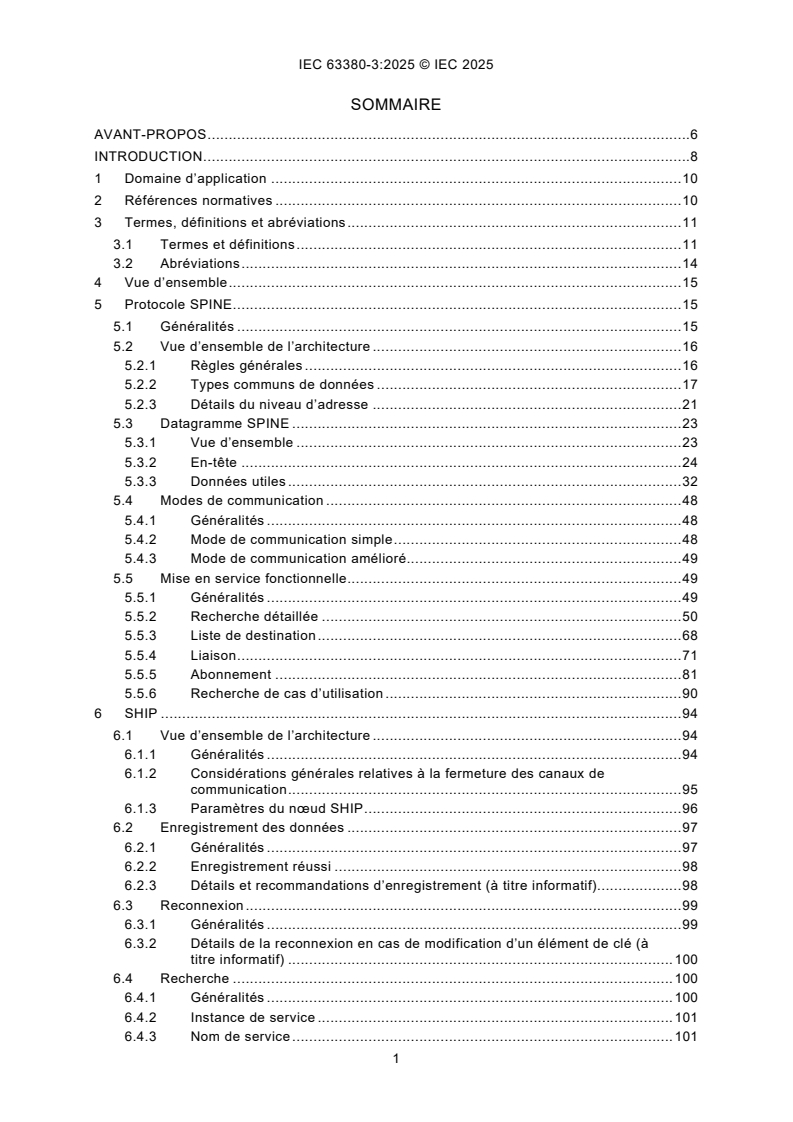
SOMMAIRE
AVANT-PROPOS . 6
INTRODUCTION . 8
1 Domaine d’application . 10
2 Références normatives . 10
3 Termes, définitions et abréviations . 11
3.1 Termes et définitions . 11
3.2 Abréviations . 14
4 Vue d’ensemble . 15
5 Protocole SPINE . 15
5.1 Généralités . 15
5.2 Vue d’ensemble de l’architecture . 16
5.2.1 Règles générales . 16
5.2.2 Types communs de données . 17
5.2.3 Détails du niveau d’adresse . 21
5.3 Datagramme SPINE . 23
5.3.1 Vue d’ensemble . 23
5.3.2 En-tête . 24
5.3.3 Données utiles . 32
5.4 Modes de communication . 48
5.4.1 Généralités . 48
5.4.2 Mode de communication simple . 48
5.4.3 Mode de communication amélioré. 49
5.5 Mise en service fonctionnelle . 49
5.5.1 Généralités . 49
5.5.2 Recherche détaillée . 50
5.5.3 Liste de destination . 68
5.5.4 Liaison . 71
5.5.5 Abonnement . 81
5.5.6 Recherche de cas d’utilisation . 90
6 SHIP . 94
6.1 Vue d’ensemble de l’architecture . 94
6.1.1 Généralités . 94
6.1.2 Considérations générales relatives à la fermeture des canaux de
communication . 95
6.1.3 Paramètres du nœud SHIP . 96
6.2 Enregistrement des données . 97
6.2.1 Généralités . 97
6.2.2 Enregistrement réussi . 98
6.2.3 Détails et recommandations d’enregistrement (à titre informatif) . 98
6.3 Reconnexion . 99
6.3.1 Généralités . 99
6.3.2 Détails de la reconnexion en cas de modification d’un élément de clé (à
titre informatif) . 100
6.4 Recherche . 100
6.4.1 Généralités . 100
6.4.2 Instance de service . 101
6.4.3 Nom de service . 101
6.4.4 Nom du DNS multidiffusion . 101
6.4.5 Recommandations relatives aux nouvelles recherches . 104
6.5 TCP . 104
6.5.1 Généralités . 104
6.5.2 Capacités de connexion limitées . 104
6.5.3 Détection en ligne . 105
6.5.4 Établissement d’une connexion TCP . 105
6.5.5 Temporisation de retransmission . 105
6.6 TLS . 106
6.6.1 Généralités . 106
6.6.2 Suites chiffrées . 107
6.6.3 Longueur de fragment maximale . 107
6.6.4 Compression TLS . 107
6.6.5 Renégociation . 108
6.6.6 Reprise de session . 108
6.6.7 Extension TLS pour ECC . 108
6.6.8 Sondage TLS . 109
6.7 WebSocket . 110
6.7.1 Généralités . 110
6.7.2 Dépendances TLS . 110
6.7.3 Liaison d’ouverture. 110
6.7.4 Trame de données . 111
6.7.5 Connexion persistante . 111
6.8 Représentation des messages au format texte JSON . 111
6.8.1 Généralités . 111
6.8.2 Définitions . 112
6.8.3 Exemples pour chaque type . 112
6.8.4 Transformation d’un XML en JSON . 113
6.8.5 Transformation d’un JSON en XML . 119
6.9 Gestion des clés . 120
6.9.1 Généralités . 120
6.9.2 Certificats . 121
6.9.3 Clé publique spécifique au nœud SHIP . 126
6.9.4 Procédure de vérification . 128
6.9.5 Clé symétrique . 135
6.9.6 PIN de nœud SHIP . 135
6.9.7 Outil de mise en service SHIP . 137
6.9.8 QR code . 140
6.10 Échange de données SHIP . 142
6.10.1 Généralités . 142
6.10.2 Termes dans le cadre de l’échange de données SHIP . 143
6.10.3 Architecture/hiérarchie de protocole . 145
6.10.4 Échange de messages SHIP . 146
6.11 ProtocolId bien connu . 189
7 ECHONET Lite . 190
Annexe A (normative) SHIP XSD . 191
Bibliographie . 196
Figure 1 – Vue d’ensemble des protocoles de communication au sein de l’IEC 63380-3 . 15
Figure 2 – PossibleOperationsType . 19
Figure 3 – DeviceAddressType . 20
Figure 4 – EntityAddressType . 20
Figure 5 – FeatureAddressType . 21
Figure 6 – Datagramme SPINE . 23
Figure 7 – Structure d’en-tête SPINE . 24
Figure 8 – Charge utile SPINE . 33
Figure 9 – Exemple de partie (extrait) de sélecteurs avec une partie adresse "entity" . 46
Figure 10 – Modes de communication des dispositifs SPINE A, B et C . 48
Figure 11 – Exemple de recherche . 50
Figure 12 – Types de hiérarchie . 51
Figure 13 – Exemple de recherche de fonction sur une description de caractéristiques . 52
Figure 14 – Vue d’ensemble de la fonction nodeManagementDetailedDiscoveryData,
partie 1 . 56
Figure 15 – Vue d’ensemble de la fonction nodeManagementDetailedDiscoveryData,
partie 2: deviceInformation.description . 56
Figure 16 – Vue d’ensemble de la fonction nodeManagementDetailedDiscoveryData,
partie 3: entityInformation.description . 57
Figure 17 – Vue d’ensemble de la fonction nodeManagementDetailedDiscoveryData,
partie 4: featureInformation.description . 57
Figure 18 – Vue d’ensemble de la fonction nodeManagementDestinationListData,
partie 1 . 70
Figure 19 – Vue d’ensemble de la fonction nodeManagementDestinationListData,
partie 2 . 70
Figure 20 – Demande de liaison . 73
Figure 21 – Vue d’ensemble de la fonction nodeManagementBindingRequestCall . 74
Figure 22 – Vue d’ensemble de la fonction nodeManagementBindingData . 76
Figure 23 – Vue d’ensemble de la fonction nodeManagementBindingDeleteCall . 78
Figure 24 – Demande d’abonnement . 83
Figure 25 – Vue d’ensemble de la fonction nodeManagementSubscriptionRequestCall . 84
Figure 26 – Vue d’ensemble de la fonction nodeManagementSubscriptionData . 86
Figure 27 – Vue d’ensemble de la fonction nodeManagementSubscriptionDeleteCall . 88
Figure 28 – Fonction nodeManagementBindingData . 92
Figure 29 – Connexions physiques dans le système global . 94
Figure 30 – Vue d’ensemble de la pile SHIP . 95
Figure 31 – Liaison TLS 1.2 complète avec authentification mutuelle . 106
Figure 32 – Liaison TLS rapide avec reprise de session. 108
Figure 33 – Authentification mutuelle facile par smartphone et QR Code . 136
Figure 34 – QR Code Modèle 2, niveau de code de correction d’erreur "faible",
0,33 mm/module, avec SKI et code PIN . 142
Figure 35 – QR Code Modèle 2, niveau de code de correction d’erreur "faible",
0,33 mm/module, avec toutes les valeurs . 142
Figure 36 – QR Code Modèle 2, niveau de code de correction d’erreur "faible",
0,33 mm/module, avec SKI brainpoolP256r1 et SKI brainpoolP384r1 . 142
Figure 37 – Architecture et hiérarchie de protocole . 145
Figure 38 – Exemple de séquence de messages CMI . 149
Figure 39 – Exemple de séquence "hello" d’état de connexion sans demande
de prolongation: "A" et "B" se sont déjà approuvés, "B" est plus lent/retardé. . 156
Figure 40 – Exemple de séquence "hello" d’état de connexion avec demande
de prolongation. . 157
Figure 41 – Exemple de séquence de message d’état de connexion "protocol
handshake" . 163
Figure 42 – Exemple de séquence de messages d’état de connexion "PIN verification"
(début) . 173
Figure 43 – Format de trame ECHONET Lite . 190
Tableau 1 – Structure du datagramme SPINE . 24
Tableau 2 – Valeurs et nature des messages cmdClassifier pour un message "M" et
domaine d’application des messages d’acquittement associés . 27
Tableau 3 – Structure de l’en-tête SPINE . 31
Tableau 4 – Éléments de la charge utile SPINE . 33
Tableau 5 – Exemple de tableau (modèle) . 37
Tableau 6 – Combinaisons de cmdOptions prises en compte pour le classificateur
"write" . 39
Tableau 7 – Combinaisons de cmdOptions prises en compte pour le classificateur
"notify" . 40
Tableau 8 – Combinaisons de cmdOptions prises en compte pour le classificateur
"read" . 41
Tableau 9 – Combinaisons de cmdOptions prises en compte pour le classificateur
"reply" . 41
Tableau 10 – Exemples de chemins d’adresse . 46
Tableau 11 – Liste de notifications/réponses des entités et leurs caractéristiques
correspondantes avec nodeManagementDetailedDiscoveryData . 58
Tableau 12 – nodeManagementDetailedDiscoveryDataSelectors . 66
Tableau 13 – Notification/réponse des informations DestinationList avec
nodeManagementDestinationListData . 71
Tableau 14 – Demande de liaison avec nodeManagementBindingRequestCall . 74
Tableau 15 – nodeManagementBindingData contient la liste des entrées de liaison . 77
Tableau 16 – Supprimer la liaison avec nodeManagementBindingDeleteCall . 79
Tableau 17 – Demande d’abonnement avec nodeManagementSubscriptionRequestCall . 84
Tableau 18 – nodeManagementSubscriptionData contient la liste des entrées
d’abonnement . 87
Tableau 19 – Supprimession de l’abonnement avec
nodeManagementSubscriptionDeleteCall . 89
Tableau 20 – nodeManagementUseCaseData . 92
Tableau 21 – Valeurs par défaut des paramètres SHIP . 96
Tableau 22 – Paramètres obligatoires dans l’enregistrement TXT . 102
Tableau 23 – Paramètres facultatifs dans l’enregistrement TXT . 102
Tableau 24 – Correspondance des types XSD avec les types JSON . 113
Tableau 25 – Transformation d’un type simple . 114
Tableau 26 – Correspondance des compositeurs XSD avec les types JSON . 114
Tableau 27 – Exemples de représentations XML et JSON . 116
Tableau 28 – Exemple de transformation de plusieurs types d’éléments XSD combinés . 118
Tableau 29 – Exemple de transformation d’un JSON en XML . 120
Tableau 30 – Niveaux de confiance . 134
Tableau 31 – Valeurs de MessageType . 147
Tableau 32 – Structure de SmeHelloValue du message "hello" SME. . 150
Tableau 33 – Structure de SmeProtocolHandshakeValue du message "protocol
handshake" SME . 158
Tableau 34 – Structure de SmeProtocolHandshakeErrorValue du message "Protocol
Handshake Error" SME . 159
Tableau 35 – Valeurs du sous-élément "error" de messageProtocolHandshakeError . 162
Tableau 36 – Structure de SmeConnectionPinStateValue du message "PIN state" SME . 164
Tableau 37 – Structure de SmeConnectionPinInputValue du message "PIN input" SME. . 165
Tableau 38 – Structure de SmeConnectionPinErrorValue du message "PIN error" SME . 165
Tableau 39 – Valeurs du sous-élément "error" de connectionPinError . 171
Tableau 40 – Structure de MessageValue du message "data" . 174
Tableau 41 – Structure de SmeConnectionAccessMethodsRequestValue du message
"Access methods request" SME . 177
Tableau 42 – Structure de SmeConnectionAccessMethodsValue du message "Access
methods" SME . 178
Tableau 43 – Structure de SmeConnectionCommissioningRequestValue du message
"commissioning request" SME . 180
Tableau 44 – Structure de SmeConnectionCommissioningResponseValue du message
"commissioning response" SME . 180
Tableau 45 – Structure de SmeConnectionKeyMaterialRequestValue du message "key
material request" SME . 181
Tableau 46 – Structure de SmeConnectionKeyMaterialValue du message "key
material" SME . 182
Tableau 47 – Structure de SmeConnectionKeyMaterialResponseValue du message
"key material response" SME . 183
Tableau 48 – Structure de SmeConnectionKeyMaterialDeleteValue du message "key
material delete" SME . 184
Tableau 49 – Structure de SmeConnectionKeyMaterialDeleteResponseValue du
message "key material delete response" SME . 185
Tableau 50 – Structure de SmeConnectionKeyMaterialStateValue du message
"key material state" SME . 186
Tableau 51 – Structure de SmeConnectionKeyMaterialStateResponseValue du
message "key material state response" SME . 187
Tableau 52 – Structure de SmeConnectionKeyMaterialStateRequestValue du message
"key material state request" SME . 187
Tableau 53 – Structure de SmeCloseValue du message "close" SME. 188
Tableau 54 – Valeurs connues pour l’élément "protocolId" . 190
COMMISSION ÉLECTROTECHNIQUE INTERNATIONALE
____________
Interface normale pour la connexion de bornes de charge
aux systèmes locaux de gestion de l’énergie –
Partie 3: Protocole de communication et aspects
spécifiques liés à la cybersécurité
AVANT-PROPOS
1) La Commission Électrotechnique Internationale (IEC) est une organisation mondiale de normalisation composée
de l’ensemble des comités électrotechniques nationaux (Comités nationaux de l’IEC). L’IEC a pour objet
de favoriser la coopération internationale pour toutes les questions de normalisation dans les domaines
de l’électricité et de l’électronique. À cet effet, l’IEC – entre autres activités – publie des Normes internationales,
des Spécifications techniques, des Rapports techniques, des Spécifications accessibles au public (PAS) et
des Guides (ci-après dénommés "Publication(s) de l’IEC"). Leur élaboration est confiée à des comités d’études,
aux travaux desquels tout Comité national intéressé par le sujet traité peut participer. Les organisations
internationales, gouvernementales et non gouvernementales, en liaison avec l’IEC, participent également
aux travaux. L’IEC collabore étroitement avec l’Organisation Internationale de Normalisation (ISO),
selon des conditions fixées par accord entre les deux organisations.
2) Les décisions ou accords officiels de l’IEC concernant les questions techniques représentent, dans la mesure
du possible, un accord international sur les sujets étudiés, étant donné que les Comités nationaux de l’IEC
intéressés sont représentés dans chaque comité d’études.
3) Les Publications de l’IEC se présentent sous la forme de recommandations internationales et sont agréées
comme telles par les Comités nationaux de l’IEC. Tous les efforts raisonnables sont entrepris afin que l’IEC
s’assure de l’exactitude du contenu technique de ses publications; l’IEC ne peut pas être tenue responsable
de l’éventuelle mauvaise utilisation ou interprétation qui en est faite par un quelconque utilisateur final.
4) Dans le but d’encourager l’uniformité internationale, les Comités nationaux de l’IEC s’engagent,
dans toute la mesure possible, à appliquer de façon transparente les Publications de l’IEC dans leurs publications
nationales et régionales. Toutes divergences entre toutes Publications de l’IEC et toutes publications nationales
ou régionales correspondantes doivent être indiquées en termes clairs dans ces dernières.
5) L’IEC elle-même ne fournit aucune attestation de conformité. Des organismes de certification indépendants
fournissent des services d’évaluation de conformité et, dans certains secteurs, accèdent aux marques
de conformité de l’IEC. L’IEC n’est responsable d’aucun des services effectués par les organismes de certification
indépendants.
6) Tous les utilisateurs doivent s’assurer qu’ils sont en possession de la dernière édition de cette publication.
7) Aucune responsabilité ne doit être imputée à l’IEC, à ses administrateurs, employés, auxiliaires ou mandataires,
y compris ses experts particuliers et les membres de ses comités d’études et des Comités nationaux de l’IEC,
pour tout préjudice causé en cas de dommages corporels et matériels, ou de tout autre dommage de quelque
nature que ce soit, directe ou indirecte, ou pour supporter les coûts (y compris les frais de justice) et les dépenses
découlant de la publication ou de l’utilisation de cette Publication de l’IEC ou de toute autre Publication de l’IEC,
ou au crédit qui lui est accordé.
8) L’attention est attirée sur les références normatives citées dans cette publication. L’utilisation de publications
référencées est obligatoire pour une application correcte de la présente publication.
9) L’IEC attire l’attention sur le fait que la mise en application du présent document peut entraîner l’utilisation
d’un ou de plusieurs brevets. L’IEC ne prend pas position quant à la preuve, à la validité et à l’applicabilité de tout
droit de brevet revendiqué à cet égard. À la date de publication du présent document, l’IEC n’avait pas reçu
notification qu’un ou plusieurs brevets pouvaient être nécessaires à sa mise en application. Toutefois, il y a lieu
d’avertir les responsables de la mise en application du présent document que des informations plus récentes
sont susceptibles de figurer dans la base de données de brevets, disponible à l’adresse https://patents.iec.ch.
L’IEC ne saurait être tenue pour responsable de ne pas avoir identifié de tels droits de brevet.
L’IEC 63380-3 a été établie par le comité d’études 69 de l’IEC: Véhicules électriques destinés
à circuler sur la voie publique et chariots de manutention électriques. Il s’agit
d’une Norme internationale.
Le texte de cette Norme internationale est issu des documents suivants:
Projet Rapport de vote
69/1051/FDIS 69/1060/RVD
Le rapport de vote indiqué dans le tableau ci-dessus donne toute information sur le vote ayant
abouti à son approbation.
La langue employée pour l’élaboration de cette Norme internationale est l’anglais.
Ce document a été rédigé selon les Directives ISO/IEC, Partie 2, il a été développé selon
les Directives ISO/IEC, Partie 1 et les Directives ISO/IEC, Supplément IEC, disponibles
sous www.iec.ch/members_experts/refdocs. Les principaux types de documents développés
par l’IEC sont décrits plus en détail sous www.iec.ch/publications.
Dans le présent document, tous les champs d’enregistrement de texte sont écrits en minuscules
Courier, car ils appartiennent à l’échange d’informations de protocole/données binaires.
Une liste de toutes les parties de la série IEC 63380, publiées sous le titre général Interface
normale pour la connexion de bornes de charge aux systèmes locaux de gestion de l’énergie,
se trouve sur le site web de l’IEC.
Le comité a décidé que le contenu de ce document ne sera pas modifié avant la date de stabilité
indiquée sur le site web de l’IEC sous webstore.iec.ch dans les données relatives au document
recherché. À cette date, le document sera
• reconduit,
• supprimé, ou
• révisé.
INTRODUCTION
L’expansion des énergies renouvelables et la réduction simultanée de la production
conventionnelle d’électricité entraînent de nouveaux flux de puissance et de nouvelles charges
sur l’équipement du réseau et au point de connexion des maisons. Dans le même temps,
des appareils électriques à forte consommation sont de plus en plus souvent installés
dans les systèmes à basse tension des clients particuliers, notamment les systèmes de charge
pour véhicules électriques et pompes à chaleur. Ces deux évolutions peuvent engendrer
des pics de charge et des goulets d’étranglement temporaires dans le réseau. Une expansion
des réseaux de distribution pour les quelques heures de forte consommation de puissance
simultanée n’est pas considérée comme économiquement raisonnable. Le législateur
du rendement en énergie a donc introduit le concept de "contrôle des dispositifs
de consommation contrôlables en fonction du réseau".
Il est essentiel de définir une interface normalisée pour les consommateurs et les installations
de production connectés, ce qui inclut également l’infrastructure de charge pour les véhicules
électriques. Lors de l’élaboration d’une interface locale normalisée, il est important de faire
une distinction fondamentale entre les termes "gestion de la puissance" et "gestion
de l’énergie".
Afin d’éviter une surcharge et l’arrêt d’urgence qui en découle en raison des limites
de puissance spécifiées dans la propriété, alors que tous les consommateurs absorbent
de l’électricité en même temps, en particulier les technologies de chauffage et de climatisation,
ainsi que l’infrastructure de charge, la gestion de la puissance est une urgence. La charge
maximale au point de connexion au réseau peut donc être réduite. Par conséquent, il est
important de donner la priorité à la gestion locale de la puissance plutôt qu’à l’optimisation
des opérations et des tarifs ou aux plans de charge souhaités, par exemple.
En outre, l’optimisation en fonction des tarifs peut être poursuivie dans les limites spécifiées
par l’infrastructure du réseau (contrôlée par le système de gestion de l’énergie).
Par conséquent, une infrastructure de charge peut transmettre au véhicule électrique
des informations sur l’optimisation de l’achat ou en fonction des tarifs, à partir de la gestion
locale de l’énergie de la propriété, afin qu’il puisse coordonner son plan de charge en fonction
des demandes locales. Une coordination efficace devient essentielle si des systèmes
de production sont utilisés à l’intérieur de la propriété, afin d’obtenir une autoconsommation
d’électricité aussi élevée que possible.
L’objectif à long terme est de compenser les goulets d’étranglement de puissance et d’énergie
dans une propriété en utilisant l’énergie stockée dans le véhicule, ce qui met également l’accent
sur la récupération d’énergie; il est nécessaire de tenir compte de cet aspect lors de la mise
au point d’une interface normalisée pour la gestion locale de la puissance et de l’énergie.
La série IEC 63380 a pour objet de définir une interface normalisée pour la connexion
des bornes de charge aux systèmes locaux de gestion de l’énergie et l’échange d'informations.
La série IEC 63380 spécifie les cas d’utilisation, les séquences d’échange d’informations,
les modèles de données, ainsi que les protocoles de communication à utiliser et inclut
tous les aspects de la gestion locale de l’énergie des bornes de charge.
La présente série IEC 63380 couvre des scénarios où l’infrastructure de charge est gérée
par l’entité qui exploite le réseau électrique privé, les systèmes locaux de gestion de l’énergie
étant utilisés pour la gestion de la charge locale.
La série IEC 63380 traite de la gestion de l’énergie dans les installations à charge directe et
bidirectionnelle, la gestion globale de l’énergie étant assurée par le gestionnaire d’énergie
du client.
La série IEC 63380 ne couvre pas l’échange sécurisé d’informations entre la borne de charge
et le ou les systèmes serveurs, par exemple la gestion du transfert d’énergie de la session
de charge, les données contractuelles et de facturation, fournies par le système serveur
La série IEC 63380 est constituée de la structure suivante, qui décrit l’interface entre les bornes
de charge et les systèmes locaux de gestion de l’énergie;
• IEC 63380-1 : Exigences générales, cas d’utilisation et messages abstraits;
• IEC 63380-2: Mise en correspondance avec des modèles de données spécifiques;
• IEC 63380-3: Protocole de communication et aspects spécifiques liés à la cybersécurité;
• IEC 63380-4 : Spécifications d’essai.
___________
1 En cours de préparation: Stade au moment de la publication: IEC/CFDIS 63380-1:2025.
2 En cours de préparation. Stade au moment de la publication: IEC/ACD 63380-4:2021.
1 Domaine d’application
La présente partie de l’IEC 63380 définit l’échange sécurisé d’informations entre les systèmes
locaux de gestion de l’énergie et les bornes de charge pour véhicules électriques. Les systèmes
locaux de gestion de l’énergie communiquent avec les contrôleurs de charge par l’intermédiaire
du gestionnaire des ressources.
Le présent document spécifie l’application des protocoles de transport pertinents:
en l’occurrence, SPINE (Smart Premises Interoperable Neutral-Message Exchange), SHIP
(Smart Home IP) et ECHONET Lite. D’autres protocoles de communication peuvent être définis
dans les prochaines éditions.
2 Références normatives
Les documents suivants sont cités dans le texte de sorte qu’ils constituent, pour tout ou partie
de leur contenu, des exigences du présent document. Pour les références datées, seule
l’édition citée s’applique. Pour les références non datées, la dernière édition du document
de référence s’applique (y compris les éventuels amendements).
IEC 62394, Service diagnostic interface for consumer electronics products and networks –
Implementation for ECHONET (disponible en anglais seulement)
IEC 63380-2, Interface normale pour la connexion de bornes de charge aux systèmes locaux
de gestion de l’énergie – Partie 2: Mise en correspondance avec des modèles de données
spécifiques
ISO/IEC 14543-4-3:2015, Information technology, Home Electronic Systems (HES) architecture
– Part 4-3: Application layer interface to lower communications layers for network enhanced
control devices of HES Class 1 (disponible en anglais seulement)
IETF RFC 793:1981, Transmission Control Protocol (disponible en anglais seulement)
IETF RFC 3280:2002, Internet X.509 Public Key Infrastructure Certificate and Certificate
Revocation List (CRL) Profile (disponible en anglais seulement)
IETF RFC 6455:2011, The WebSocket Protocol (disponible en anglais seulement)
IETF RFC 6763, DNS-Based Service Discovery (disponible en anglais seulement)
IETF RFC 5246, The Transport Layer Security (TLS) Protocol Version 1.2 (disponible en anglais
seulement)
IETF RFC 5289, TLS Elliptic Curve Cipher Suites with SHA-256/384 and AES Galois Counter
Mode (GCM) (disponible en anglais seulement)
IETF RFC 8422, Elliptic Curve Cryptography (ECC) Cipher Suites for Transport Layer Security
(TLS) Versions 1.2 and earlier
3 Termes, définitions et abréviations
Pour les besoins du présent document, les termes et définitions suivants s’appliquent.
L’ISO et l’IEC tiennent à jour des bases de données terminologiques destinées à être utilisées
en normalisation, consultables aux adresses suivantes:
• IEC Electropedia: disponible à l’adresse https://www.electropedia.org/
• ISO Online browsing platform: disponible à l’adresse https://www.iso.org/obp
3.1 Termes et définitions
3.1.1
AC
autorité de certification
autorité de certification
entité qui peut fournir une signature numérique pour les certificats
Note 1 à l’article: D’autres nœuds SHIP peuvent vérifier cette signature numérique à l’aide du certificat fourni
par l’AC elle-même (le "certificat de l’AC").
3.1.2
outil de mise en service
instrument permettant d’établir la confiance entre les différents dispositifs
de l’installation domestique intelligente, par exemple en distribuant des informations
d’identification de confiance de certains nœuds SHIP à d’autres nœuds SHIP
Note 1 à l’article: Par exemple un smartphone, un serveur Web ou un dispositif spécifique peut jouer le rôle d’outil
de mise en service. Jusqu’ici, la spécification SHIP ne spécifie pas d’outil de mise en service. Un protocole
interopérable pour la mise en service peut être utilisé sur la couche supérieure au protocole SHIP.
Note 2 à l’article: Les fabricants peuvent également utiliser leurs propres solutions.
3.1.3
nom d’hôte DNS
nom de domaine entièrement qualifié utilisé dans DNS comme nom d’hôte pour obtenir
l’adresse IP de l’hôte Internet correspondant
3.1.4
réinitialisation aux paramètres d’usine
paramètre permettant à l’utilisateur de réinitialiser le nœud SHIP à l’état neuf
Note 1 à l’article: Toutes les données qui ont été fournies et mémorisées par le nœud SHIP pendant sa durée
de fonctionnement doivent être supprimées.
3.1.5
mDNS
nom d’hôte DNS multidiffusion
nom de domaine entièrement qualifié utilisé dans mDNS comme nom d’hôte pour obtenir
l’adresse IP du nœud SHIP local correspondant
3.1.6
O/F/NV/C
abréviations faisant référence à
1) O = obligatoire
2) F = facultatif
3) NV = non valide et
4) C = choix, c’est-à-dire qu’une présence ou un soutien dépend également de la sélection
parmi de multiples possibilités
et qui sont principalement utilisées dans des tableaux de définition spécifiques décrivant
certaines définitions de modèles de données spécialisés
3.1.7
PIN
Personal Identification Number (code confidentiel)
numéro secret utilisé pour les procédures de vérification spécifiques à SHIP
3.1.8
bouton-poussoir
mécanisme de commutation permettant de cont
...
IEC 63380-3 ®
Edition 1.0 2025-07
INTERNATIONAL
STANDARD
NORME
INTERNATIONALE
Standard interface for connecting charging stations to local energy management
systems –
Part 3: Communication protocol and cybersecurity specific aspects
Interface normale pour la connexion de bornes de charge aux systèmes locaux
de gestion de l’énergie -
Partie 3: Protocole de communication et aspects spécifiques liés à la
cybersécurité
ICS 29.240.99; 43.120 ISBN 978-2-8327-0508-7
All rights reserved. Unless otherwise specified, no part of this publication may be reproduced or utilized in any form or
by any means, electronic or mechanical, including photocopying and microfilm, without permission in writing from either
IEC or IEC's member National Committee in the country of the requester. If you have any questions about IEC copyright
or have an enquiry about obtaining additional rights to this publication, please contact the address below or your local
IEC member National Committee for further information.
Droits de reproduction réservés. Sauf indication contraire, aucune partie de cette publication ne peut être reproduite ni
utilisée sous quelque forme que ce soit et par aucun procédé, électronique ou mécanique, y compris la photocopie et
les microfilms, sans l'accord écrit de l'IEC ou du Comité national de l'IEC du pays du demandeur. Si vous avez des
questions sur le copyright de l'IEC ou si vous désirez obtenir des droits supplémentaires sur cette publication, utilisez
les coordonnées ci-après ou contactez le Comité national de l'IEC de votre pays de résidence.
IEC Secretariat Tel.: +41 22 919 02 11
3, rue de Varembé info@iec.ch
CH-1211 Geneva 20 www.iec.ch
Switzerland
About the IEC
The International Electrotechnical Commission (IEC) is the leading global organization that prepares and publishes
International Standards for all electrical, electronic and related technologies.
About IEC publications
The technical content of IEC publications is kept under constant review by the IEC. Please make sure that you have the
latest edition, a corrigendum or an amendment might have been published.
IEC publications search - IEC Products & Services Portal - products.iec.ch
webstore.iec.ch/advsearchform Discover our powerful search engine and read freely all the
The advanced search enables to find IEC publications by a publications previews, graphical symbols and the glossary.
variety of criteria (reference number, text, technical With a subscription you will always have access to up to date
committee, …). It also gives information on projects, content tailored to your needs.
replaced and withdrawn publications.
Electropedia - www.electropedia.org
IEC Just Published - webstore.iec.ch/justpublished The world's leading online dictionary on electrotechnology,
Stay up to date on all new IEC publications. Just Published containing more than 22 500 terminological entries in English
details all new publications released. Available online and and French, with equivalent terms in 25 additional languages.
Also known as the International Electrotechnical Vocabulary
once a month by email.
(IEV) online.
IEC Customer Service Centre - webstore.iec.ch/csc
If you wish to give us your feedback on this publication or
need further assistance, please contact the Customer
Service Centre: sales@iec.ch.
A propos de l'IEC
La Commission Electrotechnique Internationale (IEC) est la première organisation mondiale qui élabore et publie des
Normes internationales pour tout ce qui a trait à l'électricité, à l'électronique et aux technologies apparentées.
A propos des publications IEC
Le contenu technique des publications IEC est constamment revu. Veuillez vous assurer que vous possédez l’édition la
plus récente, un corrigendum ou amendement peut avoir été publié.
Recherche de publications IEC - IEC Products & Services Portal - products.iec.ch
webstore.iec.ch/advsearchform Découvrez notre puissant moteur de recherche et consultez
La recherche avancée permet de trouver des publications gratuitement tous les aperçus des publications, symboles
IEC en utilisant différents critères (numéro de référence, graphiques et le glossaire. Avec un abonnement, vous aurez
texte, comité d’études, …). Elle donne aussi des toujours accès à un contenu à jour adapté à vos besoins.
informations sur les projets et les publications remplacées
ou retirées. Electropedia - www.electropedia.org
Le premier dictionnaire d'électrotechnologie en ligne au
IEC Just Published - webstore.iec.ch/justpublished monde, avec plus de 22 500 articles terminologiques en
Restez informé sur les nouvelles publications IEC. Just anglais et en français, ainsi que les termes équivalents
Published détaille les nouvelles publications parues. dans 25 langues additionnelles. Egalement appelé
Disponible en ligne et une fois par mois par email. Vocabulaire Electrotechnique International (IEV) en ligne.
Service Clients - webstore.iec.ch/csc
Si vous désirez nous donner des commentaires sur cette
publication ou si vous avez des questions contactez-
nous: sales@iec.ch.
CONTENTS
FOREWORD. 6
INTRODUCTION . 8
1 Scope . 10
2 Normative references . 10
3 Terms, definitions, and abbreviated terms . 11
3.1 Terms and definitions . 11
3.2 Abbreviated terms . 14
4 Overview . 15
5 SPINE protocol . 15
5.1 General . 15
5.2 Architecture overview . 16
5.2.1 General rules . 16
5.2.2 Common data types . 16
5.2.3 Address level details . 21
5.3 SPINE datagram . 22
5.3.1 Overview . 22
5.3.2 Header . 23
5.3.3 Payload . 31
5.4 Communication modes . 45
5.4.1 General . 45
5.4.2 Simple communication mode . 46
5.4.3 Enhanced communication mode . 46
5.5 Functional commissioning . 47
5.5.1 General . 47
5.5.2 Detailed discovery. 47
5.5.3 Destination list . 63
5.5.4 Binding . 66
5.5.5 Subscription . 75
5.5.6 Use case discovery . 82
6 SHIP . 85
6.1 Architecture overview . 85
6.1.1 General . 85
6.1.2 General considerations on closing communication channels . 87
6.1.3 SHIP node parameters . 87
6.2 Registration . 88
6.2.1 General . 88
6.2.2 Successful registration . 89
6.2.3 Registration details and recommendations (informative) . 89
6.3 Reconnection . 90
6.3.1 General . 90
6.3.2 Reconnection details in case of changed key material (informative) . 90
6.4 Discovery . 91
6.4.1 General . 91
6.4.2 Service instance . 91
6.4.3 Service name . 91
6.4.4 Multicast DNS name . 92
6.4.5 Recommendations for re-discovery . 94
6.5 TCP . 95
6.5.1 General . 95
6.5.2 Limited connection capabilities . 95
6.5.3 Online detection . 95
6.5.4 TCP connection establishment . 96
6.5.5 Retransmission timeout . 96
6.6 TLS . 96
6.6.1 General . 96
6.6.2 Cipher suites . 97
6.6.3 Maximum fragment length . 98
6.6.4 TLS compression . 98
6.6.5 Renegotiation . 98
6.6.6 Session resumption . 98
6.6.7 TLS extension for ECC . 99
6.6.8 TLS probing . 100
6.7 WebSocket . 100
6.7.1 General . 100
6.7.2 TLS dependencies . 100
6.7.3 Opening handshake . 101
6.7.4 Data framing . 101
6.7.5 Keep-alive connection . 101
6.8 Message representation using JSON text format . 102
6.8.1 General . 102
6.8.2 Definitions . 102
6.8.3 Examples for each type . 103
6.8.4 XML to JSON transformation . 103
6.8.5 JSON to XML transformation . 109
6.9 Key management . 110
6.9.1 General . 110
6.9.2 Certificates . 110
6.9.3 SHIP node specific public key . 115
6.9.4 Verification procedure . 117
6.9.5 Symmetric key . 123
6.9.6 SHIP node PIN. 124
6.9.7 SHIP commissioning tool . 125
6.9.8 QR code . 127
6.10 SHIP data exchange . 130
6.10.1 General . 130
6.10.2 Terms in the context of SHIP data exchange . 131
6.10.3 Protocol architecture/hierarchy . 132
6.10.4 SHIP message exchange . 133
6.11 Well-known protocolId . 173
7 ECHONET Lite . 173
Annex A (normative) SHIP XSD . 175
Bibliography . 180
Figure 1 – Overview of communication protocols within IEC 63380-3 . 15
Figure 2 – PossibleOperationsType . 19
Figure 3 – DeviceAddressType . 20
Figure 4 – EntityAddressType . 20
Figure 5 – FeatureAddressType . 20
Figure 6 – SPINE datagram . 23
Figure 7 – SPINE header . 24
Figure 8 – SPINE payload . 32
Figure 9 – Example of selectors part (extract) with entity address part . 44
Figure 10 – Communication modes of SPINE devices A, B and C . 45
Figure 11 – Discovery example . 47
Figure 12 – Hierarchy types . 48
Figure 13 – Function Discovery Example over Feature Description . 49
Figure 14 – nodeManagementDetailedDiscoveryData function overview, part 1 . 52
Figure 15 – nodeManagementDetailedDiscoveryData function overview, part 2:
deviceInformation.description . 53
Figure 16 – nodeManagementDetailedDiscoveryData function overview, part 3:
entityInformation.description . 53
Figure 17 – nodeManagementDetailedDiscoveryData function overview, part 4:
featureInformation.description . 54
Figure 18 – nodeManagementDestinationListData function overview, part 1 . 65
Figure 19 – nodeManagementDestinationListData function overview, part 2 . 65
Figure 20 – Binding request . 68
Figure 21 – nodeManagementBindingRequestCall function overview . 68
Figure 22 – nodeManagementBindingData function overview . 70
Figure 23 – nodeManagementBindingDeleteCall function overview . 72
Figure 24 – Subscription request . 76
Figure 25 – nodeManagementSubscriptionRequestCall function overview . 76
Figure 26 – nodeManagementSubscriptionData function overview . 78
Figure 27 – nodeManagementSubscriptionDeleteCall function overview . 80
Figure 28 – nodeManagementUseCaseData function . 83
Figure 29 – Physical connections in the overall system . 86
Figure 30 – SHIP stack overview . 86
Figure 31 – Full TLS 1.2 handshake with mutual authentication . 97
Figure 32 – Quick TLS Handshake with Session Resumption . 99
Figure 33 – Easy mutual authentication with QR codes and smart phone . 124
Figure 34 – QR code model 2, "low" error correction code level, 0,33mm/module, with
SKI and PIN . 129
Figure 35 – QR code model 2, "low" error correction code level, 0,33 mm/module, with
all values . 130
Figure 36 – QR code model 2, "low" error correction code level, 0,33 mm/module, with
brainpoolP256r1 SKI and brainpoolP384r1 SKI . 130
Figure 37 – Protocol architecture and hierarchy . 132
Figure 38 – CMI Message sequence example . 136
Figure 39 – Connection state "hello" sequence example without prolongation request:
"A" and "B" already trust each other; "B" is slower/delayed . 143
Figure 40 – Connection state "hello" sequence example with prolongation request . 144
Figure 41 – Connection State "Protocol Handshake" message sequence example . 149
Figure 42 – Connection state "PIN verification" message sequence example (begin) . 158
Figure 43 – ECHONET Lite frame format . 174
Table 1 – Structure of the SPINE datagram . 23
Table 2 – cmdClassifier values and kind of messages for a message "M" and scope of
related acknowledgement messages . 27
Table 3 – Structure of the SPINE header . 30
Table 4 – Elements of the SPINE payload . 32
Table 5 – Example table (template) . 36
Table 6 – Considered cmdOptions combinations for classifier "write" . 37
Table 7 – Considered cmdOptions combinations for classifier "notify" . 38
Table 8 – Considered cmdOptions combinations for classifier "read" . 39
Table 9 – Considered cmdOptions combinations for classifier "reply" . 39
Table 10 – Address path examples . 43
Table 11 – Notify/response list of entities and their corresponding features with
nodeManagementDetailedDiscoveryData . 54
Table 12 – nodeManagementDetailedDiscoveryDataSelectors . 61
Table 13 – Notify/response of DestinationList information with
nodeManagementDestinationListData . 66
Table 14 – Binding request with nodeManagementBindingRequestCall . 68
Table 15 – nodeManagementBindingData holds list of binding entries . 71
Table 16 – Remove binding with nodeManagementBindingDeleteCall . 73
Table 17 – Subscription request with nodeManagementSubscriptionRequestCall . 77
Table 18 – nodeManagementSubscriptionData holds list of subscription entries . 79
Table 19 – Remove subscription with nodeManagementSubscriptionDeleteCall . 81
Table 20 – nodeManagementUseCaseData . 84
Table 21 – SHIP parameters default values . 87
Table 22 – Mandatory parameters in the TXT record. 93
Table 23 – Optional parameters in the TXT record . 93
Table 24 – Mapping from the XSD types to JSON types . 103
Table 25 – Transformation of a simple type . 104
Table 26 – Mapping from the XSD compositors to JSON types . 104
Table 27 – Examples for XML and JSON representations . 106
Table 28 – Example transformation of several combined XSD item types . 108
Table 29 – Example for JSON to XML transformation . 110
Table 30 – Trust levels . 123
Table 31 – MessageType values . 134
Table 32 – Structure of SmeHelloValue of SME "hello" message . 137
Table 33 – Structure of SmeProtocolHandshakeValue of SME "Protocol Handshake"
message . 145
Table 34 – Structure of SmeProtocolHandshakeErrorValue of SME "Protocol
Handshake Error" message . 146
Table 35 – Values of Sub-element "error" of messageProtocolHandshakeError . 148
Table 36 – Structure of SmeConnectionPinStateValue of SME "PIN state" message. 150
Table 37 – Structure of SmeConnectionPinInputValue of SME "pin input" message . 151
Table 38 – Structure of SmeConnectionPinErrorValue of SME "Pin error" message . 151
Table 39 – Values of Sub-element "error" of connectionPinError . 157
Table 40 – Structure of MessageValue of "data" message . 159
Table 41 – Structure of SmeConnectionAccessMethodsRequestValue of SME "Access
methods request" message . 162
Table 42 – Structure of SmeConnectionAccessMethodsValue of SME "Access
methods" message . 162
Table 43 – Structure of SmeConnectionCommissioningRequestValue of SME
"commissioning request" message . 164
Table 44 – Structure of SmeConnectionCommissioningResponseValue of SME
"commissioning response" message . 165
Table 45 – Structure of SmeConnectionKeyMaterialRequestValue of SME "key
material request" message . 165
Table 46 – Structure of SmeConnectionKeyMaterialValue of SME "key material"
message . 166
Table 47 – Structure of SmeConnectionKeyMaterialResponseValue of SME "key
material response" message . 167
Table 48 – Structure of SmeConnectionKeyMaterialDeleteValue of SME "key material
delete" message . 168
Table 49 – Structure of SmeConnectionKeyMaterialDeleteResponseValue of SME "key
material delete response" message . 169
Table 50 – Structure of SmeConnectionKeyMaterialStateValue of SME "key material
state" message . 170
Table 51 – Structure of SmeConnectionKeyMaterialStateResponseValue of SME "key
material state response" message . 170
Table 52 – Structure of SmeConnectionKeyMaterialStateRequestValue of SME "key
material state request" message . 171
Table 53 – Structure of SmeCloseValue of SME "close" message . 172
Table 54 – Well-known values for the element "protocolId" . 173
INTERNATIONAL ELECTROTECHNICAL COMMISSION
____________
Standard interface for connecting charging
stations to local energy management systems -
Part 3: Communication protocol and cybersecurity specific aspects
FOREWORD
1) The International Electrotechnical Commission (IEC) is a worldwide organization for standardization comprising
all national electrotechnical committees (IEC National Committees). The object of IEC is to promote international
co-operation on all questions concerning standardization in the electrical and electronic fields. To this end and
in addition to other activities, IEC publishes International Standards, Technical Specifications, Technical Reports,
Publicly Available Specifications (PAS) and Guides (hereafter referred to as "IEC Publication(s)"). Their
preparation is entrusted to technical committees; any IEC National Committee interested in the subject dealt with
may participate in this preparatory work. International, governmental and non-governmental organizations liaising
with the IEC also participate in this preparation. IEC collaborates closely with the International Organization for
Standardization (ISO) in accordance with conditions determined by agreement between the two organizations.
2) The formal decisions or agreements of IEC on technical matters express, as nearly as possible, an international
consensus of opinion on the relevant subjects since each technical committee has representation from all
interested IEC National Committees.
3) IEC Publications have the form of recommendations for international use and are accepted by IEC National
Committees in that sense. While all reasonable efforts are made to ensure that the technical content of IEC
Publications is accurate, IEC cannot be held responsible for the way in which they are used or for any
misinterpretation by any end user.
4) In order to promote international uniformity, IEC National Committees undertake to apply IEC Publications
transparently to the maximum extent possible in their national and regional publications. Any divergence between
any IEC Publication and the corresponding national or regional publication shall be clearly indicated in the latter.
5) IEC itself does not provide any attestation of conformity. Independent certification bodies provide conformity
assessment services and, in some areas, access to IEC marks of conformity. IEC is not responsible for any
services carried out by independent certification bodies.
6) All users should ensure that they have the latest edition of this publication.
7) No liability shall attach to IEC or its directors, employees, servants or agents including individual experts and
members of its technical committees and IEC National Committees for any personal injury, property damage or
other damage of any nature whatsoever, whether direct or indirect, or for costs (including legal fees) and
expenses arising out of the publication, use of, or reliance upon, this IEC Publication or any other IEC
Publications.
8) Attention is drawn to the Normative references cited in this publication. Use of the referenced publications is
indispensable for the correct application of this publication.
9) IEC draws attention to the possibility that the implementation of this document may involve the use of (a)
patent(s). IEC takes no position concerning the evidence, validity or applicability of any claimed patent rights in
respect thereof. As of the date of publication of this document, IEC had not received notice of (a) patent(s), which
may be required to implement this document. However, implementers are cautioned that this may not represent
the latest information, which may be obtained from the patent database available at https://patents.iec.ch. IEC
shall not be held responsible for identifying any or all such patent rights.
IEC 63380-3 has been prepared by IEC technical committee 69: Electrical power/energy
transfer systems for electrically propelled road vehicles and industrial trucks. It is an
International Standard.
The text of this International Standard is based on the following documents:
Draft Report on voting
69/1051/FDIS 69/1060/RVD
Full information on the voting for its approval can be found in the report on voting indicated in
the above table.
The language used for the development of this International Standard is English.
This document was drafted in accordance with ISO/IEC Directives, Part 2, and developed in
accordance with ISO/IEC Directives, Part 1 and ISO/IEC Directives, IEC Supplement, available
at www.iec.ch/members_experts/refdocs. The main document types developed by IEC are
described in greater detail at www.iec.ch/publications.
In this document, all text record fields are written in lowercase Courier font, since they belong
to protocol information/binary data exchange.
A list of all parts in the IEC 63380 series, published under the general title Standard interface
for connecting charging stations to local energy management systems, can be found on the IEC
website.
The committee has decided that the contents of this document will remain unchanged until the
stability date indicated on the IEC website under webstore.iec.ch in the data related to the
specific document. At this date, the document will be
• reconfirmed,
• withdrawn, or
• revised.
INTRODUCTION
The expansion of renewable energy and the simultaneous reduction in conventional generation
of electricity result in new power flows and loads on the equipment in the grid and at the house
connection point. At the same time, electrical consumers with high power consumption are
increasingly being installed in low-voltage systems in private customer systems. These include
charging systems for electric vehicles and heat pumps. These two developments can
temporarily lead to peak loads and bottlenecks in the network. An expansion of the distribution
grids for the comparatively few hours of high simultaneous power consumption is not considered
economically sensible. The legislator of energy efficiency has therefore introduced the concept
of "network-friendly control of controllable consumer devices".
It is crucial to define a standardized interface for the connected consumers and generating
facilities, which also includes the charging infrastructure for electric vehicles. When developing
a local, standardized interface, it is important to make a fundamental distinction between the
terms "power management" and "energy management".
In order to avoid an overload and the associated emergency shutdown due to specified power
limits in the property while all consumers are drawing electricity at the same time – especially
heating and air conditioning technology as well as charging infrastructure –, power management
is of great urgency. The maximum load at the grid connection point can therefore be reduced.
Accordingly, it is important to give priority to local power management over, for example,
optimization of operations and tariffs or desired charging plans.
Furthermore, the tariff-optimized operation can be pursued within the limits specified by the grid
infrastructure – controlled by the energy management system. As a consequence, a charging
infrastructure will be able to transmit information about procurement and tariff-optimized
operation from the local energy management of the property to the electric vehicle so that it
can coordinate its charging plan according to local demands. Effective coordination becomes
essential if generating systems are used within the property in order to achieve the highest
possible self-consumption of electricity.
The long-term goal is to buffer power and energy bottlenecks within a property using the energy
stored in the vehicle, which also brings the topic of energy recovery into focus; this aspect
needs to be considered during the development of a standardized interface for local power and
energy management.
The aim of the IEC 63380 series is to define a standard interface for connecting charging
stations to local energy management systems and the information exchange.
The IEC 63380 series specifies use cases, the sequences of information exchange, the data
models as well as the communication protocols to be used and includes all aspects of local
energy management of charging stations.
The IEC 63380 series covers scenarios where the charging infrastructure is managed by the
entity that operates the private electrical network, and local energy management systems are
used for local load management.
The IEC 63380 series addresses the energy management in installations with forward and
bidirectional charging whereby the overall energy management is ensured by the customer
energy manager.
The IEC 63380 series does not cover the secure information exchange between the charging
station and the IT backend system(s), such as the management of energy transfer of the charge
session, contractual and billing data, provided by the IT backend.
The IEC 63380 series consists of the following structure, describing the interface between
charging stations and local energy management systems;
• IEC 63380-1 : General requirements, use cases and abstract messages;
• IEC 63380-2: Specific data model mapping;
• IEC 63380-3: Communication protocol and cybersecurity specific aspects;
• IEC 63380-4 : Test specifications.
___________
1 Under preparation: Stage at the time of publication: IEC/CFDIS 63380-1:2025.
2 Under preparation. Stage at the time of publication: IEC/ACD 63380-4:2021.
1 Scope
This part of IEC 63380 defines the secure information exchange between local energy
management systems and electric vehicle charging stations. The local energy management
systems communicate to the charging station controllers via the resource manager.
This document specifies the application of relevant transport protocols; in this case, SPINE
(smart premises interoperable neutral-message exchange), SHIP (smart home IP), and
ECHONET Lite. Other communication protocols can be defined in future editions.
2 Normative references
The following documents are referred to in the text in such a way that some or all of their content
constitutes requirements of this document. For dated references, only the edition cited applies.
For undated references, the latest edition of the referenced document (including any
amendments) applies.
IEC 62394, Service diagnostic interface for consumer electronics products and networks –
Implementation for ECHONET
IEC 63380-2, Standard interface for connecting charging stations to local energy management
systems – Part 2: Specific data model mapping
ISO/IEC 14543-4-3:2015, Information technology, Home Electronic Systems (HES) architecture
– Part 4-3: Application layer interface to lower communications layers for network enhanced
control devices of HES Class 1
IETF RFC 793:1981, Transmission Control Protocol
IETF RFC 3280:2002, Internet X.509 Public Key Infrastructure Certificate and Certificate
Revocation List (CRL) Profile
IETF RFC 6455:2011, The WebSocket Protocol
IETF RFC 6763, DNS-Based Service Discovery
IETF RFC 5246, The Transport Layer Security (TLS) Protocol Version 1.2
IETF RFC 5289, TLS Elliptic Curve Cipher Suites with SHA-256/384 and AES Galois Counter
Mode (GCM)
IETF RFC 8422, Elliptic Curve Cryptography (ECC) Cipher Suites for Transport Layer Security
(TLS) Versions 1.2 and earlier
3 Terms, definitions, and abbreviated terms
For the purposes of this document, the following terms and definitions apply.
ISO and IEC maintain terminology databases for use in standardization at the following
addresses:
• IEC Electropedia: available at https://www.electropedia.org/
• ISO Online browsing platform: available at https://www.iso.org/obp
3.1 Terms and definitions
3.1.1
CA
certificate authority
certification authority
entity which can provide a digital signature for certificates
Note 1 to entry: Other SHIP nodes can check this digital signature with the certificate from the CA itself,
the "CA-certificate".
3.1.2
commissioning tool
instrument to establish the trust between different devices in the smart home
installation, for example distribute trustworthy credentials from some SHIP nodes to other SHIP
nodes
Note 1 to entry: For example, a smart phone, a Web server or a dedicated device can embody the role of a
commissioning tool. So far, the SHIP specification does not specify a commissioning tool; an interoperable protocol
for commissioning can be used on the layer above SHIP.
Note 2 to entry: Manufacturer can also use their own solutions.
3.1.3
DNS host name
fully qualified domain name used within DNS as host name to get the IP address of the
corresponding internet host
3.1.4
factory default
setting that allows the user to reset the SHIP node to the as-new condition
Note 1 to entry: All data that has been provided and stored by the SHIP node during its operation time shall be
deleted.
3.1.5
mDNS
multicast DNS host name
fully qualified domain name used within mDNS as host name to get the IP address of the
corresponding local SHIP node
3.1.6
M/O/NV/C
abbreviations which refer to
1) M = mandatory,
2) O = optional,
3) NV = not valid, and
4) C = choice, i.e., a presence or support depends also on the selection from multiple
possibilities,
and which are primarily used within specific definition tables describing certain specialized data
model definitions
3.1.7
PIN
personal identification number
secret number used for SHIP specific verification procedures
3.1.8
push button
switching mechanism to control some aspect of a machine or a process
Note 1 to entry: A push button event does not necessarily mean that a real physical button is used to trigger this
event. A push button event can also be generated by other means, for example, via a smart phone application or a
Web-interface (secure connection to SHIP node required). A push button shall provide a simple mechanism for a
user to bring the device to a certain state or start a certain process.
3.1.9
TM
QR code
quick response code
code used for efficient encoding of data into a small graphic
Note 1 to entry: Among other standards, ISO/IEC 18004:2024 specifies the encoding of QR code symbols.
Note 2 to entry: QR code is the trademark of a product supplied by Den
...