

SIST EN 18167:2026
(Main)Quality along the patient pathway for medical imaging in radiology services
General Information
- Abstract
This document specifies the requirements for implementation of a quality system along the patient pathway in radiology services. The objective is to ensure high quality delivery of all aspects of the examination safety and patient care.
This document deals with procedures using X-rays, ultrasonography and magnetic resonance imaging on humans, including diagnostic procedures and interventional radiology as well as remote practices. It also applies, in its principles, to any other technique and modality that would be used in radiology services.
The document covers:
- the different steps of patient care (from the imaging referral, before, during, and after the examination);
- the corresponding human resources and technical-medical requirements;
- quality and risk management.
This document does not apply to radiotherapy and nuclear medicine, nor to equipment and radiation controls which are covered in other standards. This document excludes requirements related to research and education themes.
This document establishes best practices description which constitutes a reference for audits, including clinical audits. Nevertheless, the clinical audits methodology, already defined at the European level, and implemented under the responsibility of each country is excluded from the document.
- Status
- Published
- Public Enquiry End Date
- 29-Apr-2025
- Publication Date
- 17-Jun-2026
- Technical Committee
- I13 - Imaginarni 13
- Current Stage
- 6060 - National Implementation/Publication (Adopted Project)
- Start Date
- 11-Jun-2026
- Due Date
- 16-Aug-2026
- Completion Date
- 18-Jun-2026

Overview
SIST EN 18167:2026 – Quality along the patient pathway for medical imaging in radiology services is a comprehensive standard developed by SIST to ensure high-quality care and safety throughout all stages of a patient’s journey in radiology. This standard focuses on medical imaging procedures using X-rays, ultrasonography, and magnetic resonance imaging (MRI), encompassing both diagnostic and interventional radiology, as well as emerging practices like teleradiology.
By defining requirements for quality management systems in radiology services, the standard aims to support healthcare organizations in delivering consistent, safe, and effective patient care. It serves as a key reference for best practices and facilitates audit processes, helping organizations maintain compliance with statutory and regulatory requirements.
Key Topics
Patient Pathway Management: The standard details each step of patient care, from initial referral and informed consent through the imaging procedure and post-examination follow-up. It emphasizes clarity in communication, safeguarding patient identity, and maintaining confidentiality.
Human Resources and Qualifications: It requires clear definitions of roles and responsibilities for radiologists, radiographers, and related healthcare professionals. Workforce training, professional entitlements, and ongoing competence assessments are central to ensuring safe and effective practice.
Technical-Medical Requirements: Comprehensive guidance covers facility standards, equipment management, hygiene control, infection prevention, and maintenance protocols for premises and devices.
Radiation and Safety Management: The standard underscores strict protocols for ionizing (X-rays, CT scans) and non-ionizing radiation (ultrasound, MRI), including appropriate training, dose monitoring, and incident handling.
Quality and Risk Management: Establishing a robust quality management system (QMS), risk assessment procedures, and continuous improvement measures are core requirements. The standard encourages systematic documentation, internal reviews, and participation in audit cycles.
Remote Practices: Guidelines are provided for teleradiology and other remote imaging practices, ensuring consistency and patient safety, regardless of location.
Applications
Adoption of SIST EN 18167:2026 benefits a wide range of stakeholders in radiology services, including:
- Healthcare Providers: Radiology departments, imaging centers, and clinics utilize the standard to optimize workflows, improve service quality, and enhance patient safety across the imaging pathway.
- Medical Professionals: Radiologists, radiographers, and allied health professionals use the guidance to maintain best practices in patient care, imaging procedures, and collaborative teamwork.
- Quality Managers: The standard serves as a foundation for designing and implementing effective QMS in radiology services, enabling organizations to carry out internal and external audits confidently.
- Auditors and Regulators: Provides structured criteria for quality and clinical audits, fostering regulatory compliance and transparent quality assurance processes.
- Healthcare Organizations: Applicable in both public and private sectors, as well as specialized environments (such as mobile imaging units or detention centers), to standardize patient care procedures and promote continual improvement.
Related Standards
For comprehensive quality management and safety in radiology services, the following standards complement SIST EN 18167:2026:
- EN ISO 9000 Series: Guidelines for establishing and maintaining quality management systems in healthcare.
- Council Directive 2013/59/Euratom: Lays down safety standards for protection against the dangers arising from exposure to ionizing radiation.
- EN 60601-1-3: Safety requirements for radiographic equipment.
- ISO/IEC Terminology Databases: For standardized terms and definitions used in medical imaging and quality management.
SIST EN 18167:2026 is essential for any organization aiming to deliver patient-centered, safe, and high-quality radiology services. Its process-based approach and focus on the entire patient pathway make it a critical tool for optimizing medical imaging operations and enhancing overall patient outcomes.
Get Certified
Connect with accredited certification bodies for this standard

BSI Group
BSI (British Standards Institution) is the business standards company that helps organizations make excellence a habit.

TÜV SÜD
TÜV SÜD is a trusted partner of choice for safety, security and sustainability solutions.

Bureau Veritas
Bureau Veritas is a world leader in laboratory testing, inspection and certification services.
Sponsored listings
Frequently Asked Questions
SIST EN 18167:2026 is a standard published by the Slovenian Institute for Standardization (SIST). Its full title is "Quality along the patient pathway for medical imaging in radiology services". This standard covers: This document specifies the requirements for implementation of a quality system along the patient pathway in radiology services. The objective is to ensure high quality delivery of all aspects of the examination safety and patient care. This document deals with procedures using X-rays, ultrasonography and magnetic resonance imaging on humans, including diagnostic procedures and interventional radiology as well as remote practices. It also applies, in its principles, to any other technique and modality that would be used in radiology services. The document covers: - the different steps of patient care (from the imaging referral, before, during, and after the examination); - the corresponding human resources and technical-medical requirements; - quality and risk management. This document does not apply to radiotherapy and nuclear medicine, nor to equipment and radiation controls which are covered in other standards. This document excludes requirements related to research and education themes. This document establishes best practices description which constitutes a reference for audits, including clinical audits. Nevertheless, the clinical audits methodology, already defined at the European level, and implemented under the responsibility of each country is excluded from the document.
This document specifies the requirements for implementation of a quality system along the patient pathway in radiology services. The objective is to ensure high quality delivery of all aspects of the examination safety and patient care. This document deals with procedures using X-rays, ultrasonography and magnetic resonance imaging on humans, including diagnostic procedures and interventional radiology as well as remote practices. It also applies, in its principles, to any other technique and modality that would be used in radiology services. The document covers: - the different steps of patient care (from the imaging referral, before, during, and after the examination); - the corresponding human resources and technical-medical requirements; - quality and risk management. This document does not apply to radiotherapy and nuclear medicine, nor to equipment and radiation controls which are covered in other standards. This document excludes requirements related to research and education themes. This document establishes best practices description which constitutes a reference for audits, including clinical audits. Nevertheless, the clinical audits methodology, already defined at the European level, and implemented under the responsibility of each country is excluded from the document.
SIST EN 18167:2026 is classified under the following ICS (International Classification for Standards) categories: 03.100.70 - Management systems; 11.040.50 - Radiographic equipment. The ICS classification helps identify the subject area and facilitates finding related standards.
SIST EN 18167:2026 is available in PDF format for immediate download after purchase. The document can be added to your cart and obtained through the secure checkout process. Digital delivery ensures instant access to the complete standard document.
Standards Content (Sample)
SLOVENSKI STANDARD
01-julij-2026
Kakovost klinične poti pacienta pri medicinskem slikanju v radioloških storitvah
Quality along the patient pathway for medical imaging in radiology services
Qualität entlang des Patientenpfads in der medizinischen Bildgebung in der Radiologie
Qualité du parcours patient en imagerie médicale dans les services de radiologie
Ta slovenski standard je istoveten z: EN 18167:2026
ICS:
03.100.70 Sistemi vodenja Management systems
11.040.50 Radiografska oprema Radiographic equipment
2003-01.Slovenski inštitut za standardizacijo. Razmnoževanje celote ali delov tega standarda ni dovoljeno.
EN 18167
EUROPEAN STANDARD
NORME EUROPÉENNE
June 2026
EUROPÄISCHE NORM
ICS 03.100.70; 11.040.50
English Version
Quality along the patient pathway for medical imaging in
radiology services
Qualité du parcours patient en imagerie médicale dans Qualität entlang des Patientenpfads in der
les services de radiologie medizinischen Bildgebung in der Radiologie
This European Standard was approved by CEN on 20 April 2026.
CEN members are bound to comply with the CEN/CENELEC Internal Regulations which stipulate the conditions for giving this
European Standard the status of a national standard without any alteration. Up-to-date lists and bibliographical references
concerning such national standards may be obtained on application to the CEN-CENELEC Management Centre or to any CEN
member.
This European Standard exists in three official versions (English, French, German). A version in any other language made by
translation under the responsibility of a CEN member into its own language and notified to the CEN-CENELEC Management
Centre has the same status as the official versions.
CEN members are the national standards bodies of Austria, Belgium, Bulgaria, Croatia, Cyprus, Czech Republic, Denmark, Estonia,
Finland, France, Germany, Greece, Hungary, Iceland, Ireland, Italy, Latvia, Lithuania, Luxembourg, Malta, Netherlands, Norway,
Poland, Portugal, Republic of North Macedonia, Romania, Serbia, Slovakia, Slovenia, Spain, Sweden, Switzerland, Türkiye and
United Kingdom.
EUROPEAN COMMITTEE FOR STANDARDIZATION
COMITÉ EUROPÉEN DE NORMALISATION
EUROPÄISCHES KOMITEE FÜR NORMUNG
CEN-CENELEC Management Centre: Rue de la Science 23, B-1040 Brussels
© 2026 CEN All rights of exploitation in any form and by any means reserved Ref. No. EN 18167:2026 E
worldwide for CEN national Members.
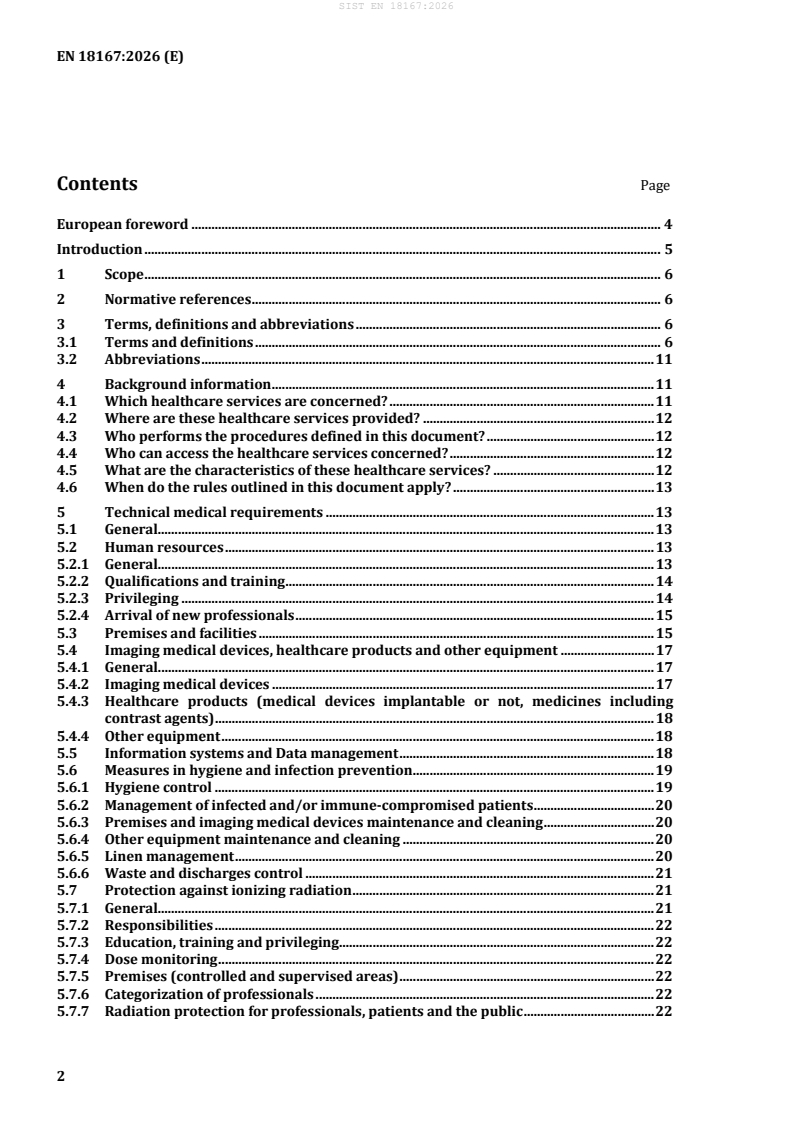
Contents Page
European foreword . 4
Introduction . 5
1 Scope . 6
2 Normative references . 6
3 Terms, definitions and abbreviations . 6
3.1 Terms and definitions . 6
3.2 Abbreviations . 11
4 Background information . 11
4.1 Which healthcare services are concerned? . 11
4.2 Where are these healthcare services provided? . 12
4.3 Who performs the procedures defined in this document? . 12
4.4 Who can access the healthcare services concerned? . 12
4.5 What are the characteristics of these healthcare services? . 12
4.6 When do the rules outlined in this document apply? . 13
5 Technical medical requirements . 13
5.1 General. 13
5.2 Human resources . 13
5.2.1 General. 13
5.2.2 Qualifications and training . 14
5.2.3 Privileging . 14
5.2.4 Arrival of new professionals . 15
5.3 Premises and facilities . 15
5.4 Imaging medical devices, healthcare products and other equipment . 17
5.4.1 General. 17
5.4.2 Imaging medical devices . 17
5.4.3 Healthcare products (medical devices implantable or not, medicines including
contrast agents) . 18
5.4.4 Other equipment . 18
5.5 Information systems and Data management . 18
5.6 Measures in hygiene and infection prevention . 19
5.6.1 Hygiene control . 19
5.6.2 Management of infected and/or immune-compromised patients . 20
5.6.3 Premises and imaging medical devices maintenance and cleaning . 20
5.6.4 Other equipment maintenance and cleaning . 20
5.6.5 Linen management . 20
5.6.6 Waste and discharges control . 21
5.7 Protection against ionizing radiation . 21
5.7.1 General. 21
5.7.2 Responsibilities . 22
5.7.3 Education, training and privileging. 22
5.7.4 Dose monitoring . 22
5.7.5 Premises (controlled and supervised areas) . 22
5.7.6 Categorization of professionals . 22
5.7.7 Radiation protection for professionals, patients and the public . 22
5.8 Safety with non-ionizing radiation . 23
5.8.1 General . 23
5.8.2 Responsibilities . 24
5.8.3 MR safety, education, training and privileging . 24
5.8.4 Premises, equipment and access control . 24
5.8.5 Safety for professionals and patients . 24
5.8.6 Specific actions in the event of an unexpected incident in MRI . 25
5.9 Identity vigilance . 25
5.10 Artificial Intelligence (AI) . 25
6 Patient pathway for a MI examination . 26
6.1 Imaging referral for MI examinations . 26
6.2 Justification and approval of the imaging referral . 26
6.3 Patient information and making an appointment . 27
6.3.1 Patient information and informed consent . 27
6.3.2 Making an appointment . 27
6.4 Arrival of the patient in the MI organization . 28
6.5 Conducting the MI examination . 29
6.6 Medical accidents and incidents . 30
6.7 Monitoring patients after an MI examination . 30
6.8 MI examination report . 31
6.8.1 General . 31
6.8.2 Content of the report . 31
6.8.3 Validation of the report . 32
6.8.4 Delivery of, and access to the results. 32
6.8.5 Revised reports . 33
6.9 Specific organizational measures . 33
6.9.1 Confidentiality . 33
6.9.2 Participation in out-of-hours service/emergencies . 33
6.9.3 Organization of relations with stakeholders throughout the MI examination . 33
6.9.4 Interventional imaging . 34
6.9.5 Teleradiology, remote primary reading and remote scanning . 35
6.9.6 Introduction of new practices . 38
7 The quality management and risk management system of the MI organization . 38
7.1 General . 38
7.2 Quality policy and objectives . 39
7.3 Involvement of the senior management of the MI organization . 40
7.4 Roles and responsibilities in the MI organization . 41
7.5 Sustainability . 41
7.6 Quality of life at work . 42
7.7 Documentation and records . 42
7.8 Measurement of indicators, assessment, and analysis . 43
7.9 Risk management . 44
7.9.1 General . 44
7.9.2 Pre-emptive risk management: risk map and risk control . 44
7.9.3 Hindsight risk management . 44
7.10 Progress initiatives . 45
7.11 Management reviews . 46
8 Audits based on this document . 46
Annex A (informative) List of the documented procedures for this document . 48
Bibliography . 51
European foreword
This document (EN 18167:2026) has been prepared by Technical Committee CEN/TC 470 “Quality along
the patient pathway in medical imaging”, the secretariat of which is held by AFNOR.
This European Standard shall be given the status of a national standard, either by publication of an
identical text or by endorsement, at the latest by December 2026, and conflicting national standards shall
be withdrawn at the latest by December 2026.
Attention is drawn to the possibility that some of the elements of this document may be the subject of
patent rights. CEN shall not be held responsible for identifying any or all such patent rights.
Any feedback and questions on this document should be directed to the users’ national standards body.
A complete listing of these bodies can be found on the CEN website.
According to the CEN-CENELEC Internal Regulations, the national standards organisations of the
following countries are bound to implement this European Standard: Austria, Belgium, Bulgaria, Croatia,
Cyprus, Czech Republic, Denmark, Estonia, Finland, France, Germany, Greece, Hungary, Iceland, Ireland,
Italy, Latvia, Lithuania, Luxembourg, Malta, Netherlands, Norway, Poland, Portugal, Republic of North
Macedonia, Romania, Serbia, Slovakia, Slovenia, Spain, Sweden, Switzerland, Türkiye and the United
Kingdom.
Introduction
This document deals with quality in diagnostic and interventional radiology practiced in radiology
services.
The medical speciality “radiology” is also known as “radiology and medical imaging” and is referred to as
medical imaging (MI) throughout this document. It is performed within a multi professional team
consisting of radiologists, radiographers, medical physicists and other professionals related to the
context and the complexity of the examinations.
This document refers to all diagnostic and interventional methods in MI especially using X-rays,
ultrasonography, and magnetic resonance imaging (MRI).
All healthcare professionals also using such imaging techniques are invited to adopt the standard.
MI activities are performed for preventive, diagnostic, therapeutic, surveillance and follow-up purposes.
As is the case for all healthcare services, the objectives of MI activities are to provide patient care that is
appropriate, compliant with the current standards, with controlled risks that are announced, understood
as far as possible and accepted. These services are provided to the correctly identified person, accessible
to all, considerate of their expectations and administered with care.
Obviously, MI extends beyond the mere production of images and the performance of a procedure, and
includes, in particular, all opinions and discussions on the justification and optimization of such
procedures, and their use in the subsequent management of patients.
This document is not meant or presented as a general quality management standard even if the structure
and background of quality management standards mentioned in the document are used for several topics.
Conformity with this document aims to ensure the appropriateness and quality of the procedures and
patient care, and the safety of practices. It should enable professionals to improve their practices, while
still having the time and energy for proper management of patients.
The document will support audits, especially with peer assessment, as well as the implementation of
solutions for quality requirements, typically within an applied quality management system.
Meeting the prevailing statutory and regulatory requirements of legislation and jurisdiction is an
essential prerequisite. The MI organization and the healthcare organization which it belongs to are
responsible for meeting the requirements of this document.
This document was written according to the principle of a process-based approach, by presenting the
support processes first, then the patient management processes and finally the quality management
system, including assessments.
1 Scope
This document specifies the requirements for implementation of a quality system along the patient
pathway in radiology services. The objective is to ensure high quality delivery of all aspects of the
examination safety and patient care.
This document deals with procedures using X-rays, ultrasonography and magnetic resonance imaging on
humans, including diagnostic procedures and interventional radiology as well as remote practices. It also
applies, in its principles, to any other technique and modality that would be used in radiology services.
The document covers:
— the different steps of patient care (from the imaging referral, before, during, and after the
examination);
— the corresponding human resources and technical-medical requirements;
— quality and risk management.
This document does not apply to radiotherapy and nuclear medicine, nor to equipment and radiation
controls which are covered in other standards. This document excludes requirements related to research
and education themes.
This document establishes best practices description which constitutes a reference for audits, including
clinical audits. Nevertheless, the clinical audits methodology, already defined at the European level, and
implemented under the responsibility of each country is excluded from the document.
2 Normative references
There are no normative references in this document.
3 Terms, definitions and abbreviations
3.1 Terms and definitions
For the purposes of this document, the following terms and definitions apply.
ISO and IEC maintain terminology databases for use in standardization at the following addresses:
— ISO Online browsing platform: available at https://www.iso.org/obp/
— IEC Electropedia: available at https://www.electropedia.org/
3.1.1
competency matrix
management tool used to map, track, evaluate and document the skills, qualifications, and expertise of
individuals within an organization
Note 1 to entry: The purpose is to identify who is qualified to perform certain tasks, spot training needs, plan
staffing and succession and to demonstrate compliance.
3.1.2
diagnostic reference levels
DRLs
ionizing radiation dose levels in diagnostic or interventional radiology practices, for typical examinations
for groups of standard-sized patients or standard phantoms for broadly defined types of equipment
Note 1 to entry: DRLs are used as a tool to optimize medical radiation exposure of patients.
[SOURCE: Council Directive 2013/59/Euratom, modified: reference to radiopharmaceutical aspects
[1]
]
removed
[2]
[SOURCE: ICRP, 2017 ]
3.1.3
documented procedure
set of written rules that specify the manner in which an activity is performed
Note 1 to entry: A procedure is a document included in the document system. The procedure, and the medium on
which it is contained, are controlled, and kept up to date.
Note 2 to entry: Documented procedures can be on any medium, in any format and from any source.
3.1.4
governance
human-based system by which an organization is directed, overseen and held accountable for achieving
its defined purpose
[3]
[SOURCE: ISO 37000:2021, 3.1.1 ]
3.1.5
healthcare organization
entity, institution, or system that provides medical and healthcare services to individuals and patients
3.1.6
interventional imaging
all invasive medical procedures intended to diagnose and/or treat a pathology that are guided and
monitored by a means of medical imaging
Note 1 to entry: For example, for introduction of devices or substances into the body.
3.1.7
medical imaging
MI
medical specialty “radiology” also known as “radiology and medical imaging”
Note 1 to entry: MI is the term used in this document to clearly state that imaging techniques used by the medical
speciality named radiology are not limited to the use of X-rays.
Note 2 to entry: It covers diagnostic and interventional imaging, performed by MI organizations, and includes the
procedures performed in operating suites by MI personnel.
Note 3 to entry: Images that are conventional optical images (endoscopy, funduscopy…), photographs of patients
or lesions, anatomopathology are out of the scope.
3.1.8
MI doctor
MI practitioner
radiologist or non-radiologist medical doctor who works in the MI organization
3.1.9
MI medical device
products or equipment intended for MI examinations
3.1.10
MI organization
imaging departments, imaging centres, medical imaging facilities, performing MI examinations
Note 1 to entry: A MI organization can be independent or part of a healthcare organization.
3.1.11
MI examination
diagnostic and/or interventional procedure performed within the MI organization
Note 1 to entry: These methods are used for diagnostic purposes or to monitor, guide and perform an
interventional procedure. They especially use X-rays, MRI, and ultrasonography.
Note 2 to entry: MI examination also refers to everything associated with the procedure from the imaging referral
to the report and clinical discussion.
Note 3 to entry: MI examinations performed within a MI organization are defined by the MI organization itself.
3.1.12
MI team
multi professional team of the MI organization consisting of radiologists, radiographers, medical
physicists and other professionals related to the context and the complexity of the examinations
3.1.13
privileging
validation by the manager of the MI organization of the capability of a person working under its
responsibility to perform the assigned tasks
Note 1 to entry: The manager is the head of the MI organization or is the person(s) delegated by this authority for
that purpose.
Note 2 to entry: Privileging guarantees the capability of a professional to proficiently perform an activity in a given
MI organization.
Note 3 to entry: Privileging takes account of the regulatory requirements of the country concerned for the
performance of an activity (initial qualification and continuous professional development) and the organization of
every MI organization. It includes in particular, the experience of every professional concerned, in order to validate
their command of the activity in every position and every relevant task. Its renewal is conditional on an appropriate
level of practice.
Note 4 to entry: Privileges are personal.
3.1.14
procedure
specified way to carry out an activity or a process
Note 1 to entry: A procedure can be documented or not.
[4]
[SOURCE: EN ISO 9000:2015, 3.4.5 ]
3.1.15
process
set of interrelated or interacting activities that use inputs to deliver an intended result
[4]
[SOURCE: EN ISO 9000:2015, 3.4.1 ]
3.1.16
quality assurance
planned and systematic preventive and corrective actions required to guarantee that a facility, a system,
an item of equipment or a procedure will function in a satisfactory manner in accordance with the
established standards
[5]
[SOURCE: ISO 13628-10:2005, 3.1.38, modified ]
3.1.17
quality management system
QMS
part of a management system with regard to quality
Note 1 to entry: The series of interdependent and interactive actions and processes work in harmony, enabling an
MI organization to define and then implement its policy based on the objectives that it has predefined.
[4]
[SOURCE: EN ISO 9000:2015, 3.5.4 ]
3.1.18
quality policy
policy related to quality corresponding to the strategic priorities, intentions, and general objectives of the
MI organization regarding quality along the patient pathway
Note 1 to entry: The policy is expressed via a written document and formally adopted by the highest level of
management of the MI organization.
Note 2 to entry: The quality policy of a MI organization integrated into a healthcare organization aligns with the
general policy of this healthcare organization.
[4]
[SOURCE: EN ISO 9000:2015, 3.5.9, modified and Notes to entry 1 and 2 added ]
3.1.19
radiology
medical speciality using ionizing and non-ionizing radiation and its application for examination of
humans for diagnostics, treatment or screening
Note 1 to entry: Non-ionizing radiation in radiology primarily includes MRI and ultrasound.
Note 2 to entry: Nuclear Medicine and Radiotherapy are excluded.
[6]
[SOURCE: EN 60601-1-3:2008, 3.68 modified and Notes to entry 1 and 2 added ]
3.1.20
radiology services
patients healthcare services providing diagnostic and/or interventional procedures carried out in a
MI organization under the authority and responsibility of radiologists
Note 1 to entry: By extension, this term also applies in some countries to units which, under the coverage of their
national regulations, could be managed by radiographers.
3.1.21
relevance
requested examination of the correct patient at the right time in the proper place by the right professional
using suitable equipment
Note 1 to entry: The relevance of MI care corresponds to the match between the diagnostic and therapeutic
procedures and the patient’s needs. An analysis of relevance assesses the referral for an examination and/or the
appropriate use of MI examinations.
Note 2 to entry: The referred examination may be modified or rejected by the healthcare professional responsible
for the MI examination.
3.1.22
risk management
coordinated activities to direct and control an organization regarding risks
Note 1 to entry: Documented process that aims to identify, assess and mitigate, wherever possible, the risks
incurred by patients, visitors and professionals in MI organizations, in order to reduce the number and/or severity
of undesirable event.
Note 2 to entry: This also includes environmental risk factors (pollution, radiation, noise and work environment).
3.1.23
standard operating procedure
SOP
detailed, step-by-step written instruction designed to achieve uniformity in the performance of regularly
recurring activities and processes
Note 1 to entry: SOPs should be handled as documented procedures.
3.1.24
systemic analysis
root cause analysis
methodical search for causes and corrective measures
Note 1 to entry: Systematic or root cause analysis goes beyond identification of immediate causes and
responsibility and focuses on cause of the event.
3.2 Abbreviations
AI Artificial Intelligence
ALARA As Low As Reasonably Achievable
CPD Continuing Professional Development
CISO Chief Information Security Officer
DPO Data Protection Officer
DRLs Diagnostic Reference Levels
GPDR General Data Protection Regulation
MI Medical Imaging
MPE Medical Physics Expert
MRI Magnetic Resonance Imaging
PDCA Plan-Do-Check-Act
QMS Quality Management System
RF radiofrequency
RPO Radiation Protection Officer
SDG Sustainable Development Goals
SOP Standard Operating Procedure
4 Background information
4.1 Which healthcare services are concerned?
MI covers diagnostic imaging and interventional imaging.
MI diagnostic procedures deliver morphological and/or functional and/or metabolic information on the
human body. MI interventional procedures have investigational or therapeutic objectives and are guided
and monitored by imaging.
The corresponding procedures are performed on humans, from foetuses to the elderly, including
postmortem procedures.
MI activities are medical procedures. Their main steps are: the analysis and approval of the imaging
referral for the purposes of justification; scheduling; the prescription of the medicine required for
the MI examination, where necessary; the preparation and performance of the MI examination, including
its optimization; image processing if necessary and the production and delivery of the report.
The MI examination is associated with pre- and post-procedure assessments and discussions, which can
be multidisciplinary.
4.2 Where are these healthcare services provided?
MI examinations are performed in imaging departments and imaging centres, hereafter referred to as
MI organizations. Procedures performed by MI professionals, outside these locations, e.g. in operating
suites or by the use of mobile units, are also part of the scope.
These MI organizations are independent and autonomous, or part of a healthcare organization.
The MI organization can have one or more sites belonging to the same public, private or mixed legal
entity. It can be associated with other healthcare organizations.
The MI organization can be in healthcare units in specific environments (detention centres, or others).
However, facilities which do not administer any patient care, are outside the scope of this document.
4.3 Who performs the procedures defined in this document?
The healthcare professionals who collaborate in the MI organization do so within a team. The team
includes two key categories of licensed professionals: the radiologist, who is a physician specialized in
radiology, and the radiographer. They work in a complementary manner according to their respective
qualification, training and privilege, the techniques employed, the situations encountered, as well as with
national regulations and their developments.
Along the patient pathway some activities require specific competences (such as those related to safety
or mastery of certain examinations) which require specific qualifications. For this reason, and without
aiming to be exhaustive, in paragraph 5.7.2. reference is made to the roles of the Medical Physics Expert
(MPE) and of the Radiation Protection Officer (RPO), in paragraph 5.8.2 to the roles of the MR Medical
Director (MRMD), MR Safety Officer (MRSO), MR Safety Expert (MRSE) and in paragraph 7.4. to the role
of the quality and risk manager.
NOTE 1 The MI team includes:
— non-radiologist doctors who work in the MI organization and adopt this document;
— the professionals providing the support functions required to perform the main activity;
— all those in training.
NOTE 2 The authorized health care professional also called the referrer who asks for the examination is not part
of the MI team.
4.4 Who can access the healthcare services concerned?
The healthcare services concerned can be accessed by the entire prenatal, child and adult population
likely to suffer from a health disorder (exploratory phase), with a health disorder (additional
investigation, treatment using MI, monitoring or in the case of possible complications), or subject to
screening.
The activities of MI organizations are scheduled or performed in emergencies, for both hospitalized
patients and outpatients.
Each MI organization defines the types of MI examinations it performs and for which populations.
4.5 What are the characteristics of these healthcare services?
The objective is that the management of patients be administered with due quality and safety, in
accordance with the regulations and the recommendations on best-medical practices, including risk
management.
The internal rules of the organization comply with applicable regulations and recommendations.
MI examinations involve the use of equipment and, in particular, of medical image acquisition devices
(CT scanners, MRI, fixed or mobile radiography and radioscopy equipment, ultrasonic scanners, hybrid
devices, etc.), the use of other medical devices, which may be implantable or not, and of medicines
including contrast agents.
The MI examination implements the principles of justification and optimization, whether it uses ionizing
radiation or not. The operational implementation of the principle of justification consists of choosing the
right procedure for the right patient, as described in “6.1 Imaging referrals for MI examinations” and
“6.2 Justification and approval of the imaging referral”. The adoption of the principle of optimization by
the professionals involved aims to limit the doses of exposure to ionizing radiation and electromagnetic
waves for the exposed persons, and to choose the adequate type and dose of contrast agents
administered, while guaranteeing the adequate diagnostic quality of the examination.
Medical activity is usually conducted face to face, but it can also be performed remotely (e.g. by
teleradiology) under conditions defined by regulations and procedures. In this case, the MI organization
procedures include those performed on-site and those performed externally/remotely under the
organization’s control, and in particular their relevance and optimization.
All the activities are performed in accordance with the patient’s rights.
4.6 When do the rules outlined in this document apply?
This document applies to the medical activity of the MI organization at all times.
5 Technical medical requirements
5.1 General
The MI organization shall control the processes and risks related to the pathway and care of the patient
and the performance of the MI examinations. The performed MI examinations are defined by the MI
organization.
5.2 Human resources
5.2.1 General
The MI organization shall determine and ensure that its workforce possesses the competence, especially
knowledge, skills and experience, required for safety, effectiveness, proper patient management of
patients and the expertise needed for the MI examinations that it performs. To this end, it shall determine
and provide the necessary human resources for the implementation of its quality management system
(QMS).
The relevant composition and structure of the MI organization shall be defined in a document which
describes the roles, tasks and responsibilities of all the categories of professionals. A competency matrix
may be another tool for documentation.
The MI organization shall ensure that all relevant roles, responsibilities and training of the workforce
from external resources used are defined in the service contract and tracked.
The management conditions of human resources and the quality of life at work shall be concerns and
responsibility of the MI organization, which shall take and follow up actions. The organization shall create
and promote a positive safety culture.
5.2.2 Qualifications and training
The MI organization shall ensure and document that all the professionals are qualified to practice. It shall
possess documents proving that all professionals have the necessary competence of the examinations
they perform. The MI organization shall ensure that all staff competencies are maintained.
NOTE 1 National regulations and professional radiological membership can apply for specific roles and
responsibilities.
The MI organization shall enable and record the Continuing Professional Development (CPD) of the
professionals in order to maintain and, if necessary, improve and develop their competence according to
the best practices, ensuring a periodic review.
Specific use of equipment, conduct of techniques or MI examinations shall only be designated to
appropriately qualified and trained staff.
The training plan, including records and the monitoring of its quality and impact shall be described in a
documented procedure.
Initial and periodic training programmes shall be defined for the acquisition of any medical device, taking
into account its complexity, the practices and the number of users concerned. All equipment suppliers
should ensure a training programme of appropriate length for the professionals is available throughout
the life of the equipment. This mandatory training shall be recorded and assessed using the training
materials made available to the workforce.
While considering the professional scope, professionals are expected to be able to communicate and
listen, show respect, kindness, and courtesy towards patients, and have ethical and professional attitude
towards the different professionals.
NOTE 2 Any delegation of activity is expected to follow processes that meet the applicable regulations.
5.2.3 Privileging
The principle of privileging shall apply to all clinical tasks performed by staff that involve direct patient
care, present potential risks, or require defined expertise. Tasks that are routine, administrative, or non-
clinical in nature shall not be subject to privileging, but shall instead be managed through documented
role descriptions, appropriate training, and competency assessments. Authorization within the
MI organization is a consequence of privileging.
EXAMPLES Authorization given to a staff member to schedule CT but not MRI examinations; authorization given
to a radiographer to operate a specific CT scanner equipment, to conduct cardiac MRI examinations; authorization
given to a radiologist to perform breast imaging.
Each professional shall be authorized by the MI organization to use the MI Medical devices and perform
the different types of MI examinations and activities within their scope of competence and qualification
requirements. The same professional can be authorized for several operating positions and/or activities
in the MI organization.
The MI organization shall define its quantitative and qualitative criteria to determine the necessary level
of activity per professional and for each of the types of MI examinations, in accordance with any existing
recommendations.
Privileging shall be adapted to the profile of the job and the formalities shall be limited strictly to meeting
the needs. It shall be proportional to the risks related to the medical imaging activity and granted after
practical exercise, according to internal procedures, for a defined duration. It shall be verified in the event
of a change of equipment, significant changes to the MI organization or a lengthy interruption of activity.
A mapping of the CPD, training and privileges of each professional of the MI Organization listing the roles,
tasks and responsibilities to which they can be assigned after validation by the responsible person shall
be drawn up and periodically reviewed. These data feed the competency matrix, which shall be
maintained.
A documented procedure shall be put in place to describe the establishment and management of
privileging.
In particular, the following contents shall be included:
— document describing the activities (types of MI examinations), carried out by the MI organization;
— job descriptions that describe the specific roles, competences, responsibilities, and tasks of the
professional categories required to conduct each of these activities, and the mentoring time required
for newly recruited professionals. All these job descriptions are used to match the workforce to the
activities conducted and serve as the supporting materials for individual privileges;
— the documents necessary for the MI organization to credential its professionals, e.g. diplomas, initial
training, CPD, professional history, validation of skills;
— the design of authorization matrix for each of the concerned activities;
— training and authorization documents for each professional.
A record of authorized staff for specific roles shall be maintained. Alternatives may be nominated as back-
up, e.g. out of hours service.
5.2.4 Arrival of new professionals
The introduction of newly arrived professionals and trainees shall be organized by the MI organization,
and if applicable in coordination with the general induction process of the healthcare organization.
NOTE This applies to all the professionals of the MI organization, trainees, and students. It can also apply to
professionals returning to their activity after a period of absence.
The introduction should include the work processes and procedures; the applicable information
system(s); occupational health and safety, including the prevention of radiation and MRI risks; the effects
of adverse incidents and accidents; ethics; confidentiality of patient information; quality management
system.
Trainees shall be pe
...