

IEC 61966-9:2000
(Main)Multimedia systems and equipment - Colour measurement and management - Part 9: Digital cameras
General Information
- Abstract
Applies to the assessment of colour reproduction of digital cameras used in open computer systems and similar applications. Deals with digital cameras designed to capture colour still images and moving images for use in multimedia applications.
- Status
- Published
- Publication Date
- 15-Jun-2000
- Technical Committee
- TC 100 - Audio, video and multimedia systems and equipment
- Current Stage
- DELPUB - Deleted Publication
- Start Date
- 20-Nov-2003
- Completion Date
- 28-Aug-2026
Buy Documents
IEC 61966-9:2000 - Multimedia systems and equipment - Colour measurement and management - Part 9: Digital cameras Released:6/16/2000
IEC 61966-9:2000 - Multimedia systems and equipment - Colour measurement and management - Part 9: Digital cameras Released:6/16/2000
Overview
IEC 61966-9:2000 - "Multimedia systems and equipment - Colour measurement and management - Part 9: Digital cameras" specifies objective methods for assessing the colour reproduction of digital cameras used in open computer and multimedia systems. It defines required test charts, measurement conditions and equipment, and standardized measurement methods so results from different laboratories and vendors can be compared and used in colour-management workflows. The standard applies to cameras that output RGB digital image data for still and moving images. It does not prescribe internal colour control algorithms nor sets pass/fail limits.
Key topics and technical requirements
- Scope and definitions: Terminology for digital cameras and colour control; applicability to multimedia and open systems.
- Measurement conditions (Clause 4): Requirements such as conducting tests in a dark room, power-supply stability, and reporting environmental conditions (temperature, humidity).
- Measurement arrangement and illumination (Clauses 4.2, 8): Specified layout using test charts, dark box, diffusers and main/auxiliary halogen lamps (incident light at 45°) for consistent illumination.
- Measurement equipment (Clause 5): Required instruments including spectral light sources, colour-temperature conversion filters, test charts, radiance meters, spectroradiometers and luminance meters.
- Tone characteristics (Clause 6): Methods to measure camera tone response and how to present results for use in tone-mapping and colour-management.
- Spectral responsivity (Clause 7): Procedures for measuring camera spectral sensitivity for RGB channels; includes measurement conditions and presentation of spectral curves.
- Built-in flash spectral data (Clause 8): Measurement and reporting of flash spectral distribution.
- Spatial non‑uniformity (Clause 9): Methods to quantify and report spatial variation in colour and luminance over the image field.
- Annexes: Normative letters/symbols, inverse function calculation, informative example mapping to sRGB (useful for colour management), compensation methods, and automated chart extraction guidance.
Applications and users
IEC 61966-9 is practical for:
- Camera manufacturers performing objective colour characterization and product documentation.
- Test laboratories and QA teams that certify colour reproduction and compare devices.
- Image-system integrators and colour managers building profiles and transformation pipelines (for sRGB and other workflows).
- Research groups and standards bodies working on imaging interoperability and metadata for multimedia distribution.
Practical uses include generating measurement data to create device profiles, validating spectral responsivity for colourimetric transforms, quantifying spatial uniformity for lens/ sensor evaluation, and integrating camera output into sRGB-based workflows.
Related standards
- IEC 61966-2-1 (sRGB default RGB colour space) - directly referenced for colour-management mapping.
- IEC 61146-1 and relevant CIE/ISO documents (CIE 15.2, ISO/CIE 10527) - normative references for observers and measurement vocabulary.
Keywords: IEC 61966-9, digital camera colour measurement, colour management, spectral responsivity, sRGB, test charts, tone characteristics, spatial non-uniformity, spectroradiometer.
Relations
- Effective Date
- 05-Sep-2023
Buy Documents
IEC 61966-9:2000 - Multimedia systems and equipment - Colour measurement and management - Part 9: Digital cameras Released:6/16/2000
IEC 61966-9:2000 - Multimedia systems and equipment - Colour measurement and management - Part 9: Digital cameras Released:6/16/2000
Get Certified
Connect with accredited certification bodies for this standard

BSI Group
BSI (British Standards Institution) is the business standards company that helps organizations make excellence a habit.

NYCE
Mexican standards and certification body.

ANCE
Mexican certification and testing association.
Sponsored listings
Frequently Asked Questions
IEC 61966-9:2000 is a standard published by the International Electrotechnical Commission (IEC). Its full title is "Multimedia systems and equipment - Colour measurement and management - Part 9: Digital cameras". This standard covers: Applies to the assessment of colour reproduction of digital cameras used in open computer systems and similar applications. Deals with digital cameras designed to capture colour still images and moving images for use in multimedia applications.
Applies to the assessment of colour reproduction of digital cameras used in open computer systems and similar applications. Deals with digital cameras designed to capture colour still images and moving images for use in multimedia applications.
IEC 61966-9:2000 is classified under the following ICS (International Classification for Standards) categories: 33.160.60 - Multimedia systems and teleconferencing equipment; 35.040 - Information coding; 37.040.01 - Photography in general. The ICS classification helps identify the subject area and facilitates finding related standards.
IEC 61966-9:2000 has the following relationships with other standards: It is inter standard links to IEC 61966-9:2003. Understanding these relationships helps ensure you are using the most current and applicable version of the standard.
IEC 61966-9:2000 is available in PDF format for immediate download after purchase. The document can be added to your cart and obtained through the secure checkout process. Digital delivery ensures instant access to the complete standard document.
Standards Content (Sample)
INTERNATIONAL IEC
STANDARD
61966-9
First edition
2000-06
Multimedia systems and equipment –
Colour measurement and management –
Part 9:
Digital cameras
Systèmes et appareils multimedia –
Mesure et gestion de la couleur –
Partie 9:
Appareils numériques de prise de vue
Reference number
Numbering
As from 1 January 1997 all IEC publications are issued with a designation in the
60000 series.
Consolidated publications
Consolidated versions of some IEC publications including amendments are
available. For example, edition numbers 1.0, 1.1 and 1.2 refer, respectively, to the
base publication, the base publication incorporating amendment 1 and the base
publication incorporating amendments 1 and 2.
Validity of this publication
The technical content of IEC publications is kept under constant review by the IEC,
thus ensuring that the content reflects current technology.
Information relating to the date of the reconfirmation of the publication is available
in the IEC catalogue.
Information on the subjects under consideration and work in progress undertaken
by the technical committee which has prepared this publication, as well as the list
of publications issued, is to be found at the following IEC sources:
• IEC web site*
•
Catalogue of IEC publications
Published yearly with regular updates
(On-line catalogue)*
• IEC Bulletin
Available both at the IEC web site* and as a printed periodical
Terminology, graphical and letter symbols
For general terminology, readers are referred to IEC 60050: International
Electrotechnical Vocabulary (IEV).
For graphical symbols, and letter symbols and signs approved by the IEC for
general use, readers are referred to publications IEC 60027: Letter symbols to be
used in electrical technology, IEC 60417: Graphical symbols for use on equipment.
Index, survey and compilation of the single sheets and IEC 60617: Graphical symbols
for diagrams.
* See web site address on title page.
INTERNATIONAL IEC
STANDARD
61966-9
First edition
2000-06
Multimedia systems and equipment –
Colour measurement and management –
Part 9:
Digital cameras
Systèmes et appareils multimedia –
Mesure et gestion de la couleur –
Partie 9:
Appareils numériques de prise de vue
IEC 2000 Copyright - all rights reserved
No part of this publication may be reproduced or utilized in any form or by any means, electronic or
mechanical, including photocopying and microfilm, without permission in writing from the publisher.
International Electrotechnical Commission 3, rue de Varembé Geneva, Switzerland
Telefax: +41 22 919 0300 e-mail: inmail@iec.ch IEC web site http://www.iec.ch
Commission Electrotechnique Internationale
PRICE CODE
V
International Electrotechnical Commission
For price, see current catalogue
– 2 – 61966-9 IEC:2000(E)
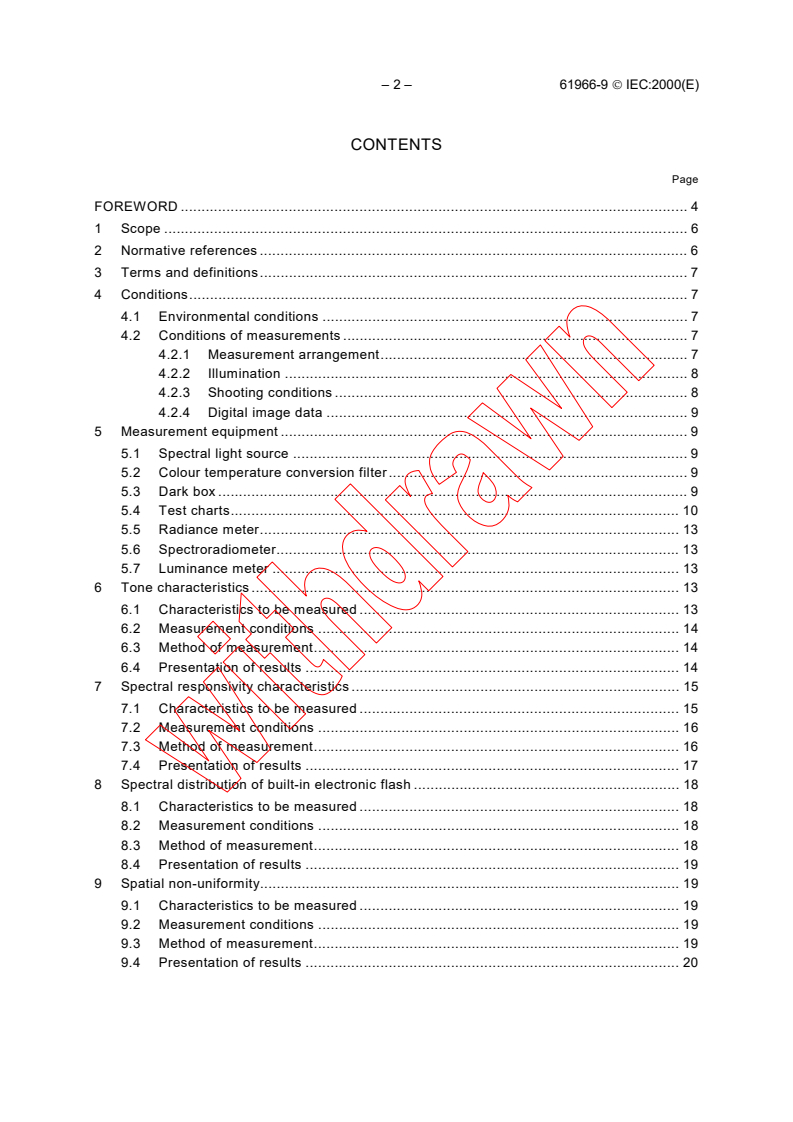
CONTENTS
Page
FOREWORD . 4
1 Scope . 6
2 Normative references . 6
3 Terms and definitions. 7
4 Conditions. 7
4.1 Environmental conditions . 7
4.2 Conditions of measurements . 7
4.2.1 Measurement arrangement. 7
4.2.2 Illumination . 8
4.2.3 Shooting conditions . 8
4.2.4 Digital image data . 9
5 Measurement equipment . 9
5.1 Spectral light source . 9
5.2 Colour temperature conversion filter. 9
5.3 Dark box . 9
5.4 Test charts. 10
5.5 Radiance meter. 13
5.6 Spectroradiometer. 13
5.7 Luminance meter . 13
6 Tone characteristics . 13
6.1 Characteristics to be measured . 13
6.2 Measurement conditions . 14
6.3 Method of measurement. 14
6.4 Presentation of results . 14
7 Spectral responsivity characteristics . 15
7.1 Characteristics to be measured . 15
7.2 Measurement conditions . 16
7.3 Method of measurement. 16
7.4 Presentation of results . 17
8 Spectral distribution of built-in electronic flash . 18
8.1 Characteristics to be measured . 18
8.2 Measurement conditions . 18
8.3 Method of measurement. 18
8.4 Presentation of results . 19
9 Spatial non-uniformity. 19
9.1 Characteristics to be measured . 19
9.2 Measurement conditions . 19
9.3 Method of measurement. 19
9.4 Presentation of results . 20
61966-9 IEC:2000(E) – 3 –
Annex A (normative) Letters and symbols . 22
Annex B (informative) Procedure to calculate the inverse function. 23
Annex C (informative) An example use of the reported results for colour management . 24
C.1 Introduction. 24
C.2 Colorimetric characteristics of the sRGB colour space. 24
C.3 Colour control for digital cameras. 24
C.3.1 Matching tone characteristics to the sRGB. 24
C.3.2 Colorimetric match to the sRGB. 25
C.3.3 Transformation from image data of digital cameras to the data
in sRGB colour space. 27
Annex D (normative) Method to compensate spectral responsivity characteristics
at the neutral point. 28
Annex E (informative) Automated extraction of data from the test chart image. 29
E.1 Introduction. 29
E.2 Horizontal image shift. 30
E.3 Vertical image shift . 30
E.4 Image rotation.30
E.5 Image magnification.30
Bibliography.31
– 4 – 61966-9 IEC:2000(E)
INTERNATIONAL ELECTROTECHNICAL COMMISSION
____________
MULTIMEDIA SYSTEMS AND EQUIPMENT –
COLOUR MEASUREMENT AND MANAGEMENT –
Part 9: Digital cameras
FOREWORD
1) The IEC (International Electrotechnical Commission) is a worldwide organization for standardization comprising
all national electrotechnical committees (IEC National Committees). The object of the IEC is to promote
international co-operation on all questions concerning standardization in the electrical and electronic fields. To
this end and in addition to other activities, the IEC publishes International Standards. Their preparation is
entrusted to technical committees; any IEC National Committee interested in the subject dealt with may
participate in this preparatory work. International, governmental and non-governmental organizations liaising
with the IEC also participate in this preparation. The IEC collaborates closely with the International Organization
for Standardization (ISO) in accordance with conditions determined by agreement between the two
organizations.
2) The formal decisions or agreements of the IEC on technical matters express, as nearly as possible, an
international consensus of opinion on the relevant subjects since each technical committee has representation
from all interested National Committees.
3) The documents produced have the form of recommendations for international use and are published in the form
of standards, technical specifications, technical reports or guides and they are accepted by the National
Committees in that sense.
4) In order to promote international unification, IEC National Committees undertake to apply IEC International
Standards transparently to the maximum extent possible in their national and regional standards. Any
divergence between the IEC Standard and the corresponding national or regional standard shall be clearly
indicated in the latter.
5) The IEC provides no marking procedure to indicate its approval and cannot be rendered responsible for any
equipment declared to be in conformity with one of its standards.
6) Attention is drawn to the possibility that some of the elements of this international standard may be the subject
of patent rights. The IEC shall not be held responsible for identifying any or all such patent rights.
International Standard IEC 61966-9 has been prepared by IEC technical committee 100: Audio,
video and multimedia systems and equipment.
The text of this standard is based on the following documents:
FDIS Report on voting
100/130/FDIS 100/151/RVD
Full information on the voting for the approval of this standard can be found in the report on
voting indicated in the above table.
This publication has been drafted in accordance with the ISO/IEC Directives, Part 3.
61966-9 IEC:2000(E) – 5 –
IEC 61966 consists of the following parts, under the general title: Multimedia systems and
equipment – Colour measurement and management:
� Part 1: General
� Part 2-0: Colour management
� Part 2-1: Colour management – Default RGB colour space – sRGB
� Part 2-2: Colour management – Extended RGB colour space – sRGB64
� Part 3: Equipment using cathode ray tubes
� Part 4: Equipment using liquid crystal display panels
� Part 5: Equipment using plasma display panels
� Part 6: Equipment for use on digital data projections
� Part 7-1: Colour printers – Reflective prints – RGB inputs
� Part 7-2: Colour printers – Reflective prints – CMYK inputs
� Part 7-3: Colour printers – Transparent prints
� Part 8: Multimedia colour scanners
� Part 9: Digital cameras
� Part 10: Quality assessment – Colour image in network systems
� Part 11: Quality assessment – Impaired video in network systems
Annexes A and D form integral parts of this standard.
Annexes B, C and E are for information only.
A bilingual version of this publication may be issued at a later date.
The committee has decided that the contents of this publication will remain unchanged until
2003. At this date, the publication will be
• reconfirmed;
• withdrawn;
• replaced by a revised edition, or
• amended.
– 6 – 61966-9 IEC:2000(E)
MULTIMEDIA SYSTEMS AND EQUIPMENT –
COLOUR MEASUREMENT AND MANAGEMENT –
Part 9: Digital cameras
1 Scope
This part of IEC 61966 is applicable to the assessment of colour reproduction of digital
cameras used in open computer systems and similar applications.
A series of methods and parameters for colour measurements and management for use in
multimedia systems and equipment is applicable to the assessment of colour reproduction.
Part 9 deals with digital cameras to capture colour still images and moving images for use in
multimedia applications.
The methods of measurement standardized in this part are designed to make possible the
objective performance assessment and characterization of colour reproduction of digital
cameras which can capture colour still and moving images, and output colour information
corresponding to red – green – blue digital image data. The measured results are intended to
be used for the purpose of colour management in multimedia systems, typically in the Internet.
This part of IEC 61966 defines test charts, measurement conditions and methods of mea-
surement, so as to make possible the colour management in open multimedia systems and
comprehensive comparison of the results of measurements for assessment of digital cameras.
Colour control within digital cameras is out of the scope of this part. It does not specify limiting
values for various parameters.
2 Normative references
The following normative documents contain provisions which, through reference in this text,
constitute provisions of this International Standard. For dated references, subsequent
amendments to, or revisions of, any of these publications do not apply. However, parties to
agreements based on this International Standard are encouraged to investigate the possibility
of applying the most recent editions of the normative documents indicated below. For undated
references, the latest edition of the normative document referred to applies. Members of IEC
and ISO maintain registers of currently valid International Standards.
IEC 60050(845):1987, International Electrotechnical Vocabulary (IEV) – Chapter 845: Lighting/
CIE 17.4: 1987, International lighting vocabulary.
IEC 61146-1:1994, Video cameras (PAL/SECAM/NTSC) – Methods of measurement – Part 1:
Non-broadcast single-sensor cameras
IEC 61966-2-1:1999, Multimedia systems and equipment – Colour measurement and
management – Part 2-1: Colour management – Default RGB colour space – sRGB
ISO/CIE 10527:1991, Colorimetric observers
CIE 15.2:1986, Colorimetry
61966-9 IEC:2000(E) – 7 –
ISO 2813:1994, Paints and varnishes – Determination of specular gloss of non-metallic paint
films at 20 degrees, 60 degrees and 85 degrees
3 Terms and definitions
For the purpose of this part of IEC 61966, the definitions in IEC 60050(845), CIE 17.4 and
following definitions apply.
3.1
colour control
conversion of equipment-dependent colour-image data to equipment-independent data for a
specific colour space including tone characteristics
3.2
digital camera
electronic imaging equipment which can capture colour still and moving images, and outputs
digital image data for red – green – blue channels either by itself or using incorporated colour
control software
4 Conditions
4.1 Environmental conditions
All measurements specified in this standard shall be carried out in a dark room.
Electric power to a digital camera under test shall be supplied using an a.c. adapter or
batteries recommended by the manufacturer.
The mains voltage and frequency applied to the a.c. adapter shall be at the rated value
specified by the manufacturer of the digital camera. When the mains voltage fluctuates, a
stabilizer shall be used to attain a stability value of ± 5 % of the rated value.
Other environmental conditions such as temperature and relative humidity shall be reported
together with the results of measurement.
For additional environmental conditions not specified in this subclause, if any, specifications of
the manufacturer of the digital camera shall be taken into account.
4.2 Conditions of measurements
4.2.1 Measurement arrangement
Unless otherwise specified, a shooting object shall be a test chart with the dark box shown in
figure 1. Specifications of a centre hole of the chart are given in figure 3. Relative positions
shall be selected to prevent unnecessary glare of the diffuser.
NOTE The spectral light source consisting of the lamp, the iris, the monochromator, the optical fibre and the
diffuser may be configured in other ways, provided that the required specifications are met.
– 8 – 61966-9 IEC:2000(E)
Main lamp
Colour temperature
conversion filter
Test chart 1
Digital camera
under test
Diffuser
Dark box
Hole
Auxiliary lamp
Main lamp
Iris
Optical fibre
Monochromator
Lamp
Spectral light source
IEC 612/2000
Figure 1 – Equipment arrangement for measurements
4.2.2 Illumination
Illumination of the test charts shall be performed by two or four main lamps and one auxiliary
lamp depending on the characteristics to be measured. Incident lights from the main lamps
shall be 45° relative to the surface of the test chart. An auxiliary lamp to illuminate the diffuser
in figure 1 is used only for the measurement specified in clause 7. The diffuser shall not be
directly illuminated by the main lamps. The main lamps and auxiliary lamp shall be halogen
lamps with a well regulated power supply.
The correlated colour temperature of the lamps shall be 3 100 K ± 100 K as specified in
IEC 61146-1. The non-uniformity of illumination shall be less than 5 %. The average illumi-
nance on the test chart shall be 2 000 lx ± 100 lx.
4.2.3 Shooting conditions
The optical axis of the digital camera under test shall coincide with the normal to the test chart.
If the digital camera under test is equipped with a zoom lens, the distance between the test
chart and the digital camera under test, unless otherwise specified, shall be approximately
1,5 m. The zooming shall be adjusted so that the horizontal and vertical markers fit within the
full frame of an image area.
If the digital camera under test is not equipped with a zoom lens, the distance between the test
chart and the digital camera under test, unless otherwise specified, shall be adjusted so that
the horizontal and vertical markers fit within the full frame of an image area.
61966-9 IEC:2000(E) – 9 –
4.2.4 Digital image data
The red - green - blue data necessary for calculation and characterization of the digital camera
under measurements shall be acquired and recorded depending on the cases as described
below:
a) If red – green – blue digital image data are directly obtained from the digital camera under
test, the values shall be recorded.
b) If red – green – blue digital image data are not directly obtainable, they should be
calculated by the manufacturer’s driver software.
c) If red – green – blue digital image data are calculated by any independent application
software on the digital camera under measurement, the name and version of the software
shall be reported together with the values.
5 Measurement equipment
5.1 Spectral light source
The spectral light source consists of a halogen lamp powered by a well-regulated d.c. electric
power source, an iris, a monochromator and an optical fibre with a diffuser as in figure 1.
Specifications of the constituent parts in the equipment arrangement should be as follows;
a) Output of spectral light source
1) diameter of the diffuser: approximately h
2) radiance: more than 10 mW/sr/m
3) stability of light output: within ± 0,5 %
NOTE An integrating sphere may be incorporated to increase uniformity.
b) Monochromator
1) wavelength range: including from 380 nm to 780 nm
2) spectral bandwidth: 5 nm (FWHM ), triangle
3) wavelength accuracy: ± 0,5 nm
−4
4) stray light: less than 10
NOTE Higher order spectra from the monochromator should be removed.
5.2 Colour temperature conversion filter
−1
The amount of reciprocal correlated colour temperature change shall be –140 MK in order to
achieve 5 500 K ± 300 K.
5.3 Dark box
A dark box for the measurements should be as shown in figure 2. Reflectance of the inside of
the dark box shall be less than 2 %. Accuracy of the dimensions should be within ± h .
Geometrical specification of the holes whose positions are designated by “0” shall be as in
figure 3.
———————
FWHM stands for “Full Width Half Maximum.”
– 10 – 61966-9 IEC:2000(E)
2h / 3
Test chart 1
Hole
Hole
h
A A'
Hole
IEC 613/2000
Figure 2 – Dark box
5.4 Test charts
a) The specular gloss at 60° shall be less than 2,5 %, according to ISO 2813, for all test
charts. The geometric specification of the test charts shall be as shown in figures 3, 4 and
5. Accuracy of the dimensions should be within ± h .
61966-9 IEC:2000(E) – 11 –
h / 18 h / 18
h / 12 h / 36 h / 36 h / 12
h / 9
()w − 4h / 9 / 2
(w − 4h / 9)/ 2
h / 6
0 1 23 45 67 89 10 11 12 13 14 15
h / 6
h / 9
15 0 15
h / 9 h
h / 9
h / 6
15 14 13 12 11 10 9 8 7 6 5 4 3 2 1 0
h / 6
8h / 9
()w − 8h / 9 / 2 ()w − 8h / 9 / 2
w
IEC 614/2000
Figure 3 – Test chart 1
Background h / 18
(Reflectance is 18 %)
Grey chip (No. i )
h / 18 h / 9
h / 9
IEC 615/2000
Figure 4 – Test chart 2 with replaceable chip i .
– 12 – 61966-9 IEC:2000(E)
h / 5
h / 5
h / 5 h
h / 5
h / 5
2h / 15
w / 5 w / 5 w / 5 w / 5 w / 5
w
IEC 616/2000
Figure 5 – Test chart 3
b) The test chart 3 in figure 5 shall be the white chart with nominal reflectance of 88,1 %. It
shall be superimposed with a rectangular grid. The designation of position in figure 5
j
shall be numbered from the top left to the bottom right for the centre of each rectangular
area as j =1 to 25.
c) The reflectances of the grey steps in the test chart 1 shall have the values specified in
table 1, where the positions designated by “0” are holes.
Table 1 – Nominal reflectances of the grey scale section and the grey chips
Reflectance(%)
i
0 0,0(hole)
12,0
24,0
36,0
48,0
5 10,3
6 14,7
7 19,8
8 25,8
9 32,5
10 39,9
11 48,1
12 57,0
13 66,6
14 77,0
15 88,1
Background 18,0
61966-9 IEC:2000(E) – 13 –
5.5 Radiance meter
A radiance meter with the following specification should be used for the measurements of the
output from the spectral light source.
a) wavelength range from 380 nm to 780 nm
2 2
b) measurable range
from 1 μW/sr/m to 1 W/sr/m
c) relative accuracy
± 5 % (from 380 nm to 780 nm)
d) linearity
± 2 %
e) measurement resolution less than 0,5 %
NOTE 1 Radiance can be measured with an irradiance meter at a known distance from a source. A spectro-
radiometer in radiance geometry can also be used to measure radiance.
NOTE 2 If a wavelength range beyond the specification in a) is required from the reported results in clause 7, the
wavelength range should be from 360 nm up to a wavelength where a response of less than 5 % of the maximum is
observed.
5.6 Spectroradiometer
A spectroradiometer with the following specification should be used for the measurement for a
built-in electronic flash in clause 8.
a) wavelength range from 380 nm to 780 nm
b) field of view between 0,1° and 2,0°
c) wavelength less than 0,5 nm throughout the wavelength range
uncertainty
d) scanning interval 5 nm or less
e) bandpass 5 nm or less
f) repeatability less than 0,5 % in radiance at each wavelength
NOTE 1 Temporal integration capability, for measuring flashing lights, is required.
NOTE 2 If a wavelength range beyond the specification in a) is required from the reported results in clause 8, the
wavelength range should be from 360 nm up to a wavelength where a response of less than 5 % of the maximum is
observed.
NOTE 3 Periodic calibration should be done with a standard optical source of known spectral power distribution.
NOTE 4 Further technical details of the design, characterization, and calibration of spectroradiometers can be
found in CIE 63, CIE 105 and JIS Z 8724.
5.7 Luminance meter
The luminance meter should have the following specifications for measurement of luminance in
clause 7. A colorimeter with luminance output in Y can also be used.
a) field of view any value between 0,1° and 2,0°.
b) Spectral
compliant to the CIE 2° colour matching function, y(λ), as
responsivity
defined in ISO/CIE 10527.
c) repeatability less than 0,5 %.
6 Tone characteristics
6.1 Characteristics to be measured
Relationship between luminance of the shooting object and the digital image data at the centre
of the image.
– 14 – 61966-9 IEC:2000(E)
6.2 Measurement conditions
The arrangement of equipment should be as in figure 1. The optical fibre shall be removed and
the hole on the rear side of the dark box shall be covered with a lid similarly painted as the
inside of the dark box. The auxiliary lamp shall be switched off.
Two separate measurements, with the colour temperature conversion filter in front of the lens
for 5 500 K and without for 3 100 K, shall be conducted.
NOTE Additional conditions of correlated colour temperature may be set according to the needs.
6.3 Method of measurement
a) The test chart 2 with the grey chip i shall sequentially be inserted into the front hole at the
centre of the test chart 1 for i = 0 to 15. The reflectances of the grey chips shall be as
shown in table 1.
NOTE The grey chip for i =0 is actually a hole without a grey chip.
b) The luminance L of the grey chip i shall be measured using the luminance meter and the
i
test chart 1 shall be shot by the digital camera under test.
c) The mean values corresponding to the grey chip i mounted at the centre, D′ , D′ and
R G
i i
D′ , of red – green – blue digital image data shall be recorded.
B
i
R G B
d) The mean values E , E and E corresponding to the step of the upper grey steps with
j
i i i
j j j
the grey chip i mounted at the centre shall also be noted for red – green – blue image
data, respectively.
6.4 Presentation of results
a) The recorded data shall be compensated to eliminate any autonomous exposure control or
errors of a mechanical shutter of the digital camera under test as follows:
R R
E − E
8 8
1 1
j + j R R
′
D = D − E + E ×100 (%) (1)
R R
i i i 8
n R R
j j
2 −1 E − E
i i
j +1 j
where the index j is the step number of the grey steps in which the inequality
R R
E < D′ < E holds, and n is the number of bits in each channel.
R
i i i
j j +
A similar compensation shall be conducted for recorded data D′ and D′ to obtain
G B
i i
D and D , respectively, for green and blue channels.
G B
i i
b) The measured and calculated data L , D , D , D for i =0 to i =15 shall be reported as
i R G B
i i i
in table 2, together with the effective correlated colour temperature of the illumination.
c) The results shall also be reported as a graphical representation, as shown in figure 6,
where the horizontal axis is the luminance L and the vertical axis is for D , D and
i R G
i i
D . The correlated colour temperature shall also be reported.
B
i
61966-9 IEC:2000(E) – 15 –
Table 2 – An example of tone characteristics
(Correlated colour temperature: 5 500 K)
i L (cd/m )
D (%) D (%) D (%)
R G B
0 1,37 0,00 0,00 0,00
1 5,17 3,83 4,00 3,94
2 8,57 9,45 9,34 9,31
3 12,3 16,4 16,7 16,5
4 15,9 21,6 21,6 21,5
5 20,5 27,3 27,2 27,2
6 27,9 36,0 36,1 36,1
7 37,5 45,3 45,5 45,2
8 49,2 55,2 55,5 55,2
9 60,8 63,6 63,7 63,4
10 75.1 72,4 72,3 72,2
11 91.4 79,9 80,0 79,7
12 107,2 85,5 85,5 85,2
13 123,1 89,8 89,5 89,6
14 143,3 94,0 94,0 93,9
15 164,5 96,8 96,8 96,8
0 20 40 60 80 100 120 140 160
Input light level (cd/m )
IEC 617/2000
Figure 6 – An example plot o
...
NORME CEI
INTERNATIONALE IEC
61966-9
INTERNATIONAL
Première édition
STANDARD
First edition
2000-06
Systèmes et appareils multimédia –
Mesure et gestion de la couleur –
Partie 9:
Appareils numériques de prise de vue
Multimedia systems and equipment –
Colour measurement and management –
Part 9:
Digital cameras
Numéro de référence
Reference number
CEI/IEC 61966-9:2001
Numérotation des publications Publication numbering
Depuis le 1er janvier 1997, les publications de la CEI As from 1 January 1997 all IEC publications are
sont numérotées à partir de 60000. Ainsi, la CEI 34-1 issued with a designation in the 60000 series. For
devient la CEI 60034-1. example, IEC 34-1 is now referred to as IEC 60034-1.
Editions consolidées Consolidated editions
Les versions consolidées de certaines publications de la The IEC is now publishing consolidated versions of its
CEI incorporant les amendements sont disponibles. Par publications. For example, edition numbers 1.0, 1.1
exemple, les numéros d’édition 1.0, 1.1 et 1.2 indiquent and 1.2 refer, respectively, to the base publication,
respectivement la publication de base, la publication de the base publication incorporating amendment 1 and
base incorporant l’amendement 1, et la publication de the base publication incorporating amendments 1
base incorporant les amendements 1 et 2. and 2.
Informations supplémentaires Further information on IEC publications
sur les publications de la CEI
Le contenu technique des publications de la CEI est The technical content of IEC publications is kept
constamment revu par la CEI afin qu'il reflète l'état under constant review by the IEC, thus ensuring that
actuel de la technique. Des renseignements relatifs à the content reflects current technology. Information
cette publication, y compris sa validité, sont dispo- relating to this publication, including its validity, is
nibles dans le Catalogue des publications de la CEI available in the IEC Catalogue of publications
(voir ci-dessous) en plus des nouvelles éditions, (see below) in addition to new editions, amendments
amendements et corrigenda. Des informations sur les and corrigenda. Information on the subjects under
sujets à l’étude et l’avancement des travaux entrepris consideration and work in progress undertaken by the
par le comité d’études qui a élaboré cette publication, technical committee which has prepared this
ainsi que la liste des publications parues, sont publication, as well as the list of publications issued,
également disponibles par l’intermédiaire de: is also available from the following:
• Site web de la CEI (www.iec.ch) • IEC Web Site (www.iec.ch)
• Catalogue des publications de la CEI • Catalogue of IEC publications
Le catalogue en ligne sur le site web de la CEI The on-line catalogue on the IEC web site
(www.iec.ch/catlg-f.htm) vous permet de faire des (www.iec.ch/catlg-e.htm) enables you to search
recherches en utilisant de nombreux critères, by a variety of criteria including text searches,
comprenant des recherches textuelles, par comité technical committees and date of publication. On-
d’études ou date de publication. Des informations line information is also available on recently
en ligne sont également disponibles sur les issued publications, withdrawn and replaced
nouvelles publications, les publications rempla- publications, as well as corrigenda.
cées ou retirées, ainsi que sur les corrigenda.
• IEC Just Published
• IEC Just Published
Ce résumé des dernières publications parues
This summary of recently issued publications
(www.iec.ch/JP.htm) est aussi disponible par
(www.iec.ch/JP.htm) is also available by email.
courrier électronique. Veuillez prendre contact
Please contact the Customer Service Centre (see
avec le Service client (voir ci-dessous) pour plus
below) for further information.
d’informations.
• Service clients
• Customer Service Centre
Si vous avez des questions au sujet de cette
If you have any questions regarding this
publication ou avez besoin de renseignements
publication or need further assistance, please
supplémentaires, prenez contact avec le Service
contact the Customer Service Centre:
clients:
Email: custserv@iec.ch
Email: custserv@iec.ch
Tél: +41 22 919 02 11
Tel: +41 22 919 02 11
Fax: +41 22 919 03 00
Fax: +41 22 919 03 00
.
NORME CEI
INTERNATIONALE IEC
61966-9
INTERNATIONAL
Première édition
STANDARD
First edition
2000-06
Systèmes et appareils multimédia –
Mesure et gestion de la couleur –
Partie 9:
Appareils numériques de prise de vue
Multimedia systems and equipment –
Colour measurement and management –
Part 9:
Digital cameras
IEC 2001 Droits de reproduction réservés Copyright - all rights reserved
Aucune partie de cette publication ne peut être reproduite ni No part of this publication may be reproduced or utilized in
utilisée sous quelque forme que ce soit et par aucun procédé, any form or by any means, electronic or mechanical,
électronique ou mécanique, y compris la photocopie et les including photocopying and microfilm, without permission in
microfilms, sans l'accord écrit de l'éditeur. writing from the publisher.
International Electrotechnical Commission 3, rue de Varembé Geneva, Switzerland
Telefax: +41 22 919 0300 e-mail: inmail@iec.ch IEC web site http://www.iec.ch
CODE PRIX
Commission Electrotechnique Internationale
V
PRICE CODE
International Electrotechnical Commission
Pour prix, voir catalogue en vigueur
For price, see current catalogue
– 2 – 61966-9 CEI:2001
SOMMAIRE
Pages
AVANT-PROPOS . 6
Articles
1 Domaine d’application . 10
2 Références normatives. 10
3 Termes et définitions. 12
4 Conditions. 12
4.1 Conditions d’environnement . 12
4.2 Conditions de mesures. 14
4.2.1 Disposition de mesure . 14
4.2.2 Éclairage. 14
4.2.3 Conditions de prise de vue . 16
4.2.4 Données numériques d’image. 16
5 Appareils de mesure . 16
5.1 Source de lumière spectrale. 16
5.2 Filtre de conversion de température de couleur . 18
5.3 Boîte noire . 18
5.4 Mires . 20
5.5 Appareil de mesure de la luminance énergétique. 24
5.6 Spectroradiomètre. 26
5.7 Luminancemètre . 26
6 Caractéristiques de niveaux . 26
6.1 Caractéristiques à mesurer . 26
6.2 Conditions de mesure . 26
6.3 Méthode de mesure . 28
6.4 Présentation des résultats . 28
7 Caractéristiques de sensibilité spectrale . 32
7.1 Caractéristiques à mesurer . 32
7.2 Conditions de mesure . 32
7.3 Méthode de mesure . 32
7.4 Présentation des résultats . 34
8 Répartition spectrale du flash électronique intégré. 38
8.1 Caractéristiques à mesurer . 38
8.2 Conditions de mesure . 38
8.3 Méthode de mesure . 38
8.4 Présentation des résultats . 38
9 Non-uniformité spatiale . 40
9.1 Caractéristiques à mesurer . 40
9.2 Conditions de mesure . 40
9.3 Méthode de mesure . 40
9.4 Présentation des résultats . 42
61966-9 IEC:2001 – 3 –
CONTENTS
Page
FOREWORD . 7
Clause
1 Scope . 11
2 Normative references . 11
3 Terms and definitions. 13
4 Conditions. 13
4.1 Environmental conditions . 13
4.2 Conditions of measurements . 15
4.2.1 Measurement arrangement. 15
4.2.2 Illumination . 15
4.2.3 Shooting conditions . 17
4.2.4 Digital image data . 17
5 Measurement equipment . 17
5.1 Spectral light source . 17
5.2 Colour temperature conversion filter. 19
5.3 Dark box . 19
5.4 Test charts. 21
5.5 Radiance meter. 25
5.6 Spectroradiometer. 27
5.7 Luminance meter . 27
6 Tone characteristics . 27
6.1 Characteristics to be measured . 27
6.2 Measurement conditions . 27
6.3 Method of measurement. 29
6.4 Presentation of results . 29
7 Spectral responsivity characteristics . 33
7.1 Characteristics to be measured . 33
7.2 Measurement conditions . 33
7.3 Method of measurement. 33
7.4 Presentation of results . 35
8 Spectral distribution of built-in electronic flash . 39
8.1 Characteristics to be measured . 39
8.2 Measurement conditions . 39
8.3 Method of measurement. 39
8.4 Presentation of results . 39
9 Spatial non-uniformity. 41
9.1 Characteristics to be measured . 41
9.2 Measurement conditions . 41
9.3 Method of measurement. 41
9.4 Presentation of results . 43
– 4 – 61966-9 CEI:2001
Pages
Annexe A (normative) Lettres et symboles . 46
Annexe B (informative) Procédure de calcul de la fonction inverse . 48
Annexe C (informative) Exemple d’utilisation de rapport de résultats
pour la gestion de la couleur . 50
C.1 Introduction .50
C.2 Caractéristiques colorimétriques de l’espace chromatique sRVB . 50
C.3 Contrôle de couleur pour les appareils numériques de prise de vue. 50
C.3.1 Transposition des caractéristiques de valeurs vers l’espace sRVB. 50
C.3.2 Égalisation colorimétrique par rapport au sRVB . 54
C.3.3 Transformation des données d’image des appareils numériques
de prise de vue en données dans l’espace chromatique sRVB . 56
Annexe D (normative) Méthode destinée à compenser les caractéristiques
de sensibilité spectrale au point neutre . 58
Annexe E (informative) Extraction automatisée de données à partir
de l’image de la mire . 60
E.1 Introduction .60
E.2 Distorsion horizontale de l’image . 62
E.3 Distorsion verticale de l’image . 62
E.4 Rotation de l’image. 62
E.5 Grossissement de l’image. 62
Bibliographie . 64
Figure 1 – Disposition de l’équipement pour les mesures . 14
Figure 2 – Boîte noire . 18
Figure 3 – Mire 1 . 20
Figure 4 – Mire 2 avec pastille remplaçable i . 22
Figure 5 – Mire 3 . 22
Figure 6 – Exemple de tracé de caractéristiques de valeurs
(température de couleur proximale: 5 500 K). 30
Figure 7 – Exemple de caractéristiques de sensibilité spectrale
(température de couleur proximale: 5 500 K). 36
Figure 8 – Exemple des caractéristiques de répartition spectrale
d’un flash électronique intégré . 40
Figure 9 – Disposition de l’équipement pour la mesure de la non-uniformité spatiale . 42
Figure C.1 – Exemple de caractéristiques de niveaux d’accord par rapport à celle du sRVB . 52
Figure C.2 – Exemple de sensibilité spectrale contrôlée pour s’approcher
des caractéristiques sRVB idéales superposées en courbes discontinues . 56
Figure E.1 – Exemple destiné à comparer une zone typique du viseur optique
et la zone d’image perceptible correspondante (rectangle extérieur). 60
Figure E.2 – Mire avec extension de repères d’orientation. 60
Tableau 1 – Facteurs de réflexion nominaux de la section d’échelle de gris
et des plaquettes de gris.24
Tableau 2 – Exemple de caractéristiques de valeurs
(température de couleur proximale: 5 500 K). 30
Tableau 3 – Exemple de formulaire de rapport pour la non-uniformité spatiale . 44
61966-9 IEC:2001 – 5 –
Page
Annex A (normative) Letters and symbols . 47
Annex B (informative) Procedure to calculate the inverse function. 49
Annex C (informative) An example use of the reported results for colour management . 51
C.1 Introduction .51
C.2 Colorimetric characteristics of the sRGB colour space . 51
C.3 Colour control for digital cameras . 51
C.3.1 Matching tone characteristics to the sRGB . 51
C.3.2 Colorimetric match to the sRGB . 55
C.3.3 Transformation from image data of digital cameras to the data in sRGB
colour space . 57
Annex D (normative) Method to compensate spectral responsivity characteristics at
the neutral point . 59
Annex E (informative) Automated extraction of data from the test chart image . 61
E.1 Introduction .61
E.2 Horizontal image shift . 63
E.3 Vertical image shift. 63
E.4 Image rotation . 63
E.5 Image magnification . 63
Bibliography . 65
Figure 1 – Equipment arrangement for measurements . 15
Figure 2 – Dark box . 19
Figure 3 – Test chart 1 . 21
Figure 4 – Test chart 2 with replaceable chip i . 23
Figure 5 – Test chart 3 . 23
Figure 6 – An example plot of tone characteristics
(correlated colour temperature: 5 500 K). 31
Figure 7 – An example of spectral responsivity characteristics
(correlated colour temperature: 5 500 K). 37
Figure 8 – An example of the spectral distribution characteristics
of a built-in electronic flash . 41
Figure 9 – Equipment arrangement for measurement of spatial non-uniformity . 43
Figure C.1 – Example of tuning tone characteristics to that of sRGB. . 53
Figure C.2 – An example of spectral responsivity controlled to approximate
the ideal sRGB characteristics superimposed as the broken curves. 57
Figure E.1 – An example to compare a typical optical viewfinder area
and the corresponding image sensible area (outer rectangle) . 61
Figure E.2 – Test chart with extended orientation markers . 61
Table 1 – Nominal reflectances of the grey scale section and the grey chips . 25
Table 2 – An example of tone characteristics (correlated colour temperature: 5 500 K). 31
Table 3 – An example of reporting form for spatial non-uniformity . 45
– 6 – 61966-9 CEI:2001
COMMISSION ÉLECTROTECHNIQUE INTERNATIONALE
____________
SYSTÈMES ET APPAREILS MULTIMÉDIA –
MESURE ET GESTION DE LA COULEUR –
Partie 9: Appareils numériques de prise de vue
AVANT-PROPOS
1) La CEI (Commission Électrotechnique Internationale) est une organisation mondiale de normalisation composée
de l'ensemble des comités électrotechniques nationaux (Comités nationaux de la CEI). La CEI a pour objet de
favoriser la coopération internationale pour toutes les questions de normalisation dans les domaines de
l'électricité et de l'électronique. A cet effet, la CEI, entre autres activités, publie des Normes internationales.
Leur élaboration est confiée à des comités d'études, aux travaux desquels tout Comité national intéressé par le
sujet traité peut participer. Les organisations internationales, gouvernementales et non gouvernementales, en
liaison avec la CEI, participent également aux travaux. La CEI collabore étroitement avec l'Organisation
Internationale de Normalisation (ISO), selon des conditions fixées par accord entre les deux organisations.
2) Les décisions ou accords officiels de la CEI concernant les questions techniques représentent, dans la mesure
du possible, un accord international sur les sujets étudiés, étant donné que les Comités nationaux intéressés
sont représentés dans chaque comité d’études.
3) Les documents produits se présentent sous la forme de recommandations internationales. Ils sont publiés
comme normes, spécifications techniques, rapports techniques ou guides et agréés comme tels par les Comités
nationaux.
4) Dans le but d'encourager l'unification internationale, les Comités nationaux de la CEI s'engagent à appliquer de
façon transparente, dans toute la mesure possible, les Normes internationales de la CEI dans leurs normes
nationales et régionales. Toute divergence entre la norme de la CEI et la norme nationale ou régionale
correspondante doit être indiquée en termes clairs dans cette dernière.
5) La CEI n’a fixé aucune procédure concernant le marquage comme indication d’approbation et sa responsabilité
n’est pas engagée quand un matériel est déclaré conforme à l’une de ses normes.
6) L’attention est attirée sur le fait que certains des éléments de la présente Norme internationale peuvent faire
l’objet de droits de propriété intellectuelle ou de droits analogues. La CEI ne saurait être tenue pour
responsable de ne pas avoir identifié de tels droits de propriété et de ne pas avoir signalé leur existence
La Norme internationale CEI 61966-9 a été établie par le comité d'études 100 de la CEI:
Systèmes et appareils audio, vidéo et multimédia.
Cette version bilingue (2001) remplace la version monolingue anglaise.
Le texte anglais de cette norme est basé sur les documents 100/130/FDIS et 100/151/RVD.
Le rapport de vote 100/151/RVD donne toute information sur le vote ayant abouti à l'appro-
bation de cette norme.
La version française de cette norme n'a pas été soumise au vote.
Cette publication a été rédigée selon les Directives ISO/CEI, Partie 3.
Les annexes A et D font partie intégrante de cette norme.
Les annexes B, C et E sont données uniquement à titre d’information.
61966-9 IEC:2001 – 7 –
INTERNATIONAL ELECTROTECHNICAL COMMISSION
____________
MULTIMEDIA SYSTEMS AND EQUIPMENT –
COLOUR MEASUREMENT AND MANAGEMENT –
Part 9: Digital cameras
FOREWORD
1) The IEC (International Electrotechnical Commission) is a worldwide organization for standardization comprising
all national electrotechnical committees (IEC National Committees). The object of the IEC is to promote
international co-operation on all questions concerning standardization in the electrical and electronic fields. To
this end and in addition to other activities, the IEC publishes International Standards. Their preparation is
entrusted to technical committees; any IEC National Committee interested in the subject dealt with may
participate in this preparatory work. International, governmental and non-governmental organizations liaising
with the IEC also participate in this preparation. The IEC collaborates closely with the International Organization
for Standardization (ISO) in accordance with conditions determined by agreement between the two
organizations.
2) The formal decisions or agreements of the IEC on technical matters express, as nearly as possible, an
international consensus of opinion on the relevant subjects since each technical committee has representation
from all interested National Committees.
3) The documents produced have the form of recommendations for international use and are published in the form
of standards, technical specifications, technical reports or guides and they are accepted by the National
Committees in that sense.
4) In order to promote international unification, IEC National Committees undertake to apply IEC International
Standards transparently to the maximum extent possible in their national and regional standards. Any
divergence between the IEC Standard and the corresponding national or regional standard shall be clearly
indicated in the latter.
5) The IEC provides no marking procedure to indicate its approval and cannot be rendered responsible for any
equipment declared to be in conformity with one of its standards.
6) Attention is drawn to the possibility that some of the elements of this international standard may be the subject
of patent rights. The IEC shall not be held responsible for identifying any or all such patent rights.
International Standard IEC 61966-9 has been prepared by IEC technical committee 100: Audio,
video and multimedia systems and equipment.
This bilingual version (2001) replaces the English version.
The text of this standard is based on the following documents:
FDIS Report on voting
100/130/FDIS 100/151/RVD
Full information on the voting for the approval of this standard can be found in the report on
voting indicated in the above table.
This publication has been drafted in accordance with the ISO/IEC Directives, Part 3.
Annexes A and D form integral parts of this standard.
Annexes B, C and E are for information only.
– 8 – 61966-9 CEI:2001
La CEI 61966 comprend les parties suivantes, regroupées sous le titre général: Systèmes et
appareils multimédia – Mesure et gestion de la couleur:
– Partie 1: Généralités
– Partie 2-0: Gestion de la couleur
– Partie 2-1: Gestion de la couleur – Espace chromatique RVB par défaut – sRVB
– Partie 2-2: Gestion de la couleur – Espace chromatique RVB étendu – sRVB64
– Partie 3: Appareils utilisant des tubes cathodiques
– Partie 4: Appareils utilisant des afficheurs à cristaux liquides
– Partie 5: Appareils utilisant des afficheurs à plasma
– Partie 6: Appareils utilisés pour les projections de données numériques
– Partie 7-1: Imprimantes couleur – Imprimés à réflexion – Entrées RVB
– Partie 7-2: Imprimantes couleur – Imprimés à réflexion – Entrées CMYK
– Partie 7-3: Imprimantes couleur – Imprimés transparents
– Partie 8: Scanners multimédia couleur
– Partie 9: Appareils numériques de prise de vue
– Partie 10: Assurance de la qualité – Image en couleur dans les systèmes de réseau
– Partie 11: Assurance de la qualité – Vidéo dégradée dans les systèmes de réseau
Le comité a décidé que le contenu de cette publication ne sera pas modifié avant 2003. A cette
date, la publication sera
reconduite;
supprimée;
remplacée par une édition révisée, ou
amendée.
61966-9 IEC:2001 – 9 –
IEC 61966 consists of the following parts, under the general title: Multimedia systems and
equipment – Colour measurement and management:
– Part 1: General
– Part 2-0: Colour management
– Part 2-1: Colour management – Default RGB colour space – sRGB
– Part 2-2: Colour management – Extended RGB colour space – sRGB64
– Part 3: Equipment using cathode ray tubes
– Part 4: Equipment using liquid crystal display panels
– Part 5: Equipment using plasma display panels
– Part 6: Equipment for use on digital data projections
– Part 7-1: Colour printers – Reflective prints – RGB inputs
– Part 7-2: Colour printers – Reflective prints – CMYK inputs
– Part 7-3: Colour printers – Transparent prints
– Part 8: Multimedia colour scanners
– Part 9: Digital cameras
– Part 10: Quality assessment – Colour image in network systems
– Part 11: Quality assessment – Impaired video in network systems
The committee has decided that the contents of this publication will remain unchanged until 2003.
At this date, the publication will be
reconfirmed;
withdrawn;
replaced by a revised edition, or
amended.
– 10 – 61966-9 CEI:2001
SYSTÈMES ET APPAREILS MULTIMÉDIA –
MESURE ET GESTION DE LA COULEUR –
Partie 9: Appareils numériques de prise de vue
1 Domaine d’application
Cette partie de la CEI 61966 est applicable à l’évaluation de la reproduction de la couleur des
appareils numériques de prise de vue utilisés dans les systèmes informatiques ouverts et
applications similaires.
Une série de méthodes et de paramètres pour les mesures et la gestion de la couleur en vue
d’une utilisation dans les systèmes et appareils multimédia est applicable à l’évaluation de la
reproduction de la couleur.
La présente partie 9 traite des appareils numériques de prise de vue destinés à prendre des
images fixes et des images animées en couleur utilisées dans des applications multimédia.
Les méthodes de mesure normalisées dans la présente partie sont conçues pour permettre
l'évaluation objective de la performance et la caractérisation de la reproduction des couleurs
des appareils numériques de prise de vue qui peuvent prendre des images en couleur fixes et
animées, et des informations de couleur en sortie correspondant aux données numériques
d’images rouge, vert et bleu. Les résultats mesurés sont destinés à être utilisés pour la gestion
de la couleur dans les systèmes multimédia, typiquement dans l'internet.
Cette partie de la CEI 61966 définit les mires, les conditions de mesure et les méthodes de
mesure, de manière à permettre la gestion de la couleur dans les systèmes multimédia ouverts
et une comparaison détaillée des résultats des mesures pour l’évaluation des appareils
numériques de prise de vue.
Le contrôle de couleur dans les appareils numériques de prise de vue ne fait pas partie du
domaine d'application de cette partie. Elle ne spécifie pas les valeurs limites pour divers
paramètres.
2 Références normatives
Les documents normatifs suivants contiennent des dispositions qui, par suite de la référence
qui y est faite, constituent des dispositions valables pour la présente partie de la CEI 61966.
Pour les références datées, les amendements ultérieurs ou les révisions de ces publications
ne s’appliquent pas. Toutefois, les parties prenantes aux accords fondés sur la présente partie
de la CEI 61966 sont invitées à rechercher la possibilité d'appliquer les éditions les plus
récentes des documents normatifs indiqués ci-après. Pour les références non datées, la
dernière édition du document normatif en référence s’applique. Les membres de la CEI et de
l'ISO possèdent le registre des Normes internationales en vigueur.
CEI 60050(845):1987, Vocabulaire Électrotechnique International (VEI) – Chapitre 845:
Éclairage/CIE 17.4: 1987, Vocabulaire international de l’éclairage
CEI 61146-1:1994, Caméras vidéo (PAL/SECAM/NTSC) – Méthodes de mesure – Partie 1:
Caméras monocapteurs hors de la radiodiffusion
61966-9 IEC:2001 – 11 –
MULTIMEDIA SYSTEMS AND EQUIPMENT –
COLOUR MEASUREMENT AND MANAGEMENT –
Part 9: Digital cameras
1 Scope
This part of IEC 61966 is applicable to the assessment of colour reproduction of digital
cameras used in open computer systems and similar applications.
A series of methods and parameters for colour measurements and management for use in
multimedia systems and equipment is applicable to the assessment of colour reproduction.
Part 9 deals with digital cameras to capture colour still images and moving images for use in
multimedia applications.
The methods of measurement standardized in this part are designed to make possible the
objective performance assessment and characterization of colour reproduction of digital
cameras which can capture colour still and moving images, and output colour information
corresponding to red – green – blue digital image data. The measured results are intended to
be used for the purpose of colour management in multimedia systems, typically in the Internet.
This part of IEC 61966 defines test charts, measurement conditions and methods of mea-
surement, so as to make possible the colour management in open multimedia systems and
comprehensive comparison of the results of measurements for assessment of digital cameras.
Colour control within digital cameras is out of the scope of this part. It does not specify limiting
values for various parameters.
2 Normative references
The following normative documents contain provisions which, through reference in this text,
constitute provisions of this part of IEC 61966. For dated references, subsequent amendments
to, or revisions of, any of these publications do not apply. However, parties to agreements
based on this part of IEC 61966 are encouraged to investigate the possibility of applying the
most recent editions of the normative documents indicated below. For undated references, the
latest edition of the normative document referred to applies. Members of IEC and ISO maintain
registers of currently valid International Standards.
IEC 60050(845):1987, International Electrotechnical Vocabulary (IEV) – Chapter 845: Lighting/
CIE 17.4: 1987, International lighting vocabulary.
IEC 61146-1:1994, Video cameras (PAL/SECAM/NTSC) – Methods of measurement – Part 1:
Non-broadcast single-sensor cameras
– 12 – 61966-9 CEI:2001
CEI 61966-2-1:1999, Systèmes et appareils multimédia – Mesure et gestion de la couleur –
Partie 2-1: Gestion de la couleur – Espace chromatique RVB par défaut – sRVB
ISO/CIE 10527:1991, Observateurs de référence colorimétriques CIE
CIE 15.2:1986, Colorimétrie
ISO 2813:1994, Peintures et vernis – Détermination de la réflexion spéculaire des feuilles de
peinture non métallisées à 20 degrés, 60 degrés et 85 degrés
3 Termes et définitions
Pour les besoins de la présente partie de la CEI 61966, les définitions de la CEI 60050(845),
de la CIE 17.4, ainsi que les définitions suivantes s'appliquent:
3.1
contrôle de couleur
conversion de données d’images couleur dépendantes des appareils en données
indépendantes des appareils pour un espace chromatique spécifique, y compris les
caractéristiques de valeurs
3.2
appareil numérique de prise de vue
appareil d’imagerie électronique qui peut saisir des images en couleur fixes et animées,
et délivre en sortie des données numériques d’images pour les voies rouge, verte et bleue, soit
de façon autonome soit en utilisant un logiciel intégré de contrôle de couleur
4 Conditions
4.1 Conditions d’environnement
Toutes les mesures spécifiées dans cette norme doivent être effectuées dans un local noir.
L’alimentation électrique de l’appareil numérique de prise de vue en essai doit être fournie par
un adaptateur à courant alternatif ou des piles ou batteries recommandées par le fabricant.
La tension et la fréquence d’alimentation appliquées à l’adaptateur à courant alternatif doivent
avoir les valeurs nominales spécifiées par le fabricant de l’appareil numérique de prise de vue.
Lorsque la tension d’alimentation fluctue, un stabilisateur doit être utilisé pour atteindre une
stabilité de ±5 % de la valeur nominale.
D’autres conditions d’environnement telles que la température et l’humidité relative doivent
figurer dans le rapport avec les résultats de mesure.
Pour les conditions d’environnement complémentaires non spécifiées dans ce paragraphe,
le cas échant, on doit prendre en compte les spécifications du fabricant de l’appareil
numérique de prise de vue.
61966-9 IEC:2001 – 13 –
IEC 61966-2-1:1999, Multimedia systems and equipment – Colour measurement and
management – Part 2-1: Colour management – Default RGB colour space – sRGB
ISO/CIE 10527:1991, CIE standard colorimetric observers
CIE 15.2:1986, Colorimetry
ISO 2813:1994, Paints and varnishes – Determination of specular gloss of non-metallic paint
films at 20 degrees, 60 degrees and 85 degrees
3 Terms and definitions
For the purpose of this part of IEC 61966, the definitions in IEC 60050(845), CIE 17.4 and
following definitions apply.
3.1
colour control
conversion of equipment-dependent colour-image data to equipment-independent data for a
specific colour space including tone characteristics
3.2
digital camera
electronic imaging equipment which can capture colour still and moving images, and outputs
digital image data for red – green – blue channels either by itself or using incorporated colour
control software
4 Conditions
4.1 Environmental conditions
All measurements specified in this standard shall be carried out in a dark room.
Electric power to a digital camera under test shall be supplied using an a.c. adapter or
batteries recommended by the manufacturer.
The mains voltage and frequency applied to the a.c. adapter shall be at the rated value
specified by the manufacturer of the digital camera. When the mains voltage fluctuates,
a stabilizer shall be used to attain a stability value of ±5 % of the rated value.
Other environmental conditions such as temperature and relative humidity shall be reported
together with the results of measurement.
For additional environmental conditions not specified in this subclause, if any, specifications of
the manufacturer of the digital camera shall be taken into account.
– 14 – 61966-9 CEI:2001
4.2 Conditions de mesures
4.2.1 Disposition de mesure
Sauf spécification contraire, l’objet de la prise de vue doit être une mire disposée sur la boîte
noire représenté à la figure 1. Les spécifications du trou central de la mire sont données à la
figure 3. Les positions relatives doivent être choisies de façon à éviter un éblouissement inutile
du diffuseur.
NOTE La source de lumière spectrale constituée de la lampe, du diaphragme, du monochromateur, de la fibre
optique et du diffuseur peut être configurée d’autres manières, à condition que les spécifications prescrites soient
satisfaites.
Filtre de conversion
Lampe principale
de la température de
couleur
Mire 1
Appareil numérique
de prises de vue en
essai
Diffuseur
Boîte noire
Trou
Lampe auxiliaire
Lampe principale
Diaphragme
Fibre optique
Monochromateur
Lampe
Source de lumière spectrale
IEC 612/2000
Figure 1 – Disposition de l’équipement pour les mesures
4.2.2 Éclairage
L’éclairage des mires doit être réalisé au moyen de deux ou quatre lampes principales et une
lampe auxiliaire en fonction des caractéristiques à mesurer. La lumière incidente des lampes
principales doit être à 45° de la normale à la surface de la mire. Une lampe auxiliaire destinée
à éclairer le diffuseur de la figure 1 est utilisée uniquement pour les mesures spécifiées à
l’article 7. Le diffuseur ne doit pas être éclairé directement par les lampes principales.
Les lampes principales et auxiliaires doivent être des lampes à halogène avec une alimentation
bien régulée.
La température de couleur proximale des lampes doit être de 3 100 K ± 100 K, comme spécifié
dans la CEI 61146-1. La non-uniformité d’éclairage doit être inférieure à 5 %. L’éclairement
moyen sur la mire doit être de 2 000 lx ± 100 lx.
61966-9 IEC:2001 – 15 –
4.2 Conditions of measurements
4.2.1 Measurement arrangement
Unless otherwise specified, a shooting object shall be a test chart with the dark box shown in
figure 1. Specifications of a centre hole of the chart are given in figure 3. Re
...