

IEC 61966-9:2003
(Main)Multimedia systems and equipment - Colour measurement and management - Part 9: Digital cameras
General Information
- Abstract
IEC 61966-9:2003 defines methods of measurement designed to make possible the objective performance assessment and characterization of the colour reproduction of digital cameras which can capture colour still and moving images, and output colour information corresponding to red - green - blue digital image data. The measured results are intended to be used for the purpose of colour management in multimedia systems, typically in the Internet. This bilingual version (2013-03) corresponds to the monolingual English version, published in 2003-11. This second edition cancels and replaces the first edition published in 2000. It includes the following significant technical changes:
- In the light of issuing IEC 61966-2-2, the relevant reference IEC 61966-2-1 in Annex C has been replaced by IEC 61966-2-2 together with sRGB by scRGB.
- The previous Annex C has been replaced by the new Annex C where the previous Figure C.1 has been deleted.
- Status
- Published
- Publication Date
- 18-Nov-2003
- Technical Committee
- TC 100 - Audio, video and multimedia systems and equipment
- Current Stage
- PPUB - Publication issued
- Start Date
- 19-Nov-2003
- Completion Date
- 30-Jun-2004
Buy Documents
IEC 61966-9:2003 - Multimedia systems and equipment - Colour measurement and management - Part 9: Digital cameras Released:11/19/2003

IEC 61966-9:2003 - Multimedia systems and equipment - Colour measurement and management - Part 9: Digital cameras Released:11/19/2003
Overview
IEC 61966-9:2003 - Multimedia systems and equipment: Colour measurement and management - Part 9: Digital cameras defines standardized methods for objectively measuring and characterizing the colour reproduction of digital cameras that capture still and moving images and output red–green–blue (RGB) image data. The measurements are intended to support colour management in multimedia systems (typically Internet and open computer systems), enabling consistent comparison and integration of camera output into colour-managed workflows. This second edition (2003) updated references in Annex C to address scRGB and related parts of the IEC 61966 series.
Key topics and technical requirements
The standard specifies measurement setups, equipment, conditions and reporting formats to ensure repeatable, comparable results. Major technical topics include:
- Measurement conditions and environment: dark-room procedures, power supply stability, and reporting of environmental data (temperature, humidity).
- Measurement equipment: definitions and requirements for spectral light sources, colour temperature conversion filters, dark boxes, test charts, radiance meters, spectro-radiometers and luminance meters.
- Test charts and nominal reflectances: standardized chart designs and grey-scale references for camera capture tests.
- Tone characteristics: procedures to measure camera tone response and how to present tone curves for colour management.
- Spectral responsivity: methods to measure the camera’s spectral sensitivity across RGB channels and report spectral curves useful for profile creation.
- Built-in electronic flash: characterization of flash spectral distribution.
- Spatial non-uniformity: measurement of scene-to-scene and field uniformity across the image sensor and reporting formats.
- Annexes: guidance on symbols/letters, inverse tone functions, use of results for colour management (including scRGB/sRGB context), compensation methods and automated data extraction from test-chart images.
Applications and users
IEC 61966-9 is useful for:
- Camera manufacturers performing design validation and QA of colour reproduction.
- Test laboratories and certification bodies conducting objective camera performance assessments.
- Colour scientists and imaging engineers developing device characterization, camera ICC profiles, or colour pipelines.
- System integrators and multimedia platform developers who need predictable camera colour behavior for web and networked services.
Using the measured tone curves and spectral responsivities supports accurate colour management, device profiling, and system-level interoperability between cameras, displays (sRGB/scRGB), scanners and printers.
Related standards
- IEC 61966 series (Part 1 general; Part 2-1 sRGB; Part 2-2 scRGB; Part 8 scanners; Parts for displays and printers)
- Normative references cited in the standard include IEC 61146-1, ISO/CIE observer standards and other colourimetric references.
Keywords: IEC 61966-9, digital cameras, colour measurement, colour management, spectral responsivity, tone characteristics, test charts, sRGB, scRGB.
Relations
- Effective Date
- 05-Sep-2023
Buy Documents
IEC 61966-9:2003 - Multimedia systems and equipment - Colour measurement and management - Part 9: Digital cameras Released:11/19/2003
IEC 61966-9:2003 - Multimedia systems and equipment - Colour measurement and management - Part 9: Digital cameras Released:11/19/2003
Get Certified
Connect with accredited certification bodies for this standard

BSI Group
BSI (British Standards Institution) is the business standards company that helps organizations make excellence a habit.

NYCE
Mexican standards and certification body.

ANCE
Mexican certification and testing association.
Sponsored listings
Frequently Asked Questions
IEC 61966-9:2003 is a standard published by the International Electrotechnical Commission (IEC). Its full title is "Multimedia systems and equipment - Colour measurement and management - Part 9: Digital cameras". This standard covers: IEC 61966-9:2003 defines methods of measurement designed to make possible the objective performance assessment and characterization of the colour reproduction of digital cameras which can capture colour still and moving images, and output colour information corresponding to red - green - blue digital image data. The measured results are intended to be used for the purpose of colour management in multimedia systems, typically in the Internet. This bilingual version (2013-03) corresponds to the monolingual English version, published in 2003-11. This second edition cancels and replaces the first edition published in 2000. It includes the following significant technical changes: - In the light of issuing IEC 61966-2-2, the relevant reference IEC 61966-2-1 in Annex C has been replaced by IEC 61966-2-2 together with sRGB by scRGB. - The previous Annex C has been replaced by the new Annex C where the previous Figure C.1 has been deleted.
IEC 61966-9:2003 defines methods of measurement designed to make possible the objective performance assessment and characterization of the colour reproduction of digital cameras which can capture colour still and moving images, and output colour information corresponding to red - green - blue digital image data. The measured results are intended to be used for the purpose of colour management in multimedia systems, typically in the Internet. This bilingual version (2013-03) corresponds to the monolingual English version, published in 2003-11. This second edition cancels and replaces the first edition published in 2000. It includes the following significant technical changes: - In the light of issuing IEC 61966-2-2, the relevant reference IEC 61966-2-1 in Annex C has been replaced by IEC 61966-2-2 together with sRGB by scRGB. - The previous Annex C has been replaced by the new Annex C where the previous Figure C.1 has been deleted.
IEC 61966-9:2003 is classified under the following ICS (International Classification for Standards) categories: 33.160.60 - Multimedia systems and teleconferencing equipment; 35.040 - Information coding; 37.040.01 - Photography in general. The ICS classification helps identify the subject area and facilitates finding related standards.
IEC 61966-9:2003 has the following relationships with other standards: It is inter standard links to IEC 61966-9:2000. Understanding these relationships helps ensure you are using the most current and applicable version of the standard.
IEC 61966-9:2003 is available in PDF format for immediate download after purchase. The document can be added to your cart and obtained through the secure checkout process. Digital delivery ensures instant access to the complete standard document.
Standards Content (Sample)
INTERNATIONAL IEC
STANDARD
61966-9
Second edition
2003-11
Multimedia systems and equipment –
Colour measurement and management –
Part 9:
Digital cameras
Systèmes et appareils multimédia –
Mesure et gestion de la couleur –
Partie 9:
Appareils numériques de prise de vue
Reference number
Publication numbering
As from 1 January 1997 all IEC publications are issued with a designation in the
60000 series. For example, IEC 34-1 is now referred to as IEC 60034-1.
Consolidated editions
The IEC is now publishing consolidated versions of its publications. For example,
edition numbers 1.0, 1.1 and 1.2 refer, respectively, to the base publication, the
base publication incorporating amendment 1 and the base publication incorporating
amendments 1 and 2.
Further information on IEC publications
The technical content of IEC publications is kept under constant review by the IEC,
thus ensuring that the content reflects current technology. Information relating to
this publication, including its validity, is available in the IEC Catalogue of
publications (see below) in addition to new editions, amendments and corrigenda.
Information on the subjects under consideration and work in progress undertaken
by the technical committee which has prepared this publication, as well as the list
of publications issued, is also available from the following:
• IEC Web Site (www.iec.ch)
• Catalogue of IEC publications
The on-line catalogue on the IEC web site (www.iec.ch/searchpub) enables you to
search by a variety of criteria including text searches, technical committees
and date of publication. On-line information is also available on recently issued
publications, withdrawn and replaced publications, as well as corrigenda.
• IEC Just Published
This summary of recently issued publications (www.iec.ch/online_news/ justpub)
is also available by email. Please contact the Customer Service Centre (see
below) for further information.
• Customer Service Centre
If you have any questions regarding this publication or need further assistance,
please contact the Customer Service Centre:
Email: custserv@iec.ch
Tel: +41 22 919 02 11
Fax: +41 22 919 03 00
INTERNATIONAL IEC
STANDARD
61966-9
Second edition
2003-11
Multimedia systems and equipment –
Colour measurement and management –
Part 9:
Digital cameras
Systèmes et appareils multimédia –
Mesure et gestion de la couleur –
Partie 9:
Appareils numériques de prise de vue
IEC 2003 Copyright - all rights reserved
No part of this publication may be reproduced or utilized in any form or by any means, electronic or
mechanical, including photocopying and microfilm, without permission in writing from the publisher.
International Electrotechnical Commission, 3, rue de Varembé, PO Box 131, CH-1211 Geneva 20, Switzerland
Telephone: +41 22 919 02 11 Telefax: +41 22 919 03 00 E-mail: inmail@iec.ch Web: www.iec.ch
PRICE CODE
Commission Electrotechnique Internationale
V
International Electrotechnical Commission
Международная Электротехническая Комиссия
For price, see current catalogue
– 2 – 61966-9 IEC:2003(E)
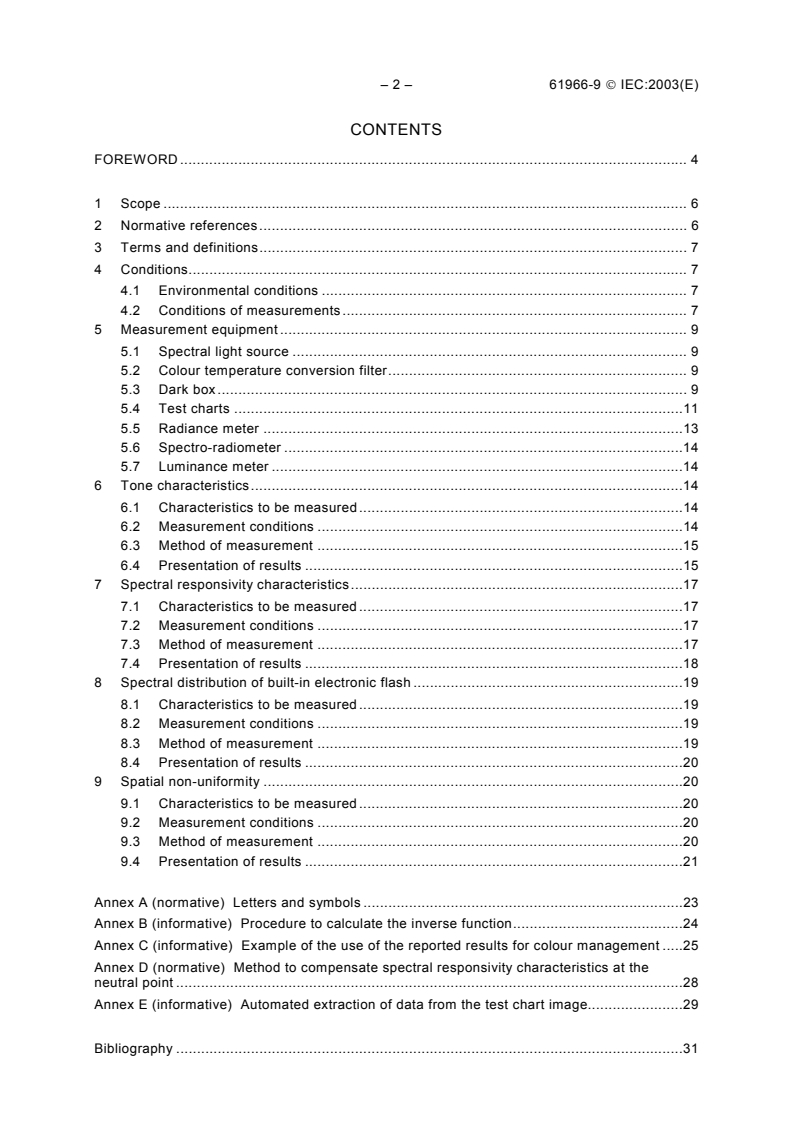
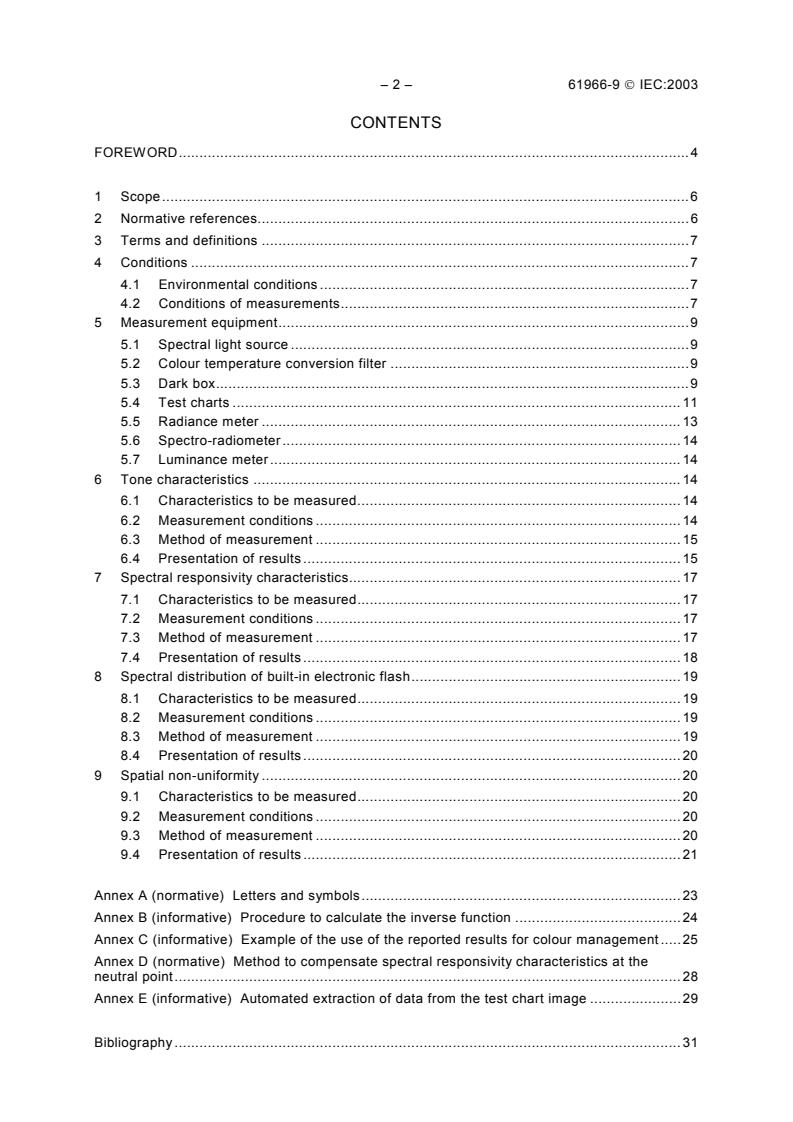
CONTENTS
FOREWORD . 4
1 Scope . 6
2 Normative references. 6
3 Terms and definitions. 7
4 Conditions. 7
4.1 Environmental conditions . 7
4.2 Conditions of measurements. 7
5 Measurement equipment . 9
5.1 Spectral light source . 9
5.2 Colour temperature conversion filter. 9
5.3 Dark box. 9
5.4 Test charts .11
5.5 Radiance meter .13
5.6 Spectro-radiometer .14
5.7 Luminance meter .14
6 Tone characteristics.14
6.1 Characteristics to be measured.14
6.2 Measurement conditions .14
6.3 Method of measurement .15
6.4 Presentation of results .15
7 Spectral responsivity characteristics.17
7.1 Characteristics to be measured.17
7.2 Measurement conditions .17
7.3 Method of measurement .17
7.4 Presentation of results .18
8 Spectral distribution of built-in electronic flash .19
8.1 Characteristics to be measured.19
8.2 Measurement conditions .19
8.3 Method of measurement .19
8.4 Presentation of results .20
9 Spatial non-uniformity .20
9.1 Characteristics to be measured.20
9.2 Measurement conditions .20
9.3 Method of measurement .20
9.4 Presentation of results .21
Annex A (normative) Letters and symbols .23
Annex B (informative) Procedure to calculate the inverse function.24
Annex C (informative) Example of the use of the reported results for colour management .25
Annex D (normative) Method to compensate spectral responsivity characteristics at the
neutral point .28
Annex E (informative) Automated extraction of data from the test chart image.29
Bibliography .31
61966-9 IEC:2003(E) – 3 –
Figure 1 – Equipment arrangement for measurements . 8
Figure 2 – Dark box.10
Figure 3 – Test chart 1 .11
Figure 4 – Test chart 2 with replaceable chip i .12
Figure 5 – Test chart 3 .12
Figure 6 – Example plot of tone characteristics (correlated colour temperature: 5 500 K).16
Figure 7 – Example of spectral responsivity characteristics (correlated colour
temperature: 5 500 K).19
Figure 8 – Example of the spectral distribution characteristics of a built-in electronic
flash.20
Figure 9 – Equipment arrangement for measurement of spatial non-uniformity .21
Figure C.1 – An example of spectral responsivity controlled to approximate the ideal
scRGB characteristics superimposed as the broken curves.27
Figure E.1 – Example to compare a typical optical viewfinder area and the
corresponding image sensible area (outer rectangle) .29
Figure E.2 – Test chart with extended orientation markers .29
Table 1 – Nominal reflectances of the grey-scale section and the grey chips .13
Table 2 – Example of tone characteristics (correlated colour temperature: 5 500 K) .16
Table 3 – An example of reporting form for spatial non-uniformity .22
– 4 – 61966-9 IEC:2003(E)
INTERNATIONAL ELECTROTECHNICAL COMMISSION
____________
MULTIMEDIA SYSTEMS AND EQUIPMENT –
COLOUR MEASUREMENT AND MANAGEMENT –
Part 9: Digital cameras
FOREWORD
1) The International Electrotechnical Commission (IEC) is a worldwide organization for standardization comprising
all national electrotechnical committees (IEC National Committees). The object of IEC is to promote
international co-operation on all questions concerning standardization in the electrical and electronic fields. To
this end and in addition to other activities, IEC publishes International Standards, Technical Specifications,
Technical Reports, Publicly Available Specifications (PAS) and Guides (hereafter referred to as “IEC
Publication(s)”). Their preparation is entrusted to technical committees; any IEC National Committee interested
in the subject dealt with may participate in this preparatory work. International, governmental and non-
governmental organizations liaising with the IEC also participate in this preparation. IEC collaborates closely
with the International Organization for Standardization (ISO) in accordance with conditions determined by
agreement between the two organizations.
2) The formal decisions or agreements of IEC on technical matters express, as nearly as possible, an international
consensus of opinion on the relevant subjects since each technical committee has representation from all
interested IEC National Committees.
3) IEC Publications have the form of recommendations for international use and are accepted by IEC National
Committees in that sense. While all reasonable efforts are made to ensure that the technical content of IEC
Publications is accurate, IEC cannot be held responsible for the way in which they are used or for any
misinterpretation by any end user.
4) In order to promote international uniformity, IEC National Committees undertake to apply IEC Publications
transparently to the maximum extent possible in their national and regional publications. Any divergence
between any IEC Publication and the corresponding national or regional publication shall be clearly indicated in
the latter.
5) IEC provides no marking procedure to indicate its approval and cannot be rendered responsible for any
equipment declared to be in conformity with an IEC Publication.
6) All users should ensure that they have the latest edition of this publication.
7) No liability shall attach to IEC or its directors, employees, servants or agents including individual experts and
members of its technical committees and IEC National Committees for any personal injury, property damage or
other damage of any nature whatsoever, whether direct or indirect, or for costs (including legal fees) and
expenses arising out of the publication, use of, or reliance upon, this IEC Publication or any other IEC
Publications.
8) Attention is drawn to the Normative references cited in this publication. Use of the referenced publications is
indispensable for the correct application of this publication.
9) Attention is drawn to the possibility that some of the elements of this IEC Publication may be the subject of
patent rights. IEC shall not be held responsible for identifying any or all such patent rights.
International Standard IEC 61966-9 has been prepared by IEC technical committee 100: Audio,
video and multimedia systems and equipment.
This second edition cancels and replaces the first edition published in 2000. This edition
includes the following significant technical changes from the previous edition.
a) In the light of issuing IEC 61966-2-2, the relevant reference IEC 61966-2-1 in Annex C has
been replaced by IEC 61966-2-2 together with sRGB by scRGB.
b) The previous Annex C has been replaced by the new Annex C where the previous Figure
C.1 has been deleted.
61966-9 IEC:2003(E) – 5 –
The text of this standard was submitted to the national committees for voting under the Fast
Track Procedure as the following documents:
CDV Report on voting
100/666/CDV 100/722/RVC
Full information on the voting for the approval of this standard can be found in the report on
voting indicated in the above table.
This publication has been drafted in accordance with the ISO/IEC Directives, Part 2.
IEC 61966 consists of the following parts, under the general title Multimedia systems and
equipment – Colour measurement and management:
– Part 1: General
– Part 2-0: Colour management
– Part 2-1: Colour management – Default RGB colour space – sRGB
– Part 2-2: Colour management – Extended RGB colour space – scRGB
– Part 3: Equipment using cathode ray tubes
– Part 4: Equipment using liquid crystal display panels
– Part 5: Equipment using plasma display panels
– Part 6: Front projection displays
– Part 7-1: Colour printers – Reflective prints – RGB inputs
– Part 7-2: Colour printers – Reflective prints – CMYK inputs
– Part 8: Multimedia colour scanners
– Part 9: Digital cameras
– Part 10: Quality assessment – Colour image in network systems
– Part 11: Quality assessment – Impaired video in network systems
The committee has decided that the contents of this publication will remain unchanged until 2008.
At this date, the publication will be
• reconfirmed;
• withdrawn;
• replaced by a revised edition, or
• amended.
– 6 – 61966-9 IEC:2003(E)
MULTIMEDIA SYSTEMS AND EQUIPMENT –
COLOUR MEASUREMENT AND MANAGEMENT –
Part 9: Digital cameras
1 Scope
This part of IEC 61966 is applicable to the assessment of colour reproduction of digital
cameras used in open computer systems and similar applications.
A series of methods and parameters for colour measurements and management for use in
multimedia systems and equipment is applicable to the assessment of colour reproduction.
This standard deals with digital cameras to capture colour still images and moving images for
use in multimedia applications.
The methods of measurement standardized in this standard are designed to make possible the
objective performance assessment and characterization of the colour reproduction of digital
cameras which can capture colour still and moving images, and output colour information
corresponding to red – green – blue digital image data. The measured results are intended to
be used for the purpose of colour management in multimedia systems, typically in the Internet.
This standard defines test charts, measurement conditions and methods of measurement, so
as to make possible the colour management in open multimedia systems and comprehensive
comparison of the results of measurements for assessment of digital cameras.
Colour control within digital cameras is outwith the scope of this part. It does not specify
limiting values for various parameters.
2 Normative references
The following referenced documents are indispensable for the application of this document. For
dated references, only the edition cited applies. For undated references, the latest edition of
the referenced document (including any amendments) applies.
IEC 60050(845):1987, International Electrotechnical Vocabulary (IEV) – Chapter 845: Lighting.
IEC 61146-1:1994, Video cameras (PAL/SECAM/NTSC) – Methods of measurement – Part 1:
Non-broadcast single-sensor cameras
IEC 61966-2-1:1999, Multimedia systems and equipment – Colour measurement and
management – Part 2-1: Colour management – Default RGB colour space – sRGB
ISO 2813:1994, Paints and varnishes – Determination of specular gloss of non-metallic paint
films at 20 degrees, 60 degrees and 85 degrees
ISO/CIE 10527:1991, CIE standard colorimetric observers
CIE 17.4:1987, International lighting vocabulary
61966-9 IEC:2003(E) – 7 –
3 Terms and definitions
For the purposes of this document, the definitions in IEC 60050-845 and CIE 17.4, as well as
the following definitions, apply.
3.1
colour control
conversion of equipment-dependent colour-image data to equipment-independent data for a
specific colour space including tone characteristics
3.2
digital camera
electronic imaging equipment which can capture colour still and moving images, and outputs
digital image data for red – green – blue channels either by itself or using incorporated colour
control software
4 Conditions
4.1 Environmental conditions
All measurements specified in this standard shall be carried out in a dark room.
Electric power to a digital camera under test shall be supplied using an a.c. adapter or
batteries recommended by the manufacturer.
The mains voltage and frequency applied to the a.c. adapter shall be at the rated value
specified by the manufacturer of the digital camera. When the mains voltage fluctuates,
a stabilizer shall be used to attain a stability value of ±5 % of the rated value.
Other environmental conditions such as temperature and relative humidity shall be reported,
together with the results of measurement.
For additional environmental conditions not specified in this subclause, if any, the speci-
fications of the manufacturer of the digital camera shall be taken into account.
4.2 Conditions of measurements
4.2.1 Measurement arrangement
Unless otherwise specified, a shooting object shall be a test chart with the dark box shown in
Figure 1. The specifications for the centre hole of the chart are given in Figure 3. Relative
positions shall be selected to prevent unnecessary glare from the diffuser.
NOTE The spectral light source consisting of the lamp, the iris, the monochromator, the optical fibre and the
diffuser may be configured in other ways, provided that the required specifications are met.
– 8 – 61966-9 IEC:2003(E)
Main lamp
Colour temperature
conversion filter
Test chart 1
Digital camera
under test
Diffuser
Dark box
Hole
Auxiliary lamp
Main lamp
Iris
Optical fibre
Monochromator
Lamp
Spectral light source
IEC 612/2000
Figure 1 – Equipment arrangement for measurements
4.2.2 Illumination
Illumination of the test charts shall be performed by two or four main lamps and one auxiliary
lamp depending on the characteristics to be measured. Incident lights from the main lamps
shall be 45° relative to the surface of the test chart. An auxiliary lamp to illuminate the diffuser
in Figure 1 is used only for the measurement specified in Clause 7. The diffuser shall not be
directly illuminated by the main lamps. The main lamps and the auxiliary lamp shall be halogen
lamps with a well-regulated power supply.
The correlated colour temperature of the lamps shall be 3 100 K ± 100 K as specified in
IEC 61146-1. The non-uniformity of illumination shall be less than 5 %. The average
illuminance on the test chart shall be 2 000 lx ± 100 lx.
4.2.3 Shooting conditions
The optical axis of the digital camera under test shall coincide with the normal to the test chart.
If the digital camera under test is equipped with a zoom lens, the distance between the test
chart and the digital camera under test, unless otherwise specified, shall be approximately
1,5 m. The zooming shall be adjusted so that the horizontal and vertical markers fit within the
full frame of an image area.
If the digital camera under test is not equipped with a zoom lens, the distance between the test
chart and the digital camera under test, unless otherwise specified, shall be adjusted so that
the horizontal and vertical markers fit within the full frame of an image area.
61966-9 IEC:2003(E) – 9 –
4.2.4 Digital image data
The red – green – blue data necessary for the calculation and characterization of the digital
camera under measurement shall be acquired and recorded depending on the cases described
below.
a) If red – green – blue digital image data are obtained direct from the digital camera under
test, the values shall be recorded.
b) If red – green – blue digital image data are not directly obtainable, they should be
calculated by the manufacturer’s driver software.
c) If red – green – blue digital image data are calculated by any independent application
software on the digital camera under measurement, the name and version of the software
shall be reported together with the values.
5 Measurement equipment
5.1 Spectral light source
The spectral light source consists of a halogen lamp powered by a well-regulated d.c. electric
power source, an iris, a monochromator and an optical fibre with a diffuser as in Figure 1.
Specifications of the constituent parts of the equipment arrangement should be as follows.
a) Output of spectral light source
1) Diameter of the diffuser: approximately h
2) Radiance: more than 10 mW/sr/m
3) Stability of light output: within ±0,5 %
NOTE An integrating sphere may be incorporated to increase uniformity.
b) Monochromator
1) Wavelength range: including from 380 nm to 780 nm
1)
2) Spectral bandwidth: 5 nm (FWHM ), triangle
3) Wavelength accuracy: ±0,5 nm
–4
4) Stray light: less than 10
NOTE Higher-order spectra from the monochromator should be removed.
5.2 Colour temperature conversion filter
–1
The amount of reciprocal correlated colour temperature change shall be –140 MK in order to
achieve 5 500 K ± 300 K.
5.3 Dark box
The dark box for the measurements should be as shown in Figure 2. The reflectance of the
inside of the dark box shall be less than 2 %. The accuracy of the dimensions should be within
± h . The geometrical specification of the holes whose positions are designated by “0” shall
be as in Figure 3.
___________
1)
FWHM stands for full-width half maximum.
– 10 – 61966-9 IEC:2003(E)
2h / 3
Test chart 1
Hole
Hole
h
A'
A
Hole
IEC 2650/03
Figure 2 – Dark box
61966-9 IEC:2003(E) – 11 –
5.4 Test charts
a) The specular gloss at 60° shall be less than 2,5 %, according to ISO 2813, for all test charts.
The geometric specification of the test charts shall be as shown in Figures 3, 4 and 5. The
accuracy of the dimensions should be within ± h .
h / 18 h / 18
h / 36 h / 36 h / 12
h / 12
h / 9
()w − 4h / 9 / 2
()w − 4h / 9 / 2
h / 6
h / 6
0 1 23 45 67 89 10 11 12 13 14 15
h / 9
15 0 15 h / 9
h
h / 9
151413121110 987654321 0
h / 6
h / 6
()w − 8h / 9 / 2
()w −8h / 9 / 2
8h / 9
w
IEC 614/2000
Figure 3 – Test chart 1
– 12 – 61966-9 IEC:2003(E)
Background
h / 18
(reflectance is 18 %)
Grey chip (No. i)
h / 9
h / 18
h / 9
IEC 2651/03
Figure 4 – Test chart 2 with replaceable chip i
h / 5
h / 5
h / 5 h
h / 5
h / 5
2h / 15
5 5 5 5 5
w / w / w / w / w /
w
IEC 616/2000
Figure 5 – Test chart 3
b) Test chart 3 in Figure 5 shall be the white chart with a nominal reflectance of 88,1 %.
It shall be superimposed with a rectangular grid. The designation of position j in Figure 5
shall be numbered from the top left to the bottom right for the centre of each rectangular
area as j = 1 to 25.
c) The reflectances of the grey steps in test chart 1 shall have the values specified in Table 1,
where the positions designated by “0” are holes.
61966-9 IEC:2003(E) – 13 –
Table 1 – Nominal reflectances of the grey-scale section and the grey chips
Reflectance (%)
i
0 0,0(hole)
12,0
24,0
36,0
48,0
5 10,3
6 14,7
7 19,8
8 25,8
9 32,5
10 39,9
11 48,1
12 57,0
13 66,6
14 77,0
15 88,1
Background 18,0
5.5 Radiance meter
A radiance meter with the following specification should be used for the measurements of the
output from the spectral light source.
a) Wavelength range: from 380 nm to 780 nm
2 2
b) Measurable range: from 1 µW/sr/m to 1 W/sr/m
c) Relative accuracy: ±5 % (from 380 nm to 780 nm)
d) Linearity: ±2 %
e) Measurement less than 0,5 %
resolution:
NOTE 1 Radiance can be measured with an irradiance meter at a known distance from a source. A spectro-
radiometer in radiance geometry can also be used to measure radiance.
NOTE 2 If a wavelength range beyond the specification in a) is required from the results reported in Clause 7,
the wavelength range should be from 360 nm up to a wavelength where a response of less than 5 % of the
maximum is observed.
– 14 – 61966-9 IEC:2003(E)
5.6 Spectro-radiometer
A spectro-radiometer with the following specification should be used for the measurement for a
built-in electronic flash in Clause 8.
a) Wavelength range: from 380 nm to 780 nm
b) Field of view: between 0,1° and 2,0°
c) Wavelength uncertainty: less than 0,5 nm throughout the wavelength range
d) Scanning interval: 5 nm or less
e) Bandpass: 5 nm or less
f) Repeatability: less than 0,5 % in radiance at each wavelength
NOTE 1 A temporal integration capability for measuring flashing lights is required.
NOTE 2 If a wavelength range beyond the specification in a) is required from the results reported in Clause 8,
the wavelength range should be from 360 nm up to a wavelength where a response of less than 5 % of the
maximum is observed.
NOTE 3 Periodic calibration should be carried out with a standard optical source of known spectral power
distribution.
NOTE 4 Further technical details of the design, characterization, and calibration of spectro-radiometers can be
found in CIE 63 [7], CIE 105 [8] and JIS Z 8724 [3] .
5.7 Luminance meter
The luminance meter should have the following specifications for the measurement of
luminance in Clause 7. A colorimeter with luminance output in Y can also be used.
a) Field of view: any value between 0,1° and 2,0°
b) Spectral responsivity: compliant to the CIE 2° colour-matching function, y(λ) ,
as defined in ISO/CIE 10527
c) Repeatability: less than 0,5 %
6 Tone characteristics
6.1 Characteristics to be measured
The relationship between the luminance of the shooting object and the digital image data at the
centre of the image shall be measured.
6.2 Measurement conditions
The arrangement of the equipment should be as in Figure 1. The optical fibre shall be removed
and the hole on the rear side of the dark box shall be covered with a lid similarly painted as the
inside of the dark box. The auxiliary lamp shall be switched off.
Two separate measurements, with the colour temperature conversion filter in front of the lens
for 5 500 K and without for 3 100 K, shall be conducted.
NOTE
...
IEC 61966-9 ®
Edition 2.0 2003-11
INTERNATIONAL
STANDARD
NORME
INTERNATIONALE
colour
inside
Multimedia systems and equipment – Colour measurement and management –
Part 9: Digital cameras
Systèmes et appareils multimédia – Mesure et gestion de la couleur –
Partie 9: Appareils numériques de prise de vue
All rights reserved. Unless otherwise specified, no part of this publication may be reproduced or utilized in any form
or by any means, electronic or mechanical, including photocopying and microfilm, without permission in writing from
either IEC or IEC's member National Committee in the country of the requester.
If you have any questions about IEC copyright or have an enquiry about obtaining additional rights to this publication,
please contact the address below or your local IEC member National Committee for further information.
Droits de reproduction réservés. Sauf indication contraire, aucune partie de cette publication ne peut être reproduite ni
utilisée sous quelque forme que ce soit et par aucun procédé, électronique ou mécanique, y compris la photocopie et les
microfilms, sans l'accord écrit de la CEI ou du Comité national de la CEI du pays du demandeur.
Si vous avez des questions sur le copyright de la CEI ou si vous désirez obtenir des droits supplémentaires sur cette
publication, utilisez les coordonnées ci-après ou contactez le Comité national de la CEI de votre pays de résidence.
IEC Central Office Tel.: +41 22 919 02 11
3, rue de Varembé Fax: +41 22 919 03 00
CH-1211 Geneva 20 info@iec.ch
Switzerland www.iec.ch
About the IEC
The International Electrotechnical Commission (IEC) is the leading global organization that prepares and publishes
International Standards for all electrical, electronic and related technologies.
About IEC publications
The technical content of IEC publications is kept under constant review by the IEC. Please make sure that you have the
latest edition, a corrigenda or an amendment might have been published.
Useful links:
IEC publications search - www.iec.ch/searchpub Electropedia - www.electropedia.org
The advanced search enables you to find IEC publications The world's leading online dictionary of electronic and
by a variety of criteria (reference number, text, technical electrical terms containing more than 30 000 terms and
committee,…). definitions in English and French, with equivalent terms in
It also gives information on projects, replaced and additional languages. Also known as the International
withdrawn publications. Electrotechnical Vocabulary (IEV) on-line.
IEC Just Published - webstore.iec.ch/justpublished Customer Service Centre - webstore.iec.ch/csc
Stay up to date on all new IEC publications. Just Published If you wish to give us your feedback on this publication
details all new publications released. Available on-line and or need further assistance, please contact the
also once a month by email. Customer Service Centre: csc@iec.ch.
A propos de la CEI
La Commission Electrotechnique Internationale (CEI) est la première organisation mondiale qui élabore et publie des
Normes internationales pour tout ce qui a trait à l'électricité, à l'électronique et aux technologies apparentées.
A propos des publications CEI
Le contenu technique des publications de la CEI est constamment revu. Veuillez vous assurer que vous possédez
l’édition la plus récente, un corrigendum ou amendement peut avoir été publié.
Liens utiles:
Recherche de publications CEI - www.iec.ch/searchpub Electropedia - www.electropedia.org
La recherche avancée vous permet de trouver des Le premier dictionnaire en ligne au monde de termes
publications CEI en utilisant différents critères (numéro de électroniques et électriques. Il contient plus de 30 000
référence, texte, comité d’études,…). termes et définitions en anglais et en français, ainsi que
Elle donne aussi des informations sur les projets et les les termes équivalents dans les langues additionnelles.
publications remplacées ou retirées. Egalement appelé Vocabulaire Electrotechnique
International (VEI) en ligne.
Just Published CEI - webstore.iec.ch/justpublished
Service Clients - webstore.iec.ch/csc
Restez informé sur les nouvelles publications de la CEI.
Just Published détaille les nouvelles publications parues. Si vous désirez nous donner des commentaires sur
Disponible en ligne et aussi une fois par mois par email. cette publication ou si vous avez des questions
contactez-nous: csc@iec.ch.
IEC 61966-9 ®
Edition 2.0 2003-11
INTERNATIONAL
STANDARD
NORME
INTERNATIONALE
colour
inside
Multimedia systems and equipment – Colour measurement and management –
Part 9: Digital cameras
Systèmes et appareils multimédia – Mesure et gestion de la couleur –
Partie 9: Appareils numériques de prise de vue
INTERNATIONAL
ELECTROTECHNICAL
COMMISSION
COMMISSION
ELECTROTECHNIQUE
PRICE CODE
INTERNATIONALE
CODE PRIX V
ICS 33.160.60; 35.040; 37.040 ISBN 978-2-83220-607-2
– 2 – 61966-9 IEC:2003
CONTENTS
FOREWORD . 4
1 Scope . 6
2 Normative references. 6
3 Terms and definitions . 7
4 Conditions . 7
4.1 Environmental conditions . 7
4.2 Conditions of measurements . 7
5 Measurement equipment . 9
5.1 Spectral light source . 9
5.2 Colour temperature conversion filter . 9
5.3 Dark box . 9
5.4 Test charts . 11
5.5 Radiance meter . 13
5.6 Spectro-radiometer . 14
5.7 Luminance meter . 14
6 Tone characteristics . 14
6.1 Characteristics to be measured . 14
6.2 Measurement conditions . 14
6.3 Method of measurement . 15
6.4 Presentation of results . 15
7 Spectral responsivity characteristics. 17
7.1 Characteristics to be measured . 17
7.2 Measurement conditions . 17
7.3 Method of measurement . 17
7.4 Presentation of results . 18
8 Spectral distribution of built-in electronic flash . 19
8.1 Characteristics to be measured . 19
8.2 Measurement conditions . 19
8.3 Method of measurement . 19
8.4 Presentation of results . 20
9 Spatial non-uniformity . 20
9.1 Characteristics to be measured . 20
9.2 Measurement conditions . 20
9.3 Method of measurement . 20
9.4 Presentation of results . 21
Annex A (normative) Letters and symbols . 23
Annex B (informative) Procedure to calculate the inverse function . 24
Annex C (informative) Example of the use of the reported results for colour management . 25
Annex D (normative) Method to compensate spectral responsivity characteristics at the
neutral point . 28
Annex E (informative) Automated extraction of data from the test chart image . 29
Bibliography . 31
61966-9 IEC:2003 – 3 –
Figure 1 – Equipment arrangement for measurements . 8
Figure 2 – Dark box. 10
Figure 3 – Test chart 1 . 11
Figure 4 – Test chart 2 with replaceable chip i . 12
Figure 5 – Test chart 3 . 12
Figure 6 – Example plot of tone characteristics (correlated colour temperature: 5 500 K) . 16
Figure 7 – Example of spectral responsivity characteristics (correlated colour
temperature: 5 500 K) . 19
Figure 8 – Example of the spectral distribution characteristics of a built-in electronic
flash . 20
Figure 9 – Equipment arrangement for measurement of spatial non-uniformity . 21
Figure C.1 – An example of spectral responsivity controlled to approximate the ideal
scRGB characteristics superimposed as the broken curves . 27
Figure E.1 – Example to compare a typical optical viewfinder area and the
corresponding image sensible area (outer rectangle) . 29
Figure E.2 – Test chart with extended orientation markers . 29
Table 1 – Nominal reflectances of the grey-scale section and the grey chips . 13
Table 2 – Example of tone characteristics (correlated colour temperature: 5 500 K) . 16
Table 3 – An example of reporting form for spatial non-uniformity . 22
– 4 – 61966-9 IEC:2003
INTERNATIONAL ELECTROTECHNICAL COMMISSION
____________
MULTIMEDIA SYSTEMS AND EQUIPMENT –
COLOUR MEASUREMENT AND MANAGEMENT –
Part 9: Digital cameras
FOREWORD
1) The International Electrotechnical Commission (IEC) is a worldwide organization for standardization comprising
all national electrotechnical committees (IEC National Committees). The object of IEC is to promote
international co-operation on all questions concerning standardization in the electrical and electronic fields. To
this end and in addition to other activities, IEC publishes International Standards, Technical Specifications,
Technical Reports, Publicly Available Specifications (PAS) and Guides (hereafter referred to as “IEC
Publication(s)”). Their preparation is entrusted to technical committees; any IEC National Committee interested
in the subject dealt with may participate in this preparatory work. International, governmental and non-
governmental organizations liaising with the IEC also participate in this preparation. IEC collaborates closely
with the International Organization for Standardization (ISO) in accordance with conditions determined by
agreement between the two organizations.
2) The formal decisions or agreements of IEC on technical matters express, as nearly as possible, an international
consensus of opinion on the relevant subjects since each technical committee has representation from all
interested IEC National Committees.
3) IEC Publications have the form of recommendations for international use and are accepted by IEC National
Committees in that sense. While all reasonable efforts are made to ensure that the technical content of IEC
Publications is accurate, IEC cannot be held responsible for the way in which they are used or for any
misinterpretation by any end user.
4) In order to promote international uniformity, IEC National Committees undertake to apply IEC Publications
transparently to the maximum extent possible in their national and regional publications. Any divergence
between any IEC Publication and the corresponding national or regional publication shall be clearly indicated in
the latter.
5) IEC provides no marking procedure to indicate its approval and cannot be rendered responsible for any
equipment declared to be in conformity with an IEC Publication.
6) All users should ensure that they have the latest edition of this publication.
7) No liability shall attach to IEC or its directors, employees, servants or agents including individual experts and
members of its technical committees and IEC National Committees for any personal injury, property damage or
other damage of any nature whatsoever, whether direct or indirect, or for costs (including legal fees) and
expenses arising out of the publication, use of, or reliance upon, this IEC Publication or any other IEC
Publications.
8) Attention is drawn to the Normative references cited in this publication. Use of the referenced publications is
indispensable for the correct application of this publication.
9) Attention is drawn to the possibility that some of the elements of this IEC Publication may be the subject of
patent rights. IEC shall not be held responsible for identifying any or all such patent rights.
International Standard IEC 61966-9 has been prepared by IEC technical committee 100: Audio,
video and multimedia systems and equipment.
This bilingual version (2013-03) corresponds to the monolingual English version, published in
2003-11.
This second edition cancels and replaces the first edition published in 2000. This edition
includes the following significant technical changes from the previous edition.
a) In the light of issuing IEC 61966-2-2, the relevant reference IEC 61966-2-1 in Annex C has
been replaced by IEC 61966-2-2 together with sRGB by scRGB.
b) The previous Annex C has been replaced by the new Annex C where the previous Figure
C.1 has been deleted.
61966-9 IEC:2003 – 5 –
The text of this standard was submitted to the national committees for voting under the Fast
Track Procedure as the following documents:
CDV Report on voting
100/666/CDV 100/722/RVC
Full information on the voting for the approval of this standard can be found in the report on
voting indicated in the above table.
The French version of this standard has not been voted upon.
This publication has been drafted in accordance with the ISO/IEC Directives, Part 2.
IEC 61966 consists of the following parts, under the general title Multimedia systems and
equipment – Colour measurement and management:
– Part 1: General
– Part 2-0: Colour management
– Part 2-1: Colour management – Default RGB colour space – sRGB
– Part 2-2: Colour management – Extended RGB colour space – scRGB
– Part 3: Equipment using cathode ray tubes
– Part 4: Equipment using liquid crystal display panels
– Part 5: Equipment using plasma display panels
– Part 6: Front projection displays
– Part 7-1: Colour printers – Reflective prints – RGB inputs
– Part 7-2: Colour printers – Reflective prints – CMYK inputs
– Part 8: Multimedia colour scanners
– Part 9: Digital cameras
– Part 10: Quality assessment – Colour image in network systems
– Part 11: Quality assessment – Impaired video in network systems
The committee has decided that the contents of this publication will remain unchanged until
2008. At this date, the publication will be
• reconfirmed;
• withdrawn;
• replaced by a revised edition, or
• amended.
he 'colour inside' logo on the cover page of this publication indicates
IMPORTANT – T
that it contains colours which are considered to be useful for the correct understanding
of its contents. Users should therefore print this document using a colour printer.
– 6 – 61966-9 IEC:2003
MULTIMEDIA SYSTEMS AND EQUIPMENT –
COLOUR MEASUREMENT AND MANAGEMENT –
Part 9: Digital cameras
1 Scope
This part of IEC 61966 is applicable to the assessment of colour reproduction of digital
cameras used in open computer systems and similar applications.
A series of methods and parameters for colour measurements and management for use in
multimedia systems and equipment is applicable to the assessment of colour reproduction.
This standard deals with digital cameras to capture colour still images and moving images for
use in multimedia applications.
The methods of measurement standardized in this standard are designed to make possible the
objective performance assessment and characterization of the colour reproduction of digital
cameras which can capture colour still and moving images, and output colour information
corresponding to red – green – blue digital image data. The measured results are intended to
be used for the purpose of colour management in multimedia systems, typically in the Internet.
This standard defines test charts, measurement conditions and methods of measurement, so
as to make possible the colour management in open multimedia systems and comprehensive
comparison of the results of measurements for assessment of digital cameras.
Colour control within digital cameras is outwith the scope of this part. It does not specify
limiting values for various parameters.
2 Normative references
The following referenced documents are indispensable for the application of this document. For
dated references, only the edition cited applies. For undated references, the latest edition of
the referenced document (including any amendments) applies.
IEC 60050(845):1987, International Electrotechnical Vocabulary (IEV) – Chapter 845: Lighting.
IEC 61146-1:1994, Video cameras (PAL/SECAM/NTSC) – Methods of measurement – Part 1:
Non-broadcast single-sensor cameras
IEC 61966-2-1:1999, Multimedia systems and equipment – Colour measurement and
management – Part 2-1: Colour management – Default RGB colour space – sRGB
ISO 2813:1994, Paints and varnishes – Determination of specular gloss of non-metallic paint
films at 20 degrees, 60 degrees and 85 degrees
ISO/CIE 10527:1991, CIE standard colorimetric observers
CIE 17.4:1987, International lighting vocabulary
61966-9 IEC:2003 – 7 –
3 Terms and definitions
For the purposes of this document, the definitions in IEC 60050-845 and CIE 17.4, as well as
the following definitions, apply.
3.1
colour control
conversion of equipment-dependent colour-image data to equipment-independent data for a
specific colour space including tone characteristics
3.2
digital camera
electronic imaging equipment which can capture colour still and moving images, and outputs
digital image data for red – green – blue channels either by itself or using incorporated colour
control software
4 Conditions
4.1 Environmental conditions
All measurements specified in this standard shall be carried out in a dark room.
Electric power to a digital camera under test shall be supplied using an a.c. adapter or
batteries recommended by the manufacturer.
The mains voltage and frequency applied to the a.c. adapter shall be at the rated value
specified by the manufacturer of the digital camera. When the mains voltage fluctuates,
a stabilizer shall be used to attain a stability value of ±5 % of the rated value.
Other environmental conditions such as temperature and relative humidity shall be reported,
together with the results of measurement.
For additional environmental conditions not specified in this subclause, if any, the speci-
fications of the manufacturer of the digital camera shall be taken into account.
4.2 Conditions of measurements
4.2.1 Measurement arrangement
Unless otherwise specified, a shooting object shall be a test chart with the dark box shown in
Figure 1. The specifications for the centre hole of the chart are given in Figure 3. Relative
positions shall be selected to prevent unnecessary glare from the diffuser.
NOTE The spectral light source consisting of the lamp, the iris, the monochromator, the optical fibre and the
diffuser may be configured in other ways, provided that the required specifications are met.
– 8 – 61966-9 IEC:2003
Main lamp
Colour temperature
conversion filter
Test chart 1
Digital camera
under test
Diffuser
Dark box
Hole
Auxiliary lamp
Main lamp
Iris
Optical fibre
Monochromator
Lamp
Spectral light source
IEC 612/2000
Figure 1 – Equipment arrangement for measurements
4.2.2 Illumination
Illumination of the test charts shall be performed by two or four main lamps and one auxiliary
lamp depending on the characteristics to be measured. Incident lights from the main lamps
shall be 45° relative to the surface of the test chart. An auxiliary lamp to illuminate the diffuser
in Figure 1 is used only for the measurement specified in Clause 7. The diffuser shall not be
directly illuminated by the main lamps. The main lamps and the auxiliary lamp shall be halogen
lamps with a well-regulated power supply.
The correlated colour temperature of the lamps shall be 3 100 K ± 100 K as specified in
IEC 61146-1. The non-uniformity of illumination shall be less than 5 %. The average
illuminance on the test chart shall be 2 000 lx ± 100 lx.
4.2.3 Shooting conditions
The optical axis of the digital camera under test shall coincide with the normal to the test chart.
If the digital camera under test is equipped with a zoom lens, the distance between the test
chart and the digital camera under test, unless otherwise specified, shall be approximately
1,5 m. The zooming shall be adjusted so that the horizontal and vertical markers fit within the
full frame of an image area.
If the digital camera under test is not equipped with a zoom lens, the distance between the test
chart and the digital camera under test, unless otherwise specified, shall be adjusted so that
the horizontal and vertical markers fit within the full frame of an image area.
61966-9 IEC:2003 – 9 –
4.2.4 Digital image data
The red – green – blue data necessary for the calculation and characterization of the digital
camera under measurement shall be acquired and recorded depending on the cases described
below.
a) If red – green – blue digital image data are obtained direct from the digital camera under
test, the values shall be recorded.
b) If red – green – blue digital image data are not directly obtainable, they should be
calculated by the manufacturer’s driver software.
c) If red – green – blue digital image data are calculated by any independent application
software on the digital camera under measurement, the name and version of the software
shall be reported together with the values.
5 Measurement equipment
5.1 Spectral light source
The spectral light source consists of a halogen lamp powered by a well-regulated d.c. electric
power source, an iris, a monochromator and an optical fibre with a diffuser as in Figure 1.
Specifications of the constituent parts of the equipment arrangement should be as follows.
a) Output of spectral light source
1) Diameter of the diffuser: approximately h
2) Radiance: more than 10 mW/sr/m
3) Stability of light output: within ±0,5 %
NOTE An integrating sphere may be incorporated to increase uniformity.
b) Monochromator
1) Wavelength range: including from 380 nm to 780 nm
2) Spectral bandwidth: 5 nm (FWHM) , triangle
3) Wavelength accuracy: ±0,5 nm
–4
4) Stray light: less than 10
NOTE Higher-order spectra from the monochromator should be removed.
5.2 Colour temperature conversion filter
–1
The amount of reciprocal correlated colour temperature change shall be –140 MK in order to
achieve 5 500 K ± 300 K.
5.3 Dark box
The dark box for the measurements should be as shown in Figure 2. The reflectance of the
inside of the dark box shall be less than 2 %. The accuracy of the dimensions should be within
. The geometrical specification of the holes whose positions are designated by “0” shall
± h
be as in Figure 3.
___________
FWHM stands for full-width half maximum.
– 10 – 61966-9 IEC:2003
2h / 3
Test chart 1
Hole
Hole
h
A'
A
Hole
IEC 2650/03
Figure 2 – Dark box
61966-9 IEC:2003 – 11 –
5.4 Test charts
a) The specular gloss at 60° shall be less than 2,5 %, according to ISO 2813, for all test charts.
The geometric specification of the test charts shall be as shown in Figures 3, 4 and 5. The
.
accuracy of the dimensions should be within ± h
h / 18 h / 18
h / 36 h / 36 h / 12
h / 12
h / 9
(w− 4h / 9)/ 2
(w− 4h / 9)/ 2
h / 6
h / 6
0 1 2 3 4 5 6 7 8 9 10 11 12 13 14 15
h / 9
15 0 15
h / 9
h
h / 9
15 14 13 12 11 10 9 8 7 6 5 4 3 2 1 0
h / 6
h / 6
(w− 8h / 9)/ 2
(w− 8h / 9)/ 2
8h / 9
w
IEC 614/2000
Figure 3 – Test chart 1
– 12 – 61966-9 IEC:2003
Background
h / 18
(reflectance is 18 %)
Grey chip (No. i)
h / 9
h / 18
h / 9
IEC 2651/03
Figure 4 – Test chart 2 with replaceable chip i
h / 5
h / 5
h / 5 h
h /
h / 5
2h / 15
w / 5 w / 5 w / 5 w / 5 w / 5
w
IEC 616/2000
Figure 5 – Test chart 3
b) Test chart 3 in Figure 5 shall be the white chart with a nominal reflectance of 88,1 %.
It shall be superimposed with a rectangular grid. The designation of position j in Figure 5
shall be numbered from the top left to the bottom right for the centre of each rectangular
area as j = 1 to 25.
c) The reflectances of the grey steps in test chart 1 shall have the values specified in Table 1,
where the positions designated by “0” are holes.
61966-9 IEC:2003 – 13 –
Table 1 – Nominal reflectances of the grey-scale section and the grey chips
Reflectance (%)
i
0 0,0(hole)
1 2,0
2 4,0
3 6,0
4 8,0
5 10,3
6 14,7
7 19,8
8 25,8
9 32,5
10 39,9
11 48,1
12 57,0
13 66,6
14 77,0
15 88,1
Background 18,0
5.5 Radiance meter
A radiance meter with the following specification should be used for the measurements of the
output from the spectral light source.
a) Wavelength range: from 380 nm to 780 nm
2 2
b) Measurable range:
from 1 μW/sr/m to 1 W/sr/m
c) Relative accuracy:
±5 % (from 380 nm to 780 nm)
d) Linearity:
±2 %
e) Measurement less than 0,5 %
resolution:
NOTE 1 Radiance can be measured with an irradiance meter at a known distance from a source. A spectro-
radiometer in radiance geometry can also be used to measure radiance.
NOTE 2 If a wavelength range beyond the specification in a) is required from the results reported in Clause 7,
the wavelength range should be from 360 nm up to a wavelength where a response of less than 5 % of the
maximum is observed.
– 14 – 61966-9 IEC:2003
5.6 Spectro-radiometer
A spectro-radiometer with the following specification should be used for the measurement for a
built-in electronic flash in Clause 8.
a) Wavelength range: from 380 nm to 780 nm
b) Field of view: between 0,1° and 2,0°
c) Wavelength uncertainty: less than 0,5 nm throughout the wavelength range
d) Scanning interval: 5 nm or less
e) Bandpass: 5 nm or less
f) Repeatability: less than 0,5 % in radiance at each wavelength
NOTE 1 A temporal integration capability for measuring flashing lights is required.
NOTE 2 If a wavelength range beyond the specification in a) is required from the results reported in Clause 8,
the wavelength range should be from 360 nm up to a wavelength where a response of less than 5 % of the
maximum is observed.
NOTE 3 Periodic calibration should be carried out with a standard optical source of known spectral power
distribution.
NOTE 4 Further technical details of the design, characterization, and calibration of spectro-radiometers can be
found in CIE 63 [7], CIE 105 [8] and JIS Z 8724 [3] .
5.7 Luminance meter
The luminance meter should have the following specifications for the measurement of
luminance in Clause 7. A colorimeter with luminance output in Y can also be used.
a) Field of view: any value between 0,1° and 2,0°
b) Spectral responsivity: compliant to the CIE 2° colour-matching function, ,
y(λ)
as defined in ISO/CIE 10527
c) Repeatability: less than 0,5 %
6 Tone characteristics
6.1 Characteristics to be measured
The relationship between the luminance of the shooting object and the digital image data at the
centre of the image shall be measured.
6.2 Measurement conditions
The arrangement of the equipment should be as in Figure 1. The optical fibre shall be removed
and the hole on the rear side of the dark box shall be covered with a lid similarly painted as the
inside of the dark box. The auxiliary lamp shall be switched off.
Two separate measurements, with the colour temperature conversion filter in front of the lens
for 5 500 K and without for 3 100 K, shall be conducted.
NOTE Additional conditions of correlated colour temperature may be set according to the needs.
___________
Figures in square brackets refer to the bibliography.
61966-9 IEC:2003 – 15 –
6.3 Method of measurement
a) Test chart 2 with the grey chip i shall sequentially be inserted into the front hole at the
centre of test chart 1 for i = 0 to 15. The reflectances of the grey chips shall be as shown in
Table 1.
NOTE The grey chip for i = 0 is a hole without a grey chip.
b) The luminance L of the grey chip i shall be measured using the luminance meter and test
i
chart 1 shall be shot by the digital camera under test.
c) The mean values corresponding to the grey chip i mounted at the centre, D′ , D′ and
R G
i i
D′ , of red – green – blue digital image data shall be recorded.
B
i
R G B
d) The mean values E , E and E corresponding to step j of the upper grey steps with the
i i i
j j j
grey chip mounted at the centre shall also be noted for red – green – blue image data,
i
respectively.
6.4 Presentation of results
a) The recorded data shall be compensated for, in order to eliminate any autonomous
exposure control or errors of a mechanical shutter of the digital camera under test as
follows.
R R
E − E
8 8
1 j+1 j
R R
D = D′ − E + E × 100 (%) (1)
R R
i i i 8
n R R
j j
2 −1 E − E
i i
j+1 j
where
R R
′
j is the step number of the grey steps in which the inequality E < D < E holds;
R
i i i
j j+1
n is the number of bits in each channel.
′ ′
A similar compensation shall be conducted for recorded data D and D to obtain
G B
i i
D and D , respectively, for green and blue channels.
G B
i i
b) The measured and calculated data L , D , D , D for i = 0 to i = 15 shall be reported
i R G B
i i i
as in Table 2, together with the effective correlated colour temperature of the illumination.
c) The results shall also be reported as a graphical representation, as shown in Figure 6, where
the horizontal axis is the luminance L and the vertical axis is for D , D and D .
i R G B
i i i
The correlated colour temperature shall also be reported.
– 16 – 61966-9 IEC:2003
Table 2 – Example of tone characteristics
(correlated colour temperature: 5 500 K)
i L (cd/m )
D (%) D (%) D (%)
R G B
0 1,37 0,00 0,00 0,00
1 5,17 3,83 4,00 3,94
2 8,57 9,45 9,34 9,31
3 12,3 16,4 16,7 16,5
4 15,9 21,6 21,6 21,5
5 20,5 27,3 27,2 27,2
6 27,9 36,0 36,1 36,1
7 37,5 45,3 45,5 45,2
8 49,2 55,2 55,5 55,2
9 60,8 63,6 63,7 63,4
10 75,1 72,4 72,3 72,2
11 91,4 79,9 80,0 79,7
12 107,2 85,5 85,5 85,2
13 123,1 89,8 89,5 89,6
14 143,3 94,0 94,0 93,9
15 164,5 96,8 96,8 96,8
0 20 40 60 80 100 120 140 160
Input light level cd/m
IEC 2652/03
Figure 6 – Example plot of tone characteristics
(correlated colour temperature: 5 500 K)
Normalized output level %
61966-9 IEC:2003 – 17 –
7 Spectral responsivity characteristics
7.1 Characteristics to be measured
The relationship between wavelength λ of monochromatic incident light and red – green – blue
digital image data obtained from the digital camera shall be measured.
7.2 Measurement conditions
a) The arrangement of equipment should be as shown in Figure 1. The optical fibre connected
to the spectral light source shall be inserted into the dark box from the rear side. All
measurement and shooting by the digital camera shall be conducted through the correlated
colour conversion filter wherever applicable.
NOTE 1 Illumination with a correlated colour temperature of 3 100 K is normally achieved without the
correlated colour conversion filter in front of the lens.
NOTE 2 Additional correlated colour temperatures may be set according to the needs.
b) The intensity of the auxiliary lamp, with the iris in front of the monochromator shut, shall be
adjusted so that digital image data corresponding to the diffuser is around 20 % of a full
data range of the digital camera. If underflows are observed in the data processing in 7.4c),
the value of 20 % should be increased.
NOTE The lower intensity of the auxiliary lamp is better for measurement accuracy.
c) The iris in front of the monochromator shall be adjusted once so that the maximum data
in red – green – blue channels are between 70 % and 80 % inclusive of the full scale on
condition that the auxiliary lamp in Figure 1 is switched on. It shall be kept unchanged after
this adjustment.
7.3 Method of measurement
a) The measurement shall be conducted for both illuminations with effective correlated colour
temperatures of 5 500 K and 3 100 K.
b) The radiance L(λ ) on the diffuser from the spectral light source shall be measured using
i
the radiance meter with the auxiliary lamp switched off. When the measurement is
conducted for 5 500 K, the colour conversion filter shall be inserted between the diffuser
and the radiance meter.
c) The auxiliary lamp shall then be switched on and the iris in front of the monochromator
shall be shut. The digital image data corresponding to the diffuser shall be recorded in pixel
by pixel as three sets of data D′′ , D′′ and D′′ for red – green – blue channels,
R G B
0 0 0
respectively.
d) Test chart 1, in which the centre portion illuminated by the spectral light source from the
back and by the auxiliary lamp from the front, shall be shot by the digital camera under test
at each wavelength , where i = 1 to 81, corresponding to the wavelength from 380 nm to
λ
i
780 nm with an interval of 5 nm.
′′
e) The pixel-by-pixel output data corresponding to the diffuser shall be recorded as D (λ ),
R i
′′ ′′
D (λ ) and D (λ ) for red – green – blue channels, respectively.
G i B i
R G B
f) The mean values F , F and F corresponding to step j of the upper grey steps, with
i i i
j j j
the monochromatic radiation at wavelength λ at the centre of test chart 1, shall also be
i
noted for red – green – blue image data, respectively, for j = 0 to 15.
g) The auxiliary lamp shall be switched off and test chart 2 with the grey chip 8 shall be
inserted into the front hole at the centre of test chart 1. Spectral distribution characteristics
L (λ ) shall be measured using a spectro-radiometer, where i = 1 to 81, corresponding to
8 i
the wavelength from 380 nm to 780 nm with an interval of 5 nm.
– 18 – 61966-9 IEC:2003
NOTE If the wavelength range beyond the specification is required from the results reported in 7.4, it should be
from 360 nm up to a wavelength where response less than 5 % will be observed.
7.4 Presentation of results
a) The recorded pixel-by-pixel data D′′ (λ ) shall be compensated to eliminate any auto-
R i
nomous exposure control or errors due to a mechanical shutter of the digital camera under
test as follows:
R R
E − E
8 8
j+1 j
R R
D′ (λ )= D′′(λ )− F + E (2)
R i R i
i 8
R R
j j
F − F
i i
j+1 j
where the index j is the step number of the grey steps in which the inequality
R R
F < D′′(λ )< F holds.
i
i i
j j+1
A similar compensation shall be conducted to the recorded data D′′ (λ ) and D′′(λ ) to
G i B i
obtain D′ (λ ) and D′ (λ ) respectively, for green and blue channels.
G i B i
b) The pixel-by-pixel digital image data D′ shall be linearized using the results reported in 6.4
for the tone characteristics, and averaged over the centre portion of the digital image
corresponding to the monochromatic radiation at wavelength λ to get L (λ ), L (λ ), L (λ )
i R i G i B i
as follows:
−1 −1
L (λ )= f (D′ (λ ))− f (D′ )
R i R R i R R
−1 −1
L (λ )= f (D′ (λ ))− f (D′ ) (3)
G i G G i G G
−1 −1
′ ′
L (λ )= f (D (λ ))− f (D )
B i B B i B B
−1 −1 −1
where f ( ), f ( ) and f ( ) are the inverse relations of the tone characteristics for red –
R G B
green – blue channels, respectively.
NOTE For practical calculation of the inverse relationship, see Annex B.
c) To take the radiance of the spectral light source L(λ ) into account, R (λ ), G (λ ) and B (λ )
i C i C i C i
shall be calculated by the following formulae:
L (λ )
R i
R (λ )= p
C i R
L(λ )
i
L (λ )
G i
G (λ )= p (4)
C i G
L(λ )
i
L (λ )
B i
B (λ )= p
C i B
L(λ )
i
where , , are coefficients to align the chromaticity coordinate value to the neutral
p p p
R G B
point in the coordinate. For the determination of the coefficients, see Annex D.
d) The spectral responsivity characteristics R (λ ) , G (λ ) and B (λ ) shall be reported in
C i C i C i
electronic form together with the effective correlated colour temperature.
e) They shall also be plotted as curves as shown in Figure 7 with the correlated colour
temperature.
NOTE Recommended use of the reported results for colour management is described in Annex C.
61966-9 IEC:2003 – 19 –
blue
red
green
−20
−40
400 450 500 550 600 650 700 750
Wavelength nm
IEC 2653/03
Figure 7 – Example of spectral responsivity characteristics
(correlated colour temperature: 5 500 K)
NOTE An alternative method based on digital image data acquired by shooting a set of colour chips with known
spectral reflectance may be used to estimate the spectral responsivity. The details are given in IEC 61966-8.
8 Spectral distribution of built-in electronic flash
8.1 Characteristics to be measured
The spectral characteristics of the light emitted from the electronic flash light source integrated
in digital cameras for illuminating objects to be shot.
8.2 Measurement conditions
The arrangement of measuring equipment shall be as in Figure 1. Test chart 2 with grey chip
15 shall be inserted into the hole at the centre of test chart 1.
8.3 Method of measurement
a) The spectral reflectance characteristics, W(λ), at the centre of grey chip 15 in test chart 2
shall be known.
b) The spectral distribution characteristics, L (λ), of the reflected light at the centre of the
W
grey chip illuminated by the built-in electronic flash shall be measured using the spectro-
radiometer.
c) The spectral distribution characteristics of the built-in flash, L (λ), shall be calculated
S
using the following formula:
L (λ)
W
L (λ)= k (5)
S
W(λ)
where k is an arbitrary normalization factor for the maximum value of L (λ) to be 100 %.
S
NOTE 1 The spectral distribution of the built-in flash may be directly measured using the spectro-radiometer in
irradiance geometry.
NOTE 2 An auxiliary flash or a lamp other than built-in can be measured by the method specified in this clause.
Normalized response %
– 20 – 61966-9 IEC:2003
8.4 Presentation of results
a) The spectral characteristics of the built-in electronic flash, L (λ), shall be reported in
S
electronic form.
b) The characteristics, L (λ), shall be plotted as the curve exemplified in Figure 8.
S
c) The correlated colour temperature, defined in 5.5 of CIE 15.2, for the built-in flash light
shall also be calculated and reported in kelvins, together with the deviation .
Δ
uv
NOTE For the actual procedure to calculate correlated colour temperatures, refer to [6].
400 450 500 550 600 650 700 750
Wavelength nm
IEC 2654/03
Figure 8 – Example of the spectral distribution characteristics
of a built-in electronic flash
9 Spatial non-uniformity
9.1 Characteristics to be measured
The non-uniformity of the digital image data acquired by shooting an evenly illuminated white chart.
9.2 Measurement conditions
The arrangement of the equipment shall be as shown in Figure 9. The illumination shall be the
–1
same as that specified in 4.2.2 with the colour temperature conversion filter of –140 MK to
achieve an effective correlated colour temperature of 5 500 K.
9.3 Method of measurement
a) Test chart 3 in Figure 5 shall be shot by the digital camera under test.
b) The mean values, D , D , D of red – green – blue digital image data for
R G B
j j j
P /100× P /100 picture elements peripheral to the position j specified in 5.4b) shall be
v v
recorded for j = 1 to 25, where P is the number of picture elements in the vertical direction.
v
NOTE If further precise measurement is required, the luminance in cd/m at the centre of each point may be
measured and the values obtained in b) can be compensated.
Normalized Intensity %
-----
...