

IEC TS 62789:2014
(Main)Photovoltaic concentrator cell documentation
General Information
- Abstract
IEC TS 62789:2014 provides guidelines for the parameters to be specified for concentrator photovoltaic cells (both multijunction and single junction) and provides recommendations and references for measurement techniques. No attempt is made to determine pass/fail criteria for cells. The purpose is to define the performance and physical characteristics of concentrator cells. This specification may also be used for describing cell assemblies and receivers.
- Status
- Published
- Publication Date
- 15-Dec-2014
- Technical Committee
- TC 82 - Solar photovoltaic energy systems
- Drafting Committee
- WG 7 - TC 82/WG 7
- Current Stage
- PPUB - Publication issued
- Start Date
- 16-Dec-2014
- Completion Date
- 15-Feb-2015
Overview
IEC TS 62789:2014 - Photovoltaic Concentrator Cell Documentation is an international technical specification developed by the International Electrotechnical Commission (IEC). This document establishes standardized guidelines for documenting the key parameters of concentrator photovoltaic cells, applicable to both multijunction and single junction cell designs. The aim is to facilitate consistent and transparent communication of the performance and physical characteristics of these high-performance solar cells, supporting easier comparison and informed decision-making within the solar energy industry.
While IEC TS 62789:2014 does not define specific pass/fail criteria, it emphasizes the clear definition and reporting of parameters relevant to concentrator photovoltaic (CPV) cell quality and performance. The specification is also applicable to the documentation of cell assemblies and receivers, enhancing the harmonization of technical data across CPV supply chains.
Key Topics
IEC TS 62789:2014 covers a comprehensive set of parameters and documentation practices for CPV cells, including:
- Product Identity and Description: Clear identification of manufacturer, model number, cell type, and materials used for each junction.
- Physical Parameters: Definition of total chip area and designated illumination area, including sketches and dimensions for clarity.
- Performance Characteristics: Reporting of nominal efficiency, design irradiance, and key values such as open-circuit voltage (Voc), short-circuit current (Isc), maximum power, and fill factor for consistent performance evaluation.
- Electrical Performance Data: Presentation of current-voltage (I-V) curves, efficiency versus irradiance, and voltage at maximum power point as a function of irradiance.
- Spectral and Angular Response: Documentation of quantum efficiency for each cell junction and angular responsivity data to understand cell performance under varying conditions.
- Thermal Behavior: Inclusion of temperature coefficients (e.g., for Voc and Isc) based on standardized measurement conditions.
- Cell Processing and Handling: Recommendations for processing temperatures, storage conditions, bonding methods, and chemical compatibility to ensure cell integrity.
- Testing and Quality: Guidance on reporting test procedures, sample sizes, and conditions relevant for cell characterization.
Applications
IEC TS 62789:2014 is critically relevant for organizations involved in the design, testing, production, specification, or procurement of concentrator photovoltaic cells and systems. Key applications include:
- Cell Manufacturers: Ensuring datasheets are comprehensive and enable consistent interpretation by customers and downstream integrators.
- Module and System Integrators: Validating cell specifications and selecting optimal cells or assemblies for high-concentration PV systems.
- Research and Development: Streamlining comparative evaluation of innovative cell designs and supporting reproducible experimental practices.
- Testing Laboratories: Providing a reference template for performance and quality testing to ensure results can be benchmarked across the industry.
- Procurement and Quality Assurance: Facilitating transparent and reliable supplier evaluations through standardized reporting and documentation.
Consistent use of IEC TS 62789:2014 enhances the reliability, comparability, and traceability of CPV component performance data, which is essential to the global adoption of solar energy technologies.
Related Standards
For a holistic approach to photovoltaic standardization, IEC TS 62789:2014 references and complements other key standards, including:
- IEC 60904-3: Measurement principles for terrestrial photovoltaic devices, establishing reference spectral irradiance data.
- IEC 62787: Reliability qualification for concentrator photovoltaic solar cells and cell-on-carrier assemblies.
- IEC 62108: Design qualification and type approval for concentrator photovoltaic modules and assemblies.
- IEC 61836: Terms, definitions, and symbols for solar photovoltaic energy systems.
By following IEC TS 62789:2014 alongside these related standards, industry stakeholders can achieve robust documentation and quality assurance for concentrator photovoltaic products, supporting the advancement of solar power technologies worldwide.
Get Certified
Connect with accredited certification bodies for this standard

DNV
DNV is an independent assurance and risk management provider.

Lloyd's Register
Lloyd's Register is a global professional services organisation specialising in engineering and technology.
DNV Energy Systems
Energy and renewable energy certification.
Sponsored listings
Frequently Asked Questions
IEC TS 62789:2014 is a technical specification published by the International Electrotechnical Commission (IEC). Its full title is "Photovoltaic concentrator cell documentation". This standard covers: IEC TS 62789:2014 provides guidelines for the parameters to be specified for concentrator photovoltaic cells (both multijunction and single junction) and provides recommendations and references for measurement techniques. No attempt is made to determine pass/fail criteria for cells. The purpose is to define the performance and physical characteristics of concentrator cells. This specification may also be used for describing cell assemblies and receivers.
IEC TS 62789:2014 provides guidelines for the parameters to be specified for concentrator photovoltaic cells (both multijunction and single junction) and provides recommendations and references for measurement techniques. No attempt is made to determine pass/fail criteria for cells. The purpose is to define the performance and physical characteristics of concentrator cells. This specification may also be used for describing cell assemblies and receivers.
IEC TS 62789:2014 is classified under the following ICS (International Classification for Standards) categories: 27.160 - Solar energy engineering; 33.120.10 - Coaxial cables. Waveguides. The ICS classification helps identify the subject area and facilitates finding related standards.
IEC TS 62789:2014 is available in PDF format for immediate download after purchase. The document can be added to your cart and obtained through the secure checkout process. Digital delivery ensures instant access to the complete standard document.
Standards Content (Sample)
IEC TS 62789 ®
Edition 1.0 2014-12
TECHNICAL
SPECIFICATION
SPECIFICATION
TECHNIQUE
colour
inside
Photovoltaic concentrator cell documentation
Documentation relative aux cellules photovoltaïques à concentration
All rights reserved. Unless otherwise specified, no part of this publication may be reproduced or utilized in any form
or by any means, electronic or mechanical, including photocopying and microfilm, without permission in writing from
either IEC or IEC's member National Committee in the country of the requester. If you have any questions about IEC
copyright or have an enquiry about obtaining additional rights to this publication, please contact the address below or
your local IEC member National Committee for further information.
Droits de reproduction réservés. Sauf indication contraire, aucune partie de cette publication ne peut être reproduite
ni utilisée sous quelque forme que ce soit et par aucun procédé, électronique ou mécanique, y compris la photocopie
et les microfilms, sans l'accord écrit de l'IEC ou du Comité national de l'IEC du pays du demandeur. Si vous avez des
questions sur le copyright de l'IEC ou si vous désirez obtenir des droits supplémentaires sur cette publication, utilisez
les coordonnées ci-après ou contactez le Comité national de l'IEC de votre pays de résidence.
IEC Central Office Tel.: +41 22 919 02 11
3, rue de Varembé Fax: +41 22 919 03 00
CH-1211 Geneva 20 info@iec.ch
Switzerland www.iec.ch
About the IEC
The International Electrotechnical Commission (IEC) is the leading global organization that prepares and publishes
International Standards for all electrical, electronic and related technologies.
About IEC publications
The technical content of IEC publications is kept under constant review by the IEC. Please make sure that you have the
latest edition, a corrigenda or an amendment might have been published.
IEC Catalogue - webstore.iec.ch/catalogue Electropedia - www.electropedia.org
The stand-alone application for consulting the entire The world's leading online dictionary of electronic and
bibliographical information on IEC International Standards, electrical terms containing more than 30 000 terms and
Technical Specifications, Technical Reports and other definitions in English and French, with equivalent terms in 14
documents. Available for PC, Mac OS, Android Tablets and additional languages. Also known as the International
iPad. Electrotechnical Vocabulary (IEV) online.
IEC publications search - www.iec.ch/searchpub IEC Glossary - std.iec.ch/glossary
The advanced search enables to find IEC publications by a More than 55 000 electrotechnical terminology entries in
variety of criteria (reference number, text, technical English and French extracted from the Terms and Definitions
committee,…). It also gives information on projects, replaced clause of IEC publications issued since 2002. Some entries
and withdrawn publications. have been collected from earlier publications of IEC TC 37,
77, 86 and CISPR.
IEC Just Published - webstore.iec.ch/justpublished
Stay up to date on all new IEC publications. Just Published IEC Customer Service Centre - webstore.iec.ch/csc
details all new publications released. Available online and If you wish to give us your feedback on this publication or
also once a month by email. need further assistance, please contact the Customer Service
Centre: csc@iec.ch.
A propos de l'IEC
La Commission Electrotechnique Internationale (IEC) est la première organisation mondiale qui élabore et publie des
Normes internationales pour tout ce qui a trait à l'électricité, à l'électronique et aux technologies apparentées.
A propos des publications IEC
Le contenu technique des publications IEC est constamment revu. Veuillez vous assurer que vous possédez l’édition la
plus récente, un corrigendum ou amendement peut avoir été publié.
Catalogue IEC - webstore.iec.ch/catalogue Electropedia - www.electropedia.org
Application autonome pour consulter tous les renseignements
Le premier dictionnaire en ligne de termes électroniques et
bibliographiques sur les Normes internationales,
électriques. Il contient plus de 30 000 termes et définitions en
Spécifications techniques, Rapports techniques et autres
anglais et en français, ainsi que les termes équivalents dans
documents de l'IEC. Disponible pour PC, Mac OS, tablettes
14 langues additionnelles. Egalement appelé Vocabulaire
Android et iPad.
Electrotechnique International (IEV) en ligne.
Recherche de publications IEC - www.iec.ch/searchpub
Glossaire IEC - std.iec.ch/glossary
Plus de 55 000 entrées terminologiques électrotechniques, en
La recherche avancée permet de trouver des publications IEC
en utilisant différents critères (numéro de référence, texte, anglais et en français, extraites des articles Termes et
comité d’études,…). Elle donne aussi des informations sur les Définitions des publications IEC parues depuis 2002. Plus
projets et les publications remplacées ou retirées. certaines entrées antérieures extraites des publications des
CE 37, 77, 86 et CISPR de l'IEC.
IEC Just Published - webstore.iec.ch/justpublished
Service Clients - webstore.iec.ch/csc
Restez informé sur les nouvelles publications IEC. Just
Published détaille les nouvelles publications parues. Si vous désirez nous donner des commentaires sur cette
Disponible en ligne et aussi une fois par mois par email. publication ou si vous avez des questions contactez-nous:
csc@iec.ch.
IEC TS 62789 ®
Edition 1.0 2014-12
TECHNICAL
SPECIFICATION
SPECIFICATION
TECHNIQUE
colour
inside
Photovoltaic concentrator cell documentation
Documentation relative aux cellules photovoltaïques à concentration
INTERNATIONAL
ELECTROTECHNICAL
COMMISSION
COMMISSION
ELECTROTECHNIQUE
PRICE CODE
INTERNATIONALE
CODE PRIX R
ICS 27.160 ISBN 978-2-8322-1944-7
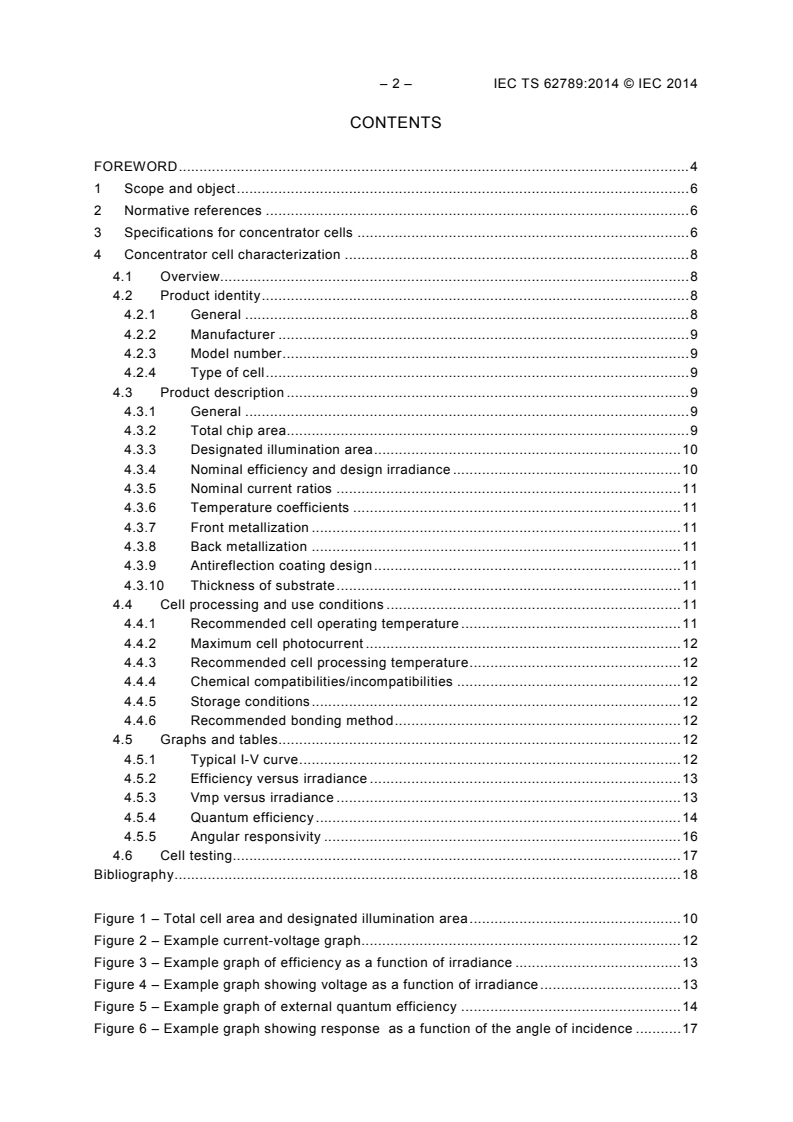
– 2 – IEC TS 62789:2014 © IEC 2014
CONTENTS
FOREWORD . 4
1 Scope and object . 6
2 Normative references . 6
3 Specifications for concentrator cells . 6
4 Concentrator cell characterization . 8
4.1 Overview. 8
4.2 Product identity . 8
4.2.1 General . 8
4.2.2 Manufacturer . 9
4.2.3 Model number . 9
4.2.4 Type of cell . 9
4.3 Product description . 9
4.3.1 General . 9
4.3.2 Total chip area. 9
4.3.3 Designated illumination area . 10
4.3.4 Nominal efficiency and design irradiance . 10
4.3.5 Nominal current ratios . 11
4.3.6 Temperature coefficients . 11
4.3.7 Front metallization . 11
4.3.8 Back metallization . 11
4.3.9 Antireflection coating design . 11
4.3.10 Thickness of substrate . 11
4.4 Cell processing and use conditions . 11
4.4.1 Recommended cell operating temperature . 11
4.4.2 Maximum cell photocurrent . 12
4.4.3 Recommended cell processing temperature . 12
4.4.4 Chemical compatibilities/incompatibilities . 12
4.4.5 Storage conditions . 12
4.4.6 Recommended bonding method . 12
4.5 Graphs and tables. 12
4.5.1 Typical I-V curve . 12
4.5.2 Efficiency versus irradiance . 13
4.5.3 Vmp versus irradiance . 13
4.5.4 Quantum efficiency . 14
4.5.5 Angular responsivity . 16
4.6 Cell testing. 17
Bibliography . 18
Figure 1 – Total cell area and designated illumination area . 10
Figure 2 – Example current-voltage graph. 12
Figure 3 – Example graph of efficiency as a function of irradiance . 13
Figure 4 – Example graph showing voltage as a function of irradiance . 13
Figure 5 – Example graph of external quantum efficiency . 14
Figure 6 – Example graph showing response as a function of the angle of incidence . 17
Table 1 – Specification template . 7
Table 2 – Example tabulation of quantum efficiency data . 14
– 4 – IEC TS 62789:2014 © IEC 2014
INTERNATIONAL ELECTROTECHNICAL COMMISSION
____________
PHOTOVOLTAIC CONCENTRATOR CELL DOCUMENTATION
FOREWORD
1) The International Electrotechnical Commission (IEC) is a worldwide organization for standardization comprising
all national electrotechnical committees (IEC National Committees). The object of IEC is to promote
international co-operation on all questions concerning standardization in the electrical and electronic fields. To
this end and in addition to other activities, IEC publishes International Standards, Technical Specifications,
Technical Reports, Publicly Available Specifications (PAS) and Guides (hereafter referred to as “IEC
Publication(s)”). Their preparation is entrusted to technical committees; any IEC National Committee interested
in the subject dealt with may participate in this preparatory work. International, governmental and non-
governmental organizations liaising with the IEC also participate in this preparation. IEC collaborates closely
with the International Organization for Standardization (ISO) in accordance with conditions determined by
agreement between the two organizations.
2) The formal decisions or agreements of IEC on technical matters express, as nearly as possible, an international
consensus of opinion on the relevant subjects since each technical committee has representation from all
interested IEC National Committees.
3) IEC Publications have the form of recommendations for international use and are accepted by IEC National
Committees in that sense. While all reasonable efforts are made to ensure that the technical content of IEC
Publications is accurate, IEC cannot be held responsible for the way in which they are used or for any
misinterpretation by any end user.
4) In order to promote international uniformity, IEC National Committees undertake to apply IEC Publications
transparently to the maximum extent possible in their national and regional publications. Any divergence
between any IEC Publication and the corresponding national or regional publication shall be clearly indicated in
the latter.
5) IEC itself does not provide any attestation of conformity. Independent certification bodies provide conformity
assessment services and, in some areas, access to IEC marks of conformity. IEC is not responsible for any
services carried out by independent certification bodies.
6) All users should ensure that they have the latest edition of this publication.
7) No liability shall attach to IEC or its directors, employees, servants or agents including individual experts and
members of its technical committees and IEC National Committees for any personal injury, property damage or
other damage of any nature whatsoever, whether direct or indirect, or for costs (including legal fees) and
expenses arising out of the publication, use of, or reliance upon, this IEC Publication or any other IEC
Publications.
8) Attention is drawn to the Normative references cited in this publication. Use of the referenced publications is
indispensable for the correct application of this publication.
9) Attention is drawn to the possibility that some of the elements of this IEC Publication may be the subject of
patent rights. IEC shall not be held responsible for identifying any or all such patent rights.
The main task of IEC technical committees is to prepare International Standards. In
exceptional circumstances, a technical committee may propose the publication of a technical
specification when
• the required support cannot be obtained for the publication of an International Standard,
despite repeated efforts, or
• the subject is still under technical development or where, for any other reason, there is the
future but no immediate possibility of an agreement on an International Standard.
Technical specifications are subject to review within three years of publication to decide
whether they can be transformed into International Standards.
IEC TS 62789, which is a technical specification, has been prepared by IEC technical
committee 82: Solar photovoltaic energy systems.
The text of this technical specification is based on the following documents:
Enquiry draft Report on voting
82/776/DTS 82/821/RVC
Full information on the voting for the approval of this technical specification can be found in
the report on voting indicated in the above table.
This publication has been drafted in accordance with the ISO/IEC Directives, Part 2.
The committee has decided that the contents of this publication will remain unchanged until
the stability date indicated on the IEC website under "http://webstore.iec.ch" in the data
related to the specific publication. At this date, the publication will be
• transformed into an International standard,
• reconfirmed,
• withdrawn,
• replaced by a revised edition, or
• amended.
IMPORTANT – The 'colour inside' logo on the cover page of this publication indicates
that it contains colours which are considered to be useful for the correct
understanding of its contents. Users should therefore print this document using a
colour printer.
– 6 – IEC TS 62789:2014 © IEC 2014
PHOTOVOLTAIC CONCENTRATOR CELL DOCUMENTATION
1 Scope and object
This Technical Specification provides guidelines for the parameters to be specified for
concentrator photovoltaic cells (both multijunction and single junction) and provides
recommendations and references for measurement techniques. No attempt is made to
determine pass/fail criteria for cells.
The purpose of this specification is to define the performance and physical characteristics of
concentrator cells. This specification may also be used for describing cell assemblies and
receivers, but is not written to specifically address cell packaging. It is not intended to
standardize the properties of the concentrator cells, but to standardize how the properties are
communicated.
2 Normative references
The following documents, in whole or in part, are normatively referenced in this document and
are indispensable for its application. For dated references, only the edition cited applies. For
undated references, the latest edition of the referenced document (including any
amendments) applies.
IEC 60904-3, Photovoltaic devices – Part 3: Measurement principles for terrestrial
photovoltaic (PV) solar devices with reference spectral irradiance data
IEC 62787, Concentrator photovoltaic (CPV) solar cells and cell-on-carrier (COC) assemblies
– Reliability qualification
3 Specifications for concentrator cells
All concentrator cell datasheets complying with this specification shall provide, as part of their
product marking and documentation, the information specified in Table 1 below. See
subsequent clauses and subclauses of this Technical Specification for further explanation of
individual specifications. In addition to the information indicated by the examples, it is
required to include a sketch of the cell and the indicated graphs.
Some of the specifications are optional; however, if a concentrator cell manufacturer chooses
to include optional information, it should be reported and measured using the definitions
provided in this Technical specification.
_____________
To be published.
Table 1 – Specification template
Characteristic Example Notes/Section
Product identification 4.2
Manufacturer The XYZ Company 4.2.2
Model number XX1090 4.2.3
Type of cell Three junction: GaInP (1,89 eV) / 4.2.4
GaInAs (1,39 eV) /
Ge (0,67 eV) on germanium substrate
Product description 4.3
Total area 4.3.2
(1,1 ± 0,003) cm × (1 ± 0,003) cm
Designated illumination area (1 ± 0,003) cm × (1 ± 0,003) cm 4.3.3
(see example Figure 1)
Simulator performance-defining area
1,01 ± 0,006 cm
Nominal efficiency at design irradiance 4.3.4
39 % ± 2 % at 500 kW/m
Nominal current ratios Current ratios under G173 direct spectrum 4.3.5
(relative to top junction current):
1,89 eV cell = 1
1,39 eV cell = 1,0 ± 0,03
0,67 eV = 1,7 ± 0,03
Temperature coefficients (measured at the 4.3.6
α = dIsc/dT = + (0,11 % ± 0,03 %)/K when
irradiance for which the product was
1,89 eV-cell limited;
designed)
+(0,07 % ± 0,03 %)/K when 1,39 eV-cell
limited
β = dVoc/dT = – (0,15 % ± 0,02 %)/K
dPmax/dT = – (0,24 % ± 0,06 %)/K
Measured at 1 000 kW/m ; AM1,5 direct;
temperature range of 25 °C to 70 °C. Other
conditions may also be documented.
Front metallization Silver 4.3.7
Front metallization thickness 4.3.7
1 µm
Back metallization Gold 4.3.8
Anti-reflection coating design Matched to index of 1.4 4.3.9
Thickness of substrate 4.3.10
150 µm
Cell processing and use conditions 4.4
Recommended operating (cell) temperature 4.4.1
–20 °C < T < 150 °C
Maximum photocurrent 1 A/cm 4.4.2
Recommended processing temperature 4.4.3
< 350 °C for 10 min
Chemical compatibilities/ incompatibilities Incompatible with aqua regia 4.4.4
Storage conditions (shelf life, humidity, 4.4.5
Storage 10 °C < T < 30 °C
temperature, and atmosphere)
20 % < RH < 70 %
Shelf life < 4 months
Atmosphere = air
Recommended bonding method Front side: wire bonding 4.4.6
Back side: solder
Electrostatic discharge threshold As measured in
future IEC 62787
– 8 – IEC TS 62789:2014 © IEC 2014
Characteristic Example Notes/Section
Graphs/Tables 4.5
Typical I-V curve (measured at the See example Figure 2 4.5.1
irradiance for which the product was
NOTE It is requested that irradiance be
designed, AM1,5 Direct spectrum, 25 °C).
specified in units of kW/m , since these units
Isc, Imp, Vmp, Voc, FF, Efficiency specified
also indicate the approximate concentration
Efficiency as function of irradiance at 25 °C See example Figure 3 4.5.2
NOTE It is requested that irradiance be
specified in units of kW/m , since these units
also indicate the approximate concentration
Voltage at maximum power point as a See example Figure 4 4.5.3
function of irradiance at 25 °C
NOTE It is requested that irradiance be
specified in units of kW/m , since these units
also indicate the approximate concentration
Quantum efficiency (presented as either a See example Figure 5 4.5.4
graph or a table). One curve for each
junction, measured at 25 °C
Angular responsivity, Isc as a function of See example Figure 6 4.5.5
incidence angle compared with cosine
function
Cell testing 4.6
LIV and other characterization testing: Note 500 kW/m ; AM1,5D; 25 °C; 100 % of Example only;
conditions for testing and sampling rate samples refer to
description in
4.6
Stress testing: Describe stress testing that is Certification to future IEC 62787 Example only;
applied and sampling rate, if applicable refer to
description in
4.6
4 Concentrator cell characterization
4.1 Overview
This clause describes parameters and guidelines for characterizing concentrator cells, with
one subclause for each entry in Table 1. It is useful for datasheets to present similar types of
information and the primary purpose of this Technical Specification is to facilitate consistency
between datasheets. However, recognizing that the information that is presented represents a
typical cell rather than a specific cell, small variations in testing methodology may be
unimportant. The focus of this specification is to provide consistent definitions of test
conditions rather than to specify precise methods for the measurements. In the future, it may
be useful to define the measurement techniques in more detail, but there is not yet consensus
on all of the details of the measurements. For example, characterizing/controlling the
spectrum as a function of time and location during the flash of a simulator can be quite
challenging and each lab has its own method for controlling the spectrum. Some of the
measurements described in this specification may have uncertainties on the order of
5 % to 10 %. Defining careful measurement techniques that can reduce these uncertainties
will be useful, but is outside of the scope of this specification.
4.2 Product identity
4.2.1 General
The datasheet shall unambiguously define the identity of the product. This may become
especially confusing if a different model number is used for a concentrator cell and a mounted
cell.
4.2.2 Manufacturer
In some cases, multiple manufacturers may be involved for the epitaxial growth, cell
processing, and cell testing. The name of the manufacturer should identify the company that
is responsible for the creation of the datasheet.
4.2.3 Model number
The model number should be unique to the described product.
4.2.4 Type of cell
The description of the cell should include at a minimum:
• The number of junctions
• The material(s) used for each junction
• The band gap associated with each junction if this is not clear from the material (e.g.
silicon needs no clarification)
• The substrate
Optionally, the thicknesses of each of the layers may also be included.
4.3 Product description
4.3.1 General
A drawing is needed to define the sample geometry.
4.3.2 Total chip area
The total cell (chip) area is needed for designing cell assemblies and how cells will be
implemented into CPV modules. The total area designation should include the dimensions
(e.g. 1 cm × 1,1 cm) and a sketch. The sketch should include the total chip dimensions as well
as the inactive areas that are both metallized and unmetallized. Figure 1 is an example,
including an expanded view of the lower right corner; the cell manufacturer may use a
different method to communicate the correct geometry.
– 10 – IEC TS 62789:2014 © IEC 2014
Total width 1,105 cm
Expansion of corner
Bus bar
Active area
that is not
illuminated
(indicated
as white)
Inactive area (black)
Illuminated area width 1,000 cm
Bus bar width 0,050 cm
IEC
Figure 1 – Total cell area and designated illumination area
4.3.3 Designated illumination area
In contrast to flat-plate cells that are usually 100 % illuminated, the design of many
concentrator systems allows for the cells’ contacts to be made outside of the illuminated area.
On the datasheet, the sketch should include indication of the location and dimensions of the
designated illumination area, referring to the area that is designed to be illuminated, including
the area of grid lines and busbars that are intended to be illuminated. The dimensions of the
busbar that will be used for electrical contact should be well defined. This can be confusing
because some concentrator cells include an area that responds to illumination but that is not
intended to be illuminated. Specifically, to prevent shorting, busbars are often designed to
leave a lip that is light active but will lie outside of the optical path. Thus, light-active areas
that are not intended to be illuminated should be masked during the measurement process,
or, a mathematical correction may be applied using the area on the simulator performance-
definition area.
Simulator performance-definition area (area that is illuminated during test) = [area inside
mesa isolation or cell edge (if no mesa)] – [busbars or bond pads].
Designated illumination area = the area designed to be illuminated between busbars and
mesas or cell edge.
4.3.4 Nominal efficiency and design irradiance
The nominal efficiency should be reported for a typical cell measured under the following
conditions:
• Design irradiance kW/m
• AM1,5 Direct (as specified in IEC 60904-3), and
• 25 °C cell temperature.
Total height 1,010 cm
Illuminated area height 1,000 cm
The design irradiance is also specified. Methods for measuring I-V curves can be found in
references listed above. The uncertainty of the measurement should be estimated and
included.
4.3.5 Nominal current ratios
The photocurrents for each junction within a multijunction cell can be measured by adjusting
the spectrum or by integrating the quantum efficiency curve convoluted with the spectrum of
interest. The expected current ratios should be specified for the IEC 60904-3 direct reference
spectrum measured at 25 °C in air (for the described package). If the product is a bare cell
that will be encapsulated it could be useful to quote the values for measurement with the
encapsulation, but this could become confusing since applying encapsulation, protective glass
and/or secondary optics could change the optics. If such information is supplied, it should be
clearly labelled as to how it was measured. By convention, the top cell will be considered to
have a relative current of unity and the ratios of the currents for each of the other subcells are
noted relative to the top-cell current. The ratios will apply to the same measurement
conditions used to determine the nominal efficiency. The variability of these ratios should be
reflected in the indication of the uncertainty. The junction identification should match the
description of the cell in an unambiguous way by specifying the band gap, composition,
junction number or other unique identifier.
4.3.6 Temperature coefficients
The temperature coefficients for the Voc (open-circuit voltage) and Pmax (maximum power)
can be obtained by measuring the I-V curves for the cell under the irradiance for which the
cell was designed and AM1,5 Direct illumination for a set of temperatures spanning a range of
at least 70 °C and/or within the full operating temperature range, as specified by the
manufacturer (see 4.4.1). The temperature coefficient of the Isc (short-circuit current) is
especially difficult to measure and may best be reported from literature values or from
integration of the quantum efficiency measured at variable temperatures considering bandgap
lowering with increased temperature. All temperature coefficients should be expressed in
relative units (%/K) and uncertainties included. Temperature coefficients for multiple
irradiance levels may be included at the discretion of the manufacturer.
4.3.7 Front metallization
The chemical composition and thickness of the front metallization should be described with
enough detail to facilitate contact formation.
4.3.8 Back metallization
The chemical composition of the back metallization should be described with enough detail to
facilitate contact formation.
4.3.9 Antireflection coating design
Specify the index of refraction that the antireflection coating was designed to match to (for
example, to air (n = 1)).
4.3.10 Thickness of substrate
The thickness of the substrate should be specified.
4.4 Cell processing and use conditions
4.4.1 Recommended cell operating temperature
If the cell operating temperature is increased, it may cause premature failure of the cells.
Operation at very low temperatures may become problematic if the tunnel junction function
becomes limited. The manufacturer should identify a recommended operating range.
– 12 – IEC TS 62789:2014 © IEC 2014
4.4.2 Maximum cell photocurrent
The performance of a multijunction cell may decrease dramatically if the local photocurrent
exceeds the capacity of the tunnel junctions. Silicon cells may show reduced output if carrier
concentrations reach levels causing Auger recombination. The maximum recommended cell
photocurrent should be specified with units of A/cm .
4.4.3 Recommended cell processing temperature
A processing temperature and time should be specified after which the cells will still retain the
properties as described in the datasheet.
4.4.4 Chemical compatibilities/incompatibilities
List common chemicals or processes that would lead to degradation of the cell performance,
or that are recommended.
4.4.5 Storage conditions
Describe recommended storage conditions of the cell at least including storage temperature,
humidity, atmosphere (ex. dry box, nitrogen-purged plastic bag) and shelf life. Storage
conditions are important both for protection of bare cells and for preserving the surface
condition of the bonding pads.
4.4.6 Recommended bonding method
The metallization configuration is typically designed to be suitable for a specific bonding
method such as wire bonding, soldering, welding or gluing. This bonding method may vary
between the front and back sides and, therefore, needs to be specified for both the front and
the back.
4.5 Graphs and tables
4.5.1 Typical I-V curve
The I-V curve measured in 4.3.3 to determine the nominal efficiency should be shown along
with the measured values for Isc, Imp, Vmp, Voc, FF, and efficiency, as shown in Figure 2.
Optionally, a power-voltage curve may be included.
Efficiency = 36,1 %
Voltage = 2,902 V
Current = 14,0 A/cm
Fill factor = 88,9 %
Vmp = 2,69 V
Imp = 13,4 A/cm
Measured at 1 000 kW/m ; 25 °C
0,0 1,0 2,0 3,0
Voltage (V)
IEC
Figure 2 – Example current-voltage graph
Current (A)
4.5.2 Efficiency versus irradiance
The efficiency measured as a function of irradiance for the AM1,5 Direct spectrum and 25 °C
cell temperature, as shown in Figure 3.
It is requested that irradiance be specified in units of kW/m , since these units also indicate
the approximate concentration.
25°C
2 3 4 5 6 7 8 9
10 100
Irradiance (kW/m )
IEC
Figure 3 – Example graph of efficiency as a function of irradiance
4.5.3 Vmp versus irradiance
The Vmp measured as a function of irradiance for the AM1,5 direct spectrum and 25 °C cell
temperature, as shown in Figure 4.
2,5
2,4
2 3 4 5 6 7 8 9
10 100
Irradiance (kW/m )
IEC
Figure 4 – Example graph showing voltage as a function of irradiance
Efficiency (%)
Voltage (V)
– 14 – IEC TS 62789:2014 © IEC 2014
4.5.4 Quantum efficiency
Plot or tabulate the typical external quantum efficiency as a function of wavelength for each
junction as measured on a cell taken from the bin with the greatest population, as shown in
Figure 5 and Table 2. It is understood that this data will vary slightly from sample to sample.
1,4 eV cell
1,8 eV cell
0,5
2 3
Photon energy (eV)
IEC
Figure 5 – Example graph of external quantum efficiency
Table 2 – Example tabulation of quantum efficiency data
Wavelength Top cell response Bottom cell response
nm unitless unitless
350 0,288
355 0,323
360 0,357
365 0,395
370 0,438
375 0,469
380 0,495
385 0,526
390 0,570
395 0,611
400 0,644
405 0,675
410 0,700
415 0,724
420 0,730
425 0,742
430 0,750
435 0,760
440 0,767
445 0,782
450 0,789
455 0,800
460 0,806
465 0,821
External quantum efficiency
Wavelength Top cell response Bottom cell response
nm unitless unitless
470 0,819
475 0,833
480 0,844
485 0,850
490 0,857
495 0,867
500 0,878
505 0,888
510 0,900
515 0,908
520 0,907
525 0,911
530 0,908
535 0,904
540 0,903
545 0,905
550 0,915
555 0,926
560 0,916
565 0,908
570 0,875
575 0,907
580 0,883
585 0,872
590 0,879
595 0,882
600 0,850
605 0,861
610 0,834
615 0,829
620 0,797
625 0,780 0,103
630 0,742 0,102
635 0,724 0,109
640 0,682 0,105
645 0,653 0,121
650 0,558 0,144
655 0,46 0,167
660 0,278 0,208
665 0,132 0,257
670 0,050 0,272
675 0,019 0,286
680 0,010 0,287
685 0,0096 0,285
690 0,009 0,274
695 0,008 0,275
700 0,004 0,269
705 0,00 0,28
710 0,286
715 0,295
– 16 – IEC TS 62789:2014 © IEC 2014
Wavelength Top cell response Bottom cell response
nm unitless unitless
720 0,296
725 0,3
730 0,291
735 0,281
740 0,278
745 0,267
750 0,269
755 0,269
760 0,28
765 0,289
770 0,299
775 0,307
780 0,308
785 0,306
790 0,295
795 0,287
800 0,274
805 0,273
810 0,263
815 0,266
820 0,268
825 0,273
830 0,282
835 0,292
840 0,298
845 0,303
850 0,308
855 0,3
860 0,286
865 0,273
870 0,265
875 0,225
880 0,131
885 0,051
890 0,0218
895 0,0126
900 0,00657
905 0,00621
910 0,00635
4.5.5 Angular responsivity
Plot or tabulate the angular dependence of the Isc as measured in air for the described
package, as shown in Figure 6. If the measurement applies to a bare cell that has been
packaged in a way that is not part of the product, such data shall be clearly labelled.
Preferably, the cosine function will be superimposed on the measured data for comparison. If
preferred, the response may be presented relative to the cosine response. In this case, the
deviation from cosine is more apparent, but as glancing angles are approached, the
uncertainty of the relative response may be very large, resulting in a misleading graph. The
angular response should be documented for rotation parallel to grids and perpendicular to
grids unless these are not easily distinguished.
Cosine function
Cell, rotation
parallel to grids
0,5
Cell, rotation
perpendicular to grids
0 20 40 60 80
Angle (degrees)
IEC
Figure 6 – Example graph showing response
as a function of the angle of incidence
4.6 Cell testing
Describe types of tests, fraction of cells that are tested, and pass conditions that are applied
both for performance and qualification. Understanding the test procedures helps the customer
assess the consistency of the product that can be expected and/or requested.
Relative response
– 18 – IEC TS 62789:2014 © IEC 2014
Bibliography
IEC 61836:2007, Solar photovoltaic energy systems – Terms, definitions and symbols
IEC 62108, Concentrator photovoltaic (CPV) modules and assemblies – Design qualification
and type approval
Emery K, Meusel M, Beckert R, Dimroth F, Bett A, Warta W, Procedures for Evaluating
th
Multijunction Concentrators, 28 IEEE Photovoltaic Specialists Conference, Anchorage,
Alaska, 2000 (IEEE, New York), p. 1126
Emery KA, Osterwald CR, Current topics in photovoltaics, Vol. 3 (Academic Press, 1988),
pp. 301-350
Emery KA, Handbook of Photovoltaic Science and Engineering, edited by A. Luque and S.
Hegedus (John Wiley and Sons, West Sussex, England, 2003), pp. 701-747
Kinsey GS, Hebert P, Barbour KE, Krut DD, Cotal HL, Sherif RA, Concentrator Multijunction
Solar Cell Characteristics Under Variable Intensity and Temperature, Prog. Photovolt. 2008,
16(503-508)
Virshup GF, Chung B-C, Ladle Ristow M, Kuryla MS, Brinker D, Temperature coefficients of
multijunction solar cells, 21st IEEE PVSC, 1990 (IEEE), pp. 336-338
_____________
– 20 – IEC TS 62789:2014 © IEC 2014
SOMMAIRE
AVANT-PROPOS . 22
1 Domaine d’application et objet . 24
2 Références normatives . 24
3 Spécifications relatives aux cellules à concentration . 24
4 Caractérisation des cellules à concentration . 26
4.1 Aperçu . 26
4.2 Identité du produit . 27
4.2.1 Généralités . 27
4.2.2 Fabricant . 27
4.2.3 Numéro du modèle . 27
4.2.4 Type de cellule . 27
4.3 Description du produit . 27
4.3.1 Généralités . 27
4.3.2 Surface totale de la puce . 27
4.3.3 Surface d’éclairement désignée . 28
4.3.4 Rendement nominal et éclairement de conception . 28
4.3.5 Rapports des courants nominaux . 29
4.3.6 Coefficients de température . 29
4.3.7 Métallisation face avant . 29
4.3.8 Métallisation face arrière . 29
4.3.9 Conception du revêtement anti-reflet . 29
4.3.10 Epaisseur du substrat . 29
4.4 Conditions de traitement et d’utilisation des cellules . 30
4.4.1 Température de fonctionnement recommandée d’une cellule . 30
4.4.2 Courant photoélectrique maximal d’une cellule . 30
4.4.3 Température recommandée de traitement d’une cellule . 30
4.4.4 Compatibilités/incompatibilités chimiques . 30
4.4.5 Conditions de stockage . 30
4.4.6 Méthode de câblage recommandée . 30
4.5 Graphiques et tableaux . 30
4.5.1 Courbe I-V type . 30
4.5.2 Rendement en fonction de l’éclairement . 31
4.5.3 Vmp en fonction de l’éclairement . 31
4.5.4 Rendement quantique . 32
4.5.5 Réponse angulaire . 35
4.6 Essais sur les cellules . 35
Bibliographie . 36
Figure 1 – Surface totale de la cellule et surface d’éclairement désignée . 28
Figure 2 – Exemple de graphique courant-tension . 31
Figure 3 – Exemple de graphique du rendement en fonction de l’éclairement . 31
Figure 4 – Exemple de graphique de la tension en fonction de l’éclairement . 32
Figure 5 – Exemple de graphique du rendement quantique externe . 32
Figure 6 – Exemple de graphique présentant la réponse en fonction de l’angle
d'incidence . 35
Tableau 1 – Modèle de spécification .
...