

IEC 61196-1-308:2012
(Main)Coaxial communication cables - Part 1-308: Mechanical test methods - Test for tensile strength and elongation for copper-clad metals
General Information
- Abstract
IEC 61196-1-308:2012(E) applies to coaxial communication cables. It specifies test methods for tensile strength and percentage elongation at fracture for annealed and hard-drawn solid copper clad metals to be used as inner conductor for coaxial cables. This second edition cancels and replaces the first edition published in 2005. It constitutes a technical revision. Changes from the previous edition of the document are the addition of test methods for annealed copper-clad conductors. This second edition makes a distinction between annealed and hard-drawn solid copper clad metals. Requirements are more precise than in the first edition.
- Status
- Published
- Publication Date
- 29-Oct-2012
- Technical Committee
- SC 46A - Coaxial cables
- Drafting Committee
- WG 3 - TC 46/SC 46A/WG 3
- Current Stage
- PPUB - Publication issued
- Start Date
- 30-Oct-2012
- Completion Date
- 15-Jan-2012
Overview
IEC 61196-1-308:2012 is an international standard developed by the International Electrotechnical Commission (IEC) that specifies mechanical test methods for copper-clad metals used in coaxial communication cables. This standard focuses on testing the tensile strength and elongation at fracture for both annealed and hard-drawn solid copper-clad metals, which serve as inner conductors in coaxial cables. The second edition, published in 2012, supersedes the 2005 edition, introducing more precise requirements and specific test methods that differentiate between annealed and hard-drawn copper-clad conductors.
Adhering to IEC 61196-1-308:2012 ensures reliable mechanical performance of copper-clad metals in coaxial cables, facilitating durability and longevity in communication systems. This standard supports manufacturers, testing laboratories, and quality assurance personnel in validating cable conductor materials to meet required mechanical properties.
Key Topics
Scope
Applies to coaxial communication cables and defines procedures for testing tensile strength and percentage elongation at fracture for annealed and hard-drawn solid copper-clad metals used as inner conductors.Test Principles
The core test involves applying tensile force to a standardized test specimen at ambient temperature (between 10 °C and 35 °C) to measure the maximum tensile force and elongation at fracture.Test Equipment and Accuracy
High-precision force-measuring machines with an error margin of less than 1% and extensometers capable of measuring elongation over a gauge length of 250 mm with resolutions better than 0.25 mm are required.Specimen Preparation
Test specimens should have an original gauge length of 250 mm and a total length around 300 mm. Specimens must be straightened before testing to ensure accuracy.Test Procedure
- Measure the original cross-sectional area of the specimen using two diameter measurements taken 90° apart.
- Load the specimen incrementally to 10% of its minimum breaking load.
- Apply tensile load at controlled rates: no more than 25 mm/min for hard-drawn metals and 300 mm/min for annealed metals.
- Record the maximum tensile force and elongation at fracture, discarding tests where fracture occurs near clamping jaws.
Result Expressions
- Tensile Strength (Rₘ) = Maximum force (Fₘ) divided by the original cross-sectional area (S₀), expressed in N/mm².
- Percentage Elongation at Fracture (Aₜ) = ((Gauge length at fracture Lₜ - Original gauge length L₀) / Original gauge length L₀) × 100%.
Requirements
Tensile strength and elongation values must comply with the parameters defined in the relevant coaxial cable specifications.
Applications
IEC 61196-1-308:2012 is essential for ensuring the mechanical integrity of coaxial cable conductors in various telecommunications and broadcasting environments. The standard’s test methods allow manufacturers to:
- Verify the tensile properties of copper-clad conductors before cable assembly.
- Distinguish between annealed and hard-drawn copper-clad metals to optimize conductor performance based on application needs.
- Guarantee mechanical reliability under operational stresses, preventing cable failures due to conductor fracture or excessive elongation.
- Support quality control processes for production and procurement, aligning with international industry benchmarks.
This standard benefits sectors including cable manufacturing, telecom infrastructure development, satellite communication, and RF systems where coaxial cables are critical.
Related Standards
IEC 61196-1 – Coaxial communication cables – Part 1: Generic specification – General, definitions and requirements. This foundational standard provides the overarching framework and terminology applicable to the 61196 series.
Other parts of IEC 61196 series – Cover additional mechanical, electrical, and environmental test methods for coaxial communication cables.
ISO/IEC Directives, Part 2 – Guidelines for drafting and structuring international standards, ensuring consistency in IEC publications.
Using IEC 61196-1-308 in conjunction with related IEC standards fosters comprehensive conformity in coaxial cable manufacturing and testing, supporting global interoperability and performance excellence.
Keywords: IEC 61196-1-308, coaxial communication cables, copper-clad metals, tensile strength test, elongation test, mechanical test methods, annealed copper, hard-drawn copper, inner conductor, cable standards, IEC standard, coaxial cable conductor testing.
Relations
- Effective Date
- 05-Sep-2023
Get Certified
Connect with accredited certification bodies for this standard

DNV
DNV is an independent assurance and risk management provider.

Lloyd's Register
Lloyd's Register is a global professional services organisation specialising in engineering and technology.
DNV Energy Systems
Energy and renewable energy certification.
Sponsored listings
Frequently Asked Questions
IEC 61196-1-308:2012 is a standard published by the International Electrotechnical Commission (IEC). Its full title is "Coaxial communication cables - Part 1-308: Mechanical test methods - Test for tensile strength and elongation for copper-clad metals". This standard covers: IEC 61196-1-308:2012(E) applies to coaxial communication cables. It specifies test methods for tensile strength and percentage elongation at fracture for annealed and hard-drawn solid copper clad metals to be used as inner conductor for coaxial cables. This second edition cancels and replaces the first edition published in 2005. It constitutes a technical revision. Changes from the previous edition of the document are the addition of test methods for annealed copper-clad conductors. This second edition makes a distinction between annealed and hard-drawn solid copper clad metals. Requirements are more precise than in the first edition.
IEC 61196-1-308:2012(E) applies to coaxial communication cables. It specifies test methods for tensile strength and percentage elongation at fracture for annealed and hard-drawn solid copper clad metals to be used as inner conductor for coaxial cables. This second edition cancels and replaces the first edition published in 2005. It constitutes a technical revision. Changes from the previous edition of the document are the addition of test methods for annealed copper-clad conductors. This second edition makes a distinction between annealed and hard-drawn solid copper clad metals. Requirements are more precise than in the first edition.
IEC 61196-1-308:2012 is classified under the following ICS (International Classification for Standards) categories: 01 - GENERALITIES. TERMINOLOGY. STANDARDIZATION. DOCUMENTATION; 27.160 - Solar energy engineering; 33.120.10 - Coaxial cables. Waveguides. The ICS classification helps identify the subject area and facilitates finding related standards.
IEC 61196-1-308:2012 has the following relationships with other standards: It is inter standard links to IEC 61196-1-308:2005. Understanding these relationships helps ensure you are using the most current and applicable version of the standard.
IEC 61196-1-308:2012 is available in PDF format for immediate download after purchase. The document can be added to your cart and obtained through the secure checkout process. Digital delivery ensures instant access to the complete standard document.
Standards Content (Sample)
IEC 61196-1-308 ®
Edition 2.0 2012-10
INTERNATIONAL
STANDARD
Coaxial communication cables –
Part 1-308: Mechanical test methods – Test for tensile strength and elongation
for copper-clad metals
All rights reserved. Unless otherwise specified, no part of this publication may be reproduced or utilized in any form
or by any means, electronic or mechanical, including photocopying and microfilm, without permission in writing from
either IEC or IEC's member National Committee in the country of the requester.
If you have any questions about IEC copyright or have an enquiry about obtaining additional rights to this publication,
please contact the address below or your local IEC member National Committee for further information.
IEC Central Office Tel.: +41 22 919 02 11
3, rue de Varembé Fax: +41 22 919 03 00
CH-1211 Geneva 20 info@iec.ch
Switzerland www.iec.ch
About the IEC
The International Electrotechnical Commission (IEC) is the leading global organization that prepares and publishes
International Standards for all electrical, electronic and related technologies.
About IEC publications
The technical content of IEC publications is kept under constant review by the IEC. Please make sure that you have the
latest edition, a corrigenda or an amendment might have been published.
Useful links:
IEC publications search - www.iec.ch/searchpub Electropedia - www.electropedia.org
The advanced search enables you to find IEC publications The world's leading online dictionary of electronic and
by a variety of criteria (reference number, text, technical electrical terms containing more than 30 000 terms and
committee,…). definitions in English and French, with equivalent terms in
It also gives information on projects, replaced and additional languages. Also known as the International
withdrawn publications. Electrotechnical Vocabulary (IEV) on-line.
IEC Just Published - webstore.iec.ch/justpublished Customer Service Centre - webstore.iec.ch/csc
Stay up to date on all new IEC publications. Just Published If you wish to give us your feedback on this publication
details all new publications released. Available on-line and or need further assistance, please contact the
also once a month by email. Customer Service Centre: csc@iec.ch.
IEC 61196-1-308 ®
Edition 2.0 2012-10
INTERNATIONAL
STANDARD
Coaxial communication cables –
Part 1-308: Mechanical test methods – Test for tensile strength and elongation
for copper-clad metals
INTERNATIONAL
ELECTROTECHNICAL
COMMISSION
PRICE CODE
G
ICS 33.120.10 ISBN 978-2-83220-474-0
– 2 – 61196-1-308 © IEC:2012(E)
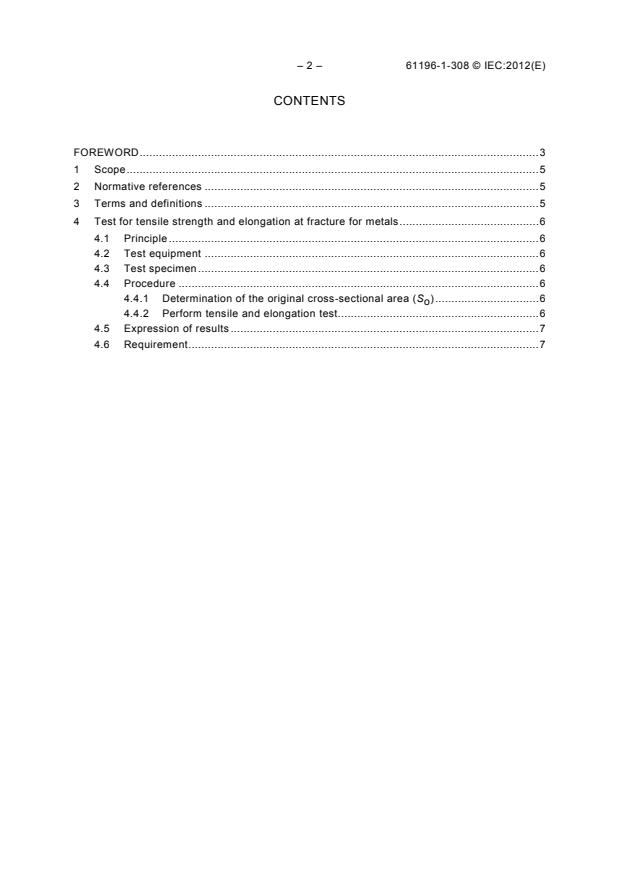
CONTENTS
FOREWORD . 3
1 Scope . 5
2 Normative references . 5
3 Terms and definitions . 5
4 Test for tensile strength and elongation at fracture for metals . 6
4.1 Principle . 6
4.2 Test equipment . 6
4.3 Test specimen . 6
4.4 Procedure . 6
4.4.1 Determination of the original cross-sectional area (S ) . 6
o
4.4.2 Perform tensile and elongation test. 6
4.5 Expression of results . 7
4.6 Requirement . 7
61196-1-308 © IEC:2012(E) – 3 –
INTERNATIONAL ELECTROTECHNICAL COMMISSION
____________
COAXIAL COMMUNICATION CABLES –
Part 1-308: Mechanical test methods –
Test for tensile strength and elongation
for copper-clad metals
FOREWORD
1) The International Electrotechnical Commission (IEC) is a worldwide organization for standardization comprising
all national electrotechnical committees (IEC National Committees). The object of IEC is to promote
international co-operation on all questions concerning standardization in the electrical and electronic fields. To
this end and in addition to other activities, IEC publishes International Standards, Technical Specifications,
Technical Reports, Publicly Available Specifications (PAS) and Guides (hereafter referred to as “IEC
Publication(s)”). Their preparation is entrusted to technical committees; any IEC National Committee interested
in the subject dealt with may participate in this preparatory work. International, governmental and non-
governmental organizations liaising with the IEC also participate in this preparation. IEC collaborates closely
with the International Organization for Standardization (ISO) in accordance with conditions determined by
agreement between the two organizations.
2) The formal decisions or agreements of IEC on technical matters express, as nearly as possible, an international
consensus of opinion on the relevant subjects since each technical committee has representation from all
interested IEC National Committees.
3) IEC Publications have the form of recommendations for international use and are accepted by IEC National
Committees in that sense. While all reasonable efforts are made to ensure that the technical content of IEC
Publications is accurate, IEC cannot be held responsible for the way in which they are used or for any
misinterpretation by any end user.
4) In order to promote international uniformity, IEC National Committees undertake to apply IEC Publications
transparently to the maximum extent possible in their national and regional publications. Any divergence
between any IEC Publication and the corresponding national or regional publication shall be clearly indicated in
the latter.
5) IEC itself does not provide any attestation of conformity. Independent certification bodies provide conformity
assessment services and, in some areas, access to IEC marks of conformity. IEC is not responsible for any
services carried out by independent certification bodies.
6) All users should ensure that they have the latest edition of this publicati
...