


CISPR TR 16-3:2000
(Main)Specification for radio disturbance and immunity measuring apparatus and methods - Part 3: Reports and recommendations of CISPR
General Information
- Abstract
Contains recommendations on statistics of disturbance complaints, on the significance of CISPR limits, on determination of CISPR limits and other specific reports which were for some time published in CISPR 7 and 8.
- Status
- Replaced
- Publication Date
- 25-Aug-2002
- Technical Committee
- CIS/A - Radio-interference measurements and statistical methods
- Current Stage
- DELPUB - Deleted Publication
- Start Date
- 23-Nov-2003
- Completion Date
- 09-Jan-2017
Buy Documents
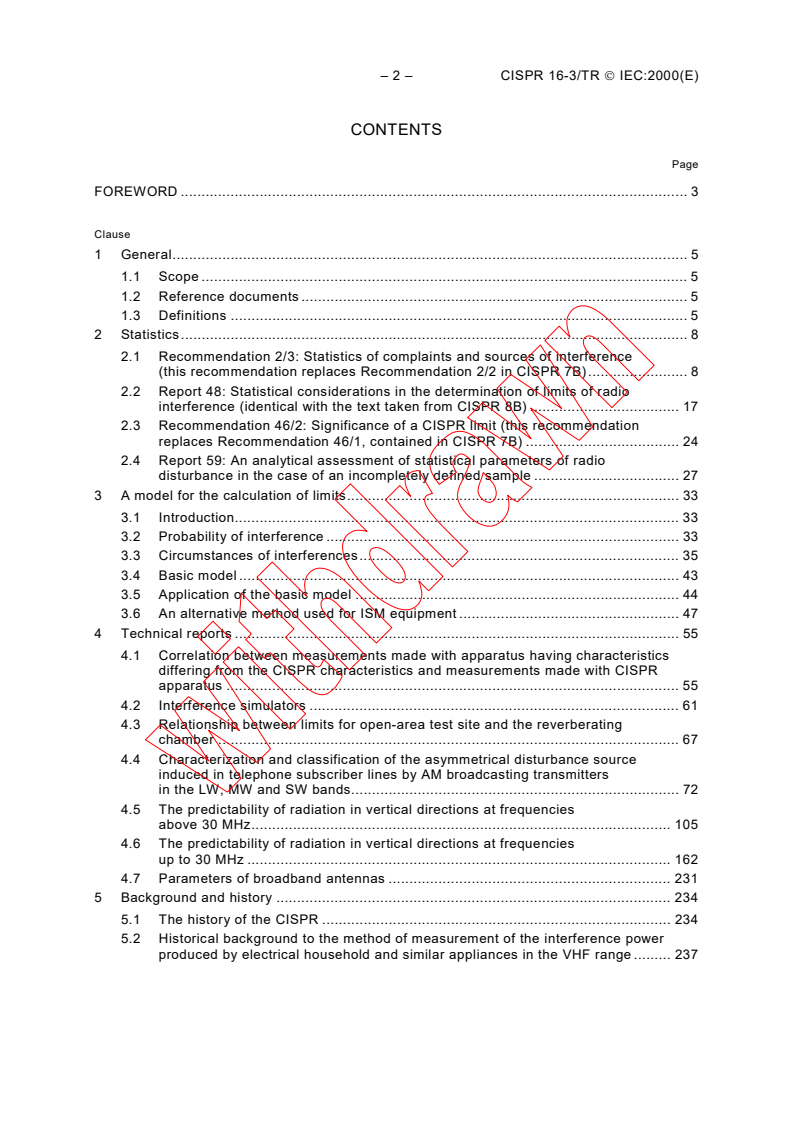
CISPR TR 16-3:2000 - Specification for radio disturbance and immunity measuring apparatus and methods - Part 3: Reports and recommendations of CISPR Released:5/30/2000
CISPR TR 16-3:2000+AMD1:2002 CSV - Specification for radio disturbance and immunity measuring apparatus and methods - Part 3: Reports and recommendations of CISPR Released:8/26/2002
Relations
- Effective Date
- 05-Sep-2023
- Effective Date
- 05-Sep-2023
- Effective Date
- 05-Sep-2023
- Effective Date
- 05-Sep-2023
- Effective Date
- 05-Sep-2023
Buy Documents
CISPR TR 16-3:2000 - Specification for radio disturbance and immunity measuring apparatus and methods - Part 3: Reports and recommendations of CISPR Released:5/30/2000
CISPR TR 16-3:2000+AMD1:2002 CSV - Specification for radio disturbance and immunity measuring apparatus and methods - Part 3: Reports and recommendations of CISPR Released:8/26/2002
Get Certified
Connect with accredited certification bodies for this standard

IMQ S.p.A. (Certification)
Italian electrical product certification.

SLG Prüf- und Zertifizierungs GmbH
German testing and certification body.

UL Solutions
Global safety science company with testing, inspection and certification.
Sponsored listings
Frequently Asked Questions
CISPR TR 16-3:2000 is a technical report published by the International Electrotechnical Commission (IEC). Its full title is "Specification for radio disturbance and immunity measuring apparatus and methods - Part 3: Reports and recommendations of CISPR". This standard covers: Contains recommendations on statistics of disturbance complaints, on the significance of CISPR limits, on determination of CISPR limits and other specific reports which were for some time published in CISPR 7 and 8.
Contains recommendations on statistics of disturbance complaints, on the significance of CISPR limits, on determination of CISPR limits and other specific reports which were for some time published in CISPR 7 and 8.
CISPR TR 16-3:2000 is classified under the following ICS (International Classification for Standards) categories: 17.220.99 - Other standards related to electricity and magnetism; 29.035.01 - Insulating materials in general; 33.100.10 - Emission; 33.100.20 - Immunity. The ICS classification helps identify the subject area and facilitates finding related standards.
CISPR TR 16-3:2000 has the following relationships with other standards: It is inter standard links to CISPR TR 16-4-1:2003, CISPR TR 16-4-4:2003, CISPR TR 16-4-3:2003, CISPR TR 16-3:2000/AMD1:2002, CISPR TR 16-3:2003. Understanding these relationships helps ensure you are using the most current and applicable version of the standard.
CISPR TR 16-3:2000 is available in PDF format for immediate download after purchase. The document can be added to your cart and obtained through the secure checkout process. Digital delivery ensures instant access to the complete standard document.
Standards Content (Sample)
TECHNICAL CISPR
REPORT 16-3
First edition
2000-05
INTERNATIONAL SPECIAL COMMITTEE ON RADIO INTERFERENCE
Specification for radio disturbance
and immunity measuring apparatus
and methods –
Part 3:
Reports and recommendations of CISPR
Spécifications des méthodes et des appareils de mesure
des perturbations radioélectriques et de l'immunité
aux perturbations radioélectriques –
Partie 3:
Rapports et recommandations du CISPR
Numéro de référence
Reference number
CISPR 16-3/TR:2000(E)
Revision of this publication
The technical content of IEC and CISPR publications is kept under constant review by the IEC and CISPR, thus
ensuring that the content reflects current technology.
Information on the subjects under consideration and work in progress undertaken by the technical com-mittee
which has prepared this publication, as well as the list of publications issued, is to be found at the following
IEC sources:
• IEC web site*
• Catalogue of IEC publications
Published yearly with regular updates
(On-line catalogue)*
• IEC Bulletin
Available both at the IEC web site* and
as a printed periodical
Terminology used in this publication
Only special terms required for the purpose of this publication are defined herein.
For general terminology, readers are referred to IEC 60050: International Electrotechnical Vocabulary (IEV), which is
issued in the form of separate chapters each dealing with a specific field, the General Index being published as a
separate booklet. Full details of the IEV will be supplied on request.
For terms on radio interference, see Chapter 902.
Graphical and letter symbols
For graphical symbols, and letter symbols and signs approved by the IEC for general use, readers are referred to:
– IEC 60027: Letter symbols to be used in electrical technology;
– IEC 60617: Graphical symbols for diagrams;
The symbols and signs contained in the present publication have either been taken from IEC 60027 or IEC 60617, or
have been specifically approved for the purpose of this publication.
* IEC web site
TECHNICAL
CISPR
REPORT
16-3
First edition
2000-05
INTERNATIONAL SPECIAL COMMITTEE ON RADIO INTERFERENCE
Specification for radio disturbance
and immunity measuring apparatus
and methods –
Part 3:
Reports and recommendations of CISPR
Spécifications des méthodes et des appareils de mesure
des perturbations radioélectriques et de l'immunité
aux perturbations radioélectriques –
Partie 3:
Rapports et recommandations du CISPR
© IEC 2000 Droits de reproduction réservés Copyright - all rights reserved
Aucune partie de cette publication ne peut être reproduite ni No part of this publication may be reproduced or utilized in
utilisée sous quelque forme que ce soit et par aucun procédé, any form or by any means, electronic or mechanical,
électronique ou mécanique, y compris la photo-copie et les including photocopying and microfilm, without permission in
microfilms, sans l'accord écrit de l'éditeur. writing from the publisher.
International Electrotechnical Commission 3, rue de Varembé Geneva, Switzerland
Telefax: +41 22 919 0300 e-mail: inmail@iec.ch IEC web site http://www.iec.ch
CODE PRIX
Commission Electrotechnique Internationale
PRICE CODE XH
International Electrotechnical Commission
Pour prix, voir catalogue en vigueur
For price, see current catalogue
– 2 – CISPR 16-3/TR IEC:2000(E)
CONTENTS
Page
FOREWORD . 3
Clause
1 General. 5
1.1 Scope . 5
1.2 Reference documents . 5
1.3 Definitions . 5
2 Statistics. 8
2.1 Recommendation 2/3: Statistics of complaints and sources of interference
(this recommendation replaces Recommendation 2/2 in CISPR 7B). 8
2.2 Report 48: Statistical considerations in the determination of limits of radio
interference (identical with the text taken from CISPR 8B) . 17
2.3 Recommendation 46/2: Significance of a CISPR limit (this recommendation
replaces Recommendation 46/1, contained in CISPR 7B) . 24
2.4 Report 59: An analytical assessment of statistical parameters of radio
disturbance in the case of an incompletely defined sample . 27
3 A model for the calculation of limits. 33
3.1 Introduction. 33
3.2 Probability of interference . 33
3.3 Circumstances of interferences. 35
3.4 Basic model . 43
3.5 Application of the basic model . 44
3.6 An alternative method used for ISM equipment . 47
4 Technical reports . 55
4.1 Correlation between measurements made with apparatus having characteristics
differing from the CISPR characteristics and measurements made with CISPR
apparatus . 55
4.2 Interference simulators . 61
4.3 Relationship between limits for open-area test site and the reverberating
chamber . 67
4.4 Characterization and classification of the asymmetrical disturbance source
induced in telephone subscriber lines by AM broadcasting transmitters
in the LW, MW and SW bands. 72
4.5 The predictability of radiation in vertical directions at frequencies
above 30 MHz. 105
4.6 The predictability of radiation in vertical directions at frequencies
up to 30 MHz . 162
4.7 Parameters of broadband antennas . 231
5 Background and history . 234
5.1 The history of the CISPR . 234
5.2 Historical background to the method of measurement of the interference power
produced by electrical household and similar appliances in the VHF range . 237
CISPR 16-3/TR © IEC:2000(E) – 3 –
INTERNATIONAL ELECTROTECHNICAL COMMISSION
____________
SPECIFICATION FOR RADIO DISTURBANCE
AND IMMUNITY MEASURING APPARATUS AND METHODS –
Part 3: Reports and recommendations of CISPR
FOREWORD
1) The IEC (International Electrotechnical Commission) is a worldwide organization for standardization comprising
all national electrotechnical committees (IEC National Committees). The object of the IEC is to promote
international co-operation on all questions concerning standardization in the electrical and electronic fields. To
this end and in addition to other activities, the IEC publishes International Standards. Their preparation is
entrusted to technical committees; any IEC National Committee interested in the subject dealt with may
participate in this preparatory work. International, governmental and non-governmental organizations liaising
with the IEC also participate in this preparation. The IEC collaborates closely with the International
Organization for Standardization (ISO) in accordance with conditions determined by agreement between the
two organizations.
2) The formal decisions or agreements of the IEC on technical matters express, as nearly as possible, an
international consensus of opinion on the relevant subjects since each technical committee has representation
from all interested National Committees.
3) The documents produced have the form of recommendations for international use and are published in the form
of standards, technical specifications, technical reports or guides and they are accepted by the National
Committees in that sense.
4) In order to promote international unification, IEC National Committees undertake to apply IEC International
Standards transparently to the maximum extent possible in their national and regional standards. Any
divergence between the IEC Standard and the corresponding national or regional standard shall be clearly
indicated in the latter.
5) The IEC provides no marking procedure to indicate its approval and cannot be rendered responsible for any
equipment declared to be in conformity with one of its standards.
6) Attention is drawn to the possibility that some of the elements of this International Standard may be the subject
of patent rights. The IEC shall not be held responsible for identifying any or all such patent rights.
The main task of IEC technical committees is to prepare International Standards. However, a
technical committee may propose the publication of a technical report when it has collected
data of a different kind from that which is normally published as an International Standard, for
example "state of the art".
Technical reports do not necessarily have to be reviewed until the data they provide are
considered to be no longer valid or useful.
CISPR 16-3, which is a technical report, has been prepared by CISPR subcommittee A: Radio
interference measurements and statistical methods.
The text of this technical report is based on the following documents:
Enquiry draft Report on voting
CISPR/A/CO/67 CISPR/A(CO)82
CISPR/A/CO/77 CISPR/A(CO)84
Full information on the voting for the approval of this technical report can be found in the
report on voting indicated in the above table.
This publication has been drafted in accordance with the ISO/IEC Directives, Part 3.
– 4 – CISPR 16-3/TR IEC:2000(E)
This document which is purely informative is not to be regarded as an International Standard.
The text of this report is based on the following documents:
Recommendation 2/2 – p/o CISPR. 7B, 1975; Recommendation 46/1 – p/o CISPR. 11, 1990;
Report 33 – p/o CISPR 8, 1969; Report 38 – p/o CISPR 8, 1969; Report 48 – p/o CISPR 8B,
1975; Report 49 – p/o CISPR 8C, 1980; Report 61 = CISPR 23, 1987; Report 59:
CIS/A(Sec)58 + CIS/A(Sec)58A, 1983; Report: CIS/A(Sec)67 + CIS/A(Sweden)29; RM
2828/CISPR/A, 1985; CIS/A(CO)32, 1985; CIS/A(Sec)58, 1983; CIS/A(Sec)58A, 1983;
CIS/A(Sec)67, 1985; CIS/A(CO)67, 1992; CIS/A(CO)67A, 1993; CIS/A(CO)77A, 1993;
CIS/A(CO)81, 1987; CIS/A(CO)82, 1994; CIS/A(CO)84, 1994; CIS/A(Sec)84, 1987;
CIS/A(Sec)88, 1988; CIS/A(Sec)88A, 1988; CIS/A(Sec)94, 1989; CIS/A(Sec)115, 1991;
CIS/A(Sec)115A, 1991; CIS/A(Sec)116, 1991; CIS/A(Sec)124, 1991; CIS/A(Sec)128, 1992;
CIS/A(Sec)132, 1993; CIS/A/166/CD, 1995.
A bilingual version of this publication may be issued at a later date.
CISPR 16-3/TR © IEC:2000(E) – 5 –
SPECIFICATION FOR RADIO DISTURBANCE
AND IMMUNITY MEASURING APPARATUS AND METHODS –
Part 3: Reports and recommendations of CISPR
1 General
1.1 Scope
This part of CISPR 16 contains recommendations on statistics of disturbance complaints, on
the significance of CISPR limits, on determination of CISPR limits and other specific reports.
Over the years, the CISPR prepared a number of recommendations and reports that have
significant technical merit but were not generally available. Reports and recommendations
were for some time published in CISPR 7 and 8.
At its meeting in Campinas, Brazil, in 1988, subcommittee A agreed on the table of contents
of part 3 and to publish the reports for posterity by giving the reports a permanent place in
part 3.
1.2 Reference documents
IEC 60083:1997, Plugs and socket-outlets for domestic and similar general use standardized
in member countries of IEC
IEC 60364-4, Electrical installations of buildings – Part 4: Protection for safety
CISPR 11:1997, Industrial, scientific and medical (ISM) radio-frequency equipment –
Electromagnetic disturbance characteristics – Limits and methods of measurement
CISPR 13:1996, Limits and methods of measurement of radio interference characteristics of
sound and television broadcast receivers and associated equipment
CISPR 14-1, Electromagnetic compatibility – Requirements for household appliances, electric
tools and similar apparatus – Part 1: Emission
CISPR 16-1:1999, Specification for radio disturbance and immunity measuring apparatus and
methods – Part 1: Radio disturbance and immunity measuring apparatus
CISPR 16-2:1996, Specification for radio disturbance and immunity measuring apparatus and
methods – Part 2: Methods of measurement of disturbances and immunity
ITU-R BS 468-4, Measurement of audio-frequency noise voltage level in sound broadcasting
1.3 Definitions
For the purpose of this part of CISPR 16, the definitions of CISPR 16-1 and IEV 60050(161)
as well as the following definitions apply.
– 6 – CISPR 16-3/TR IEC:2000(E)
1.3.1
bandwidth (B )
n
width of the overall selectivity curve of the receiver between two points at a stated
attenuation, below the midband response. The bandwidth is represented by the symbol B ,
n
where n is the stated attenuation in decibels
1.3.2
impulse bandwidth (B )
imp
B = A(t) / (2G × IS)
imp max o
where
A(t) is the peak of the envelope at the IF output of the receiver with an impulse area IS
max
applied at the receiver input;
G is the gain of the circuit at the centre frequency.
o
Specifically, for two critically coupled tuned transformers,
B = 1,05 × B = 1,31 × B
imp 6 3
where B and B are respectively the bandwidths at the –6 dB and –3 dB points (see 1.3-A.2
6 3
in annex 1.3-A for further information)
1.3.3
impulse area (sometimes called impulse strength) (IS)
the voltage-time area of a pulse defined by the integral:
+∞
IS = V (t )dt (expressed in μVs or dB(μVs))
∫
−∞
NOTE Spectral density (D) is related to impulse area and expressed in μV/MHz or dB(μV)/MHz. For rectangular
impulses of pulse duration T at frequencies f <<1/T, the relationship D (μV/MHz) = 2 × 10 /IS (μVs) applies since D
is calibrated in r.m.s. values of a corresponding sine wave.
1.3.4
electrical charge time constant (T )
C
time needed after the instantaneous application of a constant sine-wave voltage to the stage
immediately preceding the input of the detector for the output voltage of the detector to reach
63 % of its final value
NOTE This time constant is determined as follows. A sine-wave signal of constant amplitude and having a
frequency equal to the mid-band frequency of the i.f. amplifier is applied to the input of the stage immediately
preceding the detector. The indication, D, of an instrument having no inertia (for example, a cathode-ray
oscilloscope) connected to a terminal in the d.c. amplifier circuit so as not to affect the behaviour of the detector, is
noted. The level of the signal is chosen such that the response of the stages concerned remains within the linear
operating range. A sine-wave signal of this level, applied for a limited time only and having a wave train of
rectangular envelope is gated such that the deflection registered is 0,63D. The duration of this signal is equal to
the charge time of the detector.
1.3.5
electrical discharge time constant (T )
D
time needed after the instantaneous removal of a constant sine-wave voltage applied to the
stage immediately preceding the input of the detector for the output of the detector to fall to
37 % of its initial value
NOTE The method of measurement is analogous to that for the charge time constant, but instead of a signal
being applied for a limited time, the signal is interrupted for a definite time. The time taken for the deflection to fall
to 0,37D is the discharge time constant of the detector.
CISPR 16-3/TR © IEC:2000(E) – 7 –
1.3.6
mechanical time constant (T ) of a critically damped indicating instrument
M
T = T / 2π
M L
where T is the period of free oscillation of the instrument with all damping removed.
L
NOTE 1 For a critically damped instrument, the equation of motion of the system may be written as
2 2 2
()
T (d α / dt ) + 2T dα / dt + α = ki
M
M
where
α is the deflection;
i is the current through the instrument;
k is a constant.
It can be deduced from this relation that this time constant is also equal to the duration of a rectangular pulse (of
constant amplitude) that produces a deflection equal to 35 % of the steady deflection produced by a continuous
current having the same amplitude as that of the rectangular pulse.
NOTE 2 The methods of measurement and adjustment are deduced from one of the following:
a) The period of free oscillation having been adjusted to 2πT , damping is added so that α = 0,35 α .
TM
M max
b) When the period of oscillation cannot be measured, the damping is adjusted to be just below critical such that
the overswing is not greater than 5 % and the moment of inertia of the movement is such that α = 0,35 α .
TM max
1.3.7
overload factor
ratio of the level that corresponds to the range of practical linear function of a circuit (or a
group of circuits) to the level that corresponds to full-scale deflection of the indicating
instrument.
The maximum level at which the steady-state response of a circuit (or group of circuits) does
not depart by more than 1 dB from ideal linearity defines the range of practical linear function
of the circuit (or group of circuits)
1.3.8
symmetric voltage
in a two-wire circuit, such as a single-phase mains supply, the symmetric voltage is the radio-
frequency disturbance voltage appearing between the two wires. This is sometimes called the
differential mode voltage. If Va is the vector voltage between one of the mains terminals and
earth and Vb is the vector voltage between the other mains terminal and earth, the symmetric
voltage is the vector difference (Va – Vb)
1.3.9
asymmetric voltage
radio-frequency disturbance voltage appearing between the electrical mid-point of the mains
terminals and earth. It is sometimes called the common-mode voltage and is half the vector
sum of Va and Vb, i.e. (Va + Vb)/2.
1.3.10
unsymmetric voltage
amplitude of the vector voltage, Va or Vb defined in 1.3.8 and 1.3.9. This is the voltage
measured by the use of an artificial mains V-network
1.3.11
CISPR indicating range
range specified by the manufacturer which gives the maximum and the minimum meter
indications within which the receiver meets the requirements of this part of CISPR 16
– 8 – CISPR 16-3/TR IEC:2000(E)
2 Statistics
2.1 Recommendation 2/3: Statistics of complaints and sources of interference
(this recommendation replaces Recommendation 2/2 in CISPR 7B)
The CISPR,
CONSIDERING
a) that many administrations regularly publish statistics on interference complaints;
b) that it would be useful to be able to compare the figures for certain categories;
c) that, at present, varied and ambiguous presentation often renders this comparison difficult,
RECOMMENDS
1 that the statistics supplied by National Committees should be in such a form that the
following information may be readily extracted:
1.1 number of complaints as a percentage of the total number of receiving licences for
television, sound broadcasting and other services;
1.2 the relative aggressivity of the various sources of interference in the different frequency
bands;
1.3 the comparison of the interference caused by the same source in different frequency
bands;
1.4 the effectiveness of limits (CISPR or national) and other counter-measures on
subclauses 1.1, 1.2 and 1.3;
2 that the terms used in publication of statistics as recommended in clause 3 should have
the following meaning:
2.1 complaint: a request for assistance made to the interference service by a listener or a
viewer who complains that his reception is degraded by interference. For the purpose of
these statistics, one complaint will be recorded for each frequency band for which a
confirmed complaint has been received;
2.2 source: a source of interference is the apparatus or installation which causes inter-
ference. Interference may be caused by a group of devices, for example, a number of
fluorescent lamps on one circuit. In such cases, the number to be entered in the
statistics is determined by the interference service;
NOTE To facilitate comparison of statistics, the method used to determine the number of sources should
be stated.
one source may cause many complaints and one complaint may be caused by more
than one source. Therefore, it is clear that the number of sources and the number of
complaints against any classification code may not be related;
for the purpose of these statistics, both active generators of electrical energy and
apparatus and installations which cause interference by secondary effects (secondary
modulation) are included. See also Appendix II for a complete list;
2.3 cause of complaint other than a source: a reason for unsatisfactory reception in a case
in which no source is concerned. See also Appendix II for a complete list;
3 that statistics should cover a complete calendar year; they should whenever possible be
presented in the following form, without necessarily employing the finer categories listed
in Appendix II. It s not intended to exclude further subdivisions; these are desirable, but
they should fit into the scheme of the standard form;
the code numbers refer to the items listed in Appendices I and II;
CISPR 16-3/TR © IEC:2000(E) – 9 –
Statistics of interference complaints
Source of interference Number of complaints per service
or other cause of complaint from each source
a
Classification code Description Total number Broadcasting Other
b
in each services
c c
Sound Television
classification
LF/ II I III IV/V
MF/
HF
A1 1
etc. as in the appendices
Totals
a
LF = low frequency (long waves);
MF = medium frequency (medium waves);
HF = high frequency (short waves).
These three bands may either be grouped together, as shown, or dealt with separately.
II = Band II (VHF/FM)
I = Band I (VHF/television)
III = Band III (VHF/television);
IV/V = Band IV/V (UHF/television).
b
The service and band affected should be stated.
c
At the time of receipt of complaints of interference, i.e. before they have been investigated fully, it may not be
possible to apportion the complaints accurately to the various broadcasting services. If this is so, then the
number of complaints should be stated separately for sound broadcasting and television.
Appendix I to Recommendation 2/3:
Classification of sources of interference
and other causes of complaint
Main categories
Classification code Description of the source
A Industrial scientific and medical RF apparatus
A.1 Industrial and scientific RF apparatus
A.1.1 Apparatus tuned to free radiation frequency
A.1.2 Apparatus not tuned to free radiation frequencies
A.2 Medical radio-frequency apparatus
A.2.1 Apparatus tuned to free radiation frequencies
A.2.2 Apparatus not tuned to free radiation frequencies
A.3 Sparking apparatus (except ignition)
B Electric power supply, distribution and traction
B.1 AC voltages exceeding 100 kV
B.1.1 Power lines overhead
B.1.2 Generating and switching stations
B.2 DC voltages exceeding 100 kV
B.2.1 Power lines overhead
B.2.2 Converting stations
– 10 – CISPR 16-3/TR IEC:2000(E)
Classification code Description of the source
B.3 Voltages 100 kV to 1 kV (subdivision as for B.1)*
B.4 Voltages 1 kV to 450 kV (subdivision as for B.1)*
B.5 Low tension power supply and distribution (<450 V)
B.5.1 Power lines overhead
B.5.2 Generating and switching stations
B.6 Electric traction
B.6.1 Railways
B.6.2 Tramways
B.6.3 Trolley buses
C Electricity consumers' equipment (industrial and similar)
C.1 Generators
C.2 Motors (P > 700 W)
C.2.1 Rated power P: 700 W < P ≤ 1 000 W
C.2.2
Rated power P: 1 000 W < P ≤ 2 000 W
C.2.3 Rated power P: 2 000 W < P
C.3 Contacts
C.4 Ignition
C.5 Rectifiers
C.6 Convertors
C.7 Diode thyristor and thyratron control equipment
C.8 Cattle fences
D Low-power appliances as normally used in households, offices and small workshops
D.1 Motors (up to and including 700 W)
D.2 Contact devices
D.3 Diode, thyristor and thyratron control equipment (less than 1 000 W)
E Gaseous discharge and other lamps
E.1 Fluorescent lamps
E.2 Neon signs
E.3 Filament lamps
F Receiving installations
F.1 Sound broadcast receivers
F.2 Television receivers
F.3 Amplifiers and common aerial reception systems for broadcasting
F.4 Non-broadcasting receivers
G Ignition systems of internal combustion engines
H Identified sources other than those specified
* For convenience of analysis, the same subdivision is used for all voltage ranges. In those cases where a
classification does not apply, for example, corona for low voltages, the category should remain blank
CISPR 16-3/TR © IEC:2000(E) – 11 –
Classification code Description of the source
I Other causes of complaint
I.1 Telecommunication
I.1.1 Radio communication transmitters
I.1.1.1 Fundamental radiation
I.1.1.2 Harmonic radiation
I.1.1.3 Spurious radiation
I.1.2 Telecommunication by wire
I.2 Faults of the receiving installations
I.3 Receiver characteristics
I.4 Weak or faulty signals
I.5 Atmospheric disturbances
I.6 Unidentified sources of interference
I.7 Interference not observed
J Information technology equipment
J.1 Data processing equipment (DPE)
J.1.1 Large DPE in computer rooms
J.1.2 Smaller plugable DPE not in dedicated rooms
J.1.3 Home computers and home video games
J.2 Local area network
J.3 Commercial video games
J.4 Telephone exchanges and other digital telecommunication equipment
– 12 – CISPR 16-3/TR IEC:2000(E)
Appendix II to Recommendation 2/3:
Classification of sources of interference
and other causes of complaint
Detailed categories
Classification code Description of the source
A Industrial scientific and medical RF apparatus
A.1 Industrial and scientific RF apparatus
A.1.1 Apparatus tuned to free radiation frequency
A.1.1.1 Drying non-metals
A.1.1.2 Plastic pre-heaters
A.1.1.3 Plastic seam welders
A.1.1.4 Wood glue drying
A.1.1.5 Microwave heating
A.1.1.6 Microwave cooking
A.1.1.7 Ultrasonic soldering and cleaning
A.1.1.8 Food treatment heaters (for example, fish thawing)
...
A.1.1.20 Other
A.1.2 Not tuned to free radiation frequencies
A.1.2.1 to A.1.2.20 As for A.1.1.1 to A.1.1.20
A.2 Medical radiofrequency apparatus
A.2.1 Apparatus tuned to free radiation frequencies
A.2.1.1 Diathermy
A.2.1.2 Ultrasonic medical
A.2.1.3 Cauterization
...
A.2.1.20 Other
A.2.2 Apparatus not tuned to free radiation frequencies
A.2.2.1 to A.2.2.20 As for A.2.1.1 to A.2.1.20
A.3 Sparking apparatus (except ignition)
A.3.1 RF excited arc welder
A.3.2 Surface erosion of plastics
A.3.3 Surface erosion of metals
A.3.4 Spectrograph
A.3.5 Spark diathermy
...
A.3.20 Other
B Electric power supply, distribution and traction
B.1 AC voltages exceeding 100 kV
B.1.1 Power lines overhead
B.1.1.1 Corona effect
B.1.1.2 Insulators
B.1.1.3 Presence of foreign objects on line
...
B.1.1.20 Other
CISPR 16-3/TR © IEC:2000(E) – 13 –
Classification code Description of the source
B.1.2 Generating and switching stations
B.1.2.1 Generating stations
B.1.2.2 Switching stations
B.1.2.3 Transformer stations
B.1.2.4 Saturated transformers
...
B.1.2.20 Other
B.2 DC voltages exceeding 100 kV
B.2.1 As for B.1.1
B.2.2 Converting stations
B.3 Voltages 100 kV to 1 kV (subdivision as for B.1)*
B.4 Voltages 1 kV to 450 V (subdivision as for B.1)*
B.5 Low tension power supply and distribution (<450 V)
B.5.1 Power lines overhead
B.5.1.1 Presence of foreign objects on line
B.5.1.2 Equipment faults
...
B.5.1.20 Other
B.5.2 Generating and switching stations
B.5.2.1 to B.5.2.20
B.6 Electric traction
B.6.1 Railways
B.6.1.1 Overhead distribution, high voltage
B.6.1.2 Overhead distribution, medium voltage
B.6.1.3 Rail distribution
B.6.1.4 Locomotive
...
B.6.1.20 Other
B.6.2 Tramways
B.6.3 Trolley buses
C Electricity consumers' equipment (industrial and similar)
C.1 Generators
C.2 Motors (P > 700 W)
C.2.1
Rated power P: 700 W < P ≤ 1 000 W
C.2.1.1 Lifts
C.2.1.2 Central heating
...
C.2.1.20 Other
C.2.2 Rated power P: 1 000 W < P 2 000 W
≤
C.2.2.1 Lifts
C.2.2.2 Central heating
...
C.2.2.20 Other
* Appendix A of CISPR Recommendation 22/3 gives a list of such appliances
– 14 – CISPR 16-3/TR IEC:2000(E)
Classification code Description of the source
C.2.3 Rated power P: 2 000 W < P
C.2.3.1 Lifts
C.2.3.2 Central heating
...
C.2.3.20 Other
C.3 Contacts
C.3.1 Lifts
C.3.2 Central heating
...
C.3.20 Other
C.4 Ignition
C.4.1 Central heating
...
C.4.20 Other
C.5 Rectifiers
C.6 Convertors
C.7 Diode thyristor and thyratron control equipment
C.8 Cattle fences
...
C.20 Other installations
D Low power appliances as normally used in households, shops,
offices and small workshops
D.1 Motors (up to and including 700 W)*
D.1.1 Tools
D.1.1.1 Portable
D.1.1.2 Fixed
D.1.2 Household appliances
D.1.3 Shop and office appliances
...
D.1.20 Other
D.2 Contact devices**
D.2.1 Thermostats
D.2.2 Other contact devices
D.3 Diode, thyristor and thyratron control equipment (less than 1 000 W)
E Gaseous discharge and other lamps
E.1 Fluorescent lamps
E.2 Neon signs
E.3 Filament lamps
E.3.1 Vacuum
E.3.2 Gas filled
...
E.20 Other
* Appendix A of CISPR Recommendation 22/3 gives a list of such appliances.
** See Appendix III of CISPR Recommendation 50.
CISPR 16-3/TR © IEC:2000(E) – 15 –
Classification code Description of the source
F Receiving installations
F.1 Sound broadcast receivers
F.1.1 AM receiver
F.1.2 FM receiver
F.2 Television receivers
F.2.1 Local oscillator
F.2.1.1 Fundamental
F.2.1.2 Harmonic
F.2.2 Intermediate frequency radiation
F.2.3 Time base oscillator
F.2.4 Time base parasitic oscillation is, for example, Barkhausen oscillations
...
F.2.20 Other
F.3 Amplifiers and common aerial reception systems for broadcasting
F.4 Non-broadcasting receivers
G Ignition systems of internal combustion engines
G.1 Motor vehicles
G.2 Boats
G.3 Powered appliances (for example, lawn mowers)
...
G.20 Other engines
H Identified sources other than those specified
I Other causes of complaint
I.1 Telecommunication
I.1.1 Radio communication transmitters
I.1.1.1 Fundamental radiation
I.1.1.1.1 Broadcasting stations
I.1.1.1.2 Amateur stations
I.1.1.1.3 Land mobile stations
...
I.1.1.1.20 Other
I.1.1.2 Harmonic radiation
I.1.1.2.1 Broadcasting stations
I.1.1.2.2 Amateur stations
I.1.1.2.3 Land mobile stations
I.1.1.3 Spurious radiation
I.1.1.3.1 to I.1.1.3.20 As for I.1.1.1
I.1.2 Telecommunication by wire
I.2 Faults of the receiving installation
I.2.1 Inefficient aerial installation
I.2.2 Faulty receivers
I.2.3 Maladjustment of receiver
I.2.4 Low mains voltage
– 16 – CISPR 16-3/TR IEC:2000(E)
Classification code Description of the source
I.3 Receiver characteristics
I.3.1 Second (image) channel response
I.3.2 Other spurious responses
I.3.3 Intermodulation
I.3.4 Inadequate receiver immunity
I.4 Weak or faulty signals
I.4.1 Outside service area
I.4.2 Shadow area
I.4.3 Multipath reception
I.4.3.1 Power lines
I.4.3.2 Other
I.5 Atmospheric disturbances
I.6 Unidentified sources of interference
I.7 Interference not observed
J Information technology equipment
J.1 Data processing equipment
J.1.1 Large DPE in computer rooms
J.1.2 Smaller plugable DPE not in dedicated rooms
J.1.3 Home computers and home video games
J.2 Local area network
J.3 Commercial video games
J.4 Telephone exchanges and other digital telecommunication equipment
CISPR 16-3/TR © IEC:2000(E) – 17 –
2.2 Report 48: Statistical considerations in the determination
of limits of radio interference
(identical with the text taken from CISPR 8B)
2.2.1 Introduction
Compliance of mass-produced appliances with radio interference limits should be based on
the application of statistical techniques that have to ensure the consumer with an 80 %
degree of confidence that 80 % of the appliances of a type being investigated are below the
specified radio interference limit. This so-called 80 %/80 % rule protects the consumer from
appliances with too high a radio interference level, but it says hardly anything about the
probability that a batch of appliances from which the sample has been taken will be accepted.
This acceptance probability is very important to the manufacturer. The manufacturer knows
only that if 20 % of the items of the batch are above the relevant limit, the acceptance
probability is 20 % and knowledge is necessary about the dependence of the acceptance
probability on the sample size and the fraction items of the batch that are above the relevant
limit. The curves representing the acceptance probability versus fraction items above the limit
and the sample size as a parameter, are called the operating characteristic curves. These
curves can be calculated using either the non-central t-distribution (sampling by variables) or
the binomial distribution (sampling by attributes).
The Poisson distribution cannot be used since the fraction appliances above the limit should
be very small (<1 %) and the sample size large (more than 20 items). Besides sampling of
batches, it is also possible to ensure conformity of the production by means of control chart
techniques. These methods provide a continuous recording of the wanted information – for
example, the radio interference level of the appliances being produced.
2.2.2 Tests based on the non-central t-distribution (sampling by variables)
The following condition must be fulfilled:
X + k S ≤ L
n
and has to ensure, with an 80 % degree of confidence, that 80 % of the appliances produced
on a large scale are below a specified radio interference limit L.
Meaning of the symbols used in this expression:
X = mean value of the interference level of the sample with size n of the appliances to be
tested; X is known;
S = standard deviation of the interference level of the sample with size n of the appliances
n
to be tested; S is known;
n
n
(X − X )
1 ∑ i
X = X S =
∑ i n
n n − 1
i =1
k = constant to be determined in such a way that the above-stated rule is satisfied;
L = the permissible radio interference limit; L is an upper limit.
2.2.2.1 Determination of the constant k
It is assumed that the production being investigated has a normal distribution with the
following parameters:
μ = mean value of the radio interference level of all appliances; μ is unknown;
σ = standard deviation of the radio interference level of all appliances; σ is unknown.
– 18 – CISPR 16-3/TR IEC:2000(E)
Assume: p fraction that is above the limit L (fraction defective) and (1 – p) fraction of the lot
below the specified limit L.
Define a constant K :
p
y
∞
−
p = e dy
∫
2 π
K
p
y
−
in which f(y) = e is the standardized normal density function.
2 π
K can be determined from appropriate tables of the normal distribution function.
p
From the definition of K as well as the figure drawn above it follows that:
p
μ σ
L = + K K > 0
p p
since L is an upper limit.
According to the CISPR, p = 0,2, then K = 0,84. The test instruction can now be read as
p
follows:
p(X + kS ≥ L / L = μ + K σ ) = 1 − α
n p
The probability α of a batch with a fraction defective p being accepted gives the consumer's
risk.
For CISPR, α = 0,2 (1 – α = 0,8 → 80 %) and K = 0,84.
p
CISPR 16-3/TR © IEC:2000(E) – 19 –
To determine the constant k, the expression should be rewritten as follows:
p(X + kS ≥ L / L = μ + K σ ) = 1 − α
n p
X − μ L − μ kS
n
= p − ≥ − L = μ + K σ
p
σ n σ n σ n
X − μ L − μ
− +
σ n σ n
= p ≤ k n L = μ + K σ
p
S σ
n
By definition:
X − μ L − μ
− +
σ n σ n
t =
n.c.
S σ
n
t is a non-central t-distribution with non-centrality parameter
n.c.
(L − μ) σ n = K n
p
and (n – 1) degrees of freedom.
The non-centrality parameter follows from the condition that not more than a fraction p of the
lot being investigated is above the permissible limit.
( )
p t ≤ k n = 1 − α
n.c.
t n
n.c.
p ≤ k = 1 − α
n − 1
n − 1
This probability function has been tabulated in [1] and [2]. Some figures are given below.
With α = 0,2, p = 0,1 (1 – α = 80 %, 1 – p = 80 %), the following values for k will be obtained
for different sample sizes:
n 45 6789 10 11 12
k 1,68 1,51 1,42 1,35 1,30 1,27 1,24 1,21 1,20
2.2.2.2 Determination of the sample size n
The producer wants to know the probability of the appliances being accepted and has to
know:
p (X + kS ≤ L / L = μ + K σ )
n p
– 20 – CISPR 16-3/TR IEC:2000(E)
By definition, this expression is equal to β(p), the acceptance probability. The probability
1 – β(p) of a batch with a fraction defective p being rejected gives the producer's risk.
This can be rewritten as follows:
t n
n.c.
p ≥ k = β(p)
n − 1
n − 1
β α. α
For a lot with the same fraction defective p as in clause 1, (p) equals With p = 0,2, = 0,2
(CISPR values) β(0,2) is 0,2. From the producer's point of view, β(p) should be maximized by
improving the production (a smaller percentage of defective) since β(p) depends on the
defective fraction.
Generally the manufacturer needs an acceptance probability as high as 95 %. The function
representing the dependence of the acceptable probability β(p) on the fraction defective p is
called the operating characteristic if the test and 1 – β(p) the power curve of the test. The
mathematical representation for the O.C. curve:
t
n
n.c.
β (p) p k
= ≥
n − 1
n − 1
for fixed n.
In Graph 1, a few curves are given for α = 0,2. From these curves it can be seen that in order
to ensure the same acceptance probability β(p), the percentage of defectives will increase
with the sample size. The so-called discriminatory power of the operating characteristic curve
increases as the sample size increases and is ideal if n equals the total number of appliances
to be approved.
2.2.2.3 Example (see Graph 1)
A batch of appliances has to be checked according to the 80 %/80 % rule with a sample size
n = 6, we have k = 1,42. The consumer has an 80 % degree of confidence that 80 % of the
batch lies below the limit.
The acceptance probability β(p) is 20 % at p = 0,2 (80 % below the limit). To obtain a greater
acceptance probability, the percentage defective p should be decreased. At p = 0,035 (96,5 %
below the limit), the acceptance probability is 80 %. From each 10 samples consisting of six
units taken from lots with p = 0,035, eight samples will on average yield a positive result. At
p = 0,009 (99,1 % below the limit), the acceptance probability is 95 %. In the latter case, the
manufacturer has to apply a μ and σ which fulfil the expression μ + 2,4 σ ≤ L.
2.2.3 Tests based on the binomial distribution (sampling by attributes)
The number of defective units c that occur in a sample of size n has to ensure with an 80 %
degree of confidence that 80 % of the appliances produced on a large scale are below a
specified radio interference limit L. An item has to be considered defective as soon as its
radio interference level is above the specified value L.
2.2.3.1 Determination of constant c
The occurrence of defective units by sampling a batch of appliances should satisfy the
requirement that the occurrences are statistically independent and not more than one
occurrence takes place at the same moment.
CISPR 16-3/TR © IEC:2000(E) – 21 –
The binomial distribution is characterized by the fraction defective p of the batch of appliances
being tested and the sample size n.
The probability that a sample of size n has exactly c defective items is given by:
n
c n c
−
p( x = c) = p (1 − p) n, c integers
c
and that this sample contains c defective items or less by:
c
n
x n−x
p(x ≤ c) = p (1 − p) n, x, c integers
∑
x
x
=0
p (x ≤ c) represents the distribution function.
The probability that a sample with size n contains more than c defective items should be (1 – α) if
the batch of appliances being tested has the maximum allowed fraction defective, hence:
p(x ≤ c / p) = 1 − α
c
n
x n−x
p(x ≤ c / p) = p (1 − p) = α
∑
x
x
=0
According to the CISPR requirements: α = 0,2 and p = 0,2. The corresponding c and n values
are given in the left-hand table. The right-hand table represents the values for c and n
if α = 0,05 and p = 0,2. c represents the allowed number of defective items and n the
sample size.
cn cn
0 7 0 13
1 14 1 22
2 20 2 29
3 26 3 36
4 32 4 43
5 38 5 50
for a consumer's risk for a consumer's risk
of 20 % of 5 %
To have an 80 % degree of confidence that 80 % of the appliances are below the limit c and n
should correspond with the values listed in the left-hand table.
n
2.2.3.2 Determination of sample size
Analogue to 2.2, the acceptance probability follows from:
p(x ≤ c / p) = β(p)
If p = 0,2 then β(0,2) = α = 0,2. The probability 1 – β(0,2) of the batch of appliances being
rejected is 0,8.
– 22 – CISPR 16-3/TR IEC:2000(E)
The operating characteristic curve is given by
c
n
n−x
x
β(p) = p()1 − p
∑
x
x =0
Curves have been drawn in graph 2.
2.2.3.3 Control charts
The use of control charts (3) provides information about the influence of the production
process on the values to be statistically controlled and indicates the deviations from the
original values. In this way, an insight can be gained into the performance of the production
process.
Generally the sample average X and the sample standard deviation S give a good
n
estimation of the quality characteristics to be studied. For mass-produced appliances, a
sufficient number of samples can be taken to ensure conformity of X and S with the
n
required mean value μ and standard deviation σ. The confidence intervals for various
fractions of the production may be predicted from these values.
Control chart techniques can easily be applied in such a way that the consumer has the
required 80 % confidence that 80 % of the production is below the permissible limit, whereas
at the same time the use of small samples is avoided.
2.2.4 Bibliography
[1] Tables of the non-central t-distribution, Resnikoff, G.J., and Lieberman, G.J., Stanford
University, California, 1957.
[2] CISPR/WG 8 (
...
TECHNICAL CISPR
REPORT 16-3
Edition 1.1
2002-08
Edition 1:2000 consolidated with amendment 1:2002
INTERNATIONAL SPECIAL COMMITTEE ON RADIO INTERFERENCE
Specification for radio disturbance
and immunity measuring apparatus
and methods –
Part 3:
Reports and recommendations of CISPR
Spécifications des méthodes et des appareils de mesure
des perturbations radioélectriques et de l'immunité
aux perturbations radioélectriques –
Partie 3:
Rapports et recommandations du CISPR
Reference number
CISPR 16-3/TR:2000+A1:2002(E)
Revision of this publication
The technical content of IEC and CISPR publications is kept under constant review by the IEC and CISPR, thus
ensuring that the content reflects current technology.
Information on the subjects under consideration and work in progress undertaken by the technical com-mittee
which has prepared this publication, as well as the list of publications issued, is to be found at the following
IEC sources:
• IEC web site*
• Catalogue of IEC publications
Published yearly with regular updates
(On-line catalogue)*
• IEC Bulletin
Available both at the IEC web site* and
as a printed periodical
Terminology used in this publication
Only special terms required for the purpose of this publication are defined herein.
For general terminology, readers are referred to IEC 60050: International Electrotechnical Vocabulary (IEV), which is
issued in the form of separate chapters each dealing with a specific field, the General Index being published as a
separate booklet. Full details of the IEV will be supplied on request.
For terms on radio interference, see Chapter 902.
Graphical and letter symbols
For graphical symbols, and letter symbols and signs approved by the IEC for general use, readers are referred to:
– IEC 60027: Letter symbols to be used in electrical technology;
– IEC 60617: Graphical symbols for diagrams;
The symbols and signs contained in the present publication have either been taken from IEC 60027 or IEC 60617, or
have been specifically approved for the purpose of this publication.
* www.iec.ch
TECHNICAL
CISPR
REPORT
16-3
Edition 1.1
2002-08
Edition 1:2000 consolidated with amendment 1:2002
INTERNATIONAL SPECIAL COMMITTEE ON RADIO INTERFERENCE
Specification for radio disturbance
and immunity measuring apparatus
and methods –
Part 3:
Reports and recommendations of CISPR
Spécifications des méthodes et des appareils de mesure
des perturbations radioélectriques et de l'immunité
aux perturbations radioélectriques –
Partie 3:
Rapports et recommandations du CISPR
IEC 2002 Copyright - all rights reserved
No part of this publication may be reproduced or utilized in any form or by any means, electronic or mechanical, including
photocopying and microfilm, without permission in writing from the publisher.
International Electrotechnical Commission 3, rue de Varembé Geneva, Switzerland
Telefax: +41 22 919 0300 e-mail: inmail@iec.ch IEC web site http://www.iec.ch
Commission Electrotechnique Internationale
PRICE CODE
XL
International Electrotechnical Commission
For price, see current catalogue
– 2 – CISPR 16-3/TR © IEC:2000+A1:2002(E)
CONTENTS
FOREWORD . 3
1 General . 5
1.1 Scope . 5
1.2 Reference documents. 5
1.3 Definitions . 5
2 Statistics. 8
2.1 Recommendation 2/3: Statistics of complaints and sources of interference
(this recommendation replaces Recommendation 2/2 in CISPR 7B). 8
2.2 Report 48: Statistical considerations in the determination of limits of radio
interference (identical with the text taken from CISPR 8B) .17
2.3 Recommendation 46/2: Significance of a CISPR limit (this recommendation
replaces Recommendation 46/1, contained in CISPR 7B) .24
2.4 Report 59: An analytical assessment of statistical parameters of radio
disturbance in the case of an incompletely defined sample .27
3 A model for the calculation of limits.33
3.1 Introduction .33
3.2 Probability of interference.33
3.3 Circumstances of interferences.35
3.4 Basic model.43
3.5 Application of the basic model .44
3.6 An alternative method used for ISM equipment .47
4 Technical reports .55
4.1 Correlation between measurements made with apparatus having characteristics
differing from the CISPR characteristics and measurements made with CISPR
apparatus .55
4.2 Interference simulators .61
4.3 Relationship between limits for open-area test site and the reverberating chamber.67
4.4 Characterization and classification of the asymmetrical disturbance source
induced in telephone subscriber lines by AM broadcasting transmitters in
the LW, MW and SW bands .72
4.5 The predictability of radiation in vertical directions at frequencies above 30 MHz.105
4.6 The predictability of radiation in vertical directions at frequencies up to 30 MHz .162
4.7 Parameters of broadband antennas .231
5 Background and history .234
5.1 The history of the CISPR .234
5.2 Historical background to the method of measurement of the interference power
produced by electrical household and similar appliances in the VHF range.237
6 Reports on uncertainties in standardized emission compliance testing.239
6.1 Introductory note .239
6.2 General and basic considerations .240
6.3 Voltage measurements .240
6.4 Radiated emission measurements .259
CISPR 16-3/TR © IEC:2000+A1:2002(E) – 3 –
INTERNATIONAL ELECTROTECHNICAL COMMISSION
____________
SPECIFICATION FOR RADIO DISTURBANCE
AND IMMUNITY MEASURING APPARATUS AND METHODS –
Part 3: Reports and recommendations of CISPR
FOREWORD
1) The IEC (International Electrotechnical Commission) is a worldwide organization for standardization comprising
all national electrotechnical committees (IEC National Committees). The object of the IEC is to promote
international co-operation on all questions concerning standardization in the electrical and electronic fields. To
this end and in addition to other activities, the IEC publishes International Standards. Their preparation is
entrusted to technical committees; any IEC National Committee interested in the subject dealt with may
participate in this preparatory work. International, governmental and non-governmental organizations liaising
with the IEC also participate in this preparation. The IEC collaborates closely with the International
Organization for Standardization (ISO) in accordance with conditions determined by agreement between the
two organizations.
2) The formal decisions or agreements of the IEC on technical matters express, as nearly as possible, an
international consensus of opinion on the relevant subjects since each technical committee has representation
from all interested National Committees.
3) The documents produced have the form of recommendations for international use and are published in the form
of standards, technical specifications, technical reports or guides and they are accepted by the National
Committees in that sense.
4) In order to promote international unification, IEC National Committees undertake to apply IEC International
Standards transparently to the maximum extent possible in their national and regional standards. Any
divergence between the IEC Standard and the corresponding national or regional standard shall be clearly
indicated in the latter.
5) The IEC provides no marking procedure to indicate its approval and cannot be rendered responsible for any
equipment declared to be in conformity with one of its standards.
6) Attention is drawn to the possibility that some of the elements of this International Standard may be the subject
of patent rights. The IEC shall not be held responsible for identifying any or all such patent rights.
The main task of IEC technical committees is to prepare International Standards. However, a
technical committee may propose the publication of a technical report when it has collected
data of a different kind from that which is normally published as an International Standard, for
example "state of the art".
Technical reports do not necessarily have to be reviewed until the data they provide are
considered to be no longer valid or useful.
CISPR 16-3, which is a technical report, has been prepared by CISPR subcommittee A: Radio
interference measurements and statistical methods.
This consolidated version of CISPR 16-3 is based on the first edition (2000) [documents
CISPR/A/CO/67 + CISPR/A/CO/77 and CISPR/A/CO/82 + CISPR/A/CO/84] and its
amendment 1 (2002) [documents CISPR/A/297/CDV and CISPR/A/329/RVD].
It bears the edition number 1.1.
A vertical line in the margin shows where the base publication has been modified by
amendment 1.
This publication has been drafted in accordance with the ISO/IEC Directives, Part 3.
– 4 – CISPR 16-3/TR © IEC:2000+A1:2002(E)
This document which is purely informative is not to be regarded as an International Standard.
The text of this report is based on the following documents:
Recommendation 2/2 – p/o CISPR. 7B, 1975; Recommendation 46/1 – p/o CISPR. 11, 1990;
Report 33 – p/o CISPR 8, 1969; Report 38 – p/o CISPR 8, 1969; Report 48 – p/o CISPR 8B,
1975; Report 49 – p/o CISPR 8C, 1980; Report 61 = CISPR 23, 1987; Report 59:
CIS/A(Sec)58 + CIS/A(Sec)58A, 1983; Report: CIS/A(Sec)67 + CIS/A(Sweden)29; RM
2828/CISPR/A, 1985; CIS/A(CO)32, 1985; CIS/A(Sec)58, 1983; CIS/A(Sec)58A, 1983;
CIS/A(Sec)67, 1985; CIS/A(CO)67, 1992; CIS/A(CO)67A, 1993; CIS/A(CO)77A, 1993;
CIS/A(CO)81, 1987; CIS/A(CO)82, 1994; CIS/A(CO)84, 1994; CIS/A(Sec)84, 1987;
CIS/A(Sec)88, 1988; CIS/A(Sec)88A, 1988; CIS/A(Sec)94, 1989; CIS/A(Sec)115, 1991;
CIS/A(Sec)115A, 1991; CIS/A(Sec)116, 1991; CIS/A(Sec)124, 1991; CIS/A(Sec)128, 1992;
CIS/A(Sec)132, 1993; CIS/A/166/CD, 1995.
A bilingual version of this publication may be issued at a later date.
The committee has decided that the contents of the base publication and its amendment will
remain unchanged until 2004. At this date, the publication will be
• reconfirmed;
• withdrawn;
• replaced by a revised edition, or
• amended.
CISPR 16-3/TR © IEC:2000+A1:2002(E) – 5 –
SPECIFICATION FOR RADIO DISTURBANCE
AND IMMUNITY MEASURING APPARATUS AND METHODS –
Part 3: Reports and recommendations of CISPR
1 General
1.1 Scope
This part of CISPR 16 contains recommendations on statistics of disturbance complaints, on
the significance of CISPR limits, on determination of CISPR limits and other specific reports.
Over the years, the CISPR prepared a number of recommendations and reports that have
significant technical merit but were not generally available. Reports and recommendations
were for some time published in CISPR 7 and 8.
At its meeting in Campinas, Brazil, in 1988, subcommittee A agreed on the table of contents
of part 3 and to publish the reports for posterity by giving the reports a permanent place in
part 3.
1.2 Reference documents
IEC 60083:1997, Plugs and socket-outlets for domestic and similar general use standardized
in member countries of IEC
IEC 60364-4, Electrical installations of buildings – Part 4: Protection for safety
CISPR 11:1997, Industrial, scientific and medical (ISM) radio-frequency equipment –
Electromagnetic disturbance characteristics – Limits and methods of measurement
CISPR 13:1996, Limits and methods of measurement of radio interference characteristics of
sound and television broadcast receivers and associated equipment
CISPR 14-1, Electromagnetic compatibility – Requirements for household appliances, electric
tools and similar apparatus – Part 1: Emission
CISPR 16-1:1999, Specification for radio disturbance and immunity measuring apparatus and
methods – Part 1: Radio disturbance and immunity measuring apparatus
CISPR 16-2:1996, Specification for radio disturbance and immunity measuring apparatus and
methods – Part 2: Methods of measurement of disturbances and immunity
ITU-R BS 468-4, Measurement of audio-frequency noise voltage level in sound broadcasting
1.3 Definitions
For the purpose of this part of CISPR 16, the definitions of CISPR 16-1 and IEV 60050(161)
as well as the following definitions apply.
– 6 – CISPR 16-3/TR © IEC:2000+A1:2002(E)
1.3.1
bandwidth (B )
n
width of the overall selectivity curve of the receiver between two points at a stated
attenuation, below the midband response. The bandwidth is represented by the symbol B ,
n
where n is the stated attenuation in decibels
1.3.2
impulse bandwidth (B )
imp
B = A(t) / (2G × IS)
imp max o
where
A(t) is the peak of the envelope at the IF output of the receiver with an impulse area IS
max
applied at the receiver input;
G is the gain of the circuit at the centre frequency.
o
Specifically, for two critically coupled tuned transformers,
B = 1,05 × B = 1,31 × B
imp 6 3
where B and B are respectively the bandwidths at the –6 dB and –3 dB points (see 1.3-A.2
6 3
in annex 1.3-A for further information)
1.3.3
impulse area (sometimes called impulse strength) (IS)
the voltage-time area of a pulse defined by the integral:
+∞
IS = V (t )dt (expressed in μVs or dB(μVs))
∫
− ∞
NOTE Spectral density (D) is related to impulse area and expressed in μV/MHz or dB(μV)/MHz. For rectangular
impulses of pulse duration T at frequencies f <<1/T, the relationship D (μV/MHz) = 2 × 10 /IS (μVs) applies since D
is calibrated in r.m.s. values of a corresponding sine wave.
1.3.4
electrical charge time constant (T )
C
time needed after the instantaneous application of a constant sine-wave voltage to the stage
immediately preceding the input of the detector for the output voltage of the detector to reach
63 % of its final value
NOTE This time constant is determined as follows. A sine-wave signal of constant amplitude and having a
frequency equal to the mid-band frequency of the i.f. amplifier is applied to the input of the stage immediately
preceding the detector. The indication, D, of an instrument having no inertia (for example, a cathode-ray
oscilloscope) connected to a terminal in the d.c. amplifier circuit so as not to affect the behaviour of the detector, is
noted. The level of the signal is chosen such that the response of the stages concerned remains within the linear
operating range. A sine-wave signal of this level, applied for a limited time only and having a wave train of
rectangular envelope is gated such that the deflection registered is 0,63D. The duration of this signal is equal to
the charge time of the detector.
1.3.5
electrical discharge time constant (T )
D
time needed after the instantaneous removal of a constant sine-wave voltage applied to the
stage immediately preceding the input of the detector for the output of the detector to fall to
37 % of its initial value
NOTE The method of measurement is analogous to that for the charge time constant, but instead of a signal
being applied for a limited time, the signal is interrupted for a definite time. The time taken for the deflection to fall
to 0,37D is the discharge time constant of the detector.
CISPR 16-3/TR © IEC:2000+A1:2002(E) – 7 –
1.3.6
mechanical time constant (T ) of a critically damped indicating instrument
M
T = T / 2π
M L
where T is the period of free oscillation of the instrument with all damping removed.
L
NOTE 1 For a critically damped instrument, the equation of motion of the system may be written as
2 2 2
T (d α / dt ) + 2T()dα / dt + α = ki
M
M
where
α is the deflection;
i is the current through the instrument;
k is a constant.
It can be deduced from this relation that this time constant is also equal to the duration of a rectangular pulse (of
constant amplitude) that produces a deflection equal to 35 % of the steady deflection produced by a continuous
current having the same amplitude as that of the rectangular pulse.
NOTE 2 The methods of measurement and adjustment are deduced from one of the following:
a) The period of free oscillation having been adjusted to 2πT , damping is added so that α = 0,35 α .
M TM max
b) When the period of oscillation cannot be measured, the damping is adjusted to be just below critical such that
the overswing is not greater than 5 % and the moment of inertia of the movement is such that α = 0,35 α .
TM max
1.3.7
overload factor
ratio of the level that corresponds to the range of practical linear function of a circuit (or a
group of circuits) to the level that corresponds to full-scale deflection of the indicating
instrument.
The maximum level at which the steady-state response of a circuit (or group of circuits) does
not depart by more than 1 dB from ideal linearity defines the range of practical linear function
of the circuit (or group of circuits)
1.3.8
symmetric voltage
in a two-wire circuit, such as a single-phase mains supply, the symmetric voltage is the radio-
frequency disturbance voltage appearing between the two wires. This is sometimes called the
differential mode voltage. If Va is the vector voltage between one of the mains terminals and
earth and Vb is the vector voltage between the other mains terminal and earth, the symmetric
voltage is the vector difference (Va – Vb)
1.3.9
asymmetric voltage
radio-frequency disturbance voltage appearing between the electrical mid-point of the mains
terminals and earth. It is sometimes called the common-mode voltage and is half the vector
sum of Va and Vb, i.e. (Va + Vb)/2
1.3.10
unsymmetric voltage
amplitude of the vector voltage, Va or Vb defined in 1.3.8 and 1.3.9. This is the voltage
measured by the use of an artificial mains V-network
1.3.11
CISPR indicating range
range specified by the manufacturer which gives the maximum and the minimum meter
indications within which the receiver meets the requirements of this part of CISPR 16
– 8 – CISPR 16-3/TR © IEC:2000+A1:2002(E)
2 Statistics
2.1 Recommendation 2/3: Statistics of complaints and sources of interference
(this recommendation replaces Recommendation 2/2 in CISPR 7B)
The CISPR,
CONSIDERING
a) that many administrations regularly publish statistics on interference complaints;
b) that it would be useful to be able to compare the figures for certain categories;
c) that, at present, varied and ambiguous presentation often renders this comparison difficult,
RECOMMENDS
1 that the statistics supplied by National Committees should be in such a form that the
following information may be readily extracted:
1.1 number of complaints as a percentage of the total number of receiving licences for
television, sound broadcasting and other services;
1.2 the relative aggressivity of the various sources of interference in the different frequency
bands;
1.3 the comparison of the interference caused by the same source in different frequency
bands;
1.4 the effectiveness of limits (CISPR or national) and other counter-measures on
subclauses 1.1, 1.2 and 1.3;
2 that the terms used in publication of statistics as recommended in clause 3 should have
the following meaning:
2.1 complaint: a request for assistance made to the interference service by a listener or a
viewer who complains that his reception is degraded by interference. For the purpose of
these statistics, one complaint will be recorded for each frequency band for which a
confirmed complaint has been received;
2.2 source: a source of interference is the apparatus or installation which causes inter-
ference. Interference may be caused by a group of devices, for example, a number of
fluorescent lamps on one circuit. In such cases, the number to be entered in the
statistics is determined by the interference service;
NOTE To facilitate comparison of statistics, the method used to determine the number of sources should
be stated.
one source may cause many complaints and one complaint may be caused by more
than one source. Therefore, it is clear that the number of sources and the number of
complaints against any classification code may not be related;
for the purpose of these statistics, both active generators of electrical energy and
apparatus and installations which cause interference by secondary effects (secondary
modulation) are included. See also Appendix II for a complete list;
2.3 cause of complaint other than a source: a reason for unsatisfactory reception in a case
in which no source is concerned. See also Appendix II for a complete list;
3 that statistics should cover a complete calendar year; they should whenever possible be
presented in the following form, without necessarily employing the finer categories listed
in Appendix II. It s not intended to exclude further subdivisions; these are desirable, but
they should fit into the scheme of the standard form;
the code numbers refer to the items listed in Appendices I and II;
CISPR 16-3/TR © IEC:2000+A1:2002(E) – 9 –
Statistics of interference complaints
Source of interference Number of complaints per service
or other cause of complaint from each source
a
Classification code Description Total number Broadcasting Other
b
in each services
c c
Sound Television
classification
LF/ II I III IV/V
MF/
HF
A1 1
etc. as in the appendices
Totals
a
LF = low frequency (long waves);
MF = medium frequency (medium waves);
HF = high frequency (short waves).
These three bands may either be grouped together, as shown, or dealt with separately.
II = Band II (VHF/FM)
I = Band I (VHF/television)
III = Band III (VHF/television);
IV/V = Band IV/V (UHF/television).
b
The service and band affected should be stated.
c
At the time of receipt of complaints of interference, i.e. before they have been investigated fully, it may not be
possible to apportion the complaints accurately to the various broadcasting services. If this is so, then the
number of complaints should be stated separately for sound broadcasting and television.
Appendix I to Recommendation 2/3: Classification of sources
of interference and other causes of complaint
Main categories
Classification code Description of the source
A Industrial scientific and medical RF apparatus
A.1 Industrial and scientific RF apparatus
A.1.1 Apparatus tuned to free radiation frequency
A.1.2 Apparatus not tuned to free radiation frequencies
A.2 Medical radio-frequency apparatus
A.2.1 Apparatus tuned to free radiation frequencies
A.2.2 Apparatus not tuned to free radiation frequencies
A.3 Sparking apparatus (except ignition)
B Electric power supply, distribution and traction
B.1 AC voltages exceeding 100 kV
B.1.1 Power lines overhead
B.1.2 Generating and switching stations
B.2 DC voltages exceeding 100 kV
B.2.1 Power lines overhead
B.2.2 Converting stations
– 10 – CISPR 16-3/TR © IEC:2000+A1:2002(E)
Classification code Description of the source
B.3 Voltages 100 kV to 1 kV (subdivision as for B.1)*
B.4 Voltages 1 kV to 450 kV (subdivision as for B.1)*
B.5 Low tension power supply and distribution (<450 V)
B.5.1 Power lines overhead
B.5.2 Generating and switching stations
B.6 Electric traction
B.6.1 Railways
B.6.2 Tramways
B.6.3 Trolley buses
C Electricity consumers' equipment (industrial and similar)
C.1 Generators
C.2 Motors (P > 700 W)
C.2.1
Rated power P: 700 W < P ≤ 1 000 W
C.2.2
Rated power P: 1 000 W < P ≤ 2 000 W
C.2.3 Rated power P: 2 000 W < P
C.3 Contacts
C.4 Ignition
C.5 Rectifiers
C.6 Convertors
C.7 Diode thyristor and thyratron control equipment
C.8 Cattle fences
D Low-power appliances as normally used in households, offices and small workshops
D.1 Motors (up to and including 700 W)
D.2 Contact devices
D.3 Diode, thyristor and thyratron control equipment (less than 1 000 W)
E Gaseous discharge and other lamps
E.1 Fluorescent lamps
E.2 Neon signs
E.3 Filament lamps
F Receiving installations
F.1 Sound broadcast receivers
F.2 Television receivers
F.3 Amplifiers and common aerial reception systems for broadcasting
F.4 Non-broadcasting receivers
G Ignition systems of internal combustion engines
H Identified sources other than those specified
* For convenience of analysis, the same subdivision is used for all voltage ranges. In those cases where a
classification does not apply, for example, corona for low voltages, the category should remain blank
CISPR 16-3/TR © IEC:2000+A1:2002(E) – 11 –
Classification code Description of the source
I Other causes of complaint
I.1 Telecommunication
I.1.1 Radio communication transmitters
I.1.1.1 Fundamental radiation
I.1.1.2 Harmonic radiation
I.1.1.3 Spurious radiation
I.1.2 Telecommunication by wire
I.2 Faults of the receiving installations
I.3 Receiver characteristics
I.4 Weak or faulty signals
I.5 Atmospheric disturbances
I.6 Unidentified sources of interference
I.7 Interference not observed
J Information technology equipment
J.1 Data processing equipment (DPE)
J.1.1 Large DPE in computer rooms
J.1.2 Smaller plugable DPE not in dedicated rooms
J.1.3 Home computers and home video games
J.2 Local area network
J.3 Commercial video games
J.4 Telephone exchanges and other digital telecommunication equipment
– 12 – CISPR 16-3/TR © IEC:2000+A1:2002(E)
Appendix II to Recommendation 2/3: Classification of sources
of interference and other causes of complaint
Detailed categories
Classification code Description of the source
A Industrial scientific and medical RF apparatus
A.1 Industrial and scientific RF apparatus
A.1.1 Apparatus tuned to free radiation frequency
A.1.1.1 Drying non-metals
A.1.1.2 Plastic pre-heaters
A.1.1.3 Plastic seam welders
A.1.1.4 Wood glue drying
A.1.1.5 Microwave heating
A.1.1.6 Microwave cooking
A.1.1.7 Ultrasonic soldering and cleaning
A.1.1.8 Food treatment heaters (for example, fish thawing)
...
A.1.1.20 Other
A.1.2 Not tuned to free radiation frequencies
A.1.2.1 to A.1.2.20 As for A.1.1.1 to A.1.1.20
A.2 Medical radiofrequency apparatus
A.2.1 Apparatus tuned to free radiation frequencies
A.2.1.1 Diathermy
A.2.1.2 Ultrasonic medical
A.2.1.3 Cauterization
...
A.2.1.20 Other
A.2.2 Apparatus not tuned to free radiation frequencies
A.2.2.1 to A.2.2.20 As for A.2.1.1 to A.2.1.20
A.3 Sparking apparatus (except ignition)
A.3.1 RF excited arc welder
A.3.2 Surface erosion of plastics
A.3.3 Surface erosion of metals
A.3.4 Spectrograph
A.3.5 Spark diathermy
...
A.3.20 Other
B Electric power supply, distribution and traction
B.1 AC voltages exceeding 100 kV
B.1.1 Power lines overhead
B.1.1.1 Corona effect
B.1.1.2 Insulators
B.1.1.3 Presence of foreign objects on line
...
B.1.1.20 Other
CISPR 16-3/TR © IEC:2000+A1:2002(E) – 13 –
Classification code Description of the source
B.1.2 Generating and switching stations
B.1.2.1 Generating stations
B.1.2.2 Switching stations
B.1.2.3 Transformer stations
B.1.2.4 Saturated transformers
...
B.1.2.20 Other
B.2 DC voltages exceeding 100 kV
B.2.1 As for B.1.1
B.2.2 Converting stations
B.3 Voltages 100 kV to 1 kV (subdivision as for B.1)*
B.4 Voltages 1 kV to 450 V (subdivision as for B.1)*
B.5 Low tension power supply and distribution (<450 V)
B.5.1 Power lines overhead
B.5.1.1 Presence of foreign objects on line
B.5.1.2 Equipment faults
...
B.5.1.20 Other
B.5.2 Generating and switching stations
B.5.2.1 to B.5.2.20
B.6 Electric traction
B.6.1 Railways
B.6.1.1 Overhead distribution, high voltage
B.6.1.2 Overhead distribution, medium voltage
B.6.1.3 Rail distribution
B.6.1.4 Locomotive
...
B.6.1.20 Other
B.6.2 Tramways
B.6.3 Trolley buses
C Electricity consumers' equipment (industrial and similar)
C.1 Generators
C.2 Motors (P > 700 W)
C.2.1
Rated power P: 700 W < P ≤ 1 000 W
C.2.1.1 Lifts
C.2.1.2 Central heating
...
C.2.1.20 Other
C.2.2 Rated power P: 1 000 W < P ≤ 2 000 W
C.2.2.1 Lifts
C.2.2.2 Central heating
...
C.2.2.20 Other
* Appendix A of CISPR Recommendation 22/3 gives a list of such appliances
– 14 – CISPR 16-3/TR © IEC:2000+A1:2002(E)
Classification code Description of the source
C.2.3 Rated power P: 2 000 W < P
C.2.3.1 Lifts
C.2.3.2 Central heating
...
C.2.3.20 Other
C.3 Contacts
C.3.1 Lifts
C.3.2 Central heating
...
C.3.20 Other
C.4 Ignition
C.4.1 Central heating
...
C.4.20 Other
C.5 Rectifiers
C.6 Convertors
C.7 Diode thyristor and thyratron control equipment
C.8 Cattle fences
...
C.20 Other installations
D Low power appliances as normally used in households, shops,
offices and small workshops
D.1 Motors (up to and including 700 W)*
D.1.1 Tools
D.1.1.1 Portable
D.1.1.2 Fixed
D.1.2 Household appliances
D.1.3 Shop and office appliances
...
D.1.20 Other
D.2 Contact devices**
D.2.1 Thermostats
D.2.2 Other contact devices
D.3 Diode, thyristor and thyratron control equipment (less than 1 000 W)
E Gaseous discharge and other lamps
E.1 Fluorescent lamps
E.2 Neon signs
E.3 Filament lamps
E.3.1 Vacuum
E.3.2 Gas filled
...
E.20 Other
* Appendix A of CISPR Recommendation 22/3 gives a list of such appliances.
** See Appendix III of CISPR Recommendation 50.
CISPR 16-3/TR © IEC:2000+A1:2002(E) – 15 –
Classification code Description of the source
F Receiving installations
F.1 Sound broadcast receivers
F.1.1 AM receiver
F.1.2 FM receiver
F.2 Television receivers
F.2.1 Local oscillator
F.2.1.1 Fundamental
F.2.1.2 Harmonic
F.2.2 Intermediate frequency radiation
F.2.3 Time base oscillator
F.2.4 Time base parasitic oscillation is, for example, Barkhausen oscillations
...
F.2.20 Other
F.3 Amplifiers and common aerial reception systems for broadcasting
F.4 Non-broadcasting receivers
G Ignition systems of internal combustion engines
G.1 Motor vehicles
G.2 Boats
G.3 Powered appliances (for example, lawn mowers)
...
G.20 Other engines
H Identified sources other than those specified
I Other causes of complaint
I.1 Telecommunication
I.1.1 Radio communication transmitters
I.1.1.1 Fundamental radiation
I.1.1.1.1 Broadcasting stations
I.1.1.1.2 Amateur stations
I.1.1.1.3 Land mobile stations
...
I.1.1.1.20 Other
I.1.1.2 Harmonic radiation
I.1.1.2.1 Broadcasting stations
I.1.1.2.2 Amateur stations
I.1.1.2.3 Land mobile stations
I.1.1.3 Spurious radiation
I.1.1.3.1 to I.1.1.3.20 As for I.1.1.1
I.1.2 Telecommunication by wire
I.2 Faults of the receiving installation
I.2.1 Inefficient aerial installation
I.2.2 Faulty receivers
I.2.3 Maladjustment of receiver
I.2.4 Low mains voltage
– 16 – CISPR 16-3/TR © IEC:2000+A1:2002(E)
Classification code Description of the source
I.3 Receiver characteristics
I.3.1 Second (image) channel response
I.3.2 Other spurious responses
I.3.3 Intermodulation
I.3.4 Inadequate receiver immunity
I.4 Weak or faulty signals
I.4.1 Outside service area
I.4.2 Shadow area
I.4.3 Multipath reception
I.4.3.1 Power lines
I.4.3.2 Other
I.5 Atmospheric disturbances
I.6 Unidentified sources of interference
I.7 Interference not observed
J Information technology equipment
J.1 Data processing equipment
J.1.1 Large DPE in computer rooms
J.1.2 Smaller plugable DPE not in dedicated rooms
J.1.3 Home computers and home video games
J.2 Local area network
J.3 Commercial video games
J.4 Telephone exchanges and other digital telecommunication equipment
CISPR 16-3/TR © IEC:2000+A1:2002(E) – 17 –
2.2 Report 48: Statistical considerations in the determination
of limits of radio interference
(identical with the text taken from CISPR 8B)
2.2.1 Introduction
Compliance of mass-produced appliances with radio interference limits should be based on
the application of statistical techniques that have to ensure the consumer with an 80 %
degree of confidence that 80 % of the appliances of a type being investigated are below the
specified radio interference limit. This so-called 80 %/80 % rule protects the consumer from
appliances with too high a radio interference level, but it says hardly anything about the
probability that a batch of appliances from which the sample has been taken will be accepted.
This acceptance probability is very important to the manufacturer. The manufacturer knows
only that if 20 % of the items of the batch are above the relevant limit, the acceptance
probability is 20 % and knowledge is necessary about the dependence of the acceptance
probability on the sample size and the fraction items of the batch that are above the relevant
limit. The curves representing the acceptance probability versus fraction items above the limit
and the sample size as a parameter, are called the operating characteristic curves. These
curves can be calculated using either the non-central t-distribution (sampling by variables) or
the binomial distribution (sampling by attributes).
The Poisson distribution cannot be used since the fraction appliances above the limit should
be very small (<1 %) and the sample size large (more than 20 items). Besides sampling of
batches, it is also possible to ensure conformity of the production by means of control chart
techniques. These methods provide a continuous recording of the wanted information – for
example, the radio interference level of the appliances being produced.
2.2.2 Tests based on the non-central t-distribution (sampling by variables)
The following condition must be fulfilled:
X + k S ≤ L
n
and has to ensure, with an 80 % degree of confidence, that 80 % of the appliances produced
on a large scale are below a specified radio interference limit L.
Meaning of the symbols used in this expression:
X = mean value of the interference level of the sample with size n of the appliances to be
tested; X is known;
S = standard deviation of the interference level of the sample with size n of the appliances
n
to be tested; S is known;
n
n
()X − X
1 i
∑
X = X S =
i n
∑
n n − 1
i =1
k = constant to be determined in such a way that the above-stated rule is satisfied;
L = the permissible radio interference limit; L is an upper limit.
2.2.2.1 Determination of the constant k
It is assumed that the production being investigated has a normal distribution with the
following parameters:
μ = mean value of the radio interference level of all appliances; μ is unknown;
σ = standard deviation of the radio interference level of all appliances; σ is unknown.
– 18 – CISPR 16-3/TR © IEC:2000+A1:2002(E)
Assume: p fraction that is above the limit L (fraction defective) and (1 – p) fraction of the lot
below the specified limit L.
Define a constant K :
p
y
∞
−
p = e dy
∫
2 π
K
p
y
−
in which f(y) = e is the standardized normal density function.
2 π
K can be determined from appropriate tables of the normal distribution function.
p
From the definition of K as well as the figure drawn above it follows that:
p
L = μ + K σ K > 0
p p
since L is an upper limit.
According to the CISPR, p = 0,2, then K = 0,84. The test instruction can now be read as
p
follows:
p(X + kS ≥ L / L = μ + K σ ) = 1 − α
n p
The probability α of a batch with a fraction defective p being accepted gives the consumer's risk.
For CISPR, α = 0,2 (1 – α = 0,8 → 80 %) and K = 0,84.
p
CISPR 16-3/TR © IEC:2000+A1:2002(E) – 19 –
To determine the constant k, the expression should be rewritten as follows:
p(X + kS ≥ L / L = μ + K σ ) = 1 − α
n p
X − μ L − μ kS
n
= p − ≥ − L = μ + K σ
p
σ n σ n σ n
X − μ L − μ
− +
σ n σ n
= p ≤ k n L = μ + K σ
p
S σ
n
By definition:
X − μ L − μ
− +
σ n σ n
t =
n.c.
S σ
n
t is a non-central t-distribution with non-centrality parameter
n.c.
(L − μ) σ n = K n
p
and (n – 1) degrees of freedom.
The non-centrality parameter follows from the condition that not more than a fraction p of the
lot being investigated is above the permissible limit.
p(t ≤ k n ) = 1 − α
n.c.
t n
n.c.
p ≤ k = 1 − α
n − 1
n − 1
This probability function has been tabulated in [1] and [2]. Some figures are given below.
With α = 0,2, p = 0,1 (1 – α = 80 %, 1 – p = 80 %), the following values for k will be obtained
for different sample sizes:
n 45 6789 10 11 12
k
1,68 1,51 1,42 1,35 1,30 1,27 1,24 1,21 1,20
2.2.2.2 Determination of the sample size n
The producer wants to know the probability of the appliances being accepted and has to know:
( )
p X + kS ≤ L / L = μ + K σ
n p
By definition, this expression is equal to β(p), the acceptance probability. The probability
1 – β(p) of a batch with a fraction defective p being rejected gives the producer's risk.
– 20 – CISPR 16-3/TR © IEC:2000+A1:2002(E)
This can be rewritten as follows:
t
n
n.c.
p ≥ k = β(p)
n − 1
n − 1
For a lot with the same fraction defective p as in clause 1, β(p) equals α. With p = 0,2, α = 0,2
(CISPR values) β(0,2) is 0,2. From the producer's point of view, β(p) should be maximized by
improving the production (a smaller percentage of defective) since β(p) depends on the
defective fraction.
Generally the manufacturer needs an acceptance probability as high as 95 %. The function
representing the dependence of the acceptable probability β(p) on the fraction defective p is
called the operating characteristic if the test and 1 – β(p) the power curve of the test. The
mathematical representation for the O.C. curve:
t
n
n.c.
β (p) = p ≥ k
n − 1
n − 1
for fixed n.
In Graph 1, a few curves are given for α = 0,2. From these curves it can be seen that in order
to ensure the same acceptance probability β(p), the percentage of defectives will increase
with the sample size. The so-called discriminatory power of the operating characteristic curve
increases as the sample size increases and is ideal if n equals the total number of appliances
to be approved.
2.2.2.3 Example (see Graph 1)
A batch of appliances has to be checked according to the 80 %/80 % rule with a sample size
n = 6, we have k = 1,42. The consumer has an 80 % degree of confidence that 80 % of the
batch lies below the limit.
The acceptance probability β(p) is 20 % at p = 0,2 (80 % below the limit). To obtain a greater
acceptance probability, the percentage defective p should be decreased. At p = 0,035 (96,5 %
below the limit), the acceptance probability is 80 %. From each 10 samples consisting of six
units taken from lots with p = 0,035, eight samples will on average yield a positive result. At
p = 0,009 (99,1 % below the limit), the acceptance probability is 95 %. In the latter case, the
manufacturer has to apply a μ and σ which fulfil the expression μ + 2,4 σ ≤ L.
2.2.3 Tests based on the binomial distribution (sampling by attributes)
The number of defective units c that occur in a sample of size n has to ensure with an 80 %
degree of confidence that 80 % of the appliances produced on a large scale are below a
specified radio interference limit L. An item has to be considered defective as soon as its
radio interference level is above the specified value L.
2.2.3.1 Determination of constant c
The occurrence of defective units by sampling a batch of appliances should satisfy the
requirement that the occurrences are statistically independent and not more than one
occurrence takes place at the same moment.
CISPR 16-3/TR © IEC:2000+A1:2002(E) – 21 –
The binomial distribution is characterized by the fraction defective p of the batch of appliances
being tested and the sample size n.
The probability that a sample of size n has exactly c defective items is given by:
n
c n−c
p(x = c) = p (1 − p) n, c integers
c
and that this sample contains c defective items or less by:
c
n
x n− x
p(x ≤ c) = p (1 − p) n, x, c integers
∑
x
x =0
p (x ≤ c) represents the distribution function.
The probability that a sample with size n contains more than c defective items should be (1 – α) if
the batch of appliances being tested has the maximum allowed fraction defective, hence:
p(x ≤ c / p) = 1 − α
c
n
x n−x
p(x ≤ c / p) = p (1 − p) = α
∑
x
x =0
According to the CISPR requirements: α = 0,2 and p = 0,2. The corresponding c and n values
are given in the left-hand table. The right-hand table represents the values for c and n
if α = 0,05 and p = 0,2. c represents the allowed number of defective items and n the
sample size.
cn cn
0 7 0 13
1 14 1 22
2 20 2 29
3 26 3 36
4 32 4 43
5 38 5 50
for a consumer's risk for a consumer's risk
of 20 % of 5 %
To have an 80 % degree of confidence that 80 % of the appliances are below the limit c and n
should correspond with the values listed in the left-hand table.
2.2.3.2 Determination of sample size n
Analogue to 2.2, the acceptance probability follows from:
p(x ≤ c / p) = β(p)
If p = 0,2 then β(0,2) = α = 0,2. The probability 1 – β(0,2) of the batch of appliances being
rejected is 0,8.
– 22 – CISPR 16-3/TR © IEC:2000+A1:2002(E)
The operating characteristic curve is given by
c
n
n−x
x
β(p) = p()1 − p
∑
x
x =0
Curves have been drawn in graph 2.
2.2.3.3 Control charts
The use of control charts (3) provides information about the influence of the production
process on the values to be statistically controlled and indicates the deviations from the
original values. In this way, an insight can be gained into the performance of the production
process.
Generally the sample average X and the sample standard deviation S give a good
n
estimation of the quality characteristics to be studied. For mass-produced appliances, a
sufficient number of samples can be taken to ensure conformity of X and S with the
n
required mean value μ and standard deviation σ. The confidence intervals for various
fractions of th
...