

CISPR TR 16-4-4:2003
(Main)Specification for radio disturbance and immunity measuring apparatus and methods - Part 4-4: Uncertainties, statistics and limit modelling - Statistics of complaints and a model for the calculation of limits
General Information
- Abstract
This technical report describes the calculation of limits for disturbance field strength and disturbance voltage for the measurement on the test site on the basis of models for the generation of disturbance for radiation coupling respectively for mains coupling. This first edition of CISPR 16-4-4, together with CISPR 16-4-1, CISPR 16-4-3 and the second edition of CISPR 16-3, cancels and replaces the first edition of CISPR 16-3, published in 2000, and its amendment 1 (2002). It contains the relevant clauses of CISPR 16-3 without technical changes.
- Status
- Published
- Publication Date
- 25-Nov-2003
- Technical Committee
- CIS/A - Radio-interference measurements and statistical methods
- Current Stage
- DELPUB - Deleted Publication
- Start Date
- 16-Jul-2007
- Completion Date
- 28-Aug-2026
Buy Documents
CISPR TR 16-4-4:2003 - Specification for radio disturbance and immunity measuring apparatus and methods - Part 4-4: Uncertainties, statistics and limit modelling - Statistics of complaints and a model for the calculation of limits Released:11/26/2003
Overview
CISPR TR 16-4-4:2003 is an International Electrotechnical Commission (IEC) technical report developed by the International Special Committee on Radio Interference (CISPR). This standard, titled "Specification for radio disturbance and immunity measuring apparatus and methods - Part 4-4: Uncertainties, statistics and limit modelling - Statistics of complaints and a model for the calculation of limits," provides guidance on the calculation of limits for radio disturbance field strength and disturbance voltage. It is a critical resource for national authorities, manufacturers, and testing laboratories engaged in Electromagnetic Compatibility (EMC) compliance and regulatory processes.
This technical report details statistical methods for handling interference complaint data and models for determining emission limits. The guidance is designed to help achieve harmonized and meaningful limits that ensure adequate protection for radio communications while maintaining consistent testing and reporting procedures globally.
Key Topics
Statistical Analysis of Complaints
- Standardizes the collection and classification of interference complaints to improve comparability and effectiveness of countermeasures.
- Recommends forms and categorization methods for compiling complaint statistics, including detailed classification codes by source and type.
Limit Modelling
- Provides statistical models to calculate disturbance limits for both radiation coupling and mains coupling mechanisms.
- Describes the significance of coupling mechanisms (radiation, induction, conduction) in the propagation and control of electromagnetic interference.
Probability of Interference
- Explains how probability models are used to determine the likelihood of interference affecting radio communications.
- Discusses the relationship between signal-to-interference ratios and the reliability of radio services.
Harmonization with Other EMC Standards
- Consolidates relevant content from earlier CISPR standards to streamline the EMC compliance framework.
- Aligns methodologies with other CISPR parts, notably CISPR 16-4-1 and CISPR 16-4-3, for a unified approach to EMC testing and limit setting.
Applications
CISPR TR 16-4-4:2003 is a key reference for:
Regulatory Authorities
National authorities can use the standardized complaint reporting structure to support more effective policy decisions and international comparisons of interference sources.EMC Test Laboratories Accredited laboratories rely on the statistical models and limit calculation recommendations to design robust, reproducible EMC compliance tests for electrical and electronic products.
Product Manufacturers OEMs and product developers use the guidelines to design products that consistently meet international EMC requirements, reducing risks of market access issues due to non-compliance.
Radio Service Planners Telecommunications and broadcast engineers utilize the probability models to assess and mitigate risks to their services from external electromagnetic disturbances.
Standards Developers Experts use CISPR TR 16-4-4 as a reference when updating or drafting new EMC standards, promoting global harmonization.
Related Standards
Several related IEC and CISPR publications support and complement CISPR TR 16-4-4:2003 by covering broader aspects of EMC measurement and compliance:
- CISPR 16-1 (All Parts): Specification for radio disturbance and immunity measuring apparatus.
- CISPR 16-2 (All Parts): Methods of measurement of disturbances and immunity.
- CISPR 16-3: General CISPR technical reports and recommendations.
- CISPR 16-4-1: Uncertainties in standardized EMC tests.
- CISPR 16-4-3: Statistical considerations in the determination of EMC compliance of mass-produced products.
- CISPR 11: Limits and methods of measurement for industrial, scientific and medical (ISM) radio-frequency equipment.
For organizations aiming to achieve or demonstrate compliance with global EMC requirements, referencing the suite of CISPR 16 standards, including Part 4-4, is essential.
Keywords: CISPR TR 16-4-4, EMC limits, radio disturbance, immunity measurement, statistical analysis, complaint statistics, limit modelling, emission limits, IEC standards, electromagnetic compatibility, interference probability, radio services protection.
Relations
- Effective Date
- 05-Sep-2023
- Effective Date
- 05-Sep-2023
- Effective Date
- 05-Sep-2023
Buy Documents
CISPR TR 16-4-4:2003 - Specification for radio disturbance and immunity measuring apparatus and methods - Part 4-4: Uncertainties, statistics and limit modelling - Statistics of complaints and a model for the calculation of limits Released:11/26/2003
Get Certified
Connect with accredited certification bodies for this standard

ANCE
Mexican certification and testing association.

Intertek Slovenia
Intertek testing, inspection, and certification services in Slovenia.

LNE (Laboratoire National de Métrologie et d'Essais)
French national laboratory for metrology and testing.
Sponsored listings
Frequently Asked Questions
CISPR TR 16-4-4:2003 is a technical report published by the International Electrotechnical Commission (IEC). Its full title is "Specification for radio disturbance and immunity measuring apparatus and methods - Part 4-4: Uncertainties, statistics and limit modelling - Statistics of complaints and a model for the calculation of limits". This standard covers: This technical report describes the calculation of limits for disturbance field strength and disturbance voltage for the measurement on the test site on the basis of models for the generation of disturbance for radiation coupling respectively for mains coupling. This first edition of CISPR 16-4-4, together with CISPR 16-4-1, CISPR 16-4-3 and the second edition of CISPR 16-3, cancels and replaces the first edition of CISPR 16-3, published in 2000, and its amendment 1 (2002). It contains the relevant clauses of CISPR 16-3 without technical changes.
This technical report describes the calculation of limits for disturbance field strength and disturbance voltage for the measurement on the test site on the basis of models for the generation of disturbance for radiation coupling respectively for mains coupling. This first edition of CISPR 16-4-4, together with CISPR 16-4-1, CISPR 16-4-3 and the second edition of CISPR 16-3, cancels and replaces the first edition of CISPR 16-3, published in 2000, and its amendment 1 (2002). It contains the relevant clauses of CISPR 16-3 without technical changes.
CISPR TR 16-4-4:2003 is classified under the following ICS (International Classification for Standards) categories: 33.100.10 - Emission; 33.100.20 - Immunity. The ICS classification helps identify the subject area and facilitates finding related standards.
CISPR TR 16-4-4:2003 has the following relationships with other standards: It is inter standard links to CISPR TR 16-3:2000, CISPR TR 16-3:2000/AMD1:2002, CISPR TR 16-4-4:2007. Understanding these relationships helps ensure you are using the most current and applicable version of the standard.
CISPR TR 16-4-4:2003 is available in PDF format for immediate download after purchase. The document can be added to your cart and obtained through the secure checkout process. Digital delivery ensures instant access to the complete standard document.
Standards Content (Sample)
TECHNICAL CISPR
REPORT 16-4-4
First edition
2003-11
INTERNATIONAL SPECIAL COMMITTEE ON RADIO INTERFERENCE
Specification for radio disturbance and immunity
measuring apparatus and methods –
Part 4-4:
Uncertainties, statistics and limit modelling –
Statistics of complaints and a model
for the calculation of limits
Reference number
CISPR 16-4-4/TR:2003(E)
Publication numbering
As from 1 January 1997 all IEC publications are issued with a designation in the
60000 series. For example, IEC 34-1 is now referred to as IEC 60034-1.
Consolidated editions
The IEC is now publishing consolidated versions of its publications. For example,
edition numbers 1.0, 1.1 and 1.2 refer, respectively, to the base publication, the
base publication incorporating amendment 1 and the base publication incorporating
amendments 1 and 2.
Further information on IEC publications
The technical content of IEC publications is kept under constant review by the IEC,
thus ensuring that the content reflects current technology. Information relating to
this publication, including its validity, is available in the IEC Catalogue of
publications (see below) in addition to new editions, amendments and corrigenda.
Information on the subjects under consideration and work in progress undertaken
by the technical committee which has prepared this publication, as well as the list
of publications issued, is also available from the following:
• IEC Web Site (www.iec.ch)
• Catalogue of IEC publications
The on-line catalogue on the IEC web site (www.iec.ch/searchpub) enables you to
search by a variety of criteria including text searches, technical committees
and date of publication. On-line information is also available on recently issued
publications, withdrawn and replaced publications, as well as corrigenda.
• IEC Just Published
This summary of recently issued publications (www.iec.ch/online_news/ justpub)
is also available by email. Please contact the Customer Service Centre (see
below) for further information.
• Customer Service Centre
If you have any questions regarding this publication or need further assistance,
please contact the Customer Service Centre:
Email: custserv@iec.ch
Tel: +41 22 919 02 11
Fax: +41 22 919 03 00
TECHNICAL CISPR
REPORT 16-4-4
First edition
2003-11
INTERNATIONAL SPECIAL COMMITTEE ON RADIO INTERFERENCE
Specification for radio disturbance and immunity
measuring apparatus and methods –
Part 4-4:
Uncertainties, statistics and limit modelling –
Statistics of complaints and a model
for the calculation of limits
© IEC 2003 ⎯ Copyright - all rights reserved
No part of this publication may be reproduced or utilized in any form or by any means, electronic or
mechanical, including photocopying and microfilm, without permission in writing from the publisher.
International Electrotechnical Commission, 3, rue de Varembé, PO Box 131, CH-1211 Geneva 20, Switzerland
Telephone: +41 22 919 02 11 Telefax: +41 22 919 03 00 E-mail: inmail@iec.ch Web: www.iec.ch
PRICE CODE
Commission Electrotechnique Internationale
W
International Electrotechnical Commission
Международная Электротехническая Комиссия
For price, see current catalogue
– 2 – CISPR 16-4-4/TR © IEC:2003(E)
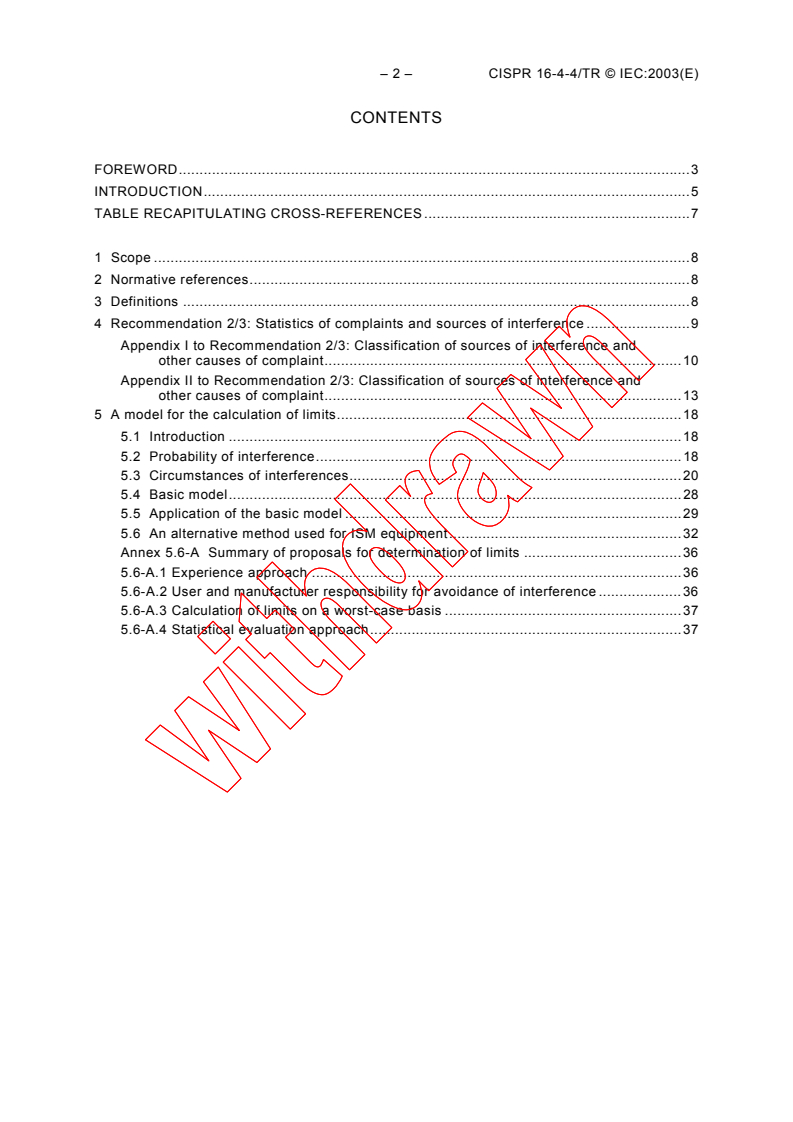
CONTENTS
FOREWORD.3
INTRODUCTION.5
TABLE RECAPITULATING CROSS-REFERENCES .7
1 Scope .8
2 Normative references.8
3 Definitions .8
4 Recommendation 2/3: Statistics of complaints and sources of interference .9
Appendix I to Recommendation 2/3: Classification of sources of interference and
other causes of complaint.10
Appendix II to Recommendation 2/3: Classification of sources of interference and
other causes of complaint.13
5 A model for the calculation of limits.18
5.1 Introduction .18
5.2 Probability of interference.18
5.3 Circumstances of interferences.20
5.4 Basic model.28
5.5 Application of the basic model .29
5.6 An alternative method used for ISM equipment.32
Annex 5.6-A Summary of proposals for determination of limits .36
5.6-A.1 Experience approach .36
5.6-A.2 User and manufacturer responsibility for avoidance of interference .36
5.6-A.3 Calculation of limits on a worst-case basis .37
5.6-A.4 Statistical evaluation approach.37
CISPR 16-4-4/TR © IEC:2003(E) – 3 –
INTERNATIONAL ELECTROTECHNICAL COMMISSION
INTERNATIONAL SPECIAL COMMITTEE ON RADIO INTERFERENCE
____________
SPECIFICATION FOR RADIO DISTURBANCE AND IMMUNITY
MEASURING APPARATUS AND METHODS –
Part 4-4: Uncertainties, statistics and limit modelling –
Statistics of complaints and a model for the calculation of limits
FOREWORD
1) The International Electrotechnical Commission (IEC) is a worldwide organization for standardization comprising
all national electrotechnical committees (IEC National Committees). The object of IEC is to promote
international co-operation on all questions concerning standardization in the electrical and electronic fields. To
this end and in addition to other activities, IEC publishes International Standards, Technical Specifications,
Technical Reports, Publicly Available Specifications (PAS) and Guides (hereafter referred to as “IEC
Publication(s)”). Their preparation is entrusted to technical committees; any IEC National Committee interested
in the subject dealt with may participate in this preparatory work. International, governmental and non-
governmental organizations liaising with the IEC also participate in this preparation. IEC collaborates closely
with the International Organization for Standardization (ISO) in accordance with conditions determined by
agreement between the two organizations.
2) The formal decisions or agreements of IEC on technical matters express, as nearly as possible, an international
consensus of opinion on the relevant subjects since each technical committee has representation from all
interested IEC National Committees.
3) IEC Publications have the form of recommendations for international use and are accepted by IEC National
Committees in that sense. While all reasonable efforts are made to ensure that the technical content of IEC
Publications is accurate, IEC cannot be held responsible for the way in which they are used or for any
misinterpretation by any end user.
4) In order to promote international uniformity, IEC National Committees undertake to apply IEC Publications
transparently to the maximum extent possible in their national and regional publications. Any divergence
between any IEC Publication and the corresponding national or regional publication shall be clearly indicated in
the latter.
5) IEC provides no marking procedure to indicate its approval and cannot be rendered responsible for any
equipment declared to be in conformity with an IEC Publication.
6) All users should ensure that they have the latest edition of this publication.
7) No liability shall attach to IEC or its directors, employees, servants or agents including individual experts and
members of its technical committees and IEC National Committees for any personal injury, property damage or
other damage of any nature whatsoever, whether direct or indirect, or for costs (including legal fees) and
expenses arising out of the publication, use of, or reliance upon, this IEC Publication or any other IEC
Publications.
8) Attention is drawn to the Normative references cited in this publication. Use of the referenced publications is
indispensable for the correct application of this publication.
9) Attention is drawn to the possibility that some of the elements of this IEC Publication may be the subject of
patent rights. IEC shall not be held responsible for identifying any or all such patent rights.
The main task of IEC technical committees is to prepare International Standards. However, a
technical committee may propose the publication of a technical report when it has collected
data of a different kind from that which is normally published as an International Standard, for
example "state of the art".
CISPR 16-4-4, which is a technical report, has been prepared by CISPR subcommittee A:
Radio interference measurements and statistical methods.
This first edition of CISPR 16-4-4, together with CISPR 16-4-1, CISPR 16-4-3 and the second
edition of CISPR 16-3, cancels and replaces the first edition of CISPR 16-3, published in
2000, and its amendment 1 (2002). It contains the relevant clauses of CISPR 16-3 without
technical changes.
This publication has been drafted in accordance with the ISO/IEC Directives, Part 2.
A bilingual version of this publication may be issued at a later date.
– 4 – CISPR 16-4-4/TR © IEC:2003(E)
The committee has decided that the contents of this publication will remain unchanged until
2004. At this date, the publication will be
• reconfirmed;
• withdrawn;
• replaced by a revised edition, or
• amended.
The text of this publication is based on the following documents:
Recommendation 2/2 – p/o CISPR 7B, 1975; CIS/A(CO)67 , 1992; CIS/A(CO)67A, 1993;
Report 61 – CISPR 23:1987; CISPR/A(Sec)81, 1987.
CISPR 16-4-4/TR © IEC:2003(E) – 5 –
INTRODUCTION
CISPR 16-1, CISPR 16-2, CISPR 16-3 and CISPR 16-4 have been reorganised into 14 parts,
to accommodate growth and easier maintenance. The new parts have also been renumbered.
See the list given below.
Old CISPR 16 publications New CISPR 16 publications
CISPR 16-1-1 Measuring apparatus
CISPR 16-1-2 Ancillary equipment – Conducted disturbances
Radio disturbance
and immunity
CISPR 16-1-3 Ancillary equipment – Disturbance power
CISPR 16-1
measuring
apparatus
Ancillary equipment – Radiated disturbances
CISPR 16-1-4
Antenna calibration test sites for 30 MHz to
CISPR 16-1-5
1 000 MHz
CISPR 16-2-1 Conducted disturbance measurements
Methods of
Measurement of disturbance power
CISPR 16-2-2
measurement of
CISPR 16-2
disturbances and
CISPR 16-2-3 Radiated disturbance measurements
immunity
CISPR 16-2-4
Immunity measurements
CISPR 16-3 CISPR technical reports
Uncertainties in standardised EMC tests
CISPR 16-4-1
Reports and
Measurement instrumentation uncertainty
CISPR 16-3 recommendations CISPR 16-4-2
of CISPR
Statistical considerations in the
CISPR 16-4-3
determination of EMC compliance of mass-
produced products
Statistics of complaints and a model for the
Uncertainty in EMC
CISPR 16-4 CISPR 16-4-4
calculation of limits
measurements
More specific information on the relation between the ‘old’ CISPR 16-3 and the present ‘new’
CISPR 16-4-4 is given in the table after this introduction (TABLE RECAPITULATING CROSS
REFERENCES).
Measurement instrumentation specifications are given in five new parts of CISPR 16-1, while
the methods of measurement are covered now in four new parts of CISPR 16-2. Various
reports with further information and background on CISPR and radio disturbances in general
are given in CISPR 16-3. CISPR 16-4 contains information related to uncertainties, statistics
and limit modelling.
CISPR 16-4 consists of the following parts, under the general title Specification for radio
disturbance and immunity measuring apparatus and methods - Uncertainties, statistics and
limit modelling:
• Part 4-1: Uncertainties in standardised EMC tests,
• Part 4-2: Uncertainty in EMC measurements,
• Part 4-3: Statistical considerations in the determination of EMC compliance of mass-
produced products,
• Part 4-4: Statistics of complaints and a model for the calculation of limits.
For practical reasons, standardised EMC tests are drastic simplifications of all possible EMI
scenarios that a product may encounter in practice. Consequently, in an EMC standard the
measurand, the limit, measurement instruments, set-up, measurement procedure and
measurement conditions shall be simplified but still meaningful. Meaningful means that there
is a statistical correlation between compliance of the product with a standardized EMC test
and a high probability of actual EMC of the same product during its life cycle. Part 4-4
provides statistically based methods to derive meaningful disturbance limits for the protection
of radio services.
– 6 – CISPR 16-4-4/TR © IEC:2003(E)
In general, a standardized EMC test must be developed such that reproducible results are
obtained if different parties perform the same test with the same product. However, various
uncertainty sources and influence quantities cause that the reproducibility of a standardized
EMC test is limited. Part 4-1 consists of a collection of informative reports that deal with all
relevant uncertainty sources that may be encountered during EMC compliance tests. Typical
examples of uncertainty sources are the product itself, the measurement instrumentation, the
set-up of the product, the test procedures and the environmental conditions.
Part 4-2, deals with a limited and specific category of uncertainties, i.e. the measurement
instrumentation uncertainties. In Part 4-2, examples of measurement instrumentation
uncertainty budgets are given for most of the CISPR test methods. In this part, also normative
requirements are given on how to incorporate the measurement instrumentation uncertainty in
the compliance criterion.
If a compliance test is performed using different samples of the same product, then the
spread of the EMC performance of the product samples shall be incorporated also in the
compliance criterion. Part 4-3 deals with the statistical treatment of test results in case
compliance test are performed using samples of mass-produced products. This treatment is
well known as the 80%-80% rule.
Part 4-4 contains forms for statistics of complaints to be applied by National Authorities and
describes methods to determine limits. For this purpose the basis for the protection of radio
services, the probability of interferences, the measurement procedures and the characteristic
of radio services are described. On the basis of the models for the generation of disturbance
for the radiation coupling and for mains coupling respectively the limits of disturbance field
strength and disturbance voltage are calculated for the measurement on the test site.
CISPR 16-4-4/TR © IEC:2003(E) – 7 –
TABLE RECAPITULATING CROSS-REFERENCES
First edition of CISPR 16-3 First edition of CISPR 16-4-4
Clauses, subclauses Clauses
1.1 1
1.2 2
1.3 3
2.1 4
3 5
Annex 3.6-A Annex 5.6-A
Figures Figures
15, 16 1, 2
– 8 – CISPR 16-4-4/TR © IEC:2003(E)
SPECIFICATION FOR RADIO DISTURBANCE AND IMMUNITY
MEASURING APPARATUS AND METHODS –
Part 4-4: Uncertainties, statistics and limit modelling –
Statistics of complaints and a model for the calculation of limits
1 Scope
This part of CISPR 16-4 describes the calculation of limits for disturbance field strength and
disturbance voltage for the measurement on the test site on the basis of models for the
generation of disturbance for radiation coupling respectively for mains coupling.
2 Normative references
The following referenced documents are indispensable for the application of this document.
For dated references, only the edition cited applies. For undated references, the latest edition
of the referenced document (including any amendments) applies.
CISPR 11, Industrial, scientific and medical (ISM) radio-frequency equipment –
Electromagnetic disturbance characteristics – Limits and methods of measurement
CISPR 16-1 (all parts), Specification for radio disturbance and immunity measuring apparatus
and methods – Radio disturbance and immunity measuring apparatus
CISPR 16-2, (all parts), Specification for radio disturbance and immunity measuring apparatus
and methods – Methods of measurement of disturbances and immunity
CISPR 16-3, Specification for radio disturbance and immunity measuring apparatus and
methods – Part 3: CISPR technical reports
CISPR 16-4-1, Specification for radio disturbance and immunity measuring apparatus and
methods – Part 4-1: Uncertainties, statistics and limit modelling - Uncertainties in
standardised EMC tests
CISPR 16-4-3, Specification for radio disturbance and immunity measuring apparatus and
methods – Part 4-3: Uncertainties, statistics and limit modelling - Statistical considerations in
the determination of EMC compliance of mass-produced products
3 Definitions
None of the definitions of CISPR 16-3:2000 apply to this part of CISPR 16. For further
definitons see IEC 60050(161).
CISPR 16-4-4/TR © IEC:2003(E) – 9 –
4 Recommendation 2/3: Statistics of complaints and sources of interference
(This recommendation replaces Recommendation 2/2 in CISPR 7B).
The CISPR,
CONSIDERING
a) that many administrations regularly publish statistics on interference complaints;
b) that it would be useful to be able to compare the figures for certain categories;
c) that, at present, varied and ambiguous presentation often renders this comparison difficult,
RECOMMENDS
1 that the statistics supplied by National Committees should be in such a form that the
following information may be readily extracted:
1.1 number of complaints as a percentage of the total number of receiving licences for
television, sound broadcasting and other services;
1.2 the relative aggressivity of the various sources of interference in the different frequency
bands;
1.3 the comparison of the interference caused by the same source in different frequency
bands;
1.4 the effectiveness of limits (CISPR or national) and other counter-measures on
subclauses 1.1, 1.2 and 1.3;
2 that the terms used in publication of statistics as recommended in clause 3 should have
the following meaning:
2.1 complaint: a request for assistance made to the interference service by a listener or a
viewer who complains that his reception is degraded by interference. For the purpose of
these statistics, one complaint will be recorded for each frequency band for which a
confirmed complaint has been received;
2.2 source: a source of interference is the apparatus or installation which causes inter-
ference. Interference may be caused by a group of devices, for example, a number of
fluorescent lamps on one circuit. In such cases, the number to be entered in the
statistics is determined by the interference service;
NOTE To facilitate comparison of statistics, the method used to determine the number of sources should
be stated.
one source may cause many complaints and one complaint may be caused by more
than one source. Therefore, it is clear that the number of sources and the number of
complaints against any classification code may not be related;
for the purpose of these statistics, both active generators of electrical energy and
apparatus and installations which cause interference by secondary effects (secondary
modulation) are included. See also Appendix II for a complete list;
2.3 cause of complaint other than a source: a reason for unsatisfactory reception in a case
in which no source is concerned. See also Appendix II for a complete list;
3 that statistics should cover a complete calendar year; they should whenever possible be
presented in the following form, without necessarily employing the finer categories listed
in Appendix II. It s not intended to exclude further subdivisions; these are desirable, but
they should fit into the scheme of the standard form;
the code numbers refer to the items listed in Appendices I and II;
– 10 – CISPR 16-4-4/TR © IEC:2003(E)
Statistics of interference complaints
Source of interference Number of complaints per service
or other cause of complaint from each source
a
Classification code Description Total number Other
Broadcasting
b
in each
services
c c
classification Sound Television
LF/ II I III IV/V
MF/
HF
A 1 1
2 1
etc. as in the appendices
Totals
a
LF = low frequency (long waves);
MF = medium frequency (medium waves);
HF = high frequency (short waves).
These three bands may either be grouped together, as shown, or dealt with separately.
II = Band II (VHF/FM)
I = Band I (VHF/television)
III = Band III (VHF/television);
IV/V = Band IV/V (UHF/television).
b
The service and band affected should be stated.
c
At the time of receipt of complaints of interference, i.e. before they have been investigated fully, it may not be
possible to apportion the complaints accurately to the various broadcasting services. If this is so, then the
number of complaints should be stated separately for sound broadcasting and television.
Appendix I to Recommendation 2/3:
Classification of sources of interference
and other causes of complaint
Main categories
Classification code Description of the source
A Industrial scientific and medical RF apparatus
A.1 Industrial and scientific RF apparatus
A.1.1 Apparatus tuned to free radiation frequency
A.1.2 Apparatus not tuned to free radiation frequencies
A.2 Medical radio-frequency apparatus
A.2.1 Apparatus tuned to free radiation frequencies
A.2.2 Apparatus not tuned to free radiation frequencies
A.3 Sparking apparatus (except ignition)
B Electric power supply, distribution and traction
B.1 AC voltages exceeding 100 kV
B.1.1 Power lines overhead
B.1.2 Generating and switching stations
B.2 DC voltages exceeding 100 kV
B.2.1 Power lines overhead
B.2.2 Converting stations
CISPR 16-4-4/TR © IEC:2003(E) – 11 –
Classification code Description of the source
B.3 Voltages 100 kV to 1 kV (subdivision as for B.1)*
B.4 Voltages 1 kV to 450 kV (subdivision as for B.1)*
B.5 Low tension power supply and distribution (<450 V)
B.5.1 Power lines overhead
B.5.2 Generating and switching stations
B.6 Electric traction
B.6.1 Railways
B.6.2 Tramways
B.6.3 Trolley buses
C Electricity consumers' equipment (industrial and similar)
C.1 Generators
C.2 Motors (P > 700 W)
C.2.1
Rated power P: 700 W < P ≤ 1 000 W
C.2.2
Rated power P: 1 000 W < P ≤ 2 000 W
C.2.3 Rated power P: 2 000 W < P
C.3 Contacts
C.4 Ignition
C.5 Rectifiers
C.6 Convertors
C.7 Diode thyristor and thyratron control equipment
C.8 Cattle fences
D Low-power appliances as normally used in households, offices and small workshops
D.1 Motors (up to and including 700 W)
D.2 Contact devices
D.3 Diode, thyristor and thyratron control equipment (less than 1 000 W)
E Gaseous discharge and other lamps
E.1 Fluorescent lamps
E.2 Neon signs
E.3 Filament lamps
F Receiving installations
F.1 Sound broadcast receivers
F.2 Television receivers
F.3 Amplifiers and common aerial reception systems for broadcasting
F.4 Non-broadcasting receivers
G Ignition systems of internal combustion engines
H Identified sources other than those specified
* For convenience of analysis, the same subdivision is used for all voltage ranges. In those cases where a
classification does not apply, for example, corona for low voltages, the category should remain blank
– 12 – CISPR 16-4-4/TR © IEC:2003(E)
Classification code Description of the source
I Other causes of complaint
I.1 Telecommunication
I.1.1 Radio communication transmitters
I.1.1.1 Fundamental radiation
I.1.1.2 Harmonic radiation
I.1.1.3 Spurious radiation
I.1.2 Telecommunication by wire
I.2 Faults of the receiving installations
I.3 Receiver characteristics
I.4 Weak or faulty signals
I.5 Atmospheric disturbances
I.6 Unidentified sources of interference
I.7 Interference not observed
J Information technology equipment
J.1 Data processing equipment (DPE)
J.1.1 Large DPE in computer rooms
J.1.2 Smaller plugable DPE not in dedicated rooms
J.1.3 Home computers and home video games
J.2 Local area network
J.3 Commercial video games
J.4 Telephone exchanges and other digital telecommunication equipment
CISPR 16-4-4/TR © IEC:2003(E) – 13 –
Appendix II to Recommendation 2/3:
Classification of sources of interference
and other causes of complaint
Detailed categories
Classification code Description of the source
A Industrial scientific and medical RF apparatus
A.1 Industrial and scientific RF apparatus
A.1.1 Apparatus tuned to free radiation frequency
A.1.1.1 Drying non-metals
A.1.1.2 Plastic pre-heaters
A.1.1.3 Plastic seam welders
A.1.1.4 Wood glue drying
A.1.1.5 Microwave heating
A.1.1.6 Microwave cooking
A.1.1.7 Ultrasonic soldering and cleaning
A.1.1.8 Food treatment heaters (for example, fish thawing)
...
A.1.1.20 Other
A.1.2 Not tuned to free radiation frequencies
A.1.2.1 to A.1.2.20 As for A.1.1.1 to A.1.1.20
A.2 Medical radiofrequency apparatus
A.2.1 Apparatus tuned to free radiation frequencies
A.2.1.1 Diathermy
A.2.1.2 Ultrasonic medical
A.2.1.3 Cauterization
...
A.2.1.20 Other
A.2.2 Apparatus not tuned to free radiation frequencies
A.2.2.1 to A.2.2.20 As for A.2.1.1 to A.2.1.20
A.3 Sparking apparatus (except ignition)
A.3.1 RF excited arc welder
A.3.2 Surface erosion of plastics
A.3.3 Surface erosion of metals
A.3.4 Spectrograph
A.3.5 Spark diathermy
...
A.3.20 Other
B Electric power supply, distribution and traction
B.1 AC voltages exceeding 100 kV
B.1.1 Power lines overhead
B.1.1.1 Corona effect
B.1.1.2 Insulators
B.1.1.3 Presence of foreign objects on line
...
B.1.1.20 Other
– 14 – CISPR 16-4-4/TR © IEC:2003(E)
Classification code Description of the source
B.1.2 Generating and switching stations
B.1.2.1 Generating stations
B.1.2.2 Switching stations
B.1.2.3 Transformer stations
B.1.2.4 Saturated transformers
...
B.1.2.20 Other
B.2 DC voltages exceeding 100 kV
B.2.1 As for B.1.1
B.2.2 Converting stations
B.3 Voltages 100 kV to 1 kV (subdivision as for B.1)*
B.4 Voltages 1 kV to 450 V (subdivision as for B.1)*
B.5 Low tension power supply and distribution (<450 V)
B.5.1 Power lines overhead
B.5.1.1 Presence of foreign objects on line
B.5.1.2 Equipment faults
...
B.5.1.20 Other
B.5.2 Generating and switching stations
B.5.2.1 to B.5.2.20
B.6 Electric traction
B.6.1 Railways
B.6.1.1 Overhead distribution, high voltage
B.6.1.2 Overhead distribution, medium voltage
B.6.1.3 Rail distribution
B.6.1.4 Locomotive
...
B.6.1.20 Other
B.6.2 Tramways
B.6.3 Trolley buses
C Electricity consumers' equipment (industrial and similar)
C.1 Generators
C.2 Motors (P > 700 W)
C.2.1 Rated power P: 700 W < P ≤ 1 000 W
C.2.1.1 Lifts
C.2.1.2 Central heating
...
C.2.1.20 Other
C.2.2
Rated power P: 1 000 W < P ≤ 2 000 W
C.2.2.1 Lifts
C.2.2.2 Central heating
...
C.2.2.20 Other
* Appendix A of CISPR Recommendation 22/3 gives a list of such appliances
CISPR 16-4-4/TR © IEC:2003(E) – 15 –
Classification code Description of the source
C.2.3 Rated power P: 2 000 W < P
C.2.3.1 Lifts
C.2.3.2 Central heating
...
C.2.3.20 Other
C.3 Contacts
C.3.1 Lifts
C.3.2 Central heating
...
C.3.20 Other
C.4 Ignition
C.4.1 Central heating
...
C.4.20 Other
C.5 Rectifiers
C.6 Convertors
C.7 Diode thyristor and thyratron control equipment
C.8 Cattle fences
...
C.20 Other installations
D Low power appliances as normally used in households, shops,
offices and small workshops
D.1 Motors (up to and including 700 W)*
D.1.1 Tools
D.1.1.1 Portable
D.1.1.2 Fixed
D.1.2 Household appliances
D.1.3 Shop and office appliances
...
D.1.20 Other
D.2 Contact devices**
D.2.1 Thermostats
D.2.2 Other contact devices
D.3 Diode, thyristor and thyratron control equipment (less than 1 000 W)
E Gaseous discharge and other lamps
E.1 Fluorescent lamps
E.2 Neon signs
E.3 Filament lamps
E.3.1 Vacuum
E.3.2 Gas filled
...
E.20 Other
* Appendix A of CISPR Recommendation 22/3 gives a list of such appliances.
** See Appendix III of CISPR Recommendation 50.
– 16 – CISPR 16-4-4/TR © IEC:2003(E)
Classification code Description of the source
F Receiving installations
F.1 Sound broadcast receivers
F.1.1 AM receiver
F.1.2 FM receiver
F.2 Television receivers
F.2.1 Local oscillator
F.2.1.1 Fundamental
F.2.1.2 Harmonic
F.2.2 Intermediate frequency radiation
F.2.3 Time base oscillator
F.2.4 Time base parasitic oscillation is, for example, Barkhausen oscillations
...
F.2.20 Other
F.3 Amplifiers and common aerial reception systems for broadcasting
F.4 Non-broadcasting receivers
G Ignition systems of internal combustion engines
G.1 Motor vehicles
G.2 Boats
G.3 Powered appliances (for example, lawn mowers)
...
G.20 Other engines
H Identified sources other than those specified
I Other causes of complaint
I.1 Telecommunication
I.1.1 Radio communication transmitters
I.1.1.1 Fundamental radiation
I.1.1.1.1 Broadcasting stations
I.1.1.1.2 Amateur stations
I.1.1.1.3 Land mobile stations
...
I.1.1.1.20 Other
I.1.1.2 Harmonic radiation
I.1.1.2.1 Broadcasting stations
I.1.1.2.2 Amateur stations
I.1.1.2.3 Land mobile stations
I.1.1.3 Spurious radiation
I.1.1.3.1 to I.1.1.3.20 As for I.1.1.1
I.1.2 Telecommunication by wire
I.2 Faults of the receiving installation
I.2.1 Inefficient aerial installation
I.2.2 Faulty receivers
I.2.3 Maladjustment of receiver
I.2.4 Low mains voltage
CISPR 16-4-4/TR © IEC:2003(E) – 17 –
Classification code Description of the source
I.3 Receiver characteristics
I.3.1 Second (image) channel response
I.3.2 Other spurious responses
I.3.3 Intermodulation
I.3.4 Inadequate receiver immunity
I.4 Weak or faulty signals
I.4.1 Outside service area
I.4.2 Shadow area
I.4.3 Multipath reception
I.4.3.1 Power lines
I.4.3.2 Other
I.5 Atmospheric disturbances
I.6 Unidentified sources of interference
I.7 Interference not observed
J Information technology equipment
J.1 Data processing equipment
J.1.1 Large DPE in computer rooms
J.1.2 Smaller plugable DPE not in dedicated rooms
J.1.3 Home computers and home video games
J.2 Local area network
J.3 Commercial video games
J.4 Telephone exchanges and other digital telecommunication equipment
– 18 – CISPR 16-4-4/TR © IEC:2003(E)
5 A model for the calculation of limits
5.1 Introduction
A harmonized method of calculation is an important pre-condition for the efficient discussion
of CISPR limits by National Committees and the adoption of CISPR Recommendations.
5.1.1 Generation of EM disturbances
CISPR Recommendations are developed for protection of radio communications and often
several types of radio networks are to be protected by a single emission limit.
Most electrotechnical equipment have the potential to interfere with radio communications.
Coupling from the source of electromagnetic disturbance to the radio communications
installation may be by radiation, induction, conduction, or a combination of these mech-
anisms. Control of the pollution of the radio spectrum is accomplished by limiting at the
source the levels of appropriate components of the electromagnetic disturbances (voltage,
current, field strength, etc.). The choice of the appropriate component is determined by the
mechanism of coupling, the effect of the disturbance on radio communications installations
and the means of measurement available.
5.1.2 Immunity from EM disturbances
Most electronic equipment has the potential to malfunction as the result of being subjected to
EM disturbances.
Protection of equipment is accomplished by hardening the appropriate disturbance entry
route. The choice is determined by the mechanism of coupling, the effect of the disturbance
on the electronic equipment and the means of measurement available.
5.1.3 Planning a radio service
Before planning radio communication service, it is necessary to decide upon the reliability of
obtaining a predetermined quality of reception. This condition can be expressed in terms of
the probability of the actual signal-to-interference ratio at the input of a receiver being greater
than the minimum permissible signal-to-interference ratio. That is:
P[]R(µ ;σ )≥ R = a
R R P
where
P[ ] is the probability function;
R(µ ;σ ) is the actual signal-to-interference ratio as a function of its mean value (µ ) and
R R R
standard deviation (σ );
R
R is the minimum permissible signal-to-interference ratio;
p
a is a specified value representing the reliability of communications.
This probability condition is the basis for the method of determining limits.
5.2 Probability of interference
In order to make recommendations to protect adequately the radio communications systems
of interest to the ITU considerable attention is paid within CISPR to the probability of
interference occurring. The following is an extract from ITU-R Report 829.
CISPR 16-4-4/TR © IEC:2003(E) – 19 –
5.2.1 Derivation of probability of interference
The Radio Regulations, No. 160, defines interference as “the effect of unwanted energy due
to one or a combination of emissions, radiations, or inductions upon reception in a radio
communication system, manifested by any performance degradation, misinterpretation, or
loss of information which could be extracted in the absence of such unwanted energy”.
5.2.1.1 Probability of instantaneous interference
Let
A denote "The desired transmitter is transmitting";
B denote "The wanted signal is satisfactorily received in the absence of unwanted energy";
C denote "Another equipment is producing unwanted energy";
D denote "The wanted signal is satisfactorily received in the presence of the unwanted
energy".
All of these statements refer to the same small-time period. Then, according to the definitions,
interference means "A and B and C and D*", where D* is the negation or opposite of D: Let
P(x) denote the "probability of X" and P(x⏐y) denote the "probability of x, given y". Then, the
probability of interference during the small-time period is
P(I) = P(A and B and C and D*) (5.1)
It can be shown that this can be expressed in terms of known or computable quantities:
P(I) = [P(B⏐A) – P(D⏐A and C)] P(A and C) (5.2)
It may be preferable to consider the probability of interference only during the time that the
wanted transmitter is transmitting. This probability is:
P′(I) = P(B and C and D*⏐A) (5.3)
which can be reduced to:
P′(I) =[P(B⏐A) – P(D⏐A and C)] P(C⏐A) (5.4)
5.2.1.2 Discussion of equations (5.2) and (5.4)
First, consider the difference between equation (5.2) and (5.4). The probability of interference
can be interpreted as the fraction of time that interference exists. In equation (5.2), this
fraction is the number of seconds of interference during a time period divided by the number
of seconds of interference divided by the number of seconds the wanted transmitter is
transmitting during the time period. This second fraction is larger than the first unless the
wanted transmitter is on all the time. P(B⏐A) is just the probability that a wanted signal will be
correctly received when there is no interference, often expressed as the probability that
S/N ≥ R where S is the signal power, N is the noise power, and R is the signal-to-noise ratio
required for satisfactory service. In some services, this probability is called the reliability, and
is often computer when the system is designed. It can be computed if system parameters (for
example, transmitter and receiver location, power, required S/N) are known using statistical
data on transmission loss (for example, Recommendation 370) and statistical data on radio
noise (for example, Reports 322 and 670).
Note Recommendation 370 is available as ITU-R Rec. P.370-7, and Report 322 is essentially in ITU-R Rec.
P.372-7. Other Reports (e.g. Rep. 670 and 656) are in former CCIR Publications.
– 20 – CISPR 16-4-4/TR © IEC:2003(E)
Many systems, such as satellite or microwave relay point-to-point systems, are designed so
that P(B⏐A) ≈ 1. In other services, such as long-distance ionospheric point-to-point services,
or mobile services near the edge of the coverage area, P(B⏐A) may be quite small. In this
latter case, the probability of interference will not be small regardless of the other
probabilities.
P(D⏐A and C) is the probability that the wanted signal will be correctly received even when
the unwanted energy is present. It can be computed if there is sufficient information about the
location, frequency, power, etc. of the source of unwanted energy. For examples, see the
references in Report 656.
Notice that it has been assumed that P(D|A and C) ≤ P(B⏐A); that is, if the signal can be
received satisfactorily in the presence of unwanted energy, then it can surely be received
satisfactorily in the absence of the unwanted energy. Thus P(I) cannot be negative.
P(A and C) is the probability that the wanted transmitter and the source of unwanted energy
are on simultaneously. In some situations, the wanted transmitter and source of unwanted
energy may be operated independently. For example, they may be on adjacent channels, or
beyond a coordination distance. In this case, P(A and C) = P(A)P(C), where P(A) is the
fraction of time that the wanted transmitter is emitting, and P(C) is the fraction of time that the
unwanted source is on.
In other situations, the operation may be highly dependent. For example, the transmitters may
be co-channel stations in a disciplined mobile service. In this case P(A and C) is very small,
but perhaps not zero, because a station can be located so that it causes interference even
when it cannot hear the other transmitter.
The two transmitters might both operate continuously. For example, one might be part of a
microwave point-to-point service, and the other a satellite sharing the same frequency band.
In this case, P(A and C) = 1, and the probability of interference depends entirely on the factor
in square brackets in equation (5.2).
Similarly, P(C⏐A) = P(C) if the transmitters operate independently. P(C⏐A) is very small if the
two transmitters are co-channel stations in a disciplined land mobile service; and P(C⏐A) = 1
if the unwanted transmitter is on all the time.
In general, all the terms in equations (5.2) and (5.4) affect the probability of interference,
although their relative importance is different in different services.
5.3 Circumstances of interferences
In this part, general criteria are laid down for establishing RFI limits. In this case, a distinction
is made for areas where close coupling exists between noise sources and victim equipment
and for areas with remote coupling.
5.3.1 Close coupling and remote coupling
Although an ill-defined borderline exists between areas of close and remote coupling these
concepts are generally used in the following terms.
Close coupling refers to a short distance between noise source and receiving antenna (for
example, 3-30 m) which is the case for residential sources interfering with broadcasting and
land mobile receivers in residential areas. In general, frequencies up to 300 MHz are
considered.
Remote coupling refers to longer distances, usually 30-300 m, which are normal between
professional or semi-professional sources and receivers as in the case of individual areas.
The relevant frequency spectrum is much broader: 10 kHz to 18 GHz.
CISPR 16-4-4/TR © IEC:2003(E) – 21 –
For the statements given above, it follows that some similarity exists between closed coupling
and near-field radiation conditions on the one hand and between remote coupling and far-field
radiating conditions on the other hand. However, these concepts do not fully correspond since
at frequencies below 1 MHz remote coupling may occur under near-field conditions whereas
for frequencies above about 30 MHz close coupling may occur under far-field conditions. In
the majority of the practical situations, however, the good correspondence between
close/remote coupling and near/far-field conditions is useful in the evaluation of coupling
aspects.
It should be noted that field strength measurements, which are normally used for evaluating
remote coupling characteristics, are actually carried out under near-field conditions in the
lower end of the frequency range.
Whereas close and remote coupling are generally used to describe a direct coupling path
between noise source and receiving antenna by means of electric, magnetic or radiation
fields, an additional coupling mode is conduction coupling. In this case, the noise signal is
conducted by the mains network from the mains output of the source to the mains input of the
receiver. Inside the receiver the noise signal is coupled from the mains terminals to sensitive
circuits of the receiver.
Some well-known differences exist between near-field and far-field radiation characteristics,
and therefore also for most close and remote coupling cases.
– Under far-field conditions with free-space propagation the relation between electric and
magnetic components of the field is fixed and well defined, the relation under near-field
conditions is completely undefined.
– Under far-field conditions the attenuation formula is
x (5.5)
y = kd
where
y = attenuation factor;
d = distance;
x = propagation coefficient, which is 1 in free-space propagation and somewhat higher
(1 to
...