


CISPR TR 16-3:2000/AMD1:2002
(Amendment)Amendment 1 - Specification for radio disturbance and immunity measuring apparatus and methods - Part 3: Reports and recommendations of CISPR
General Information
- Abstract
Contains a new clause 6: Reports on uncertainties in standardized emission compliance testing. Gives guidance to those who are involved in the development or modification of CISPR emission standards and gives useful background information for those who apply the standards in practice.
- Status
- Replaced
- Publication Date
- 04-Jun-2002
- Technical Committee
- CIS/A - Radio-interference measurements and statistical methods
- Current Stage
- DELPUB - Deleted Publication
- Start Date
- 26-Nov-2003
- Completion Date
- 28-Aug-2026
Buy Documents

CISPR TR 16-3:2000/AMD1:2002 - Amendment 1 - Specification for radio disturbance and immunity measuring apparatus and methods - Part 3: Reports and recommendations of CISPR Released:6/5/2002
Relations
- Effective Date
- 05-Sep-2023
- Effective Date
- 05-Sep-2023
- Effective Date
- 05-Sep-2023
- Effective Date
- 05-Sep-2023
- Effective Date
- 05-Sep-2023
Buy Documents
CISPR TR 16-3:2000/AMD1:2002 - Amendment 1 - Specification for radio disturbance and immunity measuring apparatus and methods - Part 3: Reports and recommendations of CISPR Released:6/5/2002
Get Certified
Connect with accredited certification bodies for this standard

ANCE
Mexican certification and testing association.

Intertek Slovenia
Intertek testing, inspection, and certification services in Slovenia.

LNE (Laboratoire National de Métrologie et d'Essais)
French national laboratory for metrology and testing.
Sponsored listings
Frequently Asked Questions
CISPR TR 16-3:2000/AMD1:2002 is a technical report published by the International Electrotechnical Commission (IEC). Its full title is "Amendment 1 - Specification for radio disturbance and immunity measuring apparatus and methods - Part 3: Reports and recommendations of CISPR". This standard covers: Contains a new clause 6: Reports on uncertainties in standardized emission compliance testing. Gives guidance to those who are involved in the development or modification of CISPR emission standards and gives useful background information for those who apply the standards in practice.
Contains a new clause 6: Reports on uncertainties in standardized emission compliance testing. Gives guidance to those who are involved in the development or modification of CISPR emission standards and gives useful background information for those who apply the standards in practice.
CISPR TR 16-3:2000/AMD1:2002 is classified under the following ICS (International Classification for Standards) categories: 33.100.10 - Emission; 33.100.20 - Immunity. The ICS classification helps identify the subject area and facilitates finding related standards.
CISPR TR 16-3:2000/AMD1:2002 has the following relationships with other standards: It is inter standard links to CISPR TR 16-4-1:2003, CISPR TR 16-4-4:2003, CISPR TR 16-4-3:2003, CISPR TR 16-3:2000, CISPR TR 16-3:2003. Understanding these relationships helps ensure you are using the most current and applicable version of the standard.
CISPR TR 16-3:2000/AMD1:2002 is available in PDF format for immediate download after purchase. The document can be added to your cart and obtained through the secure checkout process. Digital delivery ensures instant access to the complete standard document.
Standards Content (Sample)
TECHNICAL
TR CISPR 16-3
REPORT
AMENDMENT 1
2002-06
Amendment 1
Specification for radio disturbance and immunity
measuring apparatus and methods –
Part 3:
Reports and recommendations of CISPR
Amendement 1
Spécifications des méthodes et des appareils de mesure
des perturbations radioélectriques et de l'immunité aux
perturbations radioélectriques –
Partie 3:
Rapports et recommandations du CISPR
IEC 2002 Droits de reproduction réservés Copyright - all rights reserved
International Electrotechnical Commission, 3, rue de Varembé, PO Box 131, CH-1211 Geneva 20, Switzerland
Telephone: +41 22 919 02 11 Telefax: +41 22 919 03 00 E-mail: inmail@iec.ch Web: www.iec.ch
PRICE CODE
Commission Electrotechnique Internationale
T
International Electrotechnical Commission
Международная Электротехническая Комиссия
For price, see current catalogue
– 2 – TR CISPR 16-3 Amend. 1 IEC:2002(E)
FOREWORD
This amendment has been prepared by CISPR subcommittee A: Radio interference measure-
ments and statistical methods.
The text of this amendment is based on the following documents:
CDV Report on voting
CISPR/A/297/CDV CISPR/A/329/RVC
Full information on the voting for the approval of this amendment can be found in the report
on voting indicated in the above table.
The committee has decided that the contents of the base publication and its amendments will
remain unchanged until 2004. At this date, the publication will be
• reconfirmed;
• withdrawn;
• replaced by a revised edition, or
• amended.
A bilingual version of this publication may be issued at a later date.
_____________
Page 2
CONTENTS
Add the following after subclause 5.2:
6 Reports on uncertainties in standardized emission compliance testing
6.1 Introductory note
6.2 General and basic considerations
6.3 Voltage measurements
6.4 Radiated emission measurements
Page 239
Add the following new clause:
6 Reports on uncertainties in standardized emission compliance testing
6.1 Introductory note
Clause 6 of CISPR 16-3 is a collection of documents (reports) dealing with the issue of
uncertainties in standardized emission compliance tests.
The primary goal of this clause is to give guidance to those who are involved in the develop-
ment or modification of CISPR emission standards. In addition, this clause is useful
background information for those who apply the standards in practice.
TR CISPR 16-3 Amend.1 IEC:2002(E) – 3 –
Subclause 6.2 is still under consideration. Subclause 6.2 will contain details on the scope of
clause 6 and will present the general aspects of standards compliance uncertainty in emission
testing. To compensate for the absence of 6.2, this introductory note on uncertainties in
standardized compliance testing is given. This note can be deleted after subclause 6.2 is
included in clause 6.
The term Standards Compliance Uncertainty (SCU) is used to distinguish the associated
uncertainty contributions from those arising from the measurement instrumentation only.
In a standardized emission compliance test, the emission level of an electrical or electronic
product is measured, after which compliance with the associated limit is determined. The
measured level only approximates the true level to be measured, due to uncertainties in the
influence quantities. However, in classical metrology, all relevant influence quantities are
specified and the classical Measurement Instrumentation Uncertainty (MIU) can be identified.
In EMC compliance testing, very relevant influence quantities turn out to be non-specified,
while no quantitative information is available about their values. Hence, the estimate of the
associated uncertainty will, in general, differ significantly from the estimate following the
classical measurement uncertainty considerations. Therefore, the term Standards Compliance
Uncertainty (SCU) has been introduced to distinguish between the uncertainties encountered
during an EMC compliance test, and the classical Measurement Instrumentation Uncertainty
(MIU) used in metrology.
NOTE The measurement instrumentation uncertainty budgets of various CISPR emission tests are published in
CISPR 16-4.
Subclause 6.2 will give some general and basic considerations on the subject of SCU in
emission tests and can be considered as an ‘uncertainty handbook’ on uncertainties in
emission compliance testing. The following aspects will be addressed in this handbook.
a) The definition of SCU and that of some other relevant EMC and uncertainty specific terms.
b) The various classes of uncertainties that can be encountered for EMC testing and the
distinction between SCU and MIU.
c) Description of the steps to be taken to incorporate uncertainty considerations for a certain
purpose. In this subclause also, guidance is given on the application of SCU in the
compliance criterion.
The guidance given in this handbook shall be used when modifying existing or when drafting
new CISPR recommendations.
The result of the application of this handbook to existing or new CISPR recommendations will
lead to proposals to improve and harmonize the uncertainty aspects of these CISPR
recommendations. Such proposals will also be published as a report within this clause 6.
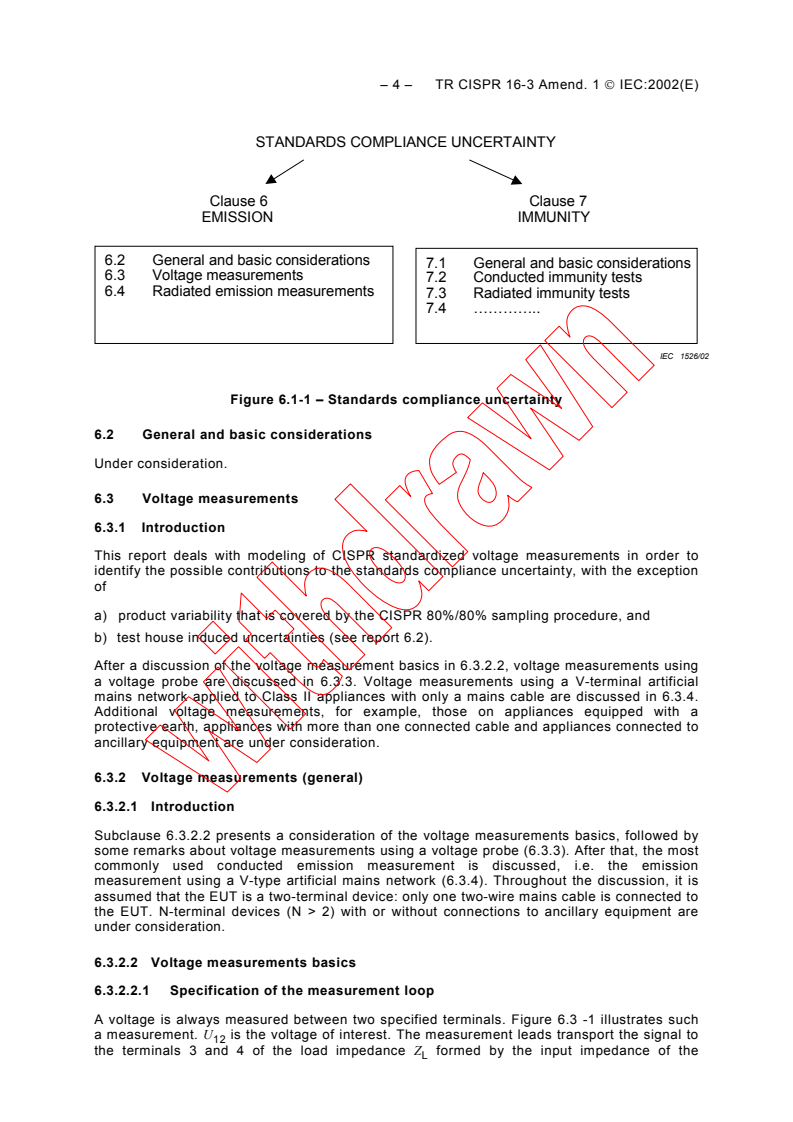
The structure of documents related to the CISPR SCU work is depicted in the figure below.
Report 6.2 (under consideration) is the first part dealing with the basic and general aspects of
the SCUs in EMC emission measurements. Subclause 6.3 contains the uncertainty
considerations related to voltage measurements. Subclause 6.4 is reserved for SCU-
consideration of radiated emission measurements.
Also for immunity tests, uncertainty work is projected. The SCU considerations of immunity
tests differ from the emission SCU considerations at particular points. For instance, for an
immunity test, the measurand is often a functional attribute of the EUT and not a quantity.
This may cause additional specific problems. The SCU documents related to immunity tests
will be published in a separate clause within CISPR 16-3.
– 4 – TR CISPR 16-3 Amend. 1 IEC:2002(E)
STANDARDS COMPLIANCE UNCERTAINTY
Clause 6 Clause 7
EMISSION IMMUNITY
6.2 General and basic considerations
7.1 General and basic considerations
6.3 Voltage measurements
7.2 Conducted immunity tests
6.4 Radiated emission measurements
7.3 Radiated immunity tests
7.4 ………….
IEC 1526/02
Figure 6.1-1 – Standards compliance uncertainty
6.2 General and basic considerations
Under consideration.
6.3 Voltage measurements
6.3.1 Introduction
This report deals with modeling of CISPR standardized voltage measurements in order to
identify the possible contributions to the standards compliance uncertainty, with the exception
of
a) product variability that is covered by the CISPR 80%/80% sampling procedure, and
b) test house induced uncertainties (see report 6.2).
After a discussion of the voltage measurement basics in 6.3.2.2, voltage measurements using
a voltage probe are discussed in 6.3.3. Voltage measurements using a V-terminal artificial
mains network applied to Class II appliances with only a mains cable are discussed in 6.3.4.
Additional voltage measurements, for example, those on appliances equipped with a
protective earth, appliances with more than one connected cable and appliances connected to
ancillary equipment are under consideration.
6.3.2 Voltage measurements (general)
6.3.2.1 Introduction
Subclause 6.3.2.2 presents a consideration of the voltage measurements basics, followed by
some remarks about voltage measurements using a voltage probe (6.3.3). After that, the most
commonly used conducted emission measurement is discussed, i.e. the emission
measurement using a V-type artificial mains network (6.3.4). Throughout the discussion, it is
assumed that the EUT is a two-terminal device: only one two-wire mains cable is connected to
the EUT. N-terminal devices (N > 2) with or without connections to ancillary equipment are
under consideration.
6.3.2.2 Voltage measurements basics
6.3.2.2.1 Specification of the measurement loop
A voltage is always measured between two specified terminals. Figure 6.3 -1 illustrates such
a measurement. U is the voltage of interest. The measurement leads transport the signal to
the terminals 3 and 4 of the load impedance Z formed by the input impedance of the
L
TR CISPR 16-3 Amend.1 IEC:2002(E) – 5 –
voltmeter, and U is the actual measured voltage. The EUT, leads and voltmeter load
impedance form a loop of which the contour is denoted by C, and the loop area by S.
C
S
Z U U Z
d 12 34 L
EUT Measurement leads Receiver
IEC 1527/02
Figure 6.3-1 – Basic circuit of a voltage measurement
In particular when the internal impedance of the disturbance source is unknown (as is usually
the case in compliance testing) care shall be taken that Z >>Z otherwise the measured
L d
voltage depends in an unknown way on Z , thus creating large contributions to the standards
L
compliance uncertainty. Consequently, Z has to be specified starting from estimated or
L
measured values of Z of the class of subject EUTs.
d
NOTE 1 Specifying only one terminal, the ‘hot’ terminal, and assuming that the other terminal can be any point
that is ‘grounded’ is only allowed in electrostatics, i.e. at d.c. (zero frequency) (see 6.3.3).
NOTE 2 Stray capacitances may limit the maximum value of Z (see 6.3.3).
L
6.3.2.2.2 Measurement loop constraint
The result of the voltage measurement has a physical meaning if, and only if, the circum-
ference of the measurement loop, the contour C, is electrically small, i.e. if the circumference
of the loop is small compared to the wavelength of the signal, or signal component to be
measured.
If this condition is not satisfied, resonance effects will occur, creating large and undefined
uncertainty contributions. These uncertainties may be reduced to an acceptable level placing
the load impedance close to the terminals where the voltage has to be measured and to
transport the measurement signal to the receiver via a transmission line, such as a coaxial
cable. The characteristic impedance of that line should match the input impedance of the
receiver. The possible mismatch is often expressed as a voltage standing wave ratio (VSWR).
See also 6.3.4.6.2.
If the condition ‘C electrically small’ is satisfied, the use of a lumped element equivalent
circuit to describe a voltage measurement is allowed. Unless indicated otherwise, it is
assumed that this condition has been satisfied.
6.3.2.2.3 The measured voltage
Faraday’s law is always applicable to a voltage measurement loop. For the loop given in
figure 6.3-1 this means that
v
v v
∂ v
E ⋅dl = − B ⋅ds (6.3-1)
∫ ∫∫
∂t
c S
v v
where the electric field E and the magnetic fluxBare generated by the disturbance source
inside the EUT, or by some ambient disturbance source. Unless specified otherwise, the latter
source is assumed to be negligibly small; for example, the measurement set-up is sufficiently
screened.
– 6 – TR CISPR 16-3 Amend. 1 IEC:2002(E)
From equation (6.3-1) it follows that the voltage U is given by
4 3 2
r
v v v v v v
∂ v
(6.3-2)
U = E ⋅dl =U − E ⋅dl − E ⋅dl − B ⋅ds
34 12
∫ ∫∫ ∫∫
∂t
3 1 4 S
where U is the voltage to be measured. In this equation the contribution of the magnetic field
term to U often dominates. Therefore, the voltage measuring method shall include a
sufficiently accurate description of the layout of the measuring leads.
A numerical example illustrating the importance of the influence of the physics described by
Faraday’s law on the measurand is given in annex 6.3-A.
Z
Z Z
dm1 dm2
½ U ½ U
dm dm
Z Z Z
13 cm 23
U
cm
IEC 1528/02
Figure 6.3-2 – Basic circuit of a loaded disturbance source (N = 2)
6.3.2.3 The disturbance source and types of voltage
At the interface the disturbance voltage is measured while the measurement loop constraints
are satisfied. The source creating that voltage can be described by a lumped element n-port.
Since differential-mode (DM) and common-mode (CM) phenomena are of importance, the
number of terminals of the n-port equals N + 1, where N is the actual number of terminals.
The additional terminal represents the surroundings of the source to which coupling via
electric and magnetic fields is possible and to which the source may have a galvanic
connection. It is the task of the standard drafter to define the surroundings in such a way that
this additional terminal is a relevant reference point in the voltage measurement.
In this section N = 2 is assumed, so that a three-terminal network results and the equivalent
circuit of figure 6.3-2 applies. An example of an EUT presenting an N = 2 disturbance source
is
a) an appliance with only a two-wire mains lead, and
b) the voltage is to be measured at the mains connector terminals.
TR CISPR 16-3 Amend.1 IEC:2002(E) – 7 –
U
dm
U
U
cm
U
IEC 1529/02
Figure 6.3-3 –Relation between the voltages
In figure 6.3-2, all elements are − in principle − frequency-dependent. Z and Z
dm1 dm2
represent the internal impedance of the equivalent DM source with open-circuit voltage U .
dm
In general, Z ≠ Z as at the frequencies of interest the circuit will seldom be
dm1 dm2
symmetrical. Z is the internal impedance of the equivalent CM source with open-circuit
cm
voltage U . The load is represented by the impedances Z and Z between the actual
cm 13 23
terminals 1 and 2 and the reference 3, and the impedance Z between the actual terminals.
Denoting the voltages across Z and Z by U and U , the relation between these voltages
13 23 13 23
and U and U , is given in figure 6.3-3.
dm cm
6.3.2.3.1 Interference probability
The DM- and the CM-conducted emission voltage level are, in general, a figure of merit for
the interference potential of an appliance when the main coupling mechanism to the victim is
crosstalk. In addition, the CM-conducted emission voltage level is generally also a figure of
merit when the main coupling mechanism is (far-field) radiation. However, in the latter case,
the CM current is generally a more direct figure of merit (see 6.3-B5). The so-called
unsymmetrical conducted emission levels U or U give, in general, no information about
13 23
the interference potential of an appliance. Additional information about the phase angle
between U and U is needed to convert these voltages into the relevant voltages U and
13 23 dm
U . So in compliance probability studies, both the DM and CM properties of the disturbance
cm
signal have to be considered.
6.3.2.3.2 CM/DM and DM/CM conversion
The parasitic properties, for example, parasitic capacitance and stray inductance, of a voltage
measuring device may cause an unwanted conversion of DM disturbances into CM
disturbances, and vice versa. Therefore, the DM/CM or CM/DM conversion properties of a
voltage-measuring device may play a part in uncertainty studies, in particular those of artificial
or impedance simulation networks. The conversion properties may also be desired in the case
where these properties dominate the compliance probability in actual situations. To give
some examples:
a) If the device is used to simulate a telephone-subscriber line, the conversion properties
should be related to the actual conversion properties of those lines.
b) If the device is used to investigate the conversion properties of telephone-subscriber lines,
the conversion properties of the device shall not influence the results of that investigation.
c) If the device is used to characterize the CM-disturbance signal emitted by a given EUT via
the telephone-subscriber line port, the DM/CM conversion properties of the device shall
not influence the measurement results. In addition, the DM/CM conversion properties of
the ancillary equipment, connected to that port during the emission test, shall not influence
the measurement results.
– 8 – TR CISPR 16-3 Amend. 1 IEC:2002(E)
6.3.3 Voltage measurements using a voltage probe
When using a voltage probe it is very important to specify the two terminals between which
the voltage is to be measured. As already mentioned in note 1 of 6.3.2.2, specifying only one
terminal, the ‘hot’ terminal, and assuming that the other terminal can be any point that is
‘grounded’ is only allowed in electrostatics, i.e. at d.c. (zero frequency). In the case of a two-
terminal disturbance source, the circuit of figure 6.3-2 applies, where Z , Z and Z
13 12 23
represent the generally unknown and unequal load impedances of the source, for example,
those formed by the mains network. If, for example, the voltage between terminals 1 and 3 is
measured, the input impedance of the voltage probe is in parallel with Z and in parallel with
(Z + Z ).
12 23
In addition, the layout of the measurement loop has to be specified to assure that the
measurement loop constraint is met (6.3.2.2.2), as resonance effects contribute to the
uncertainty in the voltage to be measured. That layout specification should be such that it
minimizes the voltage that may be induced by the magnetic field emitted by the EUT itself.
The latter voltage contributes to the uncertainty of the voltage to be measured. A numerical
example is given in annex 6.3-A.
In the CISPR specifications [3] the voltage probe is a device having a large input impedance
(for example, 1 500 Ω). As a consequence, attention has to be paid to the possible effect of
the stray capacitance between the ‘hot’ input terminal of the probe and its surroundings. That
capacitance reduces the effective input impedance of the probe (Z ), thus creating an
uncertainty contribution. In addition, if the input impedance is not very much larger than the
source impedance (a priori unknown in a compliance test), an additional uncertainty may be
introduced as a result of the uncertainty in the voltage division factor. Moreover, the loading
by the voltage probe having an insufficiently large input impedance may cause an unbalanced
loading of the disturbance source, and since generally Z ≠ Z , this unbalance may differ
dm1 dm2
when measuring the voltage between the terminals 2 and 3, compared to that between 1
and 3.
Finally, the unsymmetrical voltage measured by the probe is not a direct figure of merit for the
interference potential of the EUT. Hence, it gives no information about the interference
probability so the standardized use of the probe should be kept to an absolute minimum.
In summary, in a well-written standard both EUT terminals in the voltage-probe measurement
shall be carefully specified, as well as the layout of the leads between these two terminals
and the two terminals of the probe. Moreover, attention should be paid to the magnitude of the
input impedance of the probe relative to the actual load impedance of the EUT disturbance
source. In annex 6.3-B, attention is paid to possible improvements of CISPR standards.
TR CISPR 16-3 Amend.1 IEC:2002(E) – 9 –
6.3.4 Voltage measurement using a V-terminal Artificial Mains Network
filter and
Interface
isolation
Phase
Z
dm1
Z
½ U
dm
Z
cm Reference
U
½ U cm
dm
Z
Z
dm2
Neutral
Disturbance V-type AMN
U
m
Receiver
IEC 1530/02
Figure 6.3-4 – Basic circuit of the V-AMN voltage measurement (N = 2)
6.3.4.1 Introduction
The V-terminal artificial network (V-AMN) essentially forms a T-network or π-network loading
of the disturbance source. Throughout 6.3.4, it is assumed that the EUT is a two-terminal
device: only one two-wire mains cable is connected to the EUT. Assuming a π-network
loading, the basic circuit with the impedances Z , Z and Z as given in figure 6.3-2 applies
13 23 12
at the interface of the measurement impedances. Subclause 4.1.1 of CISPR 16-1 specifies
the two unsymmetrical impedances Z and Z , including the tolerance of the absolute value
13 23
of these impedances. In 4.1.1 of CISPR 16-1, the shunt-impedance Z is a non-specified
influence quantity; it seems that CISPR assumes that Z is always ‘infinitely’ large.
The basic circuit can be described as in figure 6.3-4. The filter and isolation between the
measurement circuit and the mains terminals is, to some extent, also specified in CISPR 16-1.
The unsymmetrical voltages across Z and Z have to be measured (see 2.2.3.1 for
13 23
comments with regard to interference probability).
Valuable information about uncertainties associated with this type of measurement, that also
may influence the calibration of the V-AMN, can be found in [9] and [12].
6.3.4.2 Basic circuit diagram of the voltage measurement
When reading the level U at the CISPR receiver, the circuit of figure 6.3-4 ‘reduces’ to that
m
of figure 6.3-5. In figure 6.3-5 U and Z , being non-specified influence quantities, represent
d d
the effective disturbance source at the interface formed by the subject unsymmetrical input
terminal of the V-AMN and the reference of the voltage measurement set-up. The latter is
normally the metal enclosure of the V-AMN. Z is the input impedance of the measurement
in
set-up as experienced by the disturbance source. Z is a specified influence quantity that can
in
be influenced by non-specified or by not sufficiently specified quantities (see 6.3.4.6). The
factor α = U /U , where U is the voltage across Z . This factor is, to a large extent,
m in in in
deterministic. In the absence of uncertainties, that is in the ideal situation, Z = Z = Z , for
in 13 23
example, equal to 50 Ω in parallel with 50 μH, and α = 1.
Mains supply
– 10 – TR CISPR 16-3 Amend. 1 IEC:2002(E)
Z 1 or 2
d
α
Z U
in in
U
d U
m
IEC 1531/02
Figure 6.3-5 – Basic circuit of the V-AN measurement during the reading of the received
voltage U (the numbers refer to figure 6.3-4)
m
6.3.4.3 Voltage measurement and standards compliance uncertainty
If U is the true level of the voltage reading at the CISPR receiver in the ideal situation, U
mt mt
is given by
α Z
0 13
U = U
mt d0 (6.3-3)
Z +Z
d0 13
where α is the true value of α. Z and U are the true values of the disturbance source
0 d0 d0
parameters when the source is loaded with the ideal impedance Z . However, in the actual
set-up, the actual parameters are α, Z , Z and U , so the voltage reading U is given by
in d d m
Z
in
(6.3-4)
U = α U
m d
Z +Z
d in
After substitutions of U = U + ΔU , α= α + Δα, Z = Z + ΔZ , Z = Z + ΔZ and U = U
m mt m 0 in 13 in d d0 d d d0
+ ΔU it follows from equation (6.3-3) and equation (6.3-4) that
d
ΔU Z +Z Δα ΔU Z ΔZ ΔZ
m d0 13 d d0 in d
(6.3-5)
= + + −
U Z +Z α U Z +Z Z Z
mt d in 0 d0 d in 13 d0
if higher order terms in Δ are neglected. If knowledge is available about the actual value and
deviations it may be possible to apply corrections [6]. For example, if from independent
measurements it can be concluded that the actual value of Z shows a systematic difference
with its ideal value and the difference is within the allowed tolerance of Z , the actual value
may be inserted in equation (6.3-5).
In equation (6.3-5), ΔU can be identified as the compliance uncertainty margin, which
m
depends on the non-specified influence quantities Z and U , and the specified influence
d d
quantities α and Z (i.e. the influence quantities that can be determined from independent
in
measurements and do not depend on the EUT properties). Moreover, two sensitivity
coefficients can be identified:
Z +Z Z +Z
d0 13 d0 13 (6.3-6)
c = ≈ =1
Z +Z Z +Z
d in d0 13
Z Z
d0 d0
= ≈ =
c
jϕ
Z +Z Z +Z 1+ ρe
d in d0 13
(6.3-7)
TR CISPR 16-3 Amend.1 IEC:2002(E) – 11 –
The latter coefficient clearly depends on the non-specified influence quantity Z .
d
5,6
3,2
1,8
0,1 1,0
0,2
0,8 1,0 1,4
0,4
–5
0,6
0 90 180 270
ϕ
degrees
IEC 1532/02
Figure 6.3-6 – The absolute value of the sensitivity coefficient c as a function of the
phase angle difference ϕϕ of the impedances Z and Z for several values of the ratio
ϕϕ
13 d0
|Z /Z |.
13 d0
In equation (6.3-7) ρ = ρ /ρ and ϕ = ϕ − ϕ , which follow after writing Z = ρ exp(jϕ )
13 d0 13 d0 13 13 13
and Z = ρ exp(jϕ ). Figure 6.3-6 presents the absolute value of c for several values of ρ
d0 d0 d0 2
ϕ
as a function of . It will be clear that additional information about Z is needed to estimate
d0
c . However, that information is normally not available in a standardized compliance test.
Hence, the standard drafters have to make an estimate when drafting a standard for a certain
class of equipment, for example, by carrying out a statistical investigation during the
development of a standard.
6.3.4.4 Combined uncertainty
It should be noted that in equation (6.3-5) all quantities are in linear units. Therefore, the
combined uncertainty can be written as the root of the sum of the partial uncertainties
squared (RSS) (see also report 6.2). In standardized EMC compliance testing, logarithmic
units are commonly used for the quantities and their uncertainty margin. Converting to
logarithmic units, it follows from equations (6.3-3) and (6.3-4) that
U α Z U Z +Z
m in d d in (6.3-8)
(dB) = (dB) + (dB) + (dB) − (dB)
U α Z U Z +Z
mt 0 13 d0 d0 13
so that
(6.3-9)
ΔU (dB) = Δα(dB) + ΔZ (dB) + ΔU (dB) − Δ(Z +Z )(dB)
m in d d in
The problem is the last term on the right-hand side of these two equations, since it is not
possible to split up this term in one for Z and one for Z . So, in this case, there is no linear
in
d
relationship between the various Δs and it is not correct to use the RSS as with equation
(6.3-5). Additional information about Z in relation to Z is needed to circumvent this
d0 13
problem. However, that information is normally not available in a standardized compliance
test. Hence, the standard drafters have to give a procedure for solving this problem for a
certain class of equipment.
| | dB
c
| |
c
– 12 – TR CISPR 16-3 Amend. 1 IEC:2002(E)
6.3.4.5 The compliance criterion
The compliance criterion is normally not formulated for U but for U , the voltage across Z .
m in in
The true value U is then given by U = U /α . If the compliance uncertainty margin is
int int mt 0
indicated by ΔU , the ratio ΔU /U can be calculated from U + ΔU = (U + ΔU )/(α +Δα).
in in int int in mt m 0
6.3.4.6 Influence quantities
6.3.4.6.1 Introduction
In this subclause, the influence quantities playing a part in the CISPR V-terminal voltage
measurement discussed in 6.3.4.3 to 6.3.4.5 will be considered in some detail, particularly in
view of a possible improvement of CISPR standards dealing with this type of measurement.
Note that the influence quantities may not be independent (see, for example, 6.3.4.6.4d) and
e)), so not all phenomena are discussed in connection with each of the influence quantities.
The final standards compliance uncertainty study for voltage measurements on a two-terminal
EUT using a V-terminal artificial mains network, shall start from the final model (the circuit
description) depicted in figure 6.3-8.
6.3.4.6.2 The input impedance Z
in
In the ideal case, the input impedance Z = Z (or Z ), where Z is the specified input
in 13 23 13
impedance of the V-AMN [3], a resistor R = 50 Ω in parallel with an inductor L = 50 μH. In
13 13
the practical realization of the V-AMN, however, the actual input impedance may be
influenced by
a) the actual value of the input impedance of the measuring receiver which in practice is
assumed to represent R , plus the influence of the length of the transmission line
between the V-AMN and the receiver. This effect can be characterized as a VSWR (see
6.3.2.2.2) and is discussed in detail in [7]. A procedure on how to characterize the VSWR
is needed and a tolerance for this VSWR (in particular, in situ) has to be specified).
b) The influence of the unknown impedance of the mains network, which is in parallel with the
specified input impedance (see figure 6.3-3). The isolation needed to avoid this influence
is to be specified.
c) The influence of the circuit parallel to Z as formed by Z in series with the non-specified
13 23
impedance Z (see figure 6.3-2). The latter impedance should be ‘infinitely’ la
...