


CISPR TR 16-3:2020
(Main)Specification for radio disturbance and immunity measuring apparatus and methods - Part 3: CISPR technical reports
General Information
- Abstract
CISPR 16-3:2020 is a collection of technical reports (Clause 4) that serve as background and supporting information for the various other standards and technical reports in CISPR 16 series. In addition, background information is provided on the history of CISPR, as well as a historical reference on the measurement of interference power from household and similar appliances in the VHF range (Clause 5). Over the years, CISPR prepared a number of recommendations and reports that have significant technical merit but were not generally available. Reports and recommendations were for some time published in CISPR 7 and CISPR 8. At its meeting in Campinas, Brazil, in 1988, CISPR subcommittee A agreed on the table of contents of CISPR 16-3, and to publish the reports for posterity by giving the reports a permanent place in CISPR 16-3. With the reorganization of CISPR 16 in 2003, the significance of CISPR limits material was moved to CISPR 16-4-3, whereas recommendations on statistics of disturbance complaints and on the report on the determination of limits were moved to CISPR 16‑4-4:2007. The contents of Amendment 1 (2002) of CISPR 16-3:2000 were moved to CISPR 16-4-1. NOTE As a consolidated collection of independent technical reports, this document can contain symbols that have differing meanings from one clause to the next. Attempts have been made to minimize this to the extent possible at the time of editing. This fourth edition cancels and replaces the third edition published in 2015. This edition constitutes a technical revision. The main technical change with respect to the previous edition consists of the addition of detailed background information on the large loop antenna system (LLAS) and its measurement method in general and on the models and equations which apply to calculate the reference validation factor and conversion factor curves.
- Status
- Published
- Publication Date
- 20-Oct-2020
- Technical Committee
- CIS/A - Radio-interference measurements and statistical methods
- Current Stage
- PPUB - Publication issued
- Start Date
- 21-Oct-2020
- Completion Date
- 05-Nov-2020
Buy Documents

CISPR TR 16-3:2020 - Specification for radio disturbance and immunity measuring apparatus and methods - Part 3: CISPR technical reports Released:10/21/2020

CISPR TR 16-3:2020 RLV - Specification for radio disturbance and immunity measuring apparatus and methods - Part 3: CISPR technical reports Released:10/21/2020
Overview
CISPR TR 16-3:2020 (IEC) is the fourth edition technical report collection that provides background, explanatory material and supporting reports for the CISPR 16 series - the set of documents that specify radio disturbance and immunity measuring apparatus and methods. Rather than prescribing limits, CISPR TR 16-3:2020 consolidates historical reports, correlation studies and methodological background (including a history of CISPR and the VHF appliance‑interference measurement method). The 2020 edition is a technical revision that notably adds detailed background on the Large Loop Antenna System (LLAS), including models and equations used to calculate the reference validation factor and conversion factor curves.
Key topics and technical content
CISPR TR 16-3:2020 covers a wide range of measurement‑method background and correlation studies that underpin practical EMC testing:
- Correlation of different measuring apparatus - how results from non‑CISPR equipment relate to CISPR‑characteristic instruments (detector behavior, impulse vs. random noise, RMS detector).
- Interference simulators and circuits for simulating broadband/intermittent disturbances.
- OATS vs. reverberation chamber correlation and guidance on limits when using alternative measurement environments.
- Predictability of radiation in vertical directions (above and below 30 MHz) and uncertainty considerations.
- Amplitude probability distribution (APD) of disturbances and effects on digital systems (W‑CDMA, Bluetooth, WLAN, PHS).
- Detector theory - background on CISPR quasi‑peak and the RMS‑average weighting detector for measuring receivers.
- FFT‑based receivers - conceptual background, error sources and validation versus tuned selective instruments.
- Common mode absorption devices (CMAD), CDNE/CDN background and measurement methods.
- LLAS (Large Loop Antenna System) - historical overview, measurement method, models and derivations (reference validation factor).
- Informative annexes with derivations, field distributions and LLAS model equations.
Note: as a consolidated series of independent reports, symbols and notation may vary between clauses.
Practical applications and intended users
This technical report is primarily intended for:
- EMC engineers and test laboratory personnel validating measurement setups
- Test‑equipment manufacturers and antenna designers developing or calibrating LLAS, CMAD, receivers and FFT‑based instruments
- Standards writers and regulators seeking background justification for CISPR measurement methods
- Product compliance teams and consultants resolving discrepancies between different measurement methods (OATS vs reverberation chamber, detector types)
Practical uses include developing correlation factors, designing verification procedures (LLAS validation dipole), understanding detector responses to pulse/noise, and improving measurement uncertainty assessments.
Related standards
- CISPR 16‑1‑1 (measurement apparatus and receiver detectors)
- CISPR 16‑4‑1, CISPR 16‑4‑3 and CISPR 16‑4‑4 (limits material and related procedures) - several historic contents were reorganized into these parts.
- Other CISPR 16 series documents covering methods, instrumentation and limits.
Keywords: CISPR TR 16-3:2020, CISPR 16 series, LLAS, large loop antenna system, RMS‑average weighting detector, FFT‑based receiver, CMAD, CDNE, OATS, reverberation chamber, radio disturbance measuring apparatus, IEC.
Relations
- Effective Date
- 05-Sep-2023
- Effective Date
- 05-Sep-2023
- Effective Date
- 05-Sep-2023
Buy Documents
CISPR TR 16-3:2020 - Specification for radio disturbance and immunity measuring apparatus and methods - Part 3: CISPR technical reports Released:10/21/2020
CISPR TR 16-3:2020 RLV - Specification for radio disturbance and immunity measuring apparatus and methods - Part 3: CISPR technical reports Released:10/21/2020
Get Certified
Connect with accredited certification bodies for this standard

ANCE
Mexican certification and testing association.

Intertek Slovenia
Intertek testing, inspection, and certification services in Slovenia.

LNE (Laboratoire National de Métrologie et d'Essais)
French national laboratory for metrology and testing.
Sponsored listings
Frequently Asked Questions
CISPR TR 16-3:2020 is a technical report published by the International Electrotechnical Commission (IEC). Its full title is "Specification for radio disturbance and immunity measuring apparatus and methods - Part 3: CISPR technical reports". This standard covers: CISPR 16-3:2020 is a collection of technical reports (Clause 4) that serve as background and supporting information for the various other standards and technical reports in CISPR 16 series. In addition, background information is provided on the history of CISPR, as well as a historical reference on the measurement of interference power from household and similar appliances in the VHF range (Clause 5). Over the years, CISPR prepared a number of recommendations and reports that have significant technical merit but were not generally available. Reports and recommendations were for some time published in CISPR 7 and CISPR 8. At its meeting in Campinas, Brazil, in 1988, CISPR subcommittee A agreed on the table of contents of CISPR 16-3, and to publish the reports for posterity by giving the reports a permanent place in CISPR 16-3. With the reorganization of CISPR 16 in 2003, the significance of CISPR limits material was moved to CISPR 16-4-3, whereas recommendations on statistics of disturbance complaints and on the report on the determination of limits were moved to CISPR 16‑4-4:2007. The contents of Amendment 1 (2002) of CISPR 16-3:2000 were moved to CISPR 16-4-1. NOTE As a consolidated collection of independent technical reports, this document can contain symbols that have differing meanings from one clause to the next. Attempts have been made to minimize this to the extent possible at the time of editing. This fourth edition cancels and replaces the third edition published in 2015. This edition constitutes a technical revision. The main technical change with respect to the previous edition consists of the addition of detailed background information on the large loop antenna system (LLAS) and its measurement method in general and on the models and equations which apply to calculate the reference validation factor and conversion factor curves.
CISPR 16-3:2020 is a collection of technical reports (Clause 4) that serve as background and supporting information for the various other standards and technical reports in CISPR 16 series. In addition, background information is provided on the history of CISPR, as well as a historical reference on the measurement of interference power from household and similar appliances in the VHF range (Clause 5). Over the years, CISPR prepared a number of recommendations and reports that have significant technical merit but were not generally available. Reports and recommendations were for some time published in CISPR 7 and CISPR 8. At its meeting in Campinas, Brazil, in 1988, CISPR subcommittee A agreed on the table of contents of CISPR 16-3, and to publish the reports for posterity by giving the reports a permanent place in CISPR 16-3. With the reorganization of CISPR 16 in 2003, the significance of CISPR limits material was moved to CISPR 16-4-3, whereas recommendations on statistics of disturbance complaints and on the report on the determination of limits were moved to CISPR 16‑4-4:2007. The contents of Amendment 1 (2002) of CISPR 16-3:2000 were moved to CISPR 16-4-1. NOTE As a consolidated collection of independent technical reports, this document can contain symbols that have differing meanings from one clause to the next. Attempts have been made to minimize this to the extent possible at the time of editing. This fourth edition cancels and replaces the third edition published in 2015. This edition constitutes a technical revision. The main technical change with respect to the previous edition consists of the addition of detailed background information on the large loop antenna system (LLAS) and its measurement method in general and on the models and equations which apply to calculate the reference validation factor and conversion factor curves.
CISPR TR 16-3:2020 is classified under the following ICS (International Classification for Standards) categories: 33.100.10 - Emission; 33.100.20 - Immunity. The ICS classification helps identify the subject area and facilitates finding related standards.
CISPR TR 16-3:2020 has the following relationships with other standards: It is inter standard links to CISPR TR 16-3:2010/AMD1:2012, CISPR TR 16-3:2010/AMD2:2015, CISPR TR 16-3:2010. Understanding these relationships helps ensure you are using the most current and applicable version of the standard.
CISPR TR 16-3:2020 is available in PDF format for immediate download after purchase. The document can be added to your cart and obtained through the secure checkout process. Digital delivery ensures instant access to the complete standard document.
Standards Content (Sample)
CISPR TR 16-3 ®
Edition 4.0 2020-10
TECHNICAL
REPORT
colour
inside
INTERNATIONAL SPECIAL COMMITTEE ON RADIO INTERFERENCE
Specification for radio disturbance and immunity measuring apparatus and
methods –
Part 3: CISPR technical reports
All rights reserved. Unless otherwise specified, no part of this publication may be reproduced or utilized in any form
or by any means, electronic or mechanical, including photocopying and microfilm, without permission in writing from
either IEC or IEC's member National Committee in the country of the requester. If you have any questions about IEC
copyright or have an enquiry about obtaining additional rights to this publication, please contact the address below or
your local IEC member National Committee for further information.
IEC Central Office Tel.: +41 22 919 02 11
3, rue de Varembé info@iec.ch
CH-1211 Geneva 20 www.iec.ch
Switzerland
About the IEC
The International Electrotechnical Commission (IEC) is the leading global organization that prepares and publishes
International Standards for all electrical, electronic and related technologies.
About IEC publications
The technical content of IEC publications is kept under constant review by the IEC. Please make sure that you have the
latest edition, a corrigendum or an amendment might have been published.
IEC publications search - webstore.iec.ch/advsearchform Electropedia - www.electropedia.org
The advanced search enables to find IEC publications by a The world's leading online dictionary on electrotechnology,
variety of criteria (reference number, text, technical containing more than 22 000 terminological entries in English
committee,…). It also gives information on projects, replaced and French, with equivalent terms in 16 additional languages.
and withdrawn publications. Also known as the International Electrotechnical Vocabulary
(IEV) online.
IEC Just Published - webstore.iec.ch/justpublished
Stay up to date on all new IEC publications. Just Published IEC Glossary - std.iec.ch/glossary
details all new publications released. Available online and 67 000 electrotechnical terminology entries in English and
once a month by email. French extracted from the Terms and definitions clause of
IEC publications issued between 2002 and 2015. Some
IEC Customer Service Centre - webstore.iec.ch/csc entries have been collected from earlier publications of IEC
If you wish to give us your feedback on this publication or TC 37, 77, 86 and CISPR.
need further assistance, please contact the Customer Service
Centre: sales@iec.ch.
CISPR TR 16-3 ®
Edition 4.0 2020-10
TECHNICAL
REPORT
colour
inside
INTERNATIONAL SPECIAL COMMITTEE ON RADIO INTERFERENCE
Specification for radio disturbance and immunity measuring apparatus and
methods –
Part 3: CISPR technical reports
INTERNATIONAL
ELECTROTECHNICAL
COMMISSION
ICS 33.100.10; 33.100.20 ISBN 978-2-8322-8957-0
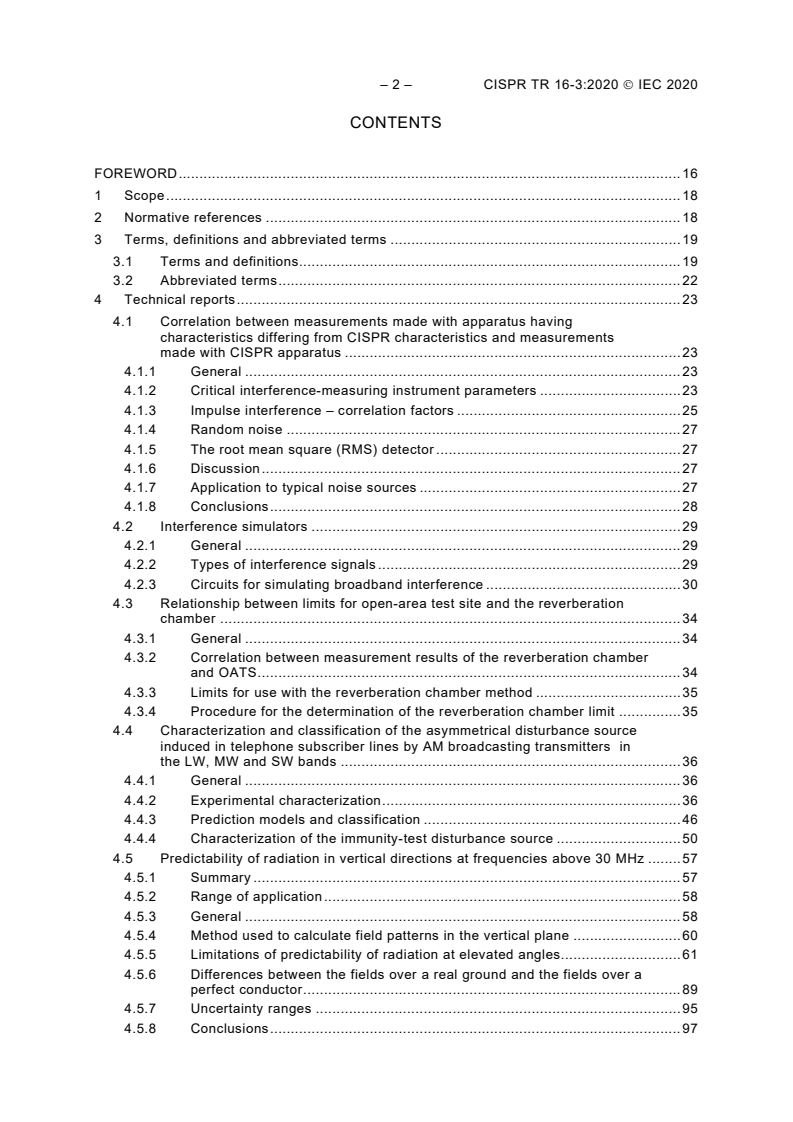
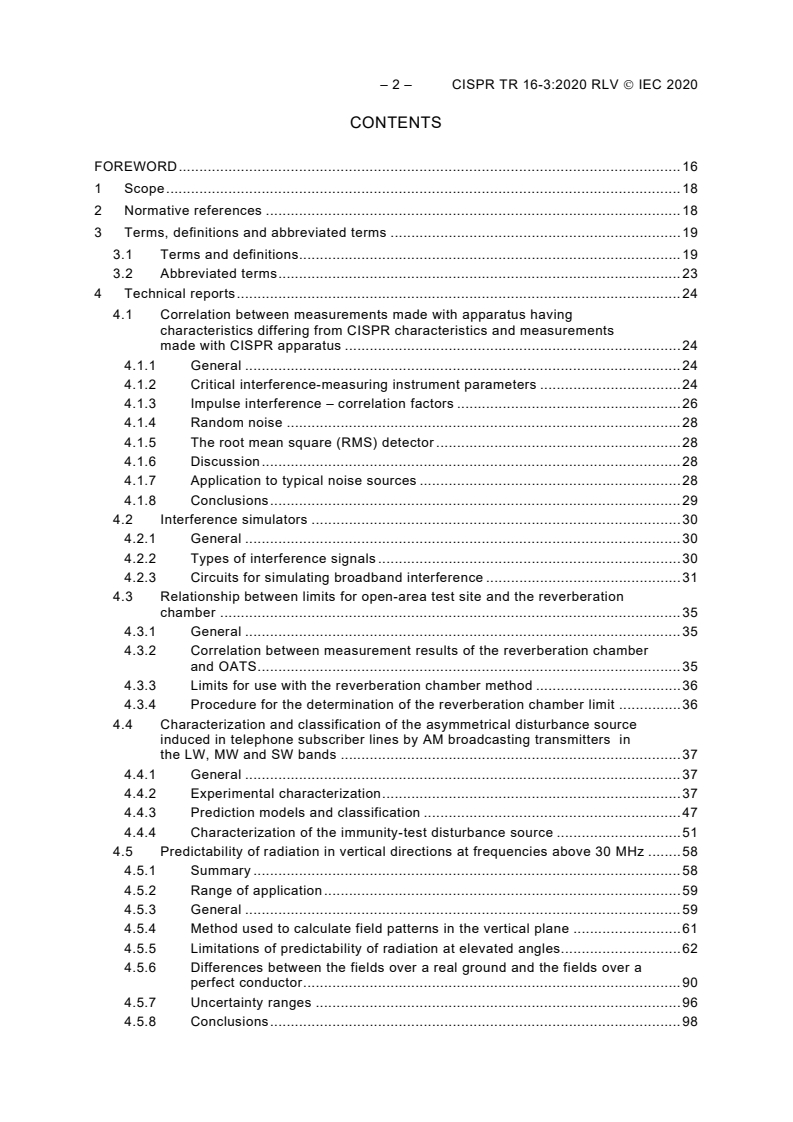
– 2 – CISPR TR 16-3:2020 IEC 2020
CONTENTS
FOREWORD . 16
1 Scope . 18
2 Normative references . 18
3 Terms, definitions and abbreviated terms . 19
3.1 Terms and definitions. 19
3.2 Abbreviated terms . 22
4 Technical reports . 23
4.1 Correlation between measurements made with apparatus having
characteristics differing from CISPR characteristics and measurements
made with CISPR apparatus . 23
4.1.1 General . 23
4.1.2 Critical interference-measuring instrument parameters . 23
4.1.3 Impulse interference – correlation factors . 25
4.1.4 Random noise . 27
4.1.5 The root mean square (RMS) detector . 27
4.1.6 Discussion . 27
4.1.7 Application to typical noise sources . 27
4.1.8 Conclusions . 28
4.2 Interference simulators . 29
4.2.1 General . 29
4.2.2 Types of interference signals . 29
4.2.3 Circuits for simulating broadband interference . 30
4.3 Relationship between limits for open-area test site and the reverberation
chamber . 34
4.3.1 General . 34
4.3.2 Correlation between measurement results of the reverberation chamber
and OATS . 34
4.3.3 Limits for use with the reverberation chamber method . 35
4.3.4 Procedure for the determination of the reverberation chamber limit . 35
4.4 Characterization and classification of the asymmetrical disturbance source
induced in telephone subscriber lines by AM broadcasting transmitters in
the LW, MW and SW bands . 36
4.4.1 General . 36
4.4.2 Experimental characterization . 36
4.4.3 Prediction models and classification . 46
4.4.4 Characterization of the immunity-test disturbance source . 50
4.5 Predictability of radiation in vertical directions at frequencies above 30 MHz . 57
4.5.1 Summary . 57
4.5.2 Range of application . 58
4.5.3 General . 58
4.5.4 Method used to calculate field patterns in the vertical plane . 60
4.5.5 Limitations of predictability of radiation at elevated angles. 61
4.5.6 Differences between the fields over a real ground and the fields over a
perfect conductor . 89
4.5.7 Uncertainty ranges . 95
4.5.8 Conclusions . 97
4.6 The predictability of radiation in vertical directions at frequencies up to
30 MHz . 98
4.6.1 Range of application . 98
4.6.2 General . 99
4.6.3 Method of calculation of the vertical radiation patterns. 100
4.6.4 The source models . 100
4.6.5 Electrical constants of the ground . 102
4.6.6 Predictability of radiation in vertical directions . 102
4.6.7 Conclusions . 110
4.6.8 Figures associated with predictability of radiation in vertical directions . 111
4.7 Correlation between amplitude probability distribution (APD) characteristics
of disturbance and performance of digital communication systems . 146
4.7.1 General . 146
4.7.2 Influence on a wireless LAN system . 146
4.7.3 Influence on a Bluetooth system . 149
4.7.4 Influence on a W-CDMA system . 153
4.7.5 Influence on Personal Handy Phone System (PHS) . 156
4.7.6 Quantitative correlation between noise parameters and system
performance . 160
4.7.7 Quantitative correlation between noise parameters of repetition pulse
and system performance of PHS and W-CDMA (BER) . 163
4.8 Background material on the definition of the RMS-average weighting
detector for measuring receivers . 166
4.8.1 General – purpose of weighted measurement of disturbance . 166
4.8.2 General principle of weighting – the CISPR quasi-peak detector . 167
4.8.3 Other detectors defined in CISPR 16-1-1 . 167
4.8.4 Procedures for measuring pulse weighting characteristics of digital
radiocommunications services . 168
4.8.5 Theoretical studies . 171
4.8.6 Experimental results . 173
4.8.7 Effects of spread-spectrum clock interference on wideband
radiocommunication signal reception . 191
4.8.8 Analysis of the various weighting characteristics and proposal of a
weighting detector . 192
4.8.9 Properties of the RMS-average weighting detector . 194
4.9 Common mode absorption devices (CMAD) . 196
4.9.1 General . 196
4.9.2 CMAD as a two-port device . 198
4.9.3 Measurement of CMAD . 202
4.10 Background on the definition of the FFT-based receiver . 212
4.10.1 General . 212
4.10.2 Tuned selective voltmeters and spectrum analyzers . 213
4.10.3 General principle of a tuned selective voltmeter . 213
4.10.4 FFT-based receivers – digital signal processing . 214
4.10.5 Measurement errors specific to FFT processing . 218
4.10.6 FFT-based receivers – examples . 220
4.11 Parameters of signals at telecommunication ports. 233
4.11.1 General . 233
4.11.2 Estimation of common mode disturbance levels . 234
4.12 Background on CDNE equipment and measurement method . 235
– 4 – CISPR TR 16-3:2020 IEC 2020
4.12.1 General . 235
4.12.2 Historical overview . 236
4.12.3 From CDN to CDNE . 240
4.13 Background on LLAS, validation and measurement method . 243
4.13.1 General . 243
4.13.2 Historical overview . 243
4.13.3 Models and equations for the LLAS method . 244
5 Background and history of CISPR . 244
5.1 The history of CISPR . 244
5.1.1 The early years: 1934-1984 . 244
5.1.2 The division of work . 246
5.1.3 The computer years: 1984 to 1998 . 247
5.1.4 The people in CISPR . 247
5.2 Historical background to the method of measurement of the interference
power produced by electrical household and similar appliances in the VHF
range . 248
5.2.1 Historical detail . 248
5.2.2 Development of the method . 249
Annex A (informative) Derivation of the formula . 251
Annex B (informative) The field-strength distribution . 255
B.1 General . 255
B.2 H -field expressions . 255
o
B.3 H field expressions. 257
i
B.4 E -field expressions . 258
o
Annex C (informative) The induced asymmetrical open-circuit voltage distribution . 259
C.1 General . 259
C.2 H-field-based relations . 259
C.3 E-field-based relations . 261
Annex D (informative) The outlet-voltage distribution . 262
D.1 General . 262
D.2 H-field-based relations . 262
D.3 E-field-based relations . 263
Annex E (informative) Some mathematical relations . 264
E.1 General . 264
E.2 The error function . 264
E.3 Application to the lognormal distribution . 265
Annex F (informative) Harmonic fields radiated at elevated angles from 27 MHz ISM
equipment over real ground . 266
Annex G (informative) Models and equations associated with the LLAS method . 272
G.1 General . 272
G.2 Response of an LAS to a magnetic field dipole . 272
G.2.1 Magnetic field strength model of a disturbance source . 272
G.2.2 Response of an LAS to a magnetic field dipole . 273
G.2.3 Sensitivity of an LLAS for different diameters . 277
G.2.4 Limitation of application of the relative sensitivity curves . 278
G.3 Response of LLAS to the LLAS verification dipole . 279
G.3.1 Relation of LLA current and voltage applied to the LLAS verification
dipole . 279
G.3.2 Calculation of mutual inductance: the original method . 280
G.3.3 Calculation of mutual inductance: the improved method . 280
G.3.4 Derivation of the equation for the reference validation factor . 280
G.3.5 Replication of the original version of the reference validation factor . 283
G.3.6 Calculation of the improved reference validation factor . 283
G.3.7 NEC2 method . 285
G.4 Magnetic field strength of a magnetic field dipole above a ground plane . 286
G.4.1 Model . 286
G.4.2 Replication of Figure C.10 . 287
G.4.3 Conversion factors for calculating magnetic field strength at other
distances . 289
G.5 LLAS validation criterion . 290
Bibliography . 291
Figure 1 – Relative response of various detectors to impulse interference . 24
Figure 2 – Pulse rectification coefficient P(α) . 25
Figure 3 – Pulse repetition frequency . 26
Figure 4 – Block diagram and waveforms of a simulator generating noise bursts . 32
Figure 5 – Block diagram of a simulator generating noise bursts according to the pulse
principle . 33
Figure 6 – Details of a typical output stage . 34
Figure 7 – Scatter plot of the measured outdoor magnetic field strength H (dBµA/m)
o
versus the calculated outdoor magnetic field strength H dB(µA/m) . 38
c
Figure 8 – Measured outdoor magnetic versus distance, and probability of the building-
effect parameter . 39
Figure 9 – Normal probability plot of the building-effect parameter A dB. 40
b
Figure 10 – Scatter plot of the outdoor antenna factor G dB(Ωm) versus the indoor
o
antenna factor G . 41
i
Figure 11 – Normal probability plots of the antenna factors . 42
Figure 12 – Normal probability plot of the equivalent asymmetrical resistance R dB(Ω) . 45
a
Figure 13 – Examples of the frequency dependence of some parameters . 46
Figure 14 – Example of the frequency histogram ∆N(E ,∆E ) . 51
o o
Figure 15 – Example of n (E ), i.e. the distribution of the outlets experiencing a
m o
maximum field strength E resulting from a given number of transmitters in (or near)
o
the respective geographical region . 52
Figure 16 – Example of the number of outlets with an induced asymmetrical open-
circuit voltage U ≤ U ≤ U = 79 V (see Table 10) . 54
L h max
Figure 17 – Examples of number (left-hand scale) and relative number (right-hand
scale) of outlets with U ≤ U ≤ U . 55
L h max
Figure 18 – Vertical polar patterns of horizontally polarized E field strengths emitted
x
around small vertical loop (horizontal magnetic dipole) over three different types of real
ground . 63
Figure 19 – Height scan patterns of vertically oriented E field strengths emitted from
z
small vertical loop (horizontal magnetic dipole) over three different types of real ground . 63
Figure 20 – Vertical polar patterns of horizontally polarized E field strengths emitted
x
around small vertical loop (horizontal magnetic dipole), over three different types of
real ground . 65
– 6 – CISPR TR 16-3:2020 IEC 2020
Figure 21 – Vertical polar patterns of vertically oriented E field strengths emitted
z
around small vertical loop (horizontal magnetic dipole) over three different types of real
ground . 65
Figure 22 – Height scan patterns of vertically oriented E field strengths emitted at
z
1 000 MHz from the small vertical loop (horizontal magnetic dipole), at horizontal
distance of 10 m, 30 m and 300 m in the Z-X plane over three different types of real
ground . 66
Figure 23 – Vertical polar patterns of horizontally polarized E and vertically oriented
x
E field strengths emitted around small horizontal electric dipole, in Y-Z and Z-X planes
z
respectively . 68
Figure 24 – Height scan patterns of horizontally polarized E field strengths emitted
x
from small horizontal electric dipole . 68
Figure 25 – Vertical polar patterns of horizontally polarized E and vertically oriented
x
E field strengths emitted around small horizontal electric dipole in Y-Z and Z-X planes
z
respectively . 71
Figure 26 – Height scan patterns of horizontally polarized E field strengths emitted
x
small horizontal electric dipole . 71
Figure 27 – Vertical polar patterns of horizontally polarized E and vertically oriented
x
E field strengths emitted around small vertical loop (horizontal magnetic dipole) in Y-Z
z
and Z-X planes respectively . 72
Figure 28 – Height scan patterns of vertically oriented E and horizontally oriented E
z x
field strengths emitted from small vertical loop (horizontal magnetic dipole) . 72
Figure 29 – Vertical polar patterns of vertically oriented E and horizontally oriented E
z x
field strengths emitted around small vertical electric dipole . 75
Figure 30 – Height scan patterns of vertically oriented E and horizontally oriented E
z x
field strengths emitted from small vertical electric dipole . 75
Figure 31 – Vertical polar patterns of horizontally polarized E and vertically oriented
x
E field strengths emitted around small vertical loop (horizontal magnetic dipole) in Y-Z
z
and Z-X planes respectively . 76
Figure 32 – Height scan patterns of vertically oriented E and horizontally oriented E
z x
field strengths emitted from small vertical loop (horizontal magnetic dipole) . 76
Figure 33 – Vertical polar patterns of horizontally polarized E-field strength emitted
around small horizontal loop (vertical magnetic dipole) . 77
Figure 34 – Height scan patterns of horizontally polarized E-field strength emitted from
small horizontal loop (vertical magnetic dipole) . 77
Figure 35 – Vertical polar patterns of vertically oriented E and horizontally oriented E
z x
field strengths emitted around small vertical electric dipole . 80
Figure 36 – Height scan patterns of vertically oriented E and horizontally oriented E
z x
field strengths emitted from the small vertical electric dipole . 80
Figure 37 – Vertical polar patterns of horizontally polarized E and vertically oriented
x
E field strengths emitted around small vertical loop (horizontal magnetic dipole) in Y-Z
z
and Z-X planes respectively . 81
Figure 38 – Height scan patterns of vertically oriented E and horizontally oriented E
z x
field strengths emitted from small vertical loop (horizontal magnetic dipole) . 81
Figure 39 – Vertical polar patterns of horizontally polarized E-field strength emitted
around small horizontal loop (vertical magnetic dipole) . 82
Figure 40 – Height scan patterns of horizontally polarized E-field strength emitted from
small horizontal loop (vertical magnetic dipole) . 82
Figure 41 – Vertical polar patterns of horizontally polarized E-field strength emitted
around the small horizontal loop (vertical magnetic dipole) . 85
Figure 42 – Height scan patterns of horizontally polarized E-field strength emitted from
small horizontal loop (vertical magnetic dipole) . 85
Figure 43 – Height scan patterns of horizontally polarized E-field strength emitted from
small horizontal loop (vertical magnetic dipole) . 89
Figure 44 – Height scan patterns of the vertical component of the E-fields emitted from
a small vertical electric dipole . 92
Figure 45 – Height scan patterns of the vertical component of the E-fields emitted from
a small vertical electric dipole . 92
Figure 46 – Height scan patterns of the horizontally polarized E-fields emitted in the
vertical plane normal to the axis of a small horizontal electric dipole . 94
Figure 47 – Height scan patterns of the horizontally polarized E-fields emitted in the
vertical plane normal to the axis of a small horizontal electric dipole . 94
Figure 48 – Ranges of uncertainties in the predictability of radiation in vertical
directions from electrically small sources located at a height of 1 m or 2 m above
ground . 96
Figure 49 – Ranges of uncertainties in the predictability of radiation in vertical
directions from electrically small sources located at a height of 1 m or 2 m above
ground . 96
Figure 50 – Ranges of uncertainties in the predictability of radiation in vertical
directions from electrically small sources located at a height of 1 m or 2 m above
ground . 97
Figure 51 – Geometry of the small vertical electric dipole model . 101
Figure 52 – Geometry of the small horizontal electrical dipole model . 101
Figure 53 – Geometry of the small horizontal magnetic dipole model (small vertical
loop) . 101
Figure 54 – Geometry of the small vertical magnetic dipole model (small horizontal
loop) . 101
Figure 55 – Ranges of errors in the predictability of radiation in vertical directions from
electrically small sources located close to the ground, based on measurements of the
horizontally oriented H-field near ground at a distance of 30 m from the sources . 109
Figure 56 – Ranges of errors in the predictability of radiation in vertical directions from
electrically small sources located close to the ground, based on measurements of the
horizontally oriented H-field at the ground supplemented with measurements of the
vertically oriented H-field in a height scan up to 6 m at a distance of 30 m from the
sources . 110
Figure 57 – Vertical radiation patterns of horizontally oriented H-fields emitted by a
small vertical electric dipole located close to the ground . 112
Figure 58 – Vertical radiation patterns of horizontally oriented H-fields emitted by a
small vertical electric dipole located close to the ground . 112
Figure 59 – Vertical radiation patterns of E-fields emitted by a small vertical electric
dipole located close to the ground . 113
Figure 60 – Vertical radiation patterns of the E-fields emitted by a small vertical electric
dipole located close to the ground . 113
Figure 61 – Vertical radiation patterns of the H-fields emitted by a small horizontal
electric dipole located close to the ground . 115
Figure 62 – Influence of a wide range of values of the electrical constants of the
ground on the vertical radiation patterns of the horizontally oriented H-fields emitted by
a small horizontal electric dipole located close to the ground . 115
Figure 63 – Vertical radiation patterns of the horizontally oriented H-fields emitted by a
small horizontal electric dipole located close to the ground . 116
Figure 64 – Vertical radiation patterns of the E-fields emitted by a small horizontal
electric dipole located close to the ground . 116
– 8 – CISPR TR 16-3:2020 IEC 2020
Figure 65 – Vertical radiation patterns of the E-fields emitted by a small horizontal
electric dipole located close to the ground . 117
Figure 66 – Vertical radiation patterns of H-fields emitted by small horizontal magnetic
dipole (vertical loop) located close to ground . 117
Figure 67 – Vertical radiation patterns of the horizontally oriented H-fields emitted by a
small horizontal magnetic dipole (vertical loop) located close to the ground . 118
Figure 68 – Vertical radiation patterns of the horizontally oriented H-fields emitted by a
small horizontal magnetic dipole (vertical loop) located close to the ground . 118
Figure 69 – Vertical radiation patterns of the E-fields emitted by a small horizontal
magnetic dipole (vertical loop) located close to the ground . 119
Figure 70 – Vertical radiation patterns of the E-fields emitted by a small horizontal
magnetic dipole (vertical loop) located close to the ground . 119
Figure 71 – Vertical radiation patterns of the H-fields emitted by a small vertical
magnetic dipole (horizontal loop) located close to the ground . 121
Figure 72 – Vertical radiation patterns of the H-fields emitted by a small vertical
magnetic dipole (horizontal loop) located close to the ground . 121
Figure 73 – Vertical radiation patterns of the H-fields emitted by a small vertical
magnetic dipole (horizontal loop) located close to the ground . 122
Figure 74 – Vertical radiation patterns of the H-fields emitted by a small vertical
magnetic dipole (horizontal loop) located close to the ground . 122
Figure 75 – Vertical radiation pattern of the E-field emitted by a small vertical magnetic
dipole (horizontal loop) located close to the ground . 123
Figure 76 – Vertical radiation patterns of the E-fields emitted by a small vertical
magnetic dipole (horizontal loop) located close to the ground . 123
Figure 77 – Vertical radiation patterns of the horizontally oriented H-fields emitted by a
small vertical electric dipole located close to the ground . 124
Figure 78 – Vertical radiation patterns of the E-fields emitted by a small vertical electric
dipole located close to the ground . 124
Figure 79 – Vertical radiation patterns of the E-fields emitted by a small vertical electric
dipole located close to the ground . 125
Figure 80 – Vertical radiation patterns of the H-fields emitted by a small horizontal
electric dipole located close to the ground . 125
Figure 81 – Vertical radiation patterns of the horizontally oriented H-fields emitted by a
small horizontal electric dipole located close to the ground . 126
Figure 82 – Vertical radiation patterns of the E-fields emitted by a small horizontal
electric dipole located close to the ground . 126
Figure 83 – Vertical radiation patterns of the E-fields emitted by a small horizontal
electric dipole located close to the ground . 128
Figure 84 – Vertical radiation patterns of the H-fields emitted by a small horizontal
magnetic dipole (vertical loop) located close to the ground . 128
Figure 85 – Vertical radiation patterns of the horizontally oriented H-fields emitted by a
small horizontal magnetic dipole (vertical loop) located close to the ground . 129
Figure 86 – Vertical radiation patterns of the horizontally oriented H-fields emitted by a
small horizontal magnetic dipole (vertical loop) located close to the ground . 129
Figure 87 – Vertical radiation patterns of the E-fields emitted by a small horizontal
magnetic dipole (vertical loop) located close to the ground . 130
Figure 88 – Vertical radiation patterns of the E-fields emitted by a small horizontal
magnetic dipole (vertical loop) located close to the ground . 130
Figure 89 – Vertical radiation patterns of the H-fields emitted by a small vertical
magnetic dipole (horizontal loop) located close to the ground . 131
Figure 90 – Vertical radiation patterns of the H-fields emitted by a small vertical
magnetic dipole (horizontal loop) located close to the ground . 131
Figure 91 – Vertical radiation patterns of the H-fields emitted by a small vertical
magnetic dipole (horizontal loop) located close to the ground . 132
Figure 92 – Vertical radiation patterns of the E-fields emitted by a small vertical
magnetic dipole (horizontal loop) located close to the ground . 132
Figure 93 – Vertical radiation patterns of the horizontally oriented H-fields emitted by a
small vertical electric dipole located close to the ground . 133
Figure 94 – Vertical radiation patterns of the E-fields emitted by a small vertical electric
dipole located close to the ground . 133
Figure 95 – Vertical radiation patterns of the E-fields emitted by a small vertical electric
dipole located close to the ground . 135
Figure 96 – Vertical radiation patterns of the H-fields emitted by a small horizontal
electric dipole located close to the ground . 135
Figure 97 – Vertical radiation patterns of the E-fields emitted by a small horizontal
electric dipole located close to the ground . 136
Figure 98 – Vertical radiation patterns of the E-fields emitted by a small horizontal
electric dipole located close to the ground . 136
Figure 99 – Vertical radiation patterns of the H-field emitted by a small horizontal
magnetic dipole (vertical loop) located close to the ground . 138
Figure 100 – Vertical radiation patterns of the vertically polarized E-fields emitted by a
small horizontal magnetic dipole (vertical loop) located close to the ground . 138
Figure 101 – Vertical radiation patterns of the H-field emitted by a small vertical
magnetic dipole (horizontal loop) located close to the ground . 139
Figure 102 – Vertical radiation patterns of the E-fields emitted by a small vertical
magnetic dipole (horizontal loop) located close to the ground . 139
Figure 103 – Vertical radiation patterns of the horizontally oriented H-fields emitted by
a small vertical electric dipole located close to the ground . 140
Figure 104 – Vertical radiation patterns of the vertically polarized E-fields emitted by a
small vertical electric dipole located close to the ground . 140
Figure 105 – Vertical radiation patterns of the H-fields emitted by a small horizontal
electric dipole located close to the ground . 141
Figure 106 – Vertical radiation patterns of the horizontally oriented H-fields emitted by
a small horizontal electric dipole located close to the ground . 141
Figure 107 – Influence of a wide range of values of the electrical constants of the
ground on the vertical radiation patterns of the horizontally oriented H-fields emitted by
a small horizontal electric dipole located close to the ground . 142
Figure 108 – Vertical radiation pattern
...
CISPR TR 16-3 ®
Edition 4.0 2020-10
REDLINE VERSION
TECHNICAL
REPORT
colour
inside
INTERNATIONAL SPECIAL COMMITTEE ON RADIO INTERFERENCE
Specification for radio disturbance and immunity measuring apparatus and
methods –
Part 3: CISPR technical reports
All rights reserved. Unless otherwise specified, no part of this publication may be reproduced or utilized in any form
or by any means, electronic or mechanical, including photocopying and microfilm, without permission in writing from
either IEC or IEC's member National Committee in the country of the requester. If you have any questions about IEC
copyright or have an enquiry about obtaining additional rights to this publication, please contact the address below or
your local IEC member National Committee for further information.
IEC Central Office Tel.: +41 22 919 02 11
3, rue de Varembé info@iec.ch
CH-1211 Geneva 20 www.iec.ch
Switzerland
About the IEC
The International Electrotechnical Commission (IEC) is the leading global organization that prepares and publishes
International Standards for all electrical, electronic and related technologies.
About IEC publications
The technical content of IEC publications is kept under constant review by the IEC. Please make sure that you have the
latest edition, a corrigendum or an amendment might have been published.
IEC publications search - webstore.iec.ch/advsearchform Electropedia - www.electropedia.org
The advanced search enables to find IEC publications by a The world's leading online dictionary on electrotechnology,
variety of criteria (reference number, text, technical containing more than 22 000 terminological entries in English
committee,…). It also gives information on projects, replaced and French, with equivalent terms in 16 additional languages.
and withdrawn publications. Also known as the International Electrotechnical Vocabulary
(IEV) online.
IEC Just Published - webstore.iec.ch/justpublished
Stay up to date on all new IEC publications. Just Published IEC Glossary - std.iec.ch/glossary
details all new publications released. Available online and 67 000 electrotechnical terminology entries in English and
once a month by email. French extracted from the Terms and Definitions clause of
IEC publications issued since 2002. Some entries have been
IEC Customer Service Centre - webstore.iec.ch/csc collected from earlier publications of IEC TC 37, 77, 86 and
If you wish to give us your feedback on this publication or CISPR.
need further assistance, please contact the Customer Service
Centre: sales@iec.ch.
CISPR TR 16-3 ®
Edition 4.0 2020-10
REDLINE VERSION
TECHNICAL
REPORT
colour
inside
INTERNATIONAL SPECIAL COMMITTEE ON RADIO INTERFERENCE
Specification for radio disturbance and immunity measuring apparatus and
methods –
Part 3: CISPR technical reports
INTERNATIONAL
ELECTROTECHNICAL
COMMISSION
ICS 33.100.10; 33.100.20 ISBN 978-2-8322-8985-3
– 2 – CISPR TR 16-3:2020 RLV IEC 2020
CONTENTS
FOREWORD . 16
1 Scope . 18
2 Normative references . 18
3 Terms, definitions and abbreviated terms . 19
3.1 Terms and definitions. 19
3.2 Abbreviated terms . 23
4 Technical reports . 24
4.1 Correlation between measurements made with apparatus having
characteristics differing from CISPR characteristics and measurements
made with CISPR apparatus . 24
4.1.1 General . 24
4.1.2 Critical interference-measuring instrument parameters . 24
4.1.3 Impulse interference – correlation factors . 26
4.1.4 Random noise . 28
4.1.5 The root mean square (RMS) detector . 28
4.1.6 Discussion . 28
4.1.7 Application to typical noise sources . 28
4.1.8 Conclusions . 29
4.2 Interference simulators . 30
4.2.1 General . 30
4.2.2 Types of interference signals . 30
4.2.3 Circuits for simulating broadband interference . 31
4.3 Relationship between limits for open-area test site and the reverberation
chamber . 35
4.3.1 General . 35
4.3.2 Correlation between measurement results of the reverberation chamber
and OATS . 35
4.3.3 Limits for use with the reverberation chamber method . 36
4.3.4 Procedure for the determination of the reverberation chamber limit . 36
4.4 Characterization and classification of the asymmetrical disturbance source
induced in telephone subscriber lines by AM broadcasting transmitters in
the LW, MW and SW bands . 37
4.4.1 General . 37
4.4.2 Experimental characterization . 37
4.4.3 Prediction models and classification . 47
4.4.4 Characterization of the immunity-test disturbance source . 51
4.5 Predictability of radiation in vertical directions at frequencies above 30 MHz . 58
4.5.1 Summary . 58
4.5.2 Range of application . 59
4.5.3 General . 59
4.5.4 Method used to calculate field patterns in the vertical plane . 61
4.5.5 Limitations of predictability of radiation at elevated angles. 62
4.5.6 Differences between the fields over a real ground and the fields over a
perfect conductor . 90
4.5.7 Uncertainty ranges . 96
4.5.8 Conclusions . 98
4.6 The predictability of radiation in vertical directions at frequencies up to
30 MHz . 99
4.6.1 Range of application . 99
4.6.2 General . 100
4.6.3 Method of calculation of the vertical radiation patterns. 101
4.6.4 The source models . 101
4.6.5 Electrical constants of the ground . 103
4.6.6 Predictability of radiation in vertical directions . 103
4.6.7 Conclusions . 111
4.6.8 Figures associated with predictability of radiation in vertical directions . 112
4.7 Correlation between amplitude probability distribution (APD) characteristics
of disturbance and performance of digital communication systems . 147
4.7.1 General . 147
4.7.2 Influence on a wireless LAN system . 147
4.7.3 Influence on a Bluetooth system . 150
4.7.4 Influence on a W-CDMA system . 154
4.7.5 Influence on Personal Handy Phone System (PHS) . 157
4.7.6 Quantitative correlation between noise parameters and system
performance . 161
4.7.7 Quantitative correlation between noise parameters of repetition pulse
and system performance of PHS and W-CDMA (BER) . 164
4.8 Background material on the definition of the RMS-average weighting
detector for measuring receivers . 167
4.8.1 General – purpose of weighted measurement of disturbance . 167
4.8.2 General principle of weighting – the CISPR quasi-peak detector . 168
4.8.3 Other detectors defined in CISPR 16-1-1 . 168
4.8.4 Procedures for measuring pulse weighting characteristics of digital
radiocommunications services . 169
4.8.5 Theoretical studies . 172
4.8.6 Experimental results . 174
4.8.7 Effects of spread-spectrum clock interference on wideband
radiocommunication signal reception . 192
4.8.8 Analysis of the various weighting characteristics and proposal of a
weighting detector . 193
4.8.9 Properties of the RMS-average weighting detector . 195
4.9 Common mode absorption devices (CMAD) . 197
4.9.1 General . 197
4.9.2 CMAD as a two-port device . 199
4.9.3 Measurement of CMAD . 203
4.10 Background on the definition of the FFT-based receiver . 213
4.10.1 General . 213
4.10.2 Tuned selective voltmeters and spectrum analyzers . 214
4.10.3 General principle of a tuned selective voltmeter . 214
4.10.4 FFT-based receivers – digital signal processing . 215
4.10.5 Measurement errors specific to FFT processing . 219
4.10.6 FFT-based receivers – examples . 221
4.11 Parameters of signals at telecommunication ports. 234
4.11.1 General . 234
4.11.2 Estimation of common mode disturbance levels . 235
4.12 Background on CDNE equipment and measurement method . 236
– 4 – CISPR TR 16-3:2020 RLV IEC 2020
4.12.1 General . 236
4.12.2 Historical overview . 237
4.12.3 From CDN to CDNE . 241
4.13 Background on LLAS, validation and measurement method . 244
4.13.1 General . 244
4.13.2 Historical overview . 244
4.13.3 Models and equations for the LLAS method . 245
5 Background and history of CISPR . 245
5.1 The history of CISPR . 245
5.1.1 The early years: 1934-1984 . 245
5.1.2 The division of work . 247
5.1.3 The computer years: 1984 to 1998 . 248
5.1.4 The people in CISPR . 248
5.2 Historical background to the method of measurement of the interference
power produced by electrical household and similar appliances in the VHF
range . 249
5.2.1 Historical detail . 249
5.2.2 Development of the method . 250
Annex A (informative) Derivation of the formula . 252
Annex B (informative) The field-strength distribution . 256
B.1 General . 256
B.2 H -field expressions . 256
o
B.3 H field expressions. 258
i
B.4 E -field expressions . 259
o
Annex C (informative) The induced asymmetrical open-circuit voltage distribution . 260
C.1 General . 260
C.2 H-field-based relations . 260
C.3 E-field-based relations . 262
Annex D (informative) The outlet-voltage distribution . 263
D.1 General . 263
D.2 H-field-based relations . 263
D.3 E-field-based relations . 264
Annex E (informative) Some mathematical relations . 265
E.1 General . 265
E.2 The error function . 265
E.3 Application to the lognormal distribution . 266
Annex F (informative) Harmonic fields radiated at elevated angles from 27 MHz ISM
equipment over real ground . 267
Annex G (informative) Models and equations associated with the LLAS method . 273
G.1 General . 273
G.2 Response of an LAS to a magnetic field dipole . 273
G.2.1 Magnetic field strength model of a disturbance source . 273
G.2.2 Response of an LAS to a magnetic field dipole . 274
G.2.3 Sensitivity of an LLAS for different diameters . 278
G.2.4 Limitation of application of the relative sensitivity curves . 279
G.3 Response of LLAS to the LLAS verification dipole . 280
G.3.1 Relation of LLA current and voltage applied to the LLAS verification
dipole . 280
G.3.2 Calculation of mutual inductance: the original method . 281
G.3.3 Calculation of mutual inductance: the improved method . 281
G.3.4 Derivation of the equation for the reference validation factor . 281
G.3.5 Replication of the original version of the reference validation factor . 284
G.3.6 Calculation of the improved reference validation factor . 284
G.3.7 NEC2 method . 286
G.4 Magnetic field strength of a magnetic field dipole above a ground plane . 287
G.4.1 Model . 287
G.4.2 Replication of Figure C.10 . 288
G.4.3 Conversion factors for calculating magnetic field strength at other
distances . 290
G.5 LLAS validation criterion . 291
Bibliography . 292
Figure 1 – Relative response of various detectors to impulse interference . 25
Figure 2 – Pulse rectification coefficient P(α) . 26
Figure 3 – Pulse repetition frequency . 27
Figure 4 – Block diagram and waveforms of a simulator generating noise bursts . 33
Figure 5 – Block diagram of a simulator generating noise bursts according to the pulse
principle . 34
Figure 6 – Details of a typical output stage . 35
Figure 7 – Scatter plot of the measured outdoor magnetic field strength H (dBµA/m)
o
versus the calculated outdoor magnetic field strength H dB(µA/m) . 39
c
Figure 8 – Measured outdoor magnetic versus distance, and probability of the building-
effect parameter . 40
Figure 9 – Normal probability plot of the building-effect parameter A dB. 41
b
Figure 10 – Scatter plot of the outdoor antenna factor G dB(Ωm) versus the indoor
o
antenna factor G . 42
i
Figure 11 – Normal probability plots of the antenna factors . 43
Figure 12 – Normal probability plot of the equivalent asymmetrical resistance R dB(Ω) . 46
a
Figure 13 – Examples of the frequency dependence of some parameters . 47
Figure 14 – Example of the frequency histogram ∆N(E ,∆E ) . 52
o o
Figure 15 – Example of n (E ), i.e. the distribution of the outlets experiencing a
m o
maximum field strength E resulting from a given number of transmitters in (or near)
o
the respective geographical region . 53
Figure 16 – Example of the number of outlets with an induced asymmetrical open-
circuit voltage U ≤ U ≤ U = 79 V (see Table 10) . 55
L h max
Figure 17 – Examples of number (left-hand scale) and relative number (right-hand
scale) of outlets with U ≤ U ≤ U . 56
L h max
Figure 18 – Vertical polar patterns of horizontally polarized E field strengths emitted
x
around small vertical loop (horizontal magnetic dipole) over three different types of real
ground . 64
Figure 19 – Height scan patterns of vertically oriented E field strengths emitted from
z
small vertical loop (horizontal magnetic dipole) over three different types of real ground . 64
Figure 20 – Vertical polar patterns of horizontally polarized E field strengths emitted
x
around small vertical loop (horizontal magnetic dipole), over three different types of
real ground . 66
– 6 – CISPR TR 16-3:2020 RLV IEC 2020
Figure 21 – Vertical polar patterns of vertically oriented E field strengths emitted
z
around small vertical loop (horizontal magnetic dipole) over three different types of real
ground . 66
Figure 22 – Height scan patterns of vertically oriented E field strengths emitted at
z
1 000 MHz from the small vertical loop (horizontal magnetic dipole), at horizontal
distance of 10 m, 30 m and 300 m in the Z-X plane over three different types of real
ground . 67
Figure 23 – Vertical polar patterns of horizontally polarized E and vertically oriented
x
E field strengths emitted around small horizontal electric dipole, in Y-Z and Z-X planes
z
respectively . 69
Figure 24 – Height scan patterns of horizontally polarized E field strengths emitted
x
from small horizontal electric dipole . 69
Figure 25 – Vertical polar patterns of horizontally polarized E and vertically oriented
x
E field strengths emitted around small horizontal electric dipole in Y-Z and Z-X planes
z
respectively . 72
Figure 26 – Height scan patterns of horizontally polarized E field strengths emitted
x
small horizontal electric dipole . 72
Figure 27 – Vertical polar patterns of horizontally polarized E and vertically oriented
x
E field strengths emitted around small vertical loop (horizontal magnetic dipole) in Y-Z
z
and Z-X planes respectively . 73
Figure 28 – Height scan patterns of vertically oriented E and horizontally oriented E
z x
field strengths emitted from small vertical loop (horizontal magnetic dipole) . 73
Figure 29 – Vertical polar patterns of vertically oriented E and horizontally oriented E
z x
field strengths emitted around small vertical electric dipole . 76
Figure 30 – Height scan patterns of vertically oriented E and horizontally oriented E
z x
field strengths emitted from small vertical electric dipole . 76
Figure 31 – Vertical polar patterns of horizontally polarized E and vertically oriented
x
E field strengths emitted around small vertical loop (horizontal magnetic dipole) in Y-Z
z
and Z-X planes respectively . 77
Figure 32 – Height scan patterns of vertically oriented E and horizontally oriented E
z x
field strengths emitted from small vertical loop (horizontal magnetic dipole) . 77
Figure 33 – Vertical polar patterns of horizontally polarized E-field strength emitted
around small horizontal loop (vertical magnetic dipole) . 78
Figure 34 – Height scan patterns of horizontally polarized E-field strength emitted from
small horizontal loop (vertical magnetic dipole) . 78
Figure 35 – Vertical polar patterns of vertically oriented E and horizontally oriented E
z x
field strengths emitted around small vertical electric dipole . 81
Figure 36 – Height scan patterns of vertically oriented E and horizontally oriented E
z x
field strengths emitted from the small vertical electric dipole . 81
Figure 37 – Vertical polar patterns of horizontally polarized E and vertically oriented
x
E field strengths emitted around small vertical loop (horizontal magnetic dipole) in Y-Z
z
and Z-X planes respectively . 82
Figure 38 – Height scan patterns of vertically oriented E and horizontally oriented E
z x
field strengths emitted from small vertical loop (horizontal magnetic dipole) . 82
Figure 39 – Vertical polar patterns of horizontally polarized E-field strength emitted
around small horizontal loop (vertical magnetic dipole) . 83
Figure 40 – Height scan patterns of horizontally polarized E-field strength emitted from
small horizontal loop (vertical magnetic dipole) . 83
Figure 41 – Vertical polar patterns of horizontally polarized E-field strength emitted
around the small horizontal loop (vertical magnetic dipole) . 86
Figure 42 – Height scan patterns of horizontally polarized E-field strength emitted from
small horizontal loop (vertical magnetic dipole) . 86
Figure 43 – Height scan patterns of horizontally polarized E-field strength emitted from
small horizontal loop (vertical magnetic dipole) . 90
Figure 44 – Height scan patterns of the vertical component of the E-fields emitted from
a small vertical electric dipole . 93
Figure 45 – Height scan patterns of the vertical component of the E-fields emitted from
a small vertical electric dipole . 93
Figure 46 – Height scan patterns of the horizontally polarized E-fields emitted in the
vertical plane normal to the axis of a small horizontal electric dipole . 95
Figure 47 – Height scan patterns of the horizontally polarized E-fields emitted in the
vertical plane normal to the axis of a small horizontal electric dipole . 95
Figure 48 – Ranges of uncertainties in the predictability of radiation in vertical
directions from electrically small sources located at a height of 1 m or 2 m above
ground . 97
Figure 49 – Ranges of uncertainties in the predictability of radiation in vertical
directions from electrically small sources located at a height of 1 m or 2 m above
ground . 97
Figure 50 – Ranges of uncertainties in the predictability of radiation in vertical
directions from electrically small sources located at a height of 1 m or 2 m above
ground . 98
Figure 51 – Geometry of the small vertical electric dipole model . 102
Figure 52 – Geometry of the small horizontal electrical dipole model . 102
Figure 53 – Geometry of the small horizontal magnetic dipole model (small vertical
loop) . 102
Figure 54 – Geometry of the small vertical magnetic dipole model (small horizontal
loop) . 102
Figure 55 – Ranges of errors in the predictability of radiation in vertical directions from
electrically small sources located close to the ground, based on measurements of the
horizontally oriented H-field near ground at a distance of 30 m from the sources . 110
Figure 56 – Ranges of errors in the predictability of radiation in vertical directions from
electrically small sources located close to the ground, based on measurements of the
horizontally oriented H-field at the ground supplemented with measurements of the
vertically oriented H-field in a height scan up to 6 m at a distance of 30 m from the
sources . 111
Figure 57 – Vertical radiation patterns of horizontally oriented H-fields emitted by a
small vertical electric dipole located close to the ground . 113
Figure 58 – Vertical radiation patterns of horizontally oriented H-fields emitted by a
small vertical electric dipole located close to the ground . 113
Figure 59 – Vertical radiation patterns of E-fields emitted by a small vertical electric
dipole located close to the ground . 114
Figure 60 – Vertical radiation patterns of the E-fields emitted by a small vertical electric
dipole located close to the ground . 114
Figure 61 – Vertical radiation patterns of the H-fields emitted by a small horizontal
electric dipole located close to the ground . 116
Figure 62 – Influence of a wide range of values of the electrical constants of the
ground on the vertical radiation patterns of the horizontally oriented H-fields emitted by
a small horizontal electric dipole located close to the ground . 116
Figure 63 – Vertical radiation patterns of the horizontally oriented H-fields emitted by a
small horizontal electric dipole located close to the ground . 117
Figure 64 – Vertical radiation patterns of the E-fields emitted by a small horizontal
electric dipole located close to the ground . 117
– 8 – CISPR TR 16-3:2020 RLV IEC 2020
Figure 65 – Vertical radiation patterns of the E-fields emitted by a small horizontal
electric dipole located close to the ground . 118
Figure 66 – Vertical radiation patterns of H-fields emitted by small horizontal magnetic
dipole (vertical loop) located close to ground . 118
Figure 67 – Vertical radiation patterns of the horizontally oriented H-fields emitted by a
small horizontal magnetic dipole (vertical loop) located close to the ground . 119
Figure 68 – Vertical radiation patterns of the horizontally oriented H-fields emitted by a
small horizontal magnetic dipole (vertical loop) located close to the ground . 119
Figure 69 – Vertical radiation patterns of the E-fields emitted by a small horizontal
magnetic dipole (vertical loop) located close to the ground . 120
Figure 70 – Vertical radiation patterns of the E-fields emitted by a small horizontal
magnetic dipole (vertical loop) located close to the ground . 120
Figure 71 – Vertical radiation patterns of the H-fields emitted by a small vertical
magnetic dipole (horizontal loop) located close to the ground . 122
Figure 72 – Vertical radiation patterns of the H-fields emitted by a small vertical
magnetic dipole (horizontal loop) located close to the ground . 122
Figure 73 – Vertical radiation patterns of the H-fields emitted by a small vertical
magnetic dipole (horizontal loop) located close to the ground . 123
Figure 74 – Vertical radiation patterns of the H-fields emitted by a small vertical
magnetic dipole (horizontal loop) located close to the ground . 123
Figure 75 – Vertical radiation pattern of the E-field emitted by a small vertical magnetic
dipole (horizontal loop) located close to the ground . 124
Figure 76 – Vertical radiation patterns of the E-fields emitted by a small vertical
magnetic dipole (horizontal loop) located close to the ground . 124
Figure 77 – Vertical radiation patterns of the horizontally oriented H-fields emitted by a
small vertical electric dipole located close to the ground . 125
Figure 78 – Vertical radiation patterns of the E-fields emitted by a small vertical electric
dipole located close to the ground . 125
Figure 79 – Vertical radiation patterns of the E-fields emitted by a small vertical electric
dipole located close to the ground . 126
Figure 80 – Vertical radiation patterns of the H-fields emitted by a small horizontal
electric dipole located close to the ground . 126
Figure 81 – Vertical radiation patterns of the horizontally oriented H-fields emitted by a
small horizontal electric dipole located close to the ground . 127
Figure 82 – Vertical radiation patterns of the E-fields emitted by a small horizontal
electric dipole located close to the ground . 127
Figure 83 – Vertical radiation patterns of the E-fields emitted by a small horizontal
electric dipole located close to the ground . 129
Figure 84 – Vertical radiation patterns of the H-fields emitted by a small horizontal
magnetic dipole (vertical loop) located close to the ground . 129
Figure 85 – Vertical radiation patterns of the horizontally oriented H-fields emitted by a
small horizontal magnetic dipole (vertical loop) located close to the ground . 130
Figure 86 – Vertical radiation patterns of the horizontally oriented H-fields emitted by a
small horizontal magnetic dipole (vertical loop) located close to the ground . 130
Figure 87 – Vertical radiation patterns of the E-fields emitted by a small horizontal
magnetic dipole (vertical loop) located close to the ground . 131
Figure 88 – Vertical radiation patterns of the E-fields emitted by a small horizontal
magnetic dipole (vertical loop) located close to the ground . 131
Figure 89 – Vertical radiation patterns of the H-fields emitted by a small vertical
magnetic dipole (horizontal loop) located close to the ground . 132
Figure 90 – Vertical radiation patterns of the H-fields emitted by a small vertical
magnetic dipole (horizontal loop) located close to the ground . 132
Figure 91 – Vertical radiation patterns of the H-fields emitted by a small vertical
magnetic dipole (horizontal loop) located close to the ground . 133
Figure 92 – Vertical radiation patterns of the E-fields emitted by a small vertical
magnetic dipole (horizontal loop) located close to the ground . 133
Figure 93 – Vertical radiation patterns of the horizontally oriented H-fields emitted by a
small vertical electric dipole located close to the ground . 134
Figure 94 – Vertical radiation patterns of the E-fields emitted by a small vertical electric
dipole located close to the ground . 134
Figure 95 – Vertical radiation patterns of the E-fields emitted by a small vertical electric
dipole located close to the ground . 136
Figure 96 – Vertical radiation patterns of the H-fields emitted by a small horizontal
electric dipole located close to the ground . 136
Figure 97 – Vertical radiation patterns of the E-fields emitted by a small horizontal
electric dipole located close to the ground . 137
Figure 98 – Vertical radiation patterns of the E-fields emitted by a small horizontal
electric dipole located close to the ground . 137
Figure 99 – Vertical radiation patterns of the H-field emitted by a small horizontal
magnetic dipole (vertical loop) located close to the ground . 139
Figure 100 – Vertical radiation patterns of the vertically polarized E-fields emitted by a
small horizontal magnetic dipole (vertical loop) located close to the ground . 139
Figure 101 – Vertical radiation patterns of the H-field emitted by a small vertical
magnetic dipole (horizontal loop) located close to the ground . 140
Figure 102 – Vertical radiation patterns of the E-fields emitted by a small vertical
magnetic dipole (horizontal loop) located close to the ground . 140
Figure 103 – Vertical radiation patterns of the horizontally oriented H-fields emitted by
a small vertical electric dipole located close to the ground . 141
Figure 104 – Vertical radiation patterns of the vertically polarized E-fields emitted by a
small vertical electric dipole located close to the ground . 141
Figure 105 – Vertical radiation patterns of the H-fields emitted by a small horizontal
electric dipole located close to the ground . 142
Figure 106 – Vertical radiation patterns of the horizontally oriented H-fields emitted by
a small horizontal electric dipole located close to the ground . 142
Figure 107 – Influence of a wide range of values of the electrical constants of the
ground on the vertical radiation patterns of the horizontally oriented H-fields emitted by
a small horizontal electric dipole located close to the ground .
...