

CISPR 16-2-3:2016
(Main)Specification for radio disturbance and immunity measuring apparatus and methods - Part 2-3: Methods of measurement of disturbances and immunity - Radiated disturbance measurements
General Information
- Abstract
CISPR 16-2-3:2016 specifies the methods of measurement of radiated disturbance phenomena in the frequency range of 9 kHz to 18 GHz. The aspects of measurement uncertainty are specified in CISPR 16-4-1 and CISPR 16-4-2. It has the status of a basic EMC publication in accordance with IEC Guide 107, "Electromagnetic compatibility - Guide to the drafting of electromagnetic compatibility publications". This fourth edition edition cancels and replaces the third edition published in 2010, its Amendment 1:2010 and its Amendment 2:2014. This edition constitutes a technical revision.
- Status
- Published
- Publication Date
- 13-Jun-2023
- Technical Committee
- CIS/A - Radio-interference measurements and statistical methods
- Current Stage
- PPUB - Publication issued
- Start Date
- 15-Sep-2016
- Completion Date
- 15-Oct-2016
Buy Documents
CISPR 16-2-3:2016 RLV - Specification for radio disturbance and immunity measuring apparatus and methods - Part 2-3: Methods of measurement of disturbances and immunity - Radiated disturbance measurements Released:9/15/2016
CISPR 16-2-3:2016 - Specification for radio disturbance and immunity measuring apparatus and methods - Part 2-3: Methods of measurement of disturbances and immunity - Radiated disturbance measurements Released:9/15/2016

CISPR 16-2-3:2016+AMD1:2019 CSV - Specification for radio disturbance and immunity measuring apparatus and methods - Part 2-3: Methods of measurement of disturbances and immunity - Radiated disturbance measurements Released:6/25/2019

CISPR 16-2-3:2016+AMD1:2019+AMD2:2023 CSV - Specification for radio disturbance and immunity measuring apparatus and methods - Part 2-3: Methods of measurement of disturbances and immunity - Radiated disturbance measurements Released:6/14/2023
Overview
CISPR 16-2-3:2016 is an international EMC standard published by IEC/CISPR that defines methods for measuring radiated disturbance phenomena from 9 kHz to 18 GHz. As a fourth‑edition basic EMC publication (technical revision of earlier editions and amendments), it specifies measurement methods, test set‑ups and procedures for radiated emissions and radiated immunity measurements. Measurement uncertainty aspects are covered in companion documents CISPR 16-4-1 and CISPR 16-4-2.
Key topics and requirements
- Frequency range and measurands: Radiated disturbance measurements across 9 kHz–18 GHz, including guidance for loop‑antenna systems, OATS/SAC, fully‑anechoic rooms (FAR), and high‑frequency absorber‑lined chambers.
- Test environments and site geometry: Requirements and methods for open‑area test sites (OATS), semi‑anechoic chambers (SAC), fully‑anechoic rooms (FAR), reverberation chambers, and in‑situ measurements.
- Antenna and probe use: Selection and positioning of antennas, antenna height variation, substitution methods, and loop‑antenna system procedures (9 kHz–30 MHz).
- Measurement procedures: Use of spectrum analyzers, scanning receivers, FFT‑based instruments, automated measurement strategies, pre‑scans, data reduction and final measurement/verification.
- Specialized methods: Substitution measurements, TEM waveguide techniques, and reverberation chamber procedures for specific frequency bands.
- Measurement timing and scan rates: Minimum measurement times, scan rates for different detectors (peak/average), and timing considerations for impulsive and discontinuous disturbances.
- In‑situ testing and documentation: Practical guidance on preparing and documenting field measurements, and assessing disturbances in the presence of ambient emissions.
- Measurement uncertainty: While measurement uncertainty specifics are referenced to CISPR 16‑4‑1 and 16‑4‑2, CISPR 16‑2‑3 defines procedures that feed into uncertainty evaluation.
Applications and users
- EMC/test engineers performing radiated emissions and radiated immunity testing for product compliance.
- Accredited testing laboratories that certify equipment to regulatory or product standards.
- Product manufacturers integrating EMC test planning in design and pre‑compliance validation.
- Test facility designers and operators establishing OATS, SAC, FAR or reverberation chamber capabilities.
- Regulators and conformity assessment bodies using standardized measurement methods for consistent enforcement.
Related standards
- CISPR 16-4-1 / CISPR 16-4-2 - measurement uncertainty and calibration practices.
- IEC Guide 107 - guidance for drafting EMC publications; CISPR 16‑2‑3 is designated a basic EMC publication.
CISPR 16-2-3:2016 is essential for anyone involved in accurate, repeatable radiated disturbance measurements and helps ensure measurement consistency across labs, chambers and field sites for frequencies from 9 kHz to 18 GHz.
Relations
- Effective Date
- 05-Sep-2023
- Effective Date
- 05-Sep-2023
- Effective Date
- 05-Sep-2023
- Effective Date
- 05-Sep-2023
- Effective Date
- 05-Sep-2023
Buy Documents
CISPR 16-2-3:2016 RLV - Specification for radio disturbance and immunity measuring apparatus and methods - Part 2-3: Methods of measurement of disturbances and immunity - Radiated disturbance measurements Released:9/15/2016
CISPR 16-2-3:2016 - Specification for radio disturbance and immunity measuring apparatus and methods - Part 2-3: Methods of measurement of disturbances and immunity - Radiated disturbance measurements Released:9/15/2016
CISPR 16-2-3:2016+AMD1:2019 CSV - Specification for radio disturbance and immunity measuring apparatus and methods - Part 2-3: Methods of measurement of disturbances and immunity - Radiated disturbance measurements Released:6/25/2019
CISPR 16-2-3:2016+AMD1:2019+AMD2:2023 CSV - Specification for radio disturbance and immunity measuring apparatus and methods - Part 2-3: Methods of measurement of disturbances and immunity - Radiated disturbance measurements Released:6/14/2023
Get Certified
Connect with accredited certification bodies for this standard

IMQ S.p.A. (Certification)
Italian electrical product certification.

SLG Prüf- und Zertifizierungs GmbH
German testing and certification body.

UL Solutions
Global safety science company with testing, inspection and certification.
Sponsored listings
Frequently Asked Questions
CISPR 16-2-3:2016 is a standard published by the International Electrotechnical Commission (IEC). Its full title is "Specification for radio disturbance and immunity measuring apparatus and methods - Part 2-3: Methods of measurement of disturbances and immunity - Radiated disturbance measurements". This standard covers: CISPR 16-2-3:2016 specifies the methods of measurement of radiated disturbance phenomena in the frequency range of 9 kHz to 18 GHz. The aspects of measurement uncertainty are specified in CISPR 16-4-1 and CISPR 16-4-2. It has the status of a basic EMC publication in accordance with IEC Guide 107, "Electromagnetic compatibility - Guide to the drafting of electromagnetic compatibility publications". This fourth edition edition cancels and replaces the third edition published in 2010, its Amendment 1:2010 and its Amendment 2:2014. This edition constitutes a technical revision.
CISPR 16-2-3:2016 specifies the methods of measurement of radiated disturbance phenomena in the frequency range of 9 kHz to 18 GHz. The aspects of measurement uncertainty are specified in CISPR 16-4-1 and CISPR 16-4-2. It has the status of a basic EMC publication in accordance with IEC Guide 107, "Electromagnetic compatibility - Guide to the drafting of electromagnetic compatibility publications". This fourth edition edition cancels and replaces the third edition published in 2010, its Amendment 1:2010 and its Amendment 2:2014. This edition constitutes a technical revision.
CISPR 16-2-3:2016 is classified under the following ICS (International Classification for Standards) categories: 29.060.10 - Wires; 33.100.10 - Emission; 33.100.20 - Immunity. The ICS classification helps identify the subject area and facilitates finding related standards.
CISPR 16-2-3:2016 has the following relationships with other standards: It is inter standard links to CISPR 16-2-3:2016/AMD2:2023, CISPR 16-2-3:2016/AMD1:2019, CISPR 16-2-3:2010/AMD1:2010, CISPR 16-2-3:2010/AMD2:2014, CISPR 16-2-3:2010. Understanding these relationships helps ensure you are using the most current and applicable version of the standard.
CISPR 16-2-3:2016 is available in PDF format for immediate download after purchase. The document can be added to your cart and obtained through the secure checkout process. Digital delivery ensures instant access to the complete standard document.
Standards Content (Sample)
CISPR 16-2-3 ®
Edition 4.0 2016-09
REDLINE VERSION
INTERNATIONAL
STANDARD
colour
inside
INTERNATIONAL SPECIAL COMMITTEE ON RADIO INTERFERENCE
BASIC EMC PUBLICATION
Specification for radio disturbance and immunity measuring apparatus and
methods –
Part 2-3: Methods of measurement of disturbances and immunity – Radiated
disturbance measurements
All rights reserved. Unless otherwise specified, no part of this publication may be reproduced or utilized in any form
or by any means, electronic or mechanical, including photocopying and microfilm, without permission in writing from
either IEC or IEC's member National Committee in the country of the requester. If you have any questions about IEC
copyright or have an enquiry about obtaining additional rights to this publication, please contact the address below or
your local IEC member National Committee for further information.
IEC Central Office Tel.: +41 22 919 02 11
3, rue de Varembé info@iec.ch
CH-1211 Geneva 20 www.iec.ch
Switzerland
About the IEC
The International Electrotechnical Commission (IEC) is the leading global organization that prepares and publishes
International Standards for all electrical, electronic and related technologies.
About IEC publications
The technical content of IEC publications is kept under constant review by the IEC. Please make sure that you have the
latest edition, a corrigenda or an amendment might have been published.
IEC Catalogue - webstore.iec.ch/catalogue Electropedia - www.electropedia.org
The stand-alone application for consulting the entire The world's leading online dictionary of electronic and
bibliographical information on IEC International Standards, electrical terms containing 21 000 terms and definitions in
Technical Specifications, Technical Reports and other English and French, with equivalent terms in 16 additional
documents. Available for PC, Mac OS, Android Tablets and languages. Also known as the International Electrotechnical
iPad. Vocabulary (IEV) online.
IEC publications search - webstore.iec.ch/advsearchform IEC Glossary - std.iec.ch/glossary
The advanced search enables to find IEC publications by a 67 000 electrotechnical terminology entries in English and
variety of criteria (reference number, text, technical French extracted from the Terms and Definitions clause of
committee,…). It also gives information on projects, replaced IEC publications issued since 2002. Some entries have been
and withdrawn publications. collected from earlier publications of IEC TC 37, 77, 86 and
CISPR.
IEC Just Published - webstore.iec.ch/justpublished
Stay up to date on all new IEC publications. Just Published IEC Customer Service Centre - webstore.iec.ch/csc
details all new publications released. Available online and If you wish to give us your feedback on this publication or
also once a month by email. need further assistance, please contact the Customer Service
Centre: sales@iec.ch.
CISPR 16-2-3 ®
Edition 4.0 2016-09
REDLINE VERSION
INTERNATIONAL
STANDARD
colour
inside
INTERNATIONAL SPECIAL COMMITTEE ON RADIO INTERFERENCE
BASIC EMC PUBLICATION
Specification for radio disturbance and immunity measuring apparatus and
methods –
Part 2-3: Methods of measurement of disturbances and immunity – Radiated
disturbance measurements
INTERNATIONAL
ELECTROTECHNICAL
COMMISSION
ICS 33.100.10; 33.100.20 ISBN 978-2-8322-3644-4
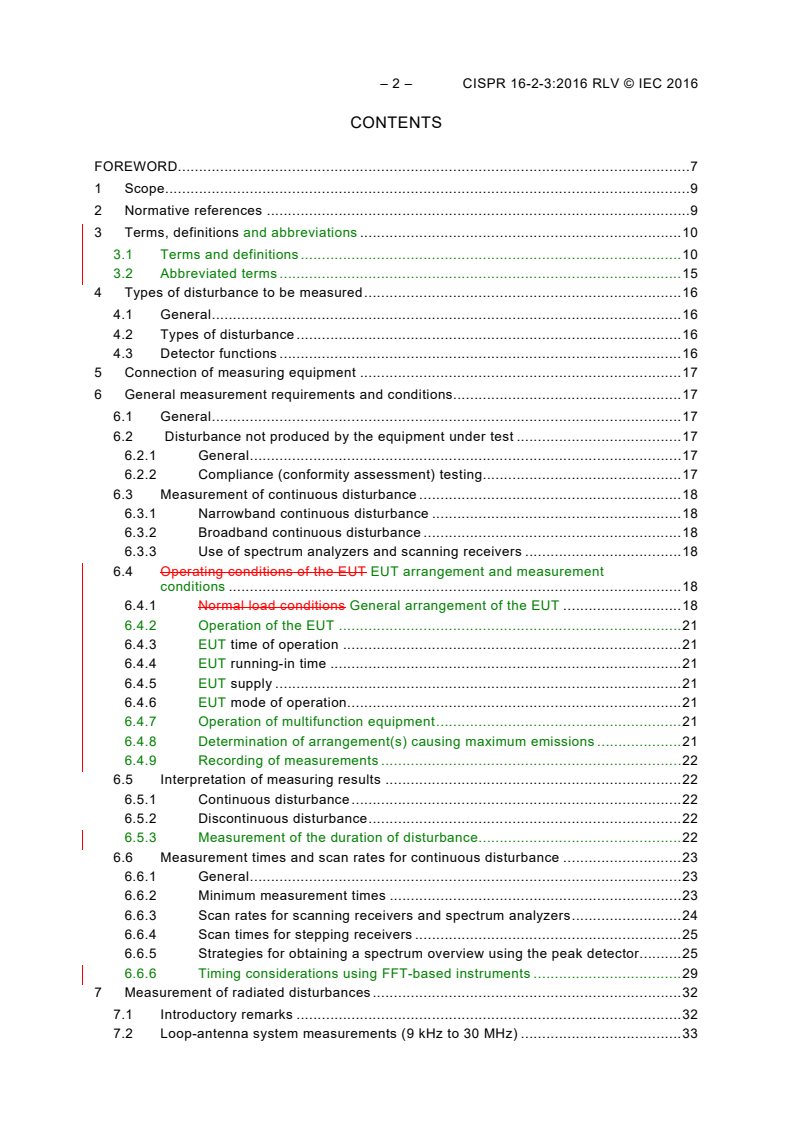
– 2 – CISPR 16-2-3:2016 RLV © IEC 2016
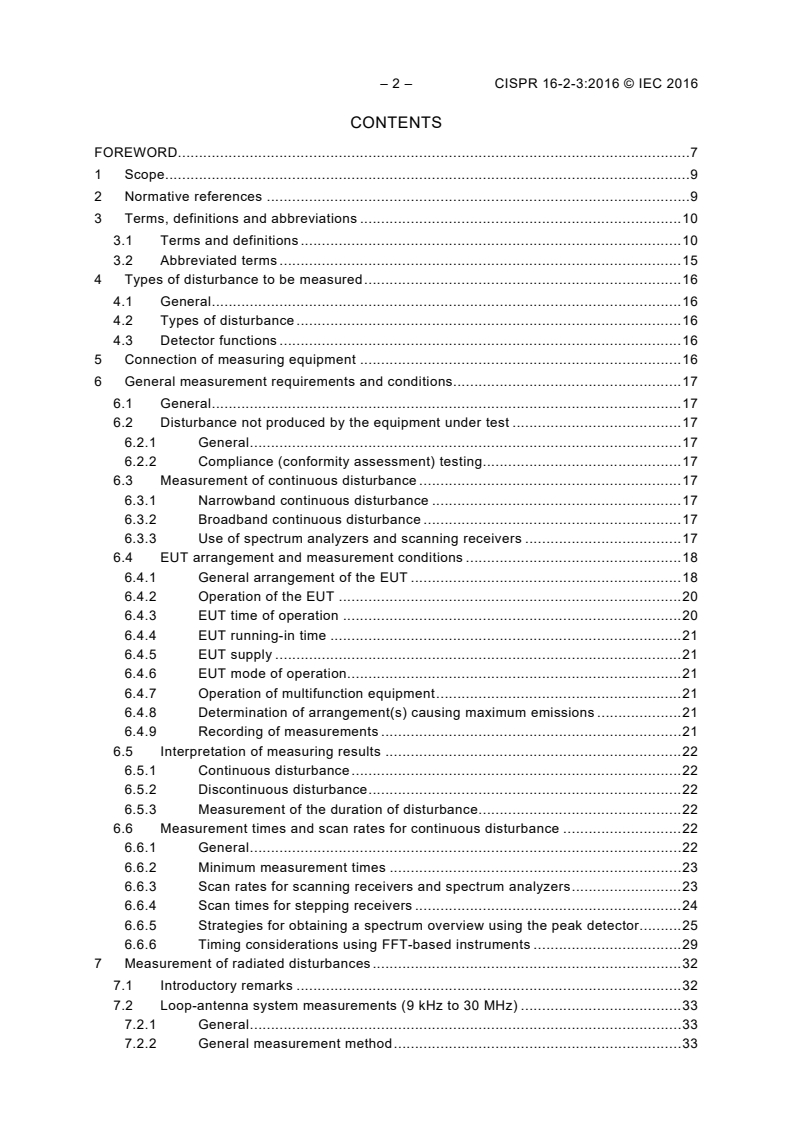
CONTENTS
FOREWORD. 7
1 Scope . 9
2 Normative references . 9
3 Terms, definitions and abbreviations . 10
3.1 Terms and definitions . 10
3.2 Abbreviated terms . 15
4 Types of disturbance to be measured . 16
4.1 General . 16
4.2 Types of disturbance . 16
4.3 Detector functions . 16
5 Connection of measuring equipment . 17
6 General measurement requirements and conditions. 17
6.1 General . 17
6.2 Disturbance not produced by the equipment under test . 17
6.2.1 General . 17
6.2.2 Compliance (conformity assessment) testing . 17
6.3 Measurement of continuous disturbance . 18
6.3.1 Narrowband continuous disturbance . 18
6.3.2 Broadband continuous disturbance . 18
6.3.3 Use of spectrum analyzers and scanning receivers . 18
6.4 Operating conditions of the EUT EUT arrangement and measurement
conditions . 18
6.4.1 Normal load conditions General arrangement of the EUT . 18
6.4.2 Operation of the EUT . 21
6.4.3 EUT time of operation . 21
6.4.4 EUT running-in time . 21
6.4.5 EUT supply . 21
6.4.6 EUT mode of operation . 21
6.4.7 Operation of multifunction equipment . 21
6.4.8 Determination of arrangement(s) causing maximum emissions . 21
6.4.9 Recording of measurements . 22
6.5 Interpretation of measuring results . 22
6.5.1 Continuous disturbance . 22
6.5.2 Discontinuous disturbance . 22
6.5.3 Measurement of the duration of disturbance . 22
6.6 Measurement times and scan rates for continuous disturbance . 23
6.6.1 General . 23
6.6.2 Minimum measurement times . 23
6.6.3 Scan rates for scanning receivers and spectrum analyzers . 24
6.6.4 Scan times for stepping receivers . 25
6.6.5 Strategies for obtaining a spectrum overview using the peak detector . 25
6.6.6 Timing considerations using FFT-based instruments . 29
7 Measurement of radiated disturbances . 32
7.1 Introductory remarks . 32
7.2 Loop-antenna system measurements (9 kHz to 30 MHz) . 33
7.2.1 General . 33
7.2.2 General measurement method . 33
7.2.3 Test environment . 34
7.2.4 Configuration of the equipment under test . 35
7.2.5 Measurement uncertainty for LAS . 35
7.3 Open-area test site or semi-anechoic chamber measurements (30 MHz to
1 GHz) . 35
7.3.1 Measurand . 35
7.3.2 Test site requirements . 38
7.3.3 General measurement method . 38
7.3.4 Measurement distance . 39
7.3.5 Antenna height variation . 40
7.3.6 Product specification details . 40
7.3.7 Measurement instrumentation . 43
7.3.8 Field-strength measurements on other outdoor sites . 43
7.3.9 Measurement uncertainty for OATS and SAC . 43
7.4 Fully-anechoic room measurements (30 MHz to 1 GHz) . 43
7.4.1 Test set-up and site geometry . 43
7.4.2 EUT position . 46
7.4.3 Cable layout and termination . 47
7.4.4 Measurement uncertainty for FAR . 48
7.5 Radiated emission measurement method (30 MHz to 1 GHz) and radiated
immunity test method (80 MHz to 1 GHz) with common test set-up in
semi-anechoic chamber . 48
7.5.1 Applicability . 48
7.5.2 EUT perimeter definition and antenna-to-EUT separation distance . 48
7.5.3 Uniform test volume . 49
7.5.4 Specifications for EUT set-up in common emissions/immunity test set-
up . 50
7.5.5 Measurement uncertainty for common emission/immunity set-up and
method . 56
7.6 Fully-anechoic room and absorber-lined OATS/SAC measurements (1 GHz
to 18 GHz) . 56
7.6.1 Quantity to measure . 56
7.6.2 Measurement distance . 56
7.6.3 Set-up and operating conditions of the equipment under test (EUT) . 57
7.6.4 Measurement site . 57
7.6.5 Measurement instrumentation . 57
7.6.6 Measurement procedure . 58
7.6.7 Measurement uncertainty for FAR . 65
7.7 In situ measurements (9 kHz to 18 GHz) . 65
7.7.1 Applicability of and preparation for in situ measurements . 65
7.7.2 Field-strength measurements in situ in the frequency range 9 kHz to
30 MHz . 66
7.7.3 Field-strength measurements in situ in the frequency range above
30 MHz . 66
7.7.4 In situ measurement of the disturbance effective radiated power using
the substitution method . 67
7.7.5 Documentation of the measurement results . 71
7.7.6 Measurement uncertainty for in situ method . 71
7.8 Substitution measurements (30 MHz to 18 GHz) . 72
– 4 – CISPR 16-2-3:2016 RLV © IEC 2016
7.8.1 General . 72
7.8.2 Test site . 72
7.8.3 Test antennas . 72
7.8.4 EUT configuration . 73
7.8.5 Test procedure . 73
7.8.6 Measurement uncertainty for substitution method . 73
7.9 Reverberation chamber measurements (80 MHz to 18 GHz) . 74
7.10 TEM waveguide measurements (30 MHz to 18 GHz) . 74
8 Automated measurement of emissions . 74
8.1 Introduction – Precautions for automated measurements . 74
8.2 Generic measurement procedure . 74
8.3 Pre-scan measurements . 75
8.3.1 General . 75
8.3.2 Determination of the required measurement time . 75
8.3.3 Pre-scan requirements for different types of measurements . 76
8.4 Data reduction . 77
8.5 Emission maximization and final measurement . 77
8.6 Post-processing and reporting . 78
8.7 Emission measurement strategies with FFT-based measuring instruments . 78
Annex A (informative) Measurement of disturbances in the presence of ambient
emissions . 79
A.1 General . 79
A.2 Terms and definitions . 79
A.3 Problem description . 79
A.4 Proposed solution . 79
A.4.1 Overview . 79
A.4.2 Pre-testing the EUT in a shielded room . 82
A.4.3 Method of measurement of EUT disturbances in the presence of
narrowband ambient emissions . 83
A.4.4 Method of measurement of EUT disturbance in the presence of
broadband ambient emissions . 86
A.5 Determination of the EUT disturbance in case of superposition . 88
Annex B (informative) Use of spectrum analyzers and scanning receivers . 93
B.1 General . 93
B.2 Overload . 93
B.3 Linearity test . 93
B.4 Selectivity . 93
B.5 Normal response to pulses . 93
B.6 Peak detection . 93
B.7 Frequency scan rate . 94
B.8 Signal interception . 94
B.9 Average detection . 94
B.10 Sensitivity . 94
B.11 Amplitude accuracy . 95
Annex C (informative) Scan rates and measurement times for use with the average
detector . 96
C.1 Purpose . 96
C.2 Suppression of disturbances . 96
C.2.1 Suppression of impulsive disturbance . 96
C.2.2 Suppression of impulsive disturbance by digital averaging . 97
C.2.3 Suppression of amplitude modulation . 97
C.3 Measurement of slowly intermittent, unsteady or drifting narrowband
disturbances . 97
C.4 Recommended procedure for automated or semi-automated measurements . 99
Annex D (informative) Explanation of the APD measurement method applying to the
compliance test . 100
Annex E (normative) Determination of suitability of spectrum analyzers for compliance
tests . 102
Bibliography . 103
Figure 1 – Measurement of a combination of a CW signal (NB) and an impulsive signal
(BB) using multiple sweeps with maximum hold . 26
Figure 2 – Example of a timing analysis . 27
Figure 3 – A broadband spectrum measured with a stepped receiver . 28
Figure 4 – Intermittent narrowband disturbances measured using fast short repetitive
sweeps with maximum hold function to obtain an overview of the emission spectrum . 29
Figure 5 – FFT scan in segments . 31
Figure 6 – Frequency resolution enhanced by FFT-based measuring instrument . 32
Figure 7 – Concept of magnetic field induced current measurements made with the
loop antenna system . 34
Figure 8 – Measurement distance . 36
Figure 9 – Separation distance relative to the phase centre of an LPDA antenna . 38
Figure 10 – Concept of electric field strength measurements made on an open-area
test site (OATS) or semi-anechoic chamber (SAC) showing the direct and reflected
rays arriving at the receiving antenna . 39
Figure 11 – Position of CMAD for table-top equipment on OATS or in SAC . 43
Figure 12 – Typical FAR site geometry, where a, b, c, e depend upon the room
performance . 44
Figure 13 – Typical test set-up for table-top equipment within the test volume of a FAR . 45
Figure 14 – Typical test set-up for floor-standing equipment within the test volume of a
FAR . 46
Figure 15 – Positions of reference planes for uniform field calibration (top-view) . 49
Figure 16 – Test set-up for table-top equipment . 53
Figure 17 – Test set-up for table-top equipment – Top view . 54
Figure 18 – Test set-up for floor-standing equipment . 55
Figure 19 – Test set-up for floor-standing equipment – Top view . 56
Figure 20 – Measurement method above 1 GHz, receive antenna in vertical
polarization . 58
Figure 21 – Illustration of height scan requirements for two different categories of
EUTs . 60
Figure 22 – Determination of the transition distance . 70
Figure 23 – Substitution method set-up geometries for: a) measurement, b) calibration . 73
Figure 24 – Process to give reduction of measurement time . 75
Figure A.1 – Flow diagram for the selection of bandwidths and detectors and the
estimated measurement errors due to that selection . 81
– 6 – CISPR 16-2-3:2016 RLV © IEC 2016
Figure A.2 – Relative difference in adjacent emission amplitudes during preliminary
testing . 83
Figure A.3 – Disturbance by an unmodulated signal (dotted line) . 84
Figure A.4 – Disturbance by an amplitude-modulated signal (dotted line) . 84
Figure A.5 – Indication of an amplitude-modulated signal as a function of modulation
frequency with the QP detector in CISPR bands B, C and D . 85
Figure A.6 – Indication of a pulse-modulated signal (pulse width 50 µs) as a function of
pulse repetition frequency with peak, QP and average detectors . 86
Figure A.7 – Disturbance by a broadband signal (dotted line) . 86
Figure A.8 – Unmodulated EUT disturbance (dotted line) . 87
Figure A.9 – Amplitude-modulated EUT disturbance (dotted line) . 87
Figure A.10 – Increase of peak value with superposition of two unmodulated signals . 89
Figure A.11 – Determination of the amplitude of the disturbance signal by means of the
amplitude ratio d and the factor i (see Equation (A.3) and Equation (A.6)) . 90
Figure A.12 – Increase of average indication measured with a real receiver and
calculated from Equation (A.8) . 91
Figure C.1 – Weighting function of a 10 ms pulse for peak (PK) and average detections
with (CISPR AV) and without (AV) peak reading: meter time constant 160 ms . 98
Figure C.2 – Weighting functions of a 10 ms pulse for peak (PK) and average
detections with (CISPR AV) and without (AV) peak reading: meter time constant
100 ms . 98
Figure C.3 – Example of weighting functions (of a 1 Hz pulse) for peak (PK) and
average detections as a function of pulse width: meter time constant 160 ms . 99
Figure C.4 – Example of weighting functions (of a 1 Hz pulse) for peak (PK) and
average detections as a function of pulse width: meter time constant 100 ms . 99
Figure D.1 – Example of APD measurement Method 1 for fluctuating disturbances . 100
Figure D.2 – Example of APD measurement Method 2 for fluctuating disturbances . 101
Table 1 – Minimum measurement times for the four CISPR bands . 23
Table 2 – Minimum scan times for the three CISPR bands with peak and quasi-peak
detectors . 23
Table 3 – Applicable frequency ranges and document references for CISPR radiated
emission test sites and test methods . 33
Table 4 – Minimum dimension of w (w ) . 59
min
Table 5 – Example values of w for three antenna types . 60
Table 6 – Horizontal polarization correction factors as a function of frequency . 70
Table 7 – Recommended antenna heights to guarantee signal interception (for pre-
scan) in the frequency range 30 MHz to 1 000 MHz . 76
Table A.1 – Combinations of EUT disturbance and ambient emissions . 80
Table A.2 – Measurement error depending on the detector type and on the combination
of ambient and disturbing signal spectra . 92
Table C.1 – Pulse suppression factors and scan rates for a 100 Hz video bandwidth . 97
Table C.2 – Meter time constants and the corresponding video bandwidths and
maximum minimum scan rates times . 97
Table E.1 – Maximum amplitude difference between peak and quasi-peak detected
signals . 102
INTERNATIONAL ELECTROTECHNICAL COMMISSION
INTERNATIONAL SPECIAL COMMITTEE ON RADIO INTERFERENCE
____________
SPECIFICATION FOR RADIO DISTURBANCE AND IMMUNITY
MEASURING APPARATUS AND METHODS –
Part 2-3: Methods of measurement of disturbances and immunity –
Radiated disturbance measurements
FOREWORD
1) The International Electrotechnical Commission (IEC) is a worldwide organization for standardization comprising
all national electrotechnical committees (IEC National Committees). The object of IEC is to promote
international co-operation on all questions concerning standardization in the electrical and electronic fields. To
this end and in addition to other activities, IEC publishes International Standards, Technical Specifications,
Technical Reports, Publicly Available Specifications (PAS) and Guides (hereafter referred to as “IEC
Publication(s)”). Their preparation is entrusted to technical committees; any IEC National Committee interested
in the subject dealt with may participate in this preparatory work. International, governmental and non-
governmental organizations liaising with the IEC also participate in this preparation. IEC collaborates closely
with the International Organization for Standardization (ISO) in accordance with conditions determined by
agreement between the two organizations.
2) The formal decisions or agreements of IEC on technical matters express, as nearly as possible, an international
consensus of opinion on the relevant subjects since each technical committee has representation from all
interested IEC National Committees.
3) IEC Publications have the form of recommendations for international use and are accepted by IEC National
Committees in that sense. While all reasonable efforts are made to ensure that the technical content of IEC
Publications is accurate, IEC cannot be held responsible for the way in which they are used or for any
misinterpretation by any end user.
4) In order to promote international uniformity, IEC National Committees undertake to apply IEC Publications
transparently to the maximum extent possible in their national and regional publications. Any divergence
between any IEC Publication and the corresponding national or regional publication shall be clearly indicated in
the latter.
5) IEC itself does not provide any attestation of conformity. Independent certification bodies provide conformity
assessment services and, in some areas, access to IEC marks of conformity. IEC is not responsible for any
services carried out by independent certification bodies.
6) All users should ensure that they have the latest edition of this publication.
7) No liability shall attach to IEC or its directors, employees, servants or agents including individual experts and
members of its technical committees and IEC National Committees for any personal injury, property damage or
other damage of any nature whatsoever, whether direct or indirect, or for costs (including legal fees) and
expenses arising out of the publication, use of, or reliance upon, this IEC Publication or any other IEC
Publications.
8) Attention is drawn to the Normative references cited in this publication. Use of the referenced publications is
indispensable for the correct application of this publication.
9) Attention is drawn to the possibility that some of the elements of this IEC Publication may be the subject of
patent rights. IEC shall not be held responsible for identifying any or all such patent rights.
This redline version of the official IEC Standard allows the user to identify the changes
made to the previous edition. A vertical bar appears in the margin wherever a change
has been made. Additions are in green text, deletions are in strikethrough red text.
– 8 – CISPR 16-2-3:2016 RLV © IEC 2016
International Standard CISPR 16-2-3 has been prepared by CISPR subcommittee A: Radio-
interference measurements and statistical methods.
This fourth edition edition cancels and replaces the third edition published in 2010, its
Amendment 1:2010 and its Amendment 2:2014. This edition constitutes a technical revision.
This edition includes the following significant technical change with respect to the previous
edition: addition of content on correction of the electric field strength to account for phase
centre of log-periodic dipole array antennas.
It has the status of a basic EMC publication in accordance with IEC Guide 107,
Electromagnetic compatibility – Guide to the drafting of electromagnetic compatibility
publications.
The text of this standard is based on the following documents:
FDIS Report on voting
CISPR/A/1176A/FDIS CISPR/A/1182/RVD
Full information on the voting for the approval of this standard can be found in the report on
voting indicated in the above table.
This publication has been drafted in accordance with the ISO/IEC Directives, Part 2.
A list of all parts of the CISPR 16 series, published under the general title Specification for
radio disturbance and immunity measuring apparatus and methods, can be found on the IEC
website.
The committee has decided that the contents of this publication will remain unchanged until
the stability date indicated on the IEC website under "http://webstore.iec.ch" in the data
related to the specific publication. At this date, the publication will be
• reconfirmed,
• withdrawn,
• replaced by a revised edition, or
• amended.
IMPORTANT – The 'colour inside' logo on the cover page of this publication indicates
that it contains colours which are considered to be useful for the correct
understanding of its contents. Users should therefore print this document using a
colour printer.
SPECIFICATION FOR RADIO DISTURBANCE AND IMMUNITY
MEASURING APPARATUS AND METHODS –
Part 2-3: Methods of measurement of disturbances and immunity –
Radiated disturbance measurements
1 Scope
This part of CISPR 16 specifies the methods of measurement of radiated disturbance
phenomena in the frequency range of 9 kHz to 18 GHz. The aspects of measurement
uncertainty are specified in CISPR 16-4-1 and CISPR 16-4-2.
NOTE In accordance with IEC Guide 107 [13] , CISPR 16-2-3 is a basic EMC publication for use by product
committees of the IEC. As stated in Guide 107, product committees are responsible for determining the
applicability of the EMC standard. CISPR and its subcommittees are prepared to co-operate with product
committees in the evaluation of the value of particular EMC tests for specific products.
2 Normative references
The following documents, in whole or in part, are normatively referenced in this document and
are indispensable for its application. For dated references, only the edition cited applies. For
undated references, the latest edition of the referenced document (including any
amendments) applies.
CISPR 14-1:2005 2016, Electromagnetic compatibility – Requirements for household
appliances, electric tools and similar apparatus – Part 1: Emission
CISPR 16-1-1, Specification for radio disturbance and immunity measuring apparatus and
methods – Part 1-1: Radio disturbance and immunity measuring apparatus – Measuring
apparatus
CISPR 16-1-2:2003 2014, Specification for radio disturbance and immunity measuring
apparatus and methods – Part 1-2: Radio disturbance and immunity measuring apparatus –
Ancillary equipment – Coupling devices for conducted disturbance measurements
Amendment 1 (2004)
Amendment 2 (2006)
CISPR 16-1-4:2010, Specification for radio disturbance and immunity measuring apparatus
and methods – Part 1-4: Radio disturbance and immunity measuring apparatus – Ancillary
equipment – Antennas and test sites for radiated disturbance measurements
CISPR 16-1-4:2010/AMD1:2012
CISPR 16-2-1:2008 2014, Specification for radio disturbance and immunity measuring
apparatus and methods – Part 2-1: Methods of measurement of disturbances and immunity –
Conducted disturbance measurements
CISPR TR 16-4-1, Specification for radio disturbance and immunity measuring apparatus
and methods – Part 4-1: Uncertainties, statistics and limit modelling – Uncertainties in
standardized EMC tests
________________
Numbers in square brackets refer to the Bibliography.
– 10 – CISPR 16-2-3:2016 RLV © IEC 2016
CISPR 16-4-2, Specification for radio disturbance and immunity measuring apparatus and
methods – Part 4-2: Uncertainties, statistics and limit modelling – Uncertainty in EMC
measurements Measurement instrumentation uncertainty
CISPR TR 16-4-5, Specification for radio disturbance and immunity measuring apparatus
and methods – Part 4-5: Uncertainties, statistics and limit modelling – Conditions for the use
of alternative test methods
IEC 60050-161:1990, International Electrotechnical Vocabulary – Chapter 161:
Electromagnetic compatibility
Amendment 1 (1997)
Amendment 2 (1998)
IEC 61000-4-3:2006, Electromagnetic compatibility (EMC) – Part 4-3: Testing and
measurement techniques – Radiated, radio-frequency, electromagnetic field immunity test
IEC 61000-4-3:2006/AMD1:2007
IEC 61000-4-3:2006/AMD2:2010
IEC 61000-4-20, Electromagnetic compatibility (EMC) – Part 4-20: Testing and measurement
techniques – Emission and immunity testing in transverse electromagnetic (TEM) waveguides
3 Terms, definitions and abbreviations
3.1 Terms and definitions
For the purposes of this document, the terms and definitions given in IEC 60050-161, as well
as the following apply.
3.1.1
absorber-lined OATS/SAC
OATS or SAC with ground plane partially covered by RF-energy absorbing material
3.1.2
ancillary equipment
transducers (e.g. current and voltage probes and artificial networks) connected to a
measuring receiver or (test) signal generator and used in the disturbance signal transfer
between the EUT and the measuring or test equipment
3.1.3
antenna beam
main lobe of the antenna pattern (gain pattern) of the receive antenna (usually the direction
with maximum sensitivity or lowest antenna factor) that is directed towards the EUT
3.1.4
antenna beamwidth
angle between the half-power (3 dB) points of the main lobe of the antenna beam, when
referenced to the maximum power of the main lobe
Note 1 to entry: It may be expressed for the H plane or for the E plane of the antenna.
Note 2 to entry: Antenna beamwidth is expressed in degrees.
3.1.5
associated equipment
AE
apparatus, that is not part of the system under test, but needed to help exercise the EUT
Note 1 to entry: This note applies to the French language only.
3.1.6
auxiliary equipment
AuxEq
peripheral equipment that is part of the system under test
Note 1 to entry: This note applies to the French language only.
3.1.7
basic standard
standard that has a wide-ranging coverage or contains general provisions for one particular
field
Note 1 to entry: A basic standard may function as a standard for direct application or as a basis for other
standards.
[SOURCE: ISO/IEC Guide 2:1991, definition 5.1 [6]]
3.1.8
coaxial cable
cable containing one or more coaxial lines, typically used for a matched connection of
ancillary equipment to the measuring equipment or (test-) signal generator providing a
specified characteristic impedance and a specified maximum allowable cable transfer
impedance
3.1.9
common-mode absorption device
CMAD
device that may be applied on cables leaving the test volume in radiated emission
measurements to reduce the compliance uncertainty
Note 1 to entry: This note applies to the French language only.
[SOURCE: CISPR 16-1-4:2010, 3.1.4]
3.1.10
conformity assessment
demonstration that specified requirements relating to a product, process, system, person or
body are fulfilled
Note 1 to entry: The subject field of conformity assessment includes activities defined elsewhere in
ISO/IEC 17000:2004 [7], such as testing, inspection and certification, as well as the accreditation of conformity
assessment bodies.
[SOURCE: ISO/IEC 17000:2004, 2.1, modified – Note 2 has been deleted.]
3.1.11
continuous disturbance
RF disturbance with duration of more than 200 ms at the IF-output of a measuring receiver
that causes a deflection on the meter of a measuring receiver in quasi-peak detection mode,
and that does not decrease immediately
[SOURCE: IEC 60050-161:1990, 161-02-11, modified – The definition has been changed.]
3.1.12
emission
phenomenon by which electromagnetic energy emanates from a source
[SOURCE: IEC 60050-161:1990, 161-01-08]
– 12 – CISPR 16-2-3:2016 RLV © IEC 2016
3.1.13
emission limit
specified maximum emission level of a source of electromagnetic
disturbance
[SOURCE: IEC 60050-161:1990, 161-03-12]
3.1.14
equipment under test
EUT
equipment (devices, appliances and systems) subjected to EMC (emission) compliance
(conformity assessment) tests
Note 1 to entry: This note applies to the French language only.
3.1.15
fully-anechoic room
FAR
shielded enclosure, whose six internal surfaces are lined with radio-frequency-energy
absorbing material (i.e. RF absorber) that absorbs attenuates electromagnetic energy in the
frequency range of interest
Note 1 to entry: This note applies to the French language only.
3.1.16
loop-antenna system
LAS
antenna system consisting of three orthogonally-oriented loop antennas that are used to
measure the three orthogonal magnetic dipole moments of an EUT located in the centre of the
three loops
Note 1 to entry: This note applies to the French language only.
3.1.17
measurement, scan and sweep times
3.1.17.1
measurement time
T
m
effective, coherent time for a measurement result at a single frequency
– for the peak detector, the effective time to detect the maximum of the signal envelope,
– for the quasi-peak detector, the effective time to measure the maximum of the weighted
envelope,
– for the average detector, the effective time to average the signal envelope,
– for the rms detector, the effective time to determine the rms of the signal envelope
Note 1 to entry: In some areas "measurement time" is also called dwell time.
3.1.17.2
scan
continuous or stepped frequency variation over a given frequency span
3.1.17.3
span
∆f
difference between stop and start frequencies of a sweep or scan
3.1.17.4
sweep
continuous frequency variation over a given frequency span
3.1.17.5
sweep or scan rate
frequency span divided by the sweep or scan time
3.1.17.6
sweep or scan time
T
s
time between start and stop frequencies of a sweep or scan
3.1.17.7
observation time
T
o
sum of measurement times T on a certain frequency in case of multiple sweeps
m
Note 1 to entry: If n is the number of sweeps or
...
CISPR 16-2-3 ®
Edition 4.0 2016-09
INTERNATIONAL
STANDARD
NORME
INTERNATIONALE
colour
inside
INTERNATIONAL SPECIAL COMMITTEE ON RADIO INTERFERENCE
COMITÉ INTERNATIONAL SPÉCIAL DES PERTURBATIONS RADIOÉLECTRIQUES
BASIC EMC PUBLICATION
PUBLICATION FONDAMENTALE EN CEM
Specification for radio disturbance and immunity measuring apparatus and
methods –
Part 2-3: Methods of measurement of disturbances and immunity – Radiated
disturbance measurements
Spécifications des méthodes et des appareils de mesure des perturbations
radioélectriques et de l’immunité aux perturbations radioélectriques –
Partie 2-3: Méthodes de mesure des perturbations et de l'immunité – Mesurages
des perturbations rayonnées
All rights reserved. Unless otherwise specified, no part of this publication may be reproduced or utilized in any form
or by any means, electronic or mechanical, including photocopying and microfilm, without permission in writing from
either IEC or IEC's member National Committee in the country of the requester. If you have any questions about IEC
copyright or have an enquiry about obtaining additional rights to this publication, please contact the address below or
your local IEC member National Committee for further information.
Droits de reproduction réservés. Sauf indication contraire, aucune partie de cette publication ne peut être reproduite
ni utilisée sous quelque forme que ce soit et par aucun procédé, électronique ou mécanique, y compris la photocopie
et les microfilms, sans l'accord écrit de l'IEC ou du Comité national de l'IEC du pays du demandeur. Si vous avez des
questions sur le copyright de l'IEC ou si vous désirez obtenir des droits supplémentaires sur cette publication, utilisez
les coordonnées ci-après ou contactez le Comité national de l'IEC de votre pays de résidence.
IEC Central Office Tel.: +41 22 919 02 11
3, rue de Varembé Fax: +41 22 919 03 00
CH-1211 Geneva 20 info@iec.ch
Switzerland www.iec.ch
About the IEC
The International Electrotechnical Commission (IEC) is the leading global organization that prepares and publishes
International Standards for all electrical, electronic and related technologies.
About IEC publications
The technical content of IEC publications is kept under constant review by the IEC. Please make sure that you have the
latest edition, a corrigenda or an amendment might have been published.
IEC Catalogue - webstore.iec.ch/catalogue Electropedia - www.electropedia.org
The stand-alone application for consulting the entire The world's leading online dictionary of electronic and
bibliographical information on IEC International Standards, electrical terms containing 20 000 terms and definitions in
Technical Specifications, Technical Reports and other English and French, with equivalent terms in 15 additional
documents. Available for PC, Mac OS, Android Tablets and languages. Also known as the International Electrotechnical
iPad. Vocabulary (IEV) online.
IEC publications search - www.iec.ch/searchpub IEC Glossary - std.iec.ch/glossary
The advanced search enables to find IEC publications by a 65 000 electrotechnical terminology entries in English and
variety of criteria (reference number, text, technical French extracted from the Terms and Definitions clause of
committee,…). It also gives information on projects, replaced IEC publications issued since 2002. Some entries have been
and withdrawn publications. collected from earlier publications of IEC TC 37, 77, 86 and
CISPR.
IEC Just Published - webstore.iec.ch/justpublished
Stay up to date on all new IEC publications. Just Published IEC Customer Service Centre - webstore.iec.ch/csc
details all new publications released. Available online and If you wish to give us your feedback on this publication or
also once a month by email. need further assistance, please contact the Customer Service
Centre: csc@iec.ch.
A propos de l'IEC
La Commission Electrotechnique Internationale (IEC) est la première organisation mondiale qui élabore et publie des
Normes internationales pour tout ce qui a trait à l'électricité, à l'électronique et aux technologies apparentées.
A propos des publications IEC
Le contenu technique des publications IEC est constamment revu. Veuillez vous assurer que vous possédez l’édition la
plus récente, un corrigendum ou amendement peut avoir été publié.
Catalogue IEC - webstore.iec.ch/catalogue Electropedia - www.electropedia.org
Application autonome pour consulter tous les renseignements
Le premier dictionnaire en ligne de termes électroniques et
bibliographiques sur les Normes internationales,
électriques. Il contient 20 000 termes et définitions en anglais
Spécifications techniques, Rapports techniques et autres
et en français, ainsi que les termes équivalents dans 15
documents de l'IEC. Disponible pour PC, Mac OS, tablettes
langues additionnelles. Egalement appelé Vocabulaire
Android et iPad.
Electrotechnique International (IEV) en ligne.
Recherche de publications IEC - www.iec.ch/searchpub
Glossaire IEC - std.iec.ch/glossary
La recherche avancée permet de trouver des publications IEC 65 000 entrées terminologiques électrotechniques, en anglais
en utilisant différents critères (numéro de référence, texte, et en français, extraites des articles Termes et Définitions des
comité d’études,…). Elle donne aussi des informations sur les publications IEC parues depuis 2002. Plus certaines entrées
projets et les publications remplacées ou retirées. antérieures extraites des publications des CE 37, 77, 86 et
CISPR de l'IEC.
IEC Just Published - webstore.iec.ch/justpublished
Service Clients - webstore.iec.ch/csc
Restez informé sur les nouvelles publications IEC. Just
Published détaille les nouvelles publications parues. Si vous désirez nous donner des commentaires sur cette
Disponible en ligne et aussi une fois par mois par email. publication ou si vous avez des questions contactez-nous:
csc@iec.ch.
CISPR 16-2-3 ®
Edition 4.0 2016-09
INTERNATIONAL
STANDARD
NORME
INTERNATIONALE
colour
inside
INTERNATIONAL SPECIAL COMMITTEE ON RADIO INTERFERENCE
COMITÉ INTERNATIONAL SPÉCIAL DES PERTURBATIONS RADIOÉLECTRIQUES
BASIC EMC PUBLICATION
PUBLICATION FONDAMENTALE EN CEM
Specification for radio disturbance and immunity measuring apparatus and
methods –
Part 2-3: Methods of measurement of disturbances and immunity – Radiated
disturbance measurements
Spécifications des méthodes et des appareils de mesure des perturbations
radioélectriques et de l’immunité aux perturbations radioélectriques –
Partie 2-3: Méthodes de mesure des perturbations et de l'immunité – Mesurages
des perturbations rayonnées
INTERNATIONAL
ELECTROTECHNICAL
COMMISSION
COMMISSION
ELECTROTECHNIQUE
INTERNATIONALE
ICS 33.100.10; 33.100.20 ISBN 978-2-8322-3590-4
– 2 – CISPR 16-2-3:2016 © IEC 2016
CONTENTS
FOREWORD. 7
1 Scope . 9
2 Normative references . 9
3 Terms, definitions and abbreviations . 10
3.1 Terms and definitions . 10
3.2 Abbreviated terms . 15
4 Types of disturbance to be measured . 16
4.1 General . 16
4.2 Types of disturbance . 16
4.3 Detector functions . 16
5 Connection of measuring equipment . 16
6 General measurement requirements and conditions. 17
6.1 General . 17
6.2 Disturbance not produced by the equipment under test . 17
6.2.1 General . 17
6.2.2 Compliance (conformity assessment) testing . 17
6.3 Measurement of continuous disturbance . 17
6.3.1 Narrowband continuous disturbance . 17
6.3.2 Broadband continuous disturbance . 17
6.3.3 Use of spectrum analyzers and scanning receivers . 17
6.4 EUT arrangement and measurement conditions . 18
6.4.1 General arrangement of the EUT . 18
6.4.2 Operation of the EUT . 20
6.4.3 EUT time of operation . 20
6.4.4 EUT running-in time . 21
6.4.5 EUT supply . 21
6.4.6 EUT mode of operation . 21
6.4.7 Operation of multifunction equipment . 21
6.4.8 Determination of arrangement(s) causing maximum emissions . 21
6.4.9 Recording of measurements . 21
6.5 Interpretation of measuring results . 22
6.5.1 Continuous disturbance . 22
6.5.2 Discontinuous disturbance . 22
6.5.3 Measurement of the duration of disturbance . 22
6.6 Measurement times and scan rates for continuous disturbance . 22
6.6.1 General . 22
6.6.2 Minimum measurement times . 23
6.6.3 Scan rates for scanning receivers and spectrum analyzers . 23
6.6.4 Scan times for stepping receivers . 24
6.6.5 Strategies for obtaining a spectrum overview using the peak detector . 25
6.6.6 Timing considerations using FFT-based instruments . 29
7 Measurement of radiated disturbances . 32
7.1 Introductory remarks . 32
7.2 Loop-antenna system measurements (9 kHz to 30 MHz) . 33
7.2.1 General . 33
7.2.2 General measurement method . 33
7.2.3 Test environment . 34
7.2.4 Configuration of the equipment under test . 35
7.2.5 Measurement uncertainty for LAS . 35
7.3 Open-area test site or semi-anechoic chamber measurements (30 MHz to
1 GHz) . 35
7.3.1 Measurand . 35
7.3.2 Test site requirements . 38
7.3.3 General measurement method . 38
7.3.4 Measurement distance . 39
7.3.5 Antenna height variation . 40
7.3.6 Product specification details . 40
7.3.7 Measurement instrumentation . 42
7.3.8 Field-strength measurements on other outdoor sites . 42
7.3.9 Measurement uncertainty for OATS and SAC . 42
7.4 Fully-anechoic room measurements (30 MHz to 1 GHz) . 42
7.4.1 Test set-up and site geometry . 42
7.4.2 EUT position . 45
7.4.3 Cable layout and termination . 46
7.4.4 Measurement uncertainty for FAR . 47
7.5 Radiated emission measurement method (30 MHz to 1 GHz) and radiated
immunity test method (80 MHz to 1 GHz) with common test set-up in semi-
anechoic chamber . 47
7.5.1 Applicability . 47
7.5.2 EUT perimeter definition and antenna-to-EUT separation distance . 47
7.5.3 Uniform test volume . 48
7.5.4 Specifications for EUT set-up in common emissions/immunity test set-
up . 49
7.5.5 Measurement uncertainty for common emission/immunity set-up and
method . 55
7.6 Fully-anechoic room and absorber-lined OATS/SAC measurements (1 GHz
to 18 GHz) . 55
7.6.1 Quantity to measure . 55
7.6.2 Measurement distance . 55
7.6.3 Set-up and operating conditions of the equipment under test (EUT) . 56
7.6.4 Measurement site . 56
7.6.5 Measurement instrumentation . 56
7.6.6 Measurement procedure . 57
7.6.7 Measurement uncertainty for FAR . 63
7.7 In situ measurements (9 kHz to 18 GHz) . 64
7.7.1 Applicability of and preparation for in situ measurements . 64
7.7.2 Field-strength measurements in situ in the frequency range 9 kHz to
30 MHz . 65
7.7.3 Field-strength measurements in situ in the frequency range above
30 MHz . 65
7.7.4 In situ measurement of the disturbance effective radiated power using
the substitution method . 66
7.7.5 Documentation of the measurement results . 70
7.7.6 Measurement uncertainty for in situ method . 70
7.8 Substitution measurements (30 MHz to 18 GHz) . 70
7.8.1 General . 70
7.8.2 Test site . 71
– 4 – CISPR 16-2-3:2016 © IEC 2016
7.8.3 Test antennas . 71
7.8.4 EUT configuration . 72
7.8.5 Test procedure . 72
7.8.6 Measurement uncertainty for substitution method . 72
7.9 Reverberation chamber measurements (80 MHz to 18 GHz) . 72
7.10 TEM waveguide measurements (30 MHz to 18 GHz) . 72
8 Automated measurement of emissions . 72
8.1 Introduction – Precautions for automated measurements . 72
8.2 Generic measurement procedure . 73
8.3 Pre-scan measurements . 73
8.3.1 General . 73
8.3.2 Determination of the required measurement time . 74
8.3.3 Pre-scan requirements for different types of measurements . 74
8.4 Data reduction . 75
8.5 Emission maximization and final measurement . 76
8.6 Post-processing and reporting . 77
8.7 Emission measurement strategies with FFT-based measuring instruments . 77
Annex A (informative) Measurement of disturbances in the presence of ambient
emissions . 78
A.1 General . 78
A.2 Terms and definitions . 78
A.3 Problem description . 78
A.4 Proposed solution . 78
A.4.1 Overview . 78
A.4.2 Pre-testing the EUT in a shielded room . 81
A.4.3 Method of measurement of EUT disturbances in the presence of
narrowband ambient emissions . 82
A.4.4 Method of measurement of EUT disturbance in the presence of
broadband ambient emissions . 85
A.5 Determination of the EUT disturbance in case of superposition . 87
Annex B (informative) Use of spectrum analyzers and scanning receivers . 92
B.1 General . 92
B.2 Overload . 92
B.3 Linearity test . 92
B.4 Selectivity . 92
B.5 Normal response to pulses . 92
B.6 Peak detection . 92
B.7 Frequency scan rate . 93
B.8 Signal interception . 93
B.9 Average detection . 93
B.10 Sensitivity . 93
B.11 Amplitude accuracy . 94
Annex C (informative) Scan rates and measurement times for use with the average
detector . 95
C.1 Purpose . 95
C.2 Suppression of disturbances . 95
C.2.1 Suppression of impulsive disturbance . 95
C.2.2 Suppression of impulsive disturbance by digital averaging . 96
C.2.3 Suppression of amplitude modulation . 96
C.3 Measurement of slowly intermittent, unsteady or drifting narrowband
disturbances . 96
C.4 Recommended procedure for automated or semi-automated measurements . 98
Annex D (informative) Explanation of the APD measurement method applying to the
compliance test . 99
Annex E (normative) Determination of suitability of spectrum analyzers for compliance
tests . 101
Bibliography . 102
Figure 1 – Measurement of a combination of a CW signal (NB) and an impulsive signal
(BB) using multiple sweeps with maximum hold . 26
Figure 2 – Example of a timing analysis . 27
Figure 3 – A broadband spectrum measured with a stepped receiver . 28
Figure 4 – Intermittent narrowband disturbances measured using fast short repetitive
sweeps with maximum hold function to obtain an overview of the emission spectrum . 29
Figure 5 – FFT scan in segments . 31
Figure 6 – Frequency resolution enhanced by FFT-based measuring instrument . 32
Figure 7 – Concept of magnetic field induced current measurements made with the
loop antenna system . 34
Figure 8 – Measurement distance . 36
Figure 9 – Separation distance relative to the phase centre of an LPDA antenna . 38
Figure 10 – Concept of electric field strength measurements made on an open-area
test site (OATS) or semi-anechoic chamber (SAC) showing the direct and reflected
rays arriving at the receiving antenna . 39
Figure 11 – Position of CMAD for table-top equipment on OATS or in SAC . 42
Figure 12 – Typical FAR site geometry, where a, b, c, e depend upon the room
performance . 43
Figure 13 – Typical test set-up for table-top equipment within the test volume of a FAR . 44
Figure 14 – Typical test set-up for floor-standing equipment within the test volume of a
FAR . 45
Figure 15 – Positions of reference planes for uniform field calibration (top-view) . 48
Figure 16 – Test set-up for table-top equipment . 52
Figure 17 – Test set-up for table-top equipment – Top view . 53
Figure 18 – Test set-up for floor-standing equipment . 54
Figure 19 – Test set-up for floor-standing equipment – Top view . 55
Figure 20 – Measurement method above 1 GHz, receive antenna in vertical
polarization . 57
Figure 21 – Illustration of height scan requirements for two different categories of
EUTs . 59
Figure 22 – Determination of the transition distance . 69
Figure 23 – Substitution method set-up geometries for: a) measurement, b) calibration . 71
Figure 24 – Process to give reduction of measurement time . 73
Figure A.1 – Flow diagram for the selection of bandwidths and detectors and the
estimated measurement errors due to that selection . 80
Figure A.2 – Relative difference in adjacent emission amplitudes during preliminary
testing . 82
Figure A.3 – Disturbance by an unmodulated signal (dotted line) . 83
– 6 – CISPR 16-2-3:2016 © IEC 2016
Figure A.4 – Disturbance by an amplitude-modulated signal (dotted line) . 83
Figure A.5 – Indication of an amplitude-modulated signal as a function of modulation
frequency with the QP detector in CISPR bands B, C and D . 84
Figure A.6 – Indication of a pulse-modulated signal (pulse width 50 µs) as a function of
pulse repetition frequency with peak, QP and average detectors . 85
Figure A.7 – Disturbance by a broadband signal (dotted line) . 85
Figure A.8 – Unmodulated EUT disturbance (dotted line) . 86
Figure A.9 – Amplitude-modulated EUT disturbance (dotted line) . 87
Figure A.10 – Increase of peak value with superposition of two unmodulated signals . 88
Figure A.11 – Determination of the amplitude of the disturbance signal by means of the
amplitude ratio d and the factor i (see Equation (A.3) and Equation (A.6)) . 89
Figure A.12 – Increase of average indication measured with a real receiver and
calculated from Equation (A.8) . 90
Figure C.1 – Weighting function of a 10 ms pulse for peak (PK) and average detections
with (CISPR AV) and without (AV) peak reading: meter time constant 160 ms . 97
Figure C.2 – Weighting functions of a 10 ms pulse for peak (PK) and average
detections with (CISPR AV) and without (AV) peak reading: meter time constant
100 ms . 97
Figure C.3 – Example of weighting functions (of a 1 Hz pulse) for peak (PK) and
average detections as a function of pulse width: meter time constant 160 ms . 98
Figure C.4 – Example of weighting functions (of a 1 Hz pulse) for peak (PK) and
average detections as a function of pulse width: meter time constant 100 ms . 98
Figure D.1 – Example of APD measurement Method 1 for fluctuating disturbances . 99
Figure D.2 – Example of APD measurement Method 2 for fluctuating disturbances . 100
Table 1 – Minimum measurement times for the four CISPR bands . 23
Table 2 – Minimum scan times for the three CISPR bands with peak and quasi-peak
detectors . 23
Table 3 – Applicable frequency ranges and document references for CISPR radiated
emission test sites and test methods . 33
Table 4 – Minimum dimension of w (w ) . 58
min
Table 5 – Example values of w for three antenna types . 59
Table 6 – Horizontal polarization correction factors as a function of frequency . 69
Table 7 – Recommended antenna heights to guarantee signal interception (for pre-
scan) in the frequency range 30 MHz to 1 000 MHz . 75
Table A.1 – Combinations of EUT disturbance and ambient emissions . 79
Table A.2 – Measurement error depending on the detector type and on the combination
of ambient and disturbing signal spectra . 91
Table C.1 – Pulse suppression factors and scan rates for a 100 Hz video bandwidth . 96
Table C.2 – Meter time constants and the corresponding video bandwidths and
minimum scan times . 96
Table E.1 – Maximum amplitude difference between peak and quasi-peak detected
signals . 101
INTERNATIONAL ELECTROTECHNICAL COMMISSION
INTERNATIONAL SPECIAL COMMITTEE ON RADIO INTERFERENCE
____________
SPECIFICATION FOR RADIO DISTURBANCE AND IMMUNITY
MEASURING APPARATUS AND METHODS –
Part 2-3: Methods of measurement of disturbances and immunity –
Radiated disturbance measurements
FOREWORD
1) The International Electrotechnical Commission (IEC) is a worldwide organization for standardization comprising
all national electrotechnical committees (IEC National Committees). The object of IEC is to promote
international co-operation on all questions concerning standardization in the electrical and electronic fields. To
this end and in addition to other activities, IEC publishes International Standards, Technical Specifications,
Technical Reports, Publicly Available Specifications (PAS) and Guides (hereafter referred to as “IEC
Publication(s)”). Their preparation is entrusted to technical committees; any IEC National Committee interested
in the subject dealt with may participate in this preparatory work. International, governmental and non-
governmental organizations liaising with the IEC also participate in this preparation. IEC collaborates closely
with the International Organization for Standardization (ISO) in accordance with conditions determined by
agreement between the two organizations.
2) The formal decisions or agreements of IEC on technical matters express, as nearly as possible, an international
consensus of opinion on the relevant subjects since each technical committee has representation from all
interested IEC National Committees.
3) IEC Publications have the form of recommendations for international use and are accepted by IEC National
Committees in that sense. While all reasonable efforts are made to ensure that the technical content of IEC
Publications is accurate, IEC cannot be held responsible for the way in which they are used or for any
misinterpretation by any end user.
4) In order to promote international uniformity, IEC National Committees undertake to apply IEC Publications
transparently to the maximum extent possible in their national and regional publications. Any divergence
between any IEC Publication and the corresponding national or regional publication shall be clearly indicated in
the latter.
5) IEC itself does not provide any attestation of conformity. Independent certification bodies provide conformity
assessment services and, in some areas, access to IEC marks of conformity. IEC is not responsible for any
services carried out by independent certification bodies.
6) All users should ensure that they have the latest edition of this publication.
7) No liability shall attach to IEC or its directors, employees, servants or agents including individual experts and
members of its technical committees and IEC National Committees for any personal injury, property damage or
other damage of any nature whatsoever, whether direct or indirect, or for costs (including legal fees) and
expenses arising out of the publication, use of, or reliance upon, this IEC Publication or any other IEC
Publications.
8) Attention is drawn to the Normative references cited in this publication. Use of the referenced publications is
indispensable for the correct application of this publication.
9) Attention is drawn to the possibility that some of the elements of this IEC Publication may be the subject of
patent rights. IEC shall not be held responsible for identifying any or all such patent rights.
International Standard CISPR 16-2-3 has been prepared by CISPR subcommittee A: Radio-
interference measurements and statistical methods.
This fourth edition edition cancels and replaces the third edition published in 2010, its
Amendment 1:2010 and its Amendment 2:2014. This edition constitutes a technical revision.
This edition includes the following significant technical change with respect to the previous
edition: addition of content on correction of the electric field strength to account for phase
centre of log-periodic dipole array antennas.
– 8 – CISPR 16-2-3:2016 © IEC 2016
It has the status of a basic EMC publication in accordance with IEC Guide 107,
Electromagnetic compatibility – Guide to the drafting of electromagnetic compatibility
publications.
The text of this standard is based on the following documents:
FDIS Report on voting
CISPR/A/1176A/FDIS CISPR/A/1182/RVD
Full information on the voting for the approval of this standard can be found in the report on
voting indicated in the above table.
This publication has been drafted in accordance with the ISO/IEC Directives, Part 2.
A list of all parts of the CISPR 16 series, published under the general title Specification for
radio disturbance and immunity measuring apparatus and methods, can be found on the IEC
website.
The committee has decided that the contents of this publication will remain unchanged until
the stability date indicated on the IEC website under "http://webstore.iec.ch" in the data
related to the specific publication. At this date, the publication will be
• reconfirmed,
• withdrawn,
• replaced by a revised edition, or
• amended.
IMPORTANT – The 'colour inside' logo on the cover page of this publication indicates
that it contains colours which are considered to be useful for the correct
understanding of its contents. Users should therefore print this document using a
colour printer.
SPECIFICATION FOR RADIO DISTURBANCE AND IMMUNITY
MEASURING APPARATUS AND METHODS –
Part 2-3: Methods of measurement of disturbances and immunity –
Radiated disturbance measurements
1 Scope
This part of CISPR 16 specifies the methods of measurement of radiated disturbance
phenomena in the frequency range of 9 kHz to 18 GHz. The aspects of measurement
uncertainty are specified in CISPR 16-4-1 and CISPR 16-4-2.
NOTE In accordance with IEC Guide 107 [13] , CISPR 16-2-3 is a basic EMC publication for use by product
committees of the IEC. As stated in Guide 107, product committees are responsible for determining the
applicability of the EMC standard. CISPR and its subcommittees are prepared to co-operate with product
committees in the evaluation of the value of particular EMC tests for specific products.
2 Normative references
The following documents, in whole or in part, are normatively referenced in this document and
are indispensable for its application. For dated references, only the edition cited applies. For
undated references, the latest edition of the referenced document (including any
amendments) applies.
CISPR 14-1:2016, Electromagnetic compatibility – Requirements for household appliances,
electric tools and similar apparatus – Part 1: Emission
CISPR 16-1-1, Specification for radio disturbance and immunity measuring apparatus and
methods – Part 1-1: Radio disturbance and immunity measuring apparatus – Measuring
apparatus
CISPR 16-1-2:2014, Specification for radio disturbance and immunity measuring apparatus
and methods – Part 1-2: Radio disturbance and immunity measuring apparatus – Coupling
devices for conducted disturbance measurements
CISPR 16-1-4:2010, Specification for radio disturbance and immunity measuring apparatus
and methods – Part 1-4: Radio disturbance and immunity measuring apparatus – Antennas
and test sites for radiated disturbance measurements
CISPR 16-1-4:2010/AMD1:2012
CISPR 16-2-1:2014, Specification for radio disturbance and immunity measuring apparatus
and methods – Part 2-1: Methods of measurement of disturbances and immunity – Conducted
disturbance measurements
CISPR TR 16-4-1, Specification for radio disturbance and immunity measuring apparatus
and methods – Part 4-1: Uncertainties, statistics and limit modelling – Uncertainties in
standardized EMC tests
CISPR 16-4-2, Specification for radio disturbance and immunity measuring apparatus and
methods – Part 4-2: Uncertainties, statistics and limit modelling – Measurement
instrumentation uncertainty
________________
Numbers in square brackets refer to the Bibliography.
– 10 – CISPR 16-2-3:2016 © IEC 2016
CISPR TR 16-4-5, Specification for radio disturbance and immunity measuring apparatus
and methods – Part 4-5: Uncertainties, statistics and limit modelling – Conditions for the use
of alternative test methods
IEC 60050-161, International Electrotechnical Vocabulary – Chapter 161: Electromagnetic
compatibility
IEC 61000-4-3:2006, Electromagnetic compatibility (EMC) – Part 4-3: Testing and
measurement techniques – Radiated, radio-frequency, electromagnetic field immunity test
IEC 61000-4-3:2006/AMD1:2007
IEC 61000-4-3:2006/AMD2:2010
IEC 61000-4-20, Electromagnetic compatibility (EMC) – Part 4-20: Testing and measurement
techniques – Emission and immunity testing in transverse electromagnetic (TEM) waveguides
3 Terms, definitions and abbreviations
3.1 Terms and definitions
For the purposes of this document, the terms and definitions given in IEC 60050-161, as well
as the following apply.
3.1.1
absorber-lined OATS/SAC
OATS or SAC with ground plane partially covered by RF-energy absorbing material
3.1.2
ancillary equipment
transducers (e.g. current and voltage probes and artificial networks) connected to a
measuring receiver or (test) signal generator and used in the disturbance signal transfer
between the EUT and the measuring or test equipment
3.1.3
antenna beam
main lobe of the antenna pattern (gain pattern) of the receive antenna (usually the direction
with maximum sensitivity or lowest antenna factor) that is directed towards the EUT
3.1.4
antenna beamwidth
angle between the half-power (3 dB) points of the main lobe of the antenna beam, when
referenced to the maximum power of the main lobe
Note 1 to entry: It may be expressed for the H plane or for the E plane of the antenna.
Note 2 to entry: Antenna beamwidth is expressed in degrees.
3.1.5
associated equipment
AE
apparatus, that is not part of the system under test, but needed to help exercise the EUT
Note 1 to entry: This note applies to the French language only.
3.1.6
auxiliary equipment
AuxEq
peripheral equipment that is part of the system under test
Note 1 to entry: This note applies to the French language only.
3.1.7
basic standard
standard that has a wide-ranging coverage or contains general provisions for one particular
field
Note 1 to entry: A basic standard may function as a standard for direct application or as a basis for other
standards.
[SOURCE: ISO/IEC Guide 2:1991, definition 5.1 [6]]
3.1.8
coaxial cable
cable containing one or more coaxial lines, typically used for a matched connection of
ancillary equipment to the measuring equipment or (test-) signal generator providing a
specified characteristic impedance and a specified maximum allowable cable transfer
impedance
3.1.9
common-mode absorption device
CMAD
device that may be applied on cables leaving the test volume in radiated emission
measurements to reduce the compliance uncertainty
Note 1 to entry: This note applies to the French language only.
[SOURCE: CISPR 16-1-4:2010, 3.1.4]
3.1.10
conformity assessment
demonstration that specified requirements relating to a product, process, system, person or
body are fulfilled
Note 1 to entry: The subject field of conformity assessment includes activities defined elsewhere in
ISO/IEC 17000:2004 [7], such as testing
...
CISPR 16-2-3 ®
Edition 4.1 2019-06
CONSOLIDATED VERSION
INTERNATIONAL
STANDARD
NORME
INTERNATIONALE
colour
inside
INTERNATIONAL SPECIAL COMMITTEE ON RADIO INTERFERENCE
COMITÉ INTERNATIONAL SPÉCIAL DES PERTURBATIONS RADIOÉLECTRIQUES
BASIC EMC PUBLICATION
PUBLICATION FONDAMENTALE EN CEM
Specification for radio disturbance and immunity measuring apparatus and
methods –
Part 2-3: Methods of measurement of disturbances and immunity – Radiated
disturbance measurements
Spécifications des méthodes et des appareils de mesure des perturbations
radioélectriques et de l’immunité aux perturbations radioélectriques –
Partie 2-3: Méthodes de mesure des perturbations et de l'immunité – Mesurages
des perturbations rayonnées
All rights reserved. Unless otherwise specified, no part of this publication may be reproduced or utilized in any form
or by any means, electronic or mechanical, including photocopying and microfilm, without permission in writing from
either IEC or IEC's member National Committee in the country of the requester. If you have any questions about IEC
copyright or have an enquiry about obtaining additional rights to this publication, please contact the address below or
your local IEC member National Committee for further information.
Droits de reproduction réservés. Sauf indication contraire, aucune partie de cette publication ne peut être reproduite
ni utilisée sous quelque forme que ce soit et par aucun procédé, électronique ou mécanique, y compris la photocopie
et les microfilms, sans l'accord écrit de l'IEC ou du Comité national de l'IEC du pays du demandeur. Si vous avez des
questions sur le copyright de l'IEC ou si vous désirez obtenir des droits supplémentaires sur cette publication, utilisez
les coordonnées ci-après ou contactez le Comité national de l'IEC de votre pays de résidence.
IEC Central Office Tel.: +41 22 919 02 11
3, rue de Varembé info@iec.ch
CH-1211 Geneva 20 www.iec.ch
Switzerland
About the IEC
The International Electrotechnical Commission (IEC) is the leading global organization that prepares and publishes
International Standards for all electrical, electronic and related technologies.
About IEC publications
The technical content of IEC publications is kept under constant review by the IEC. Please make sure that you have the
latest edition, a corrigendum or an amendment might have been published.
IEC publications search - webstore.iec.ch/advsearchform Electropedia - www.electropedia.org
The advanced search enables to find IEC publications by a The world's leading online dictionary on electrotechnology,
variety of criteria (reference number, text, technical containing more than 22 000 terminological entries in English
committee,…). It also gives information on projects, replaced and French, with equivalent terms in 16 additional languages.
and withdrawn publications. Also known as the International Electrotechnical Vocabulary
(IEV) online.
IEC Just Published - webstore.iec.ch/justpublished
Stay up to date on all new IEC publications. Just Published IEC Glossary - std.iec.ch/glossary
details all new publications released. Available online and 67 000 electrotechnical terminology entries in English and
once a month by email. French extracted from the Terms and definitions clause of
IEC publications issued between 2002 and 2015. Some
IEC Customer Service Centre - webstore.iec.ch/csc entries have been collected from earlier publications of IEC
If you wish to give us your feedback on this publication or TC 37, 77, 86 and CISPR.
need further assistance, please contact the Customer Service
Centre: sales@iec.ch.
A propos de l'IEC
La Commission Electrotechnique Internationale (IEC) est la première organisation mondiale qui élabore et publie des
Normes internationales pour tout ce qui a trait à l'électricité, à l'électronique et aux technologies apparentées.
A propos des publications IEC
Le contenu technique des publications IEC est constamment revu. Veuillez vous assurer que vous possédez l’édition la
plus récente, un corrigendum ou amendement peut avoir été publié.
Recherche de publications IEC - Electropedia - www.electropedia.org
webstore.iec.ch/advsearchform Le premier dictionnaire d'électrotechnologie en ligne au
La recherche avancée permet de trouver des publications IEC monde, avec plus de 22 000 articles terminologiques en
en utilisant différents critères (numéro de référence, texte, anglais et en français, ainsi que les termes équivalents dans
comité d’études,…). Elle donne aussi des informations sur les 16 langues additionnelles. Egalement appelé Vocabulaire
projets et les publications remplacées ou retirées. Electrotechnique International (IEV) en ligne.
IEC Just Published - webstore.iec.ch/justpublished Glossaire IEC - std.iec.ch/glossary
Restez informé sur les nouvelles publications IEC. Just 67 000 entrées terminologiques électrotechniques, en anglais
Published détaille les nouvelles publications parues. et en français, extraites des articles Termes et définitions des
Disponible en ligne et une fois par mois par email. publications IEC parues entre 2002 et 2015. Plus certaines
entrées antérieures extraites des publications des CE 37, 77,
Service Clients - webstore.iec.ch/csc 86 et CISPR de l'IEC.
Si vous désirez nous donner des commentaires sur cette
publication ou si vous avez des questions contactez-nous:
sales@iec.ch.
CISPR 16-2-3 ®
Edition 4.1 2019-06
CONSOLIDATED VERSION
INTERNATIONAL
STANDARD
NORME
INTERNATIONALE
colour
inside
INTERNATIONAL SPECIAL COMMITTEE ON RADIO INTERFERENCE
COMITÉ INTERNATIONAL SPÉCIAL DES PERTURBATIONS RADIOÉLECTRIQUES
BASIC EMC PUBLICATION
PUBLICATION FONDAMENTALE EN CEM
Specification for radio disturbance and immunity measuring apparatus and
methods –
Part 2-3: Methods of measurement of disturbances and immunity – Radiated
disturbance measurements
Spécifications des méthodes et des appareils de mesure des perturbations
radioélectriques et de l’immunité aux perturbations radioélectriques –
Partie 2-3: Méthodes de mesure des perturbations et de l'immunité – Mesurages
des perturbations rayonnées
INTERNATIONAL
ELECTROTECHNICAL
COMMISSION
COMMISSION
ELECTROTECHNIQUE
INTERNATIONALE
ICS 33.100.10; 33.100.20 ISBN 978-2-8322-7115-5
CISPR 16-2-3 ®
Edition 4.1 2019-06
CONSOLIDATED VERSION
REDLINE VERSION
VERSION REDLINE
colour
inside
INTERNATIONAL SPECIAL COMMITTEE ON RADIO INTERFERENCE
COMITÉ INTERNATIONAL SPÉCIAL DES PERTURBATIONS RADIOÉLECTRIQUES
BASIC EMC PUBLICATION
PUBLICATION FONDAMENTALE EN CEM
Specification for radio disturbance and immunity measuring apparatus and
methods –
Part 2-3: Methods of measurement of disturbances and immunity – Radiated
disturbance measurements
Spécifications des méthodes et des appareils de mesure des perturbations
radioélectriques et de l’immunité aux perturbations radioélectriques –
Partie 2-3: Méthodes de mesure des perturbations et de l'immunité – Mesurages
des perturbations rayonnées
– 2 – CISPR 16-2-3:2016+AMD1:2019 CSV
© IEC 2019
CONTENTS
FOREWORD . 9
INTRODUCTION . 11
1 Scope . 12
2 Normative references . 12
3 Terms, definitions and abbreviations . 13
3.1 Terms and definitions. 13
3.2 Abbreviated terms . 19
4 Types of disturbance to be measured . 20
4.1 General . 20
4.2 Types of disturbance . 20
4.3 Detector functions . 21
5 Connection of measuring equipment . 21
6 General measurement requirements and conditions . 21
6.1 General . 21
6.2 Disturbance not produced by the equipment under test . 21
6.2.1 General . 21
6.2.2 Compliance (conformity assessment) testing . 22
6.3 Measurement of continuous disturbance . 22
6.3.1 Narrowband continuous disturbance . 22
6.3.2 Broadband continuous disturbance . 22
6.3.3 Use of spectrum analyzers and scanning receivers . 22
6.4 EUT arrangement and measurement conditions . 22
6.4.1 General arrangement of the EUT . 22
6.4.2 Operation of the EUT . 25
6.4.3 EUT time of operation . 25
6.4.4 EUT running-in time . 25
6.4.5 EUT supply . 25
6.4.6 EUT mode of operation . 25
6.4.7 Operation of multifunction equipment . 25
6.4.8 Determination of arrangement(s) causing maximum emissions . 26
6.4.9 Recording of measurements . 26
6.5 Interpretation of measuring results . 26
6.5.1 Continuous disturbance . 26
6.5.2 Discontinuous disturbance . 26
6.5.3 Measurement of the duration of disturbance . 27
6.6 Measurement times and scan rates for continuous disturbance . 27
6.6.1 General . 27
6.6.2 Minimum measurement times . 27
6.6.3 Scan rates for scanning receivers and spectrum analyzers . 28
6.6.4 Scan times for stepping receivers . 29
6.6.5 Strategies for obtaining a spectrum overview using the peak detector . 29
6.6.6 Timing considerations using FFT-based instruments . 33
7 Measurement of radiated disturbances . 36
7.1 Introductory remarks General . 36
7.1.1 General remarks and overview of test methods . 37
© IEC 2019
7.1.2 Overview of maximum EUT volumes depending on measurement
method, frequency range, and measurement distance . 38
7.2 Loop-antenna system measurements (9 kHz to 30 MHz) . 40
7.2.1 General . 40
7.2.2 General measurement method . 41
7.2.3 Test environment . 42
7.2.4 Configuration of the equipment under test . 42
7.2.5 Measurement uncertainty for LLAS . 43
7.3 Open-area test site or semi-anechoic chamber measurements (30 MHz to
1 GHz) . 43
7.3.1 Measurand . 43
7.3.2 Test site requirements . 46
7.3.3 General measurement method . 46
7.3.4 Measurement distance . 47
7.3.5 Antenna height variation . 48
7.3.6 Product specification details . 48
7.3.7 Measurement instrumentation . 50
7.3.8 Field-strength measurements on other outdoor sites . 50
7.3.9 Measurement uncertainty for OATS and SAC. 50
7.4 Fully-anechoic room measurements (30 MHz to 1 GHz) . 50
7.4.1 Test set-up and site geometry . 50
7.4.2 EUT position . 53
7.4.3 Cable layout and termination . 54
7.4.4 Measurement uncertainty for FAR . 55
7.5 Radiated emission measurement method (30 MHz to 1 GHz) and radiated
immunity test method (80 MHz to 1 GHz) with common test set-up in semi-
anechoic chamber . 55
7.5.1 Applicability . 55
7.5.2 EUT perimeter definition and antenna-to-EUT separation distance. 55
7.5.3 Uniform test volume . 56
7.5.4 Specifications for EUT set-up in common emissions/immunity test set-
up . 57
7.5.5 Measurement uncertainty for common emission/immunity set-up and
method . 63
7.6 Fully-anechoic room and absorber-lined OATS/SAC measurements (1 GHz
to 18 GHz) . 63
7.6.1 Quantity to measure Measurand . 63
7.6.2 Measurement distance . 64
7.6.3 Set-up and operating conditions of the equipment under test (EUT) . 64
7.6.4 Measurement site . 65
7.6.5 Measurement instrumentation . 65
7.6.6 Measurement procedure . 66
7.6.7 Measurement uncertainty for FAR . 74
7.7 In situ measurements (9 kHz to 18 GHz) . 74
7.7.1 Applicability of and preparation for in situ measurements . 74
7.7.2 Field-strength measurements in situ in the frequency range 9 kHz to
30 MHz . 75
7.7.3 Field-strength measurements in situ in the frequency range above
30 MHz . 76
7.7.4 In situ measurement of the disturbance effective radiated power using
the substitution method. 77
– 4 – CISPR 16-2-3:2016+AMD1:2019 CSV
© IEC 2019
7.7.5 Documentation of the measurement results . 81
7.7.6 Measurement uncertainty for in situ method . 81
7.8 Substitution measurements (30 MHz to 18 GHz) . 81
7.8.1 General . 81
7.8.2 Test site. 81
7.8.3 Test antennas . 82
7.8.4 EUT configuration . 82
7.8.5 Test procedure . 83
7.8.6 Measurement uncertainty for substitution method . 83
7.9 Reverberation chamber measurements (80 MHz to 18 GHz) . 83
7.10 TEM waveguide measurements (30 MHz to 18 GHz) . 83
8 Automated measurement of emissions . 83
8.1 Introduction – Precautions for automated measurements . 83
8.2 Generic measurement procedure . 84
8.3 Pre-scan measurements . 84
8.3.1 General . 84
8.3.2 Determination of the required measurement time . 85
8.3.3 Pre-scan requirements for different types of measurements . 85
8.4 Data reduction . 86
8.5 Emission maximization and final measurement . 87
8.6 Post-processing and reporting . 88
8.7 Emission measurement strategies with FFT-based measuring instruments . 88
Annex A (informative) Measurement of disturbances in the presence of ambient
emissions . 89
A.1 General . 89
A.2 Terms and definitions. 89
A.3 Problem description . 89
A.4 Proposed solution . 89
A.4.1 Overview . 89
A.4.2 Pre-testing the EUT in a shielded room . 92
A.4.3 Method of measurement of EUT disturbances in the presence of
narrowband ambient emissions . 93
A.4.4 Method of measurement of EUT disturbance in the presence of
broadband ambient emissions . 96
A.5 Determination of the EUT disturbance in case of superposition . 98
Annex B (informative) Use of spectrum analyzers and scanning receivers . 103
B.1 General . 103
B.2 Overload . 103
B.3 Linearity test . 103
B.4 Selectivity . 103
B.5 Normal response to pulses. 103
B.6 Peak detection . 103
B.7 Frequency scan rate . 104
B.8 Signal interception . 104
B.9 Average detection . 104
B.10 Sensitivity . 104
B.11 Amplitude accuracy . 105
Annex C (informative) Scan rates and measurement times for use with the average
detector . 106
© IEC 2019
C.1 Purpose . 106
C.2 Suppression of disturbances . 106
C.2.1 Suppression of impulsive disturbance . 106
C.2.2 Suppression of impulsive disturbance by digital averaging . 107
C.2.3 Suppression of amplitude modulation . 107
C.3 Measurement of slowly intermittent, unsteady or drifting narrowband
disturbances . 107
C.4 Recommended procedure for automated or semi-automated measurements . 109
Annex D (informative) Explanation of the APD measurement method applying to the
compliance test . 110
Annex E (normative) Determination of suitability of spectrum analyzers for compliance
tests . 112
Annex F (informative) Background for EUT-volume specifications depending on
measurement distance and frequency range . 113
F.1 General . 113
F.2 Criterion 1 – Limitation of field-strength underestimations due to a large ratio
of EUT volume diameter-to-measurement distance for short-distance
measurements . 113
F.2.1 General . 113
F.2.2 9 kHz to 30 MHz . 113
F.2.3 30 MHz to 1 000 MHz . 114
F.2.4 1 GHz to 18 GHz . 114
F.3 Criterion 2 – Limitation due to near-field effects . 115
F.3.1 General . 115
F.3.2 9 kHz to 30 MHz . 115
F.3.3 30 MHz to 1 000 MHz . 115
F.3.4 1 GHz to 18 GHz . 117
F.4 Criterion 3 – Limitation due to receive antenna beamwidth . 118
F.4.1 General . 118
F.4.2 9 kHz to 30 MHz . 118
F.4.3 30 MHz to 1 000 MHz . 118
F.4.4 1 GHz to 18 GHz . 120
F.5 Criterion 4 – Limitation due to the results of test site validation . 123
F.5.1 General . 123
F.5.2 9 kHz to 30 MHz . 123
F.5.3 30 MHz to 1 000 MHz . 123
F.5.4 1 GHz to 6 GHz or to 18 GHz . 123
Bibliography . 124
Figure 1 – Measurement of a combination of a CW signal (NB) and an impulsive signal
(BB) using multiple sweeps with maximum hold . 30
Figure 2 – Example of a timing analysis . 31
Figure 3 – A broadband spectrum measured with a stepped receiver . 32
Figure 4 – Intermittent narrowband disturbances measured using fast short repetitive
sweeps with maximum hold function to obtain an overview of the emission spectrum. 33
Figure 5 – FFT scan in segments . 35
Figure 6 – Frequency resolution enhanced by FFT-based measuring instrument. 36
Figure 7 – Concept of magnetic field induced current measurements made with the
loop antenna system . 42
– 6 – CISPR 16-2-3:2016+AMD1:2019 CSV
© IEC 2019
Figure 8 – Measurement distance . 44
Figure 9 – Separation distance relative to the phase centre of an LPDA antenna . 46
Figure 10 – Concept of electric field strength measurements made on an open-area
test site (OATS) or semi-anechoic chamber (SAC) showing the direct and reflected
rays arriving at the receiving antenna . 47
Figure 11 – Position of CMAD for table-top equipment on OATS or in SAC . 50
Figure 12 – Typical FAR site geometry, where a, b, c, e depend upon the room
performance . 51
Figure 13 – Typical test set-up for table-top equipment within the test volume of a FAR . 52
Figure 14 – Typical test set-up for floor-standing equipment within the test volume of a
FAR . 53
Figure 15 – Positions of reference planes for uniform field calibration (top-view) . 56
Figure 16 – Test set-up for table-top equipment . 60
Figure 17 – Test set-up for table-top equipment – Top view . 61
Figure 18 – Test set-up for floor-standing equipment . 62
Figure 19 – Test set-up for floor-standing equipment – Top view . 63
Figure 20 – Measurement method above 1 GHz, receive antenna in vertical
polarization . 67
Figure 21 – Illustration of height scan requirements for two different categories of
EUTs .
Figure 22 – Determination of the transition distance . 80
Figure 23 – Substitution method set-up geometries for: a) measurement, b) calibration . 82
Figure 24 – Process to give reduction of measurement time . 84
Figure A.1 – Flow diagram for the selection of bandwidths and detectors and the
estimated measurement errors due to that selection . 91
Figure A.2 – Relative difference in adjacent emission amplitudes during preliminary
testing . 93
Figure A.3 – Disturbance by an unmodulated signal (dotted line) . 94
Figure A.4 – Disturbance by an amplitude-modulated signal (dotted line) . 94
Figure A.5 – Indication of an amplitude-modulated signal as a function of modulation
frequency with the QP detector in CISPR bands B, C and D . 95
Figure A.6 – Indication of a pulse-modulated signal (pulse width 50 µs) as a function of
pulse repetition frequency with peak, QP and average detectors. 96
Figure A.7 – Disturbance by a broadband signal (dotted line) . 96
Figure A.8 – Unmodulated EUT disturbance (dotted line) . 97
Figure A.9 – Amplitude-modulated EUT disturbance (dotted line) . 98
Figure A.10 – Increase of peak value with superposition of two unmodulated signals . 99
Figure A.11 – Determination of the amplitude of the disturbance signal by means of the
amplitude ratio d and the factor i (see Equation (A.3) and Equation (A.6)) . 100
Figure A.12 – Increase of average indication measured with a real receiver and
calculated from Equation (A.8) . 101
Figure C.1 – Weighting function of a 10 ms pulse for peak (PK) and average detections
with (CISPR AV) and without (AV) peak reading: meter time constant 160 ms . 108
Figure C.2 – Weighting functions of a 10 ms pulse for peak (PK) and average
detections with (CISPR AV) and without (AV) peak reading: meter time constant
100 ms. 108
Figure C.3 – Example of weighting functions (of a 1 Hz pulse) for peak (PK) and
average detections as a function of pulse width: meter time constant 160 ms . 109
© IEC 2019
Figure C.4 – Example of weighting functions (of a 1 Hz pulse) for peak (PK) and
average detections as a function of pulse width: meter time constant 100 ms . 109
Figure D.1 – Example of APD measurement Method 1 for fluctuating disturbances . 110
Figure D.2 – Example of APD measurement Method 2 for fluctuating disturbances . 111
Figure F.1 – Comparison of field strength given by Equation (C.17) of CISPR 16-1-
6:2014 versus near-field region given by Equation (C.31) of CISPR 16-1-6:2014 . 117
Figure F.2 – Deviation of near-field AFs from free space AFs of a biconical antenna
(from Figure C.5.b) of CISPR 16-1-6:2014) . 117
Figure F.3 – Radius r of the test volume for a given distance d and antenna
beamwidth of 60° . 119
Figure F.4 – Effect of antenna directivity . 120
Figure F.5 – HPBWs (E-plane/H-plane) of a V-type LPDA antenna . 120
Figure F.6 – Measuring receiver with external preamplifier . 121
Figure F.7 – Noise level E (example for 10lgF = 4 dB) compared with the
Nlinav tot
disturbance limit E for the linear average detector for 3 m, 5 m, and 10 m
Lav
distances in the frequency range 1 GHz to 6 GHz . 122
Figure F.8 – Noise level E (example for 10lgF = 4 dB) compared with the
Nlogav tot
disturbance limit E for the logarithmic average detector for 3 m, 5 m, and 10 m
Lav
distances in the frequency range 1 GHz to 18 GHz . 123
Table 1 – Minimum measurement times for the four CISPR bands . 27
Table 2 – Minimum scan times for the three CISPR bands with peak and quasi-peak
detectors . 27
Table 3 – Applicable frequency ranges and document references for CISPR radiated
emission test sites and test methods .
Table 4 – Illustration of height scan requirements for two different categories of EUTs .
Table 5 – Example values of w for three antenna types . 69
Table 6 – Horizontal polarization correction factors as a function of frequency . 80
Table 7 – Recommended antenna heights to guarantee signal interception (for pre-
scan) in the frequency range 30 MHz to 1 000 MHz . 86
Table 8 – Applicable frequency ranges and document references for CISPR radiated
disturbance test sites and measurement methods . 38
Table 9 – Maximum EUT dimensions for different LLAS diameters, 9 kHz to 30 MHz . 39
Table 10 – Recommended maximum EUT-volume diameter D (in m) and height h (in
m), OATS/SAC and outdoor site, 9 kHz to 30 MHz . 39
Table 11 – Maximum EUT-volume diameter D (in m) and height h (in m), OATS/SAC
and FAR, 30 MHz to 1 000 MHz . 40
Table 12 – Recommended maximum EUT-volume diameter D (in m) and height h (in m)
– for reduced near-field uncertainty; absorber-lined OATS/SAC and FAR, 1 GHz to 18
GHz . 40
Table A.1 – Combinations of EUT disturbance and ambient emissions . 90
Table A.2 – Measurement error depending on the detector type and on the combination
of ambient and disturbing signal spectra . 102
Table C.1 – Pulse suppression factors and scan rates for a 100 Hz video bandwidth . 107
Table C.2 – Meter time constants and the corresponding video bandwidths and
minimum scan times . 107
Table E.1 – Maximum amplitude difference between peak and quasi-peak detected
signals . 112
– 8 – CISPR 16-2-3:2016+AMD1:2019 CSV
© IEC 2019
Table F.1 – Maximum EUT volume diameters (D ) and heights (h ) per Formula
max max
(F.1) for various measurement distances (d) . 116
© IEC 2019
INTERNATIONAL ELECTROTECHNICAL COMMISSION
INTERNATIONAL SPECIAL COMMITTEE ON RADIO INTERFERENCE
____________
SPECIFICATION FOR RADIO DISTURBANCE AND IMMUNITY
MEASURING APPARATUS AND METHODS –
Part 2-3: Methods of measurement of disturbances and immunity –
Radiated disturbance measurements
FOREWORD
1) The International Electrotechnical Commission (IEC) is a worldwide organization for standardization comprising
all national electrotechnical committees (IEC National Committees). The object of IEC is to promote
international co-operation on all questions concerning standardization in the electrical and electronic fields. To
this end and in addition to other activities, IEC publishes International Standards, Technical Specifications,
Technical Reports, Publicly Available Specifications (PAS) and Guides (hereafter referred to as “IEC
Publication(s)”). Their preparation is entrusted to technical committees; any IEC National Committee interested
in the subject dealt with may participate in this preparatory work. International, governmental and non-
governmental organizations liaising with the IEC also participate in this preparation. IEC collaborates closely
with the International Organization for Standardization (ISO) in accordance with conditions determined by
agreement between the two organizations.
2) The formal decisions or agreements of IEC on technical matters express, as nearly as possible, an international
consensus of opinion on the relevant subjects since each technical committee has representation from all
interested IEC National Committees.
3) IEC Publications have the form of recommendations for international use and are accepted by IEC National
Committees in that sense. While all reasonable efforts are made to ensure that the technical content of IEC
Publications is accurate, IEC cannot be held responsible for the way in which they are used or for any
misinterpretation by any end user.
4) In order to promote international uniformity, IEC National Committees undertake to apply IEC Publications
transparently to the maximum extent possible in their national and regional publications. Any divergence
between any IEC Publication and the corresponding national or regional publication shall be clearly indicated in
the latter.
5) IEC itself does not provide any attestation of conformity. Independent certification bodies provide conformity
assessment services and, in some areas, access to IEC marks of conformity. IEC is not responsible for any
services carried out by independent certification bodies.
6) All users should ensure that they have the latest edition of this publication.
7) No liability shall attach to IEC or its directors, employees, servants or agents including individual experts and
members of its technical committees and IEC National Committees for any personal injury, property damage or
other damage of any nature whatsoever, whether direct or indirect, or for costs (including legal fees) and
expenses arising out of the publication, use of, or reliance upon, this IEC Publication or any other IEC
Publications.
8) Attention is drawn to the Normative references cited in this publication. Use of the referenced publications is
indispensable for the correct application of this publication.
9) Attention is drawn to the possibility that some of the elements of this IEC Publication may be the subject of
patent rights. IEC shall not be held responsible for identifying any or all such patent rights.
This consolidated version of the official IEC Standard and its amendment has been
prepared for user convenience.
CISPR 16-2-3 edition 4.1 contains the fourth edition (2016-09) [documents CISPR/
A/1176A/FDIS and CISPR/A/1182/RVD] and its amendment 1 (2019-06) [documents
CISPR/A/1278/FDIS and CISPR/A/1283/RVD].
In this Redline version, a vertical line in the margin shows where the technical content
is modified by amendment 1. Additions are in green text, deletions are in strikethrough
red text. A separate Final version with all changes accepted is available in this
publication.
– 10 – CISPR 16-2-3:2016+AMD1:2019 CSV
© IEC 2019
International Standard CISPR 16-2-3 has been prepared by CISPR subcommittee A:
Radio-interference measurements and statistical methods.
This fourth edition constitutes a technical revision.
This edition includes the following significant technical change with respect to the
previous edition: addition of content on correction of the electric field strength to account
for phase centre of log-periodic dipole array antennas.
It has the status of a basic EMC publication in accordance with IEC Guide 107,
Electromagnetic compatibility – Guide to the drafting of electromagnetic
compatibility publications.
This publication has been drafted in accordance with the ISO/IEC Directives, Part 2.
A list of all parts of the CISPR 16 series, published under the general title Specification for
radio disturbance and immunity measuring apparatus and meth
...
CISPR 16-2-3 ®
Edition 4.2 2023-06
CONSOLIDATED VERSION
INTERNATIONAL
STANDARD
NORME
INTERNATIONALE
colour
inside
INTERNATIONAL SPECIAL COMMITTEE ON RADIO INTERFERENCE
COMITÉ INTERNATIONAL SPÉCIAL DES PERTURBATIONS RADIOÉLECTRIQUES
BASIC EMC PUBLICATION
PUBLICATION FONDAMENTALE EN CEM
Specification for radio disturbance and immunity measuring apparatus and
methods –
Part 2-3: Methods of measurement of disturbances and immunity – Radiated
disturbance measurements
Spécifications des méthodes et des appareils de mesure des perturbations
radioélectriques et de l’immunité aux perturbations radioélectriques –
Partie 2-3: Méthodes de mesure des perturbations et de l'immunité – Mesurages
des perturbations rayonnées
All rights reserved. Unless otherwise specified, no part of this publication may be reproduced or utilized in any form
or by any means, electronic or mechanical, including photocopying and microfilm, without permission in writing from
either IEC or IEC's member National Committee in the country of the requester. If you have any questions about IEC
copyright or have an enquiry about obtaining additional rights to this publication, please contact the address below or
your local IEC member National Committee for further information.
Droits de reproduction réservés. Sauf indication contraire, aucune partie de cette publication ne peut être reproduite ni
utilisée sous quelque forme que ce soit et par aucun procédé, électronique ou mécanique, y compris la photocopie et
les microfilms, sans l'accord écrit de l'IEC ou du Comité national de l'IEC du pays du demandeur. Si vous avez des
questions sur le copyright de l'IEC ou si vous désirez obtenir des droits supplémentaires sur cette publication, utilisez
les coordonnées ci-après ou contactez le Comité national de l'IEC de votre pays de résidence.
IEC Secretariat Tel.: +41 22 919 02 11
3, rue de Varembé info@iec.ch
CH-1211 Geneva 20 www.iec.ch
Switzerland
About the IEC
The International Electrotechnical Commission (IEC) is the leading global organization that prepares and publishes
International Standards for all electrical, electronic and related technologies.
About IEC publications
The technical content of IEC publications is kept under constant review by the IEC. Please make sure that you have the
latest edition, a corrigendum or an amendment might have been published.
IEC publications search - webstore.iec.ch/advsearchform IEC Products & Services Portal - products.iec.ch
The advanced search enables to find IEC publications by a Discover our powerful search engine and read freely all the
variety of criteria (reference number, text, technical publications previews. With a subscription you will always have
committee, …). It also gives information on projects, replaced access to up to date content tailored to your needs.
and withdrawn publications.
Electropedia - www.electropedia.org
IEC Just Published - webstore.iec.ch/justpublished
The world's leading online dictionary on electrotechnology,
Stay up to date on all new IEC publications. Just Published
containing more than 22 300 terminological entries in English
details all new publications released. Available online and once
and French, with equivalent terms in 19 additional languages.
a month by email.
Also known as the International Electrotechnical Vocabulary
(IEV) online.
IEC Customer Service Centre - webstore.iec.ch/csc
If you wish to give us your feedback on this publication or need
further assistance, please contact the Customer Service
Centre: sales@iec.ch.
A propos de l'IEC
La Commission Electrotechnique Internationale (IEC) est la première organisation mondiale qui élabore et publie des
Normes internationales pour tout ce qui a trait à l'électricité, à l'électronique et aux technologies apparentées.
A propos des publications IEC
Le contenu technique des publications IEC est constamment revu. Veuillez vous assurer que vous possédez l’édition la
plus récente, un corrigendum ou amendement peut avoir été publié.
Recherche de publications IEC - Découvrez notre puissant moteur de recherche et consultez
webstore.iec.ch/advsearchform gratuitement tous les aperçus des publications. Avec un
La recherche avancée permet de trouver des publications IEC abonnement, vous aurez toujours accès à un contenu à jour
en utilisant différents critères (numéro de référence, texte, adapté à vos besoins.
comité d’études, …). Elle donne aussi des informations sur les
projets et les publications remplacées ou retirées. Electropedia - www.electropedia.org
Le premier dictionnaire d'électrotechnologie en ligne au monde,
IEC Just Published - webstore.iec.ch/justpublished
avec plus de 22 300 articles terminologiques en anglais et en
Restez informé sur les nouvelles publications IEC. Just
français, ainsi que les termes équivalents dans 19 langues
Published détaille les nouvelles publications parues.
additionnelles. Egalement appelé Vocabulaire
Disponible en ligne et une fois par mois par email.
Electrotechnique International (IEV) en ligne.
Service Clients - webstore.iec.ch/csc
Si vous désirez nous donner des commentaires sur cette
publication ou si vous avez des questions contactez-nous:
sales@iec.ch.
IEC Products & Services Portal - products.iec.ch
CISPR 16-2-3 ®
Edition 4.2 2023-06
CONSOLIDATED VERSION
INTERNATIONAL
STANDARD
NORME
INTERNATIONALE
colour
inside
INTERNATIONAL SPECIAL COMMITTEE ON RADIO INTERFERENCE
COMITÉ INTERNATIONAL SPÉCIAL DES PERTURBATIONS RADIOÉLECTRIQUES
BASIC EMC PUBLICATION
PUBLICATION FONDAMENTALE EN CEM
Specification for radio disturbance and immunity measuring apparatus and
methods –
Part 2-3: Methods of measurement of disturbances and immunity – Radiated
disturbance measurements
Spécifications des méthodes et des appareils de mesure des perturbations
radioélectriques et de l’immunité aux perturbations radioélectriques –
Partie 2-3: Méthodes de mesure des perturbations et de l'immunité – Mesurages
des perturbations rayonnées
INTERNATIONAL
ELECTROTECHNICAL
COMMISSION
COMMISSION
ELECTROTECHNIQUE
INTERNATIONALE
ICS 33.100.10; 33.100.20 ISBN 978-2-8322-7143-8
CISPR 16-2-3 ®
Edition 4.2 2023-06
CONSOLIDATED VERSION
REDLINE VERSION
VERSION REDLINE
colour
inside
INTERNATIONAL SPECIAL COMMITTEE ON RADIO INTERFERENCE
COMITÉ INTERNATIONAL SPÉCIAL DES PERTURBATIONS RADIOÉLECTRIQUES
BASIC EMC PUBLICATION
PUBLICATION FONDAMENTALE EN CEM
Specification for radio disturbance and immunity measuring apparatus and
methods –
Part 2-3: Methods of measurement of disturbances and immunity – Radiated
disturbance measurements
Spécifications des méthodes et des appareils de mesure des perturbations
radioélectriques et de l’immunité aux perturbations radioélectriques –
Partie 2-3: Méthodes de mesure des perturbations et de l'immunité – Mesurages
des perturbations rayonnées
– 2 – CISPR 16-2-3:2016+AMD1:2019
+AMD2:2023 CSV © IEC 2023
CONTENTS
FOREWORD . 9
INTRODUCTION to Amendment 1 . 11
1 Scope . 12
2 Normative references . 12
3 Terms, definitions and abbreviations . 13
3.1 Terms and definitions. 13
3.2 Abbreviated terms . 19
4 Types of disturbance to be measured . 20
4.1 General . 20
4.2 Types of disturbance . 20
4.3 Detector functions . 21
5 Connection of measuring equipment . 21
6 General measurement requirements and conditions . 21
6.1 General . 21
6.2 Disturbance not produced by the equipment under test . 22
6.2.1 General . 22
6.2.2 Compliance (conformity assessment) testing . 22
6.3 Measurement of continuous disturbance . 22
6.3.1 Narrowband continuous disturbance . 22
6.3.2 Broadband continuous disturbance . 22
6.3.3 Use of spectrum analyzers and scanning receivers . 22
6.4 EUT arrangement and measurement conditions . 22
6.4.1 General arrangement of the EUT . 22
6.4.2 Operation of the EUT . 25
6.4.3 EUT time of operation . 25
6.4.4 EUT running-in time . 25
6.4.5 EUT supply . 25
6.4.6 EUT mode of operation . 25
6.4.7 Operation of multifunction equipment . 25
6.4.8 Determination of arrangement(s) causing maximum emissions . 26
6.4.9 Recording of measurements . 26
6.5 Interpretation of measuring results . 26
6.5.1 Continuous disturbance . 26
6.5.2 Discontinuous disturbance . 27
6.5.3 Measurement of the duration of disturbance . 27
6.6 Measurement times and scan rates for continuous disturbance . 27
6.6.1 General . 27
6.6.2 Minimum measurement times . 27
6.6.3 Scan rates for scanning receivers and spectrum analyzers . 28
6.6.4 Scan times for stepping receivers . 29
6.6.5 Strategies for obtaining a spectrum overview using the peak detector . 30
6.6.6 Timing considerations using FFT-based instruments . 33
7 Measurement of radiated disturbances . 36
7.1 Introductory remarks General . 36
7.1.1 General remarks and overview of test methods. 37
+AMD2:2023 CSV © IEC 2023
7.1.2 Overview of maximum EUT volumes depending on measurement
method, frequency range, and measurement distance . 38
7.2 Loop-antenna system measurements (9 kHz to 30 MHz) . 40
7.2.1 General . 40
7.2.2 General measurement method . 41
7.2.3 Test environment . 42
7.2.4 Configuration of the equipment under test . 42
7.2.5 Measurement uncertainty for LLAS . 43
7.3 Open-area test site or semi-anechoic chamber measurements (30 MHz to
1 GHz) . 43
7.3.1 Measurand . 43
7.3.2 Test site requirements . 46
7.3.3 General measurement method . 46
7.3.4 Measurement distance . 47
7.3.5 Antenna height variation . 48
7.3.6 Product specification details . 48
7.3.7 Measurement instrumentation . 50
7.3.8 Field-strength measurements on other outdoor sites . 50
7.3.9 Measurement uncertainty for OATS and SAC . 50
7.4 Fully-anechoic room measurements (30 MHz to 1 GHz) . 50
7.4.1 Test set-up and site geometry . 50
7.4.2 EUT position . 53
7.4.3 Cable layout and termination . 54
7.4.4 Measurement uncertainty for FAR. 55
7.5 Radiated emission measurement method (30 MHz to 1 GHz) and radiated
immunity test method (80 MHz to 1 GHz) with common test set-up in semi-
anechoic chamber . 55
7.5.1 Applicability . 55
7.5.2 EUT perimeter definition and antenna-to-EUT separation distance . 55
7.5.3 Uniform test volume . 56
7.5.4 Specifications for EUT set-up in common emissions/immunity test set-
up . 57
7.5.5 Measurement uncertainty for common emission/immunity set-up and
method . 63
7.6 Fully-anechoic room and absorber-lined OATS/SAC measurements (1 GHz
to 18 GHz) . 63
7.6.1 Quantity to measure Measurand . 63
7.6.2 Measurement distance . 64
7.6.3 Set-up and operating conditions of the equipment under test (EUT) . 64
7.6.4 Measurement site . 65
7.6.5 Measurement instrumentation . 65
7.6.6 Measurement procedure . 66
7.6.7 Measurement uncertainty for FAR. 74
7.7 In situ measurements (9 kHz to 18 GHz) . 74
7.7.1 Applicability of and preparation for in situ measurements . 74
7.7.2 Field-strength measurements in situ in the frequency range 9 kHz to
30 MHz . 75
7.7.3 Field-strength measurements in situ in the frequency range above
30 MHz . 76
7.7.4 In situ measurement of the disturbance effective radiated power using
the substitution method. 77
– 4 – CISPR 16-2-3:2016+AMD1:2019
+AMD2:2023 CSV © IEC 2023
7.7.5 Documentation of the measurement results . 81
7.7.6 Measurement uncertainty for in situ method . 81
7.8 Substitution measurements (30 MHz to 18 GHz) . 81
7.8.1 General . 81
7.8.2 Test site . 81
7.8.3 Test antennas . 82
7.8.4 EUT configuration . 82
7.8.5 Test procedure . 83
7.8.6 Measurement uncertainty for substitution method . 83
7.9 Reverberation chamber measurements (80 MHz to 18 GHz) . 83
7.10 TEM waveguide measurements (30 MHz to 18 GHz) . 83
7.11 Open-area test site or semi-anechoic chamber measurements (9 kHz to
30 MHz) . 83
7.11.1 Measurand . 83
7.11.2 Test site requirements . 84
7.11.3 General measurement method . 84
7.11.4 Measurement distance and EUT dimensions. 86
7.11.5 Antenna height . 86
7.11.6 Product standard specification details . 87
7.11.7 Measurement uncertainty for OATS and SAC . 87
7.11.8 Field strength measurements at other sites . 87
8 Automated measurement of emissions . 88
8.1 Introduction – Precautions for automated measurements . 88
8.2 Generic measurement procedure . 88
8.3 Pre-scan measurements . 89
8.3.1 General . 89
8.3.2 Determination of the required measurement time . 89
8.3.3 Pre-scan requirements for different types of measurements . 89
8.4 Data reduction . 90
8.5 Emission maximization and final measurement . 91
8.6 Post-processing and reporting . 92
8.7 Emission measurement strategies with FFT-based measuring instruments . 92
Annex A (informative) Measurement of disturbances in the presence of ambient
emissions . 93
A.1 General . 93
A.2 Terms and definitions. 93
A.3 Problem description . 93
A.4 Proposed solution . 93
A.4.1 Overview . 93
A.4.2 Pre-testing the EUT in a shielded room . 96
A.4.3 Method of measurement of EUT disturbances in the presence of
narrowband ambient emissions . 97
A.4.4 Method of measurement of EUT disturbance in the presence of
broadband ambient emissions . 100
A.5 Determination of the EUT disturbance in case of superposition . 102
Annex B (informative) Use of spectrum analyzers and scanning receivers . 107
B.1 General . 107
B.2 Overload . 107
B.3 Linearity test . 107
+AMD2:2023 CSV © IEC 2023
B.4 Selectivity . 107
B.5 Normal response to pulses. 107
B.6 Peak detection . 107
B.7 Frequency scan rate . 108
B.8 Signal interception . 108
B.9 Average detection . 108
B.10 Sensitivity . 108
B.11 Amplitude accuracy . 109
Annex C (informative) Scan rates and measurement times for use with the average
detector . 110
C.1 Purpose . 110
C.2 Suppression of disturbances . 110
C.2.1 Suppression of impulsive disturbance . 110
C.2.2 Suppression of impulsive disturbance by digital averaging . 111
C.2.3 Suppression of amplitude modulation . 111
C.3 Measurement of slowly intermittent, unsteady or drifting narrowband
disturbances . 111
C.4 Recommended procedure for automated or semi-automated measurements . 113
Annex D (informative) Explanation of the APD measurement method applying to the
compliance test . 114
Annex E (normative) Determination of suitability of spectrum analyzers for compliance
tests . 116
Annex F (informative) Background for EUT-volume specifications depending on
measurement distance and frequency range . 117
F.1 General . 117
F.2 Criterion 1 – Limitation of field-strength underestimations due to a large ratio
of EUT volume diameter-to-measurement distance for short-distance
measurements . 117
F.2.1 General . 117
F.2.2 9 kHz to 30 MHz . 117
F.2.3 30 MHz to 1 000 MHz . 118
F.2.4 1 GHz to 18 GHz . 118
F.3 Criterion 2 – Limitation due to near-field effects . 119
F.3.1 General . 119
F.3.2 9 kHz to 30 MHz . 119
F.3.3 30 MHz to 1 000 MHz . 119
F.3.4 1 GHz to 18 GHz . 121
F.4 Criterion 3 – Limitation due to receive antenna beamwidth . 122
F.4.1 General . 122
F.4.2 9 kHz to 30 MHz . 122
F.4.3 30 MHz to 1 000 MHz . 122
F.4.4 1 GHz to 18 GHz . 124
F.5 Criterion 4 – Limitation due to the results of test site validation . 127
F.5.1 General . 127
F.5.2 9 kHz to 30 MHz . 127
F.5.3 30 MHz to 1 000 MHz . 127
F.5.4 1 GHz to 6 GHz or to 18 GHz . 127
Bibliography . 128
– 6 – CISPR 16-2-3:2016+AMD1:2019
+AMD2:2023 CSV © IEC 2023
Figure 1 – Measurement of a combination of a CW signal (NB) and an impulsive signal
(BB) using multiple sweeps with maximum hold . 30
Figure 2 – Example of a timing analysis . 31
Figure 3 – A broadband spectrum measured with a stepped receiver . 32
Figure 4 – Intermittent narrowband disturbances measured using fast short repetitive
sweeps with maximum hold function to obtain an overview of the emission spectrum. 33
Figure 5 – FFT scan in segments . 35
Figure 6 – Frequency resolution enhanced by FFT-based measuring instrument . 36
Figure 7 – Concept of magnetic field induced current measurements made with the
loop antenna system . 42
Figure 8 – Measurement distance . 44
Figure 9 – Separation distance relative to the phase centre of an LPDA antenna . 46
Figure 10 – Concept of electric field strength measurements made on an open-area
test site (OATS) or semi-anechoic chamber (SAC) showing the direct and reflected
rays arriving at the receiving antenna . 47
Figure 11 – Position of CMAD for table-top equipment on OATS or in SAC . 50
Figure 12 – Typical FAR site geometry, where a, b, c, e depend upon the room
performance . 51
Figure 13 – Typical test set-up for table-top equipment within the test volume of a FAR . 52
Figure 14 – Typical test set-up for floor-standing equipment within the test volume
of a FAR . 53
Figure 15 – Positions of reference planes for uniform field calibration (top-view) . 56
Figure 16 – Test set-up for table-top equipment . 60
Figure 17 – Test set-up for table-top equipment – Top view . 61
Figure 18 – Test set-up for floor-standing equipment . 62
Figure 19 – Test set-up for floor-standing equipment – Top view . 63
Figure 20 – Measurement method above 1 GHz, receive antenna in vertical
polarization . 67
Figure 21 – Illustration of height scan requirements for two different categories of
EUTs .
Figure 22 – Determination of the transition distance . 80
Figure 23 – Substitution method set-up geometries for: a) measurement, b) calibration . 82
Figure 25 – Concept of magnetic field strength measurement set-up at an OATS or in a
SAC for table-top EUT . 85
Figure 26 – Concept of magnetic field strength measurement set-up at an OATS or in a
SAC for floor-standing EUT . 85
Figure 27 – Feed point location . 86
Figure 24 – Process to give reduction of measurement time . 88
Figure A.1 – Flow diagram for the selection of bandwidths and detectors and the
estimated measurement errors due to that selection . 95
Figure A.2 – Relative difference in adjacent emission amplitudes during preliminary
testing . 97
Figure A.3 – Disturbance by an unmodulated signal (dotted line) . 98
Figure A.4 – Disturbance by an amplitude-modulated signal (dotted line) . 98
Figure A.5 – Indication of an amplitude-modulated signal as a function of modulation
frequency with the QP detector in CISPR bands B, C and D . 99
+AMD2:2023 CSV © IEC 2023
Figure A.6 – Indication of a pulse-modulated signal (pulse width 50 µs) as a function of
pulse repetition frequency with peak, QP and average detectors. 100
Figure A.7 – Disturbance by a broadband signal (dotted line) . 100
Figure A.8 – Unmodulated EUT disturbance (dotted line) . 101
Figure A.9 – Amplitude-modulated EUT disturbance (dotted line) . 102
Figure A.10 – Increase of peak value with superposition of two unmodulated signals . 103
Figure A.11 – Determination of the amplitude of the disturbance signal by means of the
amplitude ratio d and the factor i (see Equation (A.3) and Equation (A.6)) . 104
Figure A.12 – Increase of average indication measured with a real receiver and
calculated from Equation (A.8) . 105
Figure C.1 – Weighting function of a 10 ms pulse for peak (PK) and average detections
with (CISPR AV) and without (AV) peak reading: meter time constant 160 ms . 112
Figure C.2 – Weighting functions of a 10 ms pulse for peak (PK) and average
detections with (CISPR AV) and without (AV) peak reading: meter time constant
100 ms. 112
Figure C.3 – Example of weighting functions (of a 1 Hz pulse) for peak (PK) and
average detections as a function of pulse width: meter time constant 160 ms . 113
Figure C.4 – Example of weighting functions (of a 1 Hz pulse) for peak (PK) and
average detections as a function of pulse width: meter time constant 100 ms . 113
Figure D.1 – Example of APD measurement Method 1 for fluctuating disturbances . 114
Figure D.2 – Example of APD measurement Method 2 for fluctuating disturbances . 115
Figure F.1 – Comparison of field strength given by Equation (C.17) of CISPR 16-1-
6:2014 versus near-field region given by Equation (C.31) of CISPR 16-1-6:2014 . 121
Figure F.2 – Deviation of near-field AFs from free space AFs of a biconical antenna
(from Figure C.5.b) of CISPR 16-1-6:2014) . 121
Figure F.3 – Radius r of the test volume for a given distance d and antenna
beamwidth of 60° . 123
Figure F.4 – Effect of antenna directivity . 124
Figure F.5 – HPBWs (E-plane/H-plane) of a V-type LPDA antenna . 124
Figure F.6 – Measuring receiver with external preamplifier . 125
Figure F.7 – Noise level E (example for 10lgF = 4 dB) compared with the
Nlinav tot
disturbance limit E for the linear average detector for 3 m, 5 m, and 10 m
Lav
distances in the frequency range 1 GHz to 6 GHz . 126
Figure F.8 – Noise level E (example for 10lgF = 4 dB) compared with the
Nlogav tot
disturbance limit E for the logarithmic average detector for 3 m, 5 m, and 10 m
Lav
distances in the frequency range 1 GHz to 18 GHz . 127
Table 1 – Minimum measurement times for the four CISPR bands . 27
Table 2 – Minimum scan times for the three CISPR bands with peak and quasi-peak
detectors . 28
Table 3 – Applicable frequency ranges and document references for CISPR radiated
emission test sites and test methods.
Table 4 – Minimum dimension of w (w ) .
min
Table 8 – Applicable frequency ranges and document references for CISPR radiated
disturbance test sites and measurement methods . 38
Table 9 – Maximum EUT dimensions for different LLAS diameters, 9 kHz to 30 MHz . 39
Table 10 – Recommended maximum EUT-volume diameter D (in m) and height h (in
m), OATS/SAC and outdoor site, 9 kHz to 30 MHz . 39
– 8 – CISPR 16-2-3:2016+AMD1:2019
+AMD2:2023 CSV © IEC 2023
Table 11 – Maximum EUT-volume diameter D (in m) and height h (in m), OATS/SAC
and FAR, 30 MHz to 1 000 MHz . 40
Table 12 – Recommended maximum EUT-volume diameter D (in m) and height h (in m)
– for reduced near-field uncertainty; absorber-lined OATS/SAC and FAR,
1 GHz to 18 GHz . 40
Table 5 – Example values of w for three antenna types . 69
Table 6 – Horizontal polarization correction factors as a function of frequency . 80
Table 7 – Recommended antenna heights to guarantee signal interception (for pre-
scan) in the frequency range 30 MHz to 1 000 MHz . 90
Table A.1 – Combinations of EUT disturbance and ambient emissions . 94
Table A.2 – Measurement error depending on the detector type and on the combination
of ambient and disturbing signal spectra . 106
Table C.1 – Pulse suppression factors and scan rates for a 100 Hz video bandwidth . 111
Table C.2 – Meter time constants and the corresponding video bandwidths and
minimum scan times . 112
Table E.1 – Maximum amplitude difference between peak and quasi-peak detected
signals . 116
Table F.1 – Maximum EUT volume diameters (D ) and heights (h ) per Formula
max max
(F.1) for various measurement distances (d) . 120
+AMD2:2023 CSV © IEC 2023
INTERNATIONAL ELECTROTECHNICAL COMMISSION
INTERNATIONAL SPECIAL COMMITTEE ON RADIO INTERFERENCE
____________
SPECIFICATION FOR RADIO DISTURBANCE AND IMMUNITY
MEASURING APPARATUS AND METHODS –
Part 2-3: Methods of measurement of disturbances and immunity –
Radiated disturbance measurements
FOREWORD
1) The International Electrotechnical Commission (IEC) is a worldwide organization for standardization comprising
all national electrotechnical committees (IEC National Committees). The object of IEC is to promote international
co-operation on all questions concerning standardization in the electrical and electronic fields. To this end and
in addition to other activities, IEC publishes International Standards, Technical Specifications, Technical Reports,
Publicly Available Specifications (PAS) and Guides (hereafter referred to as “IEC Publication(s)”). Their
preparation is entrusted to technical committees; any IEC National Committee interested in the subject dealt with
may participate in this preparatory work. International, governmental and non-governmental organizations liaising
with the IEC also participate in this preparation. IEC collaborates closely with the International Organization for
Standardization (ISO) in accordance with conditions determined by agreement between the two organizations.
2) The formal decisions or agreements of IEC on technical matters express, as nearly as possible, an international
consensus of opinion on the relevant subjects since each technical committee has representation from all
interested IEC National Committees.
3) IEC Publications have the form of recommendations for international use and are accepted by IEC National
Committees in that sense. While all reasonable efforts are made to ensure that the technical content of IEC
Publications is accurate, IEC cannot be held responsible for the way in which they are used or for any
misinterpretation by any end user.
4) In order to promote international uniformity, IEC National Committees undertake to apply IEC Publications
transparently to the maximum extent possible in their national and regional publications. Any divergence between
any IEC Publication and the corresponding national or regional publication shall be clearly indicated in the latter.
5) IEC itself does not provide any attestation of conformity. Independent certification bodies provide conformity
assessment services and, in some areas, access to IEC marks of conformity. IEC is not responsible for any
services carried out by independent certification bodies.
6) All users should ensure that they have the latest edition of this publication.
7) No liability shall attach to IEC or its directors, employees, servants or agents including individual experts and
members of its technical committees and IEC National Committees for any personal injury, property damage or
other damage of any nature whatsoever, whether direct or indirect, or for costs (including legal fees) and
expenses arising out of the publication, use of, or reliance upon, this IEC Publication or any other IEC
Publications.
8) Attention is drawn to the Normative references cited in this publication. Use of the referenced publications is
indispensable for the correct application of this publication.
9) Attention is drawn to the possibility that some of the elemen
...