

CISPR 16-2-3:2010/AMD2:2014
(Amendment)Amendment 2 - Specification for radio disturbance and immunity measuring apparatus and methods - Part 2-3: Methods of measurement of disturbances and immunity - Radiated disturbance measurements
General Information
- Abstract
- Status
- Published
- Publication Date
- 13-Mar-2014
- Technical Committee
- CIS/A - Radio-interference measurements and statistical methods
- Current Stage
- DELPUB - Deleted Publication
- Start Date
- 15-Sep-2016
- Completion Date
- 28-Aug-2026
Buy Documents
CISPR 16-2-3:2010/AMD2:2014 - Amendment 2 - Specification for radio disturbance and immunity measuring apparatus and methods - Part 2-3: Methods of measurement of disturbances and immunity - Radiated disturbance measurements Released:3/14/2014
Overview
CISPR 16-2-3:2010/AMD2:2014 is an important amendment to the international standard published by the International Electrotechnical Commission (IEC) related to electromagnetic compatibility (EMC). This amendment specifically addresses the specification for radio disturbance and immunity measuring apparatus and methods, focusing on Part 2-3: Methods of measurement of disturbances and immunity – Radiated disturbance measurements.
The standard provides detailed requirements and guidance on how to perform accurate and repeatable radiated disturbance measurements. It is essential for manufacturers, testing laboratories, and certification bodies involved in EMC testing to ensure compliance with radiated emission limits and regulatory requirements.
Key Topics
Measurement Methods for Radiated Disturbances
Specifies standardized approaches to detect and quantify unwanted radiated electromagnetic disturbances emitted by electrical and electronic equipment.Terms, Definitions, and Abbreviations
Includes updated terminology such as "highest internal frequency" and "module," along with important abbreviations like RF (Radio Frequency), QP (Quasi-peak), FFT (Fast-Fourier Transform), and others relevant to EMC testing.Equipment Under Test (EUT) Arrangement and Measurement Conditions
Provides comprehensive guidelines to configure the EUT realistically, simulating typical operational and installation conditions to ensure representative test results.General and Specific Arrangements
Details how to install and arrange the EUT for:- Tabletop equipment on non-conductive surfaces,
- Floor-standing equipment on insulated reference ground planes (RGP),
- Mixed setups combining tabletop and floor-standing devices, ensuring consistency with actual user environments.
EUT Cabling and Connectors
Stresses the importance of correct cable types, lengths, termination, and bundling (e.g., cable bundles 30cm-40cm in length at cable centers) to reproduce realistic EMC scenarios.Compliance Testing Guidance
Advises on conformity testing procedures, dealing with ambient emissions, and documenting unique operational and installation configurations affecting EMC performance.
Applications
CISPR 16-2-3:2010/AMD2:2014 is widely applied in the following contexts:
Electromagnetic Compatibility Testing Labs
For conducting radiated emission tests aligning with international product standards and regulatory compliance for equipment emitting radio-frequency signals.Product Development and Certification
Helps manufacturers verify that new electronic products meet stringent EMC emission requirements prior to market release, preventing interference issues.Regulatory Bodies and Standardization Efforts
Provides a harmonized measurement methodology for radiated disturbances, supporting consistent enforcement of EMC regulations worldwide.Quality Assurance and Troubleshooting
Enables identification and quantification of radiated disturbances during product life cycles, aiding design improvements and mitigation strategies.
Related Standards
CISPR 16-2-3:2010/AMD2:2014 integrates within a broader suite of EMC and radio disturbance standards, including:
CISPR 16-1: General electromagnetic compatibility standards covering radio disturbance and immunity measuring apparatus.
CISPR 22 / CISPR 32: Standards for information technology equipment - Limits and methods of measurement for radiated emissions.
IEC 61000 Series: Standards specifying immunity requirements and testing procedures for electrical and electronic equipment.
ISO/IEC Terminology: Supporting terminology consistent with the technical definitions defined in the CISPR 16-2-3 amendment.
Using CISPR 16-2-3 together with complementary EMC standards ensures complete coverage of disturbance measurement methodologies and immunity verification required for modern electronic equipment testing.
Keywords: CISPR 16-2-3, radiated disturbance measurements, electromagnetic compatibility, EMC testing, radio disturbance, immunity measurement methods, IEC standards, equipment under test, EUT configuration, reference ground plane, compliance testing, EMC standards.
Relations
- Effective Date
- 05-Sep-2023
- Effective Date
- 05-Sep-2023
Buy Documents
CISPR 16-2-3:2010/AMD2:2014 - Amendment 2 - Specification for radio disturbance and immunity measuring apparatus and methods - Part 2-3: Methods of measurement of disturbances and immunity - Radiated disturbance measurements Released:3/14/2014
Get Certified
Connect with accredited certification bodies for this standard

ANCE
Mexican certification and testing association.

Intertek Slovenia
Intertek testing, inspection, and certification services in Slovenia.

LNE (Laboratoire National de Métrologie et d'Essais)
French national laboratory for metrology and testing.
Sponsored listings
Frequently Asked Questions
CISPR 16-2-3:2010/AMD2:2014 is a standard published by the International Electrotechnical Commission (IEC). Its full title is "Amendment 2 - Specification for radio disturbance and immunity measuring apparatus and methods - Part 2-3: Methods of measurement of disturbances and immunity - Radiated disturbance measurements". This standard covers: Amendment 2 - Specification for radio disturbance and immunity measuring apparatus and methods - Part 2-3: Methods of measurement of disturbances and immunity - Radiated disturbance measurements
Amendment 2 - Specification for radio disturbance and immunity measuring apparatus and methods - Part 2-3: Methods of measurement of disturbances and immunity - Radiated disturbance measurements
CISPR 16-2-3:2010/AMD2:2014 is classified under the following ICS (International Classification for Standards) categories: 33.100.10 - Emission; 33.100.20 - Immunity; 33.160.01 - Audio, video and audiovisual systems in general. The ICS classification helps identify the subject area and facilitates finding related standards.
CISPR 16-2-3:2010/AMD2:2014 has the following relationships with other standards: It is inter standard links to CISPR 16-2-3:2010, CISPR 16-2-3:2016. Understanding these relationships helps ensure you are using the most current and applicable version of the standard.
CISPR 16-2-3:2010/AMD2:2014 is available in PDF format for immediate download after purchase. The document can be added to your cart and obtained through the secure checkout process. Digital delivery ensures instant access to the complete standard document.
Standards Content (Sample)
CISPR 16-2-3 ®
Edition 3.0 2014-03
INTERNATIONAL
STANDARD
NORME
INTERNATIONALE
INTERNATIONAL SPECIAL COMMITTEE ON RADIO INTERFERENCE
COMITÉ INTERNATIONAL SPÉCIAL DES PERTURBATIONS RADIOÉLECTRIQUES
BASIC EMC PUBLICATION
PUBLICATION FONDAMENTALE EN CEM
AMENDMENT 2
AMENDEMENT 2
Specification for radio disturbance and immunity measuring apparatus and
methods –
Part 2-3: Methods of measurement of disturbances and immunity – Radiated
disturbance measurements
Spécifications des méthodes et des appareils de mesure des perturbations
radioélectriques et de l’immunité aux perturbations radioélectriques –
Partie 2-3: Méthodes de mesure des perturbations et de l'immunité – Mesures
des perturbations rayonnées
CISPR 16-2-3:2010-04/AMD2:2014-02(en-fr)
All rights reserved. Unless otherwise specified, no part of this publication may be reproduced or utilized in any form
or by any means, electronic or mechanical, including photocopying and microfilm, without permission in writing from
either IEC or IEC's member National Committee in the country of the requester. If you have any questions about IEC
copyright or have an enquiry about obtaining additional rights to this publication, please contact the address below or
your local IEC member National Committee for further information.
Droits de reproduction réservés. Sauf indication contraire, aucune partie de cette publication ne peut être reproduite
ni utilisée sous quelque forme que ce soit et par aucun procédé, électronique ou mécanique, y compris la photocopie
et les microfilms, sans l'accord écrit de l'IEC ou du Comité national de l'IEC du pays du demandeur. Si vous avez des
questions sur le copyright de l'IEC ou si vous désirez obtenir des droits supplémentaires sur cette publication, utilisez
les coordonnées ci-après ou contactez le Comité national de l'IEC de votre pays de résidence.
IEC Central Office Tel.: +41 22 919 02 11
3, rue de Varembé Fax: +41 22 919 03 00
CH-1211 Geneva 20 info@iec.ch
Switzerland www.iec.ch
About the IEC
The International Electrotechnical Commission (IEC) is the leading global organization that prepares and publishes
International Standards for all electrical, electronic and related technologies.
About IEC publications
The technical content of IEC publications is kept under constant review by the IEC. Please make sure that you have the
latest edition, a corrigenda or an amendment might have been published.
IEC Catalogue - webstore.iec.ch/catalogue Electropedia - www.electropedia.org
The stand-alone application for consulting the entire The world's leading online dictionary of electronic and
bibliographical information on IEC International Standards, electrical terms containing more than 30 000 terms and
Technical Specifications, Technical Reports and other definitions in English and French, with equivalent terms in 14
documents. Available for PC, Mac OS, Android Tablets and additional languages. Also known as the International
iPad. Electrotechnical Vocabulary (IEV) online.
IEC publications search - www.iec.ch/searchpub IEC Glossary - std.iec.ch/glossary
The advanced search enables to find IEC publications by a More than 55 000 electrotechnical terminology entries in
variety of criteria (reference number, text, technical English and French extracted from the Terms and Definitions
committee,…). It also gives information on projects, replaced clause of IEC publications issued since 2002. Some entries
and withdrawn publications. have been collected from earlier publications of IEC TC 37,
77, 86 and CISPR.
IEC Just Published - webstore.iec.ch/justpublished
Stay up to date on all new IEC publications. Just Published IEC Customer Service Centre - webstore.iec.ch/csc
details all new publications released. Available online and If you wish to give us your feedback on this publication or
also once a month by email. need further assistance, please contact the Customer Service
Centre: csc@iec.ch.
A propos de l'IEC
La Commission Electrotechnique Internationale (IEC) est la première organisation mondiale qui élabore et publie des
Normes internationales pour tout ce qui a trait à l'électricité, à l'électronique et aux technologies apparentées.
A propos des publications IEC
Le contenu technique des publications IEC est constamment revu. Veuillez vous assurer que vous possédez l’édition la
plus récente, un corrigendum ou amendement peut avoir été publié.
Catalogue IEC - webstore.iec.ch/catalogue Electropedia - www.electropedia.org
Application autonome pour consulter tous les renseignements
Le premier dictionnaire en ligne de termes électroniques et
bibliographiques sur les Normes internationales,
électriques. Il contient plus de 30 000 termes et définitions en
Spécifications techniques, Rapports techniques et autres
anglais et en français, ainsi que les termes équivalents dans
documents de l'IEC. Disponible pour PC, Mac OS, tablettes
14 langues additionnelles. Egalement appelé Vocabulaire
Android et iPad.
Electrotechnique International (IEV) en ligne.
Recherche de publications IEC - www.iec.ch/searchpub
Glossaire IEC - std.iec.ch/glossary
Plus de 55 000 entrées terminologiques électrotechniques, en
La recherche avancée permet de trouver des publications IEC
en utilisant différents critères (numéro de référence, texte, anglais et en français, extraites des articles Termes et
comité d’études,…). Elle donne aussi des informations sur les Définitions des publications IEC parues depuis 2002. Plus
projets et les publications remplacées ou retirées. certaines entrées antérieures extraites des publications des
CE 37, 77, 86 et CISPR de l'IEC.
IEC Just Published - webstore.iec.ch/justpublished
Service Clients - webstore.iec.ch/csc
Restez informé sur les nouvelles publications IEC. Just
Published détaille les nouvelles publications parues. Si vous désirez nous donner des commentaires sur cette
Disponible en ligne et aussi une fois par mois par email. publication ou si vous avez des questions contactez-nous:
csc@iec.ch.
CISPR 16-2-3 ®
Edition 3.0 2014-02
INTERNATIONAL
STANDARD
NORME
INTERNATIONALE
INTERNATIONAL SPECIAL COMMITTEE ON RADIO INTERFERENCE
COMITÉ INTERNATIONAL SPÉCIAL DES PERTURBATIONS RADIOÉLECTRIQUES
BASIC EMC PUBLICATION
PUBLICATION FONDAMENTALE EN CEM
AMENDMENT 2
AMENDEMENT 2
Specification for radio disturbance and immunity measuring apparatus and
methods –
Part 2-3: Methods of measurement of disturbances and immunity – Radiated
disturbance measurements
Spécifications des méthodes et des appareils de mesure des perturbations
radioélectriques et de l’immunité aux perturbations radioélectriques –
Partie 2-3: Méthodes de mesure des perturbations et de l'immunité – Mesures
des perturbations rayonnées
INTERNATIONAL
ELECTROTECHNICAL
COMMISSION
COMMISSION
ELECTROTECHNIQUE
PRICE CODE
INTERNATIONALE
CODE PRIX Q
ICS 33.100.10, 33.100.20 ISBN 978-2-8322-1444-2
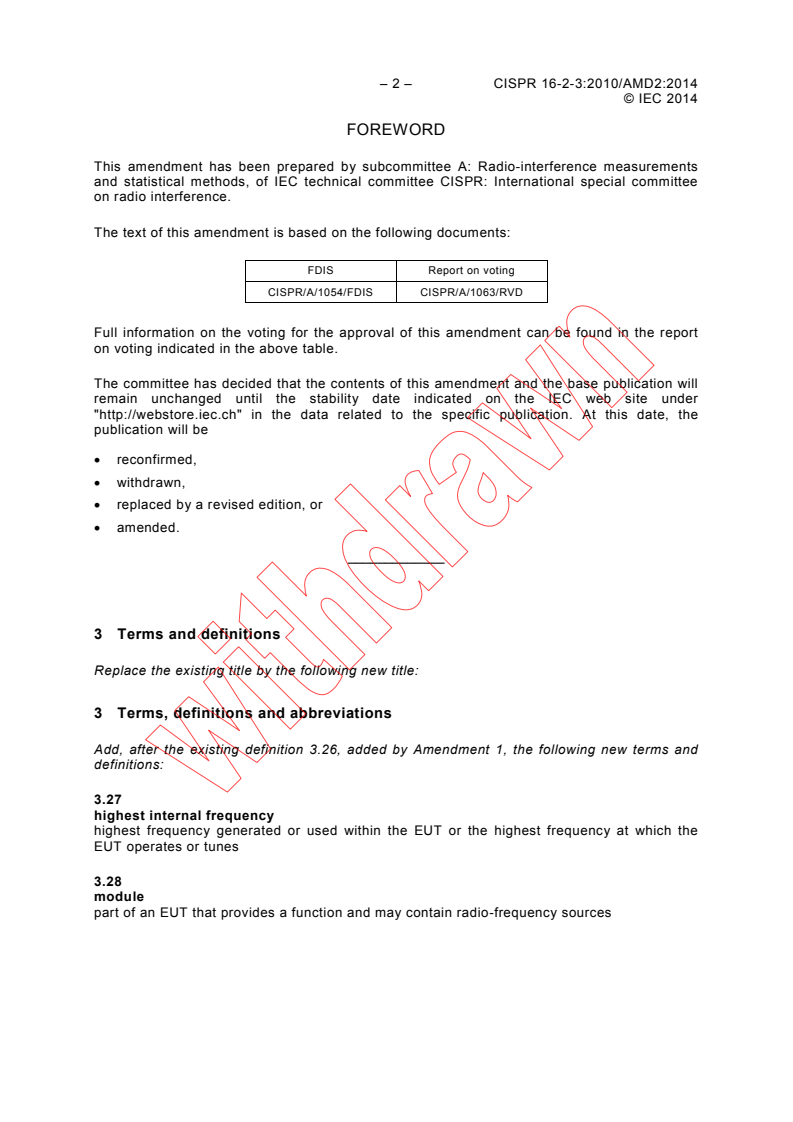
– 2 – CISPR 16-2-3:2010/AMD2:2014
© IEC 2014
FOREWORD
This amendment has been prepared by subcommittee A: Radio-interference measurements
and statistical methods, of IEC technical committee CISPR: International special committee
on radio interference.
The text of this amendment is based on the following documents:
FDIS Report on voting
CISPR/A/1054/FDIS CISPR/A/1063/RVD
Full information on the voting for the approval of this amendment can be found in the report
on voting indicated in the above table.
The committee has decided that the contents of this amendment and the base publication will
remain unchanged until the stability date indicated on the IEC web site under
"http://webstore.iec.ch" in the data related to the specific publication. At this date, the
publication will be
• reconfirmed,
• withdrawn,
• replaced by a revised edition, or
• amended.
_____________
3 Terms and definitions
Replace the existing title by the following new title:
3 Terms, definitions and abbreviations
Add, after the existing definition 3.26, added by Amendment 1, the following new terms and
definitions:
3.27
highest internal frequency
highest frequency generated or used within the EUT or the highest frequency at which the
EUT operates or tunes
3.28
module
part of an EUT that provides a function and may contain radio-frequency sources
CISPR16-2-3:2010/AMD2:2014 –3–
© IEC 2014
3.29 Abbreviations
The following abbreviations, not already provided in 3.1 through 3.28, are used in this
standard.
AM Amplitude modulation
APD Amplitude probability distribution
AV Average
BB Broadband
CW Continuous wave
FFT Fast-Fourier transform
FM Frequency modulation
IF Intermediate frequency
ISM Industrial, scientific or medical
LPDA Log-periodic dipole array
NB Narrowband
NSA Normalized site attenuation
PRF Pulse repetition frequency
RBW Resolution bandwidth
RF Radio frequency
RGP Reference ground plane
QP Quasi-peak
TEM Transverse electromagnetic
UFA Uniform field area
VBW Video bandwidth
6.2.2 Compliance (conformity assessment) testing
Replace, in the second existing paragraph of this subclause, “In the case of compliance
measurement according to a limit” by “When evaluating compliance with a limit”.
Replace the last existing sentence of the second paragraph by the following new sentence:
Further guidance on measurement of disturbances in the presence of ambient emissions is
provided in Annex A.
Delete the existing note of this subclause.
6.4 Operating conditions of the EUT
Replace the existing title by the following new title:
6.4 EUT arrangement and measurement conditions
At the next maintenance, when a new edition is published, terms and definitions will be placed in a new
subclause 3.1 and renumbered, and abbreviations will be re-located to a new subclause 3.2.
– 4 – CISPR 16-2-3:2010/AMD2:2014
© IEC 2014
6.4.1 Normal load conditions
Replace the existing title and text of this subclause by the following new titles and new text:
6.4.1 General arrangement of the EUT
6.4.1.1 General
Where not specified in the product standard, the EUT shall be configured as described below.
The EUT shall be installed, arranged and operated in a manner consistent with typical
applications. Where the manufacturer has specified or recommended an installation practice,
that practice shall be used in the test arrangement, where possible. This arrangement shall be
typical of normal installation practice. Interface cables, loads, and devices shall be connected
to at least one of each type of interface port of the EUT and, where practical, each cable shall
be terminated in a device typical of actual usage.
Where there are multiple interface ports of the same type, additional interconnecting cables,
loads and devices may have to be added to the EUT depending upon the results of
preliminary tests. Connecting a cable or wire to just one of that type of port may be sufficient.
The actual number of additional cables or wires may be limited to the condition where the
addition of another cable or wire does not significantly affect the emission level, i.e. varies
less than 2 dB, provided that the EUT remains compliant. The rationale for the selection of the
configuration and loading of ports shall be included in the test report.
Interconnecting cables should be of the type and length specified in the individual equipment
requirements. If the length can be varied, the length shall be selected to produce maximum
disturbance.
If shielded or special cables are used during the tests to achieve compliance, then a note
shall be included in the instruction manual advising of the need to use such cables.
Excess lengths of cables shall be bundled at the approximate centre of the cable with the
bundles 30 cm to 40 cm in length. If it is impractical to do so because of cable bulk or
stiffness, the disposition of the excess cable shall be precisely noted in the test report.
The results of an evaluation of EUTs having one of each type of module can be applied to
configurations having more than one of each of those modules. This is permissible because it
has been found that disturbances from identical modules are generally not additive in practice.
However the 2 dB criteria defined in this clause shall be applied.
Any set of results shall be accompanied by a complete description of the cable and equipment
orientation so that results can be reproduced. If specific conditions of use are required to
meet the limits, those conditions shall be specified and documented; for example cable length,
cable type, shielding and grounding. These conditions shall be included in the instructions to
the user.
Equipment that is populated with multiple modules (drawer, plug-in card, board, etc.) shall be
tested with a mix and number representative of that used in a typical installation. The number
of additional boards or plug-in cards of the same type may be limited to the condition where
the addition of another board or plug-in card does not significantly affect the emission level,
i.e. varies less than 2 dB, provided that the EUT remains compliant. The rationale used for
selecting the number and type of modules shall be stated in the test report.
A system that consists of a number of separate units shall be configured to form a minimum
representative configuration. The number and mix of units included in the test configuration
shall be representative of that used in a typical installation. The rationale used for selecting
units shall be stated in the test report.
CISPR16-2-3:2010/AMD2:2014 –5–
© IEC 2014
At least one module of each type shall be operative in each equipment evaluated in an EUT.
For a system EUT, at least one of each type of equipment that can be included in the possible
system configuration shall be included in the EUT.
The EUT position relative to the RGP shall be equivalent to that occurring in use. Therefore,
floor-standing equipment is placed on, but insulated from, a RGP, and tabletop equipment is
placed on a non-conductive table.
Equipment designed for wall-mounted or ceiling mounted operation shall be tested as tabletop
EUT. The orientation of the equipment shall be consistent with normal installation practice.
Combinations of the equipment types identified above shall also be arranged in a manner
consistent with normal installation practice. Equipment designed for both tabletop and floor
standing operation shall be tested as tabletop equipment unless the usual installation is floor
standing, then that arrangement shall be used.
The ends of signal cables attached to the EUT that are not connected to another unit or
auxiliary equipment shall be terminated using the correct terminating impedance defined in
the product standard.
Cables or other connections to associated equipment located outside the test area shall drape
to the floor, and then be routed to the place where they leave the test volume.
Auxiliary equipment shall be installed in accordance with normal installation practice. Where
this means that the auxiliary equipment is located on the test site, it shall be arranged using
the same conditions applicable for the EUT (e.g distance from ground plane and insulation
from the ground plane if floor standing, and layout of cabling).
6.4.1.2 Tabletop arrangement
Equipment intended for tabletop use shall be placed on a non-conductive table. The size of
the table will nominally be 1,5 m by 1,0 m, but may ultimately be dependent on the horizontal
dimensions of the EUT.
All units forming the system under test (including the EUT, connected peripherals and
auxiliary equipment or devices) shall be arranged according to normal use. Where not defined
in the normal use, a nominal 0,1 m separation distance between the neighbouring units shall
be defined for the test arrangement.
Intra-unit cables shall be draped over the back of the table. If a cable hangs closer than 0,4 m
to the horizontal ground plane (or floor), the excess shall be folded at the cable centre into a
bundle no longer than 0,4 m, such that the bundle is at least 0,4 m above the horizontal RGP.
Cables shall be positioned as for normal usage.
If the mains port input cable is less than 0,8 m long, (including power supplies integrated in
the mains plug) an extension cable shall be used such that the external power supply unit is
placed on the tabletop. The extension cable shall have characteristics similar to the mains
cable (including the number of conductors and the presence of a ground connection). The
extension cable shall be treated as part of the mains cable.
In the above arrangements, the cable between the EUT and the power accessory shall be
arranged on the tabletop in the same manner as other cables connecting components of the
EUT.
– 6 – CISPR 16-2-3:2010/AMD2:2014
© IEC 2014
6.4.1.3 Floor-standing arrangement
The EUT shall be placed on the horizontal RGP, orientated for normal use, but separated
from metallic contact with the RGP by up to 15 cm of insulation.
The cables shall be insulated (by up to 15 cm) from the horizontal RGP. If the equipment
requires a dedicated ground connection, then this shall be provided and bonded to the
horizontal ground plane.
Intra-unit cables (between units forming the EUT or between the EUT and auxiliary equipment)
shall drape to, but remain insulated from, the horizontal RGP. Any excess shall either be
folded at the cable centre into a bundle no longer than 0,4 m or arranged in a serpentine
fashion. If an intra-unit cable length is not long enough to drape to the horizontal RGP but
drapes closer than 0,4 m, then the excess shall be folded at the cable centre into a bundle no
longer than 0,4 m. The bundle shall be positioned such that it is either 0,4 m above the
horizontal RGP or at the height of the cable entry or connection point if this is within 0,4 m of
the horizontal RGP.
For equipment with a vertical cable riser, the number of risers shall be typical of installation
practice. Where the riser is made of non-conductive material, a minimum spacing of at least
0,2 m shall be maintained between the closest part of the equipment and the nearest vertical
cable. Where the riser structure is conductive, the minimum spacing of 0,2 m shall be
between the closest parts of the equipment and riser structure.
6.4.1.4 Combinations of tabletop and floor-standing equipment arrangement
Intra-unit cables between a tabletop unit and a floor standing unit shall have the excess
folded into a bundle no longer than 0,4 m. The bundle shall be positioned such that it is either
0,4 m above the horizontal RGP or at the height of the cable entry or connection point if this is
within 0,4 m of the horizontal RGP.
6.4.2 The time of operation
Replace the existing title and text of this subclause by the following new title and new text:
6.4.2 Operation of the EUT
The operating conditions of the EUT shall be determined by the manufacturer according to the
typical use of the EUT with respect to the expected highest level of emission. The determined
operational mode and the rationale for the selected operating conditions shall be stated in the
test report.
The EUT shall be operated within the rated (nominal) operating voltage range and typical load
conditions (mechanical or electrical) for which it is designed. Actual loads should be used
whenever possible. If a simulator is used, it shall represent the actual load with respect to its
radio frequency and functional characteristics.
The test programmes or other means of exercising the equipment should ensure that various
parts of a system are exercised in a manner that permits detection of all system disturbances.
6.4.3 Running-in time
Replace the existing title and text of this subclause by the following new title and new text:
6.4.3 EUT time of operation
The time of operation shall be, in the case of EUTs with a given rated operating time, in
accordance with the marking; in all other cases, the EUT shall be continuously operated
throughout the test.
CISPR16-2-3:2010/AMD2:2014 –7–
© IEC 2014
6.4.4 Supply
Replace the existing title and text of this subclause by the following new title and new text:
6.4.4 EUT running-in time
No specific running-in time, prior to testing, is given, but the EUT shall be operated for a
sufficient period to ensure that the modes and conditions of operation are typical of those
during the life of the equipment. For some EUTs, special test conditions may be prescribed in
the relevant product standards.
6.4.5 Mode of operation
Replace the existing title and text of this subclause by the following new title and new text:
6.4.5 EUT supply
The EUT shall be operated from a supply having the rated voltage of the EUT. If the level of
disturbance varies considerably with the supply voltage, the measurements shall be repeated
for supply voltages over the range of 0,9 to 1,1 times the rated voltage. EUTs with more than
one rated voltage shall be tested at the rated voltage that causes maximum disturbance.
Add, after the 6.4.5, the following new subclauses:
6.4.6 EUT mode of operation
The EUT shall be operated under practical conditions that cause the maximum disturbance at
the measurement frequency.
6.4.7 Operation of multifunction equipment
Multifunction equipment which is subjected simultaneously to different clauses of a product
standard, and/or different standards, shall be tested with each function operated in isolation, if
this can be achieved without modifying the equipment internally. The equipment thus tested
shall be deemed to have complied with the requirements of all clauses and/or standards when
each function has satisfied the requirements of the relevant clause and/or standard.
For equipment where it is not practical to test with each function operated in isolation, or
where the isolation of a particular function would result in the equipment being unable to fulfil
its primary function, or where the simultaneous operation of several functions would result in
saving measurement time, the equipment shall be deemed to have complied if it meets the
provisions of the relevant clause and/or standard with the necessary functions operated.
6.4.8 Determination of arrangement(s) causing maximum emissions
Initial testing shall identify the frequency that has the highest disturbance relative to the limit.
This identification shall be performed while operating the EUT in typical modes of operation
and with cable positions in a test arrangement that is representative of typical installation
practice.
The frequency of highest disturbance with respect to the limit shall be found by investigating
disturbances at a number of significant frequencies. This provides confidence that the
probable frequency of maximum disturbance has been found and that the associated cable,
EUT arrangement and mode of operation has been identified.
For initial testing, the EUT should be arranged in accordance with the product standards as
appropriate.
– 8 – CISPR 16-2-3:2010/AMD2:2014
© IEC 2014
6.4.9 Recording of measurements
Of those disturbances above (L – 20 dB), where L is the limit level in logarithmic units, the
disturbance levels and the frequencies of at least the six highest disturbances shall be
recorded.
For radiated disturbances, the antenna polarization and height for each reported disturbance
shall be recorded.
6.6.2 Minimum measurement times
Replace the existing text in the first paragraph of this subclause, modified by Amendment 1,
by the following new text:
The minimum measurement (dwell) times are given in Table 7. From Table 7, the minimum
scan times for measurements over a complete CISPR band have been derived in Table 1.
These minimum measurement (dwell) times for scanning receivers and FFT-based measuring
instruments in Table 7 and the scan times for spectrum analyzers in Table 1 apply to CW
signals.
In addition, the test report shall include the value of the measurement instrumentation
uncertainty corresponding to the used test setup, calculated as per the requirements of
CISPR 16-4-2.
In the existing second paragraph, delete the first sentence (beginning with “The scan times”).
6.6.6 Timing considerations using FFT-based instruments
Replace the existing Note 2 and footnote 3, added by Amendment 1, by the following new
note:
NOTE 2 Additional background information on the definition of the FFT-based receiver can be found in CISPR
16-3 [2].
7.3.6.2 Test environment
Replace the introducing text of the existing list by the following new introducing text:
If the ambient field-strength level at frequencies within the specified measurement ranges, at
the specified measurement distance, exceeds the limit(s), the following alternatives may be
used to show compliance of the EUT:
Replace the existing item a) of the list by the following new items a) and b):
a) Perform measurements at a closer distance and extrapolate results to the distance at
which the limit is specified. Extrapolate the results using one of the following methods:
1) determine L corresponding to the close-in distance d by applying the relation
2 2
L = L (d /d ), where L is the specified limit in µV/m at the distance d ;
2 1 1 2 1 1
NOTE This extrapolation method can only be used when both d and d are in the far-field zone of the
1 2
EUT at all frequencies of measurement.
2) use the formula as recommended by the product standard;
3) determine the limit L at a distance d applying an extrapolation formula verified by
2 2
measurements at no less than three different distances.
b) In the frequency bands where the ambient noise values are exceeded (measured values
higher than 6 dB below the limit), the disturbance values of the EUT may be interpolated
from the adjacent disturbance values. The interpolated value shall lie on the curve
describing a continuous function of the disturbance values adjacent to the ambient noise.
CISPR16-2-3:2010/AMD2:2014 –9–
© IEC 2014
Renumber the existing items b) to e) of the list as items c) to f) respectively.
Replace, in the existing item d), which is now renumbered e), the words “open field area test
site” by the abbreviation “OATS”.
7.3.6.3 Configuration of equipment under test
Replace, in the existing title, “equipment under test” by “EUT”.
Replace the entire text of this subclause by the following new text and figure:
The EUT operating conditions and arrangement are detailed in 6.4.
Ferrite clamp type CMADs are used to reduce the influence of cables outside the test volume
on radiated disturbance measurement results. If CMADs are used, the cable leaving the test
volume shall enter the CMAD at the point where it reaches the ground plane as shown in
Figure 22. The CMAD shall always be placed flat on the ground plane. The part of the cable
between the exit point of the CMAD and the exit point of the turntable shall be kept as short
as possible. Each cable shall be treated with a separate CMAD. Cables with diameters larger
than the cable openings of commercially available CMADs do not have to be treated with
CMADs.
NOTE 1 In order to avoid saturation, high common mode current power cables (e.g. the output port of inverters)
should not be treated with CMADs unless the CMADs in use are specifically designed for high common mode
currents.
For EUTs with up to three cables leaving the test volume, each cable shall be treated with a
CMAD during radiated disturbance measurements. This requirement applies to any type of
cable (e.g. power, telecommunication, and control). For a test set-up with more than three
cables leaving the test volume, only the three cables from which the highest emission is
expected need to be equipped with CMADs. The cables on which the CMADs have been
applied shall be documented in the test report.
NOTE 2 The limitation of the number of CMADs is discussed in [10]. In comparing large versus small size EUTs,
as well as EUTs with one versus two cables, the author concluded that a small EUT with only one cable leaving the
test volume is worst case. The author’s investigation covered application of CMADs to tabletop equipment with
three cables or less.
General information on the purpose and application of ferrite-type CMADs is provided in 4.9.1
of CISPR/TR 16-3 [2].
– 10 – CISPR 16-2-3:2010/AMD2:2014
© IEC 2014
EUT
Turntable
1)
CMAD
IEC 0838/14
1)
CMADs shall comply with the relevant specifications of CISPR 16-1-4; their use shall be documented in the test
report.
Figure 22 – Position of CMAD for table-top equipment on OATS or in SAC
Figure 7 – Typical FAR site geometry, where a, b, c, e depend on the room performance
Replace the existing footnote 2) of this figure by the following new footnote:
2)
CMADs shall comply with the relevant specifications of CISPR 16-1-4; their use shall be documented in the test
report.
Figure 8 – Typical test set-up for table-top equipment within the test volume of a FAR
Replace the existing footnote 2) of this figure by the following new footnote:
2)
CMADs shall comply with the relevant specifications of CISPR 16-1-4; their use shall be documented in the test
report.
Figure 9 – Typical test set-up for floor-standing equipment within the test volume of a
FAR
Replace the existing footnote 3) of this figure by the following new footnote:
3)
CMADs shall comply with the relevant specifications of CISPR 16-1-4; their use shall be documented in the test
report.
7.4.3 Cable layout and termination
Replace the existing item e) by the following new item, and add a new item f) as follows:
80 cm
CISPR16-2-3:2010/AMD2:2014 –11–
© IEC 2014
e) The test set-up, including cable layout and details of attached cables and terminations,
are specified in the different product standards.
f) Ferrite clamp type CMADs are used to reduce the influence of cables outside the test
volume on radiated disturbance measurement results. The cable leaving the test volume
shall enter the CMAD at the point where it reaches the bottom of the test volume
(turntable) as shown in Figures 7, 8 and 9. Each cable shall be treated with a separate
CMAD. Cables with diameters larger than the cable openings of commercially available
CMADs need not be treated with CMADs.
NOTE In order to avoid saturation, high common mode current power cables (e.g. output port of inverters)
should not be treated with CMADs, unless the CMADs in use are specifically designed for high common mode
currents.
For EUTs with up to three cables leaving the test volume, each cable shall be treated with
a CMAD during radiated disturbance measurements. This requirement applies to any type
of cable (e.g. power, telecommunications and control). For a test set-up with more than
three cables leaving the test volume only the three cables from which the highest emission
is expected need to be equipped with CMADs. The cables on which the CMADs have been
applied shall be documented in the test report.
General information on the purpose and application of ferrite-type CMADs is provided in
4.9.1 of CISPR/TR 16-3 [2].
Figure 11 – Test set-up for table-top equipment
Replace the existing figure by the following new figure:
– 12 – CISPR 16-2-3:2010/AMD2:2014
© IEC 2014
Test volume where the NSA
requirement for CISPR 16-1-4 is
satisfied
X = Horizontal cable perpendicular
a
to the EUT: 0,2 m ± 0,02 m
EUT perimeter
(including cables)
X = Horizontal cable parallel to the
b
X
a
EUT: 0,8 m ± 0,08 m
EUT
Y = Cables run down vertically from
EUT the edge of the table
X
b
B Z = Minimum distance from the ground
plane of interconnecting cables that
hang from the table: 0,4 m ± 0,04 m
Z Y
1)
CMAD
B = Excess cable length bundle
between 30 cm and 40 cm in length
Turntable
(ground-plane) Cables leaving the test
volume
IEC 0839/14
1)
CMADs shall comply with the relevant specifications of CISPR 16-1-4; their use shall be documented in the test
report.
Figure 11 – Test set-up for table-top equipment
7.5.4 Specifications for EUT set-up in common emissions/immunity test setup
In the second existing list of this subclause, further indent the paragraph starting with "For a
table-top EUT." and the paragraph starting with "For a floor-standing EUT…", and replace the
bullet points with dashes as follows:
• The cables shall be oriented…
– For a table-top EUT…
– For a floor-standing EUT…
CISPR16-2-3:2010/AMD2:2014 –13–
© IEC 2014
Figure 13 – Test set-up for floor-standing equipment
Replace the existing figure by the following new figure:
Test volume where
the NSA requirement
for CISPR 16-1-4
is satisfied
X = Horizontal cable run parallel to
one EUT perimeter face and
EUT perimeter (including
perpendicular to adjacent EUT
X Dielectric
cables)
perimeter face for a length at least
support
of 0,3 m
Y = Cables run down vertically
B = Excess cable length bundle
EUT
approximately 1 m in length
Y
NOTE Bend radius of cables shall
not be exceeded to meet the bundled
cable length.
EUT
X
B
1)
CMADs
Turntable
(ground-plane)
Cables leaving the test
volume
IEC 1094/06
1)
CMADs shall comply with the relevant specifications of CISPR 16-1-4; their use shall be documented in the test
report.
Figure 13 – Test set-up for floor-standing equipment
7.6.6.2.1 General measurement procedure
Replace, in the existing first paragraph of this subclause “different from” by “other than”.
7.6.6.2.2 Preliminary measurement procedure
Replace the existing title and text of this subclause by the following new title and text:
7.6.6.2.2 Conditional testing procedure
If the highest internal frequency of the EUT (see 3.27) is less than 108 MHz, emissions shall
be measured at least up to 1 GHz.
If the highest internal frequency of the EUT is between 108 MHz and 500 MHz, emissions
shall be measured at least up to 2 GHz.
– 14 – CISPR 16-2-3:2010/AMD2:2014
© IEC 2014
If the highest internal frequency of the EUT is between 500 MHz and 1 GHz, emissions shall
be measured at least up to 5 GHz.
If the highest internal frequency of the EUT is above 1 GHz, emissions shall be measured up
to the lower of 5 times the highest internal frequency or the highest frequency at which the
limits are defined.
7.6.6.2.3 Final measurement procedure
Replace the existing title and text of this subclause by the following new title and text:
7.6.6.2.3 Preliminary measurement procedure
The procedures of this subclause are for informative purposes – normative measurement
requirements are listed in 7.6.6.2.4. The maximum radiated disturbance for a given mode of
operation may be found during a preliminary test. To minimize measurement time, it is
suggested to first perform measurements using peak detection, and then compare the test
results to the average limit. Subsequent measurements with the average detector and
comparison of results to the average limit will only be performed in those frequency ranges
where the average limit was exceeded by data collected with peak detection.
Guidelines for a preliminary procedure to identify the radiated disturbance are as follows.
a) Use scan or sweep mode over the complete frequency range of the antenna using peak
detection and max-hold mode.
b) Determine the proper sweep or scan time to ensure adequate signal interception.
c) If necessary, during preliminary tests, reduce the resolution bandwidth in sweep mode to
reduce the displayed noise level of the measuring receiver. Note that this may reduce the
amplitude of broadband disturbance, so additional investigations to determine whether the
disturbance is broadband or narrowband may be necessary.
d) Rotate the EUT continuously or in increments of 15 ° or less, then repeat for the other
polarization. The EUT should be rotated 360 ° in azimuth for both polarizations to
determine the maximum disturbance at each frequency of interest.
e) For continuous turntable rotation mode, set the measuring receiver sweep time such that
the selected frequency span can be swept within a time that is equal to or less than the
time needed for the turntable to rotate 15 °. If the rotational speed of the turntable is such
that an angle larger than 15 ° is covered during a complete sweep or scan of the
measuring receiver, a smaller frequency range should be used to reduce measuring
receiver sweep time and to achieve the maximum 15 ° turntable rotation per sweep.
f) As needed to identify the frequencies corresponding to the maximum disturbance, apply
the method described above for all the height levels required by 7.6.6.1 (and Figure 16),
and for the various operating modes of the EUT.
g) To further evaluate the frequencies found in steps a) to d), use a small frequency span
(typically 5 MHz or less) and investigate around frequencies near the limit using additional
smaller turntable increments and height steps. Typically, all frequencies within
approximately 10 dB of the specification limit warrant further investigation with a narrow
frequency span and additional finer rotation/height increments.
Add, after the 7.6.6.2.3, the following new subclause:
7.6.6.2.4 Final measurement procedure
The field strength emitted by the EUT at the given measurement distance is measured using
the configuration (antenna height, EUT azimuth, etc.) producing the maximum disturbance, as
CISPR16-2-3:2010/AMD2:2014 –15–
© IEC 2014
identified during the preliminary disturbance maximization. Final measurements shall be done
using the EUT operational mode identified by preliminary measurements to have the highest
disturbance.
This final measurement shall be the result of a maximum hold on the measuring receiver
during a given time proportional to the frequency span used. This given time should be
defined for each product or product family, taking into account the duration of the operating
modes and the time constants associated with each specific product to be tested. Final
measurements shall be performed using all required detectors. Alternatively, peak
measurement results may be used to demonstrate compliance with all specified limits.
If the configuration of the EUT (antenna height, EUT azimuth, operation mode, etc.) producing
the maximum disturbance was not conclusively determined by a preliminary measurement the
following additional measurements shall be done:
a) for any EUT with maximum dimension equal to or smaller than w, the centre of the
receiving antenna shall be fixed at the height of the centre of the EUT [see Figure 16 a)];
b) for any EUT with maximum vertical dimension larger than w, height scanning shall be
performed in accordance with the height scan requirements (upper and lower bounds)
specified in 7.6.6.1;
c) in all cases, in order to find the maximum disturbance, the EUT shall be rotated in azimuth
through all angles in the range of 0 ° to 360 °, and the measurements shall be performed
for both horizontal and vertical polarizations.
In summary, the requirements for final measurements above 1 GHz are as follows.
The maximum disturbance shall be recorded from the following required investigations, some
of which may be performed during the preliminary measurement procedure:
1) the EUT shall be rotated in azimuth through all angles in the range of 0 ° to 360 ° either by
a turntable or movement of the receive antenna around the volume;
NOTE If a preliminary measurement was performed with azimuth steps of 1 ° < a ≤ 15 °, the final
measurement shall include an azimuth search continuous through all angles of at least ± a around the azimuth
angle found in the preliminary measurement, where a is the azimuth angle.
2) the receive antenna shall be height-scanned if the EUT height is larger than w in the
vertical direction;
3) both horizontal and vertical polarizations shall be investigated.
7.6.6.3.1 General
Replace the existing second sentence in the first paragraph by the following new sentence:
Background material on the application of the APD-measuring function is provided in 4.7 of
CISPR/TR 16-3 [2].
A.2.2 ambient emission
Delete the existing note in this subclause.
– 16 – CISPR 16-2-3:2010/AMD2:2014
© IEC 2014
A.4.2 Pre-testing the EUT in a shielded room
Replace, in the existing note, “c)” by “d)”.
Bibliography
Replace the existing reference [2] by the following new reference:
[2] CISPR/TR 16-3:2010, Specification for radio disturbance and immunity measuring
apparatus and methods – Part 3: CISPR technical reports
Amendment 1:2012
Add, after the existing reference [9], added by Amendment 1, the following new reference:
[10] Ryser, H., Motivation for the use of CMAD in radiated emission measurements (CMAD:
Common mode absorption devices), Report 2007-218-630, Federal Office of Metrology
(METAS), Bern-Wabern, Switzerland, 11 September 2007, available as a downloaded
PDF from http://www.metas.ch/2007-218-630
_____________
– 18 – CISPR 16-2-3:2010/AMD2:2014
© IEC 2014
AVANT-PROPOS
Le présent amendement a été établi par le sous-comité A: Mesures des perturbations
radioélectriques et méthodes statistiques, du comité d'études CISPR de la CEI: Comité
international spécial des perturbations radioélectriques.
Le texte de cet amendement est issu des documents suivants:
FDIS Rapport de vote
CISPR/A/1054/FDIS CISPR/A/1063/RVD
Le rapport de vote indiqué dans le tableau ci-dessus donne toute information sur le vote ayant
abouti à l'approbation de cet amendement.
Le comité a décidé que le contenu de cet amendement et de la publication de base ne sera
pas modifié avant la date de stabilité indiquée sur le site web de la CEI sous
"http://webstore.iec.ch" dans les données relatives à la publication recherchée. A cette date,
la publication sera
• reconduite,
• supprimée,
• remplacée par une édition révisée, ou
• amendée.
_____________
3 Termes et définitions
Remplacer le titre existant par le nouveau titre suivant:
3 Termes, définitions et abréviations
Ajouter, après la définition existante 3.26, ajoutée par l'Amendement 1, les nouveaux termes
et définitions suivants:
3.27
fréquence interne la plus haute
fréquence la plus haute générée ou utilisée avec le matériel en essai (EUT) ou fréquence la
plus haute à laquelle l'EUT fonctionne ou s'accorde
3.28
module
partie d'un matériel en essai (EUT) remplissant une fonction et pouvant contenir des sources
de fréquence radio
CISPR16-2-3:2010/AMD2:2014 –19–
© IEC 2014
3.29 Abréviations
Les abréviations suivantes, ne figurant pas déjà du 3.1 au 3.28, sont utilisées dans la
présente norme.
AM (Amplitude modulation) Modulation d’amplitude
DPA Distribution de probabilité d'amplitude
AV Moyenne
BB (Broadband) Large bande
CW (Continuous wave) Émission à ondes entretenues
FFT (Fast-Fourier transform) Transformée de Fourier rapide
FM (Frequency modulation) Modulation de fréquence
FI Fréquence intermédiaire
ISM Industriel, scientifique ou médical
LPDA (Log-periodic dipole array) Réseau de doublets log-pério
...