

CISPR TR 16-4-3:2003
(Main)Specification for radio disturbance and immunity measuring apparatus and methods - Part 4-3: Uncertainties, statistics and limit modelling - Statistical considerations in the determination of EMC compliance of mass-produced products
General Information
- Abstract
This technical report contains recommendations on statistics of disturbance complaints, on the significance of CISPR limits, and specific reports. Over the years, the CISPR prepared a number of recommendations and reports that have significant technical merit but were not generally available. Reports and recommendations were for some time published in CISPR 7 and 8. At its meeting in Campinas, Brazil, in 1988, subcommittee A agreed on the table of contents of the first edition of part 3 and to publish the reports for posterity by giving the reports a permanent place in part 3. In 2003, the relevant clauses on statistics were transferred to CISPR 16-4-3. CISPR 16-3 has been reorganised into 4 parts, to accommodate growth and easier maintenance. This first edition of CISPR 16-4-3, together with CISPR 16-4-1, CISPR 16-4-4 and the second edition of CISPR 16-3, cancels and replaces the first edition of CISPR 16-3, published in 2000, and its amendment 1 (2002). It contains the relevant clauses of CISPR 16-3 without technical changes.
- Status
- Published
- Publication Date
- 25-Nov-2003
- Technical Committee
- CIS/A - Radio-interference measurements and statistical methods
- Current Stage
- DELPUB - Deleted Publication
- Start Date
- 24-May-2004
- Completion Date
- 28-Aug-2026
Buy Documents
CISPR TR 16-4-3:2003 - Specification for radio disturbance and immunity measuring apparatus and methods - Part 4-3: Uncertainties, statistics and limit modelling - Statistical considerations in the determination of EMC compliance of mass-produced products Released:11/26/2003
Overview
CISPR TR 16-4-3:2003 (IEC) is a technical report that addresses statistical considerations in the determination of EMC compliance of mass‑produced products. It collects CISPR recommendations and reports on statistics, uncertainties and limit modelling that were previously distributed across older CISPR publications. The document provides guidance on the significance of CISPR limits, statistical testing approaches, and interpretation of disturbance complaints to support robust EMC compliance decisions for large production lots.
Key topics
- Scope and organization: Consolidates earlier CISPR guidance into Part 4-3 of the reorganized CISPR 16 series and retains relevant clauses from CISPR 16-3 without technical change.
- Statistical tests and sampling methods:
- Tests based on the non‑central t‑distribution - sampling by variables (continuous measurements).
- Tests based on the binomial distribution - sampling by attributes (pass/fail outcomes).
- Significance of CISPR limits: Recommendations (e.g., Recommendation 46/2) on interpreting and applying limits when assessing compliance and conformity.
- Reports included:
- Report 48 - statistical considerations for setting and testing interference limits.
- Report 59 - analytical assessment of statistical parameters when samples are incompletely defined (with appendix).
- Definitions and normative references: Cross‑references to CISPR 16‑1, CISPR 16‑2, CISPR 16‑3 and related parts for measurement apparatus, methods and uncertainty treatment.
Practical applications
CISPR TR 16-4-3:2003 is intended for professionals involved in EMC compliance of mass‑produced products:
- EMC engineers and test laboratories - to select appropriate statistical tests and sampling plans for production batches.
- Compliance managers and quality assurance teams - to interpret measurement results against CISPR limits and to model the risk of non‑compliance across production volumes.
- Manufacturers of mass‑produced electronic equipment - to design production testing strategies and to evaluate complaint statistics for corrective action.
- Standards committees and regulators - to harmonize limit setting and compliance criteria using established statistical methods.
Typical uses include defining sampling protocols (variables vs attributes), modelling the probability of exceedance relative to CISPR limits, and analysing complaint data to inform limit revisions or production control.
Related standards
- CISPR 16-4-1:2003 - Uncertainties in standardized EMC tests
- CISPR 16-4-2:2003 - Measurement instrumentation uncertainties
- CISPR 16-4-4:2003 - Statistics of complaints and a model for limit calculation
- CISPR 16-1 / 16-2 / 16-3 - Measurement apparatus, methods and technical reports
CISPR TR 16-4-3:2003 is a reference for anyone needing authoritative guidance on statistical methods, uncertainties and limit modelling for EMC compliance of large-scale production.
Relations
- Effective Date
- 05-Sep-2023
- Effective Date
- 05-Sep-2023
- Effective Date
- 05-Sep-2023
Buy Documents
CISPR TR 16-4-3:2003 - Specification for radio disturbance and immunity measuring apparatus and methods - Part 4-3: Uncertainties, statistics and limit modelling - Statistical considerations in the determination of EMC compliance of mass-produced products Released:11/26/2003
Get Certified
Connect with accredited certification bodies for this standard

ANCE
Mexican certification and testing association.

Intertek Slovenia
Intertek testing, inspection, and certification services in Slovenia.

LNE (Laboratoire National de Métrologie et d'Essais)
French national laboratory for metrology and testing.
Sponsored listings
Frequently Asked Questions
CISPR TR 16-4-3:2003 is a technical report published by the International Electrotechnical Commission (IEC). Its full title is "Specification for radio disturbance and immunity measuring apparatus and methods - Part 4-3: Uncertainties, statistics and limit modelling - Statistical considerations in the determination of EMC compliance of mass-produced products". This standard covers: This technical report contains recommendations on statistics of disturbance complaints, on the significance of CISPR limits, and specific reports. Over the years, the CISPR prepared a number of recommendations and reports that have significant technical merit but were not generally available. Reports and recommendations were for some time published in CISPR 7 and 8. At its meeting in Campinas, Brazil, in 1988, subcommittee A agreed on the table of contents of the first edition of part 3 and to publish the reports for posterity by giving the reports a permanent place in part 3. In 2003, the relevant clauses on statistics were transferred to CISPR 16-4-3. CISPR 16-3 has been reorganised into 4 parts, to accommodate growth and easier maintenance. This first edition of CISPR 16-4-3, together with CISPR 16-4-1, CISPR 16-4-4 and the second edition of CISPR 16-3, cancels and replaces the first edition of CISPR 16-3, published in 2000, and its amendment 1 (2002). It contains the relevant clauses of CISPR 16-3 without technical changes.
This technical report contains recommendations on statistics of disturbance complaints, on the significance of CISPR limits, and specific reports. Over the years, the CISPR prepared a number of recommendations and reports that have significant technical merit but were not generally available. Reports and recommendations were for some time published in CISPR 7 and 8. At its meeting in Campinas, Brazil, in 1988, subcommittee A agreed on the table of contents of the first edition of part 3 and to publish the reports for posterity by giving the reports a permanent place in part 3. In 2003, the relevant clauses on statistics were transferred to CISPR 16-4-3. CISPR 16-3 has been reorganised into 4 parts, to accommodate growth and easier maintenance. This first edition of CISPR 16-4-3, together with CISPR 16-4-1, CISPR 16-4-4 and the second edition of CISPR 16-3, cancels and replaces the first edition of CISPR 16-3, published in 2000, and its amendment 1 (2002). It contains the relevant clauses of CISPR 16-3 without technical changes.
CISPR TR 16-4-3:2003 is classified under the following ICS (International Classification for Standards) categories: 33.100.10 - Emission; 33.100.20 - Immunity. The ICS classification helps identify the subject area and facilitates finding related standards.
CISPR TR 16-4-3:2003 has the following relationships with other standards: It is inter standard links to CISPR TR 16-3:2000, CISPR TR 16-3:2000/AMD1:2002, CISPR TR 16-4-3:2004. Understanding these relationships helps ensure you are using the most current and applicable version of the standard.
CISPR TR 16-4-3:2003 is available in PDF format for immediate download after purchase. The document can be added to your cart and obtained through the secure checkout process. Digital delivery ensures instant access to the complete standard document.
Standards Content (Sample)
TECHNICAL CISPR
REPORT 16-4-3
First edition
2003-11
INTERNATIONAL SPECIAL COMMITTEE ON RADIO INTERFERENCE
Specification for radio disturbance and immunity
measuring apparatus and methods –
Part 4-3:
Uncertainties, statistics and limit modelling –
Statistical considerations in the determination
of EMC compliance of mass-produced products
Reference number
CISPR 16-4-3/TR:2003(E)
Publication numbering
As from 1 January 1997 all IEC publications are issued with a designation in the
60000 series. For example, IEC 34-1 is now referred to as IEC 60034-1.
Consolidated editions
The IEC is now publishing consolidated versions of its publications. For example,
edition numbers 1.0, 1.1 and 1.2 refer, respectively, to the base publication, the
base publication incorporating amendment 1 and the base publication incorporating
amendments 1 and 2.
Further information on IEC publications
The technical content of IEC publications is kept under constant review by the IEC,
thus ensuring that the content reflects current technology. Information relating to
this publication, including its validity, is available in the IEC Catalogue of
publications (see below) in addition to new editions, amendments and corrigenda.
Information on the subjects under consideration and work in progress undertaken
by the technical committee which has prepared this publication, as well as the list
of publications issued, is also available from the following:
• IEC Web Site (www.iec.ch)
• Catalogue of IEC publications
The on-line catalogue on the IEC web site (www.iec.ch/searchpub) enables you to
search by a variety of criteria including text searches, technical committees
and date of publication. On-line information is also available on recently issued
publications, withdrawn and replaced publications, as well as corrigenda.
• IEC Just Published
This summary of recently issued publications (www.iec.ch/online_news/ justpub)
is also available by email. Please contact the Customer Service Centre (see
below) for further information.
• Customer Service Centre
If you have any questions regarding this publication or need further assistance,
please contact the Customer Service Centre:
Email: custserv@iec.ch
Tel: +41 22 919 02 11
Fax: +41 22 919 03 00
TECHNICAL CISPR
REPORT 16-4-3
First edition
2003-11
INTERNATIONAL SPECIAL COMMITTEE ON RADIO INTERFERENCE
Specification for radio disturbance and immunity
measuring apparatus and methods –
Part 4-3:
Uncertainties, statistics and limit modelling –
Statistical considerations in the determination
of EMC compliance of mass-produced products
© IEC 2003 ⎯ Copyright - all rights reserved
No part of this publication may be reproduced or utilized in any form or by any means, electronic or
mechanical, including photocopying and microfilm, without permission in writing from the publisher.
International Electrotechnical Commission, 3, rue de Varembé, PO Box 131, CH-1211 Geneva 20, Switzerland
Telephone: +41 22 919 02 11 Telefax: +41 22 919 03 00 E-mail: inmail@iec.ch Web: www.iec.ch
PRICE CODE
Commission Electrotechnique Internationale
T
International Electrotechnical Commission
Международная Электротехническая Комиссия
For price, see current catalogue
– 2 – CISPR 16-4-3/TR © IEC:2003(E)
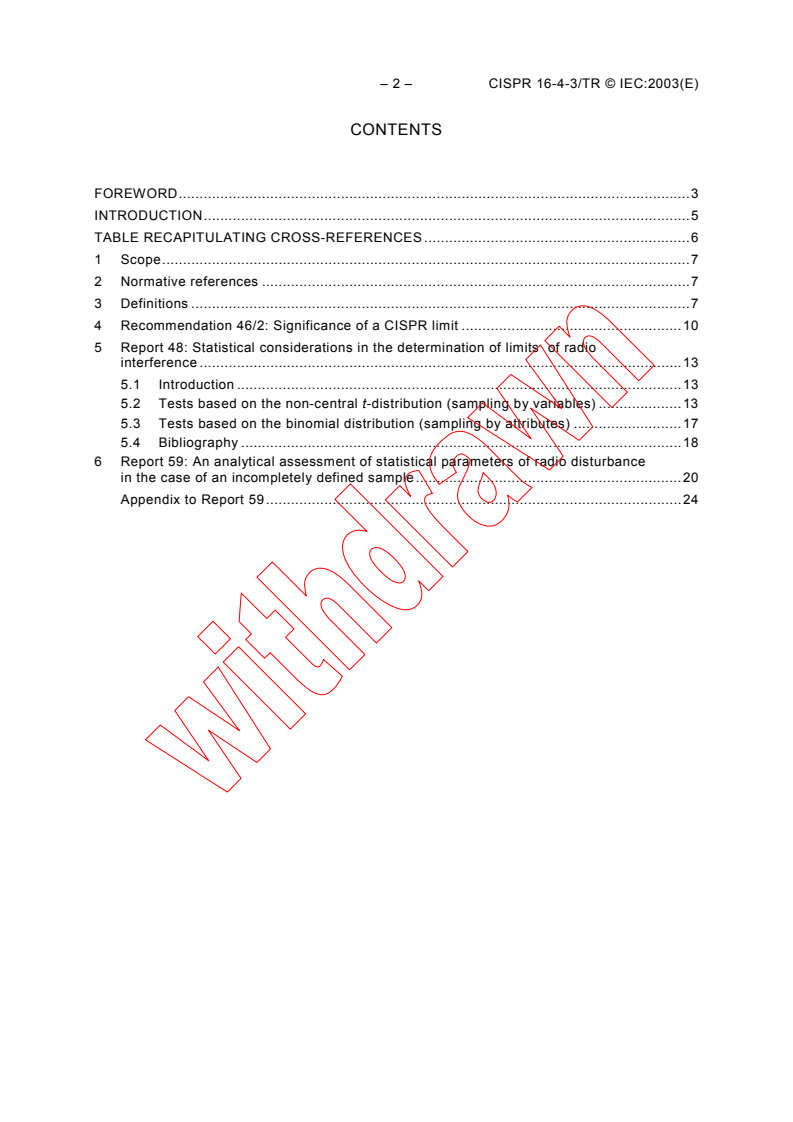
CONTENTS
FOREWORD.3
INTRODUCTION.5
TABLE RECAPITULATING CROSS-REFERENCES .6
1 Scope.7
2 Normative references.7
3 Definitions.7
4 Recommendation 46/2: Significance of a CISPR limit .10
5 Report 48: Statistical considerations in the determination of limits of radio
interference .13
5.1 Introduction.13
5.2 Tests based on the non-central t-distribution (sampling by variables) .13
5.3 Tests based on the binomial distribution (sampling by attributes) .17
5.4 Bibliography.18
6 Report 59: An analytical assessment of statistical parameters of radio disturbance
in the case of an incompletely defined sample.20
Appendix to Report 59.24
CISPR 16-4-3/TR © IEC:2003(E) – 3 –
INTERNATIONAL ELECTROTECHNICAL COMMISSION
____________
SPECIFICATION FOR RADIO DISTURBANCE
AND IMMUNITY MEASURING APPARATUS AND METHODS –
Part 4-3: Uncertainties, statistics and limit modelling –
Statistical considerations in the determination
of EMC compliance of mass-produced products
FOREWORD
1) The International Electrotechnical Commission (IEC) is a worldwide organization for standardization comprising
all national electrotechnical committees (IEC National Committees). The object of IEC is to promote
international co-operation on all questions concerning standardization in the electrical and electronic fields. To
this end and in addition to other activities, IEC publishes International Standards, Technical Specifications,
Technical Reports, Publicly Available Specifications (PAS) and Guides (hereafter referred to as “IEC
Publication(s)”). Their preparation is entrusted to technical committees; any IEC National Committee interested
in the subject dealt with may participate in this preparatory work. International, governmental and non-
governmental organizations liaising with the IEC also participate in this preparation. IEC collaborates closely
with the International Organization for Standardization (ISO) in accordance with conditions determined by
agreement between the two organizations.
2) The formal decisions or agreements of IEC on technical matters express, as nearly as possible, an international
consensus of opinion on the relevant subjects since each technical committee has representation from all
interested IEC National Committees.
3) IEC Publications have the form of recommendations for international use and are accepted by IEC National
Committees in that sense. While all reasonable efforts are made to ensure that the technical content of IEC
Publications is accurate, IEC cannot be held responsible for the way in which they are used or for any
misinterpretation by any end user.
4) In order to promote international uniformity, IEC National Committees undertake to apply IEC Publications
transparently to the maximum extent possible in their national and regional publications. Any divergence
between any IEC Publication and the corresponding national or regional publication shall be clearly indicated in
the latter.
5) IEC provides no marking procedure to indicate its approval and cannot be rendered responsible for any
equipment declared to be in conformity with an IEC Publication.
6) All users should ensure that they have the latest edition of this publication.
7) No liability shall attach to IEC or its directors, employees, servants or agents including individual experts and
members of its technical committees and IEC National Committees for any personal injury, property damage or
other damage of any nature whatsoever, whether direct or indirect, or for costs (including legal fees) and
expenses arising out of the publication, use of, or reliance upon, this IEC Publication or any other IEC
Publications.
8) Attention is drawn to the Normative references cited in this publication. Use of the referenced publications is
indispensable for the correct application of this publication.
9) Attention is drawn to the possibility that some of the elements of this IEC Publication may be the subject of
patent rights. IEC shall not be held responsible for identifying any or all such patent rights.
The main task of IEC technical committees is to prepare International Standards. However, a
technical committee may propose the publication of a technical report when it has collected
data of a different kind from that which is normally published as an International Standard, for
example "state of the art".
This first edition of CISPR 16-4-3, together with CISPR 16-4-1, CISPR 16-4-4 and the second
edition of CISPR 16-3, cancels and replaces the first edition of CISPR 16-3, published in
2000, and its amendment 1 (2002). It contains the relevant clauses of CISPR 16-3 without
technical changes.
This publication has been drafted in accordance with the ISO/IEC Directives, Part 2.
A bilingual version of this publication may be issued at a later date.
– 4 – CISPR 16-4-3/TR © IEC:2003(E)
The committee has decided that the contents of this publication will remain unchanged until
2004. At this date, the publication will be
• reconfirmed;
• withdrawn;
• replaced by a revised edition, or
• amended.
The text of this publication is based on the following documents:
Recommendation 46/1 – p/o CISPR. 11, 1990; Report 48 – p/o CISPR 8B, 1975; Report 59:
CIS/A(Sec)58 + CIS/A(Sec)58A, 1983.
CISPR 16-4-3/TR © IEC:2003(E) – 5 –
INTRODUCTION
CISPR 16-1, CISPR 16-2, CISPR 16-3 and CISPR 16-4 have been reorganised into 14 parts,
to accommodate growth and easier maintenance. The new parts have also been renumbered.
See the list given below.
Old CISPR 16 publications New CISPR 16 publications
CISPR 16-1-1 Measuring apparatus
CISPR 16-1-2 Ancillary equipment – Conducted disturbances
Radio disturbance
and immunity
Ancillary equipment – Disturbance power
CISPR 16-1-3
CISPR 16-1
measuring
apparatus
Ancillary equipment – Radiated disturbances
CISPR 16-1-4
Antenna calibration test sites for 30 MHz to
CISPR 16-1-5
1 000 MHz
CISPR 16-2-1 Conducted disturbance measurements
Methods of
CISPR 16-2-2 Measurement of disturbance power
measurement of
CISPR 16-2
disturbances and
CISPR 16-2-3 Radiated disturbance measurements
immunity
CISPR 16-2-4
Immunity measurements
CISPR 16-3 CISPR technical reports
CISPR 16-4-1 Uncertainties in standardised EMC tests
Reports and
CISPR 16-3 recommendations Measurement instrumentation uncertainty
CISPR 16-4-2
of CISPR
Statistical considerations in the
CISPR 16-4-3
determination of EMC compliance of mass-
produced products
Statistics of complaints and a model for the
Uncertainty in EMC
CISPR 16-4 CISPR 16-4-4
calculation of limits
measurements
More specific information on the relation between the ‘old’ CISPR 16-3 and the present ‘new’
CISPR 16-4-3 is given in the table after this introduction (TABLE RECAPITULATING CROSS
REFERENCES).
Measurement instrumentation specifications are given in five new parts of CISPR 16-1, while
the methods of measurement are covered now in four new parts of CISPR 16-2. Various
reports with further information and background on CISPR and radio disturbances in general
are given in CISPR 16-3. CISPR 16-4 contains information related to uncertainties, statistics
and limit modelling.
CISPR 16-4 consists of the following parts, under the general title Specification for radio
disturbance and immunity measuring apparatus and methods - Uncertainties, statistics and
limit modelling:
• Part 4-1: Uncertainties in standardised EMC tests,
• Part 4-2: Uncertainty in EMC measurements,
• Part 4-3: Statistical considerations in the determination of EMC compliance of mass-
produced products,
• Part 4-4: Statistics of complaints and a model for the calculation of limits.
– 6 – CISPR 16-4-3/TR © IEC:2003(E)
TABLE RECAPITULATING CROSS-REFERENCES
First edition of CISPR 16-3 First edition of CISPR 16-4-3
Clauses, subclauses Clauses
1.1 1
1.2 2
1.3 3
2.3 4
2.2 5
2.4 6
CISPR 16-4-3/TR © IEC:2003(E) – 7 –
SPECIFICATION FOR RADIO DISTURBANCE
AND IMMUNITY MEASURING APPARATUS AND METHODS –
Part 4-3: Uncertainties, statistics and limit modelling –
Statistical considerations in the determination
of EMC compliance of mass-produced products
1 Scope
This part of CISPR 16 contains recommendations on statistics of disturbance complaints, on
the significance of CISPR limits, and specific reports.
Over the years, the CISPR prepared a number of recommendations and reports that have
significant technical merit but were not generally available. Reports and recommendations
were for some time published in CISPR 7 and 8.
At its meeting in Campinas, Brazil, in 1988, subcommittee A agreed on the table of contents
of the first edition of part 3 and to publish the reports for posterity by giving the reports a
permanent place in part 3. In 2003, the relevant clauses on statistics were transferred to
CISPR 16-4-3.
2 Normative references
The following referenced documents are indispensable for the application of this document.
For dated references, only the edition cited applies. For undated references, the latest edition
of the referenced document (including any amendments) applies.
CISPR 16-1:2003 (all parts), Specification for radio disturbance and immunity measuring
apparatus and methods – Radio disturbance and immunity measuring apparatus
CISPR 16-2:2003 (all parts), Specification for radio disturbance and immunity measuring
apparatus and methods – Methods of measurement of disturbances and immunity
CISPR 16-3:2003 Specification for radio disturbance and immunity measuring apparatus and
methods – Part 3: CISPR technical reports
CISPR 16-4-1:2003, Specification for radio disturbance and immunity measuring apparatus
and methods – Part 4-1: Uncertainties, statistics and limit modelling – Uncertainties in
standardized EMC tests
CISPR 16-4-2:2003, Specification for radio disturbance and immunity measuring apparatus
and methods – Part 4-2: Uncertainties, statistics and limit modelling – Measurement
instrumentation uncertainties
CISPR 16-4-4:2003, Specification for radio disturbance and immunity measuring apparatus
and methods – Part 4-4: Uncertainties, statistics and limit modelling – Statistics of complaints
and a model for the calculation of limits
3 Definitions
For the purpose of this part of CISPR 16, the definitions of CISPR 16-1 and IEV 60050(161)
as well as the following definitions apply.
– 8 – CISPR 16-4-3/TR © IEC:2003(E)
3.1
bandwidth (B )
n
width of the overall selectivity curve of the receiver between two points at a stated
attenuation, below the midband response. The bandwidth is represented by the symbol B ,
n
where n is the stated attenuation in decibels
3.2
impulse bandwidth (B )
imp
B = A(t) / (2G × IS)
imp max o
where
A(t) is the peak of the envelope at the IF output of the receiver with an impulse area IS
max
applied at the receiver input;
G is the gain of the circuit at the centre frequency.
o
Specifically, for two critically coupled tuned transformers,
B = 1,05 × B = 1,31 × B
imp 6 3
where B and B are respectively the bandwidths at the –6 dB and –3 dB points
6 3
3.3
impulse area (sometimes called impulse strength) (IS)
the voltage-time area of a pulse defined by the integral:
+∞
IS = V (t )dt (expressed in µVs or dB(µVs))
∫
− ∞
NOTE Spectral density (D) is related to impulse area and expressed in µV/MHz or dB(µV)/MHz. For rectangular
impulses of pulse duration T at frequencies f <<1/T, the relationship D (µV/MHz) = 2 × 10 /IS (µVs) applies since D
is calibrated in r.m.s. values of a corresponding sine wave.
3.4
electrical charge time constant (T )
C
time needed after the instantaneous application of a constant sine-wave voltage to the stage
immediately preceding the input of the detector for the output voltage of the detector to reach
63 % of its final value
NOTE This time constant is determined as follows. A sine-wave signal of constant amplitude and having a
frequency equal to the mid-band frequency of the i.f. amplifier is applied to the input of the stage immediately
preceding the detector. The indication, D, of an instrument having no inertia (for example, a cathode-ray
oscilloscope) connected to a terminal in the d.c. amplifier circuit so as not to affect the behaviour of the detector, is
noted. The level of the signal is chosen such that the response of the stages concerned remains within the linear
operating range. A sine-wave signal of this level, applied for a limited time only and having a wave train of
rectangular envelope is gated such that the deflection registered is 0,63D. The duration of this signal is equal to
the charge time of the detector.
3.5
electrical discharge time constant (T )
D
time needed after the instantaneous removal of a constant sine-wave voltage applied to the
stage immediately preceding the input of the detector for the output of the detector to fall to
37 % of its initial value
NOTE The method of measurement is analogous to that for the charge time constant, but instead of a signal
being applied for a limited time, the signal is interrupted for a definite time. The time taken for the deflection to fall
to 0,37D is the discharge time constant of the detector.
CISPR 16-4-3/TR © IEC:2003(E) – 9 –
3.6
mechanical time constant (T ) of a critically damped indicating instrument
M
T = T / 2π
M L
where T is the period of free oscillation of the instrument with all damping removed.
L
NOTE 1 For a critically damped instrument, the equation of motion of the system may be written as
2 2 2
T (d α / dt ) + 2T (dα / dt ) + α = ki
M
M
where
α is the deflection;
i is the current through the instrument;
k is a constant.
It can be deduced from this relation that this time constant is also equal to the duration of a rectangular pulse (of
constant amplitude) that produces a deflection equal to 35 % of the steady deflection produced by a continuous
current having the same amplitude as that of the rectangular pulse.
NOTE 2 The methods of measurement and adjustment are deduced from one of the following:
a) The period of free oscillation having been adjusted to 2πT , damping is added so that α = 0,35 α .
TM
M max
b) When the period of oscillation cannot be measured, the damping is adjusted to be just below critical such that
the overswing is not greater than 5 % and the moment of inertia of the movement is such that α = 0,35 α .
TM
max
3.7
overload factor
ratio of the level that corresponds to the range of practical linear function of a circuit (or a
group of circuits) to the level that corresponds to full-scale deflection of the indicating
instrument.
The maximum level at which the steady-state response of a circuit (or group of circuits) does
not depart by more than 1 dB from ideal linearity defines the range of practical linear function
of the circuit (or group of circuits)
3.8
symmetric voltage
in a two-wire circuit, such as a single-phase mains supply, the symmetric voltage is the radio-
frequency disturbance voltage appearing between the two wires. This is sometimes called the
differential mode voltage. If Va is the vector voltage between one of the mains terminals and
earth and Vb is the vector voltage between the other mains terminal and earth, the symmetric
voltage is the vector difference (Va – Vb)
3.9
asymmetric voltage
radio-frequency disturbance voltage appearing between the electrical mid-point of the mains
terminals and earth. It is sometimes called the common-mode voltage and is half the vector
sum of Va and Vb, i.e. (Va + Vb)/2.
3.10
unsymmetric voltage
amplitude of the vector voltage, Va or Vb defined in 3.8 and 3.9. This is the voltage measured
by the use of an artificial mains V-network
3.11
CISPR indicating range
range specified by the manufacturer which gives the maximum and the minimum meter
indications within which the receiver meets the requirements of this part of CISPR 16
– 10 – CISPR 16-4-3/TR © IEC:2003(E)
4 Recommendation 46/2: Significance of a CISPR limit
(This recommendation replaces Recommendation 46/1, contained in CISPR 7B).
This recommendation deals with statistical considerations in the determination of EMC
compliance of mass-produced products.
The CISPR,
CONSIDERING
a) that the abatement of interference aims that the majority of the appliances to be approved
shall not cause interference;
b) that the CISPR limits should be suitable for the purpose of type approval of mass-
produced appliances as well as approval of single-produced appliances;
c) that to ensure compliance of mass-produced appliances with the CISPR limits, statistical
techniques have to be applied;
d) that it is important for international trade that the limits shall be interpreted in the same
way in every country;
e) that the National Committees of the IEC which collaborate in the work of the CISPR should
seek to secure the agreement of the competent authorities in their countries,
RECOMMENDS
that the following interpretation of CISPR limits and of methods of statistical sampling for
compliance of mass-produced appliances with these limits should be adopted:
1 a CISPR limit is a limit which is recommended to National Authorities for incorporation
in national standards, relevant legal regulations and official specifications. It is also
recommended that international organizations use these limits;
2 the significance of the limits for type-approved appliances shall be that, on a statistical
basis, at least 80 % of the mass-produced appliances comply with the limits with at
least 80 % confidence;
3 type tests can be made;
3.1 on a sample of appliances of the type with statistical evaluation in accordance with
clause 5 below;
3.2 for simplicity, on one item only (see clause 4);
4 subsequent tests from time to time on items are taken at random from the production
are necessary especially in 3.2 above;
in the case of controversy involving the possible withdrawal of a type approval,
withdrawal shall be considered only after tests on an adequate sample in accordance
with 3.1 above;
5 that statistically assessed compliance with limits shall be made according to one of
the two tests described below or to some other test which ensures compliance with the
requirements of clause 2;
5.1 test based on the non-central t-distribution. This test should be performed on sample of
not less than five items of the type, but if in exceptional circumstances five items are not
available, then a sample of three shall be used. Compliance is judged from the following
relationship:
x + kS ≤ L
n n
where
x = arithmetic mean value of the levels of n items in the sample;
n
CISPR 16-4-3/TR © IEC:2003(E) – 11 –
⎛ ⎞
()
S = ⎜ x − x ⎟ n − 1 ;
n
∑ n
⎝ ⎠
x = level of individual item;
k = the factor derived from tables of the non-central t-distribution with 80 % confidence
that 80 % of the type is below the limit; the value of k depends on the sample size n
and is stated below:
L = the permissible limit
the quantities x, x , S and L are expressed logarithmically (dB(µV), dB(µV/m) or dB(pW);
n n
n 3 4 5 6 7 8 9 10 11 12
k 2,04 1,69 1,52 1,42 1,35 1,30 1,27 1,24 1,21 1,20
5.2 test based on the binomial distribution. This test should be performed on a sample of
not less than seven items. Compliance is judged from the condition that the number of
appliances with an interference level above the permissible limit may not exceed c in a
sample of size n;
n 7 14 20 26 32
c 0 1 2 3 4
5.3 should the test on the sample result in non-compliance with the requirements in 5.1 or
5.2, then a second sample may be tested and the results combined with those from the
first sample and compliance checked for the larger sample.
6 Immunity tests
6.1 Application of the CISPR 80 %/80 % rule to immunity tests
In the assessment of the immunity of appliances and equipment in large-scale production,
consideration should be given to the specification of the statistical method to be used in the
CISPR sampling scheme. Two methods have been standardized: one using the binomial
distribution and the other using the non-central t-distribution.
The binomial distribution method is essentially sampling by attributes. Hence, this method
should be used in an immunity test in which the immunity level cannot be determined, with the
result that it is only possible to verify whether an appliance or equipment complies with the
immunity limit or not, i.e. only a pass or fail test at a specified immunity level is possible.
The non-central t-distribution method is essentially sampling by variables. Hence, this method
is suitable for an immunity test in which the immunity level or the level of a signal that is a
measure of the degradation of operation, can be determined. The latter level shall be
expressed in logarithmic units before applying the non-central t-distribution method.
6.2 Application guidelines
Subclause 6.1 only gives conditions related to the choice of statistical test method to be used
in the assessment of the immunity of appliances and equipment in large-scale production
after it has been decided by the relevant Product Committee that a statistical evaluation is
needed. A Product Committee may also decide that a type-test alone is adequate.
In the formulation of 6.1, use has been made of the IEC definitions of immunity level,
immunity limit and degradation, which read
– the immunity level is the maximum level of a given electromagnetic disturbance, incident
in a specified way on a particular device, equipment or system, at which no degradation of
operation occurs;
– 12 – CISPR 16-4-3/TR © IEC:2003(E)
– the immunity limit is the minimum required immunity level;
– degradation is
...