

IEC 61188-7:2017
(Main)Printed boards and printed board assemblies - Design and use - Part 7: Electronic component zero orientation for CAD library construction
General Information
- Abstract
IEC 61188-7:2017 establishes a consistent technique for the description of electronic component orientation, and their land pattern geometries. This facilitates and encourages a common data capture and transfer methodology amongst and between global trading partners.
This edition includes the following significant technical changes with respect to the previous edition:
a) Figure 1 has been corrected;
b) the term “rectangle” has generally been replaced by “polygon”;
c) level B has been indicated as preferred level for new libraries.
- Status
- Published
- Publication Date
- 09-Apr-2017
- Technical Committee
- TC 91 - Electronics assembly technology
- Drafting Committee
- WG 12 - TC 91/WG 12
- Current Stage
- PPUB - Publication issued
- Start Date
- 10-Apr-2017
- Completion Date
- 24-Apr-2017
Buy Documents
IEC 61188-7:2017 - Printed boards and printed board assemblies - Design and use - Part 7: Electronic component zero orientation for CAD library construction Released:4/10/2017
IEC 61188-7:2017 - Printed boards and printed board assemblies - Design and use - Part 7: Electronic component zero orientation for CAD library construction Released:9/24/2019
Overview - IEC 61188-7:2017 (Electronic component zero orientation for CAD library construction)
IEC 61188-7:2017 is an international standard that defines a consistent technique for describing electronic component zero orientation and associated land pattern geometries for CAD library construction. Its purpose is to enable unambiguous data capture and transfer between engineering, PCB layout, fabrication and assembly systems - supporting global trading partners and automated manufacturing. This edition clarifies orientation concepts (Figure 1 corrected), replaces the term “rectangle” with “polygon”, and designates Level B as the preferred orientation level for new libraries.
Key topics and technical requirements
- Scope: Establishes uniform rules for component orientation, land pattern origin points and the geometry metadata needed in CAD libraries.
- Basic rules:
- Components and land patterns are defined in top view.
- The component point of origin is marked (commonly “+” or “x”).
- The component, land pattern and courtyard polygon should share the same origin coordinates in the library.
- The origin of a land pattern may differ from the placement origin; this must be clearly defined.
- Pin one (or other polarity indicators) shall be positioned and identified consistently - the standard requires pin one to be on the left-hand side of the component description.
- Recommended origin selection is the centroid of the component body where practical.
- Levels: Two orientation classification levels (Level A and Level B) are defined; Level B is recommended for new libraries.
- Component classes covered: Discrete devices, diodes, transistors, ICs, BGA, resistor arrays, connectors and one-terminal components - with tabulated land-pattern conventions and origin-point rules.
- Normative references: Works with other parts of the IEC 61188 series (notably IEC 61188-5-x for attachment/land/joint considerations).
Practical applications and users
Who benefits:
- PCB designers and CAD library managers building consistent component libraries
- CAD tool vendors and EDA integrators implementing standard orientation rules
- Component manufacturers and distributors supplying CAD models
- PCB assemblers and contract manufacturers using automated pick-and-place and assembly machines
- Supply chain and data-exchange platforms requiring unambiguous component metadata
Practical uses:
- Creating a “one-world” CAD library to reduce manual rework and data translation
- Enabling automated assembly by ensuring consistent zero orientation and pin identification
- Improving cross-company data exchange, design-for-manufacture (DFM) checks and test-program generation
Related standards
- IEC 61188 family (Printed boards and printed board assemblies – Design and use), especially IEC 61188-5-x (attachment/land/joint considerations) for land-pattern definitions and solder joint requirements.
Keywords: IEC 61188-7:2017, electronic component zero orientation, CAD library construction, land pattern, CAD library, component orientation, PCB, pin one, polygon courtyard, Level B.
Relations
- Effective Date
- 05-Sep-2023
- Effective Date
- 05-Sep-2023
Buy Documents
IEC 61188-7:2017 - Printed boards and printed board assemblies - Design and use - Part 7: Electronic component zero orientation for CAD library construction Released:4/10/2017
IEC 61188-7:2017 - Printed boards and printed board assemblies - Design and use - Part 7: Electronic component zero orientation for CAD library construction Released:9/24/2019
Get Certified
Connect with accredited certification bodies for this standard

IMQ S.p.A. (Certification)
Italian electrical product certification.

SLG Prüf- und Zertifizierungs GmbH
German testing and certification body.

UL Solutions
Global safety science company with testing, inspection and certification.
Sponsored listings
Frequently Asked Questions
IEC 61188-7:2017 is a standard published by the International Electrotechnical Commission (IEC). Its full title is "Printed boards and printed board assemblies - Design and use - Part 7: Electronic component zero orientation for CAD library construction". This standard covers: IEC 61188-7:2017 establishes a consistent technique for the description of electronic component orientation, and their land pattern geometries. This facilitates and encourages a common data capture and transfer methodology amongst and between global trading partners. This edition includes the following significant technical changes with respect to the previous edition: a) Figure 1 has been corrected; b) the term “rectangle” has generally been replaced by “polygon”; c) level B has been indicated as preferred level for new libraries.
IEC 61188-7:2017 establishes a consistent technique for the description of electronic component orientation, and their land pattern geometries. This facilitates and encourages a common data capture and transfer methodology amongst and between global trading partners. This edition includes the following significant technical changes with respect to the previous edition: a) Figure 1 has been corrected; b) the term “rectangle” has generally been replaced by “polygon”; c) level B has been indicated as preferred level for new libraries.
IEC 61188-7:2017 is classified under the following ICS (International Classification for Standards) categories: 01.040.29 - Electrical engineering (Vocabularies); 29.240 - Power transmission and distribution networks; 31.180 - Printed circuits and boards. The ICS classification helps identify the subject area and facilitates finding related standards.
IEC 61188-7:2017 has the following relationships with other standards: It is inter standard links to IEC 61188-7:2009/COR1:2009, IEC 61188-7:2009. Understanding these relationships helps ensure you are using the most current and applicable version of the standard.
IEC 61188-7:2017 is available in PDF format for immediate download after purchase. The document can be added to your cart and obtained through the secure checkout process. Digital delivery ensures instant access to the complete standard document.
Standards Content (Sample)
IEC 61188-7 ®
Edition 2.0 2017-04
INTERNATIONAL
STANDARD
colour
inside
Printed boards and printed board assemblies – Design and use –
Part 7: Electronic component zero orientation for CAD library construction
All rights reserved. Unless otherwise specified, no part of this publication may be reproduced or utilized in any form
or by any means, electronic or mechanical, including photocopying and microfilm, without permission in writing from
either IEC or IEC's member National Committee in the country of the requester. If you have any questions about IEC
copyright or have an enquiry about obtaining additional rights to this publication, please contact the address below or
your local IEC member National Committee for further information.
IEC Central Office Tel.: +41 22 919 02 11
3, rue de Varembé Fax: +41 22 919 03 00
CH-1211 Geneva 20 info@iec.ch
Switzerland www.iec.ch
About the IEC
The International Electrotechnical Commission (IEC) is the leading global organization that prepares and publishes
International Standards for all electrical, electronic and related technologies.
About IEC publications
The technical content of IEC publications is kept under constant review by the IEC. Please make sure that you have the
latest edition, a corrigenda or an amendment might have been published.
IEC Catalogue - webstore.iec.ch/catalogue Electropedia - www.electropedia.org
The stand-alone application for consulting the entire The world's leading online dictionary of electronic and
bibliographical information on IEC International Standards, electrical terms containing 20 000 terms and definitions in
Technical Specifications, Technical Reports and other English and French, with equivalent terms in 16 additional
documents. Available for PC, Mac OS, Android Tablets and languages. Also known as the International Electrotechnical
iPad. Vocabulary (IEV) online.
IEC publications search - www.iec.ch/searchpub IEC Glossary - std.iec.ch/glossary
The advanced search enables to find IEC publications by a 65 000 electrotechnical terminology entries in English and
variety of criteria (reference number, text, technical French extracted from the Terms and Definitions clause of
committee,…). It also gives information on projects, replaced IEC publications issued since 2002. Some entries have been
and withdrawn publications. collected from earlier publications of IEC TC 37, 77, 86 and
CISPR.
IEC Just Published - webstore.iec.ch/justpublished
Stay up to date on all new IEC publications. Just Published IEC Customer Service Centre - webstore.iec.ch/csc
details all new publications released. Available online and If you wish to give us your feedback on this publication or
also once a month by email. need further assistance, please contact the Customer Service
Centre: csc@iec.ch.
IEC 61188-7 ®
Edition 2.0 2017-04
INTERNATIONAL
STANDARD
colour
inside
Printed boards and printed board assemblies – Design and use –
Part 7: Electronic component zero orientation for CAD library construction
INTERNATIONAL
ELECTROTECHNICAL
COMMISSION
ICS 31.180 ISBN 978-2-8322-4165-3
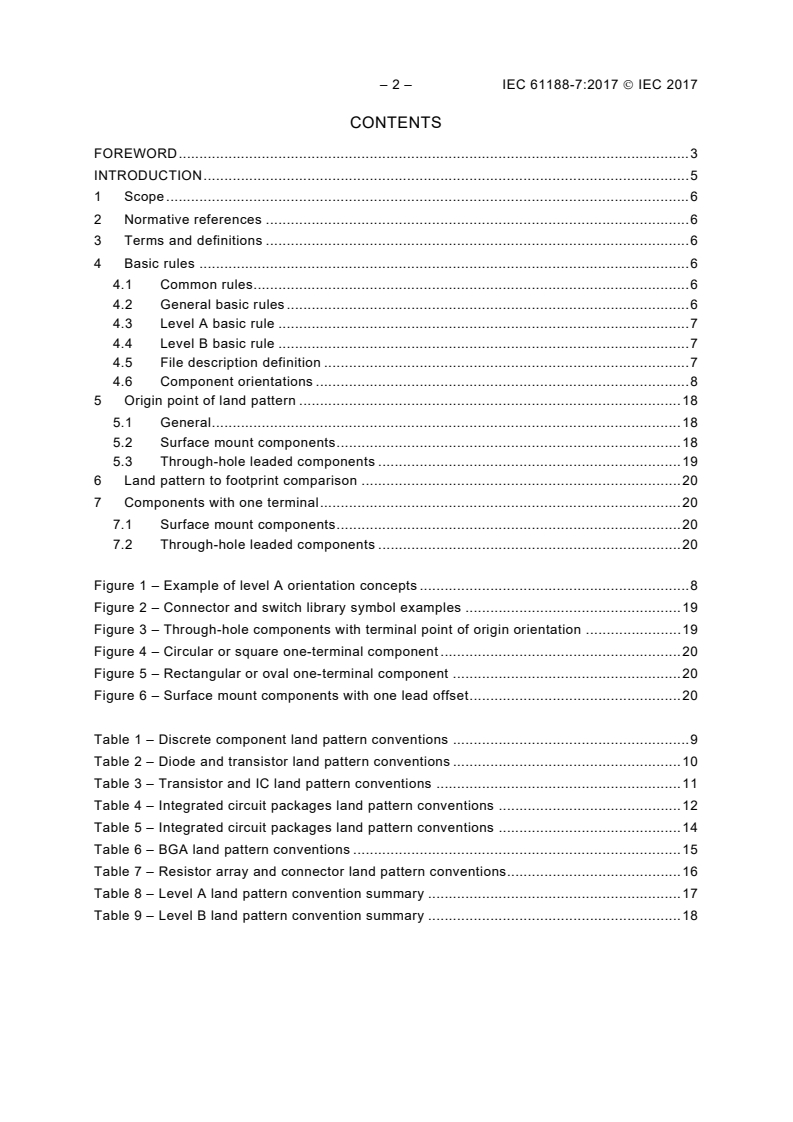
– 2 – IEC 61188-7:2017 IEC 2017
CONTENTS
FOREWORD . 3
INTRODUCTION . 5
1 Scope . 6
2 Normative references . 6
3 Terms and definitions . 6
4 Basic rules . 6
4.1 Common rules. 6
4.2 General basic rules . 6
4.3 Level A basic rule . 7
4.4 Level B basic rule . 7
4.5 File description definition . 7
4.6 Component orientations . 8
5 Origin point of land pattern . 18
5.1 General . 18
5.2 Surface mount components . 18
5.3 Through-hole leaded components . 19
6 Land pattern to footprint comparison . 19
7 Components with one terminal . 20
7.1 Surface mount components . 20
7.2 Through-hole leaded components . 20
Figure 1 – Example of level A orientation concepts . 8
Figure 2 – Connector and switch library symbol examples . 19
Figure 3 – Through-hole components with terminal point of origin orientation . 19
Figure 4 – Circular or square one-terminal component . 20
Figure 5 – Rectangular or oval one-terminal component . 20
Figure 6 – Surface mount components with one lead offset . 20
Table 1 – Discrete component land pattern conventions . 9
Table 2 – Diode and transistor land pattern conventions . 10
Table 3 – Transistor and IC land pattern conventions . 11
Table 4 – Integrated circuit packages land pattern conventions . 12
Table 5 – Integrated circuit packages land pattern conventions . 14
Table 6 – BGA land pattern conventions . 15
Table 7 – Resistor array and connector land pattern conventions. 16
Table 8 – Level A land pattern convention summary . 17
Table 9 – Level B land pattern convention summary . 18
INTERNATIONAL ELECTROTECHNICAL COMMISSION
____________
PRINTED BOARDS AND PRINTED BOARD ASSEMBLIES –
DESIGN AND USE –
Part 7: Electronic component zero orientation
for CAD library construction
FOREWORD
1) The International Electrotechnical Commission (IEC) is a worldwide organization for standardization comprising
all national electrotechnical committees (IEC National Committees). The object of IEC is to promote
international co-operation on all questions concerning standardization in the electrical and electronic fields. To
this end and in addition to other activities, IEC publishes International Standards, Technical Specifications,
Technical Reports, Publicly Available Specifications (PAS) and Guides (hereafter referred to as “IEC
Publication(s)”). Their preparation is entrusted to technical committees; any IEC National Committee interested
in the subject dealt with may participate in this preparatory work. International, governmental and non-
governmental organizations liaising with the IEC also participate in this preparation. IEC collaborates closely
with the International Organization for Standardization (ISO) in accordance with conditions determined by
agreement between the two organizations.
2) The formal decisions or agreements of IEC on technical matters express, as nearly as possible, an international
consensus of opinion on the relevant subjects since each technical committee has representation from all
interested IEC National Committees.
3) IEC Publications have the form of recommendations for international use and are accepted by IEC National
Committees in that sense. While all reasonable efforts are made to ensure that the technical content of IEC
Publications is accurate, IEC cannot be held responsible for the way in which they are used or for any
misinterpretation by any end user.
4) In order to promote international uniformity, IEC National Committees undertake to apply IEC Publications
transparently to the maximum extent possible in their national and regional publications. Any divergence
between any IEC Publication and the corresponding national or regional publication shall be clearly indicated in
the latter.
5) IEC itself does not provide any attestation of conformity. Independent certification bodies provide conformity
assessment services and, in some areas, access to IEC marks of conformity. IEC is not responsible for any
services carried out by independent certification bodies.
6) All users should ensure that they have the latest edition of this publication.
7) No liability shall attach to IEC or its directors, employees, servants or agents including individual experts and
members of its technical committees and IEC National Committees for any personal injury, property damage or
other damage of any nature whatsoever, whether direct or indirect, or for costs (including legal fees) and
expenses arising out of the publication, use of, or reliance upon, this IEC Publication or any other IEC
Publications.
8) Attention is drawn to the Normative references cited in this publication. Use of the referenced publications is
indispensable for the correct application of this publication.
9) Attention is drawn to the possibility that some of the elements of this IEC Publication may be the subject of
patent rights. IEC shall not be held responsible for identifying any or all such patent rights.
International Standard IEC 61188-7 has been prepared by IEC technical committee 91:
Electronics assembly technology.
This second edition cancels and replaces the first edition published in 2009. This edition
constitutes a technical revision.
This edition includes the following significant technical changes with respect to the previous
edition:
a) Figure 1 has been corrected;
b) the term “rectangle” has generally been replaced by “polygon”;
c) level B has been indicated as preferred level for new libraries.
– 4 – IEC 61188-7:2017 IEC 2017
The text of this International Standard is based on the following documents:
CDV Report on voting
91/1382/CDV 91/1428/RVC
Full information on the voting for the approval of this International Standard can be found in
the report on voting indicated in the above table.
This document has been drafted in accordance with the ISO/IEC Directives, Part 2.
A list of all parts of the IEC 61188 series, under the general title Printed boards and printed
board assemblies – Design and use, can be found on the IEC website.
The committee has decided that the contents of this document will remain unchanged until the
stability date indicated on the IEC website under "http://webstore.iec.ch" in the data related to
the specific document. At this date, the document will be
• reconfirmed,
• withdrawn,
• replaced by a revised edition, or
• amended.
A bilingual version of this publication may be issued at a later date.
IMPORTANT – The 'colour inside' logo on the cover page of this publication indicates
that it contains colours which are considered to be useful for the correct
understanding of its contents. Users should therefore print this document using a
colour printer.
INTRODUCTION
One of the factors of establishing a CAD library component description and land pattern
standard is to adopt a fixed zero component orientation so that all CAD images are built with
the same rotation for the purpose of assembly machine automation.
The land pattern standards clearly define all the properties necessary for standardization and
acceptability of a one world CAD library. The main objective in defining a one world CAD
library is to achieve the highest level of electronic product development automation. This
encompasses all the processes involved from engineering to PCB layout to fabrication,
assembly and test. The data format standards need this type of consistency in order to meet
the efficiency that electronic data transfer can bring to the industry.
Many large firms have spent millions of dollars creating and implementing their own unique
standards for their own electronic product development automation. These standards are
proprietary to each firm and are not openly shared with the rest of the industry. This has
resulted in massive duplication of effort, costing the industry millions of man hours in waste
and creating industry chaos and global non-standardization.
The main purpose of creating the land pattern standards is to achieve reliable solder joint
formation platforms; the reason for developing the data transfer structure is to improve the
efficiency with which engineering intelligence is converted into manufacturing reality. Even if
the neutral CAD format can drive all the manufacturing machines, it would be meaningless
unless the component description standard for CAD land patterns were implemented with
some consistency. Zero component orientation has a key role in machine automation.
The obvious choice for global standardization for EE hardware engineering, PCB design
layout, manufacturing, assembly and testing processes is to incorporate the standard land
pattern conventions. Any other option continues the confusion and additional manual hours of
intervention in order to achieve the goals of automation. In addition, the ease of having one
system export a file so that another system can accomplish the work can require unnecessary
manipulation of the neutral format in order to meet the object of clear, unambiguous software
code.
The design of any assembly will continue to permit arrangement and orientation of
components at any orientation consistent with design standards. Starting from a commonly
understood data capture concept will benefit the entire supply chain.
This standard defines angle and origin point of land patterns for land pattern designing.
– 6 – IEC 61188-7:2017 IEC 2017
PRINTED BOARDS AND PRINTED BOARD ASSEMBLIES –
DESIGN AND USE –
Part 7: Electronic component zero orientation
for CAD library construction
1 Scope
This part of IEC 61188 establishes a consistent technique for the description of electronic
component orientation, and their land pattern geometries. This facilitates and encourages a
common data capture and transfer methodology amongst and between global trading partners.
2 Normative references
The following documents are referred to in the text in such a way that some or all of their
content constitutes requirements of this document. For dated references, only the edition
cited applies. For undated references, the latest edition of the referenced document (including
any amendments) applies.
IEC 61188-5 (all parts), Printed boards and printed board assemblies – Design and use – Part
5-x: Attachment (land/joint) considerations
3 Terms and definitions
No terms and definitions are listed in this document.
ISO and IEC maintain terminological databases for use in standardization at the following
addresses:
• IEC Electropedia: available at http://www.electropedia.org/
• ISO Online browsing platform: available at http://www.iso.org/obp
4 Basic rules
4.1 Common rules
Common rules are divided into two groups: level A and level B. The main
...
IEC 61188-7 ®
Edition 2.0 2017-04
INTERNATIONAL
STANDARD
NORME
INTERNATIONALE
colour
inside
Printed boards and printed board assemblies – Design and use –
Part 7: Electronic component zero orientation for CAD library construction
Cartes imprimées et cartes imprimées équipées – Conception et utilisation –
Partie 7: Orientation nulle des composants électroniques pour l’élaboration
d’une bibliothèque CAO
All rights reserved. Unless otherwise specified, no part of this publication may be reproduced or utilized in any form
or by any means, electronic or mechanical, including photocopying and microfilm, without permission in writing from
either IEC or IEC's member National Committee in the country of the requester. If you have any questions about IEC
copyright or have an enquiry about obtaining additional rights to this publication, please contact the address below or
your local IEC member National Committee for further information.
Droits de reproduction réservés. Sauf indication contraire, aucune partie de cette publication ne peut être reproduite
ni utilisée sous quelque forme que ce soit et par aucun procédé, électronique ou mécanique, y compris la photocopie
et les microfilms, sans l'accord écrit de l'IEC ou du Comité national de l'IEC du pays du demandeur. Si vous avez des
questions sur le copyright de l'IEC ou si vous désirez obtenir des droits supplémentaires sur cette publication, utilisez
les coordonnées ci-après ou contactez le Comité national de l'IEC de votre pays de résidence.
IEC Central Office Tel.: +41 22 919 02 11
3, rue de Varembé info@iec.ch
CH-1211 Geneva 20 www.iec.ch
Switzerland
About the IEC
The International Electrotechnical Commission (IEC) is the leading global organization that prepares and publishes
International Standards for all electrical, electronic and related technologies.
About IEC publications
The technical content of IEC publications is kept under constant review by the IEC. Please make sure that you have the
latest edition, a corrigendum or an amendment might have been published.
IEC publications search - webstore.iec.ch/advsearchform Electropedia - www.electropedia.org
The advanced search enables to find IEC publications by a The world's leading online dictionary on electrotechnology,
variety of criteria (reference number, text, technical containing more than 22 000 terminological entries in English
committee,…). It also gives information on projects, replaced and French, with equivalent terms in 16 additional languages.
and withdrawn publications. Also known as the International Electrotechnical Vocabulary
(IEV) online.
IEC Just Published - webstore.iec.ch/justpublished
Stay up to date on all new IEC publications. Just Published IEC Glossary - std.iec.ch/glossary
details all new publications released. Available online and 67 000 electrotechnical terminology entries in English and
once a month by email. French extracted from the Terms and Definitions clause of
IEC publications issued since 2002. Some entries have been
IEC Customer Service Centre - webstore.iec.ch/csc collected from earlier publications of IEC TC 37, 77, 86 and
If you wish to give us your feedback on this publication or CISPR.
need further assistance, please contact the Customer Service
Centre: sales@iec.ch.
A propos de l'IEC
La Commission Electrotechnique Internationale (IEC) est la première organisation mondiale qui élabore et publie des
Normes internationales pour tout ce qui a trait à l'électricité, à l'électronique et aux technologies apparentées.
A propos des publications IEC
Le contenu technique des publications IEC est constamment revu. Veuillez vous assurer que vous possédez l’édition la
plus récente, un corrigendum ou amendement peut avoir été publié.
Recherche de publications IEC - Electropedia - www.electropedia.org
webstore.iec.ch/advsearchform Le premier dictionnaire d'électrotechnologie en ligne au
La recherche avancée permet de trouver des publications IEC monde, avec plus de 22 000 articles terminologiques en
en utilisant différents critères (numéro de référence, texte, anglais et en français, ainsi que les termes équivalents dans
comité d’études,…). Elle donne aussi des informations sur les 16 langues additionnelles. Egalement appelé Vocabulaire
projets et les publications remplacées ou retirées. Electrotechnique International (IEV) en ligne.
IEC Just Published - webstore.iec.ch/justpublished Glossaire IEC - std.iec.ch/glossary
Restez informé sur les nouvelles publications IEC. Just 67 000 entrées terminologiques électrotechniques, en anglais
Published détaille les nouvelles publications parues. et en français, extraites des articles Termes et Définitions des
Disponible en ligne et une fois par mois par email. publications IEC parues depuis 2002. Plus certaines entrées
antérieures extraites des publications des CE 37, 77, 86 et
Service Clients - webstore.iec.ch/csc CISPR de l'IEC.
Si vous désirez nous donner des commentaires sur cette
publication ou si vous avez des questions contactez-nous:
sales@iec.ch.
IEC 61188-7 ®
Edition 2.0 2017-04
INTERNATIONAL
STANDARD
NORME
INTERNATIONALE
colour
inside
Printed boards and printed board assemblies – Design and use –
Part 7: Electronic component zero orientation for CAD library construction
Cartes imprimées et cartes imprimées équipées – Conception et utilisation –
Partie 7: Orientation nulle des composants électroniques pour l’élaboration
d’une bibliothèque CAO
INTERNATIONAL
ELECTROTECHNICAL
COMMISSION
COMMISSION
ELECTROTECHNIQUE
INTERNATIONALE
ICS 31.180 ISBN 978-2-8322-7388-3
– 2 – IEC 61188-7:2017 IEC 2017
CONTENTS
FOREWORD . 3
INTRODUCTION . 5
1 Scope . 6
2 Normative references . 6
3 Terms and definitions . 6
4 Basic rules . 6
4.1 Common rules. 6
4.2 General basic rules . 6
4.3 Level A basic rule . 7
4.4 Level B basic rule . 7
4.5 File description definition . 7
4.6 Component orientations . 8
5 Origin point of land pattern . 18
5.1 General . 18
5.2 Surface mount components . 18
5.3 Through-hole leaded components . 19
6 Land pattern to footprint comparison . 20
7 Components with one terminal . 20
7.1 Surface mount components . 20
7.2 Through-hole leaded components . 20
Figure 1 – Example of level A orientation concepts . 8
Figure 2 – Connector and switch library symbol examples . 19
Figure 3 – Through-hole components with terminal point of origin orientation . 19
Figure 4 – Circular or square one-terminal component . 20
Figure 5 – Rectangular or oval one-terminal component . 20
Figure 6 – Surface mount components with one lead offset . 20
Table 1 – Discrete component land pattern conventions . 9
Table 2 – Diode and transistor land pattern conventions . 10
Table 3 – Transistor and IC land pattern conventions . 11
Table 4 – Integrated circuit packages land pattern conventions . 12
Table 5 – Integrated circuit packages land pattern conventions . 14
Table 6 – BGA land pattern conventions . 15
Table 7 – Resistor array and connector land pattern conventions. 16
Table 8 – Level A land pattern convention summary . 17
Table 9 – Level B land pattern convention summary . 18
INTERNATIONAL ELECTROTECHNICAL COMMISSION
____________
PRINTED BOARDS AND PRINTED BOARD ASSEMBLIES –
DESIGN AND USE –
Part 7: Electronic component zero orientation
for CAD library construction
FOREWORD
1) The International Electrotechnical Commission (IEC) is a worldwide organization for standardization comprising
all national electrotechnical committees (IEC National Committees). The object of IEC is to promote
international co-operation on all questions concerning standardization in the electrical and electronic fields. To
this end and in addition to other activities, IEC publishes International Standards, Technical Specifications,
Technical Reports, Publicly Available Specifications (PAS) and Guides (hereafter referred to as “IEC
Publication(s)”). Their preparation is entrusted to technical committees; any IEC National Committee interested
in the subject dealt with may participate in this preparatory work. International, governmental and non-
governmental organizations liaising with the IEC also participate in this preparation. IEC collaborates closely
with the International Organization for Standardization (ISO) in accordance with conditions determined by
agreement between the two organizations.
2) The formal decisions or agreements of IEC on technical matters express, as nearly as possible, an international
consensus of opinion on the relevant subjects since each technical committee has representation from all
interested IEC National Committees.
3) IEC Publications have the form of recommendations for international use and are accepted by IEC National
Committees in that sense. While all reasonable efforts are made to ensure that the technical content of IEC
Publications is accurate, IEC cannot be held responsible for the way in which they are used or for any
misinterpretation by any end user.
4) In order to promote international uniformity, IEC National Committees undertake to apply IEC Publications
transparently to the maximum extent possible in their national and regional publications. Any divergence
between any IEC Publication and the corresponding national or regional publication shall be clearly indicated in
the latter.
5) IEC itself does not provide any attestation of conformity. Independent certification bodies provide conformity
assessment services and, in some areas, access to IEC marks of conformity. IEC is not responsible for any
services carried out by independent certification bodies.
6) All users should ensure that they have the latest edition of this publication.
7) No liability shall attach to IEC or its directors, employees, servants or agents including individual experts and
members of its technical committees and IEC National Committees for any personal injury, property damage or
other damage of any nature whatsoever, whether direct or indirect, or for costs (including legal fees) and
expenses arising out of the publication, use of, or reliance upon, this IEC Publication or any other IEC
Publications.
8) Attention is drawn to the Normative references cited in this publication. Use of the referenced publications is
indispensable for the correct application of this publication.
9) Attention is drawn to the possibility that some of the elements of this IEC Publication may be the subject of
patent rights. IEC shall not be held responsible for identifying any or all such patent rights.
International Standard IEC 61188-7 has been prepared by IEC technical committee 91:
Electronics assembly technology.
This bilingual version (2019-09) corresponds to the monolingual English version, published in
2017-04.
This second edition cancels and replaces the first edition published in 2009. This edition
constitutes a technical revision.
This edition includes the following significant technical changes with respect to the previous
edition:
a) Figure 1 has been corrected;
b) the term “rectangle” has generally been replaced by “polygon”;
– 4 – IEC 61188-7:2017 IEC 2017
c) level B has been indicated as preferred level for new libraries.
The text of this International Standard is based on the following documents:
CDV Report on voting
91/1382/CDV 91/1428/RVC
Full information on the voting for the approval of this International Standard can be found in
the report on voting indicated in the above table.
The French version of this standard has not been voted upon.
This document has been drafted in accordance with the ISO/IEC Directives, Part 2.
A list of all parts of the IEC 61188 series, under the general title Printed boards and printed
board assemblies – Design and use, can be found on the IEC website.
The committee has decided that the contents of this document will remain unchanged until the
stability date indicated on the IEC website under "http://webstore.iec.ch" in the data related to
the specific document. At this date, the document will be
• reconfirmed,
• withdrawn,
• replaced by a revised edition, or
• amended.
IMPORTANT – The 'colour inside' logo on the cover page of this publication indicates
that it contains colours which are considered to be useful for the correct
understanding of its contents. Users should therefore print this document using a
colour printer.
INTRODUCTION
One of the factors of establishing a CAD library component description and land pattern
standard is to adopt a fixed zero component orientation so that all CAD images are built with
the same rotation for the purpose of assembly machine automation.
The land pattern standards clearly define all the properties necessary for standardization and
acceptability of a one world CAD library. The main objective in defining a one world CAD
library is to achieve the highest level of electronic product development automation. This
encompasses all the processes involved from engineering to PCB layout to fabrication,
assembly and test. The data format standards need this type of consistency in order to meet
the efficiency that electronic data transfer can bring to the industry.
Many large firms have spent millions of dollars creating and implementing their own unique
standards for their own electronic product development automation. These standards are
proprietary to each firm and are not openly shared with the rest of the industry. This has
resulted in massive duplication of effort, costing the industry millions of man hours in waste
and creating industry chaos and global non-standardization.
The main purpose of creating the land pattern standards is to achieve reliable solder joint
formation platforms; the reason for developing the data transfer structure is to improve the
efficiency with which engineering intelligence is converted into manufacturing reality. Even if
the neutral CAD format can drive all the manufacturing machines, it would be meaningless
unless the component description standard for CAD land patterns were implemented with
some consistency. Zero component orientation has a key role in machine automation.
The obvious choice for global standardization for EE hardware engineering, PCB design
layout, manufacturing, assembly and testing processes is to incorporate the standard land
pattern conventions. Any other option continues the confusion and additional manual hours of
intervention in order to achieve the goals of automation. In addition, the ease of having one
system export a file so that another system can accomplish the work can require unnecessary
manipulation of the neutral format in order to meet the object of clear, unambiguous software
code.
The design of any assembly will continue to permit arrangement and orientation of
components at any orientation consistent with design standards. Starting from a commonly
understood data capture concept will benefit the entire supply chain.
This standard defines angle and origin point of land patterns for land pattern designing.
– 6 – IEC 61188-7:2017 IEC 2017
PRINTED BOARDS AND PRINTED BOARD ASSEMBLIES –
DESIGN AND USE –
Part 7: Electronic component zero orientation
for CAD library construction
1 Scope
This part of IEC 61188 establishes a consistent technique for the description of electronic
component orientation, and their land pattern geometries. This facilitates and encourages a
common data capture and transfer methodology amongst and between global trading partners.
2 Normative references
The following documents are referred to in the text in such a way that some or all of their
content constitutes requirements of this document. For dated references, only the edition
cited applies. For undated references, the latest edition of the referenced document (including
any amendments) applies.
IEC 61188-5 (all parts), Printed boards and printed board assemblies – Design and use – Part
5-x: Attachment (land/joint) considerations
3 Terms and definitions
No terms and definitions are listed in this document.
ISO and IEC maintain terminological databases for use in standardization at the following
addresses:
• IEC Electropedia: available at http://www.electropedia.org/
• ISO Online browsing platform: available at http://www.iso.org/obp
4 Basic rules
4.1 Common rules
Common rules are divided into two groups: level A and level B. The main difference between
the rules is the original orientation within the CAD system library. This orientation may be any
version that the designer finds useful including his own version; however, when the
information is transferred to an assembler, the orientation shall be properly defined without
ambiguity or shall be corrected in order that any variation between the different systems are
properly matched. This conversion of the CAD data to manufacturing information may include
the datum of the board, fabrication panel or assembly array panel and shall have the proper
orientation of all components on the board no matter what library was used as the original
input.
4.2 General basic rules
The following basic rules apply.
• Components and land patterns are drawn in top view.
• The component point of origin is shown by "+" or "x".
• The origin point of land patterns may be different from the origin point of the placement.
• A polygon that contains the component body and land patterns (in top view) should be a
part of the library component description. This rectangle is the courtyard that provides a
minimum electrical and physical clearance for the part and the land pattern. The point of
origin of the description should match that of the component and land pattern.
• The arrangement of land-patterns is fixed uniformly by the classification and the shape of
components and shall be as described in IEC 61188-5-1 to IEC 61188-5-8. The
information for the land-patterns is independent from the angle in the component delivery
system (tape, tray, tube, etc.). The location of pin one in the land pattern or component
description shall be identical with any polarization mark on the component. If other
descriptions are used on the component data (e.g. cathode, anode, base, emitter,
collector), the library description shall assign an appropriate pin one designation.
• The component orientation shall position pin one as being on the left-hand side of the
component description.
• The component, land pattern and polygon area shall be identical in the computer library
with each description using the same point of origin coordinates. It is recommended that
the point of origin is the same as the way the component is positioned on the final design
of the board, which is normally by the centroid of the component body. Only the
component rotation shall be altered to match the rules for level A or level B descriptions
for components with more than two pins.
4.3 Level A basic rule
For level A, the following basic rule applies.
• For level A type component descriptions for multiple leaded parts, pin one shall be left
oriented as indicated in the basic rules; however, pin one shall be located at the upper or
upper-left position.
4.4 Level B basic rule
For level B, the following basic rule applies.
• For level B type component descriptions for multiple leaded parts, pin one shall be left
oriented as per the basic rules; however, pin one shall be located at the left or lower-left
position.
4.5 File description definition
Since the basic rules allow two variations of levels in the description of the CAD system
library, it is a mandatory requirement to define which level was used (level A or Level B) for
the component descriptions in the data file. This information is a mandatory requirement in
the header of any file that incorporates land patterns using these principles of zero-based
orientation. See Figure 1.
– 8 – IEC 61188-7:2017 IEC 2017
0° orientation
Mirror image
90° orientation
Mirror image
180° orientation
Mirror image
270° orientation
Mirror image
IEC
Figure 1 – Example of level A orientation concepts
4.6 Component orientations
The zero component orientations expressed in this document are defined in terms of the
standard component CAD library with respect to a given PCB design. Recognizing that a
single land pattern may be used for the same component part from different suppliers and that
each component supplier can have different orientations on their reels or that the components
can come in trays, there exists the possibility that the PCB designer loses the ability to
reference a single land pattern if the zero rotation of a part is according to the method in
which the component is delivered to the assembly machine.
Since the CAD library contains a single land pattern, the zero component rotation is thus
defined according to the CAD library. Subsequently, component suppliers can identify the
orientation of the parts on the reels by associating the placement of the part on the reel to
zero orientations defined in this document. If pin one is at the lower left as defined by the pick
and place machine tape and reel, for example, then the component on the reel is rotated 90°
counterclockwise from the zero rotation given in this document. Standardizing the orientation
of components for the installation and usage of various packaging methods, such as tubes,
trays or tapes and reels, among the variations of automated assembly equipment in existence
today is outside the scope of this document.
Table 1 to Table 7 show zero component rotations using the basic rules and rules for level A
and level B component descriptions. For new CAD libraries, level B should be used as the
preferred orientation.
Table 1 – Discrete component land pattern conventions
Package type Component example Level A Level B
Chip capacitor
Chip resistor
Chip inductor
Molded capacitor
Molded diode
– 10 – IEC 61188-7:2017 IEC 2017
Package type Component example Level A Level B
Molded inductor
Precision
wirewound
Table 2 – Diode and transistor land pattern conventions
Package type Component example Level A Level B
Diode (MELF)
Resistor (MELF)
Aluminium
electrolytic
capacitor
SOT23-3
Package type Component example Level A Level B
SOT23-5
SOT343
SOT223
Table 3 – Transistor and IC land pattern conventions
Package type Component example Level A Level B
TO252 (DPAK)
SOIC, SOP, and
SSOP
TSSOP
– 12 – IEC 61188-7:2017 IEC 2017
Package type Component example Level A Level B
SOJ
Square QFP,
pin one in
corner
Rectangular
QFP, pin one in
corner
Table 4 – Integrated circuit packages land pattern conventions
Package Component example Level A Level B
type
Bump QFP,
pin one in
corner
Package Component example Level A Level B
type
Bump QFP,
pin one in
middle
Ceramic flat
package
CQFP
(ceramic
quad flat
package)
PLCC (QFJ)
square
J leaded,
pin one in
middle
– 14 – IEC 61188-7:2017 IEC 2017
Table 5 – Integrated circuit packages land pattern conventions
Package type Component example Level A Level B
PLCC (QFJ)
rectangular
J leaded
pin one in
middle
LCC square
pin one in
middle
QFN square
QFN
rectangular
Table 6 – BGA land pattern conventions
Package Component example Level A Level B
type
BGA
square
BGA
rectangular
– 16 – IEC 61188-7:2017 IEC 2017
Table 7 – Resistor array and connector land pattern conventions
Package Component example Level A Level B
type
Resistor
array
SMT
connector
Pin 1
Pin 1
Table 8 provides a summary of the land pattern conventions for level A library concepts.
Table 8 – Level A land pattern convention summary
Level A summary – Component marking identifies pin one of land pattern
1) Chip capacitors, resistors and inductors (RES, CAP and IND) – Pin one of land pattern on left
2) Molded Inductors (INDM), resistors (RESM) and tantalum capacitors (CAPT) – Pin one of land pattern on
left
3) Precision wire-wound Inductors (INDP) – Pin one of land pattern on left
4) MELF diodes – Pin one of land pattern on left
5) Aluminium electrolytic capacitors (CAPAE) – Pin one of land pattern on left
6) SOT Devices (SOT23, SOT23-5, SOT223, SOT89, SOT143, etc.) – Pin one of land pattern on upper left
7) TO252 & TO263 (DPAK Type) devices – Pin one of land pattern on upper left
8) Small outline gullwing ICs (SOIC, SOP, TSOP, SSOP, TSSOP) – Pin one of land pattern on upper left
9) Ceramic flat packs (CFP) – Pin one of land pattern on upper left
10) Small outline J lead ICs (SOJ) – Pin one of land pattern on upper left
11) Quad flat pack ICs (PQFP, SQFP) – Pin one of land pattern on upper left
12) Ceramic quad flat packs (CQFP) – Pin one of land pattern on upper left
13) Bumper quad flat pack ICs (BQFP pin one centre) – Pin one of land pattern on top centre
14) Plastic leaded chip carriers (PLCC) – Pin one of land pattern on top centre
15) Leadless chip carriers (LCC) – Pin one of land pattern on top centre
16) Quad flat no-lead ICs (QFN) QFNS, QFNRV, QFNRH – Pin one of land pattern on upper left
17) Ball grid arrays (BGA) – Pin A1 of land pattern on upper left
18) Resistor array – Pin one of land pattern on upper left
19) SMT connector – Pin one of land pattern on upper left
Table 9 provides a summary of the land pattern conventions for level B library concepts.
– 18 – IEC 61188-7:2017 IEC 2017
Table 9 – Level B land pattern convention summary
Level B summary – Component marking identifies pin one of land pattern
1) Chip capacitors, resistors and inductors (RES, CAP and IND) – Pin one of land pattern on left
2) Molded inductors (INDM), resistors (RESM) and tantalum capacitors (CAPT) – Pin one of land pattern on
left
3) Precision wire-wound inductors (INDP) – Pin one of land pattern on left
4) MELF diodes – Pin one of land pattern on left
5) Aluminium electrolytic capacitors (CAPAE) – Pin one of land pattern on left
6) SOT devices (SOT23, SOT23-5, SOT223, SOT89, SOT143, etc.) – Pin one of land pattern on lower left
7) TO252 & TO263 (DPAK Type) devices – Pin one of land pattern on lower left
8) Small outline gullwing ICs (SOIC, SOP, TSOP, SSOP, TSSOP) – Pin one of land pattern on lower left
9) Ceramic flat packs (CFP) – Pin one of land pattern on lower left
10) Small outline J lead ICs (SOJ) – Pin one of land pattern on lower left
11) Quad flat pack ICs (PQFP, SQFP) – Pin one of land pattern on lower left
12) Ceramic quad flat packs (CQFP) – Pin one of land pattern on lower left
13) Bumper quad flat pack ICs (BQFP pin one centre) – Pin one of land pattern on left centre
14) Plastic leaded chip carriers (PLCC) – Pin one of land pattern on left centre
15) Leadless chip carriers (LCC) – Pin one of land pattern on left centre
16) Quad flat no-lead ICs (QFN) QFNS, QFNRV, QFNRH – Pin one of land pattern on left/lower left
17) Ball grid arrays (BGA) – Pin A1 of land pattern on lower left
18) Resistor array – Pin one of land pattern on lower left
19) SMT connector – Pin one of land pattern on lower left
5 Origin point of land pattern
5.1 General
Many variations can exist on the method used within CAD systems in order to develop a
computer library for land patterns. In addition, component suppliers use many different
delivery systems for providing the components to the machines used for insertion or
attachment. Although an attempt is made in this document to establish a set of rules that
create library uniformity, it is important for every assembly company to evaluate the method
and relationship between the component position by the CAD system and the component
supplier’s delivery orientation.
5.2 Surface mount components
In general, the point of origin is defined as the central position (centroid) of the polygon area
(courtyard), which is the outermost closed line surrounding the land pattern and component
body description. A variation of the basic rules may be required for components such as
connectors and components with moving parts. These shall meet the following conditions.
a) In case of connectors with lock function, the point of origin is calculated on locked position.
b) In case of components with moving part, the point of origin is calculated in the condition of
delivery.
Figure 2 is an example of the point of origin of library symbols for connectors and moving part
switches.
If a part has a lead that protrudes from the component's body and is not physically attached to
the circuitry, it shall be included in the part outline even though that lead is not attached to the
board's surface.
Condition
of delivery
Connector with
ex. switch
lock function
IEC
Figure 2 – Connector and switch library symbol examples
5.3 Through-hole leaded components
Through-hole components are identified in the CAD library looking down on the top of the
component. The point of origin is defined as a terminal or the centroid. If the terminal is used
as the point of origin, it becomes the centre of the leftmost terminal when the components are
shown in a horizontal position. The point of origin is independent from the function of the
terminal.
Figure 3 shows examples of components orientation using their terminals as the point of
origin.
IEC
Figure 3 – Through-hole components with terminal point of origin orientation
If a part has a lead that protrudes from the component's body, but is not to be connected to
the circuitry, it shall be included in the part outline even though that lead is not attached to a
through-hole in the board.
– 20 – IEC 61188-7:2017 IEC 2017
6 Land pattern to footprint comparison
The land pattern, as viewed by the CAD system, represents the conductive pattern to which
the component is attached. It is viewed from the primary side of the printed board, facing the
designer. The primary side normally represents layer 1 of the component pattern for double-
sided and multi-layer boards. The secondary side land patterns are viewed looking through
the board. In order to have component orientation match the land pattern image, the library
condition views the component facing towards the board surface of the primary side.
Positioning a component on the secondary side requires taking the component in a mirror
image condition to match the circuit configuration.
The definition of the total number of terminals is basically the number of contacts that the
component makes with the interconnecting system. Leads are normally placed in holes with
land patterns circumscribing the hole. Surface mount parts are normally attached to the
surface mount land pattern of either the primary side or secondary side of the printed board.
7 Components with one terminal
7.1 Surface mount components
When components may be circular or square, the point of origin is the centre of the terminal
and their figures are shown in Figure 4. If there is an orientation to the one-terminal
component, such as a tuning or adjustment feature, it shall be identified as the left-hand side.
IEC
Figure 4 – Circular or square one-terminal component
When component figures are oval or rectangular, and the terminal is in the centre, they shall
be represented in the CAD library in a horizontal condition. The centre of the component is
the point of origin as shown in Figure 5.
IEC
Figure 5 – Rectangular or oval one-terminal component
When surface mount components have their single terminal not in the centre, the component
is described with the terminal on the upper left side. The point of origin is the centre of the
component. See Figure 6.
IEC
Figure 6 – Surface mount components with one lead offset
7.2 Through-hole leaded components
Through-hole leaded components shall be configured in the CAD library with their leads facing
away from the component. The point of origin will be the single lead.
___________
– 22 – IEC 61188-7:2017 © IEC 2017
SOMMAIRE
SOMMAIRE . 22
AVANT-PROPOS . 23
INTRODUCTION . 25
1 Domaine d’application . 26
2 Références normatives . 26
3 Termes et définitions . 26
4 Règles de base . 26
4.1 Règles communes . 26
4.2 Règles de base générales . 26
4.3 Règle de base pour le niveau A . 27
4.4 Règle de base pour le niveau B . 27
4.5 Définition de la description de fichier . 27
4.6 Orientations des composants . 28
5 Point d’origine de la zone de report . 37
5.1 Généralités . 37
5.2 Composants pour montage en surface . 37
5.3 Composants à sorties à trous traversants . 38
6 Comparaison entre zone de report et empreinte . 39
7 Composants à une broche . 39
7.1 Composants pour montage en surface . 39
7.2 Composants à sorties à trous traversants . 40
Figure 1 – Exemple de concepts d’orientation de niveau A. 28
Figure 2 – Exemples de symboles de bibliothèque de connecteurs et de commutateurs. 38
Figure 3 – Composants à trous traversants dont le point d’origine est une broche . 38
Figure 4 – Composant rond ou carré à une broche . 39
Figure 5 – Composant ovale ou rectangulaire à une broche . 39
Figure 6 – Composants avec une broche excentrée pour montage en surface . 39
Tableau 1 – Conventions pour les zones de report des composants discrets . 29
Tableau 2 – Conventions pour les zones de report des diodes et des transistors . 30
Tableau 3 – Conventions pour les zones de report des circuits intégrés et des
transistors . 31
Tableau 4 – Conventions pour les zones de report des boîtiers de circuits intégrés . 32
Tableau 5 – Conventions pour les zones de report des boîtiers de circuits intégrés . 34
Tableau 6 – Conventions pour les zones de report des BGA . 35
Tableau 7 – Conventions pour les zones de report des réseaux de résistances et des
connecteurs . 35
Tableau 8 – Résumé des conventions des zones de report de niveau A. 36
Tableau 9 – Résumé des conventions des zones de report de niveau B. 37
COMMISSION ÉLECTROTECHNIQUE INTERNATIONALE
____________
CARTES IMPRIMÉES ET CARTES IMPRIMÉES ÉQUIPÉES – CONCEPTION
ET UTILISATION –
Partie 7: Orientation nulle des composants électroniques pour
l’élaboration d’une bibliothèque CAO
AVANT-PROPOS
1) La Commission Electrotechnique Internationale (IEC) est une organisation mondiale de normalisation
composée de l'ensemble des comités électrotechniques nationaux (Comités nationaux de l’IEC). L’IEC a pour
objet de favoriser la coopération internationale pour toutes les questions de normalisation dans les domaines
de l'électricité et de l'électronique. A cet effet, l’IEC – entre autres activités – publie des Normes internationales,
des Spécifications techniques, des Rapports techniques, des Spécifications accessibles au public (PAS) et des
Guides (ci-après dénommés "Publication(s) de l’IEC"). Leur élaboration est confiée à des comités d'études, aux
travaux desquels tout Comité national intéressé par le sujet traité peut participer. Les organisations
internationales, gouvernementales et non gouvernementales, en liaison avec l’IEC, participent également aux
travaux. L’IEC collabore étroitement avec l'Organisation Internationale de Normalisation (ISO), selon des
conditions fixées par accord entre les deux organisations.
2) Les décisions ou accords officiels de l’IEC concernant les questions techniques représentent, dans la mesure
du possible, un accord international sur les sujets étudiés, étant donné que les Comités nationaux de l’IEC
intéressés sont représentés dans chaque comité d’études.
3) Les Publications de l’IEC se présentent sous la forme de recommandations internationales et sont agréées
comme telles par les Comités nationaux de l’IEC. Tous les efforts raisonnables sont entrepris afin que l’IEC
s'assure de l'exactitude du contenu technique de ses publications; l’IEC ne peut pas être tenue responsable de
l'éventuelle mauvaise utilisation ou interprétation qui en est faite par un quelconque utilisateur final.
4) Dans le but d'encourager l'uniformité internationale, les Comités nationaux de l’IEC s'engagent, dans toute la
mesure possible, à appliquer de façon transparente les Publications de l’IEC dans leurs publications nationales
et régionales. Toutes divergences entre toutes Publications de l’IEC et toutes publications nationales ou
régionales correspondantes doivent être indiquées en termes clairs dans ces dernières.
5) L’IEC elle-même ne fournit aucune attestation de conformité. Des organismes de certification indépendants
fournissent des services d'évaluation de conformité et, dans certains secteurs, accèdent aux marques de
conformité de l’IEC. L’IEC n'est responsable d'aucun des services effectués par les organismes de certification
indépendants.
6) Tous les utilisateurs doivent s'assurer qu'ils sont en possession de la dernière édition de cette publication.
7) Aucune responsabilité ne doit être imputée à l’IEC, à ses administrateurs, employés, auxiliaires ou mandataires,
y compris ses experts particuliers et les membres de ses comités d'études et d
...