

IEC 61788-21:2015
(Main)Superconductivity - Part 21: Superconducting wires - Test methods for practical superconducting wires - General characteristics and guidance
General Information
- Abstract
IEC 61788-21:2015 specifies the test methods used for validating the mechanical, electrical, and superconducting properties of practical SC wires.
- Status
- Published
- Publication Date
- 18-May-2015
- Technical Committee
- TC 90 - Superconductivity
- Drafting Committee
- WG 13 - TC 90/WG 13
- Current Stage
- PPUB - Publication issued
- Start Date
- 19-May-2015
- Completion Date
- 15-Jun-2015
Overview
IEC 61788-21:2015 is an international standard published by the International Electrotechnical Commission (IEC) that defines test methods for practical superconducting (SC) wires. This standard focuses on validating the mechanical, electrical, and superconducting properties essential for practical use. Practical SC wires are those available in continuous lengths suitable for manufacturing devices, excluding multi-wire conductors like cables. By establishing standardized testing protocols, IEC 61788-21 facilitates the procurement, quality assurance, design, and engineering of superconducting wire products in various industrial applications.
The standard supports the development and certification of SC wires that meet critical performance criteria, ensuring reliable operation under specified conditions. It aligns with other parts of the IEC 61788 series, creating a comprehensive framework for superconducting materials and their applications.
Key Topics
Test Methods for SC Wire Properties
Specifies standardized procedures for assessing critical attributes of SC wires, including mechanical strength, superconducting critical currents, electrical characteristics, and response to environmental factors.Mechanical Properties
Measurement techniques to determine tensile strength, strain effects, and durability which are crucial for engineering integration and device stability.Superconducting Characteristics
Evaluation of critical temperature, critical magnetic fields, critical current capacity, n-value, and AC losses that define the wire’s superconducting performance.Uniformity and Stability
Assessing the consistency of properties along the wire's length and its operational stability under practical working conditions.Related IEC Standards
Complements several IEC 61788 parts, including measurement methods for critical current (Parts 1, 2, 3), residual resistance ratio (Parts 4, 11), volume ratio measurements (Parts 5, 12), mechanical tests (Parts 6, 18, 19), AC loss measurements (Parts 8, 13), and critical temperature tests (Part 10).Normative References and Terminology
Utilizes definitions from IEC 60050 and provides guidance on applying terminology consistently for clear communication in the superconductivity field.
Applications
IEC 61788-21 is essential for industries and research sectors where superconducting wires are employed, including:
Medical Technology
Manufacturing of MRI and other imaging systems that depend on stable, high-performance superconducting wires.Energy Sector
Superconducting cables, fault current limiters, transformers, and power storage devices that require wires meeting stringent operational standards.Scientific Research
Particle accelerators, fusion reactors, and low-temperature physics experiments utilizing SC wires with validated performance characteristics.Transportation and Electronics
Components for advanced transportation systems, including maglev trains and high-efficiency electronic devices.
Implementing IEC 61788-21 aids in ensuring that superconducting wire materials meet predetermined benchmarks enabling device manufacturers to design with confidence in product reliability and safety.
Related Standards
IEC 61788-21 serves as part of a broader family of superconductivity standards, including:
- IEC 61788-1 to IEC 61788-3 – DC critical current measurement methods for different superconducting composites.
- IEC 61788-4 and 61788-11 – Residual resistance ratio measurement protocols for Nb-Ti and Nb3Sn wires.
- IEC 61788-5 and 61788-12 – Methods to determine copper to superconductor volume ratios.
- IEC 61788-6, 61788-18, 61788-19 – Mechanical testing standards focusing on tensile tests at room temperature.
- IEC 61788-8 and 61788-13 – AC loss testing methods applicable to various superconductor wire geometries.
- IEC 61788-10 – Critical temperature measurement techniques by resistance.
These standards collectively ensure comprehensive assessment and consistency across the lifecycle of superconducting wires, from production to end-use.
Keywords: IEC 61788-21, superconducting wires, superconductivity standards, test methods, critical current measurement, mechanical properties, electrical properties, AC loss, critical temperature, IEC 61788 series, superconducting wire certification, practical superconducting wire testing, IEC standards, superconductivity testing guidance, superconducting wire applications.
Get Certified
Connect with accredited certification bodies for this standard

Element Materials Technology
Materials testing and product certification.

IMQ S.p.A. (Certification)
Italian electrical product certification.

SLG Prüf- und Zertifizierungs GmbH
German testing and certification body.
Sponsored listings
Frequently Asked Questions
IEC 61788-21:2015 is a standard published by the International Electrotechnical Commission (IEC). Its full title is "Superconductivity - Part 21: Superconducting wires - Test methods for practical superconducting wires - General characteristics and guidance". This standard covers: IEC 61788-21:2015 specifies the test methods used for validating the mechanical, electrical, and superconducting properties of practical SC wires.
IEC 61788-21:2015 specifies the test methods used for validating the mechanical, electrical, and superconducting properties of practical SC wires.
IEC 61788-21:2015 is classified under the following ICS (International Classification for Standards) categories: 17.220.20 - Measurement of electrical and magnetic quantities; 29.050 - Superconductivity and conducting materials; 77.040.10 - Mechanical testing of metals. The ICS classification helps identify the subject area and facilitates finding related standards.
IEC 61788-21:2015 is available in PDF format for immediate download after purchase. The document can be added to your cart and obtained through the secure checkout process. Digital delivery ensures instant access to the complete standard document.
Standards Content (Sample)
IEC 61788-21 ®
Edition 1.0 2015-05
INTERNATIONAL
STANDARD
NORME
INTERNATIONALE
Superconductivity –
Part 21: Superconducting wires – Test methods for practical superconducting
wires – General characteristics and guidance
Supraconductivité –
Partie 21: Fils supraconducteurs – Méthodes d’essai pour fils supraconducteurs
à usage pratique – Caractéristiques générales et lignes directrices
All rights reserved. Unless otherwise specified, no part of this publication may be reproduced or utilized in any form
or by any means, electronic or mechanical, including photocopying and microfilm, without permission in writing from
either IEC or IEC's member National Committee in the country of the requester. If you have any questions about IEC
copyright or have an enquiry about obtaining additional rights to this publication, please contact the address below or
your local IEC member National Committee for further information.
Droits de reproduction réservés. Sauf indication contraire, aucune partie de cette publication ne peut être reproduite
ni utilisée sous quelque forme que ce soit et par aucun procédé, électronique ou mécanique, y compris la photocopie
et les microfilms, sans l'accord écrit de l'IEC ou du Comité national de l'IEC du pays du demandeur. Si vous avez des
questions sur le copyright de l'IEC ou si vous désirez obtenir des droits supplémentaires sur cette publication, utilisez
les coordonnées ci-après ou contactez le Comité national de l'IEC de votre pays de résidence.
IEC Central Office Tel.: +41 22 919 02 11
3, rue de Varembé Fax: +41 22 919 03 00
CH-1211 Geneva 20 info@iec.ch
Switzerland www.iec.ch
About the IEC
The International Electrotechnical Commission (IEC) is the leading global organization that prepares and publishes
International Standards for all electrical, electronic and related technologies.
About IEC publications
The technical content of IEC publications is kept under constant review by the IEC. Please make sure that you have the
latest edition, a corrigenda or an amendment might have been published.
IEC Catalogue - webstore.iec.ch/catalogue Electropedia - www.electropedia.org
The stand-alone application for consulting the entire The world's leading online dictionary of electronic and
bibliographical information on IEC International Standards, electrical terms containing more than 30 000 terms and
Technical Specifications, Technical Reports and other definitions in English and French, with equivalent terms in 15
documents. Available for PC, Mac OS, Android Tablets and additional languages. Also known as the International
iPad. Electrotechnical Vocabulary (IEV) online.
IEC publications search - www.iec.ch/searchpub IEC Glossary - std.iec.ch/glossary
The advanced search enables to find IEC publications by a More than 60 000 electrotechnical terminology entries in
variety of criteria (reference number, text, technical English and French extracted from the Terms and Definitions
committee,…). It also gives information on projects, replaced clause of IEC publications issued since 2002. Some entries
and withdrawn publications. have been collected from earlier publications of IEC TC 37,
77, 86 and CISPR.
IEC Just Published - webstore.iec.ch/justpublished
Stay up to date on all new IEC publications. Just Published IEC Customer Service Centre - webstore.iec.ch/csc
details all new publications released. Available online and If you wish to give us your feedback on this publication or
also once a month by email. need further assistance, please contact the Customer Service
Centre: csc@iec.ch.
A propos de l'IEC
La Commission Electrotechnique Internationale (IEC) est la première organisation mondiale qui élabore et publie des
Normes internationales pour tout ce qui a trait à l'électricité, à l'électronique et aux technologies apparentées.
A propos des publications IEC
Le contenu technique des publications IEC est constamment revu. Veuillez vous assurer que vous possédez l’édition la
plus récente, un corrigendum ou amendement peut avoir été publié.
Catalogue IEC - webstore.iec.ch/catalogue Electropedia - www.electropedia.org
Application autonome pour consulter tous les renseignements
Le premier dictionnaire en ligne de termes électroniques et
bibliographiques sur les Normes internationales,
électriques. Il contient plus de 30 000 termes et définitions en
Spécifications techniques, Rapports techniques et autres
anglais et en français, ainsi que les termes équivalents dans
documents de l'IEC. Disponible pour PC, Mac OS, tablettes
15 langues additionnelles. Egalement appelé Vocabulaire
Android et iPad.
Electrotechnique International (IEV) en ligne.
Recherche de publications IEC - www.iec.ch/searchpub
Glossaire IEC - std.iec.ch/glossary
Plus de 60 000 entrées terminologiques électrotechniques, en
La recherche avancée permet de trouver des publications IEC
en utilisant différents critères (numéro de référence, texte, anglais et en français, extraites des articles Termes et
comité d’études,…). Elle donne aussi des informations sur les Définitions des publications IEC parues depuis 2002. Plus
projets et les publications remplacées ou retirées. certaines entrées antérieures extraites des publications des
CE 37, 77, 86 et CISPR de l'IEC.
IEC Just Published - webstore.iec.ch/justpublished
Service Clients - webstore.iec.ch/csc
Restez informé sur les nouvelles publications IEC. Just
Published détaille les nouvelles publications parues. Si vous désirez nous donner des commentaires sur cette
Disponible en ligne et aussi une fois par mois par email. publication ou si vous avez des questions contactez-nous:
csc@iec.ch.
IEC 61788-21 ®
Edition 1.0 2015-05
INTERNATIONAL
STANDARD
NORME
INTERNATIONALE
Superconductivity –
Part 21: Superconducting wires – Test methods for practical superconducting
wires – General characteristics and guidance
Supraconductivité –
Partie 21: Fils supraconducteurs – Méthodes d’essai pour fils supraconducteurs
à usage pratique – Caractéristiques générales et lignes directrices
INTERNATIONAL
ELECTROTECHNICAL
COMMISSION
COMMISSION
ELECTROTECHNIQUE
INTERNATIONALE
ICS 17.220; 29.050; 77.040.10 ISBN 978-2-8322-2691-9
– 2 – IEC 61788-21:2015 © IEC 2015
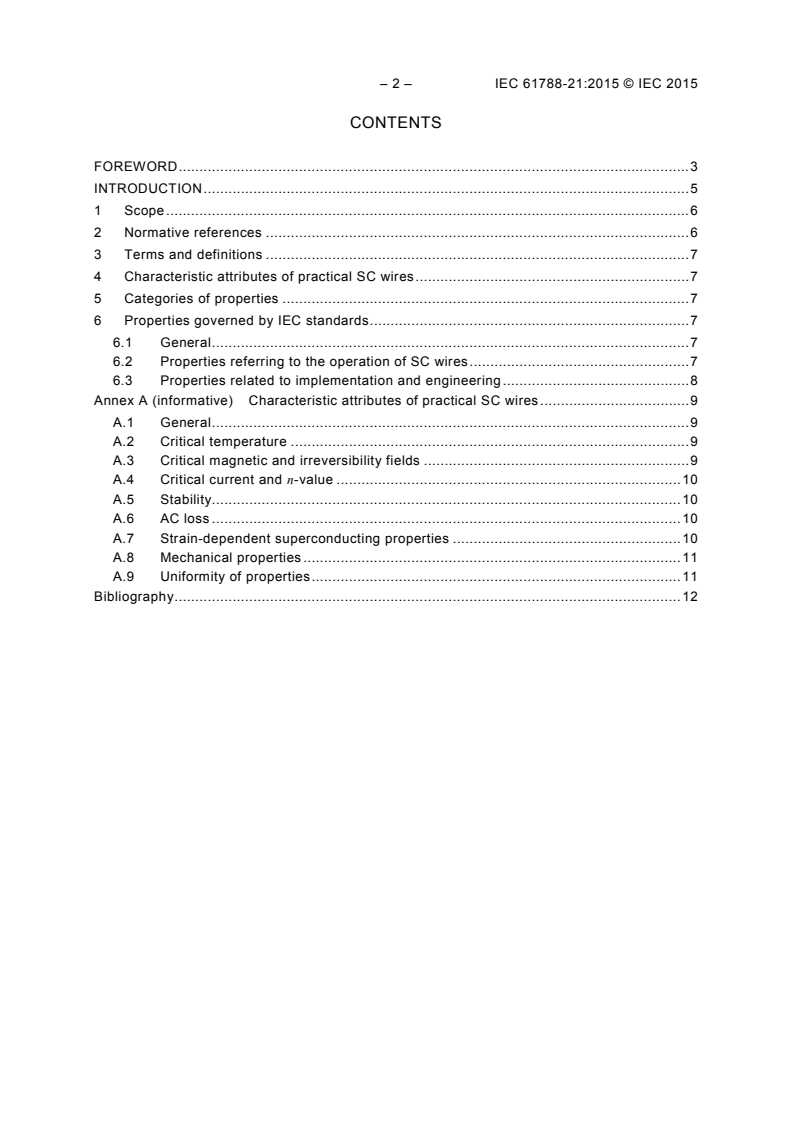
CONTENTS
FOREWORD . 3
INTRODUCTION . 5
1 Scope . 6
2 Normative references . 6
3 Terms and definitions . 7
4 Characteristic attributes of practical SC wires . 7
5 Categories of properties . 7
6 Properties governed by IEC standards . 7
6.1 General . 7
6.2 Properties referring to the operation of SC wires . 7
6.3 Properties related to implementation and engineering . 8
Annex A (informative) Characteristic attributes of practical SC wires . 9
A.1 General . 9
A.2 Critical temperature . 9
A.3 Critical magnetic and irreversibility fields . 9
A.4 Critical current and n-value . 10
A.5 Stability. 10
A.6 AC loss . 10
A.7 Strain-dependent superconducting properties . 10
A.8 Mechanical properties . 11
A.9 Uniformity of properties . 11
Bibliography . 12
INTERNATIONAL ELECTROTECHNICAL COMMISSION
____________
SUPERCONDUCTIVITY –
Part 21: Superconducting wires –
Test methods for practical superconducting wires –
General characteristics and guidance
FOREWORD
1) The International Electrotechnical Commission (IEC) is a worldwide organization for standardization comprising
all national electrotechnical committees (IEC National Committees). The object of IEC is to promote international
co-operation on all questions concerning standardization in the electrical and electronic fields. To this end and in
addition to other activities, IEC publishes International Standards, Technical Specifications, Technical Reports,
Publicly Available Specifications (PAS) and Guides (hereafter referred to as “IEC Publication(s)”). Their
preparation is entrusted to technical committees; any IEC National Committee interested in the subject dealt with
may participate in this preparatory work. International, governmental and non-governmental organizations liaising
with the IEC also participate in this preparation. IEC collaborates closely with the International Organization for
Standardization (ISO) in accordance with conditions determined by agreement between the two organizations.
2) The formal decisions or agreements of IEC on technical matters express, as nearly as possible, an international
consensus of opinion on the relevant subjects since each technical committee has representation from all
interested IEC National Committees.
3) IEC Publications have the form of recommendations for international use and are accepted by IEC National
Committees in that sense. While all reasonable efforts are made to ensure that the technical content of IEC
Publications is accurate, IEC cannot be held responsible for the way in which they are used or for any
misinterpretation by any end user.
4) In order to promote international uniformity, IEC National Committees undertake to apply IEC Publications
transparently to the maximum extent possible in their national and regional publications. Any divergence between
any IEC Publication and the corresponding national or regional publication shall be clearly indicated in the latter.
5) IEC itself does not provide any attestation of conformity. Independent certification bodies provide conformity
assessment services and, in some areas, access to IEC marks of conformity. IEC is not responsible for any
services carried out by independent certification bodies.
6) All users should ensure that they have the latest edition of this publication.
7) No liability shall attach to IEC or its directors, employees, servants or agents including individual experts and
members of its technical committees and IEC National Committees for any personal injury, property damage or
other damage of any nature whatsoever, whether direct or indirect, or for costs (including legal fees) and expenses
arising out of the publication, use of, or reliance upon, this IEC Publication or any other IEC Publications.
8) Attention is drawn to the Normative references cited in this publication. Use of the referenced publications is
indispensable for the correct application of this publication.
9) Attention is drawn to the possibility that some of the elements of this IEC Publication may be the subject of patent
rights. IEC shall not be held responsible for identifying any or all such patent rights.
International Standard IEC 61788-21 has been prepared by IEC technical committee 90:
Superconductivity.
The text of this standard is based on the following documents:
FDIS Report on voting
90/353/FDIS 90/354/RVD
Full information on the voting for the approval of this standard can be found in the report on
voting indicated in the above table.
This publication has been drafted in accordance with the ISO/IEC Directives, Part 2.
A list of all the parts in the IEC 61788 series, published under the general title
Superconductivity, can be found on the IEC website.
– 4 – IEC 61788-21:2015 © IEC 2015
The committee has decided that the contents of this publication will remain unchanged until the
stability date indicated on the IEC web site under "http://webstore.iec.ch" in the data related to
the specific publication. At this date, the publication will be
• reconfirmed,
• withdrawn,
• replaced by a revised edition, or
• amended.
INTRODUCTION
Superconducting (SC) wires are a central and often enabling technology of many important
industrial products. Consensus-based standards for SC wires greatly facilitate the creation of
procurement specifications, design and engineering of components, certification of quality,
description of operating devices, and generalization of use in industrial technologies.
This part of IEC 61788 is ranked as a first priority for both producers and users of
superconducting technology: It provides the measurement methods and test procedures for
properties critical to use. Adherence to normative information assists the development of
commercial markets and the distribution of products. Standardization in this regard is meant to
provide common access to, and unarguable reference information about, characteristics that are
most important for superconductor-based technologies.
This part of IEC 61788 includes the measurement principles and measurement techniques
together with the relevant terminology and definitions. Specifications of SC wire products take
into account the function of the different components of SC wires to meet operational needs,
maintain operational (superconducting) conditions, and accommodate mechanical forces and
strains. The various forms of SC wire products distributed by manufacturers incorporate these
aspects to varying degrees, depending on the superconducting materials used and the intended
operating conditions/environment. Design and engineering of devices that use SC wire products
take into account the unique properties of SC wires during operation. The general features of
practical SC wires are described in IEC TR 61788-20 in terms of simple general characteristics
to assist in the specification and use of superconducting wire products. Testing, certification,
and quality control apply the relevant standard test methods to SC wires, which are specified in
this part of IEC 61788.
– 6 – IEC 61788-21:2015 © IEC 2015
SUPERCONDUCTIVITY –
Part 21: Superconducting wires –
Test methods for practical superconducting wires –
General characteristics and guidance
1 Scope
This part of IEC 61788 specifies the test methods used for validating the mechanical, electrical,
and superconducting properties of practical SC wires. A wire is considered as being practical if
it can be procured in sufficiently continuous lengths under ordinary commercial transactions to
build devices. Conductors made of multiple wires, such as cables, are not included in the scope
of this part of IEC 61788. Extension of the discussions in this part of IEC 61788 beyond practical
SC wires is not intended, even though referenced documents include aspects outside of this
scope.
2 Normative references
The following documents, in whole or in part, are normatively referenced in this document and
are indispensable for its application. For dated references, only the edition cited applies. For
undated references, the latest edition of the referenced document (including any amendments)
applies.
IEC 60050 (all parts), International Electrotechnical Vocabulary. Available from:
http://www.electropedia.org
IEC 61788-1, Superconductivity – Part 1: Critical current measurement – DC critical current of
Nb-Ti composite superconductors
IEC 61788-2, Superconductivity – Part 2: Critical current measurement – DC critical current of
Nb Sn composite superconductors
IEC 61788-3, Superconductivity – Part 3: Critical current measurement – DC critical current of
Ag- and/or Ag alloy-sheathed Bi-2212 and Bi-2223 oxide superconductors
IEC 61788-4, Superconductivity – Part 4: Residual resistance ratio measurement – Residual
resistance ratio of Nb-Ti composite superconductors
IEC 61788-5, Superconductivity – Part 5: Matrix to superconductor volume ratio measurement –
Copper to superconductor volume ratio of Cu/Nb-Ti composite superconducting wires
IEC 61788-6, Superconductivity – Part 6: Mechanical properties measurement – Room
temperature tensile test of Cu/Nb-Ti composite superconductors
IEC 61788-8, Superconductivity – Part 8: AC loss measurements – Total AC loss measurement
of round superconducting wires exposed to a transverse alternating magnetic field at liquid
helium temperature by a pickup coil method
IEC 61788-10, Superconductivity – Part 10: Critical temperature measurement – Critical
temperature of composite superconductors by a resistance method
IEC 61788-11, Superconductivity – Part 11: Residual resistance ratio measurement – Residual
resistance ratio of Nb Sn composite superconductors
IEC 61788-12, Superconductivity – Part 12: Matrix to superconductor volume ratio
measurement – Copper to non-copper volume ratio of Nb Sn composite superconducting wires
IEC 61788-13, Superconductivity – Part 13: AC loss measurements – Magnetometer methods
for hysteresis loss in superconducting multifilamentary composites
IEC 61788-18, Superconductivity – Part 18: Mechanical properties measurement – Room
temperature tensile test of Ag- and/or Ag alloy-sheathed Bi-2223 and Bi-2212 composite
superconductors
IEC 61788-19, Superconductivity – Part 19: Mechanical properties measurement – Room
temperature tensile test of reacted Nb Sn composite superconductors
3 Terms and definitions
For the purposes of this document, the terms and definitions given in IEC 60050-815 apply.
4 Characteristic attributes of practical SC wires
The primary purpose of electrical wires is to carry electrical current. Practical SC wires have the
same intended purpose as common electrical wires, with the special ability to carry hundreds or
thousands of times more current than a common electrical wire of the same dimension. Standard
test methods discussed in this part of IEC 61788 address the determination of current-carrying
capacity, called the critical current of practical SC wires. Several by-products of the special
circumstances of practical SC wires also necessitate additional standards discussed in this part
of IEC 61788 with respect to mechanical and thermal properties as well as properties in
magnetic fields. The details are described in Annex A.
5 Categories of properties
The properties necessary for the specification are categorized as follows:
a) properties referring to the operation of SC wires, e.g. incurred during the initial cool-down to
operating temperature, standard continuous operation, and under fault conditions;
b) properties related to implementation and engineering, e.g. incurred during the fabrication
and installation of a device.
With respect to the properties belonging to two categories, their principal test methods have
been established as parts of IEC 61788 series indicated in Clause 6.
6 Properties governed by IEC standards
6.1 General
Several attributes are governed by parts of the IEC 61788 series. Test methods for these
attributes shall be used to settle disputes. When a new test method is established as a part of
IEC 61788 series, it will be included in Clause 6.
6.2 Properties referring to the operation of SC wires
For the purpose of consultation, current parts of the IEC 61788 series related to specific
properties shall be used to settle disputes. They are categorized in groups as follows.
a) Critical temperature:
– Critical temperature measurement – Critical temperature of composite superconductors
by a resistance method (IEC 61788-10).
– 8 – IEC 61788-21:2015 © IEC 2015
b) Critical current:
– Critical current measurement – DC critical current of Nb-Ti composite superconductors
(IEC 61788-1);
– Critical current measurement – DC critical current of Nb Sn composite superconductors
(IEC 61788-2);
– Critical current measurement – DC critical current of Ag- and/or Ag alloy-sheathed
Bi-2212 and Bi-2223 oxide superconductors (IEC 61788-3).
c) AC loss:
– AC loss measurements – Total AC loss measurement of round superconducting wires
exposed to a transverse alternating magnetic field at liquid helium temperature by a
pickup coil method (IEC 61788-8);
– Magnetometer methods for hysteresis loss in superconducting multifilamentary
composites (IEC 61788-13).
6.3 Properties related to implementation and engineering
For the purpose of consultation, current parts of the IEC 61788 series related to
implementation and engineering shall be used to settle disputes. They are categorized in
groups as follows.
a) Matrix to superconductor volume ratio:
– Matrix to superconductor volume ratio measurement – Copper to superconductor volume
ratio of Cu/Nb-Ti composite superconducting wires (IEC 61788-5);
– Matrix to superconductor volume ratio measurement – Copper to non-copper volume
ratio of Nb Sn composite superconducting wires (IEC 61788-12).
b) Residual resistance ratio:
– Residual resistance ratio measurement – Residual resistance ratio of Nb-Ti composite
superconductors (IEC 61788-4);
– Residual resistance ratio measurement – Residual resistance ratio of Nb Sn composite
superconductors (IEC 61788-11).
c) Mechanical properties:
– Mechanical properties measurement – Room temperature tensile test of Cu/Nb-Ti
composite superconductors (IEC 61788-6);
– Mechanical properties measurement – Room temperature tensile test of Ag- and/or Ag
alloy-sheathed Bi-2223 and Bi-2212 composite superconductors (IEC 61788-18);
– Mechanical properties measurement – Room temperature tensile test of reacted Nb Sn
composite superconductors (IEC 61788-19).
Annex A
(informative)
Characteristic attributes of practical SC wires
A.1 General
Procurement of practical SC wires generally requires the specification of performance for one or
many properties. The manufacturer, supplier, and customer should agree on which properties
are important for their application, and then determine specifications of performance for those
properties. Standards described in the preceding clauses are intended for the measurement of
actual performance, such as for certification or assurance to meet the specification. Annex A
describes briefly the various properties that could be considered in commercial transactions.
A.2 Critical temperature
When a SC material is cooled down, it transforms from a normal to superconducting state at a
critical temperature (T ). A large supercurrent can be carried with small Joule loss, because the
c
DC electrical resistance is almost zero in the SC state. The operation of the SC wire in real
application should be carried out at temperatures lower than T with sufficient enough
c
temperature margin, because the instability increases rapidly as the temperature becomes close
to T .
c
In standard operation, practical SC wires are cooled below their critical temperature, and
therefore a metal to conduct heat to a coolant is incorporated into the wire architecture.
Standards to evaluate the purity and conductivity of this metal are described. Also, standards to
evaluate the temperature and magnetic field at which the practical SC wire is in the
superconducting state are described.
There are also certain types of application, such as fault current limiters, that make use of the
transition of the SC wire from the superconducting state to the normal conducting state. For
such applications, the SC wire will experience temperatures above T and the electrical and
c
thermal stabilization of the wire is considered individually with regards to specific application
requirements. Major requirements are to limit temperature rise, to achieve thermal recovery
within a specific duration and to limit fault currents to a maximum level.
A.3 Critical magnetic and irreversibility fields
When an external magnetic field higher than the lower critical field is applied to a practical
superconductor, a so-called mixed state appears where quantized magnetic flux is introduced
into the SC material. In this mixed state, large supercurrent can flow steadily in the
superconductor without the generation of voltage. The ability of the SC material to carry large
supercurrents without dissipation in the mixed state makes it possible to design a SC magnet
operating at high magnetic field. However when the external magnetic field exceeds the
irreversibility value, the supercurrent is accompanied by a voltage. The mixed state would be
destroyed once the external field is above the upper critical magnetic field.
A common use of practical SC wires is the winding of electro-magnets. Under such conditions,
the SC wire is placed in a high magnetic field, which can induce properties not found for common
electrical wires. Standards to evaluate the different behaviour, such as the magnetization of a
practical SC wire, are described. In addition, certain field limits apply to the superconducting
state.
– 10 – IEC 61788-21:2015 © IEC 2015
A.4 Critical current and n-value
Theoretically the critical current is defined as the maximum direct current that can be regarded
as flowing without resistance (IEC 60050-815). In practice however, the critical current is
determined based on measurement sensitivities of the devices used to characterize dissipation
of the SC wire, and thus, the practical definition is determined according to a criterion based on
finite value of resistivity or electric field (IEC 61788-1, IEC 61788-2 and IEC 61788-3). High
performance practical SC wires developed recently can transport current at least a factor of 10
to 10 times higher than common copper electrical wires of the same dimension. The critical
current is largely dependent on temperature and magnetic field, and is dependent on
n
mechanical strain. Electric voltage appears rapidly in proportion to (I/I ) , when current I
c
approaches and exceeds the critical current. The exponential index is called “n-value”, which
indicates the sharpness of transition to the magnetic flux flow state.
A.5 Stability
When the SC state breaks down, a local part of the superconductor carrying a large supercurrent
becomes normal and generates potential instability due to Joule heat. The practical SC wire is
designed to avoid the expansion of such a current instability. In the case of Nb Sn composite
superconducting wire, for instance, the high conductivity copper surrounds the core including
Nb Sn filaments.
Practical SC wires are designed to conduct heat to an external coolant, often through a high
conductivity metal stabilizer such as copper, silver, or aluminum that surrounds the
superconducting material on the inside. Characterization of the heat-carrying capacity of the
stabilizer is often performed via measurement of the residual resistivity ratio, (RRR). The
transformation to the superconducting state at low temperatures short-circuits the electrical path
through the stabilizer, which makes such measurements more complicated than for common
wires.
For SC wires used for such applications as fault current limiters, in which the SC wire
transitions from the superconducting state to the normal conducting state and temperatures
well-above T are experienced, the stability requirements become different. The thermal and
c
electrical stabilization of the practical SC wire are designed to limit temperature rise, achieve
thermal recovery within a specified duration and to limit fault currents to a maximum level. For
such applications, heat capacity and electrical resistance of the stabilization components at
temperatures above T are important parameters.
c
A.6 AC loss
When an AC magnetic field or an AC current is applied to SC wires, heat generation takes place
due to hysteresis, coupling between superconducting elements, and eddy current losses from
complementary metallic components. In some important applications, a large heat generation is
expected and the SC wires used are specifically designed to prevent the break-down of the SC
state from the heat generated. In the case of Nb-Ti composite superconducting wire, for instance,
the Nb-Ti filaments are twisted and the Cu-Ni alloy element is inserted in the copper matrix.
Practical SC wires respond to changes of magnetic field in ways that are different from the
response of common wires. Some behaviour produces heat, which can affect the cryogenic
conditions of operation. Standards are described to evaluate the lossy effects specific to
practical SC wires.
A.7 Strain-dependent superconducting properties
Due to their complicated composite structure, the properties and architecture of the component
materials affect the internal stress/strain in the SC component, which significantly influences the
SC properties. In practice, application of the SC wire occurs such that the strain incurred during
fabrication or under operation is below the irreversibility strain limit.
If a large external strain is applied above the reversible strain limit, it causes a large permanent
degradation of the critical cu
...