

IEC 60695-6-1:2005+AMD1:2010 CSV
(Main)Fire hazard testing - Part 6-1: Smoke obscuration - General guidance
General Information
- Abstract
IEC 60695-6-1:2005+A1:2010 Gives guidance on:
a) optical measurement of smoke obscuration;
b) general aspects of optical smoke test methods;
c) consideration of test methods;
d) expression of smoke test data;
e) relevance of optical smoke data to hazard assessment.
The main changes with respect to the previous edition are listed below:
- Modified title.
- Updated normative references.
- Expanded terms and definitions.
- Numerous editorial changes of a technical nature throughout the publication.
- A flowchart has been added for the evaluation and consideration of smoke test methods.
Has the status of a basic safety publication in accordance with IEC Guide 104.
This publication is to be read in conjunction with IEC 60695-6-2:2005.
This consolidated version consists of the second edition (2005) and its amendment 1 (2010). Therefore, no need to order amendment in addition to this publication.
- Status
- Published
- Publication Date
- 15-Sep-2010
- Technical Committee
- TC 89 - Fire hazard testing
- Current Stage
- DELPUB - Deleted Publication
- Completion Date
- 05-Aug-2021

Overview
IEC 60695-6-1:2005+AMD1:2010 CSV is an international standard published by the International Electrotechnical Commission (IEC) that provides general guidance on smoke obscuration in fire hazard testing. This standard focuses on the optical measurement of smoke obscuration, which is a critical factor in assessing fire hazards associated with electrical and electronic equipment. Smoke generated during fires can severely reduce visibility, posing risks to safe evacuation and firefighting operations. IEC 60695-6-1 outlines methods for measuring, analyzing, and interpreting smoke obscuration data to better understand smoke behavior and its impact on safety.
This version consolidates the 2005 second edition with the 2010 amendment, offering updated terminology, normative references, and editorial improvements. A key addition is a flowchart designed to aid in the evaluation and consideration of smoke test methods. The standard is intended to be used alongside IEC 60695-6-2 and other parts of the 60695-6 series focusing on smoke testing.
Key Topics
Optical Smoke Measurement
Guidance on techniques and principles for measuring smoke obscuration optically, including the use of Bouguer’s law and extinction area concepts.General Test Method Aspects
Consideration of static and dynamic test approaches, selection of test specimens, and factors affecting smoke production.Expression and Presentation of Data
Uniform methods for expressing results such as extinction coefficients, log units, and mass optical density to facilitate consistent hazard assessment.Relevance to Hazard Assessment
Interpretation of smoke obscuration data to evaluate risks related to visibility reduction, aiding in safer design and material selection for electrotechnical products.Technical Updates
Expanded terms and definitions clarify smoke-related concepts; updated normative references ensure alignment with current international practices.Evaluation Tools
The addition of a clear flowchart supports test method selection and evaluation, improving decision-making in fire hazard testing.
Applications
IEC 60695-6-1 is primarily used in:
Fire Hazard Testing of Electrical Components and Equipment
Ensuring that components meet safety requirements by minimizing smoke generation and visibility impairment during fire events.Design and Material Selection
Informing engineers and manufacturers about smoke behavior to select materials and design products that limit smoke obscuration hazards.Safety Assessments and Compliance
Supporting regulatory compliance and certification efforts by providing standardized test methods and interpretation guidelines for smoke measurement.Risk Management in Buildings and Infrastructure
Enhancing fire safety plans by understanding smoke visibility impacts and integrating them into evacuation strategy and firefighting preparedness.Research and Development
Assisting in the development of new smoke measurement technologies and methods to improve fire hazard analysis and mitigation.
Related Standards
IEC 60695-6-1 forms part of the broader IEC 60695 series on Fire Hazard Testing, which includes:
IEC 60695-6-2: Smoke Obscuration – Summary and Relevance of Test Methods
Complements Part 6-1 by summarizing methods and their application relevance.IEC 60695-6-30 and IEC 60695-6-31: Small-Scale Static Smoke Test Methods
Detail apparatus descriptions and material-specific measurement procedures for assessing smoke opacity in electrotechnical products.
Other standards important for comprehensive fire hazard evaluation include:
IEC 60695-1-1: Fire Hazard Testing – Guidance for Assessment
Offers foundational principles for overall fire hazard evaluation, which pairs with the smoke obscuration guidance.ISO/TR 9122-1 and ISO 19706
Provide classification and characteristic details of fire stages that help contextualize smoke generation during fire development.
Conclusion
IEC 60695-6-1:2005+A1:2010 is an essential document for professionals involved in fire safety testing of electrical and electronic products. It delivers clear guidance on measuring smoke obscuration, interpreting smoke effects on visibility, and applying these insights to fire hazard assessments. By adopting this standard, manufacturers, safety engineers, and testing laboratories can improve fire safety design and compliance, ultimately reducing fire risks related to smoke hazards.
Keywords: IEC 60695-6-1, smoke obscuration, fire hazard testing, optical smoke measurement, extinction coefficient, fire safety standards, electrotechnical products, smoke visibility, fire hazard assessment, electrical safety testing.
Get Certified
Connect with accredited certification bodies for this standard

IMQ S.p.A. (Certification)
Italian electrical product certification.

SLG Prüf- und Zertifizierungs GmbH
German testing and certification body.

UL Solutions
Global safety science company with testing, inspection and certification.
Sponsored listings
Frequently Asked Questions
IEC 60695-6-1:2005+AMD1:2010 CSV is a standard published by the International Electrotechnical Commission (IEC). Its full title is "Fire hazard testing - Part 6-1: Smoke obscuration - General guidance". This standard covers: IEC 60695-6-1:2005+A1:2010 Gives guidance on: a) optical measurement of smoke obscuration; b) general aspects of optical smoke test methods; c) consideration of test methods; d) expression of smoke test data; e) relevance of optical smoke data to hazard assessment. The main changes with respect to the previous edition are listed below: - Modified title. - Updated normative references. - Expanded terms and definitions. - Numerous editorial changes of a technical nature throughout the publication. - A flowchart has been added for the evaluation and consideration of smoke test methods. Has the status of a basic safety publication in accordance with IEC Guide 104. This publication is to be read in conjunction with IEC 60695-6-2:2005. This consolidated version consists of the second edition (2005) and its amendment 1 (2010). Therefore, no need to order amendment in addition to this publication.
IEC 60695-6-1:2005+A1:2010 Gives guidance on: a) optical measurement of smoke obscuration; b) general aspects of optical smoke test methods; c) consideration of test methods; d) expression of smoke test data; e) relevance of optical smoke data to hazard assessment. The main changes with respect to the previous edition are listed below: - Modified title. - Updated normative references. - Expanded terms and definitions. - Numerous editorial changes of a technical nature throughout the publication. - A flowchart has been added for the evaluation and consideration of smoke test methods. Has the status of a basic safety publication in accordance with IEC Guide 104. This publication is to be read in conjunction with IEC 60695-6-2:2005. This consolidated version consists of the second edition (2005) and its amendment 1 (2010). Therefore, no need to order amendment in addition to this publication.
IEC 60695-6-1:2005+AMD1:2010 CSV is classified under the following ICS (International Classification for Standards) categories: 01 - GENERALITIES. TERMINOLOGY. STANDARDIZATION. DOCUMENTATION; 13.220.99 - Other standards related to protection against fire; 29.020 - Electrical engineering in general; 33.120.10 - Coaxial cables. Waveguides. The ICS classification helps identify the subject area and facilitates finding related standards.
IEC 60695-6-1:2005+AMD1:2010 CSV is available in PDF format for immediate download after purchase. The document can be added to your cart and obtained through the secure checkout process. Digital delivery ensures instant access to the complete standard document.
Standards Content (Sample)
IEC 60695-6-1 ®
Edition 2.1 2010-09
INTERNATIONAL
STANDARD
NORME
INTERNATIONALE
colour
inside
BASIC SAFETY PUBLICATION
PUBLICATION FONDAMENTALE DE SÉCURITÉ
Fire hazard testing –
Part 6-1: Smoke obscuration – General guidance
Essais relatifs aux risques du feu –
Partie 6-1: Opacité des fumées – Lignes directrices générales
IEC 60695-6-1:2005+A1:2010
All rights reserved. Unless otherwise specified, no part of this publication may be reproduced or utilized in any form or by
any means, electronic or mechanical, including photocopying and microfilm, without permission in writing from either IEC or
IEC's member National Committee in the country of the requester.
If you have any questions about IEC copyright or have an enquiry about obtaining additional rights to this publication,
please contact the address below or your local IEC member National Committee for further information.
Droits de reproduction réservés. Sauf indication contraire, aucune partie de cette publication ne peut être reproduite
ni utilisée sous quelque forme que ce soit et par aucun procédé, électronique ou mécanique, y compris la photocopie
et les microfilms, sans l'accord écrit de la CEI ou du Comité national de la CEI du pays du demandeur.
Si vous avez des questions sur le copyright de la CEI ou si vous désirez obtenir des droits supplémentaires sur cette
publication, utilisez les coordonnées ci-après ou contactez le Comité national de la CEI de votre pays de résidence.
IEC Central Office
3, rue de Varembé
CH-1211 Geneva 20
Switzerland
Email: inmail@iec.ch
Web: www.iec.ch
About the IEC
The International Electrotechnical Commission (IEC) is the leading global organization that prepares and publishes
International Standards for all electrical, electronic and related technologies.
About IEC publications
The technical content of IEC publications is kept under constant review by the IEC. Please make sure that you have the
latest edition, a corrigenda or an amendment might have been published.
ƒ Catalogue of IEC publications: www.iec.ch/searchpub
The IEC on-line Catalogue enables you to search by a variety of criteria (reference number, text, technical committee,…).
It also gives information on projects, withdrawn and replaced publications.
ƒ IEC Just Published: www.iec.ch/online_news/justpub
Stay up to date on all new IEC publications. Just Published details twice a month all new publications released. Available
on-line and also by email.
ƒ Electropedia: www.electropedia.org
The world's leading online dictionary of electronic and electrical terms containing more than 20 000 terms and definitions
in English and French, with equivalent terms in additional languages. Also known as the International Electrotechnical
Vocabulary online.
ƒ Customer Service Centre: www.iec.ch/webstore/custserv
If you wish to give us your feedback on this publication or need further assistance, please visit the Customer Service
Centre FAQ or contact us:
Email: csc@iec.ch
Tel.: +41 22 919 02 11
Fax: +41 22 919 03 00
A propos de la CEI
La Commission Electrotechnique Internationale (CEI) est la première organisation mondiale qui élabore et publie des
normes internationales pour tout ce qui a trait à l'électricité, à l'électronique et aux technologies apparentées.
A propos des publications CEI
Le contenu technique des publications de la CEI est constamment revu. Veuillez vous assurer que vous possédez
l’édition la plus récente, un corrigendum ou amendement peut avoir été publié.
ƒ Catalogue des publications de la CEI: www.iec.ch/searchpub/cur_fut-f.htm
Le Catalogue en-ligne de la CEI vous permet d’effectuer des recherches en utilisant différents critères (numéro de référence,
texte, comité d’études,…). Il donne aussi des informations sur les projets et les publications retirées ou remplacées.
ƒ Just Published CEI: www.iec.ch/online_news/justpub
Restez informé sur les nouvelles publications de la CEI. Just Published détaille deux fois par mois les nouvelles
publications parues. Disponible en-ligne et aussi par email.
ƒ Electropedia: www.electropedia.org
Le premier dictionnaire en ligne au monde de termes électroniques et électriques. Il contient plus de 20 000 termes et
définitions en anglais et en français, ainsi que les termes équivalents dans les langues additionnelles. Egalement appelé
Vocabulaire Electrotechnique International en ligne.
ƒ Service Clients: www.iec.ch/webstore/custserv/custserv_entry-f.htm
Si vous désirez nous donner des commentaires sur cette publication ou si vous avez des questions, visitez le FAQ du
Service clients ou contactez-nous:
Email: csc@iec.ch
Tél.: +41 22 919 02 11
Fax: +41 22 919 03 00
IEC 60695-6-1 ®
Edition 2.1 2010-09
INTERNATIONAL
STANDARD
NORME
INTERNATIONALE
colour
inside
BASIC SAFETY PUBLICATION
PUBLICATION FONDAMENTALE DE SÉCURITÉ
Fire hazard testing –
Part 6-1: Smoke obscuration – General guidance
Essais relatifs aux risques du feu –
Partie 6-1: Opacité des fumées – Lignes directrices générales
INTERNATIONAL
ELECTROTECHNICAL
COMMISSION
COMMISSION
ELECTROTECHNIQUE
PRICE CODE
INTERNATIONALE
CN
CODE PRIX
ICS 13.220.99; 29.020 ISBN 978-2-88912-122-9
– 2 – 60695-6-1 © IEC:2005+A1:2010
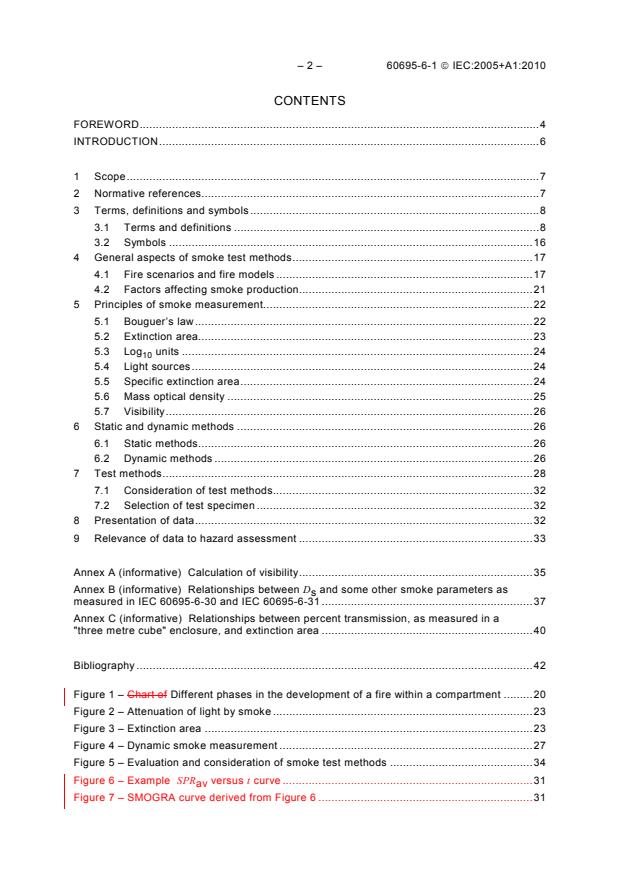
CONTENTS
FOREWORD.4
INTRODUCTION.6
1 Scope.7
2 Normative references.7
3 Terms, definitions and symbols .8
3.1 Terms and definitions .8
3.2 Symbols .16
4 General aspects of smoke test methods.17
4.1 Fire scenarios and fire models .17
4.2 Factors affecting smoke production.21
5 Principles of smoke measurement.22
5.1 Bouguer’s law.22
5.2 Extinction area.23
5.3 Log units .24
5.4 Light sources.24
5.5 Specific extinction area.24
5.6 Mass optical density .25
5.7 Visibility.26
6 Static and dynamic methods .26
6.1 Static methods.26
6.2 Dynamic methods .26
7 Test methods.28
7.1 Consideration of test methods.32
7.2 Selection of test specimen .32
8 Presentation of data.32
9 Relevance of data to hazard assessment .33
Annex A (informative) Calculation of visibility.35
Annex B (informative) Relationships between D and some other smoke parameters as
s
measured in IEC 60695-6-30 and IEC 60695-6-31 .37
Annex C (informative) Relationships between percent transmission, as measured in a
"three metre cube" enclosure, and extinction area .40
Bibliography .42
Figure 1 – Chart of Different phases in the development of a fire within a compartment .20
Figure 2 – Attenuation of light by smoke .23
Figure 3 – Extinction area .23
Figure 4 – Dynamic smoke measurement .27
Figure 5 – Evaluation and consideration of smoke test methods .34
Figure 6 – Example SPR versus t curve .31
av
Figure 7 – SMOGRA curve derived from Figure 6 .31
60695-6-1 © IEC:2005+A1:2010 – 3 –
Figure A.1 – Visibility (ω) versus extinction coefficient (k).35
Figure B.1 – Smoke parameters related to D as measured in IEC 60695-6-30 and
s
IEC 60695-6-31.39
Figure C.1 – Extinction area (amount of smoke) related to percent transmission as
measured in the "three metre cube".41
Table 1 – General classification of fires (ISO/TR 9122-1) Characteristics of fire stages
(ISO 19706) .18
Table B.1 – Conversion from D to some other smoke parameters as measured in
s
IEC 60695-6-30 and IEC 60695-6-31.38
Table C.1 – Conversions from percent transmission, as measured in the “three metre
cube” to amount of smoke (extinction area) .40
– 4 – 60695-6-1 © IEC:2005+A1:2010
INTERNATIONAL ELECTROTECHNICAL COMMISSION
____________
FIRE HAZARD TESTING –
Part 6-1: Smoke obscuration –
General guidance
FOREWORD
1) The International Electrotechnical Commission (IEC) is a worldwide organization for standardization comprising
all national electrotechnical committees (IEC National Committees). The object of IEC is to promote
international co-operation on all questions concerning standardization in the electrical and electronic fields. To
this end and in addition to other activities, IEC publishes International Standards, Technical Specifications,
Technical Reports, Publicly Available Specifications (PAS) and Guides (hereafter referred to as “IEC
Publication(s)”). Their preparation is entrusted to technical committees; any IEC National Committee interested
in the subject dealt with may participate in this preparatory work. International, governmental and non-
governmental organizations liaising with the IEC also participate in this preparation. IEC collaborates closely
with the International Organization for Standardization (ISO) in accordance with conditions determined by
agreement between the two organizations.
2) The formal decisions or agreements of IEC on technical matters express, as nearly as possible, an international
consensus of opinion on the relevant subjects since each technical committee has representation from all
interested IEC National Committees.
3) IEC Publications have the form of recommendations for international use and are accepted by IEC National
Committees in that sense. While all reasonable efforts are made to ensure that the technical content of IEC
Publications is accurate, IEC cannot be held responsible for the way in which they are used or for any
misinterpretation by any end user.
4) In order to promote international uniformity, IEC National Committees undertake to apply IEC Publications
transparently to the maximum extent possible in their national and regional publications. Any divergence
between any IEC Publication and the corresponding national or regional publication shall be clearly indicated in
the latter.
5) IEC itself does not provide any attestation of conformity. Independent certification bodies provide conformity
assessment services and, in some areas, access to IEC marks of conformity. IEC is not responsible for any
services carried out by independent certification bodies.
6) All users should ensure that they have the latest edition of this publication.
7) No liability shall attach to IEC or its directors, employees, servants or agents including individual experts and
members of its technical committees and IEC National Committees for any personal injury, property damage or
other damage of any nature whatsoever, whether direct or indirect, or for costs (including legal fees) and
expenses arising out of the publication, use of, or reliance upon, this IEC Publication or any other IEC
Publications.
8) Attention is drawn to the Normative references cited in this publication. Use of the referenced publications is
indispensable for the correct application of this publication.
9) Attention is drawn to the possibility that some of the elements of this IEC Publication may be the subject of
patent rights. IEC shall not be held responsible for identifying any or all such patent rights.
This consolidated version of IEC 60695-6-1 consists of the second edition (2005)
[documents 89/692/FDIS and 89/696/RVD] and its amendment 1 (2010) [documents
89/905/CDV and 89/946A/RVC]. It bears the edition number 2.1.
The technical content is therefore identical to the base edition and its amendment and
has been prepared for user convenience. A vertical line in the margin shows where the
base publication has been modified by amendment 1. Additions and deletions are
displayed in red, with deletions being struck through.
60695-6-1 © IEC:2005+A1:2010 – 5 –
International Standard IEC 60695-6-1 has been prepared by IEC technical committee 89: Fire
hazard testing.
The main changes with respect to the previous edition are listed below:
– Modified title.
– Updated normative references.
– Expanded terms and definitions.
– Numerous editorial changes of a technical nature throughout the publication.
– A flowchart has been added for the evaluation and consideration of smoke test methods.
It has the status of a basic safety publication in accordance with IEC Guide 104 and ISO/IEC
Guide 51.
This standard is to be used in conjunction with IEC 60695-6-2.
This publication has been drafted in accordance with the ISO/IEC Directives, Part 2.
The IEC 60695-6 series, under the general heading Fire hazard testing, consists of the
following parts
Part 6-1: Smoke obscuration – General guidance
Part 6-2: Smoke obscuration – Summary and relevance of test methods
Part 6-30: Smoke obscuration – Guidance and test methods on the assessment of
obscuration hazard of vision caused by smoke opacity from electrotechnical
products involved in fires – Small scale static method - Determination of smoke
opacity - Description of the apparatus
Part 6-31: Smoke obscuration – Small-scale static test – Materials
The committee has decided that the contents of the base publication and its amendments will
remain unchanged until the stability date indicated on the IEC web site under "http://webstore.iec.ch"
in the data related to the specific publication. At this date, the publication will be
• reconfirmed,
• withdrawn,
• replaced by a revised edition, or
• amended.
IMPORTANT – The “colour inside” logo on the cover page of this publication indicates
that it contains colours which are considered to be useful for the correct understanding
of its contents. Users should therefore print this publication using a colour printer.
– 6 – 60695-6-1 © IEC:2005+A1:2010
INTRODUCTION
The risk of fire needs to be considered in any electrical circuit, and the objective of component,
circuit and equipment design, as well as the choice of material, is to reduce the likelihood of
fire, even in the event of foreseeable abnormal use, malfunction or failure.
Electrotechnical products, primarily victims of a fire, may nevertheless contribute to the fire.
One of the contributing hazards is the release of smoke, which may cause loss of vision and/or
disorientation which could impede escape from the building or fire fighting.
Smoke particles reduce the visibility due to light absorption and scattering. Consequently,
people may experience difficulties in finding exit signs, doors and windows. Visibility is often
determined as the distance at which an object is no longer visible. It depends on many factors,
but close relationships have been established between visibility and the measurements of the
extinction coefficient of smoke – see Annex A.
The production of smoke and its optical properties can be measured as well as other fire
properties, such as heat release, flame spread, and the production of toxic gas and corrosive
effluent. This part of IEC 60695-6 serves as a guidance document and focuses on obscuration
of light by smoke.
60695-6-1 © IEC:2005+A1:2010 – 7 –
FIRE HAZARD TESTING –
Part 6-1: Smoke obscuration –
General guidance
1 Scope
This part of IEC 60695 gives guidance on:
a) optical measurement of smoke obscuration;
b) general aspects of optical smoke test methods;
c) consideration of test methods;
d) expression of smoke test data;
e) relevance of optical smoke data to hazard assessment.
One of the responsibilities of a technical committee is, wherever applicable, to make use of
basic safety publications in the preparation of its publications.
2 Normative references
The following referenced documents are indispensable for the application of this document. For
dated references, only the edition cited applies. For undated references, the latest edition of
the referenced document (including any amendments) applies.
IEC 60695-1-1, Fire hazard testing – Part 1-1: Guidance for assessing the fire hazard of
electrotechnical products – General guidelines
IEC 60695-4:2001, Fire hazard testing – Part 4: Terminology concerning fire tests
IEC 60695-6-2:2001, Fire hazard testing – Part 6-2: Smoke obscuration – Summary and
relevance of test methods
IEC 60695-6-30, Fire hazard testing – Part 6: Guidance and test methods on the assessment of
obscuration hazard of vision caused by smoke opacity from electrotechnical products involved
in fires – Section 30: Small-scale static method – Determination of smoke opacity – Description
of the apparatus
IEC 60695-6-31, Fire hazard testing – Part 6-31: Smoke obscuration – Small-scale static test –
Materials
IEC Guide 104:1997, The preparation of safety publications and the use of basic safety
publications and group safety publications
ISO/TR 9122-1:1989, Toxicity testing of fire effluents – Part 1: General
ISO 5659-2:1994, Plastics – Smoke generation – Part 2: Determination of optical density by a
single-chamber test
ISO/IEC 13943:2000, Fire safety – Vocabulary
ISO/IEC Guide 51:1999. Safety aspects – Guidelines for inclusion in standards
– 8 – 60695-6-1 © IEC:2005+A1:2010
IEC 60695-1-10, Fire hazard testing – Part 1-10: Guidance for assessing the fire hazard of
electrotechnical products – General guidelines
IEC 60695-1-11 , Fire hazard testing – Part 1-11: Guidance for assessing the fire hazard of
electrotechnical products – Fire hazard assessment
IEC 60695-4:2005, Fire hazard testing – Part 4: Terminology concerning fire tests for
electrotechnical products
IEC 60695-6-2 , Fire hazard testing – Part 6-2: Smoke obscuration – Summary and relevance
of test methods
IEC 60695-6-30:1996, Fire hazard testing – Part 6: Guidance and test methods on the
assessment of obscuration hazard of vision caused by smoke opacity from electrotechnical
products involved in fires – Section 30: Small-scale static method – Determination of smoke
opacity – Description of the apparatus
IEC 60695-6-31:1999, Fire hazard testing – Part 6-31: Smoke obscuration – Small-scale static
test – Materials
IEC Guide 104:1997, The preparation of safety publications and the use of basic safety
publications and group safety publications
ISO/IEC Guide 51:1999. Safety aspects – Guidelines for inclusion in standards
ISO 5659-2:2006, Plastics – Smoke generation – Part 2: Determination of optical density by a
single-chamber test
ISO 5660-2:2002, Reaction-to-fire tests – Heat release, smoke production and mass loss rate –
Part 2: Smoke production rate (dynamic measurement)
ISO 13943:2008, Fire safety – Vocabulary
ISO 19706:2007, Guidelines for assessing the fire threat to people
NOTE ISO 9122-1:1989, Toxicity testing of fire effluents – Part 1: General, has been withdrawn and replaced by
ISO 19706:2007.
ASTM E 1354:2008, Standard Test Method for Heat and Visible Smoke Release Rates for
Materials and Products Using an Oxygen Consumption Calorimeter
EN 13823:2002, Reaction to fire tests for building products – Building products, excluding
floorings, exposed to thermal attack by a single burning item
3 Terms, definitions and symbols
3.1 Terms and definitions
For the purpose of this document, the terms and definitions and symbols given in ISO/IEC
13943, some of which are reproduced below for the uses’ convenience, as well as the following
apply.
___________
To be published.
To be published.
60695-6-1 © IEC:2005+A1:2010 – 9 –
3.1.1
combustion
exothermic reaction of a substance with an oxidizer
NOTE Combustion generally emits effluent accompanied by flames and/or visible light.
[ISO/IEC 13943, definition 23]
3.1.2
extinction area of smoke
product of the extinction coefficient and the volume occupied by the smoke
NOTE It is a measure of the amount of smoke.
[IEC 60695-4, definition 2.130]
3.1.3
extinction coefficient of smoke
natural logarithm of the opacity of smoke divided by the path length of the light used to
measure the smoke opacity
[IEC 60695-4, definition 2.131]
3.1.4
fire
a) process of combustion characterized by the emission of heat and effluent accompanied by
smoke, and/or flame, and/or glowing;
b) rapid combustion spreading uncontrolled in time and space
[IEC 60695-4, definition 2.29]
3.1.5
fire effluent
total gaseous, particulate or aerosol effluent from combustion or pyrolysis
[IEC 60695-4, definition 2.33]
3.1.6
fire hazard
potential for injury or loss of life and/or damage to property by fire
[IEC 60695-4, definition 2.36]
3.1.7
fire model
a laboratory process, including both the apparatus and the mode of operation, intended to
simulate a certain stage of a real fire
[IEC 60695-4, definition 2.120]
3.1.8
fire scenario
detailed description of conditions, including environmental, of one or more stages from before
ignition to after completion of combustion in an actual fire at a specific location or in a real-
scale simulation
[ISO/IEC 13943, definition 58]
3.1.9
flash-over
the rapid transition to a state of total surface involvement in a fire of combustible materials
within an enclosure
– 10 – 60695-6-1 © IEC:2005+A1:2010
[IEC 60695-4, definition 2.59]
3.1.10
heat flux
amount of thermal energy emitted, transmitted or received per unit area and unit time
NOTE It is expressed in watts per square metre.
[ISO/IEC 13943, definition 85]
3.1.11
ignition
initiation of combustion
NOTE The term "ignition" in French has a very different meaning [state of body combustion].
[ISO/IEC 13943, definition 96]
3.1.12
large scale test
a test, the size of which exceeds that of a typical laboratory bench test
[IEC 60695-4, definition 2.122]
3.1.13
mass optical density of smoke
optical density multiplied by a factor, V /(L × Δm), where V is the volume of the test chamber,
Δm is the mass loss of the test specimen and L is the light path length
[IEC 60695-4, definition 2.133]
3.1.14
opacity (of smoke)
the ratio (I/T) of incident luminous flux (I) to transmitted luminous flux (T) through smoke,
under specified test conditions
[IEC 60695-4, definition 2.89]
3.1.15
optical density (of smoke) [lg(I/T)]
common logarithm of the opacity of smoke (see also specific optical density)
[IEC 60695-4, definition 2.90]
3.1.16
realscale test
a test which simulates an end-use situation in both size and surroundings
[IEC 60695-4, definition 2.123]
3.1.17
small scale test
a test which may be made on a typical laboratory bench
[IEC 60695-4, definition 2.124]
3.1.18
smoke
a visible suspension of solid and/or liquid particles in gases resulting from combustion or
pyrolysis
60695-6-1 © IEC:2005+A1:2010 – 11 –
[IEC 60695-4, definition 2.101]
3.1.19
smoke obscuration
the reduction in visibility due to smoke
[IEC 60695-4, definition 2.102]
3.1.20
smoke production rate
extinction area of smoke produced, per unit time, by the combustion of a material under
specified test conditions
3.1.21
smoke release rate
see "smoke production rate"
3.1.22
specific extinction area of smoke
extinction area of smoke divided by the mass loss of the test specimen
[IEC 60695-4, definition 2.137]
3.1.23
specific optical density (of smoke)
optical density multiplied by a geometric factor V /AL, where V is the volume of the test
chamber, A is the exposed surface area of the test specimen and L is the light path length
NOTE The use of the term ‘specific’ does not, in this case, denote 'per unit mass’ but rather denotes a
dimensionless quantity associated with a particular test apparatus and exposed surface area of the test specimen.
3.1.24
visibility
maximum distance at which an object of defined size, brightness and contrast can be seen and
recognized
3.1.1
combustion
exothermic reaction of a substance with an oxidizing agent
NOTE Combustion generally emits fire effluent accompanied by flames and/or glowing.
[ISO/IEC 13943, definition 4.46]
3.1.2
extinction area of smoke
product of the volume occupied by smoke and the extinction coefficient of the smoke
NOTE It is a measure of the amount of smoke, and the typical units are square metres (m ).
[ISO /IEC 13943, definition 4.92]
3.1.3
extinction coefficient
natural logarithm of the ratio of incident light intensity to transmitted light intensity, per unit light
path length
–1
NOTE Typical units are reciprocal metres (m ).
[ISO/IEC 13943, definition 4.93]
– 12 – 60695-6-1 © IEC:2005+A1:2010
3.1.4
fire
〈general〉 process of combustion characterized by the emission of heat and fire effluent and
usually accompanied by smoke, flame or glowing or a combination thereof
NOTE In the English language the term "fire" is used to designate three concepts, two of which, fire (3.1.5) and
fire (3.1.6), relate to specific types of self-supporting combustion with different meanings and two of them are
designated using two different terms in both French and German.
[ISO/IEC 13943, definition 4.96]
3.1.5
fire
〈controlled〉 self-supporting combustion that has been deliberately arranged to provide useful
effects and is limited in its extent in time and space
[ISO/IEC 13943, definition 4.97]
3.1.6
fire
〈uncontrolled〉 self-supporting combustion that has not been deliberately arranged to provide
useful effects and is not limited in its extent in time and space
[ISO/IEC 13943, definition 4.98]
3.1.7
fire effluent
totality of gases and aerosols, including suspended particles, created by combustion or
pyrolysis in a fire
[ISO/IEC 13943, definition 4.105]
3.1.8
fire hazard
physical object or condition with a potential for an undesirable consequence from fire
[ISO/IEC 13943, definition 4.112]
3.1.9
fire model
fire simulation
calculation method that describes a system or process related to fire development, including
fire dynamics and the effects of fire
[ISO/IEC 13943, definition 4.116]
3.1.10
fire scenario
qualitative description of the course of a fire with respect to time, identifying key events that
characterise the studied fire and differentiate it from other possible fires
NOTE It typically defines the ignition and fire growth processes, the fully developed fire stage, the fire decay
stage, and the environment and systems that impact on the course of the fire.
[ISO/IEC 13943, definition 4.129]
3.1.11
flashover
〈stage of fire〉 transition to a state of total surface involvement in a fire of combustible materials
within an enclosure
[ISO/IEC 13943, definition 4.156]
60695-6-1 © IEC:2005+A1:2010 – 13 –
3.1.12
heat flux
amount of thermal energy emitted, transmitted or received per unit area and per unit time
–2
NOTE The typical units are watts per square metre (W·m ).
[ISO/IEC 13943, definition 4.173]
3.1.13
ignition
sustained ignition (deprecated)
〈general〉 initiation of combustion
[ISO/IEC 13943, definition 4.187]
3.1.14
ignition
sustained ignition (deprecated)
〈flaming combustion〉 initiation of sustained flame
[ISO/IEC 13943, definition 4.188]
3.1.15
large-scale fire test
fire test, that cannot be carried out in a typical laboratory chamber, performed on a test
specimen of large dimensions
NOTE A fire test performed on a test specimen of which the maximum dimension is greater than 3 m is usually
called a large-scale fire test.
[ISO/IEC 13943, definition 4.205]
3.1.16
mass optical density of smoke
optical density of smoke multiplied by a factor, V /(Δm L), where V is the volume of the test
chamber, Δm is the mass lost from the test specimen, and L is the light path length
2 -1
NOTE The typical units are square metres per gram (m ⋅g ).
[ISO/IEC 13943, definition 4.225]
3.1.17
obscuration by smoke
reduction in the intensity of light due to its passage through smoke
cf. extinction area of smoke (3.1.2) and specific extinction area of smoke (3.1.26).
NOTE 1 In practice, obscuration by smoke is usually measured as the transmittance, which is normally expressed
as a percentage.
NOTE 2 Obscuration by smoke causes a reduction in visibility.
[ISO/IEC 13943, definition 4.242]
– 14 – 60695-6-1 © IEC:2005+A1:2010
3.1.18
opacity of smoke
ratio of incident light intensity to transmitted light intensity through smoke, under specified
conditions
cf. obscuration by smoke (3.1.17)
NOTE 1 Opacity of smoke is the reciprocal of transmittance.
NOTE 2 The opacity of smoke is dimensionless.
[ISO/IEC 13943, definition 4.243]
3.1.19
optical density of smoke
measure of the attenuation of a light beam passing through smoke expressed as the logarithm
to the base 10 of the opacity of smoke
cf. specific optical density of smoke (3.1.26)
NOTE The optical density of smoke is dimensionless.
[ISO/IEC 13943, definition 4.244]
3.1.20
real-scale fire test
fire test that simulates a given application, taking into account the real scale, the real way the
item is installed and used, and the environment
NOTE Such a fire test normally assumes that the products are used in accordance with the conditions laid down
by the specifier and/or in accordance with normal practice.
[ISO/IEC 13943, definition 4.273]
3.1.21
small-scale fire test
fire test performed on a test specimen of small dimensions
NOTE A fire test performed on a test specimen of which the maximum dimension is less than 1 m is usually called
a small-scale fire test.
[ISO/IEC 13943, definition 4.292]
3.1.22
SMOGRA
smoke growth rate parameter that is a function of the rate of smoke production and the time of
smoke production
NOTE Further details are given in 6.2.4.
3.1.23
SMOGRA index
maximum value of SMOGRA during a defined test period
NOTE Further details are given in 6.2.4.
3.1.24
smoke
visible part of fire effluent
[ISO/IEC 13943, definition 4.293]
60695-6-1 © IEC:2005+A1:2010 – 15 –
3.1.25
smoke production rate
amount of smoke produced per unit time in a fire or fire test
NOTE 1 It is calculated as the product of the volumetric flow rate of smoke and the extinction coefficient of the
smoke at the point of measurement.
2 -1
NOTE 2 The typical units are square metres per second (m ⋅s ).
[ISO/IEC 13943, definition 4.295]
3.1.26
specific extinction area of smoke
extinction area of smoke produced by a test specimen in a given time period divided by the
mass lost from the test specimen in the same time period
2 -1
NOTE The typical units are square metres per gram (m ·g ).
[ISO/IEC 13943, definition 4.301]
3.1.27
specific optical density of smoke
optical density of smoke multiplied by a geometric factor
NOTE 1 The geometric factor is equal to V /(A⋅L), where V is the volume of the test chamber, A is the area of the
exposed surface of the test specimen, and L is the light path length.
NOTE 2 The use of the term “specific” does not denote “per unit mass” but rather denotes a quantity associated
with a particular test apparatus and area of the exposed surface of the test specimen.
NOTE 3 The specific optical density of smoke is dimensionless.
[ISO/IEC 13943, definition 4.303]
3.1.28
visibility
maximum distance at which an object of defined size, brightness and contrast can be seen and
recognized
[ISO/IEC 13943, definition 4.350]
– 16 – 60695-6-1 © IEC:2005+A1:2010
3.2 Symbols
Symbol Quantity Typical units
exposed area of test specimen m
A
linear decadic absorption coefficient
–1
m
D
(commonly called optical density per metre)
D ' optical density dimensionless
2 –1
D mass optical density m kg
mass
D specific optical density dimensionless
s
D (also D ) maximum specific optical density dimensionless
max m
intensity of incident light W
I
ratio of incident light to transmitted light dimensionless
I /T
linear Napierian absorption coefficient
–1
m
k
(commonly called extinction coefficient)
light path length through smoke m
L
mass loss of test specimen kg
Δm
–1
& mass loss rate kg s
m
smoke extinction area (also total smoke) m
S
smoke production rate
&
2 –1
S
(rate of change of extinction area) m s
t time s
sampling time interval s
Δt
intensity of transmitted light W
T
volume of chamber m
V
& 3 –1
volume flow rate of smoke m s
V
2 –1
σ specific extinction area m kg
f
a constant of proportionality between visibility and extinction
γ
dimensionless
coefficient
ω
visibility m
NOTE 1 The quantities based on log , i.e. D, D′, D , D and D , have similar symbols but they are
10 max mass s
different quantities and have different units.
NOTE 2 The use of the term "specific" in the case of specific optical density, D , does not denote "per unit
s
mass".
60695-6-1 © IEC:2005+A1:2010 – 17 –
4 General aspects of smoke test methods
4.1 Fire scenarios and fire models
During recent years, major advances have been made in the analysis of fire effluents. It is
recognized that the composition of the mixture of combustion products is particularly
dependent upon the nature of the combusting materials, the prevailing temperatures and
ventilation conditions, especially access of oxygen to the seat of the fire. Table 1 shows how
the different stages types of fire relate to the changing atmosphere. Conditions for use in
laboratory tests (small or large-scale) can be derived from the table in order to correspond, as
far as possible, to real-scale fires.
Fire involves a complex and interrelated array of physical and chemical phenomena. As a
result, it is difficult to simulate all aspects of a real-scale fire in a smaller scale apparatus. This
problem of fire model validity is perhaps the single most perplexing technical problem
associated with all fire testing.
General guidance for assessing the fire hazard assessment of electrotechnical products is
given in IEC 60695-1-1 60695-1-10.
After ignition, fire development may occur in different ways depending on the environmental
conditions, as well as on the physical arrangement of the combustible materials. However, a
general pattern can be established for fire development within a compartment, where the
general temperature-time curve shows three stages, plus a decay stage (see Figure 1).
Stage 1 is the incipient stage of the fire prior to sustained flaming, with little rise in the fire
room temperature. Ignition and smoke generation are the main hazards during this stage.
Stage 2 (developing fire) starts with ignition and ends with an exponential rise in the fire room
temperature. Spread of flame and heat release are the main hazards in addition to smoke
during this stage. Stage 3 (fully developed fire) starts when the surface of all of the
combustible contents of the room has decomposed to such an extent that sudden ignition
occurs all over the room, with a rapid and large increase in temperature (flash-over).
At the end of stage 3, the combustibles and/or oxygen have been largely consumed and hence
the temperature decreases at a rate which depends on the ventilation and the heat and mass
transfer characteristics of the system. This is known as decay.
In each of these stages, a different mixture of decomposition products may be formed and this,
in turn, influences the smoke density produced during that stage. Moreover, information is
required on the fire scenario being considered, in particular the conditions of incident heat flux,
oxygen availability and smoke-venting facilities.
– 18 – 60695-6-1 © IEC:2005+A1:2010
Table 1 – General classification of fires (ISO/TR 9122-1)
Oxygen * Ratio Temperature * Irradiance ***
Stages of fire 2
°C kW/m
% CO /CO **
Stage 1 Non-flaming decomposition
a) Smouldering 21 Not applicable <100 Not applicable
(self-sustaining)
b) Non-flaming (oxidative) 5 to 21 Not applicable <500 < 25
c) Non-flaming (pyrolytic) <5 Not applicable <1 000 Not applicable
Stage 2 Developing fire (flaming) 10 to 15 100 to 200 400 to 600 20 to 40
Stage 3 Fully developed fire (flaming)
a) Relatively low ventilation 1 to 5 <10 600 to 900 40 to 70
b) Relatively high ventilation 5 to 10 <100 600 to 1 200 50 to 150
*
General environmental condition (average) within compartment.
**
Mean value in fire plume near to fire.
***
Incident irradiance on to test specimen (average).
– 19 – 60695-6-1 © IEC:2005+A1:2010
Table 1 – Characteristics of fire stages (ISO 19706)
Max. temperature Oxygen
Heat flux [CO] 100×[CO2]
Fuel/air
volume %
°C
to fuel
Fire stage equivalence [CO2] ([CO2] + [CO])
surface
ratio (plume)
Fuel surface Upper layer Entrained Exhausted
kW/m
v/v % efficiency
1. Non-flaming
a) self-sustaining not
d
450 to 800 25 to 85 20 20 ⎯ 0,1 to 1 50 to 90
(smouldering) applicable
b) oxidative pyrolysis from
a b c c
⎯ 300 to 600 20 20 < 1
externally applied radiation
c) anaerobic pyrolysis from b c c
⎯ 100 to 500 0 0 >> 1
externally applied radiation
d e
2. Well-ventilated flaming 0 to 60 350 to 650 50 to 500 ≈ 20 ≈ 20 < 1 < 0,05 > 95
f
3. Under-ventilated flaming
a) small, localized fire,
a
generally in a poorly 0 to 30 300 to 600 50 to 500 15 to 20 5 to 10 0,2 to 0,4 70 to 80
> 1
ventilated compartment
g h i
b) post-flashover fire 50 to 150 350 to 650 0,1 to 0,4 70 to 90
> 600 < 15 < 5 > 1
a
The upper limit is lower than for well-ventilated flaming combustion of a given combustible.
b
The temperature in the upper layer of the fire room is most likely determined by the source of the externally applied radiation and room geometry.
c
There are few data; but for pyrolysis, this ratio is expected to vary widely depending on the material chemistry and the local ventilation and thermal conditions.
d
The fire’s oxygen consumption is small compared to that in the room or the inflow, the flame tip is below the hot gas upper layer or the upper layer is not yet
significantly vitiated to increase the CO yield significantly, the flames are not truncated by contact with another object, and the burning rate is controlled by the
availability of fuel.
e
The ratio may be up to an order of magnitude higher for materials that are fire-resistant. There is no significant increase in this ratio for equivalence ratios up
to ≈ 0,75. Between ≈ 0,75 and 1, some increase in this ratio may occur.
f
The fire’s oxygen demand is limited by the ventilation opening(s); the flames extend into the upper layer.
g
Assumed to be similar to well-ventilated flaming.
h
The plume equivalence ratio has not been measured; the use of a global equivalence ratio is inappropriate.
i
Instances of lower ratios have been measured. Generally, these result from secondary combustion outside the room vent.
– 20 – 60695-6-1 © IEC:2005+A1:2010
Stage 1 Stage 2 Stage 3
Decay stage
Non-flaming Developing fire Fully developed fire
decomposition
0 Ignition Flash-over
Time t
IEC 603/05
Stage 3
Stage 2
Developing fire
Stage 1
Well-ventilated Decay stage
Fully developed fire
Non-flaming
flaming
Fire types 1a),
Fire type 2 Fire type 3b)
1b) and 1c)
Ignition Flash-over Time
IEC 1111/10
Figure 1 – Chart of Different phases in the development of a fire within a compartment
Compartment temperature
Compartment temperature
60695-6-1 © IEC:2005+A1:2010 – 21 –
4.2 Factors affecting smoke production
4.2.1 General
Many factors affect the production of smoke and the properties of smoke. A full description of
such properties is not possible, but the influence of several important variables is recognized.
4.2.2 Modes of decomposition
Smoke is a consequence of combustion. Combustion may be flaming or non-flaming, including
smouldering, and these different modes of combustion may produce quite different types of
smoke. In non-flaming combustion, volatiles are evolved at elevated temperatures. When they
mix with cool air, they condense to form spherical droplets which appear as a light-coloured
smoke aerosol. Flaming combustion produces a black carbon-rich smoke in which the particles
have a very irregular shape. The smoke particles from flaming combustion are formed in the
gas phase and in regions where the oxygen concentrations are low enough to cause
incomplete combustion. The carbonaceous smoke particles in the flames emit radiant energy
(as black-body emission) which is seen as y
...