

IEC 62862-4-2:2026
(Main)Solar thermal electric plants - Part 4-2: Heliostat field control system of solar tower plants
General Information
- Abstract
IEC 62862-4-2:2026 specifies the technical requirements and test methods for the heliostat field control system of solar power tower plants.
This document provides the technical requirements of function, performance, and safety constraints of the heliostat field control system, and is applicable to the heliostat field control system of solar power tower plants.
This document includes procedures for testing the functionality and performance requirements of the heliostat field control system. It describes the test methods, steps, conditions, and required instruments.
- Status
- Published
- Publication Date
- 11-Jan-2026
- Technical Committee
- TC 117 - Solar thermal electric plants
- Drafting Committee
- PT 62862-4-2 - TC 117/PT 62862-4-2
- Current Stage
- PPUB - Publication issued
- Start Date
- 12-Jan-2026
- Completion Date
- 16-Jan-2026
Overview
IEC 62862-4-2:2026 defines the technical requirements and test methods for the heliostat field control system of solar power tower plants. Developed by the International Electrotechnical Commission (IEC), this standard ensures that heliostat field control systems in solar thermal electric plants meet global function, performance, and safety criteria. The document is essential for designers, operators, and integrators working with solar tower plant automation, striving to optimize energy capture and operational safety.
Key Topics
System Structure and General Requirements
- The control system includes a server, operator station within the control room, and field control equipment.
- Essential functions: data acquisition, field calibration, safety mechanisms, clock synchronization, reliable communications, and data storage.
Redundancy and Availability
- Redundant critical components, ensuring the system remains operational during component failures.
- Emergency power supplies are mandatory, with defined durations to support both control room and field operations.
- The system should be scalable, accommodating the expansion of the heliostat field without reconstruction.
Safety Protection
- Comprehensive safety protocols, such as emergency defocusing, communication interlocks, wind and hail protection.
- Alarms triggered for abnormal operations, communication faults, environmental hazards, and system errors.
Testing and Validation
- Detailed test methods for redundancy, data acquisition, tracking accuracy, control function, safety protections, and electromagnetic compatibility.
Operational Modes
- The system supports multiple heliostat modes, including tracking, standby, calibration, cleaning, windproof, hailproof, maintenance, homing, sleeping, error, and local control.
- Each mode caters to specific operational and safety needs, such as automatic sun tracking or protection during adverse weather.
Data Communication and Interface
- Fast, industrial-grade communications (≥1,000 Mbit/s) and real-time performance (response time ≤4 seconds).
- Operator interfaces for inputting plant data, monitoring system status, managing alarms, and generating historical reports.
Environmental and Electromagnetic Requirements
- The system must perform reliably under a range of environmental conditions (temperature, humidity, altitude).
- Electromagnetic compatibility is governed by multiple IEC standards, including electrostatic discharge and surge immunity.
Applications
IEC 62862-4-2:2026 is critical for organizations involved in:
Design and Engineering of Solar Power Tower Plants
- Ensures control systems are robust, scalable, and safe, meeting the rigorous demands of industrial-scale solar generation.
System Integration and Commissioning
- Provides standardized procedures for configuring, testing, and validating heliostat field control systems, reducing project risk.
Operational Management
- Supports reliable monitoring and maintenance, with automated data logging, alarm handling, and safety interventions that maintain optimal performance and enhance plant safety.
Regulatory Compliance
- Assists plant operators and manufacturers in meeting international requirements for safety, security, and performance in solar thermal electric installations.
Related Standards
- IEC 62862-4-1: General requirements for the design of solar tower plants
- IEC TS 62862-1-1: Terminology for solar thermal electric plants
- IEC 61000 series: Electromagnetic compatibility standards, including testing for electrostatic discharge, surges, and magnetic field immunity
- IEC 60529: Degrees of protection by enclosures (IP code)
- IEC 62443-2-4: Security program requirements for industrial automation and control systems
Adopting IEC 62862-4-2:2026 enhances the reliability, safety, and efficiency of heliostat field control systems, facilitating the integration of renewable solar thermal power in energy infrastructures worldwide. For the latest developments and supporting standards, consult the official IEC website.
Get Certified
Connect with accredited certification bodies for this standard

DNV
DNV is an independent assurance and risk management provider.

Lloyd's Register
Lloyd's Register is a global professional services organisation specialising in engineering and technology.
DNV Energy Systems
Energy and renewable energy certification.
Sponsored listings
Frequently Asked Questions
IEC 62862-4-2:2026 is a standard published by the International Electrotechnical Commission (IEC). Its full title is "Solar thermal electric plants - Part 4-2: Heliostat field control system of solar tower plants". This standard covers: IEC 62862-4-2:2026 specifies the technical requirements and test methods for the heliostat field control system of solar power tower plants. This document provides the technical requirements of function, performance, and safety constraints of the heliostat field control system, and is applicable to the heliostat field control system of solar power tower plants. This document includes procedures for testing the functionality and performance requirements of the heliostat field control system. It describes the test methods, steps, conditions, and required instruments.
IEC 62862-4-2:2026 specifies the technical requirements and test methods for the heliostat field control system of solar power tower plants. This document provides the technical requirements of function, performance, and safety constraints of the heliostat field control system, and is applicable to the heliostat field control system of solar power tower plants. This document includes procedures for testing the functionality and performance requirements of the heliostat field control system. It describes the test methods, steps, conditions, and required instruments.
IEC 62862-4-2:2026 is classified under the following ICS (International Classification for Standards) categories: 27.160 - Solar energy engineering. The ICS classification helps identify the subject area and facilitates finding related standards.
IEC 62862-4-2:2026 is available in PDF format for immediate download after purchase. The document can be added to your cart and obtained through the secure checkout process. Digital delivery ensures instant access to the complete standard document.
Standards Content (Sample)
IEC 62862-4-2 ®
Edition 1.0 2026-01
INTERNATIONAL
STANDARD
Solar thermal electric plants -
Part 4-2: Heliostat field control system of solar tower plants
ICS 27.160 ISBN 978-2-8327-0934-4
All rights reserved. Unless otherwise specified, no part of this publication may be reproduced or utilized in any form or
by any means, electronic or mechanical, including photocopying and microfilm, without permission in writing from either
IEC or IEC's member National Committee in the country of the requester. If you have any questions about IEC copyright
or have an enquiry about obtaining additional rights to this publication, please contact the address below or your local
IEC member National Committee for further information.
IEC Secretariat Tel.: +41 22 919 02 11
3, rue de Varembé info@iec.ch
CH-1211 Geneva 20 www.iec.ch
Switzerland
About the IEC
The International Electrotechnical Commission (IEC) is the leading global organization that prepares and publishes
International Standards for all electrical, electronic and related technologies.
About IEC publications
The technical content of IEC publications is kept under constant review by the IEC. Please make sure that you have the
latest edition, a corrigendum or an amendment might have been published.
IEC publications search - IEC Products & Services Portal - products.iec.ch
webstore.iec.ch/advsearchform Discover our powerful search engine and read freely all the
The advanced search enables to find IEC publications by a publications previews, graphical symbols and the glossary.
variety of criteria (reference number, text, technical With a subscription you will always have access to up to date
committee, …). It also gives information on projects, content tailored to your needs.
replaced and withdrawn publications.
Electropedia - www.electropedia.org
The world's leading online dictionary on electrotechnology,
IEC Just Published - webstore.iec.ch/justpublished
Stay up to date on all new IEC publications. Just Published containing more than 22 500 terminological entries in English
details all new publications released. Available online and and French, with equivalent terms in 25 additional languages.
once a month by email. Also known as the International Electrotechnical Vocabulary
(IEV) online.
IEC Customer Service Centre - webstore.iec.ch/csc
If you wish to give us your feedback on this publication or
need further assistance, please contact the Customer
Service Centre: sales@iec.ch.
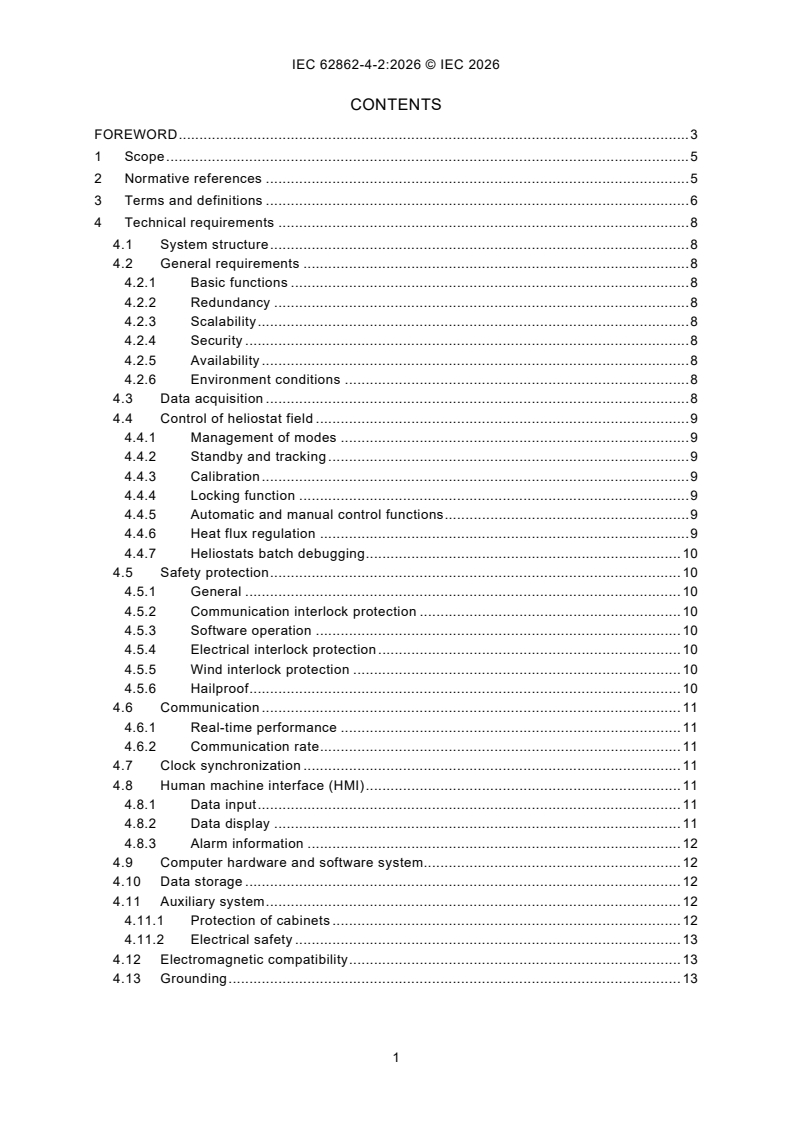
CONTENTS
FOREWORD . 3
1 Scope . 5
2 Normative references . 5
3 Terms and definitions . 6
4 Technical requirements . 8
4.1 System structure . 8
4.2 General requirements . 8
4.2.1 Basic functions . 8
4.2.2 Redundancy . 8
4.2.3 Scalability . 8
4.2.4 Security . 8
4.2.5 Availability . 8
4.2.6 Environment conditions . 8
4.3 Data acquisition . 8
4.4 Control of heliostat field . 9
4.4.1 Management of modes . 9
4.4.2 Standby and tracking . 9
4.4.3 Calibration . 9
4.4.4 Locking function . 9
4.4.5 Automatic and manual control functions . 9
4.4.6 Heat flux regulation . 9
4.4.7 Heliostats batch debugging . 10
4.5 Safety protection . 10
4.5.1 General . 10
4.5.2 Communication interlock protection . 10
4.5.3 Software operation . 10
4.5.4 Electrical interlock protection . 10
4.5.5 Wind interlock protection . 10
4.5.6 Hailproof . 10
4.6 Communication . 11
4.6.1 Real-time performance . 11
4.6.2 Communication rate . 11
4.7 Clock synchronization . 11
4.8 Human machine interface (HMI) . 11
4.8.1 Data input . 11
4.8.2 Data display . 11
4.8.3 Alarm information . 12
4.9 Computer hardware and software system. 12
4.10 Data storage . 12
4.11 Auxiliary system . 12
4.11.1 Protection of cabinets . 12
4.11.2 Electrical safety . 13
4.12 Electromagnetic compatibility . 13
4.13 Grounding . 13
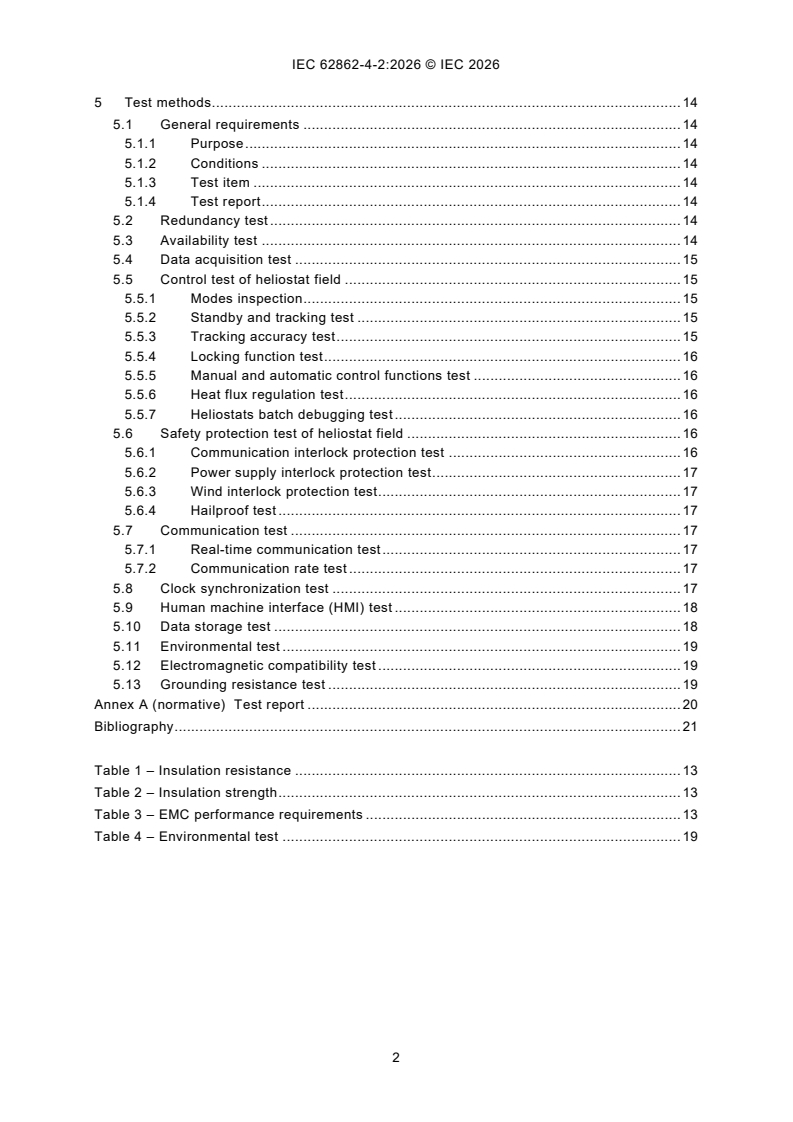
5 Test methods . 14
5.1 General requirements . 14
5.1.1 Purpose . 14
5.1.2 Conditions . 14
5.1.3 Test item . 14
5.1.4 Test report . 14
5.2 Redundancy test . 14
5.3 Availability test . 14
5.4 Data acquisition test . 15
5.5 Control test of heliostat field . 15
5.5.1 Modes inspection . 15
5.5.2 Standby and tracking test . 15
5.5.3 Tracking accuracy test . 15
5.5.4 Locking function test . 16
5.5.5 Manual and automatic control functions test . 16
5.5.6 Heat flux regulation test . 16
5.5.7 Heliostats batch debugging test . 16
5.6 Safety protection test of heliostat field . 16
5.6.1 Communication interlock protection test . 16
5.6.2 Power supply interlock protection test . 17
5.6.3 Wind interlock protection test . 17
5.6.4 Hailproof test . 17
5.7 Communication test . 17
5.7.1 Real-time communication test . 17
5.7.2 Communication rate test . 17
5.8 Clock synchronization test . 17
5.9 Human machine interface (HMI) test . 18
5.10 Data storage test . 18
5.11 Environmental test . 19
5.12 Electromagnetic compatibility test . 19
5.13 Grounding resistance test . 19
Annex A (normative) Test report . 20
Bibliography . 21
Table 1 – Insulation resistance . 13
Table 2 – Insulation strength . 13
Table 3 – EMC performance requirements . 13
Table 4 – Environmental test . 19
INTERNATIONAL ELECTROTECHNICAL COMMISSION
____________
Solar thermal electric plants -
Part 4-2: Heliostat field control system of solar tower plants
FOREWORD
1) The International Electrotechnical Commission (IEC) is a worldwide organization for
standardization comprising all national electrotechnical committees (IEC National Committees).
The object of IEC is to promote international co-operation on all questions concerning
standardization in the electrical and electronic fields. To this end and in addition to other
activities, IEC publishes International Standards, Technical Specifications, Technical Reports,
Publicly Available Specifications (PAS) and Guides (hereafter referred to as “IEC
Publication(s)”). Their preparation is entrusted to technical committees; any IEC National
Committee interested in the subject dealt with may participate in this preparatory work.
International, governmental and non-governmental organizations liaising with the IEC also
participate in this preparation. IEC collaborates closely with the International Organization for
Standardization (ISO) in accordance with conditions determined by agreement between the two
organizations.
2) The formal decisions or agreements of IEC on technical matters express, as nearly as
possible, an international consensus of opinion on the relevant subjects since each technical
committee has representation from all interested IEC National Committees.
3) IEC Publications have the form of recommendations for international use and are accepted
by IEC National Committees in that sense. While all reasonable efforts are made to ensure that
the technical content of IEC Publications is accurate, IEC cannot be held responsible for the
way in which they are used or for any misinterpretation by any end user.
4) In order to promote international uniformity, IEC National Committees undertake to apply IEC
Publications transparently to the maximum extent possible in their national and regional
publications. Any divergence between any IEC Publication and the corresponding national or
regional publication shall be clearly indicated in the latter.
5) IEC itself does not provide any attestation of conformity. Independent certification bodies
provide conformity assessment services and, in some areas, access to IEC marks of conformity.
IEC is not responsible for any services carried out by independent certification bodies.
6) All users should ensure that they have the latest edition of this publication.
7) No liability shall attach to IEC or its directors, employees, servants or agents including
individual experts and members of its technical committees and IEC National Committees for
any personal injury, property damage or other damage of any nature whatsoever, whether direct
or indirect, or for costs (including legal fees) and expenses arising out of the publication, use
of, or reliance upon, this IEC Publication or any other IEC Publications.
8) Attention is drawn to the Normative references cited in this publication. Use of the referenced
publications is indispensable for the correct application of this publication.
9) IEC draws attention to the possibility that the implementation of this document may involve
the use of (a) patent(s). IEC takes no position concerning the evidence, validity or applicability
of any claimed patent rights in respect thereof. As of the date of publication of this document,
IEC had not received notice of (a) patent(s), which may be required to implement this document.
However, implementers are cautioned that this may not represent the latest information, which
may be obtained from the patent database available at https://patents.iec.ch. IEC shall not be
held responsible for identifying any or all such patent rights.
IEC 62862-4-2 has been prepared by IEC technical committee 117: Solar thermal electric
plants . It is an International Standard.
The text of this International Standard is based on the following documents:
Draft Report on voting
117/XX/CD 117/186/CC
Full information on the voting for its approval can be found in the report on voting indicated in
the above table.
The language used for the development of this International Standard is English.
This document was drafted in accordance with ISO/IEC Directives, Part 2, and developed in
accordance with ISO/IEC Directives, Part 1 and ISO/IEC Directives, IEC Supplement, available
at www.iec.ch/members_experts/refdocs. The main document types developed by IEC are
described in greater detail at www.iec.ch/publications.
The committee has decided that the contents of this document will remain unchanged until the
stability date indicated on the IEC website under webstore.iec.ch in the data related to the
specific document. At this date, the document will be
– reconfirmed,
– withdrawn or,
– revised.
1 Scope
This document specifies the technical requirements and test methods for the heliostat field
control system of solar power tower plants.
This document provides the technical requirements of function, performance, and safety
constraints of the heliostat field control system, and is applicable to the heliostat field control
system of solar power tower plants.
This document includes procedures for testing the functionality and performance requirements
of the heliostat field control system. It describes the test methods, steps, conditions, and
required instruments.
2 Normative references
The following documents are referred to in the text in such a way that some or all of their content
constitutes requirements of this document. For dated references, only the edition cited applies.
For undated references, the latest edition of the referenced document (including any
amendments) applies.
IEC 60050-601, International Electrotechnical Vocabulary (IEV) - Part 601: Generation,
transmission and distribution of electricity - General
IEC 60068-2-1, Environmental testing - Part 2-1: Tests - Test A: Cold
IEC 60068-2-2, Environmental testing - Part 2-2: Tests - Test B: Dry heat
IEC 60068-2-6, Environmental testing - Part 2-6: Tests - Test Fc: Vibration(sinusoidal)
IEC 60068-2-11, Envrionmental testing for electric and electronic products - Part 2: Test method
- Test Ka: Salt mist
IEC 60068-2-13, Basic environmental testing procedures - Part 2-13: Tests - Test M: Low air
pressure
IEC 60068-2-14, Basic environmental testing procedures - Part 2-14: Tests - Test N: Change
of temperature
IEC 60068-2-78, Environmental Testing - Part 2-78: Tests - Test Cab: Damp heat, steady state
IEC 60529, Degrees of protection provided by enclosures (IP Code)
IEC 61000-4-2, Electromagnetic compatibility (EMC) - Part 4-2: Testing and measurement
techniques - Electrostatic discharge immunity test
IEC 61000-4-3, Electromagnetic compatibility (EMC) - Part 4-3 : Testing and measurement
techniques - Radiated, radio-frequency, electromagnetic field immunity test
IEC 61000-4-4, Electromagnetic compatibility (EMC) - Part 4-4: Testing and measurement
techniques - Electrical fast transient/burst immunity test
IEC 61000-4-5, Electromagnetic compatibility (EMC) - Part 4-5: Testing and measurement
techniques - Surge immunity test
IEC 61000-4-8, Electromagnetic compatibility (EMC) - Part 4-8: Testing and measurement
techniques - Power frequency magnetic field immunity test
IEC 61000-4-11, Electromagnetic compatibility (EMC) - Part 4-11: Testing and measurement
techniques - Voltage dips, short interruptions and voltage variations immunity tests for
equipment with input current up to 16 A per phase
IEC 61010-1, Safety requirements for electrical equipment for measurement, control, and
laboratory use - Part 1: General requirements
IEC 61557-5, Electrical safety in low voltage distribution systems up to 1000 V a.c. and 1500 V
d.c. - Equipment for testing, measuring or monitoring of protective measures - Part 5:
Resistance to earth
IEC 62443-2-4, Security for industrial automation and control systems - Part 2-4: Security
program requirements for IACS service providers
IEC TS 62862-1-1, Solar thermal electric plants - Part 1-1: Terminology
IEC 62862-4-1, Solar thermal electric plants - Part 4-1: General requirements for the design of
solar tower plants
3 Terms and definitions
For the purposes of this document, the terms and definitions given in IEC TS 62862-1-1,
IEC 62862-4-1, IEC 60050-601 and the following apply.
ISO and IEC maintain terminology databases for use in standardization at the following
addresses:
– IEC Electropedia: available at https://www.electropedia.org/
– ISO Online browsing platform: available at https://www.iso.org/obp
3.1
heliostat field control system
HFCS
dedicated set of elements responsible for heliostat field data acquisition, heliostat field
management, control of each heliostat, calibration process, statistics of heliostat tracking
performance, safety protection, fault statistics and maintenance support
3.2
defocusing
operation that moves the beam of one or more heliostats from focus positions to a safe position
away from the receiver and other installations or obstructions
3.3
tracking mode
mode of the heliostat when the heliostat tracks the sun (or another source) automatically and
reflects the direct solar irradiation onto the specified coordinates on the absorber or any other
target
3.4
standby mode
mode of the heliostat when its reflected beam is pointed to a standby point close to the receiver
and the heliostat can switch to tracking mode quickly
3.5
calibration mode
mode of the heliostat when the tracking deviation of the heliostat is calibrated to realize accurate
tracking
3.6
stop mode
mode of the heliostat when the heliostat stops in the current position once the command is
received
3.7
windproof mode
mode of the heliostat when the heliostat is in a safe position during a high wind event
Note 1 to entry: In this mode, the heliostat may be stowed or placed in another position.
3.8
hailproof mode
mode of the heliostat when the heliostat moves to a position to protect itself from hail
3.9
cleaning mode
mode of the heliostat when the heliostat moves to a particular angle for easy surface cleaning
3.10
homing mode
mode of the heliostat when the heliostat moves to its initial position
3.11
maintenance mode
mode of the heliostat when the heliostat is secured in a stationary position to facilitate fault
diagnosis and repair by the operator
3.12
sleeping mode
mode of the heliostat during non-operational periods when a minimum power consumption of
the electronic components is required
3.13
local control mode
mode of the heliostat when it is under local control and it is not able to respond to the command
of the control room
3.14
error mode
mode into which a heliostat goes if it encounters an electrical or mechanical error such as
jammed actuator, power loss, overcurrent, overtemperature, etc.
3.15
out of service
circumstance in which the heliostat has fallen out of communication
3.16
tracking accuracy
deviation between nominal and actual beam centroid upon the target
Note 1 to entry: The tracking accuracy is expressed as an angle that is formed by two lines: 1) rotation centre point
of the heliostat to the geometric centre point of the beam formed by the sunlight converging on the target surface
(through the heliostat), and 2) rotation centre point of the heliostat to the target point on the target surface.
Note 2 to entry: The unit of the tracking accuracy is mrad.
4 Technical requirements
4.1 System structure
The heliostat field control system shall include, at a minimum, the server, the operator station
located in the control room, and the field control equipment located in the heliostat field.
4.2 General requirements
4.2.1 Basic functions
The heliostat field control system shall have the functions of data acquisition and control of the
heliostat field equipment, calibration of the entire heliostat field, heliostat field safety protection,
clock synchronization, communication and data storage.
4.2.2 Redundancy
The heliostat field control system shall incorporate redundancy in all critical components which
can cause the heliostat field to be inoperable due to malfunctions, including servers, network,
equipment, and control modules. Each server shall be able to handle the entire data access
load of all clients.
When the duty equipment fails, the standby equipment shall take over the control of the heliostat
field without disturbing the system.
The heliostat field control system shall be configured with at least two power supplies (one of
which shall be an emergency power supply), to ensure that the connected equipment can run
at maximum load in case of any power fail.
The emergency power supply of the heliostat field control system may be centralized or
decentralized. The duration of the emergency power supply for the the control room equipment
shall not be less than 30 min, and the duration of the emergency power supply for heliostats'
local controllers shall not be less than twice the maximum time required for the heliostats to
move to windproof mode.
4.2.3 Scalability
It is recommended that the heliostat field control system should be scalable to adapt to the
increase in heliostat field scale, without reconstructing or rebuilding the control system.
4.2.4 Security
The security of the heliostat field control system shall meet the requirements of IEC 62443-2-4.
4.2.5 Availability
The availability of the heliostat control system is the proportion of the number of local controllers
that can function properly to the total number of local controllers in the heliostat field. The
average annual availability of the heliostat control system should be higher than 99 %.
4.2.6 Environment conditions
The heliostat field control system shall be able to withstand the local environment conditions,
including temperature, humidity, altitude, corrosivity class, etc.
4.3 Data acquisition
The heliostat field control system shall acquire the following data:
– Current mode and current angles of the heliostat;
– Diagnostic data and fault data of the heliostat;
– Environmental parameters including direct normal irradiance, wind speed and wind
direction, temperature, and humidity;
– Temperature data of the receiver relevant for the heliostat field control (relevant temperature
data are determined as provided by the receiver manufacturer);
– Control command of the heliostat field provided by the control system of the whole plant.
NOTE Wind speed in this document refers to the average wind speed within a 10 min period at 10 m height.
4.4 Control of heliostat field
4.4.1 Management of modes
The heliostat field control system shall support a range of operational modes tailored to system
needs and environmental conditions. These modes include tracking mode, standby mode,
calibration mode, stop mode, windproof mode, hailproof mode, cleaning mode, homing mode,
maintenance mode, sleeping mode, error mode, out of service, and local control mode.
Depending on the specific system configuration, some modes may be excluded if their
functionalities are integrated or rendered unnecessary.
4.4.2 Standby and tracking
The heliostat field control system shall be able to set and adjust the aim points of the standby
mode and tracking mode provided that the safety of the receiver tower is guaranteed.
4.4.3 Calibration
The heliostat field control system shall be able to calibrate all the heliostats to meet the
requirements of tracking accuracy.
The heliostat field control system should complete the calibration of the entire heliostat field
within two months after construction if the total reflection area of the heliostat field is less than
6 2 6 2
10 m , and within four months if the total reflection area of the heliostat field exceeds 10 m .
Calibration shall be done periodi
...