

IEC 62358:2026
(Main)Ferrite cores - Standard inductance factor for gapped cores and its tolerance
General Information
- Abstract
IEC 62358:2026 provides standard AL values (inductance factors) and their tolerances of Pot, RM, ETD, E, EER, EP, PQ, PM, EC, EFD and low-profile gapped ferrite cores.
This edition includes the following significant technical changes with respect to the previous edition:
a) addition of AL value (inductance factor) and its tolerance for PM-cores;
b) addition of AL value (inductance factor) and its tolerance for EC-cores;
c) addition of AL value (inductance factor) and its tolerance for EFD-cores.
- Status
- Published
- Publication Date
- 13-Jan-2026
- Technical Committee
- TC 51 - Magnetic components, ferrite and magnetic powder materials
- Drafting Committee
- WG 1 - TC 51/WG 1
- Current Stage
- PPUB - Publication issued
- Start Date
- 14-Jan-2026
- Completion Date
- 06-Feb-2026
Buy Documents
IEC 62358:2026 - Ferrite cores - Standard inductance factor for gapped cores and its tolerance/14/2026

IEC 62358:2026 RLV - Ferrite cores - Standard inductance factor for gapped cores and its tolerance Released:1/14/2026
Overview
IEC 62358:2026 is an international standard published by the International Electrotechnical Commission (IEC) that specifies the standard inductance factor (AL value) and its tolerances for a wide range of gapped ferrite cores. This standard applies to Pot, RM, ETD, E, EER, EP, PQ, PM, EC, EFD, and other low-profile core shapes commonly used in magnetic components for electronic devices.
The main objective of this standard is to provide a uniform system for specifying AL values and tolerances, which leads to better interchangeability, improved supply chain management, and streamlined design processes for manufacturers and users of ferrite core-based inductive components.
New in this edition:
- Addition of AL values and tolerances for PM-cores, EC-cores, and EFD-cores, expanding coverage and offering designers more standardized options.
Key Topics
- Standardization of AL (Inductance Factor) Values: Defines preferred AL values for gapped ferrite cores, facilitating compatibility and easier specification.
- Tolerance Letter Coding: Specifies a system of letter codes (such as A, J, E, K) corresponding to standard tolerance levels on AL values, enabling clear and concise tolerance specifications.
- Core Types Covered:
- Pot-cores
- RM-cores
- ETD-cores
- E-cores
- EER-cores
- EP-cores
- PQ-cores
- PM-cores (new)
- EC-cores (new)
- EFD-cores (new)
- Various low-profile planar cores
- Measuring Method: Requires use of the methods specified in IEC 62044-2 for determining the inductance factor to ensure accuracy and consistency.
- Selection of Preferred Numbers: Uses the R10 series from ISO 497 to define standard AL values.
Applications
Adherence to IEC 62358:2026 enables consistent and reliable design of ferrite core-based inductive components such as transformers and chokes, which are widely used in:
- Power supplies (including switch-mode power supplies and adapters)
- Telecommunications equipment
- Signal filtering applications
- Consumer electronics (e.g., TVs, computers)
- Industrial control systems
- Research and development: Ensures rapid prototyping by enabling use of standard parts with guaranteed performance and availability.
Key practical benefits include:
- Interchangeability: Use of standard AL values and tolerances ensures components from different suppliers are compatible.
- Shorter lead times: Standardization allows suppliers to stock common gapped cores, expediting delivery for both sampling and production.
- Reduced inventory risks: Streamlines component selection and management, mitigating issues of obsolete or excess stock.
- Design efficiency: Simplifies specification and tolerancing, helping engineers focus on high-level electrical requirements rather than individual core parameters.
Related Standards
Several IEC standards relate to core geometries and measuring methods complementary to IEC 62358:2026, including:
- IEC 62044-2: Cores made of soft magnetic materials - Measuring methods - Part 2: Magnetic properties at low excitation level.
- IEC 63093 series: Ferrite cores - Guidelines on dimensions and the limits of surface irregularities, with separate parts for each major core type:
- IEC 63093-2 (Pot-cores)
- IEC 63093-4 (RM-cores)
- IEC 63093-5 (EP-cores)
- IEC 63093-6 (ETD-cores)
- IEC 63093-7 (EER-cores)
- IEC 63093-8 (E-cores)
- IEC 63093-9 (Planar/low-profile cores)
- IEC 63093-10 (PM-cores)
- IEC 63093-11 (EC-cores)
- IEC 63093-13 (PQ-cores)
- IEC 63093-14 (EFD-cores)
- ISO 497: Guide to the choice of series of preferred numbers and of series containing more rounded values of preferred numbers.
Conclusion
IEC 62358:2026 plays a crucial role in the standardization of ferrite core AL values and tolerances, supporting efficient, reliable, and interchangeable design and procurement of magnetic components across the electronics industry. By adopting these standard values, organizations benefit from improved product consistency, logistics, and quality control, making IEC 62358:2026 essential for anyone specifying or manufacturing components using gapped ferrite cores.
Relations
- Revises
IEC 62358:2012 - Ferrite cores - Standard inductance factor for gapped cores and its tolerance - Effective Date
- 19-Jan-2024
Buy Documents
IEC 62358:2026 - Ferrite cores - Standard inductance factor for gapped cores and its tolerance/14/2026
IEC 62358:2026 RLV - Ferrite cores - Standard inductance factor for gapped cores and its tolerance Released:1/14/2026
Get Certified
Connect with accredited certification bodies for this standard

IMQ S.p.A. (Certification)
Italian electrical product certification.

SLG Prüf- und Zertifizierungs GmbH
German testing and certification body.

UL Solutions
Global safety science company with testing, inspection and certification.
Sponsored listings
Frequently Asked Questions
IEC 62358:2026 is a standard published by the International Electrotechnical Commission (IEC). Its full title is "Ferrite cores - Standard inductance factor for gapped cores and its tolerance". This standard covers: IEC 62358:2026 provides standard AL values (inductance factors) and their tolerances of Pot, RM, ETD, E, EER, EP, PQ, PM, EC, EFD and low-profile gapped ferrite cores. This edition includes the following significant technical changes with respect to the previous edition: a) addition of AL value (inductance factor) and its tolerance for PM-cores; b) addition of AL value (inductance factor) and its tolerance for EC-cores; c) addition of AL value (inductance factor) and its tolerance for EFD-cores.
IEC 62358:2026 provides standard AL values (inductance factors) and their tolerances of Pot, RM, ETD, E, EER, EP, PQ, PM, EC, EFD and low-profile gapped ferrite cores. This edition includes the following significant technical changes with respect to the previous edition: a) addition of AL value (inductance factor) and its tolerance for PM-cores; b) addition of AL value (inductance factor) and its tolerance for EC-cores; c) addition of AL value (inductance factor) and its tolerance for EFD-cores.
IEC 62358:2026 is classified under the following ICS (International Classification for Standards) categories: 29.100.10 - Magnetic components. The ICS classification helps identify the subject area and facilitates finding related standards.
IEC 62358:2026 has the following relationships with other standards: It is inter standard links to IEC 62358:2012. Understanding these relationships helps ensure you are using the most current and applicable version of the standard.
IEC 62358:2026 is available in PDF format for immediate download after purchase. The document can be added to your cart and obtained through the secure checkout process. Digital delivery ensures instant access to the complete standard document.
Standards Content (Sample)
IEC 62358 ®
Edition 3.0 2026-01
INTERNATIONAL
STANDARD
Ferrite cores - Standard inductance factor for gapped cores and its tolerance
ICS 29.100.10 ISBN 978-2-8327-0980-1
All rights reserved. Unless otherwise specified, no part of this publication may be reproduced or utilized in any form or
by any means, electronic or mechanical, including photocopying and microfilm, without permission in writing from either
IEC or IEC's member National Committee in the country of the requester. If you have any questions about IEC copyright
or have an enquiry about obtaining additional rights to this publication, please contact the address below or your local
IEC member National Committee for further information.
IEC Secretariat Tel.: +41 22 919 02 11
3, rue de Varembé info@iec.ch
CH-1211 Geneva 20 www.iec.ch
Switzerland
About the IEC
The International Electrotechnical Commission (IEC) is the leading global organization that prepares and publishes
International Standards for all electrical, electronic and related technologies.
About IEC publications
The technical content of IEC publications is kept under constant review by the IEC. Please make sure that you have the
latest edition, a corrigendum or an amendment might have been published.
IEC publications search - IEC Products & Services Portal - products.iec.ch
webstore.iec.ch/advsearchform Discover our powerful search engine and read freely all the
The advanced search enables to find IEC publications by a publications previews, graphical symbols and the glossary.
variety of criteria (reference number, text, technical With a subscription you will always have access to up to date
committee, …). It also gives information on projects, content tailored to your needs.
replaced and withdrawn publications.
Electropedia - www.electropedia.org
The world's leading online dictionary on electrotechnology,
IEC Just Published - webstore.iec.ch/justpublished
Stay up to date on all new IEC publications. Just Published containing more than 22 500 terminological entries in English
details all new publications released. Available online and and French, with equivalent terms in 25 additional languages.
once a month by email. Also known as the International Electrotechnical Vocabulary
(IEV) online.
IEC Customer Service Centre - webstore.iec.ch/csc
If you wish to give us your feedback on this publication or
need further assistance, please contact the Customer
Service Centre: sales@iec.ch.
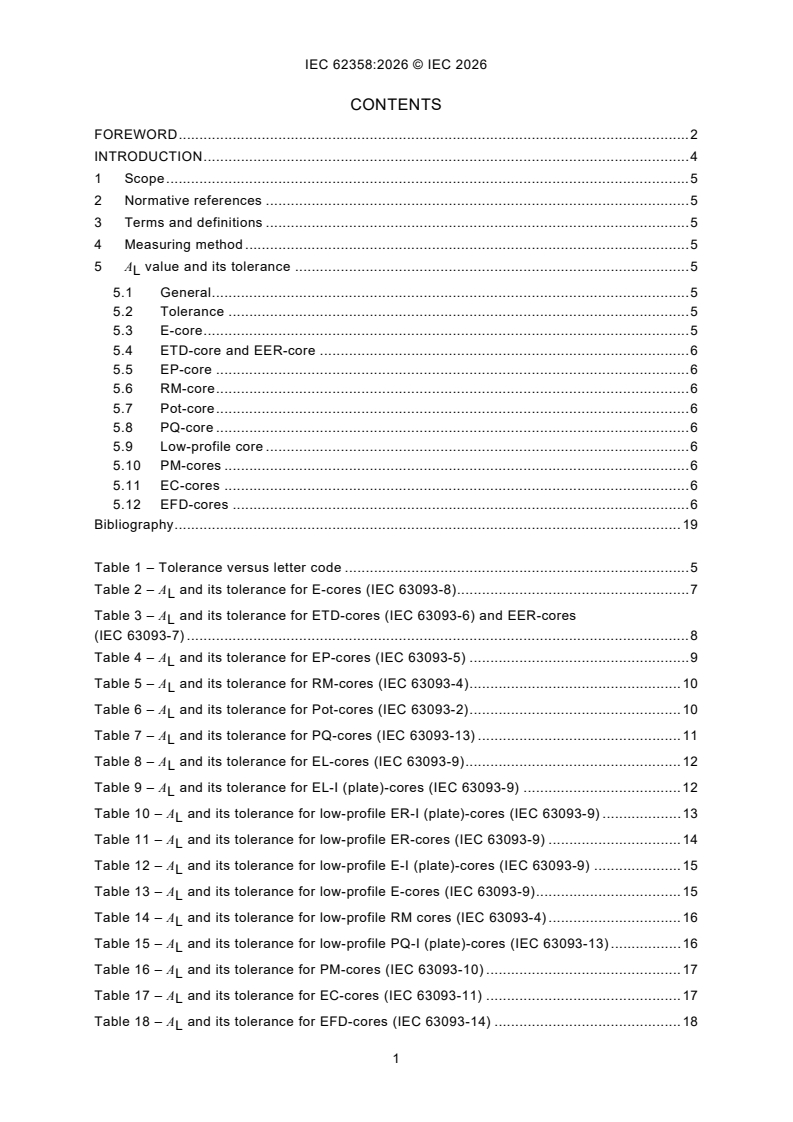
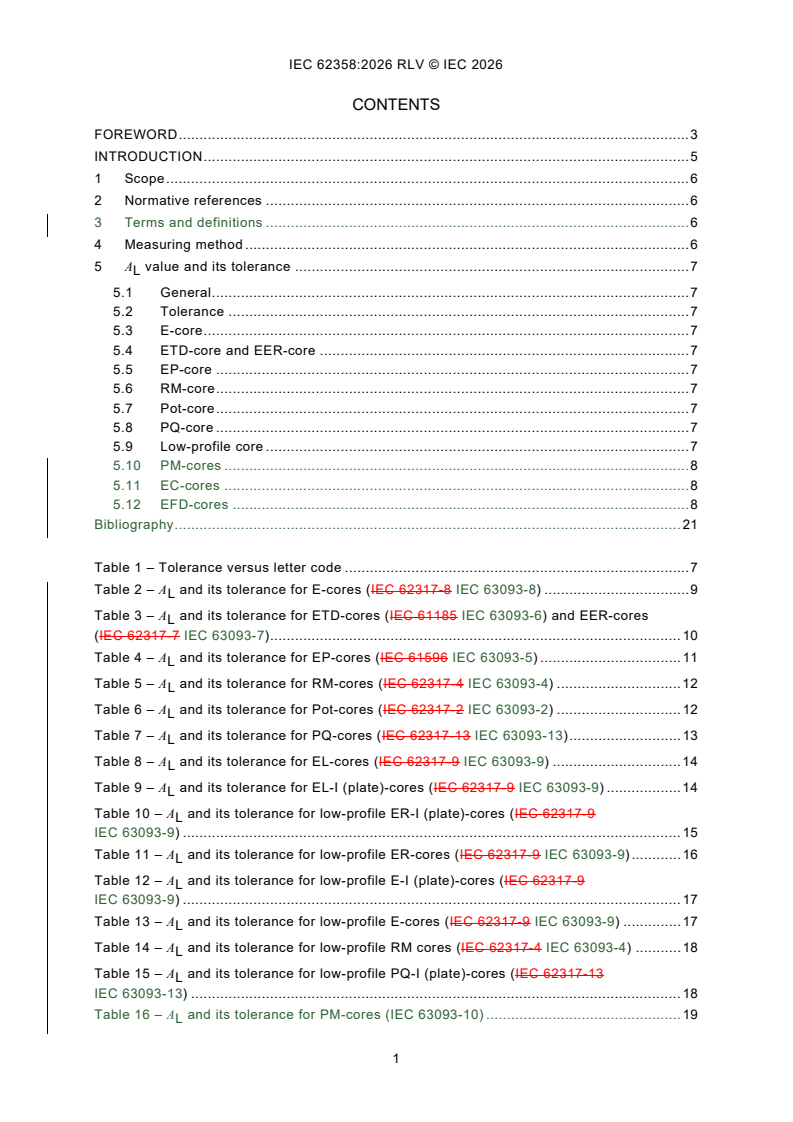
CONTENTS
FOREWORD . 2
INTRODUCTION . 4
1 Scope . 5
2 Normative references . 5
3 Terms and definitions . 5
4 Measuring method . 5
5 A value and its tolerance . 5
L
5.1 General . 5
5.2 Tolerance . 5
5.3 E-core . 5
5.4 ETD-core and EER-core . 6
5.5 EP-core . 6
5.6 RM-core . 6
5.7 Pot-core . 6
5.8 PQ-core . 6
5.9 Low-profile core . 6
5.10 PM-cores . 6
5.11 EC-cores . 6
5.12 EFD-cores . 6
Bibliography . 19
Table 1 – Tolerance versus letter code . 5
Table 2 – A and its tolerance for E-cores (IEC 63093-8) . 7
L
Table 3 – A and its tolerance for ETD-cores (IEC 63093-6) and EER-cores
L
(IEC 63093-7) . 8
Table 4 – A and its tolerance for EP-cores (IEC 63093-5) . 9
L
Table 5 – A and its tolerance for RM-cores (IEC 63093-4) . 10
L
Table 6 – A and its tolerance for Pot-cores (IEC 63093-2) . 10
L
Table 7 – A and its tolerance for PQ-cores (IEC 63093-13) . 11
L
Table 8 – A and its tolerance for EL-cores (IEC 63093-9) . 12
L
Table 9 – A and its tolerance for EL-I (plate)-cores (IEC 63093-9) . 12
L
Table 10 – A and its tolerance for low-profile ER-I (plate)-cores (IEC 63093-9) . 13
L
Table 11 – A and its tolerance for low-profile ER-cores (IEC 63093-9) . 14
L
Table 12 – A and its tolerance for low-profile E-I (plate)-cores (IEC 63093-9) . 15
L
Table 13 – A and its tolerance for low-profile E-cores (IEC 63093-9) . 15
L
Table 14 – A and its tolerance for low-profile RM cores (IEC 63093-4) . 16
L
Table 15 – A and its tolerance for low-profile PQ-I (plate)-cores (IEC 63093-13) . 16
L
Table 16 – A and its tolerance for PM-cores (IEC 63093-10) . 17
L
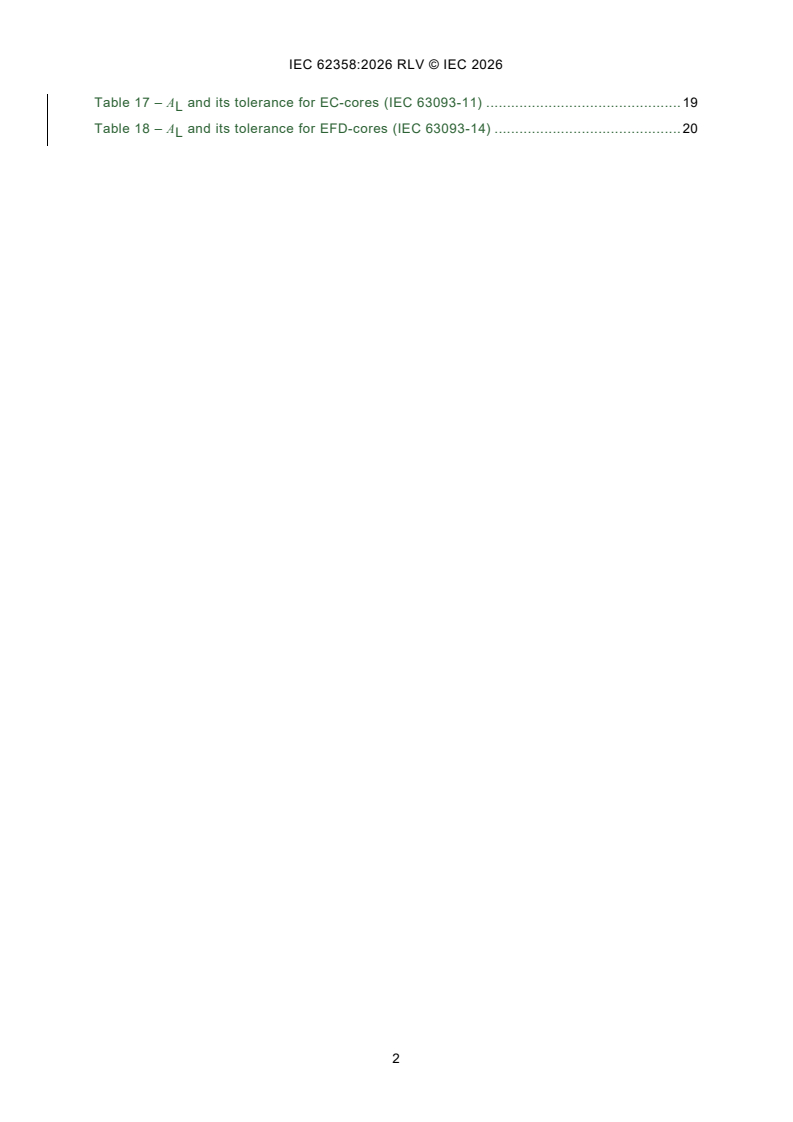
Table 17 – A and its tolerance for EC-cores (IEC 63093-11) . 17
L
Table 18 – A and its tolerance for EFD-cores (IEC 63093-14) . 18
L
INTERNATIONAL ELECTROTECHNICAL COMMISSION
____________
Ferrite cores -
Standard inductance factor for gapped cores and its tolerance
FOREWORD
1) The International Electrotechnical Commission (IEC) is a worldwide organization for standardization comprising
all national electrotechnical committees (IEC National Committees). The object of IEC is to promote international
co-operation on all questions concerning standardization in the electrical and electronic fields. To this end and
in addition to other activities, IEC publishes International Standards, Technical Specifications, Technical Reports,
Publicly Available Specifications (PAS) and Guides (hereafter referred to as “IEC Publication(s)”). Their
preparation is entrusted to technical committees; any IEC National Committee interested in the subject dealt with
may participate in this preparatory work. International, governmental and non-governmental organizations liaising
with the IEC also participate in this preparation. IEC collaborates closely with the International Organization for
Standardization (ISO) in accordance with conditions determined by agreement between the two organizations.
2) The formal decisions or agreements of IEC on technical matters express, as nearly as possible, an international
consensus of opinion on the relevant subjects since each technical committee has representation from all
interested IEC National Committees.
3) IEC Publications have the form of recommendations for international use and are accepted by IEC National
Committees in that sense. While all reasonable efforts are made to ensure that the technical content of IEC
Publications is accurate, IEC cannot be held responsible for the way in which they are used or for any
misinterpretation by any end user.
4) In order to promote international uniformity, IEC National Committees undertake to apply IEC Publications
transparently to the maximum extent possible in their national and regional publications. Any divergence between
any IEC Publication and the corresponding national or regional publication shall be clearly indicated in the latter.
5) IEC itself does not provide any attestation of conformity. Independent certification bodies provide conformity
assessment services and, in some areas, access to IEC marks of conformity. IEC is not responsible for any
services carried out by independent certification bodies.
6) All users should ensure that they have the latest edition of this publication.
7) No liability shall attach to IEC or its directors, employees, servants or agents including individual experts and
members of its technical committees and IEC National Committees for any personal injury, property damage or
other damage of any nature whatsoever, whether direct or indirect, or for costs (including legal fees) and
expenses arising out of the publication, use of, or reliance upon, this IEC Publication or any other IEC
Publications.
8) Attention is drawn to the Normative references cited in this publication. Use of the referenced publications is
indispensable for the correct application of this publication.
9) IEC draws attention to the possibility that the implementation of this document may involve the use of (a)
patent(s). IEC takes no position concerning the evidence, validity or applicability of any claimed patent rights in
respect thereof. As of the date of publication of this document, IEC had not received notice of (a) patent(s), which
may be required to implement this document. However, implementers are cautioned that this may not represent
the latest information, which may be obtained from the patent database available at https://patents.iec.ch. IEC
shall not be held responsible for identifying any or all such patent rights.
IEC 62358 has been prepared by IEC technical committee 51: Magnetic components, ferrite
and magnetic powder materials. It is an International Standard.
This third edition cancels and replaces the second edition published in 2012. This edition
constitutes a technical revision.
This edition includes the following significant technical changes with respect to the previous
edition:
a) addition of A value (inductance factor) and its tolerance for PM-cores;
L
b) addition of A value (inductance factor) and its tolerance for EC-cores;
L
c) addition of A value (inductance factor) and its tolerance for EFD-cores.
L
The text of this International Standard is based on the following documents:
Draft Report on voting
51/1583/FDIS 51/1595/RVD
Full information on the voting for its approval can be found in the report on voting indicated in
the above table.
The language used for the development of this International Standard is English.
This document was drafted in accordance with ISO/IEC Directives, Part 2, and developed in
accordance with ISO/IEC Directives, Part 1 and ISO/IEC Directives, IEC Supplement, available
at www.iec.ch/members_experts/refdocs. The main document types developed by IEC are
described in greater detail at www.iec.ch/publications.
The committee has decided that the contents of this document will remain unchanged until the
stability date indicated on the IEC website under webstore.iec.ch in the data related to the
specific document. At this date, the document will be
– reconfirmed,
– withdrawn, or
– revised.
INTRODUCTION
The A value (inductance factor) and its tolerance is a critical design parameter for gapped
L
ferrite core sets. For any core size, there is a wide range of possible gapped A values, and
L
there is no technical reason why a user could not select any precise value within the possible
range. But as a practical matter, there are advantages to the users that certain values within
the range are identified to be standard and to the users in selecting those values where possible.
The potential advantages include faster delivery from supplier inventories of standard gapped
parts, greater ease of obtaining small quantities for development sampling and low-volume
projects, interchangeability among multiple applications, reduced risk of dead inventories,
economies of scale from producing larger batches, and standardized tolerancing across
multiple suppliers.
It is important that users specify A values by selecting them from this document when possible.
L
The tolerances shown in this document are selected for suitable performance with best cost
and full interchangeability. Suppliers may offer tighter tolerances for their standard parts while
remaining in compliance with the standard. Users can require tighter tolerances for specific
applications.
In cases where users or suppliers specify a physical gap length with tolerances, then the A
L
value will only be approximate and without tolerance. It is generally true that better
measurement precision and better consistency in application performance is achieved by
specifying the A value and not the gap dimension. The exceptions are cases in which the gap
L
is quite large, where users can find that their application coil gives a more consistent result if
the gap dimension is controlled directly and the A value as measured in the supplier's standard
L
coil is allowed to vary.
1 Scope
This document provides standard A values (inductance factors) and their tolerances of Pot,
L
RM, ETD, E, EER, EP, PQ, PM, EC, EFD and low-profile gapped ferrite cores.
2 Normative references
The following documents are referred to in the text in such a way that some or all of their content
constitutes requirements of this document. For dated references, only the edition cited applies.
For undated references, the latest edition of the referenced document (including any
amendments) applies.
IEC 62044-2, Cores made of soft magnetic materials - Measuring methods - Part 2: Magnetic
properties at low excitation level
ISO 497, Guide to the choice of series of preferred numbers and of series containing more
rounded values of preferred numbers
3 Terms and definitions
No terms and definitions are listed in this document.
ISO and IEC maintain terminology databases for use in standardization at the following
addresses:
– IEC Electropedia: available at https://www.electropedia.org/
– ISO Online browsing platform: available at https://www.iso.org/obp
4 Measuring method
The method for measuring the inductance factor shall be in accordance with IEC 62044-2.
5 A value and its tolerance
L
5.1 General
The series of preferred numbers of the A value shall be selected from the R10 series of ISO 497.
L
5.2 Tolerance
The tolerance shall be selected from Table 1, which specifies letter codes for the tolerances.
Table 1 – Tolerance versus letter code
Tolerance % ±3 ±5 ±7 ±10 ±12 ±15 ±20
Letter code A J E K H L M
5.3 E-core
The A value and its tolerance for E-cores shall be selected from Table 2.
L
NOTE The E-core is a pair of an E-shape core.
...
IEC 62358 ®
Edition 3.0 2026-01
INTERNATIONAL
STANDARD
REDLINE VERSION
Ferrite cores - Standard inductance factor for gapped cores and its tolerance
ICS 29.100.10 ISBN 978-2-8327-1000-5
All rights reserved. Unless otherwise specified, no part of this publication may be reproduced or utilized in any form or
by any means, electronic or mechanical, including photocopying and microfilm, without permission in writing from either
IEC or IEC's member National Committee in the country of the requester. If you have any questions about IEC copyright
or have an enquiry about obtaining additional rights to this publication, please contact the address below or your local
IEC member National Committee for further information.
IEC Secretariat Tel.: +41 22 919 02 11
3, rue de Varembé info@iec.ch
CH-1211 Geneva 20 www.iec.ch
Switzerland
About the IEC
The International Electrotechnical Commission (IEC) is the leading global organization that prepares and publishes
International Standards for all electrical, electronic and related technologies.
About IEC publications
The technical content of IEC publications is kept under constant review by the IEC. Please make sure that you have the
latest edition, a corrigendum or an amendment might have been published.
IEC publications search - IEC Products & Services Portal - products.iec.ch
webstore.iec.ch/advsearchform Discover our powerful search engine and read freely all the
The advanced search enables to find IEC publications by a publications previews, graphical symbols and the glossary.
variety of criteria (reference number, text, technical With a subscription you will always have access to up to date
committee, …). It also gives information on projects, content tailored to your needs.
replaced and withdrawn publications.
Electropedia - www.electropedia.org
The world's leading online dictionary on electrotechnology,
IEC Just Published - webstore.iec.ch/justpublished
Stay up to date on all new IEC publications. Just Published containing more than 22 500 terminological entries in English
details all new publications released. Available online and and French, with equivalent terms in 25 additional languages.
once a month by email. Also known as the International Electrotechnical Vocabulary
(IEV) online.
IEC Customer Service Centre - webstore.iec.ch/csc
If you wish to give us your feedback on this publication or
need further assistance, please contact the Customer
Service Centre: sales@iec.ch.
CONTENTS
FOREWORD . 3
INTRODUCTION . 5
1 Scope . 6
2 Normative references . 6
3 Terms and definitions . 6
4 Measuring method . 6
5 A value and its tolerance . 7
L
5.1 General . 7
5.2 Tolerance . 7
5.3 E-core . 7
5.4 ETD-core and EER-core . 7
5.5 EP-core . 7
5.6 RM-core . 7
5.7 Pot-core . 7
5.8 PQ-core . 7
5.9 Low-profile core . 7
5.10 PM-cores . 8
5.11 EC-cores . 8
5.12 EFD-cores . 8
Bibliography . 21
Table 1 – Tolerance versus letter code . 7
Table 2 – A and its tolerance for E-cores (IEC 62317-8 IEC 63093-8) . 9
L
Table 3 – A and its tolerance for ETD-cores (IEC 61185 IEC 63093-6) and EER-cores
L
(IEC 62317-7 IEC 63093-7) . 10
Table 4 – A and its tolerance for EP-cores (IEC 61596 IEC 63093-5) . 11
L
Table 5 – A and its tolerance for RM-cores (IEC 62317-4 IEC 63093-4) . 12
L
Table 6 – A and its tolerance for Pot-cores (IEC 62317-2 IEC 63093-2) . 12
L
Table 7 – A and its tolerance for PQ-cores (IEC 62317-13 IEC 63093-13) . 13
L
Table 8 – A and its tolerance for EL-cores (IEC 62317-9 IEC 63093-9) . 14
L
Table 9 – A and its tolerance for EL-I (plate)-cores (IEC 62317-9 IEC 63093-9) . 14
L
Table 10 – A and its tolerance for low-profile ER-I (plate)-cores (IEC 62317-9
L
IEC 63093-9) . 15
Table 11 – A and its tolerance for low-profile ER-cores (IEC 62317-9 IEC 63093-9) . 16
L
Table 12 – A and its tolerance for low-profile E-I (plate)-cores (IEC 62317-9
L
IEC 63093-9) . 17
Table 13 – A and its tolerance for low-profile E-cores (IEC 62317-9 IEC 63093-9) . 17
L
Table 14 – A and its tolerance for low-profile RM cores (IEC 62317-4 IEC 63093-4) . 18
L
Table 15 – A and its tolerance for low-profile PQ-I (plate)-cores (IEC 62317-13
L
IEC 63093-13) . 18
Table 16 – A and its tolerance for PM-cores (IEC 63093-10) . 19
L
Table 17 – A and its tolerance for EC-cores (IEC 63093-11) . 19
L
Table 18 – A and its tolerance for EFD-cores (IEC 63093-14) . 20
L
INTERNATIONAL ELECTROTECHNICAL COMMISSION
____________
Ferrite cores -
Standard inductance factor for gapped cores and its tolerance
FOREWORD
1) The International Electrotechnical Commission (IEC) is a worldwide organization for standardization comprising
all national electrotechnical committees (IEC National Committees). The object of IEC is to promote international
co-operation on all questions concerning standardization in the electrical and electronic fields. To this end and
in addition to other activities, IEC publishes International Standards, Technical Specifications, Technical Reports,
Publicly Available Specifications (PAS) and Guides (hereafter referred to as “IEC Publication(s)”). Their
preparation is entrusted to technical committees; any IEC National Committee interested in the subject dealt with
may participate in this preparatory work. International, governmental and non-governmental organizations liaising
with the IEC also participate in this preparation. IEC collaborates closely with the International Organization for
Standardization (ISO) in accordance with conditions determined by agreement between the two organizations.
2) The formal decisions or agreements of IEC on technical matters express, as nearly as possible, an international
consensus of opinion on the relevant subjects since each technical committee has representation from all
interested IEC National Committees.
3) IEC Publications have the form of recommendations for international use and are accepted by IEC National
Committees in that sense. While all reasonable efforts are made to ensure that the technical content of IEC
Publications is accurate, IEC cannot be held responsible for the way in which they are used or for any
misinterpretation by any end user.
4) In order to promote international uniformity, IEC National Committees undertake to apply IEC Publications
transparently to the maximum extent possible in their national and regional publications. Any divergence between
any IEC Publication and the corresponding national or regional publication shall be clearly indicated in the latter.
5) IEC itself does not provide any attestation of conformity. Independent certification bodies provide conformity
assessment services and, in some areas, access to IEC marks of conformity. IEC is not responsible for any
services carried out by independent certification bodies.
6) All users should ensure that they have the latest edition of this publication.
7) No liability shall attach to IEC or its directors, employees, servants or agents including individual experts and
members of its technical committees and IEC National Committees for any personal injury, property damage or
other damage of any nature whatsoever, whether direct or indirect, or for costs (including legal fees) and
expenses arising out of the publication, use of, or reliance upon, this IEC Publication or any other IEC
Publications.
8) Attention is drawn to the Normative references cited in this publication. Use of the referenced publications is
indispensable for the correct application of this publication.
9) IEC draws attention to the possibility that the implementation of this document may involve the use of (a)
patent(s). IEC takes no position concerning the evidence, validity or applicability of any claimed patent rights in
respect thereof. As of the date of publication of this document, IEC had not received notice of (a) patent(s), which
may be required to implement this document. However, implementers are cautioned that this may not represent
the latest information, which may be obtained from the patent database available at https://patents.iec.ch. IEC
shall not be held responsible for identifying any or all such patent rights.
This redline version of the official IEC Standard allows the user to identify the changes made
to the previous edition IEC 62358:2012. A vertical bar appears in the margin wherever a change
has been made. Additions are in green text, deletions are in strikethrough red text.
IEC 62358 has been prepared by IEC technical committee 51: Magnetic components, ferrite
and magnetic powder materials. It is an International Standard.
This third edition cancels and replaces the second edition published in 2012. This edition
constitutes a technical revision.
This edition includes the following significant technical changes with respect to the previous
edition:
a) addition of A value (inductance factor) and its tolerance for PM-cores;
L
b) addition of A value (inductance factor) and its tolerance for EC-cores;
L
c) addition of A value (inductance factor) and its tolerance for EFD-cores.
L
The text of this International Standard is based on the following documents:
Draft Report on voting
51/1583/FDIS 51/1595/RVD
Full information on the voting for its approval can be found in the report on voting indicated in
the above table.
The language used for the development of this International Standard is English.
This document was drafted in accordance with ISO/IEC Directives, Part 2, and developed in
accordance with ISO/IEC Directives, Part 1 and ISO/IEC Directives, IEC Supplement, available
at www.iec.ch/members_experts/refdocs. The main document types developed by IEC are
described in greater detail at www.iec.ch/publications.
The committee has decided that the contents of this document will remain unchanged until the
stability date indicated on the IEC website under webstore.iec.ch in the data related to the
specific document. At this date, the document will be
– reconfirmed,
– withdrawn, or
– revised.
INTRODUCTION
The A value (inductance factor) and its tolerance have been specified by the users before.
L
When manufacturers wish to have an inventory for short delivery, they have to hold the products
before gapping since there is no standard for the A value. Because of electronic commerce
L
and the increased demand for rapid delivery of products, it will be more convenient for
customers and suppliers to refer to established A values and tolerances. This standard has
L
been developed to meet this demand.
As a result of the implementation of this standard, it will be easier for core suppliers and users
to develop electronic components using gapped soft ferrite cores. Conventional businesses will
benefit, as will new companies working in new fields such as e-commerce.
It is recommended that users specify A values by selecting them from this standard. The
L
tolerances in this standard are recommended, but for historical reasons a manufacturer’s
specification might differ for some components. Users should confirm tolerances from the
manufacturer's literature. Manufacturers are encouraged to use the A values in this standard
L
when building stocks of gapped cores for short delivery. In cases where users or manufacturers
specify a gap length with tolerances the A value will only be approximate and without tolerance.
L
Such cases will be outside the scope of this standard.
The A value (inductance factor) and its tolerance is a critical design parameter for gapped
L
ferrite core sets. For any core size, there is a wide range of possible gapped A values, and
L
there is no technical reason why a user could not select any precise value within the possible
range. But as a practical matter, there are advantages to the users that certain values within
the range are identified to be standard and to the users in selecting those values where possible.
The potential advantages include faster delivery from supplier inventories of standard gapped
parts, greater ease of obtaining small quantities for development sampling and low-volume
projects, interchangeability among multiple applications, reduced risk of dead inventories,
economies of scale from producing larger batches, and standardized tolerancing across
multiple suppliers.
It is important that users specify A values by selecting them from this document when possible.
L
The tolerances shown in this document are selected for suitable performance with best cost
and full interchangeability. Suppliers may offer tighter tolerances for their standard parts while
remaining in compliance with the standard. Users can require tighter tolerances for specific
applications.
In cases where users or suppliers specify a physical gap length with tolerances, then the A
L
value will only be approximate and without tolerance. It is generally true that better
measurement precision and better consistency in application performance is achieved by
specifying the A value and not the gap dimension. The exceptions are cases in which the gap
L
is quite large, where users can find that their application coil gives a more consistent result if
the gap dimension is controlled directly and the A value as measured in the supplier's standard
L
coil is allowed to vary.
1 Scope
This document provides standard A values (inductance factors) and their tolerances of Pot,
L
RM, ETD, E, EER, EP, PQ, PM, EC, EFD and low-profile gapped ferrite cores.
2 Normative references
The following documents are referred to in the text in such a way that some or all of their content
constitutes requirements of this document. For dated references, only the edition cited applies.
For undated references, the latest edition of the referenced document (including any
amendments) applies.
IEC 61185, Ferrite cores (ETD-cores) intended for use in power supply applications –
Dimensions
IEC 61596, Magnetic oxide EP-cores and associated parts for use in inductors and transformers
– Dimensions
IEC 62044-2, Cores made of soft magnetic materials - Measuring methods - Part 2: Magnetic
properties at low excitation level
IEC 62317-2, Ferrite cores – Dimensions – Part 2: Pot-cores for use in telecommunications,
power supply, and filter applications
IEC 62317-4, Ferrite cores – Dimensions – Part 4: RM-cores and associated parts
IEC 62317-7, Ferrite cores – Dimensions – Part 7: EER-cores
IEC 62317-8, Ferrite cores – Dimensions – Part 8: E-cores
IEC 62317-9, Ferrite cores – Dimensions – Part 9: Planar cores
IEC 62317-13, Ferrite cores – Dimensions – Part 13: PQ-cores for use in power supply
applications
ISO 497, Guide to the choice of series of preferred numbers and of series containing more
rounded values of preferred numbers
3 Terms and definitions
No terms and definitions are listed in this document.
ISO and IEC maintain terminology databases for use in standardization at the following
addresses:
– IEC Electropedia: available at https://www.electropedia.org/
– ISO Online browsing platform: available at https://www.iso.org/obp
4 Measuring method
The method for measuring the inductance factor shall be in accordance with IEC 62044-2.
5 A value and its tolerance
L
5.1 General
The series of preferred numbers of the A value shall be selected from the R10 series of ISO 497.
L
5.2 Tolerance
The tolerance shall be selected from Table 1, which specifies letter codes for the tolerances.
Table 1 – Tolerance versus letter code
Tolerance % ±3 ±5 ±7 ±10 ±12 ±15 ±20
Letter code A J E K H L M
5.3 E-core
The A value and its tolerance for E-cores shall be selected from Table 2.
L
NOTE The E-core is a pair of an E-shape core.
5.4 ETD-core and EER-core
The A value and its tolerance for ETD-cores and EER-cores shall be selected from Table 3.
L
5.5 EP-core
The A value and its tolerance for EP-cores shall be selected from Table 4.
L
5.6 RM-core
The A value and its tolerance for RM-cores shall be selected from Table 5.
L
5.7 Pot-core
The A value and its tolerance for Pot-cores shall be selected from Table 6.
L
5.8 PQ-core
The A value and its tolerance for PQ-cores shall be selected from Table 7.
L
5.9 Low-profile core
– The A value and its tolerance for EL-cores shall be selected from Table 8 and Table 9.
L
– The A value and its tolerance for low-profile ER-cores shall be selected from Table 10 and
L
Table 11.
– The A value and its tolerance for low-profile E-cores shall be selected from Table 12 and
L
Table 13.
– The A value and its tolerance for low-profile RM-cores shall be selected from Table 14.
L
– The A value and its tolerance for low-profile PQ-I (plate)-cores shall be selected from
L
Table 15.
5.10 PM-cores
The A value and its tolerance for PM-cores shall be selected from Table 16.
L
5.11 EC-cores
The A value and its tolerance for EC-cores shall be selected from Table 17.
L
5.12 EFD-cores
value and its tolerance for EFD-cores shall be selected from Table 18.
The A
L
Table 2 – A and its tolerance for E-cores (IEC 62317-8 IEC 63093-8)
L
A (nH/N ) tolerance in ± %
L
IEC references
Industrial references
core size
A12,5 A16 A20 A25 A31,5 A40 A50 A63 A80 A100 A125 A160 A200 A250 A315 A400 A500 A630 A800
E5,3/2 FEE5,25 EE5 10 10 15 20
E6,3/2 FEE6,18 10 10 15 20
E8/2 FEE8 5 7 10 10 15 20
E8,3/4 FEE8,3; EE8 7 7 10 12 15 20
E8,8/2 FEE9 7 7 10 15 20
E10/3 FEE10 5 5 7 10 12 15
E10,2/5 FEE10,2; EE10 x /11 5 5 7 10 10 15
E13/4 FEE12,7A; EF12,6 5 5 7 7 10 12 15
E13/6 EE13 5 5 7 10 12 15
E16/4,8 FEE16A; EE16 5 5 7 10 10 12
E16/5 FEE16,1; EF16 5 5 7 10 10 12 15
E19/5 FEE19A; EE19 3 5 7 10 10 10 15
E19,3/4,8 EE-187; EE19 x /16 3 5 7 10 10 10 15
E20/6 FEE20,1; EF20 3 5 7 7 10 10 12
E25/7 FEE25,1; EF25 3 3 5 7 7 10 10 12
E25,4/6 FEE25,4A 3 5 7 7 10 10 12
E25,4/6,3 EE24 x /25; EE25 x /19 3 5 7 7 10 10 12
E30/11 FEE30A; EE30 3 3 3 3 5 7 7 10 10 10
E32/9 FEE32,1; EF32 3 3 3 5 7 7 7 10 12
E33/13 FEE33A; EE33 3 3 3 5 5 7 10 10 10
E34,6/9 EE375; EE35/28B 3 5 7 7 10 10 10
E35/10 FEE35A; EE35 3 5 5 7 7 10 10 15
E40/11 FEE40A; EE40 3 3 5 7 7 10 10 10
E41/13 EE21; EE41/33C 3 3 3 5 5 7 10 10
A (nH/N ) tolerance in ± %
L
IEC references
Industrial references
core size
A12,5 A16 A20 A25 A31,5 A40 A50 A63 A80 A100 A125 A160 A200 A250 A315 A400 A500 A630 A800
E42/15 FEE42A 3 3 3 3 5 7 7 10
E42/20 FEE42B 3 3 3 3 3 7 7 10
E47/16 EE625; EE47 x /39 5 5 5 5 7 7 10 12
E50/15 EE50A; EE50 5 5 5 5 7 10 10 15
E55/21 FEE55,2A 3 5 5 5 5 5 7 10
E55/25 FEE55,2B 5 5 5 5 5 5 7 7
E60/16 FEE60A; EE60 3 5 5 7 7 10 12
E65/27 FEE65,2 3 5 5 5 5 5 7
NOTE To guarantee the tolerances in this table, 0,25 AQL (acceptable quality level) is applied.
Table 3 – A and its tolerance for ETD-cores (IEC 61185 IEC 63093-6) and EER-cores (IEC 62317-7 IEC 63093-7)
L
IEC references
A (nH/N ) tolerance in ± %
L
core size
A50 A63 A80 A100 A125 A160 A200 A250 A315 A400 A500 A630
ETD19 3 3 5 7 7 10
ETD24 3 3 5 7 7 10 10
ETD29 3 3 5 7 7 10 10 12
ETD34 3 3 5 7 7 10 10 12
ETD39 3 3 5 5 7 10 10
ETD44 3 5 5 7 10 10 15
ETD49 3 5 5 7 10 12 15
ETD54 5 5 5 5 7 10 10
ETD59 5 5 5 5 5 7 10
EER25,5 3 3 7 7 10 10 10
EER28 3 3 5 5 7 10 10 10
IEC references
A (nH/N ) tolerance in ± %
L
core size
A50 A63 A80 A100 A125 A160 A200 A250 A315 A400 A500 A630
EER28L 3 3 5 5 7 10 10 10
EER35 3 3 5 5 7 10 10 10
EER39 3 3 5 5 7 10 10
EER40 3 3 3 5 7 7 10
EER42 3 5 5 7 10 10 15
EER49 3 5 5 7 10 10 12
NOTE To guarantee the tolerances in this table, 0,25 AQL is applied.
Table 4 – A and its tolerance for EP-cores (IEC 61596 IEC 63093-5)
L
A (nH/N ) tolerance in ± %
L
IEC references
core size
A40 A50 A63 A80 A100 A125 A160 A200 A250 A315 A400 A500 A630 A800 A1 000
EP5 12 15
EP7 3 3 3 3 5 5 7 10 10
EP10 3 3 3 3 5 5 7 10 10
EP13 3 3 3 3 3 5 5 7 7 10
EP17 3 3 3 3 3 3 5 5 7 7 10
EP20 3 3 3 3 3 3 5 5 7 7
EP30 5 5
NOTE To guarantee the tolerances in this table, 0,25 AQL is applied.
Table 5 – A and its tolerance for RM-cores (IEC 62317-4 IEC 63093-4)
L
A (nH/N ) tolerance in ± %
L
IEC references
core size
A25 A31,5 A40 A50 A63 A80 A100 A125 A160 A200 A250 A315 A400 A500 A630 A800 A1 000 A1 250 A1 600 A2 000
RM4 3 3 3 5 5 5 7 7 10
RM5 3 3 3 3 3 5 5 5 7
RM6S 3 3 3 3 3 3 5 5 5
RM6R 3 3 3 3 3 3 3 5 5
RM7 3 3 3 3 3 5 5 5 7 10
RM8 3 3 3 3 3 3 5 5 7 10
RM10 3 3 3 3 3 3 3 3 5 5 7 10
RM12 3 3 3 3 3 3 3 5 5 7 10 10
RM14 3 3 3 3 3 5 5 7 10 10 12
RM14A 3 3 3 3 3 3 5 5 7 7 10 12
NOTE To guarantee the tolerances in this table, 0,25 AQL is applied.
Table 6 – A and its tolerance for Pot-cores (IEC 62317-2 IEC 63093-2)
L
IEC references
A (nH/N ) tolerance in ± %
L
core size
A25 A31,5 A40 A50 A63 A80 A100 A125 A160 A200 A250 A315 A400 A500 A630 A800 A1 000 A1 250 A1 600 A2 000
mm
P5,8 × /3,3 3 5 5 7 10 12
3 3 5 5 7 7 10
P7,4 × /4,0
3 3 3 5 5 7 10
P9 × /5
P11 × /7 3 3 3 5 5 7 10
3 3 5 5 5 7 10
P14 × /8
3 3 3 3 3 5 5 7 10
P18 × /11
P22 ×/13 3 3 3 3 3 3 3 5 5 7 10
IEC references
A (nH/N ) tolerance in ± %
L
core size
A25 A31,5 A40 A50 A63 A80 A100 A125 A160 A200 A250 A315 A400 A500 A630 A800 A1 000 A1 250 A1 600 A2 000
mm
3 3 3 3 3 3 3 3 5 5 7
P26 × /16
P30 × /19 3 3 3 3 3 3 3 3 5 5
P36 × /22 3 3 3 3 3 3 3 5 5
3 3 3 3 3 3 3 3 5 5
P42 × /29
NOTE To guarantee the tolerances in this table, 0,25 AQL is applied.
Table 7 – A and its tolerance for PQ-cores (IEC 62317-13 IEC 63093-13)
L
IEC references
A (nH/N ) tolerance in ± %
L
core size
A80 A100 A125 A160 A200 A250 A315 A400 A500 A630 A800 A1 000
mm
PQ16/11,6 3 5 5 7 10 12 15
PQ20/16 3 3 5 5 5 7 10 10 12
PQ20/20 3 3 5 5 5 7 10 10 12
PQ26/20 3 3 3 3 5 5 5 7 10
PQ26/25 3 3 3 3 5 5 5 7 10
PQ32/20 3 3 3 3 3 5 5 7 7 10
PQ32/30 3 3 3 3 3 5 5 7 7 10
PQ35/35 3 3 3 3 3 3 5 5 7 7 10
PQ40/40 3 3 3 3 3 3 5 5 7 7 10
PQ50/50 3 3 3 3 3 5 5 7 7 10 12
PQ65/54 5 5 7 10
PQ78/39 5 5 7 10 10
PQ107/87 5 5 7
NOTE To guarantee the tolerances in this table, 0,25 AQL is applied.
Table 8 – A and its tolerance for EL-cores (IEC 62317-9 IEC 63093-9)
L
IEC references
A (nH/N ) tolerance in ± %
L
Core size
A31,5 A40 A50 A63 A80 A100 A125 A160 A200 A250 A315 A400
mm
3 3 3 5 5 7 7 10
EL-EL11 × 4,0
EL-EL13 × 4,4 3 3 3 3 3 5 5 7 10
EL-EL15,5 × 5,8 3 3 3 3 3 5 5 7 7
3 3 3 3 3 3 5 5 5 7
EL-EL18 × 7,3
3 3 3 3 3 3 3 5 5 5
EL-EL20 × 7,7
EL-EL22 × 8,0 3 3 3 3 3 3 5 5 7
3 3 3 3 3 3 3 5 5
EL-EL25 × 8,6
NOTE To guarantee the tolerances in this table, 0,25 AQL is applied.
Table 9 – A and its tolerance for EL-I (plate)-cores (IEC 62317-9 IEC 63093-9)
L
IEC references
A (nH/N ) tolerance in ± %
L
core size
A31,5 A40 A50 A63 A80 A100 A125 A160 A200 A250 A315 A400
mm
EL-PLT11 × 4,0 3 3 3 5 5 7 7 10
3 3 3 3 3 5 5 7 10
EL-PLT13 × 4,4
EL-PLT15,5 × 5,8 3 3 3 3 3 5 5 7 7
EL-PLT18 × 7,3 3 3 3 3 3 3 5 5 5 7
3 3 3 3 3 3 3 5 5 5
EL-PLT20 × 7,7
EL-PLT22 × 8,0 3 3 3 3 3 3 5 5 7
EL-PLT25 × 8,6 3 3 3 3 3 3 3 5 5
3 3 3 3 3 5 5 7 10
EL-PLT11 × 3,0
3 3 3 3 3 5 5 7 10
EL-PLT13 × 3,4
EL-PLT15,5 × 4,3 3 3 3 3 3 5 5 7 7
IEC references
A (nH/N ) tolerance in ± %
L
core size
A31,5 A40 A50 A63 A80 A100 A125 A160 A200 A250 A315 A400
mm
3 3 3 3 3 3 5 5 5 7
EL-PLT18 × 5,3
EL-PLT20 × 5,7 3 3 3 3 3 3 3 5 5 5
EL-PLT22 × 6,0 3 3 3 3 3 3 5 5 7
3 3 3 3 3 3 3 5 5
EL-PLT25 × 6,6
NOTE To guarantee the tolerances in this table, 0,25 AQL is applied.
Table 10 – A and its tolerance for low-profile ER-I (plate)-cores (IEC 62317-9 IEC 63093-9)
L
IEC references
A (nH/N ) tolerance in ± %
L
core size
A40 A50 A63 A80 A100 A125 A160 A200 A250 A315 A400 A500 A630 A800 A1 000 A1 250
mm
3 5 5 7 7 10 12
ER9,5 ×2,5 × 5 / PLT9,5 × 1 × 5
ER11 × 2,5 × 6 / PLT11 × 1 × 6 3 3 3 5 5 7 10 12 15
ER13 × 3 × 9 / PLT13 × 1 × 9 3 3 3 3 5 5 7 7 10
ER14,5 × 3 × 7 / PLT14,5 × 1 × 7 3 3 3 3 5 5 7 7 10
ER18 × 3 × 10 / PLT18 × 1,5 × 10 3 3 3 3 5 5 7 10 10
ER20 × 6 × 14 / PLT20 × 2 × 14 3 3 3 3 3 5 5 7 10
ER23 × 3,6 × 13 / PLT23 × 2 × 13 3 3 3 3 5 5 7 7 10
3 3 3 3 5 5 7 7 10
ER23 × 5 × 13 / PLT23 × 2 × 13
ER25 × 6 × 15 / PLT25 ×2,4 ×15 3 3 3 3 3 5 7 7 10
ER25 × 6 × 18 / PLT25 × 2 × 18 3 3 3 3 5 5 7 7 10
3 3 3 3 5 5 7 7 10
ER30 × 8 × 20 / PLT30 × 3 × 20
ER32 × 5 × 21 / PLT32 × 2 × 21 3 3 3 3 5 5 7 7 10
ER32 × 6 × 25 / PLT32 × 3 × 25 3 3 3 3 5 5 7 7 10
ER35 × 10 × 26 / PLT35× 5 × 26 3 3 3 3 3 5 5 7 10
ER40 × 10 × 28 / PLT40 × 5 × 28 3 3 3 3 3 5 5 7 10
NOTE To guarantee the tolerances in this table, 0,25 AQL is applied.
Table 11 – A and its tolerance for low-profile ER-cores (IEC 62317-9 IEC 63093-9)
L
IEC references
A (nH/N ) tolerance in ± %
L
core size
A40 A50 A63 A80 A100 A125 A160 A200 A250 A315 A400 A500 A630 A800 A1 000 A1 250
mm
ER9,5 × 2,5 x 5 3 5 5 7 7 10 12
ER11 × 2,5 x 6 3 3 3 5 5 7 10 12 15
ER13 × 3 × 9 3 3 3 3 5 5 7 7 10
ER14,5 × 3 x 7 3 3 3 3 5 5 7 7 10
ER18 × 3 × 10 3 3 3 3 5 5 7 10 10
ER20 × 6 × 14 3 3 3 3 3 5 5 7 10
3 3 3 3 5 5 7 7 10
ER23 × 3,6 × 13
ER23 × 5 × 13 3 3 3 3 5 5 7 7 10
ER25 × 6 × 15 3 3 3 3 3 5 7 7 10
ER25 × 6 × 18 3 3 3 3 5 5 7 7 10
ER25 × 8 × 18 3 3 3 3 5 5 7 7 10
3 3 3 3 5 5 7 7 10
ER30 × 8 × 20
ER32 × 5 × 21 3 3 3 3 5 5 7 7 10
ER32 × 6 × 25 3 3 3 3 5 5 7 7 10
3 3 3 3 3 5 5 7 10
ER35 × 10 × 2726
ER40 × 10 × 3228 3 3 3 3 3 5 5 7 10
NOTE To guarantee the tolerances in this table, 0,25 AQL is applied.
Table 12 – A and its tolerance for low-profile E-I (plate)-cores (IEC 62317-9 IEC 63093-9)
L
A (nH/N ) tolerance in ± %
L
IEC references
core size
A40 A50 A63 A80 A100 A125 A160 A200 A250 A315 A400 A500 A630 A800 A1 000
E-PLT14 3 5 5 7 10 12 15
E-PLT18 3 3 3 3 5 5 7 10
E-PLT22 3 3 3 3 3 3 5 5 7
E-PLT32 3 3 3 3 5 5 7
E-PLT38 3 3 3 3 3 3 5 5 7
E-PLT43 3 3 3 3 3 3 5 7
E-PLT58 3 3 3 3 3 5 7 7
E-PLT64 3 3 3 3 3 3 5 5
E-PLT102 3 3 3 3 3 5 5
NOTE To guarantee the tolerances in this table, 0,25 AQL is applied.
Table 13 – A and its tolerance for low-profile E-cores (IEC 62317-9 IEC 63093-9)
L
A (nH/N ) tolerance in ± %
IEC references L
core size
A50 A63 A80 A100 A160 A250 A315 A400 A500 A630 A800 A1 000
A40 A125 A200
3 5 5 7 10 12
E-E14
3 3 3 3 5 5 7 10
E-E18
3 3 3 3 3 3 5 5 7
E-E22
3 3 3 3 5 5 7
E-E32
3 3 3 3 3 3 5 5 7
E-E38
3 3 3 3 3 3 5 5
E-E43
3 3 3 3 3 5 7 10
E-E58
3 3 3 3 3 3 5 5
E-E64
3 3 3 3 3 5 5
E-E102
NOTE To guarantee the tolerances in this table, 0,25 AQL is applied.,
Table 14 – A and its tolerance for low-profile RM cores (IEC 62317-4 IEC 63093-4)
L
IEC references
A (nH/N ) tolerance in ± %
L
core size
A25 A31,5 A40 A50 A63 A80 A100 A125 A160 A200 A250 A315 A400 A500 A630 A800 A1 000 A1 250 A1 600 A2 000
mm
RM4/8 3 3 3 3 5 5 7 7 10
RM5/8 3 3 3 3 3 3 5 5 7 10
RM6/9 3 3 3 3 3 3 3 5 5
RM7/10 3 3 3 3 3 3 3 5 5 7 7
RM8/11 3 3 3 3 3 3 3 5 5 7 7 10
RM10/13 3 3 3 3 3 3 3 3 5 5 7 7 10
RM12/17 3 3 3 3 3 3 3 3 3 5 5 7 7
RM14/20 3 3 3 3 3 3 3 3 3 5 5 7
NOTE To guarantee the tolerances in this table, 0,25 AQL is applied.
Table 15 – A and its tolerance for low-profile PQ-I (plate)-cores (IEC 62317-13 IEC 63093-13)
L
IEC references
A (nH/N ) tolerance in ± %
L
core size
A63 A80 A100 A125 A160 A200 A250 A315 A400 A500
mm
PQ-I (plate) 16/7,8 3 5 5 7 7 10 10 12
PQ-I (plate) 20/9 3 3 3 5 7 7 7 10
PQ-I (plate) 26/12 3 3 3 3 5 5 5 7
NOTE To guarantee the tolerances in this table, 0,25 AQL is applied.
Table 16 – A and its tolerance for PM-cores (IEC 63093-10)
L
IEC references
A (nH/N ) tolerance in ± %
L
core size
A250 A315 A400 A500 A630 A800 A1 000 A1 250
mm
PM50/39 5 5 7 10 10
PM62/49 3 5 5 7 10
PM74/59 3 3 5 5 7
PM87/70 3 5 5 7
PM114/93 3 3 3 5
NOTE To guarantee the tolerances in this table, 0,25 AQL is applied.
Table 17 – A and its tolerance for EC-cores (IEC 63093-11)
L
IEC references
A (nH/N ) tolerance in ± %
L
core size
A63 A80 A100 A125 A160 A200 A250 A315 A400 A500
mm
EC35 3 5 5 7 10
EC41 3 5 5 5 7
EC52 3 3 3 5 5
EC70 5 5 5 7 10
EC90 3 3 3 5 5 7
EC120 3 3 3 5 5 7
NOTE To guarantee the tolerances in this table, 0,25 AQL is applied.
Table 18 – A and its tolerance for EFD-cores (IEC 63093-14)
L
IEC references
A (nH/N ) tolerance in ± %
L
core size
A20 A25 A31,5 A40 A50 A63 A80 A100 A125 A160 A200 A250 A315
mm
EFD10/5/3 7 7 10 12
EFD12/6/3,5 5 5 7 10
EFD15/8/5 7 7 10 12
EFD20/10/7 5 5 7 7 10
EFD25/13/9 3 5 5 7 10
EFD30/15/9 3 5 5 7 10
NOTE To guarantee the tolerances in this table, 0,25 AQL is applied.
Bibliography
IEC 63093-2, Ferrite cores - Guidelines on dimensions and the limits of surface irregularities -
Part 2: Pot-cores for use in telecommunications, power supply, and filter applications
IEC 63093-4, Ferrite cores - Guidelines on dimensions and the limits of surface irregularities -
Part 4: RM-cores
IEC 63093-5, Ferrite cores - Guidelines on dimensions and the limits of surface irregularities -
Part 5: EP-cores and associated parts for use in inductors and transformers
IEC 63093-6, Ferrite cores - Guidelines on dimensions and the limits of surface irregularities -
Part 6: ETD-cores for use in power supplies
IEC 63093-7, Ferrite cores - Guidelines on dimensions and the limits of surface irregularities -
Part 7: EER-cores
IEC 63093-8, Ferrite cores - Guidelines on dimensions and the limits of surface irregularities -
Part 8: E-cores
IEC 63093-9, Ferrite cores - Guidelines on dimensions and the limits of surface irregularities -
Part 9: Planar cores
IEC 63093-10, Ferrite cores - Guidelines on dimensions and the limits of surface irregularities -
Part 10: PM-cores and associated parts
IEC 63093-11, Ferrite cores - Guidelines on dimensions and the limits of surface irregularities -
Part 11: EC-cores for use in power supply applications
IEC 63093-13, Ferrite cores - Guidelines on dimensions and the limits of surface irregularities -
Part 13: PQ-cores
IEC 63093-14, Ferrite cores - Guidelines on dimensions and the limits of surface irregularities -
Part 14: EFD-cores
___________
IEC 62358 ®
Edition 3.0 2026-01
INTERNATIONAL
STANDARD
Ferrite cores - Standard inductance factor for gapped cores and its tolerance
ICS 29.100.10 ISBN 978-2-8327-0980-1
CONTENTS
FOREWORD . 2
INTRODUCTION . 4
1 Scope . 5
2 Normative references . 5
3 Terms and definitions . 5
4 Measuring method . 5
5 A value and its tolerance . 5
L
5.1 General . 5
5.2 Tolerance . 5
5.3 E-core . 5
5.4 ETD-core and EER-core . 6
5.5 EP-core . 6
5.6 RM-core . 6
5.7 Pot-core . 6
5.8 PQ-core . 6
5.9 Low-profile core . 6
5.10 PM-cores . 6
5.11 EC-cores . 6
5.12 EFD-cores . 6
Bibliography . 19
Table 1 – Tolerance versus letter code . 5
Table 2 – A and its tolerance for E-cores (IEC 63093-8) . 7
L
Table 3 – A and its tolerance for ETD-cores (IEC 63093-6) and EER-cores
L
(IEC 63093-7) . 8
Table 4 – A and its tolerance for EP-cores (IEC 63093-5) . 9
L
Table 5 – A and its tolerance for RM-cores (IEC 63093-4) . 10
L
Table 6 – A and its tolerance for Pot-cores (IEC 63093-2) . 10
L
Table 7 – A and its tolerance for PQ-cores (IEC 63093-13) . 11
L
Table 8 – A and its tolerance for EL-cores (IEC 63093-9) . 12
L
Table 9 – A and its tolerance for EL-I (plate)-cores (IEC 63093-9) . 12
L
Table 10 – A and its tolerance for low-profile ER-I (plate)-cores (IEC 63093-9) . 13
L
Table 11 – A and its tolerance for low-profile ER-cores (IEC 63093-9) . 14
L
Table 12 – A and its tolerance for low-profile E-I (plate)-cores (IEC 63093-9) . 15
L
Table 13 – A and its tolerance for low-profile E-cores (IEC 63093-9) . 15
L
Table 14 – A and its tolerance for low-profile RM cores (IEC 63093-4) . 16
L
Table 15 – A and its tolerance for low-profile PQ-I (plate)-cores (IEC 63093-13) . 16
L
Table 16 – A and its tolerance for PM-cores (IEC 63093-10) . 17
L
Table 17 – A and its tolerance for EC-cores (IEC 63093-11) . 17
L
Table 18 – A and its tolerance for EFD-cores (IEC 63093-14) . 18
L
INTERNATIONAL ELECTROTECHNICAL COMMISSION
____________
Ferrite cores -
Standard inductance factor for gapped cores and its tolerance
FOREWORD
1) The International Electrotechnical Commission (IEC) is a worldwide organization for standardization comprising
all national electrotechnical committees (IEC National Committees). The object of IEC is to promote international
co-operation on all questions concerning standardization in the electrical and electronic fields. To this end and
in addition to other activities, IEC publishes International Standards, Technical Specifications, Technical Reports,
Publicly Available Specifications (PAS) and Guides (hereafter referred to as “IEC Publication(s)”). Their
preparation is entrusted to technical committees; any IEC National Committee interested in the subject dealt with
may participate in this preparatory work. International, governmental and non-governmental organizations liaising
with the IEC also participate in this preparation. IEC collaborates closely with the International Organization for
Standardization (ISO) in accordance with conditions determined by agreement between the two organizations.
2) The formal decisions or agreements of IEC on technical matters express, as nearly as possible, an international
consensus of opinion on the relevant subjects since each technical committee has representation from all
interested IEC National Committees.
3) IEC Publications have the form of recommendations for international use and are accepted by IEC National
Committees in that sense. While all reasonable efforts are made to ensure that the technical content of IEC
Publications is accurate, IEC cannot be held responsible for the way in which they are used or for any
misinterpretation by any end user.
4) In order to promote international uniformity, IEC National Committees undertake to apply IEC Publications
transparently to the maximum extent possible in their national and regional publications. Any divergence between
any IEC Publication and the corresponding national or regional publication shall be clearly indicated in the latter.
5) IEC itself does not provide any attestation of conformity. Independent certification bodies provide conformity
assessment services and, in some areas, access to IEC marks of conformity. IEC is not responsible for any
services carried out by independent certification bodies.
6) All users should ensure that they have the latest edition of this publication.
7) No liability shall attach to IEC or its directors, employees, servants or agents including individual experts and
members of its technical committees and IEC National Committees for any personal injury, property damage or
other damage of any nature whatsoever, whether direct or indirect, or for costs (including legal fees) and
expenses arising out of the publication, use of, or reliance upon, this IEC Publication or any other IEC
Publications.
8) Attention is drawn to the Normative references cited in this publication. Use of the referenced publications is
indispensable for the correct application of this publication.
9)
...