

IEC 61332:2026
(Main)Soft ferrite material classification
General Information
- Abstract
IEC 61332:2026 specifies classification rules for soft ferrite materials used in inductive components (inductors and transformers) fulfilling the requirements of the electronic industries.
This document addresses the following issues for ferrite suppliers and users:
- cross-reference between materials from multiple suppliers;
- assistance to users in understanding the published technical data in catalogues when comparing multiple suppliers;
- guidance to users in selecting the most applicable material for each application;
- setting of nomenclature for IEC standards relating to ferrite;
- establishing uniformed benchmarks for manufacturers for performance in new development of materials.
The numerical values given in this document are typical values of the parameters (properties) of the related materials. Direct translation from the material specification into the core specification is not always easy or possible.
Every detailed material and core specification should be agreed upon between suppliers and users.
This edition includes the following significant technical changes with respect to the previous edition:
a) added PW2c and PW3c in subclasses PW2 and PW3 respectively in Table 3;
b) added the column of BS in Table 3;
c) added a smaller size of the test core (Ø 12,7 mm × Ø 7,5 mm × 7 mm) for higher measuring frequency (≥ 500 kHz) in Table 3.
- Status
- Published
- Publication Date
- 22-Jan-2026
- Technical Committee
- TC 51 - Magnetic components, ferrite and magnetic powder materials
- Drafting Committee
- WG 1 - TC 51/WG 1
- Current Stage
- PPUB - Publication issued
- Start Date
- 23-Jan-2026
- Completion Date
- 23-Jan-2026
Buy Documents
IEC 61332:2026 - Soft ferrite material classification/23/2026
IEC 61332:2026 RLV - Soft ferrite material classification Released:1/23/2026
Overview
IEC 61332:2026 - Soft Ferrite Material Classification is an essential international standard established by the International Electrotechnical Commission (IEC). It defines the rules and structure for classifying soft ferrite materials used in inductive components such as inductors and transformers, which are critical for meeting the technical requirements of the electronic industry.
By providing structured classification criteria, IEC 61332:2026 helps manufacturers, suppliers, and users effectively compare materials from different suppliers, interpret technical data accurately, and select the most suitable soft ferrite materials for a wide range of applications in electronics.
Key Topics
Main Provisions of IEC 61332:2026:
- Classification System: Establishes a systematic approach for classifying soft ferrite materials according to key parameters such as initial permeability, operation frequency, flux density, power loss, and impedance.
- Material Reference: Facilitates cross-referencing of materials from multiple suppliers, aiding in supplier comparison and interchangeability.
- Nomenclature and Terminology: Provides standardized nomenclature for ferrite materials as referenced in IEC standards, supporting uniform communication across industries.
- Material Selection Guidance: Offers criteria to help users select the most appropriate ferrite material for specific applications, considering thermal, electrical, and magnetic properties.
- Benchmarking for Manufacturers: Sets industry benchmarks for material performance, supporting innovation and consistency in new ferrite material development.
Recent Updates in Edition 4.0 (2026):
- Inclusion of new subclasses (PW2c, PW3c) in the power ferrite (PW) category.
- Addition of a column for saturation flux density (BS) in relevant material tables.
- Introduction of a smaller test core size to enable measurements at higher frequencies (≥ 500 kHz).
Applications
IEC 61332:2026 soft ferrite material classification provides practical value throughout the electronics sector, particularly in the following areas:
- Electromagnetic Interference (EMI) Suppression: IS-class materials are used in rods, beads, chokes, and core shapes designed for AC low flux density conditions to suppress EMI in electronic circuits.
- Signal Processing: SP-class materials are, for example, commonly used in ring-cores, pot-cores, and E-cores in applications where low flux density performance is required-such as filtering, coupling, and winding components.
- Power Conversion and High Flux Applications: PW-class ferrite materials are specifically designed for high flux density and power applications, enabling efficient transformer and inductor operation in power supplies, converters, and planar magnetic components.
- Catalog Comparison & Supplier Selection: Enables users to confidently interpret technical data sheets and compare ferrite materials across different manufacturers.
- Engineering Design: Supports engineers in selecting ferrite materials that meet custom requirements for frequency range, temperature stability, and power loss limitations.
Related Standards
For more comprehensive implementation and deeper understanding, the following related standards are directly referenced or widely used alongside IEC 61332:2026:
- IEC 60050-221: International Electrotechnical Vocabulary (IEV) – Magnetic materials and components, for harmonized terminology.
- IEC 60401-3: Terms and nomenclature for cores made of magnetically soft ferrites – Part 3: Guidelines on data presentation in transformer and inductor core catalogues.
Adopting IEC 61332:2026 ensures interoperability, comparability, and quality assurance in the use of soft ferrite materials, supporting the evolving needs of the electronics industry and reinforcing global trade and manufacturing efficiency. For up-to-date information on ferrite classification and to ensure compliance, users and manufacturers are encouraged to adopt this standard and refer to the latest editions of related IEC documents.
Relations
- Effective Date
- 10-Nov-2023
Buy Documents
IEC 61332:2026 - Soft ferrite material classification/23/2026
IEC 61332:2026 RLV - Soft ferrite material classification Released:1/23/2026
Get Certified
Connect with accredited certification bodies for this standard

IMQ S.p.A. (Certification)
Italian electrical product certification.

SLG Prüf- und Zertifizierungs GmbH
German testing and certification body.

UL Solutions
Global safety science company with testing, inspection and certification.
Sponsored listings
Frequently Asked Questions
IEC 61332:2026 is a standard published by the International Electrotechnical Commission (IEC). Its full title is "Soft ferrite material classification". This standard covers: IEC 61332:2026 specifies classification rules for soft ferrite materials used in inductive components (inductors and transformers) fulfilling the requirements of the electronic industries. This document addresses the following issues for ferrite suppliers and users: - cross-reference between materials from multiple suppliers; - assistance to users in understanding the published technical data in catalogues when comparing multiple suppliers; - guidance to users in selecting the most applicable material for each application; - setting of nomenclature for IEC standards relating to ferrite; - establishing uniformed benchmarks for manufacturers for performance in new development of materials. The numerical values given in this document are typical values of the parameters (properties) of the related materials. Direct translation from the material specification into the core specification is not always easy or possible. Every detailed material and core specification should be agreed upon between suppliers and users. This edition includes the following significant technical changes with respect to the previous edition: a) added PW2c and PW3c in subclasses PW2 and PW3 respectively in Table 3; b) added the column of BS in Table 3; c) added a smaller size of the test core (Ø 12,7 mm × Ø 7,5 mm × 7 mm) for higher measuring frequency (≥ 500 kHz) in Table 3.
IEC 61332:2026 specifies classification rules for soft ferrite materials used in inductive components (inductors and transformers) fulfilling the requirements of the electronic industries. This document addresses the following issues for ferrite suppliers and users: - cross-reference between materials from multiple suppliers; - assistance to users in understanding the published technical data in catalogues when comparing multiple suppliers; - guidance to users in selecting the most applicable material for each application; - setting of nomenclature for IEC standards relating to ferrite; - establishing uniformed benchmarks for manufacturers for performance in new development of materials. The numerical values given in this document are typical values of the parameters (properties) of the related materials. Direct translation from the material specification into the core specification is not always easy or possible. Every detailed material and core specification should be agreed upon between suppliers and users. This edition includes the following significant technical changes with respect to the previous edition: a) added PW2c and PW3c in subclasses PW2 and PW3 respectively in Table 3; b) added the column of BS in Table 3; c) added a smaller size of the test core (Ø 12,7 mm × Ø 7,5 mm × 7 mm) for higher measuring frequency (≥ 500 kHz) in Table 3.
IEC 61332:2026 is classified under the following ICS (International Classification for Standards) categories: 29.100.10 - Magnetic components. The ICS classification helps identify the subject area and facilitates finding related standards.
IEC 61332:2026 has the following relationships with other standards: It is inter standard links to IEC 61332:2016. Understanding these relationships helps ensure you are using the most current and applicable version of the standard.
IEC 61332:2026 is available in PDF format for immediate download after purchase. The document can be added to your cart and obtained through the secure checkout process. Digital delivery ensures instant access to the complete standard document.
Standards Content (Sample)
IEC 61332 ®
Edition 4.0 2026-01
INTERNATIONAL
STANDARD
Soft ferrite material classification
ICS 29.100.10 ISBN 978-2-8327-0977-1
All rights reserved. Unless otherwise specified, no part of this publication may be reproduced or utilized in any form or
by any means, electronic or mechanical, including photocopying and microfilm, without permission in writing from either
IEC or IEC's member National Committee in the country of the requester. If you have any questions about IEC copyright
or have an enquiry about obtaining additional rights to this publication, please contact the address below or your local
IEC member National Committee for further information.
IEC Secretariat Tel.: +41 22 919 02 11
3, rue de Varembé info@iec.ch
CH-1211 Geneva 20 www.iec.ch
Switzerland
About the IEC
The International Electrotechnical Commission (IEC) is the leading global organization that prepares and publishes
International Standards for all electrical, electronic and related technologies.
About IEC publications
The technical content of IEC publications is kept under constant review by the IEC. Please make sure that you have the
latest edition, a corrigendum or an amendment might have been published.
IEC publications search - IEC Products & Services Portal - products.iec.ch
webstore.iec.ch/advsearchform Discover our powerful search engine and read freely all the
The advanced search enables to find IEC publications by a publications previews, graphical symbols and the glossary.
variety of criteria (reference number, text, technical With a subscription you will always have access to up to date
committee, …). It also gives information on projects, content tailored to your needs.
replaced and withdrawn publications.
Electropedia - www.electropedia.org
The world's leading online dictionary on electrotechnology,
IEC Just Published - webstore.iec.ch/justpublished
Stay up to date on all new IEC publications. Just Published containing more than 22 500 terminological entries in English
details all new publications released. Available online and and French, with equivalent terms in 25 additional languages.
once a month by email. Also known as the International Electrotechnical Vocabulary
(IEV) online.
IEC Customer Service Centre - webstore.iec.ch/csc
If you wish to give us your feedback on this publication or
need further assistance, please contact the Customer
Service Centre: sales@iec.ch.
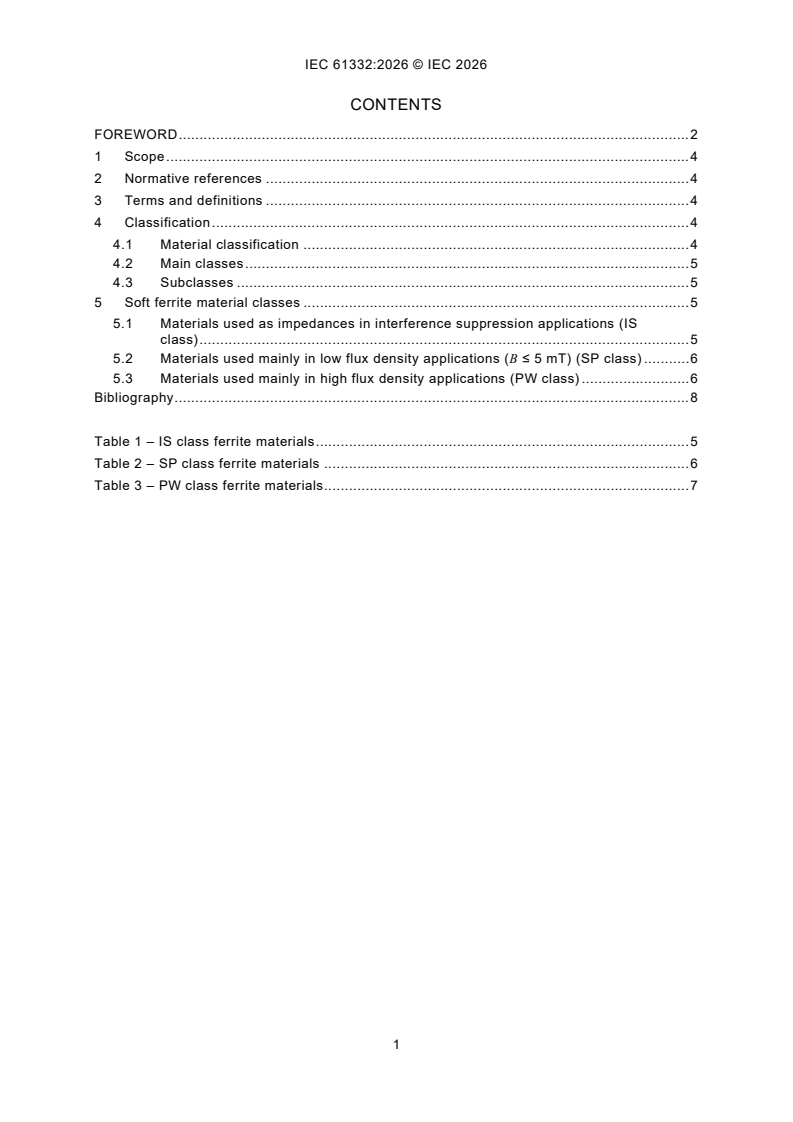
CONTENTS
FOREWORD . 2
1 Scope . 4
2 Normative references . 4
3 Terms and definitions . 4
4 Classification . 4
4.1 Material classification . 4
4.2 Main classes . 5
4.3 Subclasses . 5
5 Soft ferrite material classes . 5
5.1 Materials used as impedances in interference suppression applications (IS
class) . 5
5.2 Materials used mainly in low flux density applications (B ≤ 5 mT) (SP class) . 6
5.3 Materials used mainly in high flux density applications (PW class) . 6
Bibliography . 8
Table 1 – IS class ferrite materials . 5
Table 2 – SP class ferrite materials . 6
Table 3 – PW class ferrite materials . 7
INTERNATIONAL ELECTROTECHNICAL COMMISSION
____________
Soft ferrite material classification
FOREWORD
1) The International Electrotechnical Commission (IEC) is a worldwide organization for standardization comprising
all national electrotechnical committees (IEC National Committees). The object of IEC is to promote international
co-operation on all questions concerning standardization in the electrical and electronic fields. To this end and
in addition to other activities, IEC publishes International Standards, Technical Specifications, Technical Reports,
Publicly Available Specifications (PAS) and Guides (hereafter referred to as "IEC Publication(s)"). Their
preparation is entrusted to technical committees; any IEC National Committee interested in the subject dealt with
may participate in this preparatory work. International, governmental and non-governmental organizations liaising
with the IEC also participate in this preparation. IEC collaborates closely with the International Organization for
Standardization (ISO) in accordance with conditions determined by agreement between the two organizations.
2) The formal decisions or agreements of IEC on technical matters express, as nearly as possible, an international
consensus of opinion on the relevant subjects since each technical committee has representation from all
interested IEC National Committees.
3) IEC Publications have the form of recommendations for international use and are accepted by IEC National
Committees in that sense. While all reasonable efforts are made to ensure that the technical content of IEC
Publications is accurate, IEC cannot be held responsible for the way in which they are used or for any
misinterpretation by any end user.
4) In order to promote international uniformity, IEC National Committees undertake to apply IEC Publications
transparently to the maximum extent possible in their national and regional publications. Any divergence between
any IEC Publication and the corresponding national or regional publication shall be clearly indicated in the latter.
5) IEC itself does not provide any attestation of conformity. Independent certification bodies provide conformity
assessment services and, in some areas, access to IEC marks of conformity. IEC is not responsible for any
services carried out by independent certification bodies.
6) All users should ensure that they have the latest edition of this publication.
7) No liability shall attach to IEC or its directors, employees, servants or agents including individual experts and
members of its technical committees and IEC National Committees for any personal injury, property damage or
other damage of any nature whatsoever, whether direct or indirect, or for costs (including legal fees) and
expenses arising out of the publication, use of, or reliance upon, this IEC Publication or any other IEC
Publications.
8) Attention is drawn to the Normative references cited in this publication. Use of the referenced publications is
indispensable for the correct application of this publication.
9) IEC draws attention to the possibility that the implementation of this document may involve the use of (a)
patent(s). IEC takes no position concerning the evidence, validity or applicability of any claimed patent rights in
respect thereof. As of the date of publication of this document, IEC had not received notice of (a) patent(s), which
may be required to implement this document. However, implementers are cautioned that this may not represent
the latest information, which may be obtained from the patent database available at https://patents.iec.ch. IEC
shall not be held responsible for identifying any or all such patent rights.
IEC 61332 has been prepared by IEC technical committee 51: Magnetic components, ferrite
and magnetic powder materials. It is an International Standard.
This fourth edition cancels and replaces the third edition published in 2016. This edition
constitutes a technical revision.
This edition includes the following significant technical changes with respect to the previous
edition:
a) added PW2c and PW3c in subclasses PW2 and PW3 respectively in Table 3;
b) added the column of B in Table 3;
S
c) added a smaller size of the test core (Ø 12,7 mm × Ø 7,5 mm × 7 mm) for higher measuring
frequency (≥ 500 kHz) in Table 3.
The text of this International Standard is based on the following documents:
Draft Report on voting
51/1582/FDIS 51/1591/RVD
Full information on the voting for its approval can be found in the report on voting indicated in
the above table.
The language used for the development of this International Standard is English.
This document was drafted in accordance with ISO/IEC Directives, Part 2, and developed in
accordance with ISO/IEC Directives, Part 1 and ISO/IEC Directives, IEC Supplement, available
at www.iec.ch/members_experts/refdocs. The main document types developed by IEC are
described in greater detail at www.iec.ch/publications.
The committee has decided that the contents of this document will remain unchanged until the
stability date ind
...
IEC 61332 ®
Edition 4.0 2026-01
INTERNATIONAL
STANDARD
REDLINE VERSION
Soft ferrite material classification
ICS 29.100.10 ISBN 978-2-8327-1022-7
All rights reserved. Unless otherwise specified, no part of this publication may be reproduced or utilized in any form or
by any means, electronic or mechanical, including photocopying and microfilm, without permission in writing from either
IEC or IEC's member National Committee in the country of the requester. If you have any questions about IEC copyright
or have an enquiry about obtaining additional rights to this publication, please contact the address below or your local
IEC member National Committee for further information.
IEC Secretariat Tel.: +41 22 919 02 11
3, rue de Varembé info@iec.ch
CH-1211 Geneva 20 www.iec.ch
Switzerland
About the IEC
The International Electrotechnical Commission (IEC) is the leading global organization that prepares and publishes
International Standards for all electrical, electronic and related technologies.
About IEC publications
The technical content of IEC publications is kept under constant review by the IEC. Please make sure that you have the
latest edition, a corrigendum or an amendment might have been published.
IEC publications search - IEC Products & Services Portal - products.iec.ch
webstore.iec.ch/advsearchform Discover our powerful search engine and read freely all the
The advanced search enables to find IEC publications by a publications previews, graphical symbols and the glossary.
variety of criteria (reference number, text, technical With a subscription you will always have access to up to date
committee, …). It also gives information on projects, content tailored to your needs.
replaced and withdrawn publications.
Electropedia - www.electropedia.org
The world's leading online dictionary on electrotechnology,
IEC Just Published - webstore.iec.ch/justpublished
Stay up to date on all new IEC publications. Just Published containing more than 22 500 terminological entries in English
details all new publications released. Available online and and French, with equivalent terms in 25 additional languages.
once a month by email. Also known as the International Electrotechnical Vocabulary
(IEV) online.
IEC Customer Service Centre - webstore.iec.ch/csc
If you wish to give us your feedback on this publication or
need further assistance, please contact the Customer
Service Centre: sales@iec.ch.
CONTENTS
FOREWORD . 2
1 Scope . 1
2 Normative references . 4
3 Terms and definitions . 4
4 Classification . 4
4.1 Material classification . 4
4.2 Main classes . 5
4.3 Subclasses . 5
5 Soft ferrite material classes . 5
5.1 Materials used as impedances in interference suppression applications (IS
class) . 5
5.2 Materials used mainly in low flux density applications (B ≤ 5 mT) (SP class) . 6
5.3 Materials used mainly in high flux density applications (PW class) . 6
Bibliography . 8
Table 1 – IS class ferrite materials . 5
Table 2 – SP class ferrite materials . 6
Table 3 – PW class ferrite materials . 7
INTERNATIONAL ELECTROTECHNICAL COMMISSION
____________
Soft ferrite material classification
FOREWORD
1) The International Electrotechnical Commission (IEC) is a worldwide organization for standardization comprising
all national electrotechnical committees (IEC National Committees). The object of IEC is to promote international
co-operation on all questions concerning standardization in the electrical and electronic fields. To this end and
in addition to other activities, IEC publishes International Standards, Technical Specifications, Technical Reports,
Publicly Available Specifications (PAS) and Guides (hereafter referred to as "IEC Publication(s)"). Their
preparation is entrusted to technical committees; any IEC National Committee interested in the subject dealt with
may participate in this preparatory work. International, governmental and non-governmental organizations liaising
with the IEC also participate in this preparation. IEC collaborates closely with the International Organization for
Standardization (ISO) in accordance with conditions determined by agreement between the two organizations.
2) The formal decisions or agreements of IEC on technical matters express, as nearly as possible, an international
consensus of opinion on the relevant subjects since each technical committee has representation from all
interested IEC National Committees.
3) IEC Publications have the form of recommendations for international use and are accepted by IEC National
Committees in that sense. While all reasonable efforts are made to ensure that the technical content of IEC
Publications is accurate, IEC cannot be held responsible for the way in which they are used or for any
misinterpretation by any end user.
4) In order to promote international uniformity, IEC National Committees undertake to apply IEC Publications
transparently to the maximum extent possible in their national and regional publications. Any divergence between
any IEC Publication and the corresponding national or regional publication shall be clearly indicated in the latter.
5) IEC itself does not provide any attestation of conformity. Independent certification bodies provide conformity
assessment services and, in some areas, access to IEC marks of conformity. IEC is not responsible for any
services carried out by independent certification bodies.
6) All users should ensure that they have the latest edition of this publication.
7) No liability shall attach to IEC or its directors, employees, servants or agents including individual experts and
members of its technical committees and IEC National Committees for any personal injury, property damage or
other damage of any nature whatsoever, whether direct or indirect, or for costs (including legal fees) and
expenses arising out of the publication, use of, or reliance upon, this IEC Publication or any other IEC
Publications.
8) Attention is drawn to the Normative references cited in this publication. Use of the referenced publications is
indispensable for the correct application of this publication.
9) IEC draws attention to the possibility that the implementation of this document may involve the use of (a)
patent(s). IEC takes no position concerning the evidence, validity or applicability of any claimed patent rights in
respect thereof. As of the date of publication of this document, IEC had not received notice of (a) patent(s), which
may be required to implement this document. However, implementers are cautioned that this may not represent
the latest information, which may be obtained from the patent database available at https://patents.iec.ch. IEC
shall not be held responsible for identifying any or all such patent rights.
This redline version of the official IEC Standard allows the user to identify the changes made
to the previous edition IEC 61332:2016. A vertical bar appears in the margin wherever a change
has been made. Additions are in green text, deletions are in strikethrough red text.
IEC 61332 has been prepared by IEC technical committee 51: Magnetic components, ferrite
and magnetic powder materials. It is an International Standard.
This fourth edition cancels and replaces the third edition published in 2016. This edition
constitutes a technical revision.
This edition includes the following significant technical changes with respect to the previous
edition:
a) added PW2c and PW3c in subclasses PW2 and PW3 respectively in Table 3;
b) added the column of B in Table 3;
S
c) added a smaller size of the test core (Ø 12,7 mm × Ø 7,5 mm × 7 mm) for higher measuring
frequency (≥ 500 kHz) in Table 3.
The text of this International Standard is based on the following documents:
Draft Report on voting
51/1582/FDIS 51/1591/RVD
Full information on the voting for its approval can be found in the report on voting indicated in
the above table.
The language used for the development of this International Standard is English.
This document was drafted in accordance with ISO/IEC Directives, Part 2, and developed in
accordance with ISO/IEC Directives, Part 1 and ISO/IEC Directives, IEC Supplement, available
at www.iec.ch/members_experts/refdocs. The main document types developed by IEC are
described in greater detail at www.iec.ch/publications.
The committee has decided that the contents of this document will remain unchanged until the
stability date indicated on the IEC website under webstore.iec.ch in the data related to the
specific document. At this date, the document will be
– reconfirmed,
– withdrawn, or
– revised.
1 Scope
This document specifies classification rules for soft ferrite materials used in inductive
components (inductors and transformers) fulfilling the requirements of the electronic industries.
This document addresses the following issues for ferrite suppliers and users:
– cross-reference between materials from multiple suppliers;
– assistance to customers users in understanding the published technical data in catalogues
when comparing multiple suppliers;
– guidance to customers users in selecting the most applicable material for each application;
– setting of nomenclature for IEC standards relating to ferrite;
– establishing uniformed benchmarks for suppliers for performance in new development of
materials.
The numerical values given in this document are typical values of the parameters (properties)
of the related materials. Direct translation from the material specification into the core
specification is not always easy or possible.
Every detailed material and core specification should be agreed upon between the user
suppliers and the manufacturer users.
2 Normative references
The following documents are referred to in the text in such a way that some or all of their content
constitutes requirements of this document. For dated references, only the edition cited applies.
For undated references, the latest edition of the referenced document (including any
amendments) applies.
IEC 60050-221, International Electrotechnical Vocabulary (IEV) - Part 221: Magnetic materials
and components
3 Terms and definitions
For the purposes of this document, the terms and definitions given in IEC 60050-221 apply.
ISO and IEC maintain terminology databases for use in standardization at the following
addresses:
– IEC Electropedia: available at https://www.electropedia.org/
– ISO Online browsing platform: available at https://www.iso.org/obp
4 Classification
4.1 Material classification
Soft ferrite materials may be classified according to the following basic parameters:
– initial permeability and relevant operation frequency and/or applicable maximum frequency;
– initial permeability as a function of the temperature;
– applicable maximum flux density and/or amplitude permeability;
– power loss at a given frequency, temperature and flux density;
– normalized impedance at a given frequency.
4.2 Main classes
Soft ferrite materials may can be divided into three main classes identified by two letters as
follows:
– class IS materials are for use at AC low flux density as impedances in interference
suppression (EMI) applications;
– class SP materials are for use at low flux density in signal processing applications;
– class PW materials are for use at high flux density (power application).
4.3 Subclasses
Each main class is divided into subclasses identified by two letters and a serial number.
Ferrite manufacturers’ suppliers' catalogues may indicate more than one class into which a
material grade can fall, where desired.
5 Soft ferrite material classes
5.1 Materials used as impedances in interference suppression applications (IS class)
These materials are mainly used in the shape of rods, tubes, beads, wide band chokes, bobbin
cores, SQ-cores and rings ring-cores. The relevant subclasses are given in Table 1.
Table 1 – IS class ferrite materials
Normalized Initial
a
Subclasses Frequency Curie temperature
b c
impedance permeability
Z μ T
N i C
MHz Ω/mm °C
IS1 300 ≥ 50 < 100 > 300
IS2a ≥ 50
300 100 to 2 000 200 to 300
IS2b ≥ 40
IS3a ≥ 40
100 100 to 2 000 100 to 250
IS3b ≥ 30
IS4a ≥ 30
30 100 to 2 000 100 to 250
IS4b ≥ 20
IS5a ≥ 30
10 2 000 to 6 000 100 to 250
IS5b ≥ 20
IS6a ≥ 30
3 2 000 to 6 000 100 to 150
IS6b ≥ 20
IS7a ≥ 20
1 2 000 to 6 000 100 to 150
IS7b ≥ 10
IS8a ≥ 20
1 6 000 to 10 000 100 to 150
IS8b ≥ 10
IS9a ≥ 10
0,5 10 000 to 15 000 > 100
IS9b ≥ 5
a
The frequency is the measuring frequency of the normalized impedance.
b
Measured on a bead Ø 5 mm × Ø 2 mm × 10 mm and at temperature of 25 °C.
c
μ is measured at ≤ 10 kHz, ≤ 0,5 mT. μ is for reference only, indicating typical values seen. μ is not a
i i i
fundamental parameter for class IS materials.
5.2 Materials used mainly in low flux density applications (B ≤ 5 mT) (SP class)
These materials are mainly used in the shape of ring-cores, pot-cores, EP-cores, RM-cores and
E-cores. The relevant subclasses are given in Table 2.
Table 2 – SP class ferrite materials
Initial Relative loss
b
Subclasses Frequency Curie temperature
a a
permeability factor
tanδ/μ T
i C
–6
μ MHz °C
×10
i
SP1 < 100 50 to 150 10 > 300
SP2 100 to 400 20 to 30 1 > 250
SP3 400 to 800 15 to 50 0,1 > 150
SP4 800 to 1 200 1 to 10 0,1 > 120
SP5 1 200 to 2 000 1 to 10 0,1 > 120
SP6 1 200 to 2 500 2 to 7 0,1 > 150
SP7 1 500 to 2 500 3 to 5 0,1 > 150
SP8 2 500 to 3 500 2 to 10 0,1 > 130
SP9 3 500 to 6 000 ≤ 15 0,1 > 120
SP10a 6 000 to 8 000 ≤ 3 0,01 > 120
SP10b 6 000 to 8 000 ≤ 10 0,01 > 120
SP11a 8 000 to 12 000 ≤ 3 0,01 > 100
SP11b 8 000 to 12 000 ≤ 10 0,01 > 100
SP12a 12 000 to 16 000 ≤ 6 0,01 > 100
SP12b 12 000 to 16 000 ≤ 20 0,01 > 100
SP13 16 000 to 20 000 ≤ 20 0,01 > 100
NOTE The size of the test core is Ø 10 mm × Ø 6 mm × 4 mm.
a
μ and tanδ/μ are measured at 25 °C.
i i
b
The frequency is the measuring frequency for tanδ/μ .
i
5.3 Materials used mainly in high flux density applications (PW class)
These materials are mainly used in the shape of RM-cores, EFD-cores, EREC-cores, ETD-cores,
EER-cores, E-cores, PQ-cores, PM-cores, U-cores, ring-cores and cores for planar applications.
The relevant subclasses are given in Table 3.
Table 3 – PW class ferrite materials
Power loss
Performance
(volume)
a c d gh
c,d b
Subclasses f T μ B factor μ
f B
max a S i
Density
(B × f)
d,e,f,g
kHz kHz mT °C mT Mt × kHz
kW/m
3 500
PW1a 4 500 ≤ 100
to
100 15 300 100 2 500 -
PW1b (300 × 15) ≤ 200
2 000
3 500
PW2a - ≤ 60
5 000
to
PW2b 200 25 200 100 2 500 - ≤ 150
2 000
(200 × 25)
PW2c ≥ 470 ≤ 300
1 400
PW3a 100 - ≤ 350
3 500
PW3b 100 - 20 000 ≤ 700
to
300 100 200 3 000
PW3c 100 ≥ 440 (200 × 100) ≤ 425 2 000
1 400
PW3a-wide 80 to 140 - ≤ 450
PW4a 100 ≤ 350 3 000
30 000
PW4b 500 300 100 100 3 000 - ≤ 700 to
(100 × 300)
PW4a-wide 60 to 120 ≤ 350 1 400
PW5a 100 ≤ 100 2 000
25 000
PW5b 1 000 500 50 100 2 000 - ≤ 150 to
(50 × 500)
PW5a-wide 60 to 120 ≤ 150 1 400
1 400
PW6a 25 000 ≤ 100
2 000 1 000 25 100 1 000 - to
PW6b (25 × 1 000) ≤ 150
1 400
PW7a 30 000 ≤ 100
3 000 2 000 15 100 1 000 - to
PW7b (15 × 2 000) ≤ 150
PW8a 30 000 ≤ 100
5 000 3 000 10 100 400 - to
PW8b (10 × 3 000) ≤ 200
PW9a 50 000 ≤ 200
10 000 5 000 10 100 40 - to
PW9b (10 × 5 000) ≤ 300
NOTE The size of the test core is Ø 25 mm × Ø 15 mm × 10 mm or smaller for measuring frequency lower than
500 kHz, and is Ø 12,7 mm × Ø 7,5 mm × 7 mm for 500 kHz and above.
a
f is the guide of applicable maximum frequency relevant to a given material subclass.
max
b
B is the applicable AC peak flux density relevant to a given material subclass. These levels of B normally result in
power losses in the ranges ≤ 300 kW/m , except for subclasses PW3 and PW4. In these ranges a wide variety of
sizes in the common shapes can be used in open air conditions without forced cooling. The use of higher flux
densities in these subclasses will result in higher power losses which may often require additional cooling, or will
be limited in open air with no forced cooling to the use of only smaller sizes from the common core shapes.
c
μ is the amplitude permeability at the conditions of T, B and f in Table 3. μ is for reference only.
a a
d
B is the saturation magnetic flux density at the temperature 100 °C and the magnetic field strength from 1 200 A/m
S
to 20 000 A/m (refer to IEC 60401-3:2015, Table 2). The cross-sectional area for calculating B should be actual
S
cross-sectional area of the test core.
de
Power loss should be measured at the conditions of T, B and f in Table 3. These combinations of B and f are
different than the preferred combinations according IEC 60401-3:2015, Table 2, where higher power losses than
300 kW/m are assumed as we
...