

IEC 63093-4:2026
(Main)Ferrite cores - Guidelines on dimensions and the limits of surface irregularities - Part 4: RM-cores
General Information
- Abstract
IEC 63093-4:2026 specifies the dimensions that are of importance for mechanical interchangeability for a preferred range of RM-cores and low-profile RM-cores made of ferrite, and the locations of their terminal pins on a 2,54 mm printed wiring grid in relation to the base outlines of the cores. It also gives guidance on allowable limits of surface irregularities applicable to RM-cores in accordance with the relevant generic specification. The selection of core sizes for this document is based on the philosophy of including those sizes which are industrial standards, either by inclusion in a national standard, or by broad-based use in industry. This document is a specification useful in the negotiations between ferrite core manufacturers and customers about surface irregularities. The general considerations that the design of this range of cores is based upon are given in Annex A.
This edition includes the following significant technical changes with respect to the previous edition:
a) revision of Table 3 and Table 4 according to IEC 60205 ED4.
- Status
- Published
- Publication Date
- 05-Feb-2026
- Technical Committee
- TC 51 - Magnetic components, ferrite and magnetic powder materials
- Drafting Committee
- WG 1 - TC 51/WG 1
- Current Stage
- PPUB - Publication issued
- Start Date
- 06-Feb-2026
- Completion Date
- 20-Feb-2026
Buy Documents
IEC 63093-4:2026 - Ferrite cores - Guidelines on dimensions and the limits of surface irregularities - Part 4: RM-cores/6/2026
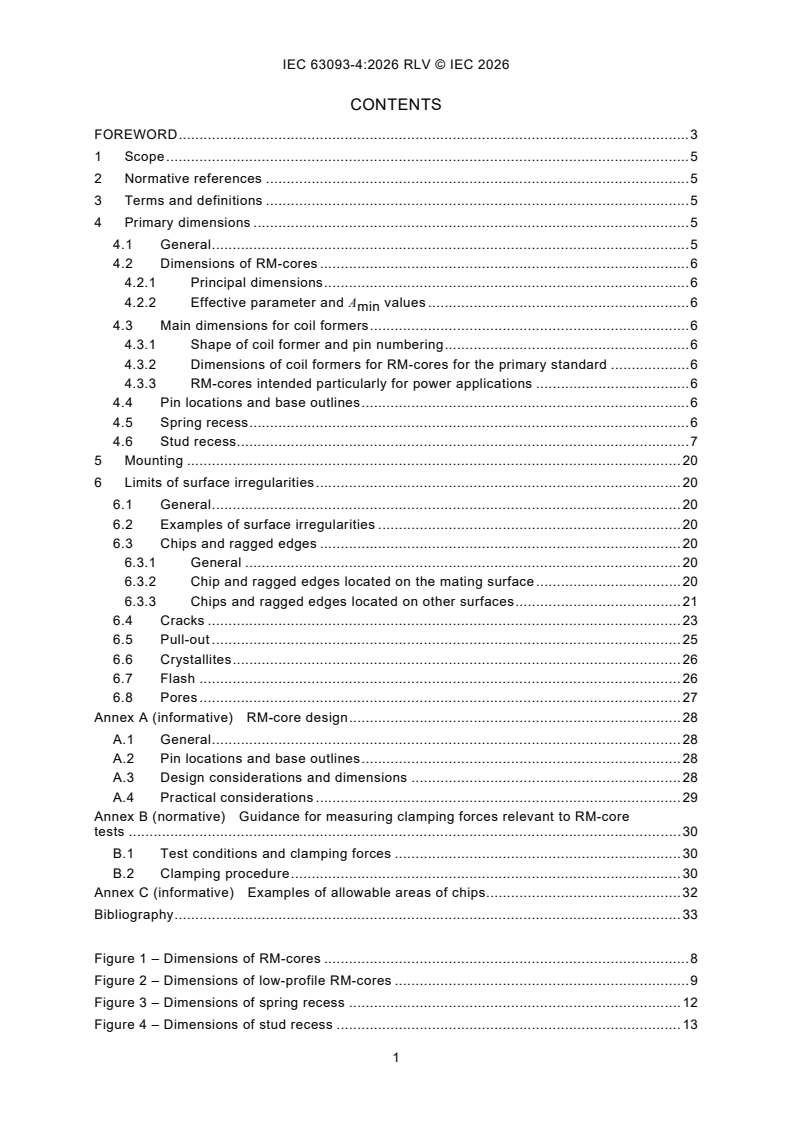
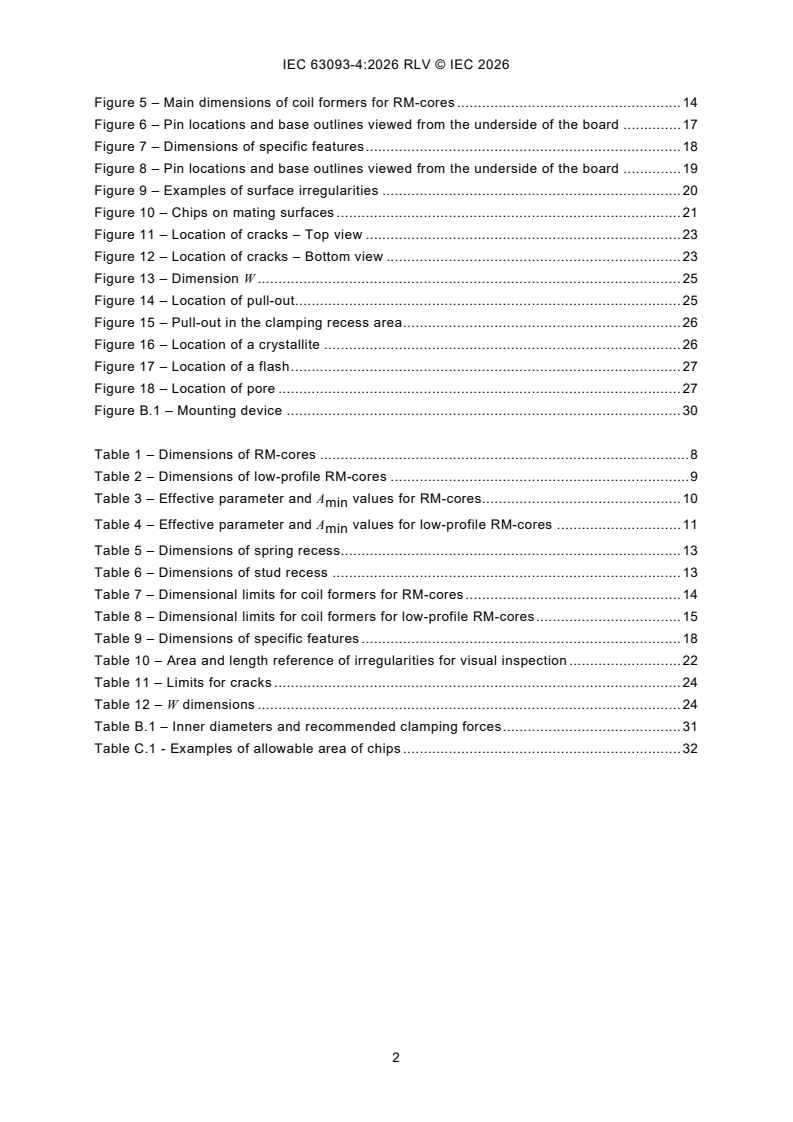
REDLINE IEC 63093-4:2026 RLV - Ferrite cores - Guidelines on dimensions and the limits of surface irregularities - Part 4: RM-cores/6/2026
Overview
IEC 63093-4:2026 is the international standard developed by the International Electrotechnical Commission (IEC) providing detailed guidelines for the dimensions and limits of surface irregularities on ferrite RM-cores and low-profile RM-cores. This standard is essential for ensuring mechanical interchangeability, reliable mounting, and agreed-upon quality between ferrite core manufacturers and customers. It specifies critical size ranges, pin arrangements on 2.54 mm printed wiring grids, and details the permissible irregularities on RM-cores used widely in electrical and electronic devices.
Key Topics
- Mechanical Interchangeability: Defines primary dimensions for a preferred range of RM-cores and low-profile RM-cores, enabling straightforward substitution and global compatibility.
- Pin Location and Grid Alignment: Specifies the locations of terminal pins to fit the industry standard 2.54 mm printed wiring grid, ensuring consistency in PCB mounting.
- Surface Irregularity Limits: Offers clear criteria for acceptable chips, cracks, pores, and other surface blemishes based on area and location, referencing visual inspection standards.
- Core and Coil Former Dimensions: Lists principal dimensions for RM-cores and the associated coil formers, including those for power applications.
- Standardized Industrial Sizes: Covers core sizes commonly established as industry standards or included in national standards, supporting broad applicability.
Applications
Ferrite RM-Cores in Electronics
IEC 63093-4:2026 is critical for manufacturers, designers, and quality control professionals who work with ferrite RM-cores in a range of electronic applications, including:
- Transformers and Inductors: Standardized RM-core dimensions simplify design and assembly of transformers and inductors for power supplies, tuning circuits, and broadband applications.
- Printed Circuit Board (PCB) Integration: The specification of pin locations on a 2.54 mm grid promotes compatibility with standard PCB layouts and automated assembly lines.
- Switched-Mode Power Supplies (SMPS): RM-cores are frequently used in power conversion devices due to their efficient electromagnetic properties and standardized geometry.
- Negotiation and Procurement: Clear criteria for allowable surface irregularities facilitate transparent negotiations and quality assurance between core suppliers and end-users.
Quality Assurance and Inspection
- Defect Assessment: Provides explicit guidance on the evaluation and allowable limits for chips, ragged edges, cracks, crystallites, flash, and pores, ensuring product reliability and customer satisfaction.
- Interchangeability in Mass Production: Ensures that cores from different manufacturers meet unified dimensional and surface quality expectations, reducing design cycle time and minimizing production disruptions.
Related Standards
When applying IEC 63093-4:2026, consider these related IEC standards for comprehensive compliance and best results:
- IEC 63093-1: General specification for ferrite core dimensions and surface irregularity limits.
- IEC 60205: Calculation methods for the effective parameters of magnetic piece parts, critical for magnetic circuit design.
- IEC 60401-1: Terminology and nomenclature for magnetically soft ferrite cores, including physical irregularities and reference dimensions.
Summary
IEC 63093-4:2026 provides recognized international guidelines for ferrite RM-core dimensions, pin layouts, and surface quality, promoting global interoperability and supply chain efficiency. By adhering to this standard, manufacturers and users ensure high product quality, reliable assembly, and streamlined integration into electronic devices, particularly for applications utilizing transformers and inductors on printed circuit boards. Compliance helps minimize misunderstandings related to surface appearance and supports consistent, high-quality electronic component production worldwide.
Relations
- Effective Date
- 22-Dec-2023
Buy Documents
IEC 63093-4:2026 - Ferrite cores - Guidelines on dimensions and the limits of surface irregularities - Part 4: RM-cores/6/2026
REDLINE IEC 63093-4:2026 RLV - Ferrite cores - Guidelines on dimensions and the limits of surface irregularities - Part 4: RM-cores/6/2026
Get Certified
Connect with accredited certification bodies for this standard

IMQ S.p.A. (Certification)
Italian electrical product certification.

SLG Prüf- und Zertifizierungs GmbH
German testing and certification body.

UL Solutions
Global safety science company with testing, inspection and certification.
Sponsored listings
Frequently Asked Questions
IEC 63093-4:2026 is a standard published by the International Electrotechnical Commission (IEC). Its full title is "Ferrite cores - Guidelines on dimensions and the limits of surface irregularities - Part 4: RM-cores". This standard covers: IEC 63093-4:2026 specifies the dimensions that are of importance for mechanical interchangeability for a preferred range of RM-cores and low-profile RM-cores made of ferrite, and the locations of their terminal pins on a 2,54 mm printed wiring grid in relation to the base outlines of the cores. It also gives guidance on allowable limits of surface irregularities applicable to RM-cores in accordance with the relevant generic specification. The selection of core sizes for this document is based on the philosophy of including those sizes which are industrial standards, either by inclusion in a national standard, or by broad-based use in industry. This document is a specification useful in the negotiations between ferrite core manufacturers and customers about surface irregularities. The general considerations that the design of this range of cores is based upon are given in Annex A. This edition includes the following significant technical changes with respect to the previous edition: a) revision of Table 3 and Table 4 according to IEC 60205 ED4.
IEC 63093-4:2026 specifies the dimensions that are of importance for mechanical interchangeability for a preferred range of RM-cores and low-profile RM-cores made of ferrite, and the locations of their terminal pins on a 2,54 mm printed wiring grid in relation to the base outlines of the cores. It also gives guidance on allowable limits of surface irregularities applicable to RM-cores in accordance with the relevant generic specification. The selection of core sizes for this document is based on the philosophy of including those sizes which are industrial standards, either by inclusion in a national standard, or by broad-based use in industry. This document is a specification useful in the negotiations between ferrite core manufacturers and customers about surface irregularities. The general considerations that the design of this range of cores is based upon are given in Annex A. This edition includes the following significant technical changes with respect to the previous edition: a) revision of Table 3 and Table 4 according to IEC 60205 ED4.
IEC 63093-4:2026 is classified under the following ICS (International Classification for Standards) categories: 29.100.10 - Magnetic components. The ICS classification helps identify the subject area and facilitates finding related standards.
IEC 63093-4:2026 has the following relationships with other standards: It is inter standard links to IEC 63093-4:2019. Understanding these relationships helps ensure you are using the most current and applicable version of the standard.
IEC 63093-4:2026 is available in PDF format for immediate download after purchase. The document can be added to your cart and obtained through the secure checkout process. Digital delivery ensures instant access to the complete standard document.
Standards Content (Sample)
IEC 63093-4 ®
Edition 2.0 2026-02
INTERNATIONAL
STANDARD
Ferrite cores - Guidelines on dimensions and the limits of surface irregularities -
Part 4: RM-cores
ICS 29.100.10 ISBN 978-2-8327-1015-9
All rights reserved. Unless otherwise specified, no part of this publication may be reproduced or utilized in any form or
by any means, electronic or mechanical, including photocopying and microfilm, without permission in writing from either
IEC or IEC's member National Committee in the country of the requester. If you have any questions about IEC copyright
or have an enquiry about obtaining additional rights to this publication, please contact the address below or your local
IEC member National Committee for further information.
IEC Secretariat Tel.: +41 22 919 02 11
3, rue de Varembé info@iec.ch
CH-1211 Geneva 20 www.iec.ch
Switzerland
About the IEC
The International Electrotechnical Commission (IEC) is the leading global organization that prepares and publishes
International Standards for all electrical, electronic and related technologies.
About IEC publications
The technical content of IEC publications is kept under constant review by the IEC. Please make sure that you have the
latest edition, a corrigendum or an amendment might have been published.
IEC publications search - IEC Products & Services Portal - products.iec.ch
webstore.iec.ch/advsearchform Discover our powerful search engine and read freely all the
The advanced search enables to find IEC publications by a publications previews, graphical symbols and the glossary.
variety of criteria (reference number, text, technical With a subscription you will always have access to up to date
committee, …). It also gives information on projects, content tailored to your needs.
replaced and withdrawn publications.
Electropedia - www.electropedia.org
The world's leading online dictionary on electrotechnology,
IEC Just Published - webstore.iec.ch/justpublished
Stay up to date on all new IEC publications. Just Published containing more than 22 500 terminological entries in English
details all new publications released. Available online and and French, with equivalent terms in 25 additional languages.
once a month by email. Also known as the International Electrotechnical Vocabulary
(IEV) online.
IEC Customer Service Centre - webstore.iec.ch/csc
If you wish to give us your feedback on this publication or
need further assistance, please contact the Customer
Service Centre: sales@iec.ch.
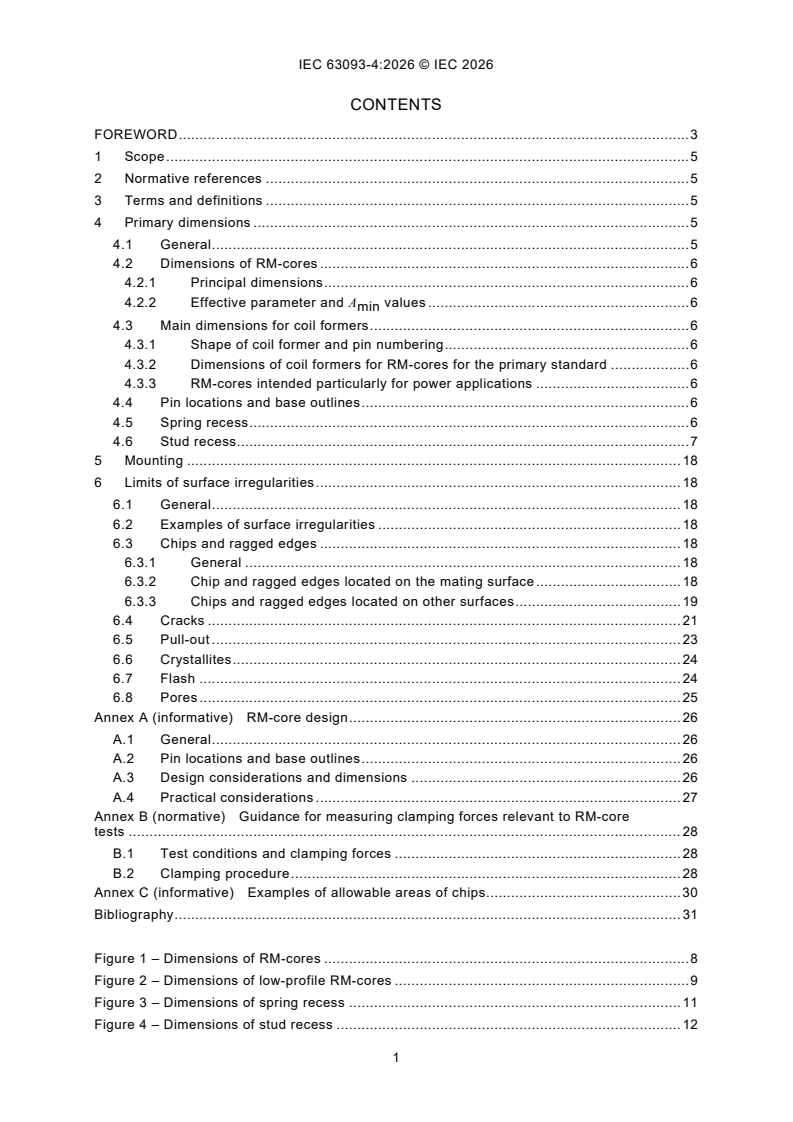
CONTENTS
FOREWORD . 3
1 Scope . 5
2 Normative references . 5
3 Terms and definitions . 5
4 Primary dimensions . 5
4.1 General . 5
4.2 Dimensions of RM-cores . 6
4.2.1 Principal dimensions . 6
4.2.2 Effective parameter and A values . 6
min
4.3 Main dimensions for coil formers . 6
4.3.1 Shape of coil former and pin numbering . 6
4.3.2 Dimensions of coil formers for RM-cores for the primary standard . 6
4.3.3 RM-cores intended particularly for power applications . 6
4.4 Pin locations and base outlines . 6
4.5 Spring recess . 6
4.6 Stud recess. 7
5 Mounting . 18
6 Limits of surface irregularities . 18
6.1 General . 18
6.2 Examples of surface irregularities . 18
6.3 Chips and ragged edges . 18
6.3.1 General . 18
6.3.2 Chip and ragged edges located on the mating surface . 18
6.3.3 Chips and ragged edges located on other surfaces . 19
6.4 Cracks . 21
6.5 Pull-out . 23
6.6 Crystallites . 24
6.7 Flash . 24
6.8 Pores . 25
Annex A (informative) RM-core design . 26
A.1 General . 26
A.2 Pin locations and base outlines . 26
A.3 Design considerations and dimensions . 26
A.4 Practical considerations . 27
Annex B (normative) Guidance for measuring clamping forces relevant to RM-core
tests . 28
B.1 Test conditions and clamping forces . 28
B.2 Clamping procedure . 28
Annex C (informative) Examples of allowable areas of chips . 30
Bibliography . 31
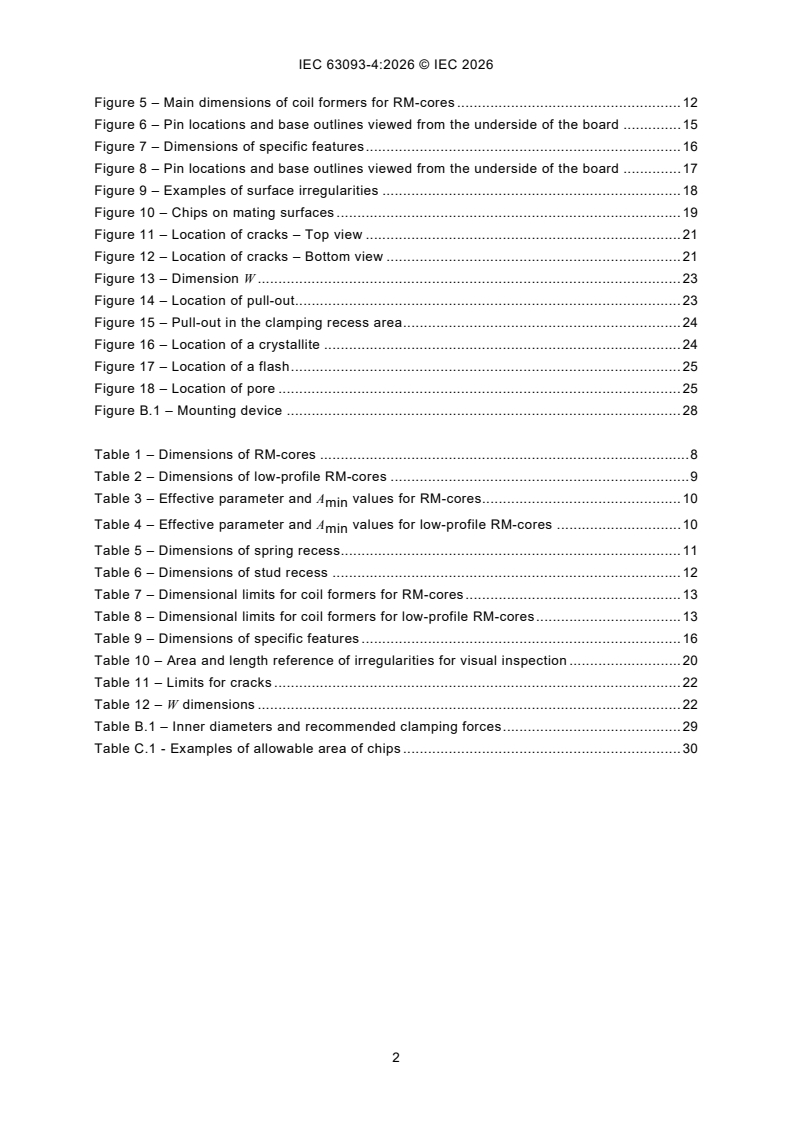
Figure 1 – Dimensions of RM-cores . 8
Figure 2 – Dimensions of low-profile RM-cores . 9
Figure 3 – Dimensions of spring recess . 11
Figure 4 – Dimensions of stud recess . 12
Figure 5 – Main dimensions of coil formers for RM-cores . 12
Figure 6 – Pin locations and base outlines viewed from the underside of the board . 15
Figure 7 – Dimensions of specific features . 16
Figure 8 – Pin locations and base outlines viewed from the underside of the board . 17
Figure 9 – Examples of surface irregularities . 18
Figure 10 – Chips on mating surfaces . 19
Figure 11 – Location of cracks – Top view . 21
Figure 12 – Location of cracks – Bottom view . 21
Figure 13 – Dimension W . 23
Figure 14 – Location of pull-out. 23
Figure 15 – Pull-out in the clamping recess area . 24
Figure 16 – Location of a crystallite . 24
Figure 17 – Location of a flash . 25
Figure 18 – Location of pore . 25
Figure B.1 – Mounting device . 28
Table 1 – Dimensions of RM-cores . 8
Table 2 – Dimensions of low-profile RM-cores . 9
Table 3 – Effective parameter and A values for RM-cores. 10
min
Table 4 – Effective parameter and A values for low-profile RM-cores . 10
min
Table 5 – Dimensions of spring recess. 11
Table 6 – Dimensions of stud recess . 12
Table 7 – Dimensional limits for coil formers for RM-cores . 13
Table 8 – Dimensional limits for coil formers for low-profile RM-cores . 13
Table 9 – Dimensions of specific features . 16
Table 10 – Area and length reference of irregularities for visual inspection . 20
Table 11 – Limits for cracks . 22
Table 12 – W dimensions . 22
Table B.1 – Inner diameters and recommended clamping forces . 29
Table C.1 - Examples of allowable area of chips . 30
INTERNATIONAL ELECTROTECHNICAL COMMISSION
____________
Ferrite cores -
Guidelines on dimensions and the limits of surface irregularities -
Part 4: RM-cores
FOREWORD
1) The International Electrotechnical Commission (IEC) is a worldwide organization for standardization comprising
all national electrotechnical committees (IEC National Committees). The object of IEC is to promote international
co-operation on all questions concerning standardization in the electrical and electronic fields. To this end and
in addition to other activities, IEC publishes International Standards, Technical Specifications, Technical Reports,
Publicly Available Specifications (PAS) and Guides (hereafter referred to as "IEC Publication(s)"). Their
preparation is entrusted to technical committees; any IEC National Committee interested in the subject dealt with
may participate in this preparatory work. International, governmental and non-governmental organizations liaising
with the IEC also participate in this preparation. IEC collaborates closely with the International Organization for
Standardization (ISO) in accordance with conditions determined by agreement between the two organizations.
2) The formal decisions or agreements of IEC on technical matters express, as nearly as possible, an international
consensus of opinion on the relevant subjects since each technical committee has representation from all
interested IEC National Committees.
3) IEC Publications have the form of recommendations for international use and are accepted by IEC National
Committees in that sense. While all reasonable efforts are made to ensure that the technical content of IEC
Publications is accurate, IEC cannot be held responsible for the way in which they are used or for any
misinterpretation by any end user.
4) In order to promote international uniformity, IEC National Committees undertake to apply IEC Publications
transparently to the maximum extent possible in their national and regional publications. Any divergence between
any IEC Publication and the corresponding national or regional publication shall be clearly indicated in the latter.
5) IEC itself does not provide any attestation of conformity. Independent certification bodies provide conformity
assessment services and, in some areas, access to IEC marks of conformity. IEC is not responsible for any
services carried out by independent certification bodies.
6) All users should ensure that they have the latest edition of this publication.
7) No liability shall attach to IEC or its directors, employees, servants or agents including individual experts and
members of its technical committees and IEC National Committees for any personal injury, property damage or
other damage of any nature whatsoever, whether direct or indirect, or for costs (including legal fees) and
expenses arising out of the publication, use of, or reliance upon, this IEC Publication or any other IEC
Publications.
8) Attention is drawn to the Normative references cited in this publication. Use of the referenced publications is
indispensable for the correct application of this publication.
9) IEC draws attention to the possibility that the implementation of this document may involve the use of (a)
patent(s). IEC takes no position concerning the evidence, validity or applicability of any claimed patent rights in
respect thereof. As of the date of publication of this document, IEC had not received notice of (a) patent(s), which
may be required to implement this document. However, implementers are cautioned that this may not represent
the latest information, which may be obtained from the patent database available at https://patents.iec.ch. IEC
shall not be held responsible for identifying any or all such patent rights.
IEC 63093-4 has been prepared by IEC technical committee 51: Magnetic components, ferrite
and magnetic powder materials. It is an International Standard.
This second edition cancels and replaces the first edition published in 2019. This edition
constitutes a technical revision.
This edition includes the following significant technical changes with respect to the previous
edition:
a) revision of Table 3 and Table 4 according to IEC 60205 ED4.
The text of this International Standard is based on the following documents:
Draft Report on voting
51/1586/FDIS 51/1599/RVD
Full information on the voting for its approval can be found in the report on voting indicated in
the above table.
The language used for the development of this International Standard is English.
This document was drafted in accordance with ISO/IEC Directives, Part 2, and developed in
accordance with ISO/IEC Directives, Part 1 and ISO/IEC Directives, IEC Supplement, available
at www.iec.ch/members_experts/refdocs. The main document types developed by IEC are
described in greater detail at www.iec.ch/publications.
A list of all parts in the IEC 63093 series, published under the general title Ferrite cores -
Guidelines on dimensions and the limits of surface irregularities, can be found on the IEC
website.
The committee has decided that the contents of this document will remain unchanged until the
stability date indicated on the IEC website under webstore.iec.ch in the data related to the
specific document. At this date, the document will be
– reconfirmed,
– withdrawn, or
– revised.
1 Scope
This part of IEC 63093 specifies the dimensions that are of importance for mechanical
interchangeability for a preferred range of RM-cores and low-profile RM-cores made of ferrite,
and the locations of their terminal pins on a 2,54 mm printed wiring grid in relation to the base
outlines of the cores. It also gives guidance on allowable limits of surface irregularities
applicable to RM-cores in accordance with the relevant generic specification.
The selection of core sizes for this document is based on the philosophy of including those
sizes which are industrial standards, either by inclusion in a national standard, or by broad-
based use in industry.
This document is a specification useful in the negotiations between ferrite core manufacturers
and customers about surface irregularities.
The general considerations that the design of this range of cores is based upon are given in
Annex A.
2 Normative references
The following documents are referred to in the text in such a way that some or all of their content
constitutes requirements of this document. For dated references, only the edition cited applies.
For undated references, the latest edition of the referenced document (including any
amendments) applies.
IEC 60205, Calculation of the effective parameters of magnetic piece parts
IEC 60401-1, Terms and nomenclature for cores made of magnetically soft ferrites - Part 1:
Terms used for physical irregularities and reference of dimensions
IEC 63093-1, Ferrite cores - Guidelines on dimensions and the limits of surface irregularities -
Part 1: General specification
3 Terms and definitions
For the purposes of this document, the terms and definitions given in IEC 60401-1 and
IEC 63093-1 apply.
ISO and IEC maintain terminology databases for use in standardization at the following
addresses:
– IEC Electropedia: available at https://www.electropedia.org/
– ISO Online browsing platform: available at https://www.iso.org/obp
4 Primary dimensions
4.1 General
Compliance with the following requirements ensures mechanical interchangeability of complete
assemblies and wound coil formers.
4.2 Dimensions of RM-cores
4.2.1 Principal dimensions
The principal dimensions of RM-cores shall be as given in Table 1 and those of the low-profile
RM-cores shall be as given in Table 2. See also Figure 1 and Figure 2.
4.2.2 Effective parameter and A values
min
The effective parameter values for cores having the dimensions given in 4.2.1 are as shown in
Table 3 and Table 4. The definitions of effective parameters and their calculations shall be as
given in IEC 60205.
4.3 Main dimensions for coil formers
4.3.1 Shape of coil former and pin numbering
When the coil former is viewed from the pin side, the pins shall be numbered in a clockwise
direction. Pin 1 shall be a corner pin, or the pin immediately to the right of a corner, and closest
to the base outline.
For asymmetrical arrangements, pin 1 shall be at the side with the largest number of pins. The
coil former shall show an asymmetry, which shall preferably be visible (or detectable) when the
assembled inductor is held with the pins downwards. This asymmetry shall clearly indicate pin 1.
For pin numbering of recommended core patterns and for recommended asymmetrical pin
arrangements, see 4.4.
NOTE It is not required that the pin numbers be marked on the coil former.
4.3.2 Dimensions of coil formers for RM-cores for the primary standard
The dimensions specified in Table 7 and Table 8 are illustrated in Figure 5.
4.3.3 RM-cores intended particularly for power applications
These coil formers are intended for use with cores RM 6-S, RM 8, RM 10, RM 12 and RM 14A,
all without centre holes. Each is provided with twelve terminal pins except for the RM 6-S coil
former, which has only eight.
Figure 7 shows the features specific to this format and the corresponding dimensions are given
in Table 9.
4.4 Pin locations and base outlines
These shall be as shown in Figure 6 and Figure 8 (for power applications), in which the base is
viewed from the pin side, i.e. from the underside of the printed wiring boards.
The pins should fit into holes, the nominal hole diameter being:
– 1 mm when the shortest distance between pins is 2,54 mm;
– 1,3 mm when the shortest distance between pins is 2,54 mm or more.
4.5 Spring recess
RM-cores usually have recesses that allow the core halves to be held together by two spring
clamps snapping into these recesses. The recesses consist of a flat spring rest and a locking
ridge. The dimensions are given in Table 5 and Figure 3; the profile of this spring recess is not
defined but the limit dimensions shall be complied with.
4.6 Stud recess
Those RM-cores with centre-pole holes may have recesses for the fixed part of the adjusting
device with dimensions in accordance with Table 6 and Figure 4. These dimensions are not
mandatory for manufacturers who supply cores with the fixed part of the adjusting device
attached.
---------------------
...
IEC 63093-4 ®
Edition 2.0 2026-02
INTERNATIONAL
STANDARD
REDLINE VERSION
Ferrite cores - Guidelines on dimensions and the limits of surface irregularities -
Part 4: RM-cores
ICS 29.100.10 ISBN 978-2-8327-1065-4
All rights reserved. Unless otherwise specified, no part of this publication may be reproduced or utilized in any form or
by any means, electronic or mechanical, including photocopying and microfilm, without permission in writing from either
IEC or IEC's member National Committee in the country of the requester. If you have any questions about IEC copyright
or have an enquiry about obtaining additional rights to this publication, please contact the address below or your local
IEC member National Committee for further information.
IEC Secretariat Tel.: +41 22 919 02 11
3, rue de Varembé info@iec.ch
CH-1211 Geneva 20 www.iec.ch
Switzerland
About the IEC
The International Electrotechnical Commission (IEC) is the leading global organization that prepares and publishes
International Standards for all electrical, electronic and related technologies.
About IEC publications
The technical content of IEC publications is kept under constant review by the IEC. Please make sure that you have the
latest edition, a corrigendum or an amendment might have been published.
IEC publications search - IEC Products & Services Portal - products.iec.ch
webstore.iec.ch/advsearchform Discover our powerful search engine and read freely all the
The advanced search enables to find IEC publications by a publications previews, graphical symbols and the glossary.
variety of criteria (reference number, text, technical With a subscription you will always have access to up to date
committee, …). It also gives information on projects, content tailored to your needs.
replaced and withdrawn publications.
Electropedia - www.electropedia.org
The world's leading online dictionary on electrotechnology,
IEC Just Published - webstore.iec.ch/justpublished
Stay up to date on all new IEC publications. Just Published containing more than 22 500 terminological entries in English
details all new publications released. Available online and and French, with equivalent terms in 25 additional languages.
once a month by email. Also known as the International Electrotechnical Vocabulary
(IEV) online.
IEC Customer Service Centre - webstore.iec.ch/csc
If you wish to give us your feedback on this publication or
need further assistance, please contact the Customer
Service Centre: sales@iec.ch.
CONTENTS
FOREWORD . 3
1 Scope . 5
2 Normative references . 5
3 Terms and definitions . 5
4 Primary dimensions . 5
4.1 General . 5
4.2 Dimensions of RM-cores . 6
4.2.1 Principal dimensions . 6
4.2.2 Effective parameter and A values . 6
min
4.3 Main dimensions for coil formers . 6
4.3.1 Shape of coil former and pin numbering . 6
4.3.2 Dimensions of coil formers for RM-cores for the primary standard . 6
4.3.3 RM-cores intended particularly for power applications . 6
4.4 Pin locations and base outlines . 6
4.5 Spring recess . 6
4.6 Stud recess. 7
5 Mounting . 20
6 Limits of surface irregularities . 20
6.1 General . 20
6.2 Examples of surface irregularities . 20
6.3 Chips and ragged edges . 20
6.3.1 General . 20
6.3.2 Chip and ragged edges located on the mating surface . 20
6.3.3 Chips and ragged edges located on other surfaces . 21
6.4 Cracks . 23
6.5 Pull-out . 25
6.6 Crystallites . 26
6.7 Flash . 26
6.8 Pores . 27
Annex A (informative) RM-core design . 28
A.1 General . 28
A.2 Pin locations and base outlines . 28
A.3 Design considerations and dimensions . 28
A.4 Practical considerations . 29
Annex B (normative) Guidance for measuring clamping forces relevant to RM-core
tests . 30
B.1 Test conditions and clamping forces . 30
B.2 Clamping procedure . 30
Annex C (informative) Examples of allowable areas of chips . 32
Bibliography . 33
Figure 1 – Dimensions of RM-cores . 8
Figure 2 – Dimensions of low-profile RM-cores . 9
Figure 3 – Dimensions of spring recess . 12
Figure 4 – Dimensions of stud recess . 13
Figure 5 – Main dimensions of coil formers for RM-cores . 14
Figure 6 – Pin locations and base outlines viewed from the underside of the board . 17
Figure 7 – Dimensions of specific features . 18
Figure 8 – Pin locations and base outlines viewed from the underside of the board . 19
Figure 9 – Examples of surface irregularities . 20
Figure 10 – Chips on mating surfaces . 21
Figure 11 – Location of cracks – Top view . 23
Figure 12 – Location of cracks – Bottom view . 23
Figure 13 – Dimension W . 25
Figure 14 – Location of pull-out. 25
Figure 15 – Pull-out in the clamping recess area . 26
Figure 16 – Location of a crystallite . 26
Figure 17 – Location of a flash . 27
Figure 18 – Location of pore . 27
Figure B.1 – Mounting device . 30
Table 1 – Dimensions of RM-cores . 8
Table 2 – Dimensions of low-profile RM-cores . 9
Table 3 – Effective parameter and A values for RM-cores. 10
min
Table 4 – Effective parameter and A values for low-profile RM-cores . 11
min
Table 5 – Dimensions of spring recess. 13
Table 6 – Dimensions of stud recess . 13
Table 7 – Dimensional limits for coil formers for RM-cores . 14
Table 8 – Dimensional limits for coil formers for low-profile RM-cores . 15
Table 9 – Dimensions of specific features . 18
Table 10 – Area and length reference of irregularities for visual inspection . 22
Table 11 – Limits for cracks . 24
Table 12 – W dimensions . 24
Table B.1 – Inner diameters and recommended clamping forces . 31
Table C.1 - Examples of allowable area of chips . 32
INTERNATIONAL ELECTROTECHNICAL COMMISSION
____________
Ferrite cores -
Guidelines on dimensions and the limits of surface irregularities -
Part 4: RM-cores
FOREWORD
1) The International Electrotechnical Commission (IEC) is a worldwide organization for standardization comprising
all national electrotechnical committees (IEC National Committees). The object of IEC is to promote international
co-operation on all questions concerning standardization in the electrical and electronic fields. To this end and
in addition to other activities, IEC publishes International Standards, Technical Specifications, Technical Reports,
Publicly Available Specifications (PAS) and Guides (hereafter referred to as "IEC Publication(s)"). Their
preparation is entrusted to technical committees; any IEC National Committee interested in the subject dealt with
may participate in this preparatory work. International, governmental and non-governmental organizations liaising
with the IEC also participate in this preparation. IEC collaborates closely with the International Organization for
Standardization (ISO) in accordance with conditions determined by agreement between the two organizations.
2) The formal decisions or agreements of IEC on technical matters express, as nearly as possible, an international
consensus of opinion on the relevant subjects since each technical committee has representation from all
interested IEC National Committees.
3) IEC Publications have the form of recommendations for international use and are accepted by IEC National
Committees in that sense. While all reasonable efforts are made to ensure that the technical content of IEC
Publications is accurate, IEC cannot be held responsible for the way in which they are used or for any
misinterpretation by any end user.
4) In order to promote international uniformity, IEC National Committees undertake to apply IEC Publications
transparently to the maximum extent possible in their national and regional publications. Any divergence between
any IEC Publication and the corresponding national or regional publication shall be clearly indicated in the latter.
5) IEC itself does not provide any attestation of conformity. Independent certification bodies provide conformity
assessment services and, in some areas, access to IEC marks of conformity. IEC is not responsible for any
services carried out by independent certification bodies.
6) All users should ensure that they have the latest edition of this publication.
7) No liability shall attach to IEC or its directors, employees, servants or agents including individual experts and
members of its technical committees and IEC National Committees for any personal injury, property damage or
other damage of any nature whatsoever, whether direct or indirect, or for costs (including legal fees) and
expenses arising out of the publication, use of, or reliance upon, this IEC Publication or any other IEC
Publications.
8) Attention is drawn to the Normative references cited in this publication. Use of the referenced publications is
indispensable for the correct application of this publication.
9) IEC draws attention to the possibility that the implementation of this document may involve the use of (a)
patent(s). IEC takes no position concerning the evidence, validity or applicability of any claimed patent rights in
respect thereof. As of the date of publication of this document, IEC had not received notice of (a) patent(s), which
may be required to implement this document. However, implementers are cautioned that this may not represent
the latest information, which may be obtained from the patent database available at https://patents.iec.ch. IEC
shall not be held responsible for identifying any or all such patent rights.
This redline version of the official IEC Standard allows the user to identify the changes made
to the previous edition IEC 63093-4:2019. A vertical bar appears in the margin wherever a
change has been made. Additions are in green text, deletions are in strikethrough red text.
IEC 63093-4 has been prepared by IEC technical committee 51: Magnetic components, ferrite
and magnetic powder materials. It is an International Standard.
This second edition cancels and replaces the first edition published in 2019. This edition
constitutes a technical revision.
This edition includes the following significant technical changes with respect to the previous
edition:
a) revision of Table 3 and Table 4 according to IEC 60205 ED4.
The text of this International Standard is based on the following documents:
Draft Report on voting
51/1586/FDIS 51/1599/RVD
Full information on the voting for its approval can be found in the report on voting indicated in
the above table.
The language used for the development of this International Standard is English.
This document was drafted in accordance with ISO/IEC Directives, Part 2, and developed in
accordance with ISO/IEC Directives, Part 1 and ISO/IEC Directives, IEC Supplement, available
at www.iec.ch/members_experts/refdocs. The main document types developed by IEC are
described in greater detail at www.iec.ch/publications.
A list of all parts in the IEC 63093 series, published under the general title Ferrite cores -
Guidelines on dimensions and the limits of surface irregularities, can be found on the IEC
website.
The committee has decided that the contents of this document will remain unchanged until the
stability date indicated on the IEC website under webstore.iec.ch in the data related to the
specific document. At this date, the document will be
– reconfirmed,
– withdrawn, or
– revised.
1 Scope
This part of IEC 63093 specifies the dimensions that are of importance for mechanical
interchangeability for a preferred range of RM-cores and low-profile RM-cores made of ferrite,
and the locations of their terminal pins on a 2,54 mm printed wiring grid in relation to the base
outlines of the cores. It also gives guidance on allowable limits of surface irregularities
applicable to RM-cores in accordance with the relevant generic specification.
The selection of core sizes for this document is based on the philosophy of including those
sizes which are industrial standards, either by inclusion in a national standard, or by broad-
based use in industry.
This document is a specification useful in the negotiations between ferrite core manufacturers
and customers about surface irregularities.
The general considerations that the design of this range of cores is based upon are given in
Annex A.
2 Normative references
The following documents are referred to in the text in such a way that some or all of their content
constitutes requirements of this document. For dated references, only the edition cited applies.
For undated references, the latest edition of the referenced document (including any
amendments) applies.
IEC 60205, Calculation of the effective parameters of magnetic piece parts
IEC 60401-1, Terms and nomenclature for cores made of magnetically soft ferrites - Part 1:
Terms used for physical irregularities and reference of dimensions
IEC 60424-1, Ferrite cores – Guidelines on the limits of surface irregularities – Part 1: General
specification
IEC 63093-1, Ferrite cores - Guidelines on dimensions and the limits of surface irregularities -
Part 1: General specification
3 Terms and definitions
For the purposes of this document, the terms and definitions given in IEC 60401-1 and
IEC 60424-1 IEC 63093-1 apply.
ISO and IEC maintain terminology databases for use in standardization at the following
addresses:
– IEC Electropedia: available at https://www.electropedia.org/
– ISO Online browsing platform: available at https://www.iso.org/obp
4 Primary dimensions
4.1 General
Compliance with the following requirements ensures mechanical interchangeability of complete
assemblies and wound coil formers.
4.2 Dimensions of RM-cores
4.2.1 Principal dimensions
The principal dimensions of RM-cores shall be as given in Table 1 and those of the low-profile
RM-cores shall be as given in Table 2. See also Figure 1 and Figure 2.
4.2.2 Effective parameter and A values
min
The effective parameter values for cores having the dimensions given in 4.2.1 are as shown in
Table 3 and Table 4. The definitions of effective parameters and their calculations shall be as
given in IEC 60205.
4.3 Main dimensions for coil formers
4.3.1 Shape of coil former and pin numbering
When the coil former is viewed from the pin side, the pins shall be numbered in a clockwise
direction. Pin 1 shall be a corner pin, or the pin immediately to the right of a corner, and closest
to the base outline.
For asymmetrical arrangements, pin 1 shall be at the side with the largest number of pins. The
coil former shall show an asymmetry, which shall preferably be visible (or detectable) when the
assembled inductor is held with the pins downwards. This asymmetry shall clearly indicate pin 1.
For pin numbering of recommended core patterns and for recommended asymmetrical pin
arrangements, see 4.4.
NOTE It is not required that the pin numbers be marked on the coil former.
4.3.2 Dimensions of coil formers for RM-cores for the primary standard
The dimensions specified in Table 7 and Table 8 are illustrated in Figure 5.
4.3.3 RM-cores intended particularly for power applications
These coil formers are intended for use with cores RM 6-S, RM 8, RM 10, RM 12 and RM 14A,
all without centre holes. Each is provided with twelve terminal pins except for the RM 6-S coil
former, which has only eight.
Figure 7 shows the features specific to this format and the corresponding dimensions are given
in Table 9.
4.4 Pin locations and base outlines
These shall be as shown in Figure 6 and Figure 8 (for power applications), in which the base is
viewed from the pin side, i.e. from the underside of the printed wiring boards.
The pins should fit into holes, the nominal hole diameter being:
– 1 mm when the shortest distance between pins is 2,54 mm;
– 1,3 mm when the shortest distance between pins is 2,54 mm or more.
4.5 Spring recess
RM-cores usually have recesses that allow the core halves to be held together by two spring
clamps snapping into these recesses. The recesses consist of a flat spring rest and a locking
ridge. The dimensions are given in Table 5 and Figure 3; the profile of this spring recess is not
defined but the limit dimensions shall be complied with.
4.6 Stud recess
Those RM-cores with centre-pole holes may have recesses for the fixed part of the adjusting
device with dimensions in accordance with Table 6 and Figure 4. These dimensions are not
mandatory for manufacturers who supply cores with the fixed part of the adjusting device
attached.
Figure 1 – Dimensions of RM-cores
Table 1 – Dimensions of RM-cores
a
J R
Size A B C D E F G H Type
mm mm mm mm mm mm mm mm mm mm
Max. Max. Max. Max. Max. Max. Max. Max. Max.
Min. Min. Min. Min. Min. Min. Min. Min. Min.
RM 4 10,6 11,8 5,15 5,25 4,40 4,60 3,50 3,70 7,95 8,35 3,70 3,90 5,80 2,0 2,1 9,40 9,80 0,3 3
RM 5 14,0 14,9 5,15 5,25 6,40 6,80 3,15 3,35 10,20 10,60 4,70 4,90 6,00 2,0 2,1 11,80 12,30 0,3 3
RM 6-S 17,2 18,3 6,15 6,25 7,80 8,20 4,00 4,20 12,40 12,90 6,10 6,40 8,40 3,0 3,1 14,10 14,70 0,3 1
RM 6-R 17,2 18,3 6,15 6,25 7,00 7,40 4,00 4,20 12,40 12,90 6,10 6,40 6,30 3,0 3,1 14,10 14,70 0,3 4
RM 7 19,5 20,3 6,65 6,75 6,95 7,25 4,20 4,45 14,75 15,40 6,95 7,25 9,30 3,0 3,1 16,50 17,20 0,3 2
RM 8 22,3 23,2 8,15 8,25 10,60 11,00 5,40 5,65 17,00 17,70 8,25 8,55 9,50 4,4 4,6 18,90 19,70 0,3 3
RM 10 27,2 28,5 9,25 9,35 13,00 13,50 6,20 6,50 21,20 22,10 10,50 10,90 10,90 5,4 5,6 23,60 24,70 0,3 3
RM 12 36,1 37,4 12,20 12,30 15,60 16,10 8,40 8,70 25,00 26,00 12,30 12,80 12,90 - - 28,70 29,80 0,3 3
RM 14 40,8 42,2 14,40 14,50 18,40 19,00 10,40 10,70 29,00 30,20 14,40 15,00 17,00 5,4 5,6 33,50 34,70 0,3 3
RM 14A 40,8 42,2 15,00 15,10 18,40 19,00 10,40 10,70 29,00 30,20 14,40 15,00 17,00 - - 33,50 34,70 0,3 3
a
Solid centre-pole cores are available for each size.
Figure 2 – Dimensions of low-profile RM-cores
Table 2 – Dimensions of low-profile RM-cores
a
Size A B C D E F G J R Type
H
mm mm mm mm mm mm mm mm mm mm
Max. Max. Max. Max. Max. Max. Max. Max. Max.
Min. Min. Min. Min. Min. Min. Min. Min. Min.
RM 4/8 10,6 11,8 3,80 3,90 4,40 4,60 2,15 2,35 7,95 8,35 3,70 3,90 5,80 2,0 2,1 9,40 9,80 0,3 3
RM 5/8 14,0 14,9 3,80 3,90 6,40 6,80 1,80 2,00 10,20 10,60 4,70 4,90 6,00 2,0 2,1 11,80 12,30 0,3 3
RM 6/9 17,2 18,3 4,40 4,50 7,80 8,20 2,25 2,45 12,40 12,90 6,10 6,40 8,40 3,0 3,1 14,10 14,70 0,3 1
RM 7/10 19,5 20,3 4,80 4,90 6,95 7,25 2,35 2,60 14,75 15,40 6,95 7,25 9,30 3,0 3,1 16,50 17,20 0,3 2
RM 8/11 22,3 23,2 5,70 5,80 10,60 11,00 2,95 3,15 17,00 17,70 8,25 8,55 9,50 4,4 4,6 18,90 19,70 0,3 3
RM 10/13 27,2 28,5 6,40 6,50 13,00 13,50 3,35 3,55 21,20 22,10 10,50 10,90 10,90 5,4 5,6 23,60 24,70 0,3 3
RM 12/17 36,1 37,4 8,30 8,40 15,60 16,10 4,50 4,75 25,00 26,00 12,30 12,80 12,90 5,4 5,6 28,70 29,80 0,3 3
RM 14/20 40,8 42,2 10,15 10,25 18,40 19,00 5,55 5,85 29,00 30,20 14,40 15,00 17,00 5,4 5,6 33,50 34,70 0,3 3
a
Solid centre-pole cores are available for each size.
Table 3 – Effective parameter and A values for RM-cores
min
a
C C A l V
A
with hole ○
1 2 e e e
min
Size
-1 -3 -3 2 3 2
no hole Φ
mm
mm × 10 mm mm mm mm
○ 1,874 3 171,63 10,9 20,5 224 8,04
RM 4
Φ 1,617 3 115,43 14,0 22,7 318 11,3
○ 1,021 5 50,075 20,4 20,8 425 14,8
RM 5
Φ 0,943 62 39,983 23,6 22,3 526 18,1
○ 0,897 83 29,592 30,3 27,2 830 23,4
RM 6-S
Φ 0,816 68 23,099 35,4 28,9 1 020 30,7
○ 0,821 49 25,728 31,3 25,7 810 23,4
RM 6-R
Φ 0,740 34 19,737 37,5 27,8 1 040 30,7
○ 0,720 27 17,389 41,4 29,8 1 240 32,3
RM 7
Φ 0,672 53 14,509 46,4 31,2 1 450 39,6
○ 0,680 17 13,134 51,8 35,2 1 820 39.5
RM 8
Φ 0,602 06 9,546 4 63,1 38,0 2 390 55,4
○ 0,503 89 6,034 9 83,5 42,1 3 510 66,2
RM 10
Φ 0,454 85 4,647 8 97,9 44,5 4 360 89,9
RM 12 Φ 0,383 33 2,626 6 146 55,9 8 160 124
○ 0,381 70 2,187 8 174 66,6 11 600 146
RM 14
Φ 0,362 17 1,918 9 189 68,4 12 900 170
RM 14A Φ 0,350 29 1,771 1 198 69,3 13 700 170
The manufacturers may indicate in their catalogues more precise values than those given in the above table.
a
See IEC 60205 for the definition of A .
min
a
C C A l V
A
with hole ○
1 2 e e e
min
Size
-1 -3 -3 2 3 2
no hole Φ mm × 10 mm mm mm mm mm
○ 1,881 7 172,44 10,9 20,5 224 8,04
RM 4
Φ 1,625 2 116,24 14,0 22,7 318 11,3
○ 1,024 3 50,233 20,4 20,9 426 14,8
RM 5
Φ 0,946 46 40,141 23,6 22,3 526 18,1
○ 0,897 83 29,592 30,3 27,2 830 23,4
RM 6-S
Φ 0,816 68 23,099 35,4 28,9 1 020 30,7
○ 0,821 49 25,728 31,3 25,7 810 23,4
RM 6-R
Φ 0,740 34 19,737 37,5 27,8 1 040 30,7
○ 0,720 27 17,389 41,4 29,8 1 240 32,3
RM 7
Φ 0,672 53 14,509 46,4 31,2 1 450 39,6
○ 0,682 32 13,186 51,7 35,3 1 830 39,5
RM 8
Φ 0,604 21 9,599 3 62,9 38,0 2 390 55,4
○ 0,505 78 6,065 5 83,4 42,2 3 520 66,2
RM 10
Φ 0,456 74 4,678 4 97,6 44,6 4 350 89,9
RM 12 Φ 0,384 66 2,639 7 146 56,1 8 170 124
○ 0,383 01 2,198 5 174 66,7 11 600 146
RM 14
Φ 0,363 47 1,929 6 188 68,5 12 900 170
RM14A Φ 0,351 51 1,780 3 197 69,4 13 700 170
When effective parameters are calculated, G(nom.) = G(min.) + (E(max.) - E(min.))/2 shall be used.
The manufacturers may indicate in their catalogues more precise values than those given in the above table.
a
See IEC 60205 for the definition of A .
min
Table 4 – Effective parameter and A values for low-profile RM-cores
min
a
C C A l V A
with hole ○
1 2 e e e min
Size
-1 -3 -3 2 3 2
no hole Φ
mm
mm × 10 mm mm mm mm
○ 1,377 4 120,26 11,5 15,8 181 8,04
RM 4/8
Φ 1,218 7 84,830 14,4 17,5 252 11,3
○ 0,748 11 34,680 21,6 16,1 348 14,8
RM 5/8
Φ 0,703 52 28,678 24,5 17,3 423 18,1
○ 0,656 34 20,781 31,6 20,7 655 23,4
RM 6/9
Φ 0,610 85 16,976 36,0 22,0 791 31,2
○ 0,528 24 12,220 43,2 22,8 987 32,3
RM 7/10
Φ 0,501 64 10,529 47,6 23,9 1 140 39,6
○ 0,477 42 8,744 5 54,6 26,1 1 420 39,5
RM 8/11
Φ 0,435 25 6,717 3 64,8 28,2 1 830 55,4
○ 0,358 02 4,117 3 87,0 31,1 2 710 66,2
RM 10/13
Φ 0,332 13 3,339 0 99,5 33,0 3 290 89,9
○ 0,294 33 2,226 4 132 38,9 5 140 99,9
RM 12/17
Φ 0,277 60 1,882 8 147 40,9 6 030 124
○ 0,262 62 1,411 5 186 48,9 9 090 146
RM 14/20
Φ 0,252 35 1,262 9 200 50,4 10 100 170
The manufacturers may indicate in their catalogues more precise values than those given in the above table.
a
See IEC 60205 for the definition of A .
min
a
C C A l V
with hole ○ A
1 2 e e e min
Size
-1 -3 -3 2 3 2
no hole Φ mm
mm × 10 mm mm mm mm
○ 1,383 5 120,91 11,4 15,8 181 8,04
RM 4/8
Φ 1,224 8 85,482 14,3 17,5 251 11,3
○ 0,750 52 34,809 21,6 16,2 349 14,8
RM 5/8
Φ 0,705 92 28,807 24,5 17,3 424 18,1
○ 0,656 34 20,781 31,6 20,7 655 23,4
RM 6/9
Φ 0,610 85 16,976 36,0 22,0 791 31,2
○ 0,528 24 12,220 43,2 22,8 987 32,3
RM 7/10
Φ 0,501 64 10,529 47,6 23,9 1 140 39,6
○ 0,479 20 8,785 9 54,5 26,1 1 430 39,5
RM 8/11
Φ 0,437 04 6,758 7 64,7 28,3 1 830 55,4
○ 0,359 60 4,141 7 86,8 31,2 2 710 66,2
RM 10/13
Φ 0,333 71 3,363 4 99,2 33,1 3 290 89,9
○ 0,295 46 2,237 4 132 39,0 5 150 99,9
RM 12/17
Φ 0,278 74 1,893 8 147 41,0 6 040 124
RM 14/20 ○ 0,263 64 1,419 0 186 49,0 9 100 146
a
C C A l V
with hole ○ A
1 2 e e e min
Size
-1 -3 -3 2 3 2
no hole Φ mm
mm × 10 mm mm mm mm
Φ 0,253 37 1,270 4 199 50,5 10 800 170
When effective parameters are calculated, G(nom.) = G(min.) + (E(max.) - E(min.))/2 shall be used.
The manufacturers may indicate in their catalogues more precise values than those given in the above table.
a
See IEC 60205 for the definition of A .
min
Figure 3 – Dimensions of spring recess
Table 5 – Dimensions of spring recess
a, b a, c a, d
H
H G G
Size m
3 1 2
mm mm mm mm mm
Min. Max. Min. Max. Max. Min. Max.
RM 4 8,75 9,25 0,05 0,15 1,0 1,65 2,5
RM 5 8,75 9,25 0,05 0,15 1,0 1,65 2,5
RM 6 10,09 10,59 0,10 0,20 1,3 2,20 2,5
RM 7 11,09 11,59 0,10 0,20 1,3 2,20 3,3
RM 8 14,05 14,55 0,10 0,20 1,3 2,20 5,0
RM 10 15,95 16,45 0,15 0,25 1,3 2,25 5,0
RM 12 21,4 21,90 0,15 0,25 1,3 3,50 5,0
RM 14 25,55 26,05 0,15 0,25 1,3 3,60 5,6
RM 14A 26,80 27,30 0,15 0,25 1,3 3,60 5,6
a
Dimensions G and G define the boundaries of the flat spring rest.
1 2
b
In particular cases, the design of the spring can require the tolerance on H to be smaller.
c
The form of the locking ridge is not specified but it shall be essentially uniform over the width m in order not to
hinder the correct application of the spring. The outer side may be of any form facilitating the introduction of the
spring into the recess; the inner side may be of any form but shall not protrude through a flat plane making an
angle of 120° with the flat spring rest and containing its boundary defined by dimensions G .
d
The inner side of the spring recess may be of any form but it shall not protrude through a flat plane making an
angle of 120° with the flat spring rest and containing its boundary defined by dimension G .
Figure 4 – Dimensions of stud recess
Table 6 – Dimensions of stud recess
d
Size t
mm mm
Min. Min. Max.
RM 4 3,0 0,4 0,7
RM 5 3,0 0,4 0,7
RM 6 4,3 0,7 1,0
RM 7 4,3 0,7 1,0
RM 8 6,0 0,7 1,0
RM 10 7,6 0,8 1,1
RM 14 7,6 0,8 1,1
Figure 5 – Main dimensions of coil formers for RM-cores
Table 7 – Dimensional limits for coil formers for RM-cores
d d d h h h
Size l P
1 2 3 2 4 5
mm mm mm mm mm mm mm mm
Min. Max. Min. Max. Min. Max. Min. Max. Max. Max. Min. Min. Max.
RM 4 7,65 7,85 4,75 4,95 4,00 4,15 6,65 6,85 0,80 0,50 3,90 0,50 0,60
RM 5 9,90 10,10 5,75 5,95 5,00 5,15 5,95 6,15 0,80 0,55 4,50 0,50 0,60
RM 6-R 12,10 12,30 7,20 7,30 6,50 6,60 7,70 7,85 0,80 0,55 4,80 0,58 0,62
RM 6-S 12,10 12,30 7,25 7,45 6,50 6,60 7,70 7,85 0,90 0,55 4,30 0,50 0,60
RM 7 14,40 14,66 8,00 8,30 7,30 7,60 8,10 8,25 0,80 0,55 6,60 0,78 0,82
RM 8 16,70 16,90 9,75 9,95 8,70 8,90 10,40 10,65 1,05 0,65 5,00 0,60 0,70
RM 10 20,80 21,00 12,30 12,50 11,10 11,30 12,00 12,25 1,05 0,70 5,35 0,60 0,70
RM 12 24,50 24,70 14,20 14,50 13,00 13,30 16,25 16,50 1,05 0,75 6,00 0,75 0,85
RM 14 28,60 28,80 16,60 16,80 15,20 15,40 20,20 20,50 1,05 0,85 6,10 0,75 0,85
Table 8 – Dimensional limits for coil formers for low-profile RM-cores
d d d h h h
Size l P
1 2 3 2 4 5
mm mm mm mm mm mm mm mm
Min. Max. Min. Max. Min. Max. Min. Max. Max. Max. Min. Min. Max.
RM 4/8 7,65 7,85 4,75 4,95 4,00 4,15 4,05 4,20 0,80 0,50 3,90 0,50 0,60
RM 5/8 9,90 10,10 5,75 5,95 5,00 5,15 3,35 3,50 0,80 0,55 4,50 0,50 0,60
RM 6/9 12,10 12,30 7,20 7,30 6,50 6,60 4,25 4,40 0,90 0,55 4,80 0,58 0,62
RM 7/10 14,40 14,66 8,00 8,30 7,30 7,60 4,45 4,60 0,80 0,55 6,60 0,78 0,82
RM 8/11 16,70 16,90 9,75 9,95 8,70 8,90 5,55 5,70 1,05 0,65 5,00 0,60 0,70
RM 10/13 20,80 21,00 12,30 12,50 11,10 11,30 6,35 6,50 1,05 0,70 5,35 0,60 0,70
RM 12/17 24,50 24,70 14,20 14,50 13,00 13,30 8,65 8,80 1,05 0,75 6,00 0,75 0,85
RM 14/20 28,60 28,80 16,60 16,80 15,20 15,40 10,75 10,90 1,05 0,85 6,10 0,75 0,85
a) For sizes below RM12
b) For size RM14
To obtain an asymmetrical arrangement, one pin may be omitted on one side from a symmetrical arrangement.
For RM 7, the five-pin version has an asymmetrical arrangement.
For the other cortes, omit:
– for RM 4, RM 5 and RM 6 with five pins: No. 4 pin;
– for RM 8 with eleven pins: No. 6 pin;
– for RM 10 with eleven pins: No. 9 pin;
– for RM 12 with eleven pins: No. 10 pin;
– for RM 14 with ten pins: No. 5 and No. 8 pins.
Figure 6 – Pin locations and base outlines viewed from the underside of the board
Figure 7 – Dimensions of specific features
Table 9 – Dimensions of specific features
d d d h h h
Size
1 2 3 2 4 5
mm mm mm mm mm mm
Min. Max. Min. Max. Min. Max. Min. Max. Max. Max.
RM 6-S 12,1 12,3 7,25 7,45 6,50 6,60 7,70 7,95 1,05 0,60
RM 8 16,7 16,9 9,75 9,95 8,70 8,90 10,40 10,65 1,20 0,75
RM 10 20,8 21,0 12,30 12,50 11,10 11,30 12,00 12,25 1,30 0,80
RM 12 24,5 24,7 14,20 14,50 13,00 13,30 16,25 16,50 1,30 0,80
RM 14A 28,6 28,8 16,60 16,80 15,20 15,40 20,20 20,50 1,40 0,90
Size a b c f e p q
b q
max max
mm mm mm mm mm
mm mm
Max. Max.
RM 6-S 16,0 24,9 2,2 2,60 0,3 0,63 3,8
RM 8 23,5 29,9 2,5 3,10 0,3 0,63 3,8
RM 10 23,3 39,4 3,1 3,45 0,3 1,00 3,8
RM 12 28,4 45,2 3,2 3,70 0,3 1,00 4,2
RM 14A 31,4 48,4 4,0 4,40 0,3 1,00 4,2
Figure 8 – Pin locations and base outlines viewed from the underside of the board
5 Mounting
In order to ensure a good contact between mating surfaces, a specific clamping force shall be
applied. The clamping force and the procedure are as specified in Annex B.
6 Limits of surface irregularities
6.1 General
Surface irregularities are defined in IEC 60424-1 IEC 63093-1.
6.2 Examples of surface irregularities
Figure 9 shows different examples of surface irregularities on an RM-core.
Figure 9 – Examples of surface irregularities
6.3 Chips and ragged edges
6.3.1 General
The minimum chipping area is taken as 0,5 mm , to be distinguishable to the naked eye.
The maximum chipping area is taken as 30 mm , to be referenced to the design for the cores
in order not to reduce the commercial value as an appearance.
6.3.2 Chip and ragged edges located on the mating surface
The areas of the chips located on the mating surface (see C1, C1' and C1" irregularities in
Figure 10) shall not exceed the following limits:
– the cumulative area of the chips located on the mating surface shall be less than 4 % of the
total mating surface;
– the total length of the ragged edges shall be less than 25 % of the perimeter of the relevant
mating surface.
Key
C1, C1′, C1″ chip
R1, R1′ ragged edge
L , L length of ragged edge
1 2
Figure 10 – Chips on mating surfaces
The examples of allowable chipping areas for a given core are summarized in Annex C.
6.3.3 Chips and ragged edges located on other surfaces
For chips and ragged edges located on other surfaces:
– the allowable chipping areas are doubled as compared to the limits for the whole mating
surfaces;
– the rule for the ragged edges is the same as for the mating surfaces;
– chips and ragged edges are not acceptable on the ridge of the clamping recess area;
– chips and ragged edges are not acceptable on the inner edges of the wire slot area.
Area and length reference of irregularities for visual inspection are given in Table 10.
Table 10 – Area and length reference of irregularities for visual inspection
6.4 Cracks
A single continuous crack that intersects the perimeter of the relevant surface at two points is
not acceptable (see S1, S1' and S1'' irregularities in Figure 11).
The limits of cracks at various locations shown in Figure 11 and Figure 12 are given in Table 11.
Figure 11 – Location of cracks – Top view
NOTE A boundary between the outer wall and the back wall is shown by a dashed line.
Figure 12 – Location of cracks – Bottom view
Table 11 – Limits for cracks
Type Location Limits for single crack Limits for multiple cracks
S1, S1', S1" Any place Not acceptable Not acceptable
50 % of centre-pole
S2, S2' Mating surface of centre-pole Centre-pole thickness
thickness
S3, S3' Mating surface of outer wall Wall thickness, W 2 W
S4, S4' Centre-pole Centre-pole thickness Centre-pole thickness
S5 Outer wall Wall thickness, W 4 W
S6, S6' Back surface Back wall thickness 4 ´ Back wall thickness
25 % of centre-pole 25 % of centre-pole
Corner of centre-pole/back
circumference circumference
S7, S7'
wall and outer wall/back wall
25 % of relevant arc 25 % of relevant arc
NOTE For cores without a hole in the centre-pole, the centre-pole thickness is replaced by a half of the centre-
pole diameter, i.e. in Table 11 the limit of "50 % of the centre-pole thickness" becomes "25 % of the centre-pole
diameter", and "centre-pole thickness" becomes "half of the centre-pole diameter".
The acceptance criteria for the size of a crack are based on the minimum thickness W of the
outer wall of the relevant core size (see Figure 13). Table 12 gives all W values approximated
as (a - d )/2.
Table 12 – W dimensions
Core size W
mm
RM 4 0,72
RM 5 0,82
RM 6 0,88
RM 7 0,88
RM 8 1,00
RM 10 1,25
RM 12 1,88
RM 14 2,55
Figure 13 – Dimension W
6.5 Pull-out
Figure 14 and Figure 15 show an example of the location of a pull-out on the RM-core.
The cumulative area of the pull-outs on the bottom surface or the clamping recess area of the
core shall be less than 25 % of the total respective surface area (including wire-way areas for
the bottom surface).
Figure 14 – Location of pull-out
Figure 15 – Pull-out in the clamping recess area
6.6 Crystallites
Figure 16 shows an example of the location of a crystallite on the RM-core:
– the single area of the crystallites located on any surface shall be less than 2 % of the
respective surface area;
– the cumulative area of the crystallites located on any surface shall be less than 4 % of the
respective surface area.
Figure 16 – Location of a crystallite
6.7 Flash
Figure 17 shows an example of the location of a flash on the RM-core:
– there shall be no flash extending from the core into the wire slot.
Figure 17 – Location of a flash
6.8 Pores
Figure 18 shows an example of the location of pores on the RM-core:
– the number of pores located on the same surface shall not exceed two; the total number of
pores located on all surfaces shall not exceed five;
– a hole with an area larger than 1 mm on any surface is not acceptable.
Figure 18 – Location of pore
Annex A
(informative)
RM-core design
A.1 General
The design of RM-cores standardized by the IEC is based on the following considerations:
a) RM-cores are especially suited for use on printed wiring boards, because it is possible to
solder the wire leads of the coils directly to the pin terminations moulded in the coil former.
Normally, these pins should remain within the outline of the core base.
b) RM-cores are primarily used for inductors and tuned transformers, but they can also be used
for broad-band transformers and in switched mode power supply applications.
For RM-cores which are used for fixed inductors and untuned transformers, where the
adjuster hole is unnecessary, a solid centre pole (no hole) construction may be used. This
gives a higher effective permeability and, in particular, more efficient operation than the
corresponding cores with a hole, an important consideration for power applications.
Cores up to and including RM 10 are specified for both forms of construction, whilst RM 12
and RM 14A are specifically intended for applications requiring a solid centre pole.
The counterpart to RM 14, with an adjuster hole, is a taller core RM 14A with solid centre
pole, whose essential advantage is a thicker base, to permit greater values of A and A
e min
to be achieved, while enabling the ratio A /A to be maintained almost unchanged.
e min
c) The base areas are square with cut-outs for the terminal pins in two opposite corners. The
winding space is annular.
A.2 Pin locations and base outlines
In order to provide for the largest possible number of pins, the shortest distance between pin
centres of 2,54 mm should be chosen. This can be safely handled by modern soldering
techniques for miniature printed wiring. The result is a maximum of six pins on the smallest
cores (e.g. base dimensions of 10 mm × 10 mm) and up to twelve pins for a large core (base
dimensions of 20 mm × 20 mm). If the maximum number of pins is not required, the shortest
distance between pin centres can be increased to 2,54 mm by omitting certain pins.
When the pins are placed on the primary grid, the sides of the core base are located at half the
grid spacing (except for RM 10). This allows the neighbouring pins of adjacent cores when
placed side by side to be located on parallel grid lines which are 2,54 mm apart.
A.3 Design considerations and dimensions
The range of base sizes is compatible with 4, 5, 6, 7, 8, 10 and 14 printed wiring modules of
2,54 mm.
Further aspects of the design are:
– a maximum wall height to thickness ratio of 5:1;
– a thickness of the core base sufficient to accommodate the wires terminated on the pins of
the coil former;
– an adjuster hole diameter in accordance with IEC 62317-2 IEC 63093-2.
Within these limitations, and assuming acceptable core heights and reasonable cut-out
dimensions, the optimum inner and outer diameters of the winding s
...