

IEC 60352-7:2026
(Main)Solderless connections - Part 7: Spring clamp connections - General requirements, test methods and practical guidance
General Information
- Abstract
IEC 60352-7:20205 is applicable to spring clamp connections made with stripped wire of the following types and sizes according to IEC 60228 or IEC 60189-3, without further preparation.
- Status
- Published
- Publication Date
- 08-Jan-2026
- Technical Committee
- SC 48B - Electrical connectors
- Drafting Committee
- WG 6 - TC 48/SC 48B/WG 6
- Current Stage
- PPUB - Publication issued
- Start Date
- 09-Jan-2026
- Completion Date
- 26-Dec-2025
Buy Documents
IEC 60352-7:2026 - Solderless connections - Part 7: Spring clamp connections - General requirements, test methods and practical guidance/9/2026
IEC 60352-7:2026 RLV - Solderless connections - Part 7: Spring clamp connections - General requirements, test methods and practical guidance Released:1/9/2026
IEC 60352-7:2026 - Connexions sans soudure - Partie 7: Connexions à ressort - Exigences générales, méthodes d’essai et guide pratique/9/2026
IEC 60352-7:2026 - Solderless connections - Part 7: Spring clamp connections - General requirements, test methods and practical guidance/9/2026
Overview
IEC 60352-7:2026 is an international standard published by the International Electrotechnical Commission (IEC) that focuses on solderless spring clamp connections. It provides the general requirements, test methods, and practical guidance necessary to ensure the reliable performance of spring clamp connections used with stripped wires as defined in IEC 60228 or IEC 60189-3. This latest third edition specifies crucial parameters for materials, design, workmanship, and testing procedures, making it an essential reference for manufacturers, designers, and quality assurance professionals involved with electrical and electronic connection technologies.
Key Topics
Scope and Applicability
The standard applies to spring clamp connections using stripped wire without additional preparation, covering various wire types and sizes. It emphasizes solderless connections, enhancing ease of assembly and maintenance.Materials and Design Features
Detailed requirements on the materials used for spring clamp terminations, surface finishes, and design characteristics ensure longevity and consistent electrical contact.Workmanship and Tools
Emphasizes the quality of workmanship and the tools required to achieve compliant, safe, and durable connections, helping reduce failures due to improper handling.Test Methods and Procedures
The document outlines comprehensive test schedules including mechanical tests (tensile strength, wire deflection, vibration, repeated connections/disconnections), electrical tests (contact resistance, electrical load and temperature), and climatic tests (rapid temperature changes, climatic sequence, mixed gas corrosion).Practical Guidance
Annexes provide useful information on current carrying capacity, tool and termination specifications, wire stripping, and connection practices, helping bridge theory and practice for end users.Contact Pressure via Insulating Material (CoPI)
Normative tests assess the resiliency of metallic components compensating for insulating material shrinkage or yielding, critical for connection reliability under environmental stress.
Applications
IEC 60352-7:2026 applies broadly in the electrical and electronic industries, particularly where solderless spring clamp connections are utilized, including:
- Industrial control panels and switchgear assemblies
- Building wiring and lighting systems
- Automotive electrical systems requiring reliable quick-connect solutions
- Renewable energy systems where field serviceability is essential
- Electrical appliance manufacturing emphasizing maintenance-free connections
Its rigorous standards and test requirements help ensure connections deliver consistent electrical and mechanical performance over the device lifecycle, enhancing safety and reducing warranty costs.
Related Standards
- IEC 60228 - Conductors of insulated cables: Defines conductor types and sizes applicable in stripped wires for spring clamp connections.
- IEC 60189-3 - Insulated cables with elastomeric or plastic insulation: Covers wire insulation relevant to connections.
- IEC 60352 (Parts 1-6) - Other solderless connection types: Offers complementary guidance on different solderless connection technologies such as crimp, insulation displacement, and spring connectors.
- ISO/IEC 17025 - Testing and calibration laboratories: Applies to the accredited testing of electrical connection samples per IEC 60352-7 requirements.
IEC 60352-7:2026 serves as a foundational standard supporting the design, testing, and practical application of spring clamp solderless connections worldwide. By adhering to its rigorous requirements and test methods, stakeholders ensure safety, durability, and optimal electrical performance across multiple industries relying on secure and efficient wiring systems.
Relations
- Effective Date
- 05-Sep-2023
Buy Documents
IEC 60352-7:2026 - Solderless connections - Part 7: Spring clamp connections - General requirements, test methods and practical guidance/9/2026
IEC 60352-7:2026 RLV - Solderless connections - Part 7: Spring clamp connections - General requirements, test methods and practical guidance Released:1/9/2026
IEC 60352-7:2026 - Connexions sans soudure - Partie 7: Connexions à ressort - Exigences générales, méthodes d’essai et guide pratique/9/2026
IEC 60352-7:2026 - Solderless connections - Part 7: Spring clamp connections - General requirements, test methods and practical guidance/9/2026
Frequently Asked Questions
IEC 60352-7:2026 is a standard published by the International Electrotechnical Commission (IEC). Its full title is "Solderless connections - Part 7: Spring clamp connections - General requirements, test methods and practical guidance". This standard covers: IEC 60352-7:20205 is applicable to spring clamp connections made with stripped wire of the following types and sizes according to IEC 60228 or IEC 60189-3, without further preparation.
IEC 60352-7:20205 is applicable to spring clamp connections made with stripped wire of the following types and sizes according to IEC 60228 or IEC 60189-3, without further preparation.
IEC 60352-7:2026 is classified under the following ICS (International Classification for Standards) categories: 31.220.10 - Plug-and-socket devices. Connectors. The ICS classification helps identify the subject area and facilitates finding related standards.
IEC 60352-7:2026 has the following relationships with other standards: It is inter standard links to IEC 60352-7:2020. Understanding these relationships helps ensure you are using the most current and applicable version of the standard.
IEC 60352-7:2026 is available in PDF format for immediate download after purchase. The document can be added to your cart and obtained through the secure checkout process. Digital delivery ensures instant access to the complete standard document.
Standards Content (Sample)
IEC 60352-7 ®
Edition 3.0 2026-01
INTERNATIONAL
STANDARD
Solderless connections -
Part 7: Spring clamp connections - General requirements, test methods and
practical guidance
ICS 31.220.10 ISBN 978-2-8327-0899-6
All rights reserved. Unless otherwise specified, no part of this publication may be reproduced or utilized in any form or
by any means, electronic or mechanical, including photocopying and microfilm, without permission in writing from either
IEC or IEC's member National Committee in the country of the requester. If you have any questions about IEC copyright
or have an enquiry about obtaining additional rights to this publication, please contact the address below or your local
IEC member National Committee for further information.
IEC Secretariat Tel.: +41 22 919 02 11
3, rue de Varembé info@iec.ch
CH-1211 Geneva 20 www.iec.ch
Switzerland
About the IEC
The International Electrotechnical Commission (IEC) is the leading global organization that prepares and publishes
International Standards for all electrical, electronic and related technologies.
About IEC publications
The technical content of IEC publications is kept under constant review by the IEC. Please make sure that you have the
latest edition, a corrigendum or an amendment might have been published.
IEC publications search - IEC Products & Services Portal - products.iec.ch
webstore.iec.ch/advsearchform Discover our powerful search engine and read freely all the
The advanced search enables to find IEC publications by a publications previews, graphical symbols and the glossary.
variety of criteria (reference number, text, technical With a subscription you will always have access to up to date
committee, …). It also gives information on projects, content tailored to your needs.
replaced and withdrawn publications.
Electropedia - www.electropedia.org
The world's leading online dictionary on electrotechnology,
IEC Just Published - webstore.iec.ch/justpublished
Stay up to date on all new IEC publications. Just Published containing more than 22 500 terminological entries in English
details all new publications released. Available online and and French, with equivalent terms in 25 additional languages.
once a month by email. Also known as the International Electrotechnical Vocabulary
(IEV) online.
IEC Customer Service Centre - webstore.iec.ch/csc
If you wish to give us your feedback on this publication or
need further assistance, please contact the Customer
Service Centre: sales@iec.ch.
IEC 60352-7:2025 © IEC 2025
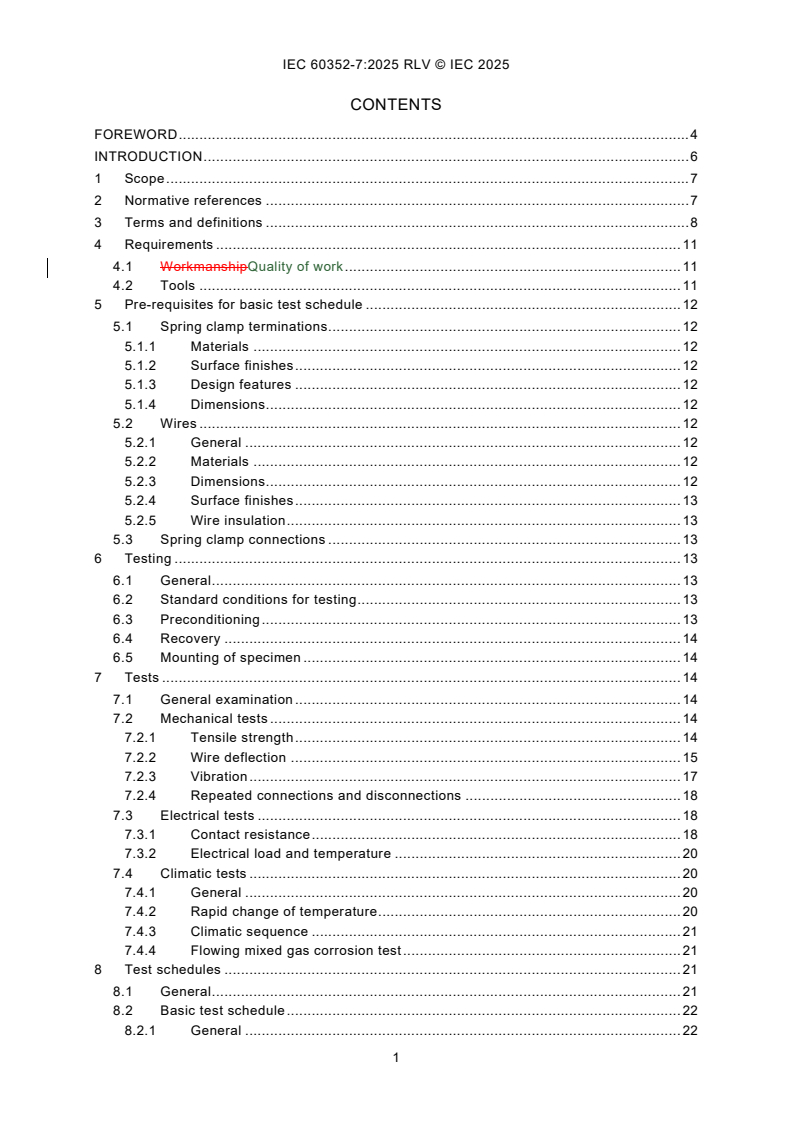
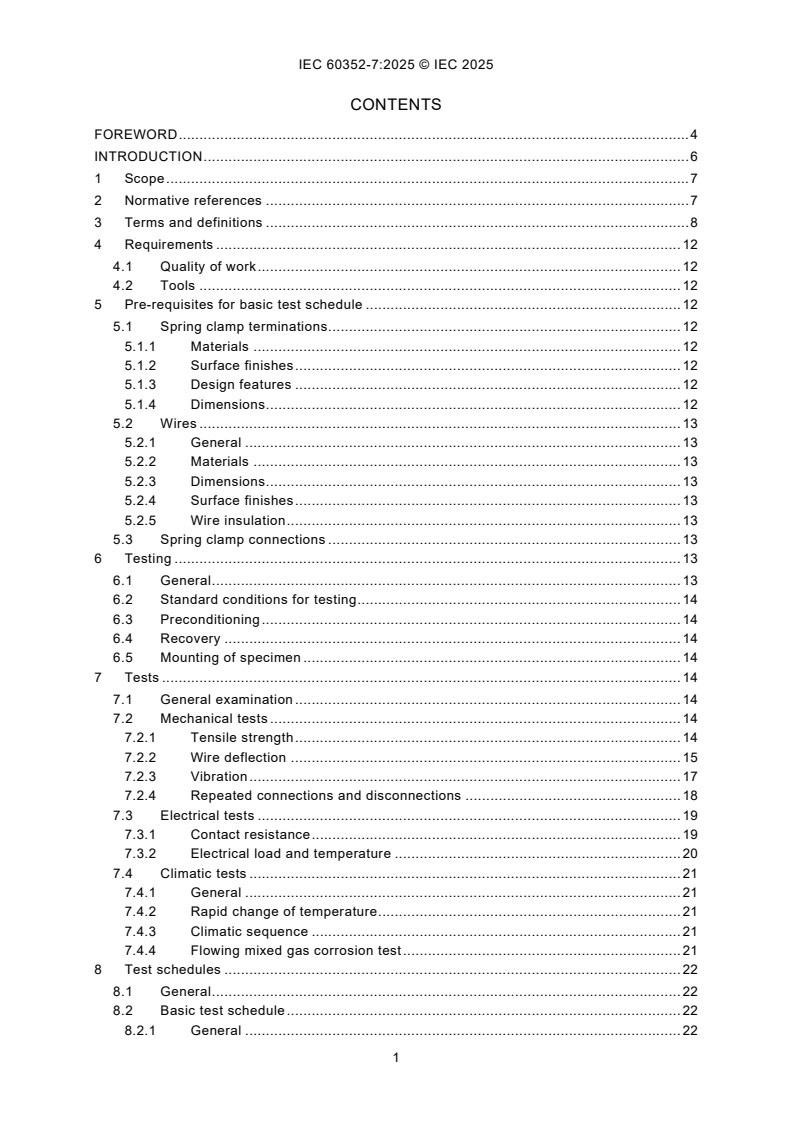
CONTENTS
FOREWORD . 4
INTRODUCTION . 6
1 Scope . 7
2 Normative references . 7
3 Terms and definitions . 8
4 Requirements . 12
4.1 Quality of work . 12
4.2 Tools . 12
5 Pre-requisites for basic test schedule . 12
5.1 Spring clamp terminations . 12
5.1.1 Materials . 12
5.1.2 Surface finishes . 12
5.1.3 Design features . 12
5.1.4 Dimensions . 12
5.2 Wires . 13
5.2.1 General . 13
5.2.2 Materials . 13
5.2.3 Dimensions . 13
5.2.4 Surface finishes . 13
5.2.5 Wire insulation . 13
5.3 Spring clamp connections . 13
6 Testing . 13
6.1 General . 13
6.2 Standard conditions for testing . 14
6.3 Preconditioning . 14
6.4 Recovery . 14
6.5 Mounting of specimen . 14
7 Tests . 14
7.1 General examination . 14
7.2 Mechanical tests . 14
7.2.1 Tensile strength . 14
7.2.2 Wire deflection . 15
7.2.3 Vibration . 17
7.2.4 Repeated connections and disconnections . 18
7.3 Electrical tests . 19
7.3.1 Contact resistance . 19
7.3.2 Electrical load and temperature . 20
7.4 Climatic tests . 21
7.4.1 General . 21
7.4.2 Rapid change of temperature . 21
7.4.3 Climatic sequence . 21
7.4.4 Flowing mixed gas corrosion test . 21
8 Test schedules . 22
8.1 General . 22
8.2 Basic test schedule . 22
8.2.1 General . 22
IEC 60352-7:2025 © IEC 2025
8.2.2 Initial examination. 22
8.2.3 Testing of spring clamp connections with spring clamp terminations with
and without a specified wire range . 23
8.3 Full test schedule . 23
8.3.1 General . 23
8.3.2 Initial examination. 23
8.3.3 Testing of spring clamp connections with and without a specified wire
range . 24
8.4 Flow charts . 25
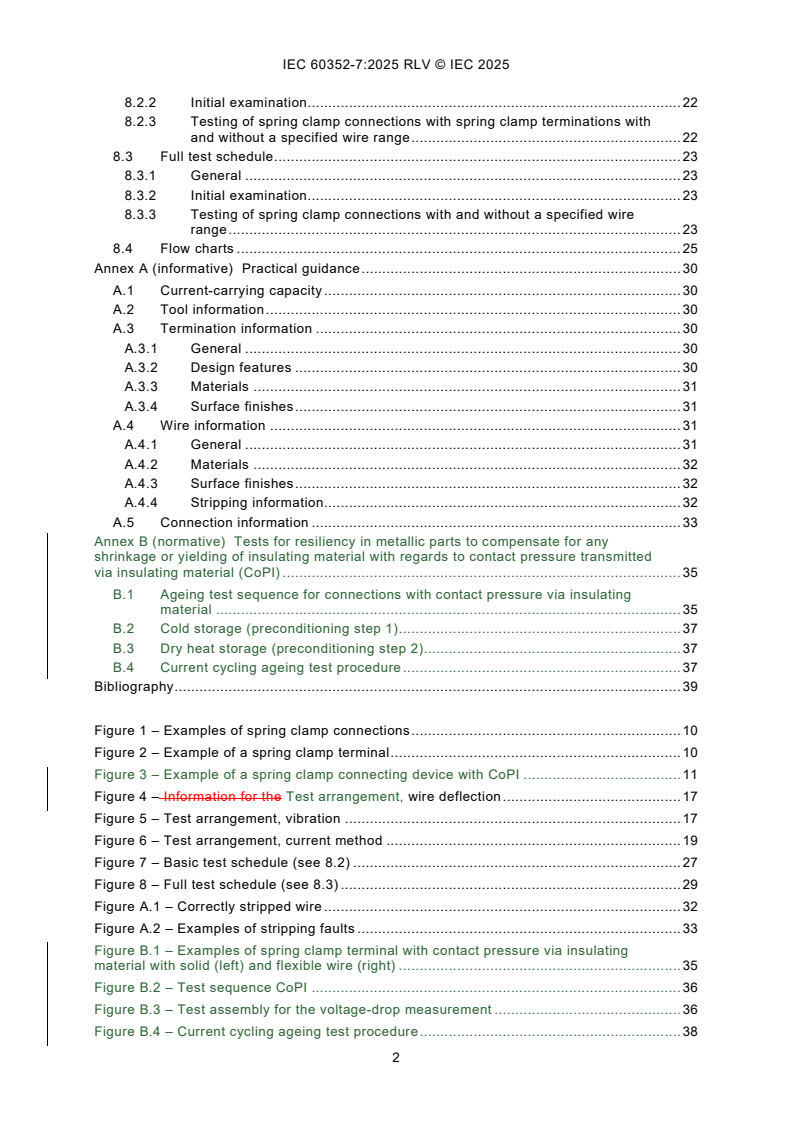
Annex A (informative) Practical guidance . 28
A.1 Current-carrying capacity . 28
A.2 Tool information . 28
A.3 Termination information . 28
A.3.1 General . 28
A.3.2 Design features . 28
A.3.3 Materials . 29
A.3.4 Surface finishes . 29
A.4 Wire information . 29
A.4.1 General . 29
A.4.2 Materials . 30
A.4.3 Surface finishes . 30
A.4.4 Stripping information. 30
A.5 Connection information . 31
Annex B (normative) Tests for resiliency in metallic parts to compensate for any
shrinkage or yielding of insulating material with regards to contact pressure transmitted
via insulating material (CoPI) . 33
B.1 Ageing test sequence for connections with contact pressure via insulating
material . 33
B.2 Cold storage (preconditioning step 1) . 35
B.3 Dry heat storage (preconditioning step 2). 35
B.4 Current cycling ageing test procedure . 35
Bibliography . 37
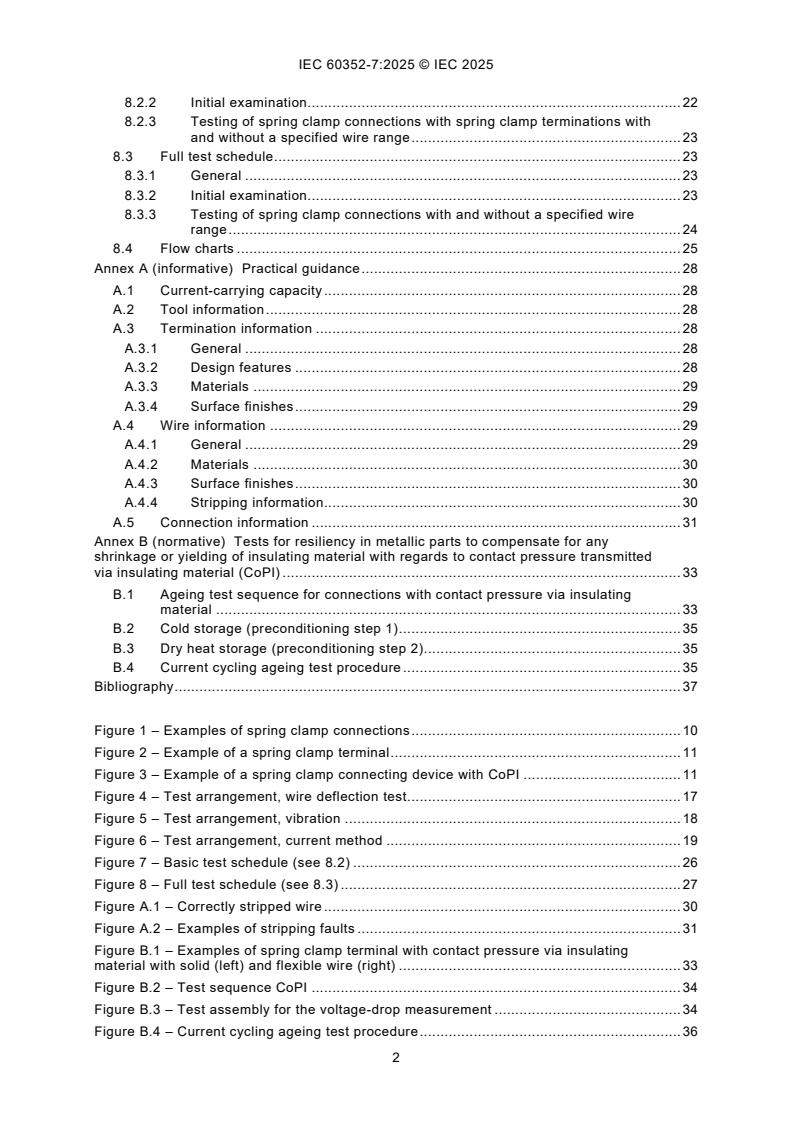
Figure 1 – Examples of spring clamp connections . 10
Figure 2 – Example of a spring clamp terminal . 11
Figure 3 – Example of a spring clamp connecting device with CoPI . 11
Figure 4 – Test arrangement, wire deflection test . 17
Figure 5 – Test arrangement, vibration . 18
Figure 6 – Test arrangement, current method . 19
Figure 7 – Basic test schedule (see 8.2) . 26
Figure 8 – Full test schedule (see 8.3) . 27
Figure A.1 – Correctly stripped wire . 30
Figure A.2 – Examples of stripping faults . 31
Figure B.1 – Examples of spring clamp terminal with contact pressure via insulating
material with solid (left) and flexible wire (right) . 33
Figure B.2 – Test sequence CoPI . 34
Figure B.3 – Test assembly for the voltage-drop measurement . 34
Figure B.4 – Current cycling ageing test procedure . 36
IEC 60352-7:2025 © IEC 2025
Table 1 – Values of tensile strength . 15
Table 2 – Value of force for wire deflection test . 16
Table 3 – Vibration, test severities . 18
Table 4 – Rated current of the wires, initial and final contact resistance. 20
Table 5 – Number of specimens required . 22
Table 6 – Test group P1 . 23
Table 7 – Test group P2 . 23
Table 8 – Test group A . 24
Table 9 – Test group B . 24
Table 10 – Test group C . 25
Table 11 – Test group D . 25
IEC 60352-7:2025 © IEC 2025
INTERNATIONAL ELECTROTECHNICAL COMMISSION
____________
Solderless connections -
Part 7: Spring clamp connections -
General requirements, test methods and practical guidance
FOREWORD
1) The International Electrotechnical Commission (IEC) is a worldwide organization for standardization comprising
all national electrotechnical committees (IEC National Committees). The object of IEC is to promote international
co-operation on all questions concerning standardization in the electrical and electronic fields. To this end and
in addition to other activities, IEC publishes International Standards, Technical Specifications, Technical Reports,
Publicly Available Specifications (PAS) and Guides (hereafter referred to as “IEC Publication(s)”). Their
preparation is entrusted to technical committees; any IEC National Committee interested in the subject dealt with
may participate in this preparatory work. International, governmental and non-governmental organizations liaising
with the IEC also participate in this preparation. IEC collaborates closely with the International Organization for
Standardization (ISO) in accordance with conditions determined by agreement between the two organizations.
2) The formal decisions or agreements of IEC on technical matters express, as nearly as possible, an international
consensus of opinion on the relevant subjects since each technical committee has representation from all
interested IEC National Committees.
3) IEC Publications have the form of recommendations for international use and are accepted by IEC National
Committees in that sense. While all reasonable efforts are made to ensure that the technical content of IEC
Publications is accurate, IEC cannot be held responsible for the way in which they are used or for any
misinterpretation by any end user.
4) In order to promote international uniformity, IEC National Committees undertake to apply IEC Publications
transparently to the maximum extent possible in their national and regional publications. Any divergence between
any IEC Publication and the corresponding national or regional publication shall be clearly indicated in the latter.
5) IEC itself does not provide any attestation of conformity. Independent certification bodies provide conformity
assessment services and, in some areas, access to IEC marks of conformity. IEC is not responsible for any
services carried out by independent certification bodies.
6) All users should ensure that they have the latest edition of this publication.
7) No liability shall attach to IEC or its directors, employees, servants or agents including individual experts and
members of its technical committees and IEC National Committees for any personal injury, property damage or
other damage of any nature whatsoever, whether direct or indirect, or for costs (including legal fees) and
expenses arising out of the publication, use of, or reliance upon, this IEC Publication or any other IEC
Publications.
8) Attention is drawn to the Normative references cited in this publication. Use of the referenced publications is
indispensable for the correct application of this publication.
9) IEC draws attention to the possibility that the implementation of this document may involve the use of (a)
patent(s). IEC takes no position concerning the evidence, validity or applicability of any claimed patent rights in
respect thereof. As of the date of publication of this document, IEC had not received notice of a patent, which
may be required to implement this document. However, implementers are cautioned that this may not represent
the latest information, which may be obtained from the patent database available at https://patents.iec.ch. IEC
shall not be held responsible for identifying any or all such patent rights.
IEC 60352-7 has been prepared by subcommittee 48B: Electrical connectors, of IEC technical
committee 48: Electrical connectors and mechanical structures for electrical and electronic
equipment. It is an International Standard.
This third edition cancels and replaces the second edition published in 2020. This edition
constitutes a technical revision.
This edition includes the following significant technical changes with respect to the previous
edition:
a) Addition of definition 3.6 contact pressure via insulating material CoPI;
b) Addition of definition 3.7 spring clamp connecting device with CoPI;
c) Addition of a dedicated test group for spring clamp connections made with spring clamp
terminations, which achieve contact pressure through insulating material (CoPI), which shall
be tested according to Annex B in Subclause 6.1;
IEC 60352-7:2025 © IEC 2025
d) Addition of test group “CoPI” in Clause 8;
e) Addition of Annex B to detail tests for resiliency in metallic parts to compensate for any
shrinkage or yielding of insulating material with regards to contact pressure transmitted
through the insulating material (CoPI), referenced in the “Test group CoPI” added in both
test schedules.
The text of this International Standard is based on the following documents:
Draft Report on voting
48B/3177/FDIS 48B/3186/RVD
Full information on the voting for its approval can be found in the report on voting indicated in
the above table.
The language used for the development of this International Standard is English.
This document was drafted in accordance with ISO/IEC Directives, Part 2, and developed in
accordance with ISO/IEC Directives, Part 1 and ISO/IEC Directives, IEC Supplement, available
at www.iec.ch/members_experts/refdocs. The main document types developed by IEC are
described in greater detail at www.iec.ch/publications.
A list of all parts in the IEC 60352 series, published under the general title Solderless
connections, can be found on the IEC website.
The committee has decided that the contents of this document will remain unchanged until the
stability date indicated on the IEC website under webstore.iec.ch in the data related to the
specific document. At this date, the document will be
– reconfirmed,
– withdrawn, or
– revised.
IEC 60352-7:2025 © IEC 2025
INTRODUCTION
This part of IEC 60352 covers spring clamp connections and includes requirements, tests and
practical guidance information.
Two test schedules are provided.
a) The basic test schedule applies to spring clamp connections which conform to all
requirements of Clause 5. These requirements are derived from experience with successful
applications of such spring clamp connections.
b) The full test schedule applies to spring clamp connections which do not fully conform to all
requirements of Clause 5, for example which are manufactured using materials or finishes
not included in Clause 5.
This approach ensures cost and time effective performance verification using a limited basic
test schedule for established spring clamp connections and an expanded full test schedule for
spring clamp connections requiring more extensive performance validation.
In this third edition, a dedicated test group providing requirements and tests for spring clamp
connections with contact pressure transmitted via insulating material (CoPI) has been added in
both test schedules, referring to the new Annex B (normative). In such instance, this provides
means to fulfil both the requirement of 6.6.3 of IEC 61984:2008 concerning the design of
electrical connections of connectors, and the requirement of 8.2 of IEC 60999-1:1999
concerning the design of clamping units connecting devices.
The values given in this document are minimum values, which are harmonized with other IEC
documents. Other standards or the manufacturer’s specification can specify other values.
The test procedure for resiliency in metallic parts to compensate for any shrinkage or yielding
of insulating material with regards to contact pressure transmitted via insulating material (CoPI)
has been derived from IEC 60947-7-4:2019.
IEC 60352-7:2025 © IEC 2025
1 Scope
This part of IEC 60352 is applicable to spring clamp connections made with stripped wire of the
following types and sizes according to IEC 60228 or IEC 60189-3, without further preparation
(later described “unprepared”):
– solid conductors (e.g. class 1 of IEC 60228) of 0,32 mm to 3,7 mm nominal diameter
2 2
(0,08 mm to 10 mm cross-section), or
2 2
– stranded conductors (e.g. class 2 of IEC 60228) of 0,08 mm to 10 mm cross-section, or
2 2
– flexible conductors (e.g. class 5 or 6 of IEC 60228) of 0,08 mm to 10 mm cross-section,
for use in electrical and electronic equipment and components.
Information on materials and data from industrial experience is included in addition to the test
procedures to provide electrically stable connections under prescribed environmental
conditions.
The object of this document is to determine the suitability of spring clamp connections under
specified mechanical, electrical and atmospheric conditions.
NOTE IEC Guide 109 advocates the need to minimize the impact of a product on the natural environment throughout
the product life cycle. It is understood that some of the materials permitted in this document can have a negative
environmental impact. As technological advances lead to acceptable alternatives for these materials, they will be
eliminated from this document.
2 Normative references
The following documents are referred to in the text in such a way that some or all of their content
constitutes requirements of this document. For dated references, only the edition cited applies.
For undated references, the latest edition of the referenced document (including any
amendments) applies.
IEC 60050-581, International Electrotechnical Vocabulary (IEV) - Part 581: Electromechanical
components for electronic equipment
IEC 60068-1, Environmental testing - Part 1: General and guidance
IEC 60189-3, Low-frequency cables and wires with PVC insulation and PVC sheath - Part 3:
Equipment wires with solid or stranded conductor, PVC insulated, in singles, pairs and triples
IEC 60228, Conductors of insulated cables
IEC 60512-1, Connectors for electrical and electronic equipment - Tests and measurements -
Part 1: Generic specification
IEC 60512-1-1, Connectors for electronic equipment - Tests and measurements -
Part 1-1: General examination - Test 1a: Visual examination
IEC 60512-1-2, Connectors for electronic equipment - Tests and measurements -
Part 1-2: General examination - Test 1b: Examination of dimension and mass
IEC 60512-2-1, Connectors for electronic equipment - Tests and measurements -
Part 2-1: Electrical continuity and contact resistance tests - Test 2a: Contact resistance -
Millivolt level method
IEC 60352-7:2025 © IEC 2025
IEC 60512-2-2:2003, Connectors for electronic equipment - Tests and measurements -
Part 2-2: Electrical continuity and contact resistance tests - Test 2b: Contact resistance -
Specified test current method
IEC 60512-2-5, Connectors for electronic equipment - Tests and measurements -
Part 2-5: Electrical continuity and contact resistance tests - Test 2e: Contact disturbance
IEC 60512-6-4, Connectors for electronic equipment - Tests and measurements -
Part 6-4: Dynamic stress tests - Test 6d: Vibration (sinusoidal)
IEC 60512-9-5, Connectors for electrical and electronic equipment - Tests and measurements -
Part 9-5: Endurance tests - Test 9e: Current loading, cyclic
IEC 60512-11-1, Connectors for electrical and electronic equipment - Tests and measurements -
Part 11-1: Climatic tests - Test 11a - Climatic sequence
IEC 60512-11-4, Connectors for electronic equipment - Tests and measurements -
Part 11-4: Climatic tests - Test 11d: Rapid change of temperature
IEC 60512-11-7, Connectors for electronic equipment - Tests and measurements -
Part 11-7: Climatic tests - Test 11g: Flowing mixed gas corrosion test
IEC 60512-11-9, Connectors for electronic equipment - Tests and measurements -
Part 11-9: Climatic tests - Test 11i: Dry heat
IEC 60512-11-10, Connectors for electronic equipment - Tests and measurements -
Part 11-10: Climatic tests - Test 11j: Cold
IEC 60512-16-20, Electromechanical components for electronic equipment - Basic testing
procedures and measuring methods - Part 16: Mechanical tests on contacts and terminations -
Section 20: Test 16t: Mechanical strength (wired termination of solderless connections)
3 Terms and definitions
For the purposes of this document, the terms and definitions given in IEC 60050-581,
IEC 60512-1 and the following apply.
ISO and IEC maintain terminology databases for use in standardization at the following
addresses:
– IEC Electropedia: available at https://www.electropedia.org/
– ISO Online browsing platform: available at https://www.iso.org/obp
3.1
spring clamp termination
part of the contact or terminal to which one single conductor only is connected by means of a
spring
IEC 60352-7:2025 © IEC 2025
3.1.1
universal spring clamp termination
spring clamp termination intended to accept solid, stranded and flexible unprepared conductors
Note 1 to entry: For the meaning of solid, stranded and flexible, see IEC 60228 where conductors are classified as
class 1 (solid conductors), class 2 (stranded conductors), class 5 (flexible conductors) and class 6 (flexible
conductors which are more flexible than class 5).
3.1.2
non-universal spring clamp termination
spring clamp termination intended to accept conductors of one class only, for example solid
conductors only, or conductors of two classes only, for example solid and stranded but not
flexible
Note 1 to entry: For the meaning of solid, stranded and flexible, see IEC 60228 where conductors are classified as
class 1 (solid conductors), class 2 (stranded conductors), class 5 (flexible conductors) and class 6 (flexible
conductors which are more flexible than class 5).
3.1.3
push-in spring clamp termination
spring clamp termination in which the connection is made by pushing in a solid or stranded
conductor without the aid of a tool or of an actuating element
Note 1 to entry: For the meaning of solid and stranded, see IEC 60228 where solid conductors are classified as
class 1, stranded conductors are classified as class 2.
Note 2 to entry: Flexible conductor ends can become solid by e.g. ultrasonic welding according to IEC 60352-9.
3.2
spring clamp connection
solderless connection achieved by clamping a conductor with a spring clamp termination
Note 1 to entry: See Figure 1.
IEC 60352-7:2025 © IEC 2025
a) Spring clamp connection, operated without a tool
b) Spring clamp connection, operated with a tool
c) Spring clamp connection, operated with an actuating element
d) Spring clamp connections, with a push-in spring clamp termination, with solid wires
Figure 1 – Examples of spring clamp connections
3.3
spring clamp terminal
terminal designed to accept a conductor for the purpose of establishing a spring clamp
connection
Note 1 to entry: See Figure 2.
IEC 60352-7:2025 © IEC 2025
Figure 2 – Example of a spring clamp terminal
3.4
spring clamp connecting device
device for the electrical connection of one or more conductors comprising one or more spring
clamp terminations and, if necessary, either insulation or auxiliary parts, or both
3.5
actuating element
part of a spring clamp termination or terminal to which an external force is to be applied
Note 1 to entry: Movement of the actuating element provides a means for activating or deactivating the spring.
3.6
contact pressure via insulating material
CoPI
contact pressure due to contact force transmitted through insulating material
3.7
spring clamp connecting device with CoPI
spring clamp connecting device where the electrical connection of one or more conductors
depends on contact pressure transmitted via insulating material with sufficient resiliency in the
metallic parts to assure necessary contact pressure
Note 1 to entry: See Figure 3.
Figure 3 – Example of a spring clamp connecting device with CoPI
IEC 60352-7:2025 © IEC 2025
4 Requirements
4.1 Quality of work
The connection shall be processed in a careful and professional manner, in accordance with
good current practice. Annex A (informative) provides practical guidance and can constitute a
benchmark for the assessment of the quality of work.
NOTE Some industry sectors (e.g. automotive, aerospace, marine, nuclear, military) use standards for the quality
of work which can be considered upon agreement between manufacturer and user.
4.2 Tools
Tools, if necessary, shall be used and inspected according to the instructions given by the
manufacturer.
5 Pre-requisites for basic test schedule
5.1 Spring clamp terminations
5.1.1 Materials
– Materials for the current-carrying parts:
Suitable grades of copper or copper alloy shall be used.
– Materials for the spring clamp parts:
Suitable (according to manufacturer´s instructions) grades of copper alloy or steel shall be
used.
5.1.2 Surface finishes
The contact area of the current-carrying parts shall be plated with tin or tin-alloy.
The surface shall be free of detrimental contamination or corrosion.
5.1.3 Design features
Spring clamp terminations shall be designed so that the spring clamp parts establish a force to
connect the conductors which ensures that the necessary contact pressure is maintained.
In a spring clamp connecting device, each conductor shall be clamped individually.
The openings for use of a tool intended to assist the insertion or withdrawal of the conductor
shall be clearly distinguishable from the conductor’s entry hole.
5.1.4 Dimensions
The suitability of a spring clamp connection depends on the dimensions of the termination
together with the characteristics of the materials used.
The dimensions of the termination shall be chosen so as to be suitable for (i.e. able to accept)
the cross-sectional area of the conductor or the range of conductors for which the termination
is designed.
The suitability is verified by applying the test schedules given in Clause 8.
IEC 60352-7:2025 © IEC 2025
5.2 Wires
5.2.1 General
Wires with solid, stranded and flexible conductors according to IEC 60228 or IEC 60189-3 shall
be used depending on the type of spring clamp terminations.
5.2.2 Materials
The conductor used shall be made of annealed copper.
5.2.3 Dimensions
Wires with the following dimensions shall be used:
2 2
– solid wires of 0,32 mm to 3,7 mm nominal diameter (0,08 mm to 10 mm cross-section), or
2 2
– stranded wires of 0,08 mm to 10 mm cross-section, or
2 2
– flexible wires of 0,08 mm to 10 mm cross-section.
5.2.4 Surface finishes
The conductor shall be unplated or plated with tin or tin-alloy.
The conductor surface shall be free of contamination and corrosion which degrades
performance.
5.2.5 Wire insulation
The insulation shall be capable of being readily stripped from the conductor without changing
the physical characteristics of the conductor or strands.
5.3 Spring clamp connections
a) The combination of conductor and spring clamp termination shall be compatible.
b) The wire shall be stripped to the correct length specified by the manufacturer. The stripped
part of the wire shall not be damaged and shall be clean and free from particles of insulation.
c) The conductor shall be correctly located in the spring clamp termination at the correct depth
specified by the manufacturer.
All strands of the wire shall be within the spring clamp termination.
6 Testing
6.1 General
The test schedule to be applied shall be chosen according to the following conditions:
a) spring clamp connections which conform to all the requirements of Clause 5 shall be tested
in accordance with and meet the requirements of the basic test schedule, see 8.2;
b) spring clamp connections which do not fully conform to all the requirements of Clause 5, for
example which are made with different wire types or termination sizes or materials, shall be
tested and meet the requirements of the full test schedule given in 8.3;
Both these test schedules include a dedicated test group for spring clamp connections made
with spring clamp terminations which have contact pressure via insulating material (CoPI) which
shall be additionally tested according to Annex B.
IEC 60352-7:2025 © IEC 2025
6.2 Standard conditions for testing
Unless otherwise specified in the relevant product standard, all tests shall be carried out under
standard conditions for testing as specified in IEC 60512-1.
The ambient temperature and the relative humidity at which the measurements are made shall
be stated in the test report.
In case of dispute about test results, the test shall be repeated at one of the referred conditions
of IEC 60068-1.
6.3 Preconditioning
Where specified, the connections shall be preconditioned under standard conditions for testing
for a period of 24 h, in accordance with IEC 60512-1.
6.4 Recovery
Where specified, the specimen shall be allowed to recover under standard conditions for testing
for a period of 1 h to 2 h after conditioning.
6.5 Mounting of specimen
a) When mounting is required in a test, the specimens shall be mounted using the normal
mounting method, unless otherwise specified in the relevant product standard.
b) Each test specimen shall consist of one spring clamp connection prepared as required in
the test schedules.
When more test specimens are required, they may be part of the same multipole spring
clamp connecting devices.
7 Tests
7.1 General examination
The examination shall be carried out in accordance with Test 1a of IEC 60512-1-1, and Test 1b
of IEC 60512-1-2. The visual examination test may be carried out with magnification up to
approximately five times.
All spring clamp terminations and wires shall be examined to ensure that the applicable
requirements of Clause 5 have been met.
7.2 Mechanical tests
7.2.1 Tensile strength
The test shall be carried out in accordance with Test 16t, method A, of IEC 60512-16-20.
Requirement:
The tensile strength of spring clamp connections shall be not less than specified in Table 1,
unless otherwise specified by the relevant product standard.
IEC 60352-7:2025 © IEC 2025
Table 1 – Values of tensile strength
Conductor cross-section Values of tensile strength
N minimum
mm
0,08 up to 0,22 (not included) 4
0,22 10
0,34 15
0,5 20
0,75 30
1,0 35
1,5 40
2,5 50
4,0 60
6,0 80
10,0 90
7.2.2 Wire deflection
NOTE This test method is similar to the deflection test method for screwless terminals described in IEC 60884-1.
Spring clamp terminations shall be so designed that the inserted solid conductor remains
clamped, even when the conductor has been deflected during normal installation, for example,
during mounting in a box, and the deflecting stress is transferred to the spring clamp
termination.
Compliance is checked by the following test which is made on specimens which have not been
used for any other test.
a) Test apparatus
The test apparatus, the principle of which is shown in Figure 4, shall be so constructed that:
– a specified conductor, properly inserted into a terminal, is allowed to be deflected in any
of the 12 directions differing from each other by 30°, with a tolerance referred to each
direction of ±5° and;
– the starting point can be varied by 10° and 20° from the original point.
A reference direction need not be specified.
The deflection of the conductor from its straight position to the testing positions shall be
effected by means of a suitable device applying a specified force to the conductor at
a certain distance from the terminal.
The deflecting device shall be so designed that:
– the force is applied in the direction perpendicular to the undeflected conductor;
– the deflection is attained without rotation or displacement of the conductor within the
clamping unit, and
– the force remains applied whilst the prescribed voltage drop measurement is made.
Provisions shall be made so that the voltage drop across the spring clamp termination under
test can be measured when the conductor is connected, as shown for example in Figure 3.
IEC 60352-7:2025 © IEC 2025
b) Test method
The specimen is mounted on the fixed part of the test apparatus in such a way that the
specified conductor inserted into the spring clamp termination under test can be freely
deflected.
The surface of the test conductor shall be free of detrimental contamination or corrosion.
If necessary, the inserted conductor may be permanently bent around obstacles, so that
these do not influence the results of the test.
In some cases, with the exception of the case of guidance for the conductors, it may be
advisable to remove those parts of the specimen which do not allow the deflection of the
conductor corresponding to the force to be applied.
A spring clamp termination is fitted as for normal use with a solid copper conductor having
the smallest cross-sectional area as specified by the manufacturer and is submitted to a
first test sequence; the same spring clamp termination is submitted to a second test
sequence using the conductor having the largest cross-sectional area, unless the first test
sequence has failed.
The force for deflecting the conductor is specified in Table 2, the distance of 100 mm being
measured from the extremity of the terminal, including the guidance for the conductor, if
any, to the point of application of the force to the conductor.
The test is made with continuous current (i.e. the current is not switched on and off during
the test); a suitable power supply should be used so that the current variations are kept
within ±5 % during the test.
Table 2 – Value of force for wire deflection test
Cross-section of the test conductor Force for deflecting the test
conductors
N
mm
0,5 up to 0,75 (not included) 0,09
0,75 0,16
1,0 0,25
1,5 0,5
2,5 1,0
4 2,0
6 3,5
10 7,0
The forces are chosen so that they stress the conductors close to the limit of
elasticity.
c) Test procedure
A tenth of the test current assigned to the wire according to Table 4 is passed through the
spring clamp connection under test. A force, according to Table 2, is applied to the test
conductor inserted in the spring clamp termination under test in the direction of one of the
12 directions shown in Figure 4 and the voltage drop across this spring clamp connection is
measured. The force is then removed.
The force is then applied successively in each of the remaining 11 directions shown in
Figure 4 following the same test procedure.
If at any of the 12 test directions the voltage drop is greater than 2,5 mV, the force is kept
applied in this direction until the voltage drop is reduced to a value below 2,5 mV, but for
not more than 1 min. After the voltage drop has reached a value lower than or equal to
2,5 mV, the force is kept applied in the same direction for a further period of 30 s during
which period the voltage drop shall not increase.
IEC 60352-7:2025 © IEC 2025
The other specimens of the set are tested following the same test procedure, but moving
the 12 directions of the force so that they differ by approximately 10° for each specimen. If
one specimen has failed at one of the directions of application of the test force, the tests
are repeated on another set of specimens, all of which shall comply with the repeated tests.
Figure 4 – Test arrangement, wire deflection test
7.2.3 Vibration
The test shall be carried out in accordance with Test 6d of IEC 60512-6-4.
The component shall be firmly held on a vibration table.
An example of a suitable test arrangement for testing a component containing a spring clamp
connection is shown in Figure 5. Contact disturbance shall be monitored during the vibration
test in accordance with Test 2e of IEC 60512-2-5, see Table 3.
The limit of duration of contact disturbance shall be 1 μs unless otherwise specified by the
relevant product standard.
IEC 60352-7:2025 © IEC 2025
Figure 5 – Test arrangement, vibration
Table 3 – Vibration, test severities
Range of frequency, Hz 10 to 55 10 to 500 10 to 2 000
Overall duration, h 2,25 6 7,5
Displacement amplitude below the cross-
0,35
...
IEC 60352-7 ®
Edition 3.0 2026-01
INTERNATIONAL
STANDARD
REDLINE VERSION
Solderless connections -
Part 7: Spring clamp connections - General requirements, test methods and
practical guidance
ICS 31.220.10 ISBN 978-2-8327-0996-2
All rights reserved. Unless otherwise specified, no part of this publication may be reproduced or utilized in any form or
by any means, electronic or mechanical, including photocopying and microfilm, without permission in writing from either
IEC or IEC's member National Committee in the country of the requester. If you have any questions about IEC copyright
or have an enquiry about obtaining additional rights to this publication, please contact the address below or your local
IEC member National Committee for further information.
IEC Secretariat Tel.: +41 22 919 02 11
3, rue de Varembé info@iec.ch
CH-1211 Geneva 20 www.iec.ch
Switzerland
About the IEC
The International Electrotechnical Commission (IEC) is the leading global organization that prepares and publishes
International Standards for all electrical, electronic and related technologies.
About IEC publications
The technical content of IEC publications is kept under constant review by the IEC. Please make sure that you have the
latest edition, a corrigendum or an amendment might have been published.
IEC publications search - IEC Products & Services Portal - products.iec.ch
webstore.iec.ch/advsearchform Discover our powerful search engine and read freely all the
The advanced search enables to find IEC publications by a publications previews, graphical symbols and the glossary.
variety of criteria (reference number, text, technical With a subscription you will always have access to up to date
committee, …). It also gives information on projects, content tailored to your needs.
replaced and withdrawn publications.
Electropedia - www.electropedia.org
The world's leading online dictionary on electrotechnology,
IEC Just Published - webstore.iec.ch/justpublished
Stay up to date on all new IEC publications. Just Published containing more than 22 500 terminological entries in English
details all new publications released. Available online and and French, with equivalent terms in 25 additional languages.
once a month by email. Also known as the International Electrotechnical Vocabulary
(IEV) online.
IEC Customer Service Centre - webstore.iec.ch/csc
If you wish to give us your feedback on this publication or
need further assistance, please contact the Customer
Service Centre: sales@iec.ch.
IEC 60352-7:2025 RLV © IEC 2025
CONTENTS
FOREWORD . 4
INTRODUCTION . 6
1 Scope . 7
2 Normative references . 7
3 Terms and definitions . 8
4 Requirements . 11
4.1 WorkmanshipQuality of work . 11
4.2 Tools . 11
5 Pre-requisites for basic test schedule . 12
5.1 Spring clamp terminations . 12
5.1.1 Materials . 12
5.1.2 Surface finishes . 12
5.1.3 Design features . 12
5.1.4 Dimensions . 12
5.2 Wires . 12
5.2.1 General . 12
5.2.2 Materials . 12
5.2.3 Dimensions . 12
5.2.4 Surface finishes . 13
5.2.5 Wire insulation . 13
5.3 Spring clamp connections . 13
6 Testing . 13
6.1 General . 13
6.2 Standard conditions for testing . 13
6.3 Preconditioning . 13
6.4 Recovery . 14
6.5 Mounting of specimen . 14
7 Tests . 14
7.1 General examination . 14
7.2 Mechanical tests . 14
7.2.1 Tensile strength . 14
7.2.2 Wire deflection . 15
7.2.3 Vibration . 17
7.2.4 Repeated connections and disconnections . 18
7.3 Electrical tests . 18
7.3.1 Contact resistance . 18
7.3.2 Electrical load and temperature . 20
7.4 Climatic tests . 20
7.4.1 General . 20
7.4.2 Rapid change of temperature . 20
7.4.3 Climatic sequence . 21
7.4.4 Flowing mixed gas corrosion test . 21
8 Test schedules . 21
8.1 General . 21
8.2 Basic test schedule . 22
8.2.1 General . 22
IEC 60352-7:2025 RLV © IEC 2025
8.2.2 Initial examination. 22
8.2.3 Testing of spring clamp connections with spring clamp terminations with
and without a specified wire range . 22
8.3 Full test schedule . 23
8.3.1 General . 23
8.3.2 Initial examination. 23
8.3.3 Testing of spring clamp connections with and without a specified wire
range . 23
8.4 Flow charts . 25
Annex A (informative) Practical guidance . 30
A.1 Current-carrying capacity . 30
A.2 Tool information . 30
A.3 Termination information . 30
A.3.1 General . 30
A.3.2 Design features . 30
A.3.3 Materials . 31
A.3.4 Surface finishes . 31
A.4 Wire information . 31
A.4.1 General . 31
A.4.2 Materials . 32
A.4.3 Surface finishes . 32
A.4.4 Stripping information. 32
A.5 Connection information . 33
Annex B (normative) Tests for resiliency in metallic parts to compensate for any
shrinkage or yielding of insulating material with regards to contact pressure transmitted
via insulating material (CoPI) . 35
B.1 Ageing test sequence for connections with contact pressure via insulating
material . 35
B.2 Cold storage (preconditioning step 1) . 37
B.3 Dry heat storage (preconditioning step 2). 37
B.4 Current cycling ageing test procedure . 37
Bibliography . 39
Figure 1 – Examples of spring clamp connections . 10
Figure 2 – Example of a spring clamp terminal . 10
Figure 3 – Example of a spring clamp connecting device with CoPI . 11
Figure 4 – Information for the Test arrangement, wire deflection . 17
Figure 5 – Test arrangement, vibration . 17
Figure 6 – Test arrangement, current method . 19
Figure 7 – Basic test schedule (see 8.2) . 27
Figure 8 – Full test schedule (see 8.3) . 29
Figure A.1 – Correctly stripped wire . 32
Figure A.2 – Examples of stripping faults . 33
Figure B.1 – Examples of spring clamp terminal with contact pressure via insulating
material with solid (left) and flexible wire (right) . 35
Figure B.2 – Test sequence CoPI . 36
Figure B.3 – Test assembly for the voltage-drop measurement . 36
Figure B.4 – Current cycling ageing test procedure . 38
IEC 60352-7:2025 RLV © IEC 2025
Table 1 – Values of tensile strength . 14
Table 2 – Value of force for wire deflection test . 16
Table 3 – Vibration, test severities . 18
Table 4 – Rated current of the wires, initial and final contact resistance. 20
Table 5 – Number of specimens required . 22
Table 6 – Test group P1 . 22
Table 7 – Test group P2 . 23
Table 8 – Test group A . 23
Table 9 – Test group B . 24
Table 10 – Test group C . 24
Table 11 – Test group D . 24
IEC 60352-7:2025 RLV © IEC 2025
INTERNATIONAL ELECTROTECHNICAL COMMISSION
____________
Solderless connections -
Part 7: Spring clamp connections -
General requirements, test methods and practical guidance
FOREWORD
1) The International Electrotechnical Commission (IEC) is a worldwide organization for standardization comprising
all national electrotechnical committees (IEC National Committees). The object of IEC is to promote international
co-operation on all questions concerning standardization in the electrical and electronic fields. To this end and
in addition to other activities, IEC publishes International Standards, Technical Specifications, Technical Reports,
Publicly Available Specifications (PAS) and Guides (hereafter referred to as “IEC Publication(s)”). Their
preparation is entrusted to technical committees; any IEC National Committee interested in the subject dealt with
may participate in this preparatory work. International, governmental and non-governmental organizations liaising
with the IEC also participate in this preparation. IEC collaborates closely with the International Organization for
Standardization (ISO) in accordance with conditions determined by agreement between the two organizations.
2) The formal decisions or agreements of IEC on technical matters express, as nearly as possible, an international
consensus of opinion on the relevant subjects since each technical committee has representation from all
interested IEC National Committees.
3) IEC Publications have the form of recommendations for international use and are accepted by IEC National
Committees in that sense. While all reasonable efforts are made to ensure that the technical content of IEC
Publications is accurate, IEC cannot be held responsible for the way in which they are used or for any
misinterpretation by any end user.
4) In order to promote international uniformity, IEC National Committees undertake to apply IEC Publications
transparently to the maximum extent possible in their national and regional publications. Any divergence between
any IEC Publication and the corresponding national or regional publication shall be clearly indicated in the latter.
5) IEC itself does not provide any attestation of conformity. Independent certification bodies provide conformity
assessment services and, in some areas, access to IEC marks of conformity. IEC is not responsible for any
services carried out by independent certification bodies.
6) All users should ensure that they have the latest edition of this publication.
7) No liability shall attach to IEC or its directors, employees, servants or agents including individual experts and
members of its technical committees and IEC National Committees for any personal injury, property damage or
other damage of any nature whatsoever, whether direct or indirect, or for costs (including legal fees) and
expenses arising out of the publication, use of, or reliance upon, this IEC Publication or any other IEC
Publications.
8) Attention is drawn to the Normative references cited in this publication. Use of the referenced publications is
indispensable for the correct application of this publication.
9) IEC draws attention to the possibility that the implementation of this document may involve the use of (a)
patent(s). IEC takes no position concerning the evidence, validity or applicability of any claimed patent rights in
respect thereof. As of the date of publication of this document, IEC had not received notice of a patent, which
may be required to implement this document. However, implementers are cautioned that this may not represent
the latest information, which may be obtained from the patent database available at https://patents.iec.ch. IEC
shall not be held responsible for identifying any or all such patent rights.
This redline version of the official IEC Standard allows the user to identify the changes made
to the previous edition IEC 60352-7:2020. A vertical bar appears in the margin wherever a
change has been made. Additions are in green text, deletions are in strikethrough red text.
IEC 60352-7:2025 RLV © IEC 2025
IEC 60352-7 has been prepared by subcommittee 48B: Electrical connectors, of IEC technical
committee 48: Electrical connectors and mechanical structures for electrical and electronic
equipment. It is an International Standard.
This third edition cancels and replaces the second edition published in 2020. This edition
constitutes a technical revision.
This edition includes the following significant technical changes with respect to the previous
edition:
a) Addition of definition 3.6 contact pressure via insulating material CoPI;
b) Addition of definition 3.7 spring clamp connecting device with CoPI;
c) Addition of a dedicated test group for spring clamp connections made with spring clamp
terminations, which achieve contact pressure through insulating material (CoPI), which shall
be tested according to Annex B in Subclause 6.1;
d) Addition of test group “CoPI” in Clause 8;
e) Addition of Annex B to detail tests for resiliency in metallic parts to compensate for any
shrinkage or yielding of insulating material with regards to contact pressure transmitted
through the insulating material (CoPI), referenced in the “Test group CoPI” added in both
test schedules.
The text of this International Standard is based on the following documents:
Draft Report on voting
48B/3177/FDIS 48B/3186/RVD
Full information on the voting for its approval can be found in the report on voting indicated in
the above table.
The language used for the development of this International Standard is English.
This document was drafted in accordance with ISO/IEC Directives, Part 2, and developed in
accordance with ISO/IEC Directives, Part 1 and ISO/IEC Directives, IEC Supplement, available
at www.iec.ch/members_experts/refdocs. The main document types developed by IEC are
described in greater detail at www.iec.ch/publications.
A list of all parts in the IEC 60352 series, published under the general title Solderless
connections, can be found on the IEC website.
The committee has decided that the contents of this document will remain unchanged until the
stability date indicated on the IEC website under webstore.iec.ch in the data related to the
specific document. At this date, the document will be
– reconfirmed,
– withdrawn, or
– revised.
IEC 60352-7:2025 RLV © IEC 2025
INTRODUCTION
This part of IEC 60352 covers spring clamp connections and includes requirements, tests and
practical guidance information.
Two test schedules are provided.
a) The basic test schedule applies to spring clamp connections which conform to all
requirements of Clause 5. These requirements are derived from experience with successful
applications of such spring clamp connections.
b) The full test schedule applies to spring clamp connections which do not fully conform to all
requirements of Clause 5, for example which are manufactured using materials or finishes
not included in Clause 5.
This approach ensures cost and time effective performance verification using a limited basic
test schedule for established spring clamp connections and an expanded full test schedule for
spring clamp connections requiring more extensive performance validation.
In this third edition, a dedicated test group providing requirements and tests for spring clamp
connections with contact pressure transmitted via insulating material (CoPI) has been added in
both test schedules, referring to the new Annex B (normative). In such instance, this provides
means to fulfil both the requirement of 6.6.3 of IEC 61984:2008 concerning the design of
electrical connections of connectors, and the requirement of 8.2 of IEC 60999-1:1999
concerning the design of clamping units connecting devices.
The values given in this document are minimum values, which are harmonized with other IEC
documents. Other standardsor the manufacturer’s specification may can specify other values.
The test procedure for resiliency in metallic parts to compensate for any shrinkage or yielding
of insulating material with regards to contact pressure transmitted via insulating material (CoPI)
has been derived from IEC 60947-7-4:2019.
IEC 60352-7:2025 RLV © IEC 2025
1 Scope
This part of IEC 60352 is applicable to spring clamp connections made with stripped wire of the
following types and sizes according to IEC 60228 or IEC 60189-3, without further preparation
(later described “unprepared”):
– solid conductors (e.g. class 1 of IEC 60228) of 0,32 mm to 3,7 mm nominal diameter
2 2
(0,08 mm to 10 mm cross-section), or
2 2
– stranded conductors (e.g. class 2 of IEC 60228) of 0,08 mm to 10 mm cross-section, or
2 2
– flexible conductors (e.g. class 5 or 6 of IEC 60228) of 0,08 mm to 10 mm cross-section,
according to IEC 60228 or IEC 60189-3 for use in electrical and electronic equipment and
components.
Information on materials and data from industrial experience is included in addition to the test
procedures to provide electrically stable connections under prescribed environmental
conditions.
The object of this document is to determine the suitability of spring clamp connections under
specified mechanical, electrical and atmospheric conditions.
NOTE IEC Guide 109 advocates the need to minimize the impact of a product on the natural environment throughout
the product life cycle. It is understood that some of the materials permitted in this document can have a negative
environmental impact. As technological advances lead to acceptable alternatives for these materials, they will be
eliminated from this document.
2 Normative references
The following documents are referred to in the text in such a way that some or all of their content
constitutes requirements of this document. For dated references, only the edition cited applies.
For undated references, the latest edition of the referenced document (including any
amendments) applies.
IEC 60050-581, International Electrotechnical Vocabulary (IEV) - Part 581: Electromechanical
components for electronic equipment
IEC 60068-1:2013, Environmental testing - Part 1: General and guidance
IEC 60189-3:2007, Low-frequency cables and wires with PVC insulation and PVC sheath -
Part 3: Equipment wires with solid or stranded conductor wires, PVC insulated, in singles,
pairs and triples
IEC 60228:2004, Conductors of insulated cables
IEC 60512-1, Connectors for electrical and electronic equipment - Tests and measurements -
Part 1: Generic specification
IEC 60512-1-1, Connectors for electronic equipment - Tests and measurements -
Part 1-1: General examination - Test 1a: Visual examination
IEC 60512-1-2, Connectors for electronic equipment - Tests and measurements -
Part 1-2: General examination - Test 1b: Examination of dimension and mass
IEC 60512-2-1, Connectors for electronic equipment - Tests and measurements -
Part 2-1: Electrical continuity and contact resistance tests - Test 2a: Contact resistance -
Millivolt level method
IEC 60352-7:2025 RLV © IEC 2025
IEC 60512-2-2:2003, Connectors for electronic equipment - Tests and measurements -
Part 2-2: Electrical continuity and contact resistance tests - Test 2b: Contact resistance -
Specified test current method
IEC 60512-2-5, Connectors for electronic equipment - Tests and measurements -
Part 2-5: Electrical continuity and contact resistance tests - Test 2e: Contact disturbance
IEC 60512-6-4, Connectors for electronic equipment - Tests and measurements -
Part 6-4: Dynamic stress tests - Test 6d: Vibration (sinusoidal)
IEC 60512-9-2, Connectors for electronic equipment – Tests and measurements – Part 9-2:
Endurance tests – Test 9b: Electrical load and temperature
IEC 60512-9-5, Connectors for electrical and electronic equipment - Tests and measurements -
Part 9-5: Endurance tests - Test 9e: Current loading, cyclic
IEC 60512-11-1, Connectors for electrical and electronic equipment - Tests and measurements -
Part 11-1: Climatic tests - Test 11a - Climatic sequence
IEC 60512-11-4, Connectors for electronic equipment - Tests and measurements -
Part 11-4: Climatic tests - Test 11d: Rapid change of temperature
IEC 60512-11-7, Connectors for electronic equipment - Tests and measurements -
Part 11-7: Climatic tests - Test 11g: Flowing mixed gas corrosion test
IEC 60512-11-9, Connectors for electronic equipment - Tests and measurements -
Part 11-9: Climatic tests - Test 11i: Dry heat
IEC 60512-11-10, Connectors for electronic equipment - Tests and measurements -
Part 11-10: Climatic tests - Test 11j: Cold
IEC 60512-16-20, Electromechanical components for electronic equipment - Basic testing
procedures and measuring methods - Part 16: Mechanical tests on contacts and terminations -
Section 20: Test 16t: Mechanical strength (wired termination of solderless connections)
3 Terms and definitions
For the purposes of this document, the terms and definitions given in IEC 60050-581,
IEC 60512-1 and the following apply.
ISO and IEC maintain terminology databases for use in standardization at the following
addresses:
– IEC Electropedia: available at https://www.electropedia.org/
– ISO Online browsing platform: available at https://www.iso.org/obp
3.1
spring clamp termination
part of the contact or terminal to which one single conductor only is connected by means of a
spring
IEC 60352-7:2025 RLV © IEC 2025
3.1.1
universal spring clamp termination
spring clamp termination intended to accept solid, stranded and flexible unprepared conductors
Note 1 to entry: For the meaning of solid, stranded and flexible, see IEC 60228 where conductors are classified as
class 1 (solid conductors), class 2 (stranded conductors), class 5 (flexible conductors) and class 6 (flexible
conductors which are more flexible than class 5).
3.1.2
non-universal spring clamp termination
spring clamp termination intended to accept conductors of one class only, for example solid
conductors only, or conductors of two classes only, for example solid and stranded but not
flexible
Note 1 to entry: For the meaning of solid, stranded and flexible, see IEC 60228 where conductors are classified as
class 1 (solid conductors), class 2 (stranded conductors), class 5 (flexible conductors) and class 6 (flexible
conductors which are more flexible than class 5).
3.1.3
push-in spring clamp termination
non-universal spring clamp termination in which the connection is made by pushing in a solid
or stranded conductor without the aid of a tool or of an actuating element
Note 1 to entry: For the meaning of solid and stranded, see IEC 60228 where solid conductors are classified as
class 1, stranded conductors are classified as class 2.
Note 2 to entry: Flexible conductor ends can become solid by e.g. ultrasonic welding according to IEC 60352-9.
3.2
spring clamp connection
solderless connection achieved by clamping a conductor with a spring clamp termination
Note 1 to entry: See Figure 1.
IEC 60352-7:2025 RLV © IEC 2025
a) Spring clamp connection, operated without a tool
b) Spring clamp connection, operated with a tool
c) Spring clamp connection, operated with an actuating element
d) Spring clamp connections, with a push-in spring clamp termination, with solid wires
Figure 1 – Examples of spring clamp connections
3.3
spring clamp terminal
terminal designed to accept a conductor for the purpose of establishing a spring clamp
connection
Note 1 to entry: See Figure 2.
Figure 2 – Example of a spring clamp terminal
IEC 60352-7:2025 RLV © IEC 2025
3.4
spring clamp connecting device
device for the electrical connection of one or more conductors comprising one or more spring
clamp terminations and, if necessary, either insulation and/or auxiliary parts, or both
3.5
actuating element
part of a spring clamp termination or terminal to which an external force is to be applied, and
the resulting movement of which provides a means for activating or deactivating the spring
Note 1 to entry: Movement of the actuating element provides a means for activating or deactivating the spring.
3.6
contact pressure via insulating material
CoPI
contact pressure due to contact force transmitted through insulating material
3.7
spring clamp connecting device with CoPI
spring clamp connecting device where the electrical connection of one or more conductors
depends on contact pressure transmitted via insulating material with sufficient resiliency in the
metallic parts to assure necessary contact pressure
Note 1 to entry: See Figure 3.
Figure 3 – Example of a spring clamp connecting device with CoPI
4 Requirements
4.1 WorkmanshipQuality of work
The connection shall be processed in a careful and workmanlike professional manner, in
accordance with good current practice. Annex A (informative) provides practical guidance and
may can constitute a benchmark for the assessment of workmanship the quality of work.
NOTE Some industry sectors (e.g. automotive, aerospace, marine, nuclear, military) use workmanship standards
for the quality of work which can be considered upon agreement between manufacturer and user.
4.2 Tools
Tools, if necessary, shall be used and inspected according to the instructions given by the
manufacturer.
IEC 60352-7:2025 RLV © IEC 2025
5 Pre-requisites for basic test schedule
5.1 Spring clamp terminations
5.1.1 Materials
– Materials for the current-carrying parts:
Suitable grades of copper or copper alloy shall be used.
– Materials for the spring clamp parts:
Suitable (according to manufacturer´s instructions) grades of copper alloy or steel shall be
used.
5.1.2 Surface finishes
The contact area of the current-carrying parts shall be plated with tin or tin-alloy.
The surface shall be free of detrimental contamination or corrosion.
5.1.3 Design features
Spring clamp terminations shall be designed so that the spring clamp parts establish a force to
connect the conductors which ensures that the necessary contact pressure is maintained.
In a spring clamp connecting device, each conductor shall be clamped individually.
The openings for use of a tool intended to assist the insertion or withdrawal of the conductor
shall be clearly distinguishable from the conductor’s entry hole.
5.1.4 Dimensions
The suitability of a spring clamp connection depends on the dimensions of the termination
together with the characteristics of the materials used.
The dimensions of the termination shall be chosen so as to be suitable for (i.e. able to accept)
the cross-sectional area of the conductor or the range of conductors for which the termination
is designed.
The suitability is verified by applying the test schedules given in Clause 8.
5.2 Wires
5.2.1 General
Wires with solid, stranded and flexible conductors according to IEC 60228 or IEC 60189-3 shall
be used depending on the type of spring clamp terminations.
5.2.2 Materials
The conductor used shall be made of annealed copper.
5.2.3 Dimensions
Wires with the following dimensions shall be used:
2 2
– solid wires of 0,32 mm to 3,7 mm nominal diameter (0,08 mm to 10 mm cross-section), or
2 2
– stranded wires of 0,08 mm to 10 mm cross-section, or
2 2
– flexible wires of 0,08 mm to 10 mm cross-section.
IEC 60352-7:2025 RLV © IEC 2025
5.2.4 Surface finishes
The conductor shall be unplated or plated with tin or tin-alloy.
The conductor surface shall be free of contamination and corrosion which degrades
performance.
5.2.5 Wire insulation
The insulation shall be capable of being readily stripped from the conductor without changing
the physical characteristics of the conductor or strands.
5.3 Spring clamp connections
a) The combination of conductor and spring clamp termination shall be compatible.
b) The wire shall be stripped to the correct length specified by the manufacturer. The stripped
part of the wire shall not be damaged and shall be clean and free from particles of insulation.
c) The conductor shall be correctly located in the spring clamp termination at the correct depth
specified by the manufacturer.
All strands of the wire shall be within the spring clamp termination.
6 Testing
6.1 General
As explained in the introduction, there are two test schedules which The test schedule to be
applied shall be applied chosen according to the following conditions:
a) spring clamp connections which conform to all the requirements of Clause 5 shall be tested
in accordance with and meet the requirements of the basic test schedule, see 8.2;
b) spring clamp connections which do not fully conform to all the requirements of Clause 5, for
example, those which are made with different wire types and/or termination sizes and/or
materials, shall be tested and meet the requirements of the full test schedule given in 8.3;
Both these test schedules include a dedicated test group for spring clamp connections made
with spring clamp terminations which have contact pressure via insulating material (CoPI) which
shall be additionally tested according to Annex B.
6.2 Standard conditions for testing
Unless otherwise specified in the relevant product standard, all tests shall be carried out under
standard conditions for testing as specified in IEC 60512-1.
The ambient temperature and the relative humidity at which the measurements are made shall
be stated in the test report.
In case of dispute about test results, the test shall be repeated at one of the test referred
conditions for referee measurements and tests set out in of IEC 60068-1.
6.3 Preconditioning
Where specified, the connections shall be preconditioned under standard conditions for testing
for a period of 24 h, in accordance with IEC 60512-1.
IEC 60352-7:2025 RLV © IEC 2025
6.4 Recovery
Where specified, the specimen shall be allowed to recover under standard conditions for testing
for a period of 1 h to 2 h after conditioning.
6.5 Mounting of specimen
a) When mounting is required in a test, the specimens shall be mounted using the normal
mounting method, unless otherwise specified in the relevant product standard.
b) Each test specimen shall consist of one spring clamp connection prepared as required in
the test schedules.
When more test specimens are required, they may be part of the same multipole spring
clamp connecting devices.
7 Tests
7.1 General examination
The examination shall be carried out in accordance with Test 1a of IEC 60512-1-1, and Test 1b
of IEC 60512-1-2. The visual examination test may be carried out with magnification up to
approximately five times.
All spring clamp terminations and wires shall be examined to ensure that the applicable
requirements of Clause 5 have been met.
7.2 Mechanical tests
7.2.1 Tensile strength
The test shall be carried out in accordance with Test 16t, method A, of IEC 60512-16-20.
Requirement:
The tensile strength of spring clamp connections shall be not less than specified in Table 1,
unless otherwise specified by the relevant product standard.
Table 1 – Values of tensile strength
Conductor cross-section Values of tensile strength
N minimum
mm
0,08 up to 0,22 (not included) 4
0,22 10
0,34 15
0,5 20
0,75 30
1,0 35
1,5 40
2,5 50
4,0 60
6,0 80
10,0 90
IEC 60352-7:2025 RLV © IEC 2025
7.2.2 Wire deflection
NOTE This test method is similar to the deflection test method for screwless terminals described in IEC 60884-1.
Spring clamp terminations shall be so designed that the inserted solid conductor remains
clamped, even when the conductor has been deflected during normal installation, for example,
during mounting in a box, and the deflecting stress is transferred to the spring clamp
termination.
Compliance is checked by the following test which is made on specimens which have not been
used for any other test.
a) Test apparatus
The test apparatus, the principle of which is shown in Figure 4, shall be so constructed that:
– a specified conductor, properly inserted into a terminal, is allowed to be deflected in any
of the 12 directions differing from each other by 30°, with a tolerance referred to each
direction of ±5° and;
– the starting point can be varied by 10° and 20° from the original point.
A reference direction need not be specified.
The deflection of the conductor from its straight position to the testing positions shall be
effected by means of a suitable device applying a specified force to the conductor at
a certain distance from the terminal.
The deflecting device shall be so designed that:
– the force is applied in the direction perpendicular to the undeflected conductor;
– the deflection is attained without rotation or displacement of the conductor within the
clamping unit, and
– the force remains applied whilst the prescribed voltage drop measurement is made.
Provisions shall be made so that the voltage drop across the spring clamp termination under
test can be measured when the conductor is connected, as shown for example
in Figure 3.Figure 3.
b) Test method
The specimen is mounted on the fixed part of the test apparatus in such a way that the
specified conductor inserted into the spring clamp termination under test can be freely
deflected.
The surface of the test conductor shall be free of detrimental contamination or corrosion.
NOTE If necessary, the inserted conductor can may be permanently bent around obstacles,
so that these do not influence the results of the test.
In some cases, with the exception of the case of guidance for the conductors, it may be
advisable to remove those parts of the specimen which do not allow the deflection of the
conductor corresponding to the force to be applied.
A spring clamp termination is fitted as for normal use with a solid copper conductor having
the smallest cross-sectional area as specified by the manufacturer and is submitted to a
first test sequence; the same spring clamp termination is submitted to a second test
sequence using the conductor having the largest cross-sectional area, unless the first test
sequence has failed.
The force for deflecting the conductor is specified in Table 2, the distance of 100 mm being
measured from the extremity of the terminal, including the guidance for the conductor, if
any, to the point of application of the force to the conductor.
The test is made with continuous current (i.e. the current is not switched on and off during
the test); a suitable power supply should be used so that the current variations are kept
within ±5 % during the test.
IEC 60352-7:2025 RLV © IEC 2025
Table 2 – Value of force for wire deflection test
Cross-section of the test conductor Force for deflecting the test
conductors
N
mm
0,5 up to 0,75 (not included) 0,09
0,75 0,16
1,0 0,25
1,5 0,5
2,5 1,0
4 2,0
6 3,5
10 7,0
The forces are chosen so that they stress the conductors close to the limit of
elasticity.
c) Test procedure
A tenth of the test current assigned to the wire according to Table 4 is passed through the
spring clamp connection under test. A force, according to Table 2, is applied to the test
conductor inserted in the spring clamp termination under test in the direction of one of the
12 directions shown in Figure 4 and the voltage drop across this spring clamp connection is
measured. The force is then removed.
The force is then applied successively in each of the remaining 11 directions shown in
Figure 4 following the same test procedure.
If at any of the 12 test directions the voltage drop is greater than 2,5 mV, the force is kept
applied in this direction until the voltage drop is reduced to a value below 2,5 mV, but for
not more than 1 min. After the voltage drop has reached a value lower than or equal to
2,5 mV, the force is kept applied in the same direction for a further period of 30 s during
which period the voltage drop shall not increase.
The other specimens of the set are tested following the same test procedure, but moving
the 12 directions of the force so that they differ by approximately 10° for each specimen. If
one specimen of the set has failed at one of the directions of application of the test force,
the tests are repeated on another set of specimens, all of which shall comply with the
repeated tests.
IEC 60352-7:2025 R
...
IEC 60352-7 ®
Edition 3.0 2026-01
NORME
INTERNATIONALE
Connexions sans soudure -
Partie 7: Connexions à ressort - Exigences générales, méthodes d’essai et guide
pratique
ICS 31.220.10 ISBN 978-2-8327-0899-6
Droits de reproduction réservés. Sauf indication contraire, aucune partie de cette publication ne peut être reproduite ni
utilisée sous quelque forme que ce soit et par aucun procédé, électronique ou mécanique, y compris la photocopie et
les microfilms, sans l'accord écrit de l'IEC ou du Comité national de l'IEC du pays du demandeur. Si vous avez des
questions sur le copyright de l'IEC ou si vous désirez obtenir des droits supplémentaires sur cette publication, utilisez
les coordonnées ci-après ou contactez le Comité national de l'IEC de votre pays de résidence.
IEC Secretariat Tel.: +41 22 919 02 11
3, rue de Varembé info@iec.ch
CH-1211 Geneva 20 www.iec.ch
Switzerland
A propos de l'IEC
La Commission Electrotechnique Internationale (IEC) est la première organisation mondiale qui élabore et publie des
Normes internationales pour tout ce qui a trait à l'électricité, à l'électronique et aux technologies apparentées.
A propos des publications IEC
Le contenu technique des publications IEC est constamment revu. Veuillez vous assurer que vous possédez l’édition la
plus récente, un corrigendum ou amendement peut avoir été publié.
Recherche de publications IEC - IEC Products & Services Portal - products.iec.ch
webstore.iec.ch/advsearchform Découvrez notre puissant moteur de recherche et consultez
La recherche avancée permet de trouver des publications gratuitement tous les aperçus des publications, symboles
IEC en utilisant différents critères (numéro de référence, graphiques et le glossaire. Avec un abonnement, vous aurez
texte, comité d’études, …). Elle donne aussi des toujours accès à un contenu à jour adapté à vos besoins.
informations sur les projets et les publications remplacées
ou retirées. Electropedia - www.electropedia.org
Le premier dictionnaire d'électrotechnologie en ligne au
IEC Just Published - webstore.iec.ch/justpublished monde, avec plus de 22 500 articles terminologiques en
Restez informé sur les nouvelles publications IEC. Just anglais et en français, ainsi que les termes équivalents
dans 25 langues additionnelles. Egalement appelé
Published détaille les nouvelles publications parues.
Disponible en ligne et une fois par mois par email. Vocabulaire Electrotechnique International (IEV) en ligne.
Service Clients - webstore.iec.ch/csc
Si vous désirez nous donner des commentaires sur cette
publication ou si vous avez des questions contactez-
nous: sales@iec.ch.
IEC 60352-7:2025 © IEC 2025
SOMMAIRE
AVANT-PROPOS . 4
INTRODUCTION . 6
1 Domaine d’application . 7
2 Références normatives . 7
3 Termes et définitions . 8
4 Exigences . 12
4.1 Qualité du travail. 12
4.2 Outils . 12
5 Prérequis pour le programme d’essais de base . 12
5.1 Sorties à ressort . 12
5.1.1 Matières . 12
5.1.2 Traitement de surface . 12
5.1.3 Caractéristiques de conception . 12
5.1.4 Dimensions . 12
5.2 Fils . 13
5.2.1 Généralités . 13
5.2.2 Matières . 13
5.2.3 Dimensions . 13
5.2.4 Traitement de surface . 13
5.2.5 Isolant du fil . 13
5.3 Connexions à ressort . 13
6 Méthodes d’essai. 13
6.1 Généralités . 13
6.2 Conditions normales pour les essais . 14
6.3 Préconditionnement . 14
6.4 Reprise . 14
6.5 Montage des spécimens . 14
7 Essais . 14
7.1 Examen général . 14
7.2 Essais mécaniques . 14
7.2.1 Tenue à la traction . 14
7.2.2 Déflexion du fil. 15
7.2.3 Vibrations . 17
7.2.4 Répétition des connexions et déconnexions. 18
7.3 Essais électriques . 19
7.3.1 Résistance de contact . 19
7.3.2 Charge électrique et température . 20
7.4 Essais climatiques . 21
7.4.1 Généralités . 21
7.4.2 Variations rapides de température . 21
7.4.3 Séquence climatique . 21
7.4.4 Essai de corrosion dans un flux de mélange de gaz . 21
8 Programmes d’essais . 22
8.1 Généralités . 22
8.2 Programme d’essais de base . 22
8.2.1 Généralités . 22
IEC 60352-7:2025 © IEC 2025
8.2.2 Examen initial . 22
8.2.3 Essais des connexions à ressort avec des sorties à ressort acceptant
ou non une gamme de fils spécifiée . 23
8.3 Programme d’essais complet . 23
8.3.1 Généralités . 23
8.3.2 Examen initial . 23
8.3.3 Essais des connexions à ressort acceptant ou non une gamme de fils
spécifiée . 24
8.4 Organigrammes . 25
Annexe A (informative) Recommandations pratiques . 28
A.1 Courant admissible . 28
A.2 Informations sur les outils . 28
A.3 Informations sur les sorties . 28
A.3.1 Généralités . 28
A.3.2 Caractéristiques de conception . 28
A.3.3 Matières . 29
A.3.4 Traitement de surface . 29
A.4 Informations sur les fils . 29
A.4.1 Généralités . 29
A.4.2 Matières . 30
A.4.3 Traitement de surface . 30
A.4.4 Informations sur le dénudage . 30
A.5 Informations sur les connexions . 31
Annexe B (normative) Essais d’élasticité des parties métalliques pour compenser un
retrait ou un affaissement du matériau isolant en ce qui concerne la pression de
contact transmise par le matériau isolant (CoPI) . 33
B.1 Séquence d’essais de vieillissement pour les connexions avec pression de
contact par matériau isolant . 33
B.2 Stockage au froid (étape 1 du préconditionnement) . 35
B.3 Stockage à la chaleur sèche (étape 2 du préconditionnement) . 35
B.4 Procédure d’essai de vieillissement par cycle de courant . 35
Bibliographie . 37
Figure 1 – Exemples de connexions à ressort . 10
Figure 2 – Exemple de contact à ressort . 11
Figure 3 – Exemple d’un dispositif de connexion à ressort avec CoPI . 11
Figure 4 – Montage d’essai pour l’essai de déflexion . 17
Figure 5 – Montage d’essai pour les vibrations . 18
Figure 6 – Montage d’essai, méthode du courant . 19
Figure 7 – Programme d’essais de base (voir 8.2) . 26
Figure 8 – Programme d’essais complet (voir 8.3) . 27
Figure A.1 – Fil correctement dénudé . 30
Figure A.2 – Exemples de défauts de dénudage . 31
Figure B.1 – Exemples de contact à ressort avec pression de contact par matériau
isolant avec un fil massif (à gauche) et souple (à droite) . 33
Figure B.2 – Séquence d’essais CoPI . 34
Figure B.3 – Assemblage d’essai pour la mesure de la chute de tension . 34
Figure B.4 – Procédure d’essai de vieillissement par cycle de courant . 36
IEC 60352-7:2025 © IEC 2025
Tableau 1 – Valeurs de tenue à la traction . 15
Tableau 2 – Valeurs pour l’essai de déflexion du fil . 16
Tableau 3 – Vibrations, sévérités d’essai . 18
Tableau 4 – Courant assigné des fils, résistances de contact initiale et finale . 20
Tableau 5 – Nombre de spécimens exigé . 22
Tableau 6 – Groupe d’essais P1 . 23
Tableau 7 – Groupe d’essais P2 . 23
Tableau 8 – Groupe d’essais A . 24
Tableau 9 – Groupe d’essais B . 24
Tableau 10 – Groupe d’essais C . 25
Tableau 11 – Groupe d’essais D . 25
IEC 60352-7:2025 © IEC 2025
COMMISSION ÉLECTROTECHNIQUE INTERNATIONALE
____________
Connexions sans soudure -
Partie 7: Connexions à ressort -
Exigences générales, méthodes d’essai et guide pratique
AVANT-PROPOS
1) La Commission Electrotechnique Internationale (IEC) est une organisation mondiale de normalisation composée
de l’ensemble des comités électrotechniques nationaux (Comités nationaux de l’IEC). L’IEC a pour objet de
favoriser la coopération internationale pour toutes les questions de normalisation dans les domaines de
l’électricité et de l’électronique. À cet effet, l’IEC – entre autres activités – publie des Normes internationales,
des Spécifications techniques, des Rapports techniques, des Spécifications accessibles au public (PAS) et des
Guides (ci-après dénommés "Publication(s) de l’IEC"). Leur élaboration est confiée à des comités d’études, aux
travaux desquels tout Comité national intéressé par le sujet traité peut participer. Les organisations
internationales, gouvernementales et non gouvernementales, en liaison avec l’IEC, participent également aux
travaux. L’IEC collabore étroitement avec l’Organisation Internationale de Normalisation (ISO), selon des
conditions fixées par accord entre les deux organisations.
2) Les décisions ou accords officiels de l’IEC concernant les questions techniques représentent, dans la mesure du
possible, un accord international sur les sujets étudiés, étant donné que les Comités nationaux de l’IEC intéressés
sont représentés dans chaque comité d’études.
3) Les Publications de l’IEC se présentent sous la forme de recommandations internationales et sont agréées
comme telles par les Comités nationaux de l’IEC. Tous les efforts raisonnables sont entrepris afin que l’IEC
s’assure de l’exactitude du contenu technique de ses publications; l’IEC ne peut pas être tenue responsable de
l’éventuelle mauvaise utilisation ou interprétation qui en est faite par un quelconque utilisateur final.
4) Dans le but d’encourager l’uniformité internationale, les Comités nationaux de l’IEC s’engagent, dans toute la
mesure possible, à appliquer de façon transparente les Publications de l’IEC dans leurs publications nationales
et régionales. Toutes divergences entre toutes Publications de l’IEC et toutes publications nationales ou
régionales correspondantes doivent être indiquées en termes clairs dans ces dernières.
5) L’IEC elle-même ne fournit aucune attestation de conformité. Des organismes de certification indépendants
fournissent des services d’évaluation de conformité et, dans certains secteurs, accèdent aux marques de
conformité de l’IEC. L’IEC n’est responsable d’aucun des services effectués par les organismes de certification
indépendants.
6) Tous les utilisateurs doivent s’assurer qu’ils sont en possession de la dernière édition de cette publication.
7) Aucune responsabilité ne doit être imputée à l’IEC, à ses administrateurs, employés, auxiliaires ou mandataires,
y compris ses experts particuliers et les membres de ses comités d’études et des Comités nationaux de l’IEC,
pour tout préjudice causé en cas de dommages corporels et matériels, ou de tout autre dommage de quelque
nature que ce soit, directe ou indirecte, ou pour supporter les coûts (y compris les frais de justice) et les dépenses
découlant de la publication ou de l’utilisation de cette Publication de l’IEC ou de toute autre Publication de l’IEC,
ou au crédit qui lui est accordé.
8) L’attention est attirée sur les références normatives citées dans cette publication. L’utilisation de publications
référencées est obligatoire pour une application correcte de la présente publication.
9) L’IEC attire l’attention sur le fait que la mise en application du présent document peut entraîner l’utilisation d’un
ou de plusieurs brevets. L’IEC ne prend pas position quant à la preuve, à la validité et à l’applicabilité de tout
droit de brevet revendiqué à cet égard. À la date de publication du présent document, l’IEC n’avait pas reçu
notification qu’un brevet pouvait être nécessaire à sa mise en application. Toutefois, il y a lieu d’avertir les
responsables de la mise en application du présent document que des informations plus récentes sont
susceptibles de figurer dans la base de données de brevets, disponible à l’adresse https://patents.iec.ch. L’IEC
ne saurait être tenue pour responsable de ne pas avoir identifié de tels droits de propriété et averti de leur
existence.
L’IEC 60352-7 a été établie par le sous-comité 48B: Connecteurs électriques, du comité
d’études 48 de l’IEC: Connecteurs électriques et structures mécaniques pour les équipements
électriques et électroniques. Il s’agit d’une Norme internationale.
Cette troisième édition annule et remplace la deuxième édition parue en 2020. Cette édition
constitue une révision technique.
IEC 60352-7:2025 © IEC 2025
Cette édition inclut les modifications techniques majeures suivantes par rapport à l’édition
précédente:
a) Ajout de la définition 3.6 pression de contact par matériau isolant CoPI;
b) Ajout de la définition 3.7 dispositif de connexion à ressort avec CoPI;
c) Ajout d’un groupe d’essai dédié pour les connexions à ressort avec des sorties à ressort,
qui atteignent une pression de contact par matériau isolant (CoPI), qui doivent être
soumises à essai conformément à l’Annexe B du paragraphe6.1;
d) Ajout du groupe d’essais "CoPI" à l’Article 8;
e) Ajout de l’Annexe B pour détailler les essais de résilience des parties métalliques afin de
compenser un retrait ou un affaissement du matériau isolant en ce qui concerne la pression
de contact transmise par le matériau isolant (CoPI), référencée dans le "Groupe d’essais
CoPI" ajouté dans les deux programmes d’essais.
Le texte de cette Norme internationale est issu des documents suivants:
Projet Rapport de vote
48B/3177/FDIS 48B/3186/RVD
Le rapport de vote indiqué dans le tableau ci-dessus donne toute information sur le vote ayant
abouti à son approbation.
La langue employée pour l’élaboration de cette Norme internationale est l’anglais.
Ce document a été rédigé selon les Directives ISO/IEC, Partie 2, il a été développé selon les
Directives ISO/IEC, Partie 1 et les Directives ISO/IEC, Supplément IEC, disponibles sous
www.iec.ch/members_experts/refdocs. Les principaux types de documents développés par
l’IEC sont décrits plus en détail sous www.iec.ch/publications.
Une liste de toutes les parties de la série IEC 60352, publiées sous le titre général Connexions
sans soudure, se trouve sur le site Web de l’IEC.
Le comité a décidé que le contenu de ce document ne sera pas modifié avant la date de stabilité
indiquée sur le site web de l’IEC sous webstore.iec.ch dans les données relatives au document
recherché. À cette date, le document sera
– reconduit,
– supprimé, ou
– amendé.
IEC 60352-7:2025 © IEC 2025
INTRODUCTION
La présente partie de l’IEC 60352 couvre les connexions à ressort et inclut des informations
sur les exigences, les essais et les recommandations pratiques.
Deux programmes d’essais sont proposés:
a) Le programme d’essais de base s’applique aux connexions à ressort conformes à toutes
les exigences de l’Article 5. Ces exigences sont élaborées à partir de l’expérience acquise
sur des applications menées à bien sur de telles connexions à ressort.
b) Le programme d’essais complet s’applique aux connexions à ressort qui ne sont pas
totalement conformes à toutes les exigences de l’Article 5, par exemple celles réalisées à
partir de matières ou de traitements de surface non définis dans l’Article 5.
Cette approche permet un contrôle optimisé en coût et en temps, en utilisant un programme
d’essais de base réduit pour les connexions à ressort éprouvées et un programme d’essais
complet étendu pour les connexions à ressort exigeant une vérification complète des
performances.
Dans cette troisième édition, un groupe d’essais dédié fournissant les exigences et les essais
pour les connexions à ressort avec pression de contact transmise par un matériau isolant (CoPI)
a été ajouté dans les deux programmes d’essais, en se référant à la nouvelle Annexe B
(normative). Dans ce cas, cela permet de satisfaire tant à l’exigence de 6.6.3 de
l’IEC 61984:2008 concernant la conception des connexions électriques des connecteurs, qu’à
l’exigence de 8.2 de l’IEC 60999-1:1999 concernant la conception des dispositifs de connexion
des organes de serrage.
Les valeurs données dans le présent document sont des valeurs minimales qui sont
harmonisées avec d’autres documents de l’IEC. D’autres normes ou la spécification du fabricant
peuvent spécifier d’autres valeurs.
La procédure d’essai d’élasticité des parties métalliques pour compenser un retrait ou un
affaissement du matériau isolant en ce qui concerne la pression de contact transmise par le
matériau isolant (CoPI) est issue de l’IEC 60947-7-4:2019.
IEC 60352-7:2025 © IEC 2025
1 Domaine d’application
La présente partie de l’IEC 60352 s’applique aux connexions à ressort réalisées avec du fil
dénudé des types et tailles suivants, conformément à l’IEC 60228 ou à l’IEC 60189-3, sans
autre préparation (décrites plus loin comme "non préparées"):
– sur des âmes massives (par exemple classe 1 de l’IEC 60228) de 0,32 mm à 3,7 mm de
2 2
diamètre nominal (section de 0,08 mm à 10 mm ), ou
– sur des âmes câblées (par exemple classe 2 de l’IEC 60228) de section: 0,08 mm à
10 mm , ou
– sur des âmes souples (par exemple classe 5 ou 6 de l’IEC 60228) de section: 0,08 mm à
10 mm ,
pour une utilisation dans les équipements et composants électriques et électroniques.
Des informations sur les matières et des résultats provenant de l’expérience industrielle y sont
inclus en supplément aux procédures d’essai, pour assurer des connexions électriquement
stables dans les conditions d’environnement prescrites.
L’objet du présent document est de déterminer la conformité des connexions à ressort dans
des conditions mécaniques, électriques et atmosphériques spécifiées.
NOTE Le Guide 109 de l’IEC met en évidence la nécessité de réduire le plus possible l’incidence d’un produit sur
l’environnement naturel tout au long du cycle de vie du produit. Il est reconnu que quelques-unes des matières
autorisées dans le présent document peuvent avoir un effet négatif sur l’environnement. À mesure que les progrès
technologiques conduiront à des alternatives acceptables pour ces matières, celles-ci seront éliminées du présent
document.
2 Références normatives
Les documents suivants sont cités dans le texte de sorte qu’ils constituent, pour tout ou partie
de leur contenu, des exigences du présent document. Pour les références datées, seule
l’édition citée s’applique. Pour les références non datées, la dernière édition du document de
référence s’applique (y compris les éventuels amendements).
IEC 60050-581, Vocabulaire électrotechnique international (IEV) - Partie 581: Composants
électromécaniques pour équipements électroniques
IEC 60068-1, Essais d’environnement - Partie 1: généralités et lignes directrices
IEC 60189-3, Low-frequency cables and wires with PVC insulation and PVC sheath -
Part 3: Equipment wires with solid or stranded conductor wires, PVC insulated, in singles, pairs
and triples (disponible en anglais seulement)
IEC 60228, Âmes des câbles isolés
IEC 60512-1, Connecteurs pour équipements électroniques - Essais et mesures -
Partie 1: Spécification générique
IEC 60512-1-1, Connecteurs pour équipements électroniques - Essais et mesures -
Partie 1-1: examen général - Essai 1a: examen visuel
IEC 60512-1-1, Connecteurs pour équipements électroniques - Essais et mesures -
Partie 1-2: examen général - Essai 1b: examen de dimension et masse
IEC 60352-7:2025 © IEC 2025
IEC 60512-2-1, Connecteurs pour équipements électroniques - Essais et mesures -
Partie 2-1: essais de continuité électrique et de résistance de contact - Essai 2a: Résistance
de contact - Méthode du niveau des millivolts
IEC 60512-2-2:2003, Connecteurs pour équipements électroniques - Essais et mesures -
Partie 2-2: Essais de continuité électrique et de résistance de contact - Essai 2b: Résistance
de contact - Méthode du courant d’essai spécifié
IEC 60512-2-5, Connecteurs pour équipements électroniques - Essais et mesures -
Partie 2-5: Essais de continuité électrique et de résistance de contact - Essai 2e: Perturbation
de contact
IEC 60512-6-4, Connecteurs pour équipements électroniques - Essais et mesures -
Partie 6-4: essais de contraintes dynamiques - Essai 6d: vibrations (sinusoïdales)
IEC 60512-9-5, Connecteurs pour équipements électriques et électroniques - Essais et mesures
- Partie 9-5: essais d’endurance - Essai 9e: charge en courant, essai cyclique
IEC 60512-11-1, Connecteurs pour équipements électriques et électroniques - Essais et
mesures - Partie 11-1: Essais climatiques - Essai 11a - Séquence climatique
IEC 60512-11-4, Connecteurs pour équipements électroniques - Essais et mesures -
Partie 11-4: Essais climatiques - Essai 11d: Variations rapides de température
IEC 60512-11-7, Connecteurs pour équipements électroniques - Essais et mesures -
Partie 11-7: Essais climatiques - Essai 11g: Essai de corrosion dans un flux de mélange de gaz
IEC 60512-11-9, Connecteurs pour équipements électroniques - Essais et mesures -
Partie 11-9: Essais climatiques - Essai 11i: Chaleur sèche
IEC 60512-11-10, Connecteurs pour équipements électroniques - Essais et mesures -
Partie 11-10: Essais climatiques - Essai 11j: Froid
IEC 60512-16-20, Composants électromécaniques pour équipements électroniques -
Procédures d’essai de base et méthodes de mesure - Partie 16: Essais mécaniques des
contacts et des sorties - Section 20: Essai 16t: Tenue mécanique (sortie câblée de connexions
sans soudure)
3 Termes et définitions
Pour les besoins du présent document, les termes et les définitions de l’IEC 60050-581,
l’IEC 60512-1 ainsi que les suivants s’appliquent.
L’ISO et l’IEC tiennent à jour des bases de données terminologiques destinées à être utilisées
en normalisation, consultables aux adresses suivantes:
– IEC Electropedia: disponible à l’adresse https://www.electropedia.org/
– ISO Online browsing platform: disponible à l’adresse https://www.iso.org/obp
3.1
sortie à ressort
partie du contact ou de la sortie à laquelle un seul conducteur est connecté au moyen d’un
ressort
IEC 60352-7:2025 © IEC 2025
3.1.1
sortie à ressort universelle
sortie à ressort destinée à accepter des âmes massives, câblées et souples, non préparées
Note 1 à l’article: Pour la signification des qualificatifs massif, câblé et souple, voir l’IEC 60228, dans laquelle les
âmes sont classées comme des âmes de classe 1 (âmes massives), de classe 2 (âmes câblées), de classe 5 (âmes
souples) et de classe 6 (âmes souples présentant une souplesse supérieure aux âmes de classe 5).
3.1.2
sortie à ressort non universelle
sortie à ressort destinée à accepter des âmes d’une classe seulement, par exemple seulement
des âmes massives, ou de deux classes seulement, par exemple âmes massives et âmes
câblées, mais pas les âmes souples
Note 1 à l’article: Pour la signification des qualificatifs massif, câblé et souple, voir l’IEC 60228, dans laquelle les
âmes sont classées comme des âmes de classe 1 (âmes massives), de classe 2 (âmes câblées), de classe 5 (âmes
souples) et de classe 6 (âmes souples présentant une souplesse supérieure aux âmes de classe 5).
3.1.3
sortie à ressort à introduction en poussant sur le fil
sortie non universelle dans laquelle la connexion est réalisée par poussée sur une âme massive
ou câblée, sans l’aide d’un outil ni d’un organe de commande
Note 1 à l’article: Pour la signification des qualificatifs massif et câblé, voir l’IEC 60228, dans laquelle les âmes
massives sont classées comme des âmes de classe 1 et les âmes câblées sont classées comme des âmes de
classe 2.
Note 2 à l’article: Les extrémités des âmes souples peuvent devenir massives, par exemple par soudage par
ultrasons, conformément à l’IEC 60352-9.
3.2
connexion à ressort
connexion sans soudure obtenue en fixant un conducteur avec une sortie à ressort
Note 1 à l’article: Voir Figure 1.
IEC 60352-7:2025 © IEC 2025
a) Connexion à ressort, réalisée sans outil
b) Connexion à ressort, réalisée avec outil
c) Connexion à ressort, réalisée avec un organe de commande
d) Connexions à ressort, à partir d’une sortie à ressort à introduction en poussant sur le fil,
accueillant des fils massifs
Figure 1 – Exemples de connexions à ressort
3.3
contact à ressort
contact conçu pour accepter un conducteur dans le but d’établir une connexion à ressort
Note 1 à l’article: Voir Figure 2.
IEC 60352-7:2025 © IEC 2025
Figure 2 – Exemple de contact à ressort
3.4
dispositif de connexion à ressort
dispositif pour la connexion électrique d’un ou de plusieurs conducteurs, comprenant une ou
plusieurs sorties à ressort et, si nécessaire, des pièces isolantes et/ou des parties auxiliaires
3.5
organe de commande
partie d’une sortie ou d’un contact à ressort à laquelle une force externe doit être appliquée, et
dont le mouvement entraîne la compression ou la décompression du ressort
Note 1 à l’article: Dispositif de connexion à ressort avec pression de contact transmise par le matériau isolant.
3.6
pression de contact par matériau isolant
CoPI
pression de contact due à la force de contact transmise par le matériau isolant
3.7
dispositif de connexion à ressort avec CoPI
dispositif de connexion à ressort dans lequel la connexion électrique d’un ou plusieurs
conducteurs dépend de la pression de contact transmise par le matériau isolant présentant une
élasticité suffisante dans les parties métalliques pour assurer la pression de contact nécessaire
Note 1 à l’article: Voir Figure 3.
Figure 3 – Exemple d’un dispositif de connexion à ressort avec CoPI
IEC 60352-7:2025 © IEC 2025
4 Exigences
4.1 Qualité du travail
Les connexions doivent être exécutées de façon soignée et professionnelle, dans les règles de
l’art. L’Annexe A (informative) donne des recommandations pratiques et peut constituer une
référence pour l’évaluation de la qualité du travail.
NOTE Certains secteurs industriels (automobile, aérospatiale, marine, nucléaire, armée, par exemple) utilisent des
normes de qualité de travail qui peuvent être prises en compte dans le cadre d’un accord entre le fabricant et
l’utilisateur.
4.2 Outils
Les outils, si nécessaire, doivent être utilisés et examinés conformément aux instructions
données par le fabricant.
5 Prérequis pour le programme d’essais de base
5.1 Sorties à ressort
5.1.1 Matières
– Matières pour les pièces parcourues par du courant:
des nuances adaptées de cuivre ou d’alliage de cuivre doivent être utilisées.
– Matières pour les pièces du ressort de serrage:
des nuances adaptées (conformément aux instructions du fabricant) d’acier ou d’alliage de
cuivre doivent être utilisées.
5.1.2 Traitement de surface
La surface de contact des pièces parcourues par le courant doit être revêtue d’étain ou d’alliage
d’étain.
Les surfaces doivent être exemptes de contamination ou de corrosion préjudiciable.
5.1.3 Caractéristiques de conception
Les sorties à ressort doivent être conçues de manière que les pièces de serrage à ressort
établissent une force permettant de réaliser une connexion avec les âmes, qui assure le
maintien de la pression de contact nécessaire.
Dans un dispositif de connexion à ressort, chaque âme doit être serrée séparément.
Les ouvertures pour l’utilisation d’un outil en vue de faciliter l’insertion ou l’extraction de l’âme
doivent pouvoir être clairement distinguées des trous d’entrée des âmes.
5.1.4 Dimensions
L’aptitude d’une connexion à ressort dépend à la fois des dimensions de la sortie et des
caractéristiques des matières utilisées.
Les dimensions de la sortie doivent être choisies de manière à convenir à (c’est-à-dire de
manière à pouvoir recevoir) la section de l’âme ou de la gamme d’âmes pour lesquelles le
contact est conçu.
L’aptitude est vérifiée en appliquant les programmes d’essais donnés à l’Article 8.
IEC 60352-7:2025 © IEC 2025
5.2 Fils
5.2.1 Généralités
Des fils consistant en des âmes massives, câblées ou souples doivent être utilisés,
conformément à l’IEC 60228 ou à l’IEC 60189-3, selon le type de sortie à ressort utilisée.
5.2.2 Matières
L’âme utilisée doit être constituée de cuivre recuit.
5.2.3 Dimensions
Les fils utilisés doivent respecter les dimensions suivantes:
2 2
– section 0,32 mm à 3,7 mm de diamètre nominal (section: 0,08 mm à 10 mm ) pour des fils
massifs, ou
2 2
– section 0,08 mm à 10 mm pour des fils câblés, ou
2 2
– section 0,08 mm à 10 mm pour des fils souples.
5.2.4 Traitement de surface
L’âme doit être brute ou revêtue d’étain ou d’alliage d’étain.
La surface de l’âme doit être exempte de contamination et de corrosion qui réduisent les
performances.
5.2.5 Isolant du fil
Il doit être possible de dénuder facilement l’isolant de l’âme, sans altérer les caractéristiques
physiques de l’âme ou des brins.
5.3 Connexions à ressort
a) La combinaison de l’âme et de la sortie à ressort doit être compatible.
b) Le fil doit être dénudé sur la longueur correcte spécifiée par le fabricant. La partie dénudée
du fil ne doit pas être endommagée et doit être propre et exempte de morceaux d’isolant.
c) L’âme doit être placée correctement dans la sortie à ressort, c’est-à-dire à la profondeur
correcte définie par le fabricant.
Tous les brins du fil doivent se situer à l’intérieur de la sortie à ressort.
6 Méthodes d’essai
6.1 Généralités
Le programme d’essais à appliquer doit être choisi dans les conditions suivantes:
a) les connexions à ressort satisfaisant à toutes les exigences de l’Article 5 doivent être
soumises à essai conformément aux exigences du programme d’essais de base, et y
satisfaire, voir 8.2;
b) les connexions à ressort qui ne satisfont pas totalement à toutes les exigences de l’Article 5,
par exemple celles qui utilisent des fils de type différent, et/ou des sorties de taille différente
et/ou des matières différentes, doivent être soumises à essai conformément aux exigences
du programme d’essais complet, et y satisfaire, voir 8.3;
Ces deux programmes d’essais comprennent un groupe d’essais dédié pour les connexions à
ressort réalisées avec des sorties à ressort atteignant une pression de contact par matériau
isolant (CoPI), qui doivent être également soumises à essai conformément à l’Annexe B.
IEC 60352-7:2025 © IEC 2025
6.2 Conditions normales pour les essais
Sauf spécification contraire dans la norme de produit correspondante, tous les essais doivent
être réalisés dans les conditions normales d’essai spécifiées dans l’IEC 60512-1.
La température ambiante et l’humidité relative auxquelles les mesures sont effectuées doivent
être mentionnées dans le rapport d’essai.
En cas de litige concernant les résultats d’essai, l’essai doit être répété suivant l’une des
conditions d’arbitrage indiquées dans l’IEC 60068-1.
6.3 Préconditionnement
Si cela est spécifié, les connexions doivent être préconditionnées dans les conditions normales
d’essai durant 24 h, conformément à l’IEC 60512-1.
6.4 Reprise
Si cela est spécifié, il faut laisser l’éprouvette récupérer dans les conditions normales d’essai
pendant 1 h à 2 h après le conditionnement.
6.5 Montage des spécimens
a) Lorsqu’un montage est exigé dans un essai, le spécimen doit être monté selon la méthode
de montage normale, sauf spécification contraire dans la norme de produit correspondante.
b) Chaque spécimen pour essai doit consister en une connexion à ressort préparée selon les
exigences des programmes d’essais.
Lorsque plusieurs spécimens pour essai sont exigés, ils peuvent faire partie du même
dispositif multipolaire de connexion à ressort.
7 Essais
7.1 Examen général
L’examen doit être effectué conformément à l’essai 1a de l’IEC 60512-1-1 et à l’essai 1b de
l’IEC 60512-1-2. L’examen visuel peut être effectué avec un grossissement d’environ cinq fois.
Tous les fils et toutes les sorties à ressort doivent être examinés pour s’assurer qu’ils satisfont
à toutes les exigences applicables de l’Article 5.
7.2 Essais mécaniques
7.2.1 Tenue à la traction
L’essai doit être réalisé conformément à l’essai 16t, méthode A, de l’IEC 60512-16-20.
Exigence:
La tenue à la traction des connexions à ressort ne doit pas être inférieure aux valeurs du
Tableau 1, sauf indication contraire dans la norme de produit correspondante.
IEC 60352-7:2025 © IEC 2025
Tableau 1 – Valeurs de tenue à la traction
Section de l’âme Valeur de tenue à la traction
N min.
mm
De 0,08 jusqu’à 0,22 (exclus) 4
0,22 10
0,34 15
0,5 20
0,75 30
1,0 35
1,5 40
2,5 50
4,0 60
6,0 80
10,0 90
7.2.2 Déflexion du fil
NOTE Cette méthode d’essai est similaire à la méthode d’essai de déflexion des bornes sans vis, décrite dans
l’IEC 60884-1.
Les sorties à ressort doivent être conçues de telle façon qu’une âme massive insérée reste
serrée, même lorsque l’âme a subi une déflexion pendant son installation normale, par exemple
au cours du montage dans un boîtier, et que la contrainte en résultant a été transférée à la
sortie à ressort.
La conformité est vérifiée par l’essai suivant, réalisé sur des spécimens n’ayant été utilisés
pour aucun autre essai.
a) Appareillage d’essai
L’appareillage d’essai dont le principe est représenté à la Figure 4 doit être construit de
telle façon que:
– une âme spécifiée, convenablement introduite dans un contact, puisse subir une
déflexion dans l’une quelconque des 12 directions respectant chacune un décalage
angulaire de 30°, avec une tolérance relative à chaque direction de ±5°; et
– le point de départ peut varier de 10° et 20° par rapport au point d’origine.
Il n’est pas nécessaire de spécifier une direction de référence.
La déflexion de l’âme à partir de sa position droite vers les positions d’essai doit être
appliquée au moyen d’un dispositif approprié, qui exerce sur l’âme, à une certaine distance
du contact, une force spécifiée.
Le dispositif de déflexion doit être conçu de telle façon que:
– la force soit appliquée dans la direction perpendiculaire à l’axe de l’âme droite;
– la déflexion soit obtenue sans rotation ou déplacement de l’âme dans l’organe de
serrage; et
– la force reste appliquée pendant que la mesure de la chute de tension prescrite est
effectuée.
Des dispositions doivent être prises pour que la chute de tension puisse être mesurée à
travers la sortie à ressort soumise à essai lorsque l’âme est raccordée, comme cela est
représenté par exemple à la Figure 3.
IEC 60352-7:2025 © IEC 2025
b) Méthode d’essai
Le spécimen est monté sur la partie fixe de l’appareillage d’essai de telle façon que l’âme
spécifiée puisse être déviée librement après son insertion dans la sortie à ressort soumise
à essai.
La surface de l’âme d’essai doit être exempte de contamination ou de corrosion
préjudiciable.
Si nécessaire, l’âme insérée peut être courbée de façon permanente autour d’obstacles de
façon que ceux-ci n’influencent pas les résultats d’essai.
Dans certains cas, à l’exception du cas de guidage de l’âme, il peut être indiqué de retirer
les parties du spécimen qui empêchent la déflexion de l’âme correspondant à la force à
appliquer.
Une sortie à ressort est équipée comme pour un usage normal d’une âme massive en cuivre
ayant la plus petite section spécifiée par le fabricant et est soumise à la première séquence
d’essais. La même sortie à ressort est soumise à une seconde séquence d’essais en
utilisant l’âme ayant la plus grande section, sauf si la première séquence d’essais a échoué.
La force pour fléchir l’âme est spécifiée dans le Tableau 2, la distance de 100 mm étant
mesurée depuis l’extrémité du contact, y compris le guidage de l’âme, le cas échéant,
jusqu’au point d’application de la force sur l’âme.
L’essai est réalisé avec un courant permanent (c’est-à-dire que le courant n’est pas établi
ni coupé durant l’essai); il convient d’utiliser une alimentation appropriée de façon que les
variations du courant soient maintenues à ±5 % pendant l’essai.
Tableau 2 – Valeurs pour l’essai de déflexion du fil
Section de l’âme soumise à essai Force pour la déflexion de l’âme
d’essai
N
mm
De 0,5 jusqu’à 0,75 0,09
(exclus)
0,75 0,16
1,0 0,25
1,5 0,5
2,5 1,0
4 2,0
6 3,5
10 7,0
Ces forces sont choisies de telle façon qu’elles contrai
...
IEC 60352-7 ®
Edition 3.0 2026-01
INTERNATIONAL
STANDARD
NORME
INTERNATIONALE
Solderless connections -
Part 7: Spring clamp connections - General requirements, test methods and
practical guidance
Connexions sans soudure -
Partie 7: Connexions à ressort - Exigences générales, méthodes d’essai et guide
pratique
ICS 31.220.10 ISBN 978-2-8327-0899-6
All rights reserved. Unless otherwise specified, no part of this publication may be reproduced or utilized in any form or
by any means, electronic or mechanical, including photocopying and microfilm, without permission in writing from either
IEC or IEC's member National Committee in the country of the requester. If you have any questions about IEC copyright
or have an enquiry about obtaining additional rights to this publication, please contact the address below or your local
IEC member National Committee for further information.
Droits de reproduction réservés. Sauf indication contraire, aucune partie de cette publication ne peut être reproduite ni
utilisée sous quelque forme que ce soit et par aucun procédé, électronique ou mécanique, y compris la photocopie et
les microfilms, sans l'accord écrit de l'IEC ou du Comité national de l'IEC du pays du demandeur. Si vous avez des
questions sur le copyright de l'IEC ou si vous désirez obtenir des droits supplémentaires sur cette publication, utilisez
les coordonnées ci-après ou contactez le Comité national de l'IEC de votre pays de résidence.
IEC Secretariat Tel.: +41 22 919 02 11
3, rue de Varembé info@iec.ch
CH-1211 Geneva 20 www.iec.ch
Switzerland
About the IEC
The International Electrotechnical Commission (IEC) is the leading global organization that prepares and publishes
International Standards for all electrical, electronic and related technologies.
About IEC publications
The technical content of IEC publications is kept under constant review by the IEC. Please make sure that you have the
latest edition, a corrigendum or an amendment might have been published.
IEC publications search - IEC Products & Services Portal - products.iec.ch
webstore.iec.ch/advsearchform Discover our powerful search engine and read freely all the
The advanced search enables to find IEC publications by a publications previews, graphical symbols and the glossary.
variety of criteria (reference number, text, technical With a subscription you will always have access to up to date
committee, …). It also gives information on projects, content tailored to your needs.
replaced and withdrawn publications.
Electropedia - www.electropedia.org
IEC Just Published - webstore.iec.ch/justpublished The world's leading online dictionary on electrotechnology,
Stay up to date on all new IEC publications. Just Published containing more than 22 500 terminological entries in English
details all new publications released. Available online and and French, with equivalent terms in 25 additional languages.
once a month by email. Also known as the International Electrotechnical Vocabulary
(IEV) online.
IEC Customer Service Centre - webstore.iec.ch/csc
If you wish to give us your feedback on this publication or
need further assistance, please contact the Customer
Service Centre: sales@iec.ch.
A propos de l'IEC
La Commission Electrotechnique Internationale (IEC) est la première organisation mondiale qui élabore et publie des
Normes internationales pour tout ce qui a trait à l'électricité, à l'électronique et aux technologies apparentées.
A propos des publications IEC
Le contenu technique des publications IEC est constamment revu. Veuillez vous assurer que vous possédez l’édition la
plus récente, un corrigendum ou amendement peut avoir été publié.
Recherche de publications IEC - IEC Products & Services Portal - products.iec.ch
webstore.iec.ch/advsearchform Découvrez notre puissant moteur de recherche et consultez
La recherche avancée permet de trouver des publications gratuitement tous les aperçus des publications, symboles
IEC en utilisant différents critères (numéro de référence, graphiques et le glossaire. Avec un abonnement, vous aurez
texte, comité d’études, …). Elle donne aussi des toujours accès à un contenu à jour adapté à vos besoins.
informations sur les projets et les publications remplacées
ou retirées. Electropedia - www.electropedia.org
Le premier dictionnaire d'électrotechnologie en ligne au
IEC Just Published - webstore.iec.ch/justpublished monde, avec plus de 22 500 articles terminologiques en
Restez informé sur les nouvelles publications IEC. Just anglais et en français, ainsi que les termes équivalents
Published détaille les nouvelles publications parues. dans 25 langues additionnelles. Egalement appelé
Disponible en ligne et une fois par mois par email. Vocabulaire Electrotechnique International (IEV) en ligne.
Service Clients - webstore.iec.ch/csc
Si vous désirez nous donner des commentaires sur cette
publication ou si vous avez des questions contactez-
nous: sales@iec.ch.
IEC 60352-7:2025 © IEC 2025
CONTENTS
FOREWORD . 4
INTRODUCTION . 6
1 Scope . 7
2 Normative references . 7
3 Terms and definitions . 8
4 Requirements . 12
4.1 Quality of work . 12
4.2 Tools . 12
5 Pre-requisites for basic test schedule . 12
5.1 Spring clamp terminations . 12
5.1.1 Materials . 12
5.1.2 Surface finishes . 12
5.1.3 Design features . 12
5.1.4 Dimensions . 12
5.2 Wires . 13
5.2.1 General . 13
5.2.2 Materials . 13
5.2.3 Dimensions . 13
5.2.4 Surface finishes . 13
5.2.5 Wire insulation . 13
5.3 Spring clamp connections . 13
6 Testing . 13
6.1 General . 13
6.2 Standard conditions for testing . 14
6.3 Preconditioning . 14
6.4 Recovery . 14
6.5 Mounting of specimen . 14
7 Tests . 14
7.1 General examination . 14
7.2 Mechanical tests . 14
7.2.1 Tensile strength . 14
7.2.2 Wire deflection . 15
7.2.3 Vibration . 17
7.2.4 Repeated connections and disconnections . 18
7.3 Electrical tests . 19
7.3.1 Contact resistance . 19
7.3.2 Electrical load and temperature . 20
7.4 Climatic tests . 21
7.4.1 General . 21
7.4.2 Rapid change of temperature . 21
7.4.3 Climatic sequence . 21
7.4.4 Flowing mixed gas corrosion test . 21
8 Test schedules . 22
8.1 General . 22
8.2 Basic test schedule . 22
8.2.1 General . 22
IEC 60352-7:2025 © IEC 2025
8.2.2 Initial examination. 22
8.2.3 Testing of spring clamp connections with spring clamp terminations with
and without a specified wire range . 23
8.3 Full test schedule . 23
8.3.1 General . 23
8.3.2 Initial examination. 23
8.3.3 Testing of spring clamp connections with and without a specified wire
range . 24
8.4 Flow charts . 25
Annex A (informative) Practical guidance . 28
A.1 Current-carrying capacity . 28
A.2 Tool information . 28
A.3 Termination information . 28
A.3.1 General . 28
A.3.2 Design features . 28
A.3.3 Materials . 29
A.3.4 Surface finishes . 29
A.4 Wire information . 29
A.4.1 General . 29
A.4.2 Materials . 30
A.4.3 Surface finishes . 30
A.4.4 Stripping information. 30
A.5 Connection information . 31
Annex B (normative) Tests for resiliency in metallic parts to compensate for any
shrinkage or yielding of insulating material with regards to contact pressure transmitted
via insulating material (CoPI) . 33
B.1 Ageing test sequence for connections with contact pressure via insulating
material . 33
B.2 Cold storage (preconditioning step 1) . 35
B.3 Dry heat storage (preconditioning step 2). 35
B.4 Current cycling ageing test procedure . 35
Bibliography . 37
Figure 1 – Examples of spring clamp connections . 10
Figure 2 – Example of a spring clamp terminal . 11
Figure 3 – Example of a spring clamp connecting device with CoPI . 11
Figure 4 – Test arrangement, wire deflection test . 17
Figure 5 – Test arrangement, vibration . 18
Figure 6 – Test arrangement, current method . 19
Figure 7 – Basic test schedule (see 8.2) . 26
Figure 8 – Full test schedule (see 8.3) . 27
Figure A.1 – Correctly stripped wire . 30
Figure A.2 – Examples of stripping faults . 31
Figure B.1 – Examples of spring clamp terminal with contact pressure via insulating
material with solid (left) and flexible wire (right) . 33
Figure B.2 – Test sequence CoPI . 34
Figure B.3 – Test assembly for the voltage-drop measurement . 34
Figure B.4 – Current cycling ageing test procedure . 36
IEC 60352-7:2025 © IEC 2025
Table 1 – Values of tensile strength . 15
Table 2 – Value of force for wire deflection test . 16
Table 3 – Vibration, test severities . 18
Table 4 – Rated current of the wires, initial and final contact resistance. 20
Table 5 – Number of specimens required . 22
Table 6 – Test group P1 . 23
Table 7 – Test group P2 . 23
Table 8 – Test group A . 24
Table 9 – Test group B . 24
Table 10 – Test group C . 25
Table 11 – Test group D . 25
IEC 60352-7:2025 © IEC 2025
INTERNATIONAL ELECTROTECHNICAL COMMISSION
____________
Solderless connections -
Part 7: Spring clamp connections -
General requirements, test methods and practical guidance
FOREWORD
1) The International Electrotechnical Commission (IEC) is a worldwide organization for standardization comprising
all national electrotechnical committees (IEC National Committees). The object of IEC is to promote international
co-operation on all questions concerning standardization in the electrical and electronic fields. To this end and
in addition to other activities, IEC publishes International Standards, Technical Specifications, Technical Reports,
Publicly Available Specifications (PAS) and Guides (hereafter referred to as “IEC Publication(s)”). Their
preparation is entrusted to technical committees; any IEC National Committee interested in the subject dealt with
may participate in this preparatory work. International, governmental and non-governmental organizations liaising
with the IEC also participate in this preparation. IEC collaborates closely with the International Organization for
Standardization (ISO) in accordance with conditions determined by agreement between the two organizations.
2) The formal decisions or agreements of IEC on technical matters express, as nearly as possible, an international
consensus of opinion on the relevant subjects since each technical committee has representation from all
interested IEC National Committees.
3) IEC Publications have the form of recommendations for international use and are accepted by IEC National
Committees in that sense. While all reasonable efforts are made to ensure that the technical content of IEC
Publications is accurate, IEC cannot be held responsible for the way in which they are used or for any
misinterpretation by any end user.
4) In order to promote international uniformity, IEC National Committees undertake to apply IEC Publications
transparently to the maximum extent possible in their national and regional publications. Any divergence between
any IEC Publication and the corresponding national or regional publication shall be clearly indicated in the latter.
5) IEC itself does not provide any attestation of conformity. Independent certification bodies provide conformity
assessment services and, in some areas, access to IEC marks of conformity. IEC is not responsible for any
services carried out by independent certification bodies.
6) All users should ensure that they have the latest edition of this publication.
7) No liability shall attach to IEC or its directors, employees, servants or agents including individual experts and
members of its technical committees and IEC National Committees for any personal injury, property damage or
other damage of any nature whatsoever, whether direct or indirect, or for costs (including legal fees) and
expenses arising out of the publication, use of, or reliance upon, this IEC Publication or any other IEC
Publications.
8) Attention is drawn to the Normative references cited in this publication. Use of the referenced publications is
indispensable for the correct application of this publication.
9) IEC draws attention to the possibility that the implementation of this document may involve the use of (a)
patent(s). IEC takes no position concerning the evidence, validity or applicability of any claimed patent rights in
respect thereof. As of the date of publication of this document, IEC had not received notice of a patent, which
may be required to implement this document. However, implementers are cautioned that this may not represent
the latest information, which may be obtained from the patent database available at https://patents.iec.ch. IEC
shall not be held responsible for identifying any or all such patent rights.
IEC 60352-7 has been prepared by subcommittee 48B: Electrical connectors, of IEC technical
committee 48: Electrical connectors and mechanical structures for electrical and electronic
equipment. It is an International Standard.
This third edition cancels and replaces the second edition published in 2020. This edition
constitutes a technical revision.
This edition includes the following significant technical changes with respect to the previous
edition:
a) Addition of definition 3.6 contact pressure via insulating material CoPI;
b) Addition of definition 3.7 spring clamp connecting device with CoPI;
c) Addition of a dedicated test group for spring clamp connections made with spring clamp
terminations, which achieve contact pressure through insulating material (CoPI), which shall
be tested according to Annex B in Subclause 6.1;
IEC 60352-7:2025 © IEC 2025
d) Addition of test group “CoPI” in Clause 8;
e) Addition of Annex B to detail tests for resiliency in metallic parts to compensate for any
shrinkage or yielding of insulating material with regards to contact pressure transmitted
through the insulating material (CoPI), referenced in the “Test group CoPI” added in both
test schedules.
The text of this International Standard is based on the following documents:
Draft Report on voting
48B/3177/FDIS 48B/3186/RVD
Full information on the voting for its approval can be found in the report on voting indicated in
the above table.
The language used for the development of this International Standard is English.
This document was drafted in accordance with ISO/IEC Directives, Part 2, and developed in
accordance with ISO/IEC Directives, Part 1 and ISO/IEC Directives, IEC Supplement, available
at www.iec.ch/members_experts/refdocs. The main document types developed by IEC are
described in greater detail at www.iec.ch/publications.
A list of all parts in the IEC 60352 series, published under the general title Solderless
connections, can be found on the IEC website.
The committee has decided that the contents of this document will remain unchanged until the
stability date indicated on the IEC website under webstore.iec.ch in the data related to the
specific document. At this date, the document will be
– reconfirmed,
– withdrawn, or
– revised.
IEC 60352-7:2025 © IEC 2025
INTRODUCTION
This part of IEC 60352 covers spring clamp connections and includes requirements, tests and
practical guidance information.
Two test schedules are provided.
a) The basic test schedule applies to spring clamp connections which conform to all
requirements of Clause 5. These requirements are derived from experience with successful
applications of such spring clamp connections.
b) The full test schedule applies to spring clamp connections which do not fully conform to all
requirements of Clause 5, for example which are manufactured using materials or finishes
not included in Clause 5.
This approach ensures cost and time effective performance verification using a limited basic
test schedule for established spring clamp connections and an expanded full test schedule for
spring clamp connections requiring more extensive performance validation.
In this third edition, a dedicated test group providing requirements and tests for spring clamp
connections with contact pressure transmitted via insulating material (CoPI) has been added in
both test schedules, referring to the new Annex B (normative). In such instance, this provides
means to fulfil both the requirement of 6.6.3 of IEC 61984:2008 concerning the design of
electrical connections of connectors, and the requirement of 8.2 of IEC 60999-1:1999
concerning the design of clamping units connecting devices.
The values given in this document are minimum values, which are harmonized with other IEC
documents. Other standards or the manufacturer’s specification can specify other values.
The test procedure for resiliency in metallic parts to compensate for any shrinkage or yielding
of insulating material with regards to contact pressure transmitted via insulating material (CoPI)
has been derived from IEC 60947-7-4:2019.
IEC 60352-7:2025 © IEC 2025
1 Scope
This part of IEC 60352 is applicable to spring clamp connections made with stripped wire of the
following types and sizes according to IEC 60228 or IEC 60189-3, without further preparation
(later described “unprepared”):
– solid conductors (e.g. class 1 of IEC 60228) of 0,32 mm to 3,7 mm nominal diameter
2 2
(0,08 mm to 10 mm cross-section), or
2 2
– stranded conductors (e.g. class 2 of IEC 60228) of 0,08 mm to 10 mm cross-section, or
2 2
– flexible conductors (e.g. class 5 or 6 of IEC 60228) of 0,08 mm to 10 mm cross-section,
for use in electrical and electronic equipment and components.
Information on materials and data from industrial experience is included in addition to the test
procedures to provide electrically stable connections under prescribed environmental
conditions.
The object of this document is to determine the suitability of spring clamp connections under
specified mechanical, electrical and atmospheric conditions.
NOTE IEC Guide 109 advocates the need to minimize the impact of a product on the natural environment throughout
the product life cycle. It is understood that some of the materials permitted in this document can have a negative
environmental impact. As technological advances lead to acceptable alternatives for these materials, they will be
eliminated from this document.
2 Normative references
The following documents are referred to in the text in such a way that some or all of their content
constitutes requirements of this document. For dated references, only the edition cited applies.
For undated references, the latest edition of the referenced document (including any
amendments) applies.
IEC 60050-581, International Electrotechnical Vocabulary (IEV) - Part 581: Electromechanical
components for electronic equipment
IEC 60068-1, Environmental testing - Part 1: General and guidance
IEC 60189-3, Low-frequency cables and wires with PVC insulation and PVC sheath - Part 3:
Equipment wires with solid or stranded conductor, PVC insulated, in singles, pairs and triples
IEC 60228, Conductors of insulated cables
IEC 60512-1, Connectors for electrical and electronic equipment - Tests and measurements -
Part 1: Generic specification
IEC 60512-1-1, Connectors for electronic equipment - Tests and measurements -
Part 1-1: General examination - Test 1a: Visual examination
IEC 60512-1-2, Connectors for electronic equipment - Tests and measurements -
Part 1-2: General examination - Test 1b: Examination of dimension and mass
IEC 60512-2-1, Connectors for electronic equipment - Tests and measurements -
Part 2-1: Electrical continuity and contact resistance tests - Test 2a: Contact resistance -
Millivolt level method
IEC 60352-7:2025 © IEC 2025
IEC 60512-2-2:2003, Connectors for electronic equipment - Tests and measurements -
Part 2-2: Electrical continuity and contact resistance tests - Test 2b: Contact resistance -
Specified test current method
IEC 60512-2-5, Connectors for electronic equipment - Tests and measurements -
Part 2-5: Electrical continuity and contact resistance tests - Test 2e: Contact disturbance
IEC 60512-6-4, Connectors for electronic equipment - Tests and measurements -
Part 6-4: Dynamic stress tests - Test 6d: Vibration (sinusoidal)
IEC 60512-9-5, Connectors for electrical and electronic equipment - Tests and measurements -
Part 9-5: Endurance tests - Test 9e: Current loading, cyclic
IEC 60512-11-1, Connectors for electrical and electronic equipment - Tests and measurements -
Part 11-1: Climatic tests - Test 11a - Climatic sequence
IEC 60512-11-4, Connectors for electronic equipment - Tests and measurements -
Part 11-4: Climatic tests - Test 11d: Rapid change of temperature
IEC 60512-11-7, Connectors for electronic equipment - Tests and measurements -
Part 11-7: Climatic tests - Test 11g: Flowing mixed gas corrosion test
IEC 60512-11-9, Connectors for electronic equipment - Tests and measurements -
Part 11-9: Climatic tests - Test 11i: Dry heat
IEC 60512-11-10, Connectors for electronic equipment - Tests and measurements -
Part 11-10: Climatic tests - Test 11j: Cold
IEC 60512-16-20, Electromechanical components for electronic equipment - Basic testing
procedures and measuring methods - Part 16: Mechanical tests on contacts and terminations -
Section 20: Test 16t: Mechanical strength (wired termination of solderless connections)
3 Terms and definitions
For the purposes of this document, the terms and definitions given in IEC 60050-581,
IEC 60512-1 and the following apply.
ISO and IEC maintain terminology databases for use in standardization at the following
addresses:
– IEC Electropedia: available at https://www.electropedia.org/
– ISO Online browsing platform: available at https://www.iso.org/obp
3.1
spring clamp termination
part of the contact or terminal to which one single conductor only is connected by means of a
spring
IEC 60352-7:2025 © IEC 2025
3.1.1
universal spring clamp termination
spring clamp termination intended to accept solid, stranded and flexible unprepared conductors
Note 1 to entry: For the meaning of solid, stranded and flexible, see IEC 60228 where conductors are classified as
class 1 (solid conductors), class 2 (stranded conductors), class 5 (flexible conductors) and class 6 (flexible
conductors which are more flexible than class 5).
3.1.2
non-universal spring clamp termination
spring clamp termination intended to accept conductors of one class only, for example solid
conductors only, or conductors of two classes only, for example solid and stranded but not
flexible
Note 1 to entry: For the meaning of solid, stranded and flexible, see IEC 60228 where conductors are classified as
class 1 (solid conductors), class 2 (stranded conductors), class 5 (flexible conductors) and class 6 (flexible
conductors which are more flexible than class 5).
3.1.3
push-in spring clamp termination
spring clamp termination in which the connection is made by pushing in a solid or stranded
conductor without the aid of a tool or of an actuating element
Note 1 to entry: For the meaning of solid and stranded, see IEC 60228 where solid conductors are classified as
class 1, stranded conductors are classified as class 2.
Note 2 to entry: Flexible conductor ends can become solid by e.g. ultrasonic welding according to IEC 60352-9.
3.2
spring clamp connection
solderless connection achieved by clamping a conductor with a spring clamp termination
Note 1 to entry: See Figure 1.
IEC 60352-7:2025 © IEC 2025
a) Spring clamp connection, operated without a tool
b) Spring clamp connection, operated with a tool
c) Spring clamp connection, operated with an actuating element
d) Spring clamp connections, with a push-in spring clamp termination, with solid wires
Figure 1 – Examples of spring clamp connections
3.3
spring clamp terminal
terminal designed to accept a conductor for the purpose of establishing a spring clamp
connection
Note 1 to entry: See Figure 2.
IEC 60352-7:2025 © IEC 2025
Figure 2 – Example of a spring clamp terminal
3.4
spring clamp connecting device
device for the electrical connection of one or more conductors comprising one or more spring
clamp terminations and, if necessary, either insulation or auxiliary parts, or both
3.5
actuating element
part of a spring clamp termination or terminal to which an external force is to be applied
Note 1 to entry: Movement of the actuating element provides a means for activating or deactivating the spring.
3.6
contact pressure via insulating material
CoPI
contact pressure due to contact force transmitted through insulating material
3.7
spring clamp connecting device with CoPI
spring clamp connecting device where the electrical connection of one or more conductors
depends on contact pressure transmitted via insulating material with sufficient resiliency in the
metallic parts to assure necessary contact pressure
Note 1 to entry: See Figure 3.
Figure 3 – Example of a spring clamp connecting device with CoPI
IEC 60352-7:2025 © IEC 2025
4 Requirements
4.1 Quality of work
The connection shall be processed in a careful and professional manner, in accordance with
good current practice. Annex A (informative) provides practical guidance and can constitute a
benchmark for the assessment of the quality of work.
NOTE Some industry sectors (e.g. automotive, aerospace, marine, nuclear, military) use standards for the quality
of work which can be considered upon agreement between manufacturer and user.
4.2 Tools
Tools, if necessary, shall be used and inspected according to the instructions given by the
manufacturer.
5 Pre-requisites for basic test schedule
5.1 Spring clamp terminations
5.1.1 Materials
– Materials for the current-carrying parts:
Suitable grades of copper or copper alloy shall be used.
– Materials for the spring clamp parts:
Suitable (according to manufacturer´s instructions) grades of copper alloy or steel shall be
used.
5.1.2 Surface finishes
The contact area of the current-carrying parts shall be plated with tin or tin-alloy.
The surface shall be free of detrimental contamination or corrosion.
5.1.3 Design features
Spring clamp terminations shall be designed so that the spring clamp parts establish a force to
connect the conductors which ensures that the necessary contact pressure is maintained.
In a spring clamp connecting device, each conductor shall be clamped individually.
The openings for use of a tool intended to assist the insertion or withdrawal of the conductor
shall be clearly distinguishable from the conductor’s entry hole.
5.1.4 Dimensions
The suitability of a spring clamp connection depends on the dimensions of the termination
together with the characteristics of the materials used.
The dimensions of the termination shall be chosen so as to be suitable for (i.e. able to accept)
the cross-sectional area of the conductor or the range of conductors for which the termination
is designed.
The suitability is verified by applying the test schedules given in Clause 8.
IEC 60352-7:2025 © IEC 2025
5.2 Wires
5.2.1 General
Wires with solid, stranded and flexible conductors according to IEC 60228 or IEC 60189-3 shall
be used depending on the type of spring clamp terminations.
5.2.2 Materials
The conductor used shall be made of annealed copper.
5.2.3 Dimensions
Wires with the following dimensions shall be used:
2 2
– solid wires of 0,32 mm to 3,7 mm nominal diameter (0,08 mm to 10 mm cross-section), or
2 2
– stranded wires of 0,08 mm to 10 mm cross-section, or
2 2
– flexible wires of 0,08 mm to 10 mm cross-section.
5.2.4 Surface finishes
The conductor shall be unplated or plated with tin or tin-alloy.
The conductor surface shall be free of contamination and corrosion which degrades
performance.
5.2.5 Wire insulation
The insulation shall be capable of being readily stripped from the conductor without changing
the physical characteristics of the conductor or strands.
5.3 Spring clamp connections
a) The combination of conductor and spring clamp termination shall be compatible.
b) The wire shall be stripped to the correct length specified by the manufacturer. The stripped
part of the wire shall not be damaged and shall be clean and free from particles of insulation.
c) The conductor shall be correctly located in the spring clamp termination at the correct depth
specified by the manufacturer.
All strands of the wire shall be within the spring clamp termination.
6 Testing
6.1 General
The test schedule to be applied shall be chosen according to the following conditions:
a) spring clamp connections which conform to all the requirements of Clause 5 shall be tested
in accordance with and meet the requirements of the basic test schedule, see 8.2;
b) spring clamp connections which do not fully conform to all the requirements of Clause 5, for
example which are made with different wire types or termination sizes or materials, shall be
tested and meet the requirements of the full test schedule given in 8.3;
Both these test schedules include a dedicated test group for spring clamp connections made
with spring clamp terminations which have contact pressure via insulating material (CoPI) which
shall be additionally tested according to Annex B.
IEC 60352-7:2025 © IEC 2025
6.2 Standard conditions for testing
Unless otherwise specified in the relevant product standard, all tests shall be carried out under
standard conditions for testing as specified in IEC 60512-1.
The ambient temperature and the relative humidity at which the measurements are made shall
be stated in the test report.
In case of dispute about test results, the test shall be repeated at one of the referred conditions
of IEC 60068-1.
6.3 Preconditioning
Where specified, the connections shall be preconditioned under standard conditions for testing
for a period of 24 h, in accordance with IEC 60512-1.
6.4 Recovery
Where specified, the specimen shall be allowed to recover under standard conditions for testing
for a period of 1 h to 2 h after conditioning.
6.5 Mounting of specimen
a) When mounting is required in a test, the specimens shall be mounted using the normal
mounting method, unless otherwise specified in the relevant product standard.
b) Each test specimen shall consist of one spring clamp connection prepared as required in
the test schedules.
When more test specimens are required, they may be part of the same multipole spring
clamp connecting devices.
7 Tests
7.1 General examination
The examination shall be carried out in accordance with Test 1a of IEC 60512-1-1, and Test 1b
of IEC 60512-1-2. The visual examination test may be carried out with magnification up to
approximately five times.
All spring clamp terminations and wires shall be examined to ensure that the applicable
requirements of Clause 5 have been met.
7.2 Mechanical tests
7.2.1 Tensile strength
The test shall be carried out in accordance with Test 16t, method A, of IEC 60512-16-20.
Requirement:
The tensile strength of spring clamp connections shall be not less than specified in Table 1,
unless otherwise specified by the relevant product standard.
IEC 60352-7:2025 © IEC 2025
Table 1 – Values of tensile strength
Conductor cross-section Values of tensile strength
N minimum
mm
0,08 up to 0,22 (not included) 4
0,22 10
0,34 15
0,5 20
0,75 30
1,0 35
1,5 40
2,5 50
4,0 60
6,0 80
10,0 90
7.2.2 Wire deflection
NOTE This test method is similar to the deflection test method for screwless terminals described in IEC 60884-1.
Spring clamp terminations shall be so designed that the inserted solid conductor remains
clamped, even when the conductor has been deflected during normal installation, for example,
during mounting in a box, and the deflecting stress is transferred to the spring clamp
termination.
Compliance is checked by the following test which is made on specimens which have not been
used for any other test.
a) Test apparatus
The test apparatus, the principle of which is shown in Figure 4, shall be so constructed that:
– a specified conductor, properly inserted into a terminal, is allowed to be deflected in any
of the 12 directions differing from each other by 30°, with a tolerance referred to each
direction of ±5° and;
– the starting point can be varied by 10° and 20° from the original point.
A reference direction need not be specified.
The deflection of the conductor from its straight position to the testing positions shall be
effected by means of a suitable device applying a specified force to the conductor at
a certain distance from the terminal.
The deflecting device shall be so designed that:
– the force is applied in the direction perpendicular to the undeflected conductor;
– the deflection is attained without rotation or displacement of the conductor within the
clamping unit, and
– the force remains applied whilst the prescribed voltage drop measurement is made.
Provisions shall be made so that the voltage drop across the spring clamp termination under
test can be measured when the conductor is connected, as shown for example in Figure 3.
IEC 60352-7:2025 © IEC 2025
b) Test method
The specimen is mounted on the fixed part of the test apparatus in such a way that the
specified conductor inserted into the spring clamp termination under test can be freely
deflected.
The surface of the test conductor shall be free of detrimental contamination or corrosion.
If necessary, the inserted conductor may be permanently bent around obstacles, so that
these do not influence the results of the test.
In some cases, with the exception of the case of guidance for the conductors, it may be
advisable to remove those parts of the specimen which do not allow the deflection of the
conductor corresponding to the force to be applied.
A spring clamp termination is fitted as for normal use with a solid copper conductor having
the smallest cross-sectional area as specified by the manufacturer and is submitted to a
first test sequence; the same spring clamp termination is submitted to a second test
sequence using the conductor having the largest cross-sectional area, unless the first test
sequence has failed.
The force for deflecting the conductor is specified in Table 2, the distance of 100 mm being
measured from the extremity of the terminal, including the guidance for the conductor, if
any, to the point of application of the force to the conductor.
The test is made with continuous current (i.e. the current is not switched on and off during
the test); a suitable power supply should be used so that the current variations are kept
within ±5 % during the test.
Table 2 – Value of force for wire deflection test
Cross-section of the
...