

IEC 61076-2:2025
(Main)Connectors for electrical and electronic equipment - Product requirements - Part 2: Sectional specification for circular connectors
General Information
- Abstract
IEC 61076-2:2025 establishes uniform specifications and technical information for circular connectors.
- Status
- Published
- Publication Date
- 25-Nov-2025
- Technical Committee
- SC 48B - Electrical connectors
- Current Stage
- PPUB - Publication issued
- Start Date
- 26-Nov-2025
- Completion Date
- 07-Nov-2025
Buy Documents
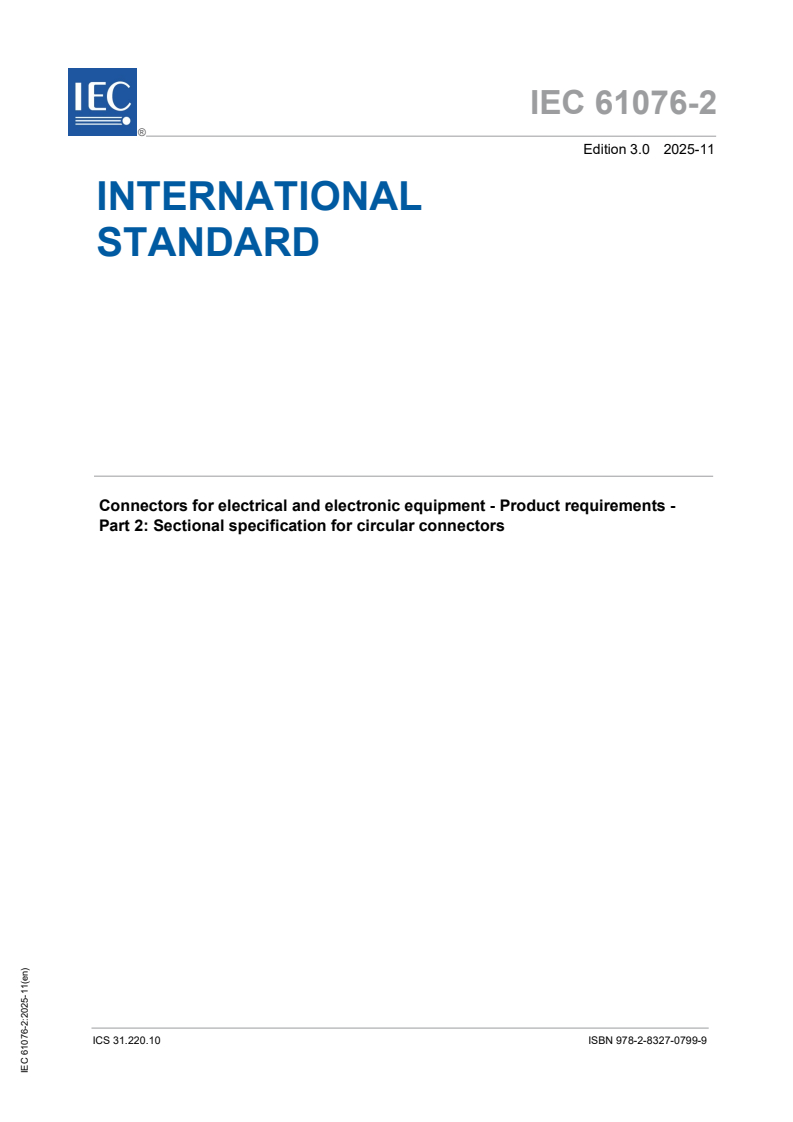
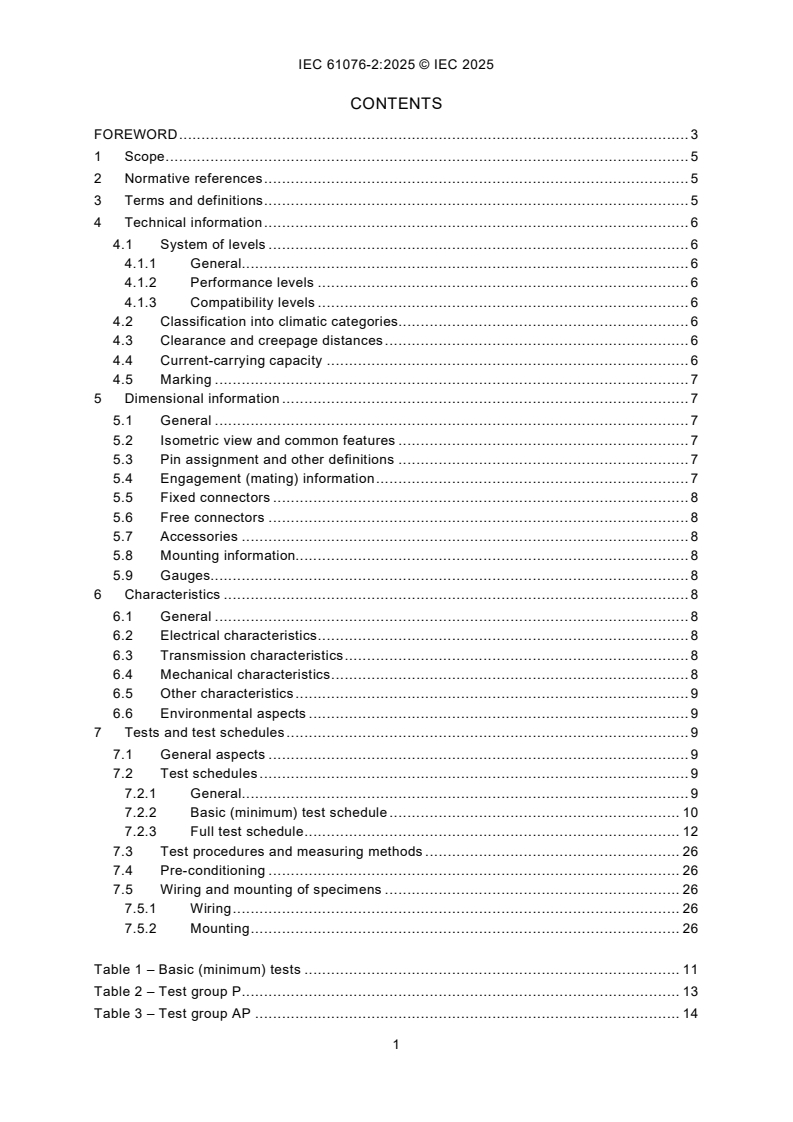
IEC 61076-2:2025 - Connectors for electrical and electronic equipment - Product requirements - Part 2: Sectional specification for circular connectors Released:11/26/2025
IEC 61076-2:2025 - <p>Connecteurs pour équipements électriques et électroniques - Exigences de produit - Partie 2: Spécification intermédiaire pour les connecteurs circulaires</p> Released:11/26/2025
IEC 61076-2:2025 - Connectors for electrical and electronic equipment - Product requirements - Part 2: Sectional specification for circular connectors Released:11/26/2025
Overview
IEC 61076-2:2025 - Connectors for electrical and electronic equipment - Product requirements - Part 2: Sectional specification for circular connectors - is the third edition (Edition 3.0, 2025-11) of the IEC sectional product specification. It establishes uniform technical information and product requirements for circular connectors and is intended to be used in conjunction with IEC 61076-1 (generic specification) when preparing detail product specifications.
This standard defines the technical framework for dimensional, electrical, mechanical and environmental characteristics, and specifies tests and test schedules to demonstrate connector performance and compatibility.
Key topics and technical requirements
- Scope and purpose: Sectional specification for circular connectors; detail product specifications take precedence where conflicts occur.
- System of levels: Guidance on performance levels (grouping environmental and mechanical stresses) and compatibility levels for interchangeability between suppliers.
- Climatic categories: Classification rules and considerations for upper/lower category and limiting temperatures relevant to derating.
- Clearance and creepage: Requirements linked to rated voltages and safety; references to insulation coordination practices.
- Dimensional information: Isometric views, pin assignments, mating/engagement data, fixed/free connector dimensions, accessories, mounting and gauges.
- Characteristics:
- Electrical - current-carrying capacity, dielectric properties and marking requirements.
- Transmission - signal integrity and related transmission characteristics.
- Mechanical - mating cycles, retention and other mechanical performance.
- Environmental - climatic, corrosion and other environmental aspects.
- Tests and test schedules: Defined basic (minimum) and full test schedules, grouped test suites (Tables P–N), pre-conditioning, wiring and mounting rules, and measurement procedures.
- Normative references: Cross-references to IEC 60068-1, IEC 60512, IEC 60529, IEC 60664-1, IEC 61984, IEC 62197-1 and others that are necessary for correct application.
Notable updates in the 2025 edition include expanded content in Clauses 4–6, revised test schedule formats and added tables for transmission characteristics and current-carrying capacity testing.
Practical applications and who uses this standard
- Connector manufacturers - to develop and document product families and detail specifications for circular connectors.
- OEMs and system integrators - to specify connector requirements for product design, procurement and interoperability.
- Test laboratories and certification bodies - to apply the standard’s test schedules and measurement methods.
- Design and electrical engineers - for guidance on interface dimensions, electrical ratings, climate suitability and safety-related clearances.
- Quality and compliance teams - to align product assessment with IEC 62197-1 quality assessment practices.
Related standards
- IEC 61076-1 - Generic product requirements (use in conjunction).
- IEC 62197-1 - Quality assessment requirements.
- Additional referenced standards: IEC 60068-1, IEC 60512, IEC 60529, IEC 60664-1, IEC 61984, IEC TR 63040.
Keywords: IEC 61076-2:2025, circular connectors, connector standards, product requirements, test schedules, compatibility levels, current-carrying capacity, transmission characteristics.
Relations
- Effective Date
- 05-Sep-2023
Buy Documents
IEC 61076-2:2025 - Connectors for electrical and electronic equipment - Product requirements - Part 2: Sectional specification for circular connectors Released:11/26/2025
IEC 61076-2:2025 - <p>Connecteurs pour équipements électriques et électroniques - Exigences de produit - Partie 2: Spécification intermédiaire pour les connecteurs circulaires</p> Released:11/26/2025
IEC 61076-2:2025 - Connectors for electrical and electronic equipment - Product requirements - Part 2: Sectional specification for circular connectors Released:11/26/2025
Frequently Asked Questions
IEC 61076-2:2025 is a standard published by the International Electrotechnical Commission (IEC). Its full title is "Connectors for electrical and electronic equipment - Product requirements - Part 2: Sectional specification for circular connectors". This standard covers: IEC 61076-2:2025 establishes uniform specifications and technical information for circular connectors.
IEC 61076-2:2025 establishes uniform specifications and technical information for circular connectors.
IEC 61076-2:2025 is classified under the following ICS (International Classification for Standards) categories: 31.220.10 - Plug-and-socket devices. Connectors. The ICS classification helps identify the subject area and facilitates finding related standards.
IEC 61076-2:2025 has the following relationships with other standards: It is inter standard links to IEC 61076-2:2011. Understanding these relationships helps ensure you are using the most current and applicable version of the standard.
IEC 61076-2:2025 is available in PDF format for immediate download after purchase. The document can be added to your cart and obtained through the secure checkout process. Digital delivery ensures instant access to the complete standard document.
Standards Content (Sample)
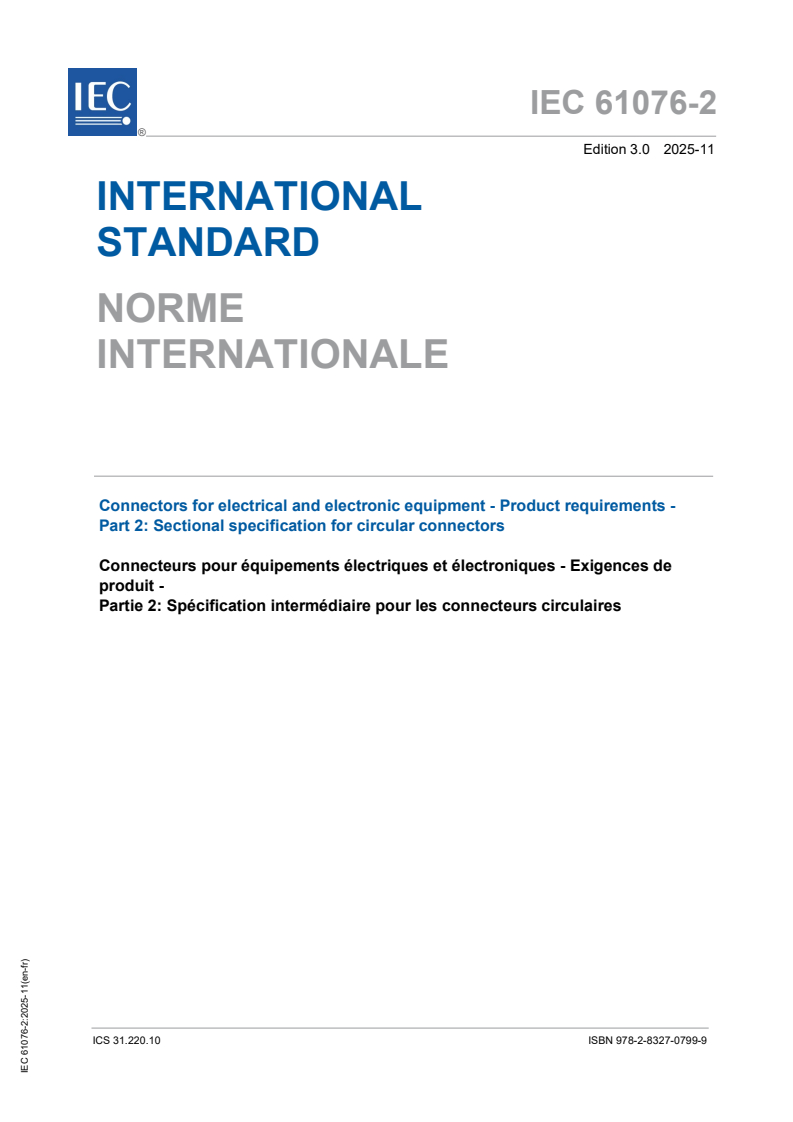
IEC 61076-2 ®
Edition 3.0 2025-11
INTERNATIONAL
STANDARD
Connectors for electrical and electronic equipment - Product requirements -
Part 2: Sectional specification for circular connectors
ICS 31.220.10 ISBN 978-2-8327-0799-9
All rights reserved. Unless otherwise specified, no part of this publication may be reproduced or utilized in any form or
by any means, electronic or mechanical, including photocopying and microfilm, without permission in writing from either
IEC or IEC's member National Committee in the country of the requester. If you have any questions about IEC copyright
or have an enquiry about obtaining additional rights to this publication, please contact the address below or your local
IEC member National Committee for further information.
IEC Secretariat Tel.: +41 22 919 02 11
3, rue de Varembé info@iec.ch
CH-1211 Geneva 20 www.iec.ch
Switzerland
About the IEC
The International Electrotechnical Commission (IEC) is the leading global organization that prepares and publishes
International Standards for all electrical, electronic and related technologies.
About IEC publications
The technical content of IEC publications is kept under constant review by the IEC. Please make sure that you have the
latest edition, a corrigendum or an amendment might have been published.
IEC publications search - IEC Products & Services Portal - products.iec.ch
webstore.iec.ch/advsearchform Discover our powerful search engine and read freely all the
The advanced search enables to find IEC publications by a
publications previews, graphical symbols and the glossary.
variety of criteria (reference number, text, technical With a subscription you will always have access to up to date
committee, …). It also gives information on projects, content tailored to your needs.
replaced and withdrawn publications.
Electropedia - www.electropedia.org
IEC Just Published - webstore.iec.ch/justpublished The world's leading online dictionary on electrotechnology,
Stay up to date on all new IEC publications. Just Published containing more than 22 500 terminological entries in English
details all new publications released. Available online and and French, with equivalent terms in 25 additional languages.
once a month by email. Also known as the International Electrotechnical Vocabulary
(IEV) online.
IEC Customer Service Centre - webstore.iec.ch/csc
If you wish to give us your feedback on this publication or
need further assistance, please contact the Customer
Service Centre: sales@iec.ch.
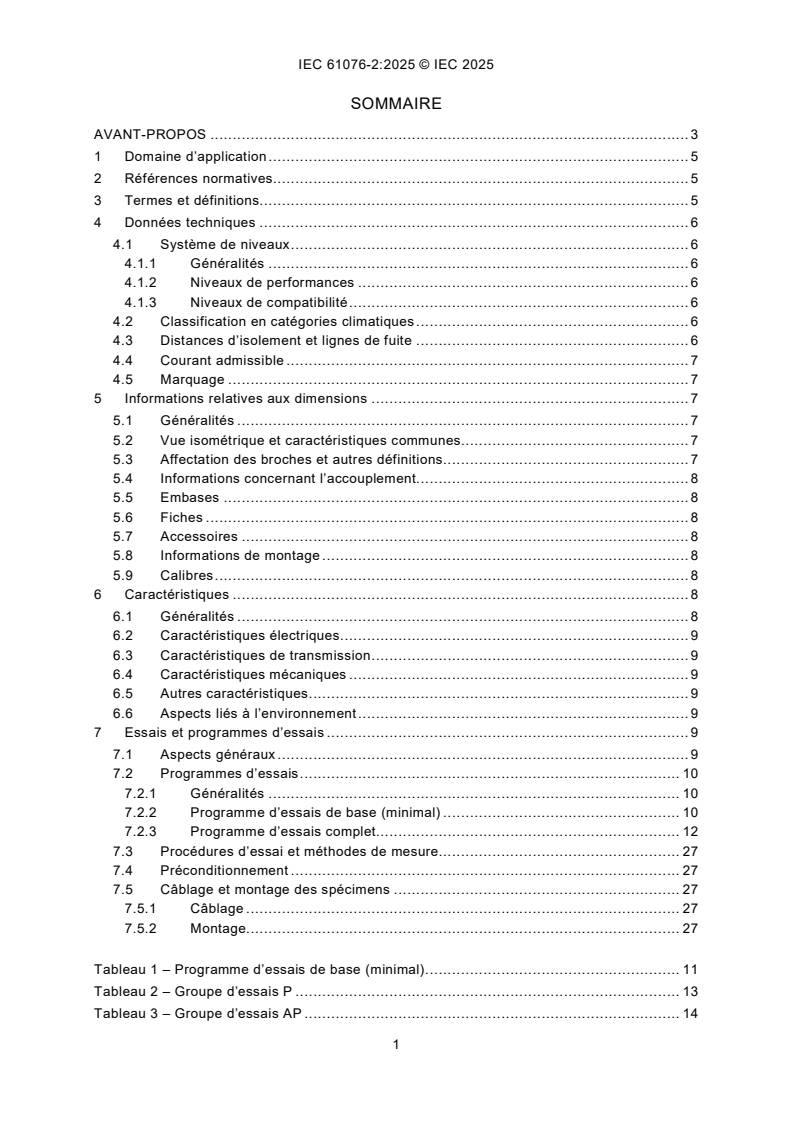
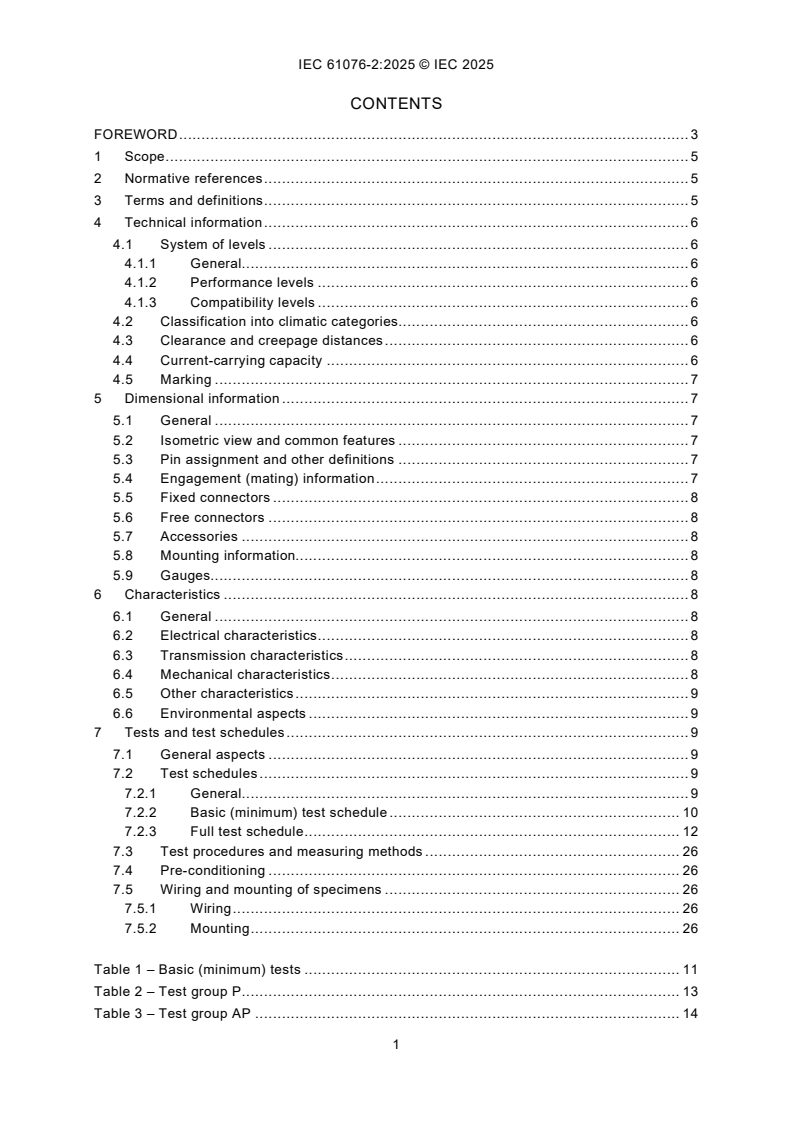
CONTENTS
FOREWORD . 3
1 Scope . 5
2 Normative references . 5
3 Terms and definitions . 5
4 Technical information . 6
4.1 System of levels . 6
4.1.1 General. 6
4.1.2 Performance levels . 6
4.1.3 Compatibility levels . 6
4.2 Classification into climatic categories . 6
4.3 Clearance and creepage distances . 6
4.4 Current-carrying capacity . 6
4.5 Marking . 7
5 Dimensional information . 7
5.1 General . 7
5.2 Isometric view and common features . 7
5.3 Pin assignment and other definitions . 7
5.4 Engagement (mating) information . 7
5.5 Fixed connectors . 8
5.6 Free connectors . 8
5.7 Accessories . 8
5.8 Mounting information. 8
5.9 Gauges. 8
6 Characteristics . 8
6.1 General . 8
6.2 Electrical characteristics . 8
6.3 Transmission characteristics . 8
6.4 Mechanical characteristics . 8
6.5 Other characteristics . 9
6.6 Environmental aspects . 9
7 Tests and test schedules . 9
7.1 General aspects . 9
7.2 Test schedules . 9
7.2.1 General. 9
7.2.2 Basic (minimum) test schedule . 10
7.2.3 Full test schedule . 12
7.3 Test procedures and measuring methods . 26
7.4 Pre-conditioning . 26
7.5 Wiring and mounting of specimens . 26
7.5.1 Wiring . 26
7.5.2 Mounting . 26
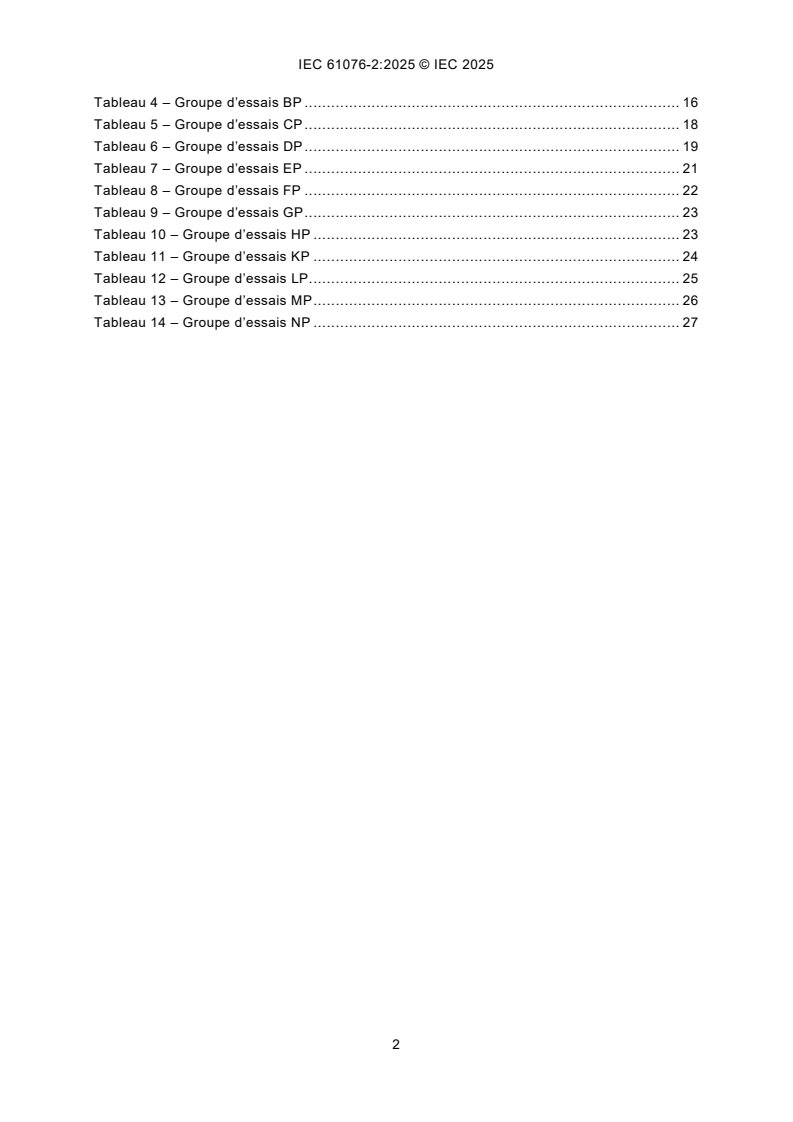
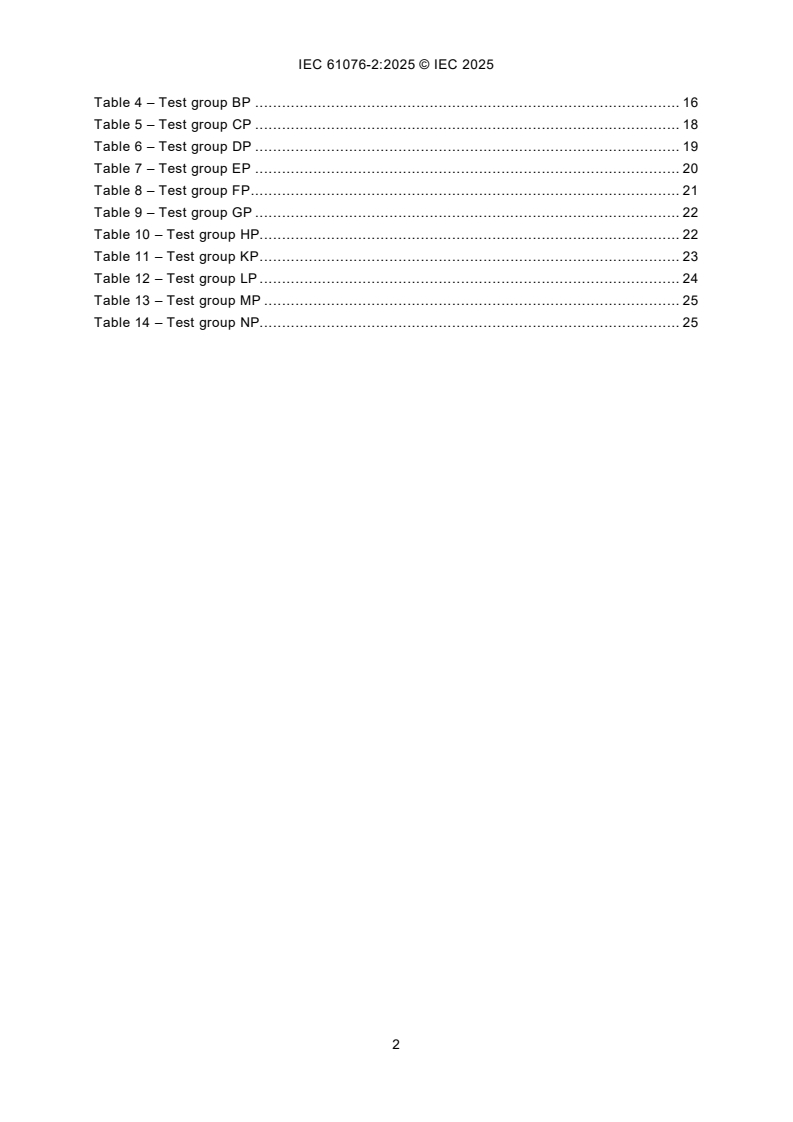
Table 1 – Basic (minimum) tests . 11
Table 2 – Test group P . 13
Table 3 – Test group AP . 14
Table 4 – Test group BP . 16
Table 5 – Test group CP . 18
Table 6 – Test group DP . 19
Table 7 – Test group EP . 20
Table 8 – Test group FP . 21
Table 9 – Test group GP . 22
Table 10 – Test group HP. 22
Table 11 – Test group KP . 23
Table 12 – Test group LP . 24
Table 13 – Test group MP . 25
Table 14 – Test group NP. 25
INTERNATIONAL ELECTROTECHNICAL COMMISSION
____________
Connectors for electrical and electronic equipment -
Product requirements -
Part 2: Sectional specification for circular connectors
FOREWORD
1) The International Electrotechnical Commission (IEC) is a worldwide organization for standardization comprising
all national electrotechnical committees (IEC National Committees). The object of IEC is to promote international
co-operation on all questions concerning standardization in the electrical and electronic fields. To this end and
in addition to other activities, IEC publishes International Standards, Technical Specifications, Technical Reports,
Publicly Available Specifications (PAS) and Guides (hereafter referred to as "IEC Publication(s)"). Their
preparation is entrusted to technical committees; any IEC National Committee interested in the subject dealt with
may participate in this preparatory work. International, governmental and non-governmental organizations liaising
with the IEC also participate in this preparation. IEC collaborates closely with the International Organization for
Standardization (ISO) in accordance with conditions determined by agreement between the two organizations.
2) The formal decisions or agreements of IEC on technical matters express, as nearly as possible, an international
consensus of opinion on the relevant subjects since each technical committee has representation from all
interested IEC National Committees.
3) IEC Publications have the form of recommendations for international use and are accepted by IEC National
Committees in that sense. While all reasonable efforts are made to ensure that the technical content of IEC
Publications is accurate, IEC cannot be held responsible for the way in which they are used or for any
misinterpretation by any end user.
4) In order to promote international uniformity, IEC National Committees undertake to apply IEC Publications
transparently to the maximum extent possible in their national and regional publications. Any divergence between
any IEC Publication and the corresponding national or regional publication shall be clearly indicated in the latter.
5) IEC itself does not provide any attestation of conformity. Independent certification bodies provide conformity
assessment services and, in some areas, access to IEC marks of conformity. IEC is not responsible for any
services carried out by independent certification bodies.
6) All users should ensure that they have the latest edition of this publication.
7) No liability shall attach to IEC or its directors, employees, servants or agents including individual experts and
members of its technical committees and IEC National Committees for any personal injury, property damage or
other damage of any nature whatsoever, whether direct or indirect, or for costs (including legal fees) and
expenses arising out of the publication, use of, or reliance upon, this IEC Publication or any other IEC
Publications.
8) Attention is drawn to the Normative references cited in this publication. Use of the referenced publications is
indispensable for the correct application of this publication.
9) IEC draws attention to the possibility that the implementation of this document may involve the use of (a)
patent(s). IEC takes no position concerning the evidence, validity or applicability of any claimed patent rights in
respect thereof. As of the date of publication of this document, IEC had not received notice of (a) patent(s), which
may be required to implement this document. However, implementers are cautioned that this may not represent
the latest information, which may be obtained from the patent database available at https://patents.iec.ch. IEC
shall not be held responsible for identifying any or all such patent rights.
IEC 61076-2 has been prepared by subcommittee 48B: Electrical connectors, of IEC technical
committee 48: Electrical connectors and mechanical structures for electrical and electronic
equipment. It is an International Standard.
This International Standard is to be used in conjunction with IEC 61076-1:2006.
This third edition cancels and replaces the second edition published in 2011. This edition
constitutes a technical revision.
This edition includes the following significant technical changes with respect to the previous
edition:
a) Added content to Clause 4, Clause 5 and Clause 6.
b) Updated the test schedule table format and added notes and other information.
c) Added Table 13, Table M with transmission characteristics tests.
d) Added Table 14, Table N with current-carrying capacity test.
e) Deleted Clause 7 regarding Blank detail specification.
The text of this International Standard is based on the following documents:
Draft Report on voting
48B/3168/FDIS 48B/3179/RVD
Full information on the voting for its approval can be found in the report on voting indicated in
the above table.
The language used for the development of this International Standard is English.
A list of all parts of the IEC 61076 series, published under the general title Connectors for
electrical and electronic equipment – Product requirements, can be found on the IEC website.
This document was drafted in accordance with ISO/IEC Directives, Part 2, and developed in
accordance with ISO/IEC Directives, Part 1 and ISO/IEC Directives, IEC Supplement, available
at www.iec.ch/members_experts/refdocs. The main document types developed by IEC are
described in greater detail at www.iec.ch/publications.
The committee has decided that the contents of this document will remain unchanged until the
stability date indicated on the IEC website under webstore.iec.ch in the data related to the
specific document. At this date, the document will be
– reconfirmed,
– withdrawn, or
– revised.
1 Scope
This part of IEC 61076 establishes uniform specifications and technical information for circular
connectors. This document is to be used in conjunction with the generic specification
IEC 61076-1 for product requirements as the basis for preparation of detail product
specifications for circular connectors.
NOTE The quality assessment requirements for connectors whose product requirements are given in IEC 61076
series are detailed in IEC 62197-1. This can be used as the basis for preparation of detail quality assessment
specifications for circular connectors.
In the event of conflict between this sectional product specification and the detail product
specification, it is intended that the requirements of the detail product specification prevail.
2 Normative references
The following documents are referred to in the text in such a way that some or all of their content
constitutes requirements of this document. For dated references, only the edition cited applies.
For undated references, the latest edition of the referenced document (including any
amendments) applies.
IEC 60068-1, Environmental testing - Part 1: General and guidance
IEC 60352 (all parts), Solderless connections
IEC 60512 (all parts), Connectors for electrical and electronic equipment - Tests and
measurements
IEC 60529, Degrees of protection provided by enclosures (IP Code)
IEC 60664-1, Insulation coordination for equipment within low-voltage supply systems - Part 1:
Principles, requirements and tests
IEC 61076-1, Connectors for electronic equipment - Product requirements - Part 1: Generic
specification
IEC 61984, Connectors - Safety requirements and tests
IEC 62197-1:2006, Connectors for electronic equipment - Quality assessment requirements -
Part 1: Generic specification
IEC TR 63040, Guidance on clearances and creepage distances in particular for distances
equal to or less than 2 mm - Test results of research on influencing parameters
3 Terms and definitions
For the purposes of this document, the terms and definitions given in IEC 61076-1,
IEC 60512-1, IEC 61984 and in IEC 60664-1 apply.
ISO and IEC maintain terminology databases for use in standardization at the following
addresses:
– IEC Electropedia: available at https://www.electropedia.org/
– ISO Online browsing platform: available at https://www.iso.org/obp
4 Technical information
4.1 System of levels
4.1.1 General
Subclauses 4.1.2 and 4.1.3 provide information about performance and compatibility levels
(respectively).
4.1.2 Performance levels
If appropriate, the detail product specification shall contain information about the different
performance levels.
The term 'performance level' reflects the grouping of the environmental and mechanical
stresses at which a component is tested, and also such features as long-term stability of
electrical characteristics. If different levels are defined in the detail product specification, they
shall be numbered, where the lowest number (1) usually indicates the highest performance.
4.1.3 Compatibility levels
As a function of the standardization degree, four levels characterize the compatibility of
connectors from different sources. These levels are defined in IEC 61076-1 and shall be
indicated in the detail product specification of circular connectors.
4.2 Classification into climatic categories
Unless impractical, the lower and upper temperatures and the duration of the damp heat, steady
state test should be described in a table similar to the example given in IEC 61076-1.
For a correct assignment of climatic category, the correct relationship between the upper
category temperature (UCT) and the upper limiting temperature (ULT) of a connector (implied
in the derating diagram(s) discussed in 4.4), as well as between the lower category temperature
(LCT) and the lower limiting temperature (LLT) of a connector should be considered (see
IEC 61984 relevant definitions).
4.3 Clearance and creepage distances
Permissible working or rated voltages depend on the connector end-use application and on the
applicable or specified safety requirements.
Clearance and creepage distances as well as proof voltages under specified air pressure shall
be specified in the detail product specification, based on the assigned rated insulation
voltage(s). See IEC 61984, IEC 60664-1 or IEC TR 63040, as applicable.
4.4 Current-carrying capacity
For each connector, the current-carrying capacity for the declared wire size (typically the
maximum) shall be specified in the detail product specification. It is preferable that the derating
curve for the relevant wire size, determined in accordance with test 5b of IEC 60512-5-2 is
prepared. Alternatively, it is allowed to provide only one value of rated current for a specified
wire size at a specified temperature as described in IEC 60512-5-1.
NOTE 1 The derating curve(s) can be provided in either graphic form or in mathematical form with the formula or
both:
0,5
t
II ×−1
t 0 °C
() ( )
ULT
where
I = working current at ambient temperature t;
(t)
I = working current at 0 °C (intersection with y-axis);
(0 °C)
t = ambient temperature;
ULT = upper limiting temperature (intersection with x-axis ≥ UCT (upper category temperature)
NOTE 2 The basic diagram determined in accordance with test 5b of IEC 60512-5-2 is then verified by a
temperature rise test 5a of IEC 60512-5-1
4.5 Marking
Each connector and its associated package shall be marked in accordance with the
requirements specified in IEC 61076-1.
5 Dimensional information
5.1 General
Dimensions provided in the detail product specification for circular connectors shall provide:
– mating information;
– mounting information;
– overall dimensions;
– locking and sealing information, if applicable;
– information on termination and cable fixing.
For more details see IEC 61076-1.
5.2 Isometric view and common features
Isometric view and common features shall be provided in the detail product specification.
5.3 Pin assignment and other definitions
Pin assignment and other definitions, if applicable, shall be provided in the detail product
specification.
5.4 Engagement (mating) information
Mating information shall be provided in the detail product specification including, as applicable:
– mating direction;
– electrical engagement length;
– contact levels and sequencing;
– perpendicular to the mating direction;
– inclination.
=
5.5 Fixed connectors
Fixed connectors shall be described in the detail product specification with relevant drawing(s)
providing interface dimensions for mating and locking – if means are provided – with counterpart
connectors and the mounting of accessories, if any, and termination dimensions and type(s).
5.6 Free connectors
Free connectors shall be described in the detail product specification with relevant drawing(s)
providing interface dimensions for mating and locking – if means are provided – with counterpart
connectors and the mounting of accessories, if any, and termination dimensions and type(s).
5.7 Accessories
Accessories, such as special contacts, coding devices, mounting devices, if any, shall be
described by the detail product specification with relevant drawing(s) providing interface
dimensions for mounting on the corresponding connector(s).
5.8 Mounting information
Mounting information shall be provided in the detail product specification.
5.9 Gauges
Sizing and retention force gauges (e.g. for mechanical tests on contacts and terminations), as
well as gauges deemed to verify the connector's mechanical function, such as engaging,
separating, insertion, withdrawal force gauges, probes (for damage testing), contact resistance
gauges, test panels (e.g. for voltage proof test or for EMC or crosstalk test, etc), if applicable,
shall be described in the detail product specification.
6 Characteristics
6.1 General
To provide information on specified essential electrical and mechanical characteristics,
preferred methods on tests and measurements are listed in 6.2 through 6.4; additional
characteristics can be added to the detail product specification, when appropriate.
6.2 Electrical characteristics
Electrical characteristics, such as minimum clearance and creepage distances based on
assigned rated (insulation) voltage(s), either presence or not of protective earth (PE) or
functional earth (FE) contact(s) or both, voltage proof, current-carrying capacity, contact and
shield (if any) resistance, insulation resistance, characteristic impedance, as applicable to the
specific connectors, shall be provided in the detail product specification.
6.3 Transmission characteristics
Transmission characteristics, such as attenuation, insertion loss, return loss, near-end
crosstalk (NEXT) loss, far-end crosstalk (FEXT) loss, voltage standing wave ratio (VSWR),
transfer impedance, shielding effectiveness, as far as applicable, shall be provided by the
product detail specification.
6.4 Mechanical characteristics
Mechanical characteristics such as mechanical operation (number of mating cycles),
effectiveness of connector coupling devices, engaging and separating forces (or insertion and
withdrawal forces), contact retention in insert, insert retention in housing, polarizing and coding,
as applicable, shall be provided in the detail product specification.
6.5 Other characteristics
Other functional characteristics, such as shock and vibration (with relevant testing method
either random or sine), degree of protection provided by enclosures (IP code), screen and
shielding properties, shall be provided as applicable in the detail product specification.
6.6 Environmental aspects
Marking of insulating materials for recyclability purposes at end-of-life, as well as design or use
of materials, as applicable, shall be provided by detail product specification.
7 Tests and test schedules
7.1 General aspects
See IEC 61076-1.
The detail product specification shall state the test sequence(s) (in accordance with this
standard), and the number of specimens for each test sequence (not less than four mated
pairs).
Individual variants may be submitted to type tests for approval of those variants.
It is permissible to limit the number of variants tested to a selection representative of the whole
range for which approval is required (which may be less than the range covered by the detail
product specification), but each feature and characteristic shall be proved.
The test specimens shall have been processed in a careful and skilful manner, in accordance
with good current practice.
NOTE When the preparation of test specimens involves wiring with a solderless connection technology, the relevant
part of IEC 60352 series includes practical guidance which serves as a benchmark for the level of skill. Wiring of
specimens implying the use of special processes or tools Is up to the connector manufacturer.
7.2 Test schedules
7.2.1 General
To provide for different applications of connectors, the extent of the test schedule may be
different in the various detail product specifications.
The basic (minimum) test schedule is given in 7.2.2.
Th
...
IEC 61076-2 ®
Edition 3.0 2025-11
NORME
INTERNATIONALE
Connecteurs pour équipements électriques et électroniques - Exigences de
produit -
Partie 2: Spécification intermédiaire pour les connecteurs circulaires
ICS 31.220.10 ISBN 978-2-8327-0799-9
Droits de reproduction réservés. Sauf indication contraire, aucune partie de cette publication ne peut être reproduite ni
utilisée sous quelque forme que ce soit et par aucun procédé, électronique ou mécanique, y compris la photocopie et
les microfilms, sans l'accord écrit de l'IEC ou du Comité national de l'IEC du pays du demandeur. Si vous avez des
questions sur le copyright de l'IEC ou si vous désirez obtenir des droits supplémentaires sur cette publication, utilisez
les coordonnées ci-après ou contactez le Comité national de l'IEC de votre pays de résidence.
IEC Secretariat Tel.: +41 22 919 02 11
3, rue de Varembé info@iec.ch
CH-1211 Geneva 20 www.iec.ch
Switzerland
A propos de l'IEC
La Commission Electrotechnique Internationale (IEC) est la première organisation mondiale qui élabore et publie des
Normes internationales pour tout ce qui a trait à l'électricité, à l'électronique et aux technologies apparentées.
A propos des publications IEC
Le contenu technique des publications IEC est constamment revu. Veuillez vous assurer que vous possédez l’édition la
plus récente, un corrigendum ou amendement peut avoir été publié.
Recherche de publications IEC - IEC Products & Services Portal - products.iec.ch
webstore.iec.ch/advsearchform Découvrez notre puissant moteur de recherche et consultez
La recherche avancée permet de trouver des publications gratuitement tous les aperçus des publications, symboles
IEC en utilisant différents critères (numéro de référence, graphiques et le glossaire. Avec un abonnement, vous aurez
texte, comité d’études, …). Elle donne aussi des toujours accès à un contenu à jour adapté à vos besoins.
informations sur les projets et les publications remplacées
ou retirées. Electropedia - www.electropedia.org
Le premier dictionnaire d'électrotechnologie en ligne au
IEC Just Published - webstore.iec.ch/justpublished monde, avec plus de 22 500 articles terminologiques en
Restez informé sur les nouvelles publications IEC. Just anglais et en français, ainsi que les termes équivalents
Published détaille les nouvelles publications parues. dans 25 langues additionnelles. Egalement appelé
Disponible en ligne et une fois par mois par email. Vocabulaire Electrotechnique International (IEV) en ligne.
Service Clients - webstore.iec.ch/csc
Si vous désirez nous donner des commentaires sur cette
publication ou si vous avez des questions contactez-
nous: sales@iec.ch.
SOMMAIRE
AVANT-PROPOS . 3
1 Domaine d’application . 5
2 Références normatives . 5
3 Termes et définitions. 5
4 Données techniques . 6
4.1 Système de niveaux . 6
4.1.1 Généralités . 6
4.1.2 Niveaux de performances . 6
4.1.3 Niveaux de compatibilité . 6
4.2 Classification en catégories climatiques . 6
4.3 Distances d’isolement et lignes de fuite . 6
4.4 Courant admissible . 7
4.5 Marquage . 7
5 Informations relatives aux dimensions . 7
5.1 Généralités . 7
5.2 Vue isométrique et caractéristiques communes . 7
5.3 Affectation des broches et autres définitions . 7
5.4 Informations concernant l’accouplement. 8
5.5 Embases . 8
5.6 Fiches . 8
5.7 Accessoires . 8
5.8 Informations de montage . 8
5.9 Calibres . 8
6 Caractéristiques . 8
6.1 Généralités . 8
6.2 Caractéristiques électriques . 9
6.3 Caractéristiques de transmission . 9
6.4 Caractéristiques mécaniques . 9
6.5 Autres caractéristiques . 9
6.6 Aspects liés à l’environnement . 9
7 Essais et programmes d’essais . 9
7.1 Aspects généraux . 9
7.2 Programmes d’essais . 10
7.2.1 Généralités . 10
7.2.2 Programme d’essais de base (minimal) . 10
7.2.3 Programme d’essais complet. 12
7.3 Procédures d’essai et méthodes de mesure. 27
7.4 Préconditionnement . 27
7.5 Câblage et montage des spécimens . 27
7.5.1 Câblage . 27
7.5.2 Montage. 27
Tableau 1 – Programme d’essais de base (minimal) . 11
Tableau 2 – Groupe d’essais P . 13
Tableau 3 – Groupe d’essais AP . 14
Tableau 4 – Groupe d’essais BP . 16
Tableau 5 – Groupe d’essais CP . 18
Tableau 6 – Groupe d’essais DP . 19
Tableau 7 – Groupe d’essais EP . 21
Tableau 8 – Groupe d’essais FP . 22
Tableau 9 – Groupe d’essais GP . 23
Tableau 10 – Groupe d’essais HP . 23
Tableau 11 – Groupe d’essais KP . 24
Tableau 12 – Groupe d’essais LP . 25
Tableau 13 – Groupe d’essais MP . 26
Tableau 14 – Groupe d’essais NP . 27
COMMISSION ÉLECTROTECHNIQUE INTERNATIONALE
____________
Connecteurs pour équipements électriques et électroniques -
Exigences de produit -
Partie 2: Spécification intermédiaire pour les connecteurs circulaires
AVANT-PROPOS
1) La Commission Électrotechnique Internationale (IEC) est une organisation mondiale de normalisation composée
de l’ensemble des comités électrotechniques nationaux (Comités nationaux de l’IEC). L’IEC a pour objet de
favoriser la coopération internationale pour toutes les questions de normalisation dans les domaines de
l’électricité et de l’électronique. À cet effet, l’IEC – entre autres activités – publie des Normes internationales,
des Spécifications techniques, des Rapports techniques, des Spécifications accessibles au public (PAS) et des
Guides (ci-après dénommés "Publication(s) de l’IEC"). Leur élaboration est confiée à des comités d’études, aux
travaux desquels tout Comité national intéressé par le sujet traité peut participer. Les organisations
internationales, gouvernementales et non gouvernementales, en liaison avec l’IEC, participent également aux
travaux. L’IEC collabore étroitement avec l’Organisation Internationale de Normalisation (ISO), selon des
conditions fixées par accord entre les deux organisations.
2) Les décisions ou accords officiels de l’IEC concernant les questions techniques représentent, dans la mesure du
possible, un accord international sur les sujets étudiés, étant donné que les Comités nationaux de l’IEC intéressés
sont représentés dans chaque comité d’études.
3) Les Publications de l’IEC se présentent sous la forme de recommandations internationales et sont agréées
comme telles par les Comités nationaux de l’IEC. Tous les efforts raisonnables sont entrepris afin que l’IEC
s’assure de l’exactitude du contenu technique de ses publications; l’IEC ne peut pas être tenue responsable de
l’éventuelle mauvaise utilisation ou interprétation qui en est faite par un quelconque utilisateur final.
4) Dans le but d’encourager l’uniformité internationale, les Comités nationaux de l’IEC s’engagent, dans toute la
mesure possible, à appliquer de façon transparente les Publications de l’IEC dans leurs publications nationales
et régionales. Toutes divergences entre toutes Publications de l’IEC et toutes publications nationales ou
régionales correspondantes doivent être indiquées en termes clairs dans ces dernières.
5) L’IEC elle-même ne fournit aucune attestation de conformité. Des organismes de certification indépendants
fournissent des services d’évaluation de conformité et, dans certains secteurs, accèdent aux marques de
conformité de l’IEC. L’IEC n’est responsable d’aucun des services effectués par les organismes de certification
indépendants.
6) Tous les utilisateurs doivent s’assurer qu’ils sont en possession de la dernière édition de cette publication.
7) Aucune responsabilité ne doit être imputée à l’IEC, à ses administrateurs, employés, auxiliaires ou mandataires,
y compris ses experts particuliers et les membres de ses comités d’études et des Comités nationaux de l’IEC,
pour tout préjudice causé en cas de dommages corporels et matériels, ou de tout autre dommage de quelque
nature que ce soit, directe ou indirecte, ou pour supporter les coûts (y compris les frais de justice) et les dépenses
découlant de la publication ou de l’utilisation de cette Publication de l’IEC ou de toute autre Publication de l’IEC,
ou au crédit qui lui est accordé.
8) L’attention est attirée sur les références normatives citées dans cette publication. L’utilisation de publications
référencées est obligatoire pour une application correcte de la présente publication.
9) L’IEC attire l’attention sur le fait que la mise en application du présent document peut entraîner l’utilisation d’un
ou de plusieurs brevets. L’IEC ne prend pas position quant à la preuve, à la validité et à l’applicabilité de tout
droit de propriété revendiqué à cet égard. À la date de publication du présent document, l’IEC n’avait pas reçu
notification qu’un ou plusieurs brevets pouvaient être nécessaires à sa mise en application. Toutefois, il y a lieu
d’avertir les responsables de la mise en application du présent document que des informations plus récentes
sont susceptibles de figurer dans la base de données de brevets, disponible à l’adresse https://patents.iec.ch.
L’IEC ne saurait être tenue pour responsable de ne pas avoir identifié de tels droits de brevet.
L’IEC 61076-2 a été établie par le sous-comité 48B: Connecteurs électriques, du comité
d’études 48 de l’IEC: Connecteurs électriques et structures mécaniques pour les équipements
électriques et électroniques. Il s’agit d’une Norme internationale.
Cette Norme internationale doit être utilisée conjointement avec l’IEC 61076-1:2006.
Cette troisième édition annule et remplace la deuxième édition parue en 2011. Cette édition
constitue une révision technique.
Cette édition inclut les modifications techniques majeures suivantes par rapport à l’édition
précédente:
a) ajout de contenu à l’Article 4, l’Article 5 et l’Article 6,
b) mise à jour du format des tableaux de programmes d’essais et ajout de notes et d’autres
informations,
c) ajout du Tableau 13 pour le groupe d’essais MP, concernant les essais des caractéristiques
de transmission,
d) ajout du Tableau 14 pour le groupe d’essais NP, concernant les essais de courant
admissible,
e) suppression de l’Article 7 concernant la spécification particulière-cadre.
Le texte de cette Norme internationale est issu des documents suivants:
Projet Rapport de vote
48B/3168/FDIS 48B/3179/RVD
Le rapport de vote indiqué dans le tableau ci-dessus donne toute information sur le vote ayant
abouti à son approbation.
La langue employée pour l’élaboration de cette Norme internationale est l’anglais.
Une liste de toutes les parties de la série IEC 61076, publiées sous le titre général Connecteurs
pour équipements électriques et électroniques - Exigences de produit, se trouve sur le site Web
de l’IEC.
Ce document a été rédigé selon les Directives ISO/IEC, Partie 2, il a été développé selon les
Directives ISO/IEC, Partie 1 et les Directives ISO/IEC, Supplément IEC, disponibles
sous www.iec.ch/members_experts/refdocs. Les principaux types de documents développés
par l’IEC sont décrits plus en détail sous www.iec.ch/publications.
Le comité a décidé que le contenu de ce document ne sera pas modifié avant la date de stabilité
indiquée sur le site web de l’IEC sous webstore.iec.ch dans les données relatives au document
recherché. À cette date, le document sera:
– reconduit,
– supprimé, ou
– révisé.
1 Domaine d’application
La présente partie de l’IEC 61076 établit des spécifications et des informations techniques
uniformes pour les connecteurs circulaires. Le présent document est à utiliser conjointement
avec la spécification générique IEC 61076-1 concernant les exigences de produit, qui constitue
la base pour la préparation des spécifications particulières de produit applicables aux
connecteurs circulaires.
NOTE Les exigences d’assurance de la qualité pour les connecteurs dont les exigences de produit sont données
dans la série IEC 61076 sont détaillées dans l’IEC 62197-1. Celle-ci peut être utilisée comme base pour la
préparation des spécifications particulières d’assurance de la qualité applicables aux connecteurs circulaires.
En cas de conflit entre la présente spécification intermédiaire de produit et la spécification
particulière de produit, il est prévu que les exigences de la spécification particulière de produit
prévalent.
2 Références normatives
Les documents suivants sont cités dans le texte de sorte qu’ils constituent, pour tout ou partie
de leur contenu, des exigences du présent document. Pour les références datées, seule
l’édition citée s’applique. Pour les références non datées, la dernière édition du document de
référence s’applique (y compris les éventuels amendements).
IEC 60068-1, Essais d’environnement - Partie 1: Généralités et lignes directrices
IEC 60352 (toutes les parties), Connexions sans soudure
IEC 60512 (toutes les parties), Connecteurs pour équipements électriques et électroniques -
Essais et mesures
IEC 60529, Degrés de protection procurés par les enveloppes (Code IP)
IEC 60664-1, Coordination de l’isolement des matériels dans les réseaux d’énergie électrique
à basse tension - Partie 1: Principes, exigences et essais
IEC 61076-1, Connecteurs pour équipements électroniques - Exigences de produit -
Partie 1: Spécification générique
IEC 61984, Connecteurs - Exigences de sécurité et essais
IEC 62197-1:2006, Connecteurs pour équipements électroniques - Exigences d'assurance de
la qualité - Partie 1: Spécification générique
IEC TR 63040, Guidance on clearances and creepage distances in particular for distances
equal to or less than 2 mm - Test results of research on influencing parameters (disponible en
anglais seulement)
3 Termes et définitions
Pour les besoins du présent document, les termes et les définitions de l’IEC 61076-1,
l’IEC 60512-1, l’IEC 61984 et l’IEC 60664-1 s’appliquent.
L’ISO et l’IEC tiennent à jour des bases de données terminologiques destinées à être utilisées
en normalisation, consultables aux adresses suivantes:
– IEC Electropedia: disponible à l’adresse https://www.electropedia.org/
– ISO Online browsing platform: disponible à l’adresse https://www.iso.org/obp
4 Données techniques
4.1 Système de niveaux
4.1.1 Généralités
Les paragraphes 4.1.2 et 4.1.3 donnent des informations sur les niveaux de performances et
de compatibilité (respectivement).
4.1.2 Niveaux de performances
Le cas échéant, la spécification particulière de produit doit contenir des informations sur les
différents niveaux de performance.
Le terme "niveau de performance" correspond au regroupement des contraintes
environnementales et mécaniques subies par un composant au cours de ses essais et aussi à
des caractéristiques comme la stabilité à long terme des caractéristiques électriques.
Si différents niveaux sont définis dans la spécification particulière de produit, ceux-ci doivent
être numérotés, le chiffre le moins élevé (1) indique généralement la performance la plus
élevée.
4.1.3 Niveaux de compatibilité
En fonction du degré de normalisation, quatre niveaux caractérisent la compatibilité de
connecteurs provenant de sources différentes. Ces niveaux sont déjà définis
dans l’IEC 61076-1 et ils doivent être indiqués dans la spécification particulière de produit des
connecteurs circulaires.
4.2 Classification en catégories climatiques
Sauf impossibilité pratique, il convient que les températures inférieure et supérieure, ainsi que
la durée de l’essai continu de chaleur humide soient données dans un tableau comme celui
donné en exemple dans l’IEC 61076-1.
Pour une attribution correcte de la catégorie climatique, la relation correcte entre la température
haute de la catégorie climatique (THC) et la température limite supérieure (ULT, Upper Limiting
Temperature) d’un connecteur (impliquée dans la ou les courbes de réduction mentionnées
en 4.4), ainsi qu’entre la température basse de la catégorie climatique (TBC) et la température
limite inférieure (LLT, Lower Limiting Temperature) d’un connecteur, voir les définitions
pertinentes de l’IEC 61984.
4.3 Distances d’isolement et lignes de fuite
Les tensions de travail ou assignées admissibles dépendent de l’application finale du
connecteur et des exigences de sécurité applicables ou spécifiées.
Les distances d’isolement et les lignes de fuite, ainsi que les tensions d’essai sous une pression
atmosphérique spécifiée, doivent être stipulées dans la spécification particulière de produit, en
se basant sur la tension d’isolement assignée spécifiée. Voir l’IEC 61984, l’IEC 60664-1 ou
l’IEC/TR 63040, suivant le cas.
4.4 Courant admissible
Pour chaque connecteur, le courant admissible pour le diamètre du fil déclaré (généralement
la valeur maximale) doit être stipulé dans la spécification particulière de produit. Il est préférable
de préparer la courbe de réduction pour le diamètre du fil approprié, déterminée conformément
à l’essai 5b de l’IEC 60512-5-2. En variante, il est admis de fournir une seule valeur de courant
assigné pour un diamètre du fil spécifié et une température spécifiée comme décrit
dans l’IEC 60512-5-1.
NOTE 1 La ou les courbes de réduction peuvent être fournies soit sous forme graphique, soit sous forme
mathématique avec la formule suivante, ou les deux à fois:
0,5
t
II ×−1
(t) (0 °C)
ULT
où
I = courant de travail à température ambiante t;
(t)
I = courant de travail à 0 °C (intersection avec l’axe x);
(0 °C)
t = température ambiante;
ULT = température limite supérieure (intersection avec l’axe x ≥ THC (température haute de la catégorie
climatique)).
NOTE 2 La courbe de base déterminée conformément à l’essai 5b de l’IEC 60512-5-2 est ensuite vérifiée par un
essai d’échauffement 5a de l’IEC 60512-5-1.
4.5 Marquage
Chaque connecteur et chaque boîtier associé doivent porter un marquage conforme aux
exigences spécifiées dans l’IEC 61076-1.
5 Informations relatives aux dimensions
5.1 Généralités
Les dimensions données dans la spécification particulière de produit pour les connecteurs
circulaires doivent fournir:
– les renseignements concernant l’accouplement;
– les informations de montage;
– les dimensions hors tout;
– les informations concernant le verrouillage et l’étanchéité, le cas échéant;
– les informations concernant les sorties et la fixation du câble.
Pour plus de détails, voir l’IEC 61076-1.
5.2 Vue isométrique et caractéristiques communes
Une vue isométrique et les caractéristiques communes doivent être fournies dans la
spécification particulière de produit.
5.3 Affectation des broches et autres définitions
L’affectation des broches et d’autres définitions, le cas échéant, doivent être fournies dans la
spécification particulière de produit.
=
5.4 Informations concernant l’accouplement
Les renseignements concernant l’accouplement doivent être fournis dans la spécification
particulière de produit, y compris, suivant le cas:
– le sens d’accouplement;
– l’engagement de contact;
– les niveaux de contact et le séquençage;
– l’insertion perpendiculaire au sens d’accouplement;
– l’inclinaison.
5.5 Embases
Les embases doivent être décrites dans la spécification particulière de produit avec le ou les
plans applicables indiquant les dimensions de l’interface pour l’accouplement et le verrouillage
(si des moyens sont fournis) avec les connecteurs correspondants et le montage des
accessoires, le cas échéant, ainsi que les dimensions et le ou les types de sorties.
5.6 Fiches
Les fiches doivent être décrites dans la spécification particulière de produit avec le ou les plans
applicables indiquant les dimensions de l’interface pour l’accouplement et le verrouillage (si
des moyens sont fournis) avec les connecteurs correspondants et le montage des accessoires,
le cas échéant, ainsi que les dimensions et le ou les types de sorties.
5.7 Accessoires
Les accessoires, tels que les contacts spéciaux, les dispositifs de détrompage, les dispositifs
de montage, le cas échéant, doivent être décrits par la spécification particulière de produit, le
ou les plans applicables fournissant les dimensions d’interface pour le montage sur le ou les
connecteurs correspondants.
5.8 Informations de montage
Les informations de montage doivent être stipulées dans la spécification particulière de produit.
5.9 Calibres
Les calibres de dimensionnement et de force de rétention (par exemple pour les essais
mécaniques sur les contacts et les sorties), ainsi que les calibres destinés à vérifier le
fonctionnement mécanique du connecteur, tels que les calibres de force d’accouplement et de
désaccouplement, d’insertion et d’extraction, les sondes (pour les essais de dommages),
les calibres de résistance de contact, les panneaux d’essai (par exemple pour les essais de
tension de tenue, pour les essais de CEM ou pour les essais de diaphonie, etc.), le cas échéant,
doivent être décrits dans la spécification particulière de produit.
6 Caractéristiques
6.1 Généralités
Pour fournir des informations sur les caractéristiques électriques et mécaniques essentielles
spécifiées, les méthodes préférentielles d’essais et de mesures sont énumérées de 6.2 à 6.4;
des caractéristiques supplémentaires peuvent être ajoutées à la spécification particulière de
produit, le cas échéant.
6.2 Caractéristiques électriques
Les caractéristiques électriques, telles que les distances d’isolement et les lignes de fuite
minimales basées sur la ou les tensions (d’isolement) assignées spécifiées, la présence ou non
de contact de terre de protection (PE) ou de contact de terre fonctionnelle (FE), ou les deux à
la fois, la tenue en tension, le courant admissible, la résistance de contact et du blindage (le
cas échéant), la résistance d’isolement et l’impédance caractéristique, suivant le cas pour les
connecteurs spécifiques, doivent être indiquées dans la spécification particulière de produit.
6.3 Caractéristiques de transmission
Les caractéristiques de transmission, telles que l’affaiblissement, la perte d’insertion,
l’affaiblissement de réflexion, l’affaiblissement de paradiaphonie (NEXT), l’affaiblissement de
télédiaphonie (FEXT), le rapport d’ondes stationnaires (ROS), l’impédance de transfert,
l’efficacité de blindage, doivent, dans la mesure du possible, être fournies par la spécification
particulière de produit.
6.4 Caractéristiques mécaniques
Les caractéristiques mécaniques telles que le fonctionnement mécanique (nombre de cycles
d’accouplement), l’efficacité des dispositifs de couplage des connecteurs, les forces
d’accouplement et de désaccouplement (ou les forces d’insertion et d’extraction), la rétention
des contacts dans l’isolant, la rétention de l’isolant dans le boîtier, la polarisation et le codage,
suivant le cas, doivent être fournies dans la spécification particulière de produit.
6.5 Autres caractéristiques
D’autres caractéristiques fonctionnelles, telles que les chocs et les vibrations (avec la méthode
d’essai appropriée, aléatoire ou sinusoïdale), le degré de protection procuré par les enveloppes
(code IP), les propriétés d’écran et de blindage, doivent être fournies suivant le cas dans la
spécification particulière de produit.
6.6 Aspects liés à l’environnement
Le marquage des matériaux isolants à des fins de recyclabilité en fin de vie, ainsi que la
conception ou l’utilisation des matériaux, le cas échéant, doivent être stipulés dans la
spécification particulière de produit.
7 Essais et programmes d’essais
7.1 Aspects généraux
Voir l’IEC 61076-1.
La spécification particulière de produit doit indiquer la ou les séquences d’essais
(conformément à la présente norme) et le nombre de spécimens pour chaque séquence
d’essais (pas moins de quatre paires accouplées).
Des variantes individuelles peuvent être soumises à des essais de type dans le cadre de
l’approbation de ces variantes.
Il est admis de limiter le nombre des variantes soumises à essai à une sélection représentative
de l’ensemble de la gamme pour laquelle l’agrément est exigé (qui peut être plus petite que la
gamme couverte par la spécification particulière), mais chaque particularité et chaque
caractéristique doit être prouvée.
Les spécimens doivent avoir été traités soigneusement et de manière professionnelle,
conformément aux bonnes pratiques en vigueur.
NOTE Lorsque la préparation des spécimens implique un câblage associé à une technologie de connexion sans
soudure, la partie applicable de la série IEC 60352 inclut un guide pratique qui sert de référence pour le niveau
d’exécution. Il relève de la responsabilité du fabricant du connecteur de déterminer si des procédés ou des outils
particuliers sont nécessaires pour le câblage des spécimens.
7.2 Programmes d’essais
7.2.1 Généralités
Pour couvrir les différentes applications des connecteurs, l’ampleur du programme d’essais
peut varier dans les diverses spécifications particulières de produit.
Le programme d’essais de base (minimal) est donné en 7.2.2.
La spécification particulière de produit doit indiquer les essais à réaliser et elle doit spécifier
les exigences à satisfaire.
En aucun cas, les essais exigés par la spécification particulière
...
IEC 61076-2 ®
Edition 3.0 2025-11
INTERNATIONAL
STANDARD
NORME
INTERNATIONALE
Connectors for electrical and electronic equipment - Product requirements -
Part 2: Sectional specification for circular connectors
Connecteurs pour équipements électriques et électroniques - Exigences de
produit -
Partie 2: Spécification intermédiaire pour les connecteurs circulaires
ICS 31.220.10 ISBN 978-2-8327-0799-9
All rights reserved. Unless otherwise specified, no part of this publication may be reproduced or utilized in any form or
by any means, electronic or mechanical, including photocopying and microfilm, without permission in writing from either
IEC or IEC's member National Committee in the country of the requester. If you have any questions about IEC copyright
or have an enquiry about obtaining additional rights to this publication, please contact the address below or your local
IEC member National Committee for further information.
Droits de reproduction réservés. Sauf indication contraire, aucune partie de cette publication ne peut être reproduite ni
utilisée sous quelque forme que ce soit et par aucun procédé, électronique ou mécanique, y compris la photocopie et
les microfilms, sans l'accord écrit de l'IEC ou du Comité national de l'IEC du pays du demandeur. Si vous avez des
questions sur le copyright de l'IEC ou si vous désirez obtenir des droits supplémentaires sur cette publication, utilisez
les coordonnées ci-après ou contactez le Comité national de l'IEC de votre pays de résidence.
IEC Secretariat Tel.: +41 22 919 02 11
3, rue de Varembé info@iec.ch
CH-1211 Geneva 20 www.iec.ch
Switzerland
About the IEC
The International Electrotechnical Commission (IEC) is the leading global organization that prepares and publishes
International Standards for all electrical, electronic and related technologies.
About IEC publications
The technical content of IEC publications is kept under constant review by the IEC. Please make sure that you have the
latest edition, a corrigendum or an amendment might have been published.
IEC publications search - IEC Products & Services Portal - products.iec.ch
webstore.iec.ch/advsearchform Discover our powerful search engine and read freely all the
The advanced search enables to find IEC publications by a publications previews, graphical symbols and the glossary.
variety of criteria (reference number, text, technical With a subscription you will always have access to up to date
committee, …). It also gives information on projects, content tailored to your needs.
replaced and withdrawn publications.
Electropedia - www.electropedia.org
IEC Just Published - webstore.iec.ch/justpublished The world's leading online dictionary on electrotechnology,
Stay up to date on all new IEC publications. Just Published containing more than 22 500 terminological entries in English
details all new publications released. Available online and and French, with equivalent terms in 25 additional languages.
once a month by email. Also known as the International Electrotechnical Vocabulary
(IEV) online.
IEC Customer Service Centre - webstore.iec.ch/csc
If you wish to give us your feedback on this publication or
need further assistance, please contact the Customer
Service Centre: sales@iec.ch.
A propos de l'IEC
La Commission Electrotechnique Internationale (IEC) est la première organisation mondiale qui élabore et publie des
Normes internationales pour tout ce qui a trait à l'électricité, à l'électronique et aux technologies apparentées.
A propos des publications IEC
Le contenu technique des publications IEC est constamment revu. Veuillez vous assurer que vous possédez l’édition la
plus récente, un corrigendum ou amendement peut avoir été publié.
Recherche de publications IEC - IEC Products & Services Portal - products.iec.ch
webstore.iec.ch/advsearchform Découvrez notre puissant moteur de recherche et consultez
La recherche avancée permet de trouver des publications gratuitement tous les aperçus des publications, symboles
IEC en utilisant différents critères (numéro de référence, graphiques et le glossaire. Avec un abonnement, vous aurez
texte, comité d’études, …). Elle donne aussi des toujours accès à un contenu à jour adapté à vos besoins.
informations sur les projets et les publications remplacées
ou retirées. Electropedia - www.electropedia.org
Le premier dictionnaire d'électrotechnologie en ligne au
IEC Just Published - webstore.iec.ch/justpublished monde, avec plus de 22 500 articles terminologiques en
Restez informé sur les nouvelles publications IEC. Just anglais et en français, ainsi que les termes équivalents
Published détaille les nouvelles publications parues. dans 25 langues additionnelles. Egalement appelé
Disponible en ligne et une fois par mois par email. Vocabulaire Electrotechnique International (IEV) en ligne.
Service Clients - webstore.iec.ch/csc
Si vous désirez nous donner des commentaires sur cette
publication ou si vous avez des questions contactez-
nous: sales@iec.ch.
CONTENTS
FOREWORD . 3
1 Scope . 5
2 Normative references . 5
3 Terms and definitions . 5
4 Technical information . 6
4.1 System of levels . 6
4.1.1 General. 6
4.1.2 Performance levels . 6
4.1.3 Compatibility levels . 6
4.2 Classification into climatic categories . 6
4.3 Clearance and creepage distances . 6
4.4 Current-carrying capacity . 6
4.5 Marking . 7
5 Dimensional information . 7
5.1 General . 7
5.2 Isometric view and common features . 7
5.3 Pin assignment and other definitions . 7
5.4 Engagement (mating) information . 7
5.5 Fixed connectors . 8
5.6 Free connectors . 8
5.7 Accessories . 8
5.8 Mounting information. 8
5.9 Gauges. 8
6 Characteristics . 8
6.1 General . 8
6.2 Electrical characteristics . 8
6.3 Transmission characteristics . 8
6.4 Mechanical characteristics . 8
6.5 Other characteristics . 9
6.6 Environmental aspects . 9
7 Tests and test schedules . 9
7.1 General aspects . 9
7.2 Test schedules . 9
7.2.1 General. 9
7.2.2 Basic (minimum) test schedule . 10
7.2.3 Full test schedule . 12
7.3 Test procedures and measuring methods . 26
7.4 Pre-conditioning . 26
7.5 Wiring and mounting of specimens . 26
7.5.1 Wiring . 26
7.5.2 Mounting . 26
Table 1 – Basic (minimum) tests . 11
Table 2 – Test group P . 13
Table 3 – Test group AP . 14
Table 4 – Test group BP . 16
Table 5 – Test group CP . 18
Table 6 – Test group DP . 19
Table 7 – Test group EP . 20
Table 8 – Test group FP . 21
Table 9 – Test group GP . 22
Table 10 – Test group HP. 22
Table 11 – Test group KP . 23
Table 12 – Test group LP . 24
Table 13 – Test group MP . 25
Table 14 – Test group NP. 25
INTERNATIONAL ELECTROTECHNICAL COMMISSION
____________
Connectors for electrical and electronic equipment -
Product requirements -
Part 2: Sectional specification for circular connectors
FOREWORD
1) The International Electrotechnical Commission (IEC) is a worldwide organization for standardization comprising
all national electrotechnical committees (IEC National Committees). The object of IEC is to promote international
co-operation on all questions concerning standardization in the electrical and electronic fields. To this end and
in addition to other activities, IEC publishes International Standards, Technical Specifications, Technical Reports,
Publicly Available Specifications (PAS) and Guides (hereafter referred to as "IEC Publication(s)"). Their
preparation is entrusted to technical committees; any IEC National Committee interested in the subject dealt with
may participate in this preparatory work. International, governmental and non-governmental organizations liaising
with the IEC also participate in this preparation. IEC collaborates closely with the International Organization for
Standardization (ISO) in accordance with conditions determined by agreement between the two organizations.
2) The formal decisions or agreements of IEC on technical matters express, as nearly as possible, an international
consensus of opinion on the relevant subjects since each technical committee has representation from all
interested IEC National Committees.
3) IEC Publications have the form of recommendations for international use and are accepted by IEC National
Committees in that sense. While all reasonable efforts are made to ensure that the technical content of IEC
Publications is accurate, IEC cannot be held responsible for the way in which they are used or for any
misinterpretation by any end user.
4) In order to promote international uniformity, IEC National Committees undertake to apply IEC Publications
transparently to the maximum extent possible in their national and regional publications. Any divergence between
any IEC Publication and the corresponding national or regional publication shall be clearly indicated in the latter.
5) IEC itself does not provide any attestation of conformity. Independent certification bodies provide conformity
assessment services and, in some areas, access to IEC marks of conformity. IEC is not responsible for any
services carried out by independent certification bodies.
6) All users should ensure that they have the latest edition of this publication.
7) No liability shall attach to IEC or its directors, employees, servants or agents including individual experts and
members of its technical committees and IEC National Committees for any personal injury, property damage or
other damage of any nature whatsoever, whether direct or indirect, or for costs (including legal fees) and
expenses arising out of the publication, use of, or reliance upon, this IEC Publication or any other IEC
Publications.
8) Attention is drawn to the Normative references cited in this publication. Use of the referenced publications is
indispensable for the correct application of this publication.
9) IEC draws attention to the possibility that the implementation of this document may involve the use of (a)
patent(s). IEC takes no position concerning the evidence, validity or applicability of any claimed patent rights in
respect thereof. As of the date of publication of this document, IEC had not received notice of (a) patent(s), which
may be required to implement this document. However, implementers are cautioned that this may not represent
the latest information, which may be obtained from the patent database available at https://patents.iec.ch. IEC
shall not be held responsible for identifying any or all such patent rights.
IEC 61076-2 has been prepared by subcommittee 48B: Electrical connectors, of IEC technical
committee 48: Electrical connectors and mechanical structures for electrical and electronic
equipment. It is an International Standard.
This International Standard is to be used in conjunction with IEC 61076-1:2006.
This third edition cancels and replaces the second edition published in 2011. This edition
constitutes a technical revision.
This edition includes the following significant technical changes with respect to the previous
edition:
a) Added content to Clause 4, Clause 5 and Clause 6.
b) Updated the test schedule table format and added notes and other information.
c) Added Table 13, Table M with transmission characteristics tests.
d) Added Table 14, Table N with current-carrying capacity test.
e) Deleted Clause 7 regarding Blank detail specification.
The text of this International Standard is based on the following documents:
Draft Report on voting
48B/3168/FDIS 48B/3179/RVD
Full information on the voting for its approval can be found in the report on voting indicated in
the above table.
The language used for the development of this International Standard is English.
A list of all parts of the IEC 61076 series, published under the general title Connectors for
electrical and electronic equipment – Product requirements, can be found on the IEC website.
This document was drafted in accordance with ISO/IEC Directives, Part 2, and developed in
accordance with ISO/IEC Directives, Part 1 and ISO/IEC Directives, IEC Supplement, available
at www.iec.ch/members_experts/refdocs. The main document types developed by IEC are
described in greater detail at www.iec.ch/publications.
The committee has decided that the contents of this document will remain unchanged until the
stability date indicated on the IEC website under webstore.iec.ch in the data related to the
specific document. At this date, the document will be
– reconfirmed,
– withdrawn, or
– revised.
1 Scope
This part of IEC 61076 establishes uniform specifications and technical information for circular
connectors. This document is to be used in conjunction with the generic specification
IEC 61076-1 for product requirements as the basis for preparation of detail product
specifications for circular connectors.
NOTE The quality assessment requirements for connectors whose product requirements are given in IEC 61076
series are detailed in IEC 62197-1. This can be used as the basis for preparation of detail quality assessment
specifications for circular connectors.
In the event of conflict between this sectional product specification and the detail product
specification, it is intended that the requirements of the detail product specification prevail.
2 Normative references
The following documents are referred to in the text in such a way that some or all of their content
constitutes requirements of this document. For dated references, only the edition cited applies.
For undated references, the latest edition of the referenced document (including any
amendments) applies.
IEC 60068-1, Environmental testing - Part 1: General and guidance
IEC 60352 (all parts), Solderless connections
IEC 60512 (all parts), Connectors for electrical and electronic equipment - Tests and
measurements
IEC 60529, Degrees of protection provided by enclosures (IP Code)
IEC 60664-1, Insulation coordination for equipment within low-voltage supply systems - Part 1:
Principles, requirements and tests
IEC 61076-1, Connectors for electronic equipment - Product requirements - Part 1: Generic
specification
IEC 61984, Connectors - Safety requirements and tests
IEC 62197-1:2006, Connectors for electronic equipment - Quality assessment requirements -
Part 1: Generic specification
IEC TR 63040, Guidance on clearances and creepage distances in particular for distances
equal to or less than 2 mm - Test results of research on influencing parameters
3 Terms and definitions
For the purposes of this document, the terms and definitions given in IEC 61076-1,
IEC 60512-1, IEC 61984 and in IEC 60664-1 apply.
ISO and IEC maintain terminology databases for use in standardization at the following
addresses:
– IEC Electropedia: available at https://www.electropedia.org/
– ISO Online browsing platform: available at https://www.iso.org/obp
4 Technical information
4.1 System of levels
4.1.1 General
Subclauses 4.1.2 and 4.1.3 provide information about performance and compatibility levels
(respectively).
4.1.2 Performance levels
If appropriate, the detail product specification shall contain information about the different
performance levels.
The term 'performance level' reflects the grouping of the environmental and mechanical
stresses at which a component is tested, and also such features as long-term stability of
electrical characteristics. If different levels are defined in the detail product specification, they
shall be numbered, where the lowest number (1) usually indicates the highest performance.
4.1.3 Compatibility levels
As a function of the standardization degree, four levels characterize the compatibility of
connectors from different sources. These levels are defined in IEC 61076-1 and shall be
indicated in the detail product specification of circular connectors.
4.2 Classification into climatic categories
Unless impractical, the lower and upper temperatures and the duration of the damp heat, steady
state test should be described in a table similar to the example given in IEC 61076-1.
For a correct assignment of climatic category, the correct relationship between the upper
category temperature (UCT) and the upper limiting temperature (ULT) of a connector (implied
in the derating diagram(s) discussed in 4.4), as well as between the lower category temperature
(LCT) and the lower limiting temperature (LLT) of a connector should be considered (see
IEC 61984 relevant definitions).
4.3 Clearance and creepage distances
Permissible working or rated voltages depend on the connector end-use application and on the
applicable or specified safety requirements.
Clearance and creepage distances as well as proof voltages under specified air pressure shall
be specified in the detail product specification, based on the assigned rated insulation
voltage(s). See IEC 61984, IEC 60664-1 or IEC TR 63040, as applicable.
4.4 Current-carrying capacity
For each connector, the current-carrying capacity for the declared wire size (typically the
maximum) shall be specified in the detail product specification. It is preferable that the derating
curve for the relevant wire size, determined in accordance with test 5b of IEC 60512-5-2 is
prepared. Alternatively, it is allowed to provide only one value of rated current for a specified
wire size at a specified temperature as described in IEC 60512-5-1.
NOTE 1 The derating curve(s) can be provided in either graphic form or in mathematical form with the formula or
both:
0,5
t
II ×−1
t 0 °C
() ( )
ULT
where
I = working current at ambient temperature t;
(t)
I = working current at 0 °C (intersection with y-axis);
(0 °C)
t = ambient temperature;
ULT = upper limiting temperature (intersection with x-axis ≥ UCT (upper category temperature)
NOTE 2 The basic diagram determined in accordance with test 5b of IEC 60512-5-2 is then verified by a
temperature rise test 5a of IEC 60512-5-1
4.5 Marking
Each connector and its associated package shall be marked in accordance with the
requirements specified in IEC 61076-1.
5 Dimensional information
5.1 General
Dimensions provided in the detail product specification for circular connectors shall provide:
– mating information;
– mounting information;
– overall dimensions;
– locking and sealing information, if applicable;
– information on termination and cable fixing.
For more details see IEC 61076-1.
5.2 Isometric view and common features
Isometric view and common features shall be provided in the detail product specification.
5.3 Pin assignment and other definitions
Pin assignment and other definitions, if applicable, shall be provided in the detail product
specification.
5.4 Engagement (mating) information
Mating information shall be provided in the detail product specification including, as applicable:
– mating direction;
– electrical engagement length;
– contact levels and sequencing;
– perpendicular to the mating direction;
– inclination.
=
5.5 Fixed connectors
Fixed connectors shall be described in the detail product specification with relevant drawing(s)
providing interface dimensions for mating and locking – if means are provided – with counterpart
connectors and the mounting of accessories, if any, and termination dimensions and type(s).
5.6 Free connectors
Free connectors shall be described in the detail product specification with relevant drawing(s)
providing interface dimensions for mating and locking – if means are provided – with counterpart
connectors and the mounting of accessories, if any, and termination dimensions and type(s).
5.7 Accessories
Accessories, such as special contacts, coding devices, mounting devices, if any, shall be
described by the detail product specification with relevant drawing(s) providing interface
dimensions for mounting on the corresponding connector(s).
5.8 Mounting information
Mounting information shall be provided in the detail product specification.
5.9 Gauges
Sizing and retention force gauges (e.g. for mechanical tests on contacts and terminations), as
well as gauges deemed to verify the connector's mechanical function, such as engaging,
separating, insertion, withdrawal force gauges, probes (for damage testing), contact resistance
gauges, test panels (e.g. for voltage proof test or for EMC or crosstalk test, etc), if applicable,
shall be described in the detail product specification.
6 Characteristics
6.1 General
To provide information on specified essential electrical and mechanical characteristics,
preferred methods on tests and measurements are listed in 6.2 through 6.4; additional
characteristics can be added to the detail product specification, when appropriate.
6.2 Electrical characteristics
Electrical characteristics, such as minimum clearance and creepage distances based on
assigned rated (insulation) voltage(s), either presence or not of protective earth (PE) or
functional earth (FE) contact(s) or both, voltage proof, current-carrying capacity, contact and
shield (if any) resistance, insulation resistance, characteristic impedance, as applicable to the
specific connectors, shall be provided in the detail product specification.
6.3 Transmission characteristics
Transmission characteristics, such as attenuation, insertion loss, return loss, near-end
crosstalk (NEXT) loss, far-end crosstalk (FEXT) loss, voltage standing wave ratio (VSWR),
transfer impedance, shielding effectiveness, as far as applicable, shall be provided by the
product detail specification.
6.4 Mechanical characteristics
Mechanical characteristics such as mechanical operation (number of mating cycles),
effectiveness of connector coupling devices, engaging and separating forces (or insertion and
withdrawal forces), contact retention in insert, insert retention in housing, polarizing and coding,
as applicable, shall be provided in the detail product specification.
6.5 Other characteristics
Other functional characteristics, such as shock and vibration (with relevant testing method
either random or sine), degree of protection provided by enclosures (IP code), screen and
shielding properties, shall be provided as applicable in the detail product specification.
6.6 Environmental aspects
Marking of insulating materials for recyclability purposes at end-of-life, as well as design or use
of materials, as applicable, shall be provided by detail product specification.
7 Tests and test schedules
7.1 General aspects
See IEC 61076-1.
The detail product specification shall state the test sequence(s) (in accordance with this
standard), and the number of specimens for each test sequence (not less than four mated
pairs).
Individual variants may be submitted to type tests for approval of those variants.
It is permissible to limit the number of variants tested to a selection representative of the whole
range for which approval is required (which may be less than the range covered by the detail
product specification), but each feature and characteristic shall be proved.
The test specimens shall have been processed in a careful and skilful manner, in accordance
with good current practice.
NOTE When the preparation of test specimens involves wiring with a solderless connection technology, the relevant
part of IEC 60352 series includes practical guidance which serves as a benchmark for the level of skill. Wiring of
specimens implying the use of special processes or tools Is up to the connector manufacturer.
7.2 Test schedules
7.2.1 General
To provide for different applications of connectors, the extent of the test schedule may be
different in the various detail product specifications.
The basic (minimum) test schedule is given in 7.2.2.
The detail product specification shall state the tests to be carried out and shall specify the
requirements to be fulfilled.
In no case shall the tests required by the detail product specification be less than those listed
in 7.2.2.
A full test schedule is described in 7.2.3. This should be used to evaluate connectors deemed
to be employed in severe environments (e.g. aircraft or marine environments).
For most connector types, an intermediate test schedule can be appropriate. This intermediate
test schedule shall then be formed by omitting either entire groups or conditionings or both from
the full test schedules that are not necessary.
Test phase numbers shall not be modified but used as given in 7.2.3 with additional words "not
applicable".
The same is applicable when the sequence of the test phases in a test group is not entirely
appropriate to a particular type or style. In that case, the sequence of the tests, but not the
measurement to be performed may be altered for that particular detail product specification.
The test phase number shall be retained the additional wording "not applicable", for each test
thereby affording clarity should such alteration in sequence be conducted.
Where a detail product specification includes additional characteristics which require either
testing or specific test sequences, or both, the appropriate existing or new test (in the form of
a normative annex to the detail product specification) shall be in the appropriate place in the
test table. These may be specified in an additional test group or groups.
It is necessary for the detail product specification to select the appropriate basic, intermediate
or full test schedule.
7.2.2 Basic (minimum) test schedule
Where the basic (minimum) test schedule is appropriate, the detail product specification shall
call for the following tests listed in Table 1 and shall specify the characteristics to be examined
and the requirements to be fulfilled.
Table 1 – Basic (minimum) tests
Test Measurement to be performed
Test Title IEC 60512 Severity or Title IEC 60512 Requirements
phase condition of
a a
Part No. Part No.
test
(Test No.)
(Test No.)
1 Visual examination -1-1 X
Examination of (1a) X
dimension and mass
-1-2
(1b)
2.1 Engaging and -13-1 X
separating forces
(13a)
or
Insertion and
2.2 or X
withdrawal forces
-13-2
(13b)
3 Contact resistance – -2-1 X
Millivolt level method (2a)
or
Contact resistance – or
Specified test
-2-2
current method
(-2b)
4 Insulation resistance -3-1 X
1)
(3a)
5 Voltage proof -4-1 X
2)
(4a)
6.1 Soldering One or X Visual examination X
several of
or or
the tests of
the 12a to
3)
6.2 other
12e series
termination
test(s)
(12-1 to
12-5)
or
3)
a
X To be specified in the detail product specification. See IEC 60512-1-100 for a list and the numbers of the
test methods.
1)
If specified in the detail product specification the insulation resistance shall also be measured between one
termination and housing having minimum spacing.
2)
When applicable the detail product specification shall specify whether the connectors are to be mated or
unmated for this test. The specimen shall be subjected to the test voltage between one termination and the
housing having a minimum spacing.
3)
Where applicable, other appropriate connection tests shall be additional to, or replace, the specified tests, for
example, tests of IEC 60512 or tests of the applicable parts of IEC 60352.
7.2.3 Full test schedule
7.2.3.1 General
Where the full test schedule is appropriate, the detail product specification shall call for the
following tests (Table 2 to Table 13) and shall specify the characteristics to be examined and
the requirements to be fulfilled.
The schedule detailed below is recommended for preparing detail product specifications,
however, specific design and application features shall carefully be taken into account when
preparing the detail product specification. The schedule detailed below shall be used as a guide.
The test phase numbering should be used as specified below.
To comply with the different applications of connectors, the test schedule of the detail product
specifications may be extended to provide performance for different fields of application.
For solderless terminations, test sequences of the applicable part of IEC 60352 shall be
integrated into the appropriate full test schedule.
7.2.3.2 Test group P – Preliminary tests
All specimens shall be subjected to preliminary test group P, in the sequence given in Table 2.
Table 2 – Test group P
Test Measurement to be performed
Test Title IEC 60512 Severity or Title IEC 60512 Requirements
phase condition
.a a
Part No Part No.
of test
(Test No.) (Test No.)
P1 General examination Visual examination -1-1 X
(1a) X
Examination of -1-2
dimension and
(1b)
mass
P2 Polarizing and -13-5 X
keying method
(13e)
P3 Restricted entry -16-2
(16b)
P4.1 Contact resistance -2-1 X
–Millivolt level
or
(2a)
method
P4.2
or
or
Contact resistance
–Specified test
-2-2
current method
(-2b)
P5 Insulation -3-1 X
resistance
1)
(3a)
P6 Voltage proof -4-1 X
2)
(4a)
P7 Sealing -14-2 x
(fine air leakage) (14b)
P8 Electrical -1-3 X
engagement length
(1c)
P9 Residual magnetism -24-1
(24a)
P10 Contact protection -1-4
effectiveness (scoop
(1d)
proof)
X To be specified in the detail product specification.
a
See IEC 60512-1-100 for a list and the numbers of the test methods.
1)
If specified in the detail product specification the insulation resistance shall also be measured between one
termination and housing having minimum spacing.
2)
When applicable the detail product specification shall specify whether the connectors are to be mated or
unmated for this test. The specimen shall be subjected to the test voltage between one termination and the
housing having a minimum spacing.
The specimens shall then be divided into the appropriate number of groups (twelve groups). All
connectors in each group shall undergo the tests specified for the relevant group as described
in the detail product specification and in the sequence given here, unless the detail product
specification requires alteration of the sequence of tests or adds new tests to verify additional
connector characteristics.
7.2.3.3 Test group AP – Dynamic-climatic tests
The specimens shall be subject to the following tests in Table 3.
Table 3 – Test group AP
Test Measurement to be performed
Test Title IEC 60512 Severity or Title IEC 60512 Requirements
phase condition of
a a
Part No. Part No.
test
(Test No.) (Test No.)
AP1 Probe damage -16-1 X
(16a)
AP2 Gauge retention force -16-5 X X
(resilient contacts)
(16e)
AP3 Engaging and -13-1 X
separating forces
(13a)
AP4 Voltage proof -4-1 X
2)
(4a)
AP5 Mechanical strength -7-2 X
impact
(7b)
AP6 Contact retention in -15-1 X
insert
(15a)
Visual -1-1 X
examination
(1a)
AP7 Insert retention in -15-3 X
housing (torsional)
(15c)
Visual -1-1 X
examination
(1a)
AP8 Bump -6-2 X Contact -2-5 X
disturbance
(6b) (2e)
AP9.1 Vibration sinusoidal -6-4 X Contact -2-5 X
disturbance
or or (6d) (2e)
AP9.2 random vibration Or
-6-5
(6e)
AP10 Shock -6-3 X Contact -2-5 X
disturbance
(6c) (2e)
AP11 Acceleration, steady- -6-1 X Contact -2-5 X
state disturbance
(6a) (2e)
AP12 Rapid change of -11-4 X
temperature
(11d)
Insulation -3-1 X
resistance
1)
(3a)
Voltage proof -4-1 X
2)
(4a)
AP13 Static load, transverse -8-1 X
(8a)
Test Measurement to be performed
Test Title IEC 60512 Severity or Title IEC 60512 Requirements
phase condition of
a a
Part No. Part No.
test
(Test No.) (Test No.)
AP14 Static load, axial -8-2 X
(8b)
AP15 Sealing (fine air -14-2 5 min in each
leakage) direction
(14b)
AP16 Visual -1-1 X
examination
(1a)
AP17 Climatic sequence -11-1 X
(11a)
b
AP18. Dry heat X
-11-9
(11i)
AP18. Low air pressure -11-11 X
(11k)
AP18. Damp heat, cyclic -11-12 X
(first cycle) (11m)
b
AP18. Cold X
-11-10
(11j)
AP18. Low air pressure -11-11 X
(11k)
AP18. Damp heat, cyclic -11-12 X
6 (remaining cycles)
(11m)
AP19 Impacting water -14-7 X
c
(14g)
Contact -2-1 X
resistance –
(2a)
Millivolt level
method
or
-2-2
Contact
resistance –
(2b)
Specified test
current method
Insulation -3-1 X
resistance
1)
(3a)
Voltage proof -4-1 X
2)
(4a)
AP20 Engaging and -13-1 X
separating forces
(13a)
Visual -1-1 X
examination
(1a)
AP21 Contact retention -15-8 X
system, resistance to
(15h)
tool application
Test Measurement to be performed
Test Title IEC 60512 Severity or Title IEC 60512 Requirements
phase condition of
a a
Part No. Part No.
test
(Test No.) (Test No.)
AP22 Interfacial sealing -14-6 X
c
(14f)
Voltage proof -4-1 X
2)
(4a)
AP23 Insert retention in -15-2 X
housing (axial)
(15b)
X To be specified in the detail product specification.
a
See IEC 60512-1-100 for a list and the numbers of the test methods.
b
Upper and lower temperature in accordance with the assigned climatic category (UCT and LCT).
c
As an alternative, a test for the second numeral of the IP degree of protection according to IEC 60529 can be
performed, when specified by the detail specification or the manufacturer.
1)
If specified in the detail product specification the insulation resistance shall also be measured between one
termination and housing having minimum spacing.
2)
When applicable the detail product specification shall specify whether the connectors are to be mated or
unmated for this test. The specimen shall be subjected to the test voltage between one termination and the
housing having a minimum spacing.
7.2.3.4 Test group BP – Mechanical-endurance tests
The specimens shall be subject to the following tests in Table 4.
Table 4 – Test group BP
Test Measurement to be performed
Test Title IEC 60512 Severity Title IEC 60512 Requirements
phase or
a a
Part No. Part No.
condition
(Test No.) (Test No.)
of test
BP1 Engaging and -13-1 X
separating forces
(13a)
Mechanical
BP2 -9-1 X
operation (half of the
(9a)
specified number of
operations)
BP3 Climatic test X
BP3.1 Corrosion, salt mist -11-6 X
or
(11f)
BP3.2 Flowing mixed gas -11-7 X
corrosion or
(11g)
BP3.3 Climatic sequence or -11-1 X
(11a)
Test Measurement to be performed
Test Title IEC 60512 Severity Title IEC 60512 Requirements
phase or
a a
Part No. Part No.
condition
(Test No.) (Test No.)
of test
BP3.4 Damp heat, steady- -11-3 X
state
(11c)
or
Damp heat, cyclic
X
-11-12
(11m)
Contact resistance – -2-1 X
Millivolt level method (2a)
or
or
Contact resistance –
-2-2
Specified test current
(2b)
method
BP4 Mechanical -9-1 X
operation (the
(9a)
remaining number of
operations)
Housing (shell) -2-6 X
electrical continuity
(2f)
Insulation resistance -3-1 X
1)
(3a)
Voltage proof -4-1 X
2)
(4a)
BP5 Engaging and -13-1 X
separating forces
(13a)
(cold)
BP6 Gauge retention force -16-5 X
(resilient contacts)
(16e)
BP7 Contact insertion, -15-4 X
release and
(15d)
b
extraction force
BP8 Contact retention in -15-5 X
insert, cable
(15e)
c
nutation
BP9 Static load, axial -8-2 X
(8b)
BP10 Visual examination -1-1
(1a)
X To be specified in the detail product specification.
a
See IEC 60512-1-100 for a list and the numbers of the test methods.
b
Not on contacts to be tested in test group P.
c
Applicable to removable contacts only.
1)
If specified in the detail product specification the insulation resistance shall also be measured between one
termination and housing having minimum spacing.
2)
When applicable the detail product specification shall specify whether the connectors are to be mated or
unmated for this test. The specimen shall be subjected to the test voltage between one termination and the
housing having a minimum spacing.
7.2.3.5 Test group CP – Moisture
The specimens shall be subject to the following tests in Table 5.
Table 5 – Test group CP
Test Measurement to be performed
Test Title IEC 60512 Severity or Title IEC 60512 Requirements
phase condition
a a
Part No. Part No.
of test
(Test (Test No.)
No.)
CP1 Immersion at low air -14-5 X
pressure
(14e)
Insulation resistance -3-1 X
1)
(3a)
b
CP2 Damp heat, steady- X
-11-3
state
(11c)
Housing (shell) -2-6 X
electrical continuity
(2f)
Contact resistance – -2-1 X
Millivolt level method
(2a)
or
or
Contact resistance –
X
Specified test current
method
-2-2
(2b)
Insulation resistance -3-1 X
1)
(3a)
Voltage proof -4-1 X
2)
(4a)
Engaging and -13-1 X
separating forces
(13a)
CP3 Sealing (fine air -14-2 X
leakage)
(14b)
CP4 Visual examination -1-1 X
(1a)
CP5 Contact retention in -15-1 X
insert
(15a)
X To be specified in the detail product specification.
a
See IEC 60512-1-100 for a list and the numbers of the test methods.
b
Number of days in accordance with the assigned climatic category.
1)
If specified in the detail product specification the insulation resistance shall also be measured between one
termination and housing having minimum spacing.
2)
When applicable the detail product specification shall specify whether the connectors are to be mated or
unmated for this test. The specimen shall be subjected to the test voltage between one termination and the
housing having a minimum spacing.
7.2.3.6 Test group DP – Heat and electrical load
The specimens shall be subject to the following tests in Table 6.
Table 6 – Test group DP
Test Measurement to be performed
Test Title IEC 60512 Severity or Title IEC 60512 Requirements
phase condition
a a
Part No. Part No.
of test
(Test (Test No.)
No.)
t
DP1 Rapid change of -11-4 X
temperature
1)
(11d)
DP2 Mechanical operation -9-1 X
(9a)
DP3 Electrical load and -9-2 X
tempera
...