


IEC TR 63436:2026
(Main)Insulation monitoring device - Marine AC application example
General Information
- Abstract
IEC TR 63436:2026 explains the setting parameters of insulation monitoring devices (IMDs) and how to interpret these measurements through plotted curves. Some examples of injection methods are also proposed.
The examples given in this document consider the situation of an insulation fault in an installation or equipment (motors, enclosure, cables, etc.) creating a resistive path to earth and calculate the touch voltage. It does not consider a person making direct contact with a live conductor in an IT grid.
- Status
- Published
- Publication Date
- 13-Jan-2026
- Drafting Committee
- MT 6 - TC 18/MT 6
- Current Stage
- PPUB - Publication issued
- Start Date
- 14-Jan-2026
- Completion Date
- 16-Jan-2026
Overview
IEC TR 63436:2026 is a technical report published by the International Electrotechnical Commission (IEC) that provides guidance on insulation monitoring devices (IMDs) in marine AC applications. This standard specifically focuses on setting the parameters for IMDs, interpreting insulation resistance measurements, and demonstrating examples of injection methods used to test insulation integrity. It addresses how to assess insulation faults in marine electrical installations such as motors, enclosures, and cables, and calculates the resulting touch voltage to improve operational safety in IT electrical systems onboard ships.
The document is particularly important for ensuring electrical safety and continuity of supply in marine environments by alerting operators to first-fault insulation losses. It does not cover direct human contact with live conductors but focuses on resistive paths to earth faults, aligning with safety standards related to electrical shock protection.
Key Topics
- Insulation Monitoring Devices (IMDs): Explanation of monitoring insulation resistance in unearthed AC IT systems up to 1000 V AC, including setting alarm thresholds to detect faults.
- Marine AC IT Systems: Description of the unique characteristics of IT systems on marine vessels, focusing on exposed-conductive-parts connected to the ship's hull and different earthing arrangements compared to onshore systems.
- Touch Voltage Calculation: Methods to calculate touch voltage caused by insulation faults, considering resistive paths and hull grounding resistance to ensure safe limits.
- Measurement Interpretation: Use of plotted curves and example scenarios to demonstrate how to interpret insulation resistance readings to assess system insulation quality.
- Injection Methods: Practical examples of AC/DC injection methods for testing insulation resistance remotely and continuously.
- Fault Scenarios: Analysis of insulation faults creating resistive paths to earth in marine electrical devices, relevant for preventive maintenance and safety compliance.
- Parameter Setting: Guidelines for configuring IMD alarm thresholds based on system characteristics and fault calculations.
Applications
IEC TR 63436:2026 provides essential insights and practical tools applicable across various marine sectors and electrical safety disciplines:
- Ship Electrical Installations: Assists marine operators, engineers, and maintenance teams in monitoring electrical insulation to prevent failures and reduce downtime.
- Offshore Units: Relevant for floating platforms and offshore rigs using IT systems where continuity of power supply and fault detection are critical.
- Shipbuilders and Equipment Manufacturers: Supports manufacturers in designing compliant insulation monitoring solutions tailored for marine applications.
- Safety Compliance: Facilitates adherence to international electrical safety standards for protecting personnel and onboard equipment.
- Maintenance and Testing: Provides procedures and criteria for ongoing insulation resistance testing to identify degradation and minimize electrical hazards.
- System Design and Commissioning: Helps design engineers define proper settings for insulation fault alarm thresholds to optimize sensitivity without false alarms.
Related Standards
- IEC 61557-8: Specifies requirements for insulation monitoring devices used in IT electrical systems, detailing performance and testing characteristics that complement IEC TR 63436.
- IEC 60364-4-41: Addresses protection against electric shock and provides foundational safety rules applicable to IT systems, referenced in the technical report for understanding electrical protection principles.
- IEC 60364-1:2025: General requirements for electrical installations, including earthing practices critical to marine IT applications discussed in this report.
- IEC 60050: Provides terminology and definitions related to electrotechnical vocabulary used throughout IEC TR 63436.
- ISO/IEC Directives: Guidelines followed for drafting this technical report ensuring consistency and clarity in international standardization practices.
Keywords: IEC TR 63436, insulation monitoring devices, marine AC application, insulation resistance measurement, IT system marine, insulation fault detection, touch voltage calculation, marine electrical safety, IMD settings, injection methods, electrical installations ships, IEC standards marine, insulation fault alert, electrical safety maritime.
Get Certified
Connect with accredited certification bodies for this standard

DNV
DNV is an independent assurance and risk management provider.

Lloyd's Register
Lloyd's Register is a global professional services organisation specialising in engineering and technology.

FSC International
Forest Stewardship Council certification.
Sponsored listings
Frequently Asked Questions
IEC TR 63436:2026 is a technical report published by the International Electrotechnical Commission (IEC). Its full title is "Insulation monitoring device - Marine AC application example". This standard covers: IEC TR 63436:2026 explains the setting parameters of insulation monitoring devices (IMDs) and how to interpret these measurements through plotted curves. Some examples of injection methods are also proposed. The examples given in this document consider the situation of an insulation fault in an installation or equipment (motors, enclosure, cables, etc.) creating a resistive path to earth and calculate the touch voltage. It does not consider a person making direct contact with a live conductor in an IT grid.
IEC TR 63436:2026 explains the setting parameters of insulation monitoring devices (IMDs) and how to interpret these measurements through plotted curves. Some examples of injection methods are also proposed. The examples given in this document consider the situation of an insulation fault in an installation or equipment (motors, enclosure, cables, etc.) creating a resistive path to earth and calculate the touch voltage. It does not consider a person making direct contact with a live conductor in an IT grid.
IEC TR 63436:2026 is classified under the following ICS (International Classification for Standards) categories: 47.020.60 - Electrical equipment of ships and of marine structures. The ICS classification helps identify the subject area and facilitates finding related standards.
IEC TR 63436:2026 is available in PDF format for immediate download after purchase. The document can be added to your cart and obtained through the secure checkout process. Digital delivery ensures instant access to the complete standard document.
Standards Content (Sample)
IEC TR 63436 ®
Edition 1.0 2026-01
TECHNICAL
REPORT
Insulation monitoring device - Marine AC application example
ICS 47.020.60 ISBN 978-2-8327-0994-8
All rights reserved. Unless otherwise specified, no part of this publication may be reproduced or utilized in any form or
by any means, electronic or mechanical, including photocopying and microfilm, without permission in writing from either
IEC or IEC's member National Committee in the country of the requester. If you have any questions about IEC copyright
or have an enquiry about obtaining additional rights to this publication, please contact the address below or your local
IEC member National Committee for further information.
IEC Secretariat Tel.: +41 22 919 02 11
3, rue de Varembé info@iec.ch
CH-1211 Geneva 20 www.iec.ch
Switzerland
About the IEC
The International Electrotechnical Commission (IEC) is the leading global organization that prepares and publishes
International Standards for all electrical, electronic and related technologies.
About IEC publications
The technical content of IEC publications is kept under constant review by the IEC. Please make sure that you have the
latest edition, a corrigendum or an amendment might have been published.
IEC publications search - IEC Products & Services Portal - products.iec.ch
webstore.iec.ch/advsearchform Discover our powerful search engine and read freely all the
The advanced search enables to find IEC publications by a
publications previews, graphical symbols and the glossary.
variety of criteria (reference number, text, technical With a subscription you will always have access to up to date
committee, …). It also gives information on projects, content tailored to your needs.
replaced and withdrawn publications.
Electropedia - www.electropedia.org
IEC Just Published - webstore.iec.ch/justpublished The world's leading online dictionary on electrotechnology,
Stay up to date on all new IEC publications. Just Published containing more than 22 500 terminological entries in English
details all new publications released. Available online and and French, with equivalent terms in 25 additional languages.
once a month by email. Also known as the International Electrotechnical Vocabulary
(IEV) online.
IEC Customer Service Centre - webstore.iec.ch/csc
If you wish to give us your feedback on this publication or
need further assistance, please contact the Customer
Service Centre: sales@iec.ch.
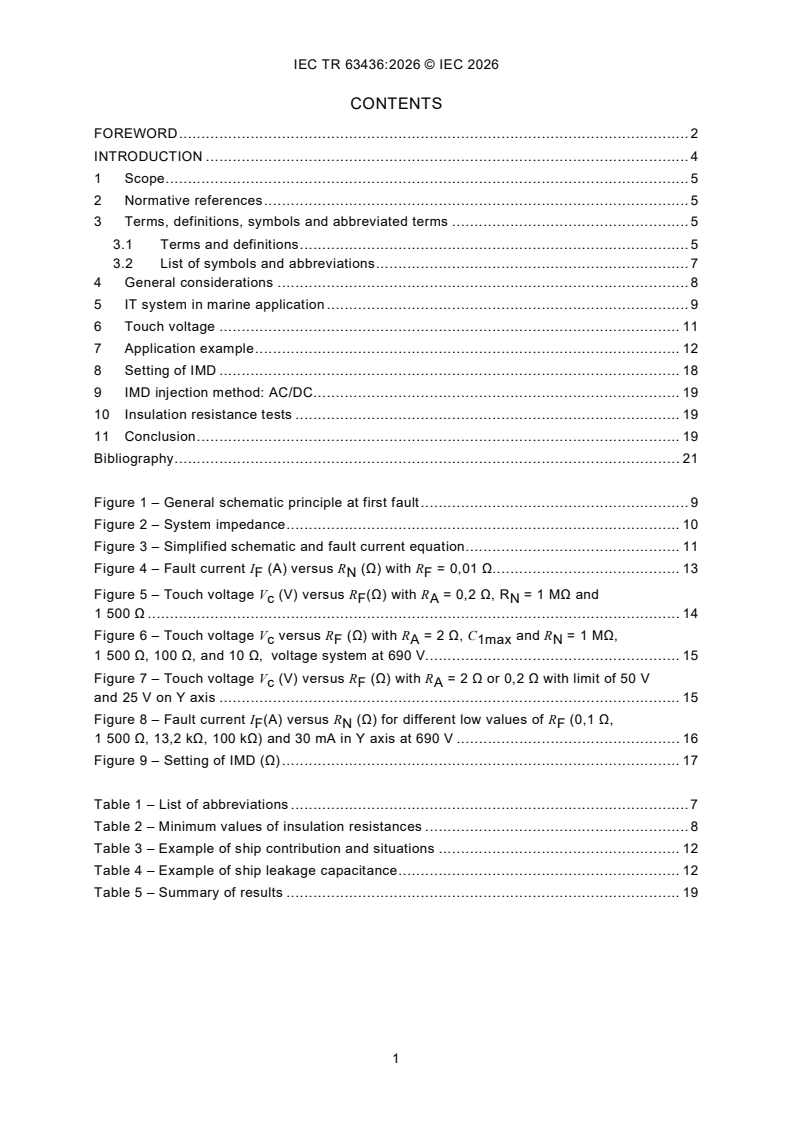
CONTENTS
FOREWORD . 2
INTRODUCTION . 4
1 Scope . 5
2 Normative references . 5
3 Terms, definitions, symbols and abbreviated terms . 5
3.1 Terms and definitions . 5
3.2 List of symbols and abbreviations . 7
4 General considerations . 8
5 IT system in marine application . 9
6 Touch voltage . 11
7 Application example . 12
8 Setting of IMD . 18
9 IMD injection method: AC/DC . 19
10 Insulation resistance tests . 19
11 Conclusion . 19
Bibliography . 21
Figure 1 – General schematic principle at first fault . 9
Figure 2 – System impedance . 10
Figure 3 – Simplified schematic and fault current equation . 11
Figure 4 – Fault current I (A) versus R (Ω) with R = 0,01 Ω. 13
F N F
Figure 5 – Touch voltage V (V) versus R (Ω) with R = 0,2 Ω, R = 1 MΩ and
c F A N
1 500 Ω . 14
Figure 6 – Touch voltage V versus R (Ω) with R = 2 Ω, C and R = 1 MΩ,
c F A 1max N
1 500 Ω, 100 Ω, and 10 Ω, voltage system at 690 V. 15
Figure 7 – Touch voltage V (V) versus R (Ω) with R = 2 Ω or 0,2 Ω with limit of 50 V
c F A
and 25 V on Y axis . 15
Figure 8 – Fault current I (A) versus R (Ω) for different low values of R (0,1 Ω,
F N F
1 500 Ω, 13,2 kΩ, 100 kΩ) and 30 mA in Y axis at 690 V . 16
Figure 9 – Setting of IMD (Ω) . 17
Table 1 – List of abbreviations . 7
Table 2 – Minimum values of insulation resistances . 8
Table 3 – Example of ship contribution and situations . 12
Table 4 – Example of ship leakage capacitance . 12
Table 5 – Summary of results . 19
INTERNATIONAL ELECTROTECHNICAL COMMISSION
____________
Insulation monitoring device - Marine AC application example
FOREWORD
1) The International Electrotechnical Commission (IEC) is a worldwide organization for standardization comprising
all national electrotechnical committees (IEC National Committees). The object of IEC is to promote international
co-operation on all questions concerning standardization in the electrical and electronic fields. To this end and
in addition to other activities, IEC publishes International Standards, Technical Specifications, Technical Reports,
Publicly Available Specifications (PAS) and Guides (hereafter referred to as “IEC Publication(s)”). Their
preparation is entrusted to technical committees; any IEC National Committee interested in the subject dealt with
may participate in this preparatory work. International, governmental and non-governmental organizations liaising
with the IEC also participate in this preparation. IEC collaborates closely with the International Organization for
Standardization (ISO) in accordance with conditions determined by agreement between the two organizations.
2) The formal decisions or agreements of IEC on technical matters express, as nearly as possible, an international
consensus of opinion on the relevant subjects since each technical committee has representation from all
interested IEC National Committees.
3) IEC Publications have the form of recommendations for international use and are accepted by IEC National
Committees in that sense. While all reasonable efforts are made to ensure that the technical content of IEC
Publications is accurate, IEC cannot be held responsible for the way in which they are used or for any
misinterpretation by any end user.
4) In order to promote international uniformity, IEC National Committees undertake to apply IEC Publications
transparently to the maximum extent possible in their national and regional publications. Any divergence between
any IEC Publication and the corresponding national or regional publication shall be clearly indicated in the latter.
5) IEC itself does not provide any attestation of conformity. Independent certification bodies provide conformity
assessment services and, in some areas, access to IEC marks of conformity. IEC is not responsible for any
services carried out by independent certification bodies.
6) All users should ensure that they have the latest edition of this publication.
7) No liability shall attach to IEC or its directors, employees, servants or agents including individual experts and
members of its technical committees and IEC National Committees for any personal injury, property damage or
other damage of any nature whatsoever, whether direct or indirect, or for costs (including legal fees) and
expenses arising out of the publication, use of, or reliance upon, this IEC Publication or any other IEC
Publications.
8) Attention is drawn to the Normative references cited in this publication. Use of the referenced publications is
indispensable for the correct application of this publication.
9) IEC draws attention to the possibility that the implementation of this document may involve the use of (a)
patent(s). IEC takes no position concerning the evidence, validity or applicability of any claimed patent rights in
respect thereof. As of the date of publication of this document, IEC had not received notice of (a) patent(s), which
may be required to implement this document. However, implementers are cautioned that this may not represent
the latest information, which may be obtained from the patent database available at https://patents.iec.ch. IEC
shall not be held responsible for identifying any or all such patent rights.
IEC TR 63436 has been prepared by IEC technical committee 18: Electrical installations of
ships and of mobile and fixed offshore units. It is a Technical Report.
The text of this Technical Report is based on the following documents:
Draft Report on voting
18/2010/DTR 18/2019/RVDTR
Full information on the voting for its approval can be found in the report on voting indicated in
the above table.
The language used for the development of this Technical Report is English.
This document was drafted in accordance with ISO/IEC Directives, Part 2, and developed in
accordance with ISO/IEC Directives, Part 1 and ISO/IEC Directives, IEC Supplement, available
at www.iec.ch/members_experts/refdocs. The main document types developed by IEC are
described in greater detail at www.iec.ch/publications.
The committee has decided that the contents of this document will remain unchanged until the
stability date indicated on the IEC website under webstore.iec.ch in the data related to the
specific document. At this date, the document will be
– reconfirmed,
– withdrawn, or
– revised.
INTRODUCTION
The purpose of this document is to determine the values of the alarm thresholds of the insulation
controller resulting from a loss of insulation of a device or a group of devices installed in an IT
electrical system.
IEC 60364-4-41:2005 and IEC 60364-4-41:2005/AMD1:2017 is dedicated to the safety of
people, i.e. protection against electric shock. Subclause 411.6 is dedicated to the IT system.
In cases where an IT system is used for reasons of continuity of supply, also in the event of an
earth fault, an insulation monitoring device is used to indicate the occurrence of that first fault
from a live part to exposed-conductive-parts or to earth.
For onshore applications, the exposed-conductive-parts are connected to earth, either
individually, in groups, or collectively to R (see Figure 1). R is the sum of the resistance in
A A
ohms of the earth electrode and protective earthing conductor PE (see IEC 60364-4-41:2005
and IEC 60364-4-41:2005/AMD1:2017, 411.6, and IEC 60364-1:2025, Figure 19).
For marine applications, the exposed-conductive-parts are connected, either individually, in
groups, or collectively to the hull. The protective conductors are either connected to the earthing
bar of the switchboard or directly to the hull.
For the purpose of this study of the alarm thresholds and touch voltage, the following is
presumed:
is the parameter to calculate at the fault point to find the touch voltage between exposed-
a) R
A
conductive-parts of a faulty equipment and to the hull (not including R ). The basic
B
schematics are not changed. See Figure 1.
b) R is not used in the calculations, because this is a very low value which does not influence
B
the current within the impedance if fitted on the neutral point and this value is not easily
identified.
c) R and R are estimated in Clause 6.
A B
Low voltage rotating machines, transformers, switchgear and controlgear assemblies, cables,
loads, etc., are subject to insulation resistance measurements during production, installation,
commissioning and periodic maintenance of equipment and systems. These values give the
operators information regarding the operational quality of a product or a sub-assembly, but do
not make it possible to conclude on the operational quality of an entire electrical network.
Insulation monitoring devices (IMDs) measure the insulation resistance, including the
resistance of all the connected loads to one voltage system to earth.
These two types of measurements have generally different values and cannot be compared.
1 Scope
This document explains the setting parameters of insulation monitoring devices (IMDs) and how
to interpret these measurements through plotted curves. Some examples of injection methods
are also proposed.
NOTE 1 Requirements for IMDs are specified by IEC 61557-8.
The examples given in this document consider the situation of an insulation fault in an
installation or equipment (motors, enclosure, cables, etc.) creating a resistive path to earth and
calculate the touch voltage. It does not consider a person making direct contact with a live
conductor in an IT grid.
NOTE 2 This document is informative and cannot contain requirements, in accordance with the ISO/IEC Directives,
Part 2, for technical reports.
2 Normative references
There are no normative references in this document.
3 Terms, definitions, symbols and abbreviated terms
For the purposes of this document, the following terms and definitions apply.
ISO and IEC maintain terminology databases for use in standardization at the following
addresses:
– IEC Electropedia: available at https://www.electropedia.org/
– ISO Online browsing platform: available at https://www.iso.org/obp
3.1 Terms and definitions
3.1.1
isolated neutral system
system where the neutral point is not intentionally connected to earth, except for high
impedance connections for protection or measurement purposes
[SOURCE: IEC 60050-601:1985, 601-02-24]
3.1.2
insulation monitoring devices
IMD
device which permanently monitors the insulation resistance to earth of unearthed AC IT
systems, AC IT systems with galvanically connected DC circuits having nominal voltages up to
1 000 V AC, as well as monitoring the insulation resistance of unearthed DC IT systems with
voltages up to 1 500 V DC, independent from the method of measuring
[SOURCE: IEC 61557-8:2014, 3.1.14]
3.1.3
insulation resistance
R
F
resistance in the system being monitored, including the resistance of all the connected
appliances to earth
[SOURCE: IEC 61557-8:2014, 3.1.2]
3.1.4
insulation fault
defect in the insulation of an electrical installation or of an equipment which can create a
resistive path to earth
Note 1 to entry: The insulation fault can appear as a single fault from one line conductor or as a symmetrical fault
from all line conductors.
[SOURCE: IEC 61557-8:2014, 3.1.18]
3.1.5
insulation resistance meter
instrument intended to measure insulation resistance
[SOURCE: IEC 60050-313:2001, 313-01-11]
3.1.6
touch voltage,
voltage between conductive parts when touched simultaneously by a human being or livestock
Note 1 to entry: The value of the touch voltage is influenced by the impedance of the human being or the livestock
in electric contact with these conductive parts.
[SOURCE: IEC 60050-195:2021, 195-05-11]
3.1.7
exposed-conductive-part
conductivepart of equipment that can be touched and that is not live under normal conditions,
but that can become live when basic insulation fails
[SOURCE: IEC 60050-195:2021, 195-06-10]
3.1.8
non-conducting environment
environment with high impedance to earth and without any earthed conductive parts
3.1.9
protective earthing conductor
PE conductor
protective grounding conductor, US
protective conductor provided for protective earthing
[SOURCE: IEC 60050-195:2021, 195-02-11]
3.1.10
PEN conductor
conductor combining the functions of both a protective earthing conductor and a neutral
conductor
[SOURCE: IEC 60050-195:2021, 195-02-12]
3.1.11
line-to-line voltage
voltage between two line conductors at a given point in an electric circuit
[SOURCE: IEC 60050-195:2021, 195-05-01]
3.1.12
line-to-neutral voltage
voltage between a line conductor and the neutral conductor at a given point in an AC circuit
[SOURCE: IEC 60050-195:2021, 195-05-02]
3.1.13
line-to-earth voltage
voltage between a line conductor and reference earth at a given point in an electric circuit
[SOURCE: IEC 60050-195:2021, 195-05-03]
3.2 List of symbols and abbreviations
Table 1 – List of abbreviations
R = R = R = R
The insulation resistance between each phase and ground
1 2 3
C = C = C = C
The capacitor between each phase and ground
1 2 3
R
The neutral resistance to the earth
N
R
Fault resistance of a resistive path between a phase and earth
F
The hull resistance including the connection resistance at the neutral point. See
R
B
Figure 1
R
One or more group earthing resistance and PE conductor. See Figure 1.
A
I
Current through the earthing resistance
R
I
Capacitive currents to ground mainly due to cables and filters
C
I Vectorial sum of I + I
F C N
Line-to-neutral voltages (V )
V , V , V
1 2 3 (i)
V Line to line voltage
ph-ph
V
Line to neutral voltage
ph-n
V
Line to earth voltage at the point of fault V V V /3
F
F ph-gnd ph-ph
V
Voltage between neutral point and earth
N
V
Touch voltage
c
Z
Positive sequence or direct impedance of the generation system
ds
Z
Negative sequence or inverse impedance of the generation system
is
Zero sequence or homopolar impedance of the generation system,
Z
0s
Z equal ∞ for insulated neutral or R if resistance earthed.
0s N
Synchronous generated voltage with V : the positive sequence voltage, Z : the
d d
E = V + Z I
direct impedance, I : the positive sequence current of the generation system (see
d d d
d
Figure 2 b),
The zero sequence of neutral resistor and the distributed zero sequence
z =R // (1/3Cω)
0 N
capacitance in parallel,
Z = z + R
Zero sequence or homopolar impedance of the fault,
0 0 F
==
4 General considerations
Low voltage electric systems are normally characterized by:
– a leakage current of the resistance between phases and phases to earth. For a network
properly insulated, the insulation resistance is balanced between phases to earth;
R = R = R = R;
1 2 3
– a leakage current of the capacitance between each phase and earth, including mainly cables
but also EMC/EMI filters, rotating machines, transformers, etc. For a network properly
insulated, the capacitance is balanced between phases to earth; C = C = C = C;
1 2 3
– whether a neutral point is earthed directly or through an impedance or resistance. The
earthing resistance R is close to zero;
B
– that the earthing conductors PE or PEN are generally interconnected or can be
interconnected per group or individually, each group will have a resistance R not eq
...