

IEC/IEEE 61886-2:2025
(Main)Subsea equipment - Part 2: Power transformers
General Information
- Abstract
IEC/IEEE 61886-2:2025 is applicable to three-phase and single-phase liquid immersed subsea power transformers (including auto-transformers) with at least one winding with rated voltages in the range 3,6 ≤ Um ≤ 245 kV and with rated power in the range 50 kVA to 300 MVA. The intention is to specify additional requirements that are not covered by the IEC 60076 series and IEEE Std C57.12TM series.
This document is published as an IEC/IEEE Dual Logo standard.
This publication contains attached files in the form of a Microsoft Excel file. This file is intended to be used as a complement and does not form an integral part of the publication.
- Status
- Published
- Publication Date
- 25-Aug-2025
- Drafting Committee
- JWG 31 - TC 18/JWG 31
- Current Stage
- PPUB - Publication issued
- Start Date
- 26-Aug-2025
- Completion Date
- 22-Aug-2025
Overview
IEC/IEEE 61886-2:2025 - Subsea equipment, Part 2: Power transformers is a dual-logo IEC/IEEE standard that defines additional requirements for liquid‑immersed subsea power transformers (including auto‑transformers). It applies to single‑ and three‑phase units with at least one winding rated between 3.6 kV and 245 kV and rated power from 50 kVA to 300 MVA. The standard supplements-but does not replace-requirements in the IEC 60076 and IEEE Std C57.12 series and includes guidance on design, materials, seals, monitoring and testing specific to the subsea environment. An attached Microsoft Excel file is published as a complementary aid (not an integral part of the standard).
Key topics and technical requirements
The standard addresses subsea‑specific technical topics that affect reliability, safety and maintainability:
- Design and lifetime: design analyses, guaranteed lifetime, rated power and highest equipment voltage.
- Insulation and windings: winding insulation requirements, tap changers, neutral terminals and neutral grounding resistors (NGR).
- Materials and fluids: tank materials, dielectric liquid selection and material certification.
- Mechanical and pressure design: tank design, pressure compensators, seals, mechanical stress and pressure/deflection limits.
- Penetrators and connectors: electrical penetrators, subsea connectors and interfaces for cables and instrumentation.
- Instrumentation & monitoring: temperature sensors (top liquid and winding), pressure monitoring, water‑penetration detection, insulation monitoring systems and cathodic protection monitoring.
- Testing and quality assurance: extensive type and routine tests including dielectric tests, helium leakage, vacuum tightness, pressure cycling, temperature‑rise (in water and air), partial discharge and specific tests for U > 72.5 kV. Test voltages, artificial seawater requirements and liquid sampling are specified.
- Service, transport and storage: environmental profiles for normal service, handling, transportation and storage requirements.
- Documentation: mandatory rating plate information and a normative subsea power transformer data sheet (annex).
Practical applications and users
This standard is intended for organizations involved in subsea power systems and offshore electrification:
- Transformer OEMs designing and manufacturing subsea liquid‑immersed transformers and auto‑transformers.
- Subsea system integrators and EPC contractors specifying transformer equipment for umbilicals, platforms, floating wind, offshore grids and tie‑backs.
- Operators and asset owners seeking robust reliability, monitoring and maintenance criteria for subsea power equipment.
- Testing laboratories, certification bodies and classification societies conducting type and routine tests and certifying subsea electrical equipment.
- Consultants and regulators preparing technical specifications and procurement documents for offshore projects.
Related standards
- IEC 60076 series (power transformer general standards)
- IEEE Std C57.12 series (transformer standards)
IEC/IEEE 61886-2:2025 is explicitly intended to provide the subsea‑specific supplements to these mainstream transformer standards.
Keywords: IEC/IEEE 61886-2:2025, subsea power transformer, liquid‑immersed transformer, subsea equipment standard, pressure compensator, dielectric liquid, penetrator, testing, insulation monitoring.
Get Certified
Connect with accredited certification bodies for this standard

DNV
DNV is an independent assurance and risk management provider.

Lloyd's Register
Lloyd's Register is a global professional services organisation specialising in engineering and technology.

FSC International
Forest Stewardship Council certification.
Sponsored listings
Frequently Asked Questions
IEC/IEEE 61886-2:2025 is a standard published by the International Electrotechnical Commission (IEC). Its full title is "Subsea equipment - Part 2: Power transformers". This standard covers: IEC/IEEE 61886-2:2025 is applicable to three-phase and single-phase liquid immersed subsea power transformers (including auto-transformers) with at least one winding with rated voltages in the range 3,6 ≤ Um ≤ 245 kV and with rated power in the range 50 kVA to 300 MVA. The intention is to specify additional requirements that are not covered by the IEC 60076 series and IEEE Std C57.12TM series. This document is published as an IEC/IEEE Dual Logo standard. This publication contains attached files in the form of a Microsoft Excel file. This file is intended to be used as a complement and does not form an integral part of the publication.
IEC/IEEE 61886-2:2025 is applicable to three-phase and single-phase liquid immersed subsea power transformers (including auto-transformers) with at least one winding with rated voltages in the range 3,6 ≤ Um ≤ 245 kV and with rated power in the range 50 kVA to 300 MVA. The intention is to specify additional requirements that are not covered by the IEC 60076 series and IEEE Std C57.12TM series. This document is published as an IEC/IEEE Dual Logo standard. This publication contains attached files in the form of a Microsoft Excel file. This file is intended to be used as a complement and does not form an integral part of the publication.
IEC/IEEE 61886-2:2025 is classified under the following ICS (International Classification for Standards) categories: 29.180 - Transformers. Reactors; 47.020.60 - Electrical equipment of ships and of marine structures. The ICS classification helps identify the subject area and facilitates finding related standards.
IEC/IEEE 61886-2:2025 is available in PDF format for immediate download after purchase. The document can be added to your cart and obtained through the secure checkout process. Digital delivery ensures instant access to the complete standard document.
Standards Content (Sample)
IEC/IEEE 61886-2 ®
Edition 1.0 2025-08
INTERNATIONAL
STANDARD
Subsea equipment -
Part 2: Power transformers
ICS 47.020.60; 29.180 ISBN 978-2-8327-0601-5
All rights reserved. Unless otherwise specified, no part of this publication may be reproduced or utilized in any form or
by any means, electronic or mechanical, including photocopying and microfilm, without permission in writing being
secured. Requests for permission to reproduce should be addressed to either IEC at the address below or IEC’s
member Nationa l Committee in the country of the requester or from IEEE.
IEC Secretariat Institute of Electrical and Electronics Engineers, Inc.
3, rue de Varembé 3 Park Avenue
CH-1211 Geneva 20 New York, NY 10016-5997
Switzerland United States of America
Tel.: +41 22 919 02 11 stds.ipr@ieee.org
info@iec.ch www.ieee.org
www.iec.ch
About the IEC
The International Electrotechnical Commission (IEC) is the leading global organization that prepares and publishes
International Standards for all electrical, electronic and related technologies.
About the IEEE
IEEE is the world’s largest professional association dedicated to advancing technological innovation and excellence for the
benefit of humanity. IEEE and its members inspire a global community through its highly cited publications, conferences,
technology standards, and professional and educational activities.
About IEC/IEEE publications
The technical content of IEC/IEEE publications is kept under constant review by the IEC and IEEE. Please make sure that
you have the latest edition, a corrigendum or an amendment might have been published.
IEC publications search - webstore.iec.ch/advsearchform IEC Products & Services Portal - products.iec.ch
The advanced search enables to find IEC publications by a Discover our powerful search engine and read freely all the
variety of criteria (reference number, text, technical publications previews, graphical symbols and the glossary. With a
committee, …). It also gives information on projects, replaced subscription you will always have access to up to date content
and withdrawn publications. tailored to your needs.
IEC Just Published - webstore.iec.ch/justpublished
Electropedia - www.electropedia.org
Stay up to date on all new IEC publications. Just Published
The world's leading online dictionary on electrotechnology,
details all new publications released. Available online and
containing more than 22 500 terminological entries in English and
once a month by email.
French, with equivalent terms in 25 additional languages. Also
known as the International Electrotechnical Vocabulary (IEV)
IEC Customer Service Centre - webstore.iec.ch/csc
online.
If you wish to give us your feedback on this publication or need
further assistance, please contact the Customer Service
Centre: sales@iec.ch.
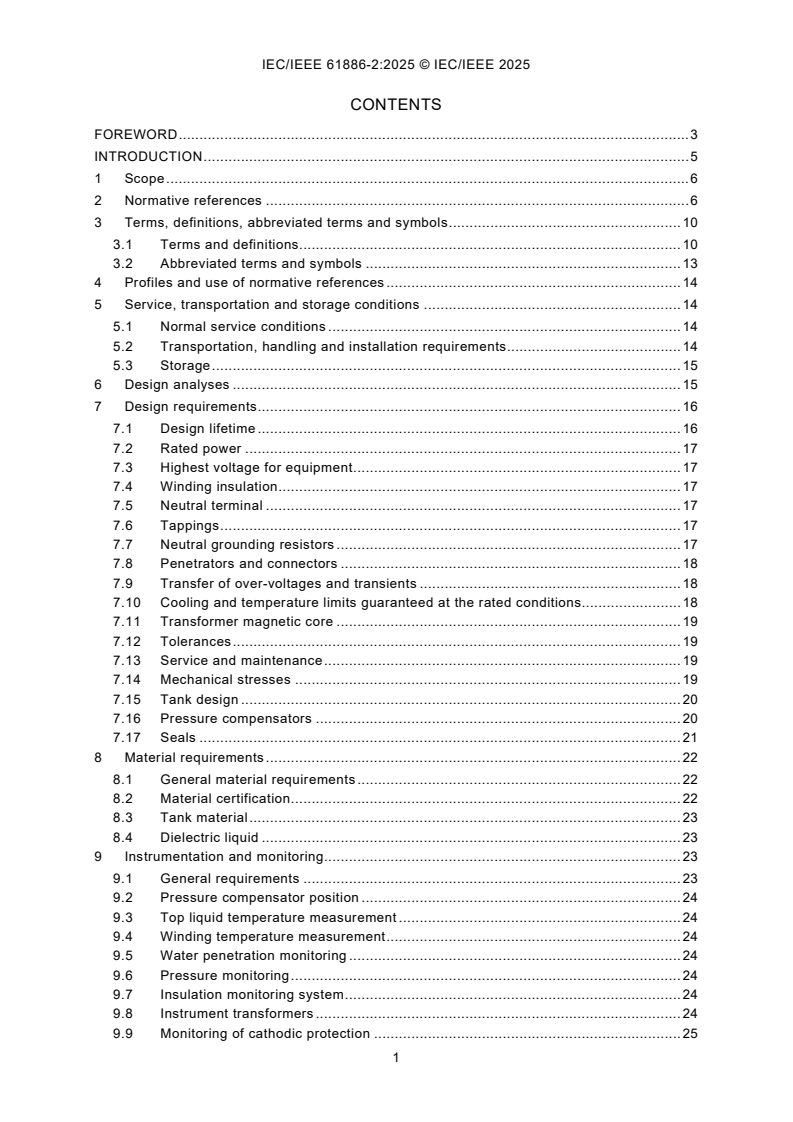
CONTENTS
FOREWORD . 3
INTRODUCTION . 5
1 Scope . 6
2 Normative references . 6
3 Terms, definitions, abbreviated terms and symbols . 10
3.1 Terms and definitions. 10
3.2 Abbreviated terms and symbols . 13
4 Profiles and use of normative references . 14
5 Service, transportation and storage conditions . 14
5.1 Normal service conditions . 14
5.2 Transportation, handling and installation requirements. 14
5.3 Storage . 15
6 Design analyses . 15
7 Design requirements. 16
7.1 Design lifetime . 16
7.2 Rated power . 17
7.3 Highest voltage for equipment . 17
7.4 Winding insulation . 17
7.5 Neutral terminal . 17
7.6 Tappings . 17
7.7 Neutral grounding resistors . 17
7.8 Penetrators and connectors . 18
7.9 Transfer of over-voltages and transients . 18
7.10 Cooling and temperature limits guaranteed at the rated conditions. 18
7.11 Transformer magnetic core . 19
7.12 Tolerances . 19
7.13 Service and maintenance . 19
7.14 Mechanical stresses . 19
7.15 Tank design . 20
7.16 Pressure compensators . 20
7.17 Seals . 21
8 Material requirements . 22
8.1 General material requirements . 22
8.2 Material certification . 22
8.3 Tank material . 23
8.4 Dielectric liquid . 23
9 Instrumentation and monitoring. 23
9.1 General requirements . 23
9.2 Pressure compensator position . 24
9.3 Top liquid temperature measurement . 24
9.4 Winding temperature measurement . 24
9.5 Water penetration monitoring . 24
9.6 Pressure monitoring . 24
9.7 Insulation monitoring system . 24
9.8 Instrument transformers . 24
9.9 Monitoring of cathodic protection . 25
10 Rating plate . 25
11 Testing . 26
11.1 General requirements . 26
11.2 Artificial seawater requirements . 26
11.3 Test voltage levels . 26
11.4 Liquid samples . 27
11.5 Type tests for new transformer designs . 27
11.6 Routine tests for all transformers . 28
11.7 Additional type and routine tests for transformers with U > 72,5 kV . 29
m
11.8 Special tests . 29
11.9 Test procedures . 30
11.9.1 General . 30
11.9.2 Material and component testing . 31
11.9.3 Fabrication and welding . 32
11.9.4 Liquid sample tests . 33
11.9.5 Helium leakage control test . 33
11.9.6 Leak testing with pressure for liquid immersed transformers . 34
11.9.7 Pressure deflection test . 35
11.9.8 Vacuum tightness test . 35
11.9.9 Vacuum deflection test . 35
11.9.10 Long term pressure cycling of pressure compensators . 35
11.9.11 Measurement of winding resistance . 36
11.9.12 Measurement of DC insulation resistance between each winding to
earth and between windings . 37
11.9.13 Measurement of polarization index . 37
11.9.14 Measurement of boost factor . 37
11.9.15 Dielectric routine tests . 38
11.9.16 Extended routine tests . 39
11.9.17 Temperature rise test in water . 40
11.9.18 Temperature rise test in air . 41
11.9.19 Partial discharge tests . 42
11.9.20 Tests of neutral grounding resistors . 42
11.9.21 Temperature cycle test . 42
11.9.22 Dismantling and examination . 43
Annex A (normative) Subsea power transformer data sheet . 45
Bibliography . 52
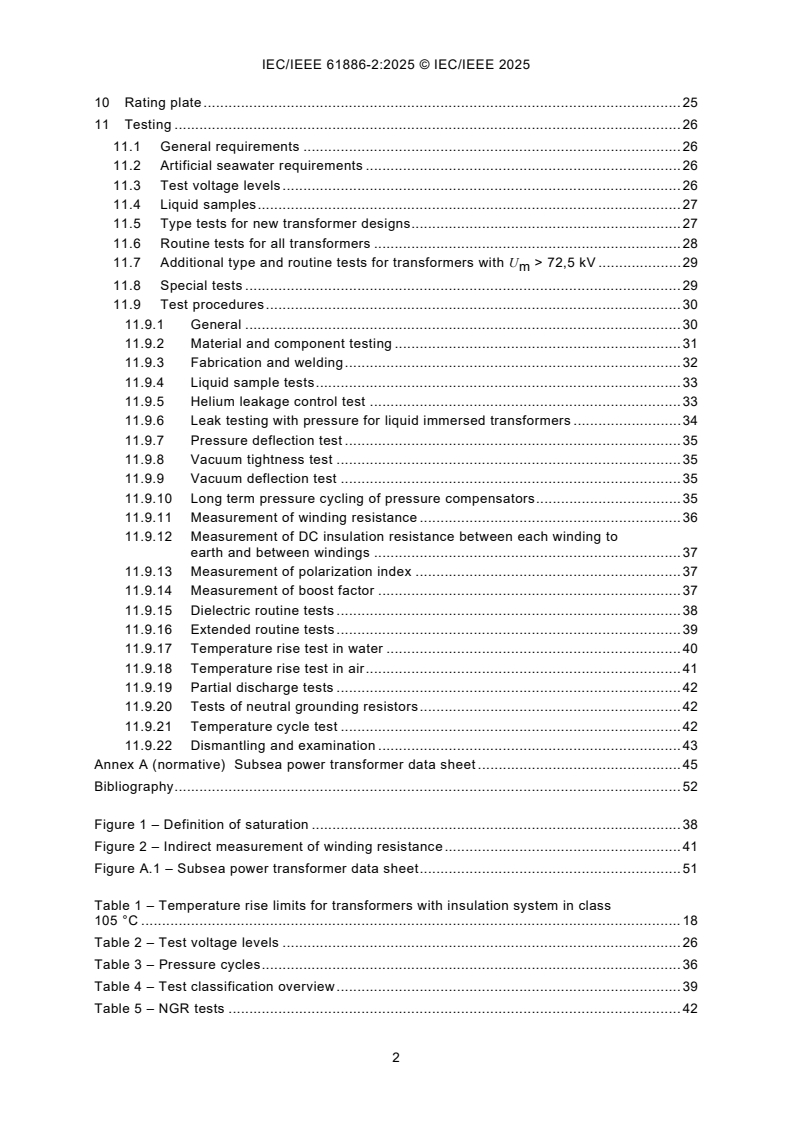
Figure 1 – Definition of saturation . 38
Figure 2 – Indirect measurement of winding resistance . 41
Figure A.1 – Subsea power transformer data sheet . 51
Table 1 – Temperature rise limits for transformers with insulation system in class
105 °C . 18
Table 2 – Test voltage levels . 26
Table 3 – Pressure cycles . 36
Table 4 – Test classification overview . 39
Table 5 – NGR tests . 42
INTERNATIONAL ELECTROTECHNICAL COMMISSION
____________
Subsea equipment -
Part 2: Power transformers
FOREWORD
1) The International Electrotechnical Commission (IEC) is a worldwide organization for standardization comprising
all national electrotechnical committees (IEC National Committees). The object of IEC is to promote international
co-operation on all questions concerning standardization in the electrical and electronic fields. To this end and
in addition to other activities, IEC publishes International Standards, Technical Specifications, Technical Reports,
Publicly Available Specifications (PAS) and Guides (hereafter referred to as "IEC document(s)"). Their
preparation is entrusted to technical committees; any IEC National Committee interested in the subject dealt with
may participate in this preparatory work. International, governmental and non-governmental organizations liaising
with the IEC also participate in this preparation.
IEEE Standards documents are developed within IEEE Societies and Standards Coordinating Committees of the
IEEE Standards Association (IEEE SA) Standards Board. IEEE develops its standards through a consensus
development process, approved by the American National Standards Institute, which brings together volunteers
representing varied viewpoints and interests to achieve the final product. Volunteers are not necessarily members
of IEEE and serve without compensation. While IEEE administers the process and establishes rules to promote
fairness in the consensus development process, IEEE does not independently evaluate, test, or verify the
accuracy of any of the information contained in its standards. Use of IEEE Standards documents is wholly
voluntary. IEEE documents are made available for use subject to important notices and legal disclaimers (see
https://standards.ieee.org/ipr/disclaimers.html for more information).
IEC collaborates closely with IEEE in accordance with conditions determined by agreement between the two
organizations. This Dual Logo International Standard was jointly developed by the IEC and IEEE under the terms
of that agreement.
2) The formal decisions of IEC on technical matters express, as nearly as possible, an international consensus of
opinion on the relevant subjects since each technical committee has representation from all interested IEC
National Committees. The formal decisions of IEEE on technical matters, once consensus within IEEE Societies
and Standards Coordinating Committees has been reached, is determined by a balanced ballot of materially
interested parties who indicate interest in reviewing the proposed standard. Final approval of the IEEE standards
document is given by the IEEE Standards Association (IEEE SA) Standards Board.
3) IEC/IEEE Publications have the form of recommendations for international use and are accepted by IEC National
Committees/IEEE Societies in that sense. While all reasonable efforts are made to ensure that the technical
content of IEC/IEEE Publications is accurate, IEC or IEEE cannot be held responsible for the way in which they
are used or for any misinterpretation by any end user.
4) In order to promote international uniformity, IEC National Committees undertake to apply IEC Publications
(including IEC/IEEE Publications) transparently to the maximum extent possible in their national and regional
publications. Any divergence between any IEC/IEEE Publication and the corresponding national or regional
publication shall be clearly indicated in the latter.
5) IEC and IEEE do not provide any attestation of conformity. Independent certification bodies provide conformity
assessment services and, in some areas, access to IEC marks of conformity. IEC and IEEE are not responsible
for any services carried out by independent certification bodies.
6) All users should ensure that they have the latest edition of this publication.
7) No liability shall attach to IEC or IEEE or their directors, employees, servants or agents including individual
experts and members of technical committees and IEC National Committees, or volunteers of IEEE Societies and
the Standards Coordinating Committees of the IEEE Standards Association (IEEE SA) Standards Board, for any
personal injury, property damage or other damage of any nature whatsoever, whether direct or indirect, or for
costs (including legal fees) and expenses arising out of the publication, use of, or reliance upon, this IEC/IEEE
Publication or any other IEC or IEEE Publications.
8) Attention is drawn to the normative references cited in this publication. Use of the referenced publications is
indispensable for the correct application of this publication.
9) Attention is drawn to the possibility that implementation of this IEC/IEEE Publication may require use of material
covered by patent rights. By publication of this standard, no position is taken with respect to the existence or
validity of any patent rights in connection therewith. IEC or IEEE shall not be held responsible for identifying
Essential Patent Claims for which a license may be required, for conducting inquiries into the legal validity or
scope of Patent Claims or determining whether any licensing terms or conditions provided in connection with
submission of a Letter of Assurance, if any, or in any licensing agreements are reasonable or non-discriminatory.
Users of this standard are expressly advised that determination of the validity of any patent rights, and the risk
of infringement of such rights, is entirely their own responsibility.
IEC/IEEE 61886-2 was prepared by IEC technical committee 18: Electrical installations of ships
and of mobile and fixed offshore units, in cooperation with IEEE IAS/PCI/P1886: Subsea
Electrical Applications Working Group of the IEEE, under the IEC/IEEE Dual Logo Agreement
between IEC and IEEE. It is an International Standard.
This document is published as an IEC/IEEE Dual Logo standard.
This publication contains attached files in the form of a Microsoft Excel file. This file is intended
to be used as a complement and does not form an integral part of the publication.
The text of this International Standard is based on the following IEC documents:
Draft Report on voting
18/1978/FDIS 18/1992A/RVD
Full information on the voting for its approval can be found in the report on voting indicated in
the above table.
The language used for the development of this International Standard is English.
This document was drafted in accordance with the rules given in the ISO/IEC Directives, Part 2,
available at www.iec.ch/members_experts/refdocs. The main document types developed by IEC
are described in greater detail at www.iec.ch/publications/.
A list of all parts in the IEC/IEEE 61886 series, published under the general title Subsea
equipment, can be found on the IEC website.
The IEC Technical Committee and IEEE Technical Committee have decided that the contents
of this document will remain unchanged until the stability date indicated on the IEC website
under webstore.iec.ch in the data related to the specific document. At this date, the document
will be
• reconfirmed,
• withdrawn, or
• revised.
INTRODUCTION
Use of electrical power on the seabed is increasing. Both within the oil and gas and renewable
industries, there is an increasing use of electrical power equipment on the seabed. Subsea
processing activities like compression and pumping require an increasingly higher amount of
electrical power. Power generation, whether onshore or offshore, requires development of
equipment both for subsea transmission and distribution.
This document includes requirements related to equipment installed below the sea surface. The
objective of this document is to substitute project/client specific specifications.
Use of this document will avoid increased costs and schedule impact (for type testing) and
reduce risk for failure. By standardizing tests and implementing continuous improvement on
fewer products, this risk will be reduced in the long term.
The SEPS JIP (Subsea Electrical Power Standardization Joint Industry Project) was established
in 2010 by seven oil and gas companies, with the aim to develop common operator standards
for subsea electrical power equipment and systems and support further development of these
into internationally recognized standards. This document proposal is developed by SEPS. The
aim for the SEPS JIP is to develop IEC/IEEE dual logo standards; hence both IEC and relevant
IEEE standards are referenced where applicable. Relevant equipment manufacturers have
contributed with review and comments to the document.
The lack of accessibility (for repair/replacement) defines strict requirements to reliability,
beyond what is normally seen in topside applications.
As subsea equipment is in many cases interconnected to topside equipment, specifications for
subsea equipment are considered to be within the Scope of IEC Technical Committee 18.
1 Scope
This part of IEC/IEEE 61886 is applicable to three-phase and single-phase liquid immersed
subsea power transformers (including auto-transformers) with at least one winding with rated
≤ 245 kV and with rated power in the range 50 kVA to 300 MVA.
voltages in the range 3,6 ≤ U
m
The intention is to specify additional requirements that are not covered by the IEC 60076 series
TM
and IEEE Std C57.12 series.
It is the intention of this document that subsea power transformers be designed and tested
either in accordance with the IEC 60076 series (IEC profile) or with the IEEE C57.12 series
(IEEE profile).
For subsea transformers where no winding has a rated voltage above or equal to 3,6 kV, this
document can be applicable, either as a whole or in part.
The mechanical design principles are also applicable for liquid-immersed reactors.
Where the terms "subsea transformer" or "transformer" are used, this means "transformer
assembly". Where required, it is stated whether transformer accessories like penetrators and
connectors are included or not.
2 Normative references
The following documents are referred to in the text in such a way that some or all of their content
constitutes requirements of this document. For dated references, only the edition cited applies.
For undated references, the latest edition of the referenced document (including any
amendments) applies.
IEC 60076-1:2011, Power transformers - Part 1: General
IEC 60076-2:2011, Power transformers - Part 2: Temperature rise for liquid-immersed
transformers
IEC 60076-3:2013, Power transformers - Part 3: Insulation levels, dielectric tests and external
clearances in air
IEC 60076-3:2013/AMD1:2018
IEC 60076-5, Power transformers - Part 5: Ability to withstand short circuit
IEC 60076-10, Power transformers - Part 10: Determination of sound levels
IEC 60076-14, Power transformers - Part 14: Liquid-immersed power transformers using
high-temperature insulation materials
IEC 60085, Electrical insulation - Thermal evaluation and designation
IEC 60137, Insulated bushings for alternating voltages above 1000 V
IEC 60156, Insulating liquids - Determination of the breakdown voltage at power frequency -
Test method
IEC 60247, Insulating liquids - Measurement of relative permittivity, dielectric dissipation factor
(tan δ) and d.c. resistivity
IEC 60296:2020, Fluids for electrotechnical applications - Mineral insulating oils for electrical
equipment
IEC 60422, Mineral insulating oils in electrical equipment - Supervision and maintenance
guidance
IEC 60475, Method of sampling insulating liquids
IEC 60814, Insulating liquids - Oil impregnated paper and pressboard - Determination of water
by automatic coulometric Karl Fischer titration
IEC 61378-1:2011, Converter transformers - Part 1: Transformers for industrial applications
IEC 61619, Insulating liquids - Contamination by polychlorinated biphenyls (PCBs) - Method of
determination by capillary column gas chromatography
IEC 62021-1, Insulating liquids - Determination of acidity - Part 1: Automatic potentiometric
titration
IEC 62021-2, Insulating liquids - Determination of acidity - Part 2: Colourimetric titration
IEC 62535:2008, Insulating liquids - Test method for detection of potentially corrosive sulphur
in used and unused insulating oil
IEC 62697-1, Test methods for quantitative determination of corrosive sulfur compounds in
unused and used insulating liquids - Part 1: Test method for quantitative determination of
dibenzyldisulfide (DBDS)
IEC/IEEE 61886-1, Subsea equipment - Part 1: Power connectors, penetrators and jumper
= 3,6 kV) to 30 kV (U = 36 kV)
assemblies with rated voltage from 3 kV (U
max max
ISO 2178, Non-magnetic coatings on magnetic substrates - Measurement of coating thickness
- Magnetic method
ISO 2409, Paints and varnishes - Cross-cut test
ISO 3452 (all parts), Non-destructive testing - Penetrant testing
ISO 9606 (all parts), Qualification testing of welders - Fusion welding
ISO 12103-1:2024, Road vehicles - Test contaminants for filter evaluation - Part 1: Arizona test
dust
ISO 13703-2, Oil and gas industries including lower carbon energy - Piping systems on offshore
platforms and onshore plants - Part 2: Materials
ISO 15614 (all parts), Specification and qualification of welding procedures for metallic
materials - Welding procedure test
ISO 17636-1, Non-destructive testing of welds - Radiographic testing - Part 1: X- and
gamma-ray techniques with film
ISO 17636-2, Non-destructive testing of welds - Radiographic testing - Part 2: X- and
gamma-ray techniques with digital detectors
ISO 17637, Non-destructive testing of welds - Visual testing of fusion-welded joints
ISO 17638, Non-destructive testing of welds - Magnetic particle testing
ISO 17640, Non-destructive testing of welds - Ultrasonic testing - Techniques, testing levels
and assessment
ISO 17781, Petroleum, petrochemical and natural gas industries - Test methods for quality
control of microstructure of ferritic/austenitic (duplex) stainless steels
ISO 17782, Petroleum, petrochemical and natural gas industries - Scheme for conformity
assessment of manufacturers of special materials
ISO 21457, Petroleum, petrochemical and natural gas industries - Materials selection and
corrosion control for oil and gas production systems
IEEE Std C57.32, Standard for requirements, terminology, and test procedures for neutral
grounding devices
IEEE Std C57.12.00-2021, General requirements for liquid-immersed distribution, power and
regulating transformers
IEEE Std C57.12.90-2021, IEEE standard test code for liquid-immersed distribution, power and
regulating transformers
IEEE Std C57.110-2018, IEEE recommended practice for establishing liquid immersed and dry-
type power and distribution transformer capability when supplying non-sinusoidal load currents
IEEE Std C57.152, IEEE guide for diagnostic field testing of fluid-filled power transformers,
regulators, and reactors
IEEE Std C57.154, IEEE standard for liquid-immersed transformers designed to operate at
temperatures above conventional limits using high- temperature insulation systems
IOGP S-563, Piping and Valve Components - Material Data Sheets
API 17F, Standard for subsea production control systems
API RP 17N:2023, Recommended practice on subsea production system reliability, technical
risk, and integrity management
ASME BPVC Section IX:2023, ASME Boiler and Pressure Vessel Code, Section IX: Welding,
Brazing and Fusing Qualifications
ASME BPVC Section V:2023, ASME Boiler and Pressure Vessel Code, Section V: Non-
destructive Examination
ASTM D971:20, Standard test method for interfacial tension of insulating liquids against water
by the ring method
ASTM D974:22, Standard test method for acid and base number by color-indicator titration
ASTM D1141-98:2021, Standard practice for preparation of substitute ocean water
ASTM D1275-15:2015, Standard test method for corrosive sulfur in electrical insulating liquids
ASTM D1298-12b:2017, Standard test method for density, relative density, or API gravity of
crude petroleum and liquid petroleum products by hydrometer method
ASTM D1524-15:2022, Standard test method for visual examination of used electrical insulating
liquids in the field
ASTM D1533-20, Standard test method for water in insulating liquids by Coulometric Karl
Fischer titration
ASTM D1816-12:2019, Standard test method for dielectric breakdown voltage of insulating
liquids using VDE electrodes
ASTM D3455-11, Standard test methods for compatibility of construction material with electrical
insulating oil of petroleum origin
ASTM D3487-16e1, Standard specification for mineral insulating oil used in electrical apparatus
ASTM D3612-02:2017, Standard test method for analysis of gases dissolved in electrical
insulating oil by gas chromatography
ASTM D4059-00(2018), Standard test method for analysis of polychlorinated biphenyls in
insulating liquids by gas chromatography
AWS D1.1/D1.1M:2020, Structural Welding Code - Steel
DNV-ST-E273 2.7-3, Portable offshore units
DNV-RP-B401, Cathodic protection design
DNV-RP-F112, Duplex stainless steel - Design against hydrogen induced stress cracking
EN 1011 (all parts), Welding - Recommendations for welding of metallic materials
EN 10204, Metallic products - Types of inspection documents
EN 13445-5, Unfired pressure vessels - Part 5: Inspection and testing
EN 14210, Surface active agents - Determination of interfacial tension of solutions of surface
active agents by the stirrup or ring method
NORSOK M-501, Surface preparation and protective coating
NORSOK M-601:2016, Welding and inspection of piping
NORSOK M-630:2020, Material data sheets and element data sheets for piping
NORSOK M-650, Qualification of manufacturers of special materials
NORSOK M-710:2014, Qualification of non-metallic materials and manufacturers - Polymers
3 Terms, definitions, abbreviated terms and symbols
For the purposes of this document, the terms and definitions given in IEC 60076-1 and the
following apply.
ISO, IEC and IEEE maintain terminology databases for use in standardization at the following
addresses:
• IEC Electropedia: available at https://www.electropedia.org/
• ISO Online browsing platform: available at https://www.iso.org/obp
• IEEE Standards Dictionary Online: available at http://dictionary.ieee.org
3.1 Terms and definitions
3.1.1
auxiliary chamber
chamber where components other than active parts can be installed (NGR, accessories,
instrumentation, controls)
3.1.2
boost factor
B
F
magnetic flux margin of a variable frequency transformer core expressed as the ratio between
the flux density occurring at a low frequency (start) and the flux density at rated frequency of
the transformer
U
start
Bf
start start
B
F
U
B
r
r
f
r
where
U is the start voltage based on resistive voltage drop, occurring at low frequency when
start
the inductive voltage drop is negligible;
f is the frequency corresponding to U ;
start start
B is the rated flux density;
r
B is the flux density at U
start start
Note 1 to entry: B = 1 is no oversizing of the core. B = 2 is oversizing of core cross section of 2 times B = 1. In
F F F
a transformer with B = 2, the flux density is 50 % of that in a transformer with B = 1.
F F
Note 2 to entry: Boost factor is related to start-up of AC motors.
3.1.3
cable termination
device fitted to the end of a cable to ensure electrical connection with other parts of the system
and to maintain the insulation up to the point of connection
3.1.4
connection chamber
intermediate chamber between chamber for active parts and external connections
==
3.1.5
connector assembly
assembly of wet and/or dry mateable connectors, penetrators, cable terminations, cable pigtails
or jumper cables between subsea components, or any combination of these
3.1.6
connector
fully insulated termination permitting the connection and the disconnection of a cable to other
equipment
3.1.7
differential pressure
difference between the two absolute values of pressure that are acting on either side of a wall
or partition
3.1.8
dry mateable connector
connector designed to be submerged in sea water, but connected/disconnected in a dry
(topside/onshore) environment only
3.1.9
extended routine test
test to which each individual transformer is subjected once all connector assemblies have been
installed
3.1.10
insulation resistance
R
it
capability of the electric insulation of a winding to resist direct current and
is determined by the quotient of the applied direct voltage divided by the total current across
the transformer insulation, taken at a specified time t from start of voltage application
Note 1 to entry: The voltage application time is usually 1 min (R ) and 10 min (R ); however other values can be
i1 i10
used. Unit conventions: subscript values of 1 through 10 are assumed to be in minutes, subscript values of 15 and
greater are assumed to be in seconds.
Note 2 to entry: Insulation resistance is sometimes abbreviated as IR.
3.1.11
penetrator
device that enables one or several conductors to pass through a partition such as a wall or a
tank and insulates the conductors from it
Note 1 to entry: The means of attachment, flange or fixing device, to the partition forms part of the penetrator.
Penetrators include bulkhead mounted connector assembly components.
3.1.12
polarization index
Γ
t1/t2
quotient of the insulation resistance measured at two different times, usually t = 1 min and
t = 10 min after application of the direct voltage, that is an indicator of the condition of the
insulation
Note 1 to entry: The insulation resistance is usually measured at 1 min (R ) and 10 min (R ); however other values
i1 i10
can be used. Unit conventions: subscript values of 1 through 10 are assumed to be in minutes, subscript values of
15 and greater are assumed to be in seconds.
3.1.13
pressure compensator
device fitted to a sealed transformer tank that ensures that the internal transformer liquid is
pressurised by the ambient water pressure such that the differential pressure across the tank
walls is maintained within the required design limits under all conditions of operation
Note 1 to entry: There is also a requirement to compensate for the volume expansion and contraction of the internal
liquid due to temperature changes. As the pressure compensator is connected to the liquid volume, the pressure
compensator shall be designed to accommodate this volume expansion and contraction.
3.1.14
rated absolute pressure
maximum absolute pressure that a subsea transformer has been designed to operate at under
the specified conditions of use
3.1.15
rated differential pressure
maximum differential pressure that a transformer assembly has been designed to operate at
under the specified conditions of use
Note 1 to entry: The rated differential pressure for a transformer assembly shall be taken as the maximum pressure
difference between the tank inboard side and the outboard side.
3.1.16
routine test
test to which each individual transformer is subjected
[SOURCE: IEC 60076-1:2011, 3.11.1]
3.1.17
special test
test other than a type test or a routine test, agreed by the manufacturer and the purchaser
[SOURCE: IEC 60076-1:2011, 3.11.3, modified – Note deleted.]
3.1.18
transformer assembly
assembly consisting of transformer active parts, instrumentation, tank, volume (pressure)
compensators and connector assemblies
3.1.19
type test
test made on a transformer which is representative of other transformers, to demonstrate that
these transformers comply with the specified requirements not covered by the routine tests
Note 1 to entry: For instance, increased water depth or different type of penetrators (new interfaces) implies that
new type tests shall be performed. Extent of type tests on previously type tested designs is subject to agreement
between manufacturer and purchaser.
[SOURCE: IEC 60076-1:2011, 3.11.2, modified – Second part of the definition deleted, and
notes replaced by a new note to entry.]
3.1.20
water seal
sealing element that prevents intrusion of conductive media
3.1.21
wet mateable connector
connector designed to be submerged in sea water, which can also be connected and
disconnected in a submerged condition
3.1.22
IEC profile
iteration of this document where the user of this document follows the IEC references
3.1.23
IEEE profile
iteration of this document where the user of this document follows the IEEE references
3.2 Abbreviated terms and symbols
A area inside the saturated winding
AV applied voltage test
ASD adjustable speed drive
AV-R applied voltage test – reduced level
B magnetic core peak flux density (tesla)
B boost factor
F
CRA corrosion resistant alloy
rated frequency
f
r
g acceleration of gravity
h electrical height of winding
HV high voltage (winding)
R insulation resistance taken at a specified time t
it
IVPD induced voltage test with partial discharge
IVW induced voltage withstand test
K Rogowski factor
R
LI lightning impulse
L saturated inductance, referred to HV side
sat-HV
MT magnetic particle testing
N number of turns of a winding
NGR neutral grounding resistor (neutral earthing resistor is also a commonly used term)
PD partial discharge
Γ polarization index
PMI positive material identification
PREN pitting resistance equivalence number
PT penetrant testing
RAP rated absolute pressure
RDP rated differential pressure
RT radiographic testing
ROV remotely operated vehicle
SFRA sweep frequency response analysis
TRL technology readiness level
T highest ambient temperature the subsea transformer will experience during storage
max
or transportation
T lowest ambient temperature the subsea transformer will experience during storage
min
or transportation
U highest voltage for equipment
m
U rated voltage of a winding
r
UT ultrasonic testing
WPS welding procedure specification
4 Profiles and use of normative references
This document can be used with either IEC or IEEE normative references, but the references
shall not be mixed. For the IEC profile (3.1.22), IEC references are used; for the IEEE profile
(3.1.23), IEEE references are used. The purchaser shall include in the enquiry and order which
normative references are to be used.
5 Service, transportation and storage conditions
5.1 Normal service conditions
The following service conditions apply.
a) Operational water depth
As specified in the data sheet.
b) Rated frequency and operational frequency range
As specified in the data sheet.
c) Ambient water temperature range
Unless specified differently in the data sheet, the following ambient water operational
temperature range shall apply:
−5 °C to +10 °C
With regard to normal temperature rise requirements, the temperature at the intended
installation site should not exceed 5 °C yearly average.
d) Ambient air storage, handling and transportation temperature range
Unless specified differently in the data sheet, the following temperature range shall apply:
−25 °C to +60 °C
e) Sea water current velocity:
0 m/s
NOTE Sea water speed at 0 m/s has been specified in order to ensure that this is used as the basis for thermal
design.
5.2 Transportation, handling and installation requirements
Unless otherwise agreed between purchaser and manufacturer, the following requirements
shall apply to the transformer assembly.
a) Basis of design
DNV 2.7-3 shall be the basis for mechanical design of the subsea transformer assembly.
Unless otherwise stated in the data sheet, operational class shall be R45-Subsea. Design
factor shall be minimum 2,5.
b) Transport acceleration in all directions (x-y-z):
1 g
c) Maximum deployment and retrieval speed
0,5 m/s
NOTE 1 This value defines the rate of pressure change internally and in compensators, and also forces during
deployment and retrieval.
d) Maximum landing speed
0,3 m/s
e) Maximum forces during installation:
The transformer assembly shall be able to withstand accelerations of 2 g in all directions
(x-y-z).
f) Maximum impact acceleration during landing
1 g
NOTE 2 A "soft landing" system can be installed to reduce impact during landing on the seabed.
g) Maximum tilting during handling and installation
22 °
h) Unless specified differently in the data sheet, the transformer assembly shall be capable of
operating on a level plane and at inclinations to the horizontal up to a maximum of 3 °.
i) Shock recorders
Shock recorders (to measure movement and acceleration) shall be installed for supervision
during transport and installation up to the moment of submerging of the subsea transformer.
Numbers of recorders shall be agreed between purchaser and manufacturer.
j) External cable and connector support system
Purchaser and manufacturer shall agree at an early stage design and scope for external
cable and connector support systems (both for transportation and permanent installation).
5.3 Storage
The subsea transformer shall be designed for minimum two-year storage onshore and for
minimum one year storage subsea, in addition to the specified de
...