

ASTM E438-92(2024)
(Specification)Standard Specification for Glasses in Laboratory Apparatus
General Information
- Abstract
ABSTRACT
This specification covers the glasses commonly used to manufacture laboratory glass apparatus. Three types of glasses are included: Type I, Class A which is a low-expansion borosilicate glass, Type I, Class B which is an alumino-borosilicate glass, and Type II which is a soda-lime glass. Different tests shall be conducted in order to determine the following properties of glasses: linear coefficient of expansion, annealing point, softening point, density, and chemical durability.
SCOPE
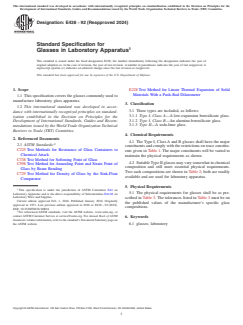
1.1 This specification covers the glasses commonly used to manufacture laboratory glass apparatus.
1.2 This international standard was developed in accordance with internationally recognized principles on standardization established in the Decision on Principles for the Development of International Standards, Guides and Recommendations issued by the World Trade Organization Technical Barriers to Trade (TBT) Committee.
- Status
- Published
- Publication Date
- 31-Jan-2024
- Technical Committee
- E41 - Laboratory Apparatus
- Drafting Committee
- E41.01 - Laboratory Ware and Supplies


Overview
ASTM E438-92(2024): Standard Specification for Glasses in Laboratory Apparatus provides crucial guidelines for the composition and properties of glasses used in laboratory glassware. Developed by ASTM International, this standard establishes requirements for three main types of laboratory glass: Type I, Class A (low-expansion borosilicate), Type I, Class B (alumino-borosilicate), and Type II (soda-lime glass). It outlines key physical and chemical characteristics necessary for ensuring laboratory glassware meets demanding scientific and safety standards.
This specification plays an important role in international trade and laboratory practice, having been created in accordance with globally recognized standardization principles, including those laid out by the World Trade Organization Technical Barriers to Trade (TBT) Committee.
Key Topics
- Glass Types:
- Type I, Class A: Low-expansion borosilicate glass, known for superior chemical durability and thermal stability.
- Type I, Class B: Alumino-borosilicate glass with adjusted composition for varied application needs.
- Type II: Soda-lime glass, offering a cost-effective option for less demanding laboratory uses.
- Critical Properties:
- Linear coefficient of expansion: Tested using ASTM E228 to ensure thermal resilience.
- Annealing point: Controlled via ASTM C598 for stress reduction during cooling.
- Softening point: Defined through ASTM C338 to maintain shape at elevated temperatures.
- Density: Measured by ASTM C729, impacting glass robustness and suitability.
- Chemical durability: Verified with ASTM C225, essential for chemical resistance in laboratory settings.
- Chemical Composition: Prescribed concentrations of SiO₂, B₂O₃, Al₂O₃, and other key constituents, along with strict limits on trace elements such as lead and arsenic, ensuring glass safety and performance.
- Testing and Compliance: Laboratories and manufacturers must adhere to the published limits, tolerances, and procedures in the standard.
Applications
ASTM E438-92(2024) serves a broad array of industries and scientific disciplines that rely on laboratory apparatus, including but not limited to:
- Pharmaceutical and biomedical research: Ensuring consistent, contamination-free equipment for handling sensitive samples, reagents, and cultures.
- Chemical analysis and industrial laboratories: Providing reliable material for beakers, flasks, tubing, and other apparatus exposed to thermal cycling and corrosive substances.
- Educational institutions: Supplying durable glassware for teaching laboratories where repeat use and diverse chemical exposures are common.
- Quality assurance and manufacturing: Assisting glassware producers in certifying that their products meet international safety and quality benchmarks.
- Regulatory compliance: Supporting conformance with international standards, boosting global acceptance and marketability of laboratory glassware.
Related Standards
Leverage these related ASTM and international standards to complement ASTM E438-92(2024) compliance and enhance laboratory safety and performance:
- ASTM E228 - Test Method for Linear Thermal Expansion of Solid Materials
- ASTM C225 - Test Methods for Resistance of Glass Containers to Chemical Attack
- ASTM C338 - Test Method for Softening Point of Glass
- ASTM C598 - Test Method for Annealing Point and Strain Point of Glass by Beam Bending
- ASTM C729 - Test Method for Density of Glass by the Sink-Float Comparator
By specifying the essential requirements for laboratory glass, ASTM E438 ensures high performance, user safety, and compliance with international trade and quality standards-making it an indispensable resource for laboratories and manufacturers worldwide.
Relations
- Effective Date
- 01-Feb-2024
- Referred By
ASTM D6188-17(2022) - Standard Test Method for Viscosity of Cellulose by Cuprammonium Ball Fall - Effective Date
- 01-Feb-2024
- Effective Date
- 01-Feb-2024
- Effective Date
- 01-Feb-2024
- Effective Date
- 01-Feb-2024
- Effective Date
- 01-Feb-2024
- Referred By
ASTM E675-02(2019) - Standard Specification for Interchangeable Taper-Ground Stopcocks And Stoppers - Effective Date
- 01-Feb-2024
- Effective Date
- 01-Feb-2024
- Effective Date
- 01-Feb-2024
- Effective Date
- 01-Feb-2024
- Effective Date
- 01-Feb-2024
- Effective Date
- 01-Feb-2024
- Referred By
ASTM E1878-97(2019) - Standard Specification for Laboratory Glass Volumetric Flasks, Special Use - Effective Date
- 01-Feb-2024
- Effective Date
- 01-Feb-2024
- Effective Date
- 01-Feb-2024
Get Certified
Connect with accredited certification bodies for this standard

ECOCERT
Organic and sustainability certification.

Eurofins Food Testing Global
Global leader in food, environment, and pharmaceutical product testing.

Intertek Bangladesh
Intertek certification and testing services in Bangladesh.
Sponsored listings
Frequently Asked Questions
ASTM E438-92(2024) is a technical specification published by ASTM International. Its full title is "Standard Specification for Glasses in Laboratory Apparatus". This standard covers: ABSTRACT This specification covers the glasses commonly used to manufacture laboratory glass apparatus. Three types of glasses are included: Type I, Class A which is a low-expansion borosilicate glass, Type I, Class B which is an alumino-borosilicate glass, and Type II which is a soda-lime glass. Different tests shall be conducted in order to determine the following properties of glasses: linear coefficient of expansion, annealing point, softening point, density, and chemical durability. SCOPE 1.1 This specification covers the glasses commonly used to manufacture laboratory glass apparatus. 1.2 This international standard was developed in accordance with internationally recognized principles on standardization established in the Decision on Principles for the Development of International Standards, Guides and Recommendations issued by the World Trade Organization Technical Barriers to Trade (TBT) Committee.
ABSTRACT This specification covers the glasses commonly used to manufacture laboratory glass apparatus. Three types of glasses are included: Type I, Class A which is a low-expansion borosilicate glass, Type I, Class B which is an alumino-borosilicate glass, and Type II which is a soda-lime glass. Different tests shall be conducted in order to determine the following properties of glasses: linear coefficient of expansion, annealing point, softening point, density, and chemical durability. SCOPE 1.1 This specification covers the glasses commonly used to manufacture laboratory glass apparatus. 1.2 This international standard was developed in accordance with internationally recognized principles on standardization established in the Decision on Principles for the Development of International Standards, Guides and Recommendations issued by the World Trade Organization Technical Barriers to Trade (TBT) Committee.
ASTM E438-92(2024) is classified under the following ICS (International Classification for Standards) categories: 71.040.20 - Laboratory ware and related apparatus; 81.040.30 - Glass products. The ICS classification helps identify the subject area and facilitates finding related standards.
ASTM E438-92(2024) has the following relationships with other standards: It is inter standard links to ASTM E438-92(2018), ASTM D6188-17(2022), ASTM E714-94(2021), ASTM E1272-02(2019), ASTM C1109-23, ASTM E923-97(2019), ASTM E675-02(2019), ASTM E982-94(2021), ASTM E1189-00(2022), ASTM E288-10(2017), ASTM E1094-04(2021), ASTM C185-20, ASTM E1878-97(2019), ASTM E1096-86(2024), ASTM E1377-99(2022). Understanding these relationships helps ensure you are using the most current and applicable version of the standard.
ASTM E438-92(2024) is available in PDF format for immediate download after purchase. The document can be added to your cart and obtained through the secure checkout process. Digital delivery ensures instant access to the complete standard document.
Standards Content (Sample)
This international standard was developed in accordance with internationally recognized principles on standardization established in the Decision on Principles for the
Development of International Standards, Guides and Recommendations issued by the World Trade Organization Technical Barriers to Trade (TBT) Committee.
Designation: E438 − 92 (Reapproved 2024)
Standard Specification for
Glasses in Laboratory Apparatus
This standard is issued under the fixed designation E438; the number immediately following the designation indicates the year of
original adoption or, in the case of revision, the year of last revision. A number in parentheses indicates the year of last reapproval. A
superscript epsilon (´) indicates an editorial change since the last revision or reapproval.
This standard has been approved for use by agencies of the U.S. Department of Defense.
1. Scope E228 Test Method for Linear Thermal Expansion of Solid
Materials With a Push-Rod Dilatometer
1.1 This specification covers the glasses commonly used to
manufacture laboratory glass apparatus.
3. Classification
1.2 This international standard was developed in accor-
3.1 Three types are included, as follows:
dance with internationally recognized principles on standard-
3.1.1 Type I, Class A—A low-expansion borosilicate glass.
ization established in the Decision on Principles for the
3.1.2 Type I, Class B—An alumino-borosilicate glass.
Development of International Standards, Guides and Recom-
3.1.3 Type II—A soda-lime glass.
mendations issued by the World Trade Organization Technical
Barriers to Trade (TBT) Committee.
4. Chemical Requirements
2. Referenced Documents
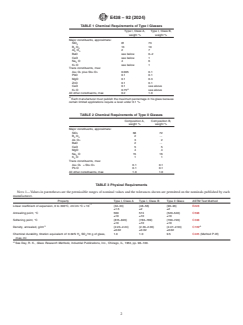
4.1 The Type I, Class A and B glasses shall have the major
2.1 ASTM Standards:
constituents and comply with the restrictions on trace constitu-
C225 Test Methods for Resistance of Glass Containers to
ents given in Table 1. The major constituents will be varied to
Chemical Attack
maintain the physical requirements as shown.
C338 Test Method for Softening Point of Glass
4.2 Suitable Type II glasses may vary somewhat in chemical
C598 Test Method for Annealing Point and Strain Point of
composition and still meet essential physical requirements.
Glass by Beam Bending
Two such compositions are shown in Table 2; both are readily
C729 Test Method for Density of Glass by the Sink-Float
available and are used for laboratory apparatus.
Comparator
5. Physical Requirements
This specification is under the jurisdiction of ASTM Committee E41 on
5.1 The physical requirements for glasses shall be as pre-
Laboratory Apparatus and is the direct responsibility of Subcommittee E41.01 on
Laboratory Ware and Supplies.
scribed in Table 3. The tolerances listed in Table 3 must be on
Current edition approved Feb. 1, 2024. Published January 2018. Originally
the published values of the manufacturer’s specific glass
approved in 1971. Last previous edition approved in 2018 as E438 – 92 (2018).
compositions.
DOI: 10.1520/E0438-92R24.
For referenced ASTM standards, visit the ASTM website, www.astm.org, or
contact ASTM Customer Service at service@astm.org. For Annual Book of ASTM
6. Keywords
Standards volume information, refer to the standard’s Document Summary page on
the ASTM website. 6.1 glasses; laboratory
Copyright © ASTM International, 100 Barr Harbor Drive, PO Box C700, West Conshohocken, PA 19428-2959. United States
-
...