

ASTM E1094-04(2021)
(Specification)Standard Specification for Pharmaceutical Glass Graduates
General Information
- Abstract
ABSTRACT
This specification covers glass graduates suitable for laboratory, pharmaceutical, and other uses, in both conical and cylindrical shapes. Graduates shall be in the following types: type 1 - graduated in metric scale only, and type 2 - graduated in both metric and inch-pound scales. Graduates having a capacity of more than 15 mL (4 fluid drams) may be either conical or cylindrical. Those having a capacity of 15 mL or less shall be cylindrical. Each graduate shall have clear graduation markings perpendicular to the vertical axis of the graduate and parallel to each other. Capacities, graduation ranges, values of graduated intervals, and numbered graduations applicable to single-scale graduates and to appropriate portions of double-scale graduates are presented in details.
SCOPE
1.1 This specification covers glass graduates suitable for laboratory, pharmaceutical, and other uses, in both conical and cylindrical shapes.
1.2 This international standard was developed in accordance with internationally recognized principles on standardization established in the Decision on Principles for the Development of International Standards, Guides and Recommendations issued by the World Trade Organization Technical Barriers to Trade (TBT) Committee.
- Status
- Published
- Publication Date
- 31-Dec-2020
- Technical Committee
- E41 - Laboratory Apparatus
- Drafting Committee
- E41.01 - Laboratory Ware and Supplies


Overview
ASTM E1094-04(2021) - Standard Specification for Pharmaceutical Glass Graduates establishes requirements for the manufacture and performance of glass graduates (measuring vessels) used in pharmaceutical, laboratory, and related settings. Developed by ASTM International, this standard covers both conical and cylindrical glass graduates in various capacities, ensuring their suitability for precise liquid measurement and safety in critical applications. The specification outlines clear criteria for graduation marking, dimensional tolerances, material properties, and production quality, enhancing consistency and reliability within laboratory and pharmaceutical environments.
Key Topics
Graduate Types and Capacities:
- Type 1: Graduated in metric scale only (capacities: 5, 10, 25, 50, 100, 250, 500, 1000 mL).
- Type 2: Graduated in both metric and inch-pound scales (various conversions such as fluid ounces, drams, minims, and mL).
- Graduates over 15 mL may be conical or cylindrical; 15 mL or less must be cylindrical.
Material Requirements:
- Manufactured from borosilicate glass compliant with ASTM E438 (Type 1, Class A), providing superior thermal resistance and durability.
- Residual stresses must conform to ASTM E671 to ensure structural integrity.
Graduation and Markings:
- Graduations must be permanent, legible, and marked clearly perpendicular to the graduate’s axis.
- Marked by etching, ceramic enamel, or stain-fired techniques for long-lasting visibility.
- Graduation lines for Type 1 extend at least 90% around the vessel; intermediate lines at least 50%.
- Type 2 (double scale) graduates require a distinct clear space between the main graduation lines of the two scales.
Tolerances and Accuracy:
- Strict dimensional tolerances depending on inside diameter ensure reliable measurement.
- Calibrated to deliver at 20 °C, as indicated by “TD” or “EX” marks.
Identification:
- Each graduate is permanently marked with the manufacturer’s name or trademark, calibration temperature, and relevant capacity units.
Applications
ASTM E1094-04(2021) is essential in applications where liquid measurement accuracy and chemical compatibility are critical, including:
- Pharmaceutical Laboratories: Preparation of solutions, dosing, and testing, where contaminant-free and precise measurement is required.
- Clinical and Research Laboratories: Quantitative analysis, reagent preparation, and experimental protocols relying on reproducible measurements.
- Industrial Quality Control: Verification of process fluids and formulations in compliance with regulatory standards.
- Educational Institutions: Teaching experimental techniques and safe laboratory practices using reliable, standardized glassware.
By specifying glass composition, dimensional features, and permanent graduations, this standard reduces measurement errors and supports repeatability in regulated environments.
Related Standards
- ASTM E438 - Specification for Glasses in Laboratory Apparatus: Defines glass types used for laboratory ware, ensuring chemical durability and thermal properties.
- ASTM E671 - Specification for Maximum Permissible Thermal Residual Stress in Annealed Glass Laboratory Apparatus: Ensures safety and performance by controlling stress levels in glassware.
- ASTM E694 - Specification for Laboratory Glass Volumetric Apparatus: Covers requirements for volumetric flasks, pipets, and burets, sharing accuracy and marking principles.
- ASTM E1157 - Specification for Sampling and Testing of Reusable Laboratory Glassware: Guides quality assurance during procurement and usage cycles.
- NIST Handbook 44, Section 4.44 - Graduates: Reference for tolerances and verification in commercial measurement practices.
Keywords: pharmaceutical glass graduates, laboratory measuring vessels, ASTM E1094, glassware graduation standards, borosilicate glass laboratory apparatus, pharmaceutical measurement accuracy, graduated cylinders, laboratory standardization, double-scale graduates, metric and inch-pound graduations.
Adhering to ASTM E1094-04(2021) guarantees laboratories and pharmaceutical facilities obtain precise, durable, and safe glass graduates for consistent measurement and regulatory compliance.
Relations
- Effective Date
- 01-Feb-2024
- Effective Date
- 01-Feb-2024
- Effective Date
- 01-Jul-2019
- Effective Date
- 01-Jan-2018
- Effective Date
- 01-Jan-2018
- Effective Date
- 01-Nov-2013
- Effective Date
- 01-Dec-2011
- Effective Date
- 01-Dec-2011
- Effective Date
- 01-Dec-2011
- Effective Date
- 01-Sep-2010
- Effective Date
- 01-Jul-2010
- Effective Date
- 15-May-2010
- Effective Date
- 01-Apr-2010
- Effective Date
- 01-Nov-2008
- Effective Date
- 01-Nov-2006
Get Certified
Connect with accredited certification bodies for this standard

ECOCERT
Organic and sustainability certification.

Eurofins Food Testing Global
Global leader in food, environment, and pharmaceutical product testing.

Intertek Bangladesh
Intertek certification and testing services in Bangladesh.
Sponsored listings
Frequently Asked Questions
ASTM E1094-04(2021) is a technical specification published by ASTM International. Its full title is "Standard Specification for Pharmaceutical Glass Graduates". This standard covers: ABSTRACT This specification covers glass graduates suitable for laboratory, pharmaceutical, and other uses, in both conical and cylindrical shapes. Graduates shall be in the following types: type 1 - graduated in metric scale only, and type 2 - graduated in both metric and inch-pound scales. Graduates having a capacity of more than 15 mL (4 fluid drams) may be either conical or cylindrical. Those having a capacity of 15 mL or less shall be cylindrical. Each graduate shall have clear graduation markings perpendicular to the vertical axis of the graduate and parallel to each other. Capacities, graduation ranges, values of graduated intervals, and numbered graduations applicable to single-scale graduates and to appropriate portions of double-scale graduates are presented in details. SCOPE 1.1 This specification covers glass graduates suitable for laboratory, pharmaceutical, and other uses, in both conical and cylindrical shapes. 1.2 This international standard was developed in accordance with internationally recognized principles on standardization established in the Decision on Principles for the Development of International Standards, Guides and Recommendations issued by the World Trade Organization Technical Barriers to Trade (TBT) Committee.
ABSTRACT This specification covers glass graduates suitable for laboratory, pharmaceutical, and other uses, in both conical and cylindrical shapes. Graduates shall be in the following types: type 1 - graduated in metric scale only, and type 2 - graduated in both metric and inch-pound scales. Graduates having a capacity of more than 15 mL (4 fluid drams) may be either conical or cylindrical. Those having a capacity of 15 mL or less shall be cylindrical. Each graduate shall have clear graduation markings perpendicular to the vertical axis of the graduate and parallel to each other. Capacities, graduation ranges, values of graduated intervals, and numbered graduations applicable to single-scale graduates and to appropriate portions of double-scale graduates are presented in details. SCOPE 1.1 This specification covers glass graduates suitable for laboratory, pharmaceutical, and other uses, in both conical and cylindrical shapes. 1.2 This international standard was developed in accordance with internationally recognized principles on standardization established in the Decision on Principles for the Development of International Standards, Guides and Recommendations issued by the World Trade Organization Technical Barriers to Trade (TBT) Committee.
ASTM E1094-04(2021) is classified under the following ICS (International Classification for Standards) categories: 71.040.20 - Laboratory ware and related apparatus. The ICS classification helps identify the subject area and facilitates finding related standards.
ASTM E1094-04(2021) has the following relationships with other standards: It is inter standard links to ASTM E438-92(2024), ASTM E694-18(2024), ASTM E920-97(2019), ASTM E438-92(2018), ASTM E694-18, ASTM E920-97(2013), ASTM E1157-87(2018)e1, ASTM E438-92(2011), ASTM E1157-87(2011), ASTM E1133-86(2010), ASTM E694-99(2010), ASTM E921-97(2010), ASTM E671-98(2010), ASTM E920-97(2008), ASTM E1157-87(2006). Understanding these relationships helps ensure you are using the most current and applicable version of the standard.
ASTM E1094-04(2021) is available in PDF format for immediate download after purchase. The document can be added to your cart and obtained through the secure checkout process. Digital delivery ensures instant access to the complete standard document.
Standards Content (Sample)
This international standard was developed in accordance with internationally recognized principles on standardization established in the Decision on Principles for the
Development of International Standards, Guides and Recommendations issued by the World Trade Organization Technical Barriers to Trade (TBT) Committee.
Designation:E1094 −04 (Reapproved 2021)
Standard Specification for
Pharmaceutical Glass Graduates
This standard is issued under the fixed designation E1094; the number immediately following the designation indicates the year of
original adoption or, in the case of revision, the year of last revision. A number in parentheses indicates the year of last reapproval. A
superscript epsilon (´) indicates an editorial change since the last revision or reapproval.
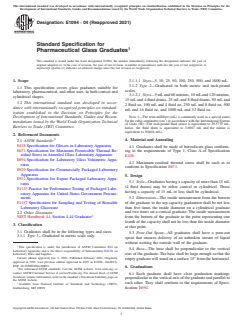
1. Scope 3.1.1.1 Sizes—5, 10, 25, 50, 100, 250, 500, and 1000 mL.
3.1.2 Type 2—Graduated in both metric and inch-pound
1.1 This specification covers glass graduates suitable for
scales.
laboratory, pharmaceutical, and other uses, in both conical and
3.1.2.1 Sizes—5mLand60minims,10mLand120minims,
cylindrical shapes.
15 mLand 4 fluid drams, 25 mLand 8 fluid drams, 50 mLand
1.2 This international standard was developed in accor-
2 fluid oz, 100 mL and 4 fluid oz, 250 mL and 8 fluid oz, 500
dance with internationally recognized principles on standard-
mL and 16 fluid oz, and 1000 mL and 32 fluid oz.
ization established in the Decision on Principles for the
NOTE 1—The term millilitre (mL) is commonly used as a special name
Development of International Standards, Guides and Recom-
forthecubiccentimetre(cm )inaccordancewiththeInternationalSystem
mendations issued by the World Trade Organization Technical
of Units (SI). (The inch-pound fluid ounce is equivalent to 29.5735 mL,
Barriers to Trade (TBT) Committee.
hence, the fluid dram is equivalent to 3.6967 mL and the minim is
equivalent to 0.0616 mL).
2. Referenced Documents
4. Material and Annealing
2.1 ASTM Standards:
E438 Specification for Glasses in Laboratory Apparatus
4.1 Graduates shall be made of borosilicate glass conform-
E671 Specification for Maximum Permissible Thermal Re-
ing to the requirements of Type 1, Class A of Specification
sidual Stress in Annealed Glass Laboratory Apparatus
E438.
E694 Specification for Laboratory Glass Volumetric Appa-
4.2 Maximum residual thermal stress shall be such as to
ratus
conform to Specification E671.
E920 Specification for Commercially Packaged Laboratory
Apparatus
5. Design
E921 Specification for Export Packaged Laboratory Appa-
5.1 Style—Graduates having a capacity of more than 15 mL
ratus
(4 fluid drams) may be either conical or cylindrical. Those
E1133 Practice for Performance Testing of Packaged Labo-
having a capacity of 15 mL or less shall be cylindrical.
ratory Apparatus for United States Government Procure-
ments 5.2 Dimensions—The inside measurement from the bottom
of the graduate to the top capacity graduation shall be not less
E1157 Specification for Sampling and Testing of Reusable
than five times the inside diameter on a cylindrical graduate
Laboratory Glassware
2.2 Other Document: and two times on a conical graduate. The inside measurement
from the bottom of the graduate to the point representing one
NIST Handbook 44, Section 4.44 Graduates
fourth of the capacity shall not be less than the inside diameter
3. Classification
at that point.
3.1 Graduates shall be in the following types and sizes:
5.3 Pour-Out Spout—All graduates shall have a pour-out
3.1.1 Type 1—Graduated in metric scale only.
spout that ensures delivery of an unbroken stream of liquid
without wetting the outside wall of the graduate.
This specification is under the jurisdiction of ASTM Committee E41 on
5.4 Base—The base shall be perpendicular to the vertical
Laboratory Apparatus and is the direct responsibility of Subcommittee E41.01 on
Laboratory Ware and Supplies. axis of the graduate. The base shall be large enough so that the
Current edition approved Jan. 1, 2021. Published February 2021. Originally
empty graduate will stand on a surface 15° from the horizontal.
approved in 1991. Last previous edition approved in 2015 as E1094 – 04(2015).
DOI: 10.1520/E1094-04R21.
6. Graduations
For referenced ASTM standards, visit the ASTM website, www.astm.org, or
contact ASTM Customer Service at service@astm.org. For Annual Book of ASTM
6.1 Each graduate shall have clear graduation markings
Standards volume information, refer to the standard’s Document Summary page on
perpendicular to the vertical axis of the graduate and parallel to
the ASTM website.
3 each other. They shall conform to the requirements of Speci-
Available from National Institute of Standards and Technology (NIST),
Gaithersburg, MD 20899. fication E694.
Copyright © ASTM International, 100 Barr Harbor Drive, PO Box C700, West Conshohocken, PA 19428-2959. United States
E1094−04 (2021)
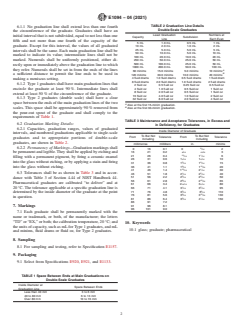
TABLE 2 Graduation Line Details
6.1.1 No graduation line shall extend less than one fourth
Double-Scale Graduates
the circumference of the graduate. Graduates shall have an
Least Graduation Numbers at
initial interval that is not subdivided, equal to not less than one
Capacity Subdivision
Line Each Even
fifth and not more than one fourth of the capacity of the
5 mL 1.0 mL 0.5 mL 1 mL
graduate. Except for this interval, the values of all graduated
10 mL 2.0
...