

ASTM E1272-02(2019)
(Specification)Standard Specification for Laboratory Glass Graduated Cylinders
General Information
- Abstract
ABSTRACT
This specification covers the requirements for laboratory glass graduated cylinders for precision and general purpose grades. The graduated cylinders may be in one of three styles; beaded lip with spout, grounded standard taper neck, or beaded lip with pour spout and reinforcing band near the top. The products should conform to the required cylinder and base shapes, dimensions, quality of gradation and identification markings, and length of gradation lines.
SCOPE
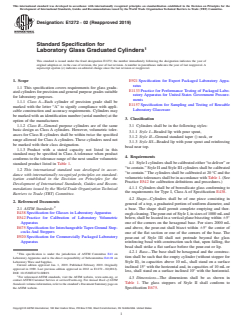
1.1 This specification covers requirements for glass graduated cylinders for precision and general purpose grades suitable for laboratory purposes.
1.1.1 Class A—Each cylinder of precision grade shall be marked with the letter “A” to signify compliance with applicable construction and accuracy requirements. Cylinders may be marked with an identification number (serial number) at the option of the manufacturer.
1.1.2 Class B—General purpose cylinders are of the same basic design as Class A cylinders. However, volumetric tolerances for Class B cylinders shall be within twice the specified range allowed for Class A cylinders. These cylinders need not be marked with their class designation.
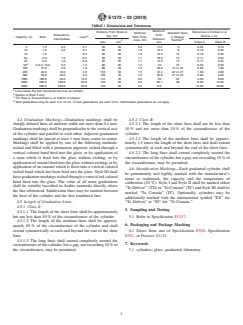
1.1.3 Product with a stated capacity not listed in this standard may be specified in Class A tolerance when product conforms to the tolerance range of the next smaller volumetric standard product listed in Table 1.
1.2 This international standard was developed in accordance with internationally recognized principles on standardization established in the Decision on Principles for the Development of International Standards, Guides and Recommendations issued by the World Trade Organization Technical Barriers to Trade (TBT) Committee.
- Status
- Published
- Publication Date
- 31-Dec-2018
- Technical Committee
- E41 - Laboratory Apparatus
- Drafting Committee
- E41.01 - Laboratory Ware and Supplies


Overview
ASTM E1272-02(2019), Standard Specification for Laboratory Glass Graduated Cylinders, is an internationally recognized specification issued by ASTM International. This standard sets the requirements for laboratory glass graduated cylinders, addressing both precision (Class A) and general-purpose (Class B) grades. Its scope includes design, material, graduation, dimensional tolerances, and identification markings essential for accurate laboratory measurements and consistent product quality.
Laboratory glass graduated cylinders are vital volumetric instruments extensively used for measuring liquid volumes in scientific, educational, and industrial environments. Compliance with ASTM E1272 ensures that these cylinders offer reliable performance, durability, and compatibility with globally harmonized standards.
Key Topics
Scope and Classification
- Covers glass graduated cylinders suitable for laboratory applications in precision and general-purpose grades.
- Class A: Precision grade, marked with “A”, compliant with stringent accuracy and construction requirements.
- Class B: General purpose, similar design to Class A, but with volumetric tolerances within twice those allowed for Class A.
Cylinder Styles
- Style I: Beaded lip with pour spout.
- Style II: Ground standard taper neck.
- Style III: Beaded lip with pour spout and reinforcing bead near the top.
Material and Construction
- Manufactured from borosilicate glass conforming to Type I, Class A as per ASTM E438.
- One-piece construction including top, graduated section, and base, designed for complete emptying and easy cleaning.
- Hexagonal base for improved stability, must withstand specified inclinations without tipping.
Graduation and Identification
- Sharp, uniform graduation lines with specific dimensions and spacing according to grade and cylinder type.
- Graduation markings applied by various permanent techniques ensuring readability and durability.
- Identification markings include manufacturer’s name/trademark, capacity, calibration temperature (20 °C), and, where applicable, “To Deliver” (TD) or “To Contain” (TC) inscriptions.
Volumetric Tolerances
- Strict tolerances defined for each capacity and class, ensuring precision and reliability in volumetric measurement.
Applications
Laboratory glass graduated cylinders specified in ASTM E1272 are essential tools for a wide range of applications, including:
- Analytical Laboratories: Accurate preparation and measurement of solutions, reagents, and samples.
- Educational Institutions: Standardized measuring instruments for precise science education and experiments.
- Quality Control and Research: Used by industrial labs for chemistry, biology, pharmaceuticals, and environmental testing.
- General Laboratory Use: Reliably measures liquids in routine laboratory operations and protocol development.
Meeting the requirements of ASTM E1272 ensures that glass graduated cylinders deliver consistency, improve reproducibility in experiments, support traceable measurements, and comply with international laboratory quality and safety standards.
Related Standards
ASTM E1272-02(2019) references and relates to several other ASTM and international standards that enhance laboratory equipment safety, quality, and interoperability:
- ASTM E438 - Specification for Glasses in Laboratory Apparatus
- ASTM E542 - Practice for Calibration of Laboratory Volumetric Apparatus
- ASTM E675 - Specification for Interchangeable Taper-Ground Stopcocks and Stoppers
- ASTM E920 - Specification for Commercially Packaged Laboratory Apparatus
- ASTM E921 - Specification for Export Packaged Laboratory Apparatus
- ASTM E1133 - Practice for Performance Testing of Packaged Laboratory Apparatus
- ASTM E1157 - Specification for Sampling and Testing of Reusable Laboratory Glassware
By adhering to ASTM E1272 and these related standards, laboratories support quality, accuracy, and compliance within global scientific and industrial communities.
Keywords: laboratory glass graduated cylinders, ASTM E1272, volumetric cylinders, Class A and Class B, precision glassware, laboratory standards, cylinder calibration, scientific measurement, glass laboratory equipment, laboratory glassware specifications.
Relations
- Effective Date
- 01-Jan-2019
- Effective Date
- 01-Feb-2024
- Effective Date
- 01-Jul-2019
- Refers
ASTM E675-02(2019) - Standard Specification for Interchangeable Taper-Ground Stopcocks And Stoppers - Effective Date
- 01-Jan-2019
- Effective Date
- 01-Jan-2018
- Effective Date
- 01-Nov-2013
- Refers
ASTM E675-02(2012) - Standard Specification for Interchangeable Taper-Ground Stopcocks And Stoppers - Effective Date
- 01-Nov-2012
- Effective Date
- 01-Dec-2011
- Effective Date
- 01-Dec-2011
- Effective Date
- 01-Dec-2011
- Effective Date
- 01-Sep-2010
- Effective Date
- 15-May-2010
- Effective Date
- 01-Nov-2008
- Effective Date
- 01-Nov-2007
- Refers
ASTM E675-02(2007) - Standard Specification for Interchangeable Taper-Ground Stopcocks And Stoppers - Effective Date
- 01-Nov-2007
Get Certified
Connect with accredited certification bodies for this standard

ECOCERT
Organic and sustainability certification.

Eurofins Food Testing Global
Global leader in food, environment, and pharmaceutical product testing.

Intertek Bangladesh
Intertek certification and testing services in Bangladesh.
Sponsored listings
Frequently Asked Questions
ASTM E1272-02(2019) is a technical specification published by ASTM International. Its full title is "Standard Specification for Laboratory Glass Graduated Cylinders". This standard covers: ABSTRACT This specification covers the requirements for laboratory glass graduated cylinders for precision and general purpose grades. The graduated cylinders may be in one of three styles; beaded lip with spout, grounded standard taper neck, or beaded lip with pour spout and reinforcing band near the top. The products should conform to the required cylinder and base shapes, dimensions, quality of gradation and identification markings, and length of gradation lines. SCOPE 1.1 This specification covers requirements for glass graduated cylinders for precision and general purpose grades suitable for laboratory purposes. 1.1.1 Class A—Each cylinder of precision grade shall be marked with the letter “A” to signify compliance with applicable construction and accuracy requirements. Cylinders may be marked with an identification number (serial number) at the option of the manufacturer. 1.1.2 Class B—General purpose cylinders are of the same basic design as Class A cylinders. However, volumetric tolerances for Class B cylinders shall be within twice the specified range allowed for Class A cylinders. These cylinders need not be marked with their class designation. 1.1.3 Product with a stated capacity not listed in this standard may be specified in Class A tolerance when product conforms to the tolerance range of the next smaller volumetric standard product listed in Table 1. 1.2 This international standard was developed in accordance with internationally recognized principles on standardization established in the Decision on Principles for the Development of International Standards, Guides and Recommendations issued by the World Trade Organization Technical Barriers to Trade (TBT) Committee.
ABSTRACT This specification covers the requirements for laboratory glass graduated cylinders for precision and general purpose grades. The graduated cylinders may be in one of three styles; beaded lip with spout, grounded standard taper neck, or beaded lip with pour spout and reinforcing band near the top. The products should conform to the required cylinder and base shapes, dimensions, quality of gradation and identification markings, and length of gradation lines. SCOPE 1.1 This specification covers requirements for glass graduated cylinders for precision and general purpose grades suitable for laboratory purposes. 1.1.1 Class A—Each cylinder of precision grade shall be marked with the letter “A” to signify compliance with applicable construction and accuracy requirements. Cylinders may be marked with an identification number (serial number) at the option of the manufacturer. 1.1.2 Class B—General purpose cylinders are of the same basic design as Class A cylinders. However, volumetric tolerances for Class B cylinders shall be within twice the specified range allowed for Class A cylinders. These cylinders need not be marked with their class designation. 1.1.3 Product with a stated capacity not listed in this standard may be specified in Class A tolerance when product conforms to the tolerance range of the next smaller volumetric standard product listed in Table 1. 1.2 This international standard was developed in accordance with internationally recognized principles on standardization established in the Decision on Principles for the Development of International Standards, Guides and Recommendations issued by the World Trade Organization Technical Barriers to Trade (TBT) Committee.
ASTM E1272-02(2019) is classified under the following ICS (International Classification for Standards) categories: 71.040.20 - Laboratory ware and related apparatus. The ICS classification helps identify the subject area and facilitates finding related standards.
ASTM E1272-02(2019) has the following relationships with other standards: It is inter standard links to ASTM E1272-02(2012), ASTM E438-92(2024), ASTM E920-97(2019), ASTM E675-02(2019), ASTM E438-92(2018), ASTM E920-97(2013), ASTM E675-02(2012), ASTM E1157-87(2011), ASTM E438-92(2011), ASTM E1157-87(2018)e1, ASTM E1133-86(2010), ASTM E921-97(2010), ASTM E920-97(2008), ASTM E542-01(2007), ASTM E675-02(2007). Understanding these relationships helps ensure you are using the most current and applicable version of the standard.
ASTM E1272-02(2019) is available in PDF format for immediate download after purchase. The document can be added to your cart and obtained through the secure checkout process. Digital delivery ensures instant access to the complete standard document.
Standards Content (Sample)
This international standard was developed in accordance with internationally recognized principles on standardization established in the Decision on Principles for the
Development of International Standards, Guides and Recommendations issued by the World Trade Organization Technical Barriers to Trade (TBT) Committee.
Designation:E1272 −02 (Reapproved 2019)
Standard Specification for
Laboratory Glass Graduated Cylinders
This standard is issued under the fixed designation E1272; the number immediately following the designation indicates the year of
original adoption or, in the case of revision, the year of last revision. A number in parentheses indicates the year of last reapproval. A
superscript epsilon (´) indicates an editorial change since the last revision or reapproval.
1. Scope E921 Specification for Export Packaged Laboratory Appa-
ratus
1.1 This specification covers requirements for glass gradu-
E1133 Practice for Performance Testing of Packaged Labo-
atedcylindersforprecisionandgeneralpurposegradessuitable
ratory Apparatus for United States Government Procure-
for laboratory purposes.
ments
1.1.1 Class A—Each cylinder of precision grade shall be
E1157 Specification for Sampling and Testing of Reusable
marked with the letter “A” to signify compliance with appli-
Laboratory Glassware
cable construction and accuracy requirements. Cylinders may
be marked with an identification number (serial number) at the
3. Classification
option of the manufacturer.
1.1.2 Class B—General purpose cylinders are of the same
3.1 Cylinders shall be in the following styles:
basic design as Class A cylinders. However, volumetric toler-
3.1.1 Style I—Beaded lip with pour spout,
ances for Class B cylinders shall be within twice the specified
3.1.2 Style II—Ground standard taper () neck, or
range allowed for Class A cylinders. These cylinders need not
3.1.3 Style III—Beaded lip with pour spout and reinforcing
be marked with their class designation.
bead near top.
1.1.3 Product with a stated capacity not listed in this
standard may be specified in Class A tolerance when product
4. Requirements
conforms to the tolerance range of the next smaller volumetric
4.1 Style I cylinders shall be calibrated either “to deliver” or
standard product listed in Table 1.
“to contain.” Style II and Style III cylinders shall be calibrated
1.2 This international standard was developed in accor-
“to contain.” The cylinders shall be calibrated at 20 °C and the
dance with internationally recognized principles on standard-
volumetric tolerances shall be in accordance with Table 1. (See
ization established in the Decision on Principles for the
Practice E542 for calibration definitions and procedures.)
Development of International Standards, Guides and Recom-
4.1.1 Cylinders shall be of borosilicate glass conforming to
mendations issued by the World Trade Organization Technical
the requirements for Type I, Class A of Specification E438.
Barriers to Trade (TBT) Committee.
4.2 Shape—Cylinders shall be of one piece consisting in
2. Referenced Documents
general of a top, a graduated portion of uniform diameter, and
2.1 ASTM Standards: a base. The shape shall permit complete emptying and thor-
E438 Specification for Glasses in Laboratory Apparatus
oughcleaning.Thepour-outofStyleI,insizesof1000mLand
E542 Practice for Calibration of Laboratory Volumetric below, shall be located in a vertical plane bisecting within 65°
Apparatus
one of the corners on the hexagonal base. For sizes 2000 mL
E675 Specification for Interchangeable Taper-Ground Stop- and above, the pour-out shall bisect within 65° the center of
cocks And Stoppers
one of the flat section or one of the corners of the base. The
E920 Specification for Commercially Packaged Laboratory pour-out of Style III shall not protrude beyond the glass
Apparatus
reinforcing bead with construction such that, upon falling, the
bead shall strike a flat surface before the pour-out or lip.
4.2.1 Base—The base shall be hexagonal and the construc-
This specification is under the jurisdiction of ASTM Committee E41 on
tion shall be such that the empty cylinder (without stopper for
Laboratory Apparatus and is the direct responsibility of Subcommittee E41.01 on
Laboratory Ware and Supplies.
Style II), in capacities above 10 mL, shall stand on a surface
Current edition approved Jan. 1, 2019. Published February 2019. Originally
inclined 15° with the horizontal and, in capacities of 10 mL or
approved in 1989. Last previous edition approved in 2012 as E1272 – 02(2012).
less, shall stand on a surface inclined 10° with the horizontal.
DOI: 10.1520/E1272-02R19.
For referenced ASTM standards, visit the ASTM website, www.astm.org, or
4.3 Dimensions—The dimensions shall be as shown in
contact ASTM Customer Service at service@astm.org. For Annual Book of ASTM
Table 1. The glass stoppers of Style II shall conform to
Standards volume information, refer to the standard’s Document Summary page on
the ASTM website. Specification E675.
Copyright © ASTM International, 100 Barr Harbor Drive, PO Box C700, West Conshohocken, PA 19428-2959. United States
E1272−02 (2019)
TABLE 1 Dimensions and Tolerances
Maximum
Distance From Scale to Tolerances to Contain or to
Minimum Standard Tap
...