

SIST EN 12604:2017+A2:2027
(Main + Amendment)Industrial, commercial and garage doors and gates - Mechanical aspects - Requirements and test methods
- Abstract
This European Standard specifies mechanical requirements and test methods for manually operated doors, gates and barriers, intended for installation in areas in the reach of persons, and for which the main intended use is giving safe access for goods and vehicles accompanied or driven by persons in industrial, commercial or residential premises.
This European Standard also covers manually operated vertically moving commercial doors such as rolling shutters and rolling grilles, used in retail premises which are mainly provided for goods protection.
This document applies only to doors which are not part of the load carrying structure of the building.
It does not apply to:
— lock gates and dock gates;
— doors on vehicles;
— doors mainly for the retention of animals unless they are at the site perimeter;
— doors intended for pedestrian use;
— railway barriers.
Whenever the term “door” is used in this document, it is deemed to cover the full scope of types and variances of doors, gates and barriers defined by the scope of this European Standard.
- Status
- Published
- Publication Date
- 26-Nov-2026
- Technical Committee
- ISTP - Doors and windows
- Current Stage
- 6060 - National Implementation/Publication (Adopted Project)
- Start Date
- 23-Nov-2026
- Due Date
- 28-Jan-2027
- Completion Date
- 27-Nov-2026

SIST EN 12604:2017+A2:2027 is the Slovenian version of EN 12604:2017+A2:2026, a European Standard for the mechanical aspects of industrial, commercial and garage doors and gates. It specifies mechanical requirements and test methods for manually operated doors, gates and barriers used to give safe access for goods and vehicles accompanied or driven by persons. The document is aimed at manufacturers, installers, testers, and users who need to design, verify, maintain, or mark these products.
What does SIST EN 12604:2017+A2:2027 specify?
SIST EN 12604:2017+A2:2027 specifies mechanical requirements and test methods for manually operated doors, gates and barriers installed where persons can reach them. It also covers manually operated vertically moving commercial doors such as rolling shutters and rolling grilles used in retail premises mainly for goods protection.
The standard applies only to doors that are not part of the load-carrying structure of the building. It excludes lock gates and dock gates, doors on vehicles, doors mainly for retaining animals unless they are at the site perimeter, doors intended for pedestrian use, and railway barriers.
The document is organized into seven clauses and three informative annexes:
- Clause 1 - Scope
- Clause 2 - Normative references
- Clause 3 - Terms and definitions
- Clause 4 - Safety requirements and/or protective measures
- Clause 5 - Verification of the safety requirements and/or protective measures
- Clause 6 - Information for Use
- Clause 7 - Marking
| Annex | What it covers |
|---|---|
| Annex A | Guidelines for a safe construction |
| Annex B | Examples of mechanical protection and safety distances |
| Annex C | Logbook |
In the standard, the term “door” covers the full scope of doors, gates and barriers included by the scope.
What are the key requirements of SIST EN 12604:2017+A2:2027?
SIST EN 12604:2017+A2:2027 focuses on preventing mechanical hazards during normal use and foreseeable failure conditions. The requirements are spread across design, movement control, finger protection, suspension systems, pass doors, and user information.
Design, operability and glazing
Clause 4.1 requires the door to be designed for a number of full operating cycles that matches planned maintenance and replacement of wear parts. In practice, the manufacturer has to consider service life, not only initial strength.
Clause 4.2.1 requires the door and its fixing and assembling means to remain safe under normal operating forces and torques. Table 1 gives minimum safety factors for calculation, and the clause also allows verification by test in place of calculation for some components. This matters because the door must keep working without deformation that affects safety.
Clause 4.2.2 requires glazing elements to remain secured in normal operation and to meet at least class 3 of EN 12600:2002. Door leaves made mainly of glazing must be clearly recognizable. That helps avoid injury from broken glass and makes transparent doors easier to see.
Protection against movement and dropping
Clause 4.3.1 requires guides and end stops to prevent disengagement or derailment, even if the leaf hits a stationary obstacle or a suspension element fails. Mechanical end stoppers must withstand impact energy in the terminal positions.
Clause 4.3.2 requires means to prevent wind-driven movement when relevant. Clause 4.3.3 requires vertically operating leaves to stop and stay in position when released during opening or closing. In practice, these clauses are about keeping the door under control even when external forces act on it.
Clause 4.3.4 requires vertically operating door leaves to be safeguarded against dropping if a single suspension or balancing element fails. The clause limits downward movement, requires automatic activation of the anti-drop safeguarding, and requires instructions for any parts that must be replaced after activation. A limited exception applies only when the out-of-balance force is low and the failed component is clearly visible or detectable.
Clause 4.3.5 gives similar protection for hinged doors. The leaf must be held in position if a supporting means fails, and an anti-lifting device must prevent the leaf from being lifted too far on the hinge pin.
Manual operation, finger protection and hardware
Clause 4.4 sets maximum forces for manual opening and closing, with different limits for residential use and for industrial/commercial use. Clause 4.5 requires suitable handles or pull cords, unless the basic design already gives a safe handhold.
Clause 4.6 deals with finger protection. Gaps where components move closer together must be eliminated or guarded up to 2.5 m above floor level, and sharp edges must be avoided. It also addresses spring coils with large gaps during normal use.
Clause 4.7 sets requirements for suspension and balancing systems. Springs must not cause faulty operation of one another, counterweights must be safeguarded, and ropes, chains, straps and belts must be arranged so they can be inspected and cannot create unsafe drawing-in points. When ropes, chains or straps are directly connected to the leaf, at least two independent elements are required.
Clause 4.7.4.2 to 4.7.4.4 adds detailed rules for ropes, pulleys, drums, straps and chains. These include the use of EN 12385-4 rope, minimum breaking-strength factors, grooved drums, compatible terminations from EN 13411-2, EN 13411-3 or EN 13411-6, and prevention of disengagement or mis-threading. These details matter because a small hardware failure can cause a large uncontrolled movement.
Pass doors, self-closing doors and user information
Clause 4.8 requires pass doors to remain in a safe position when the main door is operated, and it addresses tripping hazards and thresholds. If height differences above 5 mm are needed, they must be clearly visible or marked.
Clause 4.9 adds requirements for doors operating by gravity or other self-closing mechanisms. They must not expose people to crushing or entangling hazards, and gravity-operated doors have a speed limit. If the force limit on the body cannot be met, an audio-visual warning device is required. The clause also refers to the cycling test method in EN 12605:2000.
Clauses 6 and 7 require clear instructions for use and visible, legible, indelible marking. The instructions cover installation, intended use, maintenance, inspections, spare parts, dismantling, and actions after anti-drop activation. The marking must identify the manufacturer, the door designation, the model or type reference, the serial number if any, the year of construction, and any applicable temperature range.
What terms does SIST EN 12604:2017+A2:2027 define?
SIST EN 12604:2017+A2:2027 uses the terms and definitions from EN 12433-1, EN 12433-2 and EN 13241. In practice, several terms are especially important:
- Door - In this standard, the word covers the full range of doors, gates and barriers within the scope.
- Pass door - A smaller door built into the main door that must stay safe when the main leaf moves.
- Anti-drop safeguarding - A device or design feature that prevents a leaf from falling after a failure in the suspension or balancing system.
- Suspension and balancing system - The springs, counterweights, ropes, chains, straps, belts and related parts that support and balance the door.
- Competent person - A person with the training, knowledge, skills and practical experience needed to carry out the task safely.
- P.C.D. - Pitch circle diameter measured at the centre of the rope, used for sizing pulleys and drums.
- Manual operation - Operation by hand, which is the operating mode addressed by this standard.
- Vertically operating door - A door leaf that moves up and down, where falling control is a key safety issue.
Who uses SIST EN 12604:2017+A2:2027?
SIST EN 12604:2017+A2:2027 is used by manufacturers of industrial, commercial and garage doors and gates, especially where manual operation is involved. Installers and commissioning teams use it to set up safe gaps, safe distances, end stops, anti-drop devices and markings.
Test laboratories and conformity assessment bodies use it to verify operability, forces, finger protection, drop prevention and the behavior of ropes, chains, springs and counterweights. Maintenance providers and site operators use it to plan inspections, maintenance intervals, replacement of wearing parts and logbook entries. Buyers, specifiers and quality managers use it to check whether a product matches the intended use in industrial, commercial, retail or residential premises.
What changed in SIST EN 12604:2017+A2:2027 from the previous edition?
SIST EN 12604:2017+A2:2027 supersedes EN 12604:2017+A1:2020. The foreword also states that, compared with EN 12604:2000 and EN 12605:2000, the following changes were made:
- EN 12604 was merged with EN 12605, and EN 12605:2000 is to be withdrawn
- the scope was limited to manually operated doors
- links to Regulation (EU) No 305/2011 and Machinery Directive 2006/42/EC were removed through deletion of Annex ZA and ZB
- the structure of Clauses 4 and 5 was revised
- the requirements in Clause 4 were sorted and summarized
- the informative annexes were revised to match Clause 4
- editorial revisions were made
Which standards are used with SIST EN 12604:2017+A2:2027?
The standard relies on several normative references and companion standards:
- EN 12433-1 - provides terminology for types of doors.
- EN 12433-2 - provides terminology for parts of doors.
- EN 12385-4 - specifies stranded steel wire ropes for general lifting applications.
- EN 12600:2002 - provides the pendulum impact test and classification for flat glass, used for glazing requirements.
- EN 12605:2000 - provides cycling test methods referred to for gravity or self-closing doors.
- EN 13241 - is the product standard for industrial, commercial, garage doors and gates and supplies terms used in Clause 3.
- EN 13411-2 - covers splicing of eyes for wire rope slings.
- EN 13411-3 - covers ferrules and ferrule-securing terminations.
- EN 13411-6 - covers asymmetric wedge socket clevis terminations.
- EN 61032:1998 - provides verification probes, including probe B used for finger-protection checks.
What does the SIST EN 12604:2017+A2:2027 document contain?
The document pairs each mechanical safety topic with a verification method in Clause 5. It includes a safety-factor table for design calculations, and it sets out test conditions such as representative samples, operating temperature and humidity, and installation according to the manufacturer’s instructions.
Clause 5 describes specific test set-ups, including a 400 mm x 400 mm x 400 mm hard test body for guide and end-stop checks, release tests for vertically operating leaves, and repeated fault tests for anti-drop systems. Annex B adds figure-based examples of mechanical protection and safety distances for sectional and hinged doors. Annex A gives practical construction guidance, and Annex C gives the content of a maintenance logbook for handover and ongoing recording.
Relations
- Effective Date
- 23-Sep-2026
- Effective Date
- 23-Sep-2026
- Effective Date
- 23-Sep-2026
- Effective Date
- 23-Sep-2026
- Effective Date
- 23-Sep-2026
- Effective Date
- 23-Sep-2026
- Effective Date
- 23-Sep-2026
- Effective Date
- 23-Sep-2026
- Effective Date
- 23-Sep-2026
- Effective Date
- 23-Sep-2026
- Effective Date
- 23-Sep-2026
- Effective Date
- 23-Sep-2026
- Effective Date
- 23-Sep-2026
- Effective Date
- 23-Sep-2026
Get Certified
Connect with accredited certification bodies for this standard

DIBt (Deutsches Institut für Bautechnik)
German Institute for Building Technology.

DIN CERTCO
DIN Group product certification.

Aboma Certification B.V.
Specialized in construction, metal, and transport sectors.
Sponsored listings
Frequently Asked Questions
SIST EN 12604:2017+A2:2027 is a standard published by the Slovenian Institute for Standardization (SIST). Its full title is "Industrial, commercial and garage doors and gates - Mechanical aspects - Requirements and test methods". This standard covers: This European Standard specifies mechanical requirements and test methods for manually operated doors, gates and barriers, intended for installation in areas in the reach of persons, and for which the main intended use is giving safe access for goods and vehicles accompanied or driven by persons in industrial, commercial or residential premises. This European Standard also covers manually operated vertically moving commercial doors such as rolling shutters and rolling grilles, used in retail premises which are mainly provided for goods protection. This document applies only to doors which are not part of the load carrying structure of the building. It does not apply to: — lock gates and dock gates; — doors on vehicles; — doors mainly for the retention of animals unless they are at the site perimeter; — doors intended for pedestrian use; — railway barriers. Whenever the term “door” is used in this document, it is deemed to cover the full scope of types and variances of doors, gates and barriers defined by the scope of this European Standard.
This European Standard specifies mechanical requirements and test methods for manually operated doors, gates and barriers, intended for installation in areas in the reach of persons, and for which the main intended use is giving safe access for goods and vehicles accompanied or driven by persons in industrial, commercial or residential premises. This European Standard also covers manually operated vertically moving commercial doors such as rolling shutters and rolling grilles, used in retail premises which are mainly provided for goods protection. This document applies only to doors which are not part of the load carrying structure of the building. It does not apply to: — lock gates and dock gates; — doors on vehicles; — doors mainly for the retention of animals unless they are at the site perimeter; — doors intended for pedestrian use; — railway barriers. Whenever the term “door” is used in this document, it is deemed to cover the full scope of types and variances of doors, gates and barriers defined by the scope of this European Standard.
SIST EN 12604:2017+A2:2027 is classified under the following ICS (International Classification for Standards) categories: 91.060.50 - Doors and windows; 91.090 - External structures. The ICS classification helps identify the subject area and facilitates finding related standards.
SIST EN 12604:2017+A2:2027 has the following relationships with other standards: It is inter standard links to SIST EN 12604:2017+A1:2021, SIST EN 16034:2015, SIST EN 12444:2001, SIST EN 13501-2:2023, SIST EN 16035:2013, SIST EN 14010:2004+A1:2010, SIST EN 12635:2003+A1:2009, SIST EN 1366-7:2004, SIST EN 12445:2001, SIST EN 12604:2001, SIST EN 14600:2006, SIST EN 16035:2024, SIST EN 14637:2008, SIST EN 1539:2016. Understanding these relationships helps ensure you are using the most current and applicable version of the standard.
SIST EN 12604:2017+A2:2027 is available in PDF format for immediate download after purchase. The document can be added to your cart and obtained through the secure checkout process. Digital delivery ensures instant access to the complete standard document.
Standards Content (Sample)
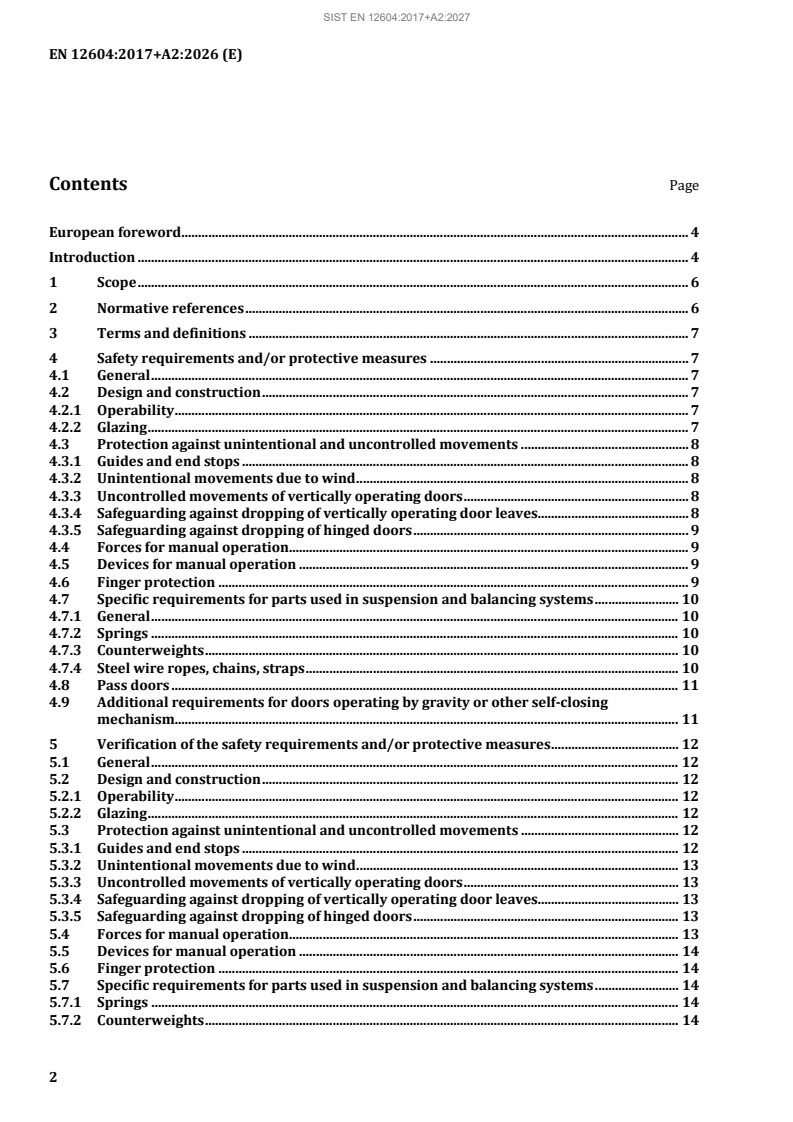
Contents
- Introduction
- 1 Scope
- 2 Normative references
- 3 Terms and definitions
- 4 Safety requirements and/or protective measures
- 4.1 General
- 4.2 Design and construction
- 4.2.1 Operability
- 4.2.2 Glazing
- 4.3 Protection against unintentional and uncontrolled movements
- 4.3.1 Guides and end stops
- 4.3.2 Unintentional movements due to wind
- 4.3.3 Uncontrolled movements of vertically operating doors
- 4.3.4 Safeguarding against dropping of vertically operating door leaves
- 4.3.5 Safeguarding against dropping of hinged doors
- 4.4 Forces for manual operation
- 4.5 Devices for manual operation
- 4.6 Finger protection
- 4.7 Specific requirements for parts used in suspension and balancing systems
- 4.7.1 General
- 4.7.2 Springs
- 4.7.3 Counterweights
- 4.7.4 Steel wire ropes, chains, straps
- 4.8 Pass doors
- 4.9 Additional requirements for doors operating by gravity or other self-closing mechanism
- 5 Verification of the safety requirements and/or protective measures
- 5.1 General
- 5.2 Design and construction
- 5.2.1 Operability
- 5.2.2 Glazing
- 5.3 Protection against unintentional and uncontrolled movements
- 5.3.1 Guides and end stops
- 5.3.2 Unintentional movements due to wind
- 5.3.3 Uncontrolled movements of vertically operating doors
- 5.3.4 Safeguarding against dropping of vertically operating door leaves
- 5.3.5 Safeguarding against dropping of hinged doors
- 5.4 Forces for manual operation
- 5.5 Devices for manual operation
- 5.6 Finger protection
- 5.7 Specific requirements for parts used in suspension and balancing systems
- 5.7.1 Springs
- 5.7.2 Counterweights
Introduction
This document has been prepared to meet the needs of manufacturers and users, with the primary purpose of providing design and performance for mechanical aspects of industrial, commercial and garage doors and gates used by vehicles accompanied or driven by persons.
With the aim of clarifying the intention of this document and avoiding doubts when reading it, it was assumed that clarification occurred between all involved parties (manufacturer, professional installer, user, etc.) concerning:
- components to be maintained and kept in good working order;
- the intended use, the type of users and the place of use of the door;
- all parts of door installations, whether fixed or moving, including the fixing and assembling means, to be in all respects of good construction, suitable material, adequate strength and free from obvious defects for their intended working life;
- the design to be in accordance with European technical rules taking into account the most unfavourable forces occurring during the operation and all failure modes.
1 Scope
This European Standard specifies mechanical requirements and test methods for manually operated doors, gates and barriers, intended for installation in areas in the reach of persons, and for which the main intended use is giving safe access for goods and vehicles accompanied or driven by persons in industrial, commercial or residential premises.
This European Standard also covers manually operated vertically moving commercial doors such as rolling shutters and rolling grilles, used in retail premises which are mainly provided for goods protection.
This document applies only to doors which are not part of the load carrying structure of the building. It does not apply to:
- lock gates and dock gates;
- doors on vehicles;
- doors mainly for the retention of animals unless they are at the site perimeter;
- doors intended for pedestrian use;
- railway barriers.
Whenever the term “door” is used in this document, it is deemed to cover the full scope of types and variances of doors, gates and barriers defined by the scope of this European Standard.
2 Normative references
The following documents, in whole or in part, are normatively referenced in this document and are indispensable for its application. For dated references, only the edition cited applies. For undated references, the latest edition of the referenced document (including any amendments) applies.
EN 12433-1, Industrial, commercial and garage doors and gates — Terminology — Part 1: Types of doors
EN 12433-2, Industrial, commercial and garage doors and gates — Terminology — Part 2: Parts of doors
EN 12385-4, Steel wire ropes — Safety — Part 4: Stranded ropes for general lifting applications
EN 12600:2002, Glass in building — Pendulum test — Impact test method and classification for flat glass 1 #EN 12605:2000, Industrial, commercial and garage doors and gates — Mechanical aspects — Test methods$
EN 13241, Industrial, commercial, garage doors and gates — Product standard, performance characteristics
EN 13411-2, Terminations for steel wire ropes — Safety — Part 2: Splicing of eyes for wire ropes slings
EN 13411-3, Terminations for steel wire ropes — Safety — Part 3: Ferrules and ferrule-securing
Withdrawn. Withdrawal effective since 2017-10-04.
EN 13411-6, Terminations for steel wire ropes — Safety — Part 6: Asymmetric wedge socket clevis
EN 61032:1998, Protection of persons and equipment by enclosures — Probes for verification (IEC 61032:1997)
3 Terms and definitions
For the purposes of this document, the terms and definitions given in EN 12433-1, EN 12433-2 and EN 13241 apply.
4 Safety requirements and/or protective measures
4.1 General
The number of full operational cycles for which the door is designed/constructed, shall take into account the planned maintenance and replacement of parts subject to wear and fatigue.
4.2 Design and construction
4.2.1 Operability
The door and its components, including its fixing and assembling means as specified by the manufacturer for attachment to a building or structure, shall be designed so that elastic or permanent deformations under operational forces or torques which occur during normal use do not affect the operation and the safety of the door.
The minimum safety factors for calculation purposes to be used for stress due to all loads for the design of the door are given in Table 1.
Table 1 — Safety factors for materials for calculation purposes
Safety factor for yield stress Safety factor for breaking stress 2,0 minimum 3,5 minimum !For components where testing is carried out instead of calculation the minimum safety factor before yield shall be 1,1."
4.2.2 Glazing
Glazing elements in the door shall be so designed that they remain fully secured under normal operating conditions.
In order to avoid occurrence of sharp splinters, cutting edges or other dangerous parts, the glazing material shall comply at least with the requirements of class 3 of EN 12600:2002 and the glazing material shall not break.
Door leaves made primarily from glazing material shall be clearly recognizable, e.g. by visible separations, permanent marking, suitable labels or by using coloured materials.
4.3 Protection against unintentional and uncontrolled movements
4.3.1 Guides and end stops
The guides (and where appropriate the door leaf as well as any other moving part of a door system) shall be designed and constructed in such a way that unintentional disengagement or derailment are prevented during normal operation, or in case of contact with a stationary obstacle, or in case of failure of a suspension element.
The movement of the door leaf shall be limited by end stops. Mechanical end stoppers in the terminal positions of the door movement shall withstand the energy developed by the possible impact of the door leaf.
4.3.2 Unintentional movements due to wind
When relevant, the door shall incorporate means suitable to prevent movement of the door due to the influence of wind. These means shall be effective at the relevant terminal position(s).
4.3.3 Uncontrolled movements of vertically operating doors
A vertically operating door leaf shall come to a stop and stay in position when released in any position during the opening or closing movement in normal operation.
...