

SIST EN 12424:2001
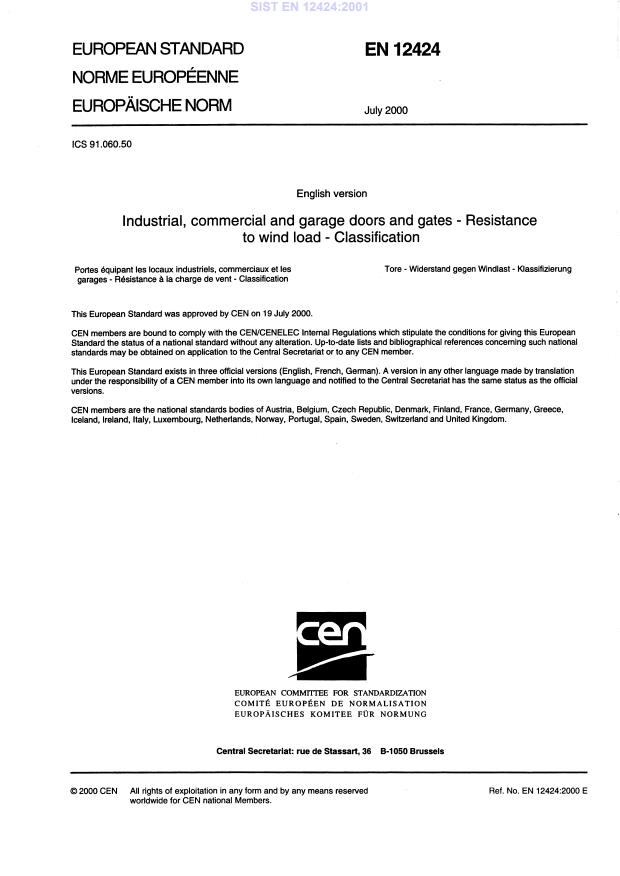
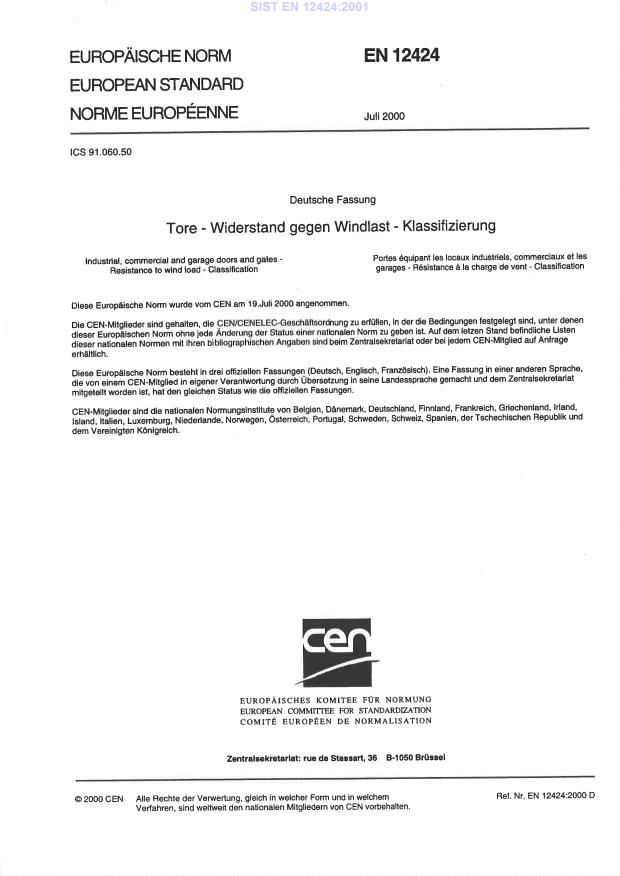
(Main)Industrial, commercial and garage doors and gates - Resistance to wind load - Classification
General Information
- Abstract
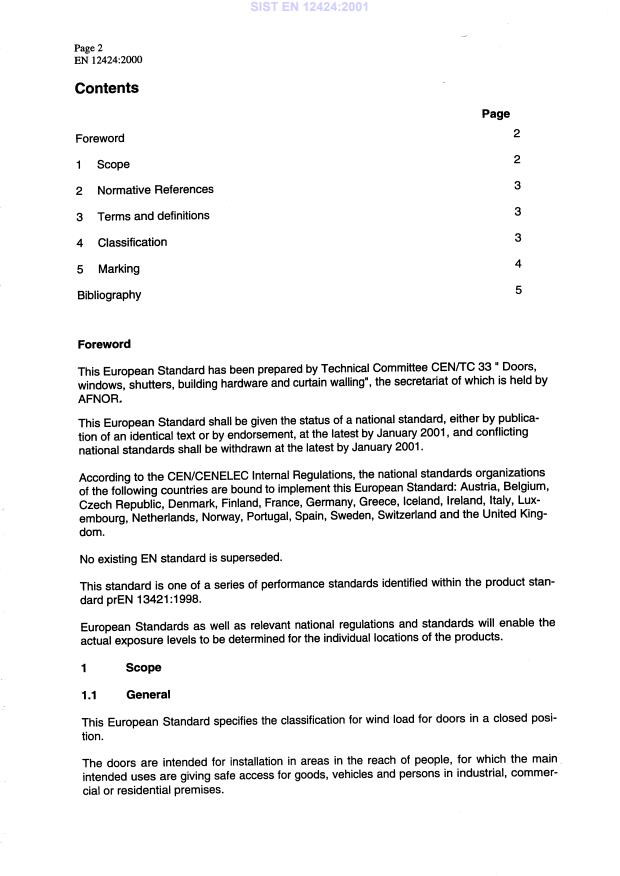
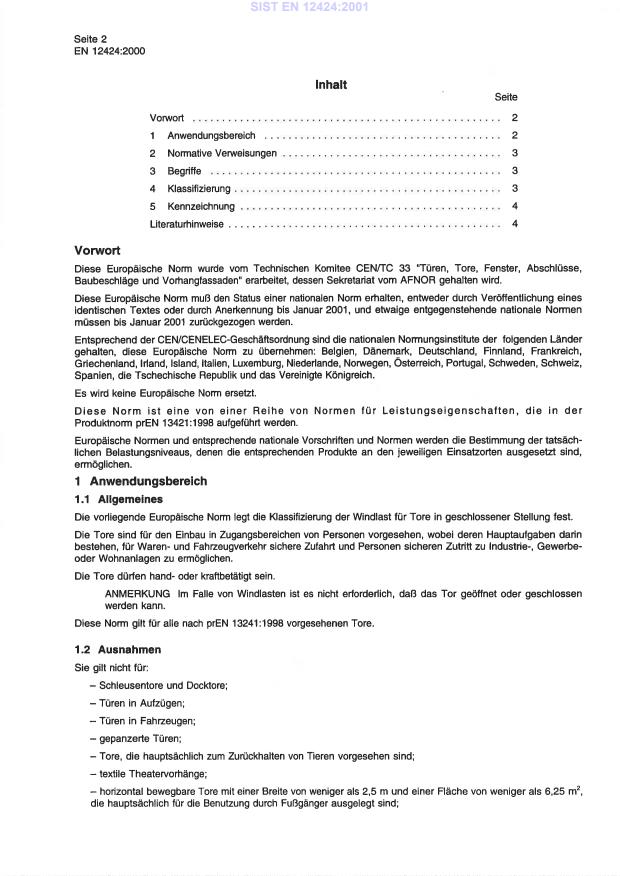
1.1 General This European Standard specifies the classification for wind load for doors in a closed posi-tion. The doors are intended for installation in areas in the reach of people, for which the main intended uses are giving safe access for goods, vehicles and persons in industrial, commer-cial or residential premises.The doors may be manually or power operated. NOTE In case of wind load it is not necessary that the door can be opened or closed. This document applies to all doors provided in accordance with prEN 13241:1998. 1.2 Exclusions It does not apply to: - lock gates and dock gates; - doors on lifts; - doors on vehicles; - armoured doors; - doors mainly for the retention of animals; - theatre textile curtains; - horizontally moving doors less than 2,5 m wide and 6,25 m² area, designed principally for
pedestrian use; - revolving doors of any size; - doors outside the reach of people (such as crane gantry fences); - railway barriers; - barriers used solely for vehicles.
- Status
- Published
- Publication Date
- 31-Aug-2001
- Technical Committee
- ISTP - Doors and windows
- Current Stage
- 6060 - National Implementation/Publication (Adopted Project)
- Start Date
- 01-Sep-2001
- Due Date
- 01-Sep-2001
- Completion Date
- 01-Sep-2001
Buy Documents


Overview
SIST EN 12424:2001 is a European Standard established by the European Committee for Standardization (CEN) that specifies the classification of industrial, commercial, and garage doors and gates based on their resistance to wind loads. This classification applies to doors in a closed position which are intended to provide safe access to goods, vehicles, and persons in various premises, including industrial, commercial, and residential environments. The standard covers both manually and power-operated doors, focusing on their structural ability to withstand wind pressure once closed, irrespective of whether the door can be opened or closed during wind events.
SIST EN 12424:2001 complements the requirements of prEN 13241:1998, which pertains to the performance characteristics of doors and gates. It does not apply to specific door types including lock gates, dock gates, lift doors, vehicle doors, and armoured doors, among others.
Key Topics
Wind Load Classification
SIST EN 12424:2001 provides a systematic classification system to rate the wind resistance of doors and gates. This classification ensures products meet minimum performance requirements under varying wind pressures, enhancing safety and durability.Scope and Exclusions
The standard applies to doors accessible to people and used mainly for access control in industrial, commercial, and residential settings. Important exclusions include:- Lock gates and dock gates
- Doors on lifts and vehicles
- Armoured doors
- Doors primarily designed for animal containment
- Theatre textile curtains
- Small horizontally moving pedestrian doors
- Revolving doors
- Doors outside human reach (e.g., crane gantry fences)
- Railway barriers and vehicle-only barriers
Integration with Other Standards
SIST EN 12424:2001 should be applied alongside related standards like prEN 13241:1998 for a comprehensive assessment of door performance characteristics.
Applications
This standard is particularly valuable for manufacturers, architects, engineers, and building owners who need to ensure their industrial, commercial, or garage doors withstand expected wind loads in their installation environment. Applications include:
Industrial and Commercial Buildings
Ensuring doors provide safe and reliable access with structural integrity against wind forces, improving building safety and operational continuity.Garage Doors
Assessing and selecting garage doors that maintain their performance and safety during adverse weather conditions.Construction and Facility Management
Specification of doors that meet wind load classifications helps in compliance with building codes and enhances occupant safety.Product Certification and Quality Control
Certification bodies and manufacturers use the classification system from EN 12424 to market compliant products and guarantee quality standards are met.
Related Standards
prEN 13241:1998 – This standard covers the performance characteristics of industrial, commercial, and garage doors and gates, which EN 12424 works alongside for classification based on wind resistance.
EN 1991-1-4 (Eurocode 1: Actions on Structures) – Provides guidance on wind actions for structural design, applicable when determining wind load parameters for doors.
EN 12453 – Safety in the operation of power-operated doors, complementing the wind load considerations by focusing on safe door automation.
Keywords: SIST EN 12424:2001, wind load resistance, door classification, industrial doors, commercial doors, garage doors, door standards, European Standard CEN, wind pressure classification, door safety, building access doors, power-operated doors, manual doors, door performance standards.
Relations
- Effective Date
- 28-Jan-2026
- Effective Date
- 28-Jan-2026
- Effective Date
- 28-Jan-2026
- Effective Date
- 28-Jan-2026
- Effective Date
- 28-Jan-2026
- Effective Date
- 28-Jan-2026
- Effective Date
- 28-Jan-2026
Buy Documents
Get Certified
Connect with accredited certification bodies for this standard

DIBt (Deutsches Institut für Bautechnik)
German Institute for Building Technology.
DIN CERTCO
DIN Group product certification.

Aboma Certification B.V.
Specialized in construction, metal, and transport sectors.
Sponsored listings
Frequently Asked Questions
SIST EN 12424:2001 is a standard published by the Slovenian Institute for Standardization (SIST). Its full title is "Industrial, commercial and garage doors and gates - Resistance to wind load - Classification". This standard covers: 1.1 General This European Standard specifies the classification for wind load for doors in a closed posi-tion. The doors are intended for installation in areas in the reach of people, for which the main intended uses are giving safe access for goods, vehicles and persons in industrial, commer-cial or residential premises.The doors may be manually or power operated. NOTE In case of wind load it is not necessary that the door can be opened or closed. This document applies to all doors provided in accordance with prEN 13241:1998. 1.2 Exclusions It does not apply to: - lock gates and dock gates; - doors on lifts; - doors on vehicles; - armoured doors; - doors mainly for the retention of animals; - theatre textile curtains; - horizontally moving doors less than 2,5 m wide and 6,25 m² area, designed principally for pedestrian use; - revolving doors of any size; - doors outside the reach of people (such as crane gantry fences); - railway barriers; - barriers used solely for vehicles.
1.1 General This European Standard specifies the classification for wind load for doors in a closed posi-tion. The doors are intended for installation in areas in the reach of people, for which the main intended uses are giving safe access for goods, vehicles and persons in industrial, commer-cial or residential premises.The doors may be manually or power operated. NOTE In case of wind load it is not necessary that the door can be opened or closed. This document applies to all doors provided in accordance with prEN 13241:1998. 1.2 Exclusions It does not apply to: - lock gates and dock gates; - doors on lifts; - doors on vehicles; - armoured doors; - doors mainly for the retention of animals; - theatre textile curtains; - horizontally moving doors less than 2,5 m wide and 6,25 m² area, designed principally for pedestrian use; - revolving doors of any size; - doors outside the reach of people (such as crane gantry fences); - railway barriers; - barriers used solely for vehicles.
SIST EN 12424:2001 is classified under the following ICS (International Classification for Standards) categories: 91.060.50 - Doors and windows; 91.090 - External structures. The ICS classification helps identify the subject area and facilitates finding related standards.
SIST EN 12424:2001 has the following relationships with other standards: It is inter standard links to oSIST prEN 13241:2021, SIST EN 12433-1:2000, SIST EN 12433-2:2000, SIST EN 13241-1:2003+A1:2011, SIST EN 13241:2003+A2:2016, SIST EN 12604:2001, SIST EN 12444:2001. Understanding these relationships helps ensure you are using the most current and applicable version of the standard.
SIST EN 12424:2001 is associated with the following European legislation: EU Directives/Regulations: 305/2011, 89/106/EEC. When a standard is cited in the Official Journal of the European Union, products manufactured in conformity with it benefit from a presumption of conformity with the essential requirements of the corresponding EU directive or regulation.
SIST EN 12424:2001 is available in PDF format for immediate download after purchase. The document can be added to your cart and obtained through the secure checkout process. Digital delivery ensures instant access to the complete standard document.
Standards Content (Sample)
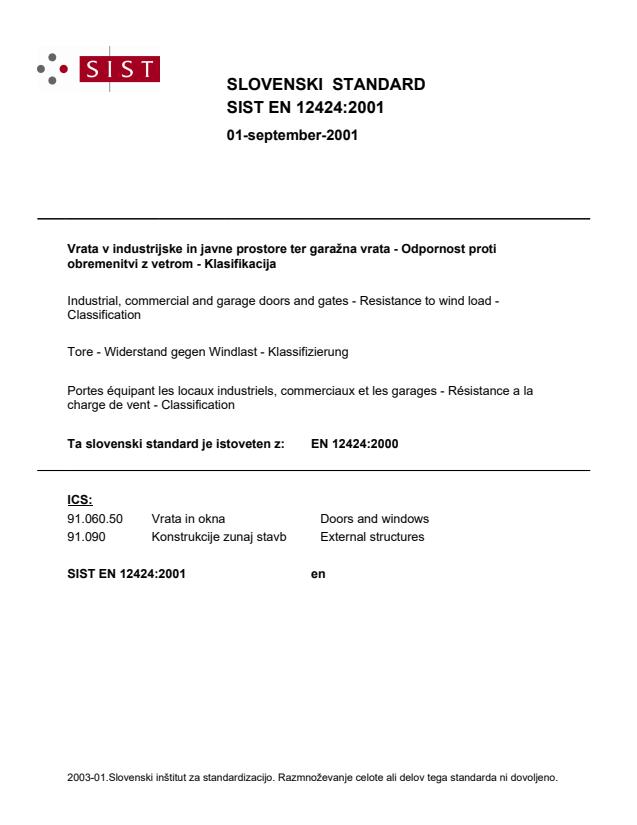
2003-01.Slovenski inštitut za standardizacijo. Razmnoževanje celote ali delov tega standarda ni dovoljeno.Vrata v industrijske in javne prostore ter garažna vrata - Odpornost proti obremenitvi z vetrom - KlasifikacijaTore - Widerstand gegen Windlast - KlassifizierungPortes équipant les locaux industriels, commerciaux et les garages - Résistance a la charge de vent - ClassificationIndustrial, commercial and
...
2003-01.Slovenski inštitut za standardizacijo. Razmnoževanje celote ali delov tega standarda ni dovoljeno.Vrata v industrijske in javne prostore ter garažna vrata - Odpornost proti obremenitvi z vetrom - KlasifikacijaTore - Widerstand gegen Windlast - KlassifizierungPortes équipant les locaux industriels, commerciaux et les garages - Résistance a la charge de vent - ClassificationIndustrial, comme
...