

EN 12604:2017+A2:2026
(Main + Amendment)Industrial, commercial and garage doors and gates - Mechanical aspects - Requirements and test methods
- Abstract
This European Standard specifies mechanical requirements and test methods for manually operated doors, gates and barriers, intended for installation in areas in the reach of persons, and for which the main intended use is giving safe access for goods and vehicles accompanied or driven by persons in industrial, commercial or residential premises.
This European Standard also covers manually operated vertically moving commercial doors such as rolling shutters and rolling grilles, used in retail premises which are mainly provided for goods protection.
This document applies only to doors which are not part of the load carrying structure of the building.
It does not apply to:
— lock gates and dock gates;
— doors on vehicles;
— doors mainly for the retention of animals unless they are at the site perimeter;
— doors intended for pedestrian use;
— railway barriers.
Whenever the term “door” is used in this document, it is deemed to cover the full scope of types and variances of doors, gates and barriers defined by the scope of this European Standard.
- Status
- Not Published
- Publication Date
- 17-Nov-2026
- Technical Committee
- CEN/TC 33 - Doors, windows, shutters, building hardware and curtain walling
- Drafting Committee
- CEN/TC 33/WG 5 - Industrial, commercial and garage doors and gates
- Current Stage
- 6060 - Definitive text made available (DAV) - Publishing
- Start Date
- 18-Nov-2026
- Due Date
- 08-Sep-2027
- Completion Date
- 08-Sep-2027

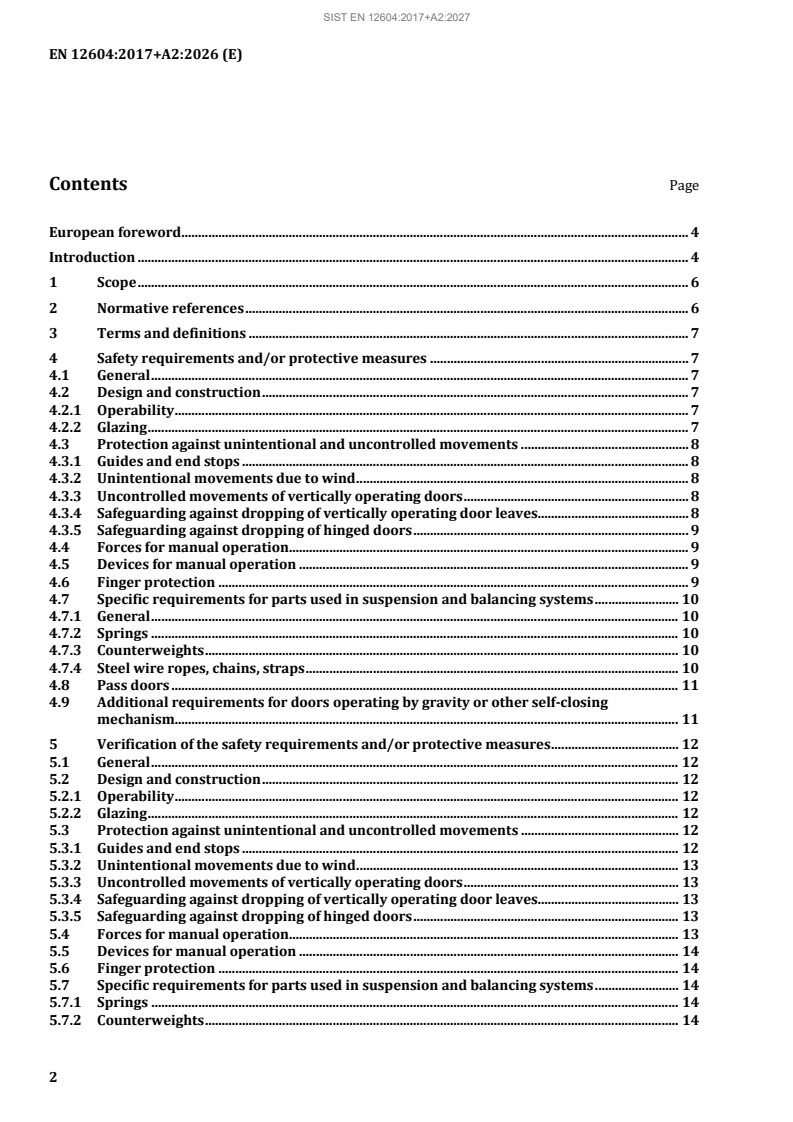
EN 12604:2017+A2:2026 is a CEN European Standard for the mechanical aspects of industrial, commercial and garage doors and gates. It specifies mechanical requirements and test methods for manually operated doors, gates and barriers used to give safe access for goods and vehicles accompanied or driven by persons, and it also covers certain manually operated vertically moving commercial doors used mainly for goods protection.
It is written for manufacturers, installers, testers, maintenance teams and buyers who need to check whether a door design, its safety features and its verification method fit the intended use.
What does EN 12604:2017+A2:2026 specify?
EN 12604:2017+A2:2026 specifies mechanical requirements and test methods for manually operated doors, gates and barriers intended for installation where persons can reach them. The document also covers manually operated vertically moving commercial doors such as rolling shutters and rolling grilles used in retail premises.
The standard applies only to doors that are not part of the building’s load-bearing structure. It excludes lock gates and dock gates, doors on vehicles, doors mainly for animal retention unless at the site perimeter, doors intended for pedestrian use, and railway barriers.
The document is arranged as follows:
- Clause 1 - Scope
- Clause 2 - Normative references
- Clause 3 - Terms and definitions
- Clause 4 - Safety requirements and/or protective measures
- Clause 5 - Verification of the safety requirements and/or protective measures
- Clause 6 - Information for use
- Clause 7 - Marking
- Annex A - Guidelines for a safe construction
- Annex B - Examples of mechanical protection and safety distances
- Annex C - Logbook
| Annex | What it covers |
|---|---|
| Annex A | Practical design guidance for safer construction, especially for sliding and rolling doors |
| Annex B | Examples of protection measures and safety distances for sectional and hinged doors |
| Annex C | A logbook format and the information that should be recorded for installation and maintenance |
What are the key requirements of EN 12604:2017+A2:2026?
EN 12604:2017+A2:2026 focuses on preventing mechanical hazards during normal use, foreseeable faults and verification testing. Clause 4 gives the requirements, and Clause 5 gives the checks and tests that confirm them.
Design, strength and glazing
Clause 4 requires the door to be designed for the planned operating life, taking maintenance and wear parts into account. In practice, the designer has to match the structure, fixings and moving parts to the expected use, not just to first installation.
Clause 4.2.1 requires the door and its fixings to keep working safely under operational loads, and Table 1 sets minimum safety factors for calculation. If testing is used instead of calculation, a lower minimum factor applies. This matters because the design evidence has to be suitable either from calculation or from test, and the manufacturer must be able to justify the chosen route.
Clause 4.2.2 requires glazing elements to stay secured in normal use and to meet at least class 3 of EN 12600:2002. Door leaves made mainly of glazing must be clearly recognisable. This helps reduce injury from breakage and helps users see that a glazed leaf is present.
Movement control and drop protection
Clause 4.3 requires guides and end stops to prevent derailment or disengagement, and end stops must withstand impact energy. The same clause also requires means to resist wind movement where relevant. For a manufacturer, this means the door must stay on its track and stay where it is meant to stop.
Clause 4.3.3 requires vertically operating door leaves to stop and stay in position when released in any position during movement. Clause 4.3.4 then adds drop protection for vertically operating doors if a single suspension or balancing element fails. The anti-drop safeguard has to stop the leaf, hold it safely, activate automatically and tolerate the full dynamic load. Clause 4.3.5 gives similar protection for hinged doors, including an anti-lifting device. In practice, these clauses are about preventing a sudden fall or uncontrolled movement after a fault.
Manual operation, finger protection and parts in suspension systems
Clause 4.4 limits the force needed for manual movement, with different limits for residential and industrial or commercial use. The door can exceed the limit only to start the movement. This matters because operators should be able to move the door without excessive effort.
Clause 4.5 requires suitable hand-holds or similar devices unless the design already gives safe gripping points. Clause 4.6 requires gaps, sharp edges and spring paths to be protected, using test probe B of EN 61032:1998 where relevant. That is the practical finger-injury control check.
Clause 4.7 covers springs, counterweights, steel wire ropes, chains, straps, pulleys and drums. The clause requires safe arrangement, protection against ejection, inspection access, minimum numbers of independent suspension elements in some cases, and safe rope or chain terminations. It also requires the steel wire rope system to be built and arranged so that it cannot jump out, mis-thread, or fail through poor alignment. For users and installers, this means suspension parts are not just strength items - they are safety items that must be visible, maintainable and correctly aligned.
Pass doors, self-closing doors, use information and marking
Clause 4.8 requires pass doors to stay safely positioned when the main door operates, and thresholds or raised areas in the traffic zone to be visible or signposted when they exceed the small height difference allowed by the standard. Clause 4.9 adds protection for doors that close by gravity or another self-closing mechanism. Their speed and impact must stay within safe limits, or the door must have an immediate audio-visual warning as it starts to close.
Clause 6 requires clear instructions for storage, installation, intended use, maintenance, cleaning, inspection, spare parts, competence requirements and dismantling. Clause 7 requires visible, legible and indelible marking with the manufacturer details, door designation, model or type reference, serial number if any, year of construction, temperature range when outside +5 °C to +40 °C, and mandatory marking. In practice, this supports safe installation, service and traceability throughout the door’s life.
What terms does EN 12604:2017+A2:2026 define?
EN 12604:2017+A2:2026 uses terms and definitions from EN 12433-1, EN 12433-2 and EN 13241. The following terms are central to reading the document:
- Door leaf - the moving part of the door, gate or barrier that is tested for movement, drop control and protection.
- Anti-drop safeguarding - the device or design feature that stops a leaf after a suspension or fixing failure and holds it safely in place.
- Suspension and balancing system - the springs, counterweights, ropes, chains, straps, belts, pulleys and drums that support or counterbalance the door leaf.
- Pass door - a door incorporated into the main door that must remain in a safe position when the main door moves.
- Competent person - a person with suitable training, knowledge, skills and practical experience to carry out a task safely.
- Test probe B - the probe from EN 61032:1998 used to check whether finger-reach gaps present a hazard.
- P.C.D. (pitch circle diameter) - the diameter measured at the centre line of a rope on a pulley or drum.
Who uses EN 12604:2017+A2:2026?
EN 12604:2017+A2:2026 is used by door manufacturers, component suppliers, professional installers, maintenance providers, test laboratories and quality or safety managers. It is also relevant to users and buyers who need to specify a door with the right mechanical safety features.
It is especially relevant in industrial, commercial and residential premises where doors and gates are used for vehicle and goods access. Retail premises using rolling shutters or rolling grilles also fall within its scope. The document is used for design reviews, type testing, verification, maintenance planning, installation checks and marking and user-instruction checks.
What changed in EN 12604:2017+A2:2026 from the previous edition?
EN 12604:2017+A2:2026 supersedes EN 12604:2017+A1:2020. The foreword also states that, compared with EN 12604:2000 and EN 12605:2000, the main changes were:
- EN 12604 was merged with EN 12605, with EN 12605:2000 to be withdrawn
- the scope was limited to manually operated doors
- the links to Regulation (EU) No 305/2011 and Machinery Directive 2006/42/EC were removed, with Annex ZA and ZB deleted
- Clause 4 and Clause 5 were restructured
- the requirements were sorted and summarised in Clause 4
- the informative annexes were revised to match Clause 4
- editorial changes were made
Which standards are used with EN 12604:2017+A2:2026?
The document relies on several companion standards:
- EN 12433-1 and EN 12433-2 - provide the terminology used for door types and door parts.
- EN 13241 - provides the broader product-standard context and additional terminology used in Clause 3.
- EN 12600:2002 - provides the glazing impact classification used for glazing elements.
- EN 12385-4 - gives the construction basis for steel wire ropes used in suspension systems.
- EN 13411-2, EN 13411-3 and EN 13411-6 - cover acceptable rope terminations used with steel wire ropes.
- EN 61032:1998 - provides probe B for checking finger-reach hazards.
- EN 12605:2000 - is referenced for the cycling test method used for gravity or self-closing doors.
What does the EN 12604:2017+A2:2026 document contain?
EN 12604:2017+A2:2026 contains both design requirements and the matching verification methods, so a reader can see what must be built and how it is checked. Clause 5 gives practical test setups such as the 400 mm by 400 mm by 400 mm test body, repeated movement tests, fault application on anti-drop systems, and inspection checks for finger protection, suspension parts and pass doors.
It also contains Table 1 for structural safety factors and several requirements that depend on visual inspection, measurement or documentation review. Annex A adds design guidance for safer construction, Annex B gives example protection arrangements and safety distances, and Annex C gives a logbook format for recording installation, verification and maintenance history.
Relations
- Effective Date
- 23-Sep-2026
- Effective Date
- 23-Sep-2026
- Effective Date
- 23-Sep-2026
- Effective Date
- 23-Sep-2026
- Effective Date
- 23-Sep-2026
- Effective Date
- 23-Sep-2026
- Effective Date
- 23-Sep-2026
- Referred By
EN 12635:2002+A1:2008 - Industrial, commercial and garage doors and gates - Installation and use - Effective Date
- 23-Sep-2026
- Effective Date
- 23-Sep-2026
- Effective Date
- 23-Sep-2026
- Effective Date
- 23-Sep-2026
- Effective Date
- 23-Sep-2026
- Effective Date
- 23-Sep-2026
- Referred By
EN 1539:2015 - Dryers and ovens, in which flammable substances are released - Safety requirements - Effective Date
- 23-Sep-2026
Get Certified
Connect with accredited certification bodies for this standard

DIBt (Deutsches Institut für Bautechnik)
German Institute for Building Technology.

DIN CERTCO
DIN Group product certification.

Aboma Certification B.V.
Specialized in construction, metal, and transport sectors.
Sponsored listings
Frequently Asked Questions
EN 12604:2017+A2:2026 is a standard published by the European Committee for Standardization (CEN). Its full title is "Industrial, commercial and garage doors and gates - Mechanical aspects - Requirements and test methods". This standard covers: This European Standard specifies mechanical requirements and test methods for manually operated doors, gates and barriers, intended for installation in areas in the reach of persons, and for which the main intended use is giving safe access for goods and vehicles accompanied or driven by persons in industrial, commercial or residential premises. This European Standard also covers manually operated vertically moving commercial doors such as rolling shutters and rolling grilles, used in retail premises which are mainly provided for goods protection. This document applies only to doors which are not part of the load carrying structure of the building. It does not apply to: — lock gates and dock gates; — doors on vehicles; — doors mainly for the retention of animals unless they are at the site perimeter; — doors intended for pedestrian use; — railway barriers. Whenever the term “door” is used in this document, it is deemed to cover the full scope of types and variances of doors, gates and barriers defined by the scope of this European Standard.
This European Standard specifies mechanical requirements and test methods for manually operated doors, gates and barriers, intended for installation in areas in the reach of persons, and for which the main intended use is giving safe access for goods and vehicles accompanied or driven by persons in industrial, commercial or residential premises. This European Standard also covers manually operated vertically moving commercial doors such as rolling shutters and rolling grilles, used in retail premises which are mainly provided for goods protection. This document applies only to doors which are not part of the load carrying structure of the building. It does not apply to: — lock gates and dock gates; — doors on vehicles; — doors mainly for the retention of animals unless they are at the site perimeter; — doors intended for pedestrian use; — railway barriers. Whenever the term “door” is used in this document, it is deemed to cover the full scope of types and variances of doors, gates and barriers defined by the scope of this European Standard.
EN 12604:2017+A2:2026 is classified under the following ICS (International Classification for Standards) categories: 91.060.50 - Doors and windows. The ICS classification helps identify the subject area and facilitates finding related standards.
EN 12604:2017+A2:2026 has the following relationships with other standards: It is inter standard links to EN 12604:2017+A1:2020, EN 12445:2000, EN 16035:2012, EN 1366-7:2004, EN 12604:2000, EN 12444:2000, EN 16035:2023, EN 12635:2002+A1:2008, EN 14637:2007, EN 16034:2014, EN 14600:2005, EN 14010:2003+A1:2009, EN 13501-2:2023, EN 1539:2015. Understanding these relationships helps ensure you are using the most current and applicable version of the standard.
EN 12604:2017+A2:2026 is available in PDF format for immediate download after purchase. The document can be added to your cart and obtained through the secure checkout process. Digital delivery ensures instant access to the complete standard document.
Standards Content (Sample)
Contents
- Introduction
- 1 Scope
- 2 Normative references
- 3 Terms and definitions
- 4 Safety requirements and/or protective measures
- 4.1 General
- 4.2 Design and construction
- 4.2.1 Operability
- 4.2.2 Glazing
- 4.3 Protection against unintentional and uncontrolled movements
- 4.3.1 Guides and end stops
- 4.3.2 Unintentional movements due to wind
- 4.3.3 Uncontrolled movements of vertically operating doors
- 4.3.4 Safeguarding against dropping of vertically operating door leaves
- 4.3.5 Safeguarding against dropping of hinged doors
- 4.4 Forces for manual operation
- 4.5 Devices for manual operation
- 4.6 Finger protection
- 4.7 Specific requirements for parts used in suspension and balancing systems
- 4.7.1 General
- 4.7.2 Springs
- 4.7.3 Counterweights
- 4.7.4 Steel wire ropes, chains, straps
- 4.8 Pass doors
- 4.9 Additional requirements for doors operating by gravity or other self-closing mechanism
- 5 Verification of the safety requirements and/or protective measures
- 5.1 General
- 5.2 Design and construction
- 5.2.1 Operability
- 5.2.2 Glazing
- 5.3 Protection against unintentional and uncontrolled movements
- 5.3.1 Guides and end stops
- 5.3.2 Unintentional movements due to wind
- 5.3.3 Uncontrolled movements of vertically operating doors
- 5.3.4 Safeguarding against dropping of vertically operating door leaves
- 5.3.5 Safeguarding against dropping of hinged doors
- 5.4 Forces for manual operation
- 5.5 Devices for manual operation
- 5.6 Finger protection
- 5.7 Specific requirements for parts used in suspension and balancing systems
- 5.7.1 Springs
- 5.7.2 Counterweights
Introduction
This document has been prepared to meet the needs of manufacturers and users, with the primary purpose of providing design and performance for mechanical aspects of industrial, commercial and garage doors and gates used by vehicles accompanied or driven by persons.
With the aim of clarifying the intention of this document and avoiding doubts when reading it, it was assumed that clarification occurred between all involved parties (manufacturer, professional installer, user, etc.) concerning:
- components to be maintained and kept in good working order;
- the intended use, the type of users and the place of use of the door;
- all parts of door installations, whether fixed or moving, including the fixing and assembling means, to be in all respects of good construction, suitable material, adequate strength and free from obvious defects for their intended working life;
- the design to be in accordance with European technical rules taking into account the most unfavourable forces occurring during the operation and all failure modes.
1 Scope
This European Standard specifies mechanical requirements and test methods for manually operated doors, gates and barriers, intended for installation in areas in the reach of persons, and for which the main intended use is giving safe access for goods and vehicles accompanied or driven by persons in industrial, commercial or residential premises.
This European Standard also covers manually operated vertically moving commercial doors such as rolling shutters and rolling grilles, used in retail premises which are mainly provided for goods protection.
This document applies only to doors which are not part of the load carrying structure of the building. It does not apply to:
- lock gates and dock gates;
- doors on vehicles;
- doors mainly for the retention of animals unless they are at the site perimeter;
- doors intended for pedestrian use;
- railway barriers.
Whenever the term “door” is used in this document, it is deemed to cover the full scope of types and variances of doors, gates and barriers defined by the scope of this European Standard.
2 Normative references
The following documents, in whole or in part, are normatively referenced in this document and are indispensable for its application. For dated references, only the edition cited applies. For undated references, the latest edition of the referenced document (including any amendments) applies.
EN 12433-1, Industrial, commercial and garage doors and gates — Terminology — Part 1: Types of doors
EN 12433-2, Industrial, commercial and garage doors and gates — Terminology — Part 2: Parts of doors
EN 12385-4, Steel wire ropes — Safety — Part 4: Stranded ropes for general lifting applications
EN 12600:2002, Glass in building — Pendulum test — Impact test method and classification for flat glass 1 #EN 12605:2000, Industrial, commercial and garage doors and gates — Mechanical aspects — Test methods$
EN 13241, Industrial, commercial, garage doors and gates — Product standard, performance characteristics
EN 13411-2, Terminations for steel wire ropes — Safety — Part 2: Splicing of eyes for wire ropes slings
EN 13411-3, Terminations for steel wire ropes — Safety — Part 3: Ferrules and ferrule-securing
Withdrawn. Withdrawal effective since 2017-10-04.
EN 13411-6, Terminations for steel wire ropes — Safety — Part 6: Asymmetric wedge socket clevis
EN 61032:1998, Protection of persons and equipment by enclosures — Probes for verification (IEC 61032:1997)
3 Terms and definitions
For the purposes of this document, the terms and definitions given in EN 12433-1, EN 12433-2 and EN 13241 apply.
4 Safety requirements and/or protective measures
4.1 General
The number of full operational cycles for which the door is designed/constructed, shall take into account the planned maintenance and replacement of parts subject to wear and fatigue.
4.2 Design and construction
4.2.1 Operability
The door and its components, including its fixing and assembling means as specified by the manufacturer for attachment to a building or structure, shall be designed so that elastic or permanent deformations under operational forces or torques which occur during normal use do not affect the operation and the safety of the door.
The minimum safety factors for calculation purposes to be used for stress due to all loads for the design of the door are given in Table 1.
Table 1 — Safety factors for materials for calculation purposes
Safety factor for yield stress Safety factor for breaking stress 2,0 minimum 3,5 minimum !For components where testing is carried out instead of calculation the minimum safety factor before yield shall be 1,1."
4.2.2 Glazing
Glazing elements in the door shall be so designed that they remain fully secured under normal operating conditions.
In order to avoid occurrence of sharp splinters, cutting edges or other dangerous parts, the glazing material shall comply at least with the requirements of class 3 of EN 12600:2002 and the glazing material shall not break.
Door leaves made primarily from glazing material shall be clearly recognizable, e.g. by visible separations, permanent marking, suitable labels or by using coloured materials.
4.3 Protection against unintentional and uncontrolled movements
4.3.1 Guides and end stops
The guides (and where appropriate the door leaf as well as any other moving part of a door system) shall be designed and constructed in such a way that unintentional disengagement or derailment are prevented during normal operation, or in case of contact with a stationary obstacle, or in case of failure of a suspension element.
The movement of the door leaf shall be limited by end stops. Mechanical end stoppers in the terminal positions of the door movement shall withstand the energy developed by the possible impact of the door leaf.
4.3.2 Unintentional movements due to wind
When relevant, the door shall incorporate means suitable to prevent movement of the door due to the influence of wind. These means shall be effective at the relevant terminal position(s).
4.3.3 Uncontrolled movements of vertically operating doors
A vertically operating door leaf shall come to a stop and stay in position when released in any position during the opening or closing movement in normal operation.
...