

SIST EN 50695:2021
(Main)Public-address-general-emergency-alarm-system, communication-system for marine applications
General Information
- Abstract
This standard describes requirements, performances and test-procedures for Public-Address-Systems (PA) and General-Alarm (GA) Communication-systems for marine applications. The standard is focused on all necessities to get a harmonized standard for marine PAGA Com.
The standard refers as much as possible to relevant established standards. Where relevant standard do not exist or are not precise enough, this standard will describe additionally own definitions , requirements performances and test-procedures
- Status
- Published
- Public Enquiry End Date
- 29-Feb-2020
- Publication Date
- 06-Jun-2021
- Technical Committee
- I09 - Imaginarni 09
- Current Stage
- 6060 - National Implementation/Publication (Adopted Project)
- Start Date
- 04-Jun-2021
- Due Date
- 09-Aug-2021
- Completion Date
- 07-Jun-2021



Overview
SIST EN 50695:2021 sets out the requirements, performance criteria, and testing procedures for Public Address (PA), General Emergency Alarm (GA), and combined Public Address General Emergency Alarm (PAGA) communication systems specifically for marine applications. Developed in alignment with prominent international directives, such as SOLAS and the Marine Equipment Directive (MED), this standard ensures the reliability and interoperability of shipboard public address and emergency communications. It also harmonizes with existing standards where available, and supplements them with marine-specific definitions, requirements, and test methods where necessary.
PA and GA systems are essential for ship safety, enabling clear communication and alarms during routine operation and in emergencies. SIST EN 50695:2021 applies to all major vessel categories, including cargo and passenger ships, ensuring that equipment can be certified and recognized across the EU and beyond.
Key Topics
- System Requirements
The standard details operational requirements for marine PA, GA, and PAGA systems, including manual activation, priority management, redundancy, and feedback prevention mechanisms. - Performance Criteria
Outlines performance parameters, such as audio clarity, alarm functionality, and reliability in harsh marine environments. - Test Procedures
Specifies methods for verifying compliance, including environmental, electromagnetic compatibility (EMC), and functional tests. Consistency with established standards such as EN 60945 and IEC 60533 is required, particularly for safety and EMC. - External Interfaces
Addresses integration with ship control systems, bridge alert management, displays, and various external devices (e.g., light beacons, ship’s whistle). - Labeling and Documentation
Requires clear marking of controls and thorough manufacturer documentation, including operational, installation, and maintenance manuals. - Redundancy and System Integrity
Sets requirements for system redundancy and mitigates single points of failure to ensure ongoing functionality during component faults.
Applications
Marine PA, GA, and PAGA System Implementation
SIST EN 50695:2021 is indispensable for manufacturers, marine engineers, and shipbuilders involved in:
- New ship construction: Ensuring that emergency alarm and public address systems are compliant from the outset, supporting regulatory approval and certification.
- Retrofits and upgrades: Guiding the replacement or enhancement of existing PA/GA systems to meet current safety and performance standards.
- Marine equipment certification: Providing a harmonized basis for conformity assessment under the MED, allowing manufacturers to affix the Wheel Mark and ensure equipment acceptance across EU member states.
- Shipboard safety operations: Supporting reliable crew and passenger communication in emergency scenarios such as fire, evacuation, or technical failures.
Operational Impact:
By standardizing testing and performance, SIST EN 50695:2021 enhances safety, reduces risk during maritime emergencies, and minimizes the likelihood of miscommunication or system malfunction in critical situations.
Related Standards
When implementing the requirements of SIST EN 50695:2021, several related standards and international conventions must be considered:
- EN 60945: General requirements for maritime navigation and radiocommunication equipment, covering EMC and environmental testing.
- IEC 60533: Addresses electrical and electronic installations in ships, especially for EMC where equipment is installed outside the bridge.
- EN 61162 Series: Defines digital interfaces for maritime navigation and radiocommunication systems.
- EN IEC 62923-1 and -2: Sets forth requirements for bridge alert management and alert cluster identification.
- EN 62288: General requirements for the presentation of navigation-related information on shipborne displays.
- SOLAS 1974 & LSA Code: International conventions providing the foundation for marine safety, including specific requirements for alarm and public address systems.
By adhering to SIST EN 50695:2021 and related standards, stakeholders in marine shipbuilding and operations can be assured of effective, compliant, and interoperable emergency communication systems crucial for maritime safety.
Get Certified
Connect with accredited certification bodies for this standard

DNV
DNV is an independent assurance and risk management provider.

Lloyd's Register
Lloyd's Register is a global professional services organisation specialising in engineering and technology.

FSC International
Forest Stewardship Council certification.
Sponsored listings
Frequently Asked Questions
SIST EN 50695:2021 is a standard published by the Slovenian Institute for Standardization (SIST). Its full title is "Public-address-general-emergency-alarm-system, communication-system for marine applications". This standard covers: This standard describes requirements, performances and test-procedures for Public-Address-Systems (PA) and General-Alarm (GA) Communication-systems for marine applications. The standard is focused on all necessities to get a harmonized standard for marine PAGA Com. The standard refers as much as possible to relevant established standards. Where relevant standard do not exist or are not precise enough, this standard will describe additionally own definitions , requirements performances and test-procedures
This standard describes requirements, performances and test-procedures for Public-Address-Systems (PA) and General-Alarm (GA) Communication-systems for marine applications. The standard is focused on all necessities to get a harmonized standard for marine PAGA Com. The standard refers as much as possible to relevant established standards. Where relevant standard do not exist or are not precise enough, this standard will describe additionally own definitions , requirements performances and test-procedures
SIST EN 50695:2021 is classified under the following ICS (International Classification for Standards) categories: 13.320 - Alarm and warning systems; 47.020.99 - Other standards related to shipbuilding and marine structures. The ICS classification helps identify the subject area and facilitates finding related standards.
SIST EN 50695:2021 is associated with the following European legislation: EU Directives/Regulations: 2014/90/EU; Standardization Mandates: M/557. When a standard is cited in the Official Journal of the European Union, products manufactured in conformity with it benefit from a presumption of conformity with the essential requirements of the corresponding EU directive or regulation.
SIST EN 50695:2021 is available in PDF format for immediate download after purchase. The document can be added to your cart and obtained through the secure checkout process. Digital delivery ensures instant access to the complete standard document.
Standards Content (Sample)
SLOVENSKI STANDARD
01-julij-2021
Splošni javni krizni alarmni sistem, komunikacijski sistem za pomorske aplikacije
Public-address-general-emergency-alarm-system, communication-system for marine
applications
Lautsprecher-Durchsage-System-General-Notfallalarm-System, Kommunikations-
System für Marine-Anwendungen
Dispositifs de communication avec le public et systèmes d'alarme générale en cas de
situation critique pour applications maritimes
Ta slovenski standard je istoveten z: EN 50695:2021
ICS:
13.320 Alarmni in opozorilni sistemi Alarm and warning systems
47.020.99 Drugi standardi v zvezi z Other standards related to
ladjedelništvom in shipbuilding and marine
konstrukcijami na morju structures
2003-01.Slovenski inštitut za standardizacijo. Razmnoževanje celote ali delov tega standarda ni dovoljeno.
EUROPEAN STANDARD EN 50695
NORME EUROPÉENNE
EUROPÄISCHE NORM
May 2021
ICS 13.320; 47.020.70
English Version
Public-address-general-emergency-alarm-system,
communication-system for marine applications
Dispositifs de communication avec le public et systèmes Lautsprecher-Durchsage-System-General-Notfallalarm-
d'alarme générale en cas de situation critique pour System, Kommunikations-System für Marine-Anwendungen
applications maritimes
This European Standard was approved by CENELEC on 2021-04-26. CENELEC members are bound to comply with the CEN/CENELEC
Internal Regulations which stipulate the conditions for giving this European Standard the status of a national standard without any alteration.
Up-to-date lists and bibliographical references concerning such national standards may be obtained on application to the CEN-CENELEC
Management Centre or to any CENELEC member.
This European Standard exists in three official versions (English, French, German). A version in any other language made by translation
under the responsibility of a CENELEC member into its own language and notified to the CEN-CENELEC Management Centre has the
same status as the official versions.
CENELEC members are the national electrotechnical committees of Austria, Belgium, Bulgaria, Croatia, Cyprus, the Czech Republic,
Denmark, Estonia, Finland, France, Germany, Greece, Hungary, Iceland, Ireland, Italy, Latvia, Lithuania, Luxembourg, Malta, the
Netherlands, Norway, Poland, Portugal, Republic of North Macedonia, Romania, Serbia, Slovakia, Slovenia, Spain, Sweden, Switzerland,
Turkey and the United Kingdom.
European Committee for Electrotechnical Standardization
Comité Européen de Normalisation Electrotechnique
Europäisches Komitee für Elektrotechnische Normung
CEN-CENELEC Management Centre: Rue de la Science 23, B-1040 Brussels
© 2021 CENELEC All rights of exploitation in any form and by any means reserved worldwide for CENELEC Members.
Ref. No. EN 50695:2021 E
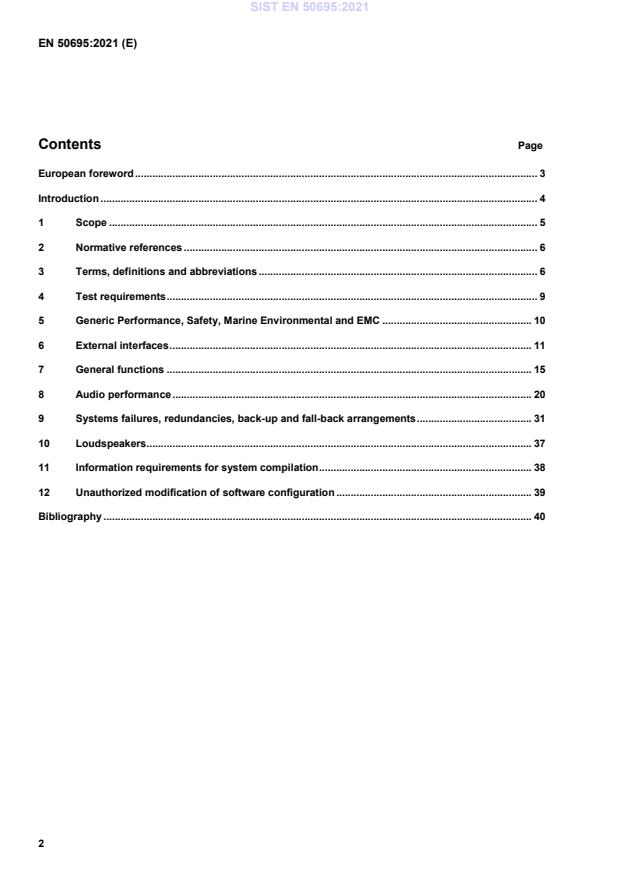
Contents Page
European foreword . 3
Introduction . 4
1 Scope . 5
2 Normative references . 6
3 Terms, definitions and abbreviations . 6
4 Test requirements . 9
5 Generic Performance, Safety, Marine Environmental and EMC . 10
6 External interfaces . 11
7 General functions . 15
8 Audio performance . 20
9 Systems failures, redundancies, back-up and fall-back arrangements . 31
10 Loudspeakers . 37
11 Information requirements for system compilation . 38
12 Unauthorized modification of software configuration . 39
Bibliography . 40
European foreword
This document (EN 50695:2021) has been prepared by CLC/BTTF 157-1 “Public address and general emergency
alarm systems”.
The following dates are fixed:
• latest date by which this document has to be (dop) 2022–04–26
implemented at national level by publication of
an identical national standard or by
endorsement
• latest date by which the national standards (dow) 2024–04–26
conflicting with this document have to be
withdrawn
Attention is drawn to the possibility that some of the elements of this document may be the subject of patent rights.
CENELEC shall not be held responsible for identifying any or all such patent rights.
The EU-Commission has received requests from stakeholders for the development of standards for public address
and general emergency alarm systems (entry A.2/1.5 in Annex A.2 of Directive 96/98/EC as amended by Commission
Directive (EU) 2015/559) and therefore requests the European standardization organisations start the development of
the respective standards.
The development of standards for public address and general emergency alarm systems is necessary because these
systems are very important for safety on board and they are exposed to specific conditions (e.g. moisture, salt) which
do not occur in other circumstances. The legislative provisions will detail the modalities for assessing that equipment.
The availability of testing standards will allow these products to be included in the scope of Directive 2014/90/EU,
which in turn will allow them to be conformity assessed by a notified body and to affix the wheel mark.
Introduction
Public address and general emergency alarm systems have the primary purpose to inform persons on board of ships
of emergency situations, and to enable the ship’s officers relay voice messages to persons on board those ships in
emergency situations.
EN 50695 has been written in pursuit of a request of the European Commission for a standard on equipment for public
address and general emergency alarm systems (PA, GA and PAGA systems). The European Commission issued this
request with the intention of taking this standard on board the Implementing Regulations belonging to the Marine
Equipment Directive (MED), with the aim to enable and require MED certification for equipment for public address and
general emergency alarm systems (PA, GA and PAGA systems). This will ensure that such equipment complies with
all applicable requirements to that equipment set by the International Maritime Organization (IMO) in SOLAS 1974 and
the LSA-code, before it is installed on board a ship.
Equipment compliant with this standard, certified according to the Marine Equipment Directive, can thus be used to
engineer and install a public address and general emergency alarm system on board a ship flying the flag of an EU
member state.
EN 50695 has been designed to make use of existing standards where possible, and specifies clarifications of
requirements in other standards, additional requirements and methods of test and required test results where
necessary to satisfy the IMO requirements.
Equipment based on EN 54 could be used as basis for PA and PAGA systems when additionally, compliant with this
document.
1 Scope
This document describes operational and performance requirements, methods of testing and required test results for
components of public address systems (PA), general emergency alarm systems (GA) and public address general
emergency alarm systems (PAGA) for marine applications as in Table 1 in support of the requirements of IMO for such
systems, while it is up to the manufacturer to define the components to be type approved together or separately, to
build up a system.
NOTE 1 This document does not include system engineering for installation on board nor installation requirements.
This document refers as much as possible to relevant established standards. Where relevant standards do not exist
or are not precise enough, this document will describe additionally own operational and performance requirements,
methods of testing and required test results.
NOTE 2 All text of this document, whose wording is identical to that of IMO circular MSC.808 or to SOLAS convention
requirements, is printed in italics, and the resolution and associated paragraph numbers are indicated in brackets.
Table 1 describes the applicable IMO requirements for each combination of ship category and type of system.
Table 1 — Product-ship type matrix
GA PA PAGA
Cargo SOLAS reg. II-2/12 .1 LSA Code 7.2.2 SOLAS reg. II-2/12 .1 and .2
ship
and .2
SOLAS reg. III/6.4
SOLAS reg. III/6.4
LSA Code 7.2
LSA Code 7.2.1
Res. A.1021(26) 5.8
Res. A.1021(26) 5.10
Passenger
SOLAS reg.II-2/12 .1 SOLAS reg. II-2/12 .1 and .3 SOLAS reg. II-2/12 .1, .2 and .3
ship (not and .2
SOLAS reg. III/6.5 SOLAS reg. III/6.4, 6.5
SRtP)
SOLAS reg. III/6.4
LSA Code 7.2.2 LSA Code 7.2
LSA Code 7.2.1
MSC/Circ.808 A.1021(26) 5.8
Res. A.1021(26) 5.10
MSC/Circ.808.
Passenger SOLAS reg. II-2/12 .1 SOLAS reg. II-2/12 .1 and .3 SOLAS reg. II-2/12 .1, .2 and .3
ship
and .2
SOLAS reg. III/6.5 SOLAS reg. III/6.4, 6.5
(SRtP)
SOLAS reg. III/6.4
LSA Code 7.2.2 LSA Code 7.2
LSA Code 7.2.1
MSC/Circ.808 Res. A.1021(26) 5.8
Res. A.1021(26) 5.10
SOLAS reg. II-2/21&22 MSC/Circ.808
MSC.1/Circ.1369/Add.1 SOLAS reg. II-2/21&22
MSC.1/Circ.1369/Add.1
Unless this document explicitly states otherwise, each section in this document applies to all ship types.
This document indicates for each section if that section is applicable to PA, GA and/or PAGA systems.
Where this document makes sections applicable to “passenger ships”, these sections apply to both “Passenger ship
(not SRtP)” and “Passenger ship (SRtP)”.
2 Normative references
The following documents are referred to in the text in such a way that some or all of their content constitutes
requirements of this document. For dated references, only the edition cited applies. For undated references, the latest
edition of the referenced document (including any amendments) applies.
EN IEC 60268-4:2018, Sound system equipment - Part 4: Microphones
EN 60945:2002, Maritime navigation and radiocommunication equipment and systems - General requirements -
Methods of testing and required test results (IEC 60945:2002)
EN 61162-1, Maritime navigation and radiocommunication equipment and systems - Digital interfaces - Part 1: Single
talker and multiple listeners (IEC 61162 1)
EN 61162-2, Maritime navigation and radiocommunication equipment and systems - Digital interfaces - Part 2: Single
talker and multiple listeners, high-speed transmission (IEC 61162 2)
EN IEC 61162-450, Maritime navigation and radiocommunication equipment and systems - Digital interfaces - Part
450: Multiple talkers and multiple listeners - Ethernet interconnection (IEC 61162 450)
EN 62288, Maritime navigation and radiocommunication equipment and systems - Presentation of navigation-related
information on shipborne navigational displays - General requirements, methods of testing and required test results
(IEC 62288)
EN IEC 62923-1, Maritime navigation and radiocommunication equipment and systems - Bridge alert management -
Part 1: Operational and performance requirements, methods of testing and required test results
EN IEC 62923-2, Maritime navigation and radiocommunication equipment and systems - Bridge alert management -
Part 2: Alert and cluster identifiers and other additional features
IEC 60268-1, Sound system equipment - Part 1: General (IEC 60268-1)
3 Terms, definitions and abbreviations
3.1 Terms and definitions
For the purposes of this document, the following terms, definitions and abbreviations apply.
ISO and IEC maintain terminological databases for use in standardization at the following addresses:
— ISO Online browsing platform: available at https://www.iso.org/obp
— IEC Electropedia: available at https://www.electropedia.org/
3.1.1
alarm
high-priority alert
(MSC 302/A) Condition requiring immediate attention and action by the bridge team, to maintain the safe navigation
and safe operation of the ship
3.1.2
alert
(MSC 302/A) announcement of abnormal situations and conditions requiring attention
Note 1 to entry: Alerts are divided in four priorities: emergency alarms, alarms, warnings and cautions. An alert provides information
about a defined state change in connection with information about how to announce this event in a defined way to the system and
the operator.
3.1.3
bridge alert management
(MSC.302/A) overall concept for management, handling and harmonized presentation of alerts on the bridge
3.1.4
central alert management system
CAM system
combined functionality of CAM and CAM-HMI
Note 1 to entry: CAM-HMI means: (MSC.302/A) human machine interface for centralized presentation and handling of alerts on the
bridge
Note 2 to entry: CAM means (MSC.302/A) functionality for the management of the presentation of alerts on the CAM-HMI, the
communication of alert states between CAM-HMI and navigational systems and sensors. The functions may be centralized or partly
centralized in subsystems and interconnected via a standardized alert-related communication
3.1.5
control station
human machine interface (e.g. panel) for the operator to use the system
3.1.6
emergency public address
emergency PA
voice announcement used to supplement general emergency alarm having priority over the general emergency alarm
3.1.7
general emergency alarm
audible signal used on board ships to indicate an emergency situation, summoning passengers and crew to muster
stations and to initiate the actions included in the muster list
3.1.8
general emergency alarm system
GA system
equipment to distribute audible signals used on board ships in times of emergency
3.1.9
loop
transmission-path between amplifiers and loudspeakers and between controllers and active loudspeakers
Note 1 to entry: A loop may be an open or closed loop.
3.1.10
multiplication and duplication systems
combination of interconnected systems that can operate as a single system and autonomously corrects a single fault
by using the other system
Note 1 to entry: Multiplication and Duplication systems can be solved by independent systems, if they are based on the same or
different technologies, both fulfilling the requirements of this document.
3.1.11
passive loudspeaker
loudspeaker that does not include any active circuit (e.g. amplifier)
3.1.12
public address
voice announcement
3.1.13
public address system
PA system
electronic system comprising microphones, amplifiers, loudspeakers, and related equipment to increase and distribute
the volume (loudness) of a live spoken human voice, or other acoustic sound source
3.1.14
public address general emergency alarm system
PAGA system
equipment which has the functions and performance of both a PA system and a GA system
3.1.15
redundancy
duplication of critical components or functions of a system with the intention of increasing reliability
3.1.16
redundant system
system that includes the possibility to autonomously correct a single fault by an internal replacement functionality
3.1.17
safe return to port
facilities supporting SOLAS reg. II-2/21 and II-2/22
3.1.18
single point of failure
internal or external cause (e.g. fire) that results in the loss of communication between two or more connected
independent systems
3.2 Abbreviations
EMC Electromagnetic compatibility
EUT Equipment under test
GA General emergency alarm
IEC International electrotechnical commission
IMO International marine organization
MSC Maritime safety committee
LSA International life-saving appliance
PA Public address
PAGA Public address general alarm
RMS Root mean square
SNR Signal to noise ratio
SOLAS Safety of life at sea
SRtP Safe return to port
THD Total Harmonic Distortion
4 Test requirements
4.1 Equipment under test
The manufacturer shall declare for
a) which ship types and
b) which product types
as defined in Table 1 the system is designed.
The manufacturer shall document the design and lay-out of the overall system that is to comply with this standard.
This shall include:
— the manufacturer-defined components of which the system consists, if applicable, and
— the possible minimum and maximum configurations of the system.
NOTE 1 Minimum configuration means the minimum number of connected components which represents a complete system
compliant with this document.
NOTE 2 Maximum configuration means the maximum number of connected components which represents a complete system
compliant with this document.
The manufacturer shall define the EUT as part of the overall system layout.
The test report shall state which set of validated manufacturer-defined components is tested together, including their
configuration.
4.2 Test set-up
Except where stated otherwise in this document, compliance with this document shall be tested in:
— a test setup covering at least the minimum configuration according to the ships type and systems type the system
shall be certified for
— the maximum configuration as describe by the manufacturer, shall be confirmed by measurement of a maximum
configuration or functionally and electrically representative for the maximum set-up, or inspection of documented
evidence where applicable
For the testing of loudspeakers and sounders only, a test set-up may be provided that enables testing of the
functionality of the loudspeakers only.
Insofar relevant for the tests to be performed the test set-up shall be installed according to the installation manual.
The manufacturer may specify a set of components that, when assembled as specified in the installation instructions,
perform a function of the PA, GA or PAGA system.
5 Generic Performance, Safety, Marine Environmental and EMC
5.1 Applicability
Applicable to all components of the PA, GA or PAGA system, including optional features, for all ship types.
5.2 Requirement
Further to the requirements of SOLAS 1974 reg. V/17 and IMO resolutions A.813(19) and A.694(17), in addition to the
requirements of this standard all components of the EUT shall comply with EN 60945, except that
— for passive loudspeakers EN 60945:2002, Clauses 9 and 10 do not apply; and
— for equipment for which the installation manual requires installation:
— outside the bridge, and
— away from mandatory receiving antenna’s as specified in IEC 60533 and/or EN 60945,
EN 60945:2002, Clauses 9 and 10 may be replaced with the requirements of IEC 60533.
For the purpose of EN 60945, where for a component of the EUT no applicable definitions for performance test and
performance check are stated in an IEC or EN equipment standard, the following definitions apply:
— Performance test: Perform any operator action in the EUT and confirm by non-quantitative observation that the
system is still operative. Where no operator action is available in the EUT (e.g. a loudspeaker), activate a primary
function of the EUT (e.g. to produce sound) and confirm by non-quantitative observation that the system is still
operative.
— Performance check: Identical to the performance test.
For all components of the EUT, the manufacturer shall declare the EN 60945 environment category to which the
components are successfully tested. The manufacturer’s documentation that will be available with the equipment shall
reflect the applicable EN 60945 environment categories for all components. The applicable category may also be
marked on the equipment.
The manufacturer’s documentation that will be available with the equipment shall reflect the compass safe distances
of all components of the EUT or the instruction to install the components at least 5 m from the compass. The compass
safe distance shall at least be marked on portable equipment.
5.3 Methods of test and required test results
Confirm by inspection of the manufacturer’s documentation that will be available with the EUT, that, in pursuit of the
EN 60945 requirements, the following documentation is available and is in compliance with the requirements of
EN 60945:
— manual for operation of the EUT;
— manual for maintenance of the EUT;
— manual for installation of the EUT.
These manuals may be combined.
Confirm by inspection of the manufacturer’s documentation that will be supplied with the EUT, that it holds:
— the applicable environment category of the equipment of all components of the EUT; and
— the compass safe distance of all components of the EUT, or instructions to install the components of the EUT with
at least 5 m separation from any compass.
These markings may also be affixed to the components.
Refer to the manufacturer’s documentation that will be available with the equipment to identify equipment for which the
applicable EN 60945 environment category is portable. Confirm by observation that this equipment is marked with the
compass safe distance or with instructions to install the equipment with at least 5 m separation from any compass.
Confirm by inspection of documented evidence that the EUT complies with the requirements of EN 60945 for
— marine environment;
— marine power supply; and
— marine special purpose tests.
For equipment other than passive loudspeakers, also confirm by inspection of documented evidence that the EUT
complies with the requirements of EN 60945 for marine EMC (EN 60945:2002, Clauses 9 and 10), where for equipment
for which the installation manual requires installation
— outside the bridge, and
— away from mandatory receiving antenna’s as specified in IEC 60533 and/or EN 60945,
EN 60945:2002, Clauses 9 and 10, may be replaced with the requirements of IEC 60533.
For equipment for which the requirements of EN 60945:2002, Clauses 9 and 10 were replaced with the requirements
of IEC 60533, confirm by inspection of manufacturer’s documentation that the installation manual contains a
requirement to install that equipment
— outside the bridge, and
— away from mandatory receiving antenna’s as specified in IEC 60533 and/or EN 60945.
Such information may also be affixed to the equipment itself.
For the EN 60945 requirements for which compliance is not confirmed by documented evidence, perform the
corresponding EN 60945 test and confirm by analytical evaluation that the EUT complies with those EN 60945
requirements.
6 External interfaces
6.1 Overview
Figure 1 gives an overview of the external interfaces of PA, GA and PAGA Systems
Key
1 User
2 Central alert management (CAM), see 6.2.2
3 Public address (PA), general alarm (GA), combined system (PAGA)
4 Audio communication system, see 6.5
5 External device, see 6.5
Figure 1 — Overview external interfaces
6.2 Bridge alert management
6.2.1 Applicability
PA and/or GA and/or PAGA system that provides alerts to the operator.
The requirements apply both to the user interface and to the technical interfaces of the equipment.
6.2.2 Requirement
The equipment shall implement one or more technical interfaces according to EN 61162-1, EN 61162-2 and/or EN
IEC 61162-450 for the purpose of bridge alert management, at least for connection to a central alert management
system.
The equipment shall comply with EN IEC 62923-1 and EN IEC 62923-2.
6.2.3 Method of test and required results
Confirm by inspection of manufacturer’s documentation that the equipment contains one or more technical interfaces
according to EN 61162-1, EN 61162-2 and/or EN IEC 61162-450 for the purpose of bridge alert management, at least
for connection to a central alert management system.
Confirm by inspection of documented evidence that the equipment complies with EN IEC 62923-1 and EN IEC 62923-2
and, if applicable, EN 61162-1, EN 61162-2 and/or EN IEC 61162-450.
6.3 Display of information on the navigation bridge
6.3.1 Applicability
GA and/or PA and/or PAGA system that features a display that can be fitted on the bridge of a ship. Display is in this
context referred to as all means for presenting information such as, but not limited to, printed text, indicators, LED and
screens.
6.3.2 Requirement
The PA and/or GA and/or PAGA shall comply as applicable with the general requirements for displays contained in
EN 62288.
6.3.3 Method of tests and required results
Confirm by inspection of documented evidence that displays of the PA and/or GA and/or PAGA system that can be
fitted on the bridge of a ship comply with EN 62288.
6.4 Marking and labelling of controls and indications
6.4.1 Applicability
This requirement is applicable for PA, GA, and PAGA systems.
6.4.2 Requirement
The controls and indications on the control station shall be clearly labelled (MSC / Circ 808 2.2.1) to avoid
misunderstanding and misinterpretation.
6.4.3 Method of tests and required results
Confirm by observation that all controls and indications on the control station are clearly labelled to avoid
misunderstanding and misinterpretation.
6.5 Interface for external devices
6.5.1 Applicability
All mandatory and optional interfaces on PA, GA and PAGA systems to external devices, such as light beacons,
sounders, ship’s whistle, siren, UHF systems, intercom systems, telephone systems, audio communication systems,
background music control, control of external volume regulators, entertainment muting and local mute relays.
6.5.2 Requirement
PAGA systems shall have at least the following interfaces for external device: light beacons and ship’s whistle.
GA systems shall have at least the following interfaces for external device: light beacons, sounders and ship’s whistle.
Any short circuit, interruption or earth fault in a transmission path to the external devices shall not impact any other
transmission path except for the functions of the connected external device.
All mandatory and optional interfaces to external devices shall be described in the interface requirements specification
of the manufacturer.
6.5.3 Method of tests and required results
Refer to the manufacturer’s documentation for the available interfaces for external devices.
Confirm by inspection of documentation that all interfaces to external devices are described in the interface
requirements specification.
Confirm by inspection of manufacturer’s documentation that:
— PAGA systems at least have interfaces available for external light beacons and ship’s whistle.
— GA systems at least have interfaces available for external light beacons, sounders and ship’s whistle.
For all available interfaces for external devices, perform the below tests.
Where in below tests “emergency signalling” is described this means:
— For PA systems: emergency PA
— For GA systems: activated GA
— For PAGA systems: emergency PA and activated GA
Short circuit test:
1. Short circuit the interface to external devices (except the interface from PA to mute GA) during ongoing emergency
signalling.
2. Expected result is that the emergency signalling had no interruption due to the short circuit, however the short-
circuited interface may interrupt.
3. Stop emergency signalling.
4. Expected result is that the emergency signalling is stopped
5. Perform new emergency signalling.
6. Expected result is, that the emergency signalling is started.
Interruption test:
1. Disconnect the interface to external devices during ongoing emergency signalling.
2. Expected result is, that the emergency signalling had no interruption due to the disconnection, however the
disconnected interface may interrupt.
3. Stop emergency signalling.
4. Expected result is, that the emergency signalling is stopped
5. Perform new emergency signalling.
6. Expected result is, that the emergency signalling is started.
Earth fault test:
1. Connect one wire of the interface to earth during ongoing emergency signalling.
2. Expected result is, that the emergency signalling had no interruption due to the short circuit to earth, however the
interface with earth fault may interrupt.
3. Stop emergency signalling.
4. Expected result is, that the emergency signalling.
5. Perform new emergency signalling.
6. Expected result is, that the emergency signalling is started.
7 General functions
7.1 Control functions
7.1.1 Manual activation of alarm signals
7.1.1.1 Applicability
This requirement is applicable for GA and PAGA.
7.1.1.2 Requirement
Following LSA Code, International Life-Saving Appliance Code 7.2.1.1, the equipment shall enable the user to
manually activate general emergency alarm from at least two or more general emergency alarm control stations. The
alarm shall continue to function after it has been triggered until it is manually turned off or is temporarily interrupted by
an emergency PA.
For PAGA: A general emergency alarm shall automatically overrides any other input system when an emergency alarm
is activated by the user, and the system shall automatically override any local volume controls and switching off facilities
provided to give the required output for the emergency mode when an emergency alarm is activated by the user;
IMO Res. A.1021(26) Annex 5.8.3: the system automatically overrides any other input system when an emergency
alarm is required (activated by the user) and the system automatically overrides any volume controls provided to give
the required output for the emergency mode when an emergency alarm is required (activated by the user);
7.1.1.3 Method of tests and required results
If the system has possibility for a user (addressee) to turn off loudspeakers or adjust volume. Configure the system
with loudspeakers off and/or volume adjusted down.
Manual activation of alarm signals:
Activate the general emergency alarm manually from the provided two or more, general emergency alarm control
stations.
— Verify general emergency alarm indicators and external devices, if provided, are activated
— Verify general emergency alarm tone sounding in all loudspeakers
Manual silence alarm:
During general emergency alarm, activate the emergency PA manually.
Verify the general emergency alarm is temporarily muted (all sound devices and all relevant interfaces) and replaced
by the emergency PA
— Verify the visual general emergency alarm indicators and external devices remain activated, as appropriate
Deactivate manual alarm:
During general emergency alarm, deactivate/cancel the general emergency alarm manually from any of the provided
two or more, general emergency alarm control stations
— Verify general emergency alarm indicators and external devices are deactivated, as appropriate
— Verify general emergency alarm tone in the loudspeakers are stopped
7.1.2 Public Address (PA)
7.1.2.1 Applicability
Applicability 1: This requirement is applicable for PA and PAGA on cargo ships and passenger ships
Applicability 2: This requirement is applicable for PA and PAGA on passenger ships
7.1.2.2 Requirement
Applicability 1: Following LSA Code 7.2.2.1 the equipment shall enable the user the broadcast of emergency PA from
at least two or more PA control stations.
The control station shall be protected against inadvertent operation and the installation manual shall hold requirements
about protection against unauthorized use.
Emergency PA shall not require any action from the addressee (receiving person).
Emergency PA shall automatically override any other input system when an emergency PA is activated by the user,
and the system shall automatically override any local volume controls and switching off facilities provided to give the
required output for the emergency mode when an emergency PA is activated by the user;
SOLAS reg. III/6.5.2 PA system shall be provided with an override function controlled from one location on the
navigation bridge and such other places on board as the Administration deems necessary, so that all emergency
messages will be broadcast if any loudspeaker in the spaces concerned has been switched off, its volume has been
turned down or the public address system is used for other purposes.
Applicability 2: In addition to Applicability 1 According to MSC Circ 808, Ch 2.1 it shall be possible to address crew
accommodation and workspace separately from passenger spaces which will require PA and/or PAGA system to
support two or more zones for PA.
7.1.2.3 Method of tests and required results
Confirm by inspection of the installation documentation that it contains requirements about protection against
unauthorized use.
— Activate PA to one zone.
— Confirm by observation that the signal is transmitted to that zone.
— If the equipment supports multiple zones, activate a PA to at least two zones.
— Confirm by observation that the signal is transmitted to the selected zones.
— If the equipment supports multiple zones, activate a PA to all zones simultaneously (“All-Call function”).
— Confirm by observation that the signal is transmitted to all zones and all loudspeakers, without exception.
— Stop the PA.
— If the system has possibility for a user to turn off loudspeakers or adjust volume. Configure the system with
loudspeakers off and/or volume adjusted down.
— If possible, select part of the available zones.
— If external inputs are provided, activate such input.
— Engage a PA on one of at least two control stations.
— Activate an emergency PA from another control station.
— Confirm by observation that the emergency PA is transmitted to all zones and loudspeakers.
— Confirm by observation that the emergency PA disregards the limited volume setting and switched off
loudspeakers.
— Confirm by observation that the emergency PA function is clearly marked as such and protected against
inadvertent operation. If an indicator is available to indicate that an emergency PA is selected or in progress,
confirm that this indicator functions correctly.
— Confirm by observation that the PA to selected zone(s), PA to all zones simultaneously (“All-Call function”) and
emergency PA are received and heard at the receiving side without necessity to activate reception.
7.1.3 Feedback handling during PA
7.1.3.1 Applicability
This requirement is applicable for PA and PAGA.
7.1.3.2 Requirement
(A.1021(26)/A.5.8.4 and Circ.808/2.4) The system shall provide means to prevent feedback or other interference.
NOTE 1 Means could include guidance in the installation manual and/or technical facilities in the system.
NOTE 2 Other interference is considered to be acoustic.
EXAMPLE: Examples of such facilities are:
— “Directional-” /” noise-cancelling-” /” close-talk-” microphones,
— Automatically muting of local loudspeaker(s)
— Individual described solution by the manufacturer
7.1.3.3 Method of tests and required results
Confirm by inspection of the manufacturer documentation that means to prevent feedback and other interference are
provided.
7.1.4 Self-test of indications and alerts on control stations
7.1.4.1 Applicability
GA and/or PA and/or PAGA system that features indicators and/or alerts
7.1.4.2 Requirement
IMO Resolution A.1021(26) 4.12 Provision shall be made for functionally testing required alerts and indicators.
A function shall be available to:
— activate all indications on the control stations ('lamp test'); and
— if the equipment is capable of providing an alert to the operator, the function shall also raise a test alert.
NOTE The other parts of the system can be tested using the main functionality of the equipment.
7.1.4.3 Method of tests and required results
Refer to the operating manual for self-test facilities of indications and alerts.
Activate the test function. Confirm by observation that:
— all indications on the control station are activated; and
— if the equipment is capable of providing alerts to the operator, that a test alert is raised.
7.2 Priority
7.2.1 Priority for signal distribution
7.2.1.1 Applicability
This requirement is applicable for GA and/or PA and/or PAGA, for the signal functions available in the equipment
7.2.1.2 Requirement
(SOLAS reg. III/6.4.2) Entertainment sound systems shall automatically be turned off when the general emergency
alarm system is activated.
(LSA/7.2.1.1) The alarm shall continue to function after it has been triggered until it is manually turned off or it is
temporarily interrupted by a message on the public-address system
(A.1021(26)/A 5.8.3) the system automatically overrides any other input system when an emergency alarm is required,
and the system automatically overrides any volume controls provided to give the required output for the emergency
mode when an emergency alarm is required;
Any local volume controls shall be overridden in case of emergency distributions (Priority 1,2,3).
The system shall at least distinguish the following priorities, where priority 1 is the highest priority:
Priority 1: emergency PA;
Priority 2: general emergency alarm;
Priority 3: other emergency alarms (see IMO resolution A.1021);
Priority 4: any other information distribution;
Priority 5: entertainment (option)
For other emergency alarms:
The manufacturer shall declare the number of other emergency alarms supported by the system including their means
of activation (e.g. external input or button). If the system support two or more other emergency alarms, the system
shall be able to priorities between them.
7.2.1.3 Method of tests and required results
Conduct the tests in Table 2 and confirm that the results are as described in the table.
Table 2 — Test for prioritising calls
No. Test GA PA PAGA Test results
1 Activate entertainment x x Entertainment shall be distributed
(option)
2 Activate Any other x x Other information shall be distributed.
information distribution
• If entertainment is provided this shall be
interrupted
No. Test GA PA PAGA Test results
3 Activate other x x Other emergency alarms shall be distributed
emergency alarms (see
• Muting interface to other Emergency Alarms
A.1021(26) Chapter
system shall be provided. Activation of
3.2)
interface shall be verified.
• If any other information is provided this shall
be interrupted
• If entertainment is provided this shall be
interrupted
4 Activate general x x General emergency alarm shall be distributed
emergency alarm (see
• If other emergency alarms are provided,
A.1021(26) Chapter
these shall be interrupted
3.2)
• Muting interface to other alert system shall
be provided. Activation of interface shall be
verified.
• If any other information is provided, this shall
be interrupted
• If entertainment is provided, this shall be
interrupted
Activate emergency PA
5 x x Emergency PA shall be distributed
• PAGA: general emergency alarm shall be
activated before the test. The GA shall be
temporarily interrupted by the emergency PA
• PA and PAGA: muting interface to other
emergency alarm system shall be provided.
Activation of interface shall be verified.
• If other emergency alarms are provided
these shall be interrupted
• If any other information is provided this shall
be interrupted
• If entertainment is provided this shall be
interrupted
Activate general
6 x Activate the general emergency alarm and verify the
emergency alarm distribution
interruption
• Simulate input of the emergency PA
activation
• Verify that the general emergency alarm will
be interrupted
7 Stop and reactivate the x x Verify that the emergency PA is not interrupted
general emergency
alarm
8 a) Stop the emergency x x a) Verify that the general emergency alarm sounds
PA again
b) Stop and reactivate b) Verify that the general emergency alarm is not
another emergency interrupted
alarm
9 a) Stop the general x x a) Verify that the other emergency alarms sound
emergency alarm again
b) Stop and reactivate b) Verify that the other emergency alarms are not
another PA interrupted
No. Test GA PA PAGA Test results
10 a) Stop the other x x a) Verify that the other PA sound again
emergency alarms
b) Verify that the other PA are not interrupted
b) Stop and reactivate
the entertainment
7.2.2 Priority between PA control stations
7.2.2.1 Applicability
This requirement is applicable for PA and PAGA systems for passenger ships.
Recommended for Cargo ships.
7.2.2.2 Requirement
(MSC/Circ.808. 2.1.) The controls of the system on the navigation bridge shall be capable of interrupting any broadcast
on the system from any other location on board.
For PA it shall be possible to configure one PA control station to have priority over all other PA control stations
performing PA.
For emergency PA it shall be possible to configure one PA control station to have priority over all other PA control
stations performing emergency PA.
7.2.2.3 Method of tests and required results
Verify priority between at least two PA control stations. Configure one control station to be navigation bridge control
station. Activate PA on the PA control stations by activating all PA of all kinds one at a time, starting with the lowest
priority and verify that the new PA interrupts the previous PA.
Table 3 shows the priority relation between the PA, where priority 1 is the highest priority.
Table 3 — Priority order between control stations
Navigation Bridge Any other mandatory location
Emergency PA 1 2
Any other information 3 4
distribution
Entertainment 5
8 Audio performance
8.1 General emergency alarm (GA) generation
8.1.1 Applicability
This requirement is applicable for GA and PAGA system.
8.1.2 Requirement
(LSA Code/7.2.1.1) The general emergency alarm system shall be capable of sounding the general emergency alarm
signal consisting of seven or more short blasts followed by one long blast (see Figure 2) on the ship’s whistle or siren
and
...