


SIST EN 15848:2026
(Main)Water conditioning equipment inside buildings - Adjustable chemical dosing systems - Requirements for performance, safety and testing
Water conditioning equipment inside buildings - Adjustable chemical dosing systems - Requirements for performance, safety and testing
This document specifies definitions, principles of construction (but not dimensions) and design, requirements on performance and operation as well as methods for testing the performance of adjustable chemical dosing systems for conditioning water intended for human consumption inside buildings (see [1]) which are permanently connected to the mains supply.
Anlagen zur Behandlung von Trinkwasser innerhalb von Gebäuden - Einstellbare Dosiersysteme - Anforderungen an Ausführung, Sicherheit und Prüfung
Dieses Dokument legt Begriffe, Grundsätze der Konstruktion (jedoch keine Maße) und Gestaltung, Anforderungen an die Funktion und den Betrieb sowie Verfahren zur Prüfung der Leistungsanforderungen von einstellbaren Dosiersystemen zur Behandlung von Wasser für den menschlichen Gebrauch (siehe [1]) fest, die fest am Eintrittspunkt des Wassers in die Hausinstallation angeschlossen sind.
Équipement de conditionnement de l'eau à l'intérieur des bâtiments - Systèmes de dosage chimique réglables - Exigences relatives aux performances, à la sécurité et aux essais
Le présent document spécifie les définitions, les principes de construction (mais non les dimensions) et de conception, les exigences de performance et d'exploitation ainsi que les méthodes d'essai des performances des systèmes de dosage de produits chimiques réglables pour le conditionnement de l'eau destinée à la consommation humaine à l'intérieur des bâtiments (voir [ 1 ]) qui sont reliés en permanence à l'alimentation du réseau.
Oprema, ki se uporablja za pripravo pitne vode v stavbah - Nastavljivi sistemi za doziranje kemikalij - Zahteve za delovanje, varnost in preskušanje
Ta dokument določa definicije, načela konstrukcije (vendar ne dimenzij) in zasnove, zahteve glede zmogljivosti in delovanja ter metode za preskušanje zmogljivosti nastavljivih sistemov za doziranje kemikalij za kondicioniranje vode, namenjene za človeško potrošnjo v stavbah (glej [1]), ki so trajno povezane z glavnim vodovodnim omrežjem.
General Information
- Status
- Published
- Public Enquiry End Date
- 18-Jun-2025
- Publication Date
- 20-May-2026
- Technical Committee
- IOVO - Water supply and waste water engineering
- Current Stage
- 6060 - National Implementation/Publication (Adopted Project)
- Start Date
- 14-May-2026
- Due Date
- 19-Jul-2026
- Completion Date
- 21-May-2026

Relations
- Effective Date
- 20-May-2026
- Effective Date
- 20-May-2026
- Effective Date
- 20-May-2026
- Effective Date
- 20-May-2026
- Effective Date
- 20-May-2026
- Effective Date
- 06-May-2026
- Effective Date
- 18-Dec-2024
Overview
SIST EN 15848:2026 establishes comprehensive guidelines for water conditioning equipment inside buildings, focusing on adjustable chemical dosing systems. This European standard defines the requirements for performance, safety, and testing of systems designed to treat water intended for human consumption that are permanently connected to the mains supply. By ensuring controlled addition of chemicals, this standard supports both water quality and user safety, while assisting manufacturers, installers, and operators in achieving regulatory compliance.
Key Topics
Core Definitions and System Components
- Adjustable chemical dosing systems allow precise, controllable introduction of water treatment chemicals.
- Mandatory components include:
- Storage tank with containment for spills,
- Suction device (with backflow prevention),
- Low-level detection to prevent pump damage,
- Dosing pump,
- Overpressure valve,
- Injection device (with non-return valve and backflow preventer),
- Water meter for flow-proportional dosing,
- Safety systems for operator/environment protection.
Performance and Safety Requirements
- Material safety: All materials in contact with potable water must comply with EU hygiene regulations to prevent contamination.
- Electrical and mechanical safety: Systems must meet standards for electrical safety, radio interference, and pressure tolerance.
- System integrity: Protection against unintended dosing, leakage, and pressure-related failures is obligatory.
- Operating limits: Systems must operate effectively within specified temperature and pressure ranges.
Design and Testing
- The standard specifies detailed procedures for testing performance, including:
- Flow accuracy tests at various pump settings,
- Pressure resistance tests (1.5 times nominal pressure),
- Testing for protection against overdosing and backflow.
- Labelling: Units must be clearly marked with essential data: working range, compliance information, manufacturer name, electrical specs, and pressure/size ratings.
Applications
- Drinking water systems: Ensures safe dosing of chemicals such as disinfectants or conditioners in residential, commercial, and public buildings.
- Building water supply management: Supports facility managers and installers in providing consistent water quality.
- Compliance and risk management: Helps organizations adhere to EU drinking water quality and safety directives, minimizing risks associated with improper chemical dosing.
- Maintenance guidance: Stipulates maintenance, operation, installation, troubleshooting, and repair protocols, promoting system reliability and water hygiene.
Related Standards
For integrated water supply safety and quality, refer to these related standards:
- EN 15161: Water conditioning equipment inside buildings - Installation, operation, maintenance, and repair.
- EN ISO 12100: Safety of machinery - General principles for design - Risk assessment and risk reduction.
- EN 55011: Limits/methods for RF disturbance in industrial, scientific, and medical equipment.
- EN 60204-1 & EN IEC 60335-1/2-41: Electrical safety requirements for machinery and appliances.
- Directive (EU) 2020/2184: Water intended for human consumption (potable water directive).
Practical Value
Implementing SIST EN 15848:2026 ensures that adjustable dosing systems for building water treatment operate safely, effectively, and in compliance with European legislation. The standard provides a framework for proper selection, installation, use, and maintenance of chemical dosing technology, ensuring consistent water quality and safeguarding public health within buildings. By following these requirements, manufacturers, installers, and facility managers contribute to reliable and sustainable water supply systems.
Get Certified
Connect with accredited certification bodies for this standard

DIBt (Deutsches Institut für Bautechnik)
German Institute for Building Technology.
DIN CERTCO
DIN Group product certification.

Kiwa BDA Testing
Building and construction product certification.
Sponsored listings
Frequently Asked Questions
SIST EN 15848:2026 is a standard published by the Slovenian Institute for Standardization (SIST). Its full title is "Water conditioning equipment inside buildings - Adjustable chemical dosing systems - Requirements for performance, safety and testing". This standard covers: This document specifies definitions, principles of construction (but not dimensions) and design, requirements on performance and operation as well as methods for testing the performance of adjustable chemical dosing systems for conditioning water intended for human consumption inside buildings (see [1]) which are permanently connected to the mains supply.
This document specifies definitions, principles of construction (but not dimensions) and design, requirements on performance and operation as well as methods for testing the performance of adjustable chemical dosing systems for conditioning water intended for human consumption inside buildings (see [1]) which are permanently connected to the mains supply.
SIST EN 15848:2026 is classified under the following ICS (International Classification for Standards) categories: 13.060.20 - Drinking water; 91.140.60 - Water supply systems. The ICS classification helps identify the subject area and facilitates finding related standards.
SIST EN 15848:2026 has the following relationships with other standards: It is inter standard links to SIST EN IEC 60335-1:2024, SIST EN IEC 60335-2-41:2022, SIST EN IEC 55011:2025, SIST EN ISO 12100:2011, SIST EN 60204-1:2018, SIST EN 806-5:2012, SIST EN 15848:2012. Understanding these relationships helps ensure you are using the most current and applicable version of the standard.
SIST EN 15848:2026 is available in PDF format for immediate download after purchase. The document can be added to your cart and obtained through the secure checkout process. Digital delivery ensures instant access to the complete standard document.
Standards Content (Sample)
SLOVENSKI STANDARD
01-julij-2026
Oprema, ki se uporablja za pripravo pitne vode v stavbah - Nastavljivi sistemi za
doziranje kemikalij - Zahteve za delovanje, varnost in preskušanje
Water conditioning equipment inside buildings - Adjustable chemical dosing systems -
Requirements for performance, safety and testing
Anlagen zur Behandlung von Trinkwasser innerhalb von Gebäuden - Einstellbare
Dosiersysteme - Anforderungen an Ausführung, Sicherheit und Prüfung
Équipement de conditionnement de l'eau à l'intérieur des bâtiments - Systèmes de
dosage chimique réglables - Exigences relatives aux performances, à la sécurité et aux
essais
Ta slovenski standard je istoveten z: EN 15848:2026
ICS:
13.060.20 Pitna voda Drinking water
91.140.60 Sistemi za oskrbo z vodo Water supply systems
2003-01.Slovenski inštitut za standardizacijo. Razmnoževanje celote ali delov tega standarda ni dovoljeno.
EN 15848
EUROPEAN STANDARD
NORME EUROPÉENNE
April 2026
EUROPÄISCHE NORM
ICS 91.140.60 Supersedes EN 15848:2010
English Version
Water conditioning equipment inside buildings -
Adjustable chemical dosing systems - Requirements for
performance, safety and testing
Appareils de traitement d'eau à l'intérieur des Anlagen zur Behandlung von Trinkwasser innerhalb
bâtiments - Systèmes de dosage ajustables - Exigences von Gebäuden - Einstellbare Dosiersysteme -
de performance, de sécurité et essais Anforderungen an Ausführung, Sicherheit und Prüfung
This European Standard was approved by CEN on 20 March 2026.
CEN members are bound to comply with the CEN/CENELEC Internal Regulations which stipulate the conditions for giving this
European Standard the status of a national standard without any alteration. Up-to-date lists and bibliographical references
concerning such national standards may be obtained on application to the CEN-CENELEC Management Centre or to any CEN
member.
This European Standard exists in three official versions (English, French, German). A version in any other language made by
translation under the responsibility of a CEN member into its own language and notified to the CEN-CENELEC Management
Centre has the same status as the official versions.
CEN members are the national standards bodies of Austria, Belgium, Bulgaria, Croatia, Cyprus, Czech Republic, Denmark, Estonia,
Finland, France, Germany, Greece, Hungary, Iceland, Ireland, Italy, Latvia, Lithuania, Luxembourg, Malta, Netherlands, Norway,
Poland, Portugal, Republic of North Macedonia, Romania, Serbia, Slovakia, Slovenia, Spain, Sweden, Switzerland, Türkiye and
United Kingdom.
EUROPEAN COMMITTEE FOR STANDARDIZATION
COMITÉ EUROPÉEN DE NORMALISATION
EUROPÄISCHES KOMITEE FÜR NORMUNG
CEN-CENELEC Management Centre: Rue de la Science 23, B-1040 Brussels
© 2026 CEN All rights of exploitation in any form and by any means reserved Ref. No. EN 15848:2026 E
worldwide for CEN national Members.
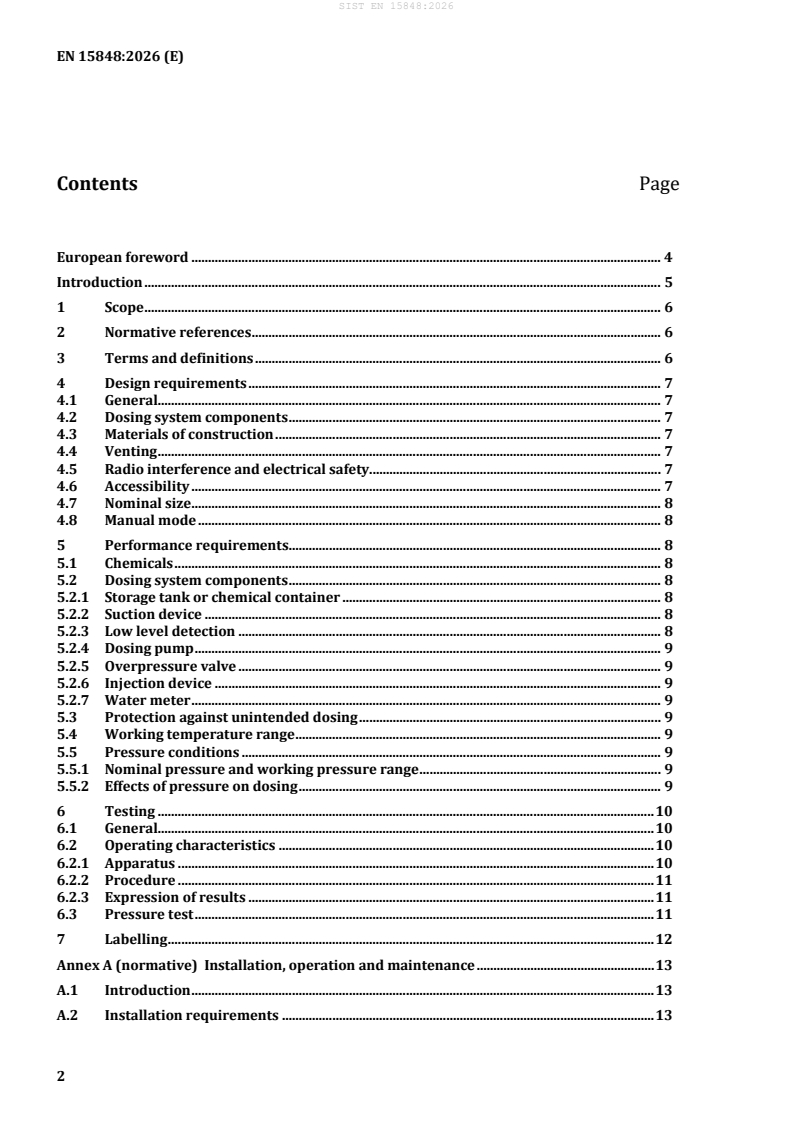
Contents Page
European foreword . 4
Introduction . 5
1 Scope . 6
2 Normative references . 6
3 Terms and definitions . 6
4 Design requirements . 7
4.1 General. 7
4.2 Dosing system components . 7
4.3 Materials of construction . 7
4.4 Venting . 7
4.5 Radio interference and electrical safety. 7
4.6 Accessibility . 7
4.7 Nominal size . 8
4.8 Manual mode . 8
5 Performance requirements . 8
5.1 Chemicals . 8
5.2 Dosing system components . 8
5.2.1 Storage tank or chemical container . 8
5.2.2 Suction device . 8
5.2.3 Low level detection . 8
5.2.4 Dosing pump . 9
5.2.5 Overpressure valve . 9
5.2.6 Injection device . 9
5.2.7 Water meter . 9
5.3 Protection against unintended dosing . 9
5.4 Working temperature range . 9
5.5 Pressure conditions . 9
5.5.1 Nominal pressure and working pressure range . 9
5.5.2 Effects of pressure on dosing . 9
6 Testing . 10
6.1 General. 10
6.2 Operating characteristics . 10
6.2.1 Apparatus . 10
6.2.2 Procedure . 11
6.2.3 Expression of results . 11
6.3 Pressure test . 11
7 Labelling . 12
Annex A (normative) Installation, operation and maintenance . 13
A.1 Introduction . 13
A.2 Installation requirements . 13
A.2.1 Equipment selection . 13
A.2.2 Installation . 13
A.2.3 Labelling . 14
A.2.4 Commissioning . 14
A.2.5 Hand over . 14
A.3 Operation requirements . 14
A.4 Maintenance requirements . 15
A.5 Repair requirements . 15
A.5.1 General . 15
A.5.2 Repair documentation . 16
A.6 Troubleshooting. 16
Bibliography . 18
European foreword
This document (EN 15848:2026) has been prepared by Technical Committee CEN/TC 164 “Water
supply”, the secretariat of which is held by AFNOR.
This European Standard shall be given the status of a national standard, either by publication of an
identical text or by endorsement, at the latest by October 2026, and conflicting national standards shall
be withdrawn at the latest by October 2026.
Attention is drawn to the possibility that some of the elements of this document may be the subject of
patent rights. CEN shall not be held responsible for identifying any or all such patent rights.
This document supersedes EN 15848:2010.
This document includes the following significant technical changes with respect to EN 15848:2010:
— safety aspects relating to the system were included;
— normative references have been updated.
Any feedback and questions on this document should be directed to the users’ national standards body.
A complete listing of these bodies can be found on the CEN website.
According to the CEN-CENELEC Internal Regulations, the national standards organisations of the
following countries are bound to implement this European Standard: Austria, Belgium, Bulgaria, Croatia,
Cyprus, Czech Republic, Denmark, Estonia, Finland, France, Germany, Greece, Hungary, Iceland, Ireland,
Italy, Latvia, Lithuania, Luxembourg, Malta, Netherlands, Norway, Poland, Portugal, Republic of North
Macedonia, Romania, Serbia, Slovakia, Slovenia, Spain, Sweden, Switzerland, Türkiye and the United
Kingdom.
Introduction
The aim of this document is to ensure that the concentration of the active chemical ingredient(s) and all
other components or minor constituents (including possible impurities) in the treated water does not
exceed the parameter values specified in [1] through the use of adjustable chemical dosing.
1 Scope
This document specifies definitions, principles of construction (but not dimensions) and design,
requirements on performance and operation as well as methods for testing the performance of adjustable
chemical dosing systems for conditioning water intended for human consumption inside buildings (see
[1]) which are permanently connected to the mains supply.
2 Normative references
The following documents are referred to in the text in such a way that some or all of their content
constitutes requirements of this document. For dated references, only the edition cited applies. For
undated references, the latest edition of the referenced document (including any amendments) applies.
EN 55011, Industrial, scientific and medical equipment - Radio-frequency disturbance characteristics -
Limits and methods of measurement (CISPR 11)
EN 60204-1, Safety of machinery - Electrical equipment of machines - Part 1: General requirements (IEC
60204-1)
EN IEC 60335-1, Household and similar electrical appliances — Safety — Part 1: General requirements
(IEC 60335-1)
EN IEC 60335-2-41, Household and similar electrical appliances - Safety - Part 2-41: Particular
requirements for pumps (IEC 60335-2-41)
EN ISO 12100, Safety of machinery — General principles for design — Risk assessment and risk reduction
(ISO 12100)
3 Terms and definitions
For the purposes of this document, the following terms and definitions apply.
ISO and IEC maintain terminology databases for use in standardization at the following addresses:
— ISO Online browsing platform: available at https://www.iso.org/obp/
— IEC Electropedia: available at https://www.electropedia.org/
3.1
adjustable dosing system
device used for the controlled addition of chemicals in concentrations that can be adjusted on the
installation site
3.2
working range
range of treated water flow rates between which the dosing system provides the required certainty of
concentration measurement of the chemicals within limits of concentration and pressure drop prescribed
by the manufacturer
Note 1 to entry: The working range covers the range between the upper and lower working limits.
3.3
dosing agent
active chemical substance for conditioning water intended for human consumption
4 Design requirements
4.1 General
The dosing system shall function to maintain a specific concentration of the chemical in the treated water.
4.2 Dosing system components
A dosing system comprises the following elements:
a) storage tank or chemical container which contains the chemical as a liquid that will be dosed into the
water pipe. The tank or the container shall be placed into an additional safety storage tank to collect
flowed back or spilled solutions.
b) suction device which comprises a suction hose and a foot valve;
c) low level detection avoiding the pump to work when storage is empty;
d) dosing pump that pumps the chemical as a liquid from the storage tank or container and doses it into
the main water flow;
e) overpressure valve as safety apparatus to avoid overpressure in the injection device;
f) injection device which comprises the hose between the pump and the mains, the injection valve and
the backflow preventer;
g) Water meter in the main water flow that transmits a control signal to the dosing pump or another
analogue or digital device that adjusts the chemical dosing in proportion to the actual flow rate;
h) safety system, installed on the pressurized supply pipeline, to protect the operator and the
environment in the event of a rupture.
4.3 Materials of construction
Materials in contact with potable water shall not have any adverse effect on hygiene. The limit values not
to be exceeded are specified in Directive (EU) 2020/2184 [1].
The temperature resistance of the injection system shall be specified.
4.4 Venting
The dosing system shall be designed so that accumulation of air or other gases is prevented.
Compliance with this requirement shall be checked by examination of the detailed technical design
documents supplied with the system.
4.5 Radio interference and electrical safety
The dosing system shall conform to EN ISO 12100, EN 55011, EN 60204-1, EN IEC 60335-1 and
EN IEC 60335-2-41. Provisions can be found in Directive 89/336/EEC [2] and Directive 73/23/EEC [3].
4.6 Accessibility
All parts which have to be accessed for replenishing of the dosing agent and for operation or servicing
shall be easily accessible.
4.7 Nominal size
If the dosing pump is controlled by signals from a water meter, the nominal size of its connection shall
correspond to the flow rates given in Table 1. The inlet connection size of the water meter may be one
size larger or smaller than the nominal size. For flange connections, the inlet flange shall conform to the
nominal size.
Table 1 — Upper limit flow rate values
Nominal size DN of water meter 15 20 25 32 40 50 65 80 100
l/s 0,35 0,63 1,0 1,6 2,53 3,89 6,67 10 15,56
Upper limit
of flow rate
1,27 2,27 3,6 5,8 9,1 14 24 36 56
m /h
NOTE These flow rates correspond to a velocity of approximately 2 m/s.
4.8 Manual mode
The dosing system shall have an indication when a manual mode is activated, for example, for
maintenance.
5 Performance requirements
5.1 Chemicals
The documentation shall define which chemicals are compatible with the dosing system and at which
maximum concentration.
All the dosed chemicals should conform to the relevant European Standards.
5.2 Dosing system components
5.2.1 Storage tank or chemical container
Materials selected for the manufacture of the dosing tank shall protect the contents against
contaminatio
...