

SIST ISO 11108:2026
(Main)Information and documentation — Archival paper — Requirements for permanence and durability
- Abstract
This document specifies the requirements for archival paper. It is applicable to unprinted papers intended for documents and publications required for permanent retention and frequent use. For these documents and publications, paper of high permanence and high durability is required.
NOTE 1 Archival paper is primarily required for documents and publications intended to be kept permanently because of their high historical, legal or other significant value. Archival paper is for special purposes, not for common use. The use of the term “archival paper” does not imply that all papers kept in archives are “archival papers”.
NOTE 2 For relationships between International Standards on paper permanence (ISO 9706), on archival paper permanence and durability (ISO 11108), and on paper stability for general graphic applications (ISO 20494), refer to Annex B.
- Status
- Not Published
- Public Enquiry End Date
- 29-Oct-2024
- Technical Committee
- IDT - Information, documentation, language and terminology
- Current Stage
- 6060 - National Implementation/Publication (Adopted Project)
- Start Date
- 11-Aug-2026
- Due Date
- 16-Oct-2026
Buy Documents
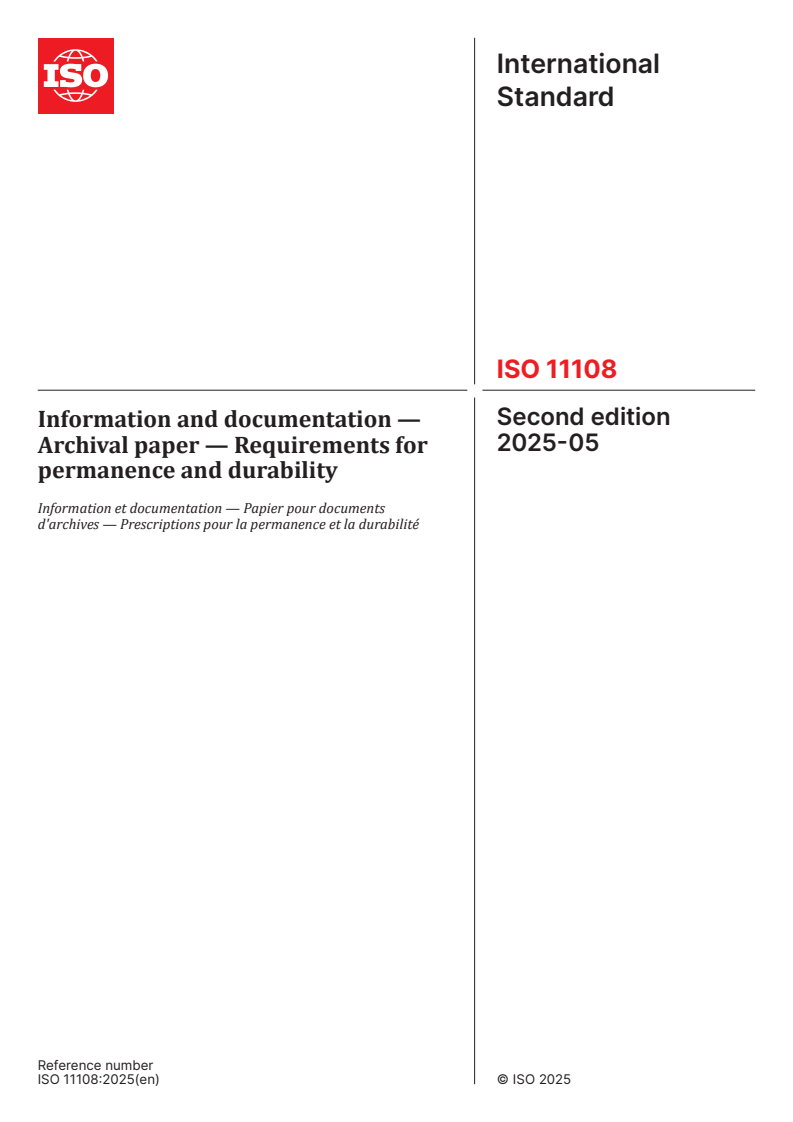
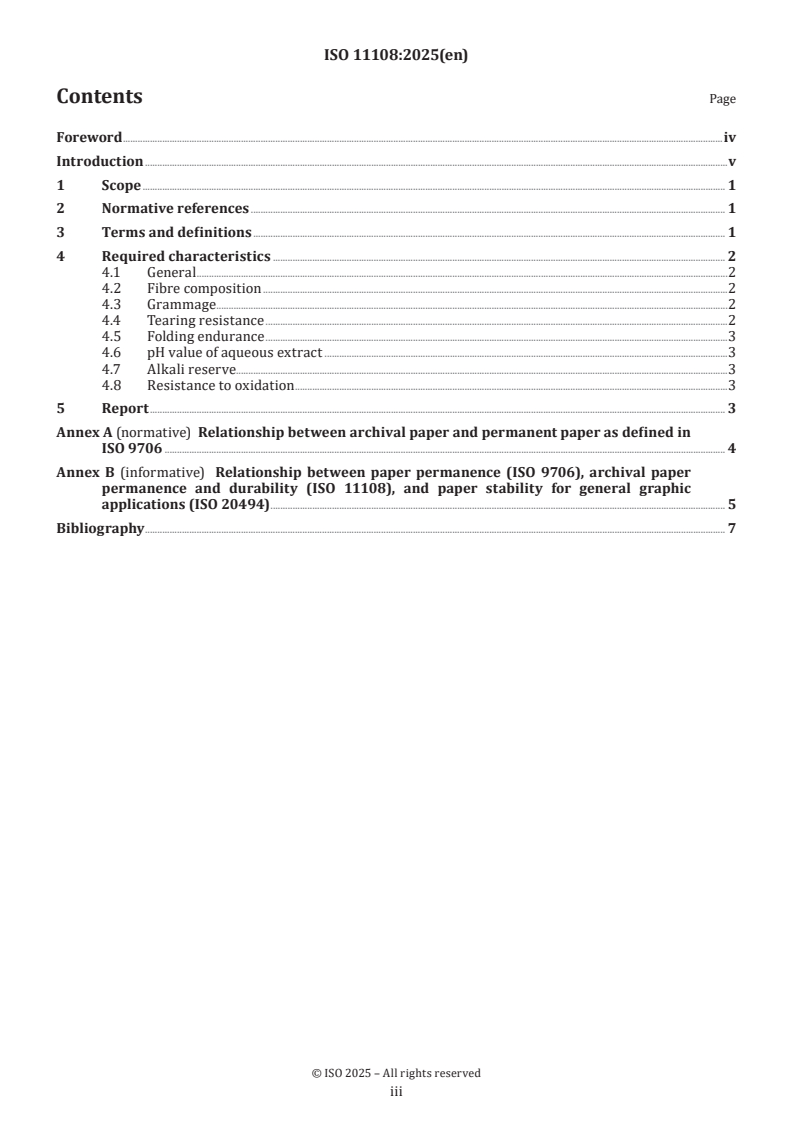
ISO 11108:2025 - Information and documentation — Archival paper — Requirements for permanence and durability Released:29. 05. 2025
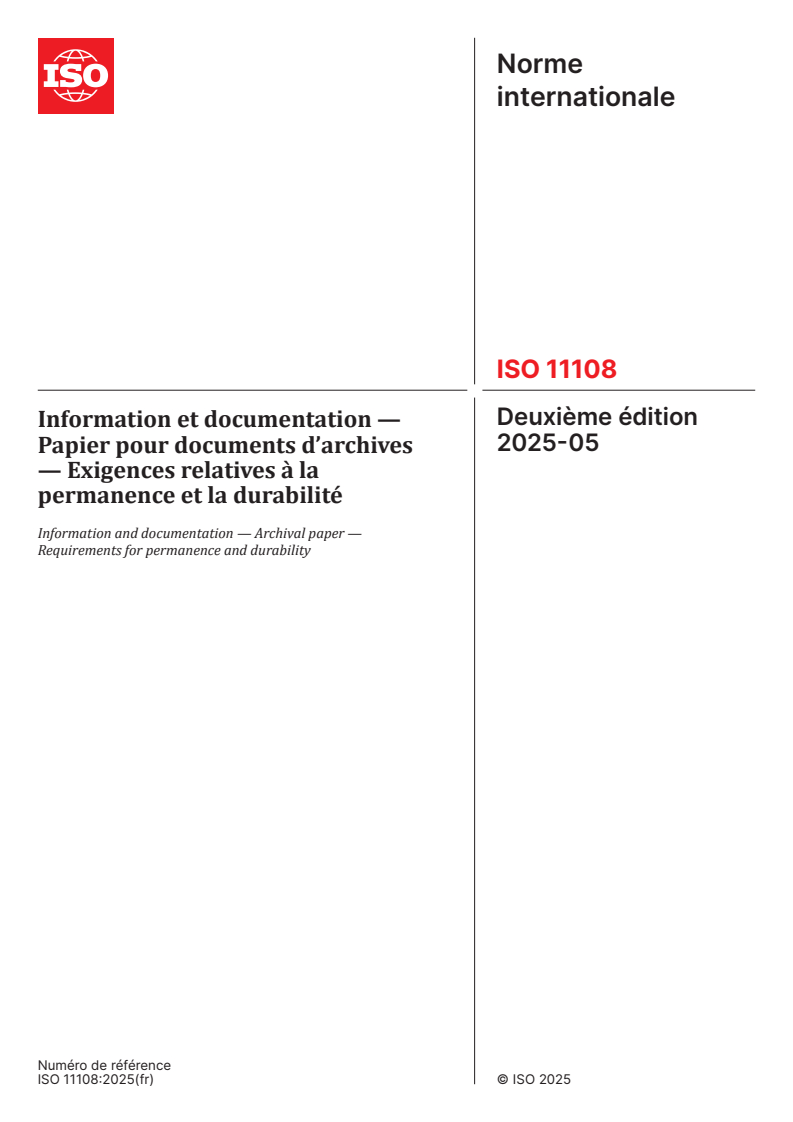
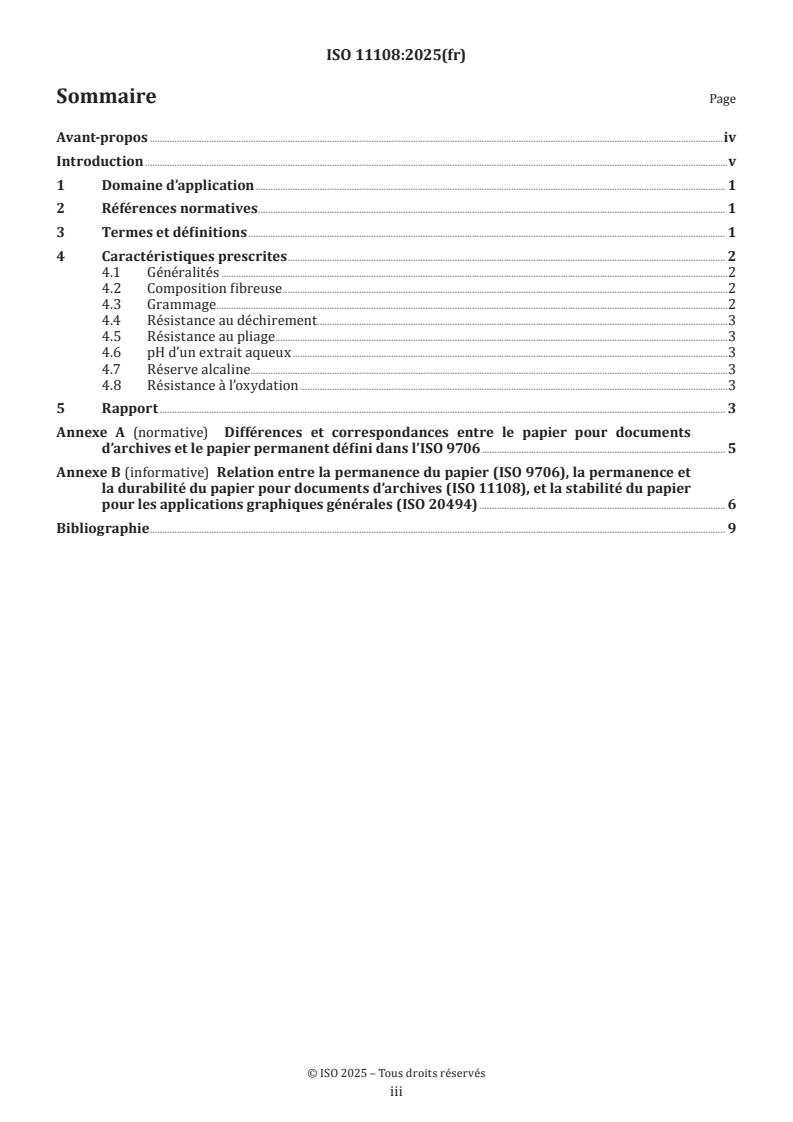
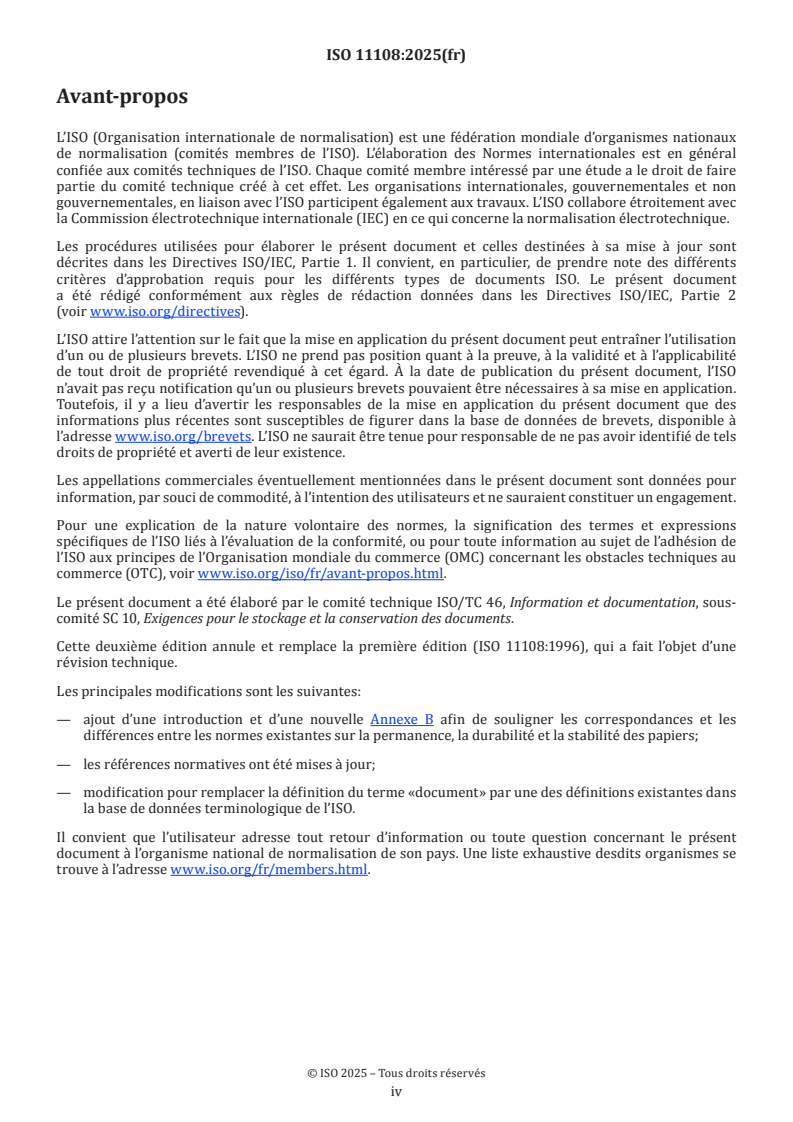
ISO 11108:2025 - Information et documentation — Papier pour documents d’archives — Exigences relatives a la permanence et la durabilité Released:8. 01. 2026


REDLINE ISO 11108:2025 - Information et documentation — Papier pour documents d’archives — Exigences relatives a la permanence et la durabilité Released:8. 01. 2026



SIST ISO 11108:2026 is a SIST standard for archival paper. It specifies requirements for unprinted paper intended for documents and publications that need permanent retention and frequent use. The standard is aimed at paper makers, test laboratories, and specifiers who need paper with high permanence and high durability.
What does SIST ISO 11108:2026 specify?
SIST ISO 11108:2026 specifies the requirements for archival paper and organizes them into scope, normative references, terms and definitions, required characteristics, and reporting. It applies to unprinted paper for records that must be kept for a long time and handled repeatedly, where both chemical stability and resistance to wear matter in practice.
| Annex | What it covers |
|---|---|
| Annex A | Relationship between archival paper and permanent paper as defined in ISO 9706 |
| Annex B | Relationship between ISO 9706, ISO 11108, and ISO 20494 |
The standard is written for special-purpose paper, not common-use paper. The introduction and notes also place it in context with ISO 9706 and ISO 20494 so users can choose the right paper specification for archives, libraries, museums, and other long-retention records.
What are the key requirements of SIST ISO 11108:2026?
SIST ISO 11108:2026 sets a small number of measurable requirements in Clause 4, and paper must meet all of them to qualify. In practice, this means the paper is checked for furnish, strength, acidity, buffering, and oxidation resistance, not just for appearance.
Clause 4.1 - sampling and visual quality. A sample is taken according to ISO 186, and the paper is inspected for obvious defects such as creases, large specks, holes, and wrinkles. This matters because archival paper must be fit for long use before laboratory testing starts.
Clause 4.2 - fibre composition. The paper is to be made mainly from cotton, cotton linters, hemp, flax, or mixtures of these. If a minor fraction of fully bleached chemical pulp is used to improve performance, its amount has to be specified, so the fibre furnish is controlled and transparent.
Clause 4.3 - grammage. Grammage, determined by ISO 536, shall be at least 70 g/m2. In practice, this sets a minimum paper mass that supports handling and durability.
Clause 4.4 - tearing resistance. The paper shall have tearing resistance of at least 350 mN in any direction, tested after conditioning at 23 °C and 50 % relative humidity. This is the handling test that shows whether the paper resists accidental tears.
Clause 4.5 - folding endurance. Folding endurance shall meet the stated minimum values, depending on the instrument used, and the test follows ISO 5626 after conditioning. The folding zone must not include a watermark, so the result reflects the paper itself rather than a local weakness.
Clause 4.6 and 4.7 - pH value and alkali reserve. The cold-water extract pH shall be 7.5 to 10.0, and the alkali reserve shall be at least 0.4 mol of acid per kilogram. Together, these requirements mean the paper is alkaline and buffered against future acid formation.
Clause 4.8 - resistance to oxidation. The paper shall have a Kappa number below 5.0, measured with ISO 302 and the modification given in ISO 9706:2025, Annex A. This limits oxidizable material such as lignin, helping the paper stay stable and resist discoloration.
Clause 5 - test report. The laboratory report has to identify the lot, give the test date and place, record visual observations and test results, and state whether the paper meets the document. This makes the result usable for purchasing, quality control, and specification records.
What terms does SIST ISO 11108:2026 define?
SIST ISO 11108:2026 defines a short set of terms that frame the whole document.
- document - information and the medium on which it is contained; in this standard, it refers to a paper object.
- archival paper - paper of high permanence and high durability.
- permanence - ability to remain chemically and physically stable over long periods of time.
- durability - ability to resist the effects of wear and tear when in use.
- alkali reserve - a compound, such as calcium carbonate, that neutralizes acid generated during ageing or from atmospheric pollution.
Who uses SIST ISO 11108:2026?
SIST ISO 11108:2026 is used by paper manufacturers, testing laboratories, and organizations that specify paper for long-term records. The introduction points to archives, libraries, museums, books, files, documents, and other records kept for legal, cultural policy, or historical reasons.
Quality managers and buyers use it when they need to define paper that will be stored permanently and handled repeatedly. It is also useful when a procurement specification needs measurable acceptance criteria instead of a general claim about “archival” quality.
What changed in SIST ISO 11108:2026 from the previous edition?
This second edition replaces ISO 11108:1996 and is described as technically revised. The listed changes are:
- an introduction was added;
- a new Annex B was added to explain the relationship and differences among ISO 9706, ISO 11108, and ISO 20494;
- the normative references were updated;
- the term document was aligned with an existing ISO terminology database definition.
Which standards are used with SIST ISO 11108:2026?
SIST ISO 11108:2026 relies on several other ISO standards for sampling, conditioning, and test methods.
- ISO 186 - sampling of the paper lot.
- ISO 187 - conditioning and test atmosphere.
- ISO 302 - Kappa number for oxidation resistance.
- ISO 536 - grammage.
- ISO 1974 - tearing resistance by the Elmendorf method.
- ISO 4046-3 - paper-making terminology, used for the watermark note.
- ISO 5626 - folding endurance.
- ISO 6588-1 - pH of aqueous extracts by cold extraction.
- ISO 9706:2025 - the related permanence standard and the Annex A modification for the Kappa test.
- ISO 10716 - alkali reserve.
- ISO 20494 - the comparison standard for paper stability in general graphic applications.
What does the SIST ISO 11108:2026 document contain?
SIST ISO 11108:2026 contains the specification itself, the test report requirements, and two annexes that relate it to nearby paper standards. Clause 4 brings together the core acceptance tests for paper furnish, strength, pH, buffering, and oxidation resistance, so users can check a lot against a single set of criteria.
Clause 5 gives the report content needed to document conformity or nonconformity. Annex A shows how archival paper relates to permanent paper under ISO 9706, and Annex B provides a comparative overview of ISO 9706, ISO 11108, and ISO 20494 for specification work and standard selection.
Relations
- Effective Date
- 27-Jan-2024
Buy Documents
ISO 11108:2025 - Information and documentation — Archival paper — Requirements for permanence and durability Released:29. 05. 2025
ISO 11108:2025 - Information et documentation — Papier pour documents d’archives — Exigences relatives a la permanence et la durabilité Released:8. 01. 2026
REDLINE ISO 11108:2025 - Information et documentation — Papier pour documents d’archives — Exigences relatives a la permanence et la durabilité Released:8. 01. 2026
Get Certified
Connect with accredited certification bodies for this standard

Control Union Certifications
Global certification for agriculture and sustainability.

Gozdarski inštitut Slovenije
Slovenian Forestry Institute. Forest management certification support, timber testing.
Sponsored listings
Frequently Asked Questions
SIST ISO 11108:2026 is a standard published by the Slovenian Institute for Standardization (SIST). Its full title is "Information and documentation — Archival paper — Requirements for permanence and durability". This standard covers: This document specifies the requirements for archival paper. It is applicable to unprinted papers intended for documents and publications required for permanent retention and frequent use. For these documents and publications, paper of high permanence and high durability is required. NOTE 1 Archival paper is primarily required for documents and publications intended to be kept permanently because of their high historical, legal or other significant value. Archival paper is for special purposes, not for common use. The use of the term “archival paper” does not imply that all papers kept in archives are “archival papers”. NOTE 2 For relationships between International Standards on paper permanence (ISO 9706), on archival paper permanence and durability (ISO 11108), and on paper stability for general graphic applications (ISO 20494), refer to Annex B.
This document specifies the requirements for archival paper. It is applicable to unprinted papers intended for documents and publications required for permanent retention and frequent use. For these documents and publications, paper of high permanence and high durability is required. NOTE 1 Archival paper is primarily required for documents and publications intended to be kept permanently because of their high historical, legal or other significant value. Archival paper is for special purposes, not for common use. The use of the term “archival paper” does not imply that all papers kept in archives are “archival papers”. NOTE 2 For relationships between International Standards on paper permanence (ISO 9706), on archival paper permanence and durability (ISO 11108), and on paper stability for general graphic applications (ISO 20494), refer to Annex B.
SIST ISO 11108:2026 is classified under the following ICS (International Classification for Standards) categories: 01.140.20 - Information sciences; 85.060 - Paper and board. The ICS classification helps identify the subject area and facilitates finding related standards.
SIST ISO 11108:2026 has the following relationships with other standards: It is inter standard links to SIST ISO 11108:2003. Understanding these relationships helps ensure you are using the most current and applicable version of the standard.
SIST ISO 11108:2026 is available in PDF format for immediate download after purchase. The document can be added to your cart and obtained through the secure checkout process. Digital delivery ensures instant access to the complete standard document.
Standards Content (Sample)
Contents
- Introduction
- 1 Scope
- 2 Normative references
- 3 Terms and definitions
- 3.1 document
- 3.2 archival paper
- 3.3 permanence
- 3.4 durability
- 3.5 alkali reserve
- 4 Required characteristics
- 4.1 General
- 4.2 Fibre composition
- 4.3 Grammage
- 4.4 Tearing resistance
- 4.5 Folding endurance
- 4.7 Alkali reserve
- 4.8 Resistance to oxidation
- 5 Report
- Annex A
- Annex B
- Bibliography
Introduction
This document intends to define a permanent and durable paper that is most suitable for indefinite storage, e.g. in archives, libraries, and museums, and that will show no or only slight changes in optical and mechanical properties when stored and handled for a long period. Such papers can be used for books as well as for files, documents and other records that are to be stored and used permanently for legal, cultural policy or other reasons. For this purpose, this document provides a method for specifying paper, which, according to the present state of knowledge, has a high degree of permanence and durability. As research indicates that the deterioration of paper is due to the presence of cellulose-degrading compounds in the paper furnish and materials incorporated in the paper during manufacture, papers eligible for permanent use are required to be free of any type of acid sizing or other acid-producing substances, and of oxidizable matter that causes undesirable discolouration, e.g. lignin or recycled material of uncertain composition.
To ensure durability over time, well-defined fibre sources are important. This document requires a specified fibre composition in order to ascertain a low degree of oxidizable or acid-producing substances and to ensure durable strength. In addition, strength is tested through both tearing resistance and folding endurance. This document is based on a small number of quantitative tests for which limiting values have been specified. Paper classified in accordance with this document shall show measurement results within the specified limits for all prescribed tests.
There are two other International Standards, apart from this document, regarding different applications of paper:
- ISO 9706, which describes permanent paper with the same permanence requirements as for this document but not including durability (ability to withstand the effects of wear and tear during use).
- ISO 20494, which describes paper for general graphic applications, not intended for permanent storage, including newspapers, magazines, catalogues, books, office printouts and copies where changes in optical properties over time can be tolerated.
This document and ISO 9706 differ from ISO 20494; they are not comparable either in approach or in method. In ISO 20494, the decrease in mechanical-physical strength that a paper suffers when subjected to moist heat treatment for up to 12 days is the basis for defining service life. Conversely, this document and ISO 9706 are based on the fact that acid-catalysed hydrolysis is the major cause of the degradation of cellulose, the substance that provides strength to paper, and that this acid hydrolysis is strongly inhibited if an alkaline buffer and no or little acid-forming substances are present in the paper. Furthermore, this document and ISO 9706 define a resistance to oxidation, which requires the paper to have a Kappa number of less than 5, corresponding to about 10 g of lignin per kg of paper. This document and ISO 9706 therefore specify a paper that is expected to remain substantially unchanged over time in long-term storage.
Both ISO 9706 and this document evaluate the permanence properties of the paper. For a document to be permanent, however, it must be noted that both a permanent paper substrate and a permanent recording method (i.e. writing, printing or copying) must be used in combination. Permanence and durability of recording materials are tested according to ISO 11798.
This document may be used as a stand-alone specification. It may also be incorporated as a component in other specifications used in trade or as national or international standards for more specific purposes.
International Standard ISO 11108:2025(en) Information and documentation — Archival paper — Requirements for permanence and durability
1 Scope
This document specifies the requirements for archival paper. It is applicable to unprinted papers intended for documents and publications required for permanent retention and frequent use. For these documents and publications, paper of high permanence and high durability is required. NOTE 1 Archival paper is primarily required for documents and publications intended to be kept permanently because of their high historical, legal or other significant value. Archival paper is for special purposes, not for common use. The use of the term “archival paper” does not imply that all papers kept in archives are “archival papers”. NOTE 2 For relationships between International Standards on paper permanence (ISO 9706), on archival paper permanence and durability (ISO 11108), and on paper stability for general graphic applications (ISO 20494), refer to Annex B.
...
Contents
- Introduction
- 1 Domaine d’application
- 2 Références normatives
- 3 Termes et définitions
- 3.1 document
- 3.2 papier pour documents d’archives
- 3.3 permanence
- 3.4 durabilité
- 3.5 réserve alcaline
- 4 Caractéristiques prescrites
- 4.1 Généralités
- 4.2 Composition fibreuse
- 4.3 Grammage
- 4.4 Résistance au déchirement
- 4.5 Résistance au pliage
- 4.7 Réserve alcaline
- 4.8 Résistance à l’oxydation
- 5 Rapport
- Annexe A
- Annexe B
- Bibliographie
Introduction
Le présent document vise à définir un papier permanent et durable qui est le mieux adapté à la conservation pérenne, par exemple dans les archives, les bibliothèques et les musées, et qui ne présente aucun ou seulement de légers changements de propriétés optiques et mécaniques lorsqu’il est conservé et manipulé sur une longue période. Ces papiers peuvent être utilisés pour des livres, ainsi que pour des dossiers, des documents et autres documents d’activité qui doivent être conservés et utilisés de façon permanente pour des raisons légales, patrimoniales ou autres. À cet effet, le présent document fournit une méthode de spécification du papier qui, selon l’état actuel des connaissances, présente un haut degré de permanence et de durabilité. La recherche établit que la dégradation du papier est due à la présence, dans la pâte à papier et dans les produits incorporés au papier durant sa fabrication de composés dommageables pour la cellulose, les papiers destinés à un usage permanent doivent être exempts de tout collage acide ou d’autres substances générant de l’acidité, ainsi que de matière oxydable donnant lieu à une coloration indésirable, lignine ou matière recyclée de composition incertaine par exemple.
Afin d’assurer la durabilité dans le temps, il est important que les fibres soient issues de sources bien définies. Le présent document exige une composition fibreuse spécifique qui garantit une faible quantité de substances oxydables ou génératrices d’acidité et assure une résistance mécanique durable. De plus, la résistance mécanique est mesurée à la fois par un essai de résistance au déchirement et par un essai de résistance au pliage.
Le présent document s’appuie sur un nombre restreint d’essais quantitatifs pour lesquels des valeurs limites ont été spécifiées. Pour être conforme au présent document, le papier doit donner, pour tous les essais prescrits, des résultats dont les valeurs sont comprises dans les limites spécifiées. Outre le présent document, il existe deux autres normes traitant d’applications différentes du papier:
- l’ISO 9706, qui décrit un papier permanent répondant aux mêmes exigences de permanence que celles énoncées dans le présent document, mais n’incluant pas la durabilité (capacité de résister aux effets de l’usure normale lors de l’utilisation);
- l’ISO 20494, qui décrit un papier utilisé pour des applications graphiques générales et non destiné à une conservation permanente, ces applications incluant les journaux, les magazines, les catalogues, les livres, les impressions bureautiques et reproductions pour lesquels des changements de propriétés optiques au fil du temps sont tolérés.
Le présent document et l’ISO 9706 diffèrent de l’ISO 20494, tant par l’approche adoptée que par les méthodes utilisées. Dans l’ISO 20494, la durée de vie d’un papier est définie sur la base de la réduction de sa résistance mécanique lorsqu’il est soumis à un traitement à la chaleur humide pendant 12 jours au maximum. À l’inverse, l’approche suivie dans le présent document et dans l’ISO 9706 repose sur le fait que l’hydrolyse acido-catalysée est la première cause de dégradation de la cellulose, la substance qui donne sa résistance au papier, et que cette hydrolyse acide est fortement inhibée si le papier contient un tampon alcalin et peu ou pas de substances génératrices d’acidité. En outre, le présent document et l’ISO 9706 fournissent une définition de la résistance à l’oxydation qui exige que le papier présente un indice Kappa inférieur à 5, ce qui correspond à environ 10 g de lignine par kilogramme de papier. Le présent document et l’ISO 9706 spécifient donc un papier qui est censé conserver ses propriétés quasi intactes au fil du temps lors d’une conservation à long terme.
L’ISO 9706 et le présent document évaluent tous les deux les propriétés de permanence du papier. Cependant, pour qu’un document soit permanent, il faut noter qu’il doit être composé à la fois d’un support en papier permanent et d’un procédé d’enregistrement permanent (c’est-à-dire l’écriture, l’impression ou la reprographie). La permanence et la durabilité des matériaux d’images ou de tracé sont soumises à essai conformément à l’ISO 11798.
Le présent document peut être utilisé comme une spécification indépendante. Il peut également être incorporé dans d’autres spécifications utilisées dans le commerce, ou dans d’autres Normes nationales ou internationales, à des fins plus particulières.
Norme internationale ISO 11108:2025(fr) Information et documentation — Papier pour documents d’archives — Exigences relatives à la permanence et la durabilité
1 Domaine d’application
Le présent document international fixe les exigences pour le papier pour documents d’archives. Il est applicable aux papiers non imprimés utilisés pour les documents et les publications destinés à une conservation et à un usage permanents. Pour ces documents et ces publications, un papier présentant un haut degré de permanence et de durabilité est nécessaire.
NOTE 1 L’utilisation du papier pour documents d’archives est en priorité requise pour les documents et les publications destinés à être soumis à une conservation permanente en raison de leur haute valeur historique, légale ou autre. Le papier pour documents d’archives est conçu à des fins particulières, non pour l’usage courant. L’utilisation du terme «papier pour documents d’archives» n’implique pas que tous les papiers conservés dans les dépôts sont des « papiers pour documents d’archives ».
NOTE 2 Se reporter à l’Annexe B pour les correspondances entre les Normes internationales relatives à la permanence du papier (ISO 9706), à la permanence et la durabilité du papier pour documents d’archives (ISO 11108) et à la stabilité du papier pour les applications graphiques générales (ISO 20494).
2 Références normatives
Les documents suivants sont cités dans le texte de sorte qu’ils constituent, pour tout ou partie de leur contenu, des exigences du présent document. Pour les références datées, seule l’édition citée s’applique. Pour les références non datées, la dernière édition du document de référence s'applique (y compris les éventuels amendements).
...
Contents
- Introduction
- 1 Domaine d’application
- 2 Références normatives
- 3 Termes et définitions
- 3.1 document
- 3.2 papier pour documents d’archives
- 3.3 permanence
- 3.4 durabilité
- 3.5 réserve alcaline
- 4 Caractéristiques prescrites
- 4.1 Généralités
- 4.2 Composition fibreuse
- 4.3 Grammage
- 4.4 Résistance au déchirement
- 4.5 Résistance au pliage
- 4.7 Réserve alcaline
- 4.8 Résistance à l’oxydation
- 5 Rapport
- Annexe A
- Annexe B
- Bibliographie
Introduction
Le présent document vise à définir un papier permanent et durable qui est le mieux adapté à la conservation pérenne, par exemple dans les archives, les bibliothèques et les musées, et qui ne présente aucun ou seulement de légers changements de propriétés optiques et mécaniques lorsqu’il est conservé et manipulé sur une longue période. Ces papiers peuvent être utilisés pour des livres, ainsi que pour des dossiers, des documents et autres documents d’activité qui doivent être conservés et utilisés de façon permanente pour des raisons légales, patrimoniales ou autres. À cet effet, le présent document fournit une méthode de spécification du papier qui, selon l’état actuel des connaissances, présente un haut degré de permanence et de durabilité. La recherche établit que la dégradation du papier est due à la présence, dans la pâte à papier et dans les produits incorporés au papier durant sa fabrication de composés dommageables pour la cellulose, les papiers destinés à un usage permanent doivent être exempts de tout collage acide ou d’autres substances générant de l’acidité, ainsi que de matière oxydable donnant lieu à une coloration indésirable, lignine ou matière recyclée de composition incertaine par exemple.
Afin d’assurer la durabilité dans le temps, il est important que les fibres soient issues de sources bien définies. Le présent document exige une composition fibreuse spécifique qui garantit une faible quantité de substances oxydables ou génératrices d’acidité et assure une résistance mécanique durable. De plus, la résistance mécanique est mesurée à la fois par un essai de résistance au déchirement et par un essai de résistance au pliage.
Le présent document s’appuie sur un nombre restreint d’essais quantitatifs pour lesquels des valeurs limites ont été spécifiées. Pour être conforme au présent document, le papier doit donner, pour tous les essais prescrits, des résultats dont les valeurs sont comprises dans les limites spécifiées. Outre le présent document, il existe deux autres normes traitant d’applications différentes du papier :
- l’ISO 9706, qui décrit un papier permanent répondant aux mêmes exigences de permanence que celles énoncées dans le présent document, mais n’incluant pas la durabilité (capacité de résister aux effets de l’usure normale lors de l’utilisation) ;);
- l’ISO 20494, qui décrit un papier utilisé pour des applications graphiques générales et non destiné à une conservation permanente, ces applications incluant les journaux, les magazines, les catalogues, les livres, les impressions bureautiques et reproductions pour lesquels des changements de propriétés optiques au fil du temps sont tolérés.
Le présent document et l’ISO 9706 diffèrent de l’ISO 20494, tant par l’approche adoptée que par les méthodes utilisées. Dans l’ISO 20494, la durée de vie d’un papier est définie sur la base de la réduction de sa résistance mécanique lorsqu’il est soumis à un traitement à la chaleur humide pendant 12 jours au maximum. À l’inverse, l’approche suivie dans le présent document et dans l’ISO 9706 repose sur le fait que l’hydrolyse acido--catalysée est la première cause de dégradation de la cellulose, la substance qui donne sa résistance au papier, et que cette hydrolyse acide est fortement inhibée si le papier contient un tampon alcalin et peu ou pas de substances génératrices d’acidité. En outre, le présent document et l’ISO 9706 fournissent une définition de la résistance à l’oxydation qui exige que le papier présente un indice Kappa inférieur à 5, ce qui correspond à environ 10 g de lignine par kilogramme de papier. Le présent document et l’ISO 9706 spécifient donc un papier qui est censé conserver ses propriétés quasi intactes au fil du temps lors d’une conservation à long terme.
L’ISO 9706 et le présent document évaluent tous les deux les propriétés de permanence du papier. Cependant, pour qu’un document soit permanent, il faut noter qu’il doit être composé à la fois d’un support en papier permanent et d’un procédé d’enregistrement permanent (c’est-à-dire l’écriture, l’impression ou la
ISO 11108:2025(fr) reprographie). La permanence et la durabilité des matériaux d’images ou de tracé sont soumises à essai conformément à l’ISO 11798.
Le présent document peut être utilisé comme une spécification indépendante. Il peut également être incorporé dans d’autres spécifications utilisées dans le commerce, ou dans d’autres Normes nationales ou internationales, à des fins plus particulières.
Norme Internationale ISO 11108:2025(fr)
Information et documentation — Papier pour documents d’archives - Exigences relatives à la permanence et la durabilité
1 Domaine d’application
Le présent document international fixe les exigences pour le papier pour documents d’archives. Il est applicable aux papiers non imprimés utilisés pour les documents et les publications destinés à une conservation et à un usage permanents. Pour ces documents et ces publications, un papier présentant un haut degré de permanence et de durabilité est nécessaire.
NOTE 1 L’utilisation du papier pour documents d’archives est en priorité requise pour les documents et les publications destinés à être soumis à une conservation permanente en raison de leur haute valeur historique, légale ou autre. Le papier pour documents d’archives est conçu à des fins particulières, non pour l’usage courant. L’utilisation du terme « «papier pour documents d’archives »» n’implique pas que tous les papiers conservés dans les dépôts sont des « papiers pour documents d’archives ».
NOTE 2 Se reporter à l’Annexe BAnnexe B pour les correspondances entre les Normes internationales relatives à la permanence du papier (ISO 9706), à la permanence et la durabilité du papier pour documents d’archives (ISO 11108) et à la stabilité du papier pour les applications graphiques générales (ISO 20494).
2 Références normatives
Les documents suivants sont cités dans le texte de sorte qu’ils constituent, pour tout ou partie de leur contenu, des exigences du présent document. Pour les références datées, seule l’édition citée s’applique. Pour les références non datées, la dernière édition du document de référence s'applique (y compris les éventuels amendements).
...
Contents
- Introduction
- 1 Scope
- 2 Normative references
- 3 Terms and definitions
- 3.1 document
- 3.2 archival paper
- 3.3 permanence
- 3.4 durability
- 3.5 alkali reserve (of a paper)
- 4 Required characteristics
- 4.1 General
- 4.2 Fibre composition
- 4.3 Grammage
- 4.4 Tearing resistance
- 4.5 Folding endurance
- 4.7 Alkali reserve
- 4.8 Resistance to oxidation
- 5 Report
- Annex A
- Annex B
- Bibliography
Introduction
The intention of ISO 11108 is to define a permanent and durable paper that is most suitable for indefinite storage e.g. in archives, libraries, and museums, and that will show no or only slight changes in optical and mechanical properties when stored and handled for a long period. Such papers can be used for books as well as for files, documents and other records that are to be stored and used permanently for legal, cultural policy or other reasons. For this purpose, this document provides a method for specifying paper, which, according to the present state of knowledge, has a high degree of permanence and durability. As research indicates that the deterioration of paper is due to the presence of cellulose-degrading compounds in the paper furnish and materials incorporated in the paper during manufacture, papers eligible for permanent use are required to be free of any type of acid sizing or other acid-producing substances, and of oxidizable matter that causes undesirable discolouration e.g. lignin or recycled material of uncertain composition.
To ensure durability over time, well-defined fibre sources are important. This document requires a specified fibre composition in order to ascertain a low degree of oxidizable or acid-producing substances and to ensure durable strength. In addition, strength is tested through both tearing resistance and folding endurance. This document is based on a small number of quantitative tests for which limiting values have been specified. Paper classified in accordance with this document shall show measurement results within the specified limits for all prescribed tests.
There are two other standards, apart from ISO 11108, regarding either permanence, or stability of papers:
- ISO 9706, Information and documentation – Paper for documents - Requirements for permanence (permanent paper), which describes permanent paper with the same permanence requirements as for ISO 11108 but not including durability (ability to withstand the effects of wear and tear during use).
- ISO 20494, Paper - Requirements for stability for general graphic applications (stable paper), which describes paper for general graphic applications, not intended for permanent storage, including newspapers, magazines, catalogues, books, office printouts and copies where changes in optical properties over time can be tolerated.
ISO 11108 and 9706 differ from ISO 20494; they are not comparable either in approach or in method. In ISO 20494, the decrease in mechanical-physical strength that a paper suffers when subjected to moist heat treatment for up to 12 days is the basis for defining service life. Conversely, ISO 11108 and ISO 9706 are based on the fact that acid-catalyzed hydrolysis is the major cause of the degradation of cellulose, the substance that provides strength to paper, and that this acid hydrolysis is strongly inhibited if an alkaline buffer and no or little acid-forming substances are present in the paper. Furthermore, ISO 11108 and ISO 9706 define a resistance to oxidation, which requires the paper to have a Kappa number of less than 5, corresponding to about 1 % lignin. ISO 11108 and ISO 9706 therefore specify a paper that is expected to remain substantially unchanged over time in long-term storage. Both ISO 9706 and ISO 11108 evaluate the permanence properties of the paper. For a document to be permanent, however, it shall be noted that both a permanent paper substrate and a permanent recording method (i.e. writing, printing or copying) must be used in combination. Permanence and durability of recording materials are tested according to ISO 11798.
This document may be used as a stand-alone specification. It may also be incorporated as a component in other specifications used in trade or as national or international standards for more specific purposes.
oSIST ISO/DIS 11108:2024
oSIST ISO/DIS 11108:2024 DRAFT International Standard ISO/DIS 11108:2024(en) Information and documentation — Archival paper — Requirements for permanence and durability
1 Scope
This international Standard specifies the requirements for archival paper. It is applicable to unprinted papers intended for documents and publications required for permanent retention and frequent use. For these documents and publications, paper of high permanence and high durability is required. NOTE 1 Archival paper is primarily required for documents and publications intended to be kept permanently because of their high historical, legal or other significant value. Archival paper is for special purposes, not for common use. The use of the term “archival paper” does not imply that all papers kept in archives are “archival papers”. NOTE 2 For relationships between International Standards on paper permanence (ISO 9706), on archival paper permanence and durability (ISO 11108), and on paper stability for general graphic applications (ISO 20494), refer to Annex B.
...