

SIST EN 50742:2027
(Main)Safety of machinery - Protection against corruption
- Abstract
This document provides requirements and recommendations for protection against corruption of machinery, related products, and partly completed machinery, hereafter referred to as ‘machinery’, where such corruption can influence the safety of the machinery, resulting in hazardous situations.
This document applies to
- hardware components, including interfaces to remote devices and control systems, that can transmit signals or data;
- software and data;
if they can influence the safety of the machinery.
NOTE 1 Topics can overlap with the domain of cybersecurity but are not necessarily identical in their coverage.
NOTE 2 This document does not describe functional safety requirements of control systems in machinery.
Machinery interfaces to external systems and services are in the scope of this document. External systems and services are out of the scope of this document. This document is not applicable to machinery manufactured before the date of its publication. This document specifies requirements related to protection against corruption related risks in all lifecycle steps such as
- development;
- manufacturing;
- commissioning;
- operation;
- maintenance;
- decommissioning.
- Status
- Not Published
- Public Enquiry End Date
- 04-Mar-2026
- Technical Committee
- MOV - Measuring equipment for electromagnetic quantities
- Current Stage
- 6060 - National Implementation/Publication (Adopted Project)
- Start Date
- 26-Nov-2026
- Due Date
- 31-Jan-2027

SIST EN 50742:2027 is a standard for safety of machinery that addresses protection against corruption. It specifies requirements and recommendations to prevent accidental and intentional corruption of machinery hardware, software and data that could lead to hazardous situations, for machinery designers, control system manufacturers and integrators. The document is organized around scope, terms, protection principles, process and product requirements, information for use, and informative annexes for logging and threat analysis.
What does SIST EN 50742:2027 specify?
SIST EN 50742:2027 covers protection against corruption for machinery, related products and partly completed machinery. It applies to hardware components with interfaces that transmit signals or data, and to software and data, when they could influence machine safety.
The scope is practical: it covers development through decommissioning, including commissioning, operation and maintenance. It also covers machinery interfaces to external systems and services, while those external systems and services themselves remain outside the scope.
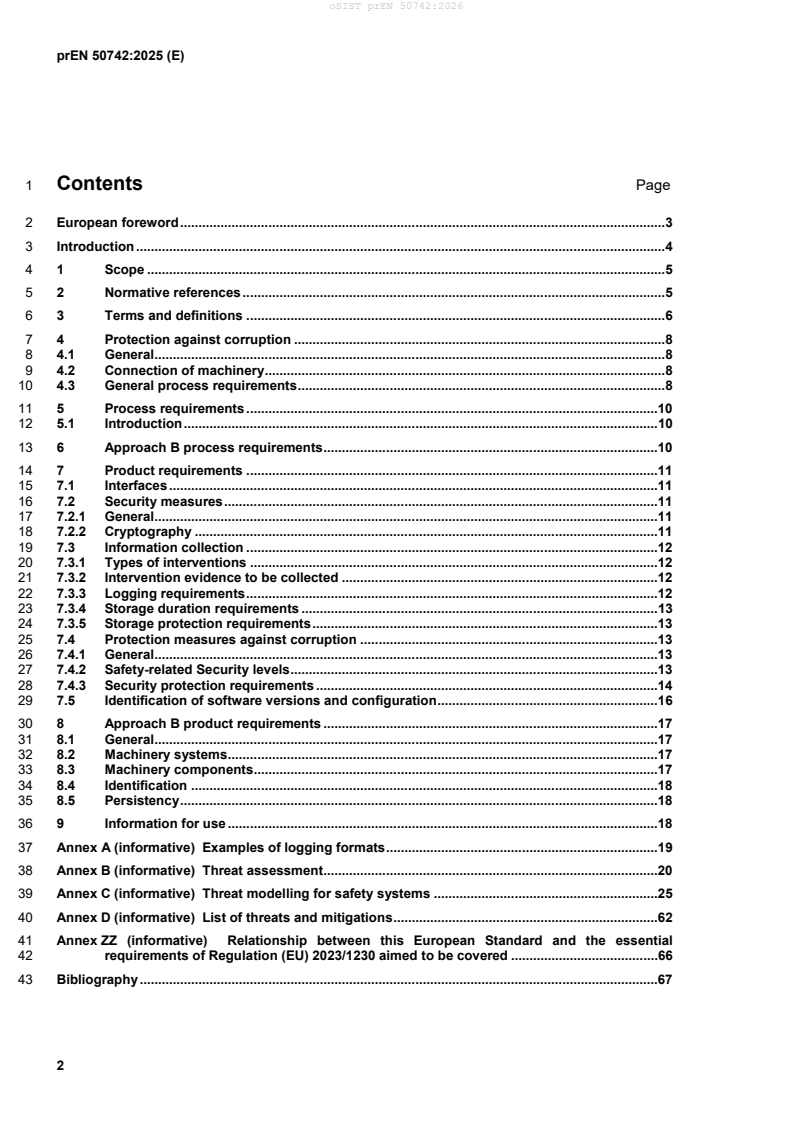
The document is organized into clauses 1 to 9, with informative Annexes A to D and Annex ZZ.
| Annex | What it covers |
|---|---|
| Annex A | Examples of logging formats |
| Annex B | Threat assessment |
| Annex C | Threat modelling for safety systems |
| Annex D | List of threats and mitigations |
| Annex ZZ | Relationship with Regulation (EU) 2023/1230 |
What are the key requirements of SIST EN 50742:2027?
SIST EN 50742:2027 gives two allowed routes: Approach A in Clauses 5 and 7, or Approach B in Clauses 6 and 8. In both cases, the designer first performs a risk assessment to EN ISO 12100, then a threat assessment, and then selects protection measures that fit the machine and its security context.
Risk assessment, threat assessment and security context
Clause 4.3 requires the designer to define the security context for the machine and to deal with vulnerabilities in order. First eliminate vulnerabilities that can lead to hazardous situations, then mitigate those that remain, and finally describe compensating countermeasures in the information for use. In practice, that means the design should remove unnecessary interfaces where possible, harden the remaining ones, and tell the user what conditions or external safeguards are needed.
Clause 4.3 also says that countermeasures shall not reduce functional safety. That matters because a security feature can create a new safety problem if, for example, it slows a safety function too much.
Connections and interfaces
Clause 4.2 requires the design and construction of machinery to prevent hazardous situations through physical, logical or indirect connections. Clause 7.1 then requires all accessible machinery interfaces that can affect safety to be identified and protected with countermeasures or compensating countermeasures. In practice, this means remote connections, service ports, wireless links, fieldbuses and similar interfaces must be assessed as part of the safety design, not treated as optional extras.
Logging, evidence and traceability
Clause 7.3 requires the machine to collect evidence of interventions that affect safety-relevant software or data. The document identifies interventions such as safety parametrization or configuration changes, updates to SRESW and SRASW, hazardous HMI parametrization, and software that displays safety instructions.
The evidence has to support traceability, be readable and accessible, and be described in the documentation so that users can access and interpret it. If digital evidence is not reasonably practicable, physical evidence can be used instead. Clause 7.3.4 requires tracing log data records to be stored for at least five years and to be enabled from the time the machine is put into service. Clause 7.3.5 requires logs to be secured against tampering and log deletion to be possible only by an authorized procedure.
Safety-related Security levels
Clause 7.4 requires a Safety-related Security level (SRSL) to be determined and documented for each identified safety function. SRSL0 is for a completely isolated safety system, while SRSL1 to SRSL3 cover increasing levels of protection as the attack potential rises.
This matters because the standard ties the level of protection to the real exposure of each safety function. Clause 7.4.3 then sets the minimum protection requirements for each SRSL, including authentication, authorization, integrity checks, input validation, physical tampering detection and authenticity checks for critical data. At the highest level, the requirements become stricter, for example unique authentication, role-based authorization, secure boot, cryptographic verification and strict validation of input data.
Software identification and configuration
Clause 7.5 requires software versions and configuration information relevant to protection against corruption to be available on demand in human-readable form, either built into the machine or provided by an external tool. Clause 8.4 repeats this requirement for safety functions under Approach B. In practice, operators and service personnel need a reliable way to identify what is installed, what has changed and whether the current configuration matches what was approved.
Approach B requirements
Clause 8 applies when the machinery is developed in the context of the EN IEC 62443 series. For machinery systems, Clause 8.2 requires compliance with EN IEC 62443-3-3:2019 and the security requirements listed in Table 3. For machinery components, Clause 8.3 requires compliance with EN IEC 62443-4-2:2019 and the security requirements listed in Table 4.
Clause 8.3 also allows compensating countermeasures at system level to support a component that does not meet every listed component requirement on its own. If that happens, the component information for use has to say which security requirements are not met and which compensating countermeasures are needed. Clause 8.5 requires audit records for safety functions to remain persistent for at least five years.
Information for use
Clause 9 requires the information for use to state the machine’s security context, identify software versions and configuration information relevant for safety functions, explain how to access that information and describe permitted or prohibited modifications. That makes the safety assumptions visible to the user and keeps the protection concept usable during operation and maintenance.
What terms does SIST EN 50742:2027 define?
- Control system - a system that receives input signals from the machinery, operators or external equipment and generates output signals to the actuators so the machine performs as intended.
- Intervention - a legitimate or illegitimate action or event that changes software or data and modifies or interrupts machine behaviour, state or operation temporarily or permanently.
- Corruption - an accidental or illegitimate modification of machinery data that can potentially result in hazardous situations.
- Security context - the security provided to the machinery by the environment in which it is intended to be used.
- Countermeasure - an action, device, procedure or technique that reduces a threat, a vulnerability or the consequences of an attack.
- Tracing log - a collection of data that records interventions affecting the safety-related control system.
- Vulnerability - a flaw or weakness in design, implementation, operation or management that could be exploited to corrupt integrity.
- SRSL - Safety-related Security Requirement, a parameter that represents the sum of security requirements linked to a specific safety-related function.
Who uses SIST EN 50742:2027?
SIST EN 50742:2027 is intended for machinery designers, control system manufacturers and integrators, and others involved in the specification, design and validation of safety control systems. It is relevant where a machine has software, networked interfaces, remote access, service tools, or safety-related data that can be changed or misused.
In practice, it helps teams in machinery manufacture, system integration, quality assurance, and procurement define what needs to be protected, what evidence must be logged, and what must be stated in the user information. The annex examples point to packaging machinery and cableless or remotely controlled machinery as typical use cases.
What changed in SIST EN 50742:2027 from the previous edition?
SIST EN 50742:2027 is identified in the document as identical to prEN 50742:2025.
Which standards are used with SIST EN 50742:2027?
- EN ISO 12100:2010 - provides the machine risk assessment and risk reduction basis that Clause 4 builds on.
- EN IEC 62443-3-3:2019 - supplies the system security requirements used for Approach B in Clause 8.2.
- EN IEC 62443-4-1:2018 - supplies secure product development lifecycle requirements used for Approach B in the introduction and Clause 6.
- EN IEC 62443-4-2:2019 - supplies the technical security requirements for IACS components used for Approach B in Clause 8.3.
What does the SIST EN 50742:2027 document contain?
The body of the document sets out the protection framework, the two implementation approaches, logging obligations, SRSL-based protection requirements, software identification requirements and the information for use. It also includes tables that map security requirements to SRSL levels and to the EN IEC 62443 route.
Annex A gives examples of logging formats such as CLF, Syslog, the W3C extended Log File Format, CEF and a BSI logging standard. Annex B presents a threat assessment method with exposure levels, attacker capability, window of opportunity and a mapping to attack potential and SRSL. Annex C develops threat modelling for safety systems using STRIDE, with example machines, data flow diagrams, trust boundaries and threat classification. Annex D lists common threat types, preconditions for exploit and possible mitigations. Annex ZZ links the standard to the essential requirements of Regulation (EU) 2023/1230.
Relations
- Effective Date
- 22-Nov-2026
- Effective Date
- 22-Nov-2026
- Effective Date
- 22-Nov-2026
- Effective Date
- 22-Nov-2026
Get Certified
Connect with accredited certification bodies for this standard

BSI Group
BSI (British Standards Institution) is the business standards company that helps organizations make excellence a habit.

Bureau Veritas
Bureau Veritas is a world leader in laboratory testing, inspection and certification services.

DNV
DNV is an independent assurance and risk management provider.
Sponsored listings
Frequently Asked Questions
SIST EN 50742:2027 is a draft published by the Slovenian Institute for Standardization (SIST). Its full title is "Safety of machinery - Protection against corruption". This standard covers: This document provides requirements and recommendations for protection against corruption of machinery, related products, and partly completed machinery, hereafter referred to as ‘machinery’, where such corruption can influence the safety of the machinery, resulting in hazardous situations. This document applies to - hardware components, including interfaces to remote devices and control systems, that can transmit signals or data; - software and data; if they can influence the safety of the machinery. NOTE 1 Topics can overlap with the domain of cybersecurity but are not necessarily identical in their coverage. NOTE 2 This document does not describe functional safety requirements of control systems in machinery. Machinery interfaces to external systems and services are in the scope of this document. External systems and services are out of the scope of this document. This document is not applicable to machinery manufactured before the date of its publication. This document specifies requirements related to protection against corruption related risks in all lifecycle steps such as - development; - manufacturing; - commissioning; - operation; - maintenance; - decommissioning.
This document provides requirements and recommendations for protection against corruption of machinery, related products, and partly completed machinery, hereafter referred to as ‘machinery’, where such corruption can influence the safety of the machinery, resulting in hazardous situations. This document applies to - hardware components, including interfaces to remote devices and control systems, that can transmit signals or data; - software and data; if they can influence the safety of the machinery. NOTE 1 Topics can overlap with the domain of cybersecurity but are not necessarily identical in their coverage. NOTE 2 This document does not describe functional safety requirements of control systems in machinery. Machinery interfaces to external systems and services are in the scope of this document. External systems and services are out of the scope of this document. This document is not applicable to machinery manufactured before the date of its publication. This document specifies requirements related to protection against corruption related risks in all lifecycle steps such as - development; - manufacturing; - commissioning; - operation; - maintenance; - decommissioning.
SIST EN 50742:2027 is classified under the following ICS (International Classification for Standards) categories: 03.100.02 - Governance and ethics; 13.110 - Safety of machinery. The ICS classification helps identify the subject area and facilitates finding related standards.
SIST EN 50742:2027 has the following relationships with other standards: It is inter standard links to SIST EN IEC 62443-4-2:2019, SIST EN IEC 62443-4-1:2018, SIST EN ISO 12100:2011, SIST EN IEC 62443-3-3:2019. Understanding these relationships helps ensure you are using the most current and applicable version of the standard.
SIST EN 50742:2027 is associated with the following European legislation: EU Directives/Regulations: 2023/1230; Standardization Mandates: M/605. When a standard is cited in the Official Journal of the European Union, products manufactured in conformity with it benefit from a presumption of conformity with the essential requirements of the corresponding EU directive or regulation.
SIST EN 50742:2027 is available in PDF format for immediate download after purchase. The document can be added to your cart and obtained through the secure checkout process. Digital delivery ensures instant access to the complete standard document.
Standards Content (Sample)
53 Introduction
54 Machinery must be safe in order to prevent injuries and loss of life. 55 The communication with the machine must not lead to hazardous situations. 56 The manufacturer performs a risk assessment according to EN ISO 12100 to identify all potential hazards. 57 Vulnerabilities can lead to a corruption of the control system of the machine and hazards can lead to dangerous 58 situations.
59 By exploitation of vulnerabilities via communication with the machine, the machine could be operated outside 60 safe parameters or degrade safety functions.
61 Vulnerabilities cannot create new hazards.
62 The probability that someone will use a vulnerability for a malicious attempt cannot be predicted. 63 The risk can only be assessed in terms of its impact on functional safety. 64 Vulnerabilities are divided into several types.
65 This document provides two approaches:
66 — Approach A (Clause 5 and 7) has been developed to facilitate compliance for machinery developed without 67 references to EN IEC 62443 series of standards.
68 — Approach B (Clauses 6 and 8) has been provided to facilitate compliance for machinery developed in the 69 context of the EN IEC 62443-3-3:2019, EN IEC 62443-4-1:2018, EN IEC 62443-4-2:2019. 70 NOTE 1 The EN IEC 62443 series provides information and a methodology to approach cybersecurity. 71 This document is intended for use by machinery designers, control system manufacturers and integrators, and 72 others involved in the specification, design and validation of an SCS. 73 NOTE 2 See EN IEC 62443-4-1:2018; the manufacturer can be a product supplier or system integrator. 74 This document does not address the role of the user.
oSIST prEN 50742:2026 prEN 50742:2025 (E) 75 1 Scope 76 This document provides requirements and recommendations for protection against corruption for machinery, 77 related products and partly completed machinery referred to in this document as ‘machinery’. 78 This document provides requirements and recommendations to prevent accidental and intentional (including 79 malicious) corruption of machines resulting in hazardous situations. 80 This document applies to:
81 — hardware components, including interfaces to remote devices and control systems, that can transmit 82 signals or data; 83 — software and data; 84 if they could influence the safety of the machinery.
85 NOTE 1 Topics can overlap with the domain of cybersecurity but are not necessarily identical in their coverage. 86 NOTE 2 This document does not describe functional safety requirements of control systems in machinery. 87 This document specifies requirements to related risks in all lifecycle steps. 88 Machinery interfaces to external systems and services are in the scope of this document. External systems and 89 services are out of the scope of this document.
90 This document does not apply to machinery installed before the date of its publication. 91 This document specifies requirements related to protection against corruption related risks in all lifecycle steps 92 such as:
93 — development; 94 — manufacturing; 95 — commissioning; 96 — operation; 97 — maintenance; 98 — decommissioning.
99 2 Normative references 100 The following documents are referred to in the text in such a way that some or all of their content constitutes 101 requirements of this document. For dated references, only the edition cited applies. For undated references, the 102 latest edition of the referenced document (including any amendments) applies. 103 EN ISO 12100:2010, Safety of machinery - General principles for design - Risk assessment and risk reduction 104 (ISO 12100:2010)
105 EN IEC 62443-3-3:2019, Industrial communication networks - Network and system security - Part 3-3: System 106 security requirements and security levels 107 EN IEC 62443-4-1:2018, Security for industrial automation and control systems - Part 4-1: Secure product 108 development lifecycle requirements
As impacted by EN IEC 62443-3-3:2019/AC:2019.
oSIST prEN 50742:2026 prEN 50742:2025 (E)
109 EN IEC 62443-4-2:2019, Security for industrial automation and control systems - Part 4-2: Technical security 110 requirements for IACS components 111 3 Terms and definitions 112 For the purposes of this document, the following terms and definitions apply. 113 ISO and IEC maintain terminology databases for use in standardization at the following addresses:
114 — ISO Online browsing platform: available at https://www.iso.org/obp/ 115 — IEC Electropedia: available at https://www.electropedia.org/ 116 3.1 117 control system 118 system which responds to input signals from parts of the machinery, from operators, from external control 119 equipment or any combination of these and generates corresponding output signals to the machinery actuators, 120 causing the machine to perform in the intended manner 121 3.2 122 intervention 123 legitimate or illegitimate action or event that changes the software or data which modifies or interrupts the 124 behaviour, state or operation of the machinery temporarily or permanently 125 Note 1 to entry: Action taken on safety routines, safety variables, calibration data, firmware updates of safety-related parts 126 of software are considered interventions in the sense of this document. 127 Note 2 to entry: Normal operational changes to variables, such as opening a safety gate, does not constitute an intervention 128 in the sense of a change to data.
129 EXAMPLE 130 1) The modification of the installed software on the machinery due to an update or configuration change(s). 131 2) modular PLC, if a PLC module is replaced by an identical spare part it is not considered an intervention; if an additional 132 part is introduced; it is considered a modification.
133 3.3 134 modification 135 change caused by an intervention 136 Note 1 to entry: Including software version, sensor calibration, configuration data etc. 137 EXAMPLE Update of safety-related software.
138 3.4 139 evidence 140 anything that allows the detection that an event or action has happened 141 EXAMPLE log records, broken safety seals (anti-tampering seals) and scratch marks, damage to interface covers e.g. 142 RJ45 cover 143 3.5 144 corruption 145 accidental or illegitimate modification of machinery data potentially resulting in hazardous situations
As impacted by EN IEC 62443-4-2:2019/AC:2022-09.
oSIST prEN 50742:2026 prEN 50742:2025 (E) 146 3.6 147 security context 148 security provided to the machinery by the environment in which the machinery is intended to be used 149 Note 1 to entry: The security provided to the machinery by its intended environment can effectively restrict the threats that 150 are applicable to the machinery.
151 Note 2 to entry: See Clause C.5.
152 [SOURCE: EN IEC 62443-4-1:2018, 3.1.23, modified — removed the word product and substituted with the 153 word machinery] 154 3.7 155 countermeasure 156 action, device, procedure or technique that reduces a threat, a vulnerability or the consequences of an attack 157 by minimizing the harm the attack can cause or by discovering and reporting it so that corrective action can be 158 taken 159 [SOURCE: EN IEC 62443-4-2 :2019, 3.1.15] 160 3.8 161 compensating countermeasure 162 countermeasure employed in lieu of or in addition to inherent security capabilities to comply with one or more 163 security requirements 164 [SOURCE: EN IEC 62443-4-2 :2019, 3.1.9] 165 3.9 166 reasonably practicable 167 balancing of risk reduction against time, money and effort 168 3.10 169 tracing log 170 collection of data recording interventions that affect the safety related control system 171 3.11 172 vulnerability 173 flaw or weakness in a system's design, implementation, or operation and management that could be exploited 174 to corrupt the system's integrity 175 3.12 176 critical data 177 data whose manipulation can result in increase of hazard 178 3.13 179 safety-related application software 180 SRASW 181 software specific to the application and generally containing logic sequences, limits and expression that control 182 the appropriate inputs, outputs, calculations and decisions necessary to meet the safety-related part of a control 183 system (SRP/CS) requirements 184 [SOURCE: EN ISO 13849-1:2023, 3.1.41] 185 3.14 186 safety-related embedded software 187 SRESW 188 software that is part of the system supplied by the manufacturer and is not intended for modification by the end- 189 user
oSIST prEN 50742:2026 prEN 50742:2025 (E) 190 [SOURCE: EN ISO 13849-1:2023, 3.1.42, modified – Note 1 to entry deleted] 191 3.15 192 SRSL 193 Safety-Related Security Requirement 194 parameter representing the sum of security requirements that are related to a specific safety-related function 195 used in order to protect it against corruption of data 196 4 Protection against corruption 197 4.1 General 198 Either approach A (Clauses 5 and 7) or approach B (Clauses 6 and 8) shall be applied. 199 4.2 Connection of machinery 200 The design and the construction of machinery shall not allow hazardous situations via connections. 201 A connection (physical, logical and indirect) is any link that can exchange information, for example:
202 — a network link, 203 — a WIFI connection, 204 — a single wire, 205 — wires of the power supply, 206 — an optical link, 207 — a card reader interface, 208 — a connection from a machine to external systems:
209 — building networks 210 — cloud services 211 — service tools 212 NOTE 1 The connectivity can exist through equipment permanently available on site, or equipment temporarily brought 213 to the location during the installation, operation and maintenance, or decommissioning steps. 214 NOTE 2 Example of a machinery not to be considered is a simple drilling machine without any possibility of connection. 215 4.3 General process requirements 216 Following a risk assessment according to EN ISO 12100:2010, where all potential hazards have previously 217 been identified, the designer shall perform a threat assessment. 218 The content of the threat assessment can be limited to additional threats that are not covered by the minimum 219 security measures.
220 The designer shall define the security context for the machine. 221 The following principles shall be applied in order to protect a machine from threats that can lead to hazardous 222 situation(s):
223 a) Where vulnerabilities are present, eliminate those that can lead to hazardous situation(s).
oSIST prEN 50742:2026 prEN 50742:2025 (E) 224 EXAMPLE 1 To eliminate any unnecessary interfaces so that the threats cannot exploit this vulnerability. 225 EXAMPLE 2 JTAG interface(s) used during development and then disabled. 226 EXAMPLE 3 Elimination can be a result of redesign using different components (maybe from same vendor). 227 b) if it is not possible to eliminate vulnerabilities, the designer shall mitigate them. 228 EXAMPLE Mitigation, implementation of user authentication on an interface. 229 c) For any vulnerabilities that remain after steps a) and b), information for use shall provide all necessary 230 information for compensating countermeasure by the user. See Annex C. 231 EXAMPLE Manufacturer states in the instruction for use that the fieldbus connection of the machine is only designed 232 for internal(local) connections to another machine in a trusted network and is not allowed to be connected to an untrusted 233 network.
234 Vulnerabilities cannot create new hazards, but their exploitation can compromise the protective measures; 235 therefore, a threat assessment shall be performed.
236 NOTE By exploitation of vulnerabilities via communication with the machine, the machine could be operated outside 237 safe parameters or degrade safety functions. The risk can only be assessed in terms of its impact on functional safety. 238 Countermeasures shall not negatively affect the functional safety of the machinery. 239 EXAMPLE When a cryptographic function is implemented, it needs to be verified that it does not lead to hazardous 240 situations due to increased safety function response time. 241 The probability that someone will try to exploit a specific vulnerability for a malicious attempt cannot be predicted. 242 Therefore, the likelihood of being a target/victim shall not be relevant for the threat assessment. 243 In order to fulfil the essential requirements and recommendations to prevent accidental and intentional (including 244 malicious) corruption of machines resulting in hazardous situations, designers shall follow approach A in below 245 table.
246 However, if designers prefer to follow EN IEC 62443-3-3:2019, EN IEC 62443-4-1:2018, 247 EN IEC 62443-4-2:2019 for the security requirements for their machinery, they shall follow approach B. 248 Table 1 provides an overview of both approaches:
249 Table 1 — Process requirements overview Common clauses to be followed:
- Risk assessment according to EN ISO 12100:2010
- Clause 4 - Protection against corruption
- Clause 9 - Information for use Specific clauses to be followed:
Approach A Approach B - Clause 5 for process requirements — Clause 6 for process requirements - Clause 7 for product requirements — Clause 8 for product requirements 250 NOTE Both routes are equally allowed to be followed. The selected route depends to the effort the manufacturer needs 251 to do, as well as the value for the manufacturer, but also their knowledge, field of application, ect.
oSIST prEN 50742:2026 prEN 50742:2025 (E) 252 5 Process requirements 253 5.1 Introduction
255 Figure 1 — Risk assessment process including safety and security aspects 256 6 Approach B process requirements 257 The requirements of EN IEC 62443-4-1:2018 shall apply.
oSIST prEN 50742:2026 prEN 50742:2025 (E) 258 7 Product requirements 259 7.1 Interfaces 260 All machinery interfaces that are accessible and can affect the safety of the machinery shall be identified and 261 protected using countermeasures or compensating countermeasures. 262 Figure 2 shows an example of machinery interfaces which can be subject to an attack.
264 Figure 2 — Machinery interfaces example 265 Guidelines on second order attack are in Annex C.
266 7.2 Security measures 267 7.2.1 General 268 Security measures to protect against corruption of the machinery leading to hazardous situations shall be 269 selected on a risk-based approach in order to be adequate. 270 This risk-based approach shall consider both safety risks and threat risks of the machinery's intended use and 271 security context.
272 Security measures shall not negatively affect the functional safety. 273 7.2.2 Cryptography 274 Where cryptographic methods are used, only state of the art algorithm should be selected. 275 NOTE 1 Information related to state-of-the-art algorithms is available from organizations such as ENISA 276 www.enisa.europa.eu. A list of examples is available in the bibliography [2][3][4]. 277 NOTE 2 When a cryptographic function is implemented, it can be verified that it does not lead to hazardous situations 278 due to increased safety function response time.
oSIST prEN 50742:2026 prEN 50742:2025 (E) 279 7.3 Information collection 280 7.3.1 Types of interventions 281 The following list provides types of interventions that shall be considered:
282 a. safety parametrization/configuration parameters (via identification means like CRC…), 283 EXAMPLE connecting or disconnecting flash drive or SD card, when being used for storing configuration data and 284 logging data that is relevant for compliance of machinery 285 b. SRESW update/modification (via identification means only, such as version number, CRC, ect…), 286 c. SRASW updates/modification (via identification means only, such as version number, CRC, ect…), 287 d. parametrization of human-machine interfaces if it can creates hazards, 288 e. software relevant for displaying safety instructions.
289 NOTE 1 Any intervention that does not result in changes of the data listed above does not need to be logged (e.g. 290 successful/unsuccessful authorized interventions).
291 NOTE 2 Actions on the machine triggering a safe state of the machine e.g. triggering safety light curtain, are not in scope. 292 NOTE 3 The version of the SRASW binaries or SRESW binaries does not need to be kept in the tracing log. 293 7.3.2 Intervention evidence to be collected 294 Digital evidence of a legitimate or illegitimate action or event that changes or interrupts the behaviour, state or 295 operation of the machinery temporarily or permanently, that changes the software or data shall be recorded and 296 shall contain the following data as a minimum:
297 a. an indication of the type of intervention that affects software relied on for risk reduction according to the risk 298 assessment, 299 b. means to allow correlation of logged events, (e.g. timestamping referring to absolute or relative system 300 time), boot counts, system times, running counters, 301 c. deletion of the log file.
302 NOTE Timestamping can be provided by the device making the log event or the remote log collector. 303 7.3.3 Logging requirements 304 The machine shall provide digital or physical means for traceability related to interventions. 305 Digital evidence of interventions shall be readable and accessible. 306 The documentation shall provide information on how to access and interpret the recorded evidence. 307 If a binary format is used, the format should be documented as part of the information for use, so that anyone 308 can program a converter to make the logs intelligible.
309 Where collection of digital evidence is not reasonably practicable, physical evidence (e.g. tampering of a seal) 310 shall be used.
311 Evidence collection of interventions is required and shall be done automatically by the machinery or related 312 product.
313 NOTE See Annex A for examples of recognized industry practice on logging standards.
oSIST prEN 50742:2026 prEN 50742:2025 (E) 314 The log records may be stored in the control system, the components inside the machine or in a component for 315 storing the data external to the machinery (e.g. Network Attached Storage (NAS), local hard drive, etc…). 316 7.3.4 Storage duration requirements 317 Log storage shall contain, as a minimum, the evidence of the last intervention of each type. 318 Tracing log data records of each intervention shall be stored for at least five years. 319 The tracing log shall be enabled, as a minimum, from the time the machine is put into service. 320 7.3.5 Storage protection requirements 321 Logs shall be properly secured to protect against tampering. 322 Log deletion, if applicable, shall only be possible by an authorized procedure. 323 7.4 Protection measures against corruption 324 7.4.1 General 325 Corruption can compromise the integrity and effectiveness of the risk-reduction measures, leading to potentially 326 hazardous consequences.
327 To safeguard against such risks, it is essential to first determine the required level of protection. 328 This involves identifying the vulnerabilities and specific needs of the application in question and defining Safety- 329 related Security levels (SRSL) for the individual risk-reduction measures. 330 Once the appropriate level of protection is identified, adequate measures can be applied to mitigate the threats 331 effectively.
332 These measures are intended to preserve the integrity and reliability of the safety control system. 333 7.4.2 Safety-related Security levels 334 For each identified safety function, a Safety-related security level (SRSL) shall be determined and documented. 335 The determination of the SRSL shall be based on the result of the threat assessment and shall correlate to the 336 risk-reduction applied by the protective measure and to the likelihood of a successful threat exploitation. 337 Four SRSL levels are defined, where SRSL0 gives no specific additional requirements, and SRSL1 to SRSL3 338 correspond from low to high security levels.
...