

EN 50742:2026
(Main)Safety of machinery - Protection against corruption
- Abstract
This document provides requirements and recommendations for protection against corruption of machinery, related products, and partly completed machinery, hereafter referred to as ‘machinery’, where such corruption can influence the safety of the machinery, resulting in hazardous situations. This document applies to - hardware components, including interfaces to remote devices and control systems, that can transmit signals or data; - software and data; if they can influence the safety of the machinery. NOTE 1 Topics can overlap with the domain of cybersecurity but are not necessarily identical in their coverage. NOTE 2 This document does not describe functional safety requirements of control systems in machinery. Machinery interfaces to external systems and services are in the scope of this document. External systems and services are out of the scope of this document. This document is not applicable to machinery manufactured before the date of its publication. This document specifies requirements related to protection against corruption related risks in all lifecycle steps such as - development; - manufacturing; - commissioning; - operation; - maintenance; - decommissioning.
- Status
- Not Published
- Publication Date
- 19-Nov-2026
- Technical Committee
- CLC/TC 44X - Safety of machinery: electrotechnical aspects
- Current Stage
- 6060 - Document made available - Publishing
- Start Date
- 20-Nov-2026
- Due Date
- 10-Sep-2025
- Completion Date
- 10-Sep-2025

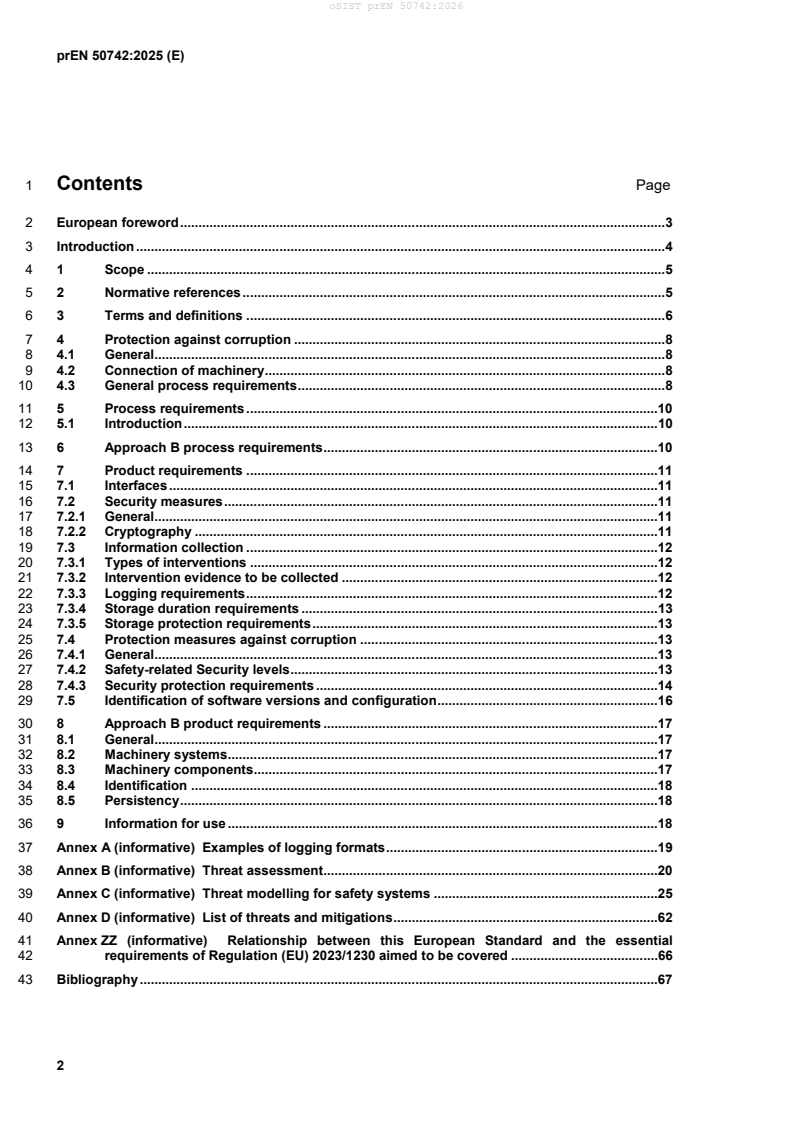
EN 50742:2026 is a CENELEC European Standard on safety of machinery that sets requirements and recommendations to prevent accidental and intentional corruption of machines, including malicious third-party actions that could create hazardous situations. It is written for machinery designers, control system manufacturers and integrators who need to protect safety-related hardware, software and data against corruption that can affect machine safety.
The document gives two implementation routes: an approach based on its own process and product requirements, and an alternative approach based on the EN IEC 62443 series for machinery developed in that context.
What does EN 50742:2026 specify?
EN 50742:2026 specifies how to protect machinery, related products and partly completed machinery against corruption that could lead to hazardous situations. It applies to hardware components, interfaces to remote devices and control systems, software and data when they can influence machine safety.
The scope covers all lifecycle steps, from development through decommissioning, and it includes machinery interfaces to external systems and services. It also states that functional safety requirements of control systems are outside its scope.
The document is organized into general provisions, process requirements, product requirements, information for use, and informative annexes.
| Annex | What it covers |
|---|---|
| Annex A | Examples of logging formats |
| Annex B | Threat assessment, exposure levels, attack potential and SRSL mapping |
| Annex C | Threat modelling for safety systems, with worked examples |
| Annex D | List of threats and mitigations |
| Annex ZZ | Relationship with Regulation (EU) 2023/1230 |
What are the key requirements of EN 50742:2026?
EN 50742:2026 requires a risk-based approach that starts with EN ISO 12100 risk assessment and then adds a threat assessment for corruption-related risks. In practice, this means the designer has to look at hazards and at how data, software or interfaces could be misused to affect safety functions.
- Choose one of two routes. Clause 4 says the machinery shall follow either Approach A, using Clauses 5 and 7, or Approach B, using Clauses 6 and 8. This matters because the document allows different engineering paths, depending on whether EN IEC 62443 is used.
- Define the security context and threats. Clause 4.3 requires the designer to define the security context and perform a threat assessment. That means identifying the intended environment, access conditions and likely threat paths before choosing protections.
- Reduce vulnerabilities first, then mitigate, then document. Clause 4.3 requires vulnerabilities that could lead to hazardous situations to be eliminated where possible, mitigated where elimination is not possible, and covered by information for use if residual vulnerabilities remain. In practice, this drives design changes, technical safeguards and user instructions.
- Protect all relevant interfaces. Clause 7.1 requires accessible interfaces that can affect safety to be identified and protected with countermeasures or compensating countermeasures. For buyers and integrators, this means ports, network links and service connections need explicit security treatment.
- Select security measures on a risk basis. Clause 7.2 requires security measures to reflect both safety risk and threat risk for the intended use and security context. Cryptographic methods, where used, should be state of the art. This means the chosen controls have to fit the actual attack surface, not just a generic checklist.
- Record interventions and keep traceability. Clause 7.3 requires automatic collection of digital evidence, readable and accessible logs, and storage of tracing log data for at least five years from service start. If digital evidence is not reasonably practicable, physical evidence is allowed. This is important for investigations, maintenance records and proving what changed.
- Set a Safety-related Security level (SRSL). Clause 7.4 requires an SRSL for each identified safety function, based on threat assessment and the effect of exploitation. SRSL0 to SRSL3 define increasing protection needs, from isolated systems to high-exposure connections such as untrusted networks.
- Meet the SRSL-specific protection rules. Clause 7.4.3 sets requirements for authentication, authorization, integrity of software and boot process, integrity of exchanged information, input validation, physical tampering detection and authenticity of critical data such as SRESW and SRASW. In practice, these are the concrete safeguards that protect safety functions against corruption.
- Provide software and configuration identification on demand. Clause 7.5 requires software versions and configuration information relevant to protection against corruption to be available in human-readable form. This helps maintenance, audits and incident response.
What terms does EN 50742:2026 define?
- Control system - The system that receives input signals and generates output signals to make the machine perform as intended.
- Intervention - A legitimate or illegitimate action or event that changes software or data and modifies or interrupts machine behaviour, state or operation.
- Corruption - Accidental or illegitimate modification of machinery data that can result in hazardous situations.
- Security context - The security provided by the intended environment in which the machinery is used.
- Tracing log - A collection of data that records interventions affecting the safety related control system.
- Vulnerability - A flaw or weakness in design, implementation, operation or management that could be exploited to corrupt integrity.
- Safety-related Security level (SRSL) - A parameter that represents the security requirements needed to protect a safety-related function against data corruption.
- Safety-related application software (SRASW) - Application software containing the logic, limits and decisions needed to meet safety-related control system requirements.
Who uses EN 50742:2026?
EN 50742:2026 is intended for machinery designers, control system manufacturers and integrators, and others involved in the specification, design and validation of an SCS. It is relevant where machinery uses remote interfaces, network connections, software updates, configuration data or logging that can affect safety.
The examples in the document show use cases such as packaging machinery and wireless-controlled crane systems, so it is useful in machinery sectors where fieldbuses, remote access, service tools and connected controllers are part of the design.
What changed in EN 50742:2026 from the previous edition?
EN 50742:2026 is presented as identical to prEN 50742:2025.
Which standards are used with EN 50742:2026?
- EN ISO 12100:2010 - provides the general machinery risk assessment and risk reduction basis that Clause 4 builds on.
- EN IEC 62443-3-3:2019 - provides the system security requirements used in Approach B for machinery systems.
- EN IEC 62443-4-1:2018 - provides secure product development lifecycle requirements used in Approach B process requirements.
- EN IEC 62443-4-2:2019 - provides technical security requirements for IACS components used in Approach B for machinery components.
- EN ISO 13849-1:2023 - appears in the defined terms for SRASW and SRESW and in the informative annexes as a related safety reference.
What does the EN 50742:2026 document contain?
EN 50742:2026 contains the main clauses for scope, normative references, terms, protection against corruption, process requirements, product requirements, and information for use. It also contains a parallel Approach B structure that points to EN IEC 62443-3-3, EN IEC 62443-4-1 and EN IEC 62443-4-2 for system and component security requirements.
The informative annexes provide practical material for implementation: Annex A gives examples of logging formats, Annex B develops threat assessment with exposure levels, attacker capability, window of opportunity and attack potential, and Annex C walks through threat modelling examples and trust boundaries for different machine types. Annex D acts as a mitigation catalogue tied to threat types and preconditions for exploit.
Relations
- Effective Date
- 22-Nov-2026
- Effective Date
- 22-Nov-2026
- Effective Date
- 22-Nov-2026
- Effective Date
- 22-Nov-2026
Get Certified
Connect with accredited certification bodies for this standard

CIS Institut d.o.o.
Personal Protective Equipment (PPE) certification body. Notified Body NB-2890 for EU Regulation 2016/425 PPE.

Kiwa BDA Testing
Building and construction product certification.
Kmetijski inštitut Slovenije
Agricultural Institute of Slovenia. Soil testing, plant health, agricultural product analysis.
Sponsored listings
Frequently Asked Questions
EN 50742:2026 is a draft published by CLC. Its full title is "Safety of machinery - Protection against corruption". This standard covers: This document provides requirements and recommendations for protection against corruption of machinery, related products, and partly completed machinery, hereafter referred to as ‘machinery’, where such corruption can influence the safety of the machinery, resulting in hazardous situations. This document applies to - hardware components, including interfaces to remote devices and control systems, that can transmit signals or data; - software and data; if they can influence the safety of the machinery. NOTE 1 Topics can overlap with the domain of cybersecurity but are not necessarily identical in their coverage. NOTE 2 This document does not describe functional safety requirements of control systems in machinery. Machinery interfaces to external systems and services are in the scope of this document. External systems and services are out of the scope of this document. This document is not applicable to machinery manufactured before the date of its publication. This document specifies requirements related to protection against corruption related risks in all lifecycle steps such as - development; - manufacturing; - commissioning; - operation; - maintenance; - decommissioning.
This document provides requirements and recommendations for protection against corruption of machinery, related products, and partly completed machinery, hereafter referred to as ‘machinery’, where such corruption can influence the safety of the machinery, resulting in hazardous situations. This document applies to - hardware components, including interfaces to remote devices and control systems, that can transmit signals or data; - software and data; if they can influence the safety of the machinery. NOTE 1 Topics can overlap with the domain of cybersecurity but are not necessarily identical in their coverage. NOTE 2 This document does not describe functional safety requirements of control systems in machinery. Machinery interfaces to external systems and services are in the scope of this document. External systems and services are out of the scope of this document. This document is not applicable to machinery manufactured before the date of its publication. This document specifies requirements related to protection against corruption related risks in all lifecycle steps such as - development; - manufacturing; - commissioning; - operation; - maintenance; - decommissioning.
EN 50742:2026 is classified under the following ICS (International Classification for Standards) categories: 13.110 - Safety of machinery. The ICS classification helps identify the subject area and facilitates finding related standards.
EN 50742:2026 has the following relationships with other standards: It is inter standard links to EN IEC 62443-4-2:2019, EN ISO 12100:2010, EN IEC 62443-4-1:2018, EN IEC 62443-3-3:2019. Understanding these relationships helps ensure you are using the most current and applicable version of the standard.
EN 50742:2026 is associated with the following European legislation: EU Directives/Regulations: 2023/1230; Standardization Mandates: M/605. When a standard is cited in the Official Journal of the European Union, products manufactured in conformity with it benefit from a presumption of conformity with the essential requirements of the corresponding EU directive or regulation.
EN 50742:2026 is available in PDF format for immediate download after purchase. The document can be added to your cart and obtained through the secure checkout process. Digital delivery ensures instant access to the complete standard document.
Standards Content (Sample)
53 Introduction
54 Machinery must be safe in order to prevent injuries and loss of life. 55 The communication with the machine must not lead to hazardous situations. 56 The manufacturer performs a risk assessment according to EN ISO 12100 to identify all potential hazards. 57 Vulnerabilities can lead to a corruption of the control system of the machine and hazards can lead to dangerous 58 situations.
59 By exploitation of vulnerabilities via communication with the machine, the machine could be operated outside 60 safe parameters or degrade safety functions.
61 Vulnerabilities cannot create new hazards.
62 The probability that someone will use a vulnerability for a malicious attempt cannot be predicted. 63 The risk can only be assessed in terms of its impact on functional safety. 64 Vulnerabilities are divided into several types.
65 This document provides two approaches:
66 — Approach A (Clause 5 and 7) has been developed to facilitate compliance for machinery developed without 67 references to EN IEC 62443 series of standards.
68 — Approach B (Clauses 6 and 8) has been provided to facilitate compliance for machinery developed in the 69 context of the EN IEC 62443-3-3:2019, EN IEC 62443-4-1:2018, EN IEC 62443-4-2:2019. 70 NOTE 1 The EN IEC 62443 series provides information and a methodology to approach cybersecurity. 71 This document is intended for use by machinery designers, control system manufacturers and integrators, and 72 others involved in the specification, design and validation of an SCS. 73 NOTE 2 See EN IEC 62443-4-1:2018; the manufacturer can be a product supplier or system integrator. 74 This document does not address the role of the user.
oSIST prEN 50742:2026 prEN 50742:2025 (E) 75 1 Scope 76 This document provides requirements and recommendations for protection against corruption for machinery, 77 related products and partly completed machinery referred to in this document as ‘machinery’. 78 This document provides requirements and recommendations to prevent accidental and intentional (including 79 malicious) corruption of machines resulting in hazardous situations. 80 This document applies to:
81 — hardware components, including interfaces to remote devices and control systems, that can transmit 82 signals or data; 83 — software and data; 84 if they could influence the safety of the machinery.
85 NOTE 1 Topics can overlap with the domain of cybersecurity but are not necessarily identical in their coverage. 86 NOTE 2 This document does not describe functional safety requirements of control systems in machinery. 87 This document specifies requirements to related risks in all lifecycle steps. 88 Machinery interfaces to external systems and services are in the scope of this document. External systems and 89 services are out of the scope of this document.
90 This document does not apply to machinery installed before the date of its publication. 91 This document specifies requirements related to protection against corruption related risks in all lifecycle steps 92 such as:
93 — development; 94 — manufacturing; 95 — commissioning; 96 — operation; 97 — maintenance; 98 — decommissioning.
99 2 Normative references 100 The following documents are referred to in the text in such a way that some or all of their content constitutes 101 requirements of this document. For dated references, only the edition cited applies. For undated references, the 102 latest edition of the referenced document (including any amendments) applies. 103 EN ISO 12100:2010, Safety of machinery - General principles for design - Risk assessment and risk reduction 104 (ISO 12100:2010)
105 EN IEC 62443-3-3:2019, Industrial communication networks - Network and system security - Part 3-3: System 106 security requirements and security levels 107 EN IEC 62443-4-1:2018, Security for industrial automation and control systems - Part 4-1: Secure product 108 development lifecycle requirements
As impacted by EN IEC 62443-3-3:2019/AC:2019.
oSIST prEN 50742:2026 prEN 50742:2025 (E)
109 EN IEC 62443-4-2:2019, Security for industrial automation and control systems - Part 4-2: Technical security 110 requirements for IACS components 111 3 Terms and definitions 112 For the purposes of this document, the following terms and definitions apply. 113 ISO and IEC maintain terminology databases for use in standardization at the following addresses:
114 — ISO Online browsing platform: available at https://www.iso.org/obp/ 115 — IEC Electropedia: available at https://www.electropedia.org/ 116 3.1 117 control system 118 system which responds to input signals from parts of the machinery, from operators, from external control 119 equipment or any combination of these and generates corresponding output signals to the machinery actuators, 120 causing the machine to perform in the intended manner 121 3.2 122 intervention 123 legitimate or illegitimate action or event that changes the software or data which modifies or interrupts the 124 behaviour, state or operation of the machinery temporarily or permanently 125 Note 1 to entry: Action taken on safety routines, safety variables, calibration data, firmware updates of safety-related parts 126 of software are considered interventions in the sense of this document. 127 Note 2 to entry: Normal operational changes to variables, such as opening a safety gate, does not constitute an intervention 128 in the sense of a change to data.
129 EXAMPLE 130 1) The modification of the installed software on the machinery due to an update or configuration change(s). 131 2) modular PLC, if a PLC module is replaced by an identical spare part it is not considered an intervention; if an additional 132 part is introduced; it is considered a modification.
133 3.3 134 modification 135 change caused by an intervention 136 Note 1 to entry: Including software version, sensor calibration, configuration data etc. 137 EXAMPLE Update of safety-related software.
138 3.4 139 evidence 140 anything that allows the detection that an event or action has happened 141 EXAMPLE log records, broken safety seals (anti-tampering seals) and scratch marks, damage to interface covers e.g. 142 RJ45 cover 143 3.5 144 corruption 145 accidental or illegitimate modification of machinery data potentially resulting in hazardous situations
As impacted by EN IEC 62443-4-2:2019/AC:2022-09.
oSIST prEN 50742:2026 prEN 50742:2025 (E) 146 3.6 147 security context 148 security provided to the machinery by the environment in which the machinery is intended to be used 149 Note 1 to entry: The security provided to the machinery by its intended environment can effectively restrict the threats that 150 are applicable to the machinery.
151 Note 2 to entry: See Clause C.5.
152 [SOURCE: EN IEC 62443-4-1:2018, 3.1.23, modified — removed the word product and substituted with the 153 word machinery] 154 3.7 155 countermeasure 156 action, device, procedure or technique that reduces a threat, a vulnerability or the consequences of an attack 157 by minimizing the harm the attack can cause or by discovering and reporting it so that corrective action can be 158 taken 159 [SOURCE: EN IEC 62443-4-2 :2019, 3.1.15] 160 3.8 161 compensating countermeasure 162 countermeasure employed in lieu of or in addition to inherent security capabilities to comply with one or more 163 security requirements 164 [SOURCE: EN IEC 62443-4-2 :2019, 3.1.9] 165 3.9 166 reasonably practicable 167 balancing of risk reduction against time, money and effort 168 3.10 169 tracing log 170 collection of data recording interventions that affect the safety related control system 171 3.11 172 vulnerability 173 flaw or weakness in a system's design, implementation, or operation and management that could be exploited 174 to corrupt the system's integrity 175 3.12 176 critical data 177 data whose manipulation can result in increase of hazard 178 3.13 179 safety-related application software 180 SRASW 181 software specific to the application and generally containing logic sequences, limits and expression that control 182 the appropriate inputs, outputs, calculations and decisions necessary to meet the safety-related part of a control 183 system (SRP/CS) requirements 184 [SOURCE: EN ISO 13849-1:2023, 3.1.41] 185 3.14 186 safety-related embedded software 187 SRESW 188 software that is part of the system supplied by the manufacturer and is not intended for modification by the end- 189 user
oSIST prEN 50742:2026 prEN 50742:2025 (E) 190 [SOURCE: EN ISO 13849-1:2023, 3.1.42, modified – Note 1 to entry deleted] 191 3.15 192 SRSL 193 Safety-Related Security Requirement 194 parameter representing the sum of security requirements that are related to a specific safety-related function 195 used in order to protect it against corruption of data 196 4 Protection against corruption 197 4.1 General 198 Either approach A (Clauses 5 and 7) or approach B (Clauses 6 and 8) shall be applied. 199 4.2 Connection of machinery 200 The design and the construction of machinery shall not allow hazardous situations via connections. 201 A connection (physical, logical and indirect) is any link that can exchange information, for example:
202 — a network link, 203 — a WIFI connection, 204 — a single wire, 205 — wires of the power supply, 206 — an optical link, 207 — a card reader interface, 208 — a connection from a machine to external systems:
209 — building networks 210 — cloud services 211 — service tools 212 NOTE 1 The connectivity can exist through equipment permanently available on site, or equipment temporarily brought 213 to the location during the installation, operation and maintenance, or decommissioning steps. 214 NOTE 2 Example of a machinery not to be considered is a simple drilling machine without any possibility of connection. 215 4.3 General process requirements 216 Following a risk assessment according to EN ISO 12100:2010, where all potential hazards have previously 217 been identified, the designer shall perform a threat assessment. 218 The content of the threat assessment can be limited to additional threats that are not covered by the minimum 219 security measures.
220 The designer shall define the security context for the machine. 221 The following principles shall be applied in order to protect a machine from threats that can lead to hazardous 222 situation(s):
223 a) Where vulnerabilities are present, eliminate those that can lead to hazardous situation(s).
oSIST prEN 50742:2026 prEN 50742:2025 (E) 224 EXAMPLE 1 To eliminate any unnecessary interfaces so that the threats cannot exploit this vulnerability. 225 EXAMPLE 2 JTAG interface(s) used during development and then disabled. 226 EXAMPLE 3 Elimination can be a result of redesign using different components (maybe from same vendor). 227 b) if it is not possible to eliminate vulnerabilities, the designer shall mitigate them. 228 EXAMPLE Mitigation, implementation of user authentication on an interface. 229 c) For any vulnerabilities that remain after steps a) and b), information for use shall provide all necessary 230 information for compensating countermeasure by the user. See Annex C. 231 EXAMPLE Manufacturer states in the instruction for use that the fieldbus connection of the machine is only designed 232 for internal(local) connections to another machine in a trusted network and is not allowed to be connected to an untrusted 233 network.
234 Vulnerabilities cannot create new hazards, but their exploitation can compromise the protective measures; 235 therefore, a threat assessment shall be performed.
236 NOTE By exploitation of vulnerabilities via communication with the machine, the machine could be operated outside 237 safe parameters or degrade safety functions. The risk can only be assessed in terms of its impact on functional safety. 238 Countermeasures shall not negatively affect the functional safety of the machinery. 239 EXAMPLE When a cryptographic function is implemented, it needs to be verified that it does not lead to hazardous 240 situations due to increased safety function response time. 241 The probability that someone will try to exploit a specific vulnerability for a malicious attempt cannot be predicted. 242 Therefore, the likelihood of being a target/victim shall not be relevant for the threat assessment. 243 In order to fulfil the essential requirements and recommendations to prevent accidental and intentional (including 244 malicious) corruption of machines resulting in hazardous situations, designers shall follow approach A in below 245 table.
246 However, if designers prefer to follow EN IEC 62443-3-3:2019, EN IEC 62443-4-1:2018, 247 EN IEC 62443-4-2:2019 for the security requirements for their machinery, they shall follow approach B. 248 Table 1 provides an overview of both approaches:
249 Table 1 — Process requirements overview Common clauses to be followed:
- Risk assessment according to EN ISO 12100:2010
- Clause 4 - Protection against corruption
- Clause 9 - Information for use Specific clauses to be followed:
Approach A Approach B - Clause 5 for process requirements — Clause 6 for process requirements - Clause 7 for product requirements — Clause 8 for product requirements 250 NOTE Both routes are equally allowed to be followed. The selected route depends to the effort the manufacturer needs 251 to do, as well as the value for the manufacturer, but also their knowledge, field of application, ect.
oSIST prEN 50742:2026 prEN 50742:2025 (E) 252 5 Process requirements 253 5.1 Introduction
255 Figure 1 — Risk assessment process including safety and security aspects 256 6 Approach B process requirements 257 The requirements of EN IEC 62443-4-1:2018 shall apply.
oSIST prEN 50742:2026 prEN 50742:2025 (E) 258 7 Product requirements 259 7.1 Interfaces 260 All machinery interfaces that are accessible and can affect the safety of the machinery shall be identified and 261 protected using countermeasures or compensating countermeasures. 262 Figure 2 shows an example of machinery interfaces which can be subject to an attack.
264 Figure 2 — Machinery interfaces example 265 Guidelines on second order attack are in Annex C.
266 7.2 Security measures 267 7.2.1 General 268 Security measures to protect against corruption of the machinery leading to hazardous situations shall be 269 selected on a risk-based approach in order to be adequate. 270 This risk-based approach shall consider both safety risks and threat risks of the machinery's intended use and 271 security context.
272 Security measures shall not negatively affect the functional safety. 273 7.2.2 Cryptography 274 Where cryptographic methods are used, only state of the art algorithm should be selected. 275 NOTE 1 Information related to state-of-the-art algorithms is available from organizations such as ENISA 276 www.enisa.europa.eu. A list of examples is available in the bibliography [2][3][4]. 277 NOTE 2 When a cryptographic function is implemented, it can be verified that it does not lead to hazardous situations 278 due to increased safety function response time.
oSIST prEN 50742:2026 prEN 50742:2025 (E) 279 7.3 Information collection 280 7.3.1 Types of interventions 281 The following list provides types of interventions that shall be considered:
282 a. safety parametrization/configuration parameters (via identification means like CRC…), 283 EXAMPLE connecting or disconnecting flash drive or SD card, when being used for storing configuration data and 284 logging data that is relevant for compliance of machinery 285 b. SRESW update/modification (via identification means only, such as version number, CRC, ect…), 286 c. SRASW updates/modification (via identification means only, such as version number, CRC, ect…), 287 d. parametrization of human-machine interfaces if it can creates hazards, 288 e. software relevant for displaying safety instructions.
289 NOTE 1 Any intervention that does not result in changes of the data listed above does not need to be logged (e.g. 290 successful/unsuccessful authorized interventions).
291 NOTE 2 Actions on the machine triggering a safe state of the machine e.g. triggering safety light curtain, are not in scope. 292 NOTE 3 The version of the SRASW binaries or SRESW binaries does not need to be kept in the tracing log. 293 7.3.2 Intervention evidence to be collected 294 Digital evidence of a legitimate or illegitimate action or event that changes or interrupts the behaviour, state or 295 operation of the machinery temporarily or permanently, that changes the software or data shall be recorded and 296 shall contain the following data as a minimum:
297 a. an indication of the type of intervention that affects software relied on for risk reduction according to the risk 298 assessment, 299 b. means to allow correlation of logged events, (e.g. timestamping referring to absolute or relative system 300 time), boot counts, system times, running counters, 301 c. deletion of the log file.
302 NOTE Timestamping can be provided by the device making the log event or the remote log collector. 303 7.3.3 Logging requirements 304 The machine shall provide digital or physical means for traceability related to interventions. 305 Digital evidence of interventions shall be readable and accessible. 306 The documentation shall provide information on how to access and interpret the recorded evidence. 307 If a binary format is used, the format should be documented as part of the information for use, so that anyone 308 can program a converter to make the logs intelligible.
309 Where collection of digital evidence is not reasonably practicable, physical evidence (e.g. tampering of a seal) 310 shall be used.
311 Evidence collection of interventions is required and shall be done automatically by the machinery or related 312 product.
313 NOTE See Annex A for examples of recognized industry practice on logging standards.
oSIST prEN 50742:2026 prEN 50742:2025 (E) 314 The log records may be stored in the control system, the components inside the machine or in a component for 315 storing the data external to the machinery (e.g. Network Attached Storage (NAS), local hard drive, etc…). 316 7.3.4 Storage duration requirements 317 Log storage shall contain, as a minimum, the evidence of the last intervention of each type. 318 Tracing log data records of each intervention shall be stored for at least five years. 319 The tracing log shall be enabled, as a minimum, from the time the machine is put into service. 320 7.3.5 Storage protection requirements 321 Logs shall be properly secured to protect against tampering. 322 Log deletion, if applicable, shall only be possible by an authorized procedure. 323 7.4 Protection measures against corruption 324 7.4.1 General 325 Corruption can compromise the integrity and effectiveness of the risk-reduction measures, leading to potentially 326 hazardous consequences.
327 To safeguard against such risks, it is essential to first determine the required level of protection. 328 This involves identifying the vulnerabilities and specific needs of the application in question and defining Safety- 329 related Security levels (SRSL) for the individual risk-reduction measures. 330 Once the appropriate level of protection is identified, adequate measures can be applied to mitigate the threats 331 effectively.
332 These measures are intended to preserve the integrity and reliability of the safety control system. 333 7.4.2 Safety-related Security levels 334 For each identified safety function, a Safety-related security level (SRSL) shall be determined and documented. 335 The determination of the SRSL shall be based on the result of the threat assessment and shall correlate to the 336 risk-reduction applied by the protective measure and to the likelihood of a successful threat exploitation. 337 Four SRSL levels are defined, where SRSL0 gives no specific additional requirements, and SRSL1 to SRSL3 338 correspond from low to high security levels.
...