

ISO 20771:2020
(Main)Legal translation — Requirements
General Information
- Abstract
This document specifies requirements for the competences and qualifications of legal translators, revisers and reviewers, best translation practices and the translation process directly affecting the quality and delivery of legal translation services. In particular, it specifies the core processes, resources, confidentiality, professional development requirements, training and other aspects of the legal translation service provided by individual translators. Fulfilment of all the requirements set out in this document enables the individual legal translator to demonstrate conformity of their legal translation services to this document and their capability to maintain a level of quality in legal translation services that will meet the client's and other applicable specifications. The use of output from machine translation, even with post-editing, is outside the scope of this document. Consulting of a machine translation resource by a legal translator, does not constitute use of raw machine translation plus post-editing. This document does not apply to interpreting services.
- Status
- Published
- Publication Date
- 19-Apr-2020
- Technical Committee
- ISO/TC 37/SC 5 - Translation, interpreting and related technology
- Drafting Committee
- ISO/TC 37/SC 5 - Translation, interpreting and related technology
- Current Stage
- 9560 - Close of voting
- Start Date
- 12-Aug-2026
- Completion Date
- 11-Aug-2026
Buy Documents





ISO 20771:2020 - Legal translation -- Requirements

ISO 20771:2020 - Legal translation — Requirements/20/2020


ISO 20771:2020 - Traduction juridique et judiciaire -- Exigences

ISO 20771:2020 - Traduction juridique et judiciaire — Exigences/20/2020
Overview
ISO 20771:2020 - Legal translation - Requirements defines the professional baseline for individual legal translators, revisers and reviewers. The standard specifies the competences and qualifications, core translation processes, resources, confidentiality, record-keeping and continuing professional development (CPD) needed to deliver high‑quality legal translation services. It is intended to help practitioners demonstrate conformity of their legal translation work to recognized international requirements. Note: the use of raw machine translation plus post‑editing is outside the scope; consulting MT resources without full post‑editing remains permitted. Interpreting services are not covered.
Key topics and technical requirements
- Competences and qualifications: requirements for legal translators, revisers and reviewers to ensure linguistic, legal-system and specialist subject-matter competence.
- Translation process: core process steps such as agreement/specification, project preparation, translation, check, revision/review, verification, sign‑off and record keeping.
- Roles and responsibilities: clear delineation of translator, reviser and reviewer tasks, and expectations for cooperation with clients and stakeholders.
- Quality controls: procedures for checks, bilingual revision and monolingual review to ensure factual and linguistic accuracy and suitability for the agreed purpose.
- Confidentiality and security: obligations and practical measures to protect sensitive legal content, including guidance on professional liability and insurance.
- Professional development (CPD): ongoing training, documented proof of CPD activities and professional involvement to maintain competence.
- Documentation and records: requirements for keeping records of work, specifications, and corrective actions (complaints and nonconformities).
- Scope exclusions: machine translation output plus post‑editing is excluded; consulting MT tools by a translator is not considered MT + post‑editing.
Practical applications
- Use ISO 20771:2020 to:
- Demonstrate professional conformity when supplying legal translations to courts, law firms, public authorities and corporate legal departments.
- Design internal workflows and quality assurance procedures for freelance legal translators and small practices.
- Define job descriptions, tender responses and contracts with clear role definitions (translator, reviser, reviewer).
- Establish CPD policies and evidence for auditors or clients requesting proof of ongoing competence.
- Strengthen confidentiality, record-keeping and liability arrangements for sensitive legal projects.
Who should use this standard
- Individual legal translators and specialist revisers/reviewers
- Freelancers and small translation practices offering legal translation services
- Legal departments, courts and public authorities that engage translators
- Quality managers and procurement officers drafting service specifications
Related standards
- ISO 17100:2015 - Translation services - Service requirements (project management, specifications)
- ISO 20539:2019 - Human translation process concepts and terms
- ISO/TR 20694:2018 - Translation quality assessment (language register and conventions)
Keywords: ISO 20771:2020, legal translation, requirements, translator competence, reviser, reviewer, confidentiality, CPD, translation process, legal translator standard.
Buy Documents
ISO 20771:2020 - Legal translation -- Requirements
ISO 20771:2020 - Legal translation — Requirements/20/2020
ISO 20771:2020 - Traduction juridique et judiciaire -- Exigences
ISO 20771:2020 - Traduction juridique et judiciaire — Exigences/20/2020
Get Certified
Connect with accredited certification bodies for this standard

Great Wall Tianjin Quality Assurance Center
Established 1993, first batch to receive national accreditation with IAF recognition.
Hong Kong Quality Assurance Agency (HKQAA)
Hong Kong's leading certification body.

Innovative Quality Certifications Pvt. Ltd. (IQCPL)
Known for integrity, providing ethical & impartial Assessment & Certification. CMMI Institute Partner.
Sponsored listings
Frequently Asked Questions
ISO 20771:2020 is a standard published by the International Organization for Standardization (ISO). Its full title is "Legal translation — Requirements". This standard covers: This document specifies requirements for the competences and qualifications of legal translators, revisers and reviewers, best translation practices and the translation process directly affecting the quality and delivery of legal translation services. In particular, it specifies the core processes, resources, confidentiality, professional development requirements, training and other aspects of the legal translation service provided by individual translators. Fulfilment of all the requirements set out in this document enables the individual legal translator to demonstrate conformity of their legal translation services to this document and their capability to maintain a level of quality in legal translation services that will meet the client's and other applicable specifications. The use of output from machine translation, even with post-editing, is outside the scope of this document. Consulting of a machine translation resource by a legal translator, does not constitute use of raw machine translation plus post-editing. This document does not apply to interpreting services.
This document specifies requirements for the competences and qualifications of legal translators, revisers and reviewers, best translation practices and the translation process directly affecting the quality and delivery of legal translation services. In particular, it specifies the core processes, resources, confidentiality, professional development requirements, training and other aspects of the legal translation service provided by individual translators. Fulfilment of all the requirements set out in this document enables the individual legal translator to demonstrate conformity of their legal translation services to this document and their capability to maintain a level of quality in legal translation services that will meet the client's and other applicable specifications. The use of output from machine translation, even with post-editing, is outside the scope of this document. Consulting of a machine translation resource by a legal translator, does not constitute use of raw machine translation plus post-editing. This document does not apply to interpreting services.
ISO 20771:2020 is classified under the following ICS (International Classification for Standards) categories: 01.020 - Terminology (principles and coordination); 03.080.20 - Services for companies; 03.080.30 - Services for consumers. The ICS classification helps identify the subject area and facilitates finding related standards.
ISO 20771:2020 is available in PDF format for immediate download after purchase. The document can be added to your cart and obtained through the secure checkout process. Digital delivery ensures instant access to the complete standard document.
Standards Content (Sample)
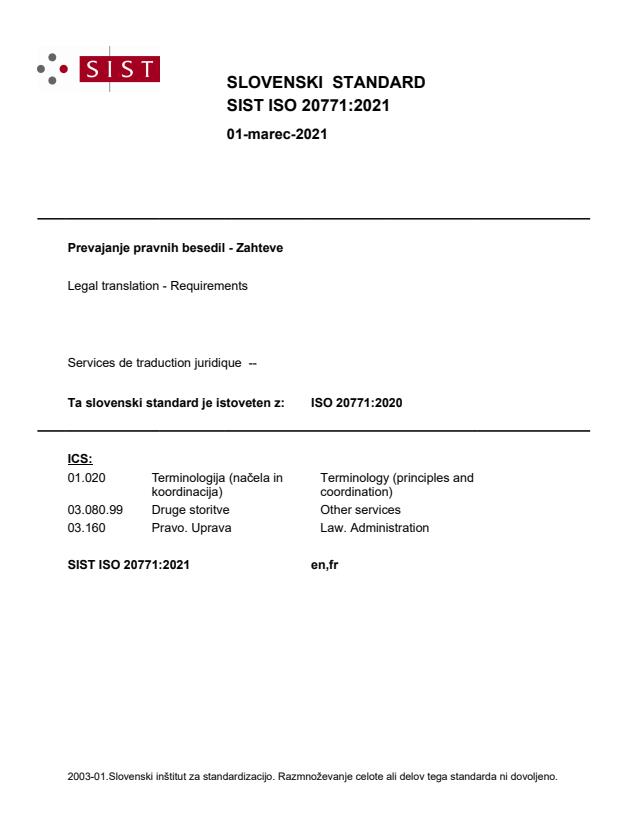
SLOVENSKI STANDARD
01-marec-2021
Prevajanje pravnih besedil - Zahteve
Legal translation - Requirements
Services de traduction juridique --
Ta slovenski standard je istoveten z: ISO 20771:2020
ICS:
01.020 Terminologija (načela in Terminology (principles and
koordinacija) coordination)
03.080.99 Druge storitve Other services
03.160 Pravo. Uprava Law. Administration
2003-01.Slovenski inštitut za standardizacijo. Razmnoževanje celote ali delov tega standarda ni dovoljeno.
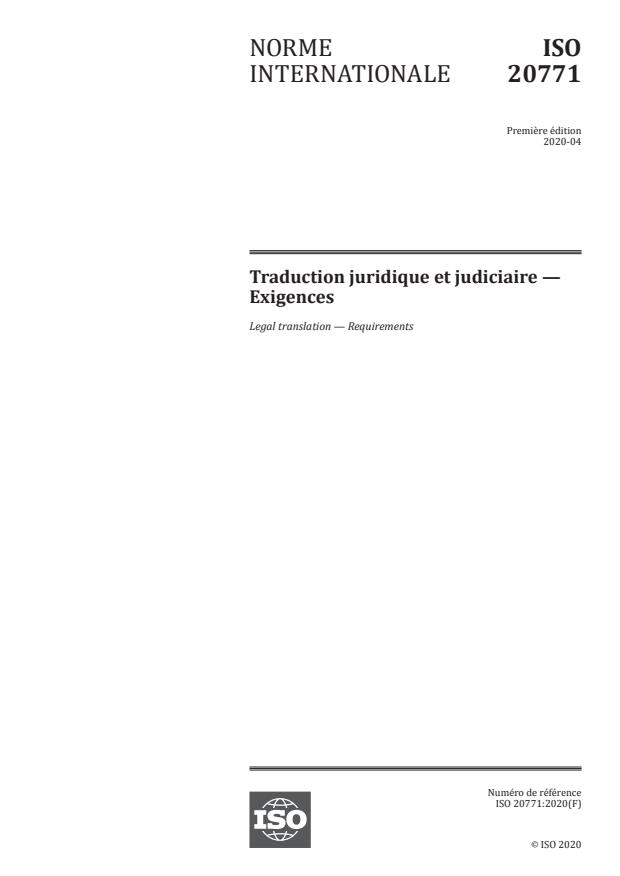
INTERNATIONAL ISO
STANDARD 20771
First edition
2020-04
Legal translation — Requirements
Traduction juridique et judiciaire — Exigences
Reference number
©
ISO 2020
© ISO 2020
All rights reserved. Unless otherwise specified, or required in the context of its implementation, no part of this publication may
be reproduced or utilized otherwise in any form or by any means, electronic or mechanical, including photocopying, or posting
on the internet or an intranet, without prior written permission. Permission can be requested from either ISO at the address
below or ISO’s member body in the country of the requester.
ISO copyright office
CP 401 • Ch. de Blandonnet 8
CH-1214 Vernier, Geneva
Phone: +41 22 749 01 11
Fax: +41 22 749 09 47
Email: copyright@iso.org
Website: www.iso.org
Published in Switzerland
ii © ISO 2020 – All rights reserved
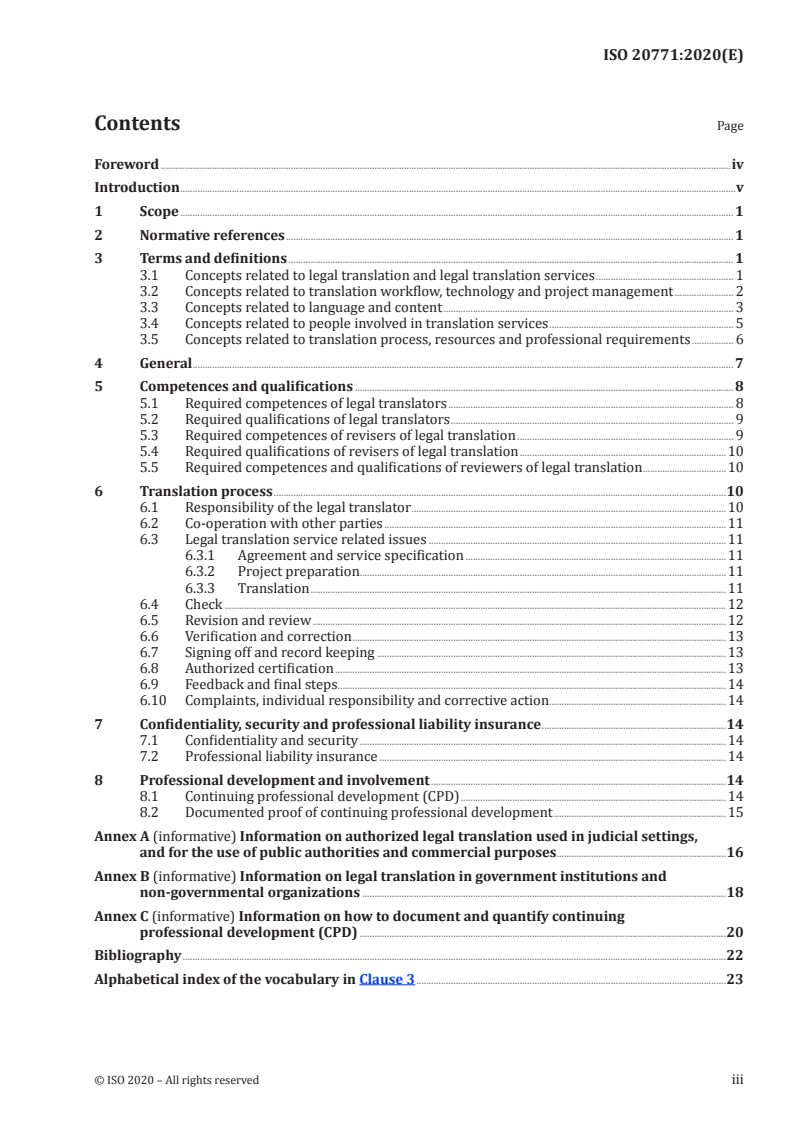
Contents Page
Foreword .iv
Introduction .v
1 Scope . 1
2 Normative references . 1
3 Terms and definitions . 1
3.1 Concepts related to legal translation and legal translation services . 1
3.2 Concepts related to translation workflow, technology and project management . 2
3.3 Concepts related to language and content . 3
3.4 Concepts related to people involved in translation services . 5
3.5 Concepts related to translation process, resources and professional requirements . 6
4 General . 7
5 Competences and qualifications . 8
5.1 Required competences of legal translators . 8
5.2 Required qualifications of legal translators . 9
5.3 Required competences of revisers of legal translation . 9
5.4 Required qualifications of revisers of legal translation .10
5.5 Required competences and qualifications of reviewers of legal translation .10
6 Translation process .10
6.1 Responsibility of the legal translator .10
6.2 Co-operation with other parties .11
6.3 Legal translation service related issues .11
6.3.1 Agreement and service specification .11
6.3.2 Project preparation . . .11
6.3.3 Translation .11
6.4 Check .12
6.5 Revision and review .12
6.6 Verification and correction .13
6.7 Signing off and record keeping .13
6.8 Authorized certification .13
6.9 Feedback and final steps .14
6.10 Complaints, individual responsibility and corrective action .14
7 Confidentiality, security and professional liability insurance .14
7.1 Confidentiality and security .14
7.2 Professional liability insurance .14
8 Professional development and involvement .14
8.1 Continuing professional development (CPD) .14
8.2 Documented proof of continuing professional development .15
Annex A (informative) Information on authorized legal translation used in judicial settings,
and for the use of public authorities and commercial purposes.16
Annex B (informative) Information on legal translation in government institutions and
non-governmental organizations .18
Annex C (informative) Information on how to document and quantify continuing
professional development (CPD) .20
Bibliography .22
Alphabetical index of the vocabulary in Clause 3 .23
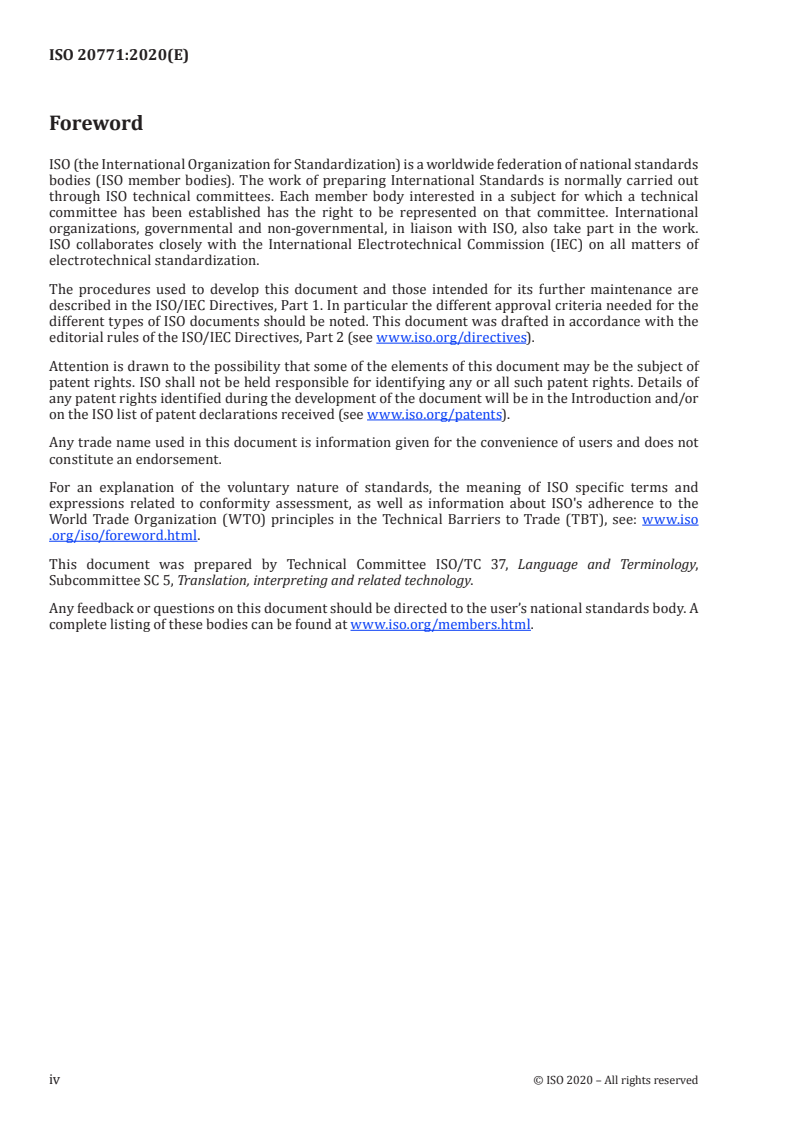
Foreword
ISO (the International Organization for Standardization) is a worldwide federation of national standards
bodies (ISO member bodies). The work of preparing International Standards is normally carried out
through ISO technical committees. Each member body interested in a subject for which a technical
committee has been established has the right to be represented on that committee. International
organizations, governmental and non-governmental, in liaison with ISO, also take part in the work.
ISO collaborates closely with the International Electrotechnical Commission (IEC) on all matters of
electrotechnical standardization.
The procedures used to develop this document and those intended for its further maintenance are
described in the ISO/IEC Directives, Part 1. In particular the different approval criteria needed for the
different types of ISO documents should be noted. This document was drafted in accordance with the
editorial rules of the ISO/IEC Directives, Part 2 (see www .iso .org/ directives).
Attention is drawn to the possibility that some of the elements of this document may be the subject of
patent rights. ISO shall not be held responsible for identifying any or all such patent rights. Details of
any patent rights identified during the development of the document will be in the Introduction and/or
on the ISO list of patent declarations received (see www .iso .org/ patents).
Any trade name used in this document is information given for the convenience of users and does not
constitute an endorsement.
For an explanation of the voluntary nature of standards, the meaning of ISO specific terms and
expressions related to conformity assessment, as well as information about ISO's adherence to the
World Trade Organization (WTO) principles in the Technical Barriers to Trade (TBT), see: www .iso
.org/ iso/ foreword .html.
This document was prepared by Technical Committee ISO/TC 37, Language and Terminology,
Subcommittee SC 5, Translation, interpreting and related technology.
Any feedback or questions on this document should be directed to the user’s national standards body. A
complete listing of these bodies can be found at www .iso .org/ members .html.
iv © ISO 2020 – All rights reserved
Introduction
Legal translation is a specialization which covers law-related or legal specialist field translation in
terms of content as well as context (e.g. legal settings). Given the highly specialist field, potential legal
consequences, and formal and liability issues, this specialization requires specific competences and
a very professional approach from the specialist translators involved. Due to the formalized, official
or sensitive nature of the subject matter in some countries, settings and under certain circumstances,
legal translators may be subject to specific professional, confidentiality and ethical requirements,
authorization, certification, and security clearance procedures. Furthermore, in some countries,
certain types of legal translation are performed by authorized legal translators who have to comply
with specific official requirements.
Serious legal issues and other consequences can be avoided if the legal translation service is provided
by competent legal translators who have professional understanding of the relevant legal systems,
knowledge of legal terminology and target language genre conventions and can produce authentic texts.
Legal documents constitute the basis for many personal and business undertakings. Legal translation
is a highly specialized type of translation service which is frequently used in official and legal settings
and this requires meeting the highest professional quality benchmarks. Taking the above into account
as well as the fact that there are no international standards in this area, this document was developed
in response to the evident market need.
This document is intended for implementation by individual translators who specialize in the provision
of legal translation services.
INTERNATIONAL STANDARD ISO 20771:2020(E)
Legal translation — Requirements
1 Scope
This document specifies requirements for the competences and qualifications of legal translators,
revisers and reviewers, best translation practices and the translation process directly affecting
the quality and delivery of legal translation services. In particular, it specifies the core processes,
resources, confidentiality, professional development requirements, training and other aspects of the
legal translation service provided by individual translators.
Fulfilment of all the requirements set out in this document enables the individual legal translator to
demonstrate conformity of their legal translation services to this document and their capability to
maintain a level of quality in legal translation services that will meet the client’s and other applicable
specifications.
The use of output from machine translation, even with post-editing, is outside the scope of this
document. Consulting of a machine translation resource by a legal translator, does not constitute use of
raw machine translation plus post-editing.
This document does not apply to interpreting services.
2 Normative references
There are no normative references in this document.
3 Terms and definitions
For the purposes of this document, the following terms and definitions apply.
ISO and IEC maintain terminological databases for use in standardization at the following addresses:
— ISO Online browsing platform: available at https:// www .iso .org/ obp
— IEC Electropedia: available at http:// www .electropedia .org/
3.1 Concepts related to legal translation and legal translation services
3.1.1
translate
render source language content (3.3.2) into target language content (3.3.3) in written form
[SOURCE: ISO 17100:2015, 2.1.1]
3.1.2
translation
set of processes to render source language content (3.3.2) into target language content (3.3.3) in
written form
Note 1 to entry: A translation may refer to formats other than text-based formats, e.g. an audio file, image, etc.
[SOURCE: ISO 17100:2015, 2.1.2]
3.1.3
legal translation
law or legal specialized translation (3.1.4) by a legal translator (3.4.5)
3.1.4
specialized translation
translation (3.1.2) within a field of specialization by a specialist translator (3.4.4)
Note 1 to entry: Specialized translation is often also referred to as specialist translation.
3.2 Concepts related to translation workflow, technology and project management
3.2.1
computer-aided translation
CAT
translation (3.1.2) in which software applications are used to support the task of human translation (3.2.3)
[SOURCE: ISO 17100:2015, 2.2.1, modified – ‘part of’ removed from beginning of definition and Note 1
to entry removed.]
3.2.2
machine translation
MT
automated translation (3.1.2) of content (3.3.1) from one natural language to another using a
computer system
[SOURCE: ISO 17100:2015, 2.2.2, modified – ‘text and speech’ replaced by ‘content’.]
3.2.3
human translation
translation (3.1.2) performed by a translator (3.4.3)
[SOURCE: ISO 20539:2019, 3.5.1.1]
3.2.4
check
examination of target language content (3.3.3) against the source language content (3.3.2) carried out by
the translator (3.4.3)
[SOURCE: ISO 17100:2015, 2.2.5, modified – ‘against the source language content’ added.]
3.2.5
revision
bilingual examination of the entire target language content (3.3.3) against the source language content
(3.3.2), in order to ensure its factual and linguistic accuracy, and suitability for the agreed purpose,
carried out by the reviser (3.4.8)
[SOURCE: ISO 17100:2015, 2.2.6, modified – ‘entire’ added before target language content and ‘for its
suitability for the agreed purpose’ replaced by ‘in order to ensure its factual and linguistic accuracy,
and suitability for the agreed purpose, carried out by the reviser’.]
3.2.6
review
monolingual examination of the entire target language content (3.3.3), in order to ensure its factual and
linguistic accuracy, and suitability for the agreed purpose, carried out by the reviewer (3.4.9)
[SOURCE: ISO 17100:2015, 2.2.7, modified – ‘entire’ added before target language content and ‘for its
suitability for the agreed purpose’ replaced by ‘in order to ensure its factual and linguistic accuracy,
and suitability for the agreed purpose, carried out by the reviewer’.]
3.2.7
proofread
examine the final target language content (3.3.3) and apply corrections before publication
[SOURCE: ISO 20539:2019, 3.3.12]
2 © ISO 2020 – All rights reserved
3.2.8
project management
coordinating, managing and monitoring a project throughout its complete lifecycle
[SOURCE: ISO 17100:2015, 2.2.9]
3.2.9
style guide
set of editing and formatting instructions
[SOURCE: ISO 17100:2015, 2.2.10]
3.2.10
specification
client’s (3.4.2) or other stakeholder’s instructions or best practice guides to what is required
Note 1 to entry: Specifications for translators are often also referred to as translation briefs.
3.2.11
record
document (3.5.3) or report stating results achieved or providing evidence of activities performed
[SOURCE: ISO 17100:2015, 2.5.3]
3.2.12
post-editing
editing and correcting machine translation (3.2.2) output
[SOURCE: ISO 20539:2019, 3.5.1.13]
3.2.13
translation management system
TMS
software for managing a translation (3.1.2) project
3.3 Concepts related to language and content
3.3.1
content
anything representing meaningful information or knowledge
[SOURCE: ISO 17100:2015, 2.3.1]
3.3.2
source language content
language content (3.3.1) to be translated (3.1.1)
[SOURCE: ISO 17100:2015, 2.3.2]
3.3.3
target language content
language content (3.3.1) translated (3.1.1) from source language content (3.3.2)
[SOURCE: ISO 17100:2015, 2.3.3]
3.3.4
text
content (3.3.1) in written form
[SOURCE: ISO 17100:2015, 2.3.4]
3.3.5
source language
language of the source language content (3.3.2)
[SOURCE: ISO 17100:2015, 2.3.5]
3.3.6
target language
language into which source language content (3.3.2) is translated (3.1.1)
[SOURCE: ISO 17100:2015, 2.3.6]
3.3.7
language register
language variety used for a particular purpose or in an event of language use, depending on the type of
situation, especially its degree of formality
[SOURCE: ISO/TR 20694:2018, 3.3]
3.3.8
locale
set of characteristics, information or conventions specific to the linguistic, cultural, technical and
geographical conventions of a target audience
[SOURCE: ISO 17100:2015, 2.3.11]
3.3.9
genre conventions
subset of specifications (3.2.10) for the target language content (3.3.3) related to the content type and
specialization (3.3.11)
Note 1 to entry: For example, in the case of legislation there are formal genre conventions that are used by
legislators.
Note 2 to entry: Genre conventions used to be sometimes referred to as “text-type conventions”.
3.3.10
domain
area of knowledge or activity having its own culture, social context and linguistic characteristics
[SOURCE: ISO 17100:2015, modified – ‘subject field, sphere of knowledge or activity having its own
specialized culture for its suitability for the agreed purpose’ replaced by ‘area of knowledge or activity
having its own culture, social context and linguistic characteristics’.]
3.3.11
specialization
process of becoming an expert in a specialist field (3.3.12) or area of knowledge having its own unique
linguistic characteristics, including language register (3.3.7) and specialist terminology
3.3.12
specialist field
subject field
specific area of knowledge having its own unique linguistic characteristics, including language register
(3.3.7), style, specialist terminology and genre conventions (3.3.9)
4 © ISO 2020 – All rights reserved
3.4 Concepts related to people involved in translation services
3.4.1
translation service provider
TSP
language service provider that provides professional translation services
Note 1 to entry: TSPs can be translation companies, individual translators or in-house translation departments.
[SOURCE: ISO 17100:2015, 2.4.2, modified – Note 2 to entry removed.]
3.4.2
client
customer
person or organization that commissions a translation service from a TSP (3.4.1)
by formal agreement
Note 1 to entry: The client can be the person or organization requesting or purchasing the translation service
and can be external or internal to the TSP’s organization.
[SOURCE: ISO 17100:2015, 2.4.3]
3.4.3
translator
person who translates (3.1.1)
[SOURCE: ISO 17100:2015, 2.4.4]
3.4.4
specialist translator
translator (3.4.3) who has the required competences and qualifications to translate (3.1.1) specialist
field (3.3.12) content (3.3.1)
3.4.5
legal translator
translator (3.4.3) who has the required competences and qualifications to translate (3.1.1) legal
specialist field (3.3.12) content (3.3.1)
3.4.6
authorized legal translator
legal translator (3.4.5) who is officially authorized by a court or a government body
Note 1 to entry: Court or government body authorization is generally given on the basis of relevant national
legislation, to translate specific documents used in judicial settings, by public authorities or as part of legal
proceedings and to take part in legal proceedings in the capacity of an authorized legal translator.
Note 2 to entry: Depending on the national legislation or convention, an authorized legal translator may in some
countries or regions also be referred to as a court-appointed translator, sworn translator, court authorized legal
translator or a certified legal translator.
3.4.7
lawyer linguist
person with legal background and linguistic competence who provides legislative linguistic advice
Note 1 to entry: The lawyer linguist can also provide advice within the context of bilingual or multilingual co-
drafted legislation, and comparison services to ensure equivalency and consistency between different language
versions of legislation.
Note 2 to entry: Depending on the custom or convention a lawyer linguist can in some countries or regions also
be referred to as jurilinguist.
Note 3 to entry: A lawyer linguist can, from time to time, also translate, revise or review legal texts, provide
advice on legal terminology, legal analysis, etc.
3.4.8
reviser
person who revises (3.2.5) target language content (3.3.3) against source language content (3.3.2)
[SOURCE: ISO 17100:2015, 2.4.5]
3.4.9
reviewer
person who reviews (3.2.6) target language content (3.3.3)
[SOURCE: ISO 17100:2015, 2.4.6]
3.4.10
proofreader
person who proofreads (3.2.7) target language content (3.3.3) in order to make final corrections before
publication
[SOURCE: ISO 17100:2015, 3.3.13, modified – ‘target language content (3.3.3) in order to make final
corrections before publication’ added.]
3.4.11
project manager
PM
person who manages specified aspects of a translation project and is responsible for the process
[SOURCE: ISO 17100:2015, 2.4.8]
3.4.12
competence
ability to apply knowledge, experience and skills to achieve intended results
[SOURCE: ISO 17100:2015, 2.4.9]
3.4.13
recognized organization
organization that has been accredited by a national authority and found to be competent to assess
required tests and certify test results
3.5 Concepts related to translation process, resources and professional requirements
3.5.1
verification
confirmation by the project manager (3.4.11) that specifications (3.2.10) have been fulfilled
[SOURCE: ISO 17100:2015, 2.5.1]
3.5.2
translation certification
procedure used by an authorized legal translator (3.4.6) to confirm that the translated document (3.5.3)
meets the official requirements
3.5.3
document
information and the medium on which it is contained
Note 1 to entry: The medium can be paper, magnetic, electronic or optical computer disc, photograph or master
sample, or combination thereof.
Note 2 to entry: A set of documents, for example specifications and records, is frequently called “documentation”.
6 © ISO 2020 – All rights reserved
Note 3 to entry: Some requirements (e.g. the requirement to be readable) relate to all types of documents.
However, there can be different requirements for specifications (e.g. the requirement to be revision controlled)
and for records (e.g. the requirement to be retrievable).
[SOURCE: ISO 9000:2015, 3.8.5]
3.5.4
non-disclosure agreement
NDA
confidentiality agreement
contract through which the parties agree not to disclose information covered by the contract
Note 1 to entry: The NDA generally outlines confidential material, knowledge, or information that the parties
wish to share with one another for certain purposes but wish to restrict access to by third parties.
3.5.5
service level agreement
SLA
contract between a service provider and a client (3.4.2) that details the nature, quality, and scope of the
service to be provided with reference to relevant specifications (3.2.10)
Note 1 to entry: The SLA is generally expressed in the form of deliverables and metrics, and in measurable terms.
3.5.6
continuing professional development
CPD
activities undertaken by a person to maintain, improve or increase their knowledge and skills related
to their professional activities
Note 1 to entry: Continuing professional development can include such activities as attending workshops,
training courses, conferences, specialist courses, submitting publications and presenting at professional events.
Note 2 to entry: Depending on the custom or convention continuing professional development can in some
countries or regions also be referred to as continuous professional development.
3.5.7
continuing education point
CEP
quantified credit used in continuing professional development (3.5.6)
Note 1 to entry: CEPs can be achieved through active participation in courses or other educational and
professional activities offered by recognized professional or educational organizations.
3.5.8
validate
act of independently checking and confirming accuracy, relevance or legality of a document (3.5.3)
or process
4 General
Legal translation is a specialization which covers law-related or legal specialist field translation in
terms of content as well as context (e.g. legal settings). Given the highly specialist field, potential legal
consequences of mistranslation, and formal and liability issues, legal translation requires specific
competences and qualifications and a very professional approach from the specialist translators
involved in providing the legal translation service. Due to the formalized, official or sensitive nature of
the subject matter in certain countries, settings and under certain circumstances, legal translators can
be subject to specific professional, confidentiality and ethical requirements, authorization, certification,
and security clearance procedures. Furthermore, in some counties and settings certain types of legal
translation are performed by officially authorized legal translators who have to comply with specific
official requirements.
For the purpose of this document, the distinction should be noted between legal translation in general
and authorized legal translation in particular:
a) legal translation refers to any law-related or legal specialist field translation. This typically
covers translation of agreements, contracts, acts of law, powers of attorney, notarial deeds, court
decisions, financial statements, registration documents or any other legal documents which do
not require translation certification by an authorized legal translator but should be translated
by a legal translator who specialises in translating this type of content and context, and provides
translation services within this specialist field;
b) authorized legal translation refers to specialized translation performed by officially authorized
legal translators (who in some countries or regions are also referred to as court appointed
translators, sworn translators, court authorized legal translators or certified legal translators)
and the certified translation output they provide has the status of officially recognized documents.
This typically covers translation of personal documents, certificates, documents used in court
and administrative proceedings and any other personal of corporate documents that require
certification and signing off by an officially authorized legal translator using personal signature,
electronic signature, official seal or other officially recognized methods.
It should be noted that the quality of legal translation is highly dependent on the competences,
qualifications and experience of the individual legal translator who has to rely on many resources and
reference documents. In some situations, machine translation might be used by a human translator as
one of the resources available, within a CAT tool or a TMS for example, and the translator may choose to
use or ignore such resources (on term or segment basis) and make informed decisions as to using such
material or rejecting it. Consulting of an MT resource by a legal translator does not constitute use of
raw machine translation plus post-editing.
5 Competences and qualifications
5.1 Required competences of legal translators
Legal translators shall have the following competences.
a) Translation competence: the ability to translate specialist legal content, including the ability to
address the problems of specialist language content comprehension and production, and the
ability to render the target language content in accordance with the project specifications, using
the correct language register, specialist terminology and taking into account other aspects of legal
translation specialization.
b) Linguistic and textual competence in the source language and the target language: the ability to
fully understand the source language, fluency in the target language, and knowledge of specialist
genre conventions, language registers, legal collocations and terminology in both the source and
target language. The linguistic and textual competence includes the ability to apply this knowledge
and specialist legal terminology when producing legal translation.
c) Specialist legal field competence: the ability to understand specialist legal content produced
in the source language and to reproduce it in the target language, using the appropriate up-to-
date specialist legal language register, genre conventions, terminology and style. If required and
authorized to do so, a legal translator should have the knowledge of proper procedure for certifying
a translation.
d) Competence in research, information acquisition and processing: the ability to efficiently
acquire additional specialist legal knowledge or source documents and terminology necessary to
understand and process specialist source language content, to produce the legal specialist target
language content, and to critically assess the credibility and reliability of all the resources. Research
competence also requires experience in the use of research tools and search engines, the ability to
develop suitable specialist termbases and strategies for the efficient use of the information sources
available, evaluation of their relevance and credibility in a given context, and source. If required,
8 © ISO 2020 – All rights reserved
to be capable of providing information about the requirements for legalization or authorization of
translated legal documents.
e) Legal culture competence: ability to make use of information on behavioural standards, value
systems, understanding of legal procedures and systems, language registers and locale that
characterize both source and target language legal cultures and are relevant to the specializations
and settings that the legal translator is dealing with as well as ability to understand the distinction
and cultural and factual implications behind different legal systems and approaches (intersystemic,
intrasystemic or acultural).
f) Technical competence: abilities and skills required to perform the technical tasks in the specialist
translation process by accessing and employing technical resources, and using tools, templates,
electronic signature systems, data safety and security systems, document and terminology data
bases and IT systems that support the legal translation process.
5.2 Required qualifications of legal translators
A legal translator shall meet at least one of the following criteria [a) to e)] in relation to the relevant
language pair and have documented evidence to support this:
a) has obtained a recognized degree in translation, language studies or an equivalent degree that
includes a significant translation training component from an institution of higher education and a
post-graduate degree in law or another specialist legal field from an institution of higher education
and has the equivalent of at least three years’ full-time professional experience in translating
within the legal field;
b) has obtained a recognized degree in law or another specialist legal field from an institution of
higher education and has the equivalent of at least three years’ full-time professional experience in
translating documents within the legal field;
c) has obtained a recognized degree in translation or any field from an institution of higher education
and has the equivalent of at least five years’ full-time professional experience in translating in the
legal field;
d) has obtained a recognized degree in any field from an institution of higher education and a
recognized professional qualification as a certified legal translator from an officially recognized
professional organization and has the equivalent of at least three years’ full-time professional
experience in translating in the legal field;
e) has obtained an officially recognized qualification as an authorized legal translator on the basis of
relevant national requirements and regulations.
5.3 Required competences of revisers of legal translation
Revisers shall have the following competences.
a) Translation or revision competence: the ability to translate or revise bilingual legal content,
including the ability to address the problems of language content comprehension and language
content production, and the ability to render the target language content in accordance with the
project specifications, using the correct language register, specialist terminology and taking into
account other aspects of legal translation specialization.
b) Linguistic and textual competence in the source language and the target language: the ability to
fully understand the source language, fluency in the target language, and knowledge of specialist
genre conventions, language registers, legal collocations and terminology in both the source and
target language. The linguistic and textual competence includes cultural competence, the ability to
apply this knowledge and specialist terminology when revising legal translation.
c) Specialist legal field competence: the ability to understand specialist legal content produced in the
source language and to revise it in the target language, using the appropriate up-to-date specialist
legal language register, genre conventions, terminology and style. If required and authorized to do
so, the reviser should have the knowledge of proper procedure for certifying a translation.
d) Competence in research, information acquisition and processing: the ability to efficiently acquire
the additional specialized legal knowledge necessary to understand the source language legal
content and to revise the target language content, and to critically assess the credibility and
reliability of these resources. Research competence also requires experience in the use of research
and terminology tools, and the ability to develop strategies for the efficient use of the information
and specialist terminology available within the given time constraints.
e) Legal culture competence: ability to make use of information on behavioural standards, value
systems, understanding of legal procedures and systems, language registers and locale that
characterize both source and target language legal cultures and are relevant to the specializations
and settings that the reviser is dealing with as well as ability to understand the distinction and
cultural and factual implications behind different legal systems and approaches (inter-systemic,
intra-systemic or acultural).
f) Technical competence: abilities and skills required to perform the technical tasks in the specialist
translation and revision process by accessing and employing technical resources, and using the
tools, templates, electronic signature systems, data safety and security systems, document and
terminology data bases and IT systems that support the translation and revision process.
5.4 Required qualifications of revisers of legal translation
The reviser shall meet at least one of the translator qualifications defined in 5.2.
5.5 Required competences and qualifications of reviewers of legal translation
Given the fact that review is a recommended but not a required step of the specialist translation process,
if the legal translator, the TSP or client wish to commission the services of a legal reviewer they should
ensure that this reviewer is an expert in the legal field, with a relevant degree qualification in law from
an institution of higher education or another degree qualification and has the equivalent of at least five
years' documented experience as a reviewer of legal texts or has the equivalent of at least three years'
documented experience working as a lawyer linguist. (See Annex A and Annex B.)
6 Translation process
6.1 Responsibility of the legal translator
The legal translator shall be responsible for the timely delivery of complete, quality legal translation
that meets the requirements of this document.
Where the legal translator is working directly with the end client, they shall be fully responsible for the
whole process, which includes fulfilling all the specifications and ensuring that revision takes place in
accordance with 6.5, project management or any other relevant translation service tasks required. The
relevant tasks include the following:
a) identifying specialist terminology in the legal field and other relevant fields;
b) doing specialist field related research work;
c) dealing with contacts and the client, including agreements;
d) managing all client and project-related terminology and other resources;
e) carrying out pre-production, production and post-production tasks;
f) checking and final verification of all project details agreed before its final and timely delivery to
the client;
10 © ISO 2020 – All rights reserved
g) providing project management;
h) providing technical support;
i) engaging the services of revisers to revise the translation and ensuring that revision is carried out
(unless agreed otherwise with the client);
j) requesting specifications and style guides if required, and any related resources assigned to them;
k) requesting that all project-related queries are answered, and all the members of the project team
are provided with all the relevant project information in a timely manner;
l) engaging the services (if required) of reviewers to review the translation or proofreaders to
proofread the reviewed translation prior to publication.
6.2 Co-operation with other parties
In case a legal translator works for a TSP as a subcontractor, the legal translator should agree with the
TSP to follow the process indicated in 6.1 if the service is to be performed according to the best practice
outlined in the document.
6.3 Legal translation service related issues
6.3.1 Agreement and service specification
Before accepting a legal translation service, the legal translator shall evaluate the project in terms of
feasibility and confirm that they have the required competence and resources to deliver the requested
service within the available time frame and according to specification. The legal translator shall then
provide a quotation or accept the terms offered by the client in writing.
The legal translator shall ask the client to provide a project specification (translation brief) which
includes at least the name of the project, its scope, indication of the function (purpose) of the translated
document and its target audience, details of what service is requested, formats, tools and technical
details, as well as locales, delivery details, etc. If a project specification is not available, the legal
translator shall send the client a summary of the service specification with a description of the service
that is being requested, delivery dates and details, rates, terms of service, and any other project-specific
issues as well as queries.
The legal translator and the client should agree on the general terms and conditions of co-operation in
the form of a service level agreement (SLA) in written form. This shall be done by issuing and obtaining
acceptance for a quote or purchase order that includes a unique identifier for the translation project
and agreeing all the relevant terms of service in writing or signing a formal agreement that outlines
specific terms of service and general provisions.
6.3.2 Project preparation
Unless agreed otherwise, the legal translator shall prepare the file for translation. Apart from the
specification, the legal translator shall request from the client any information, specialist terminology,
translation memories or other resources which they feel are required in order to perform a quality
translation service and raise any potential issues as queries at this stage.
6.3.3 Translation
The legal translator shall translate in accordance with the accepted professional best practice for legal
translation outlined in this document, taking into account the function (purpose) of the translated
document, including the genre conventions and specialist terminology of the target
...
INTERNATIONAL ISO
STANDARD 20771
First edition
2020-04
Legal translation — Requirements
Traduction juridique et judiciaire — Exigences
Reference number
©
ISO 2020
© ISO 2020
All rights reserved. Unless otherwise specified, or required in the context of its implementation, no part of this publication may
be reproduced or utilized otherwise in any form or by any means, electronic or mechanical, including photocopying, or posting
on the internet or an intranet, without prior written permission. Permission can be requested from either ISO at the address
below or ISO’s member body in the country of the requester.
ISO copyright office
CP 401 • Ch. de Blandonnet 8
CH-1214 Vernier, Geneva
Phone: +41 22 749 01 11
Fax: +41 22 749 09 47
Email: copyright@iso.org
Website: www.iso.org
Published in Switzerland
ii © ISO 2020 – All rights reserved
Contents Page
Foreword .iv
Introduction .v
1 Scope . 1
2 Normative references . 1
3 Terms and definitions . 1
3.1 Concepts related to legal translation and legal translation services . 1
3.2 Concepts related to translation workflow, technology and project management . 2
3.3 Concepts related to language and content . 3
3.4 Concepts related to people involved in translation services . 5
3.5 Concepts related to translation process, resources and professional requirements . 6
4 General . 7
5 Competences and qualifications . 8
5.1 Required competences of legal translators . 8
5.2 Required qualifications of legal translators . 9
5.3 Required competences of revisers of legal translation . 9
5.4 Required qualifications of revisers of legal translation .10
5.5 Required competences and qualifications of reviewers of legal translation .10
6 Translation process .10
6.1 Responsibility of the legal translator .10
6.2 Co-operation with other parties .11
6.3 Legal translation service related issues .11
6.3.1 Agreement and service specification .11
6.3.2 Project preparation . . .11
6.3.3 Translation .11
6.4 Check .12
6.5 Revision and review .12
6.6 Verification and correction .13
6.7 Signing off and record keeping .13
6.8 Authorized certification .13
6.9 Feedback and final steps .14
6.10 Complaints, individual responsibility and corrective action .14
7 Confidentiality, security and professional liability insurance .14
7.1 Confidentiality and security .14
7.2 Professional liability insurance .14
8 Professional development and involvement .14
8.1 Continuing professional development (CPD) .14
8.2 Documented proof of continuing professional development .15
Annex A (informative) Information on authorized legal translation used in judicial settings,
and for the use of public authorities and commercial purposes.16
Annex B (informative) Information on legal translation in government institutions and
non-governmental organizations .18
Annex C (informative) Information on how to document and quantify continuing
professional development (CPD) .20
Bibliography .22
Alphabetical index of the vocabulary in Clause 3 .23
Foreword
ISO (the International Organization for Standardization) is a worldwide federation of national standards
bodies (ISO member bodies). The work of preparing International Standards is normally carried out
through ISO technical committees. Each member body interested in a subject for which a technical
committee has been established has the right to be represented on that committee. International
organizations, governmental and non-governmental, in liaison with ISO, also take part in the work.
ISO collaborates closely with the International Electrotechnical Commission (IEC) on all matters of
electrotechnical standardization.
The procedures used to develop this document and those intended for its further maintenance are
described in the ISO/IEC Directives, Part 1. In particular the different approval criteria needed for the
different types of ISO documents should be noted. This document was drafted in accordance with the
editorial rules of the ISO/IEC Directives, Part 2 (see www .iso .org/ directives).
Attention is drawn to the possibility that some of the elements of this document may be the subject of
patent rights. ISO shall not be held responsible for identifying any or all such patent rights. Details of
any patent rights identified during the development of the document will be in the Introduction and/or
on the ISO list of patent declarations received (see www .iso .org/ patents).
Any trade name used in this document is information given for the convenience of users and does not
constitute an endorsement.
For an explanation of the voluntary nature of standards, the meaning of ISO specific terms and
expressions related to conformity assessment, as well as information about ISO's adherence to the
World Trade Organization (WTO) principles in the Technical Barriers to Trade (TBT), see: www .iso
.org/ iso/ foreword .html.
This document was prepared by Technical Committee ISO/TC 37, Language and Terminology,
Subcommittee SC 5, Translation, interpreting and related technology.
Any feedback or questions on this document should be directed to the user’s national standards body. A
complete listing of these bodies can be found at www .iso .org/ members .html.
iv © ISO 2020 – All rights reserved
Introduction
Legal translation is a specialization which covers law-related or legal specialist field translation in
terms of content as well as context (e.g. legal settings). Given the highly specialist field, potential legal
consequences, and formal and liability issues, this specialization requires specific competences and
a very professional approach from the specialist translators involved. Due to the formalized, official
or sensitive nature of the subject matter in some countries, settings and under certain circumstances,
legal translators may be subject to specific professional, confidentiality and ethical requirements,
authorization, certification, and security clearance procedures. Furthermore, in some countries,
certain types of legal translation are performed by authorized legal translators who have to comply
with specific official requirements.
Serious legal issues and other consequences can be avoided if the legal translation service is provided
by competent legal translators who have professional understanding of the relevant legal systems,
knowledge of legal terminology and target language genre conventions and can produce authentic texts.
Legal documents constitute the basis for many personal and business undertakings. Legal translation
is a highly specialized type of translation service which is frequently used in official and legal settings
and this requires meeting the highest professional quality benchmarks. Taking the above into account
as well as the fact that there are no international standards in this area, this document was developed
in response to the evident market need.
This document is intended for implementation by individual translators who specialize in the provision
of legal translation services.
INTERNATIONAL STANDARD ISO 20771:2020(E)
Legal translation — Requirements
1 Scope
This document specifies requirements for the competences and qualifications of legal translators,
revisers and reviewers, best translation practices and the translation process directly affecting
the quality and delivery of legal translation services. In particular, it specifies the core processes,
resources, confidentiality, professional development requirements, training and other aspects of the
legal translation service provided by individual translators.
Fulfilment of all the requirements set out in this document enables the individual legal translator to
demonstrate conformity of their legal translation services to this document and their capability to
maintain a level of quality in legal translation services that will meet the client’s and other applicable
specifications.
The use of output from machine translation, even with post-editing, is outside the scope of this
document. Consulting of a machine translation resource by a legal translator, does not constitute use of
raw machine translation plus post-editing.
This document does not apply to interpreting services.
2 Normative references
There are no normative references in this document.
3 Terms and definitions
For the purposes of this document, the following terms and definitions apply.
ISO and IEC maintain terminological databases for use in standardization at the following addresses:
— ISO Online browsing platform: available at https:// www .iso .org/ obp
— IEC Electropedia: available at http:// www .electropedia .org/
3.1 Concepts related to legal translation and legal translation services
3.1.1
translate
render source language content (3.3.2) into target language content (3.3.3) in written form
[SOURCE: ISO 17100:2015, 2.1.1]
3.1.2
translation
set of processes to render source language content (3.3.2) into target language content (3.3.3) in
written form
Note 1 to entry: A translation may refer to formats other than text-based formats, e.g. an audio file, image, etc.
[SOURCE: ISO 17100:2015, 2.1.2]
3.1.3
legal translation
law or legal specialized translation (3.1.4) by a legal translator (3.4.5)
3.1.4
specialized translation
translation (3.1.2) within a field of specialization by a specialist translator (3.4.4)
Note 1 to entry: Specialized translation is often also referred to as specialist translation.
3.2 Concepts related to translation workflow, technology and project management
3.2.1
computer-aided translation
CAT
translation (3.1.2) in which software applications are used to support the task of human translation (3.2.3)
[SOURCE: ISO 17100:2015, 2.2.1, modified – ‘part of’ removed from beginning of definition and Note 1
to entry removed.]
3.2.2
machine translation
MT
automated translation (3.1.2) of content (3.3.1) from one natural language to another using a
computer system
[SOURCE: ISO 17100:2015, 2.2.2, modified – ‘text and speech’ replaced by ‘content’.]
3.2.3
human translation
translation (3.1.2) performed by a translator (3.4.3)
[SOURCE: ISO 20539:2019, 3.5.1.1]
3.2.4
check
examination of target language content (3.3.3) against the source language content (3.3.2) carried out by
the translator (3.4.3)
[SOURCE: ISO 17100:2015, 2.2.5, modified – ‘against the source language content’ added.]
3.2.5
revision
bilingual examination of the entire target language content (3.3.3) against the source language content
(3.3.2), in order to ensure its factual and linguistic accuracy, and suitability for the agreed purpose,
carried out by the reviser (3.4.8)
[SOURCE: ISO 17100:2015, 2.2.6, modified – ‘entire’ added before target language content and ‘for its
suitability for the agreed purpose’ replaced by ‘in order to ensure its factual and linguistic accuracy,
and suitability for the agreed purpose, carried out by the reviser’.]
3.2.6
review
monolingual examination of the entire target language content (3.3.3), in order to ensure its factual and
linguistic accuracy, and suitability for the agreed purpose, carried out by the reviewer (3.4.9)
[SOURCE: ISO 17100:2015, 2.2.7, modified – ‘entire’ added before target language content and ‘for its
suitability for the agreed purpose’ replaced by ‘in order to ensure its factual and linguistic accuracy,
and suitability for the agreed purpose, carried out by the reviewer’.]
3.2.7
proofread
examine the final target language content (3.3.3) and apply corrections before publication
[SOURCE: ISO 20539:2019, 3.3.12]
2 © ISO 2020 – All rights reserved
3.2.8
project management
coordinating, managing and monitoring a project throughout its complete lifecycle
[SOURCE: ISO 17100:2015, 2.2.9]
3.2.9
style guide
set of editing and formatting instructions
[SOURCE: ISO 17100:2015, 2.2.10]
3.2.10
specification
client’s (3.4.2) or other stakeholder’s instructions or best practice guides to what is required
Note 1 to entry: Specifications for translators are often also referred to as translation briefs.
3.2.11
record
document (3.5.3) or report stating results achieved or providing evidence of activities performed
[SOURCE: ISO 17100:2015, 2.5.3]
3.2.12
post-editing
editing and correcting machine translation (3.2.2) output
[SOURCE: ISO 20539:2019, 3.5.1.13]
3.2.13
translation management system
TMS
software for managing a translation (3.1.2) project
3.3 Concepts related to language and content
3.3.1
content
anything representing meaningful information or knowledge
[SOURCE: ISO 17100:2015, 2.3.1]
3.3.2
source language content
language content (3.3.1) to be translated (3.1.1)
[SOURCE: ISO 17100:2015, 2.3.2]
3.3.3
target language content
language content (3.3.1) translated (3.1.1) from source language content (3.3.2)
[SOURCE: ISO 17100:2015, 2.3.3]
3.3.4
text
content (3.3.1) in written form
[SOURCE: ISO 17100:2015, 2.3.4]
3.3.5
source language
language of the source language content (3.3.2)
[SOURCE: ISO 17100:2015, 2.3.5]
3.3.6
target language
language into which source language content (3.3.2) is translated (3.1.1)
[SOURCE: ISO 17100:2015, 2.3.6]
3.3.7
language register
language variety used for a particular purpose or in an event of language use, depending on the type of
situation, especially its degree of formality
[SOURCE: ISO/TR 20694:2018, 3.3]
3.3.8
locale
set of characteristics, information or conventions specific to the linguistic, cultural, technical and
geographical conventions of a target audience
[SOURCE: ISO 17100:2015, 2.3.11]
3.3.9
genre conventions
subset of specifications (3.2.10) for the target language content (3.3.3) related to the content type and
specialization (3.3.11)
Note 1 to entry: For example, in the case of legislation there are formal genre conventions that are used by
legislators.
Note 2 to entry: Genre conventions used to be sometimes referred to as “text-type conventions”.
3.3.10
domain
area of knowledge or activity having its own culture, social context and linguistic characteristics
[SOURCE: ISO 17100:2015, modified – ‘subject field, sphere of knowledge or activity having its own
specialized culture for its suitability for the agreed purpose’ replaced by ‘area of knowledge or activity
having its own culture, social context and linguistic characteristics’.]
3.3.11
specialization
process of becoming an expert in a specialist field (3.3.12) or area of knowledge having its own unique
linguistic characteristics, including language register (3.3.7) and specialist terminology
3.3.12
specialist field
subject field
specific area of knowledge having its own unique linguistic characteristics, including language register
(3.3.7), style, specialist terminology and genre conventions (3.3.9)
4 © ISO 2020 – All rights reserved
3.4 Concepts related to people involved in translation services
3.4.1
translation service provider
TSP
language service provider that provides professional translation services
Note 1 to entry: TSPs can be translation companies, individual translators or in-house translation departments.
[SOURCE: ISO 17100:2015, 2.4.2, modified – Note 2 to entry removed.]
3.4.2
client
customer
person or organization that commissions a translation service from a TSP (3.4.1)
by formal agreement
Note 1 to entry: The client can be the person or organization requesting or purchasing the translation service
and can be external or internal to the TSP’s organization.
[SOURCE: ISO 17100:2015, 2.4.3]
3.4.3
translator
person who translates (3.1.1)
[SOURCE: ISO 17100:2015, 2.4.4]
3.4.4
specialist translator
translator (3.4.3) who has the required competences and qualifications to translate (3.1.1) specialist
field (3.3.12) content (3.3.1)
3.4.5
legal translator
translator (3.4.3) who has the required competences and qualifications to translate (3.1.1) legal
specialist field (3.3.12) content (3.3.1)
3.4.6
authorized legal translator
legal translator (3.4.5) who is officially authorized by a court or a government body
Note 1 to entry: Court or government body authorization is generally given on the basis of relevant national
legislation, to translate specific documents used in judicial settings, by public authorities or as part of legal
proceedings and to take part in legal proceedings in the capacity of an authorized legal translator.
Note 2 to entry: Depending on the national legislation or convention, an authorized legal translator may in some
countries or regions also be referred to as a court-appointed translator, sworn translator, court authorized legal
translator or a certified legal translator.
3.4.7
lawyer linguist
person with legal background and linguistic competence who provides legislative linguistic advice
Note 1 to entry: The lawyer linguist can also provide advice within the context of bilingual or multilingual co-
drafted legislation, and comparison services to ensure equivalency and consistency between different language
versions of legislation.
Note 2 to entry: Depending on the custom or convention a lawyer linguist can in some countries or regions also
be referred to as jurilinguist.
Note 3 to entry: A lawyer linguist can, from time to time, also translate, revise or review legal texts, provide
advice on legal terminology, legal analysis, etc.
3.4.8
reviser
person who revises (3.2.5) target language content (3.3.3) against source language content (3.3.2)
[SOURCE: ISO 17100:2015, 2.4.5]
3.4.9
reviewer
person who reviews (3.2.6) target language content (3.3.3)
[SOURCE: ISO 17100:2015, 2.4.6]
3.4.10
proofreader
person who proofreads (3.2.7) target language content (3.3.3) in order to make final corrections before
publication
[SOURCE: ISO 17100:2015, 3.3.13, modified – ‘target language content (3.3.3) in order to make final
corrections before publication’ added.]
3.4.11
project manager
PM
person who manages specified aspects of a translation project and is responsible for the process
[SOURCE: ISO 17100:2015, 2.4.8]
3.4.12
competence
ability to apply knowledge, experience and skills to achieve intended results
[SOURCE: ISO 17100:2015, 2.4.9]
3.4.13
recognized organization
organization that has been accredited by a national authority and found to be competent to assess
required tests and certify test results
3.5 Concepts related to translation process, resources and professional requirements
3.5.1
verification
confirmation by the project manager (3.4.11) that specifications (3.2.10) have been fulfilled
[SOURCE: ISO 17100:2015, 2.5.1]
3.5.2
translation certification
procedure used by an authorized legal translator (3.4.6) to confirm that the translated document (3.5.3)
meets the official requirements
3.5.3
document
information and the medium on which it is contained
Note 1 to entry: The medium can be paper, magnetic, electronic or optical computer disc, photograph or master
sample, or combination thereof.
Note 2 to entry: A set of documents, for example specifications and records, is frequently called “documentation”.
6 © ISO 2020 – All rights reserved
Note 3 to entry: Some requirements (e.g. the requirement to be readable) relate to all types of documents.
However, there can be different requirements for specifications (e.g. the requirement to be revision controlled)
and for records (e.g. the requirement to be retrievable).
[SOURCE: ISO 9000:2015, 3.8.5]
3.5.4
non-disclosure agreement
NDA
confidentiality agreement
contract through which the parties agree not to disclose information covered by the contract
Note 1 to entry: The NDA generally outlines confidential material, knowledge, or information that the parties
wish to share with one another for certain purposes but wish to restrict access to by third parties.
3.5.5
service level agreement
SLA
contract between a service provider and a client (3.4.2) that details the nature, quality, and scope of the
service to be provided with reference to relevant specifications (3.2.10)
Note 1 to entry: The SLA is generally expressed in the form of deliverables and metrics, and in measurable terms.
3.5.6
continuing professional development
CPD
activities undertaken by a person to maintain, improve or increase their knowledge and skills related
to their professional activities
Note 1 to entry: Continuing professional development can include such activities as attending workshops,
training courses, conferences, specialist courses, submitting publications and presenting at professional events.
Note 2 to entry: Depending on the custom or convention continuing professional development can in some
countries or regions also be referred to as continuous professional development.
3.5.7
continuing education point
CEP
quantified credit used in continuing professional development (3.5.6)
Note 1 to entry: CEPs can be achieved through active participation in courses or other educational and
professional activities offered by recognized professional or educational organizations.
3.5.8
validate
act of independently checking and confirming accuracy, relevance or legality of a document (3.5.3)
or process
4 General
Legal translation is a specialization which covers law-related or legal specialist field translation in
terms of content as well as context (e.g. legal settings). Given the highly specialist field, potential legal
consequences of mistranslation, and formal and liability issues, legal translation requires specific
competences and qualifications and a very professional approach from the specialist translators
involved in providing the legal translation service. Due to the formalized, official or sensitive nature of
the subject matter in certain countries, settings and under certain circumstances, legal translators can
be subject to specific professional, confidentiality and ethical requirements, authorization, certification,
and security clearance procedures. Furthermore, in some counties and settings certain types of legal
translation are performed by officially authorized legal translators who have to comply with specific
official requirements.
For the purpose of this document, the distinction should be noted between legal translation in general
and authorized legal translation in particular:
a) legal translation refers to any law-related or legal specialist field translation. This typically
covers translation of agreements, contracts, acts of law, powers of attorney, notarial deeds, court
decisions, financial statements, registration documents or any other legal documents which do
not require translation certification by an authorized legal translator but should be translated
by a legal translator who specialises in translating this type of content and context, and provides
translation services within this specialist field;
b) authorized legal translation refers to specialized translation performed by officially authorized
legal translators (who in some countries or regions are also referred to as court appointed
translators, sworn translators, court authorized legal translators or certified legal translators)
and the certified translation output they provide has the status of officially recognized documents.
This typically covers translation of personal documents, certificates, documents used in court
and administrative proceedings and any other personal of corporate documents that require
certification and signing off by an officially authorized legal translator using personal signature,
electronic signature, official seal or other officially recognized methods.
It should be noted that the quality of legal translation is highly dependent on the competences,
qualifications and experience of the individual legal translator who has to rely on many resources and
reference documents. In some situations, machine translation might be used by a human translator as
one of the resources available, within a CAT tool or a TMS for example, and the translator may choose to
use or ignore such resources (on term or segment basis) and make informed decisions as to using such
material or rejecting it. Consulting of an MT resource by a legal translator does not constitute use of
raw machine translation plus post-editing.
5 Competences and qualifications
5.1 Required competences of legal translators
Legal translators shall have the following competences.
a) Translation competence: the ability to translate specialist legal content, including the ability to
address the problems of specialist language content comprehension and production, and the
ability to render the target language content in accordance with the project specifications, using
the correct language register, specialist terminology and taking into account other aspects of legal
translation specialization.
b) Linguistic and textual competence in the source language and the target language: the ability to
fully understand the source language, fluency in the target language, and knowledge of specialist
genre conventions, language registers, legal collocations and terminology in both the source and
target language. The linguistic and textual competence includes the ability to apply this knowledge
and specialist legal terminology when producing legal translation.
c) Specialist legal field competence: the ability to understand specialist legal content produced
in the source language and to reproduce it in the target language, using the appropriate up-to-
date specialist legal language register, genre conventions, terminology and style. If required and
authorized to do so, a legal translator should have the knowledge of proper procedure for certifying
a translation.
d) Competence in research, information acquisition and processing: the ability to efficiently
acquire additional specialist legal knowledge or source documents and terminology necessary to
understand and process specialist source language content, to produce the legal specialist target
language content, and to critically assess the credibility and reliability of all the resources. Research
competence also requires experience in the use of research tools and search engines, the ability to
develop suitable specialist termbases and strategies for the efficient use of the information sources
available, evaluation of their relevance and credibility in a given context, and source. If required,
8 © ISO 2020 – All rights reserved
to be capable of providing information about the requirements for legalization or authorization of
translated legal documents.
e) Legal culture competence: ability to make use of information on behavioural standards, value
systems, understanding of legal procedures and systems, language registers and locale that
characterize both source and target language legal cultures and are relevant to the specializations
and settings that the legal translator is dealing with as well as ability to understand the distinction
and cultural and factual implications behind different legal systems and approaches (intersystemic,
intrasystemic or acultural).
f) Technical competence: abilities and skills required to perform the technical tasks in the specialist
translation process by accessing and employing technical resources, and using tools, templates,
electronic signature systems, data safety and security systems, document and terminology data
bases and IT systems that support the legal translation process.
5.2 Required qualifications of legal translators
A legal translator shall meet at least one of the following criteria [a) to e)] in relation to the relevant
language pair and have documented evidence to support this:
a) has obtained a recognized degree in translation, language studies or an equivalent degree that
includes a significant translation training component from an institution of higher education and a
post-graduate degree in law or another specialist legal field from an institution of higher education
and has the equivalent of at least three years’ full-time professional experience in translating
within the legal field;
b) has obtained a recognized degree in law or another specialist legal field from an institution of
higher education and has the equivalent of at least three years’ full-time professional experience in
translating documents within the legal field;
c) has obtained a recognized degree in translation or any field from an institution of higher education
and has the equivalent of at least five years’ full-time professional experience in translating in the
legal field;
d) has obtained a recognized degree in any field from an institution of higher education and a
recognized professional qualification as a certified legal translator from an officially recognized
professional organization and has the equivalent of at least three years’ full-time professional
experience in translating in the legal field;
e) has obtained an officially recognized qualification as an authorized legal translator on the basis of
relevant national requirements and regulations.
5.3 Required competences of revisers of legal translation
Revisers shall have the following competences.
a) Translation or revision competence: the ability to translate or revise bilingual legal content,
including the ability to address the problems of language content comprehension and language
content production, and the ability to render the target language content in accordance with the
project specifications, using the correct language register, specialist terminology and taking into
account other aspects of legal translation specialization.
b) Linguistic and textual competence in the source language and the target language: the ability to
fully understand the source language, fluency in the target language, and knowledge of specialist
genre conventions, language registers, legal collocations and terminology in both the source and
target language. The linguistic and textual competence includes cultural competence, the ability to
apply this knowledge and specialist terminology when revising legal translation.
c) Specialist legal field competence: the ability to understand specialist legal content produced in the
source language and to revise it in the target language, using the appropriate up-to-date specialist
legal language register, genre conventions, terminology and style. If required and authorized to do
so, the reviser should have the knowledge of proper procedure for certifying a translation.
d) Competence in research, information acquisition and processing: the ability to efficiently acquire
the additional specialized legal knowledge necessary to understand the source language legal
content and to revise the target language content, and to critically assess the credibility and
reliability of these resources. Research competence also requires experience in the use of research
and terminology tools, and the ability to develop strategies for the efficient use of the information
and specialist terminology available within the given time constraints.
e) Legal culture competence: ability to make use of information on behavioural standards, value
systems, understanding of legal procedures and systems, language registers and locale that
characterize both source and target language legal cultures and are relevant to the specializations
and settings that the reviser is dealing with as well as ability to understand the distinction and
cultural and factual implications behind different legal systems and approaches (inter-systemic,
intra-systemic or acultural).
f) Technical competence: abilities and skills required to perform the technical tasks in the specialist
translation and revision process by accessing and employing technical resources, and using the
tools, templates, electronic signature systems, data safety and security systems, document and
terminology data bases and IT systems that support the translation and revision process.
5.4 Required qualifications of revisers of legal translation
The reviser shall meet at least one of the translator qualifications defined in 5.2.
5.5 Required competences and qualifications of reviewers of legal translation
Given the fact that review is a recommended but not a required step of the specialist translation process,
if the legal translator, the TSP or client wish to commission the services of a legal reviewer they should
ensure that this reviewer is an expert in the legal field, with a relevant degree qualification in law from
an institution of higher education or another degree qualification and has the equivalent of at least five
years' documented experience as a reviewer of legal texts or has the equivalent of at least three years'
documented experience working as a lawyer linguist. (See Annex A and Annex B.)
6 Translation process
6.1 Responsibility of the legal translator
The legal translator shall be responsible for the timely delivery of complete, quality legal translation
that meets the requirements of this document.
Where the legal translator is working directly with the end client, they shall be fully responsible for the
whole process, which includes fulfilling all the specifications and ensuring that revision takes place in
accordance with 6.5, project management or any other relevant translation service tasks required. The
relevant tasks include the following:
a) identifying specialist terminology in the legal field and other relevant fields;
b) doing specialist field related research work;
c) dealing with contacts and the client, including agreements;
d) managing all client and project-related terminology and other resources;
e) carrying out pre-production, production and post-production tasks;
f) checking and final verification of all project details agreed before its final and timely delivery to
the client;
10 © ISO 2020 – All rights reserved
g) providing project management;
h) providing technical support;
i) engaging the services of revisers to revise the translation and ensuring that revision is carried out
(unless agreed otherwise with the client);
j) requesting specifications and style guides if required, and any related resources assigned to them;
k) requesting that all project-related queries are answered, and all the members of the project team
are provided with all the relevant project information in a timely manner;
l) engaging the services (if required) of reviewers to review the translation or proofreaders to
proofread the reviewed translation prior to publication.
6.2 Co-operation with other parties
In case a legal translator works for a TSP as a subcontractor, the legal translator should agree with the
TSP to follow the process indicated in 6.1 if the service is to be performed according to the best practice
outlined in the document.
6.3 Legal translation service related issues
6.3.1 Agreement and service specification
Before accepting a legal translation service, the legal translator shall evaluate the project in terms of
feasibility and confirm that they have the required competence and resources to deliver the requested
service within the available time frame and according to specification. The legal translator shall then
provide a quotation or accept the terms offered by the client in writing.
The legal translator shall ask the client to provide a project specification (translation brief) which
includes at least the name of the project, its scope, indication of the function (purpose) of the translated
document and its target audience, details of what service is requested, formats, tools and technical
details, as well as locales, delivery details, etc. If a project specification is not available, the legal
translator shall send the client a summary of the service specification with a description of the service
that is being requested, delivery dates and details, rates, terms of service, and any other project-specific
issues as well as queries.
The legal translator and the client should agree on the general terms and conditions of co-operation in
the form of a service level agreement (SLA) in written form. This shall be done by issuing and obtaining
acceptance for a quote or purchase order that includes a unique identifier for the translation project
and agreeing all the relevant terms of service in writing or signing a formal agreement that outlines
specific terms of service and general provisions.
6.3.2 Project preparation
Unless agreed otherwise, the legal translator shall prepare the file for translation. Apart from the
specification, the legal translator shall request from the client any information, specialist terminology,
translation memories or other resources which they feel are required in order to perform a quality
translation service and raise any potential issues as queries at this stage.
6.3.3 Translation
The legal translator shall translate in accordance with the accepted professional best practice for legal
translation outlined in this document, taking into account the function (purpose) of the translated
document, including the genre conventions and specialist terminology of the target language, and the
relevant legal translation project specification (translation brief) in particular. Throughout the project,
the legal translator shall provide a translation service in conformance with the following contractual,
linguistic and formal requirements:
a) the service agreement, project specification (translation brief) and other relevant information
provided by the client;
b) specific genre conventions used within the legal field, locale and language register;
c) semantic accuracy of the target language content, taking into account possible differences between
source language and target language concepts (which may call for a translator’s note);
d) appropriate syntax, spelling, punctuation, diacritical marks and other orthographical conventions
of the target language;
e) client terminology, related templates and/or any other reference material provided to ensure
terminological consistency, lexical cohesion and
...
INTERNATIONAL ISO
STANDARD 20771
First edition
2020-04
Legal translation — Requirements
Traduction juridique et judiciaire — Exigences
Reference number
©
ISO 2020
© ISO 2020
All rights reserved. Unless otherwise specified, or required in the context of its implementation, no part of this publication may
be reproduced or utilized otherwise in any form or by any means, electronic or mechanical, including photocopying, or posting
on the internet or an intranet, without prior written permission. Permission can be requested from either ISO at the address
below or ISO’s member body in the country of the requester.
ISO copyright office
CP 401 • Ch. de Blandonnet 8
CH-1214 Vernier, Geneva
Phone: +41 22 749 01 11
Fax: +41 22 749 09 47
Email: copyright@iso.org
Website: www.iso.org
Published in Switzerland
ii © ISO 2020 – All rights reserved
Contents Page
Foreword .iv
Introduction .v
1 Scope . 1
2 Normative references . 1
3 Terms and definitions . 1
3.1 Concepts related to legal translation and legal translation services . 1
3.2 Concepts related to translation workflow, technology and project management . 2
3.3 Concepts related to language and content . 3
3.4 Concepts related to people involved in translation services . 5
3.5 Concepts related to translation process, resources and professional requirements . 6
4 General . 7
5 Competences and qualifications . 8
5.1 Required competences of legal translators . 8
5.2 Required qualifications of legal translators . 9
5.3 Required competences of revisers of legal translation . 9
5.4 Required qualifications of revisers of legal translation .10
5.5 Required competences and qualifications of reviewers of legal translation .10
6 Translation process .10
6.1 Responsibility of the legal translator .10
6.2 Co-operation with other parties .11
6.3 Legal translation service related issues .11
6.3.1 Agreement and service specification .11
6.3.2 Project preparation . . .11
6.3.3 Translation .11
6.4 Check .12
6.5 Revision and review .12
6.6 Verification and correction .13
6.7 Signing off and record keeping .13
6.8 Authorized certification .13
6.9 Feedback and final steps .14
6.10 Complaints, individual responsibility and corrective action .14
7 Confidentiality, security and professional liability insurance .14
7.1 Confidentiality and security .14
7.2 Professional liability insurance .14
8 Professional development and involvement .14
8.1 Continuing professional development (CPD) .14
8.2 Documented proof of continuing professional development .15
Annex A (informative) Information on authorized legal translation used in judicial settings,
and for the use of public authorities and commercial purposes.16
Annex B (informative) Information on legal translation in government institutions and
non-governmental organizations .18
Annex C (informative) Information on how to document and quantify continuing
professional development (CPD) .20
Bibliography .22
Alphabetical index of the vocabulary in Clause 3 .23
Foreword
ISO (the International Organization for Standardization) is a worldwide federation of national standards
bodies (ISO member bodies). The work of preparing International Standards is normally carried out
through ISO technical committees. Each member body interested in a subject for which a technical
committee has been established has the right to be represented on that committee. International
organizations, governmental and non-governmental, in liaison with ISO, also take part in the work.
ISO collaborates closely with the International Electrotechnical Commission (IEC) on all matters of
electrotechnical standardization.
The procedures used to develop this document and those intended for its further maintenance are
described in the ISO/IEC Directives, Part 1. In particular the different approval criteria needed for the
different types of ISO documents should be noted. This document was drafted in accordance with the
editorial rules of the ISO/IEC Directives, Part 2 (see www .iso .org/ directives).
Attention is drawn to the possibility that some of the elements of this document may be the subject of
patent rights. ISO shall not be held responsible for identifying any or all such patent rights. Details of
any patent rights identified during the development of the document will be in the Introduction and/or
on the ISO list of patent declarations received (see www .iso .org/ patents).
Any trade name used in this document is information given for the convenience of users and does not
constitute an endorsement.
For an explanation of the voluntary nature of standards, the meaning of ISO specific terms and
expressions related to conformity assessment, as well as information about ISO's adherence to the
World Trade Organization (WTO) principles in the Technical Barriers to Trade (TBT), see: www .iso
.org/ iso/ foreword .html.
This document was prepared by Technical Committee ISO/TC 37, Language and Terminology,
Subcommittee SC 5, Translation, interpreting and related technology.
Any feedback or questions on this document should be directed to the user’s national standards body. A
complete listing of these bodies can be found at www .iso .org/ members .html.
iv © ISO 2020 – All rights reserved
Introduction
Legal translation is a specialization which covers law-related or legal specialist field translation in
terms of content as well as context (e.g. legal settings). Given the highly specialist field, potential legal
consequences, and formal and liability issues, this specialization requires specific competences and
a very professional approach from the specialist translators involved. Due to the formalized, official
or sensitive nature of the subject matter in some countries, settings and under certain circumstances,
legal translators may be subject to specific professional, confidentiality and ethical requirements,
authorization, certification, and security clearance procedures. Furthermore, in some countries,
certain types of legal translation are performed by authorized legal translators who have to comply
with specific official requirements.
Serious legal issues and other consequences can be avoided if the legal translation service is provided
by competent legal translators who have professional understanding of the relevant legal systems,
knowledge of legal terminology and target language genre conventions and can produce authentic texts.
Legal documents constitute the basis for many personal and business undertakings. Legal translation
is a highly specialized type of translation service which is frequently used in official and legal settings
and this requires meeting the highest professional quality benchmarks. Taking the above into account
as well as the fact that there are no international standards in this area, this document was developed
in response to the evident market need.
This document is intended for implementation by individual translators who specialize in the provision
of legal translation services.
INTERNATIONAL STANDARD ISO 20771:2020(E)
Legal translation — Requirements
1 Scope
This document specifies requirements for the competences and qualifications of legal translators,
revisers and reviewers, best translation practices and the translation process directly affecting
the quality and delivery of legal translation services. In particular, it specifies the core processes,
resources, confidentiality, professional development requirements, training and other aspects of the
legal translation service provided by individual translators.
Fulfilment of all the requirements set out in this document enables the individual legal translator to
demonstrate conformity of their legal translation services to this document and their capability to
maintain a level of quality in legal translation services that will meet the client’s and other applicable
specifications.
The use of output from machine translation, even with post-editing, is outside the scope of this
document. Consulting of a machine translation resource by a legal translator, does not constitute use of
raw machine translation plus post-editing.
This document does not apply to interpreting services.
2 Normative references
There are no normative references in this document.
3 Terms and definitions
For the purposes of this document, the following terms and definitions apply.
ISO and IEC maintain terminological databases for use in standardization at the following addresses:
— ISO Online browsing platform: available at https:// www .iso .org/ obp
— IEC Electropedia: available at http:// www .electropedia .org/
3.1 Concepts related to legal translation and legal translation services
3.1.1
translate
render source language content (3.3.2) into target language content (3.3.3) in written form
[SOURCE: ISO 17100:2015, 2.1.1]
3.1.2
translation
set of processes to render source language content (3.3.2) into target language content (3.3.3) in
written form
Note 1 to entry: A translation may refer to formats other than text-based formats, e.g. an audio file, image, etc.
[SOURCE: ISO 17100:2015, 2.1.2]
3.1.3
legal translation
law or legal specialized translation (3.1.4) by a legal translator (3.4.5)
3.1.4
specialized translation
translation (3.1.2) within a field of specialization by a specialist translator (3.4.4)
Note 1 to entry: Specialized translation is often also referred to as specialist translation.
3.2 Concepts related to translation workflow, technology and project management
3.2.1
computer-aided translation
CAT
translation (3.1.2) in which software applications are used to support the task of human translation (3.2.3)
[SOURCE: ISO 17100:2015, 2.2.1, modified – ‘part of’ removed from beginning of definition and Note 1
to entry removed.]
3.2.2
machine translation
MT
automated translation (3.1.2) of content (3.3.1) from one natural language to another using a
computer system
[SOURCE: ISO 17100:2015, 2.2.2, modified – ‘text and speech’ replaced by ‘content’.]
3.2.3
human translation
translation (3.1.2) performed by a translator (3.4.3)
[SOURCE: ISO 20539:2019, 3.5.1.1]
3.2.4
check
examination of target language content (3.3.3) against the source language content (3.3.2) carried out by
the translator (3.4.3)
[SOURCE: ISO 17100:2015, 2.2.5, modified – ‘against the source language content’ added.]
3.2.5
revision
bilingual examination of the entire target language content (3.3.3) against the source language content
(3.3.2), in order to ensure its factual and linguistic accuracy, and suitability for the agreed purpose,
carried out by the reviser (3.4.8)
[SOURCE: ISO 17100:2015, 2.2.6, modified – ‘entire’ added before target language content and ‘for its
suitability for the agreed purpose’ replaced by ‘in order to ensure its factual and linguistic accuracy,
and suitability for the agreed purpose, carried out by the reviser’.]
3.2.6
review
monolingual examination of the entire target language content (3.3.3), in order to ensure its factual and
linguistic accuracy, and suitability for the agreed purpose, carried out by the reviewer (3.4.9)
[SOURCE: ISO 17100:2015, 2.2.7, modified – ‘entire’ added before target language content and ‘for its
suitability for the agreed purpose’ replaced by ‘in order to ensure its factual and linguistic accuracy,
and suitability for the agreed purpose, carried out by the reviewer’.]
3.2.7
proofread
examine the final target language content (3.3.3) and apply corrections before publication
[SOURCE: ISO 20539:2019, 3.3.12]
2 © ISO 2020 – All rights reserved
3.2.8
project management
coordinating, managing and monitoring a project throughout its complete lifecycle
[SOURCE: ISO 17100:2015, 2.2.9]
3.2.9
style guide
set of editing and formatting instructions
[SOURCE: ISO 17100:2015, 2.2.10]
3.2.10
specification
client’s (3.4.2) or other stakeholder’s instructions or best practice guides to what is required
Note 1 to entry: Specifications for translators are often also referred to as translation briefs.
3.2.11
record
document (3.5.3) or report stating results achieved or providing evidence of activities performed
[SOURCE: ISO 17100:2015, 2.5.3]
3.2.12
post-editing
editing and correcting machine translation (3.2.2) output
[SOURCE: ISO 20539:2019, 3.5.1.13]
3.2.13
translation management system
TMS
software for managing a translation (3.1.2) project
3.3 Concepts related to language and content
3.3.1
content
anything representing meaningful information or knowledge
[SOURCE: ISO 17100:2015, 2.3.1]
3.3.2
source language content
language content (3.3.1) to be translated (3.1.1)
[SOURCE: ISO 17100:2015, 2.3.2]
3.3.3
target language content
language content (3.3.1) translated (3.1.1) from source language content (3.3.2)
[SOURCE: ISO 17100:2015, 2.3.3]
3.3.4
text
content (3.3.1) in written form
[SOURCE: ISO 17100:2015, 2.3.4]
3.3.5
source language
language of the source language content (3.3.2)
[SOURCE: ISO 17100:2015, 2.3.5]
3.3.6
target language
language into which source language content (3.3.2) is translated (3.1.1)
[SOURCE: ISO 17100:2015, 2.3.6]
3.3.7
language register
language variety used for a particular purpose or in an event of language use, depending on the type of
situation, especially its degree of formality
[SOURCE: ISO/TR 20694:2018, 3.3]
3.3.8
locale
set of characteristics, information or conventions specific to the linguistic, cultural, technical and
geographical conventions of a target audience
[SOURCE: ISO 17100:2015, 2.3.11]
3.3.9
genre conventions
subset of specifications (3.2.10) for the target language content (3.3.3) related to the content type and
specialization (3.3.11)
Note 1 to entry: For example, in the case of legislation there are formal genre conventions that are used by
legislators.
Note 2 to entry: Genre conventions used to be sometimes referred to as “text-type conventions”.
3.3.10
domain
area of knowledge or activity having its own culture, social context and linguistic characteristics
[SOURCE: ISO 17100:2015, modified – ‘subject field, sphere of knowledge or activity having its own
specialized culture for its suitability for the agreed purpose’ replaced by ‘area of knowledge or activity
having its own culture, social context and linguistic characteristics’.]
3.3.11
specialization
process of becoming an expert in a specialist field (3.3.12) or area of knowledge having its own unique
linguistic characteristics, including language register (3.3.7) and specialist terminology
3.3.12
specialist field
subject field
specific area of knowledge having its own unique linguistic characteristics, including language register
(3.3.7), style, specialist terminology and genre conventions (3.3.9)
4 © ISO 2020 – All rights reserved
3.4 Concepts related to people involved in translation services
3.4.1
translation service provider
TSP
language service provider that provides professional translation services
Note 1 to entry: TSPs can be translation companies, individual translators or in-house translation departments.
[SOURCE: ISO 17100:2015, 2.4.2, modified – Note 2 to entry removed.]
3.4.2
client
customer
person or organization that commissions a translation service from a TSP (3.4.1)
by formal agreement
Note 1 to entry: The client can be the person or organization requesting or purchasing the translation service
and can be external or internal to the TSP’s organization.
[SOURCE: ISO 17100:2015, 2.4.3]
3.4.3
translator
person who translates (3.1.1)
[SOURCE: ISO 17100:2015, 2.4.4]
3.4.4
specialist translator
translator (3.4.3) who has the required competences and qualifications to translate (3.1.1) specialist
field (3.3.12) content (3.3.1)
3.4.5
legal translator
translator (3.4.3) who has the required competences and qualifications to translate (3.1.1) legal
specialist field (3.3.12) content (3.3.1)
3.4.6
authorized legal translator
legal translator (3.4.5) who is officially authorized by a court or a government body
Note 1 to entry: Court or government body authorization is generally given on the basis of relevant national
legislation, to translate specific documents used in judicial settings, by public authorities or as part of legal
proceedings and to take part in legal proceedings in the capacity of an authorized legal translator.
Note 2 to entry: Depending on the national legislation or convention, an authorized legal translator may in some
countries or regions also be referred to as a court-appointed translator, sworn translator, court authorized legal
translator or a certified legal translator.
3.4.7
lawyer linguist
person with legal background and linguistic competence who provides legislative linguistic advice
Note 1 to entry: The lawyer linguist can also provide advice within the context of bilingual or multilingual co-
drafted legislation, and comparison services to ensure equivalency and consistency between different language
versions of legislation.
Note 2 to entry: Depending on the custom or convention a lawyer linguist can in some countries or regions also
be referred to as jurilinguist.
Note 3 to entry: A lawyer linguist can, from time to time, also translate, revise or review legal texts, provide
advice on legal terminology, legal analysis, etc.
3.4.8
reviser
person who revises (3.2.5) target language content (3.3.3) against source language content (3.3.2)
[SOURCE: ISO 17100:2015, 2.4.5]
3.4.9
reviewer
person who reviews (3.2.6) target language content (3.3.3)
[SOURCE: ISO 17100:2015, 2.4.6]
3.4.10
proofreader
person who proofreads (3.2.7) target language content (3.3.3) in order to make final corrections before
publication
[SOURCE: ISO 17100:2015, 3.3.13, modified – ‘target language content (3.3.3) in order to make final
corrections before publication’ added.]
3.4.11
project manager
PM
person who manages specified aspects of a translation project and is responsible for the process
[SOURCE: ISO 17100:2015, 2.4.8]
3.4.12
competence
ability to apply knowledge, experience and skills to achieve intended results
[SOURCE: ISO 17100:2015, 2.4.9]
3.4.13
recognized organization
organization that has been accredited by a national authority and found to be competent to assess
required tests and certify test results
3.5 Concepts related to translation process, resources and professional requirements
3.5.1
verification
confirmation by the project manager (3.4.11) that specifications (3.2.10) have been fulfilled
[SOURCE: ISO 17100:2015, 2.5.1]
3.5.2
translation certification
procedure used by an authorized legal translator (3.4.6) to confirm that the translated document (3.5.3)
meets the official requirements
3.5.3
document
information and the medium on which it is contained
Note 1 to entry: The medium can be paper, magnetic, electronic or optical computer disc, photograph or master
sample, or combination thereof.
Note 2 to entry: A set of documents, for example specifications and records, is frequently called “documentation”.
6 © ISO 2020 – All rights reserved
Note 3 to entry: Some requirements (e.g. the requirement to be readable) relate to all types of documents.
However, there can be different requirements for specifications (e.g. the requirement to be revision controlled)
and for records (e.g. the requirement to be retrievable).
[SOURCE: ISO 9000:2015, 3.8.5]
3.5.4
non-disclosure agreement
NDA
confidentiality agreement
contract through which the parties agree not to disclose information covered by the contract
Note 1 to entry: The NDA generally outlines confidential material, knowledge, or information that the parties
wish to share with one another for certain purposes but wish to restrict access to by third parties.
3.5.5
service level agreement
SLA
contract between a service provider and a client (3.4.2) that details the nature, quality, and scope of the
service to be provided with reference to relevant specifications (3.2.10)
Note 1 to entry: The SLA is generally expressed in the form of deliverables and metrics, and in measurable terms.
3.5.6
continuing professional development
CPD
activities undertaken by a person to maintain, improve or increase their knowledge and skills related
to their professional activities
Note 1 to entry: Continuing professional development can include such activities as attending workshops,
training courses, conferences, specialist courses, submitting publications and presenting at professional events.
Note 2 to entry: Depending on the custom or convention continuing professional development can in some
countries or regions also be referred to as continuous professional development.
3.5.7
continuing education point
CEP
quantified credit used in continuing professional development (3.5.6)
Note 1 to entry: CEPs can be achieved through active participation in courses or other educational and
professional activities offered by recognized professional or educational organizations.
3.5.8
validate
act of independently checking and confirming accuracy, relevance or legality of a document (3.5.3)
or process
4 General
Legal translation is a specialization which covers law-related or legal specialist field translation in
terms of content as well as context (e.g. legal settings). Given the highly specialist field, potential legal
consequences of mistranslation, and formal and liability issues, legal translation requires specific
competences and qualifications and a very professional approach from the specialist translators
involved in providing the legal translation service. Due to the formalized, official or sensitive nature of
the subject matter in certain countries, settings and under certain circumstances, legal translators can
be subject to specific professional, confidentiality and ethical requirements, authorization, certification,
and security clearance procedures. Furthermore, in some counties and settings certain types of legal
translation are performed by officially authorized legal translators who have to comply with specific
official requirements.
For the purpose of this document, the distinction should be noted between legal translation in general
and authorized legal translation in particular:
a) legal translation refers to any law-related or legal specialist field translation. This typically
covers translation of agreements, contracts, acts of law, powers of attorney, notarial deeds, court
decisions, financial statements, registration documents or any other legal documents which do
not require translation certification by an authorized legal translator but should be translated
by a legal translator who specialises in translating this type of content and context, and provides
translation services within this specialist field;
b) authorized legal translation refers to specialized translation performed by officially authorized
legal translators (who in some countries or regions are also referred to as court appointed
translators, sworn translators, court authorized legal translators or certified legal translators)
and the certified translation output they provide has the status of officially recognized documents.
This typically covers translation of personal documents, certificates, documents used in court
and administrative proceedings and any other personal of corporate documents that require
certification and signing off by an officially authorized legal translator using personal signature,
electronic signature, official seal or other officially recognized methods.
It should be noted that the quality of legal translation is highly dependent on the competences,
qualifications and experience of the individual legal translator who has to rely on many resources and
reference documents. In some situations, machine translation might be used by a human translator as
one of the resources available, within a CAT tool or a TMS for example, and the translator may choose to
use or ignore such resources (on term or segment basis) and make informed decisions as to using such
material or rejecting it. Consulting of an MT resource by a legal translator does not constitute use of
raw machine translation plus post-editing.
5 Competences and qualifications
5.1 Required competences of legal translators
Legal translators shall have the following competences.
a) Translation competence: the ability to translate specialist legal content, including the ability to
address the problems of specialist language content comprehension and production, and the
ability to render the target language content in accordance with the project specifications, using
the correct language register, specialist terminology and taking into account other aspects of legal
translation specialization.
b) Linguistic and textual competence in the source language and the target language: the ability to
fully understand the source language, fluency in the target language, and knowledge of specialist
genre conventions, language registers, legal collocations and terminology in both the source and
target language. The linguistic and textual competence includes the ability to apply this knowledge
and specialist legal terminology when producing legal translation.
c) Specialist legal field competence: the ability to understand specialist legal content produced
in the source language and to reproduce it in the target language, using the appropriate up-to-
date specialist legal language register, genre conventions, terminology and style. If required and
authorized to do so, a legal translator should have the knowledge of proper procedure for certifying
a translation.
d) Competence in research, information acquisition and processing: the ability to efficiently
acquire additional specialist legal knowledge or source documents and terminology necessary to
understand and process specialist source language content, to produce the legal specialist target
language content, and to critically assess the credibility and reliability of all the resources. Research
competence also requires experience in the use of research tools and search engines, the ability to
develop suitable specialist termbases and strategies for the efficient use of the information sources
available, evaluation of their relevance and credibility in a given context, and source. If required,
8 © ISO 2020 – All rights reserved
to be capable of providing information about the requirements for legalization or authorization of
translated legal documents.
e) Legal culture competence: ability to make use of information on behavioural standards, value
systems, understanding of legal procedures and systems, language registers and locale that
characterize both source and target language legal cultures and are relevant to the specializations
and settings that the legal translator is dealing with as well as ability to understand the distinction
and cultural and factual implications behind different legal systems and approaches (intersystemic,
intrasystemic or acultural).
f) Technical competence: abilities and skills required to perform the technical tasks in the specialist
translation process by accessing and employing technical resources, and using tools, templates,
electronic signature systems, data safety and security systems, document and terminology data
bases and IT systems that support the legal translation process.
5.2 Required qualifications of legal translators
A legal translator shall meet at least one of the following criteria [a) to e)] in relation to the relevant
language pair and have documented evidence to support this:
a) has obtained a recognized degree in translation, language studies or an equivalent degree that
includes a significant translation training component from an institution of higher education and a
post-graduate degree in law or another specialist legal field from an institution of higher education
and has the equivalent of at least three years’ full-time professional experience in translating
within the legal field;
b) has obtained a recognized degree in law or another specialist legal field from an institution of
higher education and has the equivalent of at least three years’ full-time professional experience in
translating documents within the legal field;
c) has obtained a recognized degree in translation or any field from an institution of higher education
and has the equivalent of at least five years’ full-time professional experience in translating in the
legal field;
d) has obtained a recognized degree in any field from an institution of higher education and a
recognized professional qualification as a certified legal translator from an officially recognized
professional organization and has the equivalent of at least three years’ full-time professional
experience in translating in the legal field;
e) has obtained an officially recognized qualification as an authorized legal translator on the basis of
relevant national requirements and regulations.
5.3 Required competences of revisers of legal translation
Revisers shall have the following competences.
a) Translation or revision competence: the ability to translate or revise bilingual legal content,
including the ability to address the problems of language content comprehension and language
content production, and the ability to render the target language content in accordance with the
project specifications, using the correct language register, specialist terminology and taking into
account other aspects of legal translation specialization.
b) Linguistic and textual competence in the source language and the target language: the ability to
fully understand the source language, fluency in the target language, and knowledge of specialist
genre conventions, language registers, legal collocations and terminology in both the source and
target language. The linguistic and textual competence includes cultural competence, the ability to
apply this knowledge and specialist terminology when revising legal translation.
c) Specialist legal field competence: the ability to understand specialist legal content produced in the
source language and to revise it in the target language, using the appropriate up-to-date specialist
legal language register, genre conventions, terminology and style. If required and authorized to do
so, the reviser should have the knowledge of proper procedure for certifying a translation.
d) Competence in research, information acquisition and processing: the ability to efficiently acquire
the additional specialized legal knowledge necessary to understand the source language legal
content and to revise the target language content, and to critically assess the credibility and
reliability of these resources. Research competence also requires experience in the use of research
and terminology tools, and the ability to develop strategies for the efficient use of the information
and specialist terminology available within the given time constraints.
e) Legal culture competence: ability to make use of information on behavioural standards, value
systems, understanding of legal procedures and systems, language registers and locale that
characterize both source and target language legal cultures and are relevant to the specializations
and settings that the reviser is dealing with as well as ability to understand the distinction and
cultural and factual implications behind different legal systems and approaches (inter-systemic,
intra-systemic or acultural).
f) Technical competence: abilities and skills required to perform the technical tasks in the specialist
translation and revision process by accessing and employing technical resources, and using the
tools, templates, electronic signature systems, data safety and security systems, document and
terminology data bases and IT systems that support the translation and revision process.
5.4 Required qualifications of revisers of legal translation
The reviser shall meet at least one of the translator qualifications defined in 5.2.
5.5 Required competences and qualifications of reviewers of legal translation
Given the fact that review is a recommended but not a required step of the specialist translation process,
if the legal translator, the TSP or client wish to commission the services of a legal reviewer they should
ensure that this reviewer is an expert in the legal field, with a relevant degree qualification in law from
an institution of higher education or another degree qualification and has the equivalent of at least five
years' documented experience as a reviewer of legal texts or has the equivalent of at least three years'
documented experience working as a lawyer linguist. (See Annex A and Annex B.)
6 Translation process
6.1 Responsibility of the legal translator
The legal translator shall be responsible for the timely delivery of complete, quality legal translation
that meets the requirements of this document.
Where the legal translator is working directly with the end client, they shall be fully responsible for the
whole process, which includes fulfilling all the specifications and ensuring that revision takes place in
accordance with 6.5, project management or any other relevant translation service tasks required. The
relevant tasks include the following:
a) identifying specialist terminology in the legal field and other relevant fields;
b) doing specialist field related research work;
c) dealing with contacts and the client, including agreements;
d) managing all client and project-related terminology and other resources;
e) carrying out pre-production, production and post-production tasks;
f) checking and final verification of all project details agreed before its final and timely delivery to
the client;
10 © ISO 2020 – All rights reserved
g) providing project management;
h) providing technical support;
i) engaging the services of revisers to revise the translation and ensuring that revision is carried out
(unless agreed otherwise with the client);
j) requesting specifications and style guides if required, and any related resources assigned to them;
k) requesting that all project-related queries are answered, and all the members of the project team
are provided with all the relevant project information in a timely manner;
l) engaging the services (if required) of reviewers to review the translation or proofreaders to
proofread the reviewed translation prior to publication.
6.2 Co-operation with other parties
In case a legal translator works for a TSP as a subcontractor, the legal translator should agree with the
TSP to follow the process indicated in 6.1 if the service is to be performed according to the best practice
outlined in the document.
6.3 Legal translation service related issues
6.3.1 Agreement and service specification
Before accepting a legal translation service, the legal translator shall evaluate the project in terms of
feasibility and confirm that they have the required competence and resources to deliver the requested
service within the available time frame and according to specification. The legal translator shall then
provide a quotation or accept the terms offered by the client in writing.
The legal translator shall ask the client to provide a project specification (translation brief) which
includes at least the name of the project, its scope, indication of the function (purpose) of the translated
document and its target audience, details of what service is requested, formats, tools and technical
details, as well as locales, delivery details, etc. If a project specification is not available, the legal
translator shall send the client a summary of the service specification with a description of the service
that is being requested, delivery dates and details, rates, terms of service, and any other project-specific
issues as well as queries.
The legal translator and the client should agree on the general terms and conditions of co-operation in
the form of a service level agreement (SLA) in written form. This shall be done by issuing and obtaining
acceptance for a quote or purchase order that includes a unique identifier for the translation project
and agreeing all the relevant terms of service in writing or signing a formal agreement that outlines
specific terms of service and general provisions.
6.3.2 Project preparation
Unless agreed otherwise, the legal translator shall prepare the file for translation. Apart from the
specification, the legal translator shall request from the client any information, specialist terminology,
translation memories or other resources which they feel are required in order to perform a quality
translation service and raise any potential issues as queries at this stage.
6.3.3 Translation
The legal translator shall translate in accordance with the accepted professional best practice for legal
translation outlined in this document, taking into account the function (purpose) of the translated
document, including the genre conventions and specialist terminology of the target language, and the
relevant legal translation project specification (translation brief) in particular. Throughout the project,
the legal translator shall provide a translation service in conformance with the following contractual,
linguistic and formal requirements:
a) the service agreement, project specification (translation brief) and other relevant information
provided by the client;
b) specific genre conventions used within the legal field, locale and language register;
c) semantic accuracy of the target language content, taking into account possible differences between
source language and target language concepts (which may call for a translator’s note);
d) appropriate syntax, spelling, punctuation, diacritical marks and other orthographical conventions
of the target language;
e) client terminology, related templates and/or any other reference material provided to ensure
terminological consistency, lexical cohesion and
...
NORME ISO
INTERNATIONALE 20771
Première édition
2020-04
Traduction juridique et judiciaire —
Exigences
Legal translation — Requirements
Numéro de référence
©
ISO 2020
DOCUMENT PROTÉGÉ PAR COPYRIGHT
© ISO 2020
Tous droits réservés. Sauf prescription différente ou nécessité dans le contexte de sa mise en œuvre, aucune partie de cette
publication ne peut être reproduite ni utilisée sous quelque forme que ce soit et par aucun procédé, électronique ou mécanique,
y compris la photocopie, ou la diffusion sur l’internet ou sur un intranet, sans autorisation écrite préalable. Une autorisation peut
être demandée à l’ISO à l’adresse ci-après ou au comité membre de l’ISO dans le pays du demandeur.
ISO copyright office
Case postale 401 • Ch. de Blandonnet 8
CH-1214 Vernier, Genève
Tél.: +41 22 749 01 11
Fax: +41 22 749 09 47
E-mail: copyright@iso.org
Web: www.iso.org
Publié en Suisse
ii © ISO 2020 – Tous droits réservés
Sommaire Page
Avant-propos .iv
Introduction .v
1 Domaine d’application . 1
2 Références normatives . 1
3 Termes et définitions . 1
3.1 Concepts relatifs à la traduction juridique et judiciaire et aux services de
traduction juridique et judiciaire . 1
3.2 Concepts relatifs au flux, à la technologie et à la gestion des projets de traduction . 2
3.3 Concepts relatifs à la langue et au contenu . 3
3.4 Concepts relatifs aux personnes impliquées dans les services de traduction . 5
3.5 Concepts relatifs au processus, aux ressources et aux exigences professionnelles
de traduction . 7
4 Généralités . 8
5 Compétences et qualifications . 9
5.1 Compétences requises des traducteurs juridiques et judiciaires . 9
5.2 Qualifications requises des traducteurs juridiques et judiciaires .10
5.3 Compétences requises des réviseurs de traduction juridique et judiciaire .10
5.4 Qualifications requises des réviseurs de traduction juridique et judiciaire .11
5.5 Compétences et qualifications requises des relecteurs-experts de traduction
juridique et judiciaire .11
6 Processus de traduction .11
6.1 Responsabilité du traducteur juridique et judiciaire .11
6.2 Coopération avec d’autres parties .12
6.3 Enjeux liés aux services de traduction juridique et judiciaire .12
6.3.1 Accord et spécification de service .12
6.3.2 Préparation du projet .13
6.3.3 Traduction .13
6.4 Vérification .14
6.5 Révision et relecture-expertise .14
6.6 Contrôle et correction .14
6.7 Signature d’approbation et enregistrement .15
6.8 Certification agréée .15
6.9 Retours d’information et étapes finales .15
6.10 Réclamations, responsabilité individuelle et action corrective .15
7 Confidentialité, sécurité et assurance responsabilité civile professionnelle .16
7.1 Confidentialité et sécurité .16
7.2 Assurance responsabilité civile professionnelle .16
8 Développement professionnel et implication.16
8.1 Formation professionnelle continue (FPC) .16
8.2 Preuve documentée de formation professionnelle continue .16
Annexe A (informative) Informations relatives à la traduction juridique et judiciaire agréée
utilisée dans un cadre judiciaire, à l’usage des autorités publiques et à des fins
commerciales .18
Annexe B (informative) Informations relatives à la traduction juridique dans les
institutions gouvernementales et les organisations non gouvernementales .20
Annexe C (informative) Informations sur la manière de documenter et de quantifier la
formation professionnelle continue (FPC) .22
Bibliographie .24
Index alphabétique des termes de l’Article 3 .25
Avant-propos
L’ISO (Organisation internationale de normalisation) est une fédération mondiale d’organismes
nationaux de normalisation (comités membres de l’ISO). L’élaboration des Normes internationales est
en général confiée aux comités techniques de l’ISO. Chaque comité membre intéressé par une étude
a le droit de faire partie du comité technique créé à cet effet. Les organisations internationales,
gouvernementales et non gouvernementales, en liaison avec l’ISO participent également aux travaux.
L’ISO collabore étroitement avec la Commission électrotechnique internationale (IEC) en ce qui
concerne la normalisation électrotechnique.
Les procédures utilisées pour élaborer le présent document et celles destinées à sa mise à jour sont
décrites dans les Directives ISO/IEC, Partie 1. Il convient, en particulier de prendre note des différents
critères d’approbation requis pour les différents types de documents ISO. Le présent document a été
rédigé conformément aux règles de rédaction données dans les Directives ISO/IEC, Partie 2 (voir www
.iso .org/ directives).
L’attention est attirée sur le fait que certains des éléments du présent document peuvent faire l’objet de
droits de propriété intellectuelle ou de droits analogues. L’ISO ne saurait être tenue pour responsable
de ne pas avoir identifié de tels droits de propriété et averti de leur existence. Les détails concernant
les références aux droits de propriété intellectuelle ou autres droits analogues identifiés lors de
l’élaboration du document sont indiqués dans l’Introduction et/ou dans la liste des déclarations de
brevets reçues par l’ISO (voir www .iso .org/ brevets).
Les appellations commerciales éventuellement mentionnées dans le présent document sont données
pour information, par souci de commodité, à l’intention des utilisateurs et ne sauraient constituer un
engagement.
Pour une explication de la nature volontaire des normes, la signification des termes et expressions
spécifiques de l’ISO liés à l’évaluation de la conformité, ou pour toute information au sujet de l’adhésion
de l’ISO aux principes de l’Organisation mondiale du commerce (OMC) concernant les obstacles
techniques au commerce (OTC), voir le lien suivant: www .iso .org/ iso/ fr/ avant -propos.
Le présent document a été élaboré par le comité technique ISO/TC 37, Langage et terminologie, sous-
comité SC 5, Traduction, interprétation et technologies apparentées.
Il convient que l’utilisateur adresse tout retour d’information ou toute question concernant le présent
document à l’organisme national de normalisation de son pays. Une liste exhaustive desdits organismes
se trouve à l’adresse www .iso .org/ fr/ members .html.
iv © ISO 2020 – Tous droits réservés
Introduction
La traduction juridique et judiciaire est une spécialisation qui couvre aussi bien le contenu que le contexte
(par exemple, le cadre juridique) de traductions relatives au droit ou à un domaine de spécialisation
juridique. Compte tenu du domaine hautement spécialisé, des conséquences juridiques potentielles et
des enjeux de forme et de responsabilité, cette spécialisation requiert des compétences particulières
et une approche très professionnelle de la part des traducteurs concernés. Du fait de la nature
formelle, officielle ou sensible du sujet traité dans certains pays, cadres juridiques et circonstances,
les traducteurs juridiques et judiciaires peuvent être soumis à des exigences professionnelles, de
confidentialité et de déontologie spécifiques ainsi qu’à des procédures d’autorisation, de certification
et d’habilitation de sécurité. En outre, dans certains pays, certains types de traduction juridique et
judiciaire sont effectués par des traducteurs habilités qui sont tenus de se conformer à des exigences
officielles spécifiques.
De graves problèmes juridiques et judiciaires et d’autres conséquences peuvent être évités si le
service de traduction juridique et judiciaire est fourni par des traducteurs compétents qui ont une
compréhension professionnelle des systèmes juridiques et judiciaires concernés, une connaissance de
la terminologie juridique et judiciaire et des conventions de genre de la langue cible, et qui peuvent
produire des textes authentiques. Les documents juridiques et judiciaires constituent la base de
nombreuses démarches personnelles et professionnelles. La traduction juridique et judiciaire est un
type de service de traduction hautement spécialisé qui est fréquemment utilisé dans le cadre officiel et
juridique. Cela exige de répondre aux critères de qualité professionnelle les plus élevés. Compte tenu de
ce qui précède ainsi que du fait qu’il n’existe pas de normes internationales dans ce domaine, le présent
document a été élaboré en réponse à un besoin manifeste du marché.
Le présent document est destiné à être mis en œuvre par des traducteurs indépendants spécialisés
dans la prestation de services de traduction juridique et judiciaire.
NORME INTERNATIONALE ISO 20771:2020(F)
Traduction juridique et judiciaire — Exigences
1 Domaine d’application
Le présent document spécifie les exigences relatives aux compétences et aux qualifications des
traducteurs, réviseurs et relecteurs-experts juridiques et judiciaires, aux bonnes pratiques de
traduction et au processus de traduction ayant une incidence directe sur la qualité et la prestation
de services de traduction juridique et judiciaire. Il spécifie notamment les principaux processus, les
ressources, la confidentialité, les exigences de développement professionnel, la formation et d’autres
aspects du service de traduction juridique et judiciaire fourni par des traducteurs indépendants.
La satisfaction de l’ensemble des exigences énoncées dans le présent document permet au traducteur
juridique et judiciaire indépendant de démontrer la conformité de ses services de traduction juridique
et judiciaire et sa capacité à maintenir un niveau de qualité dans les services de traduction juridique et
judiciaire qui répondra aux spécifications du client et à d’autres spécifications applicables.
L’utilisation du résultat d’une traduction automatique, même avec sa post-édition, ne relève pas du
domaine d’application du présent document. La consultation d’une ressource documentaire issue d’une
traduction automatique par un traducteur juridique et judiciaire ne constitue pas l’utilisation d’une
traduction automatique brute plus sa post-édition.
Le présent document ne s’applique pas aux services d’interprétation.
2 Références normatives
Le présent document ne contient aucune référence normative.
3 Termes et définitions
Pour les besoins du présent document, les termes et définitions suivants s’appliquent.
L’ISO et l’IEC tiennent à jour des bases de données terminologiques destinées à être utilisées en
normalisation, consultables aux adresses suivantes:
— ISO Online browsing platform: disponible à l'adresse http:// www .iso .org/ obp;
— IEC Electropedia: disponible à l’adresse http:// www .electropedia .org/ .
3.1 Concepts relatifs à la traduction juridique et judiciaire et aux services de traduction
juridique et judiciaire
3.1.1
traduire
transposer un contenu dans la langue source (3.3.2) en un contenu dans la langue cible (3.3.3) sous
forme écrite
[SOURCE: ISO 17100:2015, 2.1.1]
3.1.2
traduction
ensemble de processus permettant de transposer un contenu dans la langue source (3.3.2) en un contenu
dans la langue cible (3.3.3) sous forme écrite
Note 1 à l'article: Une traduction peut se rapporter à des formats autres que les formats textuels (par exemple, un
fichier audio, une image, etc.).
[SOURCE: ISO 17100:2015, 2.1.2]
3.1.3
traduction juridique et judiciaire
traduction (3.1.4) spécialisée relative au droit ou à un domaine juridique par un traducteur juridique et
judiciaire (3.4.5)
3.1.4
traduction spécialisée
traduction (3.1.2) dans un domaine de spécialisation par un traducteur spécialisé (3.4.4)
Note 1 à l'article: La traduction spécialisée est souvent également appelée traduction de spécialisation.
3.2 Concepts relatifs au flux, à la technologie et à la gestion des projets de traduction
3.2.1
traduction assistée par ordinateur
TAO
traduction (3.1.2) au cours de laquelle des applications logicielles sont utilisées pour assister la tâche de
la traduction humaine (3.2.3)
[SOURCE: ISO 17100:2015, 2.2.1, modifiée – «partie d’un flux de» a été supprimé au début de la définition
et la Note 1 à l’article a été supprimée.]
3.2.2
traduction automatique
TA
traduction (3.1.2) automatisée de contenu (3.3.1) d’un langage naturel à un autre à l’aide d’un système
informatique
[SOURCE: ISO 17100:2015, 2.2.2, modifiée – «d’un texte ou d’un discours» a été remplacé par «de
contenu».]
3.2.3
traduction humaine
traduction (3.1.2) effectuée par un traducteur (3.4.3)
[SOURCE: ISO 20539:2019, 3.5.1.1]
3.2.4
vérification
examen du contenu dans la langue cible (3.3.3) comparé au contenu dans la langue source (3.3.2) réalisé
par le traducteur (3.4.3)
[SOURCE: ISO 17100:2015, 2.2.5, modifiée– «comparé au contenu dans la langue source» a été ajouté.]
3.2.5
révision
examen bilingue de l’intégralité du contenu dans la langue cible (3.3.3) comparé au contenu dans la langue
source (3.3.2) dans le but de garantir son exactitude factuelle et linguistique ainsi que son adéquation à
l’objet convenu, réalisé par le réviseur (3.4.8)
[SOURCE: ISO 17100:2015, 2.2.6, modifiée – «de l’intégralité» a été ajouté avant «du contenu dans la
langue cible» et «afin d’évaluer son adéquation avec l’objectif convenu» a été remplacé par «dans le but
de garantir son exactitude factuelle et linguistique ainsi que son adéquation à l’objet convenu, réalisé
par le réviseur».]
2 © ISO 2020 – Tous droits réservés
3.2.6
relecture-expertise
examen unilingue de l’intégralité du contenu dans la langue cible (3.3.3) dans le but de garantir son
exactitude factuelle et linguistique ainsi que son adéquation à l’objet convenu, réalisé par le relecteur-
expert (3.4.9)
[SOURCE: ISO 17100:2015, 2.2.7, modifiée – «de l’intégralité» a été ajouté avant «du contenu dans la
langue cible» et «afin d’évaluer son adéquation avec l’objectif convenu» a été remplacé par «dans le but
de garantir son exactitude factuelle et linguistique ainsi que son adéquation à l’objet convenu, réalisé
par le relecteur-expert».]
3.2.7
corriger des épreuves
examiner le contenu dans la langue cible (3.3.3) définitif et effectuer des corrections avant publication
[SOURCE: ISO 20539:2019, 3.3.12]
3.2.8
gestion de projet
coordination, gestion et surveillance d’un projet pendant toute sa durée
[SOURCE: ISO 17100:2015, 2.2.9]
3.2.9
guide stylistique
ensemble d’instructions relatives à l’édition et à la mise en forme
[SOURCE: ISO 17100:2015, 2.2.10]
3.2.10
spécification
instructions ou guides de bonnes pratiques du client (3.4.2) ou autre partie prenante relatifs aux
exigences à satisfaire
Note 1 à l'article: Les spécifications destinées aux traducteurs sont souvent également appelées «instructions de
traduction».
3.2.11
enregistrement
document (3.5.3) ou rapport faisant état de résultats obtenus ou apportant la preuve de la réalisation
d’une activité
[SOURCE: ISO 17100:2015, 2.5.3]
3.2.12
post-édition
édition et correction du résultat d’une traduction automatique (3.2.2)
[SOURCE: ISO 20539:2019, 3.5.1.13]
3.2.13
système de gestion de traduction
SGT
logiciel de gestion d’un projet de traduction (3.1.2)
3.3 Concepts relatifs à la langue et au contenu
3.3.1
contenu
tout ce qui représente des informations ou des connaissances utiles
[SOURCE: ISO 17100:2015, 2.3.1]
3.3.2
contenu dans la langue source
contenu (3.3.1) linguistique devant être traduit (3.1.1)
[SOURCE: ISO 17100:2015, 2.3.2]
3.3.3
contenu dans la langue cible
contenu (3.3.1) linguistique traduit (3.1.1) à partir du contenu dans la langue source (3.3.2)
[SOURCE: ISO 17100:2015, 2.3.3]
3.3.4
texte
contenu (3.3.1) sous forme écrite
[SOURCE: ISO 17100:2015, 2.3.4]
3.3.5
langue source
langue du contenu dans la langue source (3.3.2)
[SOURCE: ISO 17100:2015, 2.3.5]
3.3.6
langue cible
langue dans laquelle le contenu dans la langue source (3.3.2) est traduit (3.1.1)
[SOURCE: ISO 17100:2015, 2.3.6]
3.3.7
registre linguistique
variété de langue utilisée pour un objet spécifique ou dans un cas d’utilisation de langage particulier en
fonction du type de situation, et notamment de son degré de formalité
[SOURCE: ISO/TR 20694:2018, 3.3]
3.3.8
particularités locales
ensemble des caractéristiques, informations ou conventions spécifiques aux conventions linguistiques,
culturelles, techniques et géographiques d’un public cible
[SOURCE: ISO 17100:2015, 2.3.11]
3.3.9
conventions de genre
sous-ensemble de spécifications (3.2.10) pour le contenu dans la langue cible (3.3.3) relatif au type de
contenu et à la spécialisation (3.3.11)
Note 1 à l'article: Par exemple, dans le cas de la législation, il existe des conventions de genre formelles qui sont
utilisées par le législateur.
Note 2 à l'article: Les conventions de genre utilisées sont parfois appelées «conventions intertextuelles».
3.3.10
domaine
champ de connaissance ou activité ayant ses propres caractéristiques culturelles, sociales et
linguistiques
[SOURCE: ISO 17100:2015, modifiée – «sujet, champ de connaissance ou activité ayant ses propres
caractéristiques culturelles, sociales et linguistique spécialisées» a été remplacé par «champ de
connaissance ou activité ayant ses propres caractéristiques culturelles, sociales et linguistiques».]
4 © ISO 2020 – Tous droits réservés
3.3.11
spécialisation
processus visant à devenir un expert dans un domaine de spécialisation (3.3.12) ou un champ de
connaissance ayant ses propres caractéristiques linguistiques exclusives, incluant le registre linguistique
(3.3.7) et la terminologie spécialisée
3.3.12
domaine de spécialisation
domaine
champ de connaissance spécifique ayant ses propres caractéristiques linguistiques exclusives, incluant
le registre linguistique (3.3.7), le style, la terminologie spécialisée et les conventions de genre (3.3.9)
3.4 Concepts relatifs aux personnes impliquées dans les services de traduction
3.4.1
prestataire de services de traduction
PST
prestataire de services linguistiques fournissant des services professionnels de traduction
Note 1 à l'article: Les PST peuvent être des sociétés de traduction, traducteurs indépendants ou services internes
de traduction.
[SOURCE: ISO 17100:2015, 2.4.2, modifiée – La Note 2 à l’article a été supprimée.]
3.4.2
client
donneur d’ouvrage
personne ou organisation qui commande un service de traduction d’un PST
(3.4.1) dans le cadre d’un accord officiel
Note 1 à l'article: Le client peut être la personne ou l’organisation demandant ou achetant le service de traduction
et peut être externe ou interne à l’organisation du PST.
[SOURCE: ISO 17100:2015, 2.4.3]
3.4.3
traducteur
personne qui traduit (3.1.1)
[SOURCE: ISO 17100:2015, 2.4.4]
3.4.4
traducteur spécialisé
traducteur (3.4.3) disposant des compétences et qualifications requises pour traduire (3.1.1) du contenu
(3.3.1) d’un domaine de spécialisation (3.3.12)
3.4.5
traducteur juridique et judiciaire
traducteur (3.4.3) disposant des compétences et qualifications requises pour traduire (3.1.1) du contenu
(3.3.1) d’un domaine de spécialisation (3.3.12) juridique
3.4.6
traducteur habilité
traducteur agréé
traducteur assermenté
traducteur juridique et judiciaire (3.4.5) officiellement agréé par une cour, un tribunal ou un organisme
gouvernemental
Note 1 à l'article: L’assermentation d’un tribunal ou d’un organisme gouvernemental est généralement accordée
sur la base de la législation nationale applicable pour traduire des documents spécifiques utilisés dans un
contexte judiciaire par les autorités publiques ou dans le cadre de procédures judiciaires et pour participer à des
procédures judiciaires en qualité de traducteur habilité.
Note 2 à l'article: Selon la législation nationale ou la convention, un traducteur habilité peut, dans certains pays
ou régions, être également désigné comme traducteur judiciaire, traducteur juridique agréé, traducteur juridique
agréé par un tribunal ou traducteur juridique certifié. En France, on parle d’expert traducteur près une cour
d’appel ou agréé par la cour de cassation ou d’un traducteur assermenté par un tribunal.
3.4.7
juriste-linguiste
personne dotée de connaissances juridiques et judiciaires et de compétences langagières qui fournit
des conseils linguistiques en matière de législation
Note 1 à l'article: Le juriste-linguiste peut également fournir des conseils dans le cadre d’une législation bilingue
ou multilingue co-rédigée et des services de comparaison pour assurer l’équivalence et la cohérence entre les
différentes versions linguistiques de la législation.
Note 2 à l'article: Selon l’usage ou la convention, un juriste-linguiste peut, dans certains pays ou régions, être
également appelé jurilinguiste.
Note 3 à l'article: Occasionnellement, un juriste-linguiste peut également traduire, réviser ou faire une relecture-
expertise de textes juridiques et judiciaires, donner des conseils sur la terminologie juridique et judiciaire,
l’analyse juridique et judiciaire, etc.
3.4.8
réviseur
personne qui révise (3.2.5) le contenu dans la langue cible (3.3.3) par rapport au contenu dans la langue
source (3.3.2)
[SOURCE: ISO 17100:2015, 2.4.5]
3.4.9
relecteur-expert
personne qui assure une relecture-expertise (3.2.6) du contenu dans la langue cible (3.3.3)
[SOURCE: ISO 17100:2015, 2.4.6]
3.4.10
correcteur d’épreuves
personne qui assure une correction d’épreuves (3.2.7) du contenu dans la langue cible (3.3.3) afin d’y
apporter des corrections finales avant sa publication
[SOURCE: ISO 17100:2015, 3.3.13, modifiée – «du contenu dans la langue cible (3.3.3) afin d’y apporter
des corrections finales avant sa publication» a été ajouté.]
3.4.11
chef de projet
CP
personne qui gère des aspects spécifiés d’un projet de traduction et qui est responsable de ce processus
[SOURCE: ISO 17100:2015, 2.4.8]
6 © ISO 2020 – Tous droits réservés
3.4.12
compétence
aptitude à mettre en œuvre des connaissances, une expérience et un savoir-faire en vue d’obtenir les
résultats escomptés
[SOURCE: ISO 17100:2015, 2.4.9]
3.4.13
organisation reconnue
organisation qui a été accréditée par une autorité nationale et jugée compétente pour évaluer les essais
requis et certifier les résultats des essais
3.5 Concepts relatifs au processus, aux ressources et aux exigences professionnelles de
traduction
3.5.1
contrôle
confirmation par le chef de projet (3.4.11) que les spécifications (3.2.10) ont été respectées
[SOURCE: ISO 17100:2015, 2.5.1]
3.5.2
certification de traduction
procédure utilisée par un traducteur habilité (3.4.6) pour confirmer que le document (3.5.3) traduit
satisfait aux exigences officielles
3.5.3
document
support d’information et l’information qu’il contient
Note 1 à l'article: Le support peut être papier, magnétique, électronique ou optique, photographie ou échantillon
étalon, ou une combinaison de ceux-ci.
Note 2 à l'article: Un ensemble de documents, par exemple spécifications et enregistrements, est couramment
appelé «documentation».
Note 3 à l'article: Certaines exigences (par exemple, l’exigence de lisibilité) se rapportent à tous les types de
documents. Il peut toutefois y avoir des exigences différentes pour les spécifications (par exemple l’exigence de
maîtrise des révisions) et les enregistrements (par exemple, l’exigence de récupération des données).
[SOURCE: ISO 9000:2015, 3.8.5]
3.5.4
accord de non-divulgation
NDA
accord de confidentialité
contrat par lequel les parties conviennent de ne pas divulguer les informations visées par le contrat
Note 1 à l'article: Le NDA décrit généralement les supports, connaissances ou informations confidentiels que les
parties souhaitent partager entre elles à certaines fins, mais dont l’accès est restreint par des tiers.
3.5.5
accord de niveau de service
ANS
contrat entre un prestataire de services et un client (3.4.2) qui détaille la nature, la qualité et l’étendue
du service à fournir en tenant compte des spécifications (3.2.10) applicables
Note 1 à l'article: L’ANS est généralement exprimé sous la forme de livrables et de métriques en des termes
mesurables.
3.5.6
formation professionnelle continue
FPC
activités entreprises par une personne pour maintenir, améliorer ou accroître ses connaissances et ses
compétences relatives à ses activités professionnelles
Note 1 à l'article: La formation professionnelle continue peut inclure des activités telles que la participation
à des ateliers, des cours de formation, des conférences, des cours spécialisés, le dépôt de publications et leur
présentation à des événements professionnels.
Note 2 à l'article: Selon l’usage ou la convention, la formation professionnelle continue peut, dans certains pays ou
régions, être également appelé perfectionnement professionnel continu.
3.5.7
point de formation continue
PFC
crédit utilisé dans le cadre de la formation professionnelle continue (3.5.6)
Note 1 à l'article: Il est possible d’obtenir des PFC en participant activement à des cours ou à d’autres activités de
formation et professionnelles proposées par des organisations professionnelles ou de formation reconnues.
3.5.8
valider
acte de vérifier et de confirmer de manière indépendante l’exactitude, la pertinence ou la légalité d’un
document (3.5.3) ou d’un processus
4 Généralités
La traduction juridique et judiciaire est une spécialisation qui couvre aussi bien le contenu que
le contexte (par exemple, le cadre juridique) de traductions relatives au droit ou à un domaine de
spécialisation juridique. Compte tenu du domaine hautement spécialisé, des conséquences juridiques
potentielles d’une mauvaise traduction et des enjeux de forme et de responsabilité, la traduction
juridique et judiciaire requiert des compétences et des qualifications particulières et une approche
très professionnelle de la part des traducteurs spécialisés impliqués dans la prestation du service de
traduction juridique et judiciaire. Du fait de la nature formelle, officielle ou sensible du sujet traité dans
certains pays, cadres juridiques et circonstances, les traducteurs juridiques et judiciaires peuvent être
soumis à des exigences professionnelles, de confidentialité et de déontologie spécifiques ainsi qu’à des
procédures d’autorisation, de certification et d’habilitation de sécurité. En outre, dans certains pays et
cadres juridiques, certains types de traduction juridique et judiciaire sont effectués par des traducteurs
officiellement agréés qui sont tenus de se conformer à des exigences officielles spécifiques.
Pour les besoins du présent document, il convient de faire la distinction entre la traduction juridique et
judiciaire en général et la traduction juridique et judiciaire agréée en particulier:
a) la traduction juridique et judiciaire désigne toute traduction relative au droit ou à un domaine
de spécialisation juridique. Il s’agit généralement de la traduction d’accords, de contrats, d’actes
juridiques, de procurations, d’actes notariés, de décisions de justice, d’états financiers, de documents
d’enregistrement ou de tout autre document juridique qui ne nécessitent pas de certification de
traduction par un traducteur habilité. Il convient cependant de faire traduire ces documents par un
traducteur juridique et judiciaire spécialisé dans la traduction de ce type de contenu et de contexte,
et qui fournit des services de traduction dans ce domaine de spécialisation;
b) la traduction juridique et judiciaire agréée désigne une traduction spécialisée effectuée par des
traducteurs officiellement agréés (qui, dans certains pays ou régions, sont également désignés
comme traducteurs judiciaires, traducteurs juridiques agréés, traducteurs juridiques agréés
par un tribunal ou traducteurs juridiques certifiés), et le résultat de la traduction certifiée qu’ils
fournissent a le statut de document officiellement reconnu. Il s’agit généralement de la traduction
de documents personnels, de certificats, de documents utilisés dans des procédures judiciaires
et administratives et de tout autre document personnel ou professionnel qui requièrent d’être
8 © ISO 2020 – Tous droits réservés
certifiés et signés par un traducteur officiellement agréé au moyen d’une signature personnelle,
d’une signature électronique, d’un sceau officiel ou d’autres méthodes officiellement reconnues.
Il convient de noter que la qualité de la traduction juridique et judiciaire dépend fortement des
compétences, des qualifications et de l’expérience du traducteur juridique et judiciaire indépendant,
qui est tenu de s’appuyer sur de nombreuses ressources et documents de référence. Dans certaines
situations, la traduction automatique peut être utilisée par un traducteur comme l’une des ressources
documentaires disponibles, dans le cadre d’un outil de TAO ou d’un SGT par exemple, et le traducteur
peut choisir d’utiliser ou d’ignorer ces ressources (par terme ou par segment) et prendre des décisions
éclairées quant à l’utilisation ou au rejet d’un tel support. La consultation d’une ressource documentaire
issue d’une TA par un traducteur juridique et judiciaire ne constitue pas l’utilisation d’une traduction
automatique brute plus sa post-édition.
5 Compétences et qualifications
5.1 Compétences requises des traducteurs juridiques et judiciaires
Les traducteurs juridiques et judiciaires doivent posséder les compétences énumérées ci-dessous:
a) Compétence de traduction: aptitude à traduire un contenu juridique et judiciaire spécialisé, y
compris l’aptitude à résoudre les problèmes de compréhension du contenu linguistique spécialisé
et de production d’un contenu linguistique spécialisé ainsi que l’aptitude à transposer le contenu
dans la langue cible conformément aux spécifications du projet, en utilisant le registre linguistique
et la terminologie spécialisée appropriés et en tenant compte des autres aspects de la spécialisation
en traduction juridique et judiciaire;
b) Compétence linguistique et rédactionnelle dans la langue source et dans la langue cible:
aptitude à comprendre pleinement la langue source, à maîtriser parfaitement la langue cible et à
connaître les conventions de genre, les registres linguistiques, la terminologie et les expressions
juridiques et judiciaires spécialisés, aussi bien dans la langue source que dans la langue cible. La
compétence linguistique et rédactionnelle comprend l’aptitude à appliquer ces connaissances et
cette terminologie juridique et judiciaire spécialisée à la production d’une traduction juridique et
judiciaire;
c) Compétence dans le domaine de spécialisation juridique et judiciaire: aptitude à comprendre le
contenu juridique et judiciaire produit dans la langue source et à le transposer dans la langue cible
en utilisant le registre linguistique, les conventions de genre, la terminologie et le style juridiques
et judiciaires spécialisés appropriés et en vigueur. Si cela est exigé et qu’il est autorisé à la mettre
en œuvre, il convient qu’un traducteur juridique et judiciaire ait connaissance de la procédure
appropriée de certification d’une traduction;
d) Compétence en matière de recherche, d’acquisition et de traitement de l’information: aptitude
à acquérir de manière efficace les connaissances juridiques et judiciaires spécialisées
supplémentaires ou les documents sources et la terminologie nécessaires à la compréhension et à la
transposition du contenu spécialisé dans la langue source, à la production du contenu juridique et
judiciaire spécialisé dans la langue cible et à l’évaluation de la crédibilité et de la fiabilité de toutes
les ressources. La compétence en matière de recherche requiert également de l’expérience dans
l’utilisation des outils et moteurs de recherche, l’aptitude à élaborer des bases terminologiques
spécialisées et stratégies appropriées pour une exploitation efficace des sources d’information
disponibles et l’évaluation de leur pertinence et de leur crédibilité dans un contexte donné ainsi
que de la source. Si cela est exigé, être en mesure de fournir des informations sur les exigences en
matière de légalisation ou d’autorisation des documents juridiques et judiciaires traduits;
e) Compétence juridique et judiciaire culturelle: aptitude à exploiter les informations relatives aux
normes comportementales, aux systèmes de valeurs, à la compréhension des procédures et systèmes
juridiques et judiciaires, aux registres linguistiques et aux particularités locales qui caractérisent
les cultures juridiques et judiciaires de la langue source et de la langue cible et qui sont pertinentes
pour les spécialisations et les contextes que traite le traducteur juridique et judiciaire, et aptitude à
comprendre la distinction entre les différents systèmes et approches juridiques et judiciaires et les
implications culturelles et factuelles sous-jacentes à ceux-ci (intersystémiques, intrasystémiques
ou aculturels);
f) Compétence technique: aptitudes et savoir-faire nécessaires à la réalisation des tâches techniques
du processus de traduction spécialisée en accédant à des ressources techniques, en les employant
et en utilisant des outils, modèles, systèmes de signature électronique, système de protection et de
sécurité des données, documents, bases terminologiques et systèmes informatiques qui assistent le
processus de traduction juridique et judiciaire.
5.2 Qualifications requises des traducteurs juridiques et judiciaires
Un traducteur juridique et judiciaire doit satisfaire au moins à l’un des critères suivants [a) à e)] en lien
avec la paire de langues concernée et disposer de preuves documentées à l’appui:
a) avoir obtenu un diplôme reconnu en traduction, en études de langues ou un diplôme équivalent
comprenant une formation substantielle en traduction d’un établissement d’enseignement
supérieur et un diplôme de troisième cycle en droit ou dans un autre domaine de spécialisation
juridique d’un établissement d’enseignement supérieur, et disposer de l’équivalent d’une expérience
professionnelle d’au moins trois ans à temps plein en traduction dans le domaine juridique et
judiciaire;
b) avoir obtenu un diplôme reconnu en droit ou dans un autre domaine de spécialisation juridique
d’un établissement d’enseignement supérieur et disposer de l’équivalent d’une expérience
professionnelle d’au moins trois ans à temps plein dans la traduction de documents relevant du
domaine juridique;
c) avoir obtenu un diplôme reconnu en traduction ou dans un domaine quelconque d’un établissement
d’enseignement supérieur et disposer de l’équivalent d’au moins cinq ans d’expérience
professionnelle à temps plein en traduction dans le domaine juridique et judiciaire;
d) avoir obtenu un diplôme reconnu dans un domaine quelconque d’un établissement d’enseignement
supérieur et une qualification professionnelle reconnue en tant que traducteur juridique et
judiciaire certifié d’une organisation professionnelle officiellement reconnue, et disposer de
l’équivalent d’au moins trois ans d’expérience professionnelle à temps plein en traduction dans le
domaine juridique et judiciaire;
e) avoir obtenu une qualification officiellement reconnue en tant que traducteur habilité sur la base
des exigences et réglementations nationales applicables.
5.3 Compétences requises des réviseurs de traduction juridique et judiciaire
Les réviseurs doivent posséder les compétences énumérées ci-dessous:
a) Compétence de traduction ou de révision: aptitude à traduire ou à réviser un contenu juridique
et judiciaire bilingue, y compris l’aptitude à résoudre les problèmes de compréhension du contenu
linguistique et de production d’un contenu linguistique spécialisé ainsi que l’aptitude à transposer
le contenu dans la langue cible conformément aux spécifications du projet, en utilisant le registre
linguistique et la terminologie spécialisée appropriés et en tenant compte des autres aspects de la
spécialisation en traduction juridique et judiciaire.
b) Compétence linguistique et rédactionnelle dans la langue source et dans la langue cible: aptitude
à comprendre pleinement la langue source, à maîtriser parfaitement la langue cible et à connaître
les conventions de genre, les registres linguistiques, la terminologie et les expressions juridiques
et judiciaires spécialisés, aussi bien dans la langue source que dans la langue cible. La compétence
linguistique et rédactionnelle comprend la compétence culturelle ainsi que l’aptitude à appliquer
ces connaissances et cette terminologie spécialisée à la révision d’une traduction juridique et
judiciaire.
10 © ISO 2020 – Tous droits réservés
c) Compétence dans le domaine de spécialisation juridique et judiciaire: aptitude à comprendre le
contenu juridique et judiciaire produit dans la langue source et à le réviser dans la langue cible
en utilisant le registre linguistique, les conventions de genre, la terminologie et le style juridiques
et judiciaires spécialisés appropriés et en vigueur. Si cela est exigé et qu’il est autorisé à la mettre
en œuvre, il convient que le réviseur ait connaissance de la procédure appropriée de certification
d’une traduction.
d) Compétence en matière de recherche, d’acquisition et de traitement de l’information: aptitude à
acquérir de manière efficace les connaissances juridiques et judiciaires spécialisées supplémentaires
nécessaires à la compréhension du contenu juridique et judiciaire dans la langue source, à la révision
du contenu dans la langue cible et à l’évaluation de la crédibilité et de la fiabilité de ces ressources.
La compétence en matière de recherche requiert également de l’expérience dans la manipulation
des outils de recherche et de terminologie ainsi que l’aptitude à élaborer des stratégies pour une
exploitation efficace des informations et de la terminologie spécialisée disponibles dans les délais
impartis.
e) Compétence juridique et judiciaire culturelle: aptitude à exploiter les informations relatives
aux normes comportementales, aux systèmes de valeurs, à la compréhension des procédures
et systèmes juridiques et judiciaires, aux registres linguistiques et aux particularités locales
qui caractérisent les cultures juridiques et judiciaires de la langue source et de la langue cible et
qui sont pertinentes pour les spécialisations et les contextes que traite le réviseur, et aptitude à
comprendre la distinction entre les différents systèmes et approches juridiques et judiciaires et les
implications culturelles et factuelles sous-jacentes à ceux-ci (intersystémiques, intrasystémiques
ou
...
NORME ISO
INTERNATIONALE 20771
Première édition
2020-04
Traduction juridique et judiciaire —
Exigences
Legal translation — Requirements
Numéro de référence
©
ISO 2020
DOCUMENT PROTÉGÉ PAR COPYRIGHT
© ISO 2020
Tous droits réservés. Sauf prescription différente ou nécessité dans le contexte de sa mise en œuvre, aucune partie de cette
publication ne peut être reproduite ni utilisée sous quelque forme que ce soit et par aucun procédé, électronique ou mécanique,
y compris la photocopie, ou la diffusion sur l’internet ou sur un intranet, sans autorisation écrite préalable. Une autorisation peut
être demandée à l’ISO à l’adresse ci-après ou au comité membre de l’ISO dans le pays du demandeur.
ISO copyright office
Case postale 401 • Ch. de Blandonnet 8
CH-1214 Vernier, Genève
Tél.: +41 22 749 01 11
Fax: +41 22 749 09 47
E-mail: copyright@iso.org
Web: www.iso.org
Publié en Suisse
ii © ISO 2020 – Tous droits réservés
Sommaire Page
Avant-propos .iv
Introduction .v
1 Domaine d’application . 1
2 Références normatives . 1
3 Termes et définitions . 1
3.1 Concepts relatifs à la traduction juridique et judiciaire et aux services de
traduction juridique et judiciaire . 1
3.2 Concepts relatifs au flux, à la technologie et à la gestion des projets de traduction . 2
3.3 Concepts relatifs à la langue et au contenu . 3
3.4 Concepts relatifs aux personnes impliquées dans les services de traduction . 5
3.5 Concepts relatifs au processus, aux ressources et aux exigences professionnelles
de traduction . 7
4 Généralités . 8
5 Compétences et qualifications . 9
5.1 Compétences requises des traducteurs juridiques et judiciaires . 9
5.2 Qualifications requises des traducteurs juridiques et judiciaires .10
5.3 Compétences requises des réviseurs de traduction juridique et judiciaire .10
5.4 Qualifications requises des réviseurs de traduction juridique et judiciaire .11
5.5 Compétences et qualifications requises des relecteurs-experts de traduction
juridique et judiciaire .11
6 Processus de traduction .11
6.1 Responsabilité du traducteur juridique et judiciaire .11
6.2 Coopération avec d’autres parties .12
6.3 Enjeux liés aux services de traduction juridique et judiciaire .12
6.3.1 Accord et spécification de service .12
6.3.2 Préparation du projet .13
6.3.3 Traduction .13
6.4 Vérification .14
6.5 Révision et relecture-expertise .14
6.6 Contrôle et correction .14
6.7 Signature d’approbation et enregistrement .15
6.8 Certification agréée .15
6.9 Retours d’information et étapes finales .15
6.10 Réclamations, responsabilité individuelle et action corrective .15
7 Confidentialité, sécurité et assurance responsabilité civile professionnelle .16
7.1 Confidentialité et sécurité .16
7.2 Assurance responsabilité civile professionnelle .16
8 Développement professionnel et implication.16
8.1 Formation professionnelle continue (FPC) .16
8.2 Preuve documentée de formation professionnelle continue .16
Annexe A (informative) Informations relatives à la traduction juridique et judiciaire agréée
utilisée dans un cadre judiciaire, à l’usage des autorités publiques et à des fins
commerciales .18
Annexe B (informative) Informations relatives à la traduction juridique dans les
institutions gouvernementales et les organisations non gouvernementales .20
Annexe C (informative) Informations sur la manière de documenter et de quantifier la
formation professionnelle continue (FPC) .22
Bibliographie .24
Index alphabétique des termes de l’Article 3 .25
Avant-propos
L’ISO (Organisation internationale de normalisation) est une fédération mondiale d’organismes
nationaux de normalisation (comités membres de l’ISO). L’élaboration des Normes internationales est
en général confiée aux comités techniques de l’ISO. Chaque comité membre intéressé par une étude
a le droit de faire partie du comité technique créé à cet effet. Les organisations internationales,
gouvernementales et non gouvernementales, en liaison avec l’ISO participent également aux travaux.
L’ISO collabore étroitement avec la Commission électrotechnique internationale (IEC) en ce qui
concerne la normalisation électrotechnique.
Les procédures utilisées pour élaborer le présent document et celles destinées à sa mise à jour sont
décrites dans les Directives ISO/IEC, Partie 1. Il convient, en particulier de prendre note des différents
critères d’approbation requis pour les différents types de documents ISO. Le présent document a été
rédigé conformément aux règles de rédaction données dans les Directives ISO/IEC, Partie 2 (voir www
.iso .org/ directives).
L’attention est attirée sur le fait que certains des éléments du présent document peuvent faire l’objet de
droits de propriété intellectuelle ou de droits analogues. L’ISO ne saurait être tenue pour responsable
de ne pas avoir identifié de tels droits de propriété et averti de leur existence. Les détails concernant
les références aux droits de propriété intellectuelle ou autres droits analogues identifiés lors de
l’élaboration du document sont indiqués dans l’Introduction et/ou dans la liste des déclarations de
brevets reçues par l’ISO (voir www .iso .org/ brevets).
Les appellations commerciales éventuellement mentionnées dans le présent document sont données
pour information, par souci de commodité, à l’intention des utilisateurs et ne sauraient constituer un
engagement.
Pour une explication de la nature volontaire des normes, la signification des termes et expressions
spécifiques de l’ISO liés à l’évaluation de la conformité, ou pour toute information au sujet de l’adhésion
de l’ISO aux principes de l’Organisation mondiale du commerce (OMC) concernant les obstacles
techniques au commerce (OTC), voir le lien suivant: www .iso .org/ iso/ fr/ avant -propos.
Le présent document a été élaboré par le comité technique ISO/TC 37, Langage et terminologie, sous-
comité SC 5, Traduction, interprétation et technologies apparentées.
Il convient que l’utilisateur adresse tout retour d’information ou toute question concernant le présent
document à l’organisme national de normalisation de son pays. Une liste exhaustive desdits organismes
se trouve à l’adresse www .iso .org/ fr/ members .html.
iv © ISO 2020 – Tous droits réservés
Introduction
La traduction juridique et judiciaire est une spécialisation qui couvre aussi bien le contenu que le contexte
(par exemple, le cadre juridique) de traductions relatives au droit ou à un domaine de spécialisation
juridique. Compte tenu du domaine hautement spécialisé, des conséquences juridiques potentielles et
des enjeux de forme et de responsabilité, cette spécialisation requiert des compétences particulières
et une approche très professionnelle de la part des traducteurs concernés. Du fait de la nature
formelle, officielle ou sensible du sujet traité dans certains pays, cadres juridiques et circonstances,
les traducteurs juridiques et judiciaires peuvent être soumis à des exigences professionnelles, de
confidentialité et de déontologie spécifiques ainsi qu’à des procédures d’autorisation, de certification
et d’habilitation de sécurité. En outre, dans certains pays, certains types de traduction juridique et
judiciaire sont effectués par des traducteurs habilités qui sont tenus de se conformer à des exigences
officielles spécifiques.
De graves problèmes juridiques et judiciaires et d’autres conséquences peuvent être évités si le
service de traduction juridique et judiciaire est fourni par des traducteurs compétents qui ont une
compréhension professionnelle des systèmes juridiques et judiciaires concernés, une connaissance de
la terminologie juridique et judiciaire et des conventions de genre de la langue cible, et qui peuvent
produire des textes authentiques. Les documents juridiques et judiciaires constituent la base de
nombreuses démarches personnelles et professionnelles. La traduction juridique et judiciaire est un
type de service de traduction hautement spécialisé qui est fréquemment utilisé dans le cadre officiel et
juridique. Cela exige de répondre aux critères de qualité professionnelle les plus élevés. Compte tenu de
ce qui précède ainsi que du fait qu’il n’existe pas de normes internationales dans ce domaine, le présent
document a été élaboré en réponse à un besoin manifeste du marché.
Le présent document est destiné à être mis en œuvre par des traducteurs indépendants spécialisés
dans la prestation de services de traduction juridique et judiciaire.
NORME INTERNATIONALE ISO 20771:2020(F)
Traduction juridique et judiciaire — Exigences
1 Domaine d’application
Le présent document spécifie les exigences relatives aux compétences et aux qualifications des
traducteurs, réviseurs et relecteurs-experts juridiques et judiciaires, aux bonnes pratiques de
traduction et au processus de traduction ayant une incidence directe sur la qualité et la prestation
de services de traduction juridique et judiciaire. Il spécifie notamment les principaux processus, les
ressources, la confidentialité, les exigences de développement professionnel, la formation et d’autres
aspects du service de traduction juridique et judiciaire fourni par des traducteurs indépendants.
La satisfaction de l’ensemble des exigences énoncées dans le présent document permet au traducteur
juridique et judiciaire indépendant de démontrer la conformité de ses services de traduction juridique
et judiciaire et sa capacité à maintenir un niveau de qualité dans les services de traduction juridique et
judiciaire qui répondra aux spécifications du client et à d’autres spécifications applicables.
L’utilisation du résultat d’une traduction automatique, même avec sa post-édition, ne relève pas du
domaine d’application du présent document. La consultation d’une ressource documentaire issue d’une
traduction automatique par un traducteur juridique et judiciaire ne constitue pas l’utilisation d’une
traduction automatique brute plus sa post-édition.
Le présent document ne s’applique pas aux services d’interprétation.
2 Références normatives
Le présent document ne contient aucune référence normative.
3 Termes et définitions
Pour les besoins du présent document, les termes et définitions suivants s’appliquent.
L’ISO et l’IEC tiennent à jour des bases de données terminologiques destinées à être utilisées en
normalisation, consultables aux adresses suivantes:
— ISO Online browsing platform: disponible à l'adresse http:// www .iso .org/ obp;
— IEC Electropedia: disponible à l’adresse http:// www .electropedia .org/ .
3.1 Concepts relatifs à la traduction juridique et judiciaire et aux services de traduction
juridique et judiciaire
3.1.1
traduire
transposer un contenu dans la langue source (3.3.2) en un contenu dans la langue cible (3.3.3) sous
forme écrite
[SOURCE: ISO 17100:2015, 2.1.1]
3.1.2
traduction
ensemble de processus permettant de transposer un contenu dans la langue source (3.3.2) en un contenu
dans la langue cible (3.3.3) sous forme écrite
Note 1 à l'article: Une traduction peut se rapporter à des formats autres que les formats textuels (par exemple, un
fichier audio, une image, etc.).
[SOURCE: ISO 17100:2015, 2.1.2]
3.1.3
traduction juridique et judiciaire
traduction (3.1.4) spécialisée relative au droit ou à un domaine juridique par un traducteur juridique et
judiciaire (3.4.5)
3.1.4
traduction spécialisée
traduction (3.1.2) dans un domaine de spécialisation par un traducteur spécialisé (3.4.4)
Note 1 à l'article: La traduction spécialisée est souvent également appelée traduction de spécialisation.
3.2 Concepts relatifs au flux, à la technologie et à la gestion des projets de traduction
3.2.1
traduction assistée par ordinateur
TAO
traduction (3.1.2) au cours de laquelle des applications logicielles sont utilisées pour assister la tâche de
la traduction humaine (3.2.3)
[SOURCE: ISO 17100:2015, 2.2.1, modifiée – «partie d’un flux de» a été supprimé au début de la définition
et la Note 1 à l’article a été supprimée.]
3.2.2
traduction automatique
TA
traduction (3.1.2) automatisée de contenu (3.3.1) d’un langage naturel à un autre à l’aide d’un système
informatique
[SOURCE: ISO 17100:2015, 2.2.2, modifiée – «d’un texte ou d’un discours» a été remplacé par «de
contenu».]
3.2.3
traduction humaine
traduction (3.1.2) effectuée par un traducteur (3.4.3)
[SOURCE: ISO 20539:2019, 3.5.1.1]
3.2.4
vérification
examen du contenu dans la langue cible (3.3.3) comparé au contenu dans la langue source (3.3.2) réalisé
par le traducteur (3.4.3)
[SOURCE: ISO 17100:2015, 2.2.5, modifiée– «comparé au contenu dans la langue source» a été ajouté.]
3.2.5
révision
examen bilingue de l’intégralité du contenu dans la langue cible (3.3.3) comparé au contenu dans la langue
source (3.3.2) dans le but de garantir son exactitude factuelle et linguistique ainsi que son adéquation à
l’objet convenu, réalisé par le réviseur (3.4.8)
[SOURCE: ISO 17100:2015, 2.2.6, modifiée – «de l’intégralité» a été ajouté avant «du contenu dans la
langue cible» et «afin d’évaluer son adéquation avec l’objectif convenu» a été remplacé par «dans le but
de garantir son exactitude factuelle et linguistique ainsi que son adéquation à l’objet convenu, réalisé
par le réviseur».]
2 © ISO 2020 – Tous droits réservés
3.2.6
relecture-expertise
examen unilingue de l’intégralité du contenu dans la langue cible (3.3.3) dans le but de garantir son
exactitude factuelle et linguistique ainsi que son adéquation à l’objet convenu, réalisé par le relecteur-
expert (3.4.9)
[SOURCE: ISO 17100:2015, 2.2.7, modifiée – «de l’intégralité» a été ajouté avant «du contenu dans la
langue cible» et «afin d’évaluer son adéquation avec l’objectif convenu» a été remplacé par «dans le but
de garantir son exactitude factuelle et linguistique ainsi que son adéquation à l’objet convenu, réalisé
par le relecteur-expert».]
3.2.7
corriger des épreuves
examiner le contenu dans la langue cible (3.3.3) définitif et effectuer des corrections avant publication
[SOURCE: ISO 20539:2019, 3.3.12]
3.2.8
gestion de projet
coordination, gestion et surveillance d’un projet pendant toute sa durée
[SOURCE: ISO 17100:2015, 2.2.9]
3.2.9
guide stylistique
ensemble d’instructions relatives à l’édition et à la mise en forme
[SOURCE: ISO 17100:2015, 2.2.10]
3.2.10
spécification
instructions ou guides de bonnes pratiques du client (3.4.2) ou autre partie prenante relatifs aux
exigences à satisfaire
Note 1 à l'article: Les spécifications destinées aux traducteurs sont souvent également appelées «instructions de
traduction».
3.2.11
enregistrement
document (3.5.3) ou rapport faisant état de résultats obtenus ou apportant la preuve de la réalisation
d’une activité
[SOURCE: ISO 17100:2015, 2.5.3]
3.2.12
post-édition
édition et correction du résultat d’une traduction automatique (3.2.2)
[SOURCE: ISO 20539:2019, 3.5.1.13]
3.2.13
système de gestion de traduction
SGT
logiciel de gestion d’un projet de traduction (3.1.2)
3.3 Concepts relatifs à la langue et au contenu
3.3.1
contenu
tout ce qui représente des informations ou des connaissances utiles
[SOURCE: ISO 17100:2015, 2.3.1]
3.3.2
contenu dans la langue source
contenu (3.3.1) linguistique devant être traduit (3.1.1)
[SOURCE: ISO 17100:2015, 2.3.2]
3.3.3
contenu dans la langue cible
contenu (3.3.1) linguistique traduit (3.1.1) à partir du contenu dans la langue source (3.3.2)
[SOURCE: ISO 17100:2015, 2.3.3]
3.3.4
texte
contenu (3.3.1) sous forme écrite
[SOURCE: ISO 17100:2015, 2.3.4]
3.3.5
langue source
langue du contenu dans la langue source (3.3.2)
[SOURCE: ISO 17100:2015, 2.3.5]
3.3.6
langue cible
langue dans laquelle le contenu dans la langue source (3.3.2) est traduit (3.1.1)
[SOURCE: ISO 17100:2015, 2.3.6]
3.3.7
registre linguistique
variété de langue utilisée pour un objet spécifique ou dans un cas d’utilisation de langage particulier en
fonction du type de situation, et notamment de son degré de formalité
[SOURCE: ISO/TR 20694:2018, 3.3]
3.3.8
particularités locales
ensemble des caractéristiques, informations ou conventions spécifiques aux conventions linguistiques,
culturelles, techniques et géographiques d’un public cible
[SOURCE: ISO 17100:2015, 2.3.11]
3.3.9
conventions de genre
sous-ensemble de spécifications (3.2.10) pour le contenu dans la langue cible (3.3.3) relatif au type de
contenu et à la spécialisation (3.3.11)
Note 1 à l'article: Par exemple, dans le cas de la législation, il existe des conventions de genre formelles qui sont
utilisées par le législateur.
Note 2 à l'article: Les conventions de genre utilisées sont parfois appelées «conventions intertextuelles».
3.3.10
domaine
champ de connaissance ou activité ayant ses propres caractéristiques culturelles, sociales et
linguistiques
[SOURCE: ISO 17100:2015, modifiée – «sujet, champ de connaissance ou activité ayant ses propres
caractéristiques culturelles, sociales et linguistique spécialisées» a été remplacé par «champ de
connaissance ou activité ayant ses propres caractéristiques culturelles, sociales et linguistiques».]
4 © ISO 2020 – Tous droits réservés
3.3.11
spécialisation
processus visant à devenir un expert dans un domaine de spécialisation (3.3.12) ou un champ de
connaissance ayant ses propres caractéristiques linguistiques exclusives, incluant le registre linguistique
(3.3.7) et la terminologie spécialisée
3.3.12
domaine de spécialisation
domaine
champ de connaissance spécifique ayant ses propres caractéristiques linguistiques exclusives, incluant
le registre linguistique (3.3.7), le style, la terminologie spécialisée et les conventions de genre (3.3.9)
3.4 Concepts relatifs aux personnes impliquées dans les services de traduction
3.4.1
prestataire de services de traduction
PST
prestataire de services linguistiques fournissant des services professionnels de traduction
Note 1 à l'article: Les PST peuvent être des sociétés de traduction, traducteurs indépendants ou services internes
de traduction.
[SOURCE: ISO 17100:2015, 2.4.2, modifiée – La Note 2 à l’article a été supprimée.]
3.4.2
client
donneur d’ouvrage
personne ou organisation qui commande un service de traduction d’un PST
(3.4.1) dans le cadre d’un accord officiel
Note 1 à l'article: Le client peut être la personne ou l’organisation demandant ou achetant le service de traduction
et peut être externe ou interne à l’organisation du PST.
[SOURCE: ISO 17100:2015, 2.4.3]
3.4.3
traducteur
personne qui traduit (3.1.1)
[SOURCE: ISO 17100:2015, 2.4.4]
3.4.4
traducteur spécialisé
traducteur (3.4.3) disposant des compétences et qualifications requises pour traduire (3.1.1) du contenu
(3.3.1) d’un domaine de spécialisation (3.3.12)
3.4.5
traducteur juridique et judiciaire
traducteur (3.4.3) disposant des compétences et qualifications requises pour traduire (3.1.1) du contenu
(3.3.1) d’un domaine de spécialisation (3.3.12) juridique
3.4.6
traducteur habilité
traducteur agréé
traducteur assermenté
traducteur juridique et judiciaire (3.4.5) officiellement agréé par une cour, un tribunal ou un organisme
gouvernemental
Note 1 à l'article: L’assermentation d’un tribunal ou d’un organisme gouvernemental est généralement accordée
sur la base de la législation nationale applicable pour traduire des documents spécifiques utilisés dans un
contexte judiciaire par les autorités publiques ou dans le cadre de procédures judiciaires et pour participer à des
procédures judiciaires en qualité de traducteur habilité.
Note 2 à l'article: Selon la législation nationale ou la convention, un traducteur habilité peut, dans certains pays
ou régions, être également désigné comme traducteur judiciaire, traducteur juridique agréé, traducteur juridique
agréé par un tribunal ou traducteur juridique certifié. En France, on parle d’expert traducteur près une cour
d’appel ou agréé par la cour de cassation ou d’un traducteur assermenté par un tribunal.
3.4.7
juriste-linguiste
personne dotée de connaissances juridiques et judiciaires et de compétences langagières qui fournit
des conseils linguistiques en matière de législation
Note 1 à l'article: Le juriste-linguiste peut également fournir des conseils dans le cadre d’une législation bilingue
ou multilingue co-rédigée et des services de comparaison pour assurer l’équivalence et la cohérence entre les
différentes versions linguistiques de la législation.
Note 2 à l'article: Selon l’usage ou la convention, un juriste-linguiste peut, dans certains pays ou régions, être
également appelé jurilinguiste.
Note 3 à l'article: Occasionnellement, un juriste-linguiste peut également traduire, réviser ou faire une relecture-
expertise de textes juridiques et judiciaires, donner des conseils sur la terminologie juridique et judiciaire,
l’analyse juridique et judiciaire, etc.
3.4.8
réviseur
personne qui révise (3.2.5) le contenu dans la langue cible (3.3.3) par rapport au contenu dans la langue
source (3.3.2)
[SOURCE: ISO 17100:2015, 2.4.5]
3.4.9
relecteur-expert
personne qui assure une relecture-expertise (3.2.6) du contenu dans la langue cible (3.3.3)
[SOURCE: ISO 17100:2015, 2.4.6]
3.4.10
correcteur d’épreuves
personne qui assure une correction d’épreuves (3.2.7) du contenu dans la langue cible (3.3.3) afin d’y
apporter des corrections finales avant sa publication
[SOURCE: ISO 17100:2015, 3.3.13, modifiée – «du contenu dans la langue cible (3.3.3) afin d’y apporter
des corrections finales avant sa publication» a été ajouté.]
3.4.11
chef de projet
CP
personne qui gère des aspects spécifiés d’un projet de traduction et qui est responsable de ce processus
[SOURCE: ISO 17100:2015, 2.4.8]
6 © ISO 2020 – Tous droits réservés
3.4.12
compétence
aptitude à mettre en œuvre des connaissances, une expérience et un savoir-faire en vue d’obtenir les
résultats escomptés
[SOURCE: ISO 17100:2015, 2.4.9]
3.4.13
organisation reconnue
organisation qui a été accréditée par une autorité nationale et jugée compétente pour évaluer les essais
requis et certifier les résultats des essais
3.5 Concepts relatifs au processus, aux ressources et aux exigences professionnelles de
traduction
3.5.1
contrôle
confirmation par le chef de projet (3.4.11) que les spécifications (3.2.10) ont été respectées
[SOURCE: ISO 17100:2015, 2.5.1]
3.5.2
certification de traduction
procédure utilisée par un traducteur habilité (3.4.6) pour confirmer que le document (3.5.3) traduit
satisfait aux exigences officielles
3.5.3
document
support d’information et l’information qu’il contient
Note 1 à l'article: Le support peut être papier, magnétique, électronique ou optique, photographie ou échantillon
étalon, ou une combinaison de ceux-ci.
Note 2 à l'article: Un ensemble de documents, par exemple spécifications et enregistrements, est couramment
appelé «documentation».
Note 3 à l'article: Certaines exigences (par exemple, l’exigence de lisibilité) se rapportent à tous les types de
documents. Il peut toutefois y avoir des exigences différentes pour les spécifications (par exemple l’exigence de
maîtrise des révisions) et les enregistrements (par exemple, l’exigence de récupération des données).
[SOURCE: ISO 9000:2015, 3.8.5]
3.5.4
accord de non-divulgation
NDA
accord de confidentialité
contrat par lequel les parties conviennent de ne pas divulguer les informations visées par le contrat
Note 1 à l'article: Le NDA décrit généralement les supports, connaissances ou informations confidentiels que les
parties souhaitent partager entre elles à certaines fins, mais dont l’accès est restreint par des tiers.
3.5.5
accord de niveau de service
ANS
contrat entre un prestataire de services et un client (3.4.2) qui détaille la nature, la qualité et l’étendue
du service à fournir en tenant compte des spécifications (3.2.10) applicables
Note 1 à l'article: L’ANS est généralement exprimé sous la forme de livrables et de métriques en des termes
mesurables.
3.5.6
formation professionnelle continue
FPC
activités entreprises par une personne pour maintenir, améliorer ou accroître ses connaissances et ses
compétences relatives à ses activités professionnelles
Note 1 à l'article: La formation professionnelle continue peut inclure des activités telles que la participation
à des ateliers, des cours de formation, des conférences, des cours spécialisés, le dépôt de publications et leur
présentation à des événements professionnels.
Note 2 à l'article: Selon l’usage ou la convention, la formation professionnelle continue peut, dans certains pays ou
régions, être également appelé perfectionnement professionnel continu.
3.5.7
point de formation continue
PFC
crédit utilisé dans le cadre de la formation professionnelle continue (3.5.6)
Note 1 à l'article: Il est possible d’obtenir des PFC en participant activement à des cours ou à d’autres activités de
formation et professionnelles proposées par des organisations professionnelles ou de formation reconnues.
3.5.8
valider
acte de vérifier et de confirmer de manière indépendante l’exactitude, la pertinence ou la légalité d’un
document (3.5.3) ou d’un processus
4 Généralités
La traduction juridique et judiciaire est une spécialisation qui couvre aussi bien le contenu que
le contexte (par exemple, le cadre juridique) de traductions relatives au droit ou à un domaine de
spécialisation juridique. Compte tenu du domaine hautement spécialisé, des conséquences juridiques
potentielles d’une mauvaise traduction et des enjeux de forme et de responsabilité, la traduction
juridique et judiciaire requiert des compétences et des qualifications particulières et une approche
très professionnelle de la part des traducteurs spécialisés impliqués dans la prestation du service de
traduction juridique et judiciaire. Du fait de la nature formelle, officielle ou sensible du sujet traité dans
certains pays, cadres juridiques et circonstances, les traducteurs juridiques et judiciaires peuvent être
soumis à des exigences professionnelles, de confidentialité et de déontologie spécifiques ainsi qu’à des
procédures d’autorisation, de certification et d’habilitation de sécurité. En outre, dans certains pays et
cadres juridiques, certains types de traduction juridique et judiciaire sont effectués par des traducteurs
officiellement agréés qui sont tenus de se conformer à des exigences officielles spécifiques.
Pour les besoins du présent document, il convient de faire la distinction entre la traduction juridique et
judiciaire en général et la traduction juridique et judiciaire agréée en particulier:
a) la traduction juridique et judiciaire désigne toute traduction relative au droit ou à un domaine
de spécialisation juridique. Il s’agit généralement de la traduction d’accords, de contrats, d’actes
juridiques, de procurations, d’actes notariés, de décisions de justice, d’états financiers, de documents
d’enregistrement ou de tout autre document juridique qui ne nécessitent pas de certification de
traduction par un traducteur habilité. Il convient cependant de faire traduire ces documents par un
traducteur juridique et judiciaire spécialisé dans la traduction de ce type de contenu et de contexte,
et qui fournit des services de traduction dans ce domaine de spécialisation;
b) la traduction juridique et judiciaire agréée désigne une traduction spécialisée effectuée par des
traducteurs officiellement agréés (qui, dans certains pays ou régions, sont également désignés
comme traducteurs judiciaires, traducteurs juridiques agréés, traducteurs juridiques agréés
par un tribunal ou traducteurs juridiques certifiés), et le résultat de la traduction certifiée qu’ils
fournissent a le statut de document officiellement reconnu. Il s’agit généralement de la traduction
de documents personnels, de certificats, de documents utilisés dans des procédures judiciaires
et administratives et de tout autre document personnel ou professionnel qui requièrent d’être
8 © ISO 2020 – Tous droits réservés
certifiés et signés par un traducteur officiellement agréé au moyen d’une signature personnelle,
d’une signature électronique, d’un sceau officiel ou d’autres méthodes officiellement reconnues.
Il convient de noter que la qualité de la traduction juridique et judiciaire dépend fortement des
compétences, des qualifications et de l’expérience du traducteur juridique et judiciaire indépendant,
qui est tenu de s’appuyer sur de nombreuses ressources et documents de référence. Dans certaines
situations, la traduction automatique peut être utilisée par un traducteur comme l’une des ressources
documentaires disponibles, dans le cadre d’un outil de TAO ou d’un SGT par exemple, et le traducteur
peut choisir d’utiliser ou d’ignorer ces ressources (par terme ou par segment) et prendre des décisions
éclairées quant à l’utilisation ou au rejet d’un tel support. La consultation d’une ressource documentaire
issue d’une TA par un traducteur juridique et judiciaire ne constitue pas l’utilisation d’une traduction
automatique brute plus sa post-édition.
5 Compétences et qualifications
5.1 Compétences requises des traducteurs juridiques et judiciaires
Les traducteurs juridiques et judiciaires doivent posséder les compétences énumérées ci-dessous:
a) Compétence de traduction: aptitude à traduire un contenu juridique et judiciaire spécialisé, y
compris l’aptitude à résoudre les problèmes de compréhension du contenu linguistique spécialisé
et de production d’un contenu linguistique spécialisé ainsi que l’aptitude à transposer le contenu
dans la langue cible conformément aux spécifications du projet, en utilisant le registre linguistique
et la terminologie spécialisée appropriés et en tenant compte des autres aspects de la spécialisation
en traduction juridique et judiciaire;
b) Compétence linguistique et rédactionnelle dans la langue source et dans la langue cible:
aptitude à comprendre pleinement la langue source, à maîtriser parfaitement la langue cible et à
connaître les conventions de genre, les registres linguistiques, la terminologie et les expressions
juridiques et judiciaires spécialisés, aussi bien dans la langue source que dans la langue cible. La
compétence linguistique et rédactionnelle comprend l’aptitude à appliquer ces connaissances et
cette terminologie juridique et judiciaire spécialisée à la production d’une traduction juridique et
judiciaire;
c) Compétence dans le domaine de spécialisation juridique et judiciaire: aptitude à comprendre le
contenu juridique et judiciaire produit dans la langue source et à le transposer dans la langue cible
en utilisant le registre linguistique, les conventions de genre, la terminologie et le style juridiques
et judiciaires spécialisés appropriés et en vigueur. Si cela est exigé et qu’il est autorisé à la mettre
en œuvre, il convient qu’un traducteur juridique et judiciaire ait connaissance de la procédure
appropriée de certification d’une traduction;
d) Compétence en matière de recherche, d’acquisition et de traitement de l’information: aptitude
à acquérir de manière efficace les connaissances juridiques et judiciaires spécialisées
supplémentaires ou les documents sources et la terminologie nécessaires à la compréhension et à la
transposition du contenu spécialisé dans la langue source, à la production du contenu juridique et
judiciaire spécialisé dans la langue cible et à l’évaluation de la crédibilité et de la fiabilité de toutes
les ressources. La compétence en matière de recherche requiert également de l’expérience dans
l’utilisation des outils et moteurs de recherche, l’aptitude à élaborer des bases terminologiques
spécialisées et stratégies appropriées pour une exploitation efficace des sources d’information
disponibles et l’évaluation de leur pertinence et de leur crédibilité dans un contexte donné ainsi
que de la source. Si cela est exigé, être en mesure de fournir des informations sur les exigences en
matière de légalisation ou d’autorisation des documents juridiques et judiciaires traduits;
e) Compétence juridique et judiciaire culturelle: aptitude à exploiter les informations relatives aux
normes comportementales, aux systèmes de valeurs, à la compréhension des procédures et systèmes
juridiques et judiciaires, aux registres linguistiques et aux particularités locales qui caractérisent
les cultures juridiques et judiciaires de la langue source et de la langue cible et qui sont pertinentes
pour les spécialisations et les contextes que traite le traducteur juridique et judiciaire, et aptitude à
comprendre la distinction entre les différents systèmes et approches juridiques et judiciaires et les
implications culturelles et factuelles sous-jacentes à ceux-ci (intersystémiques, intrasystémiques
ou aculturels);
f) Compétence technique: aptitudes et savoir-faire nécessaires à la réalisation des tâches techniques
du processus de traduction spécialisée en accédant à des ressources techniques, en les employant
et en utilisant des outils, modèles, systèmes de signature électronique, système de protection et de
sécurité des données, documents, bases terminologiques et systèmes informatiques qui assistent le
processus de traduction juridique et judiciaire.
5.2 Qualifications requises des traducteurs juridiques et judiciaires
Un traducteur juridique et judiciaire doit satisfaire au moins à l’un des critères suivants [a) à e)] en lien
avec la paire de langues concernée et disposer de preuves documentées à l’appui:
a) avoir obtenu un diplôme reconnu en traduction, en études de langues ou un diplôme équivalent
comprenant une formation substantielle en traduction d’un établissement d’enseignement
supérieur et un diplôme de troisième cycle en droit ou dans un autre domaine de spécialisation
juridique d’un établissement d’enseignement supérieur, et disposer de l’équivalent d’une expérience
professionnelle d’au moins trois ans à temps plein en traduction dans le domaine juridique et
judiciaire;
b) avoir obtenu un diplôme reconnu en droit ou dans un autre domaine de spécialisation juridique
d’un établissement d’enseignement supérieur et disposer de l’équivalent d’une expérience
professionnelle d’au moins trois ans à temps plein dans la traduction de documents relevant du
domaine juridique;
c) avoir obtenu un diplôme reconnu en traduction ou dans un domaine quelconque d’un établissement
d’enseignement supérieur et disposer de l’équivalent d’au moins cinq ans d’expérience
professionnelle à temps plein en traduction dans le domaine juridique et judiciaire;
d) avoir obtenu un diplôme reconnu dans un domaine quelconque d’un établissement d’enseignement
supérieur et une qualification professionnelle reconnue en tant que traducteur juridique et
judiciaire certifié d’une organisation professionnelle officiellement reconnue, et disposer de
l’équivalent d’au moins trois ans d’expérience professionnelle à temps plein en traduction dans le
domaine juridique et judiciaire;
e) avoir obtenu une qualification officiellement reconnue en tant que traducteur habilité sur la base
des exigences et réglementations nationales applicables.
5.3 Compétences requises des réviseurs de traduction juridique et judiciaire
Les réviseurs doivent posséder les compétences énumérées ci-dessous:
a) Compétence de traduction ou de révision: aptitude à traduire ou à réviser un contenu juridique
et judiciaire bilingue, y compris l’aptitude à résoudre les problèmes de compréhension du contenu
linguistique et de production d’un contenu linguistique spécialisé ainsi que l’aptitude à transposer
le contenu dans la langue cible conformément aux spécifications du projet, en utilisant le registre
linguistique et la terminologie spécialisée appropriés et en tenant compte des autres aspects de la
spécialisation en traduction juridique et judiciaire.
b) Compétence linguistique et rédactionnelle dans la langue source et dans la langue cible: aptitude
à comprendre pleinement la langue source, à maîtriser parfaitement la langue cible et à connaître
les conventions de genre, les registres linguistiques, la terminologie et les expressions juridiques
et judiciaires spécialisés, aussi bien dans la langue source que dans la langue cible. La compétence
linguistique et rédactionnelle comprend la compétence culturelle ainsi que l’aptitude à appliquer
ces connaissances et cette terminologie spécialisée à la révision d’une traduction juridique et
judiciaire.
10 © ISO 2020 – Tous droits réservés
c) Compétence dans le domaine de spécialisation juridique et judiciaire: aptitude à comprendre le
contenu juridique et judiciaire produit dans la langue source et à le réviser dans la langue cible
en utilisant le registre linguistique, les conventions de genre, la terminologie et le style juridiques
et judiciaires spécialisés appropriés et en vigueur. Si cela est exigé et qu’il est autorisé à la mettre
en œuvre, il convient que le réviseur ait connaissance de la procédure appropriée de certification
d’une traduction.
d) Compétence en matière de recherche, d’acquisition et de traitement de l’information: aptitude à
acquérir de manière efficace les connaissances juridiques et judiciaires spécialisées supplémentaires
nécessaires à la compréhension du contenu juridique et judiciaire dans la langue source, à la révision
du contenu dans la langue cible et à l’évaluation de la crédibilité et de la fiabilité de ces ressources.
La compétence en matière de recherche requiert également de l’expérience dans la manipulation
des outils de recherche et de terminologie ainsi que l’aptitude à élaborer des stratégies pour une
exploitation efficace des informations et de la terminologie spécialisée disponibles dans les délais
impartis.
e) Compétence juridique et judiciaire culturelle: aptitude à exploiter les informations relatives
aux normes comportementales, aux systèmes de valeurs, à la compréhension des procédures
et systèmes juridiques et judiciaires, aux registres linguistiques et aux particularités locales
qui caractérisent les cultures juridiques et judiciaires de la langue source et de la langue cible et
qui sont pertinentes pour les spécialisations et les contextes que traite le réviseur, et aptitude à
comprendre la distinction entre les différents systèmes et approches juridiques et judiciaires et les
implications culturelles et factuelles sous-jacentes à ceux-ci (intersystémiques, intrasystémiques
ou
...