

IEC 62899-203:2024
(Main)Printed electronics - Part 203: Materials - Semiconductor ink
General Information
- Abstract
IEC 62899-203:2024 defines terms and specifies standard methods for characterization and evaluation of semiconductor inks and semiconductive layers that are made from semiconductor inks. This edition includes the following significant technical changes with respect to the previous edition:
a) addition of 6.3.1.2.2 - Normalised on-current measurement of the TFT device;
b) in 6.3.2, correction of formula for calculation of permittivity.
- Status
- Published
- Publication Date
- 27-May-2024
- Technical Committee
- TC 119 - Printed Electronics
- Drafting Committee
- WG 2 - TC 119/WG 2
- Current Stage
- PPUB - Publication issued
- Start Date
- 28-May-2024
- Completion Date
- 07-Jun-2024
Buy Documents
IEC 62899-203:2024 - Printed electronics - Part 203: Materials - Semiconductor ink Released:5/28/2024
IEC 62899-203:2024 RLV - Printed electronics - Part 203: Materials - Semiconductor ink Released:5/28/2024
Overview
IEC 62899-203:2024 - Printed electronics: Materials - Semiconductor ink is the 2024 second edition of the IEC method standard for characterizing semiconductor inks and the semiconductive layers produced from them. The document defines key terms and specifies standardized test methods covering formulation parameters, physical ink properties, electrical and optical properties of printed semiconductive films, and storage/ageing evaluation. This edition additionally introduces a normalised on-current measurement for TFT devices and corrects the permittivity calculation in the dielectric test methods.
Key topics and technical requirements
The standard organizes evaluation into clear, repeatable test areas (summarized from the contents):
- Terms and definitions: standardized vocabulary for semiconductor ink testing to ensure consistent reporting.
- Atmospheric conditioning: specified atmospheres for conditioning and testing to improve comparability.
- Ink composition & contents:
- Solid content and non‑volatile content measurement methods.
- Physical properties of inks:
- Density, rheology (viscosity), surface tension, flash point and evaporation rate-methods referenced to established ISO tests.
- Semiconductive layer evaluation:
- Test-piece preparation (substrates, layer dimensions, deposition).
- Electrical properties: charge mobility, dielectric properties (including corrected permittivity formula), ionization potential and band-gap measurements.
- Device-level measurement: TFT-related tests including the newly added normalised on-current method (6.3.1.2.2) to improve device comparability.
- Optical properties: luminous transmittance, chromaticity, colour uniformity, haze and refractive index.
- Storage and ageing: storage conditions and methods for quantifying deterioration caused by ageing, with informative annex examples.
Practical applications and users
IEC 62899-203:2024 is intended for stakeholders involved in printed electronics material development and quality control:
- Semiconductor ink manufacturers - standardize characterization and supply specifications.
- Device manufacturers & OEMs - validate inks for printed transistors, sensors, displays and flexible electronics.
- Test laboratories and QA teams - implement repeatable methods for acceptance testing and R&D benchmarking.
- Research institutions - compare materials and processing effects using standardized metrics.
- Supply chain and procurement - specify standardized test requirements in contracts and datasheets.
Adopting IEC 62899-203 helps reduce ambiguity in material specifications, improves interoperability across suppliers and fabs, and supports reproducible device performance benchmarking.
Related standards and references
- IEC 62899 series (Parts 1, 201, 202, etc.) - overarching printed electronics material and equipment standards.
- IEC 62860 - test methods for characterization of organic transistors and materials.
- Various ISO methods referenced for physical and optical measurements.
For the official text, test procedures and normative references consult the IEC Webstore (webstore.iec.ch).
Relations
- Effective Date
- 05-Sep-2023
Buy Documents
IEC 62899-203:2024 - Printed electronics - Part 203: Materials - Semiconductor ink Released:5/28/2024
IEC 62899-203:2024 RLV - Printed electronics - Part 203: Materials - Semiconductor ink Released:5/28/2024
Get Certified
Connect with accredited certification bodies for this standard

IMQ S.p.A. (Certification)
Italian electrical product certification.

SLG Prüf- und Zertifizierungs GmbH
German testing and certification body.

UL Solutions
Global safety science company with testing, inspection and certification.
Sponsored listings
Frequently Asked Questions
IEC 62899-203:2024 is a standard published by the International Electrotechnical Commission (IEC). Its full title is "Printed electronics - Part 203: Materials - Semiconductor ink". This standard covers: IEC 62899-203:2024 defines terms and specifies standard methods for characterization and evaluation of semiconductor inks and semiconductive layers that are made from semiconductor inks. This edition includes the following significant technical changes with respect to the previous edition: a) addition of 6.3.1.2.2 - Normalised on-current measurement of the TFT device; b) in 6.3.2, correction of formula for calculation of permittivity.
IEC 62899-203:2024 defines terms and specifies standard methods for characterization and evaluation of semiconductor inks and semiconductive layers that are made from semiconductor inks. This edition includes the following significant technical changes with respect to the previous edition: a) addition of 6.3.1.2.2 - Normalised on-current measurement of the TFT device; b) in 6.3.2, correction of formula for calculation of permittivity.
IEC 62899-203:2024 is classified under the following ICS (International Classification for Standards) categories: 29.045 - Semiconducting materials; 87.080 - Inks. Printing inks. The ICS classification helps identify the subject area and facilitates finding related standards.
IEC 62899-203:2024 has the following relationships with other standards: It is inter standard links to IEC 62899-203:2018. Understanding these relationships helps ensure you are using the most current and applicable version of the standard.
IEC 62899-203:2024 is available in PDF format for immediate download after purchase. The document can be added to your cart and obtained through the secure checkout process. Digital delivery ensures instant access to the complete standard document.
Standards Content (Sample)
IEC 62899-203 ®
Edition 2.0 2024-05
INTERNATIONAL
STANDARD
Printed electronics –
Part 203: Materials – Semiconductor ink
All rights reserved. Unless otherwise specified, no part of this publication may be reproduced or utilized in any form
or by any means, electronic or mechanical, including photocopying and microfilm, without permission in writing from
either IEC or IEC's member National Committee in the country of the requester. If you have any questions about IEC
copyright or have an enquiry about obtaining additional rights to this publication, please contact the address below or
your local IEC member National Committee for further information.
IEC Secretariat Tel.: +41 22 919 02 11
3, rue de Varembé info@iec.ch
CH-1211 Geneva 20 www.iec.ch
Switzerland
About the IEC
The International Electrotechnical Commission (IEC) is the leading global organization that prepares and publishes
International Standards for all electrical, electronic and related technologies.
About IEC publications
The technical content of IEC publications is kept under constant review by the IEC. Please make sure that you have the
latest edition, a corrigendum or an amendment might have been published.
IEC publications search - webstore.iec.ch/advsearchform IEC Products & Services Portal - products.iec.ch
The advanced search enables to find IEC publications by a Discover our powerful search engine and read freely all the
variety of criteria (reference number, text, technical publications previews, graphical symbols and the glossary.
committee, …). It also gives information on projects, replaced With a subscription you will always have access to up to date
and withdrawn publications. content tailored to your needs.
IEC Just Published - webstore.iec.ch/justpublished
Electropedia - www.electropedia.org
Stay up to date on all new IEC publications. Just Published
The world's leading online dictionary on electrotechnology,
details all new publications released. Available online and once
containing more than 22 500 terminological entries in English
a month by email.
and French, with equivalent terms in 25 additional languages.
Also known as the International Electrotechnical Vocabulary
IEC Customer Service Centre - webstore.iec.ch/csc
(IEV) online.
If you wish to give us your feedback on this publication or need
further assistance, please contact the Customer Service
Centre: sales@iec.ch.
IEC 62899-203 ®
Edition 2.0 2024-05
INTERNATIONAL
STANDARD
Printed electronics –
Part 203: Materials – Semiconductor ink
INTERNATIONAL
ELECTROTECHNICAL
COMMISSION
ICS 29.045; 87.080 ISBN 978-2-8322-8931-0
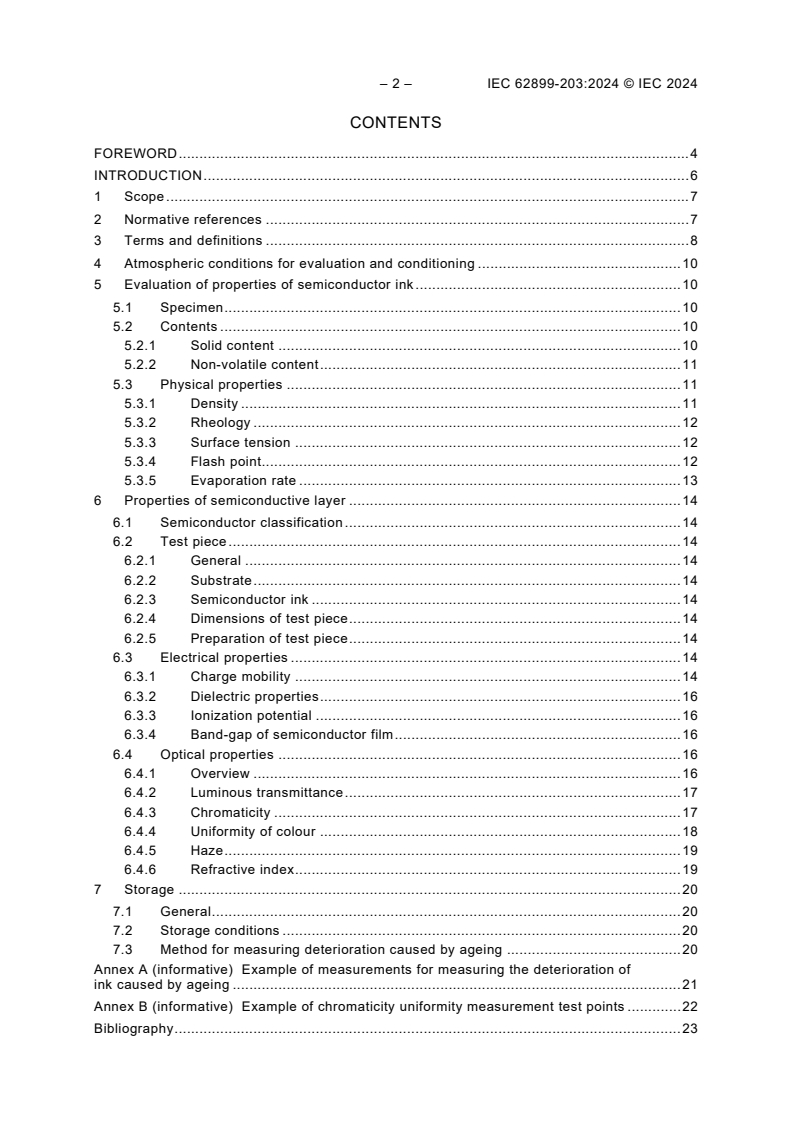
– 2 – IEC 62899-203:2024 © IEC 2024
CONTENTS
FOREWORD . 4
INTRODUCTION . 6
1 Scope . 7
2 Normative references . 7
3 Terms and definitions . 8
4 Atmospheric conditions for evaluation and conditioning . 10
5 Evaluation of properties of semiconductor ink . 10
5.1 Specimen . 10
5.2 Contents . 10
5.2.1 Solid content . 10
5.2.2 Non-volatile content . 11
5.3 Physical properties . 11
5.3.1 Density . 11
5.3.2 Rheology . 12
5.3.3 Surface tension . 12
5.3.4 Flash point . 12
5.3.5 Evaporation rate . 13
6 Properties of semiconductive layer . 14
6.1 Semiconductor classification . 14
6.2 Test piece . 14
6.2.1 General . 14
6.2.2 Substrate . 14
6.2.3 Semiconductor ink . 14
6.2.4 Dimensions of test piece . 14
6.2.5 Preparation of test piece . 14
6.3 Electrical properties . 14
6.3.1 Charge mobility . 14
6.3.2 Dielectric properties . 16
6.3.3 Ionization potential . 16
6.3.4 Band-gap of semiconductor film . 16
6.4 Optical properties . 16
6.4.1 Overview . 16
6.4.2 Luminous transmittance . 17
6.4.3 Chromaticity . 17
6.4.4 Uniformity of colour . 18
6.4.5 Haze . 19
6.4.6 Refractive index . 19
7 Storage . 20
7.1 General . 20
7.2 Storage conditions . 20
7.3 Method for measuring deterioration caused by ageing . 20
Annex A (informative) Example of measurements for measuring the deterioration of
ink caused by ageing . 21
Annex B (informative) Example of chromaticity uniformity measurement test points . 22
Bibliography . 23
Figure A.1 – Example of a series of TFT mobility measurements for an ink to evaluate
deterioration over time . 21
Figure B.1 – Chromaticity uniformity test point locations . 22
– 4 – IEC 62899-203:2024 © IEC 2024
INTERNATIONAL ELECTROTECHNICAL COMMISSION
____________
PRINTED ELECTRONICS –
Part 203: Materials – Semiconductor ink
FOREWORD
1) The International Electrotechnical Commission (IEC) is a worldwide organization for standardization comprising
all national electrotechnical committees (IEC National Committees). The object of IEC is to promote international
co-operation on all questions concerning standardization in the electrical and electronic fields. To this end and
in addition to other activities, IEC publishes International Standards, Technical Specifications, Technical Reports,
Publicly Available Specifications (PAS) and Guides (hereafter referred to as “IEC Publication(s)”). Their
preparation is entrusted to technical committees; any IEC National Committee interested in the subject dealt with
may participate in this preparatory work. International, governmental and non-governmental organizations liaising
with the IEC also participate in this preparation. IEC collaborates closely with the International Organization for
Standardization (ISO) in accordance with conditions determined by agreement between the two organizations.
2) The formal decisions or agreements of IEC on technical matters express, as nearly as possible, an international
consensus of opinion on the relevant subjects since each technical committee has representation from all
interested IEC National Committees.
3) IEC Publications have the form of recommendations for international use and are accepted by IEC National
Committees in that sense. While all reasonable efforts are made to ensure that the technical content of IEC
Publications is accurate, IEC cannot be held responsible for the way in which they are used or for any
misinterpretation by any end user.
4) In order to promote international uniformity, IEC National Committees undertake to apply IEC Publications
transparently to the maximum extent possible in their national and regional publications. Any divergence between
any IEC Publication and the corresponding national or regional publication shall be clearly indicated in the latter.
5) IEC itself does not provide any attestation of conformity. Independent certification bodies provide conformity
assessment services and, in some areas, access to IEC marks of conformity. IEC is not responsible for any
services carried out by independent certification bodies.
6) All users should ensure that they have the latest edition of this publication.
7) No liability shall attach to IEC or its directors, employees, servants or agents including individual experts and
members of its technical committees and IEC National Committees for any personal injury, property damage or
other damage of any nature whatsoever, whether direct or indirect, or for costs (including legal fees) and
expenses arising out of the publication, use of, or reliance upon, this IEC Publication or any other IEC
Publications.
8) Attention is drawn to the Normative references cited in this publication. Use of the referenced publications is
indispensable for the correct application of this publication.
9) IEC draws attention to the possibility that the implementation of this document may involve the use of (a)
patent(s). IEC takes no position concerning the evidence, validity or applicability of any claimed patent rights in
respect thereof. As of the date of publication of this document, IEC had not received notice of (a) patent(s), which
may be required to implement this document. However, implementers are cautioned that this may not represent
the latest information, which may be obtained from the patent database available at https://patents.iec.ch. IEC
shall not be held responsible for identifying any or all such patent rights.
IEC 62899-203 has been prepared by IEC technical committee 119: Printed Electronics. It is an
International Standard.
This second edition cancels and replaces the first edition published in 2018. This edition
constitutes a technical revision.
This edition includes the following significant technical changes with respect to the previous
edition:
a) addition of 6.3.1.2.2 – Normalised on-current measurement of the TFT device;
b) in 6.3.2, correction of formula for calculation of permittivity.
The text of this International Standard is based on the following documents:
Draft Report on voting
119/485/FDIS 119/489/RVD
Full information on the voting for its approval can be found in the report on voting indicated in
the above table.
The language used for the development of this International Standard is English.
This document was drafted in accordance with ISO/IEC Directives, Part 2, and developed in
accordance with ISO/IEC Directives, Part 1 and ISO/IEC Directives, IEC Supplement, available
at www.iec.ch/members_experts/refdocs. The main document types developed by IEC are
described in greater detail at www.iec.ch/publications.
A list of all parts in the IEC 62899 series, published under the general title Printed electronics,
can be found on the IEC website.
The committee has decided that the contents of this document will remain unchanged until the
stability date indicated on the IEC website under webstore.iec.ch in the data related to the
specific document. At this date, the document will be
• reconfirmed,
• withdrawn, or
• revised.
IMPORTANT – The "colour inside" logo on the cover page of this document indicates
that it contains colours which are considered to be useful for the correct understanding
of its contents. Users should therefore print this document using a colour printer.
– 6 – IEC 62899-203:2024 © IEC 2024
INTRODUCTION
The IEC 62899 series deals mainly with evaluation methods for materials of printed electronics.
The series also includes storage methods, packaging and marking, and transportation
conditions.
The IEC 62899 series is divided into several parts according to each material. Each part is
prepared as a generic specification containing fundamental information for the area of printed
electronics.
This part of IEC 62899 is prepared for inks containing semiconducting materials used in printed
electronics and contains the test conditions, the evaluation methods and the storage conditions.
PRINTED ELECTRONICS –
Part 203: Materials – Semiconductor ink
1 Scope
This part of IEC 62899 defines terms and specifies standard methods for characterization and
evaluation of semiconductor inks and semiconductive layers that are made from semiconductor
inks.
2 Normative references
The following documents are referred to in the text in such a way that some or all of their content
constitutes requirements of this document. For dated references, only the edition cited applies.
For undated references, the latest edition of the referenced document (including any
amendments) applies.
IEC 62860, Test methods for the characterization of organic transistors and materials
ISO 5-2, Photography and graphic technology – Density measurements – Part 2: Geometric
conditions for transmittance density
ISO 5-3, Photography and graphic technology – Density measurements – Part 3: Spectral
conditions
ISO 124, Latex, rubber – Determination of total solids content
ISO 291, Plastics – Standard atmospheres for conditioning and testing
ISO 489:2022, Plastics – Determination of refractive index
ISO 758, Liquid chemical products for industrial use – Determination of density at 20 °C
ISO 1183-1, Plastics – Methods for determining the density of non-cellular plastics – Part 1:
Immersion method, liquid pycnometer method and titration method
ISO 2555, Plastics – Resins in the liquid state or as emulsions or dispersions – Determination
of apparent viscosity using a single cylinder type rotational viscometer method
ISO 2592, Petroleum and related products – Determination of flash and fire points – Cleveland
closed cup method
ISO 2719, Determination of flash point – Pensky-Martens closed cup method
ISO 2811-1, Paints and varnishes – Determination of density – Part 1: Pycnometer method
ISO 2811-2, Paints and varnishes – Determination of density – Part 2: Immersed body (plummet)
method
ISO 2884-1, Paints and varnishes – Determination of viscosity using rotary viscometers – Part 1:
Cone-and-plate viscometer operated at a high rate of shear
– 8 – IEC 62899-203:2024 © IEC 2024
ISO 3219, Plastics – Polymers/resins in the liquid state or as emulsions or dispersions –
Determination of viscosity using a rotational viscometer with defined shear rate
ISO 3251, Paints, varnishes and plastics – Determination of non-volatile-matter content
ISO 3664, Graphic technology and photography – Viewing conditions
ISO 3679, Determination of flash point – Method for flash no-flash and flash point by small scale
closed cup tester
ISO 13468-1:2019, Plastics – Determination of the total luminous transmittance of transparent
materials – Part 1: Single-beam instrument
ISO 13468-2:1999, Plastics – Determination of the total luminous transmittance of transparent
materials – Part 2: Double-beam instrument
ISO 13655, Graphic technology – Spectral measurement and colorimetric computation for
graphic arts images
ISO 14488, Particulate materials – Sampling and sample splitting for the determination of
particulate properties
ISO 14782, Plastics – Determination of haze for transparent materials
ISO 15212-1, Oscillation-type density meters – Part 1: Laboratory instruments
3 Terms and definitions
For the purposes of this document, the terms and definitions given in IEC 62860 and the
following apply.
ISO and IEC maintain terminology databases for use in standardization at the following
addresses:
• IEC Electropedia: available at https://www.electropedia.org/
• ISO Online browsing platform: available at https://www.iso.org/obp
NOTE The terms in italic font are those defined in Clause 3.
3.1
semiconductive material
ingredient of a printing or coating material, which itself is electrically semiconductive
Note 1 to entry: The ingredient can be one or more small molecules, precursors, polymers, or particles.
Note 2 to entry: The ingredient can require post treatment to provide semiconductive properties.
3.2
semiconductor ink
liquid in which one or more inorganic particles, ions, salts, organic small molecules or organic
polymers are dissolved or dispersed, and which becomes an electrically semiconductive layer
(3.3) through solvent removal or post treatment such as UV, photonic, or thermal processing
[SOURCE: IEC 62899-101:2019, 3.121]
3.3
semiconductive layer
film-like semiconductive body of material made of semiconductor ink (3.2), which is printed or
coated on a substrate, followed, as necessary, by using a post treatment such as UV, photonic,
or thermal processing
[SOURCE: IEC 62899-101:2019, 3.119]
3.4
semiconductor film
substrate (sheet or roll) with semiconductive layer (3.3)
[SOURCE: IEC 62899-101:2019, 3.120]
3.5
solid content
mass fraction of an ingredient which effectively functions as a semiconductive material (3.1)
dissolved or dispersed in a solvent to form a semiconductor ink (3.2)
Note 1 to entry: In some instances the ink can include insulating materials, sometimes referred to as binders, or
other additives included to improve the film formation during coating or printing.
3.6
non-volatile content
mass fraction of residue obtained by evaporation of the volatile solvent under specific
conditions, in semiconductor ink (3.2)
3.7
dispersion
heterogeneous system in which fine separated materials are distributed uniformly in other
materials
3.8
flash point
lowest liquid temperature at which, under certain standardized conditions, a liquid gives off
vapours in quantity such as to be capable of forming an ignitable vapour/air mixture
[SOURCE: IEC 60050-212:2010, 212-18-05]
3.9
field effect mobility
majority carrier mobility of semiconductive material (3.1) derived through the transfer curve
measurement of a fabricated TFT (3.10) device
Note 1 to entry: The field effect mobility is usually derived from either saturation or linear approximations.
Note 2 to entry: Field effect mobility is given in units of cm /V·s.
– 10 – IEC 62899-203:2024 © IEC 2024
3.10
thin-film transistor
TFT
switching device made from three electrodes (source, drain and gate) and semiconducting and
insulating layers, wherein potentials applied to a gate electrode modulate charge carriers on
the opposite side of the insulating layer situated between the gate and semiconductive layer
(3.3)
Note 1 to entry: The change in charge density in the semiconductive layer changes its conductivity, and this in turn
allows a modulation in current flow between the source and drain electrodes for a given source-drain potential
difference.
Note 2 to entry: TFTs are found in a wide variety of electronic devices such as integrated circuits and display
backplanes.
4 Atmospheric conditions for evaluation and conditioning
The standard atmosphere for evaluation (test and measurement) and storage of the specimen
shall be a temperature of (23 ± 2) °C and relative humidity of (50 ± 10) %, in accordance with
standard atmosphere class 2 as specified in ISO 291. If a polymer substrate is used for a test
piece coated with a semiconductive layer, the standard atmosphere for evaluation shall be a
temperature of (23 ± 1) °C and relative humidity of (50 ± 5) %, in accordance with standard
atmosphere class 1 as specified in ISO 291.
If conditioning is necessary, the same standard atmosphere as specified above shall apply.
5 Evaluation of properties of semiconductor ink
5.1 Specimen
The specimen for evaluation shall be prepared in accordance with ISO 14488 or an equivalent
method. If necessary, dilution by a compatible solvent is permitted. For semiconductor inks, in
many cases the properties to be evaluated can be influenced by the choice of solvent and
method of deposition. Consideration of the likely effects of solvent choice and ink deposition
should be made in light of the semiconductor chemistry, the ink composition or both.
5.2 Contents
5.2.1 Solid content
5.2.1.1 Determination of solid content
Solid content of semiconductive materials and non-semiconductive materials shall be
determined by the theoretical mass fraction (expressed as a percentage) of functional
ingredients to the total ink mass. Functional ingredients include semiconductive materials, their
precursors or binders, or any additives.
5.2.1.2 Report of the results
The report shall include the following items:
a) unique specimen identification;
b) date of test;
c) atmospheric conditions of test;
d) solid content.
5.2.2 Non-volatile content
5.2.2.1 Principle
Non-volatile content is determined by measuring the mass of residue after evaporation of the
volatile ingredients and calculating the mass fraction (expressed as a percentage) to the total
ink mass.
5.2.2.2 Test method
The test method shall be as specified in ISO 3251 with the following exceptions:
a) Air pressure: 86 kPa to 106 kPa.
b) If specified by the manufacturer, the test can be performed under reduced pressure. The
conditions and procedures for reducing the pressure shall be as specified in ISO 124 or by
the manufacturer.
c) Materials which do not react with the ink during an examination shall be used.
d) Repeat the test until the weight becomes constant within 5 %.
5.2.2.3 Report of the results
The report shall include the following items:
a) specimen identification;
b) test conditions (air pressure if reduced, drying temperature and time);
c) specimen mass;
d) results.
5.3 Physical properties
5.3.1 Density
5.3.1.1 Measurement method
The measurement method shall either be the pyknometer method as specified in ISO 758,
ISO 1183-1 and ISO 2811-1, the method using oscillation-type density meters as specified in
ISO 15212-1, or the immersed body (plummet) method as specified in ISO 2811-2. The detailed
product specifications shall specify the measurement method to be used.
5.3.1.2 Equipment
Equipment shall be as specified in the measurement method (see 5.3.1.1) or shall
...
IEC 62899-203 ®
Edition 2.0 2024-05
REDLINE VERSION
INTERNATIONAL
STANDARD
colour
inside
Printed electronics –
Part 203: Materials – Semiconductor ink
All rights reserved. Unless otherwise specified, no part of this publication may be reproduced or utilized in any form
or by any means, electronic or mechanical, including photocopying and microfilm, without permission in writing from
either IEC or IEC's member National Committee in the country of the requester. If you have any questions about IEC
copyright or have an enquiry about obtaining additional rights to this publication, please contact the address below or
your local IEC member National Committee for further information.
IEC Secretariat Tel.: +41 22 919 02 11
3, rue de Varembé info@iec.ch
CH-1211 Geneva 20 www.iec.ch
Switzerland
About the IEC
The International Electrotechnical Commission (IEC) is the leading global organization that prepares and publishes
International Standards for all electrical, electronic and related technologies.
About IEC publications
The technical content of IEC publications is kept under constant review by the IEC. Please make sure that you have the
latest edition, a corrigendum or an amendment might have been published.
IEC publications search - webstore.iec.ch/advsearchform IEC Products & Services Portal - products.iec.ch
The advanced search enables to find IEC publications by a Discover our powerful search engine and read freely all the
variety of criteria (reference number, text, technical publications previews, graphical symbols and the glossary.
committee, …). It also gives information on projects, replaced With a subscription you will always have access to up to date
and withdrawn publications. content tailored to your needs.
IEC Just Published - webstore.iec.ch/justpublished
Electropedia - www.electropedia.org
Stay up to date on all new IEC publications. Just Published
The world's leading online dictionary on electrotechnology,
details all new publications released. Available online and once
containing more than 22 500 terminological entries in English
a month by email.
and French, with equivalent terms in 25 additional languages.
Also known as the International Electrotechnical Vocabulary
IEC Customer Service Centre - webstore.iec.ch/csc
(IEV) online.
If you wish to give us your feedback on this publication or need
further assistance, please contact the Customer Service
Centre: sales@iec.ch.
IEC 62899-203 ®
Edition 2.0 2024-05
REDLINE VERSION
INTERNATIONAL
STANDARD
colour
inside
Printed electronics –
Part 203: Materials – Semiconductor ink
INTERNATIONAL
ELECTROTECHNICAL
COMMISSION
ICS 29.045; 87.080 ISBN 978-2-8322-9018-7
– 2 – IEC 62899-203:2024 RLV © IEC 2024
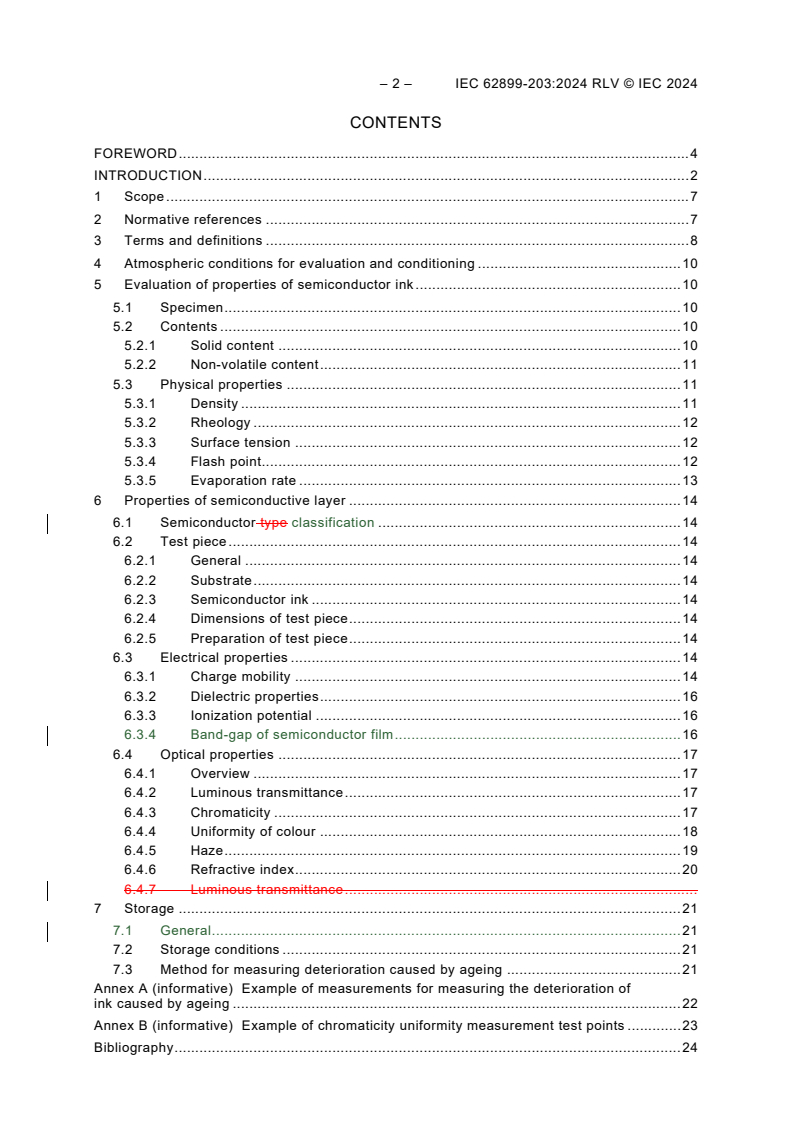
CONTENTS
FOREWORD . 4
INTRODUCTION . 2
1 Scope . 7
2 Normative references . 7
3 Terms and definitions . 8
4 Atmospheric conditions for evaluation and conditioning . 10
5 Evaluation of properties of semiconductor ink . 10
5.1 Specimen . 10
5.2 Contents . 10
5.2.1 Solid content . 10
5.2.2 Non-volatile content . 11
5.3 Physical properties . 11
5.3.1 Density . 11
5.3.2 Rheology . 12
5.3.3 Surface tension . 12
5.3.4 Flash point . 12
5.3.5 Evaporation rate . 13
6 Properties of semiconductive layer . 14
6.1 Semiconductor type classification . 14
6.2 Test piece . 14
6.2.1 General . 14
6.2.2 Substrate . 14
6.2.3 Semiconductor ink . 14
6.2.4 Dimensions of test piece . 14
6.2.5 Preparation of test piece . 14
6.3 Electrical properties . 14
6.3.1 Charge mobility . 14
6.3.2 Dielectric properties . 16
6.3.3 Ionization potential . 16
6.3.4 Band-gap of semiconductor film . 16
6.4 Optical properties . 17
6.4.1 Overview . 17
6.4.2 Luminous transmittance . 17
6.4.3 Chromaticity . 17
6.4.4 Uniformity of colour . 18
6.4.5 Haze . 19
6.4.6 Refractive index . 20
6.4.7 Luminous transmittance .
7 Storage . 21
7.1 General . 21
7.2 Storage conditions . 21
7.3 Method for measuring deterioration caused by ageing . 21
Annex A (informative) Example of measurements for measuring the deterioration of
ink caused by ageing . 22
Annex B (informative) Example of chromaticity uniformity measurement test points . 23
Bibliography . 24
Figure A.1 – Example of a series of TFT mobility measurements for an ink to evaluate
deterioration over time . 22
Figure B.1 – Chromaticity uniformity test point locations . 23
– 4 – IEC 62899-203:2024 RLV © IEC 2024
INTERNATIONAL ELECTROTECHNICAL COMMISSION
____________
PRINTED ELECTRONICS –
Part 203: Materials – Semiconductor ink
FOREWORD
1) The International Electrotechnical Commission (IEC) is a worldwide organization for standardization comprising
all national electrotechnical committees (IEC National Committees). The object of IEC is to promote international
co-operation on all questions concerning standardization in the electrical and electronic fields. To this end and
in addition to other activities, IEC publishes International Standards, Technical Specifications, Technical Reports,
Publicly Available Specifications (PAS) and Guides (hereafter referred to as “IEC Publication(s)”). Their
preparation is entrusted to technical committees; any IEC National Committee interested in the subject dealt with
may participate in this preparatory work. International, governmental and non-governmental organizations liaising
with the IEC also participate in this preparation. IEC collaborates closely with the International Organization for
Standardization (ISO) in accordance with conditions determined by agreement between the two organizations.
2) The formal decisions or agreements of IEC on technical matters express, as nearly as possible, an international
consensus of opinion on the relevant subjects since each technical committee has representation from all
interested IEC National Committees.
3) IEC Publications have the form of recommendations for international use and are accepted by IEC National
Committees in that sense. While all reasonable efforts are made to ensure that the technical content of IEC
Publications is accurate, IEC cannot be held responsible for the way in which they are used or for any
misinterpretation by any end user.
4) In order to promote international uniformity, IEC National Committees undertake to apply IEC Publications
transparently to the maximum extent possible in their national and regional publications. Any divergence between
any IEC Publication and the corresponding national or regional publication shall be clearly indicated in the latter.
5) IEC itself does not provide any attestation of conformity. Independent certification bodies provide conformity
assessment services and, in some areas, access to IEC marks of conformity. IEC is not responsible for any
services carried out by independent certification bodies.
6) All users should ensure that they have the latest edition of this publication.
7) No liability shall attach to IEC or its directors, employees, servants or agents including individual experts and
members of its technical committees and IEC National Committees for any personal injury, property damage or
other damage of any nature whatsoever, whether direct or indirect, or for costs (including legal fees) and
expenses arising out of the publication, use of, or reliance upon, this IEC Publication or any other IEC
Publications.
8) Attention is drawn to the Normative references cited in this publication. Use of the referenced publications is
indispensable for the correct application of this publication.
9) IEC draws attention to the possibility that the implementation of this document may involve the use of (a)
patent(s). IEC takes no position concerning the evidence, validity or applicability of any claimed patent rights in
respect thereof. As of the date of publication of this document, IEC had not received notice of (a) patent(s), which
may be required to implement this document. However, implementers are cautioned that this may not represent
the latest information, which may be obtained from the patent database available at https://patents.iec.ch. IEC
shall not be held responsible for identifying any or all such patent rights.
This redline version of the official IEC Standard allows the user to identify the changes
made to the previous edition IEC 62899-203:2018. A vertical bar appears in the margin
wherever a change has been made. Additions are in green text, deletions are in
strikethrough red text.
IEC 62899-203 has been prepared by IEC technical committee 119: Printed Electronics. It is an
International Standard.
This second edition cancels and replaces the first edition published in 2018. This edition
constitutes a technical revision.
This edition includes the following significant technical changes with respect to the previous
edition:
a) addition of 6.3.1.2.2 – Normalised on-current measurement of the TFT device;
b) in 6.3.2, correction of formula for calculation of permittivity.
The text of this International Standard is based on the following documents:
Draft Report on voting
119/485/FDIS 119/489/RVD
Full information on the voting for its approval can be found in the report on voting indicated in
the above table.
The language used for the development of this International Standard is English.
This document was drafted in accordance with ISO/IEC Directives, Part 2, and developed in
accordance with ISO/IEC Directives, Part 1 and ISO/IEC Directives, IEC Supplement, available
at www.iec.ch/members_experts/refdocs. The main document types developed by IEC are
described in greater detail at www.iec.ch/publications.
A list of all parts in the IEC 62899 series, published under the general title Printed electronics,
can be found on the IEC website.
The committee has decided that the contents of this document will remain unchanged until the
stability date indicated on the IEC website under webstore.iec.ch in the data related to the
specific document. At this date, the document will be
• reconfirmed,
• withdrawn, or
• revised.
IMPORTANT – The "colour inside" logo on the cover page of this document indicates
that it contains colours which are considered to be useful for the correct understanding
of its contents. Users should therefore print this document using a colour printer.
– 6 – IEC 62899-203:2024 RLV © IEC 2024
INTRODUCTION
The IEC 62899 series deals mainly with evaluation methods for materials of printed electronics.
The series also includes storage methods, packaging and marking, and transportation
conditions.
The IEC 62899 series is divided into several parts according to each material. Each part is
prepared as a generic specification containing fundamental information for the area of printing
printed electronics.
The IEC 62899 series consists of the following parts:
Part 1: Terminology
Part 201: Materials – Substrates
Part 202: Materials – Conductive ink
Part 203: Materials – Semiconductor ink
Part 250: Material technologies required in printed electronics for wearable smart devices
Part 301-X: Equipment – Contact printing – Rigid master
Part 302-X: Equipment – Inkjet
Part 303-X: Equipment – Roll-to-roll printing
Part 401: Printability – Overview
Part 402-X: Printability – Measurement of qualities
Part 403-X: Printability – Requirements for reproducibility
Part 502-X: Quality assessment – Organic light emitting diode (OLED) elements
Furthermore, sectional specifications, blank detail specifications, and detail specifications for
each material will be based on these parts.
This part of IEC 62899 is prepared for inks containing semiconducting materials used in printed
electronics and contains the test conditions, the evaluation methods and the storage conditions.
PRINTED ELECTRONICS –
Part 203: Materials – Semiconductor ink
1 Scope
This part of IEC 62899 defines terms and specifies standard methods for characterization and
evaluation of semiconductor inks and semiconductive layers that are made from semiconductor
inks.
2 Normative references
The following documents are referred to in the text in such a way that some or all of their content
constitutes requirements of this document. For dated references, only the edition cited applies.
For undated references, the latest edition of the referenced document (including any
amendments) applies.
IEC 62860, Test methods for the characterization of organic transistors and materials
ISO 5-2, Photography and graphic technology – Density measurements – Part 2: Geometric
conditions for transmittance density
ISO 5-3, Photography and graphic technology – Density measurements – Part 3: Spectral
conditions
ISO 124, Latex, rubber – Determination of total solids content
ISO 291, Plastics – Standard atmospheres for conditioning and testing
ISO 304, Surface active agents – Determination of surface tension by drawing up liquid films
ISO 489:19992022, Plastics – Determination of refractive index
ISO 758, Liquid chemical products for industrial use – Determination of density at 20 °C
ISO 1183-1, Plastics – Methods for determining the density of non-cellular plastics – Part 1:
Immersion method, liquid pycnometer method and titration method
ISO 2555, Plastics – Resins in the liquid state or as emulsions or dispersions – Determination
of apparent viscosity by the Brookfield Test using a single cylinder type rotational viscometer
method
ISO 2592, Petroleum and related products – Determination of flash and fire points – Cleveland
closed cup method
ISO 2719, Determination of flash point – Pensky-Martens closed cup method
ISO 2811-1, Paints and varnishes – Determination of density – Part 1: Pycnometer method
ISO 2811-2, Paints and varnishes – Determination of density – Part 2: Immersed body (plummet)
method
– 8 – IEC 62899-203:2024 RLV © IEC 2024
ISO 2884-1, Paints and varnishes – Determination of viscosity using rotary viscometers – Part 1:
Cone-and-plate viscometer operated at a high rate of shear
ISO 3219, Plastics – Polymers/resins in the liquid state or as emulsions or dispersions –
Determination of viscosity using a rotational viscometer with defined shear rate
ISO 3251, Paints, varnishes and plastics – Determination of non-volatile-matter content
ISO 3664, Graphic technology and photography – Viewing conditions
ISO 3679, Determination of flash no-flash and flash point – Rapid equilibrium closed cup
method Determination of flash point – Method for flash no-flash and flash point by small scale
closed cup tester
ISO 13468-1:19962019, Plastics – Determination of the total luminous transmittance of
transparent materials – Part 1: Single-beam instrument
ISO 13468-2:1999, Plastics – Determination of the total luminous transmittance of transparent
materials – Part 2: Double-beam instrument
ISO 13655, Graphic technology – Spectral measurement and colorimetric computation for
graphic arts images
ISO 14488, Particulate materials – Sampling and sample splitting for the determination of
particulate properties
ISO 14782, Plastics – Determination of haze for transparent materials
ISO 15212-1, Oscillation-type density meters – Part 1: Laboratory instruments
3 Terms and definitions
For the purposes of this document, the terms and definitions given in IEC 62860 and the
following apply.
ISO and IEC maintain terminology databases for use in standardization at the following
addresses:
• IEC Electropedia: available at https://www.electropedia.org/
• ISO Online browsing platform: available at https://www.iso.org/obp
NOTE The terms in italic font are those defined in Clause 3.
3.1
semiconductive material
ingredient of a printing or coating material, which itself is electrically semiconductive
Note 1 to entry: The ingredient can be one or more small molecules, precursors, polymers, or particles.
Note 2 to entry: The ingredient can require post treatment to provide semiconductive properties.
3.2
semiconductor ink
liquid in which one or more inorganic particles, ions, salts, organic small molecules or organic
polymers are dissolved or dispersed, and which becomes an electrically semiconductive layer
(3.3) through solvent removal or post treatment such as UV, photonic, or thermal processing
[SOURCE: IEC 62899-101:2019, 3.121]
3.3
semiconductive layer
film-like semiconductive body of material made of semiconductor ink (3.2), which is printed or
coated on a substrate, followed, as necessary, by using a post treatment such as UV, photonic,
or thermal processing
[SOURCE: IEC 62899-101:2019, 3.119]
3.4
semiconductor film
substrate (sheet or roll) with semiconductive layer (3.3)
[SOURCE: IEC 62899-101:2019, 3.120]
3.5
solid content
mass fraction of an ingredient which effectively functions as a semiconductive material (3.1)
dissolved or dispersed in a solvent to form a semiconductor ink (3.2)
Note 1 to entry: In some instances the ink may can include insulating materials, sometimes referred to as binders,
or other additives included to improve the film formation during coating or printing.
3.6
non-volatile content
mass fraction of residue obtained by evaporation of the volatile solvent under specific
conditions, in semiconductor ink (3.2)
3.7
dispersion
heterogeneous system in which fine separated materials are distributed uniformly in other
materials
3.8
flash point
lowest liquid temperature at which, under certain standardized conditions, a liquid gives off
vapours in quantity such as to be capable of forming an ignitable vapour/air mixture
[SOURCE: IEC 60050-212:2010, 212-18-05]
3.9
field effect mobility
majority carrier mobility of semiconductive material (3.1) derived through the transfer curve
measurement of a fabricated TFT (3.10) device
Note 1 to entry: The field effect mobility is usually derived from either saturation or linear approximations.
Note 2 to entry: Field effect mobility is given in units of cm /V·s.
– 10 – IEC 62899-203:2024 RLV © IEC 2024
3.10
thin-film transistor
TFT
switching device made from three electrodes (source, drain and gate) and semiconducting and
insulating layers, wherein potentials applied to a gate electrode modulate charge carriers on
the opposite side of the insulating layer situated between the gate and semiconductive layer
(3.3)
Note 1 to entry: The change in charge density in the semiconductive layer changes its conductivity, and this in turn
allows a modulation in current flow between the source and drain electrodes for a given source-drain potential
difference.
Note 2 to entry: TFTs are found in a wide variety of electronic devices such as integrated circuits and display
backplanes.
4 Atmospheric conditions for evaluation and conditioning
The standard atmosphere for evaluation (test and measurement) and storage of the specimen
shall be a temperature of (23 ± 2) °C and relative humidity of (50 ± 10) %, conforming to in
accordance with standard atmosphere class 2 as specified in ISO 291. If a polymer substrate
is used for a test piece coated with a semiconductive layer, the standard atmosphere for
evaluation shall be a temperature of (23 ± 1) °C and relative humidity of (50 ± 5) %, conforming
to in accordance with standard atmosphere class 1 as specified in ISO 291.
If conditioning is necessary, the same standard atmosphere as specified above shall apply.
5 Evaluation of properties of semiconductor ink
5.1 Specimen
The specimen for evaluation shall be prepared in accordance with ISO 14488 or an equivalent
method. If necessary, dilution by a compatible solvent may be allowed is permitted. For
semiconductor inks, in many cases the properties to be evaluated could can be influenced by
the choice of solvent and method of deposition. Consideration of the likely effects of solvent
choice and ink deposition should be made in light of the semiconductor chemistry and/or, the
ink composition or both.
5.2 Contents
5.2.1 Solid content
5.2.1.1 Determination of solid content
Solid content of semiconductive materials and non-semiconductive materials shall be
determined by the theoretical mass fraction (expressed as a percentage) of functional
ingredients to the total ink mass. Functional ingredients include semiconductive materials, their
precursors or binders, or any additives.
5.2.1.2 Report of the results
The report shall include the following items:
a) unique specimen identification;
b) date of test;
c) atmospheric conditions of test;
d) solid content.
5.2.2 Non-volatile content
5.2.2.1 Principle
Non-volatile content is determined by measuring the mass of residue after evaporation of the
volatile ingredients and calculating the mass fraction (expressed as a percentage) to the total
ink mass.
5.2.2.2 Test method
The test method shall be as specified in ISO 3251 with the following exceptions:
a) Air pressure: 86 kPa to 106 kPa.
b) If specified by the manufacturer, the test may can be performed under reduced pressure.
The conditions and procedures for reducing the pressure shall be as specified in ISO 124
or by the manufacturer.
c) Materials which do not react with the ink during an examination shall be used.
d) Repeat the test until the weight becomes constant within 5 %.
5.2.2.3 Report of the results
The report shall include the following items:
a) specimen identification;
b) test conditions (air pressure if reduced, drying temperature and time);
c) specimen mass;
d) results.
5.3 Physical properties
5.3.1 Density
5.3.1.1 Measuring Measurement method
The measuring measurement method shall either be the pyknometer method as specified in
ISO 758, ISO 1183-1 and ISO 2811-1, the method using oscillation-type density meters as
specified in ISO 15212-1, or the immersed body (plummet) method as specified in ISO 2811-2.
The detailed product specifications shall specify the measuring measurement method to be
used.
5.3.1.2 Equipment
Equipment shall be as specified in the measurement method (see 5.3.1.1) or shall be equipment
considered equivalent or superior.
5.3.1.3 Report of the results
The report shall include the following items:
a) specimen identification;
b) measurement method;
c) measurement atmosphere (temperature and relative humidity);
d) results.
– 12 – IEC 62899-203:2024 RLV © IEC 2024
5.3.2 Rheology
5.3.2.1 Measuring Measurement method
Viscosity shall be measured using a Brookfield type rotational viscometer as specified in
ISO 2555, cone-and-plate viscometer as specified in ISO 2884-1, or rotational viscometer as
specified in ISO 3219.
The detailed product specifications shall specify the measuring measurement method and
measuring temperature to be used.
5.3.2.2 Report of the results
The report shall include the following items:
a) standard number of the measurement method;
b) specimen identification;
c) measuring temperature;
d) viscometer model;
e) viscosity expressed in millipascal second (mPa·s) at (a) shear rate(s) appropriate to the
printing method(s) for which the ink is proposed to be used by the supplier.
5.3.3 Surface tension
5.3.3.1 Measuring Measurement method
Surface tension shall can be measured using the drawing up liquid film (Wilhelmy) method as
specified in ISO 304 with the following exceptions:
a) equipment considered equivalent to that in ISO 304 may can be used;
b) the test jig shall be made of platinum;
c) the equipment shall be calibrated using pure water and a hanging weight.
Other methods of measuring surface tension can be used such as the Du Noüy method and the
pendant drop method.
5.3.3.2 Report of the results
The report shall include the following items:
a) specimen identification;
b) measuring temperature;
c) measurement method used to evaluate the surface tension;
d) surface tension expressed in millinewton per metre (mN/m).
5.3.4 Flash point
5.3.4.1 Measuring Measurement method
Flash point shall be measured in accordance with ISO 2592 in the case of an open system. The
method of "open system" is preferable for safety, however "closed systems" are also widely
used. The measurement method based on ISO 2719 (closed system) and ISO 3679 (closed
system) may can be applied if a closed system is required.
5.3.4.2 Report of the results
The report shall include the following items:
a) specimen identification;
b) test conditions (temperature, humidity and atmospheric pressure);
c) sampling conditions (type of ink used, dispersive media and concentration);
d) results;
e) others (special items).
5.3.5 Evaporation rate
5.3.5.1 General
The evaporation rate is a property which is necessary for the printed electronics ink, but the
details of the evaluation condition and the measuring measurement method are significantly
different for the ink. In this document, a common framework for the method is specified as a
guideline. The detailed conditions and measurements may can be determined between trading
partners depending on the properties of the ink.
5.3.5.2 Measuring Measurement method
The evaporation rate of solvent from an ink formulation can be determined by measuring the
time taken for 90 % of the mass of the solvent content of the ink formulation to evaporate.
A flat absorbent material (such as a filter paper) is positioned on a sensitive mass balance
located inside a dry air (< 5 % relative humidity) or nitrogen cabinet at atmospheric pressure. A
known volume of ink (such as 1 ml) is dispensed in a straight line on the absorbent material to
produce a repeatable area of wetted film on the filter paper. Dried air or nitrogen is passed
through the cabinet at a controlled temperature and flow rate. The temperature and flow rate
may can be determined between trading partners depending on the properties of the ink, but
these conditions shall be included in the report. The location of the entry and exit ports for the
dry air or nitrogen should be chosen so as not to disturb the mass balance readings throughout
the test.
The evaporation rate can be calculated by measuring the difference in mass over a period of
time. It is recommended that sufficient measurements be made to allow five or more points to
be plotted on a graph of mass loss versus time for values of between 10 % and 90 % loss of
solvent from the ink. The test should be repeated a total of three times and the evaporation
rates averaged for that ink. In order to make a comparison, the procedure should be conducted
with a known solvent such as n-butyl acetate and the evaporation rate normalised to this solvent.
In the case of an ink comprising a solvent mixture, an increased number of measurements shall
be made in order to clearly show how the evaporation rate changes over time. It is
recommended that a balance with automated data logging be used in order to facilitate the
capture of sufficient data to describe the detailed behaviour. The results may can be presented
in graphical form for the case where the solvent evaporation rate is varying with time in a
complex manner. These results can also be compared with those for n-butyl acetate by plotting
both data on the same graph.
5.3.5.3 Report of the results
The report shall include the following items:
a) specimen identification;
b) test conditions (mass of ink, flow rate of air/nitrogen, solvent used for comparison);
c) results (normalised to the solvent used for comparison).
– 14 – IEC 62899-203:2024 RLV © IEC 2024
6 Properties of semiconductive layer
6.1 Semiconductor type classification
The methods described in IEC 62860 are applicable to the evaluation of printable printed
semiconductors. However, for the purposes of this document the test methods for organic or
inorganic printable semiconductors will be the same. No distinction between the two classes of
material is necessary.
6.2 Test piece
6.2.1 General
Test pieces are used for evaluating the semiconductive layer.
6.2.2 Substrate
The substrate for the test piece shall be clean and of smooth-surface non-alkali glass which will
not affect the ink. Other substrate materials may can be used if agreed between the trading
partners (supplier and purchaser).
6.2.3 Semiconductor ink
According to 5.1, except no dilution is allowed.
6.2.4 Dimensions of test piece
The dimensions of the test piece shall be as specified in each test method. If evaluation is
possible, a test piece with smaller and/or thinner dimensions, or both, than specified may can
be used.
6.2.5 Preparation of test piece
The test piece shall be prepared according to the following procedure:
a) Prior to ink printing or coating, the substrate surface shall be cleaned by appropriate means
using one or more of an organic solvent such as acetone, an aqueous detergent solution,
diluted tetramethylammonium hydroxide (TMAH), and water.
b) Print or coat the ink onto the substrate surface using an appropriate method to form a
uniform layer of ink.
c) Solidify the ink by appropriate means to produce an electrically semiconductive layer.
6.3 Electrical properties
6.3.1 Charge mobility
6.3.1.1 General
The method of direct charge carrier mobility measurement should be described for
measurement of the semiconductive layer. Direct measurement of the charge mobility may not
be possible for all material types. This may be due to the absence of sufficient charges in the
semiconductor for Hall effect measurements to be made. Depending on the carrier
concentration the appropriate method should be selected amongst the measurements of field
effect mobility, Hall mobility, time of flight (TOF) mobility, and space charge limited current
(SCLC) mobility.
6.3.1.2 TFTs
6.3.1.2.1 Field effect mobility of the TFT device
TFT field effect mobility measurements can be used to give an indication of the performance of
the ink in a particular application. In this case measurements should be made in accordance
with IEC 62860. Charge mobility should be calculated in the linear and/or saturated regime, or
both, and presented graphically as a variable for a range of gate voltages in the accumulation
mode. This will enable the gate voltage dependence of the mobility to be seen for a given
material. TFTs should be constructed with channel lengths covering a factor of 5 from smallest
to largest in order to illustrate any variation in performance arising from short channel effects.
Ideally the smallest channel length tested should be less than < 10 µm since these dimensions
are where the channel length shortening effects have the greatest effect upon device
performance. The field effect mobility often varies as a function of gate voltage and can, on
occasion, be extracted inaccurately due to contact resistance effects. Therefore, other methods
to evaluate semiconductor ink performance in a TFT should be employed in addition to field
effect mobility. One method is to use a normalised on-current measurement as shown in
6.3.1.2.2.
6.3.1.2.2 Normalised on-current measurement of the TFT device
) at a defined set of gate and drain voltages can be an
Measurement of the TFT on-current (I
D
effective way to evaluate the performance of the semiconductor ink and determine if it is able
to provide enough current for an application. To evaluate devices produced with different
geometries channel length (L), width (W) and dielectric capacitance (C ), it is necessary to
i
normalise the on-current with respect to these parameters (i.e. the current that would flow in a
TFT with W = L = 1 µm and at C = 1 nF/cm ). The normalised drain current (NI ) is calculated
i D
according to the following formula:
NI I ⋅ L⋅
DD
WC
i
The voltages for the TFT should be agreed between trading partners (supplier and purchaser).
As an example, for a p-type TFT the NI could be measured for the drain set at −15 V and the
D
gate voltage at −22 V. N-type TFTs would require positive gate and drain voltages. As in
6.3.1.2.1, the NI shall be measured on a range of TFT channel lengths covering a factor of at
D
least 5 from smallest to largest to identify any short channel effects. The C of the TFT is often
i
2 2
in the range of 2 nF/cm to 20 nF/cm for printed devices. Values above this range could be
obtained if the relative permittivity of the insulator in the device is very high or the insulator is
very thin, or both. Values below this range can be achieved due to the use of a very thick
insulator. The dielectric thickness, and hence gate capacitance, should be agreed between the
trading partners at a level relevant for the intended application.
6.3.1.2.3 Current hysteresis
IV characteristics for drain current versus gate voltage at fixed drain voltage shall be made in
accordance with IEC 62860. This measurement shall be made at the same drain voltage as
used to calculate the NI value. Forward and reverse scans shall be plotted in a graph to show
D
the level of current hysteresis throughout the transfer scan. In this way the semiconductor ink’s
performance can be measured without any effects of ion migration or slow polarization that can
affect the value.
6.3.1.3 Diodes
Charge mobility measurement through TOF or (SCLC) measurements may can also be used to
evaluate the performance of the semiconductive layer in a diode metal-semiconductor-metal
configuration. The test method should be described, detailing the preparation method for the
device contacts and the voltage measurement regimes used to conduct the study.
=
– 16 – IEC 62899-203:2024 RLV © IEC 2024
6.3.2 Dielectric properties
The dielectric properties of the semiconductor film can be measured by forming a capacitor
structure using the semiconductor as a dielectric in between two metal plates. The metal plates
can be formed by thermal evaporation or sputtering and patterned by shadow masking or
photolithography. The semiconductor ink can be coated by spin, slot die coating, or printing and
dried using a hot plate or oven. Film thickness should be measured using a stylus profileometer
or similar equipment with the required accuracy for the film thickness. Measurement of the
capacitance of a known thickness of the semiconductor (at a frequency of 1 kHz) will enable
the relative permittivity ε to be calculated using the formula:
r
∈ A
∈=
r
dC⋅
where
d semiconductor thickness,
permittivity of free space,
∈
A area of capacitor,
C measured capacitance.
Cd⋅
ε =
r
εA⋅
where
d is the semiconductor thickness,
ε is the vacuum electric permittivity,
A is the area of the capacitor,
C is the measured capacitance.
For applications where the semiconductor is operating at higher frequencies, the capacitance
can be measured at different frequencies to establish the variation of the permittivity with
frequency. For the capacitance measurement either a capacitance meter, LCR meter or
frequency analyser may can be used. Care should be taken to account for Any parasitic
capacitance in the measurement leads or test fixture should be accounted for. The dimensions
of the electrodes and thickness of the film should be reported, and these should be chosen so
as to avoid any edge effects that would alter the accuracy of the measurement. It is
recommended that the diameter of the capacitor plates (or length for the case of a square device)
be at least 1 000 times larger than the thickness of the semiconductor film. If a large dielectric
loss is measured in the film, due to a high charge concentration in the semiconductor, then the
frequency of the measurement can be increased from 1 kHz to 10 kHz or 100 kHz. Alternatively,
the capacitance-voltage CV technique can be used to vary the applied bias across a metal-
insulator-semiconductor-metal structure during capacitance measurement. The applied DC bias
can be used to compare the capacitance values of the structure for both depletion and
accumulation of charges in the semiconductor.
6.3.3 Ionization potential
Ionization potential for p-type materials can be measured using photoelectron spectroscopy in
air. The test method and the film preparation conditions should be described, including the
atmospheric conditions in the laboratory.
6.3.4 Band-gap of semiconductor film
The band-gap of the semiconductor film can be measured using the Tauc method applied to a
UV-Vis absorption plot of the film or absorbance spectrum fitting (ASF) method. The test method
and the film preparation conditions should be described, including the atmospheric conditions
in the laboratory.
6.4 Optical properties
6.4.1 Overview
The tests specified in 6.4.2 through 6.4.6 shall be used for transparent or equivalent materials.
6.4.2 Luminous transmittance
6.4.2.1 General
Luminous transmittance is presented as total luminous transmittance.
6.4.2.2 Measuring Measurement method
Luminous transmittance shall be measured using the single-beam method as specified in
ISO 13468-1, or the double-beam method as specified in ISO 13468-2, with the following details.
If agreed between the trading partners (supplier and purchaser), another method which is
considered equivalent may can be used.
The detailed product specifications shall specify the applicable measuring measurement
method.
6.4.2.3 Measuring equipment
Measuring equipment shall be as specified in ISO 13468-1:19962019, Clause 4, for single-
beam instruments or ISO 13468-2:19992021, Clause 4, for double-beam instruments, as
appropriate. Measuring equipment according to ISO 13655 or ISO 5-2 may can be used.
6.4.2.4 Wavelength or wavelength range used in the test
Luminous transmittance shall be measured either at a particular wavelength or a wavelength
range, as agreed between the trading partners (supplier and purchaser) considering factors
such as material characteristics or application.
6.4.2.5 Report of the results
The report shall include the following items:
a) measuring measurement method and equipment;
b) measuring wavelength or wavelength range;
c) specimen thickness;
d) luminous transmittance.
6.4.3 Chromaticity
6.4.3.1 General
According to ISO 11664-4, chromaticity is presented as CIE (1976) L*a*b* colour space.
6.4.3.2 Measuring Measurement method
The measuring measurement method shall be the reflected light method or the transmitted light
method, depending on the application and the purpose.
If the reflected light method is used, a reflecting diffuser shall be placed on both the surface to
be measured and the other surface, with the specimen in between.
– 18 – IEC 62899-203:2024 RLV © IEC 2024
The reflecting diffuser shall be a perfect reflecting diffuser or a reference diffuser used for
calibrating measuring equipment.
6.4.3.3 Measuring equipment and auxiliaries
The measuring equipment and light source shall be in accordance with at least one of the
following: ISO 5-2, ISO 5-3, ISO 3664 or ISO 13655, and shall be specified in the
...