

IEC 60947-9-1:2019
(Main)Low-voltage switchgear and controlgear - Part 9-1: Active arc-fault mitigation systems - Arc quenching devices
General Information
- Abstract
IEC 60947-9-1:2019 covers low-voltage arc quenching devices, hereinafter referred to as AQDs, which are intended to eliminate arc-faults in low-voltage assemblies (typically low-voltage switchgear and controlgear assemblies in accordance with the IEC 61439 series), by creating a lower impedance current path, to cause the arcing current to transfer to the new current path. This new current path is maintained until a short-circuit protection device (SCPD) interrupts the short-circuit current.
AQDs are installed in low-voltage assemblies, connected to the main circuit, preferably as close as possible to all primary power sources.
Their rated voltage does not exceed 1 000 V AC or 1 500 V DC.
- Status
- Published
- Publication Date
- 15-Jan-2019
- Technical Committee
- SC 121A - Low-voltage switchgear and controlgear
- Drafting Committee
- PT 60947-9-1 - TC 121/SC 121A/PT 60947-9-1
- Current Stage
- PPUB - Publication issued
- Start Date
- 16-Jan-2019
- Completion Date
- 25-Jan-2019
Overview
IEC 60947-9-1:2019 is an international standard published by the International Electrotechnical Commission (IEC) that specifies requirements for low-voltage arc quenching devices (AQDs). These devices are designed to mitigate arc faults in low-voltage switchgear and controlgear assemblies - typically those complying with the IEC 61439 series. AQDs function by creating a low-impedance current path to transfer arcing currents away from fault locations until a short-circuit protection device (SCPD) can interrupt the fault current. These devices are crucial for enhancing electrical safety and reliability in low-voltage electrical systems. The standard applies to AQDs with rated voltages up to 1000 V AC or 1500 V DC.
Key Topics
Scope and Application
IEC 60947-9-1 covers the specification, classification, performance, and testing of AQDs installed in low-voltage assemblies. It excludes sensors, actuators, or current-interrupting devices related to arc faults, and special AQDs used in explosive atmospheres (e.g., ATEX).Device Classification
AQDs are classified by:- Number of operations: single-shot or resettable
- Mounting type: fixed, withdrawable, or plug-in
Essential Characteristics
The standard defines important electrical and mechanical properties, including:- Rated operational voltage and insulation voltage
- Rated impulse withstand voltage
- Short-time withstand current
- Maximum voltage drop in low-impedance state
- Maximum operating time and number of operation cycles for resettable AQDs
- Temperature limits for terminals
Installation and Usage
AQDs should be installed as close as possible to all primary power sources within low-voltage assemblies to optimize arc fault mitigation.Testing Requirements
The document details type tests to verify construction and performance, electromagnetic compatibility (EMC) tests, and routine tests such as dielectric withstand and closing operations.Safety and Performance Rationale
It includes informative annexes explaining voltage drop limits and minimum distance for effective arc extinction, ensuring high reliability and safety in electrical installations.
Applications
Low-Voltage Switchgear and Controlgear Assemblies
AQDs are essential for integrating active arc-fault mitigation systems within switchgear and controlgear assemblies, significantly enhancing user protection and reducing outage times.Electrical Panels in Industrial and Commercial Buildings
In commercial and industrial low-voltage applications, AQDs prevent severe damage and hazards caused by internal arc faults, improving operational continuity and personnel safety.Renewable Energy Systems and DC Applications
With ratings up to 1500 V DC, these arc quenching devices are suitable for DC applications, such as photovoltaic systems and energy storage installations, where arc fault risks require careful control.Retrofit and Maintenance Upgrades
AQDs can be incorporated into existing assemblies to upgrade safety features, meeting modern arc-fault mitigation requirements and compliance with latest regulations.
Related Standards
IEC 61439 Series
Specifies requirements for low-voltage switchgear and controlgear assemblies, defining the framework where AQDs are installed.Upcoming IEC 60947-9-2
Draft standard covering internal arc-fault control devices (IACDs), complementing AQDs by providing arc-fault detection requirements.Draft IEC TS 63107
Technical specification under development for integration of active arc-fault mitigation systems within assemblies, providing guidance on system-level design.ATEX Standards
For AQDs intended for use in explosive atmospheres, compliant with specific safety requirements outside the scope of IEC 60947-9-1.
Summary
IEC 60947-9-1:2019 defines performance and safety requirements for arc quenching devices used in low-voltage electrical assemblies, a vital technology for active arc-fault mitigation. The standard helps manufacturers, installers, and engineers design and implement safer, more reliable electrical switchgear capable of rapid arc-fault suppression, thereby protecting life, equipment, and property. By adhering to this standard, stakeholders ensure international consistency and compliance in electrical safety technology across diverse applications, including industrial, commercial, and renewable energy sectors.
Keywords: IEC 60947-9-1, arc quenching devices, low-voltage switchgear, active arc-fault mitigation, electrical safety, low-impedance current path, low-voltage assemblies, short-circuit protection device, AQD classification, electrical standards, arc fault control, IEC 61439, electrical arc fault prevention.
Get Certified
Connect with accredited certification bodies for this standard

IMQ S.p.A. (Certification)
Italian electrical product certification.

SLG Prüf- und Zertifizierungs GmbH
German testing and certification body.

UL Solutions
Global safety science company with testing, inspection and certification.
Sponsored listings
Frequently Asked Questions
IEC 60947-9-1:2019 is a standard published by the International Electrotechnical Commission (IEC). Its full title is "Low-voltage switchgear and controlgear - Part 9-1: Active arc-fault mitigation systems - Arc quenching devices". This standard covers: IEC 60947-9-1:2019 covers low-voltage arc quenching devices, hereinafter referred to as AQDs, which are intended to eliminate arc-faults in low-voltage assemblies (typically low-voltage switchgear and controlgear assemblies in accordance with the IEC 61439 series), by creating a lower impedance current path, to cause the arcing current to transfer to the new current path. This new current path is maintained until a short-circuit protection device (SCPD) interrupts the short-circuit current. AQDs are installed in low-voltage assemblies, connected to the main circuit, preferably as close as possible to all primary power sources. Their rated voltage does not exceed 1 000 V AC or 1 500 V DC.
IEC 60947-9-1:2019 covers low-voltage arc quenching devices, hereinafter referred to as AQDs, which are intended to eliminate arc-faults in low-voltage assemblies (typically low-voltage switchgear and controlgear assemblies in accordance with the IEC 61439 series), by creating a lower impedance current path, to cause the arcing current to transfer to the new current path. This new current path is maintained until a short-circuit protection device (SCPD) interrupts the short-circuit current. AQDs are installed in low-voltage assemblies, connected to the main circuit, preferably as close as possible to all primary power sources. Their rated voltage does not exceed 1 000 V AC or 1 500 V DC.
IEC 60947-9-1:2019 is classified under the following ICS (International Classification for Standards) categories: 01 - GENERALITIES. TERMINOLOGY. STANDARDIZATION. DOCUMENTATION; 29.120.40 - Switches; 29.130.20 - Low voltage switchgear and controlgear. The ICS classification helps identify the subject area and facilitates finding related standards.
IEC 60947-9-1:2019 is available in PDF format for immediate download after purchase. The document can be added to your cart and obtained through the secure checkout process. Digital delivery ensures instant access to the complete standard document.
Standards Content (Sample)
IEC 60947-9-1 ®
Edition 1.0 2019-01
INTERNATIONAL
STANDARD
NORME
INTERNATIONALE
Low-voltage switchgear and controlgear –
Part 9-1: Active arc-fault mitigation systems – Arc quenching devices
Appareillage à basse tension –
Partie 9-1: Systèmes actifs de limitation des défauts d'arc – Dispositifs
d'extinction d'arc
All rights reserved. Unless otherwise specified, no part of this publication may be reproduced or utilized in any form
or by any means, electronic or mechanical, including photocopying and microfilm, without permission in writing from
either IEC or IEC's member National Committee in the country of the requester. If you have any questions about IEC
copyright or have an enquiry about obtaining additional rights to this publication, please contact the address below or
your local IEC member National Committee for further information.
Droits de reproduction réservés. Sauf indication contraire, aucune partie de cette publication ne peut être reproduite
ni utilisée sous quelque forme que ce soit et par aucun procédé, électronique ou mécanique, y compris la photocopie
et les microfilms, sans l'accord écrit de l'IEC ou du Comité national de l'IEC du pays du demandeur. Si vous avez des
questions sur le copyright de l'IEC ou si vous désirez obtenir des droits supplémentaires sur cette publication, utilisez
les coordonnées ci-après ou contactez le Comité national de l'IEC de votre pays de résidence.
IEC Central Office Tel.: +41 22 919 02 11
3, rue de Varembé info@iec.ch
CH-1211 Geneva 20 www.iec.ch
Switzerland
About the IEC
The International Electrotechnical Commission (IEC) is the leading global organization that prepares and publishes
International Standards for all electrical, electronic and related technologies.
About IEC publications
The technical content of IEC publications is kept under constant review by the IEC. Please make sure that you have the
latest edition, a corrigendum or an amendment might have been published.
IEC publications search - webstore.iec.ch/advsearchform Electropedia - www.electropedia.org
The advanced search enables to find IEC publications by a The world's leading online dictionary on electrotechnology,
variety of criteria (reference number, text, technical containing more than 22 000 terminological entries in English
committee,…). It also gives information on projects, replaced and French, with equivalent terms in 16 additional languages.
and withdrawn publications. Also known as the International Electrotechnical Vocabulary
(IEV) online.
IEC Just Published - webstore.iec.ch/justpublished
Stay up to date on all new IEC publications. Just Published IEC Glossary - std.iec.ch/glossary
details all new publications released. Available online and 67 000 electrotechnical terminology entries in English and
once a month by email. French extracted from the Terms and Definitions clause of
IEC publications issued since 2002. Some entries have been
IEC Customer Service Centre - webstore.iec.ch/csc collected from earlier publications of IEC TC 37, 77, 86 and
If you wish to give us your feedback on this publication or CISPR.
need further assistance, please contact the Customer Service
Centre: sales@iec.ch.
A propos de l'IEC
La Commission Electrotechnique Internationale (IEC) est la première organisation mondiale qui élabore et publie des
Normes internationales pour tout ce qui a trait à l'électricité, à l'électronique et aux technologies apparentées.
A propos des publications IEC
Le contenu technique des publications IEC est constamment revu. Veuillez vous assurer que vous possédez l’édition la
plus récente, un corrigendum ou amendement peut avoir été publié.
Recherche de publications IEC - Electropedia - www.electropedia.org
webstore.iec.ch/advsearchform Le premier dictionnaire d'électrotechnologie en ligne au
La recherche avancée permet de trouver des publications IEC monde, avec plus de 22 000 articles terminologiques en
en utilisant différents critères (numéro de référence, texte, anglais et en français, ainsi que les termes équivalents dans
comité d’études,…). Elle donne aussi des informations sur les 16 langues additionnelles. Egalement appelé Vocabulaire
projets et les publications remplacées ou retirées. Electrotechnique International (IEV) en ligne.
IEC Just Published - webstore.iec.ch/justpublished Glossaire IEC - std.iec.ch/glossary
Restez informé sur les nouvelles publications IEC. Just 67 000 entrées terminologiques électrotechniques, en anglais
Published détaille les nouvelles publications parues. et en français, extraites des articles Termes et Définitions des
Disponible en ligne et une fois par mois par email. publications IEC parues depuis 2002. Plus certaines entrées
antérieures extraites des publications des CE 37, 77, 86 et
Service Clients - webstore.iec.ch/csc CISPR de l'IEC.
Si vous désirez nous donner des commentaires sur cette
publication ou si vous avez des questions contactez-nous:
sales@iec.ch.
IEC 60947-9-1 ®
Edition 1.0 2019-01
INTERNATIONAL
STANDARD
NORME
INTERNATIONALE
Low-voltage switchgear and controlgear –
Part 9-1: Active arc-fault mitigation systems – Arc quenching devices
Appareillage à basse tension –
Partie 9-1: Systèmes actifs de limitation des défauts d'arc – Dispositifs
d'extinction d'arc
INTERNATIONAL
ELECTROTECHNICAL
COMMISSION
COMMISSION
ELECTROTECHNIQUE
INTERNATIONALE
ICS 29.120.40; 29.130.20 ISBN 978-2-8322-6404-1
– 2 – IEC 60947-9-1:2019 © IEC 2019
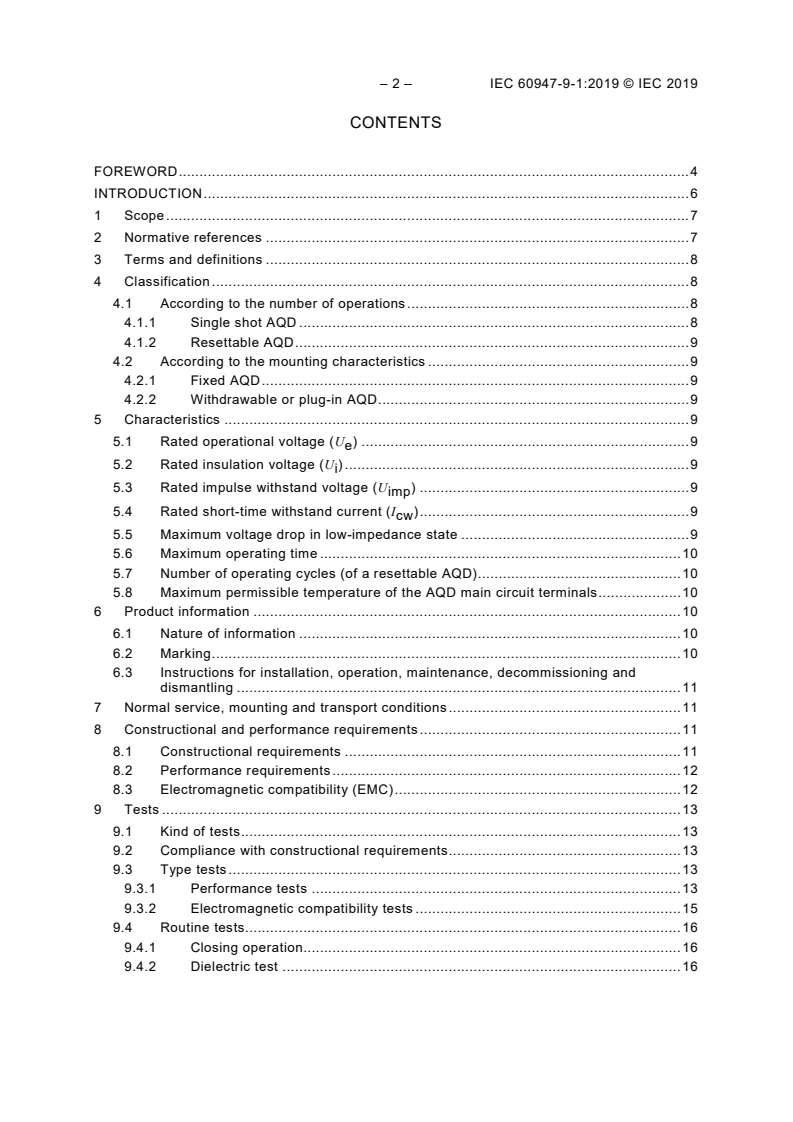
CONTENTS
FOREWORD . 4
INTRODUCTION . 6
1 Scope . 7
2 Normative references . 7
3 Terms and definitions . 8
4 Classification . 8
4.1 According to the number of operations . 8
4.1.1 Single shot AQD . 8
4.1.2 Resettable AQD . 9
4.2 According to the mounting characteristics . 9
4.2.1 Fixed AQD . 9
4.2.2 Withdrawable or plug-in AQD . 9
5 Characteristics . 9
5.1 Rated operational voltage (U ) . 9
e
5.2 Rated insulation voltage (U ) . 9
i
5.3 Rated impulse withstand voltage (U ) . 9
imp
5.4 Rated short-time withstand current (I ) . 9
cw
5.5 Maximum voltage drop in low-impedance state . 9
5.6 Maximum operating time . 10
5.7 Number of operating cycles (of a resettable AQD) . 10
5.8 Maximum permissible temperature of the AQD main circuit terminals . 10
6 Product information . 10
6.1 Nature of information . 10
6.2 Marking . 10
6.3 Instructions for installation, operation, maintenance, decommissioning and
dismantling . 11
7 Normal service, mounting and transport conditions . 11
8 Constructional and performance requirements . 11
8.1 Constructional requirements . 11
8.2 Performance requirements . 12
8.3 Electromagnetic compatibility (EMC) . 12
9 Tests . 13
9.1 Kind of tests . 13
9.2 Compliance with constructional requirements . 13
9.3 Type tests . 13
9.3.1 Performance tests . 13
9.3.2 Electromagnetic compatibility tests . 15
9.4 Routine tests. 16
9.4.1 Closing operation. 16
9.4.2 Dielectric test . 16
Annex A (informative) Rationale for defining the maximum voltage drop value in low-
impedance state . 17
A.1 Condition for arc extinction . 17
A.2 Determination of minimum distance and corresponding voltage drop . 18
Bibliography . 19
Table 1 – Product information . 11
– 4 – IEC 60947-9-1:2019 © IEC 2019
INTERNATIONAL ELECTROTECHNICAL COMMISSION
____________
LOW-VOLTAGE SWITCHGEAR AND CONTROLGEAR –
Part 9-1: Active arc-fault mitigation systems –
Arc quenching devices
FOREWORD
1) The International Electrotechnical Commission (IEC) is a worldwide organization for standardization comprising
all national electrotechnical committees (IEC National Committees). The object of IEC is to promote
international co-operation on all questions concerning standardization in the electrical and electronic fields. To
this end and in addition to other activities, IEC publishes International Standards, Technical Specifications,
Technical Reports, Publicly Available Specifications (PAS) and Guides (hereafter referred to as “IEC
Publication(s)”). Their preparation is entrusted to technical committees; any IEC National Committee interested
in the subject dealt with may participate in this preparatory work. International, governmental and non-
governmental organizations liaising with the IEC also participate in this preparation. IEC collaborates closely
with the International Organization for Standardization (ISO) in accordance with conditions determined by
agreement between the two organizations.
2) The formal decisions or agreements of IEC on technical matters express, as nearly as possible, an international
consensus of opinion on the relevant subjects since each technical committee has representation from all
interested IEC National Committees.
3) IEC Publications have the form of recommendations for international use and are accepted by IEC National
Committees in that sense. While all reasonable efforts are made to ensure that the technical content of IEC
Publications is accurate, IEC cannot be held responsible for the way in which they are used or for any
misinterpretation by any end user.
4) In order to promote international uniformity, IEC National Committees undertake to apply IEC Publications
transparently to the maximum extent possible in their national and regional publications. Any divergence
between any IEC Publication and the corresponding national or regional publication shall be clearly indicated in
the latter.
5) IEC itself does not provide any attestation of conformity. Independent certification bodies provide conformity
assessment services and, in some areas, access to IEC marks of conformity. IEC is not responsible for any
services carried out by independent certification bodies.
6) All users should ensure that they have the latest edition of this publication.
7) No liability shall attach to IEC or its directors, employees, servants or agents including individual experts and
members of its technical committees and IEC National Committees for any personal injury, property damage or
other damage of any nature whatsoever, whether direct or indirect, or for costs (including legal fees) and
expenses arising out of the publication, use of, or reliance upon, this IEC Publication or any other IEC
Publications.
8) Attention is drawn to the Normative references cited in this publication. Use of the referenced publications is
indispensable for the correct application of this publication.
9) Attention is drawn to the possibility that some of the elements of this IEC Publication may be the subject of
patent rights. IEC shall not be held responsible for identifying any or all such patent rights.
International Standard IEC 60947-9-1 has been prepared by subcommittee SC121A: Low-
voltage switchgear and controlgear, of IEC technical committee 121: Switchgear and
controlgear and their assemblies for low voltage.
The text of this International Standard is based on the following documents:
FDIS Report on voting
121A/254/FDIS 121A/266/RVD
Full information on the voting for the approval of this International Standard can be found in
the report on voting indicated in the above table.
This document has been drafted in accordance with the ISO/IEC Directives, Part 2.
A list of all parts in the IEC 60947 series, published under the general title Low-voltage
switchgear and controlgear, can be found on the IEC website.
The committee has decided that the contents of this document will remain unchanged until the
stability date indicated on the IEC website under "http://webstore.iec.ch" in the data related to
the specific document. At this date, the document will be
• reconfirmed,
• withdrawn,
• replaced by a revised edition, or
• amended.
– 6 – IEC 60947-9-1:2019 © IEC 2019
INTRODUCTION
The effects of arc-faults inside an enclosure are more and more taken into consideration, both
from user safety and time-to-repair points of view. Protection against the effects of internal
arc-faults can be achieved through passive components (containment) or through active
components, also known as "active arc-fault mitigation systems".
Active arc-fault mitigation systems generally use internal arc-fault control devices (IACDs),
based on the effects of the arc (light, pressure, current or voltage harmonics, etc.), and an
actuator to eliminate the arc-fault.
This actuator can be an upstream circuit-breaker, which is tripped to interrupt the fault current,
or an arc quenching device that will transfer the fault to a dedicated low-impedance circuit,
before the short-circuit current is interrupted by the upstream short-circuit protective device
(SCPD).
The purpose of this document is to set the requirements for arc quenching devices, so that
the necessary safety is ensured and their performance can be fairly assessed.
Special requirements for environmental withstand (e.g. ambient temperature, damp heat,
shock, vibrations) are included, considering the high impact of a malfunction, either unwanted
operation (creation of a short-circuit) or failure to operate.
Requirements for internal arc-fault control devices are under development and will be
published as IEC 60947-9-2 .
Requirements for integration of internal arc-fault mitigation systems in power switchgear and
controlgear assemblies are under development and will be published as IEC TS 63107 .
___________
Under preparation. Stage at the time of publication: IEC/ACD 60947-9-2:2018.
Under preparation. Stage at the time of publication: IEC/PCC 63107:2018.
LOW-VOLTAGE SWITCHGEAR AND CONTROLGEAR –
Part 9-1: Active arc-fault mitigation systems –
Arc quenching devices
1 Scope
This part of IEC 60947 covers low-voltage arc quenching devices, hereinafter referred to as
AQDs, which are intended to eliminate arc-faults in low-voltage assemblies (typically low-
voltage switchgear and controlgear assemblies in accordance with the IEC 61439 series), by
creating a lower impedance current path, to cause the arcing current to transfer to the new
current path. This new current path is maintained until a short-circuit protection device (SCPD)
interrupts the short-circuit current.
AQDs are installed in low-voltage assemblies, connected to the main circuit, preferably as
close as possible to all primary power sources.
Their rated voltage does not exceed 1 000 V AC or 1 500 V DC.
This document does not cover:
• sensors intended to detect arc-faults;
• devices intended to trigger the functioning of the arc quenching device;
• devices intended to interrupt arc-fault current;
• special requirements for AQDs for use in explosive atmospheres (e.g. ATEX).
2 Normative references
The following documents are referred to in the text in such a way that some or all of their
content constitutes requirements of this document. For dated references, only the edition
cited applies. For undated references, the latest edition of the referenced document (including
any amendments) applies.
IEC 60068-2-30:2005, Environmental testing – Part 2-30: Tests – Test Db: Damp heat, cyclic
(12 h + 12 h cycle)
IEC 60417, Graphical symbols for use on equipment (available at http://www.graphical-
symbols.info/equipment)
IEC 60947-1:2007, Low-voltage switchgear and controlgear – Part 1: General rules
IEC 60947-1:2007/AMD1:2010
IEC 60947-1:2007/AMD2:2014
IEC 61439 (all parts), Low-voltage switchgear and controlgear assemblies
CISPR 11:2015, Industrial, scientific and medical equipment – Radio-frequency disturbance
characteristics – Limits and methods of measurement
CISPR 11:2015/AMD1:2016
– 8 – IEC 60947-9-1:2019 © IEC 2019
3 Terms and definitions
For the purposes of this document, the terms and definitions given in IEC 60947-1:2007,
IEC 60947-1:2007/AMD1:2010 and IEC 60947-1:2007/AMD2:2014, as well as the following
apply.
ISO and IEC maintain terminological databases for use in standardization at the following
addresses:
• IEC Electropedia: available at http://www.electropedia.org/
• ISO Online browsing platform: available at http://www.iso.org/obp
3.1
arc quenching device
AQD
device intended to eliminate arc-faults by creating a lower impedance current path in order to
cause the arcing current to transfer to the new current path
Note 1 to entry: This note applies to the French language only.
3.2
low impedance state
closed state
state where the voltage drop across the AQD is below a defined limit
Note 1 to entry: The limit value is defined in 5.5.
3.3
open state
state of the AQD, before operation or after resetting or re-opening (see Clause 4), in which
the predetermined dielectric withstand voltage requirements of the main circuit are satisfied
Note 1 to entry: This definition also covers devices without mechanical contacts, for example semi-conductor
devices.
4 Classification
4.1 According to the number of operations
4.1.1 Single shot AQD
4.1.1.1 Not able to be reopened after operating
AQD that:
• is designed and intended to operate only once, and needs to be replaced or refurbished
after operation;
• cannot be reopened after operation, and therefore needs to be removed or disconnected
from the equipment before the main circuit can be re-energized.
4.1.1.2 Able to be reopened after operating
AQD that:
• is designed and intended to operate only once, and needs to be replaced or refurbished
after operation;
• can be reopened after operation, to allow re-energization of the main circuit before
replacement.
NOTE Re-opening after operation does not provide protection against internal arcs anymore. This function is
restored only after the device has been replaced.
4.1.2 Resettable AQD
AQD that is designed and intended to operate a number of times, as specified by the
manufacturer.
4.2 According to the mounting characteristics
4.2.1 Fixed AQD
AQD directly mounted and connected in the assembly, so that it is necessary for the operator
to come into contact with the main circuit conductors to replace it.
4.2.2 Withdrawable or plug-in AQD
AQD mounted in a draw-out cradle, or plugged on a fixed base, so that it can be easily
replaced after operation, or maintained, without the operator coming into contact with the
main circuit conductors.
5 Characteristics
5.1 Rated operational voltage (U )
e
Subclause 4.3.1.1 of IEC 60947-1:2007 applies.
5.2 Rated insulation voltage (U )
i
Subclause 4.3.1.2 of IEC 60947-1:2007 applies.
5.3 Rated impulse withstand voltage (U )
imp
Subclause 4.3.1.3 of IEC 60947-1:2007 applies.
5.4 Rated short-time withstand current (I )
cw
The rated short-time withstand current of an AQD is the RMS value of current that the device
is able to make and carry without damage for a given duration, under the test conditions
specified in Clause 9.
There may be different values of current associated with different durations.
The duration associated with the rated short-time withstand current shall be at least 0,05 s,
preferred values being as follows:
0,05 s - 0,1 s – 0,2 s – 0,3 s – 0,5 s – 1 s
5.5 Maximum voltage drop in low-impedance state
Maximum peak value of voltage between the main circuit terminals of the AQD, in the low-
impedance state, when carrying the current corresponding to its rated short-time withstand
current. This value shall be not greater than 34 V (peak).
NOTE The value of 34 V (peak) has been defined to ensure proper arc quenching (see Annex A).
– 10 – IEC 60947-9-1:2019 © IEC 2019
5.6 Maximum operating time
Maximum time between receiving the triggering signal and the AQD steadily reaching the low-
impedance state.
NOTE “Steadily” means that the voltage drop stays below the maximum value stated by the manufacturer (see
5.5).
5.7 Number of operating cycles (of a resettable AQD)
Number of trip-reset cycles assigned by the manufacturer to a resettable AQD and minimum
interval between two operations.
5.8 Maximum permissible temperature of the AQD main circuit terminals
Maximum value of permissible temperature of the AQD main circuit terminals based on the
material properties (see 8.1).
6 Product information
6.1 Nature of information
Subclause 5.1 of IEC 60947-1:2007, IEC 60947-1:2007/AMD1:2010 and
IEC 60947-1:2007/AMD2:2014 applies, as far as appropriate for a particular design.
6.2 Marking
An AQD shall be marked in a durable manner; data to be provided and corresponding
locations are given in Table 1.
Table 1 – Product information
Marking
Item Information
location
1 Manufacturer’s name or trademark Marked
2 Type designation or catalogue reference Marked
3 IEC 60947-9-1, if the manufacturer claims compliance with the standard Marked
Rated operational voltage(s) U Marked
e
Rated impulse withstand voltage (U )
Marked
imp
Value (or range) of the rated frequency (for example 50 Hz), and/or the indication Marked
"direct current", or the symbol (IEC 60417-5031:2002)
), and associated duration(s)
Rated short-time withstand current (I Marked
cw
Rated control circuit voltage (U ), if applicable Marked
s
Instructions for integrating the AQD in the arc-fault mitigation system, including the Literature
9 characteristics of the triggering signal (e.g. voltage, frequency, current, duration), and
max cable or optic fibre length
10 Maximum operating time Literature
11 Maximum voltage drop in the low-impedance state Literature
Maximum number of operating cycles, and minimum interval between two operations, Literature
for resettable devices
Rated insulation voltage (U ), if higher than the rated operational voltage
Literature
i
14 Pollution degree if other than 3 Literature
15 Value of tightening torque for the terminals, if applicable Literature
Instructions for installation with regard to withstanding prospective short-circuit Literature
current and minimizing arc-quenching circuit impedance
17 Maximum permissible temperature of the AQD main circuit terminals Literature
Key
Marked marked externally on the AQD and visible with the AQD compartment door open
Literature provided in the manufacturer’s literature
6.3 Instructions for installation, operation, maintenance, decommissioning and
dismantling
Subclause 5.3 of IEC 60947-1:2007 and IEC 60947-1:2007/AMD2:2014 applies with the
following addition:
Additional information for the decommissioning and dismantling of the AQD shall be provided
to the user in case of a foreseeable hazardous condition, for example due to stored energy or
hazardous substances.
7 Normal service, mounting and transport conditions
Clause 6 of IEC 60947-1:2007 and IEC 60947-1:2007/AMD2:2014 applies, except that the
device shall be able to operate up to an ambient temperature of 70 °C.
NOTE The ambient temperature is that existing in the vicinity of the AQD and not the ambient temperature around
the assembly.
8 Constructional and performance requirements
8.1 Constructional requirements
Subclause 7.1 of IEC 60947-1:2007, IEC 60947-1:2007/AMD1:2010 and
IEC 60947-1:2007/AMD2:2014 applies with the following additions:
– 12 – IEC 60947-9-1:2019 © IEC 2019
Parts of insulating materials necessary to retain current-carrying parts in position shall be
compatible with the maximum permissible main circuit terminal temperature declared by the
manufacturer (see item 17 of Table 1). Where, in 7.1.2.2 of IEC 60947-1:2007,
IEC 60947-1:2007/AMD1:2010 and IEC 60947-1:2007/AMD2:2014, the test temperature is to
be specified, the value required by this standard is 850 °C.
AQDs shall be provided with a local indicator showing the state (open or closed) of the device.
This indicator shall be visible when installed and with the AQD compartment door open. This
information shall also be available remotely, through an auxiliary contact or equivalent, to
provide electrical interlocking with the upstream SCPD.
NOTE 1 This interlocking is to ensure that the circuit protected by the AQD cannot be re-energized until the
device has been replaced, re-opened or reset.
NOTE 2 One or more additional auxiliary contacts can also be provided for optional interlocking with other
devices, such as the external detection device.
Single shot AQDs able to be re-opened after operating shall be provided with an additional
indicator showing, after re-opening, that the device is “open”, but not ready to operate
anymore. This indicator shall be visible when installed and with the AQD compartment door
open.
Resettable AQDs shall be provided with means to count the number of operations. A means to
indicate that the maximum number of operations has been reached shall be provided in that
case.
AQDs that have provisions for disabling the quenching function shall have provisions for local
and remote indication that the device has been disabled.
If AQDs contain items that have stored charges after disconnection from the power supply
(capacitors, etc.), means shall be provided either to prevent access to these items during
normal service, or to discharge them before access is possible. This requirement does not
apply if the stored charges voltage falls below 60 V DC in less than 5 s after disconnection
from the power supply.
8.2 Performance requirements
Subclause 7.2 of IEC 60947-1:2007, IEC 60947-1:2007/AMD1:2010 and
IEC 60947-1:2007/AMD2:2014 applies with the following modifications:
The maximum operating time shall comply with the value stated by the manufacturer.
It shall not be possible to reset a resettable AQD while the triggering signal is present.
As AQDs do not permanently carry current, the temperature-rise requirements of 7.2.2.4 of
IEC 60947-1:2007 for the main circuit do not apply.
Subclause 7.2.4 of IEC 60947-1:2007 does not apply, since an AQD is not intended to make,
carry or break currents under no-load, normal load or overload conditions.
Subclause 7.2.5 of IEC 60947-1:2007 applies only to the rated short-time withstand current.
8.3 Electromagnetic compatibility (EMC)
Subclause 7.3 of IEC 60947-1:2007, IEC 60947-1:2007/AMD1:2010 and
IEC 60947-1:2007/AMD2:2014 applies.
9 Tests
9.1 Kind of tests
Subclause 8.1 of IEC 60947-1:2007 applies.
9.2 Compliance with constructional requirements
Subclause 8.2 of IEC 60947-1:2007, IEC 60947-1:2007/AMD1:2010 and
IEC 60947-1:2007/AMD2:2014 applies.
9.3 Type tests
9.3.1 Performance tests
9.3.1.1 General
Subclause 8.3.2 of IEC 60947-1:2007 and IEC 60947-1:2007/AMD2:2014 applies.
Performance tests are grouped together in sequences and shall be run in the order listed on
the same sample.
Depending on the classification according to Clause 4, either 9.3.1.2 or 9.3.1.3 applies.
Tests performed at 50 Hz cover 60 Hz applications and vice-versa.
9.3.1.2 Test sequence for fixed single shot devices
9.3.1.2.1 General
This test sequence applies to fixed single shot devices (see 4.1.1 and 4.2.1).
9.3.1.2.2 Vibration and shock test
The device shall be subjected to a vibration test and a shock test, in accordance with items 2
and 3, environment E, of Table Q.1 of IEC 60947-1:2007/AMD2:2014. The two tests shall be
run successively in the order agreeable to the manufacturer.
During the tests, there shall be no unwanted operation of the AQD.
9.3.1.2.3 Damp heat test
A damp heat test shall be performed in accordance with IEC 60068-2-30, for 28 cycles and
with an upper temperature of 55 °C.
After the test, the recovery shall be made in normal atmospheric conditions for 24 h.
9.3.1.2.4 Dielectric properties
Subclause 8.3.3.4.1 of IEC 60947-1:2007, IEC 60947-1:2007/AMD1:2010 and
IEC 60947-1:2007/AMD2:2014 applies with the following additions:
With reference to 8.3.3.4.1, item 2) c) i) and ii) of IEC 60947-1:2007, the only normal position
of operation is the open state.
With reference to 8.3.3.4.1, item 2) c) iv) of IEC 60947-1:2007, the test in the open position is
covered by the test of item 2) c) ii).
– 14 – IEC 60947-9-1:2019 © IEC 2019
9.3.1.2.5 Rated short-time withstand current test
Subclause 8.3.4.3 of IEC 60947-1:2007 applies with the following modifications:
The metallic screen of 8.3.2.1 of IEC 60947-1:2007 and IEC 60947-1:2007/AMD2:2014 shall
be used.
With the AQD in the open state, the AQD shall be closed onto the test circuit by applying a
triggering signal in accordance with the manufacturer's instructions under the most severe
conditions, considering, for example, minimum voltage, minimum current, maximum length of
cable or optical fibre, and minimum signal duration. If the operation of the AQD depends on
an auxiliary power supply, the supply voltage shall be set to 70 % of the minimum rated
supply voltage of the AQD.
The voltage between poles shall be recorded throughout the test; the maximum voltage drop
(see 5.5) and the operating time (see 5.6) shall comply with the values stated by the
manufacturer.
The correct functioning of the local and remote indicators (see 8.1) shall be verified before
and after the test.
During the test, there shall be neither arcing nor flashover between poles, or between poles
and frame, and no melting of the fusible element F in the leakage detection circuit (see
8.3.4.1.7 of IEC 60947-1:2007). There shall be no ejected parts likely to cause a hazard to the
operator.
NOTE 1 In assessing the hazard, a limit of 60 g is considered in IEC TR 61641.
After the test, the AQD housing (including, if applicable, the fixed base or cradle – see 4.2.2)
shall not be broken but hairline cracks are acceptable.
NOTE 2 Hairline cracks are of a superficial nature and do not develop through the entire thickness of the housing.
9.3.1.2.6 Verification of dielectric withstand
This test applies only to fixed single shot devices that can be reopened after operation (see
4.1.1.2).
The AQD shall be reopened in accordance with the manufacturer's instructions.
The dielectric withstand shall then be verified in accordance with 8.3.3.4.1, item 4) of
IEC 60947-1:2007.
9.3.1.3 Test sequence for withdrawable, plug-in or resettable devices
9.3.1.3.1 General
This test sequence applies to withdrawable or plug-in devices (see 4.2.2), and to resettable
devices (see 4.1.2).
9.3.1.3.2 Vibration and shock test
Subclause 9.3.1.2.2 applies.
9.3.1.3.3 Damp heat test
Subclause 9.3.1.2.3 applies.
9.3.1.3.4 Dielectric properties
Subclause 9.3.1.2.4 applies.
9.3.1.3.5 Rated short-time withstand current test
Subclause 9.3.1.2.5 applies with the following additions:
For a withdrawable or plug-in single shot AQD, the device shall then be removed from the
draw-out cradle or fixed base, and replaced by a new device. A verification of the dielectric
withstand shall be performed in accordance with 8.3.3.4.1 item 4) of IEC 60947-1:2007. The
short-time withstand test of 9.3.1.2.5 shall then be repeated.
For a resettable AQD, the device shall be reset in accordance with the manufacturer's
instructions. The test of 9.3.1.2.5 shall be repeated on the same sample until the number of
operating cycles specified by the manufacturer is reached, taking into account the minimum
interval between two operations stated by the manufacturer.
9.3.1.3.6 Verification of the inhibition of the resetting function
Following 9.3.1.3.5, for a resettable AQD, with the device in the closed state and a triggering
signal being applied to the AQD and maintained for twice the minimum interval between two
operations stated by the manufacturer, a reset of the AQD shall be attempted; the AQD shall
remain in the closed state.
9.3.1.3.7 Verification of dielectric withstand
The dielectric withstand shall then be verified in accordance with 8.3.3.4.1 item 4) of
IEC 60947-1:2007. For the purpose of this test, the only normal operating position is the open
state. Resettable AQDs and single shot AQDs that can be re-opened after operation (see
4.1.1.2) are tested in the open state; single shot AQDs that cannot be re-opened after
operation are removed from the fixed base or draw-out cradle and the test performed on the
fixed base or draw-out cradle.
9.3.2 Electromagnetic compatibility tests
9.3.2.1 Immunity
9.3.2.1.1 General
Subclause 8.4.1.2.1 of IEC 60947-1:2007 applies with the following additions:
For the purposes of this document, only performance criterion A applies; there shall be no
unwanted triggering during the application of the disturbance.
A new sample may be used for each test or one sample may be used for several tests, at the
manufacturer’s discretion. Devices rated 50 Hz/60 Hz shall be tested at either one of the rated
frequencies.
9.3.2.1.2 Electrostatic discharges
Subclause 8.4.1.2.2 of IEC 60947-1:2007 applies.
9.3.2.1.3 Radiated radio-frequency electromagnetic fields
Subclause 8.4.1.2.3 of IEC 60947-1:2007 applies.
9.3.2.1.4 Electrical fast transients/bursts (EFT/B)
Subclause 8.4.1.2.4 of IEC 60947-1:2007 applies.
– 16 – IEC 60947-9-1:2019 © IEC 2019
9.3.2.1.5 Surges
Subclause 8.4.1.2.5 of IEC 60947-1:2007 applies.
9.3.2.1.6 Conducted disturbances induced by radio-frequency fields
Subclause 8.4.1.2.6 of IEC 60947-1:2007 applies.
9.3.2.1.7 Power frequency magnetic fields
Subclause 8.4.1.2.7 of IEC 60947-1:2007 applies.
9.3.2.1.8 Voltage dips and interruptions
Subclause 8.4.1.2.8 of IEC 60947-1:2007 applies to AQDs, the operation of which depends on
an auxiliary power supply.
9.3.2.2 Emission
Subclause 8.4.2.2 of IEC 60947-1:2007 only applies to AQDs incorporating permanently
energized electronic circuits, with the following additions:
Conducted and radiated radio-frequency emission tests are required; the test shall be
performed in accordance with the classification of equipment given in Clause 5 of
CISPR 11:2015, CISPR 11:2015/AMD1:2016 for group 1, class A devices. The test levels
specified in Clause 6 of CISPR 11:2015, CISPR 11:2015/AMD1:2016 shall apply together with
the test methods specified in Clause 7 of CISPR 11:2015, CISPR 11:2015/AMD1:2016.
The AQD shall be tested in open state, and be connected to an auxiliary power supply, if
applicable, in accordance with the manufacturer’s instructions. The particular test setup,
including the type of cable, shall be detailed in the test report.
A new sample may be used for each test or one sample may be used for several tests, at the
manufacturer’s discretion. Devices rated 50 Hz/60 Hz shall be tested at either one of the rated
frequencies.
9.4 Routine tests
9.4.1 Closing operation
This test applies only to resettable devices.
The device shall be subjected to one "closing" operation, by applying a triggering signal in
accordance with the manufacturer's instructions, followed by a reset operation. The closed
and open states shall be verified by continuity tests.
9.4.2 Dielectric test
This test applies to all types of AQDs.
The device shall be subjected to a dielectric test in accordance with 8.3.3.4.2 of
IEC 60947-1:2007. For the purpose of this test, the only normal position of operation is the
open state.
The impulse withstand voltage test and the power-frequency withstand voltage test may be
combined, in accordance with item 3) of 8.3.3.4.2 of IEC 60947-1:2007.
Annex A
(informative)
Rationale for defining the maximum voltage drop value
in low-impedance state
A.1 Condition for arc extinction
U = UU +
It is well-known that the arc voltage can be expressed as: , where:
arc col root
– U represents the voltage drop in the arc column, and,
col
– U represents the voltage drop at both roots of the arc.
root
An electric arc is sustained if sufficiently heated.
In a simplified model, arc heating is determined by the balance between power input P
Input
and power loss P of the arc column (by radiation/conductivity):
loss
P = U × IU = - U × I
( )
Input col arc root
P = kL × × U × I
( )
loss root
where L represents the arc length and k is a coefficient.
Law and coefficients are known from literature and proven by experiments.
The arc extinguishes when power input is kept below power loss: P < P
input loss
< (1 + (k × L)) × U
which gives: U
arc root
Generally considered values are U ≈ 16 V, k ≈ 0,2/mm, which finally brings:
root
U < 16 V + (3,2 V/mm × L) (A.1)
arc
with L expressed in mm.
If the voltage is maintained below this threshold, the arc will extinguish in a very short period
of time (within approximately 10 µs).
This relationship is substantially independent of the current when close to extinction.
– 18 – IEC 60947-9-1:2019 © IEC 2019
A.2 Determination of minimum distance and corresponding voltage drop
It is difficult to define the minimum distance between conductors that can be encountered in
different equipment and low-voltage assemblies.
The minimum clearance depends on the rated impulse voltage of the assembly, which can be
down to 6 kV for 480 V networks (see Annex H of IEC 60947-1:2007), thus resulting in a
minimum clearance of 5,5 mm.
Considering a 5,5 mm distance, Formula (A.1) gives for U a maximum value of 34 V.
arc
Therefore, the maximum voltage drop in 5.5 has been specified as 34 V.
Bibliography
IEC 60947-9-2 , Low-voltage switchgear and controlgear – Active arc-fault mitigation systems
– Part 9-2: Optical-based internal arc-detection and mitigation devices
IEC TR 61641:2014, Enclosed low-voltage switchgear and controlgear assemblies – Guide for
testing under conditions of arcing due to internal fault
IEC TS 63107 , Integration of arcing fault mitigation devices into power switchgear and
controlgear assemblies (PSC-ASSEMBLIES) according to IEC 61439-2
_____________
___________
Under preparation. Stage at the time of publication: IEC/ACD 60947-9-2:2018.
Under preparation. Stage at the time of publication: IEC/PCC 63107:2018.
– 20 – IEC 60947-9-1:2019 © IEC 2019
SOMMAIRE
AVANT-PROPOS . 22
INTRODUCTION . 24
1 Domaine d’application . 25
2 Références normatives . 25
3 Termes et définitions . 26
4 Classification . 26
4.1 Selon le nombre de manœuvres . 26
4.1.1 AQD à un coup . 26
4.1.2 AQD réarmable . 27
4.2 Selon les caractéristiques de montage .
...