

IEC 61189-11:2013
(Main)Test methods for electrical materials, printed boards and other interconnection structures and assemblies - Part 11: Measurement of melting temperature or melting temperature ranges of solder alloys
General Information
- Abstract
IEC 61189-11:2013 describes the measurement method of melting ranges of solder alloys that are mainly used for wiring of electrical equipment, for electrical and communication equipment, and for other apparatus, as well as for connecting components.
- Status
- Published
- Publication Date
- 06-May-2013
- Technical Committee
- TC 91 - Electronics assembly technology
- Drafting Committee
- WG 3 - TC 91/WG 3
- Current Stage
- PPUB - Publication issued
- Start Date
- 07-May-2013
- Completion Date
- 31-May-2013
Buy Documents
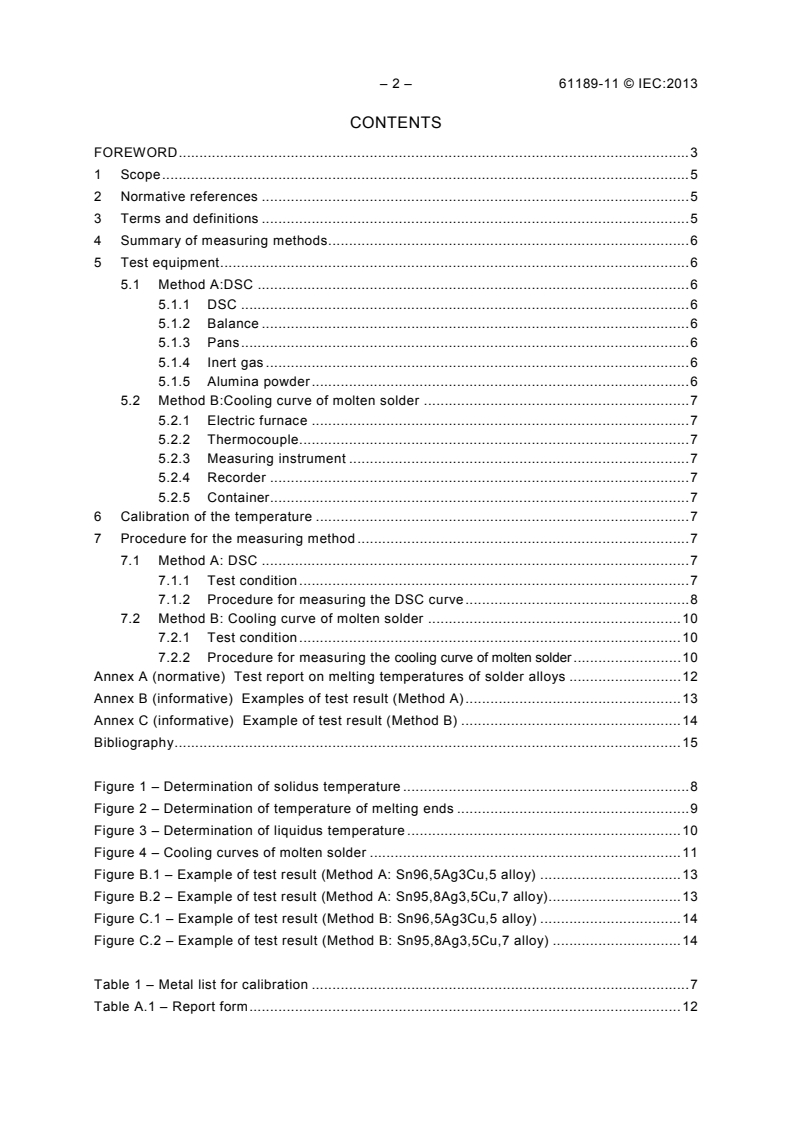
IEC 61189-11:2013 - Test methods for electrical materials, printed boards and other interconnection structures and assemblies - Part 11: Measurement of melting temperature or melting temperature ranges of solder alloys Released:5/7/2013
IEC 61189-11:2013 Overview
IEC 61189-11:2013 is an international standard published by the International Electrotechnical Commission (IEC) that specifies test methods for measuring the melting temperature or melting temperature ranges of solder alloys. These solder alloys are critical materials widely used in wiring electrical equipment, assembling printed boards, electronic interconnections, communication devices, and other electrical apparatuses. Accurate determination of melting points ensures quality control and reliability in electronics manufacturing and assembly.
This part of the IEC 61189 series focuses specifically on two proven measurement methods: Differential Scanning Calorimetry (DSC) and the Cooling Curve of Molten Solder. Both methods help characterize solder alloys’ melting behavior, assisting manufacturers and engineers in selecting appropriate solder materials that meet performance requirements.
Key Topics Covered
Scope and Purpose
Defines methods for measuring melting temperature ranges (solidus and liquidus) of solder alloys used in electrical and communication equipment assembly.Terms and Definitions
Clarifies essential terms related to melting temperature ranges, including:- Solidus temperature – temperature when melting starts or solidification ends
- Liquidus temperature – temperature when melting ends or solidification starts
- Melting temperature ranges – the total range between solidus and liquidus temperatures
Measurement Methods
- Method A: Differential Scanning Calorimetry (DSC)
Uses thermal analysis to record heat flow changes during controlled heating to identify melting points.
Requires equipment such as DSC instruments, high-resolution balances, inert gas atmospheres, and alumina powder as reference. - Method B: Cooling Curve of Molten Solder
Involves heating solder in an electric furnace and recording temperature changes with thermocouples as the solder cools and solidifies.
Demands precise temperature measurement instruments and appropriate data recording tools.
- Method A: Differential Scanning Calorimetry (DSC)
Test Equipment Requirements
Describes specifications for balances, furnaces, thermocouples, DSC instruments, pans, and inert gases necessary to perform accurate measurements.Calibration and Procedure Details
Provides guidelines for equipment calibration, testing conditions, and step-by-step measurement procedures to ensure repeatability and reliability.Reporting and Examples
Includes annexes with test report formats, example results for common solder alloys, and graphical interpretations of DSC and cooling curves.
Practical Applications
IEC 61189-11:2013 is indispensable for professionals involved in:
Electronics Assembly and Manufacturing
Precisely measuring melting temperature ensures correct solder alloy selection, preventing defects in solder joints.Quality Assurance Laboratories
Standardized test methods support compliance verification and material certification for solder alloys used in printed circuit boards (PCBs) and interconnection assemblies.R&D in Solder Materials
Melting point data is crucial when developing new solder compositions with tailored melting ranges and mechanical properties.Communication Equipment Production
Reliable soldering techniques contribute to device longevity, performance stability, and regulatory compliance across telecommunications hardware.Electrical Equipment Fabrication
Controls over solder alloy performance directly impact electrical connectivity reliability and safety in various apparatus.
Related Standards
For comprehensive testing and quality control of solder alloys and electronic assembly materials, IEC 61189-11:2013 should be used alongside these complementary standards:
- IEC 60194 – Printed Board Design, Manufacture and Assembly – Terms and Definitions
- IEC 61189-3 – Test Methods for Electrical Materials, Printed Boards, and Interconnection Structures – Part 3 (Interconnection Structures Testing)
- IEC 61190-1-3 – Attachment Materials for Electronic Assembly – Requirements for Electronic Grade Solder Alloys and Solders
- ISO 9453 – Soft Solder Alloys – Chemical Composition and Forms
- ISO 11357-1 – Plastics – Differential Scanning Calorimetry (DSC) – General Principles
Utilization of these interconnected standards provides a robust framework for testing, material specifications, and terminology harmonization in electrical and electronic manufacturing sectors.
Summary
IEC 61189-11:2013 defines internationally accepted test methods for accurately measuring melting temperature ranges of solder alloys used in electrical and communication equipment assembly. The standard’s guidance on DSC and cooling curve methods enables manufacturers, testers, and developers to perform reliable and repeatable measurements ensuring quality and performance in solder materials. Conformance to this standard supports industry-wide enhancement of electronics manufacturing processes and interconnection reliability, making it essential for quality control, materials research, and regulatory compliance in electro-assembly environments.
Keywords: IEC 61189-11, solder alloy melting temperature, melting temperature range, solidus temperature, liquidus temperature, differential scanning calorimetry, DSC, cooling curve, electrical materials testing, printed boards, interconnection assembly standards, electronics manufacturing quality assurance.
Buy Documents
IEC 61189-11:2013 - Test methods for electrical materials, printed boards and other interconnection structures and assemblies - Part 11: Measurement of melting temperature or melting temperature ranges of solder alloys Released:5/7/2013
Get Certified
Connect with accredited certification bodies for this standard

IMQ S.p.A. (Certification)
Italian electrical product certification.

SLG Prüf- und Zertifizierungs GmbH
German testing and certification body.

UL Solutions
Global safety science company with testing, inspection and certification.
Sponsored listings
Frequently Asked Questions
IEC 61189-11:2013 is a standard published by the International Electrotechnical Commission (IEC). Its full title is "Test methods for electrical materials, printed boards and other interconnection structures and assemblies - Part 11: Measurement of melting temperature or melting temperature ranges of solder alloys". This standard covers: IEC 61189-11:2013 describes the measurement method of melting ranges of solder alloys that are mainly used for wiring of electrical equipment, for electrical and communication equipment, and for other apparatus, as well as for connecting components.
IEC 61189-11:2013 describes the measurement method of melting ranges of solder alloys that are mainly used for wiring of electrical equipment, for electrical and communication equipment, and for other apparatus, as well as for connecting components.
IEC 61189-11:2013 is classified under the following ICS (International Classification for Standards) categories: 29.035.20 - Plastics and rubber insulating materials; 29.060.20 - Cables; 31.180 - Printed circuits and boards. The ICS classification helps identify the subject area and facilitates finding related standards.
IEC 61189-11:2013 is available in PDF format for immediate download after purchase. The document can be added to your cart and obtained through the secure checkout process. Digital delivery ensures instant access to the complete standard document.
Standards Content (Sample)
IEC 61189-11 ®
Edition 1.0 2013-05
INTERNATIONAL
STANDARD
NORME
INTERNATIONALE
colour
inside
Test methods for electrical materials, printed boards and other interconnection
structures and assemblies –
Part 11: Measurement of melting temperature or melting temperature ranges of
solder alloys
Méthodes d'essai pour les matériaux électriques, les cartes imprimées et autres
structures d'interconnexion et ensembles –
Partie 11: Mesure de la température de fusion ou des plages de températures de
fusion des alliages à braser
All rights reserved. Unless otherwise specified, no part of this publication may be reproduced or utilized in any form
or by any means, electronic or mechanical, including photocopying and microfilm, without permission in writing from
either IEC or IEC's member National Committee in the country of the requester.
If you have any questions about IEC copyright or have an enquiry about obtaining additional rights to this publication,
please contact the address below or your local IEC member National Committee for further information.
Droits de reproduction réservés. Sauf indication contraire, aucune partie de cette publication ne peut être reproduite ni
utilisée sous quelque forme que ce soit et par aucun procédé, électronique ou mécanique, y compris la photocopie et les
microfilms, sans l'accord écrit de la CEI ou du Comité national de la CEI du pays du demandeur.
Si vous avez des questions sur le copyright de la CEI ou si vous désirez obtenir des droits supplémentaires sur cette
publication, utilisez les coordonnées ci-après ou contactez le Comité national de la CEI de votre pays de résidence.
IEC Central Office Tel.: +41 22 919 02 11
3, rue de Varembé Fax: +41 22 919 03 00
CH-1211 Geneva 20 info@iec.ch
Switzerland www.iec.ch
About the IEC
The International Electrotechnical Commission (IEC) is the leading global organization that prepares and publishes
International Standards for all electrical, electronic and related technologies.
About IEC publications
The technical content of IEC publications is kept under constant review by the IEC. Please make sure that you have the
latest edition, a corrigenda or an amendment might have been published.
Useful links:
IEC publications search - www.iec.ch/searchpub Electropedia - www.electropedia.org
The advanced search enables you to find IEC publications The world's leading online dictionary of electronic and
by a variety of criteria (reference number, text, technical electrical terms containing more than 30 000 terms and
committee,…). definitions in English and French, with equivalent terms in
It also gives information on projects, replaced and additional languages. Also known as the International
withdrawn publications. Electrotechnical Vocabulary (IEV) on-line.
IEC Just Published - webstore.iec.ch/justpublished Customer Service Centre - webstore.iec.ch/csc
Stay up to date on all new IEC publications. Just Published If you wish to give us your feedback on this publication
details all new publications released. Available on-line and or need further assistance, please contact the
also once a month by email. Customer Service Centre: csc@iec.ch.
A propos de la CEI
La Commission Electrotechnique Internationale (CEI) est la première organisation mondiale qui élabore et publie des
Normes internationales pour tout ce qui a trait à l'électricité, à l'électronique et aux technologies apparentées.
A propos des publications CEI
Le contenu technique des publications de la CEI est constamment revu. Veuillez vous assurer que vous possédez
l’édition la plus récente, un corrigendum ou amendement peut avoir été publié.
Liens utiles:
Recherche de publications CEI - www.iec.ch/searchpub Electropedia - www.electropedia.org
La recherche avancée vous permet de trouver des Le premier dictionnaire en ligne au monde de termes
publications CEI en utilisant différents critères (numéro de électroniques et électriques. Il contient plus de 30 000
référence, texte, comité d’études,…). termes et définitions en anglais et en français, ainsi que
Elle donne aussi des informations sur les projets et les les termes équivalents dans les langues additionnelles.
publications remplacées ou retirées. Egalement appelé Vocabulaire Electrotechnique
International (VEI) en ligne.
Just Published CEI - webstore.iec.ch/justpublished
Service Clients - webstore.iec.ch/csc
Restez informé sur les nouvelles publications de la CEI.
Just Published détaille les nouvelles publications parues. Si vous désirez nous donner des commentaires sur
Disponible en ligne et aussi une fois par mois par email. cette publication ou si vous avez des questions
contactez-nous: csc@iec.ch.
IEC 61189-11 ®
Edition 1.0 2013-05
INTERNATIONAL
STANDARD
NORME
INTERNATIONALE
colour
inside
Test methods for electrical materials, printed boards and other interconnection
structures and assemblies –
Part 11: Measurement of melting temperature or melting temperature ranges of
solder alloys
Méthodes d'essai pour les matériaux électriques, les cartes imprimées et autres
structures d'interconnexion et ensembles –
Partie 11: Mesure de la température de fusion ou des plages de températures de
fusion des alliages à braser
INTERNATIONAL
ELECTROTECHNICAL
COMMISSION
COMMISSION
ELECTROTECHNIQUE
PRICE CODE
INTERNATIONALE
CODE PRIX P
ICS 31.180 ISBN 978-2-83220-800-7
– 2 – 61189-11 © IEC:2013
CONTENTS
FOREWORD . 3
1 Scope . 5
2 Normative references . 5
3 Terms and definitions . 5
4 Summary of measuring methods . 6
5 Test equipment . 6
5.1 Method A:DSC . 6
5.1.1 DSC . 6
5.1.2 Balance . 6
5.1.3 Pans . 6
5.1.4 Inert gas . 6
5.1.5 Alumina powder . 6
5.2 Method B:Cooling curve of molten solder . 7
5.2.1 Electric furnace . 7
5.2.2 Thermocouple. 7
5.2.3 Measuring instrument . 7
5.2.4 Recorder . 7
5.2.5 Container. 7
6 Calibration of the temperature . 7
7 Procedure for the measuring method . 7
7.1 Method A: DSC . 7
7.1.1 Test condition . 7
7.1.2 Procedure for measuring the DSC curve . 8
7.2 Method B: Cooling curve of molten solder . 10
7.2.1 Test condition . 10
7.2.2 Procedure for measuring the cooling curve of molten solder . 10
Annex A (normative) Test report on melting temperatures of solder alloys . 12
Annex B (informative) Examples of test result (Method A) . 13
Annex C (informative) Example of test result (Method B) . 14
Bibliography . 15
Figure 1 – Determination of solidus temperature . 8
Figure 2 – Determination of temperature of melting ends . 9
Figure 3 – Determination of liquidus temperature . 10
Figure 4 – Cooling curves of molten solder . 11
Figure B.1 – Example of test result (Method A: Sn96,5Ag3Cu,5 alloy) . 13
Figure B.2 – Example of test result (Method A: Sn95,8Ag3,5Cu,7 alloy). 13
Figure C.1 – Example of test result (Method B: Sn96,5Ag3Cu,5 alloy) . 14
Figure C.2 – Example of test result (Method B: Sn95,8Ag3,5Cu,7 alloy) . 14
Table 1 – Metal list for calibration . 7
Table A.1 – Report form . 12
61189-11 © IEC:2013 – 3 –
INTERNATIONAL ELECTROTECHNICAL COMMISSION
____________
TEST METHODS FOR ELECTRICAL MATERIALS,
PRINTED BOARDS AND OTHER INTERCONNECTION STRUCTURES
AND ASSEMBLIES –
Part 11: Measurement of melting temperature or
melting temperature ranges of solder alloys
FOREWORD
1) The International Electrotechnical Commission (IEC) is a worldwide organization for standardization comprising
all national electrotechnical committees (IEC National Committees). The object of IEC is to promote
international co-operation on all questions concerning standardization in the electrical and electronic fields. To
this end and in addition to other activities, IEC publishes International Standards, Technical Specifications,
Technical Reports, Publicly Available Specifications (PAS) and Guides (hereafter referred to as “IEC
Publication(s)”). Their preparation is entrusted to technical committees; any IEC National Committee interested
in the subject dealt with may participate in this preparatory work. International, governmental and non-
governmental organizations liaising with the IEC also participate in this preparation. IEC collaborates closely
with the International Organization for Standardization (ISO) in accordance with conditions determined by
agreement between the two organizations.
2) The formal decisions or agreements of IEC on technical matters express, as nearly as possible, an international
consensus of opinion on the relevant subjects since each technical committee has representation from all
interested IEC National Committees.
3) IEC Publications have the form of recommendations for international use and are accepted by IEC National
Committees in that sense. While all reasonable efforts are made to ensure that the technical content of IEC
Publications is accurate, IEC cannot be held responsible for the way in which they are used or for any
misinterpretation by any end user.
4) In order to promote international uniformity, IEC National Committees undertake to apply IEC Publications
transparently to the maximum extent possible in their national and regional publications. Any divergence
between any IEC Publication and the corresponding national or regional publication shall be clearly indicated in
the latter.
5) IEC itself does not provide any attestation of conformity. Independent certification bodies provide conformity
assessment services and, in some areas, access to IEC marks of conformity. IEC is not responsible for any
services carried out by independent certification bodies.
6) All users should ensure that they have the latest edition of this publication.
7) No liability shall attach to IEC or its directors, employees, servants or agents including individual experts and
members of its technical committees and IEC National Committees for any personal injury, property damage or
other damage of any nature whatsoever, whether direct or indirect, or for costs (including legal fees) and
expenses arising out of the publication, use of, or reliance upon, this IEC Publication or any other IEC
Publications.
8) Attention is drawn to the Normative references cited in this publication. Use of the referenced publications is
indispensable for the correct application of this publication.
9) Attention is drawn to the possibility that some of the elements of this IEC Publication may be the subject of
patent rights. IEC shall not be held responsible for identifying any or all such patent rights.
International Standard IEC 61189-11 has been prepared by IEC technical committee 91:
Electronics assembly technology.
The text of this standard is based on the following documents:
FDIS Report on voting
91/1086/FDIS 91/1097/RVD
Full information on the voting for the approval of this standard can be found in the report on
voting indicated in the above table.
This publication has been drafted in accordance with the ISO/IEC Directives, Part 2.
– 4 – 61189-11 © IEC:2013
A list of all parts of IEC 61189 under the general title Test methods for electrical materials,
printed boards and other interconnection structures and assemblies can be found in the IEC
website.
The committee has decided that the contents of this publication will remain unchanged until
the stability date indicated on the IEC web site under "http://webstore.iec.ch" in the data
related to the specific publication. At this date, the publication will be
• reconfirmed,
• withdrawn,
• replaced by a revised edition, or
• amended.
IMPORTANT – The 'colour inside' logo on the cover page of this publication indicates
that it contains colours which are considered to be useful for the correct
understanding of its contents. Users should therefore print this document using a
colour printer.
61189-11 © IEC:2013 – 5 –
TEST METHODS FOR ELECTRICAL MATERIALS,
PRINTED BOARDS AND OTHER INTERCONNECTION STRUCTURES
AND ASSEMBLIES –
Part 11: Measurement of melting temperature or
melting temperature ranges of solder alloys
1 Scope
This part of IEC 61189 describes the measurement method of melting ranges of solder alloys
that are mainly used for wiring of electrical equipment, for electrical and communication
equipment, and for other apparatus, as well as for connecting components.
2 Normative references
The following documents, in whole or in part, are normatively referenced in this document and
are indispensable for its application. For dated references, only the edition cited applies. For
undated references, the latest edition of the referenced document (including any
amendments) applies.
IEC 60194,— Printed board design, manufacture and assembly – Terms and definitions
IEC 61189-3, Test methods for electrical materials, printed boards and other interconnection
structures and assemblies – Part 3: Test methods for interconnection structures (printed
boards)
IEC 61190-1-3, Attachment materials for electronic assembly – Part 1-3: Requirements for
electronic grade solder alloys and fluxed and non-fluxed solid solders for electronic soldering
applications
ISO 9453, Soft solder alloys – Chemical compositions and forms
ISO 11357-1, Plastics – Differential scanning calorimetry (DSC) – Part 1: General principles
3 Terms and definitions
For the purposes of this document the terms and definitions of IEC 60194, IEC 61189-3,
IEC 61190-1-3, ISO 9453 and ISO 11357-1, as well as the following apply.
3.1
melting temperature ranges
total range of solidus and liquidus temperature of solder alloys
3.2
solidus temperature
temperature when solder alloys start to melt measured by DSC (method A)
———————
Sixth edition to be published.
– 6 – 61189-11 © IEC:2013
3.3
solidus temperature
temperature when solidification of solder alloys ends measured by the cooling curve of molten
solder (method B)
3.4
liquidus temperature
temperature when melting ends measured for various heating temperature levels by DSC
(method A)
3.5
liquidus temperature
solidification temperature measured by the cooling curve of molten solder (method B)
3.6
DSC curve
curve measured by differential scanning calorimetry (DSC)
4 Summary of measuring methods
The melting temperature range of solder alloys is measured by using the following methods.
Method A: Differential scanning calorimetry (DSC).
Method B: Cooling curve of molten solder.
Test report shall be made according to Annex A.
5 Test equipment
5.1 Method A: DSC
5.1.1 DSC
See ISO 11357-1.
5.1.2 Balance
The balance shall have a resolution of 0,1 mg or better.
5.1.3 Pans
Pans shall be constructed of a material with a high heat transfer rate and which is not
corroded by the samples. Usually, aluminium is used.
5.1.4 Inert gas
Inert gas (example N2 or Ar: of a purity higher than 99,9 %) should be used to avoid the
sample oxidation.
5.1.5 Alumina powder
Alumina powder should be used as a reference material. It is stable for the temperature range
of the measurement. See ISO 11357-1.
61189-11 © IEC:2013 – 7 –
5.2 Method B: Cooling curve of molten solder
5.2.1 Electric furnace
It shall be capable of heating its content to a temperature of 400 °C or higher and provide
good heat insulation.
5.2.2 Thermocouple
A thermocouple that is suitable for the temperature being used, shall be selected. The
compensating lead used shall be suitable for the thermocouple being used.
5.2.3 Measuring instrument
The heat flow measuring instrument shall be capable of measurements of one second
intervals or less.
5.2.4 Recorder
The recorder shall be capable of recording a cooling curve and reading in 0,1 °C units.
5.2.5 Container
The graphite or ceramic crucible shall be used.
6 Calibration of the temperature
Temperature calibration shall be conducted using the pure materials listed in Table 1, whose
purity shall be 99,99 % or higher. The melting points of two or more pure materials that are
close to the temperature to be measured, shall be measured under the same conditions as
those applied to the sample, and a compensation formula with a linear function shall be
determined for the temperature correction from the obtained measurements and the melting
temperatures given in Table 1.
Table 1 – Metal list for calibration
Metal Melting temperature
°C
In (indium) 156,6
Sn (tin) 231,9
Pb (lead) 327,4
7 Procedure for the measuring method
7.1 Method A: DSC
7.1.1 Test condition
7.1.1.1 Sample mass
The sample mass shall be from 5 mg to 50 mg.
7.1.1.2 Inert gas flow
Inert gas shall be used. Gas flow rate shall be from 10 ml/min to 50 ml/min.
– 8 – 61189-11 © IEC:2013
7.1.1.3 Heating rate
Heating rate shall be from 0,5 °C/min to 10 °C/min. Recommended heating rate are 0,5, 1, 2,
5 and 10 °C/min.
7.1.2 Procedure for measuring the DSC curve
7.1.2.1 Instructions
Carry out the measuring DSC curve as follows.
a) The sample is placed in the centre part of pans, and the cap of the pans is put and
clamped.
b) The pan containing the sample is placed on to the pan holder, and the pan with alumina
powder is placed on the other pan holder.
c) Flow the inert gas (example N2 or Ar) until the measurement ends.
d) Carry out the measuring DSC curve with a heating rate of 0,5 °C/min up to a temperature
about 30 °C higher than the heat flow peak.
Repeat procedures a) through d) using a new sample, except heating rate of 1, 2, 5 and
10 °C/min.
7.1.2.2 Solidus temperature
The data of a heating rate of 2 °C/min are used. A typical DSC curve is shown in Figure 1. T1
or T2 represent the solidus temperature.
a) If melting occurs abruptly, then the temperature when melting starts shall be the
temperature T1 at the intersection of the extrapolation of the low-temperature side
baseline towards the high-temperature side and the tangent drawn from the low-
temperature side endothermic peak at the point with the steepest slope, as shown in
Figure 1a. In this case, correct the temperature, using T1 of the pure materials.
b) If melting occurs gradually, then determine temperature T2 at the point at which the curve
starts to leave the baseline, as shown in Figure 1b. In this case, correct the temperature,
using T2 of the pure materials. Repeat the measurement several times and then determine
the average.
T2
T1
Temperature (°C)
Temperature (°C)
IEC 1070/13 IEC 1071/13
Figure 1a – Abruptly melting alloy Figure 1b – Gradually melting alloy
Figure 1 – Determination of solidus temperature
Heat flow
Heat flow
61189-11 © IEC:2013 – 9 –
7.1.2.3 Liquidus temperature
The data of a heating rate of 0,2, 0,5, 1, 2, 5 and 10 °C/min are used. A typical DSC curve is
shown in Figure 2. T3 or T4 indicate the temperature where melting ends.
a) If melting occurs with a single peak, the temperature of melting ends shall be the
temperature T3 at the intersection of the extrapolation of the high-temperature side
baseline towards the low-temperature side and the tangent drawn from the high-
temperature side endothermic peak at the point with the steepest slope, as shown in
Figure 2a.
b) If melting occurs with double or more peaks, the temperature where the melting ends shall
be the temperature T4 at the intersection of the extrapolation of the high-temperature side
baseline towards the low-temperature side and the tangent drawn from the most highest-
temperature side endothermic peak at the point with the steepest slope, as shown in
Figure 2b.
T3
Temperature (°C)
Temperature (°C)
IEC 1072/13 IEC 1073/13
Figure 2a – Single melting peak Figure 2b – Double or more melting peaks
Figure 2 – Determination of temperature of melting ends
c) The extrapolated end temperature of endothermic peak is a linear function of the square
root of the heating rate. Therefore, the point of interception on a temperature axis of the
linear function is assumed to be the liquidus temperature, as shown in Figure 3.
NOTE Examples of the test results are shown in Annex B.
Heat flow
Heat flow
– 10 – 61189-11 © IEC:2013
Liquidus temperature
0,5 –0,5
Square root of heating rate (°C × min )
IEC 1074/13
Figure 3 – Determination of liquidus temperature
7.2 Method B: Cooling curve of molten solder
7.2.1 Test condition
7.2.1.1 Sample mass
The sample mass shall be 500 g or more.
7.2.1.2 Sample melting
Place the sample in the container and then heat it in the electric furnace until it melts.
7.2.1.3 Thermocouple installation
Position the temperature-measuring junction of the thermocouple in the centre of the molten
solder.
7.2.1.4 Reference junction
The reference junction shall be of the cryoscopic, thermoelectric cooling, or compensating
type.
7.2.2 Procedure for measuring the cooling curve of molten solder
7.2.2.1 Instructions
Melt the entire sample in the crucible, then turn off the power to the electric furnace and
measure the temperature as the sample cools down.
Typical cooling curves of molten solder are shown in Figure 4.
7.2.2.2 Solidus temperature
The solidus temperature shall be determined from the parallel portion, (T6, as shown in
Figure 4b). If undercooling occurs, as shown in Figure 4c, then the temperature T7 at the
intersection of the extrapolation of the parallel portion toward the short-time side and the
cooling curve shall be assumed to be the solidus temperature.
Extrapolated end temperature (°C)
61189-11 © IEC:2013 – 11 –
7.2.2.3 Liquidus temperature
The liquidus temperature shall be determined from the inflection point (T5) of the cooling
curve (time-temperature curve), as shown in Figure 4a. If two or more inflection points or
parallel portions appear, then the first one shall be used to determine the liquidus temperature.
In some alloys, for example Sn95,5Ag3Cu,5 and Sn95,8Ag3,5Cu,7, liquidus temperature may
not be measured. Annex C shows such examples of cooling curve.
T5
T6
T7
Time
Time
Time
IEC 1075/13 IEC 1076/13 IEC 1077/13
Figure 4a – Inflection Figure 4b – Parallel Figure 4c – Undercooling
point appears portion appears occurs
Figure 4 – Cooling curves of molten solder
Temperature (°C)
Temperature (°C)
Temperature (°C)
– 12 – 61189-11 © IEC:2013
Annex A
(normative)
Test report on melting temperatures of solder alloys
Enter the appropriate information in top portion of this report and complete it by entering the
test results. Add the measurements, values, pictures, and so on, as an attachment to this
report, see Table A.1.
Table A.1 – Report form
Date of measurement
Measuring equipment
Sample name
Sample size
Inert gas
Inert gas flow rate
Heating rate
Solidus temperature
Liquidus temperature
61189-11 © IEC:2013 – 13 –
Annex B
(informative)
Examples of test result (Method A)
Figure B.1 and Figure B.2 show examples of test results of liquidus temperature using
method A.
Sn96,5Ag3Cu,5
0 1 2 3
0,5 –0,5
Square root of heating rate (°C × min )
IEC 1078/13
Figure B.1 – Example of test result (Method A: Sn96,5
...