

IEC 62561-7:2018
(Main)Lightning protection system components (LPSC) - Part 7: Requirements for earthing enhancing compounds
General Information
- Abstract
IEC 62561-7:2018 specifies the requirements and tests for earthing enhancing compounds producing low resistance of an earth termination system.
This second edition cancels and replaces the first edition, published in 2011. This edition constitutes a technical revision.
This edition includes the following significant technical changes with respect to the previous edition:
a) information concerning the execution of the test for the determination of the resistivity in 5.4.3;
b) addition of Annex A for the assessment of the corrosion load.
- Status
- Published
- Publication Date
- 24-Jan-2018
- Technical Committee
- TC 81 - Lightning protection
- Drafting Committee
- MT 15 - TC 81/MT 15
- Current Stage
- DELPUB - Deleted Publication
- Start Date
- 22-Feb-2024
- Completion Date
- 30-Jun-2021
Overview
IEC 62561-7:2018 is an international standard developed by the International Electrotechnical Commission (IEC) that specifies the requirements and testing methods for earthing enhancing compounds used in lightning protection system components (LPSC). These compounds are critical for ensuring low resistance in earth termination systems, improving the reliability and safety of lightning protection systems. The standard applies to compounds used for enhancing the conductivity and performance of earthing systems-an essential aspect of building safety and effective lightning protection.
This second edition of IEC 62561-7 replaces the previous 2011 edition, introducing updated testing procedures and a new annex focused on corrosion load assessment. By adhering to IEC 62561-7:2018, manufacturers, installers, and inspectors ensure that earthing enhancing compounds are safe, environmentally sound, and effective in reducing ground resistance.
Key Topics
- Scope and Purpose: Defines requirements for earthing enhancing compounds that produce low resistance in earth termination systems, contributing to efficient lightning protection.
- Testing and Compliance: Outlines standardized tests for leaching, sulphur content, resistivity, and corrosion to ensure materials are safe, stable, and non-corrosive.
- Environmental and Safety Aspects: Requires compounds to be chemically inert, non-polluting, and safe to use, minimizing risks to both personnel and the environment.
- Documentation and Marking: Specifies clear instructions for documentation, labeling, and packaging to ensure traceability and correct installation.
- Corrosion Assessment: Introduces procedures for evaluating potential corrosive effects on earth electrodes, critical for long-term durability.
Applications
Implementing IEC 62561-7:2018 is vital for any sector where effective lightning protection is required. Key applications include:
- Building and Infrastructure: Used in commercial, industrial, and residential buildings to achieve reliable grounding as part of integrated lightning protection systems.
- Telecommunications: Applied where continuous service and equipment protection from lightning-induced surges are mandatory.
- Power and Utility Installations: Enhances grounding for substations and transmission infrastructure, safeguarding assets and personnel.
- Renewable Energy Facilities: Ensures performance and safety of solar parks and wind turbines, where robust earthing is essential.
- Transport Facilities: Used in airports, rail, and transport hubs to mitigate lightning risks and maintain system reliability.
Adhering to this standard ensures earthing systems deliver low resistance ground paths, are environmentally responsible, and have documented resistance to corrosion, thereby supporting the longevity and safety of critical infrastructure.
Related Standards
For comprehensive lightning protection and grounding system safety, consider these closely associated standards:
- IEC 62305 (all parts): Protection against lightning; foundational series for risk assessment and protection methodology.
- IEC 62561-2: Lightning protection system components - Part 2: Requirements for conductors and earth electrodes.
- EN 12501-2: Protection of metallic materials against corrosion – Corrosion likelihood in soil – Part 2: Low alloyed and non-alloyed ferrous materials.
- EN 12457-2: Leaching tests for granular waste materials and sludges.
- ISO 4689-3, ISO 14869-1: Methods for determining sulfur and total element content.
- ASTM G57-06, ASTM G59-97, ASTM G102-89: Test methods related to soil resistivity and corrosion rates.
Conclusion
Applying IEC 62561-7:2018 ensures that earthing enhancing compounds for lightning protection systems are thoroughly tested for safety, effectiveness, and durability. This international standard is essential for engineers, installers, and product manufacturers aiming to meet compliance, improve system performance, and mitigate lightning-related risks across a wide range of applications.
Relations
- Effective Date
- 05-Sep-2023
- Effective Date
- 05-Sep-2023
Get Certified
Connect with accredited certification bodies for this standard

BSI Group
BSI (British Standards Institution) is the business standards company that helps organizations make excellence a habit.

TÜV Rheinland
TÜV Rheinland is a leading international provider of technical services.

TÜV SÜD
TÜV SÜD is a trusted partner of choice for safety, security and sustainability solutions.
Sponsored listings
Frequently Asked Questions
IEC 62561-7:2018 is a standard published by the International Electrotechnical Commission (IEC). Its full title is "Lightning protection system components (LPSC) - Part 7: Requirements for earthing enhancing compounds". This standard covers: IEC 62561-7:2018 specifies the requirements and tests for earthing enhancing compounds producing low resistance of an earth termination system. This second edition cancels and replaces the first edition, published in 2011. This edition constitutes a technical revision. This edition includes the following significant technical changes with respect to the previous edition: a) information concerning the execution of the test for the determination of the resistivity in 5.4.3; b) addition of Annex A for the assessment of the corrosion load.
IEC 62561-7:2018 specifies the requirements and tests for earthing enhancing compounds producing low resistance of an earth termination system. This second edition cancels and replaces the first edition, published in 2011. This edition constitutes a technical revision. This edition includes the following significant technical changes with respect to the previous edition: a) information concerning the execution of the test for the determination of the resistivity in 5.4.3; b) addition of Annex A for the assessment of the corrosion load.
IEC 62561-7:2018 is classified under the following ICS (International Classification for Standards) categories: 01 - GENERALITIES. TERMINOLOGY. STANDARDIZATION. DOCUMENTATION; 11.040.50 - Radiographic equipment; 29.020 - Electrical engineering in general; 91.120.40 - Lightning protection. The ICS classification helps identify the subject area and facilitates finding related standards.
IEC 62561-7:2018 has the following relationships with other standards: It is inter standard links to IEC 62561-7:2024, IEC 62561-7:2011. Understanding these relationships helps ensure you are using the most current and applicable version of the standard.
IEC 62561-7:2018 is available in PDF format for immediate download after purchase. The document can be added to your cart and obtained through the secure checkout process. Digital delivery ensures instant access to the complete standard document.
Standards Content (Sample)
IEC 62561-7 ®
Edition 2.0 2018-01
INTERNATIONAL
STANDARD
NORME
INTERNATIONALE
Lightning protection system components (LPSC) –
Part 7: Requirements for earthing enhancing compounds
Composants des systèmes de protection contre la foudre (CSPF) –
Partie 7: Exigences pour les enrichisseurs de terre
All rights reserved. Unless otherwise specified, no part of this publication may be reproduced or utilized in any form
or by any means, electronic or mechanical, including photocopying and microfilm, without permission in writing from
either IEC or IEC's member National Committee in the country of the requester. If you have any questions about IEC
copyright or have an enquiry about obtaining additional rights to this publication, please contact the address below or
your local IEC member National Committee for further information.
Droits de reproduction réservés. Sauf indication contraire, aucune partie de cette publication ne peut être reproduite
ni utilisée sous quelque forme que ce soit et par aucun procédé, électronique ou mécanique, y compris la photocopie
et les microfilms, sans l'accord écrit de l'IEC ou du Comité national de l'IEC du pays du demandeur. Si vous avez des
questions sur le copyright de l'IEC ou si vous désirez obtenir des droits supplémentaires sur cette publication, utilisez
les coordonnées ci-après ou contactez le Comité national de l'IEC de votre pays de résidence.
IEC Central Office Tel.: +41 22 919 02 11
3, rue de Varembé info@iec.ch
CH-1211 Geneva 20 www.iec.ch
Switzerland
About the IEC
The International Electrotechnical Commission (IEC) is the leading global organization that prepares and publishes
International Standards for all electrical, electronic and related technologies.
About IEC publications
The technical content of IEC publications is kept under constant review by the IEC. Please make sure that you have the
latest edition, a corrigenda or an amendment might have been published.
IEC Catalogue - webstore.iec.ch/catalogue Electropedia - www.electropedia.org
The stand-alone application for consulting the entire The world's leading online dictionary of electronic and
bibliographical information on IEC International Standards, electrical terms containing 21 000 terms and definitions in
Technical Specifications, Technical Reports and other English and French, with equivalent terms in 16 additional
documents. Available for PC, Mac OS, Android Tablets and languages. Also known as the International Electrotechnical
iPad. Vocabulary (IEV) online.
IEC publications search - webstore.iec.ch/advsearchform IEC Glossary - std.iec.ch/glossary
The advanced search enables to find IEC publications by a 67 000 electrotechnical terminology entries in English and
variety of criteria (reference number, text, technical French extracted from the Terms and Definitions clause of
committee,…). It also gives information on projects, replaced IEC publications issued since 2002. Some entries have been
and withdrawn publications. collected from earlier publications of IEC TC 37, 77, 86 and
CISPR.
IEC Just Published - webstore.iec.ch/justpublished
Stay up to date on all new IEC publications. Just Published IEC Customer Service Centre - webstore.iec.ch/csc
details all new publications released. Available online and If you wish to give us your feedback on this publication or
also once a month by email. need further assistance, please contact the Customer Service
Centre: sales@iec.ch.
A propos de l'IEC
La Commission Electrotechnique Internationale (IEC) est la première organisation mondiale qui élabore et publie des
Normes internationales pour tout ce qui a trait à l'électricité, à l'électronique et aux technologies apparentées.
A propos des publications IEC
Le contenu technique des publications IEC est constamment revu. Veuillez vous assurer que vous possédez l’édition la
plus récente, un corrigendum ou amendement peut avoir été publié.
Catalogue IEC - webstore.iec.ch/catalogue Electropedia - www.electropedia.org
Application autonome pour consulter tous les renseignements
Le premier dictionnaire en ligne de termes électroniques et
bibliographiques sur les Normes internationales,
électriques. Il contient 21 000 termes et définitions en anglais
Spécifications techniques, Rapports techniques et autres
et en français, ainsi que les termes équivalents dans 16
documents de l'IEC. Disponible pour PC, Mac OS, tablettes
langues additionnelles. Egalement appelé Vocabulaire
Android et iPad.
Electrotechnique International (IEV) en ligne.
Recherche de publications IEC -
Glossaire IEC - std.iec.ch/glossary
webstore.iec.ch/advsearchform
67 000 entrées terminologiques électrotechniques, en anglais
La recherche avancée permet de trouver des publications IEC et en français, extraites des articles Termes et Définitions des
en utilisant différents critères (numéro de référence, texte, publications IEC parues depuis 2002. Plus certaines entrées
comité d’études,…). Elle donne aussi des informations sur les antérieures extraites des publications des CE 37, 77, 86 et
projets et les publications remplacées ou retirées. CISPR de l'IEC.
IEC Just Published - webstore.iec.ch/justpublished Service Clients - webstore.iec.ch/csc
Restez informé sur les nouvelles publications IEC. Just Si vous désirez nous donner des commentaires sur cette
Published détaille les nouvelles publications parues. publication ou si vous avez des questions contactez-nous:
Disponible en ligne et aussi une fois par mois par email. sales@iec.ch.
IEC 62561-7 ®
Edition 2.0 2018-01
INTERNATIONAL
STANDARD
NORME
INTERNATIONALE
Lightning protection system components (LPSC) –
Part 7: Requirements for earthing enhancing compounds
Composants des systèmes de protection contre la foudre (CSPF) –
Partie 7: Exigences pour les enrichisseurs de terre
INTERNATIONAL
ELECTROTECHNICAL
COMMISSION
COMMISSION
ELECTROTECHNIQUE
INTERNATIONALE
ICS 29.020; 91.120.40 ISBN 978-2-8322-5249-9
– 2 – IEC 62561-7:2018 © IEC 2018
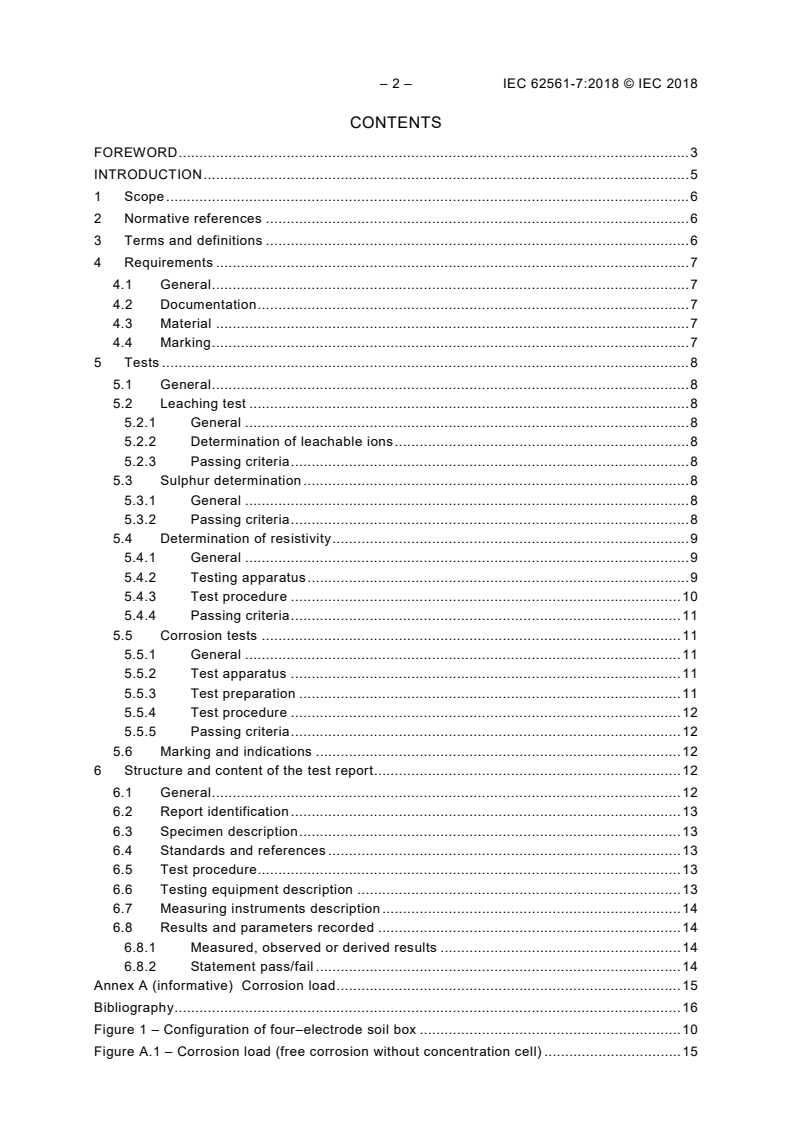
CONTENTS
FOREWORD . 3
INTRODUCTION . 5
1 Scope . 6
2 Normative references . 6
3 Terms and definitions . 6
4 Requirements . 7
4.1 General . 7
4.2 Documentation . 7
4.3 Material . 7
4.4 Marking . 7
5 Tests . 8
5.1 General . 8
5.2 Leaching test . 8
5.2.1 General . 8
5.2.2 Determination of leachable ions . 8
5.2.3 Passing criteria . 8
5.3 Sulphur determination . 8
5.3.1 General . 8
5.3.2 Passing criteria . 8
5.4 Determination of resistivity . 9
5.4.1 General . 9
5.4.2 Testing apparatus . 9
5.4.3 Test procedure . 10
5.4.4 Passing criteria . 11
5.5 Corrosion tests . 11
5.5.1 General . 11
5.5.2 Test apparatus . 11
5.5.3 Test preparation . 11
5.5.4 Test procedure . 12
5.5.5 Passing criteria . 12
5.6 Marking and indications . 12
6 Structure and content of the test report . 12
6.1 General . 12
6.2 Report identification . 13
6.3 Specimen description . 13
6.4 Standards and references . 13
6.5 Test procedure . 13
6.6 Testing equipment description . 13
6.7 Measuring instruments description . 14
6.8 Results and parameters recorded . 14
6.8.1 Measured, observed or derived results . 14
6.8.2 Statement pass/fail . 14
Annex A (informative) Corrosion load . 15
Bibliography . 16
Figure 1 – Configuration of four–electrode soil box . 10
Figure A.1 – Corrosion load (free corrosion without concentration cell) . 15
INTERNATIONAL ELECTROTECHNICAL COMMISSION
____________
LIGHTNING PROTECTION SYSTEM COMPONENTS (LPSC) –
Part 7: Requirements for earthing enhancing compounds
FOREWORD
1) The International Electrotechnical Commission (IEC) is a worldwide organization for standardization comprising
all national electrotechnical committees (IEC National Committees). The object of IEC is to promote
international co-operation on all questions concerning standardization in the electrical and electronic fields. To
this end and in addition to other activities, IEC publishes International Standards, Technical Specifications,
Technical Reports, Publicly Available Specifications (PAS) and Guides (hereafter referred to as “IEC
Publication(s)”). Their preparation is entrusted to technical committees; any IEC National Committee interested
in the subject dealt with may participate in this preparatory work. International, governmental and
non-governmental organizations liaising with the IEC also participate in this preparation. IEC collaborates
closely with the International Organization for Standardization (ISO) in accordance with conditions determined
by agreement between the two organizations.
2) The formal decisions or agreements of IEC on technical matters express, as nearly as possible, an international
consensus of opinion on the relevant subjects since each technical committee has representation from all
interested IEC National Committees.
3) IEC Publications have the form of recommendations for international use and are accepted by IEC National
Committees in that sense. While all reasonable efforts are made to ensure that the technical content of IEC
Publications is accurate, IEC cannot be held responsible for the way in which they are used or for any
misinterpretation by any end user.
4) In order to promote international uniformity, IEC National Committees undertake to apply IEC Publications
transparently to the maximum extent possible in their national and regional publications. Any divergence
between any IEC Publication and the corresponding national or regional publication shall be clearly indicated in
the latter.
5) IEC itself does not provide any attestation of conformity. Independent certification bodies provide conformity
assessment services and, in some areas, access to IEC marks of conformity. IEC is not responsible for any
services carried out by independent certification bodies.
6) All users should ensure that they have the latest edition of this publication.
7) No liability shall attach to IEC or its directors, employees, servants or agents including individual experts and
members of its technical committees and IEC National Committees for any personal injury, property damage or
other damage of any nature whatsoever, whether direct or indirect, or for costs (including legal fees) and
expenses arising out of the publication, use of, or reliance upon, this IEC Publication or any other IEC
Publications.
8) Attention is drawn to the Normative references cited in this publication. Use of the referenced publications is
indispensable for the correct application of this publication.
9) Attention is drawn to the possibility that some of the elements of this IEC Publication may be the subject of
patent rights. IEC shall not be held responsible for identifying any or all such patent rights.
International Standard IEC 62561-7 has been prepared by IEC technical committee 81:
Lightning protection.
This second edition cancels and replaces the first edition, published in 2011. This edition
constitutes a technical revision.
This edition includes the following significant technical changes with respect to the previous
edition:
a) information concerning the execution of the test for the determination of the resistivity in
5.4.3;
b) addition of Annex A for the assessment of the corrosion load.
– 4 – IEC 62561-7:2018 © IEC 2018
The text of this International Standard is based on the following documents:
FDIS Report on voting
81/576/FDIS 81/579/RVD
Full information on the voting for the approval of this International Standard can be found in
the report on voting indicated in the above table.
This document has been drafted in accordance with the ISO/IEC Directives, Part 2.
A list of all parts in the IEC 62561 series, published under the general title Lightning
protection system components (LPSC), can be found on the IEC website.
The committee has decided that the contents of this document will remain unchanged until the
stability date indicated on the IEC website under "http://webstore.iec.ch" in the data related to
the specific document. At this date, the document will be
• reconfirmed,
• withdrawn,
• replaced by a revised edition, or
• amended.
INTRODUCTION
This part of IEC 62561 deals with the requirements and tests for earthing enhancing
compounds as being a lightning protection system component (LPSC) designed and
implemented according to IEC 62305 (all parts).
– 6 – IEC 62561-7:2018 © IEC 2018
LIGHTNING PROTECTION SYSTEM COMPONENTS (LPSC) –
Part 7: Requirements for earthing enhancing compounds
1 Scope
This part of IEC 62561 specifies the requirements and tests for earthing enhancing
compounds producing low resistance of an earth termination system.
2 Normative references
The following documents are referred to in the text in such a way that some or all of their
content constitutes requirements of this document. For dated references, only the edition
cited applies. For undated references, the latest edition of the referenced document (including
any amendments) applies.
ISO 4689-3, Iron ores – Determination of sulfur content – Part 3: Combustion/infrared method
ISO 14869-1, Soil quality – Dissolution for the determination of total element content – Part 1:
Dissolution with hydrofluoric and perchloric acids
EN 12457-2, Characterization of waste – Leaching – Compliance test for leaching of granular
waste materials and sludges – Part 2: One stage batch test at a liquid to solid ratio of 10 l/kg
for materials with particle size below 4 mm (without or with size reduction)
EN 16192, Characterization of waste – Analysis of eluates
ASTM G57-06, Standard Test Method for Field Measurement of Soil Resistivity, Using the
Wenner, Four-Electrode Method
ASTM G59-97,Standard Test Method for Conducting Potentiodynamic Polarization Resistance
Measurements
ASTM G102-89, Standard Practice for Calculation of Corrosion Rates and Related Information
from Electrochemical Measurements
3 Terms and definitions
For the purposes of this document, the following terms and definitions apply.
ISO and IEC maintain terminological databases for use in standardization at the following
addresses:
• IEC Electropedia: available at http://www.electropedia.org/
• ISO Online browsing platform: available at http://www.iso.org/obp
3.1
earthing enhancing compound
conductive compound producing low resistance of an earth termination system
3.2
manufacturer's instructions
supplier's instructions
written instructions provided by the manufacturer or the supplier in his documentation
Note 1 to entry: See 4.2.
3.3
leaching test
test during which the earthing enhancing compound is put into contact with a leachant and
some constituents of the material are extracted
3.4
corrosive load
sum of all the effects of a corrosive environment
4 Requirements
4.1 General
Earthing enhancing compounds shall be so designed and constructed that in normal use their
performance is reliable and without danger to persons and the surrounding environment.
The choice of a material depends on its ability to match the requirements of a particular
application.
4.2 Documentation
The manufacturer or supplier of the earthing enhancing compounds shall provide adequate
information in his literature to ensure that the installer can select and install the materials in a
suitable and safe manner.
Compliance is checked by inspection.
The manufacturer’s literature shall contain information on how to maintain the characteristics
of the earthing enhancing compound so it remains stable over time.
4.3 Material
The material of the earthing enhancing compound shall be chemically inert to subsoil. It shall
not pollute the environment. It shall provide a stable environment in terms of physical and
chemical properties and exhibit low resistivity. The earthing enhancing compound shall not be
corrosive to the earth electrodes being used.
Compliance is checked by the tests specified in 5.2, 5.3, 5.4 and 5.5.
4.4 Marking
All products complying with this document shall be marked at least with the following:
a) manufacturer's or responsible vendor's name or trade mark;
b) identifying symbol;
c) resistivity.
The marking should be given on the packing unit.
Compliance is checked in accordance with 5.6.
– 8 – IEC 62561-7:2018 © IEC 2018
5 Tests
5.1 General
The tests in accordance with this document are type tests.
Unless otherwise specified, tests are carried out with the specimens prepared as in normal
use according to the manufacturer's or supplier's instructions.
All tests are carried out on new specimens.
NOTE Unless otherwise specified, three samples are subjected to each individual test and the requirements are
satisfied if all the criteria are met. The applicant, when submitting the material to be tested, can also submit an
additional quantity which could be necessary should one test fail. The testing station will then, without further
request, repeat the test and will reject the samples only if a further failure occurs. If the additional sample is not
submitted at the same time, the failure of one test will entail rejection.
5.2 Leaching test
5.2.1 General
The leaching test shall be performed according to EN 12457-2 in order to determine the
content of:
– Fe (iron);
– Cu (copper);
– Zn (zinc);
– Ni (nickel);
– Cd (cadmium);
– Co (cobalt);
– Pb (lead).
5.2.2 Determination of leachable ions
Determination of the concentrations of any or all of the metals listed in 5.2.1 shall be
performed according to EN 16192.
5.2.3 Passing criteria
The criteria are given by national or international regulations.
5.3 Sulphur determination
5.3.1 General
Test for the determination of sulphur shall be performed according to ISO 4689-3 or
ISO 14869-1 and the adapted analyses instrumentation (ICP-OES, ICP-AES or other ICP
methods).
5.3.2 Passing criteria
The material is deemed to have passed the test if all measured values are less than 2 %. The
recorded value resulting from this test shall be indicated within the product documentation.
5.4 Determination of resistivity
5.4.1 General
The four-electrode method shall be used to measure the resistivity of earthing enhancing
compounds as described in ASTM G57-06. Representative samples of the materials shall be
taken from a typical package as provided by the manufacturer and prepared in accordance
with the manufacturer’s instructions. Three samples of the earthing enhancement material
shall be tested in a four-electrode soil box.
With the four-electrode method, a voltage is applied to the outer electrodes, which causes
current to flow. The resulting voltage drop between the inner electrodes is measured using a
voltmeter, and the resulting resistance is calculated. The resistance of the material can also
be measured directly.
The resistance of each earthing enhancing compound sample shall be converted to the
resistivity value using the following formula:
R×A
ρ=
a
where:
ρ is the sample resistivity (Ω·m);
R is the resistance (Ω);
A is the cross sectional area of the container perpendicular to the current flow (m );
a is the inner electrode spacing, measured from inner edges of electrodes (m).
5.4.2 Testing apparatus
The following apparatus are permitted to be used:
a) Any reliable commercially available earth resistance meter having two current and two
voltage terminals or low frequency AC source, a high input impedance voltmeter and
ammeter. Typical connections for use of a soil box with various types of instruments are
shown in Figure 1.
b) Four-electrode soil box, made of an inert non-conductive material with four permanently
mounted electrodes manufactured of mild or stainless steel. Soil boxes are commercially
available or can be constructed in various sizes, as long as the inside dimensions are
known.
c) Connecting cables.
– 10 – IEC 62561-7:2018 © IEC 2018
+
+
–
–
-
–
+
IEC
Key
1 soil box
2 ammeter
3 voltmeter
4 earth resistance meter
Figure 1 – Configuration of four–electrode soil box
5.4.3 Test procedure
The earthing enhancing compound shall be prepared according to the manufacturer’s
instructions. If the material is to be installed as provided, with no preparation required, the
earthing enhancing compound shall be tested as received.
The resistivity measurements shall be taken after the elapsed time, as specified by the
manufacturer, to allow for curing or maturing if required.
The sample of the earthing enhancing compounds shall be placed in the soil box in a manner
to ensure good constant electrical contact between the earth enhancing compound and the
electrodes. For solid materials, a standard 100 N/m force should be applied evenly to the
surface of the material under test within the soil box for a period of 1 h and be maintained
during the resistance measurement.
The resistance R of the samples shall be measured using the earth resistance meter or
technical method (derived from current and voltage measurements) and resistivity of each
sample shall be calculated in accordance with 5.4.1.
The tests shall be carried out in an ambient temperature in the range of +15 °C to +25 °C.
The temperature at the time of measurement shall be recorded.
NOTE 1 Both the pressure applied and the moisture level of the sample under test will affect the test results.
NOTE 2 For certain materials, it is possible that the method described in 5.4 is not the most appropriate and that
other methods are more desirable. This is under consideration.
5.4.4 Passing criteria
The specimens are deemed to have passed the tests if the obtained resistivity value from the
three samples are equal or less than the resistivity value claimed by the manufacturer.
5.5 Corrosion tests
5.5.1 General
This test method covers the procedure for determining the corrosiveness of materials used as
earthing enhancement compounds. The corrosion rate shall be determined by using
potentiodynamic polarization resistance methods as outlined in ASTM G59-97 (subsequent
conversion to corrosion rates via ASTM G102-89). The polarization curves collected as per
ASTM G59-97 are used to determine the polarization resistance. The significance of the test
is important because earthing enhancement materials have to be physically and chemically
inert for the earth electrodes in order to avoid corrosion to the earthing electrode and earth
lead-in rod.
5.5.2 Test apparatus
The test apparatus consists of a three-terminal potentiostat, which can be used to impose the
positive and negative potential variations and to record the currents needed to obtain
potentials:
a) distilled water;
b) glassware;
c) mixer;
d) balance with an accuracy of ±0,001 g.
5.5.3 Test preparation
a) Prepare a mix of the earthing enhancing compound with a water content (by weight)
following the manufacturer’s instructions.
b) Place the three electrodes (working, reference and active electrodes) into the material
according to the polarization resistance method.
c) Connect to the potentiostat. The working electrode shall be a material to represent the
ground electrode (e.g. copper-plated or galvanized steel).
d) The active electrode shall be a graphite electrode.
e) The reference electrode is typically Cu/CuSO4.
f) Earthing enhancing compound designed to be used in a hardened or solid state shall be
tested after the relevant curing period.
g) Earthing enhancing compound designed to be used within a dry form shall be tested with
a minimum 40 % water content.
– 12 – IEC 62561-7:2018 © IEC 2018
5.5.4 Test procedure
a) Obtain the open circuit potential of the working electrode immersed in the earthing
enhancing compound.
b) Obtain the Tafel curve for the earthing enhancing compound.
c) Determine the Tafel constants and the polarization resistance (R ) values until such time
p
they have been stabilized.
5.5.5 Passing criteria
a) For copper-plated earth electrodes, the polarization resistance shall be > 4 Ω·m for
non-aggressive environments and > 8 Ω·m for aggressive environments.
b) For galvanized earth electrodes, the polarization resistance shall be > 3 Ω·m for
non-aggressive environments and > 7,6 Ω·m for aggressive environments.
NOTE Aggressive (high corrosion load) and non-aggressive (low corrosion load) environments are described in
Annex A.
5.6 Marking and indications
The information listed below shall be written on the package unit and/or on the installation
data sheet and/or in the manufacturer’s catalogue.
Each package unit shall have indelible markings containing the following information:
a) the name of the manufacturer or its trademark;
b) the type or the serial number of the batch of earthing enhancing compound;
c) the installation instructions;
d) the resistivity value and test apparatus used;
e) the conformity statement to the present document (IEC 62561-7).
The marking shall be checked by inspection.
6 Structure and content of the test report
6.1 General
The purpose of this clause is to provide general requirements for laboratory test reports. It is
intended to provide means to promote clear, complete reporting procedures for laboratories
submitting test reports.
The results of each test carried out by the laboratory shall be reported accurately, clearly,
unambiguously and objectively, in accordance with any instructions in the test methods. The
results shall be given in a test report and shall include all the information necessary for the
interpretation of the test results and all information required by the method used.
Particular care and attention shall be paid to the arrangement of the report, especially with
regard to the presentation of the test data and the ease of assimilation by the reader. The
format shall be carefully and specifically designed for each type of test carried out, but the
headings shall be standardized as indicated herein.
The structure of each report shall include the information according to 6.2 to 6.8, as a
minimum.
6.2 Report identification
The following information shall be included :
a) a title or subject of the report;
b) name, address and telephone number of the test laboratory;
c) name, address and telephone number of the sub-testing laboratory where the test was
carried out, if different from the company which has been assigned to perform the test;
d) unique identification number (or serial number) of the test report;
e) name and address of the vendor;
f) report shall be paginated and the total number of pages indicated on each page, including
appendices or annexes;
g) date of issue of the report;
h) date(s) test(s) was (were) performed;
i) signature and title, or an equivalent identification, of the person(s) authorized to sign for
the testing laboratory for the content of the report;
j) signature and title of the person(s) conducting the test.
6.3 Specimen description
a) Sample description.
b) Detailed description and unambiguous identification of the test sample and/or test
assembly.
c) Characterization and condition of the test sample and/or test assembly.
d) Sampling procedure, where relevant.
e) Date of receipt of test samples.
f) Photographs, drawings or any other visual documentation, if available.
6.4 Standards and references
a) Identification of the test standard used and the date of issue of the standard.
b) Other relevant documentation with the documentation date.
6.5 Test procedure
a) Description of the test procedure.
b) Justification for any deviations from, additions to or exclusions from the referenced
standard.
c) Any other information relevant to a specific test such as environmental conditions.
d) Configuration of the testing assembly and measuring setup.
e) Location of the arrangement in the testing area and measuring techniques.
6.6 Testing equipment description
Description of equipment used for every test conducted, e.g. apparatus used for resistivity
measurement (box or tube).
___________
It is suggested to insert in the test report a specific declaration to avoid its misuse. A declaration example is:
“This type test report may not be reproduced other than in full, except with the prior written approval of the
issuing testing laboratory. This type test report only covers the samples submitted for test and does not
produce evidence of the quality for series production.”
– 14 – IEC 62561-7:2018 © IEC 2018
6.7 Measuring instruments description
Characteristics and calibration dates of all instruments used for measuring the values
specified in this document ( e.g. earth resistance meter, voltmeter, ammeter).
6.8 Results and parameters recorded
6.8.1 Measured, observed or derived results
The measured, observed or derived results shall be clearly identified, at least for:
a) independent measured values for each test,
b) the average value for each test,
c) the required passing criterion for each test defined by the standard,
d) the relevant observed or derived results of the tests.
e) Time of period between preparation of the specimen and the measurement of resistivity
The above shall be presented by means of tables, graphs, drawings, photographs or other
documentation of visual observations, as appropriate.
6.8.2 Statement pass/fail
A statement of pass/fail is necessary, identifying the part of the test for which the specimen
has failed and also a description of the failure.
Annex A
(informative)
Corrosion load
The minimum resistivity value ρ* and the pH value measured on a soil sample after the
addition of de-ionized water allows the assessment of the corrosion loading (see Figure A.1);
the evaluation of soils on the border between two fields of corrosion load requires expert
knowledge.
In addition, a medium corrosion load should be changed to a high corrosion load when
heterogeneous soil conditions occur at the level of the structure, such as:
– presence of water table (partly submerged structure);
– wide range of ρ* values of samples (ρ*max/ρ*min > 3);
– wide range of pH values of samples (ρ*max/ρ*min > 1,5);
> 9,5
6 – 9,5
HIGH MEDIUM
LOW
pH
4,5 – 6
< 4,5
10 30 50 100
ρ* = Minimum resistivity value after adding de-ionized water (Ω.m)
IEC
Figure A.1 – Corrosion load (free corrosion without concentration cell)
Materials out of this pH range, but with low acidity or alkalinity amount, could be considered
as contributing to a low corrosion load.
When industrial by-products are considered as backfill materials, the presence and amount of
metallic salts should also be considered in order to avoid possible galvanic corrosion.
NOTE For more details, refer to EN 12501-2.
– 16 – IEC 62561-7:2018 © IEC 2018
Bibliography
IEC 62305 (all parts), Protection against lightning
IEC 62561-2, Lightning protection system components (LPSC) – Part 2: Requirements for
conductors and earth electrodes
EN 12501-2, Protection of metallic materials against corrosion – Corrosion likelihood in soil –
Part 2: Low alloyed and non-alloyed ferrous materials
___________
– 18 – IEC 62561-7:2018 © IEC 2018
SOMMAIRE
AVANT-PROPOS . 19
INTRODUCTION . 21
1 Domaine d'application . 22
2 Références normatives . 22
3 Termes et définitions . 22
4 Exigences . 23
4.1 Généralités . 23
4.2 Documentation . 23
4.3 Matériau . 23
4.4 Marquage . 23
5 Essais . 24
5.1 Généralités . 24
5.2 Essai de lixiviation . 24
5.2.1 Généralités . 24
5.2.2 Détermination des ions de lixiviation . 24
5.2.3 Critères de réussite . 24
5.3 Détermination du soufre . 24
5.3.1 Généralités . 24
5.3.2 Critères de réussite . 25
5.4 Détermination de la résistivité . 25
5.4.1 Généralités . 25
5.4.2 Appareillage d'essai . 25
5.4.3 Procédure d'essai . 26
5.4.4 Critères de réussite . 27
5.5 Essais de corrosion . 27
5.5.1 Généralités . 27
5.5.2 Appareillage d'essai . 27
5.5.3 Préparation des essais . 27
5.5.4 Procédure d'essai . 28
5.5.5 Critères de réussite . 28
5.6 Marquage et indications . 28
6 Structure et contenu du rapport d'essai . 28
6.1 Généralités . 28
6.2 Identification du rapport . 29
6.3 Description de l'éprouvette . 29
6.4 Normes et références. 29
6.5 Procédure d'essai . 29
6.6 Description des équipements d'essai . 29
6.7 Description des instruments de mesure . 30
6.8 Résultats et paramètres enregistrés . 30
6.8.1 Mesures, observations ou résultats annexes. 30
6.8.2 Déclaration de réussite/échec . 30
Annexe A (informative) Force corrosive . 31
Bibliographie . 32
Figure 1 – Configuration du récipient à quatre électrodes pour l'analyse du sol . 26
Figure A.1 – Force corrosive (corrosion libre, sans pile de concentration) . 31
COMMISSION ÉLECTROTECHNIQUE INTERNATIONALE
____________
COMPOSANTS DES SYSTÈMES
DE PROTECTION CONTRE LA FOUDRE (CSPF) –
Partie 7: Exigences pour les enrichisseurs de terre
AVANT-PROPOS
1) La Commission Electrotechnique Internationale (IEC) est une organisation mondiale de normalisation
composée de l'ensemble des comités électrotechniques nationaux (Comités nationaux de l'IEC). L'IEC a pour
objet de favoriser la coopération internationale pour toutes les questions de normalisation dans les domaines
de l'électricité et de l'électronique. A cet effet, l'IEC – entre autres activités – publie des Normes
internationales, des Spécifications techniques, des Rapports techniques, des Spécifications accessibles au
public (PAS) et des Guides (ci-après dénommés "Publication(s) de l'IEC"). Leur élaboration est confiée à des
comités d'études, aux travaux desquels tout Comité national intéressé par le sujet traité peut participer. Les
organisations internationales, gouvernementales et non gouvernementales, en liaison avec l'IEC, participent
également aux travaux. L'IEC collabore étroitement avec l'Organisation Internationale de Normalisation (ISO),
selon des conditions fixées par accord entre les deux organisations.
2) Les décisions ou accords officiels de l'IEC concernant les questions techniques représentent, dans la mesure
du possible, un accord international sur les sujets étudiés, étant donné que les Comités nationaux de l'IEC
intéressés sont représentés dans chaque comité d'études.
3) Les Publications de l'IEC se présentent sous la forme de recommandations internationales et sont agréées
comme telles par les Comités nationaux de l'IEC. Tous les efforts raisonnables sont entrepris afin que l'IEC
s'assure de l'exactitude du contenu techni
...