


IEC 61757-1:2012
(Main)Fibre optic sensors - Part 1: Generic specification
General Information
- Abstract
IEC 61757-1:2012 is a generic specification covering optical fibres, components and sub-assemblies as they pertain specifically to fibre optic sensing applications. It has been designed to be used as a common working and discussion tool by the vendor of components and subassemblies intended to be integrated in fibre optic sensors, as well as by designers, manufacturers and users of fibre optic sensors independent of any application or installation. The objective of this generic specification is to define, classify and provide the framework for specifying fibre optic sensors, and their specific components and subassemblies. The requirements of this standard apply to all related sectional, family, and detail specifications. Sectional specifications will contain requirements specific to sensors for particular quantities subject to measurement. Within each sectional specification, family and detail specifications contain requirements for a particular style or variant of a fibre optic sensor of that sectional specification. This edition includes a substantial technical update of all clauses, definitions, and cited references with respect to the previous edition.
- Status
- Replaced
- Publication Date
- 14-May-2012
- Technical Committee
- SC 86C - Fibre optic systems, sensing and active devices
- Drafting Committee
- WG 1 - TC 86/SC 86C/WG 1
- Current Stage
- DELPUB - Deleted Publication
- Start Date
- 25-Jan-2018
- Completion Date
- 30-Dec-2016

Relations
- Effective Date
- 05-Sep-2023
- Effective Date
- 05-Sep-2023
Get Certified
Connect with accredited certification bodies for this standard

IMQ S.p.A. (Certification)
Italian electrical product certification.

SLG Prüf- und Zertifizierungs GmbH
German testing and certification body.

UL Solutions
Global safety science company with testing, inspection and certification.
Sponsored listings
Frequently Asked Questions
IEC 61757-1:2012 is a standard published by the International Electrotechnical Commission (IEC). Its full title is "Fibre optic sensors - Part 1: Generic specification". This standard covers: IEC 61757-1:2012 is a generic specification covering optical fibres, components and sub-assemblies as they pertain specifically to fibre optic sensing applications. It has been designed to be used as a common working and discussion tool by the vendor of components and subassemblies intended to be integrated in fibre optic sensors, as well as by designers, manufacturers and users of fibre optic sensors independent of any application or installation. The objective of this generic specification is to define, classify and provide the framework for specifying fibre optic sensors, and their specific components and subassemblies. The requirements of this standard apply to all related sectional, family, and detail specifications. Sectional specifications will contain requirements specific to sensors for particular quantities subject to measurement. Within each sectional specification, family and detail specifications contain requirements for a particular style or variant of a fibre optic sensor of that sectional specification. This edition includes a substantial technical update of all clauses, definitions, and cited references with respect to the previous edition.
IEC 61757-1:2012 is a generic specification covering optical fibres, components and sub-assemblies as they pertain specifically to fibre optic sensing applications. It has been designed to be used as a common working and discussion tool by the vendor of components and subassemblies intended to be integrated in fibre optic sensors, as well as by designers, manufacturers and users of fibre optic sensors independent of any application or installation. The objective of this generic specification is to define, classify and provide the framework for specifying fibre optic sensors, and their specific components and subassemblies. The requirements of this standard apply to all related sectional, family, and detail specifications. Sectional specifications will contain requirements specific to sensors for particular quantities subject to measurement. Within each sectional specification, family and detail specifications contain requirements for a particular style or variant of a fibre optic sensor of that sectional specification. This edition includes a substantial technical update of all clauses, definitions, and cited references with respect to the previous edition.
IEC 61757-1:2012 is classified under the following ICS (International Classification for Standards) categories: 17.220.20 - Measurement of electrical and magnetic quantities; 29.030 - Magnetic materials; 33.180.99 - Other fibre optic equipment. The ICS classification helps identify the subject area and facilitates finding related standards.
IEC 61757-1:2012 has the following relationships with other standards: It is inter standard links to IEC 61757:2018, IEC 61757-1:1998. Understanding these relationships helps ensure you are using the most current and applicable version of the standard.
IEC 61757-1:2012 is available in PDF format for immediate download after purchase. The document can be added to your cart and obtained through the secure checkout process. Digital delivery ensures instant access to the complete standard document.
Standards Content (Sample)
IEC 61757-1 ®
Edition 2.0 2012-05
INTERNATIONAL
STANDARD
NORME
INTERNATIONALE
colour
inside
Fibre optic sensors –
Part 1: Generic specification
Capteurs à fibres optiques –
Partie 1: Spécification générique
All rights reserved. Unless otherwise specified, no part of this publication may be reproduced or utilized in any form
or by any means, electronic or mechanical, including photocopying and microfilm, without permission in writing from
either IEC or IEC's member National Committee in the country of the requester.
If you have any questions about IEC copyright or have an enquiry about obtaining additional rights to this publication,
please contact the address below or your local IEC member National Committee for further information.
Droits de reproduction réservés. Sauf indication contraire, aucune partie de cette publication ne peut être reproduite ni
utilisée sous quelque forme que ce soit et par aucun procédé, électronique ou mécanique, y compris la photocopie et les
microfilms, sans l'accord écrit de la CEI ou du Comité national de la CEI du pays du demandeur.
Si vous avez des questions sur le copyright de la CEI ou si vous désirez obtenir des droits supplémentaires sur cette
publication, utilisez les coordonnées ci-après ou contactez le Comité national de la CEI de votre pays de résidence.
IEC Central Office Tel.: +41 22 919 02 11
3, rue de Varembé Fax: +41 22 919 03 00
CH-1211 Geneva 20 info@iec.ch
Switzerland www.iec.ch
About the IEC
The International Electrotechnical Commission (IEC) is the leading global organization that prepares and publishes
International Standards for all electrical, electronic and related technologies.
About IEC publications
The technical content of IEC publications is kept under constant review by the IEC. Please make sure that you have the
latest edition, a corrigenda or an amendment might have been published.
Useful links:
IEC publications search - www.iec.ch/searchpub Electropedia - www.electropedia.org
The advanced search enables you to find IEC publications The world's leading online dictionary of electronic and
by a variety of criteria (reference number, text, technical electrical terms containing more than 30 000 terms and
committee,…). definitions in English and French, with equivalent terms in
It also gives information on projects, replaced and additional languages. Also known as the International
withdrawn publications. Electrotechnical Vocabulary (IEV) on-line.
IEC Just Published - webstore.iec.ch/justpublished Customer Service Centre - webstore.iec.ch/csc
Stay up to date on all new IEC publications. Just Published If you wish to give us your feedback on this publication
details all new publications released. Available on-line and or need further assistance, please contact the
also once a month by email. Customer Service Centre: csc@iec.ch.
A propos de la CEI
La Commission Electrotechnique Internationale (CEI) est la première organisation mondiale qui élabore et publie des
Normes internationales pour tout ce qui a trait à l'électricité, à l'électronique et aux technologies apparentées.
A propos des publications CEI
Le contenu technique des publications de la CEI est constamment revu. Veuillez vous assurer que vous possédez
l’édition la plus récente, un corrigendum ou amendement peut avoir été publié.
Liens utiles:
Recherche de publications CEI - www.iec.ch/searchpub Electropedia - www.electropedia.org
La recherche avancée vous permet de trouver des Le premier dictionnaire en ligne au monde de termes
publications CEI en utilisant différents critères (numéro de électroniques et électriques. Il contient plus de 30 000
référence, texte, comité d’études,…). termes et définitions en anglais et en français, ainsi que
Elle donne aussi des informations sur les projets et les les termes équivalents dans les langues additionnelles.
publications remplacées ou retirées. Egalement appelé Vocabulaire Electrotechnique
International (VEI) en ligne.
Just Published CEI - webstore.iec.ch/justpublished
Service Clients - webstore.iec.ch/csc
Restez informé sur les nouvelles publications de la CEI.
Just Published détaille les nouvelles publications parues. Si vous désirez nous donner des commentaires sur
Disponible en ligne et aussi une fois par mois par email. cette publication ou si vous avez des questions
contactez-nous: csc@iec.ch.
IEC 61757-1 ®
Edition 2.0 2012-05
INTERNATIONAL
STANDARD
NORME
INTERNATIONALE
colour
inside
Fibre optic sensors –
Part 1: Generic specification
Capteurs à fibres optiques –
Partie 1: Spécification générique
INTERNATIONAL
ELECTROTECHNICAL
COMMISSION
COMMISSION
ELECTROTECHNIQUE
PRICE CODE
INTERNATIONALE
CODE PRIX V
ICS 33.180.99 ISBN 978-2-83220-090-2
– 2 – 61757-1 © IEC:2012
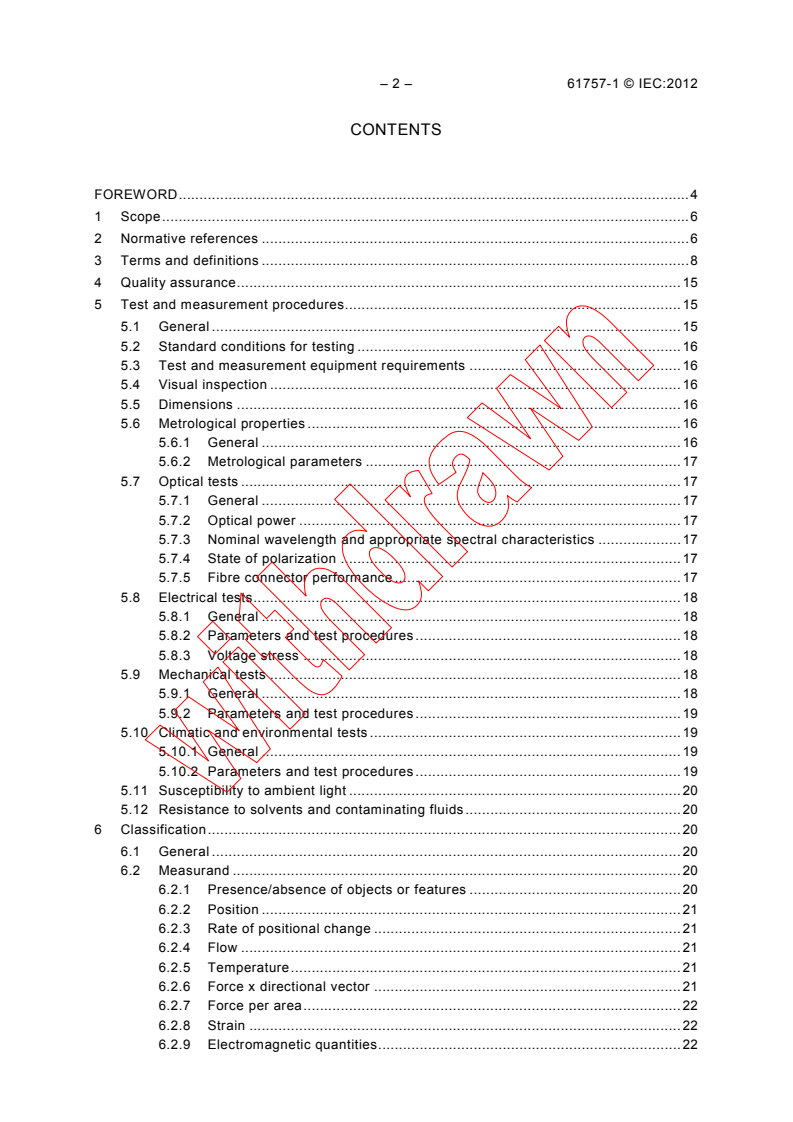
CONTENTS
FOREWORD . 4
1 Scope . 6
2 Normative references . 6
3 Terms and definitions . 8
4 Quality assurance . 15
5 Test and measurement procedures . 15
5.1 General . 15
5.2 Standard conditions for testing . 16
5.3 Test and measurement equipment requirements . 16
5.4 Visual inspection . 16
5.5 Dimensions . 16
5.6 Metrological properties . 16
5.6.1 General . 16
5.6.2 Metrological parameters . 17
5.7 Optical tests . 17
5.7.1 General . 17
5.7.2 Optical power . 17
5.7.3 Nominal wavelength and appropriate spectral characteristics . 17
5.7.4 State of polarization . 17
5.7.5 Fibre connector performance . 17
5.8 Electrical tests . 18
5.8.1 General . 18
5.8.2 Parameters and test procedures . 18
5.8.3 Voltage stress . 18
5.9 Mechanical tests . 18
5.9.1 General . 18
5.9.2 Parameters and test procedures . 19
5.10 Climatic and environmental tests . 19
5.10.1 General . 19
5.10.2 Parameters and test procedures . 19
5.11 Susceptibility to ambient light . 20
5.12 Resistance to solvents and contaminating fluids . 20
6 Classification . 20
6.1 General . 20
6.2 Measurand . 20
6.2.1 Presence/absence of objects or features . 20
6.2.2 Position . 21
6.2.3 Rate of positional change . 21
6.2.4 Flow . 21
6.2.5 Temperature . 21
6.2.6 Force x directional vector . 21
6.2.7 Force per area . 22
6.2.8 Strain . 22
6.2.9 Electromagnetic quantities . 22
61757-1 © IEC:2012 – 3 –
6.2.10 Ionizing and nuclear radiation . 22
6.2.11 Other physical properties of materials . 22
6.2.12 Composition and specific chemical quantities . 23
6.2.13 Particulates . 23
6.2.14 Imaging . 23
6.3 Transduction principle . 23
6.3.1 Active generation of light . 23
6.3.2 Atom-field interaction . 23
6.3.3 Coherence modulation . 23
6.3.4 Intensity modulation . 23
6.3.5 Optical spectrum modulation . 23
6.3.6 Phase modulation . 24
6.3.7 Polarization modulation . 24
6.4 Spatial distribution . 24
6.5 Interface level . 24
7 Marking, labelling, packaging . 24
7.1 Marking of component . 24
7.2 Marking of sealed package . 24
8 IEC type designation . 24
9 Safety aspects . 25
9.1 General . 25
9.2 Personal safety . 25
9.3 Safety in explosive environment . 25
10 Ordering information . 25
11 Drawings included in the sectional, family and detail specifications . 25
Annex A (informative) Examples of fibre optic sensors . 26
Bibliography . 34
Figure 1 – Fibre optic sensor configuration with a passive sensing element and
separate fibre leads for optical input and output . 14
Figure 2 – Fibre optic sensor configuration with an active sensing . 14
Figure 3 – Fibre optic sensor configuration with a passive sensing element and one
fibre lead for optical input and output; signal separation is realized by a Y-splitter . 15
– 4 – 61757-1 © IEC:2012
INTERNATIONAL ELECTROTECHNICAL COMMISSION
____________
FIBRE OPTIC SENSORS –
Part 1: Generic specification
FOREWORD
1) The International Electrotechnical Commission (IEC) is a worldwide organization for standardization comprising
all national electrotechnical committees (IEC National Committees). The object of IEC is to promote
international co-operation on all questions concerning standardization in the electrical and electronic fields. To
this end and in addition to other activities, IEC publishes International Standards, Technical Specifications,
Technical Reports, Publicly Available Specifications (PAS) and Guides (hereafter referred to as “IEC
Publication(s)”). Their preparation is entrusted to technical committees; any IEC National Committee interested
in the subject dealt with may participate in this preparatory work. International, governmental and non-
governmental organizations liaising with the IEC also participate in this preparation. IEC collaborates closely
with the International Organization for Standardization (ISO) in accordance with conditions determined by
agreement between the two organizations.
2) The formal decisions or agreements of IEC on technical matters express, as nearly as possible, an international
consensus of opinion on the relevant subjects since each technical committee has representation from all
interested IEC National Committees.
3) IEC Publications have the form of recommendations for international use and are accepted by IEC National
Committees in that sense. While all reasonable efforts are made to ensure that the technical content of IEC
Publications is accurate, IEC cannot be held responsible for the way in which they are used or for any
misinterpretation by any end user.
4) In order to promote international uniformity, IEC National Committees undertake to apply IEC Publications
transparently to the maximum extent possible in their national and regional publications. Any divergence
between any IEC Publication and the corresponding national or regional publication shall be clearly indicated in
the latter.
5) IEC itself does not provide any attestation of conformity. Independent certification bodies provide conformity
assessment services and, in some areas, access to IEC marks of conformity. IEC is not responsible for any
services carried out by independent certification bodies.
6) All users should ensure that they have the latest edition of this publication.
7) No liability shall attach to IEC or its directors, employees, servants or agents including individual experts and
members of its technical committees and IEC National Committees for any personal injury, property damage or
other damage of any nature whatsoever, whether direct or indirect, or for costs (including legal fees) and
expenses arising out of the publication, use of, or reliance upon, this IEC Publication or any other IEC
Publications.
8) Attention is drawn to the Normative references cited in this publication. Use of the referenced publications is
indispensable for the correct application of this publication.
9) Attention is drawn to the possibility that some of the elements of this IEC Publication may be the subject of
patent rights. IEC shall not be held responsible for identifying any or all such patent rights.
International Standard IEC 61757-1 has been prepared by subcommittee 86C: Fibre optic
systems and active devices, of IEC technical committee 86: Fibre optics.
This second edition cancels and replaces the first edition published in 1998 and constitutes a
technical revision.
This edition includes a substantial technical update of all clauses, definitions, and cited
references with respect to the previous edition.
The text of this standard is based on the following documents:
FDIS Report on voting
86C/1059/FDIS 86C/1066/RVD
Full information on the voting for the approval of this standard can be found in the report on
voting indicated in the above table.
61757-1 © IEC:2012 – 5 –
This publication has been drafted in accordance with the ISO/IEC Directives, Part 2.
A list of all the parts in the IEC 61757 series, published under the general title Fibre optic
sensors, can be found on the IEC website.
The committee has decided that the contents of this publication will remain unchanged until
the stability date indicated on the IEC web site under "http://webstore.iec.ch" in the data
related to the specific publication. At this date, the publication will be
• reconfirmed,
• withdrawn,
• replaced by a revised edition, or
• amended.
IMPORTANT – The 'colour inside' logo on the cover page of this publication indicates
considered to be useful for the correct
that it contains colours which are
understanding of its contents. Users should therefore print this document using a
colour printer.
– 6 – 61757-1 © IEC:2012
FIBRE OPTIC SENSORS –
Part 1: Generic specification
1 Scope
This part of IEC 61757 is a generic specification covering optical fibres, components and sub-
assemblies as they pertain specifically to fibre optic sensing applications. It has been
designed to be used as a common working and discussion tool by the vendor of components
and subassemblies intended to be integrated in fibre optic sensors, as well as by designers,
manufacturers and users of fibre optic sensors independent of any application or installation.
The objective of this generic specification is to define, classify and provide the framework for
specifying fibre optic sensors, and their specific components and subassemblies. The
requirements of this standard apply to all related sectional, family, and detail specifications.
Sectional specifications will contain requirements specific to sensors for particular quantities
subject to measurement. Within each sectional specification, family and detail specifications
contain requirements for a particular style or variant of a fibre optic sensor of that sectional
specification.
A fibre optic sensor contains an optical or optically powered sensing element in which the
information is created by reaction of light to a measurand. The sensing element can be the
fibre itself or an optically powered element inserted along the optical path. In a fibre optic
sensor, one or more light parameters are directly or indirectly modified by the measurand
somewhere in the optical path, contrary to an optical data link where the information is merely
transmitted from the transmitter to the receiver.
Generic tests or measurement methods are defined for specified attributes. Where possible,
these definitions are by reference to an IEC standard – otherwise the test or measurement
method is outlined in the relevant sectional, family and/or detail specification.
Annex A gives examples of fibre optic sensors to better illustrate the classification scheme.
The examples given are illustrative only and are not limitative, nor do they constitute a
recommendation or endorsement of a particular transduction principle.
2 Normative references
The following documents, in whole or in part, are normatively referenced in this document and
are indispensable for its application. For dated references, only the edition cited applies. For
undated references, the latest edition of the referenced document (including any
amendments) applies.
IEC 60050, International Electrotechnical Vocabulary
IEC 60060-1, High-voltage test techniques – Part 1: General definitions and test requirements
IEC 60068-1 Environmental testing – Part 1: General and guidance
IEC 60068-2-1, Environmental testing – Part 2-1: Tests – Test A: Cold
IEC 60068-2-2, Environmental testing – Part 2-2: Tests – Test B: Dry heat
61757-1 © IEC:2012 – 7 –
IEC 60068-2-5, Environmental testing – Part 2-5: Tests – Test Sa: Simulated solar radiation at
ground level and guidance for solar radiation testing
IEC 60068-2-6, Environmental testing – Part 2-6: Tests – Test Fc: Vibration (sinusoidal)
IEC 60068-2-10, Environmental testing – Part 2-10: Tests – Test J and guidance: Mould
growth
IEC 60068-2-11, Basic environmental testing procedures – Part 2-11: Tests – Test Ka: Salt
mist
IEC 60068-2-13, Basic environmental testing procedures – Part 2-13: Tests – Test M: Low air
pressure
IEC 60068-2-14, Environmental testing – Part 2-14: Tests – Test N: Change of temperature
IEC 60068-2-27, Environmental testing – Part 2-27: Tests – Test Ea and guidance: Shock
IEC 60068-2-30, Environmental testing - Part 2-30: Tests - Test Db: Damp heat, cyclic (12 h +
12 h cycle)
IEC 60068-2-42, Environmental testing – Part 2-42: Tests – Test Kc: Sulphur dioxide test for
contacts and connections
IEC 60068-2-43, Environmental testing – Part 2-43: Tests – Test Kd: Hydrogen sulphide test
for contacts and connections
IEC 60068-2-78, Environmental testing – Part 2-78: Tests – Cab: Damp heat, steady state
IEC 60079-28, Explosive atmospheres – Part 28: Protection of equipment and transmission
systems using optical radiation
IEC 60529, Degrees of protection provided by enclosures (IP Code)
IEC 60695-11-5, Fire hazard testing – Part 11-5: Test flames – Needle-flame test method –
Apparatus, confirmatory test arrangement and guidance
IEC 60793-1-1, Optical fibres – Part 1-1: Measurement methods and test procedures –
General and guidance
IEC 60793-1-54, Optical fibres – Part 1-54: Measurement methods and test procedures -
Gamma irradiation
IEC 60793-2, Optical fibres – Part 2: Product specifications – General
IEC 60794-1-1, Optical fibre cables – Part 1: Generic specification – General
IEC 60794-1-2, Optical fibre cables – Part 1-2: Generic specification – Basic optical cable test
procedures
IEC 60825-1, Safety of laser products – Part 1: Equipment classification and requirements
IEC 60874-1, Fibre optic interconnecting devices and passive components – Connectors for
optical fibres and cables – Part 1: Generic specification
IEC 61000-4-2, Electromagnetic compatibility (EMC) – Part 4-2: Testing and measurement
techniques – Electrostatic discharge immunity test
– 8 – 61757-1 © IEC:2012
IEC 61000-4-3, Electromagnetic compatibility (EMC) – Part 4-3: Testing and measurement
techniques – Radiated, radio-frequency, electromagnetic field immunity test
IEC 61000-4-4, Electromagnetic compatibility (EMC) – Part 4-4: Testing and measurement
techniques – Electrical fast transient/burst immunity test
IEC 61000-4-5, Electromagnetic compatibility (EMC) – Part 4-5: Testing and measurement
techniques – Surge immunity test
IEC 61300 (all parts), Fibre optic interconnecting devices and passive components – Basic test
and measurement procedures
IEC 61300-2-18, Fibre optic interconnecting devices and passive components – Basic test and
measurement procedures – Part 2-18: Tests – Dry heat – High temperature endurance
IEC 61300-2-22, Fibre optic interconnecting devices and passive components – Basic test and
measurement procedures – Part 2-22: Tests – Change of temperature
IEC 61300-2-34, Fibre optic interconnecting devices and passive components – Basic test and
measurement procedures – Part 2-34: Tests – Resistance to solvents and contaminating
fluids of interconnecting components and closures
IEC 61300-2-46, Fibre optic interconnecting devices and passive components – Basic test and
measurement procedures – Part 2-46: Tests – Damp heat, cyclic
IEC 61300-3-35, Fibre optic interconnecting devices and passive components –Basic test and
measurement procedures – Part 3-35: Examinations and measurements – Fibre optic
connector endface visual and automated inspection
IEC 61753 (all parts), Fibre optic interconnecting devices and passive components
performance standard
IEC/TR 61931, Fibre optic – Terminology
IEC/TR 62222, Fire performance of communication cables installed in buildings
IEC/TR 62283, Optical fibres – Guidance for nuclear radiation tests
IEC/TR 62362, Selection of optical fibre cable specifications relative to mechanical, ingress,
climatic or electromagnetic characteristics – Guidance
IEC/TR 62627-01, Fibre optic interconnecting devices and passive components – Part 01: Fibre
optic connector cleaning methods
ISO/IEC Guide 98-3, Uncertainty of measurement – Part 3: Guide to the expression of
uncertainty in measurement (GUM:1995)
ISO/IEC Guide 99, International vocabulary of metrology — Basic and general concepts and
associated terms (VIM)
3 Terms and definitions
For the purpose of this International Standard, the definitions of IEC 60050 (IEV),
IEC/TR 61931, ISO/IEC Guide 99 (VIM), and the following apply:
61757-1 © IEC:2012 – 9 –
3.1
accuracy
quality which characterizes the ability of a measuring instrument [of a fibre optic sensor] to
provide an indicated value close to a true value of the measurand
Note 1 to entry: This term is used in the "true value" approach. This is a value that would be obtained by a
perfect measurement.
Note 2 to entry: Accuracy is all the better when the indicated value is closer to the corresponding true value.
[SOURCE: IEC 60050-311:2001, 311-06-08, modified]
3.2
analogue signal interface
signal interface which provides analogue output signals in a form directly usable for control or
measurement purposes, and which is generally electrical
Note 1 to entry: Output schemes should preferably comply with existing interface standards such as those existing
for electrical analogue signals. Output schemes can be, for example, 4-20 mA, 0-20 mA, 0-5V, etc. A fibre optic
sensor with a photodetector or other square-law detector, or with integrated signal processing electronics is a
representative application example.
3.3
characteristic curve / calibration curve
expression of the relation between indication and corresponding measured quantity value
[SOURCE: ISO/IEC Guide 99]
Note 1 to entry: A characteristic curve / calibration curve expresses a one-to-one relation that does not supply a
complete measurement result as it bears no information about the measurement uncertainty.
3.4
communication interface
digital interface of a fibre optic sensor which provides digital output signals in a form directly
usable for control or measurement purposes, or which enables digital communication with
other digital divices (e.g. personal computer)
Note 1 to entry: It is usually designed to a specific standard (e.g. Universal Serial Interface Bus USB, RS-232) and
used for transmitting control and measurement data.
3.5
distributed fibre optic sensor
fibre optic sensor which provides a spatially resolved measurement of a measurand over an
extended region by means of a continuous sensing element
3.6
drift
change in the metrological characteristics of a measuring instrument [and /or fibre optic
sensor], generally slow, continuous, not necessarily in the same direction and not related to a
change in the measurand
3.7
durability
ability of a fibre optic sensor to perform a required function under defined conditions of use
and maintenance, until a limiting state is reached
Note 1 to entry: A limiting state of an item may be characterized by the end of the useful life, unsuitability for any
economic or technological reasons or other relevant factors.
3.8
extrinsic fibre optic sensor
fibre optic sensor in which the characteristics of the light are affected externally to the optical
fibre(s) by the measurand
– 10 – 61757-1 © IEC:2012
3.9
fibre optic sensor
part of a measuring instrument, or measuring chain, which is directly affected by the
measurand and which generates a change in the optical characteristics of an optical fibre
related to the value of the measurand. The optical fibre itself acts as the sensing element or it
includes an optical or optically powered sensing element and may include one or more of the
following (see Figures 1, 2, and 3):
– optical fibre lead;
– signal conditioning.
3.10
gauge length / measurement basis
length of the parallel portion of the measured object over which the fibre optic sensor gathers
information
[SOURCE: COST Guideline for Use of Fibre Optic Sensors]
Note 1 to entry: For example, if the sensor is only anchored at two fixed points L cm apart, then the gauge length is
L. On the other hand, if a sensor of length l is continuously-fixed in or to a measured object of length L, then the
actual gauge length depends on the method of attachment to the measured object and is a function of the
mechanical properties of both the sensor and its surrounding; it is generally longer than l but shorter than L.
Note 2 to entry: If a user wants to achieve a pre-determined gauge length, he must be very careful in selecting the
procedure by which the sensor is anchored/attached/embedded. In case of continuously-fixed sensors, the fixing
length must exceed the defined gauge length by a few tens of fibre diameter to avoid shear-lag problems at the
edges. In the specific case of fracture or cracks within the gauge length of the sample, the final gauge length must
be calculated then from the gauge length at fracture by subtracting from the latter the elastic portion of the
elongation.
3.11
influence quantity
quantity that, in a direct measurement, does not affect the quantity that is actually measured,
but affects the relation between the indication and the measurement result
[SOURCE: ISO/IEC Guide 99]
3.12
integrating fibre optic sensor
fibre optic sensor which provides a measurement result of a measurand over an extended
region by means of a continuous sensing element of a defined length. The measurand is not
spatially resolved but is integrated or summed over the length of the sensing element.
3.13
intrinsic fibre optic sensor
fibre optic sensor whose sensing element consists of one or more optical fibre(s) in which one
or more characteristics like intensity, phase, polarization, spectrum, wavelength or transit time
of light depend on the measurand
Note 1 to entry: There are a lot of fibre optic sensors where the sensing principle is based on a change in coating
characteristics only (e.g. chemical or RH sensors) or on an interaction between core and cladding (e.g. bending
sensor). They can be defined as indirect intrinsic fibre optic sensors. Direct intrinsic fibre optic sensors are defined
by a direct change of the fibre core characteristics (e.g. Brillouin, Raman or Rayleigh scattering based sensors).
3.14
instrumental measurement uncertainty
component of measurement uncertainty arising from a measuring instrument or measuring
system in use
Note 1 to entry: Instrumental measurement uncertainty is obtained through calibration of a measuring instrument
or measuring system, except for a primary measurement standard for which other means are used.
61757-1 © IEC:2012 – 11 –
Note 2 to entry: Instrumental uncertainty is used in a Type B evaluation of measurement uncertainty according to
ISO/IEC Guide 98-3, Uncertainty of measurement – Part 3: Guide to the expression of uncertainty in measurement
(GUM:1995).
3.15
limiting operating condition / limiting values for operation
extreme operating condition that a measuring instrument or measuring system or a sensing
element [or a fibre optic sensor] is required to withstand without damage, and without
degradation of specified metrological properties, when it is subsequently operated under its
rated operating conditions
[SOURCE: ISO/IEC Guide 99]
Note 1 to entry: Limiting conditions for storage, transport or operation can differ.
Note 2 to entry: Limiting conditions can include limiting values of a quantity being measured and of any influence
quantity.
Note 3 to entry: The limiting values can depend on the duration of their application.
3.16
measurement precision
closeness of agreement between indications or measured quantity values obtained by
replicate measurements on the same or similar objects under specified conditions
[SOURCE: ISO/IEC Guide 99]
Note 1 to entry: Measurement precision is usually expressed numerically by measures of imprecision, such as
standard deviation, variance, or coefficient of variation under the specified conditions of measurement.
Note 2 to entry: The ‘specified conditions’ can be, for example, repeatability conditions of measurement,
intermediate precision conditions of measurement or reproducibility conditions of measurement.
Note 3 to entry: Measurement precision is used to define measurement repeatability, intermediate measurement
precision, and measurement reproducibility.
Note 4 to entry: Sometimes “measurement precision” is erroneously used to mean measurement accuracy.
3.17
measuring interval / measuring range
set of values of quantities of the same kind that can be measured by a given measuring
instrument or measuring system [or fibre optic sensor] with specified instrumental uncertainty,
under defined conditions
[SOURCE: ISO/IEC Guide 99]
3.18
multiple point fibre optic sensor
fibre optic sensor consisting of a number of single point sensors which enables a spatially
resolved measurement of a measurand over an extended region at discrete locations
3.19
optical or optically powered sensing element
device which accepts information in the form of a physical quantity and converts it to
information in the form of an optical quantity, according to a definite law
3.20
optical fibre
filament-shaped waveguide made of dielectric materials for guiding optical waves
[SOURCE: IEC 60050-151:2001, 151-12-35]
For the purpose of this International Standard, the general specifications for optical fibres of
IEC 60793-2 apply.
– 12 – 61757-1 © IEC:2012
Note 1 to entry: Fibre optic sensors based on planar or micro-structured waveguides, or photonic crystal fibres or
multi-core fibres are under consideration and not yet part of this standard.
3.21
optical fibre lead(s)
optical fibre line(s) which connect the sensing element to the optical source and to the optical
receiver
3.22
optical interface
arbitrary point at which the effect of the measurand on the sensing element is optically
defined
Note 1 to enrty: The optical interface represents the raw optical signal for subsequent processing by the user.
Typical attributes for this type of interface would be the wavelength, state of polarization, optical power, and so on.
More detailed specifications would include fibre-optic connector style, optical fibre type, etc.
3.23
optical receiver
device which receives the light affected by the measurand and converts it into a quantity,
generally electric, according to a predetermined law. It may contain one or more photo
detectors, signal conditioners and communication interfaces
3.24
optical source
device which supplies the optical energy required to allow the interaction between the sensing
element and the measurand. It contains, as a minimum, a luminous source and it may contain
signal conditioning. When the optical energy is generated by the phenomenon sensed, no
optical source is required
3.25
rated operating condition
operating condition that must be fulfilled during measurement in order that a measuring
instrument or measuring system [or fibre optic sensor] perform as designed
[SOURCE: ISO/IEC Guide 99]
Note 1 to entry: Rated operating conditions generally specify intervals of values for a quantity being measured and
for any influence quantity.
3.26
resolution
smallest change in a quantity being measured that causes a perceptible change in the
corresponding indication
[SOURCE: ISO/IEC Guide 99]
Note 1 to entry: Resolution can depend on, for example, noise (internal or external) or friction. It may also depend
on the value of a quantity being measured.
3.27
sensitivity
quotient of the change in an indication of a measuring system [or a fibre optic sensor] and the
corresponding change in a value of a quantity being measured
[SOURCE: ISO/IEC Guide 99]
Note 1 to entry: Sensitivity of a measuring system can depend on the value of the quantity being measured.
Note 2 to entry: The change considered in a value of a quantity being measured must be large compared with the
resolution.
61757-1 © IEC:2012 – 13 –
3.28
signal interface
arbitrary point at which the effect of the measurand is present in a form directly usable for
control or measurement purposes. The optical interface(s) and the signal interface(s) can in
some cases coincide
3.29
single point fibre optic sensor
fibre optice sensor consisting of one discrete sensing element which generates a signal
related to the value of the measurand
3.30
spatial resolution
measure of the ability of a distributed fibre optic sensor to distinguish spatial indications of the
measurand
Note 1 to entry: Measurand resolution (e.g. temperature or strain), spatial resolution, distance range and
acquisition time are inter-related. The signal processing has additional influence.
3.31
stability
ability of a measuring instrument [and /or fibre optic sensor] to keep its [metrological]
performance characteristics within a specified range during a specified time interval, all other
conditions being the same
[SOURCE: IEC 60050:2001, 311-06-12, modified]
3.32
step response time
duration between the instant when the measurand (or quantity supplied) is subjected to a
specified abrupt change and the instant when the indication (or quantity supplied) reaches,
and remains within specified limits of, its final steady-state value
Note 1 to entry: This definition is the one conventionally used for measuring instruments. Other definitions exist.
[SOURCE: IEC 60050-311:2001, 311-06-04]
3.33
variation due to an influence quantity / cross sensitivity
difference in indication for a given measured quantity value when an influence quantity
assumes successively two different quantity values [e.g. while measuring a strain a
temperature change may appear as a strain change.
[SOURCE: ISO/IEC Guide 99]
Figure 1 shows fibre optic sensor configuration with a passive sensing element and separate
fibre leads for optical input and output.
– 14 – 61757-1 © IEC:2012
Optical Signal
interface interface
Phenomenon
Optical
Sensing
receiver
element
Optical fibre lead(s)
Optical or optically
Optical
powered element source
or sensitive fibre
Signal conditioning
IEC 907/12
Figure 1 – Fibre optic sensor configuration with a passive sensing element and
separate fibre leads for optical input and output
Figure 2 shows fibre optic sensor configuration with an active sensing.
Optical Signal
interface interface
Phenomenon
Sensing
element
Optical
receiver
Optical fibre lead
Optical or optically
powered element
or sensitive fibre
Signal conditioning
IEC 908/12
Figure 2 – Fibre optic sensor configuration with an active sensing
Figure 3 shows fibre optic sensor configuration with a passive sensing element and one fibre
lead for optical input and output; signal separation is realized by a Y-splitter.
61757-1 © IEC:2012 – 15 –
Optical Signal
interface interface
Phenomenon
Optical
Sensing
receiver
element
Y-Splitter
Optical fibre lead(s)
Optical or optically
Optical
powered element
source
or sensitive fibre
Signal conditioning
IEC 909/12
Figure 3 – Fibre optic sensor configuration with a passive sensing element and one
fibre lead for optical input and output; signal separation is realized by a Y-splitter
4 Quality assurance
Compliance with this International Standard does not guarantee the manufacturing
consistency of each produced fibre optic sensor. This should be maintained using a
recognised quality assurance programme.
When the customer wishes to specify acceptance tests or other quality assurance procedures,
it is essential that an agreement be reached between the supplier and the customer at the
time of ordering.
The present generic specification provides the normative references, definitions, test and
measurement procedures, and classification criteria applicable to fibre optic sensors in general.
Because of the wide variety of fibre optic sensor classes, the sectional specifications shall
prescribe those tests which are applicable to each particular class of fibre optic sensors. The
family and/or detail specifications shall describe which of the tests prescribed in the relevant
sectional specifications are applicable to a particular style or variant of a fibre optic sensor.
The relevant sectional, family and/or detail specifications shall also specify which of the tests
and performance levels are applicable to the different elements of the fibre optic sensor, such
as the optical source, the optical receiver, the sensing element and the optical fibre leads.
5 Test and measurement procedures
5.1 General
The purpose of this clause is to introduce general test and measuring methods applicable to
fibre optic sensors. These tests and measurements are intended to address the interaction of
the various components of the fibre optic sensor as they function to translate the specified
mea
...